The Glorification of Alcohol in Hindi Cinema

A study released in April of this year claimed that Indian adolescents aged 12-16 exposed to alcohol consumption in films were nearly three times more likely to drink than their peers who did not watch Bollywood movies. While this study most likely pertains to the movies released in the industry today, I would venture to say that the origins of this trend can be traced back to films from the Golden Era of Bollywood cinema. Indeed, the consumption of alcohol has been glorified on India’s silver screen for decades, especially through portrayal of sharaab (alcohol) songs in films. Here, I’ve compiled a list of my five favorite male and female sharaab numbers from the Golden Era–let’s take a closer look at these examples to examine how the consumption of alcohol has been portrayed cinematically and its implications on Indian culture.

“Girls Just Want To Have Fun”

In Bollywood’s earliest days, drinking alcohol in films was portrayed as a strictly masculine activity, à la Devdas and other Bollywood heroes who have famously drowned their sorrows in liquor. In contrast, the idealized image of the traditional Indian woman did not permit the depiction of female alcohol consumption in the media.  This trend began to change in the 60s when films depicted heroines and female actresses playing roles in which they partook in the consumption of the Devil’s nectar, just like their male counterparts. As you can see below, the contexts in which female characters drink vary from film to film: alcohol has been used by the women of Bollywood as a coping mechanism, a means of revenge, or just a way to have a good time.

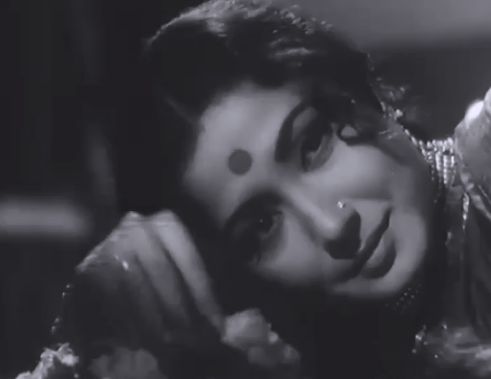
na jaao saiyaa.n (Sahib Bibi aur Ghulam, 1962): In this film based on a Bengali novel by Bimal Mitra, Meena Kumari gives one of her career’s best performances as Chhoti Bahu. Chhoti Bahu is married to young zamii.ndar (played by Rehman), who neglects his wife at home in order to take part in debauchery at local brothels on a nightly basis. In desperate need of her unfaithful husband’s companionship, she decides to take up drinking in order to keep him away from those pesky courtesans at night. In this heartbreaking song sung by Geeta Dutt, Chhoti Bahu drunkenly entreats her husband to stay at home and spend the night with her. In a truly unfortunate example of art mimicing real life, both Geeta and Meena would succumb to alcoholism as a way to cope with their unhappy marriages in the coming years. For those of you who enjoy this song, be sure to check out Hemant Kumar’s Bengali version of the same tune: “olir katha shune.

Meena Kumari, as Chhoti Bahu, tragically turns to alcoholism in Sahib Bibi aur Ghulam (1962).

piike hum tum jo chale aaye hai.n (Gumnaam, 1965): This film (reviewed by us here) is a suspense thriller loosely based on the Agatha Christie novel And Then There Were None. The story revolves around seven vacationers who find themselves on a remote island in the middle of nowhere after a plane crash. One by one, they are murdered off and the big question is, of course: whodunnit? In the midst of all this tension, two of the vacationers, Miss Kitty (played by Helen) and Asha (played by Nanda), decide to loosen up and have some fun with a few drinks. In this comical duet sung by Asha Bhonsle and Usha Mangeshkar, the two actresses appear to be having the time of their lives in a drunken stupor on screen. I mean, who wouldn’t be having a good time if they were getting drunk with Helen?
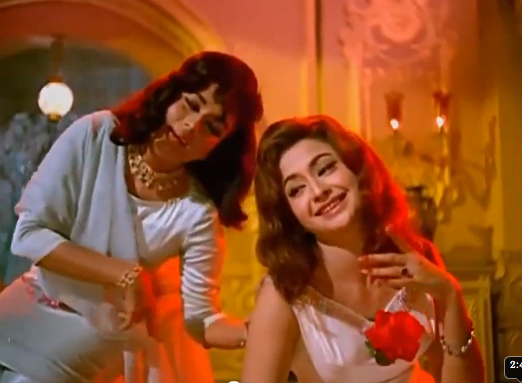
Helen and Nanda get sloppy together in Gumnaam (1965). If you excuse the stumbling, Helen actually looks quite sophisticated in this scene because she’s not wearing one of her characteristically outrageous wigs/outfits.

aao huzuur tum ko (Kismat, 1968): This Asha-OP Nayyar collaboration is an all-time classic from the soundtrack of Kismat (along with “kajraa muhabbatvaalaa“). The film’s narrative is so outrageous that it’s not even worth summarizing here, but this song is picturized on the actress Babita, who is the mother of Karisma and Kareena Kapoor. Babita never managed to gain much success as a heroine, and that’s not surprising given that it’s unclear whether she is drunk or undergoing eplipetic fits in this particular scene. She certainly does make a statement though and manages to embarass the hero Biswajeet with her public intoxication at this party. Regardless of the picturization, Asha Bhonsle adds all the right expressions here to make this an unforgettable sharaab number on the basis of the song alone. Her vocal control in the extended introduction (“ham se raushan hai chaa.nd aur taare...”) before the song’s first stanza is especially commendable. 

Babita has probably had one too many in this scene from Kismat (1968)

kaise rahuu.n chup (Inteqaam, 1969): Inteqaam is an entertaining (but occaisionally illogical) thriller that stars Sadhana as a woman who seeks revenge against her former boss because he framed her for a theft that she did not commit. As part of her elaborate plan for revenge, she intends to marry her boss’s son (played by Sanjay Khan) and bring shame to his entire family by revealing that the new bahu is, in fact, a convicted criminal! In this song, Sadhana further embarasses her boss’s family by  acting extremely intoxicated under the influence of alcohol at a public gathering. (Technically, this might not be considered a genuine sharaab song because Sadhana is putting on a facade of being drunk without actually consuming, but I liked this song too much to pass up putting it on the list.) This soundtrack composed by Laxmikant-Pyarelal is particularly memorable today because it casts a different light on Lata Mangeshkar, who was considered to be staunchly conservative and traditional in her playback output.  Lata surprises us all by agreeing to sing two sizzling cabaret numbers in addition to this drinking song for the film–listen to her nail those hiccups during the interludes!
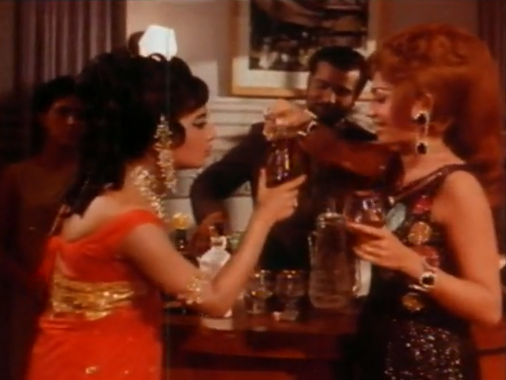
Helen serves Sadhana another glass in Inteqaam (1969)

piyaa tuu ab to aajaa (Caravan, 1971): Asha Bhonsle and R.D. Burman come together to produce one of their biggest musical hits together with this classic item number from Caravan. Asha’s performance here solidified her status as the queen of cabaret singing in Hindi cinema. Furthermore, Helen’s portrayal of a nightclub dancer on screen during this song is considered the quintessential Bollywood cabaret performance. Helen’s dance moves are completely outrageous here but she makes it work somehow (see Mrs. 55’s step-by-step breakdown here). Given the ridiculousness of the situation here, you can’t really blame Helen for the heavy drinking…it certainly doesn’t stop her from completely owning the stage during her performance!

Helen gives one of the best cabaret performances of her career in Caravan (1971)

“Alcohol May Be Man’s Worst Enemy…”

Unlike their female counterparts, the men of Bollywood cinema have been imbibing alcohol since the industry’s earliest days. The most popular context for male drinking in Hindi films occurs when the hero resigns himself to heavy drinking in order to drown his sorrows, usually caused by woman-related heartbreak. While female characters are often stigmatized for their drinking and public intoxication, it is more acceptable for men of the silver screen to use alcohol consumption to deal with their grief.  Other contexts where actors are depicted consuming alcohol include scenes of male-male bonding (bromances, anyone?) and seduction of heroines and courtesans. Though Bollywood has glamorized the consumption of alcohol for both genders, the effect is far more pronounced for males, as evident in the examples I’ve selected below.

mujhe duniyaavaalo sharaabii na samjho (Leader, 1964): Even though its soundtrack is full of gems like “tere husn kii kyaa tariif karuu.n” and “ek shahanshah ne banvaa ke ek hasii.n taaj mahal,” Leader is one mess of a film starring Dilip Kumar and Vijayantimala. Dilip Kumar stars as a law graduate and aspiring political revolutionary who falls in love with a princess (played by Vijyantimala). The script has so many holes that it’s difficult to discern the overall message of this film, but there are some scenes of comic relief between Vijayantimala and Dilip Kumar that are worth remembering. By far, however, the main attraction here is the soundtrack composed by Naushad. In this particular number, an intoxicated Dilip Kumar claims that he has been forced to take up drinking to grapple with society’s evils.

Vijayntimala tries to stop a drunk Dilip Kumar from embarassing himself too much at this party in Leader (1964).

din Dhal jaaye (Guide, 1965): Where do I even begin with the praise for Vijay Anand’s Guide? Mrs. 55 and I both love everything about this film: the unique story written by R.K. Narayan, the stellar performances by Dev Anand and Waheeda Rehman, and of course, the unforgettable soundtrack composed by S.D. Burman. Each and every song from this film is an absolute gem. In this particular Rafi solo picturized on Dev Anand, the hero drowns his sorrows about lost love in alcohol. The melancholic expression that pervades throughout this scene is enhanced by the beautifully crafted lyrics and tune.
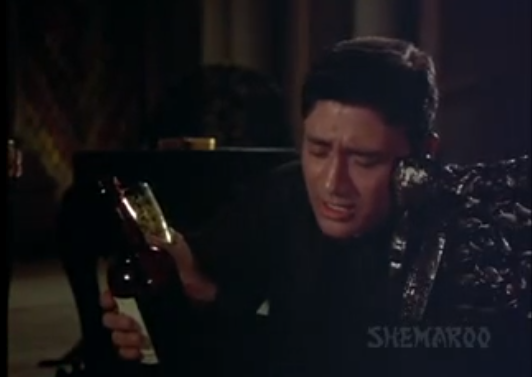
Dev Anand turns to the bottle when love goes sour in Guide (1965).

chuu lene do naazuk ho.nTho.n ko (Kaajal, 1965): With this Rafi number penned by Sahir Ludhianvi and composed by Ravi, Raaj Kumar tries to get Meena Kumari, his on-screen shaadi-shudhaa (virtuous) wife, to come to the dark side by having a drink. Alcohol glorification occurs is at its finest in these lyrics: it is referred to as “mubarak cheez,” or a blessed thing.  Meena Kumari excels, as usual, at looking incredibly uncomfortable and disturbed by Raaj Kumar’s advances in this scene.

A drunk Raaj Kumar tries to get Meena Kumari on his team in Kaajal (1965).

jo unkii tamanna hai barbad ho jaa (Inteqaam, 1969): This film certainly features a lot of alcohol consumption on screen. In addition to the drunk Lata number discussed above, this Rafi solo from Inteqaam is picturized on Sanjay Khan as he laments being a mere object in Sadhana’s plans for revenge. Rajinder Krishan’s lyrics are exquisite in their ability to capture the essence of being deceived in love.
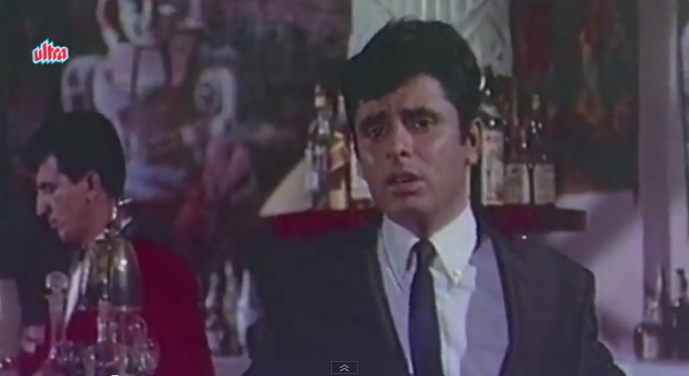
Handsome Sanjay Khan turns to alcohol to get over Sadhana’s deception in Inteqaam (1969)

yeh jo muhabbat hai (Kati Patang, 1970): Directed by Shakti Samanta, this film features an evergreen soundtrack composed by R.D. Burman. This particular number sung by Kishore Kumar is one of Bollywood’s most treasured drinking songs, and it features a handsome and bitter Rajesh Khanna drinking the night away because he was stood up at the altar by his wife-to-be.  Asha Parekh watches from a distance, not yet aware of the fact that she is the woman responsible for his heartache.
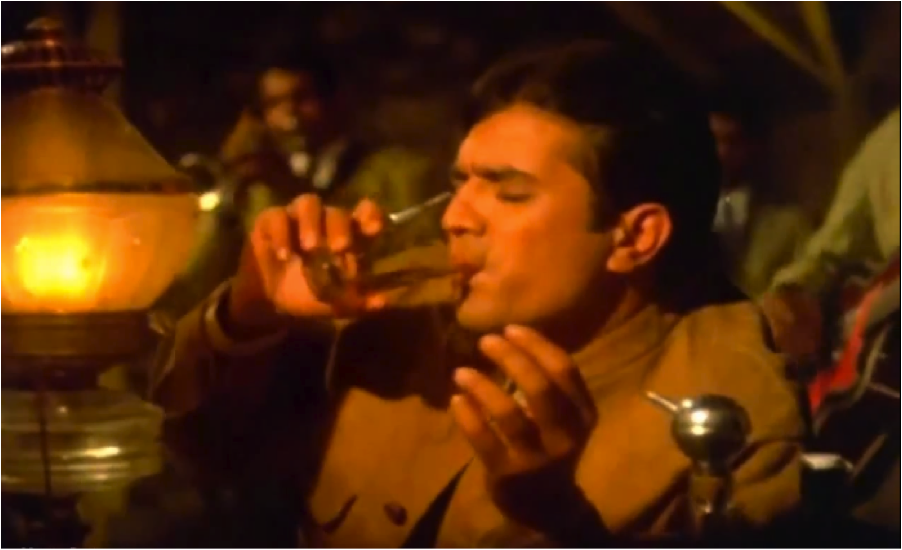
Rajesh Khanna drinks another glass of liquid courage before singing about the pain of disloyal love in Kati Patang (1970).

What are some of your favorite sharaab/daaru songs from Bollywood films? Let us know in the comments! We’ll understand if your typing is a little bit off…
Mr. 55

Nigahein Milane Ko Jee Chahta Hai Lyrics and Translation: Let’s Learn Urdu-Hindi

Who wouldn’t want to exchange glances with those eyes?

For today’s post, we showcase the lyrics and English translation of “Nigahen Milane To” from the film Dil Hi To Hai (1963). If I had to name my favorite actress from the Golden Era of Bollywood cinema, I think that I would pick Nutan.

As one of the beloved goddesses of India’s silver screen, Nutan starred in many evergreen films from the 1950s and 1960s, including Paying Guest (1957), Anari (1959), Bandini (1963), and Milan (1967), just to name a few. In my opinion, there’s something special about Nutan’s performances that sets her apart from her peers. She played her roles with a dignified beauty, a restrained grace, and an acute intelligence that was difficult to find in other actresses of the time. Here, I’ve chosen to translate a song from Dil Hi To Hai (1963), a charming Bollywood romance that is enjoyable to watch even though it is one of Nutan’s lesser-known films.

Nutan stars in Dil Hi To Hai as Jamila, the beautiful daughter of a wealthy London-based banker. Here, Raj Kapoor departs from the image established in his previous films by playing a comic double role as Jamila’s love interest Chand and Jamila’s aged music teacher Khan Sahab. While the film features some memorable performances by Nutan and Raj Kapoor, this film is probably even more memorable today for its soundtrack composed by music director Roshan. Two gems from this soundtrack have survived the test of time. The first is the Bhairavi-based classical number “laagaa chunarii me.n daag,” which is regarded as one of the best songs of Manna De’s career. The other gem is Asha Bhonsle’s exquisitely rendered Yaman qawwalinigaahe.n milaane ko jii chahtaa hai,” which I have translated here.

Penned by Sahir Ludhianvi, this qawwali centers around a woman’s desire to exchange glances with her beloved. The romanticization of eyes and sight is a common theme found in Bollywood films, and the poetry in this song is one of this era’s most cherished portrayals of this theme. The song’s charm is enhanced by the use of Urdu vocabulary (e.g. tahumat and tamhiid) and Asha Bhonsle’s immaculate rendition. Don’t you just love the way she owns those octave glides during the sargam passage?

Mrs. 55 and I actually performed this qawwali at Harvard during the annual South Asian cultural show Ghungroo two years ago. One thing that we noticed after listening carefully to these lyrics during rehearsal is that there is some ambiguity in gender. While most of the song appears to be from a female perspective, we thought that lyrics take on a masculine role for the line starting with “jab kabhii mai.ne teraa chaand-saa chahraa dekhaa…” (Whenever my eyes have fallen upon your moon-like face…). In addition to the fact that the moon is traditionally used by males to describe feminine beauty (e.g. Mohammed Rafi’s “yeh chaa.nd-saa roshan chahraa“), Nutan’s gestures and body language become more masculine in nature in this segment of the song. In fact, as she sings these two lines, Nutan begins to walk with a manly gait and and then flirts with a female friend as if she is her male lover. We may have totally made this up in our heads, but it was not uncommon for such gender-bending to occur in Bollywood songs–a full post on this trend will be coming up soon! In any case, please enjoy this timeless qawwali while following along with our translation/glossary provided below, and remember to send us your requests for any other songs that you would like translated.

-Mr. 55

Nutan takes on the masculine role for a few lines in this qawwali

Nigahein Milane Ko Jee Chahta Hai Lyrics and Translation

raaz kii baat hai, mahfil me.n kahe yaa na kahe?
It is a secret matter; shall I share it in this gathering?
bas gayaa hai koii is dil me.n, kahe yaa na kahe?
Someone has begun to reside in my heart; shall I reveal this here?

nigaahe.n milaane ko jii chahtaa hai
I yearn to exchange glances with my beloved. 
dil-o-jaa.n luTaane ko jii chahtaa hai
I yearn to give away my heart and soul to him.  

woh tahumat jise “ishq” kahtii hai duniyaa
The allegation that the world calls “love,”
woh tahumat uThaane ko jii chahtaa hai
I yearn to accept that allegation.  

kisii ke manaane me.n lazzat woh paayi
Although I have experienced the pleasure of being appeased,   
ki phir ruuTh jaane ko jii chahtaa hai
I yearn to once again engage in a lovers’ tiff. 
 
woh jalvaa jo ojhal bhii hai saamne bhii
The splendor that vanishes and reappears in love, 
woh jalvaa churaane ko jii chahta hai
I yearn to steal that splendor.  
 
jis ghaDii merii nigaaho.n ko terii diid huii
The moment when our eyes first met,  
woh ghaDii mere liye aish kii tamhiid huii
That moment served as a prelude to happiness for me.  
jab kabhii mai.ne teraa chaa.nd-saa chahraa dekhaa.
Whenever my eyes have fallen upon your moon-like face, 
Eid ho ya ki na ho mere liye Eid huii
it is as if I am celebrating the holiday of Eid.  

ni re ga, ga re ga ni re ma, ma ga ma ni re ga
ga re ga ni ga re, re ga, ga ma, ma dha ni
sa sa ni ni dha dha pa pa ga re
sa ni dha pa ma ga re,
ni dha pa ma ga re sa ni, re ga 

mulaaqaat
kaa koii paighaam diije
Please send me a message about our next rendez-vous, 
ki chhup-chhup ke aane ko jii chahtaa hai
Because I yearn to visit you secretly, 
aur aake na jaane ko jii chahtaa hai
And upon visiting you, I hope to never leave.  

nigaahe.n milaane ko jii chahtaa hai
I yearn to exchange glances with my beloved. 


Glossary

raaz: secret; mahfil: gathering; nigaahe.n: eyes; dil-o-jaan: heart and soul; tahumat: allegation; manaanaa: to appease; lazzat: pleasure; jalvaa: splendor,charm; ojhal: vanished; diid: sighting, gaze; aish: joy, happiness; tamhiid: prelude, preamble; Eid: Islamic festival celebrating the end of Ramadan; mulaaqaat: meeting, rendez-vous; chhup-chhup ke: secretly; paighaam: message.

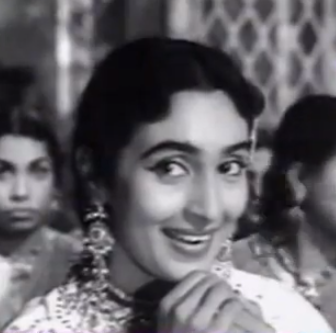
Nutan leads the chorus with an enchanting smile in Dil Hi To Hai (1963)

In Aankhon Ki Masti Ke Lyrics and Translation: Let’s Learn Urdu-Hindi

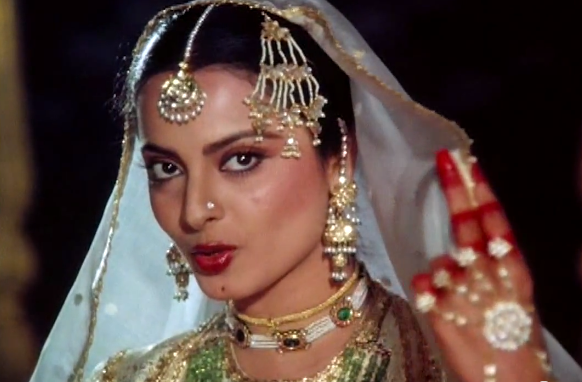
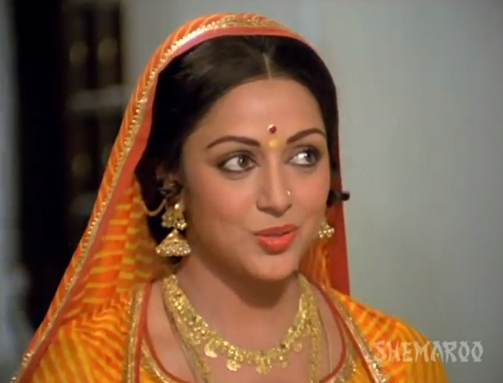
Rekha gives a career-defining performance as a courtesan and poetess in Umrao Jaan (1981)

I recently rewatched Muzaffar Ali’s masterpiece Umrao Jaan (1981), a film that is so brilliantly crafted that it deserves multiple posts on this blog like Pakeezah and Mughal-e-AzamThe film is based on an Urdu novel written by Mirza Muhammad Hadi Ruswa that recounts the life of one of South Asia’s most influential literary figures: Umrao Jaan. Born in Faizabad, a young girl named Amiran is kidnapped and sold to a brothel in Lucknow. As she grows older, Amiran is grooomed by the brothel’s madam until she becomes Umrao Jaan (played by Rekha), one of Lucknow’s most desirable courtesans.  Misfortune after misfortune falls upon Umrao Jaan, but the film ultimately portrays her as a resilient woman whose beautiful mujras and poetry serve as a lasting legacy to her indomitable spirit.

In addition to Rekha’s stunning performance as the tawaif Umrao Jaan, this film is especially memorable for its portrayal of the richness of Lucknow’s cultural heritage. The indulgent life of nawaabs around the turn of 20th century is visually apparent in the film’s costumes, artwork, and set design, but the luxurious atmosphere in the film is taken to a new level by the soundtrack composed by Khayyam and penned by Shahryar. Here, I’ve chosen to translate one of the unforgettable mujra numbers from this film: in aa.nkho.n kii mastii.

She’s not lying when she says her eyes are intoxicating…

In this song, Umrao Jaan engages in some self-indulgent vanity. She mildly chides her lover Nawab Sultan (played by Farooq Shaikh) by saying there are thousands of other madmen in Lucknow that admire her charm and beauty. In the third verse, she continues to brag by saying that all the taverns in the world cannot serve wine as intoxicating as the wine that she serves from her glances. Finally, in the last verse, Umrao makes a warning against those that attempt to suppress her grandeur using a common symbol found in Urdu-Hindi poetry: the moth. Like moths to a flame, she claims that there are thousands of admirers in the city who would sacrifice their lives to protect her. The poetry in this song is not overly complex, but there is a subtle beauty to it that is enhanced by Asha Bhonsle’s beautiful rendition and Rekha’s graceful expressions on screen. I managed to find a very high-quality print of this song on YouTube, so please do watch the link provided above and follow along with the translation/glossary–enjoy!

–Mr. 55

P.S. Whatever you do, please do not waste three hours of your life (like I did) watching J.P. Dutta’s 2006 remake of this movie starring Aishwarya Rai and Abhishek Bacchan. It is a travesty of a film that completely disrespects the beauty of the original. I think one of the worst parts is the atrocious Urdu pronunciations. I mean, even I can get the guttural khe sound right when I say “khudaa haafiz,” and they don’t pay me the big bucks. Why can’t Aishwarya or Abhishek? And let’s not even get started on Anu Malik’s tired and stale soundtrack…

The camera adds to the meaning of the lyrics here by bringing candles into the shot when Rekha sings “is shamm-e-farozaa.n…

In Aankhon Ki Masti Ke Lyrics and Translation

in aa.nkho.n kii mastii ke mastaane hazaaro.n hai.n
The intoxicating beauty of these eyes attracts thousands of admirers. 
in aa.nkho.n se vaabastaa afsaane hazaaro.n hai.n
Indeed, there are thousands of stories associated with these eyes. 

ek tum hii nahii.n tanhaa ulfat me.n merii rusvaa
You are not the only one disgraced by your love for me, 
is shahar me.n tum jaise diivaane hazaaro.n hai.n
There are thousands of madmen like you in this city.

ek sirf ham hii mai ko aa.nkho.n se pilaate hai.n
It is only I who can serve you wine with my eyes, 
kahne ko to duniyaa me.n maikhaane hazaaro.n hai.n
Though it is said that there are thousands of taverns in this world.

is shamm-e-farozaa.n ko aa.ndhii se Daraate ho
Although you attempt to scare this bright candle with a storm,
is shamm-e-farozaa.n ke parvaane hazaaro.n hai.n
The light from this candle attracts thousands of moths. 

in aa.nkho.n kii mastii ke mastaane hazaaro.n hai.n
The intoxicating beauty of these eyes attracts thousands of admirers. 

Glossary

mastii: intoxication; mastaane: admirers; vaabasta: associated with; ulfat: love; rusvaa: disgraced; mai: wine; maikhaane: taverns; shamm-e-farozaa.n: bright candle; aa.ndhii: storm; parvaane: moths.

Farooq Shaikh, as Nawab Sultan, watches the mujra in admiration.

Meera Bhajans as Film Songs: The Saintlier Side of Bollywood

Meera-bai (c. 1498-1547 A.D) was a mystical poet and devotee of Lord Krishna

When most people think of Bollywood cinema, they usually think of extravagant costumes, seductive dance moves, and lots of melodramatic overacting. While all this extravagance is certainly an integral aspect of the industry, you may be surprised to learn about a saintlier side of Bollywood that I will discuss here today: the use of Meera-bai’s texts in Hindi film music.

Meera-bai was a 16th-century mystic whose devotion to Lord Krishna has been immortalized in Indian culture through her poetry and bhajans (religious songs). Meera, a Rajput princess, was married off to a prince at young age, but this marriage did not satisfy her as she already  considered herself the spouse of Lord Krishna. Her husband died in battle soon after their marriage and Meera became a widow at an early age. Meera transformed her grief into spiritual devotion and wrote many poems in praise of Lord Krishna.  In her texts, she worships Krishna from the perspective of a lover longing for union: romantic on one level and spiritual on another. Although her undying devotion to Krishna was initially a private matter, public moments of spiritual ecstasy soon outed her to society. Eventually, her brother-in-law became displeased with her excessive devotion for Krishna and made several attempts on Meera’s life. The most well-known story describes how he poisoned Meera’s prasad and made her drink it, but the Lord transformed the poison into amrit (spiritual nectar) to save her life.

Meera-bai’s texts express themes that are highly pertinent to  heroines in Hindi cinema from the Golden Era. Interpreting and contextualizing Meera’s love for Lord Krishna can be a challenging task, however, because of its apparently paradoxical relationship to acceptable gender norms for women at the time. On one hand, Meera could be considered the ideal Indian woman for the eternal devotion she displays toward her lover–in this case, Lord Krishna–in spite of all the obstacles placed in her way. The type of selfless devotion and sacrifice Meera-bai displays toward Krishna is the same type of devotion that Indian women in the chauvinistic climate of the ’50s and ’60s were expected to provide their husbands.  On the other hand, Meera-bai actually subverts the typical pativrata norms established by Indian society because her devotion is misplaced. Instead of serving her human husband, Meera devotes all of her love to Krishna, which is inconsistent with society’s expectations for the dutiful and virtuous Indian wife. This is further complicated by the fact that Meera, in her mind, actually considered herself to be the wife of Krishna (and supposedly conducted a marriage ceremony with a Krishna idol at a temple).

In any case, it is undeniable that Meera’s texts contain universal themes about love, pain, and devotion that have permeated several mediums of the South Asian cultural sphere. Here, let’s analyze a couple of examples in order to see how Meera’s words have been used in the context of Hindi film songs:

pag ghungruu bandh miiraa nachii re (Meera, 1947): Meera (1947) is a rare treat for lovers of Bollywood films because it is the only Hindi film ever made that features M.S. Subbulakshmi as both an actress and playback singer. M.S. Subbulakshmi, who was the first musician to be awarded the prestigious Bharat Ratna, is one of the most renowned vocalists in the history of the Carnatic musical tradition. Her singing is ethereal and sublime, and many people have praised her by saying she is modern-day personification of Meera-bai herself! Although she retired from films early in her career to pursue classical concert music, her portrayal of Meera in this film is remembered to this day for its natural and pure expression of spiritual divinity.  Words don’t do this woman justice, so just click the link and take a listen for yourself. I’ve selected one of about 20 Meera bhajans that are found in the film; in this particular poem, Meera uses the metaphor of dance to describe her love for the Lord. You may have noticed that the first line of this bhajan was used in another (much less saintly) Bollywood classic rendered by Kishore Kumar and composed by Bappi Lahiri from Namak Halaal (1982) decades later.

M.S. Subbulakshmi embodies the spiritual divinity of Meera-bai in the 1947 Hindi remake of the Tamil film Meera. 

ghunghaT ke paT khol re, tohe piiyaa mile.nge (Jogan, 1950): I have always thought that one of Geeta Dutt’s strengths as a singer was her rendition of bhajans. She shines here in this Raga Jaunpuri-based devotional composed by Bulo C Rani that has some beautiful words penned by Meera-bai. Literally, the first line translates roughly as  “remove your veil so that you can get a glimpse of your beloved.” However, on a deeper level, Meera-bai is using the veil as a metaphor for ignorance–she is asking us to remove our veils of ignorance so that we can be closer to the Lord.

erii mai.n to prem divaanii, meraa dard na jaane koii (Nau Bahar, 1952): Lata Mangeshkar is brilliant in her rendition of this Raga Bhimpalasi-based bhajan composed by Roshan and picturized on Nalini Jaywant  in Nau Bahar. Inspired by a Meera-bai poem, the words here describe how Meera’s devotion to the Lord can is best expressed through love, as she is unfamiliar with the traditional rites and rituals of worship.

 jo tum toDo piiyaa, mai.n naahii.n toDuu.n  (Jhanak Jhanak Payal Baaje, 1955):  V. Shantaram’s Jhanak Jhanak Payal Baje was one of India’s first technicolor films when it was released in 1955.  In this Filmfare award-winning film, when the character played by Sandhya fears that she has destroyed her beloved’s (played by Gopi Krishna) dancing career, she becomes so depressed that she decides to reject all wordly pleasures and become an ascetic like Meera-bai. This Bhairavi-based bhajan composed by Vasant Desai is rendered beautifully once again by Lata, who succeeds in expressing the sentiment of Meera’s words about unconditional devotion to her Lord even if he is not faithful to her.

piyaa ko milan kaise hoye rii, mai.n jaanuu.n naahii.n (Andolan, 1977)Asha Bhonsle tends to employ a lot of over-the-top histrionics in her songs, but music director Jaidev manages to get Asha at her pure, unadulterated best with this soulful composition from Andolan picturized on Neetu Singh.

mere to giriidhhar gopaal, duusro na koii  (Meera, 1979): Directed by lyricist Gulzar, this film is yet another Bollywood biopic about Meera-bai, and Hema Malini takes the starring role here. Despite high hopes, this film achieved only moderate success at the box office. However, the film’s soundtrack of  compositions by sitar virtuoso Pandit Ravi Shankar has certainly left a memorable legacy. In this particular poem, Meera-bai’s words express her singular devotion to the Lord; there is no one else in the world for her except for her Lord Krishna. While Hema falls a little flat in her portrayal of Meera, Vani Jairam actually does a great job expressing the appropriate emotions needed in this rendition and in the rest of the songs on the soundtrack. However, as you may have suspected, Vani was not Ravi Shankar’s first choice of singer for this film–his first choice was none other than Lata Mangeshkar. Lata, however, turned him down, by using the following reasoning:

“How could I? I had already done Meera bhajans for my brother Hridaynath.”

Now, don’t get me wrong, I love the non-filmi album of Meera bhajans released by Lata and Hridaynath. In fact, Lata’s rendition of a similar text  “mhara re giridhhar gopaal, duusra na koii” tuned by Hridaynath for this album is absolutely exquisite. However, her reasoning here doesn’t really make sense to me. Even before her album for Hridaynath, Lata had sung plenty of Meera bhajans for films (see above!) under the baton of other music directors, so I don’t see how this excuse constitutes a legitimate reason to refuse singing in this film. I suspect that her refusal had more to do with some lingering bad blood between her and Ravi Shankar from their prior collaboration on Anuradha (1960): apparently, tensions had flared between the two of them because Lata had failed to show up to a recording session of “saa.nvare saa.nvare” without prior notice. 

Hema Malini is way too attractive to pull off being an ascetic in Meera (1979)

 jo tum toDo piiyaa, mai.n naahii.n toDuu.n  (Silsila, 1981): Although this text is similar to the Jhanak Jhanak Payal Baje song listed above, the melody is quite different because music directors Shiv-Hari have tuned this song to the Raga Chandrakauns, an underused raga that is quite rare in the filmi musical sphere. Lata, unfortunately, sounds a bit past her prime here, but this song is still memorable for Meera-bai’s words and their relevance to the contemporary situation at hand in the film. Similar to the real-life rumors that were rampant at this time, Jaya Bacchan’s character suspects that her husband (played by Amitabh Bacchan) is having an extramarital affair with another woman (played by Rekha). Meera-bai’s lyrics express the anguish and torment that Jaya feels in response to her husband’s infidelity, but she resolves to remain faithful to him even though he is not faithful to her. Interestingly, things also turned out this way in real life–Jaya stayed with Amitabh even though it was widely known within the film community that he had cheated on her with Rekha.

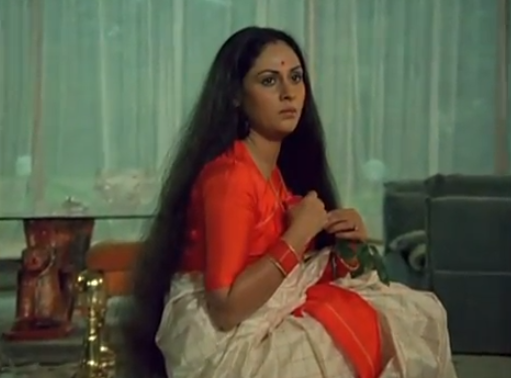
Jaya Bacchan laments her husband’s infidelity in Silsila (1981). Look at those eyes!

What are some of your favorite bhajans featured in Bollywood films? Let us know in the comments!
–Mr. 55

Aage Bhi Jaane Na Tu Lyrics and Translation: Let’s Learn Urdu-Hindi

What a classy soiree!

I just spent three hours of my life watching Waqt (1965) instead of studying for the MCAT.  Therefore today we present the lyrics and English translation of “Aage Bhi Jane Na Tu.” Was it worth it? Totally.

This 1965 film directed by Yash Chopra features an all-star cast (Balraj Sahni, Achla Sachdev, Sadhana, Raaj Kumar, Sunil Dutt, Sharmila Tagore, Shashi Kapoor, Motilal, Rehman, Madan Puri, Leela Chitnis, and Shashikala, among others) along with a compelling storyline that defined the masala genre of Hindi cinema for years to come. The plot tells the story of a family of five who are tragically separated by a natural disaster. Years later, their lives become bizarrely connected through a series of complex entanglements involving romance, misunderstandings, illness, and of course–a murder. I don’t want to ruin the movie by giving away too many details, but its theme can be summarized by the powerful concluding statement made by Balraj Sahni’s character: “waqt hi banata hai aur waqt hi bigaDta hai” (Time creates all, and time destroys all).

Sadhana and Sunil Dutt have a moment in Waqt (1965)

The icing on the cake for this movie is its soundtrack composed by Ravi and penned by Sahir Ludhianvi. One popular song you may know from this film is Manna De’s “ai merii zohraa jabii.n,” but today, I have chosen to translate the soundtrack’s crown jewel: “aage bhii jaane na tu.” Unlike many songs in Bollywood movies that serve as fillers, this song is actually instrumental in advancing the plot. The song is played in the background at a soiree that is attended by many of the film’s major characters. During the course of the song, a lot of important things happen: Sadhana and Sunil Dutt get all romantic together, Rehman orders Raaj Kumar to steal Shashikala’s diamond necklace, Sharmila Tagore seeks Shashi Kapoor’s attention, and Shashi Kapoor is forced to leave the party early to take care of his sick mother. Most importantly, however, Raaj Kumar gets into a fight with a drunk Madan Puri because he makes a pass at Sadhana, and this fight is related to the murder that I eluded to above. I’ll leave it at that for now to keep things suspenseful…

Dashing Raaj Kumar attempts to steal Shashikala’s diamond necklace. Sneaky!

Sahir Ludhianvi is brilliant as always in his poetry, as he transforms a potentially mediocre party song into a beautifully expressed philosophical statement about life. Through his words, he urges listeners to adopt a carpe diem intellectual framework in which decisions should be based on the present instead of relying on the uncertainties of the future and the past. He illustrates that seizing the day is important by saying, “jo bhii hai, bas yahii ek pal hai” (What is here now is only this one moment), and these words are particularly apt for a movie whose title and theme revolve around time. Ravi’s exquisite tune and Asha Bhonsle’s passionate rendition do justice to the depth of Ludhianvi’s words, which all  have contributed to making this gem one of Bollywood’s most treasured songs from the Golden Era.

Shashi Kapoor leaves the party to take care of his ailing mother 😦

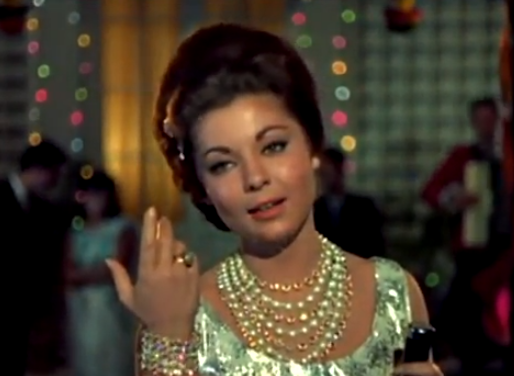
Do you recognize the woman on whom this song is picturized in the film? Her name is Erica Lal, but I couldn’t find much biographical information about her except that she was an American woman who married an Indian living in Mumbai at this time. In any case, she looks stunning on screen during this song and captures the spirit and style of the sophisticated ’60s crooner.

–Mr. 55

Erica Lal is the epitome of the stylish ’60s crooner in Waqt (1965)

Aage Bhi Jaane Na Tu Lyrics and Translation

aage bhii jaane na tu, piichhe bhii jaane na tu
You may not know what lies ahead of you, nor do you know what lies behind you.

jo bhii hai, bas yahii ek pal hai
What is here now is only this one moment.

anjaane saayo.n kaa raaho.n mein Deraa hai
Unknown shadows camp along the paths ahead,

andekhii baaho.n ne ham sab ko ghera hai
While unseen arms have embraced us all.

yeh pal ujaalaa hai, baaqii andhheraa hai
This moment is shining with light; everything else is darkness.

yeh pal gavaana na, yeh pal hii teraa hai
Do not waste this moment, as only this moment is yours.

jiinevaale, soch le yahii vaqt hai kar le purii aarzuu
Think fast, oh living soul: this is the time to fulfill all your desires.

is pal ke jalvo.n ne mahfil sa.nvaarii hai
The passion of this moment has graced this gathering,

is pal kii garmii ne dhaDkan ubhaarii hai
And the warmth of this moment has accelerated our heartbeats.

is pal ke hone se duniyaa hamaarii hai
The world is ours because of this moment’s existence.

yeh pal jo dekho to sadiyo.n pe bhaarii hai
Take a look at this moment, for its grandeur is to be remembered for centuries.

jiinevaale, soch le yahii vaqt hai kar le purii aarzuu
Think fast, oh living soul: this is the time to fulfill all your desires.

is pal ke saaye me.n apnaa Thikaanaa hai
One’s destination can be found in the shadows of this moment.

is pal ke aage hii har shay fasaanaa hai
Ahead of this moment, all objects become stories of fantasy.

kal kis ne dekhaa hai? kal kis ne jaanaa hai?
Who has seen tomorrow? Who has known tomorrow?
is pal se paayegaa jo tujh ko paanaa hai
From this moment, you shall receive all that you are due.

jiinevaale, soch le yahii vaqt hai kar le purii aarzuu
Think fast, oh living soul: this is the time to fulfill all your desires.

aage bhii jaane na tu, piichhe bhii jaane na tu
You may not know what lies ahead of you, nor do you know what lies behind you.

jo bhii hai, bas yahii ek pal hai
What is here now is only this one moment.

Glossary

pal: moment; anjaane: unknown; Deraa: stop, camp; andekhii: unseen; baahe.n: arms; ghernaa: to encircle, embrace; ujaalaa: light; andhheraa: darkness; jiinevaale: living soul;  aarzuu: desire; jalvaa: passion; mahfil: gathering; sa.nvaaranaa: to grace, adorn; ubhaarnaa: to intensify, accelerate; sadii: century; Thikaanaa: destination, address; shay: object;  fasaanaa: tale, story

Raaj Kumar beats up a salacious drunkard to protect Sadhana’s honor. With the right combination of handsome looks, sophisticated personality, and masculine brawn, he is a model example of the classic Bollywood stud.