A Guide to the Instruments of Old Bollywood Film Music: from Hindustani to Western (and everything in-between)

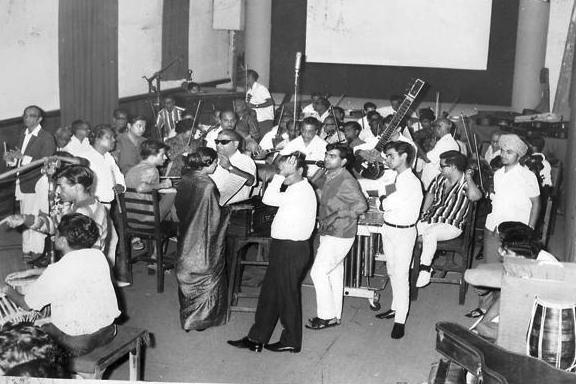
Madan Mohan recording studio orchestra

Music director Madan Mohan in his studio circa. 1960s. How many different instruments can you spot in this photo?

Ever find yourself listening to Bollywood film music and feel like your brain is exploding in ecstasy from the rainbow of instruments striking your tympanic membranes? We know the feeling. The history of Bollywood film music goes much deeper than the playback singers who lived in limelight. The incredible talents of Hindi film music directors and musicians are responsible for the compositions we love today. Their risks and creativity were a gift to generations of music-lovers. Without composer Naushad defying his parents to play the harmonium “live” for silent films in the 1930s or R.D. Burman’s daring musical ingenuity in his break-out film Teesri Manzil, Bollywood music as we know it would be radically different.

To truly understand the brilliance of the men and women who shaped Hindi film music, we must learn their tools. From traditional Indian instruments that date to the Vedic age to the orchestral forerunners of Europe to the unsung instruments of Brazil and Africa, the rich mediums of Bollywood music wrote their own rules. We have created a Beginner’s Guide to the Instruments of Classic Hindi Films for whether you’re a newcomer to Bollywood or a veteran, the innovation of these songs and their mechanisms will stun you. To simplify, we divided the instruments into rough categories with several of our favorite examples and links to videos and song translations beneath. And if you ever wonder which instrument was played in a particular song, refer back to this guide for the answer!

A Beginner’s Guide to the Instruments of Classic Hindi Films

String Instruments

Banjo: A plucked 4-5 string instrument with origins in Africa that traveled to America around the 18th century with African-American traditional music and became a staple of country and folk genres.

Ignore how uncomfortable the heroine’s Stockholm Syndrome makes you, and enjoy Meena Kumari’s decent impression of someone who knows how to play the banjo in the film Azaad. This is the only instance of this instrument’s prominent use in a film song that I know. If you have heard others, please leave a comment!

Kitna Haseen Hai Mausam (Azaad 1955)

Cello: A bass 4-stringed instrument dating back to 17th century Italy, the large cello is held against the seated cellist and traditionally played with a horsehair bow.

Yeh Jo Mohabbat Hai (Kati Patang 1970)

Zindagi Ke Safar Mein (Aap Ki Kasam 1973)

Kuch To Log Kahenge (Amar Prem 1972)

Panna Ki Tammana (Heera Panna 1973)

Meri Bheegi Bheegi Si (Anamika 1973)

Guitar: A typically 6-string instrument with European roots with a multitude of incarnations, from acoustic to electric, that have influenced every genre from hard rock to reggae.

Bollywood film music saw a revolution with guitar use from the more acoustic versions a la “Tadbeer Se Bigdhi Hui” in the early 50s to the electric guitar riots of the 60s such as in the jolting opening of “Aaja Aaja” from Teesri Manzil (1966).

Aaja Aaja Main Hoon Pyaar Tera (Teesri Manzil 1966)

Chura Liya Hai (Yaadon Ki Baraat 1973)

Ajeeb Dastan Hai Yeh (Dil Apna Aur Preet Parai 1960)

Tadbeer Se Bigdi Hui (Baazi 1951)

Rulake Gaya Sapna Mera (Jewel Thief 1967)

Mandolin: An evolution from the lute family around 17th century Italy with traditionally 4 courses of double strings that feature prominently in classical European music.

This instrument has had a diverse role in Hindi film music–from an instrument of seduction in C.I.D. (1956) to one of tragedy in “Suhani Raat Dhal Chuki.” Fun fact: the mandolin that is featured in the interlude music “Achaji Main Hari” was played by Laxmikant and Manoharida themselves!

Kahin Pe Nigahen Kahin Pe Nishana (C.I.D 1956)

Achaji Main Hari Chalo (Kala Pani 1958)

Tum Bin Jaoon Kahan (Pyar Ka Mausam 1969)

Suhani Raat Dhal Chuki (Dulari 1949)

Santoor: An ancient Kashmiri instrument of 72-strings that are struck with special mallets and heard in traditional Sufi hymns and folk music of Northern India.

The beautiful, reflective santoor is prominent in many Bollywood films, often as a gentle romantic hint in the score during dialogue or first encounters with love. A great example is in “Mere Mehboob Tujhe” where the santoor is allowed to muse solo as the hero recalls his meeting with a mysterious woman for whom he now searches.

Aye Dil-e-Nadan (Razia Sultan 1983)

Sajna Hai Mujhe (Saudagar 1973)

Mere Mehboob Tujhe (Mere Mehboob 1963)

Sarangi: A bowed short-neck stringed instrument famed in Hindustani classical music for its close imitation of the human voice.

I often associate the sarangi with its great performances in courtesan songs. No better example is the hypnotizing opening of Pakeezah‘s immortal “Chalte Chalte.” The sarangi is a very evocative instrument, conjuring unimaginable sadness as in “Do Hanson Ka JoDa” or a lovely shyness in “Dil Cheez Kya Hai.”

Chalte Chalte (Pakeezah 1972)

Saranga Teri Yaad Mein (Saranga 1961)

Do Hanson Ka Joda (Ganga Jamuna 1961)

Dil Cheez kya Hai (Umrao Jaan 1981)

Aansuu Bhari Hai (Parvarish 1958)

Sarod: A lute-like instrument from Afghanistan that rose to prominence in the Mughal courts.

Like the santoor, the sarod often appears in the film’s score outside of a full-blown song-and-dance sequence. The sarod is highly versatile–when played quickly it can denote excitement and movement, and when plucked slowly it can pull at your heart strings. The mesmerizing battle between sitar and sarod in “Madhuban Mein Radhika” demonstrates this instrument’s power to take your breath away!

Madhuban Mein Radhika (Kohinoor 1960)

Man Re Tu Kahe (Chitralekha 1964)

Suno Chhoti Si Gudiya (Seema 1955)

Sitar: An 18-20 string plucked instrument synonymous with Hindustani classical music that influenced the Western pop world in the 1960s when adopted by The Beatles and Rolling Stones.

The ethereal sitar helped bring Hindustani music to the international stage. Used often in Hindi films to denote the gentle falling of rain (a famous Ravi Shankar composition in Satyajit Ray’s Pathar Panchali captures this brilliantly), sitar music is a classic Bollywood backbone.

O Sajna Barkha (Parakh 1960)

Hum Tere Pyar Mein Saara Aalam (Dil Ek Mandir 1963)

Chandan Sa Badan (Saraswatichandra 1968)

Tere Bina Zindagi Se (Aandhi 1975)

Chori Chori Chupke Chupke (Aap Ki Kasam 1974)

Tanpura: A 4-string instrument to accompany a Hindustani classical vocalist that does not play a melody, but rather provides a harmonic drone throughout the piece.

The beauty of the tanpura is in its relative simplicity. The singer plucks four strings in order continuously, allowing them to focus on their vocal composition while maintaining harmony. Listen carefully for its deep drone in the background of many classical and semi-classical songs!

Duniya Na Bhaaye (Basant Bahar 1956)

Man Tarpat Hari Dar (Baiju Bawra 1952)

Sukh Ke Sab Saathi (Gopi 1970)

Violin: A highly popular bowed 4-string instrument with roots in 16th century Italy that has had global impact, including in orchestral performances of Hindi film music.

Violins are an integral part of film music orchestration. I’ve listed several songs that highlight its use as a solo instrument, or more commonly as part of a large orchestra seen in numerous Hindi film songs from the 1950s onwards (the famous opening of “Pyar Hua Iqrar Hua” being but one of dozens).

Ek Pyar Ka Naghma (Shor 1972)

Mujhe Kisi Se Pyar (Barsaat 1949)

Likhe Jo Khat Tujhe (Kanyadaan 1968)

Pyar Hua Iqrar Hua (1955)

Karvaten Badalte Rahe (Mere Jeevan Saathi 1972)

Wind Instruments

Bansuri: An ancient flute-like instrument with a history dating back to the myths of Lord Krishna and Radha, the bansuri is made from a single shaft of bamboo with 6-7 holes and is associated with pastoral compositions of India.

The lonely bansuri is a common instrument of Hindi films denoting a tragedy, a philosophical side-note, or a quiet village scene. The bansuri of “Chingari Koi Bhadke” represents the second of these themes and will never fail to transport you to a different world of exoticism.

Chingari Koi Bhadke (Amar Prem 1972)

Chahoonga Main Tujhe (Dosti 1964)

Piya Bina (Abhiman 1973)

Na Koi Umang Hai (Kati Patang 1970)

Been (Pungi): An instrument fashioned from a gourd and two reed pipes, the been is the traditional instrument of snake charmers and popular in folk music of South Asia.

The good old been is one of pop cultures favorite instruments, yet is actually only a prominent player in a few classic Bollywood songs. The landmark, of course, is Nagin (1954) where “Man Dole Mera Tan Dole” made been music popular even outside the crowds who gather for snake charmers.

Man Dole Mera Tan Dole (Nagin 1953)

Ek Pardesi Mera Dil Le Gaya (Phagun 1958)

Parde Mein Rehne Do (Shikar 1968)

Western concert flute: A popular sideblown woodwind instrument that dates back to the 11th century Byzantine Empire and is commonly heard in bands and orchestras.

I love how the flute has been used in Hindi film music. Rethink how you’ve always imagined the flute and take a listen to the evocative solo the opens “Ja Re Ja Re Udi Ja Re Panchi” or the seductive twist of the key flute in “Aao Na Gale Lagalo Na”!

Ja Re Ja Re Udi Ja Re Panchi (Maya 1961)

Ruk Ja O Janewali Ruk Ja (Kanhaiya 1959)

Aao Na Gale Lagalo Na (Mere Jeevan Saathi 1972 – key flute)

O Haseena Zulfonwali Jane (Teesri Manzil 1966)

Harmonica: First appearing in Vienna in the 19th century, the easily portable hand-held harmonica has influenced artists from Blues and jazz genres.

Harmonica plays an important role in classic Bollywood film music, often played by optimistic young heroes with a song in their heart despite having great odds against them.

Jaanewalo Zara (Dosti 1964)

Hai Apna Dil To Awara (Solva Saal 1958)

Mere Sapno Ki Rani (Aradhana 1969)

Saxophone: Fashioned in brass originally in Belgium in the 19th century, the edgy saxophone is a key member of jazz and marching bands.

I was first alerted to the presence of saxophones when I heard the haunting and unexpected interlude music of “Awaaz Deke” (Professor 1962).  Interestingly, I’ve found that in Hindi film music (due in large part to maestro Manohari Singh whose soprano sax sets your heart on fire in “Mehbooba Mehbooba”), it is just as often as a jazzy party-starter as an edgy bridge toward tragedy.

Awaaz Deke (Professor  1962)

Jis Gali Mein Tera Ghar (Kati Patang 1970)

Aage Bhi Jaane Na Tu (Waqt 1965)

Roop Tera Mastana (Aradhana 1969)

Mehbooba mehbooba (Sholay 1975)

Shehnai: A traditional South Asian instrument known for its auspicious melodies at weddings and processions.

This lovely, but almost invariably tragic-sounding instrument is a staple of wedding scenes. The opening shehnai of “Babul Ki Duaaen” feels as if someone is crying, reflecting the sadness of a father’s loss. One of the more innovative melodies I’ve heard with shehnai is in the song “Chal Ri Sajni” (and incidentally among the most perfectly filmed and edited sequences in Bollywood history, but that’s another story…)

Babul Ki Duae.N Leti Jaa (Neel Kama 1968)

Kabhi Kabhi (Kabhi Kabhi 1976,  interlude after ghughat utaa raha hoon main)

Chal Ri Sajni Ab Kya Soche (Bombai Ka Babu 1960)

Trumpet: 3 piston-valves are the hallmark of this 15th century European instrument which has influenced jazz, Latin, and pop music alike.

While a more limited role in Hindi film music, the trumpet moved strictly cabaret club numbers to the beautiful opening of “Zindagi Kaisi Hai Paheli” where the lifting trumpet solo carries our hopes to the sky with it.

Zindagi Kaisi Hai Paheli (Anand 1971)

Zuby Zuby Jalembu (An Evening in Paris 1967)

Patli Kamar Hai (Barsaat 1949)

Haal Kaisa Janab Ka (Chalti Ka Naam Gaadi 1958)

Percussion

Bongo-Conga: Afro-Cuban drums (consisting of the smaller hand-held bongos and the larger barrel congas) that are backbones of Latin music, Afro-Cuban jazz, and the mambo music that swept 1950s United States.

Wanna know why “O Mere Dil Ke Chain” is your favorite Rajesh Khanna song and your heart races every time it plays? It’s not (just) his perfect face, it’s the Bongo-Conga! This exotic and uber-fun percussion instrument translates effortlessly from living room romance to an outdoor gypsy party.

O Mere Dil Ke Chain (Mere Jeevan Saathi 1972)

Dilbar Dil Se Pyaare (Caravan 1971)

Gum Hai Kisise Pyar (Rampur Ka Lakshman 1972)

Castanets: A distinct handheld instrument commonly associated with the Spanish Sevillanas folk dance that is played by clicking two small wooden shells together in a quick rattle.

Once you hear this sound in a song, you’ll never forget it. More popular in Bollywood songs of the 50s and early 60s, the castanets add a playful nuance on top of the base percussion provided by a different instrument.

Tere Sur Aur Mere Geet (Goonj Uthi Shehnai 1959)

Yeh Chand Sa Roshan Chehra (Kashmir Ki Kali 1964)

Door Gagan Ki Chaaon (Door Gagan Ki Chaaon Mein 1964)

Aaiye Meharbaan (Howrah Bridge 1958)

Mora Gora Ang Laile (Bandini 1963)

Madal: A hand-drum used in Nepali folk music that made its debut in Bollywood under music director R.D. Burman and Ranjjit Gazmer in the 1970s.

The madal has a fuller more rounded tone than the tabla or bongo, lending itself well to rustic scenes. It was featured heavily in the destination film “Hare Rama Hare Krishna”!

Hum Dono Do Premi (Ajnabee 1974)

Kanchi Re Kanchi Re (Hare Rama Hare Krishna 1971)

Dhol: A exciting Panjabi instrument famous for its influence on bhangra music, the dhol (and its family members the dholak and dholki) is a double-headed drum featured in genres from pop to qawwali.

The dhol is a great instrument for dancing and some of the best Bollywood choreography has featured the upbeat dhol. If you ever doubted Vijayantimala’s rumored legendary dance skills, just watch and listen to the end of “Honton Pe Aisi Baat” with the mind-boggling dhol spinning circles around the other instruments.

Chadti Jawani (Caravan 1971)

Honton Pe Aisi Baat (Jewel Thief 1965)

Jhumka Gira Re (Mera Saaya 1966)

Yamma Yamma (1980)

Jai Jai Shiv Shankar (Aap Ki Kasam 1973)

Duggi: A traditional Uttar Pradesh kettle drum in the tabla family played with two hands.

Popularized by Bollywood musician Homi Mullan, this percussion instrument creates a more rounded tone than the tabla, but is a perfect pastoral compliment to “Ni Sultana Re” as well as the sultry domestic “Bahon Mein Chale Aao.”

Ni Sultana Re (Pyar Ka Mausam 1969)

Bahon Mein Chale Aao (Anamika 1973)

Roop Tera Mastana (Aradhana 1969)

Dekha Na Haye Re Socha Na (Bombay to Goa 1972)

Ghatam (Matka): An ancient percussion instrument from South India, the ghatam is a clay pot with a narrow mouth and is played with bare hands.

It doesn’t get any more traditional than the ghatam, but R.D. Burman figured out how to use it an as unconventional ways as possible. Bet you wouldn’t have guessed that the percussion of hipster hit “Samne Yeh Kaun Aaya” came from a clay pot?

Samne Yeh Kaun Aaya (Jawani Diwani)

Are Kaise Mitti Ki Maadho (Imaan 1974)

Muttu Kudi (Do Phool 1974)

Reco Reco (Reso Reso): A scraped percussion instrument with a distict sound with origins in Brazilian music.

The reco reco is basically a party in a box! The distinct rhythm it creates adds spice to every song that is bold enough to utilize it. Watch how Kishore Kumar in a hilarious scene from Padosan lipsyncs his own actual recorded voice while playing the Reco Reco (who is in turn lipsynced by Sunil Dutt!) in “Mere Samnewali Khidki Mein.”

Mere Samnewali Khidki Mein (Padosan 1968)

Mere Naina Saawan Bhado (Mehbooba 1976)

Mera Naam Hai Shabnam (Kati Patang 1970)

Tabla: A pair of hand drums used commonly in Hindustani classic music composed of two distinct drums with differing roles for each hand.

This is one of the most common percussion instruments used in old Hindi songs and is always to go-to when all else fails. I once took tabla lessons, but quit after 2 weeks because my guru insisted I needed to cut my nails shorter to play the instrument correctly. He was right, of course, but there are sacrifices I’m not willing to make!

Sanam Tu Bewafa (Khilona 1970)

Jurm-e-Ulfat Pe (Taj Mahal 1963)

Baiyan Na Daro (Dastak 1970)

Jaag Dard-e-Ishq (Anarkali 1953)

Inhi Logon Ne (Pakeezah 1971)

Western Drum Kit: A collection of instruments often including a bass drum, a snare drum, and one or more cymbals that became popular with jazz bands in the early 20th century and ushered in rock-and-roll.

Rock-and-roll and nightclub bands have long been a part of Hindi film traditions and the Western drum kit hit the screen with a literal bang, and usually accompanied by a song better suited for “modern” audiences.

Dil Deke Dekho (Dil Deke Dekho 1959)

Ina Mina Dika (Aasha 1957)

Baar Baar Dekho (Chinatown 1962)

Tumne Mujhe Dekha (Teesri Manzil 1966)

Nain Milakar Chain Churana (Aamne Samne 1967)

Other

Accordion: Believed to have been invented in Berlin in the early 19th century, the accordion, like the harmonium, is played by compressing the instrument’s bellows with one hand while playing keys with the other hand.

The accordion produces a harsher sound than the harmonium, but is often more exciting as in the epic performance in “Anhoni Ko Honi” or the drama-filled “Har Dil Jo Pyar Karega”!

Har Dil Jo Pyar Karega (Sangam 1964)

Awaara Hoon (Awaara 1951)

Sab Kuch Seeka Humne (Anari 1959)

Anhoni Ko Honi Karde (Amar Akbar Anthony 1977)

Jeena Yahan Marna Yahan (Mera Naam Joker 1970)

Heavy Breathing and Grunting: An R.D. Burman signature that marks any classic Bollywood song as particularly racy and is served by both men and women with an extra scoop of awkward sauce.

Yeah, I had to throw this in. Don’t pretend like it doesn’t exist, and definitely don’t pretend that you don’t love it. Awkward breathing and grunting nosies are a strange but important hallmark of many of our favorite classic Bollywood cabaret numbers. They really just have to be heard to understand (and to believe). Now before you start to blush, these noises are actually pretty complicated to make–it takes great breathing control and just the right amount of oomph. Seriously, try these exercises at home when no one’s around to judge. You’ll give your lungs a run for their money!

Piya Tu Ab To Aaja (Caravan 1971)

Duniya Mein Logon Ko (Apna Desh 1972)

Mera Naam Hai Shabnam (Kati Patang 1970)

Aa Jaane Ja (Intaqam 1969)

Lekar Hum Deewana Dil (Yaadon Ki Baraat 1973)

Harmonium: A type of hand-pumped accordion often used as melodic accompaniment in Hindustani vocals as well as qawwali and folk music.

The harmonium is one of Hindustani classical music’s best modern friends and a great accompanist to everything from a layman’s love ode (a la “Bahut Shukriya”) to semi-classical qawwalis (as seen in Nutan’s one-man-show “Nigahen Milane”).

Leke Pehla Pehla Pyaar (C.I.D. 1956)

Bahut Shukriya (Ek Musafir Ek Hasina 1962)

Nigahen Milane Ko (Dil Hi To Hai 1963)

Kajra Mohabbatwala (Kismat 1968)

Yashomati Maiya Se (Satyam Shivam Sundaram 1978)

Manjira: A small pair of hand cymbals that traditionally accompanied bhajans with roots in ancient temple music.

Although manjira are traditionally used as accompaniments to bhajans, I ADORE how they were used in the romantic “Chhupa Lo Yun Dil” to underscore the devotional imagery to a couple’s love for each other.

Chhupa Lo Yun Dil Mein (Mamta 1966)

Na Main Dhan Chaahoon (Kala Bazaar 1960)

Kanhaiya Kanhaiya Tujhe Aana Padega (Maalik 1972)

Piano: One of the world’s most familiar musical instruments, the piano is played through a keyboard that strikes strings connected to a soundboard.

You’ll be the classiest guy in the room if you can burst into song with your own piano accompaniment at a party. Or so classic Bollywood tells us. Piano songs are essentially their own genre in the world of Hindi films. Once the piano comes out, it gets fancy and emotional in a hurry.

Pyar Diwana Hota Hai (Kati Patang 1970)

Dil Ke Jharoke Mein (Brahmachari 1968)

Aji Rooth Kar Ab (Aarzoo 1965)

Dheere Dheere Machal (Anupama 1966)

Dost Dost Na Raha (Sangam 1964)

Shankh (conch shell): An ancient instrument fashioned from the shells of large snails that are typically featured in Hindu religious hymns.

This occasionally heard instrument is usually only found in highly religious songs, but can also be heardwhen our heroes make a trip to a temple or when someone is praying for justice in the world. A powerful example comes during the climax of aarti in Purab Aur Paschim!

Om Jai Jagdish (Purab Aur Paschim 1970)

Mose Mora Shaam Roota (Johnny Mera Naam 1970)

What a whirlwind! We hope our introductory guide to the instruments of old Bollywood is a useful tool as you immerse yourself in the incredibly diverse music of our favorite films! All I have to say after reviewing my list is that I really could have used more cowbell.

Just kidding (in fact, listen to “Kitne Bhi Tu Kar Le Sitam” from Sanam Teri Kasam for some actual Bollywood cowbell action). What other instruments played in your favorite classic Bollywood songs have we left off our list? Leave us a comment with an old film song you wish you knew more about and we’ll try to tell you which instruments are featured!

-Mrs. 55


Tere Bina Zindagi Se Koi Shikwa Lyrics and Translation: Let’s Learn Urdu-Hindi

Directed by the renowned lyricist Gulzar, Aandhi stirred up quite the controversy after the film was released in 1975. Shortly after the release of Aandhi, India found itself in the midst of a national state of emergency instituted by Prime Minister Indira Gandhi in response to the deep-seated political unrest and instability that had emerged across the nation. The 21-month Emergency of 1975-1977 is often viewed as one of the darkest eras in the political history of post-independence India: corruption, censorship, and the suspension of civil liberties threatened to compromise the basic principles upon which the nation’s democracy had been built. In this context, it’s not surprising that Aandhi was banned by the government during the Emergency on the grounds that the film’s protagonist bore an inappropriate resemblance to Mrs. Gandhi. As a result, certain scenes depicting the protagonist drinking and smoking were re-shot and an extra scene in which the protagonist tells her father that she idolizes Indira Gandhi (“ye hii to mere ideal hai.n“) was included to separate the film from real life. Although the parallels in appearance, mannerisms, and even the film’s title (Aandhi, meaning storm, rhymes with Gandhi) are undeniable, Gulzar explains in an old Filmfare interview that he never intended to base this film on the life of Indira Gandhi:

“Contrary to popular opinion, my story wasn’t based on Indira Gandhi’s life. It had nothing to do with Indira-ji. She was just the role model for the lady politician. Frankly, who better could there be? She was such a dynamic lady.”

SuchitraSen_Aandhi_IndiraGandhi

Suchitra Sen tells her father that she idolizes Indira Gandhi in a flashback scene that was added to Aandhi (1975) after the film was initially banned by the government.

With inspiration from a novel titled Kali Aandhi by Hindi author Kamaleshwar, Aandhi (1975) depicts the story of Aarti Devi (portrayed by Suchitra Sen) as she struggles to balance her professional ambitions with her quest for personal gratification while navigating through the volatile world of Indian politics. While traveling on the campaign trail, Aarti is caught by surprise when she runs into her estranged husband JK (portrayed by Sanjeev Kumar), who happens to be the owner of the hotel where she is staying currently. Nine years ago, the call to public service compelled Aarti to eschew her domestic duties and leave her husband and daughter in order to pursue her dreams of becoming a politician. After their unexpected reunion, Aarti and JK cultivate a tender but awkward relationship as they reminisce about memories from their past and come to realize that they still have unresolved feelings for each other after all these years. Through an artistic use of flashbacks, we learn about the development of Aarti and JK’s early romance, the disapproval of their marriage by Aarti’s father, and the eventual breakdown of their relationship. Their domestic conflict evolves into an Abhimaan-esque clash of egos and personalities, and they eventually decide to part ways after several failed efforts to maintain a happy marriage.

Su

Suchitra Sen sports Indira Gandhi’s trademark silver streak in Aandhi (1975).

Ultimately, Aandhi illustrates the complexities of an evolving relationship between two individuals who share mutual respect and affection for each other but are unable to reconcile their differences to converge seamlessly on the same path. In addition to providing a mature and realistic view of human relationships, Aandhi sheds light on the unique challenges that confront Indian women in positions of power as they attempt to balance their professional and personal lives. Although Aarti wins her election at the conclusion of the film, this victory is made bittersweet as she grapples with an unfortunate reality: professional success and domestic bliss were often mutually exclusive for Indian women of her time.

SK

The Martand Sun Temple near Anantnag, Kashmir serves as a gorgeous backdrop for this classic song from Aandhi (1975).

In addition to Gulzar’s skillful direction and the captivating performances delivered by Suchitra Sen (her diction is excused!) and Sanjeev Kumar, Aandhi is remembered most often today for its soundtrack of stunning songs composed by R.D. Burman using Gulzar’s poetry. Each Lata-Kishore duet is a gem and serves to illustrate a different facet of Aarti and JK’s relationship in the film. In particular, the classic “tere binaa zindagii se koii” is a tender and wistful expression of regret and lost love. Without the frills of an elevated vocabulary, this song boldly questions: can living life without the one you love be considered a life at all?

Tere Bina Zindagi Se Koi Shikwa: Lyrics and Translation

tere binaa zindagii se koii shikvaa to nahii.n, shikvaa nahii.n
I have no complaints against a life without you.
tere binaa zindagii bhii lekin zindagii to nahii.n, zindagii nahii.n
Yet a life without you is not a life at all.

kaash aisaa ho tere qadamo.n se
I wish that, from your footsteps,
chunke manzil chale.n aur kahii.n, duur kahii.n
we could find a new destination; somewhere else, somewhere far.
tum gar saath ho manzilo.n kii kamii to nahii.n
With you by my side, there is no shortage of destinations for us to reach.

SK: suno Aartii, ye jo phuulo.n kii bele.n nazar aatii hai.n na?
Listen Aarti, do you see those things that look like flower vines?
darasal ye bele.n nahii.n, arabii me.n aayate.n likhii.n hai.n.
In fact, they are not vines. They are verses written in Arabic.
ise din ke vaqt dekhnaa chaahiye, bilkul saaf nazar aatii hai.n.
We should see them during the day. They can be read very clearly.
din ke vaqt yah saaraa paanii se bharaa rahtaa hai.
During the day, this whole place is filled with water. 
din ke vaqt jab ye phuvaaare

During the day, when these fountains…

SS:  din kii baat kyo.n kar rahe ho? kahaa.n aa paauu.ngii mai.n din me.n?
Why do you keep talking about the day? How will I come here during the day?

SK: yah jo chaand hai na? ise raat main dekhnaa.
Do you see this Moon? Watch it at night.
yah din me.n nahii.n nikaltaa.

It does not come out during the day. 

SS: yah to roz nikaltaa hogaa.
But the Moon comes out every night.

SK: haa.n, lekin biich me.n amaavas aa jaatii hai.
Yes, but the dark fortnight comes in between.
vaise to amaavas pandrah din kii hotii hai.
The dark fortnight usually lasts 15 days.
lekin is baar bahut lambii thii.
But this time, it felt much longer.

SS: nau baras lambii thii na?
It felt as if it were nine years long, no?

jii me.n aataa hai tere daaman me.n
I yearn to seek refuge in your bosom
sar chhupake ham rote rahe.n, rote rahe.n
to hide my face as I continue to weep.
terii bhii aa.nkho.n me.n aa.nsuuo.n kii namii to nahii.n
Are your eyes not clouded by the mist of fresh tears, too?

tum jo kah do to aaj kii raat
If you say so tonight,
chaa.nd Duubegaa nahii.n, raat ko rok lo
even the Moon will not wane. Please stop the night from passing!
raat kii baat hai, aur zindagii baaqii to nahii.n
We only have tonight, for the rest of our lives will not be shared together.

tere binaa zindagii se koii shikvaa to nahii.n, shikvaa nahii.n
I have no complaints against a life without you.
tere binaa zindagii bhii lekin zindagii to nahii.n, zindagii nahii.n
Yet a life without you is not a life at all.

*Female lines in red are sung by Lata Mangeshkar. Male lines in green are sung by Kishore Kumar.  The dialogue takes place between Sanjeev Kumar (SK) and Suchitra Sen (SS). 

Glossary

shikvaa: complaint; qadam: footstep; chunnaa: to select; manzil: destination; kamii: shortage, dearth; bele.n: vines; darasal: in fact; aayate.n: verses; phuvaare: fountains; amaavas: dark fortnight; pandrah: fifteen; baras: year; daaman: lap, bosom; aa.nsuu: tear; namii: moistness; chaa.nd: Moon. 

SK

After rumors circulate regarding her nightly meetings with Sanjeev Kumar, Suchitra Sen reveals to the public that she has been meeting her estranged husband in Aandhi (1975).

Did you know that this song was based on a Bengali melody originally composed by R.D. Burman for a Durga Puja album in the 1970s? Listen to “jete jete pathe holo deri” to hear this melody sung by the composer himself! When Gulzar heard R.D. Burman working on this song with Bengali lyricist Gauriprasanna Mazumdar, he enjoyed the song so much that he wrote Hindi lyrics for the tune so it could be included in Aandhi. When Gulzar inserted the iconic “nau baras lambii thii, na?” dialogue in between antaras of this song, he reports in the same interview that R.D. Burman was not pleased:

“So we kept the original tune for the mukhda, and he composed something else for the antara. But when I inserted some dialogue into the lyrics, Pancham scolded me, “’Do you have any idea of sur and taal? You cut in with your dialogue anywhere you want. It’s not done!”’ But we did it!”

They certainly did something right, as this song has become immortalized as one of Hindi film music’s most treasured creations. Thanks to our reader Raju for requesting this post! Until next time…

-Mr. 55

Do Lafzon Ki Hai Dil Ki Kahani Lyrics and Translation: Let’s Learn Urdu-Hindi


asdf

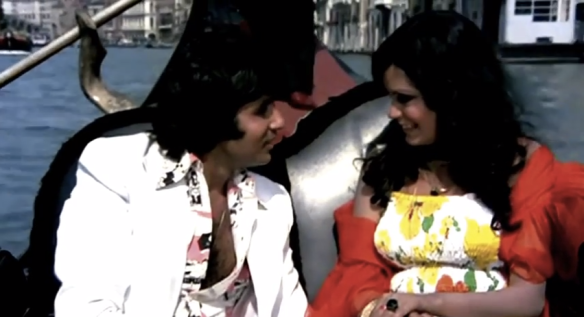
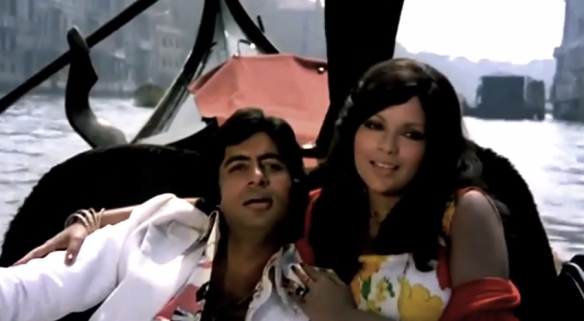
Amitabh Bacchan and Zeenat Aman share a romantic moment during a glamorous gondola ride shot in Venice, Italy for The Great Gambler (1979).

Today, we present the lyrics and English translation to an all-time hit song from The Great Gambler (1979): do lafzo.n kii hai dil kii kahaanii. Directed by Shakti Samanta, this action film starring Amitabh Bacchan in a dual role takes the audience on a cosmopolitan journey through a variety of exotic locales including Cairo, Rome, Lisbon, Amsterdam, and Egypt. While the film itself has not much to offer over other masala films released during this period of Hindi cinema, the soundtrack’s crowning gem do lafzo.n kii hai dil kii kahaanii is cherished by audiences to this day. In fact, watch Asha Bhonsle (at the age of 80!) dazzle the audience with this song here accompanied by the Metropole Orchestra at The Hague in 2013.

do lafzon kii hai dil kii kahaanii can be considered a natural successor to previous boat songs directed by Shakti Samanta, such araat ke humsafar  (An Evening in Paris, 1967) and chingaarii koii bhaDke (Amar Prem, 1972). The exotic picturization as well as the exquisite lilting melody make this song a stand-out among the other lackluster items found on the film’s soundtrack, which was composed by R.D. Burman and penned by Anand Bakshi. To infuse a dose of authentic Italian charm, the lyricist has included a few words of Italian in the song’s introduction–I’m certainly not an Italian expert, but my attempt at translating these lines is also presented below.

While the choice of veteran songstress Asha Bhonsle as the playback singer for heroine Zeenat Aman is no surprise, the choice of Sharad Kumar as the voice of the gondolier is rather interesting. Sharad Kumar Bader is an actor/singer who achieved fame in the late 1960s and early 1970s for his imitative renditions of songs originally performed by the one and only Elvis Presley. In addition to touring the globe for concerts where he sang Elvis numbers decked out in The King’s trademark jumpsuits, Sharad also received a break in Bollywood as an actor in films such as Paisa Ya Pyar (1969) and Zameen Aasman (1972) with the support of Shobhana Samarth (mother of actresses Tanuja and Nutan).  After his brief stint in the film industry, Sharad moved to Canada where he worked as an insurance agent and opened a vegetarian Indian food company called Zara’s Gourmet Kitchen with his wife Gita Bader. A colorful career path indeed!

What is your favorite foreign destination featured in a vintage Bollywood song? Let us know in the comments! Until next time…

-Mr. 55
Venice

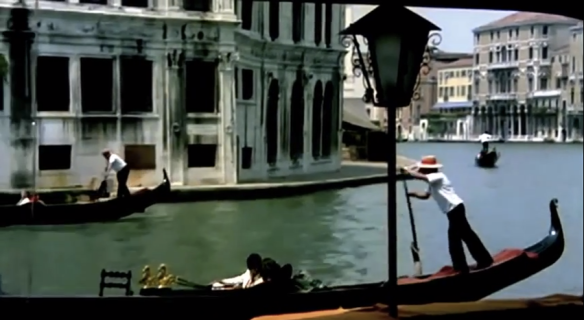
Venice’s Grand Canal and its rich tradition of gondoliering are featured prominently in this all-time fan favorite song.

Do Lafzon Ki Hai Dil Ki Kahani: Lyrics and Translation

Sharad Kumar: laa, laa, laa… amore mio, dove sei tu?
My love, where are you?
ti sto cercando, tesoro mio!
I am searching for you, my treasure!

Amitabh Bacchan: “amore mio, dove sei tu..”
ai kyaa gaa rahaa hai?
What is he singing?

Asha Bhonsle: apne pyaar ko yaad kar rahaa hai aur kah rahaa hai ki…
He is remembering his love and saying…

Amitabh Bacchan: na, na, na aise nahii.n! gaa ke sunaao na?
No, not like this! Sing it for me, won’t you?

Asha Bhonsle: gaa ke? acchhaa!
Sing it? Okay!

do lafzo.n kii hai dil kii kahaanii
The tale of my heart is only two words long.
yaa hai muhabbat, yaa hai javaanii
Is it love or is it youth?

Sharad Kumar: amore mio, il tempo vola
My love, time flies.
prendilo, prendilo, amore mio!
Catch it, catch it, my love!

Sdf

The on-screen chemistry shared by the leading pair serves as the backbone for this lighthearted, action-packed, and often nonsensical film.

Asha Bhonsle: dil kii baato.n kaa matlab na puuchho
Please don’t ask me the meaning of my heart’s words.
kuchh aur ham se bas ab na puuchho
Please don’t ask me anything now.
jis ke liye hai duniyaa diivaanii
What the world has gone mad for,
yaa hai muhabbat, yaa hai javaanii?
Is it love or is it youth?

yah kashTiivaalaa kyaa gaa rahaa thaa?
What was that gondolier singing about?
koii ise bhii yaad aa rahaa thaa
He was reminded of someone special
qisse puraane, yaade.n puraanii
along with old tales and old memories.
yaa hai muhabbat, yaa hai javaanii?
Is it love or is it youth?

is zindagii ke din kitne kam hai.n
The days of this life are limited in number.
kitnii hai.n khushiyaa.n aur kitne gham hai.n
they are filled with so much joy and so much sorrow.
lag jaa gale se, rut hai suhaanii
So embrace me, in this beautiful season.
yaa hai muhabbat, yaa hai javaanii
Is it love or is it youth?

do lafzo.n kii hai dil kii kahaanii
The tale of my heart is only two words long.
yaa hai muhabbat, yaa hai javaanii
Is it love or is it youth?

Glossary

lafz: word; kahaanii: tale; muhabbat: love; javaanii: youth; matlab: meaning; duniyaa: world; kashTiivaalaa: gondolier; qisse: tales; yaade.n: memories; khushiyaa.n: joy; gham: sorrow; gale se lag jaanaa: to embrace; rut: season; suhaanii: lovely, beautiful. 

venetian

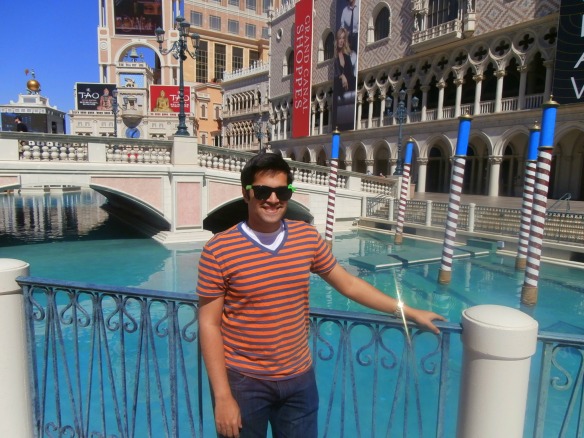
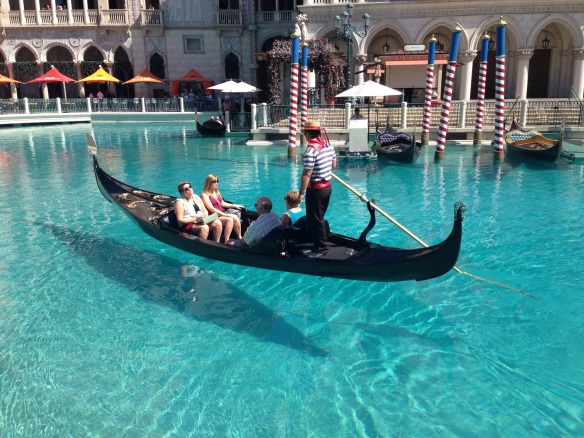
A glimpse of Italy at The Venetian hotel from my recent vacation to Las Vegas.

gondola

Vegas’s replica of the Grand Canal–complete with gondolier and Italian serenades!


Zindagi Ke Safar Mein Guzar Lyrics and Translation: Let’s Learn Urdu-Hindi

Rajesh Khanna regret aap ki qasam

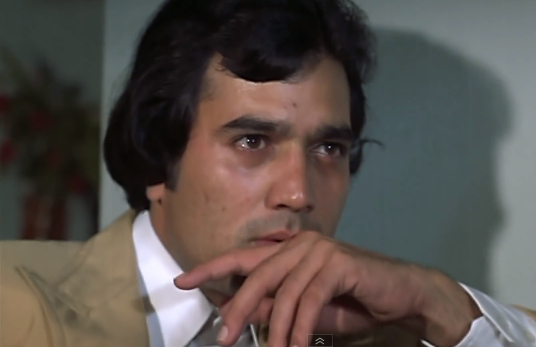
Rajesh Khanna reflects on the choices he made and the love he lost in Aap Ki Kasam (1974).

Happy New Year’s to all our fans and lovers of classic Bollywood! In the spirit of the holiday, we present the lyrics and full English translation to the thought-provoking “Zindagi Ke Safar Mein Guzar” from Aap Ki Kasam (1974). In this song, lyricist Anand Bakshi explores the regret of one man who loses his chance to spend time with the people he loves. Rajesh Khanna plays a successful businessman who neglects and mistrusts his loving wife Mumtaz, ultimately costing him his marriage and family. Wanting desperately to make amends, Khanna soon realizes he is unable to change the past. For anyone still thinking of a New Year’s Resolution, this Kishore Kumar hit is sure to inspire!

happier times with mumtaz in aap ki kasam

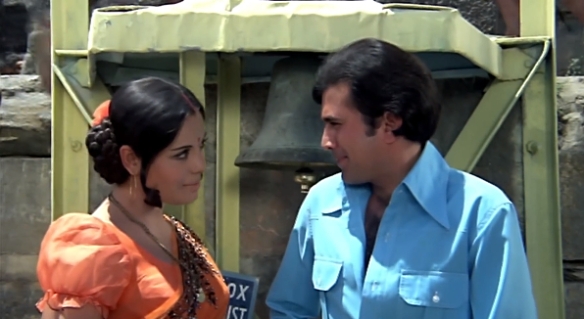
Ignoring the eyesore of Delhi that is Mumtaz’s horrendous puffy orange sari blouse, happier times once reigned for the estranged couple in Aap Ki Kasam (1974).

Like time itself, linear movement is the emphasis of director J. Om Prakash’s gorgeous mis-en-scène. From symbolic train tracks or plodding footsteps to fantasy-pixie Mumtaz’s unidirectional trajectory through the woods, Kishore Kumar’s rich vocals are underlined by a feeling of racing forward with no way of turning back. “Zindagi Ke Safar Mein” shines in stark contrast to the romantic “Karvaten Badalte Rahe” duet sung during a high-key moment of the film. Of equal importance, the song is also a textbook example of the Bollywood cliche demonstrating a strong correlation between despondency of the hero’s love life with the length of the hero’s beard.

rajesh khanna beard aap ki qasam

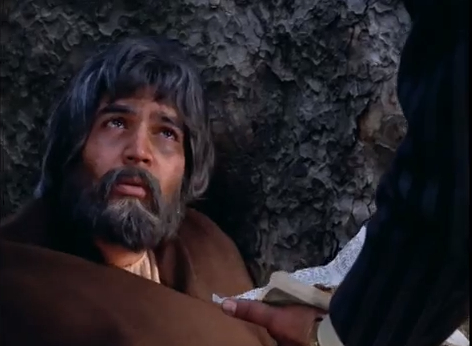
By the time “Zindagi Ke Safar Mein” finishes, Rajesh Khanna has spiraled into total despondency as evidenced by his increasing length of beard.

We hope that listening to this song may inspire you to appreciate the moments you have with your loved ones over the holidays. So take a break from the daily grind and let those people know how much you care–don’t be a Rajesh Khanna! You’ll find the lyrics and our English translation of the sentimental hit “Zindagi Ke Safar Mein Guzar Jaate Hai” from Aap Ki Kasam (1974) below. Follow along with the video on youtube and let us know YOUR New Year’s resolution in the comments!

Zindagi Ke Safar Mein Guzar Jaate Hai Lyrics and Translation:

Zindagii ke safar mei.N guzar jaate hai.N jo maqaam
Those places you pass in the journey of life
Woh phir nahii.N aate
They never return
Woh phir nahii.N aate
They never return

Phuul khilte hai.N, log milte hai.N
Flowers bloom, people meet
Magar patjhaD mei.N jo phuul muDjhaa jaate hai.N
But that flower which dies in Autumn
Woh bahaaro.N ke aane se khilte nahii.N
It does not bloom with the coming of Spring
Kuch log ek roz jo bichhaD jaate hai.N
Those people from whom you are separated one day
Woh hazaaro.N ke aane se milte nahii.N
A thousand others may come, but you will not meet them again
Umr bhar chahe koi pukaaraa kare unkaa naam
Even though you may call their names the rest of your life
Woh phir nahii.N aate
They never return
Woh phir nahii.N aate
They never return

rajesh khanna wanders aimlessly in aap ki qasam

Overcome with regret, Rajesh Khanna wanders aimlessly in Aap Ki Kasam (1974).

Aa.Nkh dhokaa hai, kya bharosaa hai?
Your eye deceives you, what is the truth?
Suno, dosto.N, shak dostii kaa dushman hai
Listen, friends, doubt is the enemy of friendship
Apne dil mei.N ise ghar banaane na do
Do not let doubt reside in your heart
Kal tadapnaa paDe yaad mei.N jinkii
Those people whose memories will torment you tomorrow
Rok lo rooThkar, unko jaane na do
Stop them when they are upset, do not let them leave
Baad mei.N pyaar ke chahe bhejo hazaaro.N salaam
For later, even though you may wish to greet them with love a thousand times
Woh phir nahii.N aate
They never return
Woh phir nahii.N aate
They never return

mumtaz fantasy

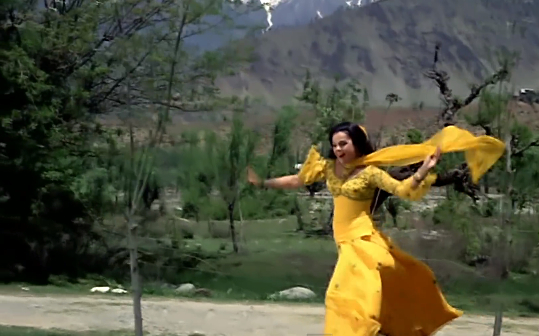
In epic slow-motion, Mumtaz prances through the forest of Rajesh Khanna’s fantasy, chunni billowing in the wind.

Subaah aatii hai, raat jaatii hai
Morning comes, the night departs
Yuu.n hii waqt chaltaa hii rehtaa hai, ruktaa nahii.N
In this manner, time marches on, it does not stop
Ek pal mei.N yeh aage nikal jaata hai
In a single moment, time moves forward
Aadmi Theek se dekh paataa nahii.N
Man is unable to see this well
Aur parde pe manzar badal jaata hai
And the view continues to change
Ek baar chale jaate hai jo din raat subaah shaam
But once those days and nights, and those mornings and evenings pass
Woh phir nahii.N aate
They never return
Woh phir nahii.N aate
They never return

Zindagii ke safar mei.N guzar jaate hai.N jo maqaam
Those places you pass in the journey of life
Woh phir nahin aate
They never return
Woh phir nahin aate
They never return

Glossary:

zindagii: life; safar: journey; guzar jaanaa: to pass, maqaam: place, landmark, milestone; phuul: flower; log: people; patjhaD: Autumn; muDjhaanaa: to become destroyed; bahaar: Spring; khilnaa: to bloom; ek roz: one day; bichhaD jaanaa: to become separated; hazaar: a thousand; umr bhar: whole life; pukaarnaa: to call; naam: name; aa.Nkh: eye; dhokaa: deception, trick; bharosaa: trust; shak: doubt; dostii: friendship; dushman: enemy; ghar: home; taDapnaa: to torment, to flutter; yaad: memory; roknaa: to stop; rooThna: to be upset; jaanaa dena: to let someone leave; baad mei.N: later on, bhejnaa: to send; salaam: greeting; subaah: morning; raat: night; yuu.N hii: in this manner, like this; waqt: time; pal: moment; aadmi: man; thiik se: properly, well; pardaa: veil, [in this case, a movie screen]; manzar: view; badal jaanaa: to change; ek baar: once, one time; din: day; shaam: evening

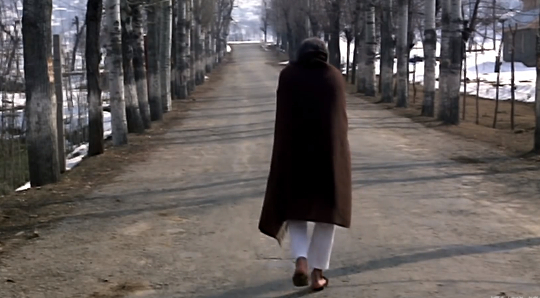
Rajesh Khanna walks away from the camera

In my favorite shot of the film, Rajesh Khanna walks away from the camera, leaving the viewer alone in the cold Winter morning in Aap Ki Kasam (1974).

For the Urdu snobs, you may note that the plural of the multi-layered term maqaam is technically maqaamaat. The suffix –aat is necessary to denote plurality of certain vocabulary with an Arabic origin, however modern Hindustani often omits this mark of purist pretension–particularly when it would throw off a song’s rhyming scheme! But if you’re quick, you’ll still hear it used in classic film dialogues. Other examples include:

kaaghazaat (pieces of paper)
zevaraat (jewels)
makaanaat (stores)
jawaharaat (rubies)
ma’luumaat (information)

Zindagi Ke Safar Mei.N” was requested by fan Agar Raheem. Our resolution for the New Year is to keep up quicker with requests from fans! If you haven’t seen your request in one of our blog posts yet, don’t worry–it’s coming! Thank you for the fantastic year we’ve had together, and our best wishes for a joyful and prosperous 2014!

Old Classic Bollywood Save the Date!

2014 is going to be a particularly memorable year for us because Mrs. 55 is getting married! Get ready because, you guessed correctly, it’s going to be a classic Bollywood-themed wedding!

-Mrs. 55

Dum Maro Dum Lyrics and Translation: Let’s Learn Urdu-Hindi

Zeenat Aman Dev Anand Dum Maro Dum

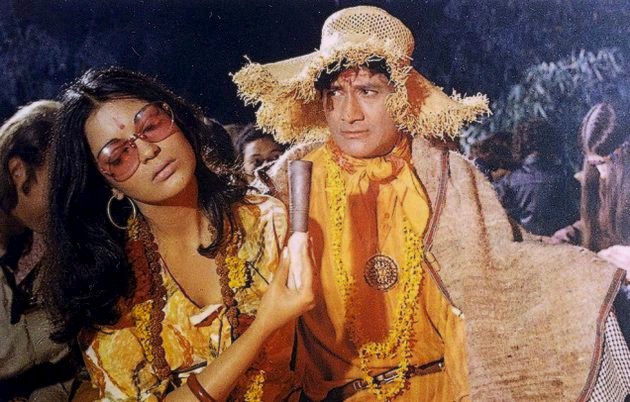
Zeenat Aman becomes shamelessly intoxicated in front of her brother Dev Anand in Hare Rama Hare Krishna (1971). More importantly, can someone please burn that hideous floppy straw hat?

Our next lyrics and English translation is the epitome of youthful rebellion and psychadelic glamour: “Dum Maro Dum” from Dev Anand’s 1971 Hare Rama Hare Krishna. The translation could not have come at a more appropriate time–as many of you know, as of 2 weeks ago, medical marijuana is now legalized in Massachusetts. So to all the Harvard seniors getting ready to graduate in a few months, this song is for you! When people think of Asha Bhonsle at her craziest, “Dum Maro Dum” is often the song that comes immediately to mind. It’s seductive, eccentric, and exhibits her full range from those bizarre, unexpected high notes to the fabulous embodiment of character as only Asha knew how. It’s one of incomparable music director R.D. Burman’s greatest works for the ground he broke–putting illicit drugs and societal defiance to the forefront in a youth-targeted song that was so instantly catchy no one could brush it off. Let’s face it, with this song, Zeenat may represent everything we don’t want in our loved ones, but God, does she make it look appealing.

Zeenat Aman Hare Rama Hare Krishna

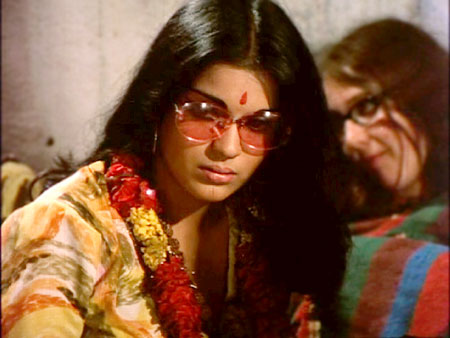
Gorgeous Zeenat Aman sports a pair of show-stopping 70s shades as a drug addict in Hare Rama Hare Krishna (1971).

Shot in one of Dev Anand’s favorite locations, Kathmandu (remember Jewel Thief, anyone?), Hare Rama Hare Krishna is a politically-driven film against the subversive hippie culture that our hero believes to be distorting the true message of the Hindu ideals it pretends to preach. Dev Anand hunts down his long-lost sister in such a hippie camp and tries to extricate her with tragic results. The film delivers a powerful message without feeling like Manoj Kumar-eqsue patriotic propaganda. I really applaud Dev Anand for making such a bold film that critiques a subject so ignored by his contemporaries and so popular among the masses who bought into it–with a delightfully satirical name like Hare Rama Hare Krishna, the film was a risk and it paid off.

So enjoy our English translation and lyrics to “Dum Maro Dum” below! Follow along with the video and let us know your thoughts on this controversial smash hit in the comments! You know how Zeenat starts the song with a little “Hush!” just before the music starts? I can’t exactly explain why, but I always feel really awkward when I hear it.

Dum Maro Dum Lyrics and Translation

Dam maaro dam miT jaaye gham
Take another hit, all your worries will disappear
Bolo subah shaam hare krishna hare raam
From morning until night sing, “Hare Krishna Hare Ram!”

Duniyaa ne hum ko diyaa kyaa?
What has the world given us?
Duniyaa se hum ne liyaa kyaa?
What have we taken from the world?
Hum sab kii parwaa kare.N kyo.N?
Why should we worry about anyone?
Sab ne humaaraa kiyaa kyaa?
What has anyone does for us?
Dam maaro dam miT jaaye gham…

Chaahe jiye.Nge, mare.Nge
Whether we want to live or to die
Hum na kisii se Dare.Nge
We won’t be afraid of anyone
hum ko na roke zamaanaa
The world won’t be able to stop us
Jo chaahe.Nge hum kare.Nge
For we will do what we want

Dam maaro dam miT jaaye gham
Take another hit, all your worries will disappear
Bolo subah shaam hare krishna hare raam
From morning until night sing, “Hare Krishna Hare Ram!”

Glossary:

dam maarnaa: to take a hit [of marijuana]; miT jaanaa: to disappear; gham: sadness, worries; subah shaam: from morning to night; Hare Krishna Hare Raam: a chant of the Hare Krishna sect popularized by the hippie culture in the 60s and 70s; duniyaa: society, the world; parwaa: worry; zamaanaa: the world

Zeenat Aman Dum Maro Dum

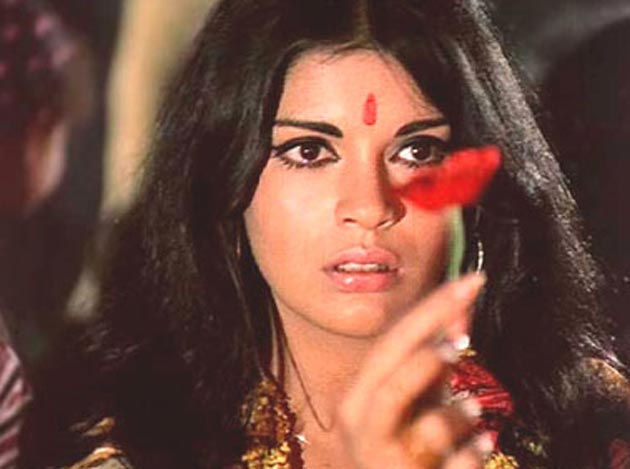
Zeenat Aman suddenly remembers her idyllic drug-free childhood with an emotional outburst of regret in Hare Rama Hare Krishna (1971).

For the sake of completeness, I feel compelled to include a translation of Dev Anand’s great comeback to the moral disorder he witnesses among the Hare Krishnas: “Dekho O Diwaano.” “Dekh O Diwano” and indeed the film Hare Rama Hare Krishna, is not a direct attack on the actual Hare Krishna movement, but rather the hippie culture that traveled with it in the 60 and 70s–and by blending the two, confused and disheartened many a contemporary conservative Hindu. Dev Anand makes some brilliant comparisons through example in this song–by drawing upon classic Hindu literature such as the Ramayan story of Lord Ram’s banishment to the forest (“Ram ne ha.Ns kar sab sukh tyaage“) and Krishna’s explanation to Arjun of the meaning of karma in the timeless battlefield of the Mahabharat (“Krishna ne karm ki riit sikhaayi“), Dev Anand makes a clear distinction between lip service and actual belief.

Dekho O Deewano Lyrics and Translation:

Dekho O deewano, tum yeh kaam na karo
Look, Oh crazy people, do not behave like this
Raam kaa naam badnaam na karo
Do not bring dishonor to the name of Ram

Raam ko samjho, Krishna ko jaano
Understand Ram, know Krishna well
Nee.Nd se jaago, O mastaano
Wake up from this sleep, Oh intoxicated ones
Jeet lo man ko paDh kar Geeta
Win back your mind by studying the Geeta
Man hii haaraa, to kyaa jeetaa?
For once you’ve lost your mind, what is there to win?

Hare Krishna, Hare Ram
Jeevan ko nashe ka tum ghulaam na karo
Do not make your life a servant to intoxications
Raam kaa naam badnaam na karo
Do not bring dishonor to the name of Ram

Raam ne ha.Ns kar sab sukh tyaage
With a smile, Ram renounced all his joys
Tum sab dukh se Dar ke bhaage
But you are scared and run away from every grief
Krishna ne karm kii riit sikhaaii
Krishna taught us the tradition of righteous action
Tum ne farz se aa.Nkh churaayii
But you avoid your duties

Hare Krishna, Hare Ram
Jeevan naam hai kaam kaa aaraam na karo
The meaning of life is work, do not rest
Raam kaa naam badnaam na karo
Do not bring dishonor to the name of Ram

Glossary:

badnaam: dishonored; tyaagnaa: to renounce; nee.Nd: sleep; Geeta: the Bhagavad Gita, a religious text within the epic poem the Mahabharat; jeevan: life; nashe: intoxications; ghulaam: servant; riit: culture, tradition; farz: duty; aa.Nkh churaanaa: to avoid; aaraam karna: to rest

While Zeenat Aman and her fellow groupies waste their minds and lives to drugs in the name of Lords Ram and Krishna, Dev Anand reminds the audience of the wrong of even inaction as discussed in the Gita. Classical Hindu dharmic responsibility is not passive, but active and tempered–with no stake in the outcome whether happiness or sadness. It is an ancient theme that you may recall Dev Anand explored years earlier in his 1965 legend Guide. Sadly, Zeenat Aman eventually succumbs to her addiction, and in the end the story returns briefly to the heart of many a great film: a tale of a broken family reunited.

These themes can certainly be pretty volatile subjects, and it’s not our intention to spark a political or religious debate on this forum. So we shall end with a grammar lesson instead: do you know why the “deewaano” and “mastaano” are used instead of simply “deewaane” or “mastaane”? The vocative as used here is a special case! The nasalization “o.N” used in the oblique (eg. “dosto.N ke saath”) is not to be confused with the vocative “o” (eg. “suniye, dosto”) used to address a group directly! People commonly make this sloppy Urdu mistake–so rise above the masses!

But don’t go that high, if you know what I mean. Have fun, Massachusetts.

-Mrs. 55