Deewana Hua Badal Lyrics and Translation: Let’s Learn Urdu-Hindi

Sharmila Tagore Kashmir ki Kali

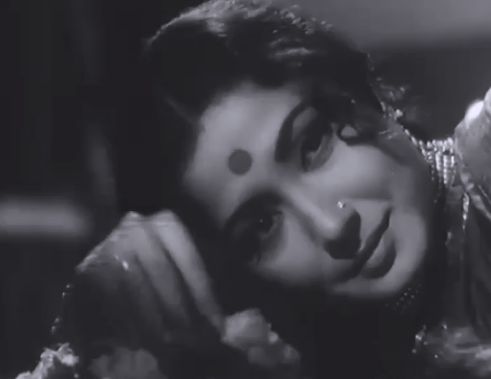
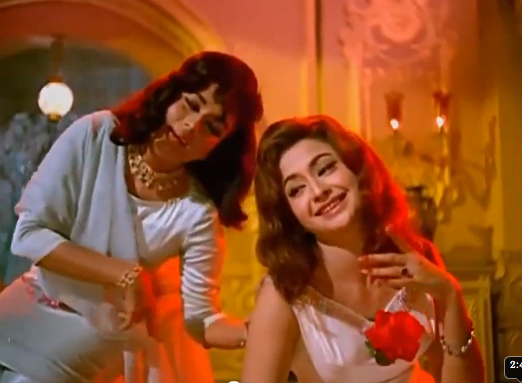
Sharmila Tagore plays a shy Kashmiri village girl in Kashmir ki Kali (1964)

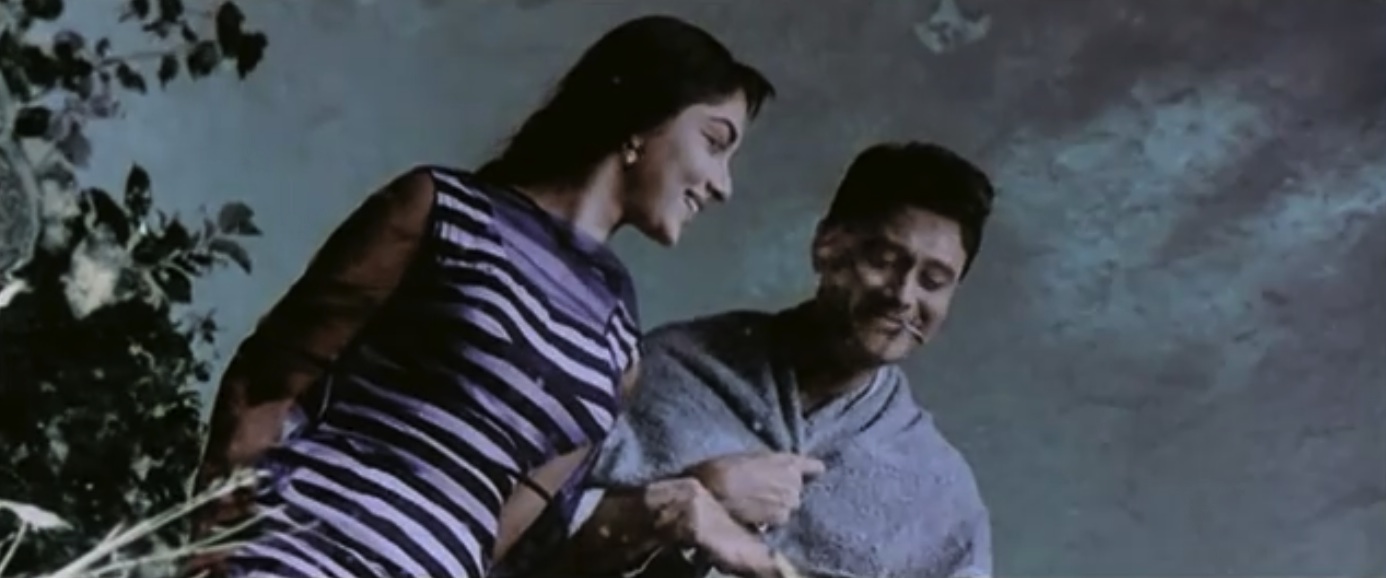
Next we present the full lyrics and English translation to the jewel “Deewana Hua Badal” from Kashmir Ki Kali (1964). A beauty of beauties, “Deewaana Hua Badal” embodies the timeless dream of Kashmiri paradise. This charming duet by Mohammed Rafi and Asha Bhonsle is the highlight of the film Kashmir Ki Kali (1964), starring Shammi Kapoor and Sharmila Tagore. With a gently uplifting melody and traditional orchestration, “Deewana Hua Badal” captures a sense of pure bliss in the surroundings of the beautiful Kashmiri mountainside. Shammi Kapoor follows his lover Sharmila Tagore to the base of the famous Dal Lake where lotus flowers bloom and intricate wooden houseboats line the banks.

For centuries, Indians have been entranced by that heavenly treasure, Kashmir. Mughal emperor Jahangir famously wrote of Kashmir in the 17th century,

Gar firdaus ruhe zameen ast,
Hameen asto, hameen asto, hameen ast.”

“If there is Paradise on this Earth,
Then it is here, it is here, it is here…”

And classic Bollywood was no different. For years, all love dream sequences and the most beautiful of songs were set in Kashmir’s Shalimar gardens. Kashmir Ki Kali is but one of many films set in this paradise from that time period–before internal war and strife drove filmmakers away from Srinagar to the Swiss mountains. Being partly Kashmiri myself, I can attest to the sublimity of the countryside and what the natural beauty means to its people and history. The politics and tragedies that have plagued this gem are completely beyond the scope of this blog, but regarding its impact on Bollywood, Kashmir will remain forever the lover’s ideal.
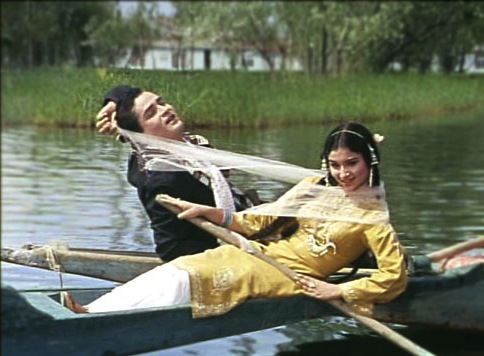
Sharmila Tagore and Shammi Kapoor Kashmir Ki Kali Dal Lake

The famous Dal Lake of Srinagar, Kashmir is the gorgeous backdrop for “Deewana Hua Badal” from Kashmir Ki Kali (1964).

If I’m ever making a list of my favorite Bollywood songs, “Deewana Hua Badal” IS my number one choice. Since I was a little girl, this enchanting song found a special place in my heart. In fact, my own grandparents honeymooned in Srinagar by the famous Dal Lake in the early 1950s! When you listen to the sweetness of this song’s lyrics and melody, then imagine the paradise of vintage Kashmir, it’s easy to fall to in love! Please enjoy our full lyrics and English translation to “Deewana Hua Badal” below!

Deewana Hua Badal Lyrics and Translation: Let’s Learn Urdu-Hindi

Male:
Yeh dekh ke dil jhuumaa
Upon seeing her, my heart swayed
Lii pyaar ne a.NgaDaaii
And love sprang forth
Diiwaanaa huaa baadal
The clouds became mad with love
Saavan kii ghataa chhaaii
The rain clouds of Spring abounded

Aisii to merii taqdiir na thii
My fate was once not as such
Tumsaa jo koii mehboob mile
To have met a lover like you before
Dil aaj khushii se paagal hai
Today my heart is crazy with happiness
Aye jaan-e-wafaa tum khuub mile
Oh my faithful one, we met at the right time
Dil kyuu.N na bane paagal?
Why should my heart not go crazy?
Kyaa tumne adaa paaii!
What style you have!
Yeh dekh ke dil jhuumaa
Upon seeing her, my heart swayed
Lii pyaar ne a.NgaDaaii
And love sprang forth
Diiwaanaa huaa baadal
The clouds became mad with love

Female:
Jab tumse nazar takaraaii sanam
Ever since my gaze struck you
Jazabaat kaa ek tuufaan uThaa
A storm of emotions lifted within me
Tinake kii tarah mai.N Bah nikalii
Like a twig, I was swept away
Sailaab mere roke na rukaa
Despite my effort, I could not stop the flood
Jeevan mei.N machii halchal
There was a stirring in my soul
Aur bajane lagii shahanaaii
And music of the shahanaii began to play
Yeh dekh ke dil jhuumaa
Upon seeing him, my heart swayed
Lii pyaar ne a.NgaDaaii
And love sprang forth

Male
Diiwaanaa huaa baadal
The clouds became mad with love

Hai aaj naye armaano.N se
Today with new desires
Aabaad merii dil kii nagarii
The city of my heart is filled
Baraso.N se khizaa.N kaa mausam thaa
For ages it was the season of Autumn
Viiraan baDi duniyaa thi merii
My world was a barren waste
Haathon mei.N teraa aanchal
Then in my hands came the drape of your saari
Aayaa ki bahaar aayii!
And when it came, the Spring followed!
Yeh dekh ke dil jhuumaa
Upon seeing her, my heart swayed
Lii pyaar ne a.NgaDaaii
And love sprang forth

Female:
Diiwaanaa huaa baadal
The clouds became mad with love
Saavan kii ghataa chhaaii
The rain clouds of Spring abounded
Yeh dekh ke dil jhuumaa
Upon seeing him, my heart swayed
Lii pyaar ne a.NgaDaaii
And love sprang forth

Male:
Diiwaanaa huaa baadal…

Glossary

angaDaaii: a turn, a leap; diiwaanaa: crazy (in love); baadal: cloud, saawan: rain; ghataa: cloud; taqdiir: Fate; mehboob: lover; khushii: happiness; paagal: crazy; jaan-e-wafa: faithful one; nazar takraanaa: to strike a gaze; jazabaat: emotion; tuufaan: storm; tinake: twig; straw; sailaab: flood, deluge; halchal: stirring; shahanaaii: a woodwind instrument traditionally played at Indian weddings; armaan: desire; aabad: filled; nagarii: city; khizaa: Autumn; mausam: atmosphere; viraan: wasted; duniya: world; aanchal: drape of a saari or dupatta; bahar: Spring

A few notes on this translation: The word angaDaaii does not have a simple English translationPlease see our translation of Likhe Jo Khat Tujhe for further discussion of this complex word. Basically, all of those awkward stretching movements Shammi is doing in the beginning are examples of angaDaaii. Furthermore the line “deewana hua baadal…” can be interpreted in two ways! Although we have written “the clouds became mad with love,” this line could easily mean the inverse: that he who is mad with love became a cloud. This alternative meaning could make some sense–he felt so light and happy with love that he lifted up and joined the clouds. I’m not going to get carried overboard though. We will leave it up to you to decide to how interpret these famous opening lines!

Shammi Kapoor Kashmir ki Kali

Shammi Kapoor blushes and shimmies during the opening of “Deewana Hua Badal” from Kashmir Ki Kali (1964).

Some of you may question the opening performance by Shammi Kapoor in this song. Yes, he’s absurd as he comes tumbling down the stairs, bulging out of his tight clothes. Yes, his lipstick is a tad too red. And yes, you can see the line below his chin where Costumes forgot to blend his pasty white pancake foundation into his neck. But I’ve come to terms with everything Shammi is: a spastic, messy heartthrob. And since in this film, Sharmila Tagore isn’t wearing half of the sweeping cat-eyeliner that would later become her signature, someone had to wear enough make-up for the team!

– Mrs. 55
Main Zindagi Ka Saath Nibhata Lyrics and Translation: Let’s Learn Urdu Hindi

Dev Anand Hum Dono Main Zindagi Ka Saath

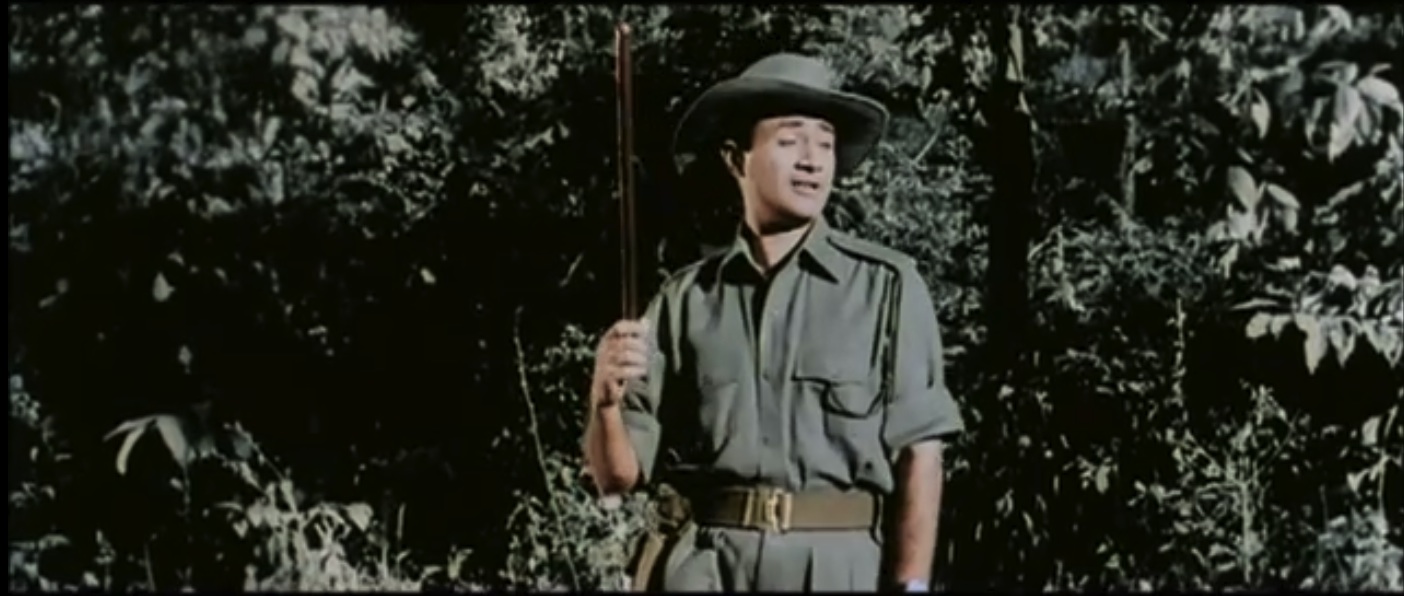
Dev Anand plays a philosophical military officer in Navketan Films’ all-time hit Hum Dono (1961)

We now present the full lyrics and English translation to the evergreen Mohammed Rafi solo, “Main Zindagi Ka Saath Nibhata” from the film Hum Dono (1961). As we know, Hum Dono was released in colour last year by the late film legend Dev Anand, and newly entitled Hum Dono Rangeen. The film joins a string of recently re-colourized classics such as Mughal-e-Azam (1961) and Naya Daur (1957), riding the wave of India’s general excitement to enter previously unexplored technologies in film-making–from animation to digital special effects. The amount of work that goes into a recolourization of a film is amazing–particularly a 3 hour Hindi epic. Imagine hand-painting a single frame from the film: First, you must decide which colours would best match the director’s intention and the styles of the time. Then painstakingly painting the colours onto the frame that follow to exactly match the hue of the one before, making allowances for natural shifts of shadows and lighting as the actors move. When you remember that it takes 24 frames to make 1 second of a film, you can realize the enormity of the job ahead.

Dev Anand Sadhana Hum Dono

Dev Anand imagines Sadhana appearing next to his reflection in a pool of water.

Additionally, apart from adding a splash of colour, it would seem the new editors also altered the aspect ratio of the film into a widescreen presentation. Throughout some of the songs, you’ll also see Dev Anand had added fancy fades to and from black, which are definitely classy. However, I mourn the loss of the original aspect ratio–because the film is now made for the widescreen, a portion of the frame’s top and bottom have been cut off. A bit of the magic was cut too.

But even without these external alterations, the original beauty of the film has shone for decades. Hum Dono is a war film, but the story is not strictly about war. Dev Anand plays a dual role in the film and faces a moral dilemma when he impersonates the identity of his look-alike after the latter’s presumed death. Every action he makes has spiraling and exciting ethical repercussions. The film is one of the finest Bollywood has ever produced, and like most Dev Anand films, boldly explores difficult social themes and relationships. My only regret is that it’s obviously a twin story that no one bothered to explicitly state in the script. It’s a big gripe of mine about Bollywood twin movies, and for one of the worst examples of it, Haseena Maan Jaayegi, see our previous post on Bekhudi Mein Sanam!

Dev Anand hum Dono Main Zindagi Ka Saath 2

Dev Anand in full military dress from Hum Dono (1961)

But the greatest achievement of Hum Dono is in its music by Jaidev. Every single song in its soundtrack is pure gold, from the Rafi-Asha love duet “Abhi Na Jaao ChoD Kar” to the majestic Lata devotional “Allah Tero Naam.” The sweet melodies of Hum Dono have remained popular today, and amongst them is the sentimental mood-lifter “Main Zindagi Ka Saath Nibhata Chala Gaya.” In it, Dev Anand expresses many of the philosophies that would present in his later films such as Guide (1965). The Vedic-inspired line “gham aur khushi ke farq na mehsuus ho jahaan” allows the hero a carefree outlook that is unusual and refreshing for a jaded military officer. Because of it, this song has retained its popularity over the years. Of interesting note, Hindi movies were not allowed to use authentic Indian Army officer outfits for their costumes. So for anyone familiar with period military wear in India, you’ll notice the epaulette on the shoulder has been adjusted so it is not an exact replicate of what was actually worn!

Check out the youtube link here, and follow along with us below for full lyrics and English translation of “Main Zindagi Ka Saath“!

Main Zindagi Ka Saath Nibhata Lyrics and Translation

Mai.N zindagii ka saath nibhaataa chalaa gayaa
I faithfully followed wherever life took me
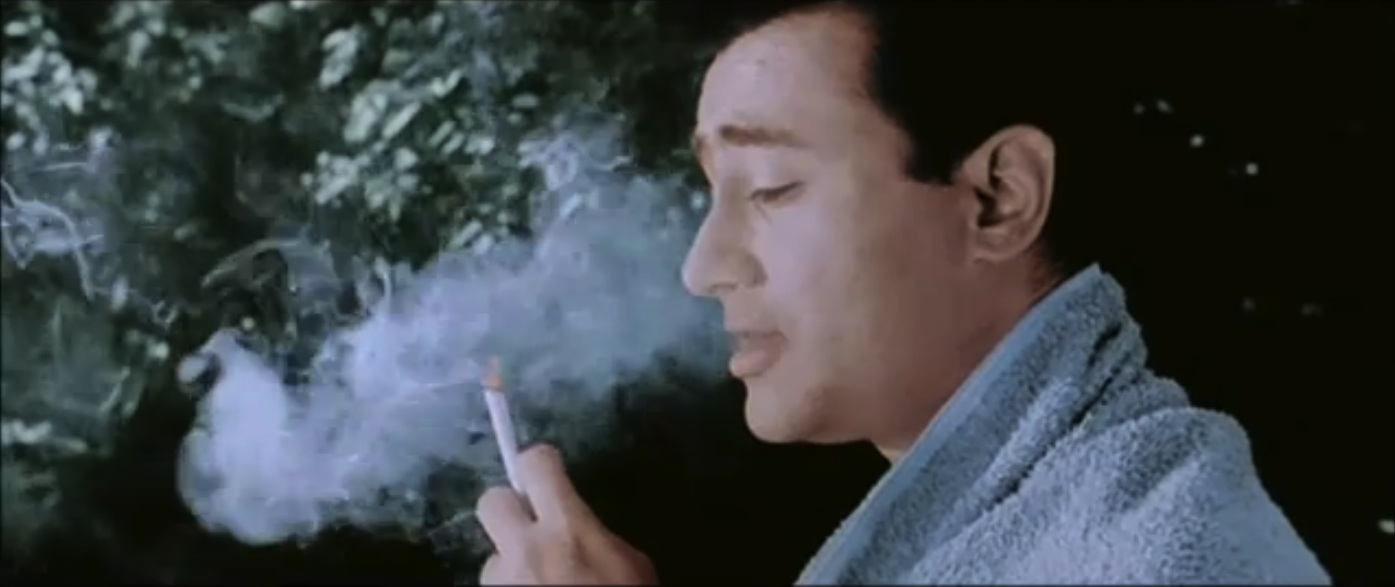
Har fikr ko dhuei.N mei.N uDaataa chalaa gayaa
I blew every worry into a mist of smoke

Barbaadiyo.N ka shok manaanaa fizuul tha
It was pointless to grieve about my destruction,
Barbaadiyo.N ka jashn manaataa chalaa gayaa
So I kept making a celebration of my destruction!
Har fikr ko dhuei.N mei.N uDaataa chalaa gayaa
I blew every worry into a mist of smoke

Jo mil gayaa usii ko muqaddar samajh liyaa
Whatever came my way I considered to be my destiny
Jo kho gayaa mei.N usko bhulaataa chalaa gayaa
Whatever was lost to me, I kept putting out of my mind.
Har fikr ko dhuei.N mei.N uDaataa chalaa gayaa
I blew every worry into a mist of smoke

Gham aur khushi mei.N farq na mehsuus ho jahaa.N
That state where happiness and sorrow are indistinguishable
Mai.N dil ko us muqaam pe laataa chalaa gayaa
That realm is where I kept pushing my heart
Har fikr ko dhuei.N mei.N uDaataa chalaa gayaa
I blew every worry into a mist of smoke

Glossary:

zindagii: life; fikr: worry; dhuuei.N; smoke; barbaad: destruction; shok manaanaa: grieve; fizul: pointless; jashn: celebration; muqaddar: destiny, fate; bhulaanaa: to forget gham: sadness; khushi: happiness; farq: difference mehsuus: feeling; muqaam: realm

Dev Anand Hum Dono Main Zindagi Ka Saath

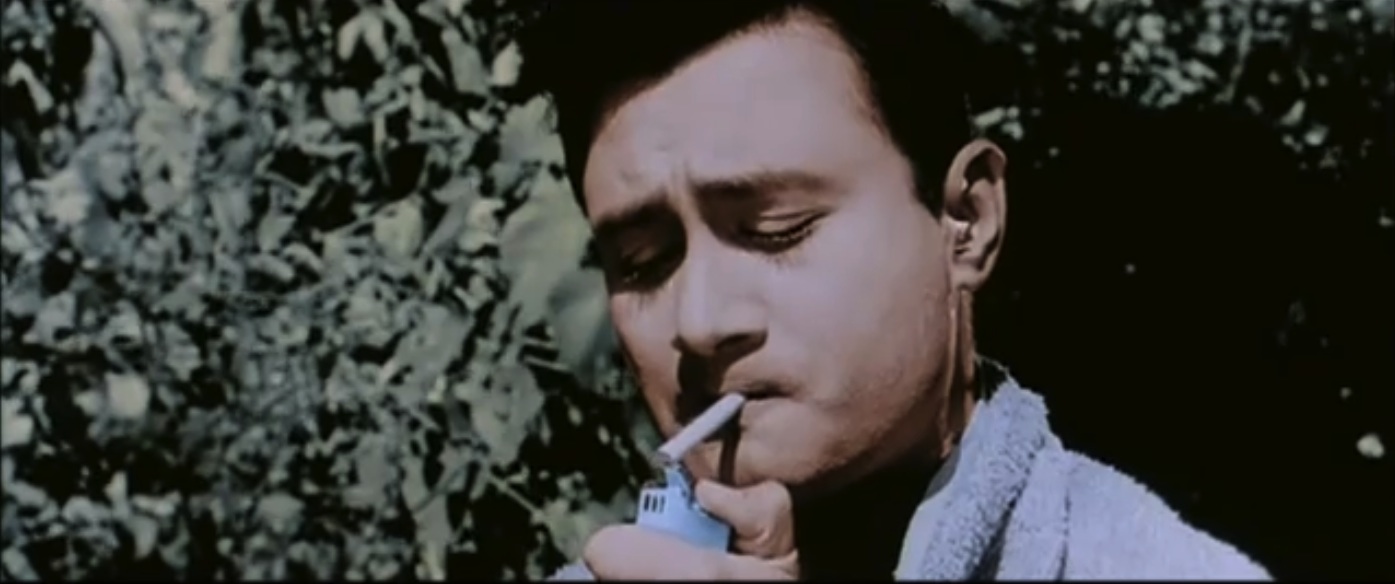
Dev Anand blows all his worries away in a puff of smoke in Hum Dono (1961)

The gentle chiming at the beginning of the song can also be found at the very end of “Abhi Na Jaao ChoD Kar” from the same film. Nice, Jaidev. Nice. This song translation was made by special request from our fan Bhuvesh! We always welcome requests from our readers, so don’t forget to drop us a line!

– Mrs. 55

Jis Gali Mein Tera Ghar Na Ho Balma Lyrics and Translation: Let’s Learn Urdu-Hindi

Rajesh Khanna serenades Asha Parekh in one of Hindi cinema’s most treasured boat songs from Kati Patang (1970)

If you’ve been following the latest news about Bollywood stars (as you should be), you might be aware of the fact that Rajesh Khanna has been hospitalized recently for exhaustion and a stomach infection. In light of this news, I thought I’d share one of my favorite songs picturized on the Bombay superstar and send along our best wishes for a speedy recovery. Below, I’ve provided the lyrics and a translation for “jis galii me.n teraa ghar na ho baalma,” a beautiful number sung by Mukesh in Kati Patang (1970).

Mukesh singing for Rajesh Khanna? Blasphemy, you might say. As we all know, Kishore Kumar was officially the playback voice for India’s beloved ‘Kaka,’ and you might hear a pairing with Mohammed Rafi on occasion. But a Mukesh song picturized on Rajesh Khanna, let alone a popular one, is quite rare indeed.

In spite of the unconventional pairing, this song from Kati Patang is an all-time classic that has been cherished by fans of Hindi cinema over the years. The beauty in the simplicity of Anand Bakshi’s lyrics here is striking. Expressing the the theme of selflessness in love, these lyrics are unique when placed into context of the film. Rajesh Khanna’s character uses this song to profess his love for Asha Parekh, a woman pretending to be a widow after fleeing the altar. At a time when societal norms prevented such women from marrying again, using such romantic lyrics to describe the love between a man and an ostensible widow is a bold move. In his inimitable style, Mukesh gives one of his career’s best performances as he sings these lyrics with sincerity and a tinge of melancholy.  To top it all off, R.D. Burman composes a simple, yet touching melody that does justice to the beauty of these lyrics. Enjoy this poignantly crafted declaration of love with our glossary and translation below!

-Mr. 55

Playing the role of a supposed widow, Asha Parekh wears a white sari throughout most of this film.

Jis Gali Mein Tera Ghar Na Ho Balma: Lyrics and Translation

jis galii me.n teraa ghar na ho baalma
Any  street on which your house does not reside
us galii se hame.n to guzarnaa nahii.n
is not a street that I shall traverse.
jo Dagar tere dvaare pe jaatii na ho
Any path that does not lead to your door
us Dagar pe hame.n paa.nv rakhnaa nahii.n
is not a path on which I shall set foot.

zindagii me.n kaii rangraliyaa.n sahii
In my life, there have been many colorful celebrations.
har taraf muskuratii ye kaliyaa.n sahii
In every direction, there are smiling flowerbuds
khuubsurat bahaaro.n kii galiyaa.n sahi
and many beautiful views of springtime.
jis chaman mei.n tere pag me.n kaa.nTe chubhe.n
Yet, the garden in which thorns pierce your feet 
us chaman se hame.n phuul chunnaa nahii.n
is not a garden from which I shall pick flowers.

haa.n ye rasme, ye qasame.n sabhii toD ke
Yes, after having broken these rituals and vows,
tu chalii aa chunar pyaar kii oDh ke
please come to me, flying your scarf of love in the air.
yaa chalaa jaauu.nga mai.n yah jag chhoD ke
Or else, I shall go away and leave this world.
jis jagah yaad terii sataane lage
The place where your memories begin to torture me
us jagah ek pal bhii Thaharana nahii.n
is not a place where I shall spend a single moment.

jis galii me.n teraa ghar na ho baalma
Any  street on which your house does not reside…

Glossary

galii: street, alley; baalma: beloved; Dagar: path; dvaaraa: door; rangraliyaa.n: colorful celebrations; kaliyaa.n: flower buds; chaman: garden; pag: foot; chubhnaa: to pierce; rasm: ritual, ceremony; qasam: vow; chunar: scarf; jag: world; sataanaa: to torture.

Rajesh Khanna charms the audience with his characteristic smile.

This song was filmed on site at Lake Nainital in Uttarakhand, India.

Ab Kya Misal Doon Lyrics and Translation: Let’s Learn Urdu-Hindi

Pradeep Kumar Aarti 1962

Pradeep Kumar sings an Urdu love poem to Meena Kumari in Aarti (1962)

The next English translation in our series is of the poetic lyrics to “Ab Kya Misal Doon” from Aarti (1962). This timeless song is one of Bollywood’s most beloved romantic odes by Mohammed Rafi. Pradeep Kumar, Meena Kumari, and Ashok Kumar star in Aarti, a family drama of love, debts, and vengeance. Ashok Kumar plays a wealthy surgeon and the villain of the film, vowing revenge when his betrothed, Meena Kumari, marries another man, Pradeep Kumar. An exacting dilemma of the film comes when ironically Ashok Kumar must decide whether or not to push aside his emotional battles and perform surgery on his own rival Pradeep Kumar to save his life. Of course, Meena Kumari throws in some more drama into the bargain–and her quiet beauty steals the show yet again. Aarti has a number of great songs written by Majrooh Sultanpuri, but unarguably the greatest is the sweet Mohammed Rafi ballad “Ab Kya Misal Doon.”

Pradeep Kumar plays “the other man” in the film–a good-hearted, but unemployed poetic dreamer who croons softly to Meena Kumari in this number. It would put any girl in a tough position: the poetry of the song is exquisite, without overwhelming anyone with an Urdu vocabulary exam. It has just the right blend of tenderness, lyricism, and adoration made magical by the unequivocal talent of Mohammed Rafi. Follow along on youtube here and enjoy our English translation of this poetic masterpiece!

Meena Kumari in Aarti 1962

Meena Kumari blushes as she hears Pradeep Kumar singing her praises in Aarti (1962)

Ab Kya Misal Doon: Lyrics and Translation

Ab kyaa misaal doon mei.N tumhaare shabaab ki
What can I now compare to your lustre?
Insaan ban gayee hai kiran mahtaab kii
You are a ray of the moon in human form

Chehre mei.N ghul gayaa hai haseen chaandni ka noor
The beautiful light of the moon has melted upon your face
Aankho.N mei.N hai chaman ki jawaan raat ka suroor
In your eyes is the garden of the early night’s joy
Gardan hai ek jhuki hui daali gulab kii
Your neck is like a lowered branch of a rose flower
Ab kyaa misaal doon…
What can I compare now…

Gesu khule to shaam ke dil se dhuan uThe
When your hair was let open, then the smokiness of night emerged from my heart
Chhule qadam to jhuk ke na phir aasmaan uThe
When your feet hit the ground, the sky bowed down would not raise itself again
Sau baar jhilmilaaye shamaa aftaab kii
The light of this sun sparkled a hundred times
Ab kyaa misaal doon…
What can I compare now…

Deewar-o-dar kaa rang, yeh aanchal, yeh pairhan
The end of your saarii and your robes are the colours of my refuge
Ghar kaa mere chiraagh hai boota sa yeh badan
The lamp of my house is this slender plant-like body
Tasveer ho tumhii mere jannat ke khwaab kii
You are the image of the paradise of my dreams
Ab kyaa misaal doon…
What can I compare now…

Glossary:

misaal: example, comparison; shabaab: glory, lustre; insaan: human; kiran: ray, mahtaab: moon; chehra: face; noor: light; chaman: garden; suruur: joy, exhilaration; gardan: neck; daalii: branch; gulaab: rose flower; gesuu: hair; dhuaan: smoke; qadam: footsteps; aasmaan: sky; sau baar: a hundred times; jhilmilaanaa: to sparkle, to shine; aftaab: sun; deewar-o-dar: walls and doors, refuge; rang: colour; aanchal: the end draping of a saarii; pairhan: robe; ghar: house; chiraagh: light; boota: small plant; badan: body; tasveer: image, picture; jannat: paradise; khwaab: dream

Meena Kumari filmfare awards 1962

Meena Kumari poses with Ashok Kumar and actress Shashikala at the 1962 Filmfare Awards.

Did you know in 1962, Meena Kumari was the only nominee at the Filmfare Awards for Best Actress? She was nominated for Aarti, Sahib Bibi Aur Ghulam, Main Chhup Rahuungi. Talk about a walk-over. She took it home for Sahib Bibi Aur Ghulam (1962).

-Mrs. 55

The Glorification of Alcohol in Hindi Cinema

A study released in April of this year claimed that Indian adolescents aged 12-16 exposed to alcohol consumption in films were nearly three times more likely to drink than their peers who did not watch Bollywood movies. While this study most likely pertains to the movies released in the industry today, I would venture to say that the origins of this trend can be traced back to films from the Golden Era of Bollywood cinema. Indeed, the consumption of alcohol has been glorified on India’s silver screen for decades, especially through portrayal of sharaab (alcohol) songs in films. Here, I’ve compiled a list of my five favorite male and female sharaab numbers from the Golden Era–let’s take a closer look at these examples to examine how the consumption of alcohol has been portrayed cinematically and its implications on Indian culture.

“Girls Just Want To Have Fun”

In Bollywood’s earliest days, drinking alcohol in films was portrayed as a strictly masculine activity, à la Devdas and other Bollywood heroes who have famously drowned their sorrows in liquor. In contrast, the idealized image of the traditional Indian woman did not permit the depiction of female alcohol consumption in the media.  This trend began to change in the 60s when films depicted heroines and female actresses playing roles in which they partook in the consumption of the Devil’s nectar, just like their male counterparts. As you can see below, the contexts in which female characters drink vary from film to film: alcohol has been used by the women of Bollywood as a coping mechanism, a means of revenge, or just a way to have a good time.

na jaao saiyaa.n (Sahib Bibi aur Ghulam, 1962): In this film based on a Bengali novel by Bimal Mitra, Meena Kumari gives one of her career’s best performances as Chhoti Bahu. Chhoti Bahu is married to young zamii.ndar (played by Rehman), who neglects his wife at home in order to take part in debauchery at local brothels on a nightly basis. In desperate need of her unfaithful husband’s companionship, she decides to take up drinking in order to keep him away from those pesky courtesans at night. In this heartbreaking song sung by Geeta Dutt, Chhoti Bahu drunkenly entreats her husband to stay at home and spend the night with her. In a truly unfortunate example of art mimicing real life, both Geeta and Meena would succumb to alcoholism as a way to cope with their unhappy marriages in the coming years. For those of you who enjoy this song, be sure to check out Hemant Kumar’s Bengali version of the same tune: “olir katha shune.

Meena Kumari, as Chhoti Bahu, tragically turns to alcoholism in Sahib Bibi aur Ghulam (1962).

piike hum tum jo chale aaye hai.n (Gumnaam, 1965): This film (reviewed by us here) is a suspense thriller loosely based on the Agatha Christie novel And Then There Were None. The story revolves around seven vacationers who find themselves on a remote island in the middle of nowhere after a plane crash. One by one, they are murdered off and the big question is, of course: whodunnit? In the midst of all this tension, two of the vacationers, Miss Kitty (played by Helen) and Asha (played by Nanda), decide to loosen up and have some fun with a few drinks. In this comical duet sung by Asha Bhonsle and Usha Mangeshkar, the two actresses appear to be having the time of their lives in a drunken stupor on screen. I mean, who wouldn’t be having a good time if they were getting drunk with Helen?

Helen and Nanda get sloppy together in Gumnaam (1965). If you excuse the stumbling, Helen actually looks quite sophisticated in this scene because she’s not wearing one of her characteristically outrageous wigs/outfits.

aao huzuur tum ko (Kismat, 1968): This Asha-OP Nayyar collaboration is an all-time classic from the soundtrack of Kismat (along with “kajraa muhabbatvaalaa“). The film’s narrative is so outrageous that it’s not even worth summarizing here, but this song is picturized on the actress Babita, who is the mother of Karisma and Kareena Kapoor. Babita never managed to gain much success as a heroine, and that’s not surprising given that it’s unclear whether she is drunk or undergoing eplipetic fits in this particular scene. She certainly does make a statement though and manages to embarass the hero Biswajeet with her public intoxication at this party. Regardless of the picturization, Asha Bhonsle adds all the right expressions here to make this an unforgettable sharaab number on the basis of the song alone. Her vocal control in the extended introduction (“ham se raushan hai chaa.nd aur taare...”) before the song’s first stanza is especially commendable. 

Babita has probably had one too many in this scene from Kismat (1968)

kaise rahuu.n chup (Inteqaam, 1969): Inteqaam is an entertaining (but occaisionally illogical) thriller that stars Sadhana as a woman who seeks revenge against her former boss because he framed her for a theft that she did not commit. As part of her elaborate plan for revenge, she intends to marry her boss’s son (played by Sanjay Khan) and bring shame to his entire family by revealing that the new bahu is, in fact, a convicted criminal! In this song, Sadhana further embarasses her boss’s family by  acting extremely intoxicated under the influence of alcohol at a public gathering. (Technically, this might not be considered a genuine sharaab song because Sadhana is putting on a facade of being drunk without actually consuming, but I liked this song too much to pass up putting it on the list.) This soundtrack composed by Laxmikant-Pyarelal is particularly memorable today because it casts a different light on Lata Mangeshkar, who was considered to be staunchly conservative and traditional in her playback output.  Lata surprises us all by agreeing to sing two sizzling cabaret numbers in addition to this drinking song for the film–listen to her nail those hiccups during the interludes!

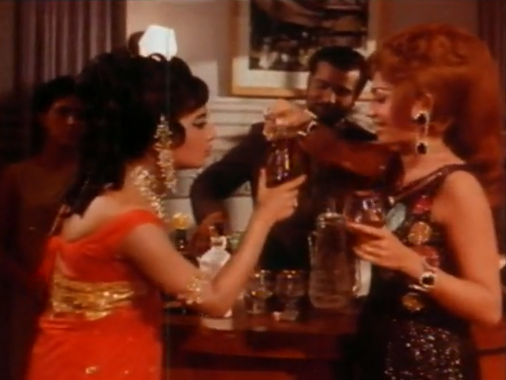
Helen serves Sadhana another glass in Inteqaam (1969)

piyaa tuu ab to aajaa (Caravan, 1971): Asha Bhonsle and R.D. Burman come together to produce one of their biggest musical hits together with this classic item number from Caravan. Asha’s performance here solidified her status as the queen of cabaret singing in Hindi cinema. Furthermore, Helen’s portrayal of a nightclub dancer on screen during this song is considered the quintessential Bollywood cabaret performance. Helen’s dance moves are completely outrageous here but she makes it work somehow (see Mrs. 55’s step-by-step breakdown here). Given the ridiculousness of the situation here, you can’t really blame Helen for the heavy drinking…it certainly doesn’t stop her from completely owning the stage during her performance!

Helen gives one of the best cabaret performances of her career in Caravan (1971)

“Alcohol May Be Man’s Worst Enemy…”

Unlike their female counterparts, the men of Bollywood cinema have been imbibing alcohol since the industry’s earliest days. The most popular context for male drinking in Hindi films occurs when the hero resigns himself to heavy drinking in order to drown his sorrows, usually caused by woman-related heartbreak. While female characters are often stigmatized for their drinking and public intoxication, it is more acceptable for men of the silver screen to use alcohol consumption to deal with their grief.  Other contexts where actors are depicted consuming alcohol include scenes of male-male bonding (bromances, anyone?) and seduction of heroines and courtesans. Though Bollywood has glamorized the consumption of alcohol for both genders, the effect is far more pronounced for males, as evident in the examples I’ve selected below.

mujhe duniyaavaalo sharaabii na samjho (Leader, 1964): Even though its soundtrack is full of gems like “tere husn kii kyaa tariif karuu.n” and “ek shahanshah ne banvaa ke ek hasii.n taaj mahal,” Leader is one mess of a film starring Dilip Kumar and Vijayantimala. Dilip Kumar stars as a law graduate and aspiring political revolutionary who falls in love with a princess (played by Vijyantimala). The script has so many holes that it’s difficult to discern the overall message of this film, but there are some scenes of comic relief between Vijayantimala and Dilip Kumar that are worth remembering. By far, however, the main attraction here is the soundtrack composed by Naushad. In this particular number, an intoxicated Dilip Kumar claims that he has been forced to take up drinking to grapple with society’s evils.

Vijayntimala tries to stop a drunk Dilip Kumar from embarassing himself too much at this party in Leader (1964).

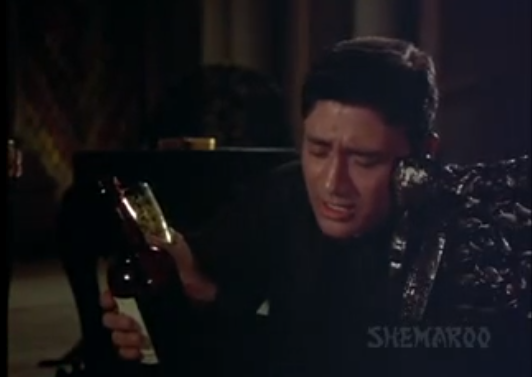
din Dhal jaaye (Guide, 1965): Where do I even begin with the praise for Vijay Anand’s Guide? Mrs. 55 and I both love everything about this film: the unique story written by R.K. Narayan, the stellar performances by Dev Anand and Waheeda Rehman, and of course, the unforgettable soundtrack composed by S.D. Burman. Each and every song from this film is an absolute gem. In this particular Rafi solo picturized on Dev Anand, the hero drowns his sorrows about lost love in alcohol. The melancholic expression that pervades throughout this scene is enhanced by the beautifully crafted lyrics and tune.

Dev Anand turns to the bottle when love goes sour in Guide (1965).

chuu lene do naazuk ho.nTho.n ko (Kaajal, 1965): With this Rafi number penned by Sahir Ludhianvi and composed by Ravi, Raaj Kumar tries to get Meena Kumari, his on-screen shaadi-shudhaa (virtuous) wife, to come to the dark side by having a drink. Alcohol glorification occurs is at its finest in these lyrics: it is referred to as “mubarak cheez,” or a blessed thing.  Meena Kumari excels, as usual, at looking incredibly uncomfortable and disturbed by Raaj Kumar’s advances in this scene.

A drunk Raaj Kumar tries to get Meena Kumari on his team in Kaajal (1965).

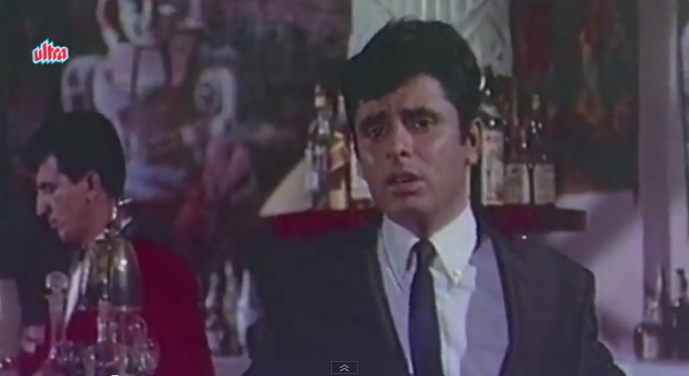
jo unkii tamanna hai barbad ho jaa (Inteqaam, 1969): This film certainly features a lot of alcohol consumption on screen. In addition to the drunk Lata number discussed above, this Rafi solo from Inteqaam is picturized on Sanjay Khan as he laments being a mere object in Sadhana’s plans for revenge. Rajinder Krishan’s lyrics are exquisite in their ability to capture the essence of being deceived in love.

Handsome Sanjay Khan turns to alcohol to get over Sadhana’s deception in Inteqaam (1969)

yeh jo muhabbat hai (Kati Patang, 1970): Directed by Shakti Samanta, this film features an evergreen soundtrack composed by R.D. Burman. This particular number sung by Kishore Kumar is one of Bollywood’s most treasured drinking songs, and it features a handsome and bitter Rajesh Khanna drinking the night away because he was stood up at the altar by his wife-to-be.  Asha Parekh watches from a distance, not yet aware of the fact that she is the woman responsible for his heartache.

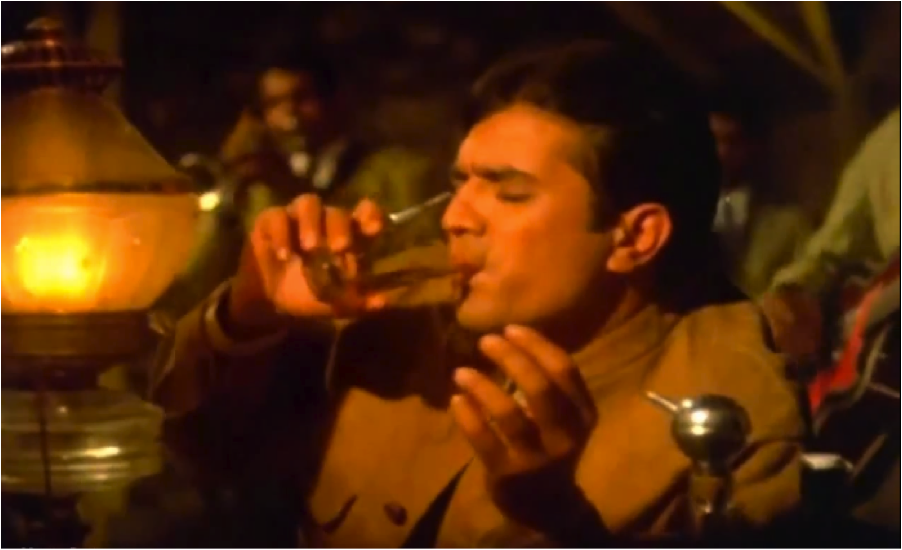
Rajesh Khanna drinks another glass of liquid courage before singing about the pain of disloyal love in Kati Patang (1970).

What are some of your favorite sharaab/daaru songs from Bollywood films? Let us know in the comments! We’ll understand if your typing is a little bit off…
Mr. 55