O Sajna Barkha Bahar Aayi Lyrics and Translation: Let’s Learn Urdu-Hindi

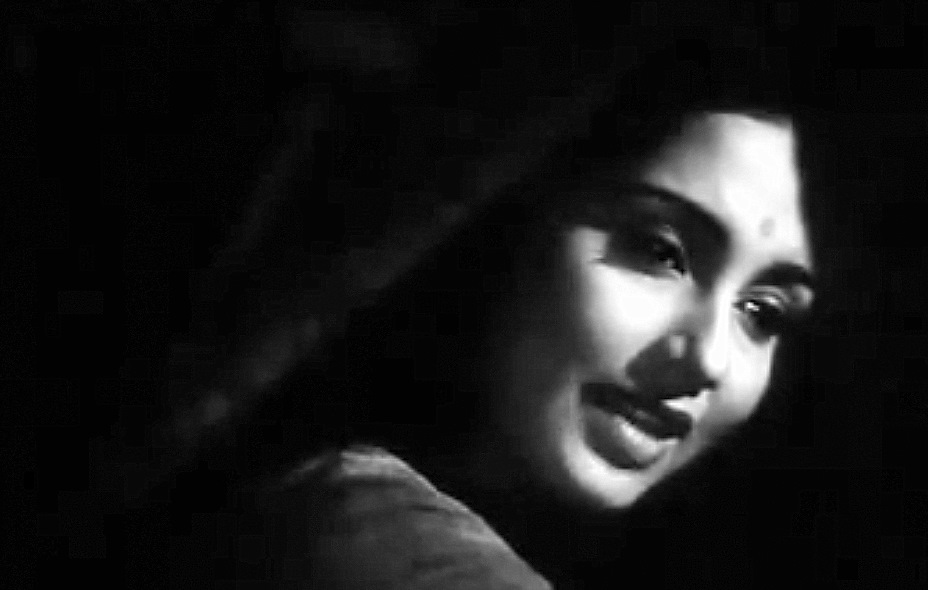
Sadhana wistfully enjoys the rain in "o sajna barkhaa bahaar aayii" from Parakh (1960). Because she plays the role of a village girl here, she was instructed to get rid of the characteristic "fringe" hairstyle seen in her later movies in order to avoid looking too glamorous!

Rain songs have always held a special place in Bollywood cinema. From “pyaar hua iqraar hua” in Shree 420 (1955) to “ghanan ghanan ghir aayii badra” in Lagaan (2001), fans of Hindi cinema have been treated to a number of beautiful gems about the rain over the years. Today, I’ve translated an all-time classic rain song from the film Parakh (1960) directed by Bimal Roy (he won his third Filmfare Award for Best Director for this film!): “o sajna barkhaa bahaar aayii”.   Parakh satirizes Indian democracy using a plot in which the postmaster (Nasir Hussain) of a village mysteriously receives a check for five lakh rupees to be given to an individual who is most well-equipped to benefit the village. When it is decided that an election will be held, influential characters in the village begin campaigning to persuade the village that they are the most deserving candidate to receive the check: namely, the impious postman (Motilal), the pious piest (Kanhaiyya Lal), the creepy rich man (Asit Sen), the greedy doctor (Rashid Khan) , the landlord (Jayant), and the well-respected schoolmaster (Vasant Chowdhury). Meanwhile, the postmaster’s daughter (Sadhana) begins to fall in love with the schoolmaster, and she sings “o sajna” as she pines for him in the rain.
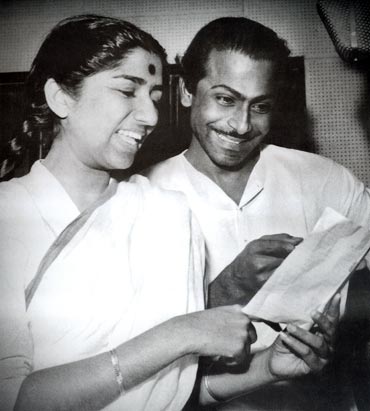
A musically timeless duo: playback singer Lata Mangeshkar and music director Salil Chowdhury

This song is considered to be one of the finest compositions of the music director Salil Chowdhury (who also wrote the story for Parakh). Although Salil Chowdhury did not receive his due during his lifetime, he is undeniably  one of the most talented and revolutionary composers from the Golden Era. His compositions are often remembered for their unusual melodies, rich orchestration, and integration of Western and Indian classical themes. Those of you familiar with Salil Chowdhury’s work in Bollywood may be surprised to know that he also composed songs for a wide variety of Indian languages, including Bengali, Malayalam, Tamil, Kannada, Telegu. Among these languages, Salil’s most prolific work was in his native tongue Bengali–he revolutionized the genre of the Bengali adhunik (modern) song with his musical compositions and self-written lyrics (what a multi-talent!). In fact, as is the case with many of his Hindi songs,  the tune for “o sajna” was released in Bengali first in 1959 as “na jeo na.” This song was one of Lata Mangeshkar’s earliest hits in the Bengali music industry, and Bengalis have cherished the collaboration between Lata and Salil ever since this major musical milestone.

–Mr. 55

P.S: As an extra tidbit of trivia, it has been said that the only non-classical record found in the collection of renowned Hindustani vocalist Ustad Bade Ghulam Ali Khan after his death was an LP of “na jeo na.” What an honor!

O Sajna Barkha Bahar Aayi Lyrics and Translation

o sajnaa barkhaa bahaar aayii
Oh, my beloved, the rain-filled season of spring has arrived.
ras
kii puhaar laayii, a.nkhiyo.n me.n pyaar laayii
It has brought sprinkling droplets of nectar, it has brought love to these eyes.

tum ko pukaare mere man kaa papiiharaa
The cuckoo bird in my heart calls out to you,
miThii miThii aganii me.n jale moraa jiiyaraa
as my heart burns in a sweet fire.

aisii rimjhim me.n, o sajan, pyaase pyaase mere nayan
My eyes long for you, my beloved, in this light shower of rain;
tere hii khvaab me.n kho gaye
they have become lost in a dream of you.

saa.nvalii salonii ghaTaa jab jab chhaayii
When the beautiful dark clouds spread throughout the sky,
a.nkhiyo.n me.n rainaa gayii, nindiyaa na aayii
the night passed in my eyes, and I could not fall asleep.

o sajna barkhaa bahaar aayii
Oh beloved, the rain-filled season of spring has arrived.

Glossary

barkhaa: rain; ras: nectar; puhaar: sprinkles, droplets; papiiharaa: pied-crusted cuckoo bird (associated with the monsoons in Indian mythology); jiyaraa: heart; rimjhim: light rain; saa.nvalii: beautiful; salonii: dark; ghaTaa: clouds; rainaa: night; nindiyaa: sleep.
Dil Jo Na Keh Saka Lyrics and Translation: Let’s Learn Urdu-Hindi

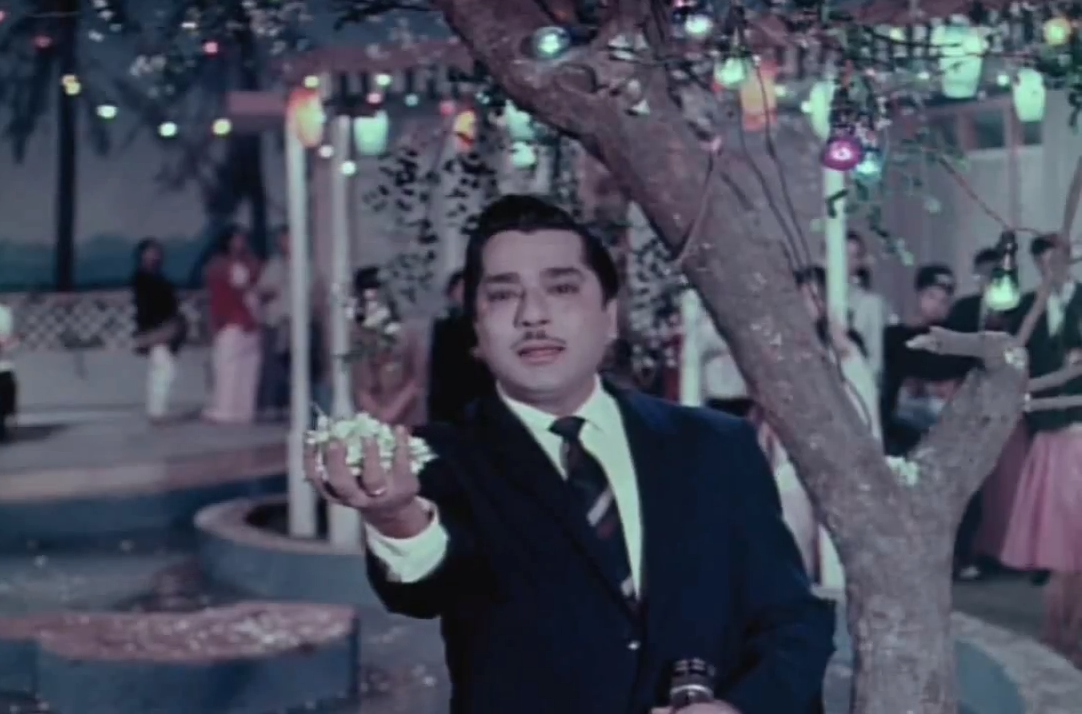
A vengeful Pradeep Kumar taunts Meena Kumari at her engagement party in Bheegi Raat (1965)

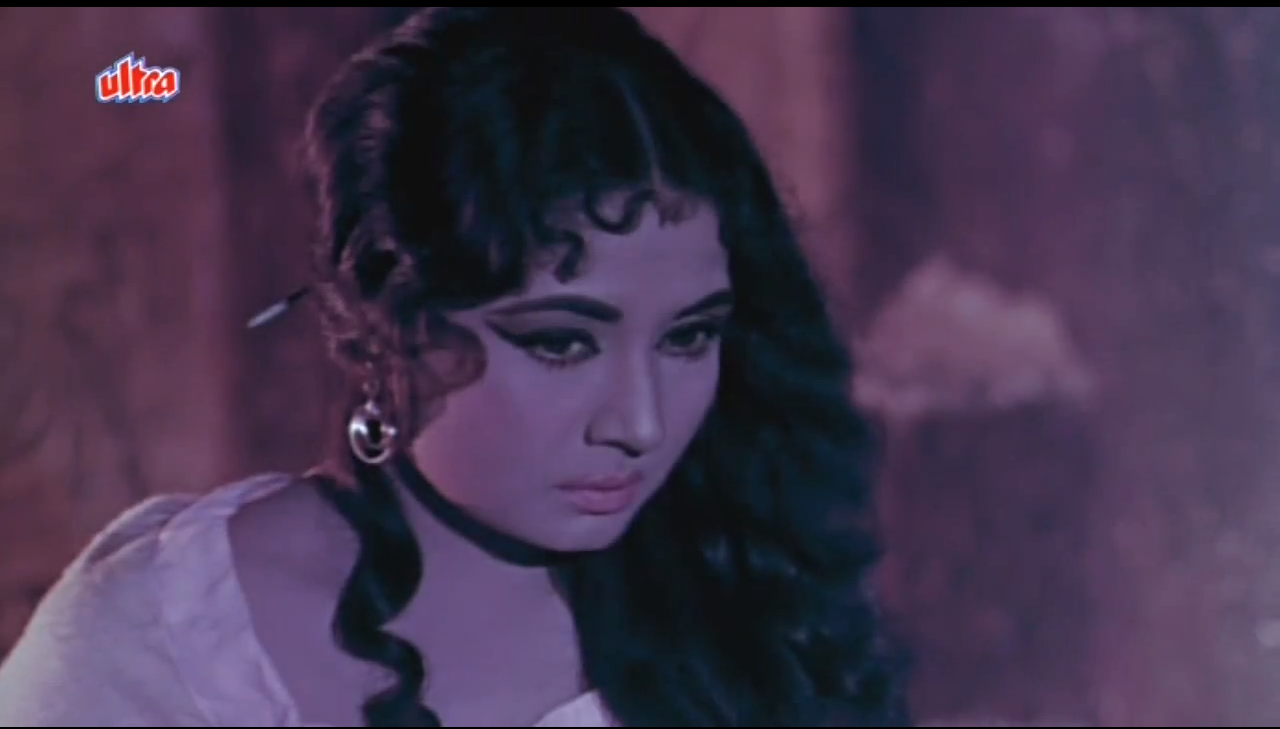
Bheegi Raat (1965) stars Ashok Kumar, Meena Kumari, and Pradeep Kumar in a classic Bollywood love triangle story full of messy drama and heartache. The film is not particularly memorable for its plot, but the soundtrack composed by Roshan and penned by Majrooh Sultanpuri contains a beautiful Raga Yaman-based gem that is still remembered today: “dil jo na keh saka.” Here, I’ve provided the lyrics and translation for both the female version (sung by Lata Mangeshkar) and the male version (sung by Mohammed Rafi) found in the film. The lyrics for the female version are standard Bollywood fare, but the male version is surprisingly vengeful and caustic. Hearing these lyrics in context of the film makes more sense: a jealous Pradeep Kumar taunts Meena Kumari using this song at a party celebrating her engagement to Ashok Kumar during the film’s conclusion. Even still, some of these lyrics are pretty wild. For example, he implores Meena’s character to drink blood from the heart (!) (piyo chaahe khuun-e-dil ho, ki piite pilaate hi…). The bitter sentiments found in these lyrics really drive home a theme expressed in Hindi films from this era that we’re all forced to grapple with at some point — love really hurts sometimes, doesn’t it?

–Mr. 55

P.S. Obviously, the Rafi version of this song is more popular than the Lata version, but I really think Lata holds her ground in this case with the tandem rendition. Her version has a segment of humming during the introduction that isn’t found in the Rafi version, which has always sounded absolutely heavenly to me.

Dil Jo Na Keh Saka Lyrics and Translation:


[Male]

dil jo na kah sakaa, vohii raaz-e-dil kahne kii raat aayii
The  night has come to uncover that secret which my heart could not reveal. 

naghmaa saa koii jaag uThaa badan me.n
A melody has awakened in my soul,
jhankaar kii sii thharthharii hai tan me.n
and a tinkling sensation quivered throughout my body.
mubaarak tumhe.n kisii kii laraztii sii baaho.n me.n rahne kii raat aayii
Congratulations to you, for the night has come to spend in someone else’s quivering arms. 

taubaa! yeh kis ne anjuman sajaa ke
Oh! Who has organized this gathering
tukDe kiye hai.n gunchaa-e-vafaa ke?
and destroyed the flowerbud of love?
uchhaalo gulo.n ke tukDe ki rangii.n fizaao.n me.n rehne kii raat aayii
Toss up the pieces of those flowers, for the night has come to spend in this colorful atmosphere.

chaliye mubaarak jashn dosti kaa,
Felications on this celebration of friendship;

daaman to thaamaa aap ne kisii kaa
you have accepted someone else’s embrace. 

hame.n to khushii yahii.n hai, tumhe.n bhi kisii ko apnaa kahne kii raat aayii
I am pleased, as the night has come for you to call someone else your own.

saaghar uThaao, dil kaa kis ko gham hai?
Raise your wine glass; who sulks for the heart?
aaj dil kii qiimat jaam se bhi kam hai
Today, the value of a heart is worth less than that of wine.  

piiyo chaahe khuun-e-dil ho ki piite pilaate hii rahne kii raat aayii
Drink the blood of the heart if you so desire, for the night of endless drinking has come. 

dil jo na kah sakaa, vohii raaz-e-dil kehne kii raat aayii
The night has come to uncover that secret which my heart could not reveal.


[Female]

dil jo na kah sakaa, vohii raaz-e-dil kahne kii raat aayi
The night has come to uncover that secret which my heart could not reveal. 

naghmaa saa koii jaag uThaa badan me.n
A melody has awakened in my soul,
jhankaar kii sii thharthharii hai tan me.n
and a tinkling sensation quivered throughout my body. 

pyaar kii inhii.n dhaDaktii fizaao.n me.n rahne kii raat aayii
The night has come to spend in this pulsating ambience of love.  

ab tak dabii thii ek mauj-e-armaa.n
Until now, a wave of desire was suppressed within me.
lab tak jo aayii ban gayii hai tuufaa.n
When it reached my lips, it became a storm.
baat pyaar ki bahakti nigaaho.n se kahne kii raat aayii
The night has come to speak about love to those wandering eyes. 

guzare na yah shab, khol duu.n ye zulfe.n
As the night passses slowly, I shall let down my hair.
tum ko chhupaa luu.n muund ke ye palake.n
And I will hide you by shutting these eyelids. 
beqaraar sii laraztii sii chhaa.nvo.n me.n rahne ki raat aayii
The night has come to spend in these restless and quivering shadows. 

dil jo na kah sakaa, vohii raaz-e-dil kahne kii raat aayi
The  night has come to uncover that secret which my heart could not reveal.

Meena Kumari looking beautiful (and sad) as usual in Bheegi Raat (1965).

Glossary:

raaz-e-dil: secret of the heart; naghmaa: melody, song; thharthharaanaa: to quiver;  jhankaar: tinkle; laraztii: trembling; baaho.n: arms; tauba: oh!; anjuman: gathering; tukDe karna: to crush, destroy; gunchaa-e-vafaa: flowerbud of love; uchhaalna: to throw, toss up; gul: flowerfizaa: atmosphere, ambience; jashn: celebration; daaman thhaamnaa: to accept an embrace; saaghar: wine glass; qiimat: price, value; jaam: wine; khuun-e-dil: blood of heart; dabnaa: to suppress; mauj-e-armaa.n: wave of desire; bahakna: to wander; shab: night; muundna: to shut; palake.n: eyelids; beqaraar: restless

Chalte Chalte Lyrics and Translation: Let’s Learn Urdu-Hindi

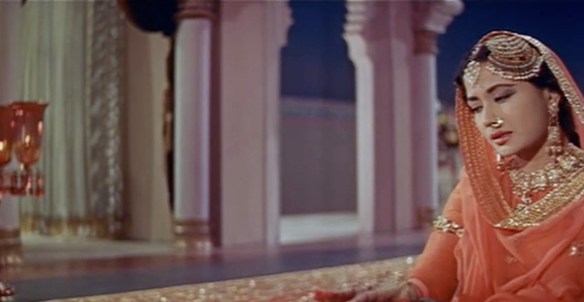
Meena Kumar shines as Pakeezah in the beloved mujra song "Chalte Chalte."

Meena Kumar shines as the golden-hearted Pakeezah in the beloved mujra song “Chalte Chalte.”

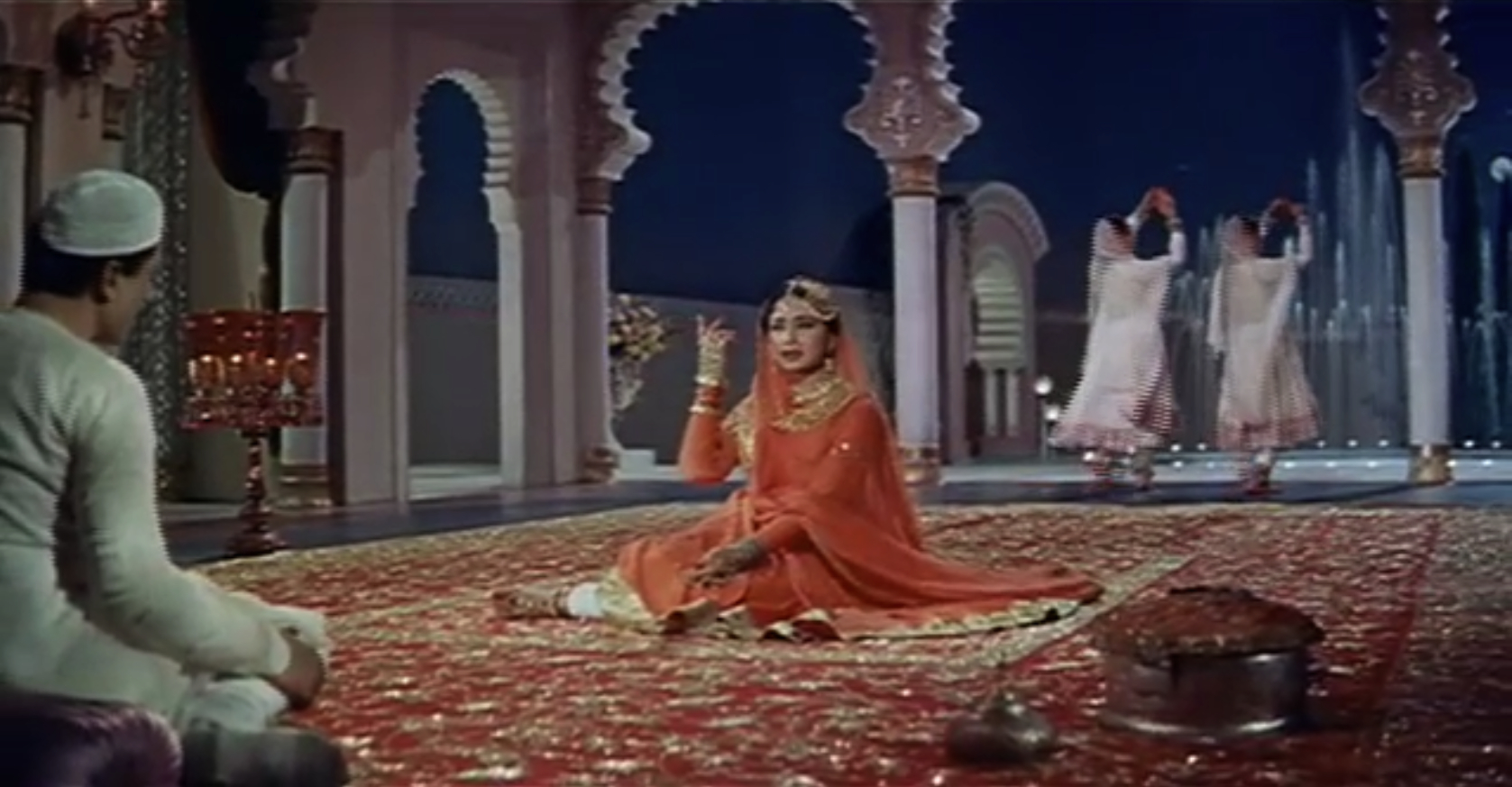
For our next song, we provide an English translation of the timeless lyrics of Pakeezah’sChalte Chalte.” The film Pakeezah (1971) instantly reached legendary Bollywood status upon its release, due in part to the ethereal musical score, brilliant Urdu dialogue, lavish sets, but also from its star Meena Kumari’s untimely death within a week of the premiere. This song is known everywhere, and the beauty of Meena and Lata’s performance truly speaks for itself. My parents have old home videos of 4-year-old me draping a chunni on my head and attempting to dance and sing along with her during this song. It’s hard to put that kind of impact into words, but you can tell it’s profound.

Anyway.

Meena Kumari dazzles her audience with “Chalte Chalte” in Pakeezah (1971)

An interesting facet of this song is the interwoven theme of the train ride. For anyone familiar with film theory, “the train” has a fascinating and critically important role in cinematic history across the globe. Likened to films themselves, the train transports you to a different world and takes you on a brief journey that can leave you different from when you started. It is a theme heavily explored by early French filmmakers first experimenting with the medium (you may remember the loving references to the Lumiere brother’s Arrival of a Train at La Ciotat Station (1895) in Hugo!), and in Indian cinema, trains play no less an important role. Like Satyajit Ray’s famous Pather Panchali (1955) which pivoted on the introduction of a train whistle across the quiet sugarcane fields, so too does the world of Pakeezah hinge on the sound of a distant train whistle incorporated into the score at the end of the song. For trains can represent that journey from tradition to modernity, from reality to fantasy, and for Pakeezah as well as Kamal Amrohi’s viewers entering a hidden, dying world of ornamentation, the train is a vehicle of escape.

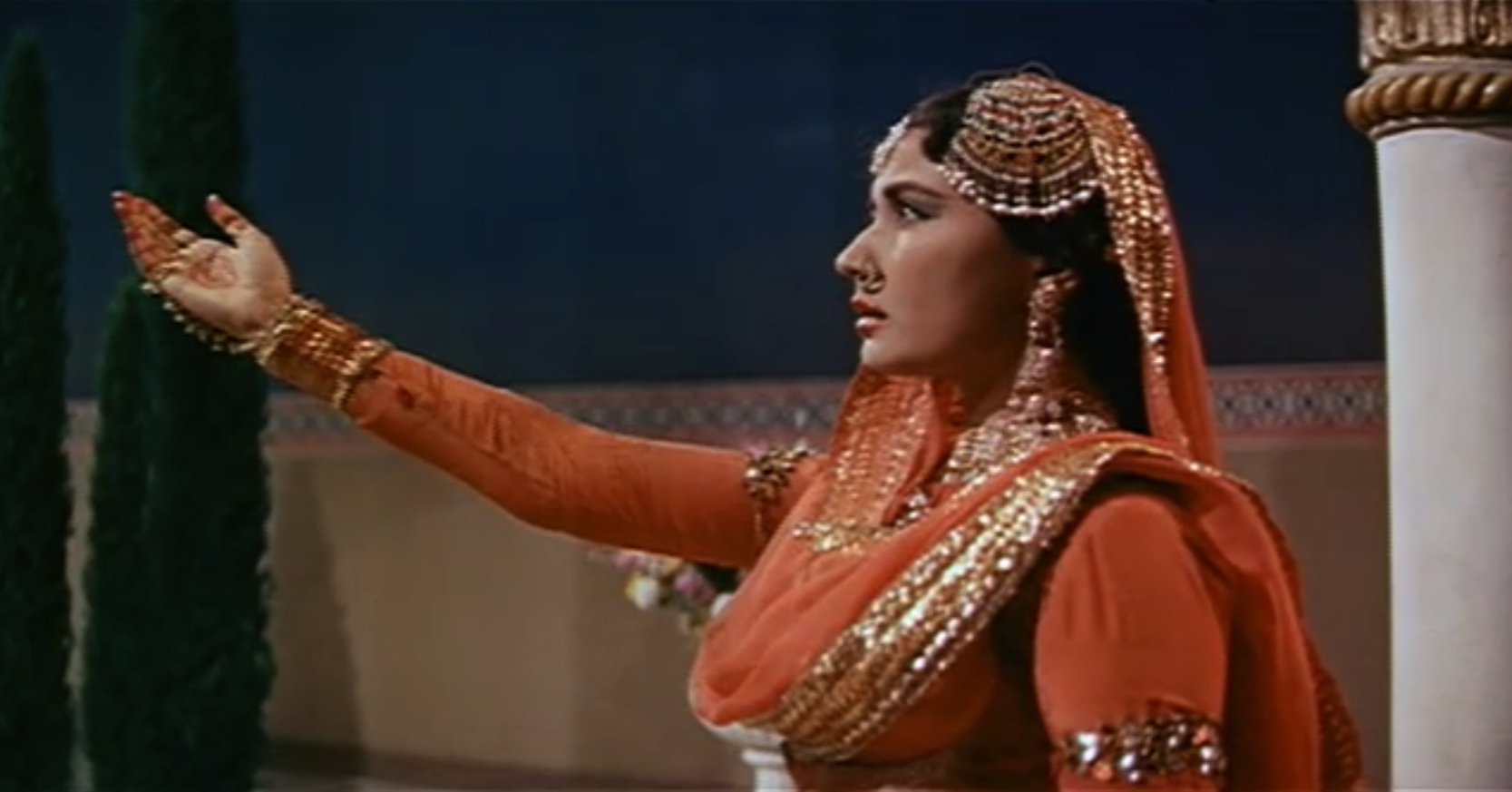
Gesturing to the moon, Meena Kumari waits for her mysterious admirer to find her again in Pakeezah (1971)

“Chalte Chalte” will absolutely leave you wishing for more, so make sure you watch the movie if you ever want to claim cultural competency. To read more about this film, check out our post on behind-the-scenes Pakeezah trivia! Enjoy our full lyrics and English translation to “Chalte Chalte” below!

Chalte Chalte Lyrics and Translation:

Chalte chalte yuu.N hii koi mil gaya tha
I met someone by chance while walking
Sare raah chalte chalte
Walking around the path
Wohii thamke rah gayii hai
The night suddenly came to a standstill
Meri raat dhalte dhalte
Just as it was about to fade away

Jo kahii gayii na mujhse
What I was unable to voice
Woh zamaanaa keh rahaa hai
The world is now saying
Ki fasaanaa ban gayii hai
That a fable has been created
Meri baat talte talte
From those words which evaded me

Shab-e-intezaar aakhir kabhi hogi mukhtasar bhi
That night of waiting will after all shorten soon
Yeh chiraag bhuj rahi hai
These lamps are dying
Mere saath jalte jalte
As they burn alongside me

Glossary:

raah: path; zamaanaa: the world; fasaanaa: fable, legend; baat: words, incident, matter; talna: to evade, to escape; shab-e-intezaar: night of waiting; mukhtasar: short, soon; chiraag: flame

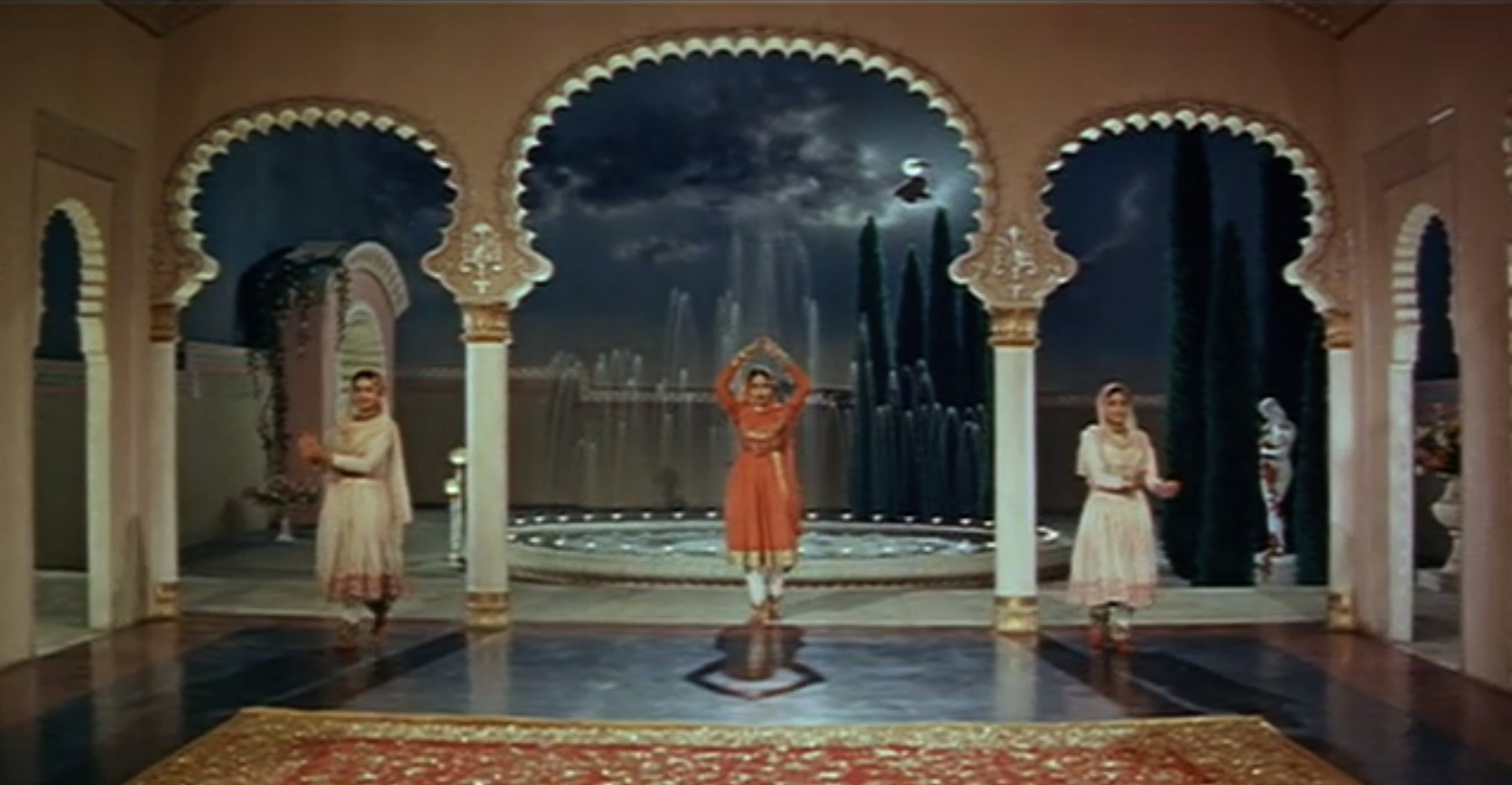
The production value of this film is ridiculous.

It’s always slightly bothered me that after the first antra the two back-up dancers start twirling, and after the second turn, get completely off-sync since the genius on the right goes a little too fast for the music. Kamal Amrohi cuts quickly to the next shot when this starts happening, so you might say it’s not a huge deal per se, but for someone who was such a neurotic perfectionist, how did this slip by him? It just gets to me every time. Or am I over-thinking this?

-Mrs. 55

Rabindranath Tagore’s Influence on S.D. Burman

Rabindranath Tagore (1861-1941) and S.D. Burman (1906-1975)

Due to my upbringing in a Bengali household, I am intimately familiar with Rabindra-sangeet: the genre of songs written and composed by Nobel laureate Rabindranath Tagore. As a composer, artist, novelist, playwright, poet, and philosopher, Tagore has left a lasting legacy on Indian culture through his vast collection of works in a variety of mediums. Although the purism and simplicity of Tagore’s style might suggest that Bollywood is an inappropriate forum to celebrate his art, several music directors from the Golden Age of Hindi cinema have been known to use Tagore songs as inspirations for their musical compositions. The music director who is most well-known for this practice is none other than the illustrious S.D Burman. S.D. Burman is one of the most succesful music directors in the history of the Bollywood industry, and his songs from films such as Bandini (1963), Guide (1965), Jewel Thief (1967), and Aradhana (1969) are still considered all-time classics today. His filmi compositions tend to draw upon inspiration from Bengali folk traditions (e.g. bhatiaalii, saari, etc. ), but here I’d like to draw your attention to a collection of S.D. Burman compositions that are derived from Rabindra-sangeet:

meraa sundar sapnaa biit gayaa (Do Bhai, 1949): From one of S.D. Burman’s first hit scores in the Bollywood industry, this song is considered to be Geeta Dutt’s breakthrough as a playback singer in Hindi films. The mukhDaa of this song is inspired by a Bilaaval-based Tagore composition called “radono bharaa e basonto.” Geeta does an excellent job of expressing the sorrow and pain of this song with her voice, and it is truly unfortunate that the lyrics here would become a reality for her during her tumultuous marriage to Guru Dutt in the next decade.

Playback singer Geeta Dutt (1930-1972) with her husband Guru Dutt (1925-1964)

nain diivaane (Afsar, 1950): This Pilu-based composition is skilfully rendered by Suraiyya, a leading singer/actress who became a huge sensation in Bollywood during the 1940s. Bollywood as we know it today relies on actors and actresses lip-syncing songs sung by playback singers; however, in its very early days, actresses like Suraiyya used to sing their own songs for films. In spite of their dual talents, singer-actresses were not able to survive the onslaught of the Mangeshkar monopoly in the 1950s, and the playback singing paradigm became the standard that is still maintained today in the industry. In any case, this song is based on an extremely popular Tagore composition called “sediin duujane duulechhiinuu bone.” S.D. Burman literally did a copy-paste job here, as the melody of the entire Hindi song is identical to the Bengali original. While loosely basing a mukhDaa on a previous composition is somewhat acceptable, recycling a whole song written by another composer begs the question: should S.D. Burman have given credit to Tagore for this composition?

Singer/actress Suraiyya (1929-2004)


 jaaye.n to jaaye.n kahaa.n? (Taxi Driver, 1954): S.D. Burman won his first Filmfare Award for Best Music Director for this song from Taxi Driver in 1954. As is often the case, the male version of the song (sung by Talat Mehmood) is more popular than the female version (sung by Lata Mangeshkar). Although S.D. Burman modified the raga of his composition to more closely resemble Jaunpuri, the first line of the mukhDaa is instantly recognizable as the main phrase from Tagore’s Bhairavi-based classic  “ he khoniiker otiithhii.” Note that the Tagore original that I have provided here is sung by Hemanta Mukherjee (a.k.a Hemant Kumar), who, in addition to achieving fame as a Hindi playback singer/music director, was known for his beautiful renditions of Rabindra-sangeet in Bengali.

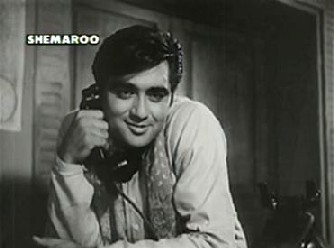
jalte hai.n jiske liye: (Sujata, 1959): This probably qualifies as my favorite “telephone song” from a Hindi film. Here, Sunil Dutt woos Nutan over the phone with this gem as he croons to Talat Mehmood’s silky vocals on playback (notice the characteristic quiver that we know and love!). Although this composition is often considered an all-time classic song of romance, fans of this song may be surprised to know that the mukhDaa is taken directly from a Tagore composition named “ekodaa tumii priye.”

Sunil Dutt serenades Nutan over the telephone with “jalte hai.n jiske liye” in Sujata (1959)

meghaa chhaye aadhii raat (Sharmilee, 1971): Out of all the compositions listed here, the inspiration from Tagore is the most difficult to hear in this song because it does not involve the mukhDaa. Rather, S.D. Burman seems to have inserted a small segment of  laho laho tuule laho (0:26-0:40) into the antara of this raga Patdeep-based classic from Sharmilee. What a trickster, huh?

tere mere milan kii yeh rainaa (Abhimaan, 1973): By far, this is the most famous example where  S.D. Burman has been inspired by Rabindra-sangeet.  In his last hit film score (for which he won his second  Filmfare Award for Best Music Director), S.D. Burman recycles the mukhDaa from Tagore’s Mishra Khamaj-based “jodii taare nai chiinii go sekii?” in this evergreen duet of Lata Mangeshkar and Kishore Kumar. Burman’s antaras are a beautiful addition to the original composition, so we won’t give him too much trouble for his rehashing of Tagore here. Note that the Bengali original that I have linked to here is sung by Kishore Kumar, another Hindi playback singer who was famous for his renditions of Rabindra-sangeet in Bengal.

Amitabh and Jaya Bacchan sing the duet “tere mere milan kii yeh raina” on stage during the climax of Abhimaan (1973).

Although S.D. Burman was often inspired by Tagore in his compositions, he never recorded or sang a single piece of Rabindra-sangeet throughout his career. The reason behind this is, of course, family feuding–an unavoidable staple of all things related to Indian culture. Here’s the story: S.D Burman’s father Nabadwip Chandra Dev Burman was set to be the direct heir to the throne of Tripura when the current king passed away in 1862. However, the crown went to Nabadwip’s paternal uncle Birchandra Dev Burman due to some dirty palace politics. Because Rabindranath Tagore had a very close relationship with Birchandra Dev Burman, S.D. Burman avoided meeting Tagore throughout his lifetime and refused to perform Rabindra-sangeet out of principle. Nevertheless, in spite of this tiff, it is undeniable that S.D. Burman had a great deal of respect for Tagore as a musician given the influence of Rabindra-sangeet on his compositions.

–Mr. 55

The Best Qawwalis of Bollywood Films

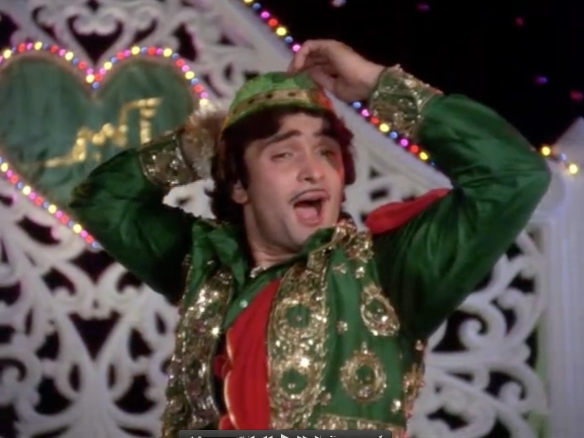
Rishi Kapoor Amar Akbar Anthony Bollywood Qawwali

Rishi Kapoor charms his audience singing the famous qawwali “Pardah Hai Pardah” from Amar Akbar Anthony (1979).

The qawwali from films has a hallowed place in the history of the Hindi music industry. A mystic tradition more than 700 hundred years old, the qawwali gained prominence in Bollywood initially through 1950s Muslim social dramas and grew so much in popularity that its influences became mainstream–even continuing to live on today. We present our list below of the best qawwalis of Bollywood films.

But let us first define what precisely is a qawwali? The great Indian poet Amir Khusrau (d. 1326) is considered the founding father of the qawwali genre, having composed songs for the first time in this style to celebrate the death of his spiritual guide Nizamuddin Aulia. The qawwali is the authentic Sufi spiritual song that transports the mystic toward union with God. For centuries, Sufi communities in the Indian subcontinent have sustained this musical tradition in the mahfil-e-sama, or assembly for listening. The qawwali was a religious experience for both listener and performer: as the listener hopes for a spiritual experience of intensity and immediacy to transcend his or her conscious striving, the trained performer seeks to present in song a vast treasure of poetry that articulate and evoke a mystical experience for the audience.

Madhubala impresses the Mughal prince in the classic qawwali “Teri Mehfil Mei.N Qismat” from Mughal-e-Azam (1960)

The qawwali performance usually begins after the evening and may last all night until the morning prayers. The word qawwali means “words” worthy of remembrance, and as such the qawwali traditionally has a devotional aspect in praise of God. Even most “secular” qawwalis found in popular Bollywood movement can be read in this way, although superficially the lyrics have another literal meaning. The harmonium has replaced what was traditionally a sitar as musical accompaniment, but equally important are the tabla and the signature qawwali cyclic hand clapping that increase in speed during the performance. The tarz or tune of the qawwali is normally identified by the first line of the text, which is often a part of the refrain couplet. Although the qawwal was traditionally male, both men and women have enjoyed and excelled at performing the modern qawwali.

Rishi Kapoor dazzles his audience as a popular qawwal in the 1979 blockbuster Amar Akbar Anthony.

Unlike in Hindustani classical music, while taal and raagaa usage is the same, the qawwali places a greater emphasis on the poetic text and the delivery of its message than on musical ornamentation. In many of its vast incarnations within Bollywood, the qawwali became synonymous with a musical debate, a verbal battle (often between the sexes) to outwit the other side on topics that usually boil down to love or the pain of love. That kind of screen chemistry, as you can imagine, is prime Bollywood flirting territory just waiting to be sung.

Let’s take a look at how this genre evolved in mainstream Bollywood into one of the most beloved musical genres of the industry. Here are some highlights:

Humen To Loot LiyaAl Hilal (1958):

One of the first qawwalis to hit the silver screen, no list is complete without this retro low-budget gem. The music is really quite simple, but extremely catchy.

Yeh Ishq Ishq HaiBarsaat Ki Raat (1960):

This qawwali is an Urdu-lover’s paradise. Filled with complex words and allusions you’ll never use in real life, “Yeh Ishq Ishq Hai” set the stage for classy performance duels between men and women that is still considered the greatest Bollywood qawwali for its poetry (see our post for a full English translation!)

Sharma Ke Yeh Kyo.NChaudhvin Ka Chand (1960):

A fun twist on the traditional qawwali, two women sing (Asha Bhonsle and Shamshad Begum) with the latter taking the masculine side and the former taking the feminine.

Teri Mehfil Mei.N QismatMughal-e-Azam (1960):

Oh, does it get any better than this? Every moment of Mughal-e-Azam is a poetic dream and this briliant qawwali is no less. Shamshad Begum battles Lata Mangeshkar for the Prince’s approval of their take on love, each lyric outwitting the last. See our translation with glossary for more!

Nigahe.N Milane KoDil Hi To Hai (1963):

Asha Bhonsle’s greatest contribution to this genre, this qawwali has some beautiful Urdu and probably the most thrilling sargams you’ll find in any of her songs. See our translation with glossary here!

Tumhe Husn Dekhe – Jab Se Tumhe Dekha Hai (1963):

OK, so sure, this qawwali is not particularly memorable for its musical ingenuity (you may or may not cringe the entire way), but how often are you going to behold Shammi and Shashi Kapoor on screen at the same time?! This fascinating qawwali is worth a watch if only for its star value! Kudos to Geeta Bali for holding her own!

Mehengai Maar GayiRoti Kapada Aur Makaan (1974):

This qawwali has a unique flavor–taken from one of Manoj Kumar’s popular Indian propoganda films, the lyrics carry an interesting social message outside the realms of romantic love.

Pardah Hai PardahAmar Akbar Anthony (1979):

A Mohammed Rafi gem, this qawwali ranks among the best of the best. After watching Rishi Kapoor’s enthusiastic performance, you’d believe he was born to be a qawwal. The song is a must-see for anyone interested in the genre.

And just to throw in the contemporary, here’s a picture of me performing the qawwali at last year’s Harvard Ghungroo!

At a Harvard Ghungroo performance of Asha Bhonsle’s “Nigaahe.N Milane Ko.”

-Mrs. 55