What is Eastmancolor?

Amar Akbar Anthony in blinding Eastmancolor!

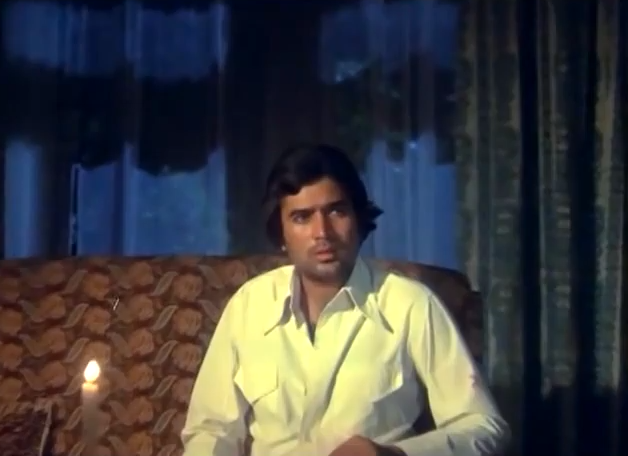
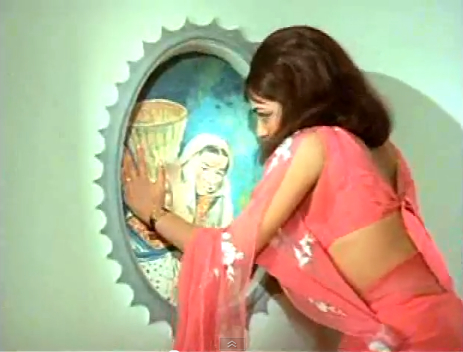
No, really, what the heck is Eastmancolor? When you look closely at title screen of each of your favorite classic Bollywood films, you find the simple, but bold little phrase, “EASTMANCOLOR” conspicuously splashed across the screen. It’s gnawed quietly at the back of your mind for years. Is “Eastmancolor” part of the name of the film? Is someone making a not-so-clever reference to Indians themselves (“Who is this MAN from the EAST, anyway?”)!? But the words quickly dissolve, the film begins, and in the excitement and messiness of the resulting masala, why “Eastmancolor” deserves a holy spot right in the title screen remains forever an unsolved mystery. Luckily for you, that’s about to change.

Aradhana in mind-blowing Eastmancolor!

Let’s back ourselves up and unravel this riddle from the start. When the first monopack colour film stocks hit Hollywood in the 1930s, India was eager to catch up and bring colour to Bollywood. But the process was not easy. Apart from being significantly more expensive than traditional black-and-white (silver halide photographic emulsion), coloured film stock brought with it a new set of artistic problems: development of the negative taking both luminosity and color into account.

Mere Huzoor in death-defying Eastmancolor!

The first colour film made entirely in India was Kisan Kanya (1937), produced by Ardeshir Irani who had also pioneered the first talkie of Hindi cinema 6 years earlier. However, poor box-office returns and difficulties and expenses in garnering rights to the American Cinecolor stock development process kept coloured film largely out of range for many years following. Guru Dutt, not surprisingly, was among the later auteurs who help revive its popularity. He experimented with the new colour cinematography in his timeless beauty “Chaudhvin Ka Chand”(1961)  that highlights the effect of (fake) moonlight and colour ranges at night. The opportunity to use colour arrived mid-production, and although Dutt had wanted to reshoot the entire film with the new technology, budget and time-constraints forced him to film only this and one other song in colour before the release. Around the same time, K. Asif too experimented with the range of this new technology, incorporating the dazzling colour song “Pyar Kiya To Darna Kya” into his magnum opus Mughal-e-Azam (1961) as a stunning and vivid tribute to the full glamour of the Mughal Empire.

Junglee in dazzling Eastmancolor!

India’s full-length color feature, Mother India (1957), was a landmark film for many reasons, but notably for demonstrating that coloured film stock was the wave of the future—garnering a nomination for Best Foreign Film at the Academy Awards the year of its release. After the overwhelming success of Mother India, Bollywood began shifting its norm to predominantly coloured film, eventually using black-and-white sparingly for stylistic reasons (as in the film noirs or Teen Devian).

Caravan in jaw-dropping Eastmancolor!

Prior to this era, colourizing film had been a technical and artistic nightmare—as far back as the 1910s and 1920s, filmmakers had been painting each frame of a film by hand, bleaching the film stock and adding color dye, or most popularly, using the expensive Technicolor multi-strip subtractive method. These options had little ground in the competitive, movie-a-minute atmosphere of India, and the hassle of processing such film stock (which often needed to be shipped abroad for the purpose), left India for many years colourless.

Teesri Manzil in heart-stopping Eastmancolor!

Eastmancolor, introduced in 1950 by Kodak was a novel and economic technology that used a single-strip 33mm negative-positive process incorporated into one strip of film. While a popular rival to expensive Technicolor, it unfortunately is also the stock most prone to fading over the years. The Eastmancolor emulsions are made of cyan, yellow, and magenta layers. The cyan is the first to fade—in films you see what were originally blue skies now turned white—then eventually all you have left are the sun-washed reddish hues. This gives us a classic image of badly preserved Bollywood films with faded colours and a warm tint.  Contrast this with most beautifully vivid Technicolor processed films you can watch today (think MGM Judy Garland musicals), and you can see a big difference in how the colours have survived.

Safar in gut-wrenching Eastmancolor!

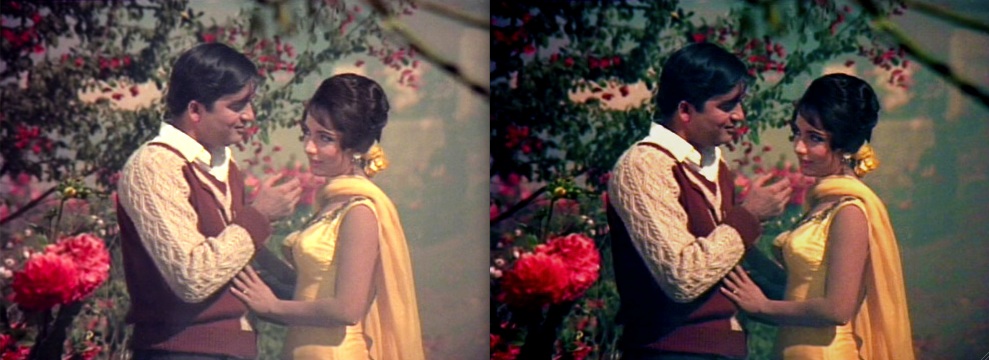
By the time DVDs rolled around, many of the films we know and love in Bollywood had suffered destruction in their original film stocks that no one bothered to repair before a DVD transfer. However, just to give you a hint of what we’ve lost, I’ve personally adjusted the color (albeit imperfectly), to a few stills below from some classic Bollywood films as they would have looked had they been printed on extremely saturated Technicolor. See how subtle thing like this can actually make a HUGE overall difference?! That faded look is merely a tragic artifact of time and neglect.
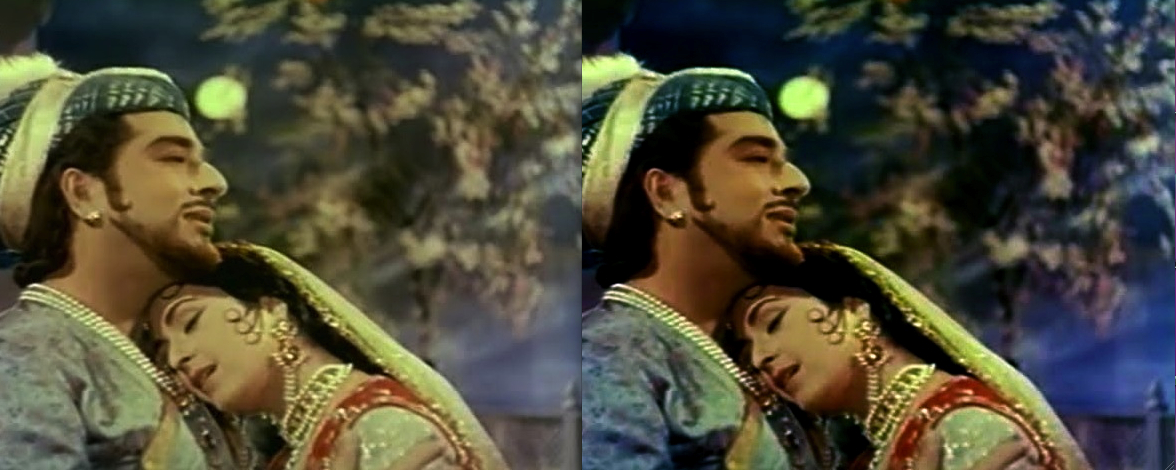
Pradeep Kumar and Bina Rai in Taj Mahal (1963).
Left: Eastmancolor. Right: Technicolor.
Sunil Dutt and Sadhana in Waqt (1965).
Left: Eastmancolor. Right: Technicolor.

Waheeda Rehman in Guide (1965).
Left: Eastmancolor. Right: Technicolor.

Shammi Kapoor and Asha Parekh in Teesri Manzil (1966).
Left: Eastmancolor. Right: Technicolor.

Aruna Irani in Caravan (1971).
Left: Eastmancolor. Right: Technicolor.

Rajesh Khanna and Sharmila Tagore in Aradhana (1969).
Left: Eastmancolor. Right: Technicolor.

Zeenat Aman and Dev Anand in Hare Rama Hare Krishna (1971).
Left: Eastmancolor. Right: Technicolor.

We often think that Eastmancolor was used only in Bollywood, but it truly started in America as a cheaper rival to Technicolor. In fact, with the advent of Cinemascope (a new widescreen format that once again changed the dynamic of filmmaking), Eastmancolor became THE industry standard—however, in America and unlike in India, the Eastmancolor stock was actually processed still by Technicolor using their sturdier dye-transfer printing. Therefore many films in America billed as “Technicolor” actually have an Eastmancolor base, but would retain their colour fidelity over the years. This is also true of the climax of Mughal-e-Azam which was also shot in and processed by Technicolor and has therefore remained brilliant over the years (helped, of course, also by the recent restoration project). The colours of that film look far different than the colours of classic Eastmancolor Bollywood films like Caravan (1978), Amar Akbar Anthony (1977), or Jewel Thief (1967). Sigh. A little investment would have gone a long way.

Madhubala glitters in K. Asif’s true Technicolor masterpiece Mughal-e-Azam (1961). Now THAT’s colour, people.

Satisfied? More information than you really wanted? I hope everyone’s burning curiosity has been slaked at last. The next time you and your hip friends watch an Eastmancolor film, you’ll be the cool cat who knows the full story. Impress the crowd with your knowledge, and poo-poo those provincial fools who think Eastmancolor simply meant Indian men making films! Fun fact: Eastman is actually the name of George Eastman who founded Kodak Photography in 1889!

This Bollywood Mystery request was submitted by faithful fan Pankaj. As always, shoot us an email and keep those requests coming!

-Mrs. 55

Hai Isi Mein Pyar Ki Abhroo Lyrics and Translation: Let’s Learn Urdu-Hindi

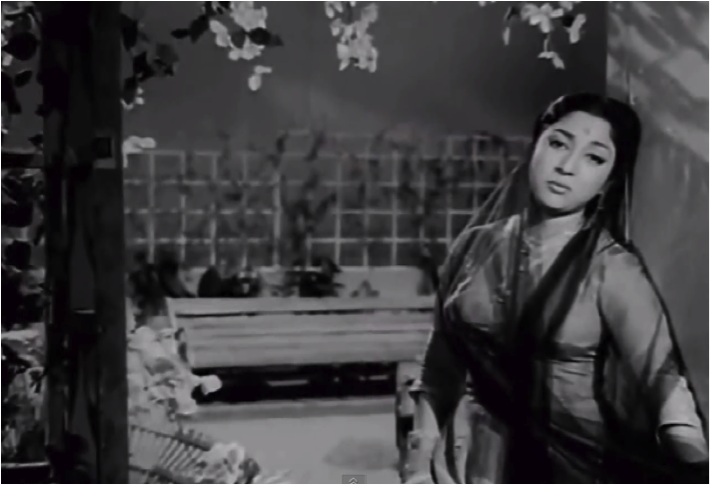
Mala Sinha experiences the pain of rejection in Anpadh (1962) from her husband Dharmendra due to her illiteracy.

As a sequel to our previous post on “aap ki nazaro.n samjhaa,” I have provided an English translation and glossary for another memorable ghazal from Anpadh (1962): “hai isii me.n pyaar kii aabhruu.” As a quick refresher, Anpadh narrates the story of a wealthy but illiterate woman (played by Mala Sinha) who is married off to an educated gentleman (played by Dharmendra).  When Dharmendra asks Mala to recite a poem for him for her on their wedding night, she is compelled to reveal her darkest secret: her parents never taught her how to read or write.  After hearing this, Dharmendra is furious that his parents lured into arranging his marriage to an uneducated woman because of the large dowry. As he spurns Mala for her lack of education, she expresses her sadness through this song, which was composed by Madan Mohan and penned by Raja Mehndi Ali Khan.

I’ll be the first to admit that these lyrics are a tad excessive in the drama department, but this is exactly the kind of song that you need when you’re in the mood to wallow. The essence of heartache is and the pain of rejection are illustrated beautifully in these words,  so listening to a song like this can really hit the spot when you’re love-sick and need to get that sulking out of your system.  Although one can find beauty in the lyrics, it is difficult to overlook that this ghazal also carries an underlying subtext of misogyny that reflects societal attitudes of the time. Take, for instance, the mukhDaa where Mala proclaims that she finds pride in her beloved’s cruelty: “hai isii me.n pyaar kii aabhruuwah jafaa kare, mai.n vafaa karuu.n” (In this, I find the pride of love: he is cruel to me, yet I remain faithful to him).  You won’t (and shouldn’t!) find such a line sung by the heroines in the Bollywood industry today.

Even if the lyrics for this song are too much for you to handle, I am certain that you can appreciate this song for its musical value. Madan Mohan has composed an evergreen melody that tugs at your heartstrings, and Lata Mangeshkar pulls through with a winning rendition. As an aside, I thought that I would share an alternate version of this song rendered by Madan Mohan himself using a different tune.  This alternate melody was not used in the film, and I am guessing that was because it sounds too happy to suit the melancholic nature of these lyrics. Take a listen to both versions for yourself, and enjoy the translation and glossary that we have provided below! Requests for future posts, as always, should be e-mailed to themrandmrs55@gmail.com.

The intensity of Mala’s pain depicted in this song highlights the urgency of Anpadh‘s message about the need educate Indian girls.

Hai Isi Mein Pyar Ki Abhroo: Lyrics and Translation

hai isii me.n pyaar kii aabhruu
In this, I find the pride of love:
wah jafaa kare mai.n vafaa karuu.n
He is cruel to me, yet I remain faithful to him.
jo vafaa bhii kaam na aa sake
Although this love is in vain,
to wahii kahe ki mai.n kyaa karuu.n
It now dictates my actions.

mujhe gham bhii unkaa aziiz hai
Even the sadness I feel is dear to me,
ki unhii kii dii huii chiiz hai
Because it is something given to me by him.
yahii gham hai ab merii zindagii
This sadness has become my life,
ise kaise dil se judaa karuu.n?
how shall I separate it from my heart?

jo na ban sake mai.n wah baat huu.n
I am the matter that cannot be,
jo na khatm ho mai.n wah raat huu.n
And I am the night that cannot end. 
yah likhaa hai mere nasiib mein
It is written in my destiny
yuu.n hii shamma ban ke jalaa karuu.n
That I shall burn here like a candle.

na kisii ke dil kii huu.n aarzuu
I am not the desire of anyone’s heart
na kisii nazar ki huu.n justajuu
Nor am I the object of anyone’s glances.
mai.n wah phuul huu.n jo udaas ho
I am that flower which is wilted.
na bahaar aaye to kyaa karuu.n?
If the spring does not arrive, what shall I do?

hai isii me.n pyaar kii aabhruu
In this, I find the pride of love.

Glossary

aabhruu: pride; jafaa: cruelty; vafaa: loyalty, love; aziiz: dear; judaa: separate; khatm: end; nasiib: destiny, fate; shamma: candle; aarzuu: desire; justajuu: quest, search; udaas: sullen, wilted.

Hai Apna Dil To Awaara Lyrics and Translation: Let’s Learn Urdu-Hindi

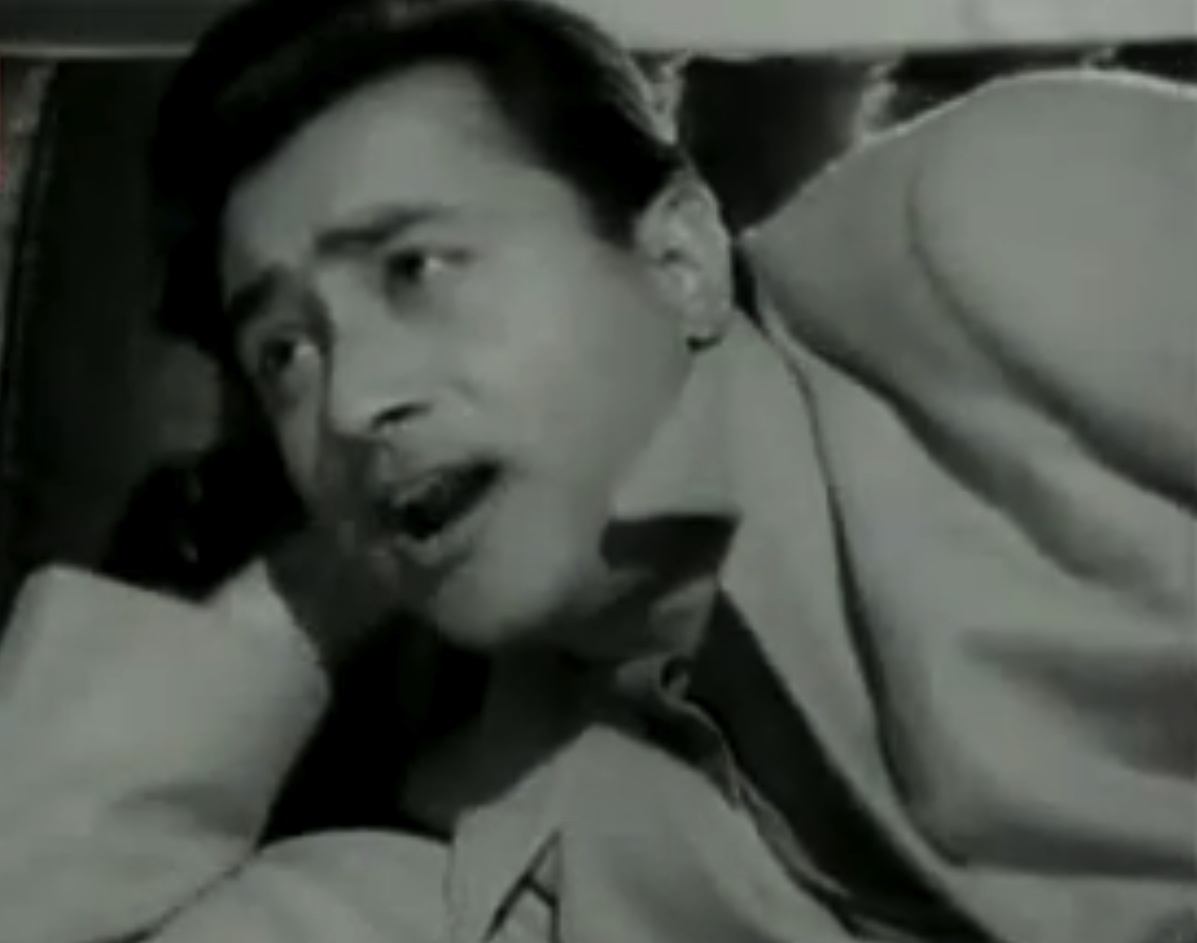
Dev Anand croons “Hai Apna Dil To Awara” aboard a moving train in Solva Saal (1958).

You gotta love this song. Hemant Kumar, whose forte is usually deep soulful melodies, outshines everyone in this catchy classic. Dev Anand stars with the lovely Waheeda Rehman in 1958 quasi-noir Solva Saal, mostly memorable for this all-time hit “Hai Apna Dil To Awara” picturized on a train. What is it about Dev Anand and trains? “Jab Pyaar Kisi Se Hota Hai” is also sung on a moving train to a sulky heroine, although by that point, Dev had perfected the look and ventured outside the train’s window! But that’s another story.

Directed by the legendary Raj Khosla, the shining moments of Solva Saal are clearly the fruits of a brilliant collaboration. While somewhat obscure, the film delivers a high-paced plot with enough twists to keep you glued, but enough groans to make you want to immediately watch a more redeeming Dev-Waheeda film soon after (I strongly recommend Guide).

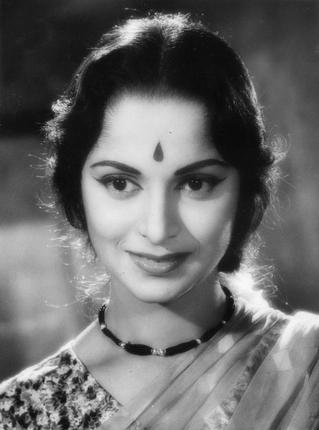
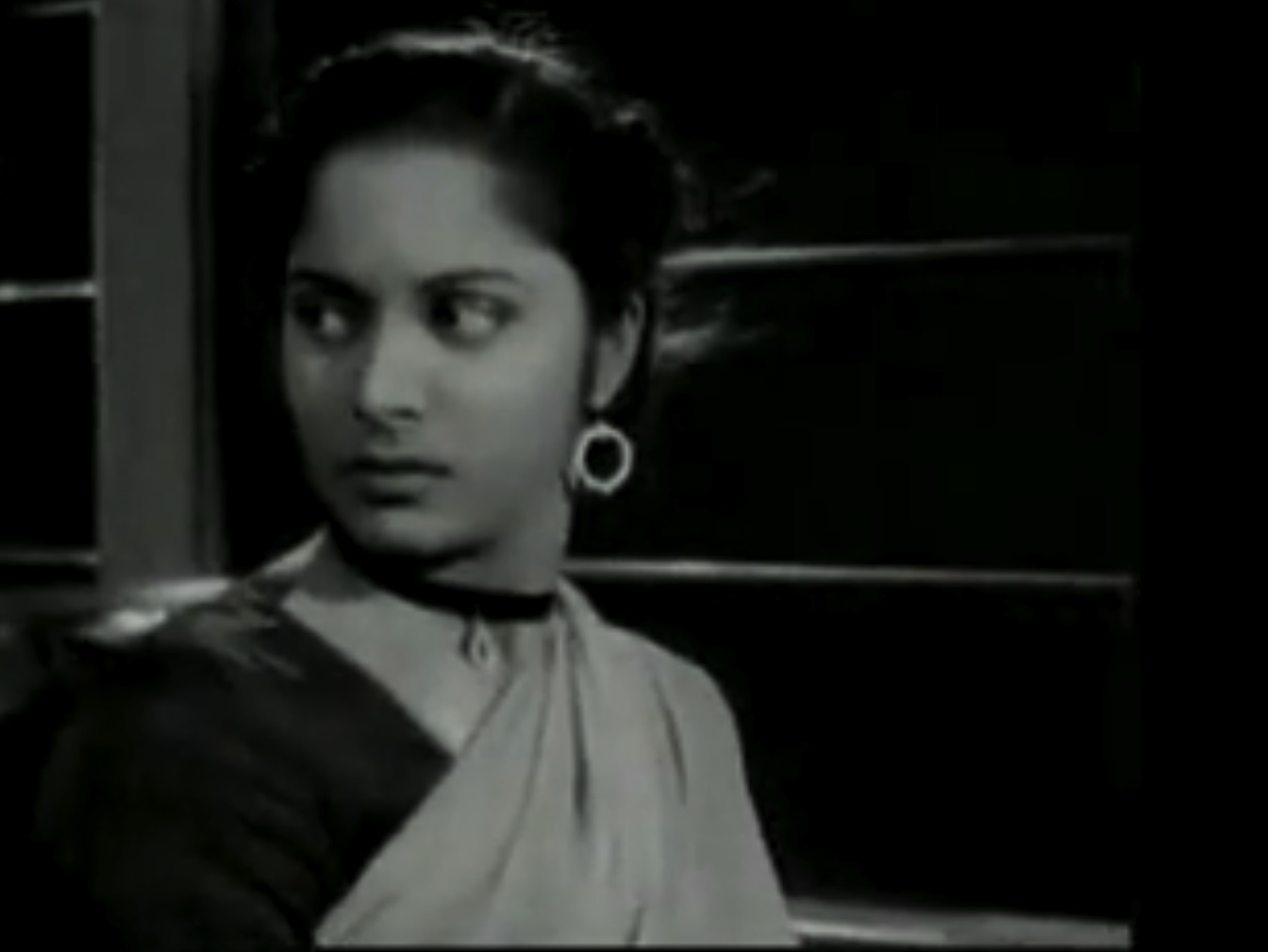
Drop-dead beautiful Waheeda Rehman plays a risk-taking jilted lover in Solva Saal (1958). Seriously, Waheeda. Stop being so gorgeous!!

The lyrics of this song, penned by Urdu maestro Majrooh Sultanpuri, are just plain and simple fun. In it, the hero personifies his own heart, speaking as if it were another being with a mind and will separate from his own. It’s so clear that Waheeda is having trouble keeping her mind on the awkward guy next to her she’s supposed to be eloping with!

For anyone more in the mood for melodrama, there’s also a “sad” version of this song just before the hero and heroine sort out their differences and live happily ever after. Until then, follow along with the youtube song of the happier classic, and enjoy our lyrics and translation to “Hai Apna Dil To Awara below!


Hai Apna Dil To Awara Lyrics and Translation

Hai apnaa dil to aawaaraa
My heart is a vagabond
Na jaane kis pe aayegaa
I wonder to whom he will take a liking

Haseeno.N ne bulaayaa, gale se bhii lagaayaa
Many beautiful women called me, they even embraced me
Bahut samjhayaa, yahii.N na samajhaa
They tried hard to explain, but my heart did not understand
Bahut bholaa hai bechaaraa
The poor thing is way too innocent
Na jaane kis pe aayegaa
I wonder to whom he will take a liking

Ajab hai diiwaanaa, na ghar na Thiikaanaa
My heart is a strange madman, he has no house and no abode
Zameen se begaanaa, falak se judaa
He has no roots with the Earth, he is distanced from Heaven
Yeh ek tuutaa huaa taaraa
He is a shooting star
Na jaane kis pe aayegaa
I wonder upon whom he will fall

Zamaanaa dekhaa saaraa, hai sab kaa sahaaraa
I have seen this whole world, I have everyone’s support
Yeh dil hii humaaraa, huaa na kisii kaa
Only this heart of mine never gave himself to anyone
Safar mei.N hai yeh banjaaraa
He is a gypsy on a journey
Na jaane kis pe aayegaa
I wonder to whom he will take a liking

Hua jo kabhii raazii, to milaa nahii.N qaazii
If he ever agreed to someone, no pandit could be found
Jahaa.N pe lagii baazii, wohii.N pe haaraa
Wherever he has taken a gamble, he lost
Zamaane bhar kaa naakaaraa
He is rejected by the whole world
Na jaane kis pe aayegaa
I wonder to whom he will take a liking

Glossary:

awaaraa: vagabond; bhola: innocent, pure; bechaaraa: poor thing; ajab: odd; diiwaanaa: madman (from love), ghar: house, Thikaanaa: abode, shelter; zameen: Earth; begaanaa: distanced, estranged; falak: sky, Heaven; tuutaa hua taaraa: a fallen star; sahaaraa: support; safar: journey; banjaaaraa: gypsy, nomads of North Indian origin; raazi: agreement, qaazi: a judge who in Islamic faith can legalize a marriage as witness; baazi: a gamble, a round of cards, haaraa: lose; naakaaraa: rejected

A brief note on the word “vagabond.” The somewhat arcane term is inevitably used across many sources to translate the Hindi word aawaara dating back to Raj Kapoor’s breakthrough film of the same name-so for posterity’s sake, I have translated it similarly. Still, I have never held that the word does justice to what aawaaraa is. Just to clarify, someone who is an aawaaraa is not necessarily a vagrant with all the connotations that come with the English usage—i.e. homeless, unemployed, etc. Aawaaraa, especially as it is commonly used poetically in Hindi films, is someone carefree, independently wandering and unwilling to be tied down. It’s a subtle, but pretty important distinction. I’m glad we’re all on the same page on this.

Waheeda Rehman pretends to be annoyed by Dev Anand’s playful song. Don’t be a such a party-pooper!

More importantly, does anyone else question the slightly awkward cheering and whoops that occur to punctuate this otherwise straightforward song? Listen carefully right during the interlude music just before the last stanza. I mean, can you imagine being a chamcha in S.D. Burman’s brainstorming session when someone decided this was a great idea? And furthermore, I don’t think that the voice is Hemant’s or Dev Anand’s doing the whooping. That means some random chamcha had to come in to the recording studio, put on the headphones, stand in front of an isolated mic, and make these wild sounds that S.D. Burman mixed lovingly into the track.

CHAMCHA: How was that, Boss?

BURMAN: Almost, almost. Right there, where it sounds like you’re having an esophageal hernia. Give me a little more of that kind of enthusiasm.

CHAMCHA: [whoops brains out]

BURMAN: Brilliant! That is precisely the touch that this composition needed. Aloo tikkis are on me tonight!

The whole thing just strikes me as trippy. Of course, we know R.D. Burman took those spastic noises to new heights in the decades following, so I guess we now know where it came from!

– Mrs. 55

Phool Ahista Phenko Lyrics and Translation: Let’s Learn Urdu-Hindi

Mumtaz is at her sassy finest on screen during this blazing duet from Prem Kahani (1975)

Our next translation comes from Prem Kahani (1975), a hit film set during the peak of India’s struggle for freedom from British rule that stars Mumtaz, Rajesh Khanna, and Shashi Kapoor in  another take on the archetypal Bollywood love triangle. Rajesh Khanna plays the role of an apolitical poet with aspirations of teaching literature who becomes involved in a revolutionary freedom fighter movement to avenge his brother’s murder during a peace protest. He engages in a passionate romance with Mumtaz; however, when she boldly asks to marry him, he turns her down. The reason? Knowing the risks that he will face as a revolutionary, he does not want Mumtaz to be subjected to the cruelties of becoming widowed. Deeply hurt by this rejection,  Mumtaz agrees to marry the man of her father’s choosing. In the mean time, Rajesh kills his brother’s murderer and becomes a fugitive highly sought after by the police. One day, while visiting his sister-in-law’s house, he is shot by police who arrive to search the premises. In order to recover from his wound, Rajesh flees to seek refuge at his best friend Shashi Kapoor’s place. When Rajesh arrives, he finds that it is the day of Shashi’s wedding! Rajesh meets the new bride, and — you guessed it — it is none other than Mumtaz.

In this context, the meaning of the lyrics in “phuul aahistaa phe.nko” come truly alive. The tension at home between Mumtaz and Rajesh Khanna is painfully palpable, and in the midst of this mess, the clueless Shashi calls for the start of an informal mushaira (poetry recital).  If you’re interested in the poetry preceding this song, you can listen to the back-and-forth of the witty retorts between Rajesh and Mumtaz at this link here.  The poetry leads seamlessly into the introduction of this memorable Lata-Mukesh duet, which was composed by Laxmikant-Pyarelal and penned by Anand Bakshi. This gem is a perfect example of how songs in Bollywood films can be used  to express emotions that cannot be described as gracefully with dialogue alone.

Through these lyrics, Rajesh takes the opportunity to express his sorrow for letting Mumtaz go and playing with her heart. Mumtaz, with some sassy lines of her own, chides Rajesh for the way that he treated her. In order to fully understand these lyrics, it is important note that the thematic message of this song revolves around a key metaphor: the roses discussed here represent womankind. Like flowers, Indian women must grapple with a delicate and fragile fate as they endure the pain inflicted by the thorns of society’s constraining norms.  Thus, when Rajesh claims in the mukhDaa that roses must be plucked gently (phuul aahistaa phe.nko, phuul baDe naazuk hote hai.n), Mumtaz sarcastically questions the sincerity of his politesse during her antara (baDii khuubsuurat shikaayat hai yah, magar sochiye kyaa sharafat hai yah?). In her heart, she wishes Rajesh had not been overly concerned with her well-being so that their marriage could have occurred (in spite of her prospects of becoming widowed).  By channeling her emotions into anger, Mumtaz now hopes that the same kind of pain will ultimately afflict Rajesh so that he can understand the heartbreak she was forced to endure because of his decisions (jo rulaate hai.n logo.n ko ek din khud bhii rote hai.n).

As you can tell, this song is power-packed with emotional intensity and some beautifully crafted poetry–I highly recommend a listen if you have not received the opportunity to hear it yet. Follow along with our translation and glossary below, and as always, remember to send in your requests to themrandmrs55@gmail.com!

–Mr.55

Rajesh Khanna recites poetry that expresses deep regret for letting his beloved Mumtaz slip away in Prem Kahani (1975)

Phool Ahista Phenko: Lyrics and Translation

kahaa aap kaa yah bajaa hii sahii
What you have said is entirely correct: 
ki ham beqadar, bevafaa hii sahii
I am insensitive and unfaithful. 
bade shauq se jaaiye chhoD kar
With pleasure, you may leave me and go away.
magar sahan-e-gulshan se yuu.n toD kar
But, from the rose garden,

phuul aahistaa phe.nko, phuul baDe naazuk hote hai.n
Gently pluck the roses, for they are very delicate. 
vaise bhii to ye badqismatnok pe kaa.nto.n kii sote hai.n
Indeed, these ill-fated flowers must reside on the tips of thorns.

baDii khuubsuurat shikaayat hai yah
You have expressed quite a lovely grievance,
magar sochiye, kyaa sharaafat hai yah?
but please consider whether it is mere politesse.
jo auro.n kaa dil toDte rahte hai.n
Those who continue to break others’ hearts 
lage choT unko to yah kahte hai.n ki
say this when they become hurt themselves: 
phuul aahistaa phe.nko, phuul baDe naazuk hote hai.n
Gently pluck the roses, for they are very delicate. 
jo rulaate hai.n logo.n ko ek din khud bhii rote hai.n
Those who make others cry shed their own tears one day.

kisii shauk ko baagh kii sair me.n
During a stroll in the garden,
jo lag jaaye kaa.nTaa koii pair me.n
when a thorn pierces your foot,
khafaa husn phuulo.n se ho kis liye?
why do you become angry with the roses, oh beautiful one?
ye maasuum hai.n, bekhataa is liye
They are innocent and faultless.
phuul aahistaa phe.nko, phuul baDe naazuk hote hai.n
Gently pluck the roses, for they are delicate.
ye kare.nge kaise ghaayal? ye to khud ghaayal hote hai.n 

How can they hurt others? They are wounded themselves.

gulo.n ke baDe aap hamdard hai.n
You are quite sympathetic to the beauty of these roses.
bhalaa kyo.n na ho? aap bhii mard hai.n
And why not? You are also a man!
hazaaro.n savaalo.n kaa hai ek javaab
A thousand questions have this one answer.
fareb-e-nazar yah na ho, ai janaab
My dear, don’t let your eyes deceive you.
phuul aahistaa phe.nko, phuul baDe naazuk hote hai.n

Gently pluck the roses, for they are delicate.
sab jise kahte hai.n shabnam, phuul ke aa.nsuu hote hai.n
What people call dew drops are, in fact, the tears shed by roses

*Female lines sung by Lata Mangeshkar are denoted in red. Male lines sung by Mukesh are denoted in black.

Glossary

bajaa: correct; beqadar: insensitive; bevafaa: unfaithful; shauq se: with pleasure; sahan: courtyard; gulshan: rose garden; phe.nknaa: to pluck, throw; aahistaa: slowly, gently; naazuk: delicate; badqismat: ill-fated; nok: tip; shikaayat; grievance; sharaafat: politesse, decency; choT: injury, wound; shauk: thorn; baagh: garden; sair: promenade, stroll; khafaa: angry; maasuum: innocent; bekhataa: faultless; gul: rose; hamdard: sympathetic; fareb-e-nazar: delusion of sight; shabnam: dew drops.  

The handsome yet clueless Shashi Kapoor is unaware of the tumultuous history between his wife Mumtaz and best friend Rajesh Khanna in Prem Kahani (1975). 

Pal Bhar Ke Liye Koi Lyrics and Translation: Let’s Learn Urdu-Hindi

Dev Anand gazes longingly at Hema Malini through the kitsch 1970s windows of her living room in Johnny Mera Naam.

Next we present the lyrics and full English translation to “Pal Bhar Ke Liye Koi,” a timelessly catchy Dev Anand jingle from the 1970 blockbuster Johnny Mera Naam. The film became the highest grossing film of Bollywood in the 1970s, and the soundtrack rose with it to glory bringing hits like this playful Kishore solo, the duet “O Mere Raja,” and Lata’s “O Babul Pyaare.” Johnny Mera Naam is an action-thriller-mystery with a splash of glamour by the gorgeous Hema Malini and a touch of class from Pran. Those were the golden days when the name “Johnny” in Bollywood implied the height of suavity, second perhaps only to the villainous sophistication of “Robert!” While the film’s storyline does not quite match up to the genius and spectacle of his earlier films of a similar genre like Jewel Thief (1967), Johnny Mera Naam delivers good clean fun for the whole family.

“Pal Bhar Ke Liye Koi” is one of the all-time cutest songs picturized on screen. Besides the fact that Hema Malini probably wears a saari better than any actress of yesteryear, I love the set design. Hema Malini has to literally shut every single window and blind in the house to keep Dev Anand from singing to her from outside, and the designer was forced to get really creative! I love the painting that’s actually a hidden window and the the strangle holed wall that Dev Anand uses as handcuff props. It’s adorable how he tries to woo her throughout the song, begging her to just pretend to love him–and then the clever zinger of an ending where he throws it back in her face! It’s also one of the last Dev Anand films where I feel like he is still pulling off acting the hero and flirting with younger women. As much as we love him, we wish he had not acted in too many films past this…but that’s another story.

Hema Malini cleverly disguises a window with a traditional oil painting in the wacky fun house of the Johnny Mera Naam (1970) sets.

Below enjoy our English translation of this ever-popular Kishore Kumar song. Did you know that this song was even featured at the end of a Simpsons episode in 2006 entitled, “Kiss Kiss Bangalore”? You’re killing me, people.

Pal Bhar Ke Liye Koi Lyrics and Translation

Pal bhar ke liye koii hume.N pyaar kar le
Let somebody give me momentary love
JhuTa hii sahii
Even if it is false
Do din ke liye koii iqraar kar le
Somebody say yes for a couple of days
JhuTa hii sahii
Even if it is false
Pal bhar ke liye koii hume.N pyaar kar le
Let somebody give me momentary love
JhuTa hii sahii
Even if it is false

Hum ne bahut tujhko chhup chhupke dekhaa
I have often viewed you secretively
Dil pe khiichii hai tere kaajal kii rekhaa
The darkness of your eyeliner is etched on my heart
Kajal kii rekhaa banii Lakshman kii rekhaa
That line has become a line of control now
Ram mei.N kyuu.N tuu ne Raavan ko dekhaa?
Why did you mistake Ram for Raavan?
KhaDe khiDkii pe jogii, swiikar kar le
At your window stands a Yogi, accept him
JhuTa hii sahii
Even if your acceptance is a lie
Pal bhar ke liye koii hume.N pyaar kar le
Let somebody give me momentary love
JhuTa hii sahii
Even if it is false

Hiire se jaDe tere nain baDe
Your big eyes were embedded with diamonds,
Jis din se laDe tere Dar pe paDe
The day our eyes made contact, I was floored,
Sun sun kar terii “nahii.N nahii.N”
Listening to your constant no’s,
Jaa.N apnii nikal jaaye.N na kahii.N
My life may slip away
Zaraa haa.N keh de, merii jaa.N, keh de
Just say yes, my love, say it
Merii jaa.N keh de, zaraa haa.N keh de
Call me “my love,” just say yes
Jab rain paDe ,nahii.N chain paDe
When night falls I have no peace
Nahii.N chain paDe jab rain paDe
I have no peace when night falls

Maanaa tu saare hasiino.N se hasii.N hai
I agree you are the prettiest of the pretty
Apnii bhii surat burii to nahii.N hai
But my face isn’t too bad either
Kabhii tu bhii humaaraa diidaar kar le
Why don’t you sometimes take a look at me?
JhuTaa hii sahii
Even if you are faking
Pal bhar ke liye koii hume.N pyaar kar le
Let somebody give me momentary love
JhuTa hii sahii
Even if it is false

Pal bhar ke pyaar pe nisaar saare jeevan
For a moment of your love, I would sacrifice my entire life
Hum woh nahii.N jo choD de teraa daaman
I am not someone who would leave your embrace
Apne honto.N kii ha.Nsii hum tujhko de.Nge
I will give you the laughter from my lips
Aa.Nsoo tere apni aa.Nkho.N mei.N le.Nge
And I will take the tears from your eyes
Tuu humaari wafaa kaa ek baar kar le
Believe in me just once
JhuTa hii sahii
Even if I’m just lying!

Pal bhar ke liye koii hume.N pyaar kar le
Let somebody give me momentary love
JhuTa hii sahii
Even if it is false

Glossary

jhuuTaa: untrue; iqraar: acceptance; chhup chhupke: secretively; kaajal: eyeliner; Lakshman ki rekha: the circle of protection and control drawn by Lakshman for Sita in the Ramayana; Raavan: the villain of the Ramayana into whose hands Sita temporarily fell (until Raam saved the day once more); khiDkii: window; jogii: yogi; swiikar karna: to accept; hiire: diamonds nain: eyes; Dar: doorstep; jaa.N: life; rain: night; chain: peace of mind; maanaa: agree; hasiino.N se hasii.N: the most beautiful of the beautiful; suurat: face; diidaar: glimpse; nisaar: sacrifice; damaan: embrace; ho.Nto.N: lips; ha.Nsii: laughter; aa.Nsuu: tears; wafaa: faith, belief

Note that I’ve translated “JhuuTaa hii sahii” in many slightly different ways throughout the song’s translation, to match the meaning in each stanzas particular context. But he’s basically always just saying if it’s a lie, that works too.

Hema Malini stops lying to herself and joyfully sings along to Dev Anand’s catchy “Pal Bhar Ke Liye” from Johnny Mera Naam (1970).

My favorite line from the song is from the final antra is: “Pal bhar ke pyaar pe nisaar saaraa jeevan.” Nisaar is such a fabulous Urdu vocabulary word that works so poetically right here before the word saaraa. Unfortunately, this stanza is often missing from most recordings that people have of the song (see our post on songs with hidden stanzas for more!) And without this final stanza in which initially Kishore’s voice becomes the most sweet and sincere of the whole film, you miss the whole surprise ending where Dev Anand shows that he can be just as sassy! Such a shame.

This song request came from one of our absolute favorite readers Bhuvesh! Always, if you have a request for a translation or post, be sure to send us a message!

-Mrs. 55