The Art of Urdu in Hindi Films: Losing A Poetic Legacy

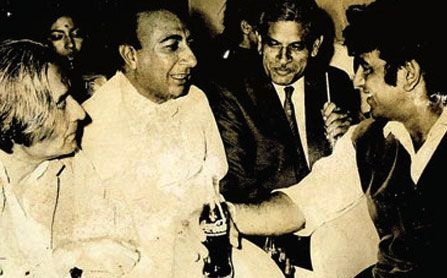
Jan Nisar Akhtar and Sahir Ludhianvi

Legendary Bollywood lyricists Jan Nisar Akhtar (far left) and Sahir Ludhianvi (left center) enjoy a birthday celebration.

The language of Hindi films has evolved since the first talkie Alam Ara in 1931, based on a Parsi play.  The Golden Age of Hindi cinema that blossomed with the studio era of the 1950s and ebbed by the late 1970s is one of India’s greatest artistic achievements. During that time, Hindi films could hardly be called Hindi films. Rather, Hindustani, a mixture of Urdu and Hindi, was the lingua franca of the silver-screen—a reflection of a country unified by a fascinatingly diverse heritage with linguistic influences from Sanskrit, Farsi, Bengali, Arabic, Panjabi, and a myriad of others.

To anyone unfamiliar with the distinction between Urdu and Hindi—there are no hard and fast rules. What many call Hindi, others would call Urdu, but most everyone can appreciate their structural and grammatical similarity. Any attempt to divide them is based on the root origins of the vocabulary intermingled with what is generally a highly homologous syntax. “Urdu” vocabulary tends to draw upon words of Farsi or occasionally Arabic and Turkish origin and “Hindi” vocabulary is generally derived from Sanskrit or regional dialects. But don’t be fooled into thinking any word “belongs” to another language (or those of a particular religion)—Hindustani may vary speaker to speaker, community to community, but the language is all-encompassing.
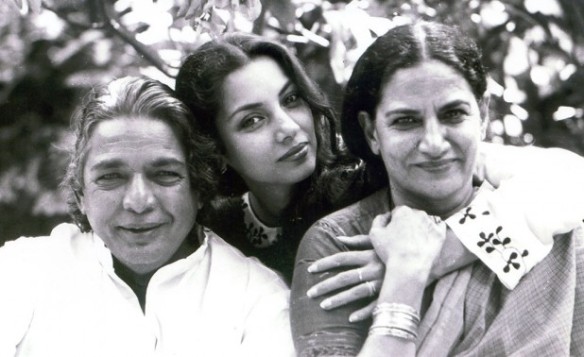
Veteran Urdu poet Kaifi Azmi (left) with his daughter actress Shabhana Azmi (center), who married contemporary lyricist Javed Akhtar, and wife Shaukat Azmi (right).

Veteran Urdu poet Kaifi Azmi (left) with his daughter actress Shabhana Azmi (center), who married contemporary lyricist Javed Akhtar, and wife Shaukat Azmi (right).

The impact of Urdu in the Indian mainstream can be no better summed up by the famous words of our freedom struggle: “Inquilaab zindabaad!” or “Sarfaroshii kii tamanna ab hamaare dil mei.N hai.” Controversial arguments have been made relating the decline in popularity to links with Pakistan, which adopted Urdu as its official language. Yet in Hindi films for decades, the legacy of Urdu poetry continued to flourish in India as the pinnacle of culture and expression.

Indeed, despite enormous gaps in literacy across the country, some of the most popular songs of that era amazingly contain the most complex Urdu-based vocabulary. Perhaps one reason is that the Hindi film song-writers themselves were trained in the art of Urdu poetry. Many of the finest and most successful poets of Hindi film: Sahir Ludhianvi, Raja Mehdi Ali Khan, Gulzar, Hasrat Jaipuri, Shakeel Badayuni, Kaifi Azmi, Jan Nisar Akhtar, and Majrooh Sultanpuri to name but a few, began their careers in Urdu mushairaas, or poetic symposiums.
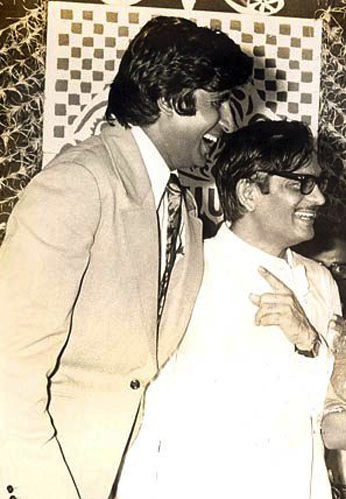
Gulzar lyricist

Record-breaking winner of 11 Filmfare awards for best lyrics, poet Gulzar (right) stands with actor Amitabh Bacchan (left) for whom he wrote hits from the dialogue of Anand (1971) to the modern dance number “Kajra Re” from Bunty Aur Babli (2006)

It would seem more than mere coincidence that these artists came to dominate film lyrics. Like many arenas, the Bombay film industry was an old boy network: Sahir Ludhianvi for example was close friends with Jan Nisar Akhtar, who became in-laws with Kaifi Azmi, who was a prominent member of the pre-partition Progressive Writer’s Movement with Majrooh Sultanpuri. And the music directors who often hand-picked their lyricists and made recommendations to film producers were also steeped in similar artistic traditions. Veteran composer Naushad grew up in the heart of Lucknowi culture, and Madan Mohan spent his childhood in the Middle East, eventually getting his break by joining the All India Radio in Lucknow. Yet connections in the film industry account for only part of its success—audiences had to maintain demand as well.

From the epic qawwali “Yeh Ishq Ishq Hai” from Barsaat Ki Raat (1961), the lilting ode, “Aap Ki Nazron Mein Samjha” from Anpadh 1962), to the playful duet “Deewana Hua Badal” from Kashmir Ki Kali (1964), Urdu in films was remarkably accessible—holding a place for any viewer in every genre. True, it is unlikely the entire audience understood each word in those songs. However, in this manner, film and music could be educational for those who did not–a unique way of preserving the culture they reflected back on. As parallel cinema diva Shabana Azmi aptly quipped,

“If you compare today’s songs with the songs of the 1960s and 1970s, then definitely today’s songs are according to the demand. But if you see, Hindi films used to protect the Urdu language as they used it, but it is slowly dying and I feel bad for it.”

The same extended to the dialogues of films themselves–and I don’t refer only to genre films like Pakeezah (1971) or Mughal-e-Azam (1961). Pure Urdu was ubiquitous in classic Hindi cinema, wafting equally through the sets of an urban crime drama and meandering through a village epic. The importance and sheer beauty of Urdu poetry in dialogues is highlighted in one of the most famous film speech’s of yesteryear. The stirring climax of Daag (1973) culminates in a speech given by Rajesh Khanna’s character for an award bestowed to him by his community. Notice how in this and so many other scripts, Urdu is an inextricable poetic catalyst for the Hindi speech:

Rajesh Khanna’s Speech from Daag (1973):

Aap.
Aap kya jaane mujhko samajhte hai.N kyaa?
Mai.N to kuch bhi nahii.N

“You.
I do not know what you make of me
For I am nothing

Is qadar pyaar itnii baDe bheed ka mai.N rakhuu.Ngaa kya?
Is qadar pyaar rakhne ke qaabil nahii.N
Mera dil, merii jaan…
Mujhko itni mohabbat na do, dosto.
Soch lo dosto…
Is qadar pyaar kaise sambhaaluu.Ngaa mai.N?
Mai.N to kuch bhi nahii.N

How can I carry such love from so great a crowd?
I am not worthy of such great love
My heart, my life…
Do not give me so much love, my friends
Think instead.
How will I bear such great love?
For I am nothing.

Pyaar.
Pyaar ek shakhs ko agar mil sake to badii cheez hai zindagi ke liye
Aadmi ko magar yeh bhi milta nahii.n
Yeh bhi milta nahii.n
Mujhko itni mohabbat milii aap se,
Mujhko itni mohabbat milii aap se…
Yeh mera haq nahii.N, merii taqdiir hai.
Mai.N zamaane ki nazro.N mei.N kuch bhi na thaa.
Merii ankho.N mei.N ab tak woh tasveer hai

Love.
If a man can receive love, it is a great thing in life
Yet many men do not even receive this
They do not even receive this
I have received so much love from you,
I have received so much love from you
This is not my right, it is my fate
I was once nothing in the eyes of the world
And in my eyes, that image remains

Izzate.N, shauharate.N, chaahate.N, ulfate.N, koi cheez duniya mei.N rehtii nahii.N
Aaj mai.N huu.N jahaa.N, kal koi aur thaa.
Yeh bhi ek daur hai, woh bhi ek daur thaa…

Respect, fame, desire, love, nothing remains in the world permanently
Today where I am, yesterday there was someone else
This is one generation, that was another generation…

Aaj itni mohabbat na do dosto.
Ki mere kal kii khatir ka kuch bhi rahe
Aaj ka pyaar thoDa bacha kar rakho
Aaj ka pyaar thoDa bacha kar rakho, mere kal ke liye

Today do not give me so much love, my friends
So that there may be some left for me tomorrow
Today, save some of that love
Today save some of that love for my days ahead

Kal.
Kal jo gumnaam hai
Kal jo sunsaan hai
Kal jo anjaan hai
Kal jo viiraan hai

Tomorrow.
Tomorrow which is anonymous
Tomorrow which is silent
Tomorrow which is unknown
Tomorrow which may be barren

Main to kuch bhi nahii.N huu.N
Mai.N to kuch bhi nahii.n”

I am nothing at all
I am nothing at all.”

With every thoughtfully chosen word, the pervasive Urdu “qaaf” is pronounced as delicately as the gentle “khe,” and the lines are delivered with the poetic overtures of a song lyric. These dialogues were written with poetry in mind, and indeed many song lyricists eventually took to writing entire film scripts (the script of Daag was written by immortal Urdu poet Akhtar ul Iman of Waqt and Gumraah fame).
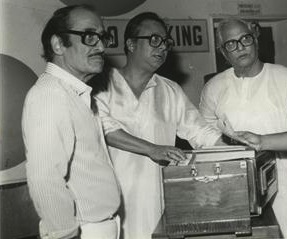
Immortal lyricist Majrooh Sultanpuri (right) with music director R.D. Burman and film director Nasir Hussain at a 1983 recording session.

Famed lyricist Majrooh Sultanpuri (right) with music director R.D. Burman (center) and film director Nasir Hussain (left) at a 1983 recording session.

It would be impossible to summarize the incredible work of these poets in one post (hence why we’ve devoted much of our blog to it!). A small sampling of Filmfare award-winning lyrics are below:

“Chaudhvin ka chaand ho, ya aftaab ho? Jo bhi ho tum khudaa ki qasam laa-jawaab ho…” –Shakeel Badayuni (Chaudhvin Ka Chand 1961)

“Chaahuu.Ngaa mai.N tujhe saa.Nj saveN.re. Phir bhi kabhi ab naam ko tere awaaz mai.N na doo.Ngaa…”--Majrooh Sultanpuri (Dosti 1965)

“Bahaaro.N phool barsaao, meraa mehboob aayaa hai. Hawaao.N raagini gaao, meraa mehboob aaya hai…”--Hasrat Jaipuri (Suraj 1967)

“Kabhi kabhi mere dil mei.N khayaal aataa hai ki jaise tujhko baanaayaa gaya hai mere liye…” –Sahir Ludhianvi (Kabhi Kabhi 1977)

“Aanewaalaa pal jaanewaalaa hai. Ho sake to is mei.N zindagii biTaado pal jo yeh jaanewalaa hai…” — Gulzar (Gol Maal 1980)

I was fortunate to have the chance to learn to read and write in Urdu from my grandparents who moved to New Delhi after the partition of Punjab. But this opportunity is so rare that I found after my grandfather passed away, I know few people to whom I can still write in Nasta’liq. Urdu is a language of romance—more beautiful than French and Italian, and more intricate than superficial political divides. The legacy of Urdu will continue to add to the allure and nostalgia of old films for generations to come. For the loss of Urdu is more than the mere loss of vocabulary. Without Urdu in Hindi films, we have lost our own andaaz–the manner with which we once communicated our thoughts and feelings, our decorum, and a rich, meaningful ornamentation in expressing ourselves that can never be replaced.

-Mrs. 55
The Best Holi Songs of Classic Bollywood Movies

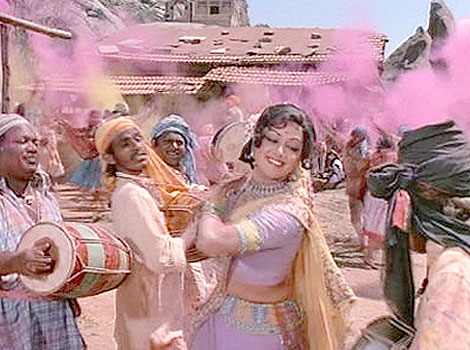
Hema Malini Sholay holi

Hema Malini dances with joyful abandon in Sholay’s famous holi number “Holi Ke Din.”

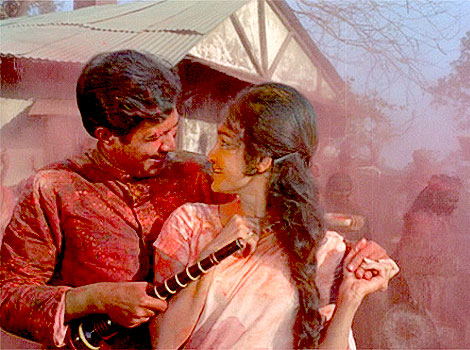
The festival of Holi is among Bollywood’s favorite celebrations–an occasion at last as colorful as the country of its origin. Indeed Holi, a Hindu spring festival, is commonly known as the Festival of Colors. It is both a religious celebration signifying the triumph of Good over Evil, as well as a cultural one commemorating the onset of a new Spring season. It is marked by the throwing of colorful powders, the lighting of bonfires, and the strengthening of bonds between all individuals in colorful merriment. Its spirited catchphrase “Buraa na maano, Holi hai!” (Don’t bear any ill-feelings, it’s Holi!”) speaks to the underlying theme of the day – the burning of negative forces or ill-will, a sort of spiritual purging. The smearing of colors represents the deconstructing of identities and the breaking of social barriers, as all rejoice and participate together, regardless of social class. At the very least, it is a day to settle old scores and move on. Indeed, everyone is welcome and everyone is pardoned for his or her revelry. Thus, we mortals celebrate Holi today with fun and games, colors and powder, and Bollywood takes this grand opportunity to ignite romance.

Rajesh Khanna asha parekh holi

Rajesh Khanna woos Asha Parekh with color at the Holi celebration of Kati Patang (1970).

There’s something inherent to the playful tag-style nature of Holi that lends itself so conveniently to flirtation and a male-female dichotomy. We discussed the appalling lack of Diwali-associated songs in classic Bollywood previously, and hazarded the guess that the festival is far less conducive to overt flirtation and bumping dance grooves like Holi invariably is. Whether wooing the mourning lover into a literal rainbow of joy or painting your sweetheart with a visible mark of your flirtatious overtures, Holi delivers the goods for Bollywood every time.

Mother India holi

Even the old school epic Mother India takes a drama break for the holi festivities!

Below is our list of the 10 greatest Holi songs of classic Bollywood cinema. Happy Holi to all our readers–and if you’re stuck in a huge snowstorm like we are, here’s hoping Holi will usher in the Spring at last!

1. Rang barse (Silsila 1981)

The ultimate old school Holi hit, this song will force anyone to get in the mood and join the festivities! Say what you want about Amitabh and Rekha’s clandestine affair, this dance number will get you on board in no time!

2. Aaj na chodenge (Kati Patang 1970)

This song is easily my favorite Bollywood holi song! Besides the fact that I grew up on the Kati Patang soundtrack, does it get much better than Rajesh Khanna-Asha Parekh shy seduction? Lata and Kishore are delightful, but don’t get me started on the bizarre chorus act that chops up the number like barbarians on holiday.

3. Holi Aayi Re Kanhaayi (Mother India 1957)

Oh, there’s no school like the old school! Bring it back Nargis-style with this classic song from Mother India that just overflows with romance and sass! The only thing better than a Holi song is a Holi village dance-off.

4. Tan rang lo ji (Kohinoor 1960)

While this royal gem may be shot in black-and-white, you can practically see the colors flying in this fantastic Mohammed Rafi-Dilip Kumar celebration that invites the entire kingdom for a Holi song-and-dance sequence!

5. Holi Ke Din (Sholay 1975)

Retro flirting Queen Hema Malini proves to Dharmendra that she’s more than just a loud mouth in Sholay–her moves and dancing steal the show in this colorful song!

6. Are Ja Re Hat Natkhat (Navrang 1959)

Classical dancer Sandhya wows the audience with this traditional stage performance, alternating as both the male and female character complete with ghungroo! Asha Bhonsle’s Hindustani vocals balance out Mahendra Kapoor’s mainstream sway in a Holi number that is well-known even today for its stunning classical choreography.

7. Piya Tose Naina (Guide 1965)

Looking for something a little classier? Go no further than this Waheeda Rehman semi-classical piece from the great philosophical Guide. Watch her prance around with so much joie de vivre, you’ll ignore how gaudy the stage is decorated and your feelings for high-pitched female choruses of the 1960s.

8. Nadiya Se Dariya (Namak Haram 1973)

This song is just plain cute. While not a roaring shoulder-shaking dance off like some of these others, the song is playful and full of shy passion for Rajesh Khanna, which we always approve of.

9. Baghi Re Bhagi Brij Bala (Rajput 1982)

I think this hidden jewel is under-appreciated by historians. While something of a repeat of previous Hema Malini-Dharmendra magic, Vinod Khanna holds his own in this fast-paced duet that once again brings an entire kingdom to the palace to party Holi-style!

10. Kaikhe Paan Banaraswala (Don 1978)

OK, so this isn’t technically a Holi song per se, but it’s arguably the unofficial anthem! There’s something about a traditional, rich beat coupled with Kishore’s absolutely unabashed vocals that set the tone of a celebration and throwing inhibitions to the wind!

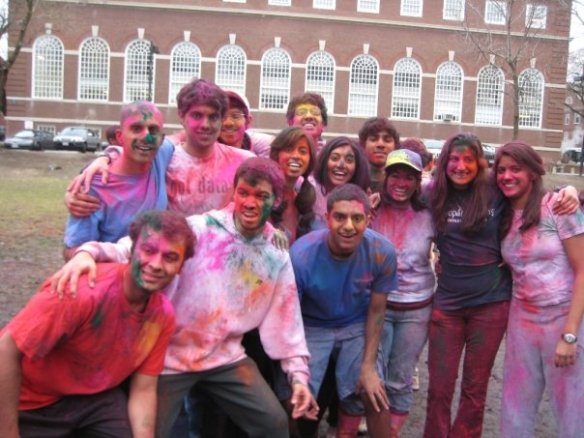
While Holi was born in India, it’s popularity was carried across the diaspora and is celebrated around the world each year with full force! The picture below is from my freshman year at Harvard where Holi was played on the Mac quad! Can you spot me in the pigtails with the orange-yellow face?

n31939_34049799_4730

– Mrs. 55

Tum Pukar Lo Lyrics and Translation: Let’s Learn Urdu-Hindi

Waheeda Rehman Tum Pukar Lo

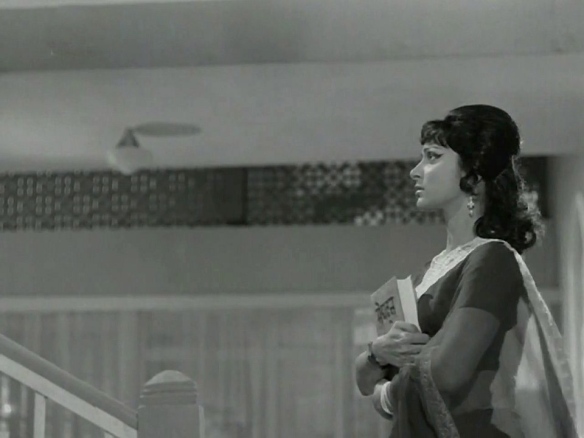
Waheeda Rehman hesitates at the bottom of a staircase leading to the man she loves in Khamoshi (1968).

For our next post we present the full lyrics and translation to the hauntingly beautiful “Tum Pukar Lo” from Khamoshi (1968). This song easily makes my list of most powerful and stirring picturizations from Bollywood. The stark black-and-white imagery highlights the emptiness of space, of shadows, and symbolic barriers. Most of all, the graceful shots that linger longer than action alone permits serve to create a new environment–a world of waiting where time slows down and the confines of the hospital become both escapist and imprisoning. I loved and still love the opening dolly shot so much that I attempted to recreate it in my final film project junior year of Harvard. The shot is transformative–literally taking the audience from behind bars to the free world, and Waheeda from the restraint of her conscience to the new life that beckons her above the staircase. A gentle wind miraculously flows down from Dharmendra’s balcony, through the barren corridor, down the grand stairs, and ultimately through Waheeda’s saari palluu giving rise to a simple, evocative image of a woman drawn by a force greater than any danger: love.

Waheeda Rehman Tum Pukar Lo Khamoshi

I LOVE the classic “frame-within-a-frame” of the mis-en-scene. Not how the lighting in this sequence informs the trajectory of the characters–recall that prior to Waheeda’s discouragement, the welcoming light source came from the balcony (now shrouded in obscurity), indicating a change in both destination and mindset.

I’ve broken down the dolly shot into 3 parts with my storyboard sketches to give you a full picture of how a shot like this is pulled off. The timing and fluidity of the dolly movement (and the pull focus) must be perfectly coordinated with the pace of the actresses walk as the camera additionally swivels on its own axis tracking her ascent up the stairs. I can only say after having attempting to do this shot myself, that it’s a headache but the effect is absolutely wonderful. Ultimately, Khamoshi is a film about identity and the silence caused by its loss through love. The misappropriated gazes in the film that lead characters in and out of a world of insanity is moving and tragic–and the audience too becomes implicit in that beautiful slippage of reality through Kamal Bose’s stunning cinematography, which won him the Filmfare award in 1968! Like Khamoshi’s characters, the camera lingers in each constructedly bereft space, longing for something more.

TumPukarLo1

The shot begins to the side of the staircase, a literal behind-bars view of Waheeda’s ascent.

tumpukarlo2

The camera swivels midway through the dolly pull at a low-angle as the rails of the staircase form a figurative cage around the actress.

The dolly track at last ends at the base of the staircase, holding the shot after Waheeda leaves the stairs, underscoring the incredible emptiness of the space she inhabits.

The dolly track at last ends at the base of the staircase, holding the shot after Waheeda leaves the stairs, underscoring the incredible emptiness of the rigid space she inhabits–and her escape from it.

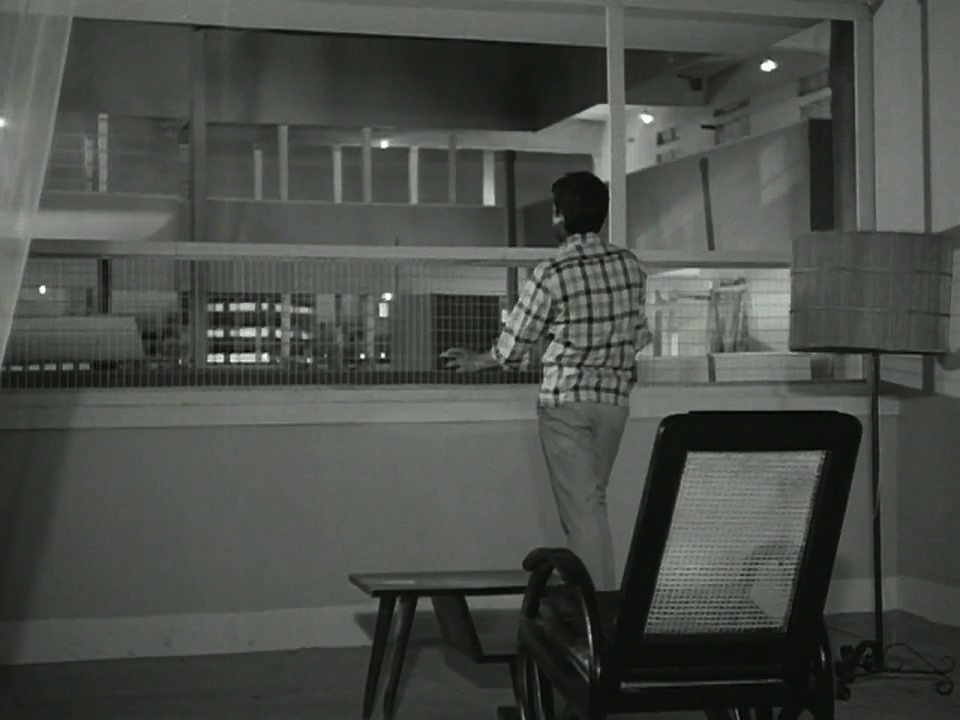
You won’t see much of Dharmendra, the mystery man and asylum inpatient, who sings this song. Instead you see only his outline against the balcony of their confinement. And of course, anything else would be imperfect–while this, this unfulfilled gaze of love, is precisely the poetic complement to the yearning expressed in Gulzar’s heartfelt lyrics. This song may be my favorite Hemant Kumar solo with a melody that hangs in the air long after the song is finished. Whether or not it beats Rajesh Khanna lip-syncing “Woh Shaam Kuch Ajeeb Thi” from the same film is up to you to decide!

tum-pukar-lo-03 Dharmendra

Dharmendra passes sleepless nights thinking of the beautiful woman he lost in Khamoshi (1968).

Without further ado, see for yourself why this song has become immortal. Follow along with the video here, and we hope you enjoy the lyrics and full English translation to “Tum Pukar Lo” below!

Tum Pukar Lo Lyrics and Translation:

Tum pukaar lo
Call out to me
Tumhaaraa intezaar hai
I am waiting for you
Tum pukar lo
Call out to me
Khwaab chun rahe hai.N raat beqaraar hai
I am sifting through dreams while the night remains restless
Tumhaaraa intezaar hai
I am waiting for you
Tum pukaar lo
Call out to me

HonTh se liye hue dil ki baat hum
The words in my heart have escaped from my lips
Jaagte rahe.nge aur kitne raat hum?
How many more nights will I remain awake like this?
Mukhtasar si baat hai: tumse pyaar hai
The matter is simple: I love you

Tumhaaraa intezaar hai
I am waiting for you
Tum pukaar lo
Call out to me

Dil bahal to jaayegaa is khayaal se
My heart will be content with this thought
Haal mil gaya tumhaaraa apne haal se
That my well-being becomes yours
Raat yeh qaraar ki beqaraar hai
This restful night remains restless

Tumhaaraa intezaar hai
I am waiting for you
Tum pukaar lo
Call out to me

Glossary:

pukaarnaa: to call; intezaar karna: to wait; khvaab: dream; beqaraar: restless; honTh: lips; mukhtasar: brief, short; bahal: content; khayaal: thought; haal: well-being, state; qaraar: restful, quiet

My favorite line of this song is by far “Mukhtasar si baat hai, tum se pyaar hai!” So romantic and God, how I love an understatedly accurate pronunciation of the Urdu khe! However, I’m afraid this is one of those cases in which no matter how you translate it, the beauty of the line is just lost in the bluntness of English.

Mrs. 55

Karvaten Badalte Rahe Lyrics and Translation: Let’s Learn Urdu-Hindi


RK

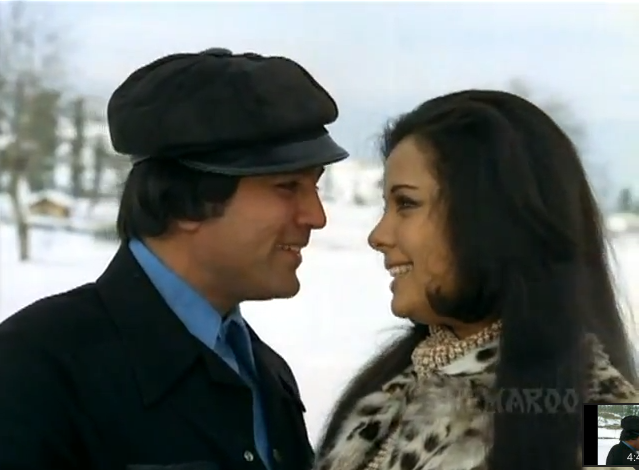
Rajesh Khanna and Mumtaz frolic in pre-marital bliss in the title track from Aap Ki Qasam (1974)

Today, we present the lyrics and English translation to the title track from Aap Ki Qasam (1974): karvate.n badalte rahe.n.  Directed by J. Om Prakash, this film stars Rajesh Khanna, Mumtaz, and Sanjeev Kumar in a story that illustrates how suspicion can be the ultimate enemy to marital bliss. 

As Mumtaz’s jealous husband, Rajesh Khanna begins to doubt his wife’s fidelity when his best friend Sanjeev Kumar comes into the picture. Although Mumtaz and Sanjeev Kumar share a platonic brother-sister friendship, Rajesh Khanna’s suspicion blinds him from reality until he destroys his own marriage.  Refusing to dignify the false accusations of infidelity placed on her with a response, Mumtaz leaves him and returns to her father’s home.  When she realizes that she is pregnant with Rajesh Khanna’s daughter, she enters a second marriage (with her father’s blessings!) so that her child can be raised in a loving home.  In the mean time, Rajesh Khanna comes to his senses and realizes that his suspicion towards his wife was misguided. Unable to apologize properly to Mumtaz for his unacceptable behavior, guilt drives Rajesh Khanna to become a homeless wanderer. Several years later, Mumtaz invites him to his daughter’s wedding where all parties receive closure of sorts. However, a tragedy strikes to create an ending that seeps with melodrama in true Bollywood fashion. 

Aap Ki Qasam is remarkable in its portrayal of marital suspicion for avoiding the chauvinistic bias present in similar films of this era. Typically, female characters accused of infidelity were vilified and forced to appease their husbands regardless of whether the accusations placed upon them were were valid or not. This film breaks the patii-parameshvar (husband is God) mold by supporting a woman’s right to leave an unhappy marriage in which she is treated disrespectfully by her husband. In particular, the support that Mumtaz receives from her father (played by Rehman) in divorcing her husband and entering a second marriage is unusually refreshing for this period of cinematic history. Although it can be argued that Mumtaz’s father makes much of the decisions for her, the fact that she is not compelled to beg for forgiveness at her husband’s feet is sufficiently progressive to merit attention. Indeed, valuing a woman’s dignity and self-worth over her duty to preserve a dysfunctional marriage is the ground-breaking message that makes Aap Ki Qasam stand out among other movies from this time.

In addition to being a cherished Rajesh Khanna-Mumtaz hit, this film is remembered today for its fantastic soundtrack composed by R.D. Burman. Aside from the  Pahadi-based duet sung by Lata Mangeshkar and Kishore Kumar presented here, this album contains the popular duets “suno, haa.n kaho,” “jai jai shiv sha.nkar,” “paas nahii.n aanaa,” the beautiful Lata solo “chorii chorii chup ke chup ke,” and the philosophical Kishore solo “zindagii ke safar me.n.”  Anand Bakshi’s lyrics in “karvate.n badalte rahe.n” are marked by simplicity in their expression of the romance and trust shared between two lovers as they yearn in separation. Moreover, the beautiful snow-filled Himalayan landscape and the on-screen chemistry exhibited by Rajesh Khanna and Mumtaz add to the appeal of this duet. 

Finally, as an aside, the 1973 BBC documentary Bombay Superstar profiling Rajesh Khanna and his influence on Hindi cinema actually features a behind-the-scenes look at the making of Aap Ki Qasam through interviews with the superstar himself,  director J. Om Prakash, and co-star Mumtaz. My favorite part of this documentary is the scene that depicts the amount of work that went into picturizing a playback song for a Bollywood film (the filming of “suno, haa.n kaho” is shown in the documentary).  Check out the full documentary here on YouTube if you haven’t seen it yet! Until next time…

-Mr. 55
RK

The on-screen chemistry between Rajesh Khanna and Mumtaz allowed this pair to dominate the box office during the early 1970s.

Karvaten Badalte Rahe: Lyrics and Translation

karvate.n badalte rahe.n saarii raat ham
Tossing and turning in bed, I have been restless the entire night.
aap kii qasam, aap kii qasam
I swear by you.
gham na karo, din judaayii ke bahut hai.n kam
Do not be sad; the days of our separation are very limited.
aap kii qasam, aap kii qasam
I swear by you.

yaad tum aate rahe ek huuk sii uThtii rahii
As I remembered you, a sharp pain kept arising in my heart.
nii.nd mujhse, nii.nd se mai.n, bhaagtii chhuptii rahii
Sleep and I kept fleeing and hiding from each other.
raat bhar bairan nigoDii chaa.ndnii chubhtii rahii
The hostile, wretched moonlight continued to pierce through the entire night.
aag sii jaltii rahii, girtii rahii shabnam
A fire kept burning, as the dew continued to fall.
aap kii qasam, aap kii qasam
I swear by you.

jhiil sii aa.nkho.n me.n aashiq Duub ke kho jaayegaa
Your beloved will get lost by drowning in the loch of your eyes.
zulf ke saaye me.n dil armaan bharaa so jayegaa
Under the shadows of your tresses, his hope-filled heart will fall into slumber.
tum chale jaao, nahii.n to kuchh na kuchh ho jaayegaa
Please go away, or else something will happen between us.
Dagmagaa jaaye.nge aise haal me.n qadam
Our steps will falter out of control under these circumstances.
aap kii qasam, aap kii qasam
I swear by you.

ruuTh jaaye.n ham to tum ham ko manaa lenaa sanam
Should I sulk, please console me, oh beloved.
duur ho.n to paas ham ko tum bulaa lenaa sanam
Should you be far away, please call me to your side, oh beloved.
kuchh gilaa ho to gale ham ko lagaa lenaa sanam
Should I make a mistake, please embrace me in forgiveness, oh beloved.
TuuT na jaaye kabhii yah pyaar kii qasam
May this vow of love never be broken by us.
aap kii qasam, aap kii qasam
I swear by you.

Female lines in red are sung by Lata Mangeshkar. Male lines in green are sung by Kishore Kumar. Lines in black are sung together by Lata Mangeshkar and Kishore Kumar. 

Glossary

karvate.n badalnaa: to toss and turn in bed  (i.e. to be restless at night); qasam: a sworn oath or vow; gham karnaa: to be sad; judaayii: separation; huuk: a sharp pain; nii.nd: sleep; bhaagna: to flee; chhupnaa: to hide; bairan: hositle, cruel; nigoDii: wretched; chubhnaa: to pierce; aag: fire; shabnam: dew; jhiil: loch, lake; aashiq: beloved; zulf: tresses; saaye: shadows; armaan: hope; Dagmagaaanaa: to falter, stagger; haal: circumstances, state; qadam: steps, feet; ruuTh jaanaa: to sulk; manaa lenaa: to console; sanam: beloved; paas bulaa lenaa: to call to one’s side; gilaa: mistake; gale lagaa lenaa: to embrace; TuuT jaanaa: to be broken.

r

The snowy Himalayan foothills provide the ideal backdrop for this romantic duet from Aap Ki Qasam (1974).

Phool Ahista Phenko Lyrics and Translation: Let’s Learn Urdu-Hindi

Mumtaz is at her sassy finest on screen during this blazing duet from Prem Kahani (1975)

Our next translation comes from Prem Kahani (1975), a hit film set during the peak of India’s struggle for freedom from British rule that stars Mumtaz, Rajesh Khanna, and Shashi Kapoor in  another take on the archetypal Bollywood love triangle. Rajesh Khanna plays the role of an apolitical poet with aspirations of teaching literature who becomes involved in a revolutionary freedom fighter movement to avenge his brother’s murder during a peace protest. He engages in a passionate romance with Mumtaz; however, when she boldly asks to marry him, he turns her down. The reason? Knowing the risks that he will face as a revolutionary, he does not want Mumtaz to be subjected to the cruelties of becoming widowed. Deeply hurt by this rejection,  Mumtaz agrees to marry the man of her father’s choosing. In the mean time, Rajesh kills his brother’s murderer and becomes a fugitive highly sought after by the police. One day, while visiting his sister-in-law’s house, he is shot by police who arrive to search the premises. In order to recover from his wound, Rajesh flees to seek refuge at his best friend Shashi Kapoor’s place. When Rajesh arrives, he finds that it is the day of Shashi’s wedding! Rajesh meets the new bride, and — you guessed it — it is none other than Mumtaz.

In this context, the meaning of the lyrics in “phuul aahistaa phe.nko” come truly alive. The tension at home between Mumtaz and Rajesh Khanna is painfully palpable, and in the midst of this mess, the clueless Shashi calls for the start of an informal mushaira (poetry recital).  If you’re interested in the poetry preceding this song, you can listen to the back-and-forth of the witty retorts between Rajesh and Mumtaz at this link here.  The poetry leads seamlessly into the introduction of this memorable Lata-Mukesh duet, which was composed by Laxmikant-Pyarelal and penned by Anand Bakshi. This gem is a perfect example of how songs in Bollywood films can be used  to express emotions that cannot be described as gracefully with dialogue alone.

Through these lyrics, Rajesh takes the opportunity to express his sorrow for letting Mumtaz go and playing with her heart. Mumtaz, with some sassy lines of her own, chides Rajesh for the way that he treated her. In order to fully understand these lyrics, it is important note that the thematic message of this song revolves around a key metaphor: the roses discussed here represent womankind. Like flowers, Indian women must grapple with a delicate and fragile fate as they endure the pain inflicted by the thorns of society’s constraining norms.  Thus, when Rajesh claims in the mukhDaa that roses must be plucked gently (phuul aahistaa phe.nko, phuul baDe naazuk hote hai.n), Mumtaz sarcastically questions the sincerity of his politesse during her antara (baDii khuubsuurat shikaayat hai yah, magar sochiye kyaa sharafat hai yah?). In her heart, she wishes Rajesh had not been overly concerned with her well-being so that their marriage could have occurred (in spite of her prospects of becoming widowed).  By channeling her emotions into anger, Mumtaz now hopes that the same kind of pain will ultimately afflict Rajesh so that he can understand the heartbreak she was forced to endure because of his decisions (jo rulaate hai.n logo.n ko ek din khud bhii rote hai.n).

As you can tell, this song is power-packed with emotional intensity and some beautifully crafted poetry–I highly recommend a listen if you have not received the opportunity to hear it yet. Follow along with our translation and glossary below, and as always, remember to send in your requests to themrandmrs55@gmail.com!

–Mr.55

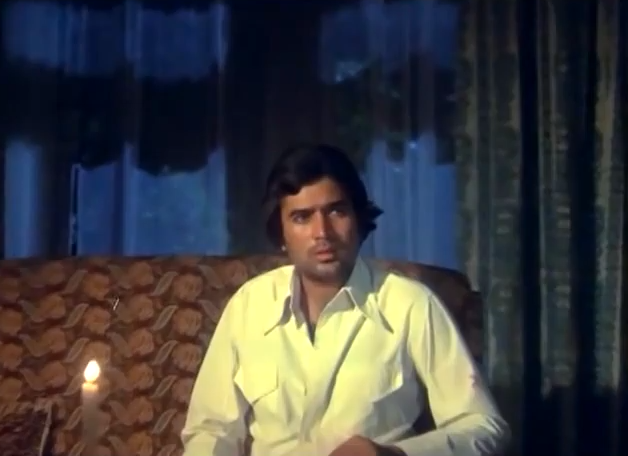
Rajesh Khanna recites poetry that expresses deep regret for letting his beloved Mumtaz slip away in Prem Kahani (1975)

Phool Ahista Phenko: Lyrics and Translation

kahaa aap kaa yah bajaa hii sahii
What you have said is entirely correct: 
ki ham beqadar, bevafaa hii sahii
I am insensitive and unfaithful. 
bade shauq se jaaiye chhoD kar
With pleasure, you may leave me and go away.
magar sahan-e-gulshan se yuu.n toD kar
But, from the rose garden,

phuul aahistaa phe.nko, phuul baDe naazuk hote hai.n
Gently pluck the roses, for they are very delicate. 
vaise bhii to ye badqismatnok pe kaa.nto.n kii sote hai.n
Indeed, these ill-fated flowers must reside on the tips of thorns.

baDii khuubsuurat shikaayat hai yah
You have expressed quite a lovely grievance,
magar sochiye, kyaa sharaafat hai yah?
but please consider whether it is mere politesse.
jo auro.n kaa dil toDte rahte hai.n
Those who continue to break others’ hearts 
lage choT unko to yah kahte hai.n ki
say this when they become hurt themselves: 
phuul aahistaa phe.nko, phuul baDe naazuk hote hai.n
Gently pluck the roses, for they are very delicate. 
jo rulaate hai.n logo.n ko ek din khud bhii rote hai.n
Those who make others cry shed their own tears one day.

kisii shauk ko baagh kii sair me.n
During a stroll in the garden,
jo lag jaaye kaa.nTaa koii pair me.n
when a thorn pierces your foot,
khafaa husn phuulo.n se ho kis liye?
why do you become angry with the roses, oh beautiful one?
ye maasuum hai.n, bekhataa is liye
They are innocent and faultless.
phuul aahistaa phe.nko, phuul baDe naazuk hote hai.n
Gently pluck the roses, for they are delicate.
ye kare.nge kaise ghaayal? ye to khud ghaayal hote hai.n 

How can they hurt others? They are wounded themselves.

gulo.n ke baDe aap hamdard hai.n
You are quite sympathetic to the beauty of these roses.
bhalaa kyo.n na ho? aap bhii mard hai.n
And why not? You are also a man!
hazaaro.n savaalo.n kaa hai ek javaab
A thousand questions have this one answer.
fareb-e-nazar yah na ho, ai janaab
My dear, don’t let your eyes deceive you.
phuul aahistaa phe.nko, phuul baDe naazuk hote hai.n

Gently pluck the roses, for they are delicate.
sab jise kahte hai.n shabnam, phuul ke aa.nsuu hote hai.n
What people call dew drops are, in fact, the tears shed by roses

*Female lines sung by Lata Mangeshkar are denoted in red. Male lines sung by Mukesh are denoted in black.

Glossary

bajaa: correct; beqadar: insensitive; bevafaa: unfaithful; shauq se: with pleasure; sahan: courtyard; gulshan: rose garden; phe.nknaa: to pluck, throw; aahistaa: slowly, gently; naazuk: delicate; badqismat: ill-fated; nok: tip; shikaayat; grievance; sharaafat: politesse, decency; choT: injury, wound; shauk: thorn; baagh: garden; sair: promenade, stroll; khafaa: angry; maasuum: innocent; bekhataa: faultless; gul: rose; hamdard: sympathetic; fareb-e-nazar: delusion of sight; shabnam: dew drops.  

The handsome yet clueless Shashi Kapoor is unaware of the tumultuous history between his wife Mumtaz and best friend Rajesh Khanna in Prem Kahani (1975).