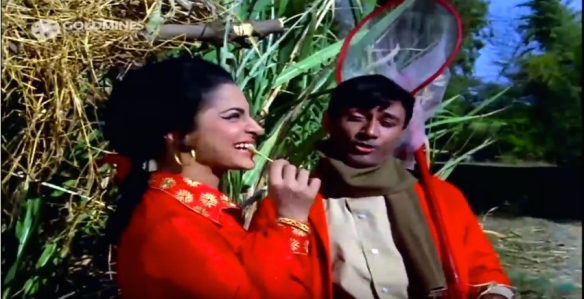
As Dev Anand croons “Shokhiyon Mein Ghola Jaaye” in Prem Pujari (1970), Waheeda Rehman makes even chomping raw sugarcane look attractive.
Today we present the lyrics and English translation of the evergreen duet “Shokhiyon Mein Ghola Jaaye” from Prem Pujari (1970). There could be no better song to welcome the change of seasons than this sweet exploration of the meaning of love…and of a haystack maze. Dev Anand plays a peace-loving son of a veteran who would rather be catching butterflies and whispering words of love to his fiancee, Waheeda Rehman, than holding a gun. However, when war breaks out, he is forced to reconcile his rosy temperament with patriotic duty, ultimately becoming a double spy for India at the expense of his family and loved ones.
But before these complexities of the spirit arise, Waheeda Rehman and Dev Anand spend a few moments blissfully unaware of the perils ahead, playing hide-and-go-seek together like any fully-grown adults in love would do. Their delightful escapades among the haystacks are second only to the passionate Bollywood thrills of running around a tree. I’m a huge sucker for nature-themed flirtation in Hindi films. In “Shokhiyon Mein Ghola Jaaye,” the camera surges between haystacks on a dolly track like a sheep on the loose, anticipating every peekaboo moment of Dev Anand poking his head through the straw or tracing Waheeda’s bright red chunni across the hay to victory. And don’t miss the special moment as they are just about to kiss each otherwhen the camera suddenly cuts to a completely random shot of a raging fire followed by a shot of a gushing water stream. Try to make sense of that adorably antagonistic symbolism, just try. Fortunately, S.D. Burman’s musical genius provides exactly the rip-roaring crescendo we needed to seam all the pieces together.
Gopal Das Neeraj’s poem was originally written as “Chandnii Mei.N Ghola Jaaye,” however Dev Anand wanted to picturize the song during daylight and hence the lyrics were changed. Lata Mangeshkar’s celestial voice is at such a peak in this song, it will make you question her divinity. Kishore Kumar balances her angelic vocals with manly aplomb, helping us gloss past the rough patches caused by Dev Anand’s crimson blazer and matching butterfly net.
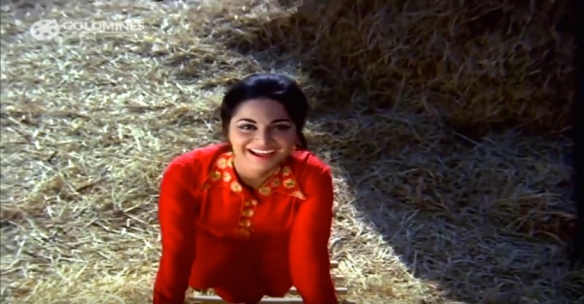
Forgetting that sound travels, Waheeda Rehman sings while playfully climbing up a haystack to hide from her lover in Prem Pujari (1970).
Doesn’t this all just make you crave a pumpkin spice latte? We tragically don’t have sugarcane fields in my town, but I hope you enjoy our translation of this charming Autumn ballad and feel inspired to hit your nearest corn maze, apple orchard, or petting zoo with the one you love. Watch the video on youtube here and follow along with our lyrics and English translation below!
Shokhiyon Mein Ghola Jaaye Lyrics and Translation:
KISHORE: Shokhiyo.N mei.N gholaa jaaye, phoolo.N kaa shabaab Take a swirl of mischievousness, and the youthfulness of flowers Us mei.N phir milaaii jaaye thoDii sii sharaab In those mix in a little bit of wine Hogaa yuu.N nashaa jo taiyyaar The intoxication you create like this Haa.N , hogaa yuu.N nashaa jo taiyyaar, woh pyaar hai Yes, the intoxication you create like this is love Shokhiyo.N mei.N gholaa jaaye, phoolo.N kaa shabaab…
KISHORE: Hey hey, hey hey, hey hey, hey hey!
LATA: Ha.Nstaa huaa bachpan woh, bahakaa huaa mausam hai It is a childhood of laughter, it is a deceptive atmosphere ChheDo to ek sholaa hai, chhuu lo to bas shabnam hai It teases you like an ember, but when it touches you, it feels like a dewdrop Gaao.N mei.N, mele mei.N, raah mei.N, akele mei.N Whether in a village or in a fair, whether upon a street or by yourself Aataa jo yaadbaar baar, woh pyaar hai That memory that comes to you all the time is love Shokhiyo.N mei.N gholaa jaaye, phoolo.N kaa shabaab…
LATA: Oh, la la, la la la, la la la, ah…
KISHORE: Rang mei.N pighalesonaa, ang se yuu.N ras chhalke It is the color of liquid gold, nectar flows from its body Jaise baje dhun koi raat mei.N halkehalke It is as if a melody is played softly at night Dhuup mei.N, chhaao.N mei.N, jhuumtii hawaao.N mei.N In the sunlight, in the shadows, in the playful winds Har dam kare jo intezaar, woh pyaar hai That which waits for you every moment is love Shokhiyo.N mei.N gholaa jaaye, phoolo.N kaa shabaab…
KISHORE: Yaad agar woh aaye… If you remember your love… LATA: Oh, yaad agar woh aaye, aise kaTetanhaaii Oh, if you remember your love, then loneliness is eased Suunesheher mei.N jaise bajne lage shahanaai As if in an empty city, wedding music begins to play KISHORE: Yaad agar woh aaye, aise kaTe tanahaai If you remember your love, then loneliness is eased Suune shahar mei.N jaise bajane lage shahanaai As if in an empty city, wedding music begins to play BOTH: Aanaa ho, jaanaa ho, jaisaa bhii zamaanaa ho Whether you are coming or leaving, however the world may be Utare kabhii naa jo khumaar, woh pyaar hai That feeling of intoxication which never lifts is love
BOTH: Shokhiyo.N mei.N gholaa jaaye, phoolo.N kaa shabaab Take a swirl of mischeviousness, and the youthfulness of flowers Us mei.N phir milaaii jaaye thoDii sii sharaab In those mix in a little bit of wine KISHORE: Hogaa yuu.N nashaa jo taiyyaar The intoxication you create like this LATA: Woh pyaar hai That is love BOTH: Shokhiyo.N mei.N gholaa jaaye, phoolo.N kaa shabaab…
Glossary:
Shokh: mischievousness, prank; gholaa: solution, swirl; phool: flower, shabaab: youthfulness; thoDii sii: a little bit; sharaab: alcohol; nashaa: intoxication; taiyyaar: ready; ha.Nsnaa: to laugh; bachpan: childhood; bakahnaa: to deceive; mausam: season, atmosphere; chheDnaa: to tease; sholaa: ember; chhuunaa: to touch; shabnam: dewdrop; gaao.N: village; melaa: fair; raah: path; akelaa: alone; yaad: memory; baar baar: time to time, often; rang: color; phigalnaa: to flow, to liquify; sonaa: gold; ang: body; ras: nectar; dhun: tune, melody; raat: night; halkaa: soft; dhuup: sunlight: chaao.N: shadow, cloud; jhoomnaa: to swing; hawaa: wind; har dam: every moment; intezaar: wait; kaTnaa: to be cut; tanhaaii: loneliness; suunaa: lonely, empty; sheher: city; bajnaa: to play [an instrument]; shahanaaii: traditional wind instrument played at weddings; zamaanaa: world, earth; utarnaa: to lift, to raise; khumaar: state of intoxication
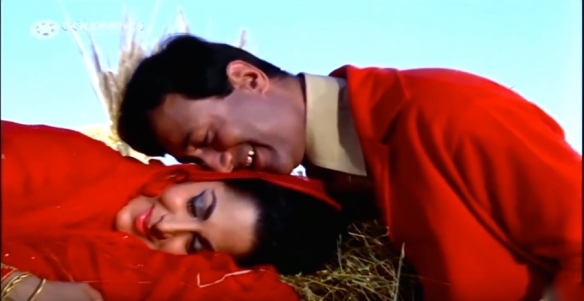
Perched on an excessively romantic pile of hay, Dev Anand presses his nose affectionately to Waheeda Rehman’s ear in Prem Pujari (1970). Is it getting hot in here, or is it just me?
This lovely duet was requested by fan Roshan Sadanani. Thank you for the excellent suggestion, and keep the requests coming! For more on-screen magic between Dev Anand and Waheeda Rehman, check out our translations of “Na Tum Humen Jano,” “Hai Apna Dil To Awaraa,” and “Khoya Khoya Chand!”
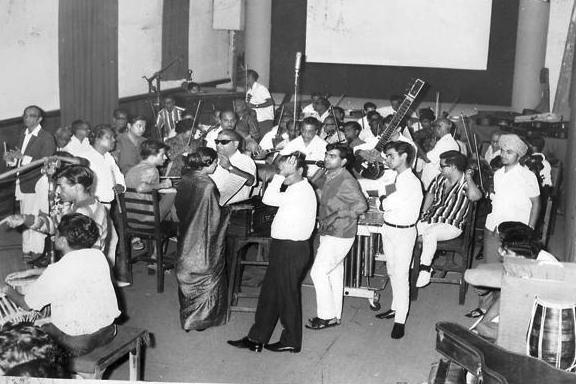
Music director Madan Mohan in his studio circa. 1960s. How many different instruments can you spot in this photo?
Ever find yourself listening to Bollywood film music and feel like your brain is exploding in ecstasy from the rainbow of instruments striking your tympanic membranes? We know the feeling. The history of Bollywood film music goes much deeper than the playback singers who lived in limelight. The incredible talents of Hindi film music directors and musicians are responsible for the compositions we love today. Their risks and creativity were a gift to generations of music-lovers. Without composer Naushad defying his parents to play the harmonium “live” for silent films in the 1930s or R.D. Burman’s daring musical ingenuity in his break-out film Teesri Manzil, Bollywood music as we know it would be radically different.
To truly understand the brilliance of the men and women who shaped Hindi film music, we must learn their tools. From traditional Indian instruments that date to the Vedic age to the orchestral forerunners of Europe to the unsung instruments of Brazil and Africa, the rich mediums of Bollywood music wrote their own rules. We have created a Beginner’s Guide to the Instruments of Classic Hindi Films for whether you’re a newcomer to Bollywood or a veteran, the innovation of these songs and their mechanisms will stun you. To simplify, we divided the instruments into rough categories with several of our favorite examples and links to videos and song translations beneath. And if you ever wonder which instrument was played in a particular song, refer back to this guide for the answer!
A Beginner’s Guide to the Instruments of Classic Hindi Films
String Instruments
Banjo: A plucked 4-5 string instrument with origins in Africa that traveled to America around the 18th century with African-American traditional music and became a staple of country and folk genres.
Ignore how uncomfortable the heroine’s Stockholm Syndrome makes you, and enjoy Meena Kumari’s decent impression of someone who knows how to play the banjo in the film Azaad. This is the only instance of this instrument’s prominent use in a film song that I know. If you have heard others, please leave a comment!
Kitna Haseen Hai Mausam (Azaad 1955)
Cello:A bass 4-stringed instrument dating back to 17th century Italy, the large cello is held against the seated cellist and traditionally played with a horsehair bow.
Guitar: A typically 6-string instrument with European roots with a multitude of incarnations, from acoustic to electric, that have influenced every genre from hard rock to reggae.
Bollywood film music saw a revolution with guitar use from the more acoustic versions a la “Tadbeer Se Bigdhi Hui” in the early 50s to the electric guitar riots of the 60s such as in the jolting opening of “Aaja Aaja” from Teesri Manzil (1966).
Aaja Aaja Main Hoon Pyaar Tera (Teesri Manzil 1966)
Chura Liya Hai (Yaadon Ki Baraat 1973)
Ajeeb Dastan Hai Yeh (Dil Apna Aur Preet Parai 1960)
Tadbeer Se Bigdi Hui (Baazi 1951)
Rulake Gaya Sapna Mera (Jewel Thief 1967)
Mandolin: An evolution from the lute family around 17th century Italy with traditionally 4 courses of double strings that feature prominently in classical European music.
This instrument has had a diverse role in Hindi film music–from an instrument of seduction in C.I.D. (1956) to one of tragedy in “Suhani Raat Dhal Chuki.” Fun fact: the mandolin that is featured in the interlude music “Achaji Main Hari” was played by Laxmikant and Manoharida themselves!
Kahin Pe Nigahen Kahin Pe Nishana (C.I.D 1956)
Achaji Main Hari Chalo (Kala Pani 1958)
Tum Bin Jaoon Kahan (Pyar Ka Mausam 1969)
Suhani Raat Dhal Chuki (Dulari 1949)
Santoor: An ancient Kashmiri instrument of 72-strings that are struck with special mallets and heard in traditional Sufi hymns and folk music of Northern India.
The beautiful, reflective santoor is prominent in many Bollywood films, often as a gentle romantic hint in the score during dialogue or first encounters with love. A great example is in “Mere Mehboob Tujhe” where the santoor is allowed to muse solo as the hero recalls his meeting with a mysterious woman for whom he now searches.
Sarangi: A bowed short-neck stringed instrument famed in Hindustani classical music for its close imitation of the human voice.
I often associate the sarangi with its great performances in courtesan songs. No better example is the hypnotizing opening of Pakeezah‘s immortal “Chalte Chalte.” The sarangi is a very evocative instrument, conjuring unimaginable sadness as in “Do Hanson Ka JoDa” or a lovely shyness in “Dil Cheez Kya Hai.”
Sarod: A lute-like instrument from Afghanistan that rose to prominence in the Mughal courts.
Like the santoor, the sarod often appears in the film’s score outside of a full-blown song-and-dance sequence. The sarod is highly versatile–when played quickly it can denote excitement and movement, and when plucked slowly it can pull at your heart strings. The mesmerizing battle between sitar and sarod in “Madhuban Mein Radhika” demonstrates this instrument’s power to take your breath away!
Madhuban Mein Radhika (Kohinoor 1960)
Man Re Tu Kahe (Chitralekha 1964)
Suno Chhoti Si Gudiya (Seema 1955)
Sitar: An 18-20 string plucked instrument synonymous with Hindustani classical music that influenced the Western pop world in the 1960s when adopted by The Beatles and Rolling Stones.
Tanpura: A 4-string instrument to accompany a Hindustani classical vocalist that does not play a melody, but rather provides a harmonic drone throughout the piece.
The beauty of the tanpura is in its relative simplicity. The singer plucks four strings in order continuously, allowing them to focus on their vocal composition while maintaining harmony. Listen carefully for its deep drone in the background of many classical and semi-classical songs!
Duniya Na Bhaaye (Basant Bahar 1956)
Man Tarpat Hari Dar (Baiju Bawra 1952)
Sukh Ke Sab Saathi (Gopi 1970)
Violin: A highly popular bowed 4-string instrument with roots in 16th century Italy that has had global impact, including in orchestral performances of Hindi film music.
Violins are an integral part of film music orchestration. I’ve listed several songs that highlight its use as a solo instrument, or more commonly as part of a large orchestra seen in numerous Hindi film songs from the 1950s onwards (the famous opening of “Pyar Hua Iqrar Hua” being but one of dozens).
Bansuri: An ancient flute-like instrument with a history dating back to the myths of Lord Krishna and Radha, the bansuri is made from a single shaft of bamboo with 6-7 holes and is associated with pastoral compositions of India.
The lonely bansuri is a common instrument of Hindi films denoting a tragedy, a philosophical side-note, or a quiet village scene. The bansuri of “Chingari Koi Bhadke” represents the second of these themes and will never fail to transport you to a different world of exoticism.
Been (Pungi): An instrument fashioned from a gourd and two reed pipes, the been is the traditional instrument of snake charmers and popular in folk music of South Asia.
The good old been is one of pop cultures favorite instruments, yet is actually only a prominent player in a few classic Bollywood songs. The landmark, of course, is Nagin (1954) where “Man Dole Mera Tan Dole” made been music popular even outside the crowds who gather for snake charmers.
Man Dole Mera Tan Dole (Nagin 1953)
Ek Pardesi Mera Dil Le Gaya (Phagun 1958)
Parde Mein Rehne Do (Shikar 1968)
Western concert flute:A popular sideblown woodwind instrument that dates back to the 11th century Byzantine Empire and is commonly heard in bands and orchestras.
I love how the flute has been used in Hindi film music. Rethink how you’ve always imagined the flute and take a listen to the evocative solo the opens “Ja Re Ja Re Udi Ja Re Panchi” or the seductive twist of the key flute in “Aao Na Gale Lagalo Na”!
Ja Re Ja Re Udi Ja Re Panchi (Maya 1961)
Ruk Ja O Janewali Ruk Ja (Kanhaiya 1959)
Aao Na Gale Lagalo Na (Mere Jeevan Saathi 1972 – key flute)
O Haseena Zulfonwali Jane (Teesri Manzil 1966)
Harmonica: First appearing in Vienna in the 19th century, the easily portable hand-held harmonica has influenced artists from Blues and jazz genres.
Harmonica plays an important role in classic Bollywood film music, often played by optimistic young heroes with a song in their heart despite having great odds against them.
Saxophone: Fashioned in brass originally in Belgium in the 19th century, the edgy saxophone is a key member of jazz and marching bands.
I was first alerted to the presence of saxophones when I heard the haunting and unexpected interlude music of “Awaaz Deke” (Professor 1962). Interestingly, I’ve found that in Hindi film music (due in large part to maestro Manohari Singh whose soprano sax sets your heart on fire in “Mehbooba Mehbooba”), it is just as often as a jazzy party-starter as an edgy bridge toward tragedy.
Shehnai: A traditional South Asian instrument known for its auspicious melodies at weddings and processions.
This lovely, but almost invariably tragic-sounding instrument is a staple of wedding scenes. The opening shehnai of “Babul Ki Duaaen” feels as if someone is crying, reflecting the sadness of a father’s loss. One of the more innovative melodies I’ve heard with shehnai is in the song “Chal Ri Sajni” (and incidentally among the most perfectly filmed and edited sequences in Bollywood history, but that’s another story…)
Babul Ki Duae.N Leti Jaa (Neel Kama 1968)
Kabhi Kabhi (Kabhi Kabhi 1976, interlude after ghughat utaa raha hoon main)
Chal Ri Sajni Ab Kya Soche (Bombai Ka Babu 1960)
Trumpet: 3 piston-valves are the hallmark of this 15th century European instrument which has influenced jazz, Latin, and pop music alike.
While a more limited role in Hindi film music, the trumpet moved strictly cabaret club numbers to the beautiful opening of “Zindagi Kaisi Hai Paheli” where the lifting trumpet solo carries our hopes to the sky with it.
Bongo-Conga: Afro-Cuban drums (consisting of the smaller hand-held bongos and the larger barrel congas) that are backbones of Latin music, Afro-Cuban jazz, and the mambo music that swept 1950s United States.
Wanna know why “O Mere Dil Ke Chain” is your favorite Rajesh Khanna song and your heart races every time it plays? It’s not (just) his perfect face, it’s the Bongo-Conga! This exotic and uber-fun percussion instrument translates effortlessly from living room romance to an outdoor gypsy party.
O Mere Dil Ke Chain (Mere Jeevan Saathi 1972)
Dilbar Dil Se Pyaare (Caravan 1971)
Gum Hai Kisise Pyar (Rampur Ka Lakshman 1972)
Castanets:A distinct handheld instrument commonly associated with the Spanish Sevillanas folk dance that is played by clicking two small wooden shells together in a quick rattle.
Once you hear this sound in a song, you’ll never forget it. More popular in Bollywood songs of the 50s and early 60s, the castanets add a playful nuance on top of the base percussion provided by a different instrument.
Tere Sur Aur Mere Geet (Goonj Uthi Shehnai 1959)
Yeh Chand Sa Roshan Chehra (Kashmir Ki Kali 1964)
Door Gagan Ki Chaaon (Door Gagan Ki Chaaon Mein 1964)
Aaiye Meharbaan (Howrah Bridge 1958)
Mora Gora Ang Laile (Bandini 1963)
Madal: A hand-drum used in Nepali folk music that made its debut in Bollywood under music director R.D. Burman and Ranjjit Gazmer in the 1970s.
The madal has a fuller more rounded tone than the tabla or bongo, lending itself well to rustic scenes. It was featured heavily in the destination film “Hare Rama Hare Krishna”!
Hum Dono Do Premi (Ajnabee 1974)
Kanchi Re Kanchi Re (Hare Rama Hare Krishna 1971)
Dhol: A exciting Panjabi instrument famous for its influence on bhangra music, the dhol (and its family members the dholak and dholki) is a double-headed drum featured in genres from pop to qawwali.
The dhol is a great instrument for dancing and some of the best Bollywood choreography has featured the upbeat dhol. If you ever doubted Vijayantimala’s rumored legendary dance skills, just watch and listen to the end of “Honton Pe Aisi Baat” with the mind-boggling dhol spinning circles around the other instruments.
Chadti Jawani (Caravan 1971)
Honton Pe Aisi Baat (Jewel Thief 1965)
Jhumka Gira Re (Mera Saaya 1966)
Yamma Yamma (1980)
Jai Jai Shiv Shankar (Aap Ki Kasam 1973)
Duggi:A traditional Uttar Pradesh kettle drum in the tabla family played with two hands.
Popularized by Bollywood musician Homi Mullan, this percussion instrument creates a more rounded tone than the tabla, but is a perfect pastoral compliment to “Ni Sultana Re” as well as the sultry domestic “Bahon Mein Chale Aao.”
Ni Sultana Re (Pyar Ka Mausam 1969)
Bahon Mein Chale Aao (Anamika 1973)
Roop Tera Mastana (Aradhana 1969)
Dekha Na Haye Re Socha Na (Bombay to Goa 1972)
Ghatam (Matka):An ancient percussion instrument from South India, the ghatam is a clay pot with a narrow mouth and is played with bare hands.
It doesn’t get any more traditional than the ghatam, but R.D. Burman figured out how to use it an as unconventional ways as possible. Bet you wouldn’t have guessed that the percussion of hipster hit “Samne Yeh Kaun Aaya” came from a clay pot?
Samne Yeh Kaun Aaya (Jawani Diwani)
Are Kaise Mitti Ki Maadho (Imaan 1974)
Muttu Kudi (Do Phool 1974)
Reco Reco (Reso Reso): A scraped percussion instrument with a distict sound with origins in Brazilian music.
The reco reco is basically a party in a box! The distinct rhythm it creates adds spice to every song that is bold enough to utilize it. Watch how Kishore Kumar in a hilarious scene from Padosan lipsyncs his own actual recorded voice while playing the Reco Reco (who is in turn lipsynced by Sunil Dutt!) in “Mere Samnewali Khidki Mein.”
Mere Samnewali Khidki Mein (Padosan 1968)
Mere Naina Saawan Bhado (Mehbooba 1976)
Mera Naam Hai Shabnam (Kati Patang 1970)
Tabla: A pair of hand drums used commonly in Hindustani classic music composed of two distinct drums with differing roles for each hand.
This is one of the most common percussion instruments used in old Hindi songs and is always to go-to when all else fails. I once took tabla lessons, but quit after 2 weeks because my guru insisted I needed to cut my nails shorter to play the instrument correctly. He was right, of course, but there are sacrifices I’m not willing to make!
Western Drum Kit: A collection of instruments often including a bass drum, a snare drum, and one or more cymbals that became popular with jazz bands in the early 20th century and ushered in rock-and-roll.
Rock-and-roll and nightclub bands have long been a part of Hindi film traditions and the Western drum kit hit the screen with a literal bang, and usually accompanied by a song better suited for “modern” audiences.
Dil Deke Dekho (Dil Deke Dekho 1959)
Ina Mina Dika (Aasha 1957)
Baar Baar Dekho (Chinatown 1962)
Tumne Mujhe Dekha (Teesri Manzil 1966)
Nain Milakar Chain Churana (Aamne Samne 1967)
Other
Accordion:Believed to have been invented in Berlin in the early 19th century, the accordion, like the harmonium, is played by compressing the instrument’s bellows with one hand while playing keys with the other hand.
The accordion produces a harsher sound than the harmonium, but is often more exciting as in the epic performance in “Anhoni Ko Honi” or the drama-filled “Har Dil Jo Pyar Karega”!
Har Dil Jo Pyar Karega (Sangam 1964)
Awaara Hoon (Awaara 1951)
Sab Kuch Seeka Humne (Anari 1959)
Anhoni Ko Honi Karde (Amar Akbar Anthony 1977)
Jeena Yahan Marna Yahan (Mera Naam Joker 1970)
Heavy Breathing and Grunting: An R.D. Burman signature that marks any classic Bollywood song as particularly racy and is served by both men and women with an extra scoop of awkward sauce.
Yeah, I had to throw this in. Don’t pretend like it doesn’t exist, and definitely don’t pretend that you don’t love it. Awkward breathing and grunting nosies are a strange but important hallmark of many of our favorite classic Bollywood cabaret numbers. They really just have to be heard to understand (and to believe). Now before you start to blush, these noises are actually pretty complicated to make–it takes great breathing control and just the right amount of oomph. Seriously, try these exercises at home when no one’s around to judge. You’ll give your lungs a run for their money!
Harmonium: A type of hand-pumped accordion often used as melodic accompaniment in Hindustani vocals as well as qawwali and folk music.
The harmonium is one of Hindustani classical music’s best modern friends and a great accompanist to everything from a layman’s love ode (a la “Bahut Shukriya”) to semi-classical qawwalis (as seen in Nutan’s one-man-show “Nigahen Milane”).
Manjira:A small pair of hand cymbals that traditionally accompanied bhajans with roots in ancient temple music.
Although manjira are traditionally used as accompaniments to bhajans, I ADORE how they were used in the romantic “Chhupa Lo Yun Dil” to underscore the devotional imagery to a couple’s love for each other.
Piano: One of the world’s most familiar musical instruments, the piano is played through a keyboard that strikes strings connected to a soundboard.
You’ll be the classiest guy in the room if you can burst into song with your own piano accompaniment at a party. Or so classic Bollywood tells us. Piano songs are essentially their own genre in the world of Hindi films. Once the piano comes out, it gets fancy and emotional in a hurry.
Shankh (conch shell): An ancient instrument fashioned from the shells of large snails that are typically featured in Hindu religious hymns.
This occasionally heard instrument is usually only found in highly religious songs, but can also be heardwhen our heroes make a trip to a temple or when someone is praying for justice in the world. A powerful example comes during the climax of aarti in Purab Aur Paschim!
Om Jai Jagdish (Purab Aur Paschim 1970)
Mose Mora Shaam Roota (Johnny Mera Naam 1970)
What a whirlwind! We hope our introductory guide to the instruments of old Bollywood is a useful tool as you immerse yourself in the incredibly diverse music of our favorite films! All I have to say after reviewing my list is that I really could have used more cowbell.
Just kidding (in fact, listen to “Kitne Bhi Tu Kar Le Sitam” from Sanam Teri Kasam for some actual Bollywood cowbell action). What other instruments played in your favorite classic Bollywood songs have we left off our list? Leave us a comment with an old film song you wish you knew more about and we’ll try to tell you which instruments are featured!
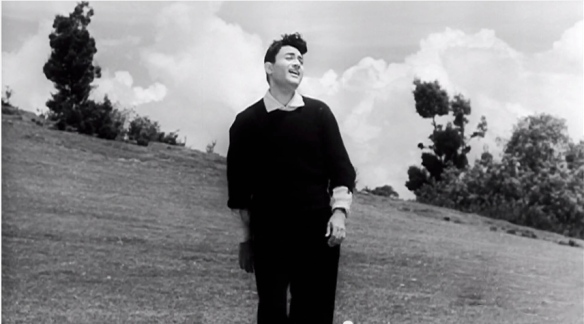
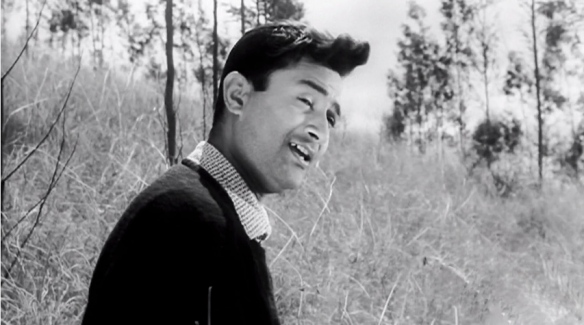
Dapper Dev Anand floats through Ooty with hair that could make Tintin jealous in Kala Bazaar (1960).
Today we highlight the lyrics and English translation to Mohammed Rafi’s “Khoya Khoya Chand” from the film Kala Bazaar(1960). Dev Anand stars as a poor bus conductor with an ailing mother who becomes desperate when he loses his job. He turns to the black market and makes a fortune in underground business dealings. Although he is able to provide well for his mother, he is ashamed when he meets the pure-hearted, but strong-willed Waheeda Rehman who spurns all forms of dishonesty. The strength of Kala Bazaar is in its character study, and though perhaps occasionally heavy-handed, the personalities it portrays are not stereotypic. Both Dev Anand and Waheeda Rehman carry flaws as they navigate the grey space of their moral boundaries, adding a welcome warmth to the film.
Like the effortlessly romantic “Likhe Jo Khat Tujhe,” “Khoya Khoya Chand” makes my top three Mohammed Rafi songs of all time (bonus points if you can guess the third!) Set upon the peaceful Ooty landscape and brimming with whimsy, “Khoya Khoya Chand” is Dev Anand’s ode to the woman he loves and the crossroads at which they stand. The camera breezes alongside him, a cinematographic embodiment of the changing winds, and soars left and right as flirtatiousy as Shailendra’s lyrics. “Khoya Khoya Chand” is quite literally a breath of fresh air that will change the characters (and possibly you) forever! With an open sky of possibility above, what’s there not to love?
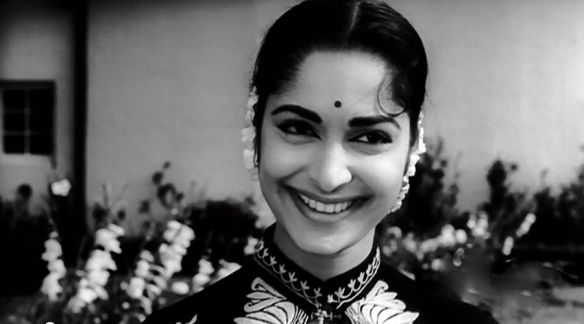
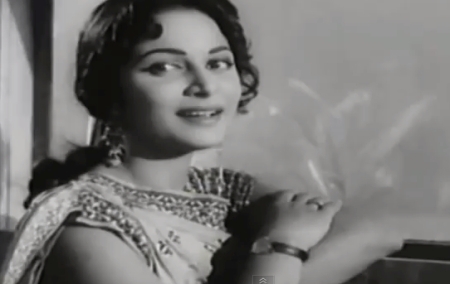
With bold and unafraid eyebrows that make no excuses, Waheeda Rehman glows in the elegant black-and-white cinematography of Kala Bazaar (1960).
We hope you enjoy our English translation of the playful hit song “Khoya Khoya Chand” below! Follow along with our lyrics to the video here and try not to get dizzy as the camera spins with Dev Anand through the Ooty countryside!
Khoya Khoya Chand Lyrics and Translation:
O ho ho, khoya khoya chaand, khula aasmaan The lost moon in the open sky Aankhon mei.N saari raat jaayegi The whole night will fly before your eyes
Tumko bhi kaise nee.Ndaayegi How will you be able to sleep?
Oh oh, khoya khoya chaand… Oh, the lost moon
Mastii bharii hawaa jo chalii The blowing wind is filled with intoxication
Khil khil gayii yeh dil ki kalii The flower of my heart has blossomed Man ki gali mein hai khalbalii There is an agitation in the alley of my soul
Ke unko to bulaao For I must call out to her
O ho ho, khoya khoya chaand Oh, the lost moon…
Taare chale, nazaare chale
Stars go, sights go Sang sang mere woh saare chale They all go along with me Chaaro.N tarafishaare chale Signals come from every direction
Kisi ke to ho jaao That I must become someone else’s
O ho ho, khoya khoya chaand Oh, the lost moon…
Aisii hii raat, bheegii sii raat On a rainy night like this Haatho.N mein haath hote voh saath If she was beside me, hand in hand
Keh lete unse dil kii yeh baat I would tell her these words from my heart
Ab to na sataao Now do not torture me
O ho ho, khoya khoya chaand Oh, the lost moon…
Hum miT chale jinke liye The person for whom I would disappear
Bin kuch kahe woh chhupchhup rahe Without saying a word, she sits quietly
Koi zaraa yeh unse kahe Someone tell her
Na aise aazmaao Do not test me like this
O ho ho, khoya khoya chaand, khula aasmaan The lost moon in the open sky
Aankhon mei.N saari raat jaayegi The whole night will fly before your eyes
Tumko bhi kaise nee.Nd aayegi How will you be able to sleep?
Oh oh, khoya khoya chaand… Oh, the lost moon
Glossary:
chaand: moon; aasmaan: sky; aa.Nkh: eye; raat: night; [kisi ko] nee.Nd aanaa: to fall asleep; mastii: intoxication; hawaa: wind; khilnaa: to bloom; dil: heart; kalii: flower; man: soul; galii: alleyway, street; khalbalii: agitation; bulaanaa: to call; taaraa: star; nazaaraa: sights, vision; sang sang: alongside, together; chaaron taraf se: from 4 directions, from everywhere; ishaaraa: signal, sign; bheegii: rainy, wet; haath: hand; baat; word; sataanaa: to torture; miTnaa: to disappear; chhup: quiet; aazmaanaa: to test; to try
I see you, you sneaky lover of men with vintage hairstyles. Wanna piece of this pompadour?
One of the best moments of Kala Bazaar is earlier in the film when Dev Anand and his posse are selling black market tickets to the premier of the film Mother India (1957)! Real archival footage from the premiere is blended seamlessly into the narrative, giving us a glimpse at the hysteria and excitement of a real-life star-studded movie premiere in the Golden Age of Bollywood. Watch as Mohammed Rafi, Nargis, Lata Mangeshkar, Guru Dutt, Dilip Kumar, Rajendra Kumar and many more make unexpected real-life cameos! There are few things I love more than the existential fairyland that is a film about films.
Famed playback singer Mohammed Rafi smiles at the real-life Mother India (1957) premiere as seen in Kala Bazaar (1960)!
This fun-loving song was requested by two faithful fans, Sudipta Banerjee and Himani Sood! Many thanks for the brilliant request and if you’re trapped in a snowstorm this week like we are, we hope these lyrics remind you of the joys of warm weather soon to come!
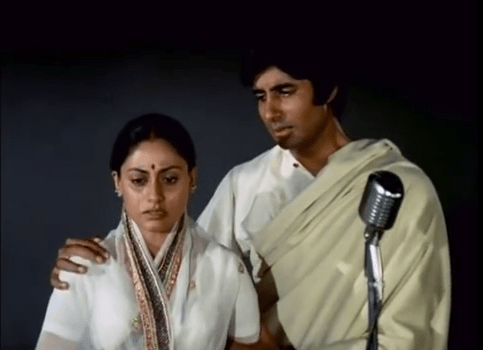
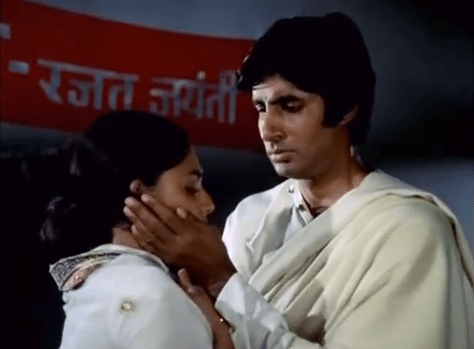
In the famous climax of Abhimaan (1973), Jaya Bhaduri and Amitabh Bachhan reunite on-stage for an emotional rendition of “Tere Mere Milan Ki.”
Today we showcase the lyrics and full English translation of “Tere Mere Milan Ki” from the 1973 hit film Abhimaan. Based loosely on the life of famous playback singer Kishore Kumar and his first wife, Ruma Ghosh, the film centers around a talented newlywed couple whose marriage is threatened by professional jealousy. When high-rolling pop singer Amitabh Bacchan marries innocent country girl Jaya Bhaduri, her newly-discovered musical prowess steals his limelight with alarming disharmony.
The show-stopping number “Tere Mere Milan Ki” is a song of reconciliation in the film’s finale. Flowing with tenderness and hope, the enchanting duet gives Amitabh Bacchan and Jaya Bhaduri another chance to love each other. Is their marriage worth saving? Read more about the film’s story and behind-the-scenes gossip in our earlier review of Abhimaan!
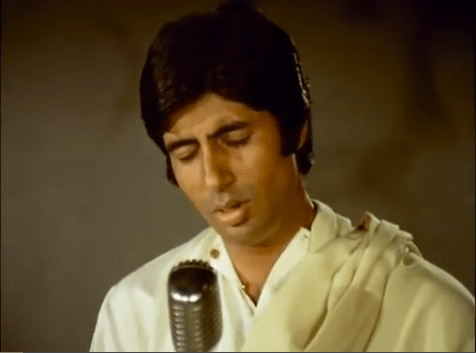
Amitabh Bachhan humbly begins his performance alone and ashamed in Abhimaan (1973).
Rightfully earning S.D. Burman the 1973 Filmfare Award for Best Music Director, “Tere Mere Milan Ki” is a classic example of Rabindra-sangeet in Bollywood. The song dazzles with Majrooh Sultanpuri’s poetic nuances, a metaphorical glimpse into the creation of a family. He describes the lover’s eyes as “chanchal,” which can mean playful, but also implies something that does not remain in one spot, a certain liveliness in spirit. With every “dekho na,” he directs that gaze back toward the night of their union, while she looks toward what lies ahead and the family they will begin together.
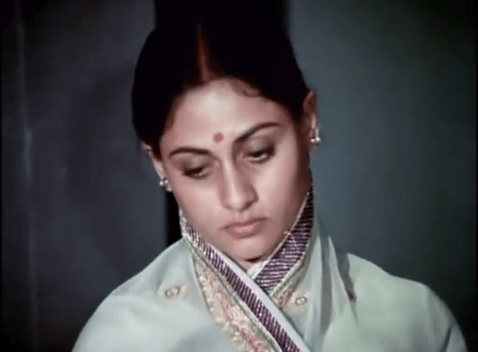
Jaya Bhaduri mourns her miscarried child backstage of her husband’s performance in Abhimaan (1973).
For me, this song has always glowed. Lata Mangeshkar’s voice resonates after the opening stanza like an angel descending from heaven. But it was only after seeing the film that I realized the heroine of the story had recently suffered a miscarriage. Thus the lines “nanhaa sa gul khilegaa a.Nganaa” are more than a hope for the future, but a true reflection of their family’s dream deferred. The entire song changed its meaning for me, and became if possible, even more poignant.
We hope you enjoy our English translation and lyrics to “Tere Mere Milan Ki” from Abhimaan (1973) below! Follow along with the video here.
Tere Mere Milan Ki Yeh Raina Lyrics and Translation:
Male: Tere mere milan kii yeh rainaa On the night of your and my union Nayaa koi gul khilaayegi A new rose will bloom Tabhi to chanchal hai tere naina That is why your eyes are playful Dekho na! Dekho na, tere mere milan kii yeh rainaa Look! Look at the night of your and my union
Female: Nanha sa gul khilegaa a.Nganaa A small rose will bloom upon our balcony Suuniibaiyaasajegii, sajnaa She will decorate my lonely arms, beloved Male: Jaise khele chandaabaadal mei.N Just as the moon plays with the clouds Khelegaa woh tere aa.Nchal mei.N She will play in the folds of your saari Female: Chandaniyaagungunaayegi The rays of the moon will sing Tabhi to chanchal hai tere naina That is why your eyes are playful Dekho na! Dekho na, tere mere milan kii yeh rainaa Look! Look at the night of your and my union
Male: Tujhe thaame kaii hatho.N se I will hold your hand many times Miluu.Nga madbharii raato.N mei.N I will meet you many intoxicating nights Female: Jagaakeaansuunii si dhaDkan By awakening this unfamiliar heartbeat Balamwaa, bhar duu.Ngii teraa man My beloved, I will fill your soul Male: Nayii adaa se sataayegii With a new style you will torment me Tabhi to chanchal hai tere naina That is why your eyes are playful Dekho na! Dekho na, tere mere milan kii yeh rainaa Look! Look at the night of your and my union
Both: Nayaa koi gul khilaayegi A new rose will bloom Tabhi to chanchal hai tere naina That is why your eyes are playful Dekho na! Dekho na, tere mere milan kii yeh rainaa Look! Look at the night of your and my union
Glossary:
milan: meeting, union; rainaa: night; gul: rose; tabhi: this is why, hence; chanchal: restless, playful; nainaa: eyes; nanhaa: little, tiny; a.Nganaa: balcony; suunii: lonely; baiyaa: arms; sajnaa [verb]: to decorate; sajnaa [noun]: darling, beloved; chandaa: moon; baadal: clouds; aa.Nchal: the end of a saari (pallu) or dupatta; chandan: silver, rays of the moon; gungunaanaa: to hum, to sing; haaththaamnaa: to hold hands; madbharii: filled with intoxication; jagaanaa: to wake up; aansuunii: unfamiliar, unheard; dhaDkan: heartbeat; balamwaa: lover; man: soul, heart; adaa: style; sataanaa: to torment
Art mimics life as Amitabh Bachhan comforts Jaya Bhaduri in “Tere Mere Milan Ki” from Abhimaan (1973).
This lovely Lata-Kishore duet was requested by fan Dilip! Thank you for the beautiful request! For more songs from Abhimaan, check out our earlier post on the lovely Rafi-Lata duet “Teri Bindiya Re.”
With glistening suavity dripping from his pomade, Dev Anand croons the love ballad “Na Tum Humen Jano” to a sleeping Waheeda Rehman in Baat Ek Raat Ki (1962).
Today we showcase the lyrics and English translation of the haunting melody “Na Tum Humen Jano” from Baat Ek Raat Ki (1962). Dapper Dev Anand plays a young lawyer whose enigmatic client, Waheeda Rehman, has been convicted of murdering her ex-lover in a fit of rage. Deemed clinically depressed and mentally unhinged, Waheeda’s only chance at redemption, in classic Bollywood tradition, is the stable love of a good man. Dev Anand rises quickly to the occasion, “pretending” to woo her for..ahem…medical reasons–and more importantly to extract the true events leading up to the murder for which she is convicted. I think it comes as no surprise that she ultimately proves innocent and Dev Anand actually falls in love with her while faking it. But that’s not what makes this film’s twist ending so fantastic–and trust me, it’s not what you’d expect!
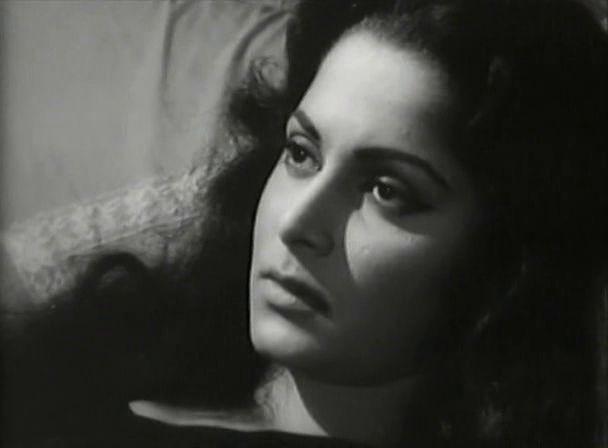
Waheeda Rehman is awakened by the sound of a haunting melody in Baat Ek Raat Ki (1962). Did anyone mention that black is totally your color, Waheeda?
So how does this gem of a Hemant Kumar solo fit into the bizarre whoddunit? I’ve always found Hemant Kumar an intriguing rogue in the strict actor-singer pairings of classic films–the mysterious dark chocolate mousse of Bollywood playback. His tender yet overwhelmingly manly voice stood out among the Rafi wannabes of the age–the celestial way his voice resonates in the opening lines is a rich treat for the soul. Famed music director Salil Chowdhury said of the singer’s voice,
“If God could sing, he would have a voice like Hemanta.”
Have truer words ever been spoken? No better testament exists than the love song “Na Tum Humen Jano.” In Baat Ek Raat Ki, “Na Tum Humen Jano” plays on a gramophone record in the moments leading up to the murder. Waheeda Rehman is so traumatized afterwards, she cannot recall details of the event or her exact involvement. Naturally, Dev Anand believes that singing the song while she sleeps will subconsciously trigger her memory, thereby providing him the missing evidence of what transpired that fatal night. He croons to her hidden in the background, observing her reaction as the melody wafts through the air. What follows is one of the most nostalgic songs of yesteryear.
We hope you love the lyrics and English translation to “Na Tum Humen Jano” as much as us! Follow along with the video and try to keep your beating heart in check as you get swept away in the romance!
Na Tum Humen Jano Lyrics and Translation:
Na tum hame.N jaano, na hum tumhe.N jaane
You do not know me, I do not know you Magar lagtaa hai kuch aisaameraa humdum mil gayaaa
Yet somehow I feel as if I have found my soul mate
Yeh mausam yeh raat chhup hai
These surroundings and this night are quiet Woh honTo.N kii baat chhup hai
Those words on our lips are quiet Khamoshiisunaanii lagii hai dastaa.N
The silence has begun to tell a story Nazar ban gayii hai dil kii zubaa.N
Our glances have become the language of our hearts
Mohabbat kemoD pe hum
At the crossing of love Mile sab ko chhoDke hum
We met and left everything behind DhaDakhte dilo.N ka leke yeh caravaa.N
We took our beating hearts with us on this caravan Chale aaj dono.N jaane kahaa.N
Let us go together today, I know not where
Na tum hame.N jaano, na hum tumhe.N jaane.N
You do not know me, I do not know you Magar lagtaa hai kuch aisaameraa humdum mil gayaaa
Yet somehow I feel as if I have found my soul mate
Prior to murder charges, the lovely Waheeda Rehman sings merrily along to a record of “Na Tum Humen Jano” in Baat Ek Raat Ki (1962).
Now before anyone comments on how angelic Lata’s solo moment is halfway through the song, don’t be fooled! That voice of a goddess is none other than rival soprano Suman Kalyanpur! Her highest high note in the cameo moment is an E5, which doesn’t even come close to Asha and Lata’s famous trills. Composed by S.D. Burman, the song is fully picturized as a happy female solo earlier in the film here! Was Suman Kalyanpur’s solo able to compete with the magic of the famous Hemant counterpart? I think it was certainly a valiant effort, but…let’s not lie to ourselves.
Our English translation of “Na Tum Humen Jano” was requested by diehard fangirl Reena! Stay classy, Reena.

 Mr. & Mrs. 55 - Classic Bollywood Revisited!