Karvaten Badalte Rahe Lyrics and Translation: Let’s Learn Urdu-Hindi


RK

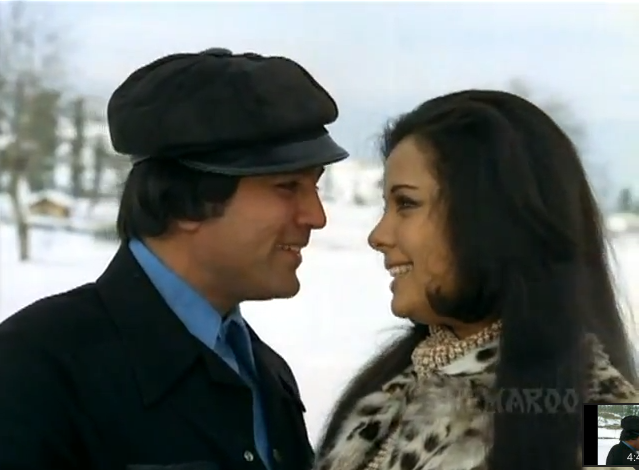
Rajesh Khanna and Mumtaz frolic in pre-marital bliss in the title track from Aap Ki Qasam (1974)

Today, we present the lyrics and English translation to the title track from Aap Ki Qasam (1974): karvate.n badalte rahe.n.  Directed by J. Om Prakash, this film stars Rajesh Khanna, Mumtaz, and Sanjeev Kumar in a story that illustrates how suspicion can be the ultimate enemy to marital bliss. 

As Mumtaz’s jealous husband, Rajesh Khanna begins to doubt his wife’s fidelity when his best friend Sanjeev Kumar comes into the picture. Although Mumtaz and Sanjeev Kumar share a platonic brother-sister friendship, Rajesh Khanna’s suspicion blinds him from reality until he destroys his own marriage.  Refusing to dignify the false accusations of infidelity placed on her with a response, Mumtaz leaves him and returns to her father’s home.  When she realizes that she is pregnant with Rajesh Khanna’s daughter, she enters a second marriage (with her father’s blessings!) so that her child can be raised in a loving home.  In the mean time, Rajesh Khanna comes to his senses and realizes that his suspicion towards his wife was misguided. Unable to apologize properly to Mumtaz for his unacceptable behavior, guilt drives Rajesh Khanna to become a homeless wanderer. Several years later, Mumtaz invites him to his daughter’s wedding where all parties receive closure of sorts. However, a tragedy strikes to create an ending that seeps with melodrama in true Bollywood fashion. 

Aap Ki Qasam is remarkable in its portrayal of marital suspicion for avoiding the chauvinistic bias present in similar films of this era. Typically, female characters accused of infidelity were vilified and forced to appease their husbands regardless of whether the accusations placed upon them were were valid or not. This film breaks the patii-parameshvar (husband is God) mold by supporting a woman’s right to leave an unhappy marriage in which she is treated disrespectfully by her husband. In particular, the support that Mumtaz receives from her father (played by Rehman) in divorcing her husband and entering a second marriage is unusually refreshing for this period of cinematic history. Although it can be argued that Mumtaz’s father makes much of the decisions for her, the fact that she is not compelled to beg for forgiveness at her husband’s feet is sufficiently progressive to merit attention. Indeed, valuing a woman’s dignity and self-worth over her duty to preserve a dysfunctional marriage is the ground-breaking message that makes Aap Ki Qasam stand out among other movies from this time.

In addition to being a cherished Rajesh Khanna-Mumtaz hit, this film is remembered today for its fantastic soundtrack composed by R.D. Burman. Aside from the  Pahadi-based duet sung by Lata Mangeshkar and Kishore Kumar presented here, this album contains the popular duets “suno, haa.n kaho,” “jai jai shiv sha.nkar,” “paas nahii.n aanaa,” the beautiful Lata solo “chorii chorii chup ke chup ke,” and the philosophical Kishore solo “zindagii ke safar me.n.”  Anand Bakshi’s lyrics in “karvate.n badalte rahe.n” are marked by simplicity in their expression of the romance and trust shared between two lovers as they yearn in separation. Moreover, the beautiful snow-filled Himalayan landscape and the on-screen chemistry exhibited by Rajesh Khanna and Mumtaz add to the appeal of this duet. 

Finally, as an aside, the 1973 BBC documentary Bombay Superstar profiling Rajesh Khanna and his influence on Hindi cinema actually features a behind-the-scenes look at the making of Aap Ki Qasam through interviews with the superstar himself,  director J. Om Prakash, and co-star Mumtaz. My favorite part of this documentary is the scene that depicts the amount of work that went into picturizing a playback song for a Bollywood film (the filming of “suno, haa.n kaho” is shown in the documentary).  Check out the full documentary here on YouTube if you haven’t seen it yet! Until next time…

-Mr. 55
RK

The on-screen chemistry between Rajesh Khanna and Mumtaz allowed this pair to dominate the box office during the early 1970s.

Karvaten Badalte Rahe: Lyrics and Translation

karvate.n badalte rahe.n saarii raat ham
Tossing and turning in bed, I have been restless the entire night.
aap kii qasam, aap kii qasam
I swear by you.
gham na karo, din judaayii ke bahut hai.n kam
Do not be sad; the days of our separation are very limited.
aap kii qasam, aap kii qasam
I swear by you.

yaad tum aate rahe ek huuk sii uThtii rahii
As I remembered you, a sharp pain kept arising in my heart.
nii.nd mujhse, nii.nd se mai.n, bhaagtii chhuptii rahii
Sleep and I kept fleeing and hiding from each other.
raat bhar bairan nigoDii chaa.ndnii chubhtii rahii
The hostile, wretched moonlight continued to pierce through the entire night.
aag sii jaltii rahii, girtii rahii shabnam
A fire kept burning, as the dew continued to fall.
aap kii qasam, aap kii qasam
I swear by you.

jhiil sii aa.nkho.n me.n aashiq Duub ke kho jaayegaa
Your beloved will get lost by drowning in the loch of your eyes.
zulf ke saaye me.n dil armaan bharaa so jayegaa
Under the shadows of your tresses, his hope-filled heart will fall into slumber.
tum chale jaao, nahii.n to kuchh na kuchh ho jaayegaa
Please go away, or else something will happen between us.
Dagmagaa jaaye.nge aise haal me.n qadam
Our steps will falter out of control under these circumstances.
aap kii qasam, aap kii qasam
I swear by you.

ruuTh jaaye.n ham to tum ham ko manaa lenaa sanam
Should I sulk, please console me, oh beloved.
duur ho.n to paas ham ko tum bulaa lenaa sanam
Should you be far away, please call me to your side, oh beloved.
kuchh gilaa ho to gale ham ko lagaa lenaa sanam
Should I make a mistake, please embrace me in forgiveness, oh beloved.
TuuT na jaaye kabhii yah pyaar kii qasam
May this vow of love never be broken by us.
aap kii qasam, aap kii qasam
I swear by you.

Female lines in red are sung by Lata Mangeshkar. Male lines in green are sung by Kishore Kumar. Lines in black are sung together by Lata Mangeshkar and Kishore Kumar. 

Glossary

karvate.n badalnaa: to toss and turn in bed  (i.e. to be restless at night); qasam: a sworn oath or vow; gham karnaa: to be sad; judaayii: separation; huuk: a sharp pain; nii.nd: sleep; bhaagna: to flee; chhupnaa: to hide; bairan: hositle, cruel; nigoDii: wretched; chubhnaa: to pierce; aag: fire; shabnam: dew; jhiil: loch, lake; aashiq: beloved; zulf: tresses; saaye: shadows; armaan: hope; Dagmagaaanaa: to falter, stagger; haal: circumstances, state; qadam: steps, feet; ruuTh jaanaa: to sulk; manaa lenaa: to console; sanam: beloved; paas bulaa lenaa: to call to one’s side; gilaa: mistake; gale lagaa lenaa: to embrace; TuuT jaanaa: to be broken.

r

The snowy Himalayan foothills provide the ideal backdrop for this romantic duet from Aap Ki Qasam (1974).

Who Is Anthony Gonsalves?

anthonygonsalves amitabh

Amitabh Bachhan looks a befitting popinjay in top hat and monocle for the cult classic number “My Name Is Anthony Gonsalves.”

Who is Anthony Gonsalves? Even if you have but a fleeting knowledge of classic Bollywood, you’ll have come across the name before. Anthony Gonsalves is an enigma, a hero, and a forgotten figure in history. He is both legend and fact–a swashbuckling joker and a serious man of the world. But the truth is, few people appreciate the history while adoring the myth. His entrance into mainstream culture is unforgettable, one of the most famous scenes of the masala classic Amar Akbar Anthony (1977): It’s Easter Day and Parveen Babi has arrived at a friendly dance party with her bulging bodyguard. A mysterious over-sized egg is wheeled into the crowded room. Just when you think the spectacle is over, out bursts Amitabh Bachhan dressed as an Edwardian fop, complete with the astounding vocabulary of a deranged member of the House of Lords.

Anthony Gonsalves is a sacred tune in my house–our whole family loves the song, a particular favorite of my younger brother growing up. Everyone knows when to chime in with the sheepish “Excuse me, please!” or the womenfolk’s “Really?! WOW!” (pronounced, of course, “VOW!”) woven into the melody. But what many don’t realize is that Anthony Gonsalves nor his famously inane words are not entirely fiction.

anthony gonsalves egg

Amitabh Bachhan emerges from the life-sized party egg as a dapper Anthony Gonsalves in Amar, Akbar, Anthony (1977).

Yes, folks, Anthony Gonsalves was real. Born in 1927 in the small Goan fishing village of Majorda, Anthony Prabhu Gonsalves was a genuine and highly influential figure in the Hindi film music industry of the 1950s. He worked as a violinist in the early 1940s with none other than great musical composer Naushad, and later taught violin to eager pupils R.D. Burman and Pyarelal Ramprasad Sharma (of Laxmikant-Pyarelal fame!) in his apartment in Bandra. It is in dedication to him, his old violin teacher, that Pyarelal composed this number and thereby immortalized one of the great unsung heros of the Bollywood music industry. Originally, Amitabh’s character was named “Anthony Fernandez” and Pyarelal personally requested director Manmohan Desai change the name to the now notorious “Anthony Gonsalves” to honor his teacher. The original Anthony Gonsalves orchestrated music for epics like Mahal (1949), Pyaasa (1957), and even founded the Indian Symphony Orchestra following his love for raaga-based music with a Western flair.

Tragically, Gonsalves passed away last year in 2012 after having left a legacy of Goan-Hindustani fusion jazz across the Indian continent. When Amar Akbar Anthony was released, the reclusive artist had already disappeared from the world of filmdom on a traveling grant from Syracuse University in NY. He remained in the states where he joined the American Society of Composers, Publishers, and Authors until a quiet return to Goa later in later years, his musical days long behind him. In 2010 a documentary entitled “Anthony Gonsalves: The Music Legend” based on his life and works won the Special Jury Award at the International Film Festival of India.

The real Anthony Gonsalves, musician

The real Anthony Gonsalves (1927-2012).

Still, most of us with forever associate the name “Anthony Gonsalves” with the blustering, idiotic, and highly endearing character played by Amitabh Bachhan in Amar, Akbar, Anthony (1977). It’s impossible to brush by a song as outrageously absurd (and enjoyable!) as this one. Filled with trick photography and silly antics, the song does its best to grab the audience by the coattails and give them a good spin. You’ll probably wonder about the onslaught of random English words exploding out of Amitabh’s mouth between each stanzas. While most are indeed arbitrary 3-4 syllable English words intended to sound too fancy to bother comprehending (with disastrous and embarrassing results), the opening line shines above the others:

“Wait, wait wait! You see the whole country of the system is juxtapositioned by the hemoglobin the atmosphere because you are a sophisticated rhetorician intoxicated by the exuberance of your own verbosity!”

True, that doesn’t mean anything in relation to this song or the film (and frankly the first part of that sentence doesn’t even mean anything to anyone who knows English), but let’s take a closer gander at that last bit. In 1878 British Prime Minister Benjamin Disraeli gave a speech in reference to his liberal rival and famous orator William Ewart Gladstone in the Parliament of the United Kingdom. In the speech he spoke viciously of Gladstone as a “sophisticated rhetorician inebriated by the exuberance of his own verbosity”! Hmm..coincidence? I think not!

Parveen Babi My Name is Anthony gonsalves

Parveen Babi is totally buying all the crazy sauce Anthony Gonsalves has to sell at the Easter celebration in Amar, Akbar, Anthony (1977).

So say what you want about the other lines (oh, that gosh darned country of the system), at least one was clearly influenced by something that at one point in time had been a logical thought. Perhaps we have Anand Bakshi to thank for that. Interestingly, a 2008 box office failure was released called “My Name is Anthony Gonsalves” based on the song, but its awfulness might attest to the fact that you can only get away with something as bizarre as this once. Check out the full video of the original to see what I mean here!

At last another Bollywood mystery solved–this one requested by loyal fan Neil! You may now sleep restfully at night once more! Until next time…

-Mrs. 55

Plagiarism in Hindi Film Music: Is Imitation the Most Sincere Form of Flattery?

Music directors in the Bollywood industry today are often accused of plagiarizing songs without giving proper credit to the original sources. Pritam Chakraborty, in particular, comes to mind as a composer who has been subjected to such accusations in recent times. Yet, lifting tunes is not a new trend in the industry: its origins can be  traced back to the industry’s earliest days when music directors of the Golden Era composed melodies heavily inspired by unattributed sources. Below, let’s take a listen to some plagiarized works composed by five of the greatest music directors of yesteryear: R.D. Burman, S.D. Burman, Shankar-Jaikishan, Salil Chowdhury, and O.P. Nayyar.

 R.D. Burman

Among the music directors of his time, R.D. Burman was perhaps the most notorious for composing inspired tunes.  Within the list that I’ve provided below, the magnitude of plagiarism varies from song to song. Some numbers below are direct lifts from their originals, such as the cult classic “mahbuubaa mahbuubaa” from Sholay (1975). Others represent more subtle variations of plagiarism: for instance,  the Kishore Kumar classic “dilbar mere kab tak mujhe” only takes it mukhDaa from “Zigeunerjunge” but has original antaras and interludes.  As a musician, I personally feel that the latter form of lifting is somewhat justifiable because it still reflects a level of creativity and originality on the part of the composer. The direct copying of tunes, however, raises ethical concerns and may have even placed music directors like R.D. Burman in legal trouble had such songs been released today.  Regardless of your opinion on this issue, what is universally striking about the list of songs below is the diversity of sources from which R.D. Burman drew his inspiration.  Collectively, the original melodies come from a smorgasbord of musical genres from all over the world: traditional folk, American pop, Greek, German, French, and even Iranian rock!

aao twist kare.n (Bhoot Bangla, 1965)  / “Let’s Twist Again” (Chubby Checker, 1962)
churaa liyaa hai tum ne  (Yaadon Ki Baraat,  1973) / “If It’s Tuesday, This Must Be Belgium” (Bojoura, 1969)
teraa mujhse hai pahle kaa naataa koii  (Aa Gale Lag Ja, 1973)/ “The Yellow Rose of Texas” (Traditional)
mahbuubaa, mahbuubaa (Sholay, 1975) / “Say You Love Me” (Demis Roussos, 1974)
mil gayaa ham ko saathii (Hum Kisi Se Kum Nahin, 1977) / “Mamma Mia” (ABBA, 1975)
jahaa.n terii yah nazar hai (Kaalia, 1981) / “Heleh Maali” (Zia Atabi, 1977)
kaisaa teraa pyaar (Love Story, 1981) / “I Have A Dream” (ABBA, 1979)
dilbar mere kab tak mujhe (Satta Pe Satta, 1982) / “Zigeunerjunge” (Alexandra, 1967)
kahii.n na jaa  (Bade Dilwala, 1983) / “La Vie En Rose” (Edith Piaf, 1955)
tum se milke  (Parinda, 1989) / “When I Need You” (Leo Sayer, 1977)

Zeenat Aman sizzles in “churaa liyaa tum ne” from Yaadon Ki Baraat (1973)

S.D. Burman

Like his son, S.D. Burman has also composed melodies that reflect marked inspiration from foreign sources.  Although we have already investigated the influence of Tagore’s music on S.D. Burman in a previous post, we now observe how his compositions also were inspired by non-Indian genres.  For a composer who was rather traditional in his musical output, who would have imagined that he lifted material from Mexican, Italian, and American country melodies?

chaahe koi khush ho (Taxi Driver, 1954) / “Tarantella” (Traditional)
jiivan ke safar me.n raahii
 
(Munimji, 1955) / “Mexican Hat Dance” (Traditional)
ek laDkii bhiigii bhaagii sii (Chalti Ka Naam Gaadi, 1958) / “Sixteen Tons” (Tennessee Ernie Ford, 1955)
ham the vah thii (Chalti Ka Naam Gaadi, 1958) / “Watermelon Song” (Tennessee Ernie Ford, 1957)
yah dil na hotaa bechaaraa (Jewel Thief, 1967) / “March” (Bridge on the River Kwai, 1957)
saalaa mai.n to sahab ban gayaa (Sagina, 1974) / “Chella Lla” (Renato Carosone, 1959)

The ever-versatile Kishore Kumar stars in a comic role in Chalti Ka Naam Gaadi (1955)

Shankar-Jaikishan

In my opinion, Shankar-Jakishan were the quintessential music directors of Bollywood’s Golden Age. They combined the authenticity of traditional Indian music with the modern sophistication of Western influences to produce songs that appealed to the masses. It’s not surprising that some of their tunes reflect inspiration from foreign influences, but what is remarkable is that several of the songs listed below are remembered today as some of this duo’s most treasured gems.  Two songs from Chori Chori (1956), two songs from Gumnaam (1965), and the title track of Jab Pyar Kisi Se Hota Hai (1961) — among many other hits — were heavily inspired by existing Western numbers. I think you’ll be surprised to see some of your favorites on the list below…

ghar aayaa meraa pardesii (Awaara, 1952) / “Al Balad El Mahboub” (Umm Kulthum)
aajaa sanam madhur chaa.ndnii me.n ham (Chori Chori, 1956) / “Tarantella” (Traditional)
panchii banuu.n uDtii phiruu.n (Chori Chori, 1956) / “Coming Through The Rye” (Traditional)
aigo aigo yah kyaa ho gayaa?
(Boyfriend, 1961) / Stupid Cupid” (Connie Francis, 1958)
jiyaa ho jiyaa kuchh bol do  (Jab Pyar Kisi Se Hota Hai, 1961) / “Broken-Hearted Melody” (Sarah Vaughan, 1959)
sukuu sukuu (Junglee, 1961) / “Sucu Sucu” (Ping Ping, 1961)
dekho ab to kis ko nahii.n hai khabar (Janwar, 1964) / “I Want To Hold Your Hand” (The Beatles, 1963 )
gumnaam hai koii (Gumnaam, 1965) / “Charade” (Henry Mancini and Orchestra, 1963)
jaane chaman sholaa badan (Gumnaam, 1965) / “Autumn Leaves” (Nat King Cole, 1956)
le jaa le jaa meraa dil (An Evening in Paris, 1967) / “Man of Mystery” (The Shadows, 1960)
kaun hai jo sapno.n me.n aayaa? (Jhuk Gaya Aasman, 1968) / “Marguerita” (Elvis Presley, 1963)

Rajendra Kumar definitely breaks conventions of automobile safety during the picturization of “kaun hai jo sapno.n me.n aayaa?” from Jhuk Gaya Aasman (1968).

Salil Chowdhury

Salil Chowdhury’s compositions always reflect an intelligent and sophisticated mastery of music that set him apart from his peers in the industry.  Instead of describing the songs listed here as cases of plagiarism, I would be more likely to categorize them as adaptations. When Salil Chowdhury used another Western melody as an inspiration, he always managed to make it his own by adding something special that would resonate with Indian audiences. Take, for example, the evergreen Talat-Lata duet “itnaa mujhse tu pyaar baDhaa.” Although the mukhDaa is clearly inspired by Mozart’s Jupiter Symphony, Salil composes new antaras that beautifully complement the original melody.  As another example, consider “bachpan o bachpan” from Memdidi (1961).  Inspired by the children’s rhyme “A Tisket, A Tasket,” Salil takes the melody to a new level of complexity by inserting operatic interludes sung by our beloved diva Lata Mangeshkar.  Bravo!

dharti kahe pukaar ke (Do Bigha Zameen, 1953) / “Meadowlands” (Lev Knipper, 1934)
halke halke chalo saa.nvare (Tangewaali, 1955) / “The Wedding Samba” (Edmund Ros and Orchestra,  1950)
dil taDap taDap ke (Madhumati, 1957) / “Szla Dziewczka” (Traditional)
zindagii hai kyaa, sun merii jaan  (Maya, 1961) / “Theme from Limelight [from 3:27] ” (Charlie Chaplin, 1952)
itnaa na mujhse tu pyaar baDhaa (Chhaya, 1961) / “Molto allegro” from Symphony No. 40 (Wolfgang Amadeus Mozart, 1788)
bachpan o bachpan (Memdidi, 1961) / A Tisket, A Tasket” (Traditional)
aa.nkho.n me.n tum ho (Half-Ticket, 1962) / “Buttons and Bows” (Dinah Shore, 1948)

Vijayantimala coyly hides behind a tree in the picturization of “dil taDap taDap ke” from Madhumati (1957)

O.P. Nayyar

O.P. Nayyar is known for his characteristically Western-inspired approach to crafting melodies for Hindi films, but his contribution to our list of directly plagiarized songs is relatively small in comparison to some of his peers in the industry. The most well-known example here is, of course,  the Rafi-Geeta duet “yah hai bambaaii merii jaa.n” which has been lifted from its predecessor “My Darling Clementine.”

baabuujii dhiire chalnaa (Aar Paar, 1954) / “Quizas, Quizas, Quizas(Trio Los Panchos, 1947)
yah hai bambaii merii jaa.n (C.I.D., 1955) / “My Darling Clementine” (Traditional)
lakho.n hai.n yahaa.n dilvaale (Kismat, 1968) / Red River Valley” (Traditional)

Biswajeet hams it up for Babita during the picturization of “lakho.n hai.n yahaa.n dilvaale” in Kismat (1968)

What is your opinion on plagiarism in Hindi film music? Was it acceptable for music directors of this time to lift material from Western sources in order to introduce musical diversity to Indian audiences? Or, is it unethical for such plagiarism to occur without giving credit to the original musicians who created the songs in the first place? Let us know in the comments, and feel free to share any examples that go along the theme of this post!

-Mr. 55

Chingari Koi Bhadke Lyrics and Translation: Let’s Learn Urdu-Hindi

Rajesh Khanna Sharmila Tagore Amar Prem

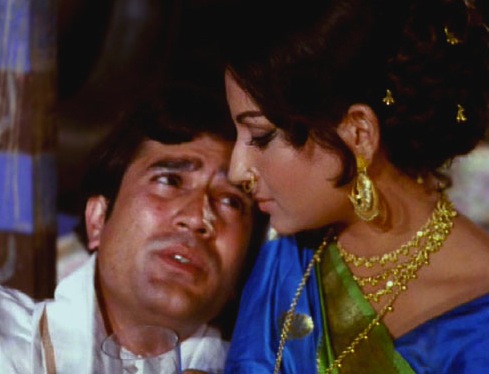
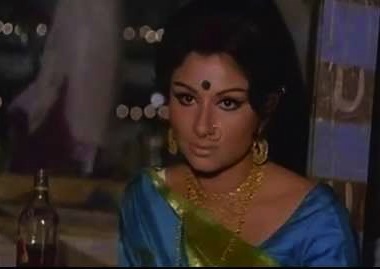
Aided heavily by hard liquor, Rajesh Khanna slips into philosophical discourse gazing at the beautiful Sharmila Tagore in Amar Prem (1972).

Our next English translation, the beautiful lyrics of “Chingari Koi Bhadke,” comes from the eternal love story Amar Prem (1972). Anand Bakshi outdoes himself with these philosophical, thought-provoking lyrics on the nature of life and the inevitability of Fate. Like other masterpieces songs of the sharaab genre in Bollywood, “Chingari Koi Bhadke” glorifies the opportunity to escape societal boundaries through alcohol.

Sung by Rajesh Khanna favorite, Kishore Kumar, “Chingari Koi Bhadke” has some of the greatest lines written in Bollywood music: “Madiira jo pyaas lagaaye, use kaun bhujaaye?” echoes the lines of the great 1935 Hindi poem by Harivanshrai Bachhan, “Madhushala”:

Kya mai.N madhushala ke andhar? Ya mere andhar madhushala?”

Indeed, the theme of an inner thirst can be found in Indian art from time immemorial–whether from spiritual seekers rejecting worldly materialism, or from thwarted lovers searching for a way out.

Amar Prem tells the story of a man trapped in a loveless marriage (Rajesh Khanna) who falls for the golden-hearted brothel songstress, Sharmila Tagore. Although both realize the world will never accept the purity of their love for one another, they remain faithful to their shared ideal of “amar prem” even as they are forced apart. Rajesh Khanna and Sharmila Tagore eventually grow older, not knowing what became of the other, but in separate ways undergo a spiritual transformation sparked by the love they shared. This immortal song, like others in the film by versatile maestro R.D. Burman (eg. “Kuch To Log Kahenge” and “Yeh Kya Hua”) is both a critique on an unforgiving society and a resignation to the laws of Nature. Intoxication itself, the profundity of these lyrics take several passes to completely envelop you, so go slowly and enjoy the full lyrics and our English translation of “Chingari Koi Bhadke” below!

Rajesh Khanna Amar Prem

Rajesh Khanna plays a good-hearted alcoholic trapped by the fetters of societal propriety in Amar Prem (1972).

Chingari Koi Bhadke Lyrics and Translation:

Chingaari koii bhadke
If someone lights a spark
To saawan use bujhaaye
Then the rains will put it out
Saawan jo agan lagaaye, use kaun bhujaaye?
But if the rains start a fire, who will put it out?

PatajhaD jo baagh mei.n ujaaDe
If a garden is destroyed in the Autumn
Woh baagh bahaar khilaaye
It will bloom again in the Spring
Jo baagh bahaar mei.N ujade, use kaun khilaaye?
But who can revive the garden that is destroyed in Spring?

Hum se mat poochho kaise
Do not ask me how
mandir TooTaa sapno.N kaa
The temple of my dreams shattered
Logo.N kii baat nahii.N hai
This is not a matter for everyone to discuss
Yeh qissa hai.N apno.N kaa
This tale is only for my own circle

Koi dushman thhais lagaaye
If an enemy strikes you a blow
To miit jiyaa bahalaaye
Then your beloved will nurse you
Manmiit jo ghaav lagaaye, use kaun mitaaye?
But who can nurse the wounds your beloved strikes?

Na jaane kya ho jaataa
I do not know what happens
Jaane hum kyaa kar jaate
I do not know what would happen
Peete hai.N to zindaa hai.N
If I drink, then I live
Na peete, to mar jaate
If I do not drink, then I die

Duniyaa jo pyaasaa rakhe
If the world is thirsty
To madiiraa pyaas bujhaaye
Then wine can slake that thirst
Madiiraa jo pyaas lagaaye, use kaun bujhaaye?
But who can slake the thirst caused by wine?

Maanaa toofaan ke aage
I agree that before a storm
Nahii.N chaltaa zor kisii kaa
No one can use force
Maujo.N ka dosh naii.N hai
Yet this is not the fault of the waves
Yeh dosh hai aur kisi kaa
It is the fault of someone else

Majhadaar mei.N naiyaa Doobe
If a boat starts to rock midstream
To maajhi par lagaaye
The boatman can lead it to shore
Maajhi jo naaw Dooboye, use kaun bachaaye?
But if the riverman drowns the boat, who can save it?

Chingaari koii bhadke
If someone lights a spark
To saawan use bujhaaye
Then the rains will put it out
Saawan jo agan lagaaye, use kaun bhujaaye?
But if the rains start a fire, who will put it out?

Glossary:

chingari: spark;  agan: fire; patajhaD: Autumn; baagh: garden; bahaar: Spring; mandir: temple; qissa: story, tale; dushman: enemy; thhais: blow; ghaav: wound; zindaa: alive; pyaasaa: thirsty; madhiira: spirits; toofaan: storm; zor: force, dosh: fault; majhdaar: midstream; Doobnaa: to drown; maajhi: boatman; naaw: small boat

Sharmila Tagore Amar Prem

Oh, Sharmila! Is there any commentary anyone can really give you for your divinely majestic presence in this film??!

No, Sir, they sure don’t make songs like they used to. I love the elegance and seeming simplicity of the picturization for this song. No big ruffles or fireworks–just a beautiful traditional instrumentation for background and a metaphorical boat ride filled with meaningful glances and serious faces. Could a song this classy even exist today?

-Mrs. 55

Jis Gali Mein Tera Ghar Na Ho Balma Lyrics and Translation: Let’s Learn Urdu-Hindi

Rajesh Khanna serenades Asha Parekh in one of Hindi cinema’s most treasured boat songs from Kati Patang (1970)

If you’ve been following the latest news about Bollywood stars (as you should be), you might be aware of the fact that Rajesh Khanna has been hospitalized recently for exhaustion and a stomach infection. In light of this news, I thought I’d share one of my favorite songs picturized on the Bombay superstar and send along our best wishes for a speedy recovery. Below, I’ve provided the lyrics and a translation for “jis galii me.n teraa ghar na ho baalma,” a beautiful number sung by Mukesh in Kati Patang (1970).

Mukesh singing for Rajesh Khanna? Blasphemy, you might say. As we all know, Kishore Kumar was officially the playback voice for India’s beloved ‘Kaka,’ and you might hear a pairing with Mohammed Rafi on occasion. But a Mukesh song picturized on Rajesh Khanna, let alone a popular one, is quite rare indeed.

In spite of the unconventional pairing, this song from Kati Patang is an all-time classic that has been cherished by fans of Hindi cinema over the years. The beauty in the simplicity of Anand Bakshi’s lyrics here is striking. Expressing the the theme of selflessness in love, these lyrics are unique when placed into context of the film. Rajesh Khanna’s character uses this song to profess his love for Asha Parekh, a woman pretending to be a widow after fleeing the altar. At a time when societal norms prevented such women from marrying again, using such romantic lyrics to describe the love between a man and an ostensible widow is a bold move. In his inimitable style, Mukesh gives one of his career’s best performances as he sings these lyrics with sincerity and a tinge of melancholy.  To top it all off, R.D. Burman composes a simple, yet touching melody that does justice to the beauty of these lyrics. Enjoy this poignantly crafted declaration of love with our glossary and translation below!

-Mr. 55

Playing the role of a supposed widow, Asha Parekh wears a white sari throughout most of this film.

Jis Gali Mein Tera Ghar Na Ho Balma: Lyrics and Translation

jis galii me.n teraa ghar na ho baalma
Any  street on which your house does not reside
us galii se hame.n to guzarnaa nahii.n
is not a street that I shall traverse.
jo Dagar tere dvaare pe jaatii na ho
Any path that does not lead to your door
us Dagar pe hame.n paa.nv rakhnaa nahii.n
is not a path on which I shall set foot.

zindagii me.n kaii rangraliyaa.n sahii
In my life, there have been many colorful celebrations.
har taraf muskuratii ye kaliyaa.n sahii
In every direction, there are smiling flowerbuds
khuubsurat bahaaro.n kii galiyaa.n sahi
and many beautiful views of springtime.
jis chaman mei.n tere pag me.n kaa.nTe chubhe.n
Yet, the garden in which thorns pierce your feet 
us chaman se hame.n phuul chunnaa nahii.n
is not a garden from which I shall pick flowers.

haa.n ye rasme, ye qasame.n sabhii toD ke
Yes, after having broken these rituals and vows,
tu chalii aa chunar pyaar kii oDh ke
please come to me, flying your scarf of love in the air.
yaa chalaa jaauu.nga mai.n yah jag chhoD ke
Or else, I shall go away and leave this world.
jis jagah yaad terii sataane lage
The place where your memories begin to torture me
us jagah ek pal bhii Thaharana nahii.n
is not a place where I shall spend a single moment.

jis galii me.n teraa ghar na ho baalma
Any  street on which your house does not reside…

Glossary

galii: street, alley; baalma: beloved; Dagar: path; dvaaraa: door; rangraliyaa.n: colorful celebrations; kaliyaa.n: flower buds; chaman: garden; pag: foot; chubhnaa: to pierce; rasm: ritual, ceremony; qasam: vow; chunar: scarf; jag: world; sataanaa: to torture.

Rajesh Khanna charms the audience with his characteristic smile.

This song was filmed on site at Lake Nainital in Uttarakhand, India.