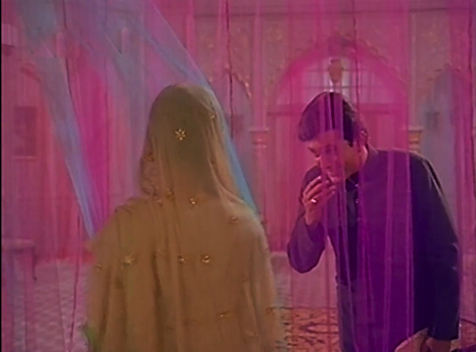
Hindi Film Songs with Unnecessary English: Fusion Lyrics in Old Bollywood

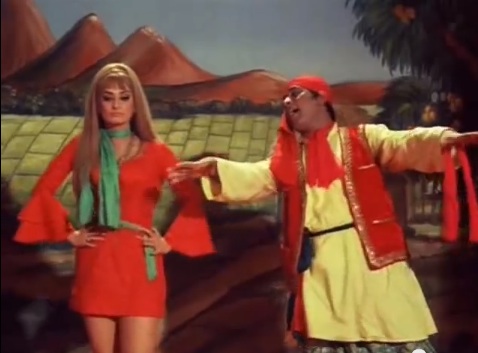
Saira Banu looks on in disgust as Manoj Kumar ruins classic English songs with Panjabi dhamaka in Purab Aur Paschim (1970).

Saira Banu is disgusted as Manoj Kumar ruins classic English songs with Panjabi dhamaka in Purab Aur Paschim (1970).

Happy Fourth of July from Mr. and Mrs. 55! To honor this occasion, we would like to discuss that well-recognized, unsettling phenomena of classic Bollywood: Hindi film songs with unnecessary English. Yes, I know you just cringed. But recognition is the first step towards healing. Like those t-shirts your aunties used to bring back from the motherland with random English words sprawled across the front, these songs are the ones you tend to hide from your friends. Despite their heroic attempts at glamorous cross-over appeal, these adulterated lyrics explode messily in the face of linguistic purism.

If you thought this was a strictly modern phenomena, prepare to blow your mind. Indian lyricists have been playing this dangerous game since the 1950s! Why, God, why? You may ask. There are many reasons. In some instances, the use of English was directly pertinent to the plot, such as in Laxmi’s portrayal of an Anglo-Indian girl in Julie (1975) or even Shammi Kapoor’s Elvis-esque embodiment of a happening nightclub singer in Chinatown (1962). Yet other times, the English words were gratuitous with no contextual relevance, such as Joy Mukherjee’s boyish declaration of “Japan, love in Tokyo!” (1966). All of them represent a fashionable trend toward westernization, even exoticism to some extent, in Hindi music that evolved over the 50s through 70s. The lyrics reflected back on the changing Indian society and the growing popularity of interspersed English in spoken Hindustani.
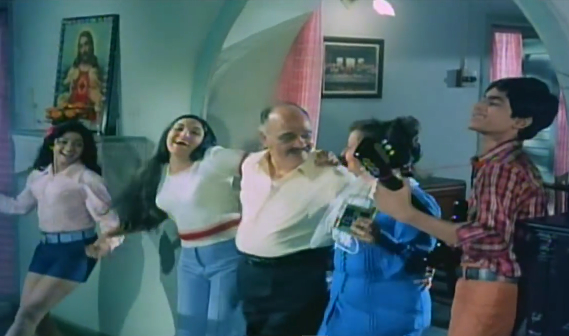
One big happy Anglo-Indian family sings "My Heart is Beating" in Julie (1975).

Just another average evening at home for the big happy Anglo-Indian family singing “My Heart is Beating” together in Julie (1975).

I always find it ironic that as I cling to the idealization of the Indian culture glorified by films of the 50s and 60s, when I visit my cousins in India, they find it tiresome to sit through a Rajesh Khanna film (many hardly know who he is!), or insist on speaking English, while I desperately want to practice my Hindi. Ah, the joys of being an American Desi. These songs that straddle two worlds appall me just as much as they identify a crisis I know so well.

So let us celebrate India’s love of English today with our list of fusion lyrics from classic films! Each song on our list gets a verdict: a cheer or a cry.  Should you feel proud busting out these melodies in the shower, or should you try to hide your shame in the dark recesses of your filmi sub-conscious? Find out below! But be forewarned: this exercise was never meant to be done in public. Go home to the safety of a private room, shut all the windows and lock the doors. Some of the lines you are about to hear require a true devotion to classic Bollywood to survive!

15 Classic Hindi Film Songs with Unnecessary English:

1. All Line Clear (Chori Chori 1956)

Verdict: Cry

It’s not for blind enthusiasm that this song is lacking. Johnny Walker parades his family through the metropolis, rolling the ‘r’ like a Spaniard of what sounds way more like “killier” than “clear.” It’s meant to be comic, but it might reduce you to tears.

2. C-A-T, Cat…Cat Maane Billi (Dilli Ka Thug 1958)

Verdict: Cry

The title says it all. Don’t expect Shakespearean poetry from this song, you might do well on your next spelling bee thanks to Kishore Kumar.

3. Bolo Bolo, Kuch To Bolo (Dil Deke Dekho 1958)

Verdict: Cheer

Questionable line: “Pyaar ho to keh do ‘Yes!’ Pyaar nahii.N to keh do ‘No!'” It’s subtle, right? Just enough English to keep the audience on their toes, but not enough to overwhelm anyone. And the song is so catchy, it’s hard to hate.

4. April Fool Banaya (April Fool 1964)

Verdict: Cry

OMG, Saira, stop it. When she screeches “Yooooooooooou eeediot!” I think we all ask ourselves if we were not better off dead. His awkward reply of “Very good!” is as out of place as the hideous shirt on his back.

5. Baar Baar Dekho (China Town 1965)

Verdict: Cheer…and then cry

See, this song walks the line. It’s so catchy and Shammi looks so fly, that you could go through the entire song and not realize any words of English were actually spoken. Oh, but they were. The refrain he struts around to is actually the English fox-hunting cry “Tally ho!” I don’t understand.

6. Japan, Love in Tokyo (Love in Tokyo 1966)

Verdict: Cry

Just warning you, this song WILL get stuck in your head and won’t be released until you sing the refrain out loud in a public forum. The English here is purely gratuitous. First of all, why does he suddenly scream “Japaaaaaaaaan!”? Could there possibly be any confusion in the viewer’s mind about their location? And second, why must he declare there has been “love in Tokyo!” in English of all languages at this point? Who is his real target audience here?

7. An Evening in Paris (An Evening in Paris 1967)

Verdict: Cheer

They were really experimenting in this film. From Asha’s interesting interpretation of the French “Zou Bisou Bisou” to Mohammed Rafi’s inexplicable commemoration of his Parisien adventure in English, “An Evening in Paris” wins by sheer virtue of its kitsch factor. Can it get more exotic than this??

8. Baar Baar Din Yeh Aaye (Farz 1967)

Verdict: Cheer

This song is quintessential and needs no introduction. Of course, we all wish Bollywood had more to offer in terms of great birthday songs (and ones which were not specifically dedicated to women named Sunita), but we’ll take it. Rafi’s cuckoo-like “oh ho!” after each lilting “Happy Birthday to you!” is just one of many reasons why this song should never get played in front of your non-Indian friends.

9. The She I Love (Mohammed Rafi 1969, non-filmi)

Verdict: Cry

I debated a long time whether or not to put this song on this list. It wasn’t because the song is non-filmi, but rather, because my undying love for Mohammed Rafi held me back from sharing this little dark secret of his with the world. But it had to be done. We must learn from history’s mistakes. Sung vaguely to the tune of “Hum Kale Hain to Kya Hua,” this song is sure to kill the mood of any party.

10. Twinkle Twinkle Little Star (Purab Paschim 1970)

Verdict: Cheer

This song just wins hands-down. Saira Banu, as the blonde-wig sporting Londoner, takes on dhoti-clad Manoj Kumar in an East-meets-West sing-off of epic proportions. I love how he twists her straight-laced rendition of “Twinkle Twinkle Little Star” into a completely Panjabi “Twinkle Twinkle Little Sitar” that is actually far more exciting than the original! The total irony, of course, is that when Asha Bhonsle sings the English lines as if she’s a blue-blooded English girl, her Indian accent is so thick, the effect is totally lost (but still kind of loveable).

11. Piya Tu Ab To Aaja (Caravan 1971)

Verdict: Cheer

Helen can literally get away with anything. I have zero problem with the pyscho in a toreador costume crying “Monica! O my darling!” from inside a jumbo birdcage.

12. Meri Soni Meri Tamanna (Yaadon Ki Baraat 1973)

Verdict: Cheer…but it’s borderline

This is song so good, it practically kills me that they threw in an English line just for giggles. It makes the whole thing awkward. Why can’t you just say “tumse pyaar hai” instead of “I low you”? Nope, I didn’t misspell. Listen to the line. I sure didn’t hear the ‘v’ in that sentence either.

13. My Heart is Beating (Julie 1975)

Verdict: Cheer

I know, I know. Bear with me here. I too stuck my head under a pillow and cried about the cruel and unusual punishment I was being served when I first heard this song. Part of it is her thick accent, part of it is the ridiculous caricatures of the members of the Anglo-Saxon family they portray. 100% of the lyrics are sung in English, which is a rare thing in classic Bollywood. Julie took fusion lyrics where no lyricist had dared go before. And I’ll be the first to say…it grew on me. It’s actually very melodious! Sure, Preeti Sagar is no Karen Carpenter, but this song did earn her the Filmfare Award for Best Female Playback Singer in 1975!

14. My Name is Anthony Gonzalves (Amar Akbar Anthony 1977)

Verdict: Cheer

This song theoretically makes some sense in the context of the film. Yes, Anthony Gonzalves was a real guy, and Amitabh Bachhan is supposed to be just another God-fearing Christian at an Easter party. When he starts spewing strings of random English words together, it’s clear he knows he’s just a buffoon trying to look smart and sophisticated to impress the ladies!

15. Humko Tumse Ho Gaya Hai (Amar Akbar Anthony 1977)

Verdict: Cry

It’s not that I hate this song, in fact, I love it. But I would have never known in a million years that Amitabh Bachhan is supposed to be saying “God promise, ham sach bolaa hai.” Excuse me, ‘God promise’? Who even SAYS that?? I know you’re supposed to be Christian and all that, but seriously, what is happening here.

We know this is a divisive issue in the obscure world of classic cinema and as constant mourners of the loss of Urdu in Hindi films, we want to hear YOUR thoughts! Do you love you a good Hinglish patois or do you cringe and die every time? Have we forgotten any potential gems that deserve a place on our list? Let us know in the comments!

– Mrs. 55
Who Is Minoo Purshottam? Appreciation from a Former Student

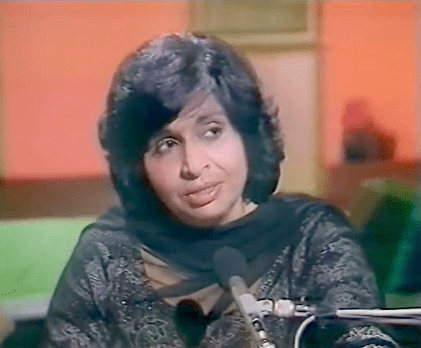
Minoo Purushottam, Bollywood playback singer.

Minoo Purshottam, Bollywood playback singer of the 60s and 70s, performing live for the BBC.

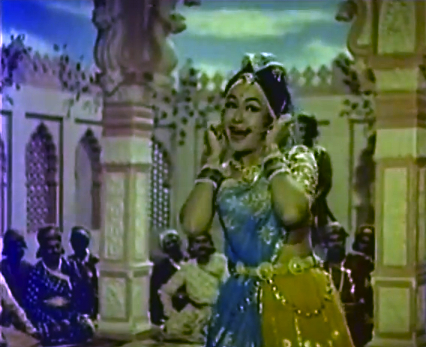
Minoo Purshottam was an acclaimed Bollywood playback singer of the 1960s and 70s. She lived in the era dominated by the famous soprano sisters Lata Mangeshkar and Asha Bhonsle, fighting for the ground they couldn’t cover—and scoring! Continuing our slant of broadcasting the unsung heroes of classic Bollywood, I now introduce you to Minoo Purshottam, yesteryear songstress and incidentally, my former vocal instructor.

I spent much of my childhood in Houston where I had the pleasure of learning music from Minoo-ji in the classical Hindustani style. Before becoming her student, I knew her work well from the soundtracks of great Bollywood films I had grown up with. You may not know her name, but you’ve probably heard her songs. From “Ni Main Yaar Manana Ni” with Lata Mangeshkar from Daag (1973), “Na Na Na Re, Haath Na Lagaana” from Taj Mahal (1963) with Suman Kalyanpur, and “Huzur-e-Wala Jo Ho Ijaazat” from Yeh Raat Phir Na Aayegi (1966), Minoo-ji made an important mark among the musical legends in India.

helen na na na haath na taj mahal

Helen dances to Minoo Purshottam’s playful “Na Na Na Haath Na Lagana” in Taj Mahal (1963).

Minoo-ji made her playback debut in Taj Mahal at the age of 16. Legendary music director Roshan took her under his wing, giving her a chance to sing a duet with Suman Kalyanpur. She recalls that she was much shorter than Suman and since in those days singers shared a single microphone during a studio recording (at Mehboob Studios, no less), she had to stand on a platform to make up for the difference!

From the daughter of a farming family in Patiala, she went on to become a singing maestro, working with composers like S.D. Burman, O.P. Nayyar, and Madan Mohan. Although she had a few occasional solos, her most famous work in films is as a partner, not a lead—always a bridesmaid, never a bride. Yet listen to how heroine-esque Minoo-ji’s voice sounds in the playful Jaidev composition “Raat Piya Ke Sang” from the lost film Prem Parbat (1973)! She toured with playback singers like Mohammed Rafi until his passing, yet when it came time to record songs for films, he was matched with Asha Bhonsle or Lata Mangeshkar. Minoo-ji waited for the female-female duets to shine.

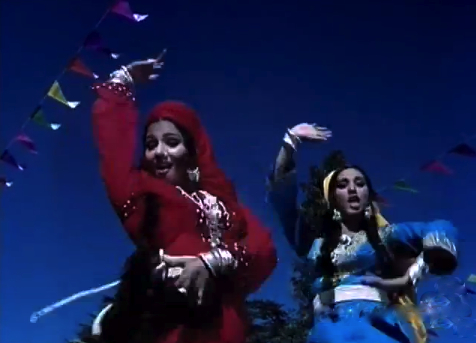
Ni Main Yaar Daag Minoo Purushottam

One of classic Bollywood’s favorite female dance duets, “Ni Main Yaar Manana Ni” features the vocals of Minoo Purshottam from the hit film Daag (1973).

Eventually, Minoo Purushottam turned to non-filmi ghazals where she felt the songs could have more “meaning,” something with a more serious philosophy, and eventually left India and settled in Houston where she started teaching Hindustani vocals. Her depth in the heart-stirring ghazal Zakhm Rahguzaaro.N Ke demonstrates another aspect of her talent that may otherwise have remained hidden behind the glitzy duets of old Bollywood.

I remember her classes used to take place at an auntie’s house in the community. We sat next to each other on a keyboard bench and she played the melody as I tried to keep up with what she was singing.  Minoo-ji was a strict teacher, but full of laughter and great stories—a Panjabi like me. I remember she often performed at local functions where she held her audiences captivated.

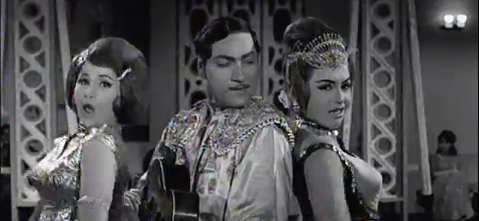
huzur e wala minoo purushottam helen

Asha Bhonsle and Minoo Purushottam join forces for the cabaret number “Huzoor-e wala” in the mystery film Yeh Raat Phir Na Aayegi (1966).

I often regret that I was too young to fully appreciate the magnitude of the legend from whom I was learning. I sometimes wish I could go back and ask her the questions on her life experiences and the inspirations that made her the fascinating artist she became. Yes, she never reached the heights of the playback singers we all associate with that era—but it is precisely because of it that I respect her more, standing her ground in a world notorious for its ruthlessness. Perhaps it was because of her innocence and much younger age that she never felt any rivalry between herself and these stars. Minoo-ji enjoyed collaboration rather than competition. And in Bollywood, that was a rare and beautiful thing.

What is your favorite Minoo Purshottam song? Let us know in the comments! For more unsung heroes of early Bollywood, check out our previous posts on costume designer Mani Rabadi and music composer Anthony Gonsalves!

Minoo Purshottam playback singer

Minoo Purushottam, Bollywood playback singer of the 60s and 70s.

– Mrs. 55

Jo Wada Kiya Woh Nibhana Padega Lyrics and Translation: Let’s Learn Urdu-Hindi

PK BR

The eternal love story of emperor Shah Jahan and Mumtaz Mahal is presented in Taj Mahal (1963)

In the spirit of Valentine’s Day 2014, we continue our series on Taj Mahal (1963) with the lyrics and English translation to the film’s most popular song: jo vaadaa kiyaaFor our previous posts on this film, please see our translations of khudaa-e-bartar, jurm-e-ulfat pe, and paa.nv chhuu lene do.

As its name suggests, Taj Mahal (1963) directed by M. Sadiq tells one of the greatest love stories in India’s history: how Mughal emperor Shah Jahan (played by Pradeep Kumar) fell in love with his (third!) wife Mumtaz Mahal a.k.a Arjumand Banu Begum (played by Bina Rai) and eventually built the Taj Mahal in her memory following her demise. While the film’s historical — yet often fictional — narrative earned commercial success and critical acclaim, it is mostly remembered today for its soundtrack composed by Roshan and penned by Sahir Ludhianvi.

It is no surprise that this immortal duet sung by Lata Mangeshkar and Mohammed Rafi earned the well-deserved #1 position in Binaca Geet Mala for the year of 1963. In fact, this song was played for so long on Binaca Geet Mala that the program had to change its rules regarding the maximum number of weeks that a single song could be featured on the list! Ever since, this blockbuster song, tuned to Raga Pahadi, has remained an all-time romantic favorite in Hindi cinema. Although some may consider its charm to be hampered by overexposure, even the most diehard fans may be surprised to learn that this song has two additional versions featuring lyrics that differ from those in the song’s most popular version. Among the three renditions found in the film, my personal favorite is the “sad” version (transcribed as Version 2 below).  I mean, how could you not love that beautiful Lata alaap played as Bina Rai’s spirit descends from the Moon to meet Pradeep Kumar?

Will the romance of this song be enough to charm your sweetheart on Valentine’s Day this year? Share this poetry with that special someone and you’re guaranteed to score some major points from him or her today! Until next time…

-Mr. 55
PK

Pradeep Kumar exudes a regal aura as he plays Shah Jahan in Taj Mahal (1963).

Jo Wada Kiya Woh Nibhana Padega (Version 1): Lyrics and Translation

jo vaadaa kiyaa vah nibhaanaa paDegaa
You must fulfill the promise that you made.
roke zamaanaa chaahe, roke khudaayii
Should society or divinity attempt to stop you,
tum ko aanaa paDegaa
you must still come to me. 

tarastii nigaaho.n ne aavaaz dii hai
My pining eyes have called out to you.
muhabbat kii raaho.n ne aavaaz dii hai
The paths of love have called out to you.
jaan-e-hayaa, jaan-e-adaa, chhoDo tarsaana
Oh beloved, please stop tormenting me.
tum ko aanaa paDegaa
You must come to me.
jo vaadaa kiyaa vah nibhaanaa paDegaa
You must fulfill the promise that you made.

yah maanaa hame.n jaa.n se jaanaa paDegaa
I accept that I must leave this life.
par yah samajh lo tum ne jab bhii pukaaraa
But understand this: whenever you call out to me,
ham ko aanaa paDegaa
I must come to you.
jo vaadaa kiyaa vah nibhaanaa paDegaa
I must fulfill the promise that I made. 

ham apnii vafaa pe na ilzaam le.nge
I will not tolerate accusations concerning my fidelity. 
tumhe.n dil diyaa hai, tumhe.n jaa.n bhii de.nge
I have given you my heart, and I can offer you my life too. 
jab ishq kaa saudaa kiyaa, phir kyaa ghabraanaa?
When I have already bargained with love, what is there to fear?
ham ko aanaa paDegaa
I must come to you.
jo vaadaa kiyaa vah nibhaanaa paDegaa
I must fulfill the promise that I made.

chamakte hai.n jab tak yah chaa.nd aur taare.n
As long as the Moon and stars continue to shine,
na TuuTe.nge ahd-o-paimaa.n hamaare
our promises and pledges will not be broken.
ek-duusraa jab de sadaa hoke diivaanaa
When one of us calls the other in the pangs of love,
ham ko aanaa paDegaa
we must come to each other.
jo vaadaa kiyaa vah nibhaanaa paDegaa
We must fulfill the promise that we made.

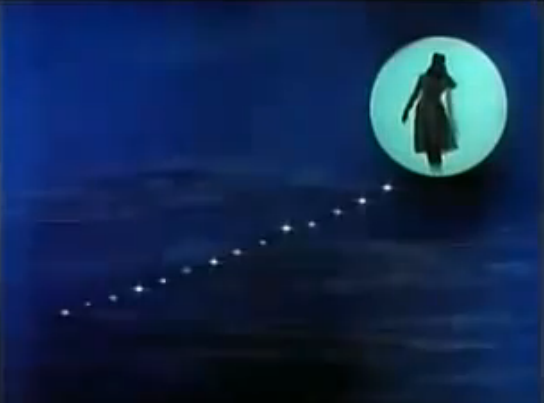
Moon

Bina Rai’s spirit descends from the heavens to come meet Pradeep Kumar in his old age in Taj Mahal (1963).

Jo Wada Kiya Woh Nibhana Padega (Version 2): Lyrics and Translation

jo vaadaa kiyaa vah nibhaanaa paDegaa
You must fulfill the promise that you made. 
roke zamaanaa chaahe, roke khudaayii
Should society or divinity attempt to stop you,
tum ko aanaa paDegaa
you must still come to me.

sabhii ahal-e-duniyaa yah kahte hai.n ham se
All the people of the world tell me that
ki aataa nahii.n hai koi muD ke adam se
no one returns from the next world.
aaj zaraa shaan-e-vafaa dekhe zamaanaa
Today, let this world see the splendor of faithfulness.
tum ko aanaa paDegaa
You must come to me. 
jo vaadaa kiyaa vah nibhaanaa paDegaa
You must fulfill the promise that you made.

yah maanaa hame.n jaa.n se jaanaa paDegaa
I accept that I must leave this life.
par yah samajh lo tum ne jab bhii pukaaraa
Yet, understand this: whenever you call out to me,
ham ko aanaa paDegaa
I must come to you.
jo vaadaa kiyaa vah nibhaanaa paDegaa
I must fulfill the promise that I made.

ham aate rahe hai.n, ham aate rahe.nge
I have been coming to you, and I will continue to do so eternally.
muhabbat kii rasme.n nibhaate rahe.nge
I will continue to fulfill the duties of love.
jaan-e-vafaa, tum do sadaa phir kyaa Thikanaa?
Oh beloved, at which dwelling shall we meet when you call? 
ham ko aanaa paDegaa
I must come to you. 
jo vaadaa kiyaa vah nibhaanaa paDegaa
I must fulfill the promise that I made. 

BR

Bina Rai stars as the elegant Mumtaz Mahal a.k.a Arjumand Banu Begum.

Jo Wada Kiya Woh Nibhana Padega (Version 3): Lyrics and Translation

jo vaadaa kiyaa vah nibhaanaa paDegaa
You must fulfill the promise that you made. 
roke zamaanaa chaahe, roke khudaayii
Should society or divinity attempt to stop you,
tum ko aanaa paDegaa
you must still come to me.

yah maanaa hame.n jaa.n se jaanaa paDegaa
I accept that I must leave this life.
par yah samajh lo tum ne jab bhii pukaaraa
Yet, understand this: whenever you call out to me,
ham ko aanaa paDegaa
I must come to you.
jo vaadaa kiyaa vah nibhaanaa paDegaa
I must fulfill the promise that I made to you.

hamarii kahaanii tumhaaraa fasaanaa
My story and your tale
hameshaa hameshaa kahegaa zamaanaa
will be narrated eternally by the world.
kaisii balaa kaisii sazaa, ham ko hai aanaa
Whatever misfortune or punishment falls upon me, I must come.
ham ko aanaa paDegaa
I must come to you.
jo vaadaa kiyaa vah nibhaanaa paDegaa
I must fulfill the promise that I made.

jo vaadaa kiyaa vah nibhaanaa paDegaa
You must fulfill the promise that you made.
roke zamaanaa chaahe, roke khudaayii
Should society or divinity attempt to stop you,
tum ko aanaa paDegaa
you must still come to me.

*Female lines in red are sung by Lata Mangeshkar. Male lines in green are sung by Mohammed Rafi. Lines in black are sung together by Lata Mangeshkar and Mohammed Rafi.  

Glossary

vaadaa nibhaanaa: to fulfill a promise; roknaa: to stop; zamaanaa: society, world; khudaayii: divinity; tarasnaa: to pine; nigaah: eyes; aavaaz denaa: to call out; muhabbat: love; raah: path; jaan-e-hayaa: beloved; jaan-e-adaa: beloved; tarsaanaa: to torment; maanna: to accept; jaha.n: world; samajh lenaa: to understand; pukaarnaa: to call out; vafaa: fidelity, faithfulness; ilzaam: accusations; ishq; love; saudaa karnaa: to bargain; ghabraanaa: to fear; chamaknaa: to shine;  TuuTnaa: to break; ahd-o-paimaa.n: promises and pledges; sadaa denaa: to call; diivaanaa: mad, crazy in love; ahal-e-duniyaa: people of the world; muD ke aanaa: to return; adam: non-existence, the next world; shaan-e-vafaa: splendor of faithfulness; rasm: duty, rule; jaan-e-vafaa: beloved; Thikaanaa: dwelling, place; kahaanii: story; fasaanaa: tale; hameshaa: always, eternally; balaa: misfortune, calamity; sazaa: punishment.

PK BR

Pradeep Kumar and Bina Rai remain united in love through both life and death in Taj Mahal (1963).

Abhi Na Jao Chod Kar Lyrics and Translation: Let’s Learn Urdu-Hindi

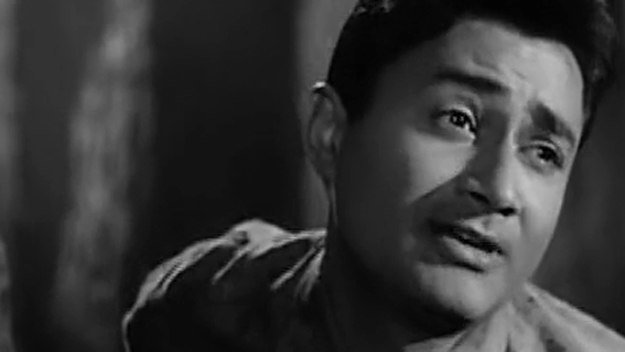
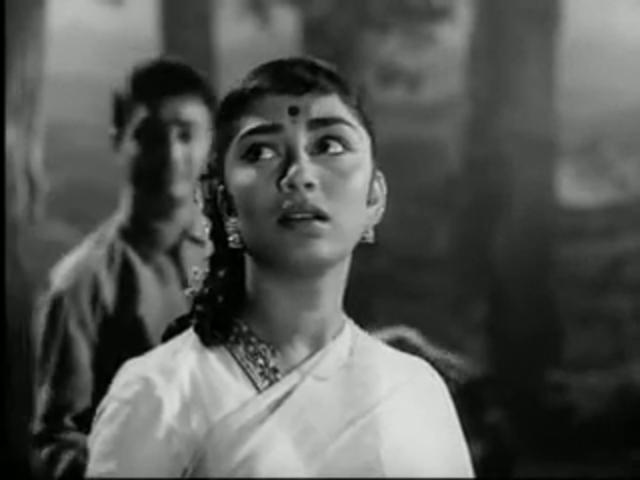
Dev Anand croons to Sadhana in a moonlit forest in Hum Dono (1961).

Dev Anand croons to Sadhana in a moonlit forest in Hum Dono (1961).

Next we present the enchanting lyrics and English translation to “Abhi Na Jao” from Hum Dono (1961). When I think of a Bollywood tree song, I think of this. This is where the magical tradition of hopping around a hidden forest and coyly shimmying behind the nearest tree to dodge your lover’s advances all began. Delightful Dev Anand and young Sadhana prance about gently in a quiet grove with slick back-and-forth lyrics that keep us grounded. The essence of the song comes down to this: Boy loves girl. Girl shyly expresses a desire to go home. Boy insists girl stays. Girl fears losing face. Boy takes opportunity to corner girl against a tree. You certainly don’t need anyone else to tell you how to think, but consider what it means that modern day Romeo Shah Rukh Khan voted this picturization as the most romantic song of Hindi cinema! “Abhi Na Jao” is eternal and the embodiment of sweetly innocent Bollywood courtship.

I’ve talked before about my feelings for the Hum Dono recolourization. Frankly, it’s cute, but not worth eliminating the original black-and-white stock. By converting the film from academy ratio to widescreen, you lose a great deal of the movie in exchange for some glitzy editing tricks (watch the colorized version here to see what I mean!). The film, its characters, the music, and the plot are so strong, it does not require any remodeling for wider accessibility. This song comes early in the movie, setting a high key tone for the upcoming embroilment.

Dev Anand Abhi Na Jao

Dev Anand looks like a lost sheep as Sadhana coyly sneaks away in “Abhi Na Jao” from Hum Dono (1961).

The signature Dev Anand coiffure is at its puffiest in this song, a welcome reflection of his bursting emotions. So take a seat, grab a snuggle pillow, and enjoy the lyrics and our full English translation to the evergreen duet “Abhi Na Jao Chod Kar” from Hum Dono (1961)!

Abhi Na Jao Chhod Kar Lyrics and Translation

MALE:
Abhi na jaao chhoD kar ki dil abhi bhara nahii.N
Do not go and leave me now, for my heart is not yet filled
Abhi abhi to aayii ho abhi abhi to
You have only just come
Abhi abhi to aayi ho bahaar banke chhaaii ho
You have only just come, you became the Spring as you arrived
Hawaa zaraa mahak to le nazar zara bahak to le
Let the wind spread your fragrance, let your gaze wander
Yeh shaam dhal to le zaraa
Let the night fall a little more
Yeh dil sambhal to le zaraa
Let my heart steady itself
Main thoDi der jii to luu.N nashe ke ghuunT pii to luu.N
Let me live a little longer, let me taste a sip of your intoxication
Nashe ke ghunT pii to luu.N, abhi to kuch kahaa nahii.N
Let me taste a sip of your intoxication, for I have said nothing yet
Abhii to kuch sunaa nahii.N
You have heard nothing yet
Abhii na jaao chod kar ke dil abhi bhara nahii.N
Do not go and leave me now, for my heart is not yet filled

FEMALE:
Sitaare.N jhil milaa uThe
The stars have begun to sparkle
Sitaare.N jhil milaa uThe, chiraag jagmagaa uThe
The stars have begun to sparkle, the lamps have been lit
Bas ab na mujhko Toknaa
Enough, do not scold me now
Bas ab na mujhko Toknaaa, na baDhke raah rokna
Enough, do not scold me now, do not come forward to block my path
Agar mai.N ruk gayii abhii to jaa na paauu.Ngii kabhii
If I stop now, I will never be able to leave
Yehii kahoge tum sadaa ke dil abhii nahii.N bharaa
For you will keep on saying that your heart is not yet filled
Jo khatm ho kisii jagah yeh aisaa silsila nahii.N
This is not the kind of affair that ends easily

MALE:
Abhii nahii.N abhii nahii.N!
Not yet, not yet!

FEMALE:
Nahii.N, nahii.N, nahii.N, nahii.N!
No, no, no, no!

MALE:
Abhi na jaao chod kar ke dil abhi bhara nahii.N
Do not go and leave me now, for my heart is not yet filled

MALE:
Adhuurii aas
Unfulfilled desire
Adhuurii aas chhoDke, adhuurii pyaas chhoD ke
Leaving me with unfulfilled desire, leaving me with unfulfilled thirst
Jo roz yuu.N hii jaaogii to kis tarhaa nibhaaogii
If you go every day like this, then how will you keep your promise?
Ki zindagii kii raah mei.N jawaa.N dilo.N kii chaah mei.N
For in the path of life, in the desire of two young hearts
Kaii maqaam aaye.Nge jo humko aazmaae.Nge
Many challenges will come to test us
Buraa na maano baat kaa, yeh pyaar hai, gilaa nahii.N
Do not be hurt by my words, for they are words of love, not a complaint

FEMALE:
Haa.N, yehii kahoge tum sadaa ki dil abhii bharaa nahii.N!
Yes, but you will keep on saying that your heart is not yet filled!

MALE:
Haa.N, dil abhi bharaa nahii.N
Yes, my heart is not yet filled!

FEMALE:
Nahii.N, nahii.N, nahii.N, nahii.N!
No, no, no, no!

Glossary:

bhara: filled; bahaar: Spring; hawaa: wind; mahak: fragrance; nazar: gaze, bahak: wander; shaam: evening; sambhalnaa: to steady oneself; thoDi der: a little while longer; nashe: intoxication; ghuunT: sip; jhilmilnaa: to sparkle; chiraag: lamp; Toknaa: to scold; raah: path; khatm: finish; jagaah: place; silsilaa: affair; adhuurii: unfulfilled; aas: desire; pyaas: thirst; roz: every day; nibhaanaa: to fulfill [a promise], zindagii: life; jawaa.N: young; chaah: desire, love; maqaam: challenge; aazmaanaa: to test, to try; buraa: hurt; gilaa: complaint

Sadhana Abhi Na Jao Hum Dono

Sadhana worries on a late evening out with her lover in Hum Dono (1961).

Yes, like many a great Hindi song, this one comes with a tragic reprise. A tender Asha Bhonsle solo, “Jahan Mein Aisa Kaun Hai” is a song of steadfast devotion in the face of impending wartime separation. Sadhana beautifully demonstrates her love to be more than a worthy match for the original duet’s playful warning of a perilous future. We have included the full lyrics and translation of Jahan Mein Aisa Kaun Hai as well below for your edification!

Jahan Mein Aisa Kaun Hai Lyrics and Translation:

Dukh aur sukh ke raaste bane hai sab ke vaaste
The paths of sadness and happiness are made for everyone
Jo gham se haar jaaoge to kis tarah nibhaaoge?
If you lose to sadness and leave, then how will you keep your promise?
Khushii mile hame.N ki gham jo hoga baat le.Nge hum
Whether we are met with happiness or sorrow, let us accept it
Mujhe tum aazmaao to zara nazar milaao to
Test me and meet my eyes
Ye jism do sahii magar dilo.N mei.N faaslaa nahii.N
We may have two bodies, but there is no distance between our hearts

Jahaan mei.N aisaa kaun hai ki jisko gham milaa nahii.N?
Is there anyone in the world who has not had sadness?

Tumhaare pyaar kii qasam tumharaa gham hai meraa gham
I swear by your love that your sorrow is my sorrow
Na yuu.N bhujhe bhujhe raho jo dil ki baat hai kaho
Do not fade away like this, tell me what is in your heart
Jo mujhse bhi chhupaaoge to phir kisse bataaoge?
If you hide those words from me, then whom will you tell?
Mai.N koi ghair to nahii.N dilaaoo.N kis tarah yakeen?
I am no stranger, how can I make you believe me?

Ki tum se mai.N judaa nahii.N, mujhse tum judaa nahii.N
For you are not separated from me, and I am not separated from you

Glossary:

dukh: sorrow; sukh: happiness; raastaa: path; [kisii ke] vaaste: for the sake of; haarnaa: to lose; tarah: type, manner; khushii: joy, happiness; aazmaanaa: to test, to try; nazar milaanaa: to make eye contact; jism: body, faaslaa: distance; qasam: swear; chhupaanaa: to hide; ghair: stranger; yakeen: belief

Can’t get enough? Check out our other translations from the same film like “Main Zindagi Ka Saath” and “Allah Tero Naam” for more!

-Mrs. 55