Rahe Na Rahe Hum Lyrics and Translation: Let’s Learn Urdu-Hindi

Suchitra Sen Ashok Kumar Mamta

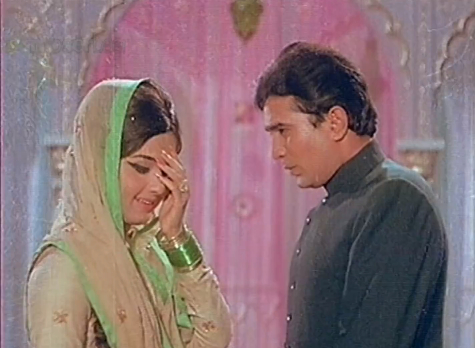
Ashok Kumar and Suchitra Sen star in the beautiful Asit Sen film Mamta (1966).

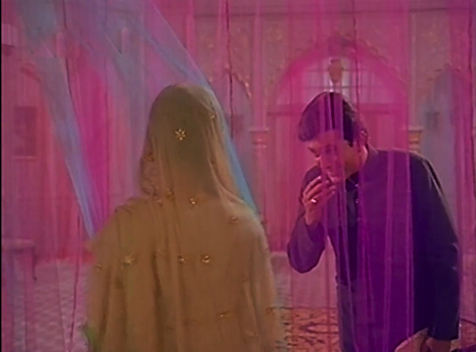
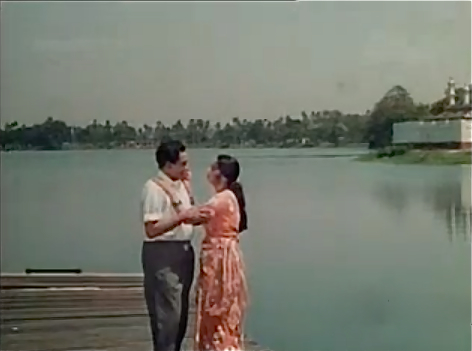
Today we showcase the lyrics and English translation of the melodious “Rahe Na Rahe Hum” from the film Mamta (1966). This gentle beauty sung by Lata Mangeshkar captures an inspiring philosophy on losing a loved one. An optimistic melody balances the tragic sentiments of its lyrics. While Ashok Kumar must leave Suchitra Sen to study law abroad, he pledges his loyalty to her upon the forthcoming separation and asks her to sing for him before he leaves.

The film Mamta explores the sacrifices Suchitra makes upon becoming a mother and like the thematically-similar blockbuster Aradhana (1969) demonstrates the resilience of a woman wronged by society. Majrooh Sultanpuri wrote the lyrics to Roshan’s superb compositions for Mamta that have kept the film’s legacy alive today. “Rahe Na Rahe Hum” continues to be a favorite with its playful chime opening and nectar-sweet vocals that betray the heartache of the scene.

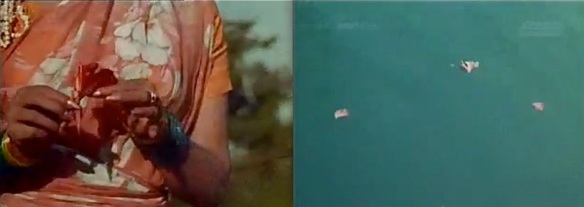
Suchitra Sen in Mamta

Suchitra Sen tears the petals from a flower on the eve of her separation from Ashok Kumar (right) and tosses the torn petals into the pond (left). The imagery of Suchitra’s identification with a flower recurs throughout the song and film–note how even her saari is decorated with a floral pattern!

“Rahe Na Rahe Hum” captures an appreciation of transience, framed as a neglected yet wonderous consequence of continuity, and highlights the transcendence of attachment to worldly phenomena such as seasons, physical proximity, and even time itself.

The tender line “ashqo.N se bhiigii chandnii mei.N ek sadaa si sunoge chalte chalte” allows simultaneously for mourning and recovery. While Suchitra acknowledges he will miss her, those tears of sadness will not last through the end of his journey that both know he must continue without her. Like the flowers petals that fall away drifting into the pond, Suchitra’s presence is not fettered by a set manifestation. Ultimately “Rahe Na Rahe Hum” is far more than mere words of consolation—it is an ode to love that celebrates the permanence of memory.

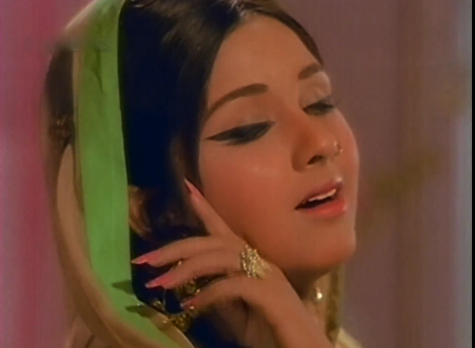
Suchitra Sen in Mamta

Suchitra Sen sings “Rahe Na Rahe Hum” as a parting gesture to the man she loves in Mamta (1966).

We hope you enjoy the full lyrics and English translation to the beautiful “Rahe Na Rahe Hum” below. Note that the plural pronoun “hum” can be translated as either “we” or “I.” I’ve chosen the singular for poetic purposes, but you can see how this no-doubt deliberate subtlety on the part of Sultanpuri sahib may color the translation slightly differently with each read. Watch the original song here!

Rahe Na Rahe Hum Lyrics and Translation: Let’s Learn Urdu-Hindi

Rahe na rahe hum mahakaa kareN.ge
Whether or not I am here, this fragrance will remain
Banke kali banke sabaa baagh-e-wafaa mei.N
As if a flower, as if a breeze in our devoted garden

Mausum koi ho, is chaman mei.N rang barse rahe.Nge hum khiraamaa
Whatever the weather may be in our garden, I will fill it gracefully with color
Chaahat ki khushbuu yuu.N hii zulfo.N se uDegii khizaa ho ya bahaare.N
The sweet fragrance of our love will still fly from my hair, whether Autumn or Spring
Yuu.N hii jhuumte aur khilte rahe.Nge
I will continue to sway and blossom
Banke kali banke sabaa baagh-e-wafaa mei.N
As if a flower, as if a breeze in our devoted garden
Rahe na rahe hum…
Whether or not I am here…

Khoye hum aise kyaa hai milnaa kyaa bichhaDnaa nahii.N hai yaad humko
I am so deeply lost in love that I no longer know separation from unity
Kooche mei.N dil ke jab se aaye sirf dil ki zameen hai yaad humko
Ever since you entered the lanes of my heart, I can only remember its world of love
Ise sarzameen pe hum to rahe.Nge
In that realm I will remain
Banke kali banke sabaa baagh-e-wafaa mei.N
As if a flower, as if a breeze in our devoted garden
Rahe na rahe hum…
Whether or not I am here…

Jab hum na ho.Nge, jab hamaare khaak pe tum rukoge chalte chalte
When I am gone, when you pause by my ashes as you walk
Ashqo.N se bhiigi chaandnii mei.N ek sadaa si sunoge chalte chalte
In the rainy moonlight that is wet from my tears, you will hear my call as you walk
Wohii pe kahii.N hum tum se mile.Nge
There somewhere, we both will meet again
Banke kali banke sabaa baagh-e-wafaa mei.N
As if a flower, as if a breeze in our devoted garden

Rahe na rahe hum mahakaa kareN.ge
Whether or not I am here, this fragrance will remain
Banke kali banke sabaa baagh-e-wafaa mei.N
As if a flower, as if a breeze in our devoted garden

Glossary:

mahaknaa: [a fragrance] to spread, kali: flower; sabaa: breeze; baagh: garden; wafaa: loyalty, devotedness; mausam: weather, atmosphere; chaman: garden; rang: color; khiraamaa: gracefully; chaahat: love, desire; khushbuu: sweet fragrance; zulf: hair; khizaa: Autumn; bahaar: Spring; jhuumnaa: to sway; khilnaa: to blossom; milnaa: to meet; bichhaDnaa: to separate; kooche: lane; zameen: world; yaad: memory; sarzameen: realm, society; khaak: ashes; ashq: tears; bhiigii: wet, rainy; chaandnii: moonlight, sadaa: call, voice

You may be interested to note that there is a duet version of this gem that is reprised at the end of the film by Mohammed Rafi and Suman Kalyanpur. Yes, it was the days of the famous Rafi-Mangeshkar feud–hence why the duets of the film necessitated recruiting additional singers (also from the same film, the flirtatious hit “In Baharo.N Mei.N Akeli” by Rafi and Asha as well as “Chhupa Lo Yuu.N Dil” featuring Lata and Hemant Kumar).

This song was requested by the one and only “lalten“! Let us know in the comments, does this song make you feel happy or bring tears to your eyes?

– Mrs. 55

Yeh Kya Jagah Hai Doston Lyrics and Translation: Let’s Learn Urdu-Hindi

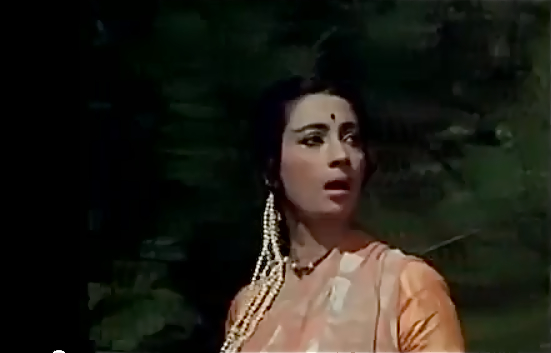
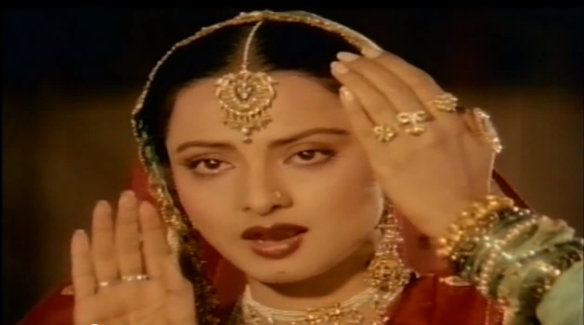
Rekha Umrao Jaan Yeh Kya Jagah Hai Doston

Rekha stars as a courtesan with a heart of gold in Umrao Jaan (1981).

We next present the beautifully tragic lyrics and English translation of “Yeh Kya Jagah Hai Doston” from Umrao Jaan (1981). Umrao Jaan is a heart-breaking film with depths more profound than the glittery tawaif dances it showcases. Based on the 1899 Urdu novel by Mirza Hadi Ruswa entitled, “Umrao Jaan Ada,” the 1981 film stays largely true to the original text.

Delving into the decadence of 19th century Lucknowi society, Umrao Jaan Ada portrays the rituals of a fascinating culture marked by luxury and oppression. I first read Ruswa’s novel during my junior year of college in Urdu class and fell in in love with the resilience of the story’s heroine.

Rekha in Umrao jaan 1981

Searching for a familiar face in a crowd of strangers, Rekha remains alone in Umrao Jaan (1981).

Interestingly, the framing of the 1981 Muzaffar Ali-directed film differs from the novel, told as a chronological account instead of a reminiscence. For me, this changes the tone of the film entirely: in the novel, the audience knows that although Umrao Jaan has suffered greatly in her lifetime, she eventually finds the peace and independence she deserves.

In the film, however, Umrao Jaan’s fate is unclear. We are left only with the stirring final image of her somber reflection in the mirror of her childhood home—an identity so long defined by others now confronted by its owner. Knowing these alternate endings colours the implications of Asha Bhonsle’s emotional “Yeh Kya Jagah Hai Doston” preceding them.

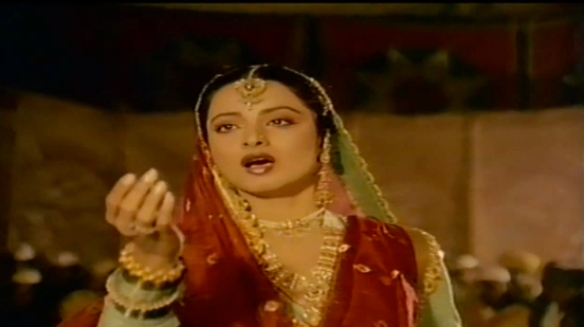
Rekha Umrao Jaan 2

Rekha hides a tear as Umrao Jaan sings to a gathering in her hometown of Faizabad.

Just prior to the film’s finale, Umrao Jaan (portrayed by Rekha) is asked to perform a song in her own town of Faizabad where she is now regarded as a pariah or stranger. The poetry that results in “Yeh Kya Jagah Hai Doston” evokes that sense of loss and confusion—a blameless fall from Eden with no path forward. As her own mother listens quietly outside the tent, Umrao Jaan’s addressing the unfamiliar gathering as “doston” becomes perhaps less ironic and more of an earnest plea.

Written by Shahryar with music by Khayyam, “Yeh Kya Jagah Hai Doston” is a counterpoint to the film’s earlier musical gems “In Ankhon Ki Masti” and “Dil Cheez Kya Hai.” With no ulterior motives, Umrao Jaan at last sings and dances as herself, voicing the real emotions within her heart. Many consider this song to be the film’s greatest composition.

We hope you enjoy our lyrics and translation to the soulful swansong, “Yeh Kya Jagah Hai Doston” below! Let us know your favorite Umrao Jaan moment in the comments!

Yeh Kya Jagah Hai Doston Lyrics and Translation:

Yeh kyaa jagah hai dosto.N?
What place is this, friends?
Yeh kaunsaa dayaar hai?
What kind of world is this?
Had-e-nigaah tak jahaa.N, ghubaar hii ghubaar hai
Where, as far as the eye can see, there are only dust storms

Yeh kis maqaam par hayaat mujhko lekii aa gayii?
To what realm has life brought me?
Na bas khushii pe hai jahaa.N, na gham pe ikhtiyaar hai
In this place I have no control over my happiness, and no choice in my sorrow

Tamaam umr ka hissaa maa.ngtii hai zindagii
Life demands an account of all my years
Yeh meraa dil kahe to kyaa? Yeh khud se sharmasaar hai
What will this heart of mine answer? It is so ashamed of itself

Bulaa rahaa hai kaun mujhko chilmano.N ki us taraf?
Who is calling me from the other side of those blinds?
Mere liye bhi kyaa koi udhaas beqaraar hai?
Is anyone there for me who is restless in sorrow?

Yeh kyaa jagah hai dosto.N?
What place is this, friends?
Yeh kaunsaa dayaar hai?
What kind of world is this?
Had-e-nigaah tak jahaa.N, ghubaar hii ghubaar hai
Where, as far as the eye can see, there are only dust storms

Glossary:

jagah: place; dayaar: world, region; had-e nigaah tak: until the limits seen by the eye; ghubaar: dust storm; maqaam: realm; hayaat: life; bas: power; khushii: happiness; gham: sorrow; ikhtiyaar: choice, tamaam umr: whole life, all the years; hissaa: account; zindagi: life; khud: self; sharmasaar: embarrassed, ashamed; chilman: curtains made of reeds, blinds; udhaas: sorrow; beqaraar: restless

As I read the pages of Ruswa’s novel, I was so struck by his descriptions of the admirable training in classical arts given to students of the kothe. These talents that in today’s society would be so valued as the pinnacle of culture, instead branded these women for a lifetime of ignominy. Today such diligence in the study and practice of classical voice, dance, and poetry is so rare and impressive!

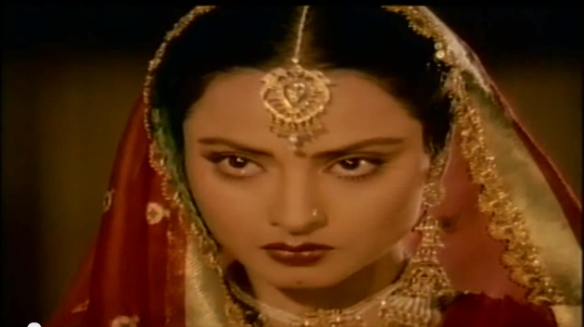
Rekha in Umrao Jaan Yeh Kya Jagah Hai Doston

Ethereal beauty Rekha yearns for acceptance from her long-lost family in Umrao Jaan (1981).

For the grammar junkies among us, you may wonder why the “jagah” in this song is pronounced to rhyme with “yeh” instead of “kyaa.” Strictly speaking, the Lucknowi pronunciation of the word is the long “aah,” however, for poetic fluidity, Asha Bhonsle pronounces it here in the alternate form. Regional variants exist in the Hindustani language for similar words such as subah and vajah!

– Mrs. 55

Hum Bekhudi Mein Tumko Pukare Lyrics and Translation: Let’s Learn Urdu-Hindi

Dev Anand hum bekhudi kala pani

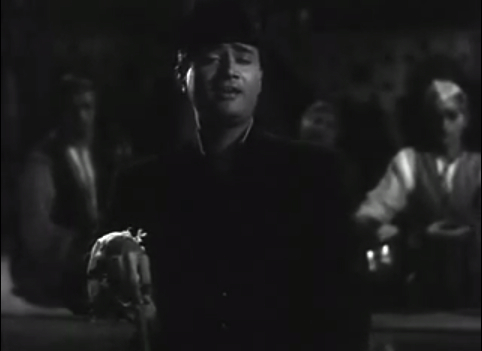
Dev Anand entrances the audience with “Hum Bekhudi Mein” in Kala Pani (1958).

We now present our complete translation to “Hum Bekhudi Mein Tumko Pukare,” one of Mohammed Rafi’s finest solos. The song, and in fact the film Kala Pani (1958), is a considerable break from Dev Anand’s previous work, transforming him from the debonair urbanite to a meditative, black kurta pajama-clad member of the traditional intelligentsia. “Hum Bekhudi Mein” bears the unmistakable hallmark of S.D. Burman’s finest compositions—a hauntingly powerful melody that is so captivating, instrumental ornamentation is close to entirely abandoned. There is something reminiscent of his earlier composition, “Dekhi Zamaane Ki Yaari“–with an emphasis on reflection, the purity of Mohammed Rafi’s voice engulfs the listener in the qawwal-like trance of his yearning, the feeling of entering a dream where time loses its meaning. Indeed, the “bekhudi” or loss of self as described by the singer is precisely what lyricist Majrooh Sultanpuri aims to induce in the listener.

Nalini Jaywant Kala Pani hum bekhudi

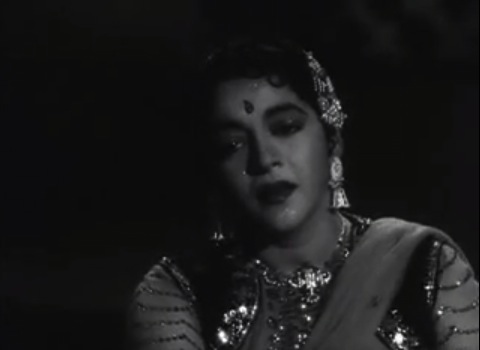
Nalini Jaywant believes she has found love at last in the mysterious stranger with a haunting voice in Kala Pani (1958).

The nuance of the lyrics is an exceptional example of the multi-faceted levels of interpretation of Urdu poetry. Each line returns to the refrain’s lingering “chale gaye”—a verb tense indicating continuity of the hero’s past actions, and his current obsession with reliving them. However, Mohammed Rafi’s very deliberate pause before singing “chale gaye” with each line allows for an additional dimension to the song’s interpretation, as if a forlorn reference to the woman herself who has left him (“woh jo chale gaye”). I love this song for every person that hears it will understand it in a slightly different way. If you can’t get enough of this melody, lovers of trivia will be delighted to discover that S.D. Burman actually recorded the original Bengali version of this song in his own voice, “Ghum Bhulechi Nijhum”!

In the Hindi version, hero Dev Anand elaborates on two forms of intoxication—first, the spell cast by his former lover, and second, alcohol to which he has resigned himself.  In the evocative final line of the song, “Sheeshe mei.N aap ko bhi utaare chale gaye,” the hero reconciles their duality and his escape from reality. With the oblivion granted by alcohol, he regains the very woman who has left him in a state of bekhudi—a philosophical wanderer in fugue-like search of a connection.

Dev Anand kala pani black hat

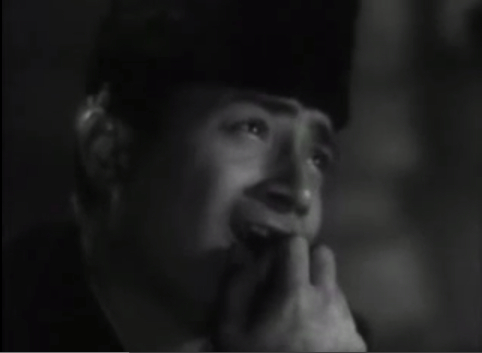
Despite biting his fingernails throughout the song, Dev Anand is simply too attractive to handle in a black kurta and matching traditional hat.

We hope you enjoy our English translation to the lyrics of this beautiful poem “Hum Bekhudi Mein” from Kala Pani (1958). Check out the video in which Dev Anand woos the lovely courtesan Nalini Jaywant with his artistic depth! Did you know that after this song was released, Dev Anand was actually told not to wear black anymore in public because Indian women  would swoon and jump from buildings upon seeing him dressed in that devastatingly attractive shade? I mean…I can see where they’re coming from!

Hum Bekhudi Mein Tumko Pukare Lyrics and Translation:

Hum bekhudii mei.N tum ko pukaare chale gaye
Unaware of my own self, I kept calling to you
Saaghar mei.N zindagii ko utaare chale gaye
And so I kept drowning my life in a glass of wine
Hum…

Dekhaa kiye tumhe hum banke deewaanaa
When I used to see you, I was madly love
Utaraa jo nashaa to hum ne yeh jaana
Once that intoxication wore off, I knew this
Saare woh zindagii ke sahaare chale gaye
That all the support I had in life had gone

Hum bekhudii mei.N tum ko pukaare chale gaye
Unaware of my own self, I kept calling to you

Tum to na kaho hum khud hi se khele
At least do not say that I played this game by myself.
Doobe nahii.N humii yuu.N nashe mei.N akele
For I did not drown in this intoxication alone
Sheeshe mei.N aap ko bhi utaare chale gaye
You were what I kept pouring into my glass

Hum bekhudii mei.N tum ko pukaare chale gaye
Unaware of my own self, I kept calling to you
Saaghar mei.N zindagii ko utaare chale gaye
And so I kept drowning my life in a glass of wine
Hum…

Glossary:

bekhudi: loss of self-awareness; pukaarnaa: to call out; saaghar: wine goblet; zindagii: life; deewaanaa: madly in love; nashaa: intoxication; sahaaraa: support; khud: self; khelnaa: to play; Doobnaa: to drown; akelaa: alone; sheeshaa: glass, mirror

Interestingly, this gently hypnotic song is used to trap Nalini Jaywant into falling in love with Dev Anand and confess her past crimes. Yes, it’s all a pretense–Dev Anand is actually in love with Madhubala, the cheeky journalist who is helping him absolve his wrongfully imprisoned father. Nalini Jaywant played a role in the original crime and must now the price of unrequited love for his son. The film was actually based on A.J. Cronin’s Scottish novel “Beyond This Place” published in 1953. Dev Anand loved Cronin’s work so much, he also later turned one of Cronin’s most famous novels, “The Citadel” into the 1971 Bollywood film Tere Mere Sapne.

– Mrs. 55

Saiyan Dil Mein Aana Re Lyrics and Translation: Let’s Learn Urdu-Hindi

Shamshad Begum Bollywood playback singer

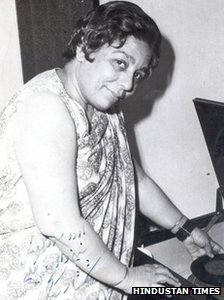
Bollywood playback legend Shamshad Begum (1919-2013)

Last Wednesday, Bollywood lost another of its finest treasures: legendary playback singer Shamshad Begum. The veteran singer was 94 years old. She was well-known for breaking the norms–a maverick with a Brenda Lee-esque penchant for the Western and an irresistible je ne sais quoi that drew hoards of admirers from across the sub-continent. While Lata Mangeshkar and her clones sought to define femininity by delicate, high-pitch vocals Shamshad Begum proved over and over again that a sexy, strong timber could still carry innocence and that women in India could not all be categorized by a single stereotyped voice. Yes, the world needed Shamshad Begum, a woman who never succumbed to expectations and whose daring voice lent itself to some of the greatest works of Bollywood’s Golden Age. We salute you, Shamshad, and the invaluable service you did to the nascent Hindi film industry.

Who can forget her performance with Nigar Sultana as the sultry Bahar in Mughal-e-Azam‘s “Teri Mehfil Mein Qismat“? Few women dared sing a duet with Lata Mangeshkar for fear of inferiority–but that was precisely where the great talents of Shamshad shined their brightest. With a voice unlike anything in Bollywood history, Shamshad dazzled audiences with a deep, edgy flair for which she was famous. There was simply no competition because the voices were incomparable. Shamshad’s other famous duets such as “Leke Pehla Pehla Pyar” with Mohammed Rafi from CID (1956), “Mere Piya Gaye Rangoon” with Chitalkar Ramchandra in Patanga (1949) or “Kajra Mohabbatwala” with Asha Bhonsle in Qismat (1968) to name a few, showcase her unique robust twist on the norm and continue to be remade and popularized today.

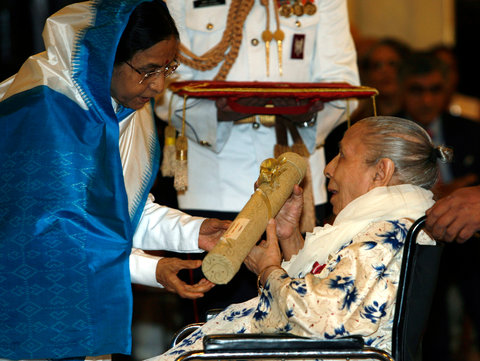
Shamshad Begum receiving the Padma Bhushan for a lifetime of achievements in 200.9

Shamshad Begum receiving the Padma Bhushan for a lifetime of achievements in 2009.

Music director O.P. Nayyar confessed in an interview that when he entered the music industry, he begged Shamshad Begum to sing for his compositions. Her first collaboration with him became absolutely legendary: “Kabhi Aar, Kabhi Paar” from the film Aar Paar (1954). Here at Mr. and Mrs. 55, our favorite of her solo hits is the extraordinarily catchy S.D. Burman composition, “Saiyan Dil Mein Aana Re” from Bahar (1951) in which classical dancer Vijayantimala made her Bollywood debut.

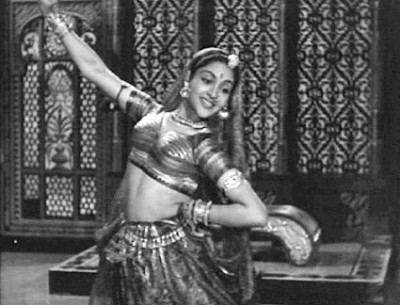
You can tell from themyriad of hand gestures reminiscent of a classical mudra to accompany the emotion of each line (coupled with her impeccable posture), that teenager Vijayantimala was well-trained in Bharatnatyam arts. This theatrical dance form meshes interestingly with the medium of film, at times carrying the over-expression of a silent movie and the spectacle of a living room classical dance performance. Perhaps the best part of this adorably innocent love song (besides, of course, Shamshad’s vocals!) is the clever and hilariously unnecessary drama accompanying the actresses 4 costumes changes in the song!

Vijayantimala in Bahar 1951 Saiyan Dil Mein Ana Re

Young Vijantimala makes her Bollywood film debut singing Shamshad Begum’s “Saiyan Dil Mein Aana Re” in Bahar (1951).

Please enjoy the full lyrics and English translation to this Shamshad Begum hit “Saiyan Dil Mein Aana Re” below and let us know YOUR favorite Shamshad Begum song in the comments!

Saiyan Dil Mein Aana Re Lyrics and Translation:

Saiyaa.N dil mei.N aanaa re
Beloved, come into my heart
Aake phir na jaanaa re
And once you come, never leave
Chham chhamaa chham chham

Raja ban ke aanaa re
Like a king, come to me
Mohe leke jaanaa re
And take me with you when you go
Chham chhamaa chham chham

Chaandnii raat hogii, taaro.N kii baaraat hogii
It will be a moonlit night, the stars will form a wedding procession
Pehle pehle pyaar kii pehlii pehlii baat hogii
The first words of my first love will be spoken
Khushii khushii gaaye.Nge ham geet suhaanaa re
We will joyfully sing a beautiful song

ThoDii thoDii sahal hogii, thoDaa thoDaa pyaar hogaa
Little by little, our love will become easy
Kabhii iqraar hoga, kabhii inkaar hogaa
Sometimes you will agree with me, sometimes you will refuse me
Teraa manaanaa meraa rooTh jaanaa re
But you appease me, my anger will disappear

Tum mere paas hoge, gham baDii duur hogaa
You will be beside me, and all sadness will be far away
Kehtaa hai jiyaa meraa hogaa zuroor hogaa
My heart tells me this will certainly be so
Laanaa re laanaa tashriif laana re
Come, believe in me

Saiyaa.N dil mei.N aanaa re
Beloved, come into my heart
Aake phir na jaanaa re
And once you come, never leave
Chham chhamaa chham chham

Raja ban ke aanaa re
Like a king, come to me
Mohe leke jaanaa re
And take me with you when you go
Chham chhamaa chham chham

Glossary:

saiyaaN: beloved; raajaa: king; chaandnii: moonlight; baaraat: wedding procession; khushii: happiness, joy; geet: song; suhaanaa: beautiful; thoDaa: a little; sahal: easy; iqraar: agreement, acceptance; inkaar: refusal; manaanaa: to appease someone; rooTh: sulk, anger; gham: sadness; duur: far; jiyaa: soul, heart; zuroor: certainly; tashriif laanaa: a respectful way of asking someone to come or to enter (and in doing so, trust their honor with you)

So now you’re asking yourself, why is there no translation given for arguably the best line of the song: “Chham chhamaa chham chham“? There are a few ways to analyze this line–whether she’s referencing the glittering of stars, doing some free-styling by adding an extemporaneous beat to the melody, or getting carried away by the excitement of her own life–I think any real attempt to translate that exceedingly interpretive line formally would be an injustice to the song’s joie de vivre. Let us know your favorite Shamshad Begum moment in the comments!

– Mrs. 55