The Best Holi Songs of Classic Bollywood Movies

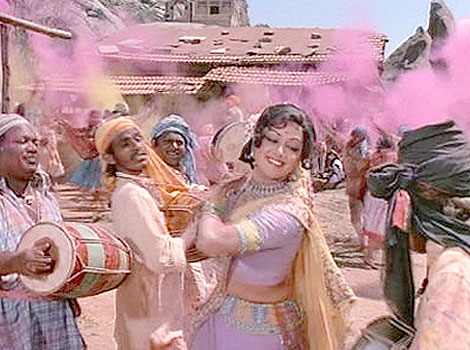
Hema Malini Sholay holi

Hema Malini dances with joyful abandon in Sholay’s famous holi number “Holi Ke Din.”

The festival of Holi is among Bollywood’s favorite celebrations–an occasion at last as colorful as the country of its origin. Indeed Holi, a Hindu spring festival, is commonly known as the Festival of Colors. It is both a religious celebration signifying the triumph of Good over Evil, as well as a cultural one commemorating the onset of a new Spring season. It is marked by the throwing of colorful powders, the lighting of bonfires, and the strengthening of bonds between all individuals in colorful merriment. Its spirited catchphrase “Buraa na maano, Holi hai!” (Don’t bear any ill-feelings, it’s Holi!”) speaks to the underlying theme of the day – the burning of negative forces or ill-will, a sort of spiritual purging. The smearing of colors represents the deconstructing of identities and the breaking of social barriers, as all rejoice and participate together, regardless of social class. At the very least, it is a day to settle old scores and move on. Indeed, everyone is welcome and everyone is pardoned for his or her revelry. Thus, we mortals celebrate Holi today with fun and games, colors and powder, and Bollywood takes this grand opportunity to ignite romance.
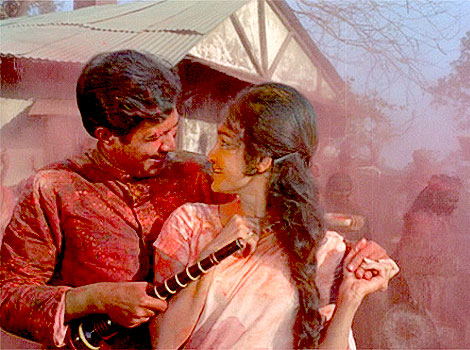
Rajesh Khanna asha parekh holi

Rajesh Khanna woos Asha Parekh with color at the Holi celebration of Kati Patang (1970).

There’s something inherent to the playful tag-style nature of Holi that lends itself so conveniently to flirtation and a male-female dichotomy. We discussed the appalling lack of Diwali-associated songs in classic Bollywood previously, and hazarded the guess that the festival is far less conducive to overt flirtation and bumping dance grooves like Holi invariably is. Whether wooing the mourning lover into a literal rainbow of joy or painting your sweetheart with a visible mark of your flirtatious overtures, Holi delivers the goods for Bollywood every time.
Mother India holi

Even the old school epic Mother India takes a drama break for the holi festivities!

Below is our list of the 10 greatest Holi songs of classic Bollywood cinema. Happy Holi to all our readers–and if you’re stuck in a huge snowstorm like we are, here’s hoping Holi will usher in the Spring at last!

1. Rang barse (Silsila 1981)

The ultimate old school Holi hit, this song will force anyone to get in the mood and join the festivities! Say what you want about Amitabh and Rekha’s clandestine affair, this dance number will get you on board in no time!

2. Aaj na chodenge (Kati Patang 1970)

This song is easily my favorite Bollywood holi song! Besides the fact that I grew up on the Kati Patang soundtrack, does it get much better than Rajesh Khanna-Asha Parekh shy seduction? Lata and Kishore are delightful, but don’t get me started on the bizarre chorus act that chops up the number like barbarians on holiday.

3. Holi Aayi Re Kanhaayi (Mother India 1957)

Oh, there’s no school like the old school! Bring it back Nargis-style with this classic song from Mother India that just overflows with romance and sass! The only thing better than a Holi song is a Holi village dance-off.

4. Tan rang lo ji (Kohinoor 1960)

While this royal gem may be shot in black-and-white, you can practically see the colors flying in this fantastic Mohammed Rafi-Dilip Kumar celebration that invites the entire kingdom for a Holi song-and-dance sequence!

5. Holi Ke Din (Sholay 1975)

Retro flirting Queen Hema Malini proves to Dharmendra that she’s more than just a loud mouth in Sholay–her moves and dancing steal the show in this colorful song!

6. Are Ja Re Hat Natkhat (Navrang 1959)

Classical dancer Sandhya wows the audience with this traditional stage performance, alternating as both the male and female character complete with ghungroo! Asha Bhonsle’s Hindustani vocals balance out Mahendra Kapoor’s mainstream sway in a Holi number that is well-known even today for its stunning classical choreography.

7. Piya Tose Naina (Guide 1965)

Looking for something a little classier? Go no further than this Waheeda Rehman semi-classical piece from the great philosophical Guide. Watch her prance around with so much joie de vivre, you’ll ignore how gaudy the stage is decorated and your feelings for high-pitched female choruses of the 1960s.

8. Nadiya Se Dariya (Namak Haram 1973)

This song is just plain cute. While not a roaring shoulder-shaking dance off like some of these others, the song is playful and full of shy passion for Rajesh Khanna, which we always approve of.

9. Baghi Re Bhagi Brij Bala (Rajput 1982)

I think this hidden jewel is under-appreciated by historians. While something of a repeat of previous Hema Malini-Dharmendra magic, Vinod Khanna holds his own in this fast-paced duet that once again brings an entire kingdom to the palace to party Holi-style!

10. Kaikhe Paan Banaraswala (Don 1978)

OK, so this isn’t technically a Holi song per se, but it’s arguably the unofficial anthem! There’s something about a traditional, rich beat coupled with Kishore’s absolutely unabashed vocals that set the tone of a celebration and throwing inhibitions to the wind!

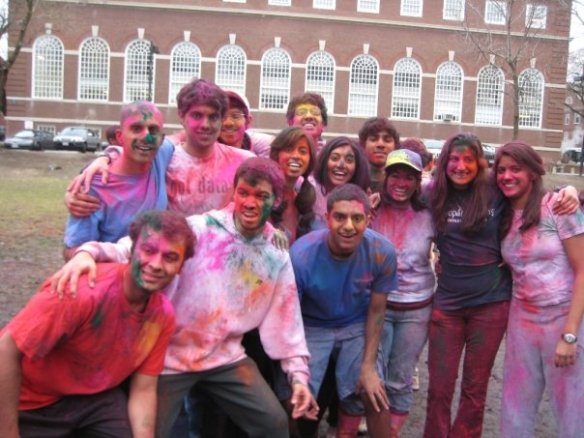
While Holi was born in India, it’s popularity was carried across the diaspora and is celebrated around the world each year with full force! The picture below is from my freshman year at Harvard where Holi was played on the Mac quad! Can you spot me in the pigtails with the orange-yellow face?
n31939_34049799_4730

– Mrs. 55

What Killed Madhubala: A Close Look at the Death of A Bollywood Icon

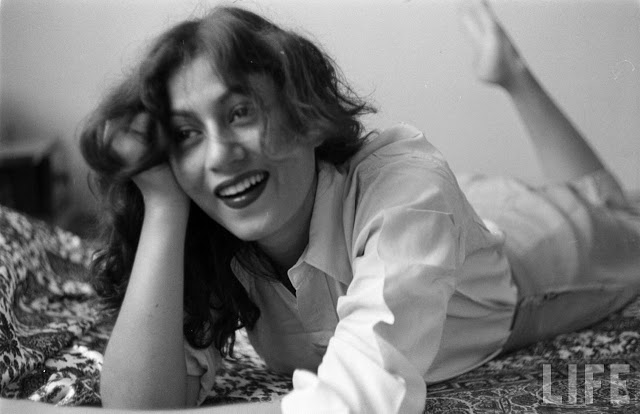
Rare Madhubala picture Indian actress

Madhubala, classic Bollywood actress, (1933-1969)

Madhubala was born Mumtaz Jahan Nehlavi on Valentine’s Day, February 14, 1933. Perhaps was no coincidence with such a birthday that Madhubala would grow up to become one of the most beloved romantic heroines of India. But her life could not share the happy endings of many of her films. This month, Madhubala would have turned 80 years old. Her premature death has likened Madhubala to iconic Hollywood greats like Marilyn Monroe, Judy Garland, Carol Lombard and even Bollywood’s own Meena Kumari–women of the silver screen who died before the world was ready.

Madhubala’s unique allure was known worldwide–she had been featured in many American magazines including LIFE magazine whose rare photographs are featured in this post. Legendary director Frank Capra was eager to bring the mysterious Indian beauty to Hollywood and launch an international career–but his efforts were halted quickly by Madhubala’s conservative father. She was sought after by every great Bollywood director and actor from Dilip Kumar to Dev Anand and even romanced and married playback singer Kishore Kumar at the height of her illustrious career. For years, Madhubala was the Queen of Bollywood and the hearts of millions.

But what killed Madhubala, ending her short-lived reign? Could it have been prevented?

Rare vintage photograph of Indian actress Madhubala by LIFE magazine

Indian actress Madhubala as photographed by James Burke for LIFE magazine in 1951.

When Madhubala was born to a traditional Muslim family in Delhi, her elder sister Madhur Bhushan recalled that the baby was “blue”–a serious sign of cyanosis and poor oxygen perfusion. Madhubala had a Ventricular Septal Defect (VSD), a disorder colloquially referred to as a “hole in the heart.” A congenital abnormality of that kind allowed for mixing of both normal oxygenated blood and deoxygenated blood to be shunted through her body–an unhealthy adulteration with a bad prognosis. While a somewhat common birth defect (1 in 500 babies are born with a VSD), the medical community’s understanding of  the condition was in its infancy–VSD had first been described in 1879 and at the time of Madhubala birth, there was no treatment. Yet Madhubala continued to grow into a vivacious and beautiful young woman whose fragility was for many years known only to a few.

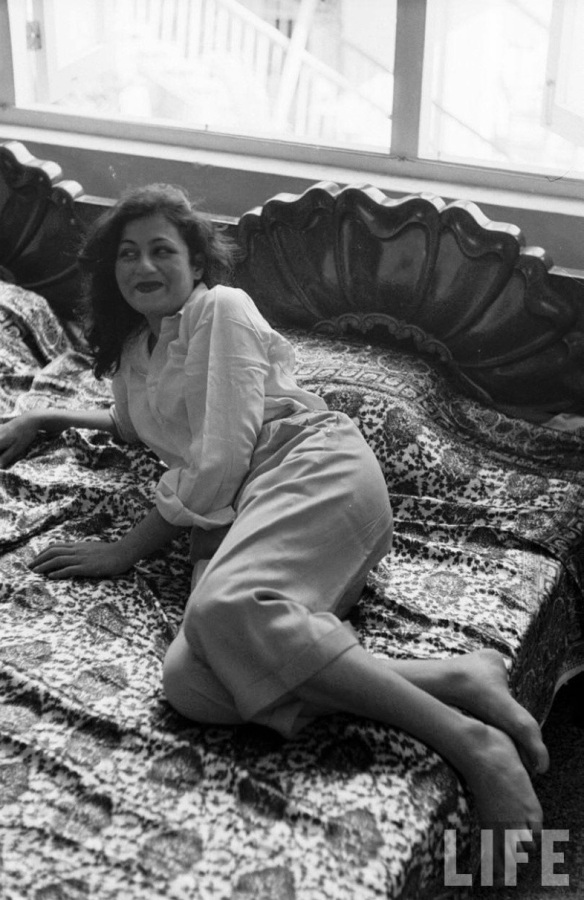
madhubala life magazine bed

Indian superstar Madhubala was sought by directors across the country and internationally during the height of her career.

The young beauty shot to fame in 1949 at the age of 16 in Kamal Amrohi’s Mahal with Bollywood veteran Ashok Kumar. One success followed another, establishing Madhubala as an A-grade star with a rare versatility and ebullience that hid her growing fatigue and weakness. In was not until filming scenes for Bahut Din Hue in 1954, Madhubala vomited blood on the set. It was an ominous sign that electrified the Indian media. The history of her heart defect came to public light as the mid-1950s brought her a string of failures, earning her the label “box office poison.” With skyrocketing notoriety, no longer was Madhubala’s illness a family secret.

Beautiful madhubala in a personal photograph

The lovely Madhubala in an unscripted moment in her room in Bombay.

Little did her family know, in the same year on the other side of the world at the University of Minnesota, Dr. Walt Lillehei was about to make medical history. After years of research in the field, on the morning of March 26, 1954, Lillehei performed the first surgical closure on a child with VSD. The surgery was a success that brought hope to thousands of families whose children were otherwise not expected to live past their 30th birthday.

Meanwhile in Bombay, Madhubala’s career revived and reached dazzling heights with smash hits like Chalti Ka Naam Gaadi (1958), Barsaat Ki Raat (1960) and the pinnacle of her career, Mughal-e Azam (1961). However, as Madhubala neared her 30th birthday, the grueling filming of historical epic Mughal-e Azam was to take a toll on the young actress’ health that is speculated to have hurried her demise.

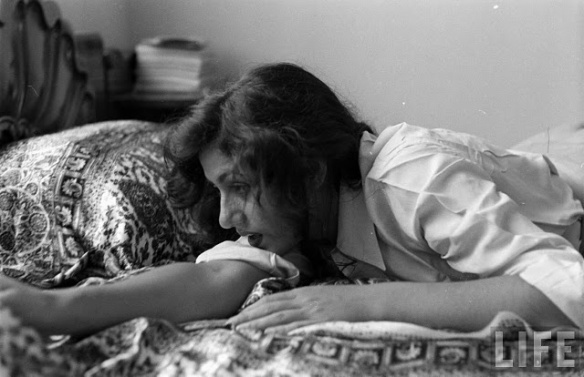
An unscripted moment with Madhubala

Madhubala died on February 23, 1969 at the age of 36.

During the filming of the famous song, “Bekas Pe Karam Kijiye,” Madhubala’s performance turned art into life. The scene was of defiant courtesan Anarkali chained in the palace prison, singing for mercy. Director K. Asif actually made Madhubala perform in heavy, burdensome metal chains that weighed the actress down and cut into her skin. Her exhaustion and despair that you can see in the song are real–for a patient with VSD, such an amount of physical exertion truly mimicked the torture of her Mughal character. It became clear that her only hope lay in the the rumors of a surgical cure with the techniques recently pioneered by Dr. Lillehei.

Madhubala Life magazine

Bollywood Actress Madhubala was most remembered for her roles in Mahal (1949), Mughal-e Azam (1960), and Barsaat Ki Raat (1960).

In 1960, the actress sought treatment in London, but physicians refused to operate. Although Lillehei’s surgery had worked in children, physicians across the West had not perfected the technique in adults, and the first heart transplant in a human adult would not be performed for 7 more years. It was with a heavy spirit that Madhubala returned home to Bombay where she realized her career as an actress was over. She sought instead to enter film as a director, setting the stage to make tremendous strides for women in her directorial debut of the film Farz Aur Ishq. However, while the project was still in pre-production, Madhubala–the immortal woman with a mischievous smile and a mystical aura–succumbed to her illness at the age of 36. Tragically, within a few short years of her death, operations that closed VSDs were made widely available to adults. The history of heart surgery and Madhubala’s life crossed paths at a critical corner, but for a matter of time, never made that life-saving collision.

Rare beautiful photograph of Madhubala

The enigmatic beauty of Madhubala captures audiences generations after her death.

Perhaps if Madhubala had been born just a few years later or if Dr. Lillehei had begun his famous experiments just a few years earlier, Madhubala would have lived to see a surgery that would have allowed her to celebrate her 80th birthday today with us. Perhaps it was Madhubala’s early death itself that has immortalized her as a forever beautiful, forever carefree young woman who will remain always elusive. That ethereal woman haunting the mansion of Mahal (1949) or glittering in jewels of Mughal-e Azam (1961) is now only a shadow in our memories who vanished before time could transform her. In the words of her famous character from Mahal in which she starred at the age of 16:

Mai.N vehm nahii.N hoo.N, haqeeqat.” [“I am not an apparition, I am reality.”]

For fans of Madhubala all over, her words proved true only for a short while.

– Mrs. 55

Karvaten Badalte Rahe Lyrics and Translation: Let’s Learn Urdu-Hindi


RK

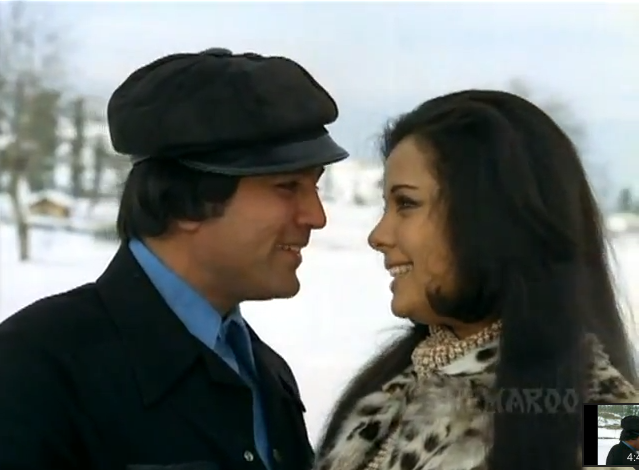
Rajesh Khanna and Mumtaz frolic in pre-marital bliss in the title track from Aap Ki Qasam (1974)

Today, we present the lyrics and English translation to the title track from Aap Ki Qasam (1974): karvate.n badalte rahe.n.  Directed by J. Om Prakash, this film stars Rajesh Khanna, Mumtaz, and Sanjeev Kumar in a story that illustrates how suspicion can be the ultimate enemy to marital bliss. 

As Mumtaz’s jealous husband, Rajesh Khanna begins to doubt his wife’s fidelity when his best friend Sanjeev Kumar comes into the picture. Although Mumtaz and Sanjeev Kumar share a platonic brother-sister friendship, Rajesh Khanna’s suspicion blinds him from reality until he destroys his own marriage.  Refusing to dignify the false accusations of infidelity placed on her with a response, Mumtaz leaves him and returns to her father’s home.  When she realizes that she is pregnant with Rajesh Khanna’s daughter, she enters a second marriage (with her father’s blessings!) so that her child can be raised in a loving home.  In the mean time, Rajesh Khanna comes to his senses and realizes that his suspicion towards his wife was misguided. Unable to apologize properly to Mumtaz for his unacceptable behavior, guilt drives Rajesh Khanna to become a homeless wanderer. Several years later, Mumtaz invites him to his daughter’s wedding where all parties receive closure of sorts. However, a tragedy strikes to create an ending that seeps with melodrama in true Bollywood fashion. 

Aap Ki Qasam is remarkable in its portrayal of marital suspicion for avoiding the chauvinistic bias present in similar films of this era. Typically, female characters accused of infidelity were vilified and forced to appease their husbands regardless of whether the accusations placed upon them were were valid or not. This film breaks the patii-parameshvar (husband is God) mold by supporting a woman’s right to leave an unhappy marriage in which she is treated disrespectfully by her husband. In particular, the support that Mumtaz receives from her father (played by Rehman) in divorcing her husband and entering a second marriage is unusually refreshing for this period of cinematic history. Although it can be argued that Mumtaz’s father makes much of the decisions for her, the fact that she is not compelled to beg for forgiveness at her husband’s feet is sufficiently progressive to merit attention. Indeed, valuing a woman’s dignity and self-worth over her duty to preserve a dysfunctional marriage is the ground-breaking message that makes Aap Ki Qasam stand out among other movies from this time.

In addition to being a cherished Rajesh Khanna-Mumtaz hit, this film is remembered today for its fantastic soundtrack composed by R.D. Burman. Aside from the  Pahadi-based duet sung by Lata Mangeshkar and Kishore Kumar presented here, this album contains the popular duets “suno, haa.n kaho,” “jai jai shiv sha.nkar,” “paas nahii.n aanaa,” the beautiful Lata solo “chorii chorii chup ke chup ke,” and the philosophical Kishore solo “zindagii ke safar me.n.”  Anand Bakshi’s lyrics in “karvate.n badalte rahe.n” are marked by simplicity in their expression of the romance and trust shared between two lovers as they yearn in separation. Moreover, the beautiful snow-filled Himalayan landscape and the on-screen chemistry exhibited by Rajesh Khanna and Mumtaz add to the appeal of this duet. 

Finally, as an aside, the 1973 BBC documentary Bombay Superstar profiling Rajesh Khanna and his influence on Hindi cinema actually features a behind-the-scenes look at the making of Aap Ki Qasam through interviews with the superstar himself,  director J. Om Prakash, and co-star Mumtaz. My favorite part of this documentary is the scene that depicts the amount of work that went into picturizing a playback song for a Bollywood film (the filming of “suno, haa.n kaho” is shown in the documentary).  Check out the full documentary here on YouTube if you haven’t seen it yet! Until next time…

-Mr. 55
RK

The on-screen chemistry between Rajesh Khanna and Mumtaz allowed this pair to dominate the box office during the early 1970s.

Karvaten Badalte Rahe: Lyrics and Translation

karvate.n badalte rahe.n saarii raat ham
Tossing and turning in bed, I have been restless the entire night.
aap kii qasam, aap kii qasam
I swear by you.
gham na karo, din judaayii ke bahut hai.n kam
Do not be sad; the days of our separation are very limited.
aap kii qasam, aap kii qasam
I swear by you.

yaad tum aate rahe ek huuk sii uThtii rahii
As I remembered you, a sharp pain kept arising in my heart.
nii.nd mujhse, nii.nd se mai.n, bhaagtii chhuptii rahii
Sleep and I kept fleeing and hiding from each other.
raat bhar bairan nigoDii chaa.ndnii chubhtii rahii
The hostile, wretched moonlight continued to pierce through the entire night.
aag sii jaltii rahii, girtii rahii shabnam
A fire kept burning, as the dew continued to fall.
aap kii qasam, aap kii qasam
I swear by you.

jhiil sii aa.nkho.n me.n aashiq Duub ke kho jaayegaa
Your beloved will get lost by drowning in the loch of your eyes.
zulf ke saaye me.n dil armaan bharaa so jayegaa
Under the shadows of your tresses, his hope-filled heart will fall into slumber.
tum chale jaao, nahii.n to kuchh na kuchh ho jaayegaa
Please go away, or else something will happen between us.
Dagmagaa jaaye.nge aise haal me.n qadam
Our steps will falter out of control under these circumstances.
aap kii qasam, aap kii qasam
I swear by you.

ruuTh jaaye.n ham to tum ham ko manaa lenaa sanam
Should I sulk, please console me, oh beloved.
duur ho.n to paas ham ko tum bulaa lenaa sanam
Should you be far away, please call me to your side, oh beloved.
kuchh gilaa ho to gale ham ko lagaa lenaa sanam
Should I make a mistake, please embrace me in forgiveness, oh beloved.
TuuT na jaaye kabhii yah pyaar kii qasam
May this vow of love never be broken by us.
aap kii qasam, aap kii qasam
I swear by you.

Female lines in red are sung by Lata Mangeshkar. Male lines in green are sung by Kishore Kumar. Lines in black are sung together by Lata Mangeshkar and Kishore Kumar. 

Glossary

karvate.n badalnaa: to toss and turn in bed  (i.e. to be restless at night); qasam: a sworn oath or vow; gham karnaa: to be sad; judaayii: separation; huuk: a sharp pain; nii.nd: sleep; bhaagna: to flee; chhupnaa: to hide; bairan: hositle, cruel; nigoDii: wretched; chubhnaa: to pierce; aag: fire; shabnam: dew; jhiil: loch, lake; aashiq: beloved; zulf: tresses; saaye: shadows; armaan: hope; Dagmagaaanaa: to falter, stagger; haal: circumstances, state; qadam: steps, feet; ruuTh jaanaa: to sulk; manaa lenaa: to console; sanam: beloved; paas bulaa lenaa: to call to one’s side; gilaa: mistake; gale lagaa lenaa: to embrace; TuuT jaanaa: to be broken.

r

The snowy Himalayan foothills provide the ideal backdrop for this romantic duet from Aap Ki Qasam (1974).

Teri Bindiya Re Lyrics and Translation: Let’s Learn Urdu-Hindi

Amitabh Bacchan marries a village girl with a golden voice in Abhimaan (1973)

Today, we present the lyrics and English translation of an evergreen duet from Hrishikesh Mukherjee’s Abhimaan (1975): terii bi.ndiyaa re . Starring Amitabh Bacchan and Jaya Bhaduri, Abhimaan narrates the story of an ill-fated love between two singers that eventually approaches it breaking point when a husband’s masculine ego suffers a wound from his wife’s overwhelming professional success.

Given that this film revolves around a playback singing couple, the composition of its soundtrack naturally demanded a music director par excellence. In this case, director Hrishikesh Mukherjee chose veteran composer S.D. Burman to do the job–and what a job he did! Aside from the duet presented here, the Lata solos “nadiyaa kinaare,” “ab to hai tum se,” and “piyaa binaa,” the Kishore solo “miit na milaa re man kaa,” and the Lata-Kishore duet “tere mere milan kii yah rainaa” are still cherished by fans today. S.D. Burman’s compositions in this film won him his last Filmfare Award for Best Music Director before his death in 1975.

The duet terii bindiyaa re is sung by Lata Mangeshkar and Mohammed Rafi at a point in the film where Amitabh Bacchan introduces his newly wedded wife Jaya Bhaduri at their wedding reception. In response to a request, they sing this duet for the guests at their party. Here, Majrooh Sultanpuri’s lyrics describe the allure of a woman’s ornaments, specifically her bi.ndiyaa (beauty spot), jhumkaa (earring), and ka.nganaa (bangle).  Voiced by Lata Mangeshkar on playback, Jaya Bhaduri offers an on-screen performance that illustrates a wife’s admiration and respect for her husband. Since this song takes place before Amitabh Bacchan’s tragic descent into insecurity, he is able to reciprocate with affection and warmth.  However, after this performance, a classical musician (played by David) in the audience recognizes that Jaya is the technically superior singer and expresses concern about the couple’s future…watch the film to see how the drama unfolds!

Those of you who are more musically inclined may have noticed that this song is based in rupak taal, a 7-beat rhythmic cycle that was used far less frequently by Bollywood composers than kaharva taal (8 beats) or dadra taal  (6 beats). Interestingly, S.D. Burman has also used this unconventional rhythmic pattern skillfully in the film’s other popular duet tere mere milan kii yah rainaa

What are some of your other favorite Hindi songs that describe female ornaments? Feel free to share with us in the comments! Until next time…

– Mr. 55

Jaya Bacchan gives a Filmfare Award-winning performance as a humble and talented singer whose success in the music industry ultimately hurts her husband’s ego.

Teri Bindiya Re: Lyrics and Translation

terii bi.ndiyaa re, re aay haay!
Your beauty spot, oh!
sajan, bi.ndiyaa le legii terii ni.ndiyaa
Oh beloved, my beauty spot will steal away your sleep.
re aay haay! terii bindiyaa re
Oh, your beauty spot!

tere maathe lage hai.n yuu.n jaise chandaa taaraa
It clings to your forehead like a star to the moon.
jiyaa me.n chamke kabhii kabhii to, jaise koii a.ngaaraa
It shines in my heart from time to time, as if it were a glowing ember.
tere maathe lage hai.n yuu.n
It clings to your forehead.
sajan, nindiyaa le legii, le legii, le legii merii bi.ndiyaa
Beloved, my beauty spot will steal away your sleep.
re aay haay! teraa jhumkaa re
Oh, your earring!
chain lene na degaa sajan tum kaa
It will not let you be at peace, beloved.
re aay haay! meraa jhumkaa re
Oh, my earring!

meraa gahnaa balam tuu, tose saj ke Doluu.n
You are my jewelry, beloved.  Adorning myself with you, I will dance.
bhaTakte hai.n tere hii nainaa, mai.n to kuchh na boluu.n
Your eyes wander, yet I say nothing at all.
meraa gahnaa balam tuu
You are my jewelry, beloved.
to phir yah kyaa bole hai, bole hai, bole hai teraa ka.nganaa?
Then, what is it that your bangle says?
re aay haay! meraa kanganaa re
Oh, my bangle!
bole re ab to chhuuTe na teraa a.nganaa
It says that it will not leave your courtyard.
re aay haay! teraa ka.nganaa re
Oh, your bangle!

tuu aayii hai sajaniyaa, jab se merii ban ke
Beloved, since you came to me and became mine,
Thuumak-Thuumak chale hai tu, merii nas-nas khanke
your strutting has made me feel a jitter in my veins.
tuu aayii hai sajaniyaa
Beloved, since you came to me.
sajan, ab to chhuuTe na, chhuuTe na, chhuuTe na, teraa anganaa
Beloved, it will not leave your courtyard.
re aay haay! teraa ka.nganaa re
Oh, your bangle!
sajan, ab to chuuTe na teraa a.nganaa
Beloved, it will not leave your courtyard.
re aay haay! teraa a.nganaa re
Oh, your courtyard!

*Female lines in red are sung by Lata Mangeshkar. Male lines in green are sung by Mohammed Rafi. 

Glossary

bindiyaa: beauty spot; nindiyaa: sleep; jiyaa: heart; chamkaanaa: to shine, glow; angaaraa: ember; jhumkaa: earring; sajan: beloved; gahnaa: jewelry; balam: beloved; tose: from you, an archaic form of ‘tujhse‘; sajnaa: to adorn; Dolnaa: to swing, dance; bhaTaknaa: to wander; nainaa: eye; kanganaa: bangle; chhuTnaa: to leave, forsake; a.nganaa: courtyard; sajaniyaa: beloved; Thumak-Thumak chalnaa: to strutter; nas-nas: veins; khanaknaa: to jitter.

In her first major non-vamp role, Bindu plays the ‘other woman’  as  a rich socialite who fawns over Amitabh Bacchan in Abhimaan (1973).

Diwali Songs from Classic Bollywood

Happy Diwali! For all our readers and fans observing the occasion, what could be better than a list of 10 classic Bollywood Diwali songs to enjoy over the celebrations today? For a country of over 1 billion Hindus and an industry that absolutely loves to celebrate any kind of occasion with song and dance, Bollywood has a surprisingly low number of Diwali songs in its films. I mean, think about it–Diwali is the country’s largest national holiday, lends itself brilliantly to poetry (festival of lights imagery, the story of the Ramayan, etc.), and is practically bound to succeed by virtue of having very little with which to compete. People are aching for these songs, yet they hardly exist–much less ones worth hearing over and over.

Dharmendra Jugnu Diwali

Dharmendra celebrates Diwali with fireworks and song in Jugnu (1973).

To be sure, plenty of great Diwali bhajans exist outside the realm of Bollywood (look no further than Tulsidas classic “Shri Ram Chandra”), many of which have excellent covers by our favorite playback singers. But within the films? The pickings are slim. I’ve got a theory as to why this might be the case. Let us consider the example of Christmas as we know it in America. When we think of great Christmas jingles, the songs we name predominantly come from hit singers or church traditions–with only a few actually having made it to popular culture from films, despite Hollywood having had a long and successful musical film movement (Judy Garland’s gorgeous “Have Yourself a Merry Little Christmas” comes to mind).

So perhaps Bollywood is no different. Because singing a song about Diwali actually requires Diwali to be a major part of the plot, the happy coincidence rarely occurred–much less with the good fortune of also having been a brilliant composition. Furthermore, celebrations like Holi, for which we can name at least a handful of terrific Bollywood songs, actually lend themselves much better to an upbeat and colorful party on-screen–so musical composition could be a bit more relaxed. With Diwali, you’re treading on sacred ground–and why mess with something that non-filmi bhajans do way better anyway?

Still, a few intrepid pioneers prevailed, and while some are more memorable than others, you’ll find plenty of hidden gems! Below find our list of 10 classic Bollywood Diwali songs that will get the festivities started old-school style! Click the song names to get to the link to youtube.

10 Classic Bollywood Diwali Songs:

1. Kaise Diwali Manaye Lala (Mohammed Rafi, Paigham 1959)

Be prepared from some ridiculous Johnny Walker antics, but a fun dance beat to get your spirits up!

2. Aayi Ab Ke Saal Diwali (Lata Mangeshkar, Haqeeqat 1965)

On a somber note, this haunting Lata Mangeshkar melody from war epic Haqeeqat is a stark reminder of families in grieving this time of year.

3. Is Raat Diwali Kaise (Mohammed Rafi, Shamshad Begum, & Asha Bhonsle, Sabse Bada Rupaiya 1955)

Oh, what?! A Diwali qawwali?! SIGN ME UP! A peppy song describing Diwali festivities sung in traditional qawwali style that gets you clapping along.

4. Laakhon Taare Aasman Mein (Mukesh and Lata, Hariyali Aur Raasta 1962)

Another tragic lovers-separated-on-Diwali-night song starring Manoj Kumar and Mala Sinha, but the melody is sweet and watching Manoj Kumar mope is never such a bad thing. The Lata-Mukesh chemistry works well as always!

5. Jagmati Diwali Ki Raat Aa Gayi (Asha Bhonsle, Stage 1951)

We’re really getting old-school with this one. It’s a rare early song that sounds more like Geeta Dutt than Asha Bhonsle to me. It builds to a frenzy at the end that’s kind of exciting!

6. Deep Diwale Ke (Kishore Kumar, Jugnu 1973)

This may be one of the more popular Diwali songs on our list–sung by lively Kishore Kumar and picturized on Dharmendra with a bunch of happy school kids, you can’t go wrong!

7. Ek Woh Bhi Diwali Thi (Mukesh, Nazrana 1961)

For some balance, here’s another sad song by the inimitable Mukesh-Raj Kapoor duo. Everyone is having a grand time outside partying with sparklers, while moody Raj Kapoor broods upon the days that once were.

8. Deep Jalenge Deep Diwali Aayi Ho (Geeta Dutt, Paisa 1957)

As a connoisseur of Geeta Dutt obscurities, I love this song. With a joyous melody and that gentle lulling voice, it’s one of the better gems on this list!

9. Mele Hain Chiragon Ke Rangeen Ki Diwali Hai (Lata, Nazrana, 1961)

This would be the “happy version” counterpoint to the Raj Kapoor tragedy from earlier. You can see why Raj Kapoor is sad these days are over–everyone’s having a grand old time and it doesn’t hurt to have the voice of a goddess Lata to back you up!

10. Aayi Hai Diwali (Geeta Dutt and Shamshad Begum, Sheesh Mahal 1950)

Another early period Diwali song–and a duet no less! The whole household is bustling with activity and women all over join the chorus for the celebrations!

Even sexy song siren Helen puts on her serious face for a Diwali moment in Lahu Ke Do Rang (1979).

Here are two bonus tracks for extra thrills:

11. Aayi Diwali (Zohrabai Ambalewali, Rattan 1944)

The oldest song on our list! And of course, it’s a Greek tragedy–but rare and exciting for any fans of early early Bollywood. Before the days of Lata Mangeshkar, 1940s playback singer Zohrabai Ambalewali turned music director Naushad into an overnight sensation with this hit!

12. Jyot Se Jyot Jagate Chalo (the exciting Lata version! Sant Gyaneshwar, 1964)

OK, so this song might not be *technically* a Diwali song per se, but it’s thematically spot-on! And I just discovered the Lata Mangeshkar version to compliment the Mukesh version, which I had thought existed in isolation. I can’t believe I did not know about this sooner, I’m so happy right now!

This Diwali special was brought in by request from one of our favorite readers muskaan. We wish everyone a joyous Diwali and a prosperous year ahead!

– Mrs. 55