Papa Jaldi Aaja Na Lyrics and Translation: Let’s Learn Urdu-Hindi

kids

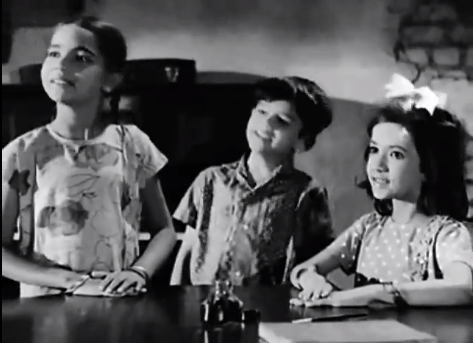
These adorable children await their father Bharat Bhushan’s return from an overseas journey in Taqdeer (1967).

Here at Mr. and Mrs. 55, we wish you a very merry Christmas and send you our warmest season’s greetings! Although songs that depict Christmas are few and far between within the realm of Bollywood cinema (see last year’s post on Jingle Bells/Aao Tumhein Chand Pe Le Jaaye), there is no dearth of songs that celebrate the values comprising the essence of the holiday spirit.  While you shouldn’t hold out for a guest appearance by Santa Claus or good old Rudolph, many Hindi films from the Golden Era revolve around the aspects of Christmas that many people cherish the most: sharing happiness with others, celebrating love, and strengthening family bonds. Today, in honor of Christmas , we present a children’s classic from Taqdeer (1967) that evokes the holiday spirit through its heart-warming depiction of familial love: pappaa jaldii aajaa na.

Directed by A. Salaam Taqdeer (1967) is a Hindi remake of the Konkani film Nirmon (1966) that narrates a powerful story about a destitute widow (played by Shalini Mardolkar) whose husband (played by Bharat Bhushan) is thought to have died in a tragic shipwrecking. Struggling to make ends meet, she accepts a marriage proposal from her husband’s wealthy friend (played by Kamal Kapoor) for the sake of her family. Although money is no longer an issue for them, Shalini and her children struggle to find happiness in the absence of their warm and loving husband/father. Although his family thinks that he is deceased, it turns out that Bharat miraculously survived the shipwrecking but lost all of his memory prior to the accident as a result of amnesia. Several years later, Bharat’s amnesia resolves when he hears a performance of a song (“jab jab bahaar aayii“) that he had taught to one of his former music students. After his memory returns, Bharat returns home to Goa and encounters the harsh reality of the sacrifices his family has been forced to make in his absence. How will Bharat be reunited with Shalini and his children? Watch the full movie here to find out!

Composed by Laxmikant-Pyarelaal and penned by Anand Bakshi, this song is presented at the beginning of Taqdeer after Bharat has embarked on his overseas journey. Equipped with the gentle maternal beauty of Lata Mangeshkar’s voice, Shalini leads her children (voiced by Sulakshana Pandit, Ila Desai, and Meena Petki) in a song to ask for their father’s safe and prompt return home. Naturally, part of the reason that the children await their father’s return is because they are excited to receive the new toys and gifts that he will bring home for them from abroad. Yet, the line “guDiyaa chaahe na laanaa, pappaa jaldii aajaa na!” illustrates how the children dearly miss their father’s love and support regardless of whether they receive his gifts or not.

Indeed, this heart-warming song can serve as a reminder of what is truly important to us at this time of the year. The most important part of the holiday season is not exchanging gifts and reveling in new excitement of our new toys, clothes, or gadgets. Rather, the greatest gift that we can receive for the holidays is the opportunity to live, laugh and cherish the company of our family and loved ones. Still looking for ideas on how to spend your quality time this holiday season? Mrs. 55 and I recommend putting on your favorite old Bollywood flick and letting the bonding begin with those that matter to you the most. Until next time…

-Mr. 55
Shalini

Shalini Mardolkar writes a letter to her husband to tell him how much the family misses him in Taqdeer (1967)


Papa Jaldi Aaja Na: Lyrics and Translation

saat samundar paar se, guDiyo.n ke bazaar se
From a doll store across the seven seas,
achhii sii guDiyaa laanaa
please bring us back a doll. 
guDiyaa chaahe na laanaa, pappaa jaldii aajaa na!
Whether you bring a doll or not, please come home soon, Papa!
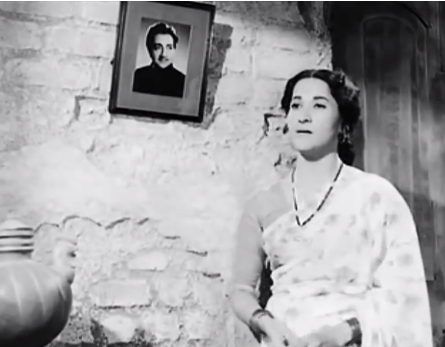
tum pardes gaye jab se, bas yah haal huaa tab se
Ever since you went abroad, our lives have not been the same.
dil diivaanaa lagtaa hai, ghar viraanaa lagtaa hai
My heart has gone mad, as this house feels desolate without you.
jhilmil chaa.nd sitaaro.n ne, darvaazo.n diivaaro.n ne
The shining Moon and stars, these doors and walls,
sab ne puuchha hai ham se: kab jii chhuuTegaa gham se?
they all have asked me, “When will your heart be liberated of sorrow?
kab hogaa unkaa aanaa? pappaa jaldii aajaa na!
When is the date of his return?” Please come home soon, Papa!

maa.n bhii loDii nahii.n gaatii, ham ko nii.nd nahii.n aatii
Since Mom does not sing lullabies anymore, we have trouble falling asleep.
khelkhilaune TuuT gaye, sangiisaathii chhuuT gaye
Our toys are broken, and our companions have left our side.
jeb hamaarii khaalii hai aur aatii diivaalii hai
Our pockets are empty, yet Diwali is still to come.
ham sab ko na taDpaao, apne ghar vaapas aao
Please do not torment us any longer. Once you return home,
aur kabhii phir na jaanaa. pappaa jaldii aajaa na!
never leave us again. Please come home soon, Papa!

khat na samjho taar hai yah, kaaghaz nahii.n hai pyaar hai yah
Consider this a telegram, not a letter. It is made of love, not paper.
durii aur itnii durii, aisii bhii kyaa majbuurii?
There is such distance between us. What compels you to be so far?
tum koii naadaan nahii.n, tum isse anjaan nahii.n
You are not naive, nor are you unaware that
is jiivan ke sapne ho, ek tum hii to apne ho
you are my dream in this life. I consider only you to be mine. 
saaraa jag hai begaanaa, pappaa jaldii aajaa na!
I am estranged from the rest of the world. Please come home soon, Papa!

saat samundar paar se, guDiyo.n ke bazaar se
From a doll store across the seven seas,
achhii sii guDiyaa laanaa
please bring us back a doll.  
guDiyaa chaahe na laanaa, pappaa jaldii aajaa na!
Whether you bring a doll or not, please come home soon, Papa!

Shalini

Shalini Mardolkar and her children are not the same without their beloved head of household Bharat Bhushan in Taqdeer (1967).


Glossary

samundar: sea; guDiyaa: doll; bazaar: store, market; jaldi: soon, quickly; pardes: abroad; viraanaa: empty, desolate; jhilmil: shining; darvaazaa: door; diivaar: wall; chhuTnaa: to escape/depart, to be free of; loDii: lullaby; khel-khilaune: toys; sangii-saathii: companions; jeb: pocket; khaalii: empty; taDpaanaa: to torment; duurii: distance; majbuurii: compulsion, helplessness: anjaan: unaware; jag: world; begaanaa: estranged, alien.
Nutcracker

In my holiday best for my first viewing of The Nutcracker by Tchaikovsky!

Neele Gagan Ke Tale Lyrics and Translation: Let’s Learn Urdu-Hindi

Neele Gagan Ke Tale 2

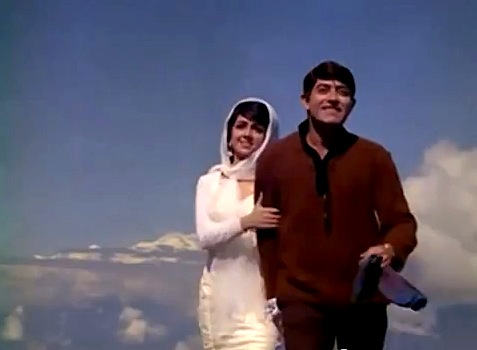
Rajkumar gets romantic with his co-star Vimi in “Neele Gagan Ke Tale” from Humraaz (1967)

Next we showcase the lovely lyrics and English translation of “Neele Gagan Ke Tale” from Humraaz (1967). Set against a peaceful blue sky, Rajkumar and Vimi express their young love for each other as the voice of Mahendra Kapoor floats above. Because of this, the song carries a timeless quality marked by omniscience, as if everything we see is approved by Heaven. Whether a gentle horseback ride or riverside rendez-vous, “Neele Gagan Ke Tale” focuses just as much attention on the protagonists as it does on the wonder of nature. With an opening number as famously idyllic as this, Humraaz effectively lulls the viewer into a false sense of security. A highly underrated mystery thriller, the film shifts gears radically, filled with exciting turns and unexpected cameos until the shocking, but artistically very satisfying end. But that Elysian paradise of “Neele Gagan Ke Tale” where lovers dream and Earth is in bloom will continue to live on forever.

Rajkumar Vimi Neele Gagan ke Tale Humraaz 1967

Mahendra Kapoor’s  “Neele Gagan Ke Tale” is appropriately filmed against a beautiful deep blue sky.

Humraaz is also a rare showcase of Mahendra Kapoor’s talent as a singer. Music director Ravi is often credited as making Kapoor’s career with opportunities and expressiveness that other music directors famously denied him. A devoted Mohammed Rafi disciple, Mahendra Kapoor was often brushed aside by music directors like O.P. Nayyar, who unfairly referred to Kapoor as “besuraa” or “tuneless” in comparison! Ravi, however, believed in Kapoor’s unique talent and freely demonstrated his ability with Sahir Ludhianvi lyrics from the tragic “Chalo Ek Baar Phir Se” to the romantic “Kisi Patthar Ki Murat Se” also from Humraaz. The evergreen hit “Neele Gagan Ke Tale” won Kapoor the filmfare award for Best Playback Singer in 1967! And indeed, one listen of Kapoor’s resonant, tender vocals in this sweet ballad will quickly quell any dissent (which, coming from myself, a fight-to-the-death Rafi groupie, says a lot)! Paired with the blissfully romantic landscapes of India’s beloved tea estates in Darjeeling, the song is truly one of the most gorgeous classic Bollywood has to offer.

Rajkumar Vimi darjeeling Humraaz

Rajkumar and Vimi enjoy the peaceful Darjeeling landscapes in Humraaz (1967).

We hope you enjoy the full lyrics and English translation of “Neele Gagan Ke Tale” below. Follow along with the video and let us know how much you love the escapist fantasy of it all in the comments!

Neele Gagan Ke Tale Lyrics and Translation:

Hey neele gagan ke tale
Beneath the blue sky
Dhartii ka pyaar phale
The love of earth blossoms
Aise hii jag mei.N aate hai.N subahe.N
In this place the morning arrives
Aise hii shaam Dhale
In this place the evening falls
Hey neele gagan ke tale
Beneath the blue sky
Dhartii ke pyaar phale
The love of earth blossoms

Shabnam kii motii phoolo.N pe bhikre
The pearls of morning dew spread upon the flowers
Dono.N kii aas phale
And both of their desires flourish
Hey neele gagan ke tale
Beneath the blue sky
Dhartii ke pyaar phale
The love of earth blossoms

Bhalkaatii bele.N mastii mei.N khele
The sprawling branches play joyfully
PeDo.N se milke gale
And meet the embrace of the trees
Hey neele gagan ke tale
Beneath the blue sky
Dhartii ke pyaar phale
The love of earth blossoms

Nadiyaa kaa paanii dariyaa se milke
The water of the stream meets the river
Saagar kii or chale
And travels toward the ocean
Hey neele gagan ke tale
Beneath the blue sky
Dhartii ke pyaar phale
The love of earth blossoms

Glossary:

neelaa: blue; gagan: sky; tale: below; dhartii: earth; pyaar: love; phalna: to blossom; jag: place; subaah: morning; shaam: evening; Dhalnaa: to set, to diminish; shabnam: dew; motii: pearl; aas: desire; bhalkaatii: sprawling, winding; bel: branch; mastii: intoxication, joy; peD: tree; gale: embrace; nadiyaa: stream: paanii: river; dariyaa: river; saagar: ocean; or: toward, direction

Rajkumar Vimi Humraaz Neele gagan ke tale

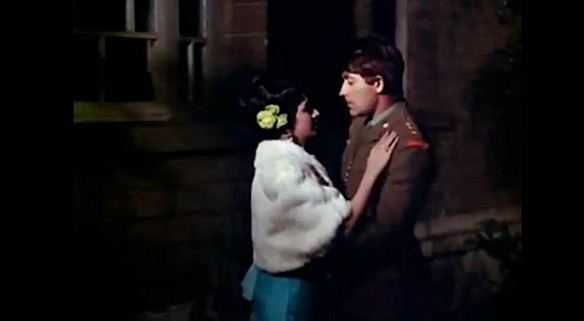
Rajkumar is one heck of a handsome soldier as he bids a tender farewell to Vimi in Humraaz (1967).

Fun fact: “Neele Gagan Ke Tale” also makes our list of favorite “horse songs” found in Bollywood films because of its opening trot!

-Mrs. 55

Chhupa Lo Yun Dil Mein Lyrics and Translation: Let’s Learn Urdu-Hindi

Mamta Suchitra Sen Chhup Lo Yun Dil

Suchitra Sen wishes her daughter will never meet a Fate like her own in Mamta (1966).

Today we showcase the lyrics and English translation to the soulful “Chhupa Lo Yun Dil Mein” from Mamta (1966). One of Majrooh Sultanpuri’s greatest pieces, the calming lyrics set the tone for both the song’s music and its picturization, entering the film as fluidly as it ebbs away, as if an extension of the dialogue the audience so yearns to hear. “Chhupa Lo Yun Dil Mein” is an expression of unwavering romantic devotion set to a soothingly monastic pace.

Suchitra Sen and Ashok Kumar play two lovers who were unable to wed because of class differences, but never forget their love for one another. Suchitra later marries an abusive husband, and ultimately is forced into becoming a courtesan to survive. She tearfully gives up her only daughter so that her child can escape her mother’s ignominious shadow. In the aftermath, “Chhupa Lo Yun Dil” is not lipsynced, but rather the female voice is picturized on a lingering image of Suchitra Sen fading behind a drawn curtain, while the male is picturized on Ashok Kumar shrouding his eyes behind a pair of sunglasses. Poetically fitting, both literally conceal themselves from the viewer in a song dedicated to the beauty of hidden worship.

Ashok Kumar Mamta 1966 sunglasses

Ashok Kumar pensively shields his emotions in Mamta (1966).

Roshan’s soundtrack of Mamta is as gorgeous as it is diverse (see our earlier translation of “Rahe Na Rahe Hum“). “Chhupa Lo Yun Dil” employs a rare paucity of musical instrumentation: from the opening chimes of temple manjira to the traditional bansuri echoing alone in the empty cinematic space, the song emphasizes the ascetic nature of their devotion. To match, the romantic lyrics are infused with religious imagery, and director Asit Sen carefully constructs shots that instead of bring the hero and heroine closer together, in fact emphasize their distance (even their eyelines don’t match!). Indeed, perhaps the song is not two lovers singing to each other after all. The song can be read instead as a mother singing to the daughter she will leave forever, and a father discovering a new meaning to his life by caring for the child in her mother’s memory.

Based in Bollywood’s favorite raaga Yaman, “Chhupa Lo Yun Dil” is one of the most moving Hemant Kumar-Lata Mangeshkar duets of all time. We hope you enjoy our English translation to the lyrics of “Chhupa Lo Yun Dil Mein” below!

Chhupa Lo Yun Dil Mein Lyrics and Translation:

MALE:
Chhupaa lo yuu.N dil mei.N pyaar meraa
Hide my love inside your heart
Ki jaise mandir mei.N lau diye kii
Like the flame of a candle inside a temple

FEMALE:
Tum apne charano.N mei.N rakh lo mujhko
Keep me by your feet
Tumhaare charano.n ka phuul huu.N mai.N
For I am the flowers beneath your footsteps
Mai.N sar jhukaaye khaDii hoo.n priitam
I am standing with my head bowed, my beloved one
Ki jaise mandir mei.N lau diye kii
Like the flame of a candle inside a temple

MALE:
Yeh sach hai jeenaa thaa paap tum bin
It is true that to live without you was a sin
Yeh paap mai.N ne kiyaa hai ab tak
I have committed this sin until now
Magar thii man mei.N chhabii tumhaariI
But your image was always in my mind
Ki jaise mandir mei.N lau diye kii
Like the flame of a candle inside a temple

FEMALE:
Phir aag birhaa ki mat lagaanaa
Please do not light the fire of separation again,
Ki jal ke mai.N raakh ho chukii hoo.N
For I have already burned into ashes

MALE:
Yeh raakh maaThe pe mai.N ne rakh lii
I have worn those ashes upon my forehead
Ki jaise mandir mei.N lau diye kii
Like the flame of a candle inside a temple

BOTH:
Chhupaa lo yuu.N dil mei.N pyaar meraa
Hide my love inside your heart
Ki jaise mandir mei.N lau diye kii
Like the flame of a candle inside a temple

Glossary:

chhupaanaa: to hide; mandir: temple; lau: flame; diyaa: candle; charan: footsteps; phuul: flower; sar jhukaanaa: to bow [one’s] head; khaDaa: standing; priitam: loved one; jiinaa: to live; paap: sin; man: mind; chhabii: image; aag: fire; birhaa: separation; jalna: to burn; raakh: ashes; maaThe: forehead

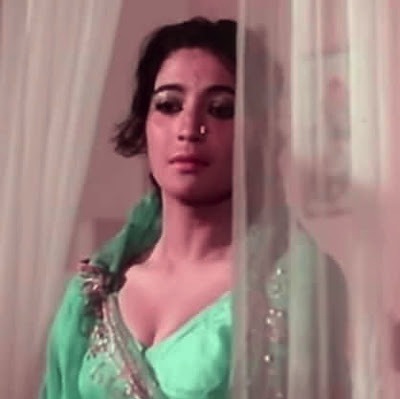
Gorgeous Suchitra Sen Mamta 1966

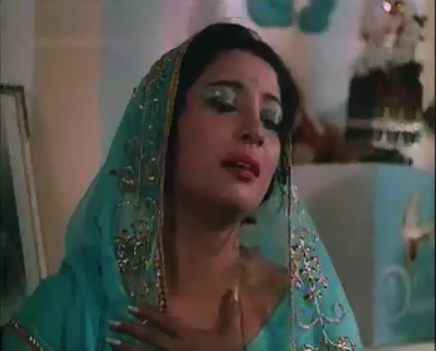
Suchitra Sen’s glittery teal eyeshadow brilliantly matches her sari before becoming soaked in tears in Mamta (1966).

Famous Bengali director Asit Sen was well-known for making films with a refreshingly strong female lead, from Khamoshi (1969) starring Waheeda Rehman to Safar (1970) starring Sharmila Tagore. His mentor was none other than auteur Bimal Roy of Parineeta (1953) fame, which undoubtedly influenced the stories he chose to tell in his own directorial works. This beautiful Mamta song was requested by fan Jiyati Verma! Thank you for the great request!

– Mrs. 55

Aye Meri Zohra Jabeen Lyrics and Translation: Let’s Learn Urdu-Hindi

balraj sahni aye meri zohra jabeen waqt

Balraj Sahni plays a wealthy, family-loving merchant whose good fortune takes a disastrous turn in Waqt (1965).

We now present the lyrics and English translation to “Aye Mere Zohra Jabeen” from Waqt (1965). Young at heart Balraj Sahni plays a loving father of three young children who celebrates his business success with pomp and splendor. So overjoyed by where he believes Fate is taking his family, he dedicates a love song to his wife at a party. The film’s hit opening number “Aye Mere Zohra Jabeen” brims with a sense of carpe diem in the lives of a couple whose youth is coming to an end. Achala Sachdev plays the gentle wife fittingly embarrassed by the attention, but clearly loving the compliments. Their picture-perfect world is too wonderful to last–and before the night is over, tragedy strikes that separates the family. And from there unfolds one of the best Hindi masala films of the 60s!

The well-known opening line carries the Urdu vocabulary lover’s favorite, “zohra jabeen.” The meaning of this term has confused many a Hindi film goer over the ages. Actually a combination of two separate words, zohra and jabeen, the term is used loosely to mean “beautiful one,” but the true definition is far more fascinating. Zohra is the Arabic term for the Roman goddess of beauty, Venus, and also the planet easily identifiable as a shining star in the sky. Jabeen translate literally as forehead, a delicate part of the woman’s face to which praise has been given for centuries of Urdu ghazalry. So when addressing your sweetheart as zohra-jabeen, you are implying that her face shines with the beauty of Venus! Pretty flattering, right?

shy achala sachdev aye meri zohra jabeen

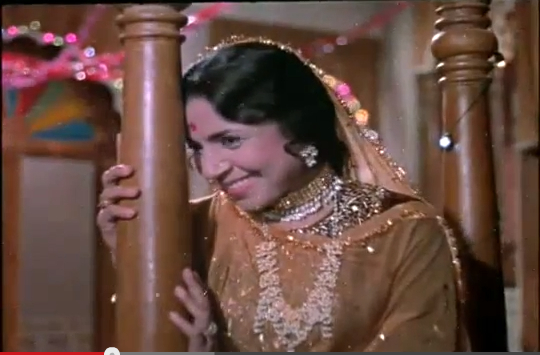
With the coyness of a young bride, Achala Sachdev blushes at her husband’s public display of affection in Waqt (1965).

In an interview on Bangalore’s Radio City in 2005, Manna Dey recalls being requested for the number by music director Ravi with surprise:

“When Ravi called me to sing “Aye meri zohra-jabeen” for Waqt, I asked him, ‘Why me? You use only Rafi or Mahendra Kapoor.’ Ravi said it was Balraj Sahni’s personal request that I sing.”

Although Mahendra Kapoor and Rafi do indeed sing the other fabulous songs of the film, none ever became as famous than this Manna Dey chart-buster. Sung at almost any sangeet or wedding, “Aye Meri Zohra Jabeen” endears listeners across generations with excitement and sentimentality. Although often categorized as a qawwali, the song does not quite fit into the genre–despite its best attempts at synchronized group clapping. Check out the video to see class act Balraj Sahni get into character and witness one of the only Bollywood love songs uniquely targeted at couple of any age! Cutie-pie Achala Sachdev would later play Kajol’s grandmother’s in Dilwale Dulhaniya Le Jayenge where the song was memorably revived!

We hope you enjoy the evergreen Sahir Ludhianvi lyrics and our full English translation to “Aye Meri Zohra Jabeen” below:

Aye Meri Zohra Jabeen Lyrics and English Translation:

Aye merii zohra-jabeen
Oh, my beautiful one
Tujhe ma’aluum nahii.N
You are not aware
Tuu abhii tak hai hasii.N
that you are still lovely
Aur mai.N jawaa.n!
and I am still young!
Tujhpe qurbaan merii jaan merii jaan!
I would sacrifice my life for you!

Yeh shokhiyaa.N yeh baa.Nkpan jo tujh mei.N hai kahii.N nahii.N
This coyness, this attractiveness of yours is nowhere else
Dilo.N ko jiitne kaa fan jo tujh me hai kahii.N nahii.N
The art of winning hearts that you possess is nowhere else
Mai.N terii! maii.N terii aankho.N mei.N paa gayaa do jahaa.N!
In your eyes, I have found my heaven and earth!
Aye merii zohra jabeen…

Tuu miiThe bol, jaan-e-man, jo muskuraake bol de
If you speak sweet words to me, my love, and smile
To dhaDakano.N mei.N aaj bhii sharaabii ra.Ng ghol de
Then even today, you infuse my heartbeats with an intoxicating colour
O sanam! O sanam mai.N teraa aashiq-e-jaavedaan!
Oh darling, I am your lover for eternity!
Aye merii zohra jabeen…

Glossary:

zohra-jabeen: beautiful (literally zohra: Venus and jabeen: forehead = beautiful one with the face that glows like Venus); ma’aluum: aware, information; hasii.N: beauty; jawaa.N: youth; qurbaan: sacrifice; jaan: life; shokhiyaa.N: coyness; baa.Nkpan: attractiveness; fan: art; do jahaa.N: two worlds, heaven and earth, realm; miiThaa: sweet; bol: words; jaan-eman: beloved; muskuraanaa: to smile; dhaDkan: heartbeat; sharaabii: intoxicating, drunken; ra.Ng: colour; ghol: mixture, infusion; sanam: beloved; aashiq: lover; jaavedaan: eternal, never-ending

handkerchiefs waqt

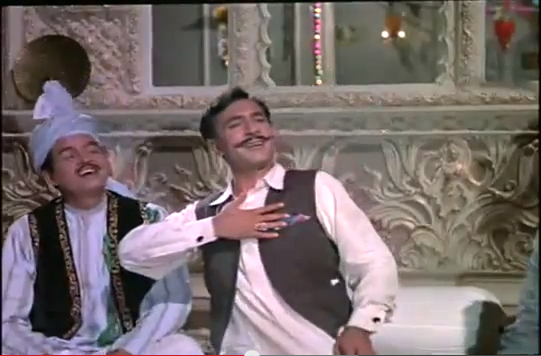
When the flirty handkerchiefs come out, there’s really no going back. I think we all have uncles who have pulled this flamboyant dance move at parties, much to their wives’ chagrin.

Aye Meri Zohra Jabeen” is actually based on a musical composition by Afghanistan’s Abdul Ghafoor Breshna (1907-1974), a famous painter, poet, director, and musician who also composed the national anthem for the Republic of Afghanistan just before his death. “Aye Meri Zohra Jabeen” was requested by two fans, Kuldip Babbar and Hema Fonseka! Thanks for the fantastic suggestion, and keep those requests coming!

– Mrs. 55

Abhi Na Jao Chod Kar Lyrics and Translation: Let’s Learn Urdu-Hindi

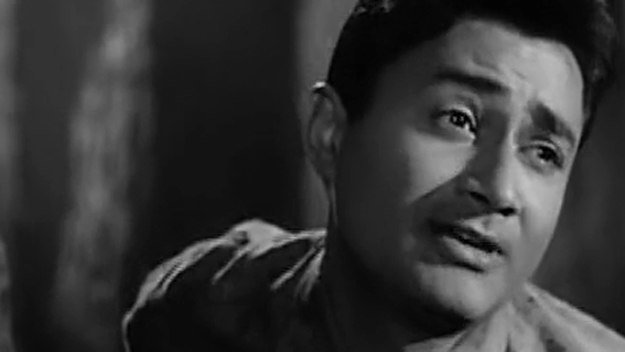
Dev Anand croons to Sadhana in a moonlit forest in Hum Dono (1961).

Dev Anand croons to Sadhana in a moonlit forest in Hum Dono (1961).

Next we present the enchanting lyrics and English translation to “Abhi Na Jao” from Hum Dono (1961). When I think of a Bollywood tree song, I think of this. This is where the magical tradition of hopping around a hidden forest and coyly shimmying behind the nearest tree to dodge your lover’s advances all began. Delightful Dev Anand and young Sadhana prance about gently in a quiet grove with slick back-and-forth lyrics that keep us grounded. The essence of the song comes down to this: Boy loves girl. Girl shyly expresses a desire to go home. Boy insists girl stays. Girl fears losing face. Boy takes opportunity to corner girl against a tree. You certainly don’t need anyone else to tell you how to think, but consider what it means that modern day Romeo Shah Rukh Khan voted this picturization as the most romantic song of Hindi cinema! “Abhi Na Jao” is eternal and the embodiment of sweetly innocent Bollywood courtship.

I’ve talked before about my feelings for the Hum Dono recolourization. Frankly, it’s cute, but not worth eliminating the original black-and-white stock. By converting the film from academy ratio to widescreen, you lose a great deal of the movie in exchange for some glitzy editing tricks (watch the colorized version here to see what I mean!). The film, its characters, the music, and the plot are so strong, it does not require any remodeling for wider accessibility. This song comes early in the movie, setting a high key tone for the upcoming embroilment.

Dev Anand Abhi Na Jao

Dev Anand looks like a lost sheep as Sadhana coyly sneaks away in “Abhi Na Jao” from Hum Dono (1961).

The signature Dev Anand coiffure is at its puffiest in this song, a welcome reflection of his bursting emotions. So take a seat, grab a snuggle pillow, and enjoy the lyrics and our full English translation to the evergreen duet “Abhi Na Jao Chod Kar” from Hum Dono (1961)!

Abhi Na Jao Chhod Kar Lyrics and Translation

MALE:
Abhi na jaao chhoD kar ki dil abhi bhara nahii.N
Do not go and leave me now, for my heart is not yet filled
Abhi abhi to aayii ho abhi abhi to
You have only just come
Abhi abhi to aayi ho bahaar banke chhaaii ho
You have only just come, you became the Spring as you arrived
Hawaa zaraa mahak to le nazar zara bahak to le
Let the wind spread your fragrance, let your gaze wander
Yeh shaam dhal to le zaraa
Let the night fall a little more
Yeh dil sambhal to le zaraa
Let my heart steady itself
Main thoDi der jii to luu.N nashe ke ghuunT pii to luu.N
Let me live a little longer, let me taste a sip of your intoxication
Nashe ke ghunT pii to luu.N, abhi to kuch kahaa nahii.N
Let me taste a sip of your intoxication, for I have said nothing yet
Abhii to kuch sunaa nahii.N
You have heard nothing yet
Abhii na jaao chod kar ke dil abhi bhara nahii.N
Do not go and leave me now, for my heart is not yet filled

FEMALE:
Sitaare.N jhil milaa uThe
The stars have begun to sparkle
Sitaare.N jhil milaa uThe, chiraag jagmagaa uThe
The stars have begun to sparkle, the lamps have been lit
Bas ab na mujhko Toknaa
Enough, do not scold me now
Bas ab na mujhko Toknaaa, na baDhke raah rokna
Enough, do not scold me now, do not come forward to block my path
Agar mai.N ruk gayii abhii to jaa na paauu.Ngii kabhii
If I stop now, I will never be able to leave
Yehii kahoge tum sadaa ke dil abhii nahii.N bharaa
For you will keep on saying that your heart is not yet filled
Jo khatm ho kisii jagah yeh aisaa silsila nahii.N
This is not the kind of affair that ends easily

MALE:
Abhii nahii.N abhii nahii.N!
Not yet, not yet!

FEMALE:
Nahii.N, nahii.N, nahii.N, nahii.N!
No, no, no, no!

MALE:
Abhi na jaao chod kar ke dil abhi bhara nahii.N
Do not go and leave me now, for my heart is not yet filled

MALE:
Adhuurii aas
Unfulfilled desire
Adhuurii aas chhoDke, adhuurii pyaas chhoD ke
Leaving me with unfulfilled desire, leaving me with unfulfilled thirst
Jo roz yuu.N hii jaaogii to kis tarhaa nibhaaogii
If you go every day like this, then how will you keep your promise?
Ki zindagii kii raah mei.N jawaa.N dilo.N kii chaah mei.N
For in the path of life, in the desire of two young hearts
Kaii maqaam aaye.Nge jo humko aazmaae.Nge
Many challenges will come to test us
Buraa na maano baat kaa, yeh pyaar hai, gilaa nahii.N
Do not be hurt by my words, for they are words of love, not a complaint

FEMALE:
Haa.N, yehii kahoge tum sadaa ki dil abhii bharaa nahii.N!
Yes, but you will keep on saying that your heart is not yet filled!

MALE:
Haa.N, dil abhi bharaa nahii.N
Yes, my heart is not yet filled!

FEMALE:
Nahii.N, nahii.N, nahii.N, nahii.N!
No, no, no, no!

Glossary:

bhara: filled; bahaar: Spring; hawaa: wind; mahak: fragrance; nazar: gaze, bahak: wander; shaam: evening; sambhalnaa: to steady oneself; thoDi der: a little while longer; nashe: intoxication; ghuunT: sip; jhilmilnaa: to sparkle; chiraag: lamp; Toknaa: to scold; raah: path; khatm: finish; jagaah: place; silsilaa: affair; adhuurii: unfulfilled; aas: desire; pyaas: thirst; roz: every day; nibhaanaa: to fulfill [a promise], zindagii: life; jawaa.N: young; chaah: desire, love; maqaam: challenge; aazmaanaa: to test, to try; buraa: hurt; gilaa: complaint

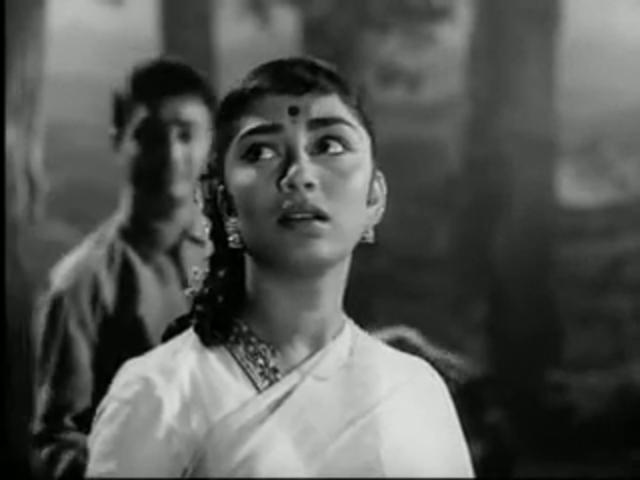
Sadhana Abhi Na Jao Hum Dono

Sadhana worries on a late evening out with her lover in Hum Dono (1961).

Yes, like many a great Hindi song, this one comes with a tragic reprise. A tender Asha Bhonsle solo, “Jahan Mein Aisa Kaun Hai” is a song of steadfast devotion in the face of impending wartime separation. Sadhana beautifully demonstrates her love to be more than a worthy match for the original duet’s playful warning of a perilous future. We have included the full lyrics and translation of Jahan Mein Aisa Kaun Hai as well below for your edification!

Jahan Mein Aisa Kaun Hai Lyrics and Translation:

Dukh aur sukh ke raaste bane hai sab ke vaaste
The paths of sadness and happiness are made for everyone
Jo gham se haar jaaoge to kis tarah nibhaaoge?
If you lose to sadness and leave, then how will you keep your promise?
Khushii mile hame.N ki gham jo hoga baat le.Nge hum
Whether we are met with happiness or sorrow, let us accept it
Mujhe tum aazmaao to zara nazar milaao to
Test me and meet my eyes
Ye jism do sahii magar dilo.N mei.N faaslaa nahii.N
We may have two bodies, but there is no distance between our hearts

Jahaan mei.N aisaa kaun hai ki jisko gham milaa nahii.N?
Is there anyone in the world who has not had sadness?

Tumhaare pyaar kii qasam tumharaa gham hai meraa gham
I swear by your love that your sorrow is my sorrow
Na yuu.N bhujhe bhujhe raho jo dil ki baat hai kaho
Do not fade away like this, tell me what is in your heart
Jo mujhse bhi chhupaaoge to phir kisse bataaoge?
If you hide those words from me, then whom will you tell?
Mai.N koi ghair to nahii.N dilaaoo.N kis tarah yakeen?
I am no stranger, how can I make you believe me?

Ki tum se mai.N judaa nahii.N, mujhse tum judaa nahii.N
For you are not separated from me, and I am not separated from you

Glossary:

dukh: sorrow; sukh: happiness; raastaa: path; [kisii ke] vaaste: for the sake of; haarnaa: to lose; tarah: type, manner; khushii: joy, happiness; aazmaanaa: to test, to try; nazar milaanaa: to make eye contact; jism: body, faaslaa: distance; qasam: swear; chhupaanaa: to hide; ghair: stranger; yakeen: belief

Can’t get enough? Check out our other translations from the same film like “Main Zindagi Ka Saath” and “Allah Tero Naam” for more!

-Mrs. 55