Chingari Koi Bhadke Lyrics and Translation: Let’s Learn Urdu-Hindi

Rajesh Khanna Sharmila Tagore Amar Prem

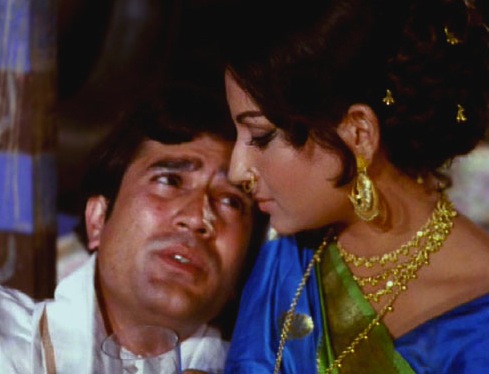
Aided heavily by hard liquor, Rajesh Khanna slips into philosophical discourse gazing at the beautiful Sharmila Tagore in Amar Prem (1972).

Our next English translation, the beautiful lyrics of “Chingari Koi Bhadke,” comes from the eternal love story Amar Prem (1972). Anand Bakshi outdoes himself with these philosophical, thought-provoking lyrics on the nature of life and the inevitability of Fate. Like other masterpieces songs of the sharaab genre in Bollywood, “Chingari Koi Bhadke” glorifies the opportunity to escape societal boundaries through alcohol.

Sung by Rajesh Khanna favorite, Kishore Kumar, “Chingari Koi Bhadke” has some of the greatest lines written in Bollywood music: “Madiira jo pyaas lagaaye, use kaun bhujaaye?” echoes the lines of the great 1935 Hindi poem by Harivanshrai Bachhan, “Madhushala”:

Kya mai.N madhushala ke andhar? Ya mere andhar madhushala?”

Indeed, the theme of an inner thirst can be found in Indian art from time immemorial–whether from spiritual seekers rejecting worldly materialism, or from thwarted lovers searching for a way out.

Amar Prem tells the story of a man trapped in a loveless marriage (Rajesh Khanna) who falls for the golden-hearted brothel songstress, Sharmila Tagore. Although both realize the world will never accept the purity of their love for one another, they remain faithful to their shared ideal of “amar prem” even as they are forced apart. Rajesh Khanna and Sharmila Tagore eventually grow older, not knowing what became of the other, but in separate ways undergo a spiritual transformation sparked by the love they shared. This immortal song, like others in the film by versatile maestro R.D. Burman (eg. “Kuch To Log Kahenge” and “Yeh Kya Hua”) is both a critique on an unforgiving society and a resignation to the laws of Nature. Intoxication itself, the profundity of these lyrics take several passes to completely envelop you, so go slowly and enjoy the full lyrics and our English translation of “Chingari Koi Bhadke” below!

Rajesh Khanna Amar Prem

Rajesh Khanna plays a good-hearted alcoholic trapped by the fetters of societal propriety in Amar Prem (1972).

Chingari Koi Bhadke Lyrics and Translation:

Chingaari koii bhadke
If someone lights a spark
To saawan use bujhaaye
Then the rains will put it out
Saawan jo agan lagaaye, use kaun bhujaaye?
But if the rains start a fire, who will put it out?

PatajhaD jo baagh mei.n ujaaDe
If a garden is destroyed in the Autumn
Woh baagh bahaar khilaaye
It will bloom again in the Spring
Jo baagh bahaar mei.N ujade, use kaun khilaaye?
But who can revive the garden that is destroyed in Spring?

Hum se mat poochho kaise
Do not ask me how
mandir TooTaa sapno.N kaa
The temple of my dreams shattered
Logo.N kii baat nahii.N hai
This is not a matter for everyone to discuss
Yeh qissa hai.N apno.N kaa
This tale is only for my own circle

Koi dushman thhais lagaaye
If an enemy strikes you a blow
To miit jiyaa bahalaaye
Then your beloved will nurse you
Manmiit jo ghaav lagaaye, use kaun mitaaye?
But who can nurse the wounds your beloved strikes?

Na jaane kya ho jaataa
I do not know what happens
Jaane hum kyaa kar jaate
I do not know what would happen
Peete hai.N to zindaa hai.N
If I drink, then I live
Na peete, to mar jaate
If I do not drink, then I die

Duniyaa jo pyaasaa rakhe
If the world is thirsty
To madiiraa pyaas bujhaaye
Then wine can slake that thirst
Madiiraa jo pyaas lagaaye, use kaun bujhaaye?
But who can slake the thirst caused by wine?

Maanaa toofaan ke aage
I agree that before a storm
Nahii.N chaltaa zor kisii kaa
No one can use force
Maujo.N ka dosh naii.N hai
Yet this is not the fault of the waves
Yeh dosh hai aur kisi kaa
It is the fault of someone else

Majhadaar mei.N naiyaa Doobe
If a boat starts to rock midstream
To maajhi par lagaaye
The boatman can lead it to shore
Maajhi jo naaw Dooboye, use kaun bachaaye?
But if the riverman drowns the boat, who can save it?

Chingaari koii bhadke
If someone lights a spark
To saawan use bujhaaye
Then the rains will put it out
Saawan jo agan lagaaye, use kaun bhujaaye?
But if the rains start a fire, who will put it out?

Glossary:

chingari: spark;  agan: fire; patajhaD: Autumn; baagh: garden; bahaar: Spring; mandir: temple; qissa: story, tale; dushman: enemy; thhais: blow; ghaav: wound; zindaa: alive; pyaasaa: thirsty; madhiira: spirits; toofaan: storm; zor: force, dosh: fault; majhdaar: midstream; Doobnaa: to drown; maajhi: boatman; naaw: small boat

Sharmila Tagore Amar Prem

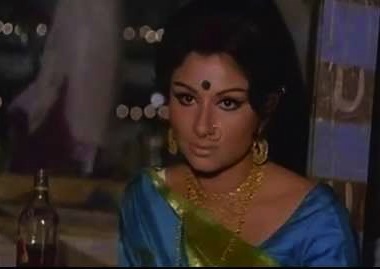
Oh, Sharmila! Is there any commentary anyone can really give you for your divinely majestic presence in this film??!

No, Sir, they sure don’t make songs like they used to. I love the elegance and seeming simplicity of the picturization for this song. No big ruffles or fireworks–just a beautiful traditional instrumentation for background and a metaphorical boat ride filled with meaningful glances and serious faces. Could a song this classy even exist today?

-Mrs. 55

The 15 Best Bollywood Rain Songs: Evolution of a Classic Genre

Rajesh Khanna and Rakhee Rain Song Bollywood

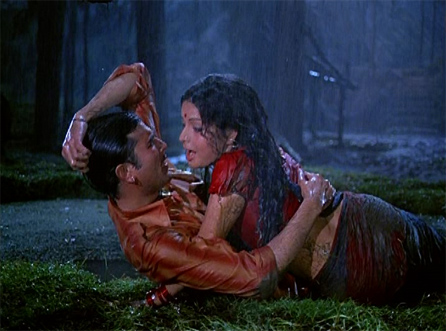
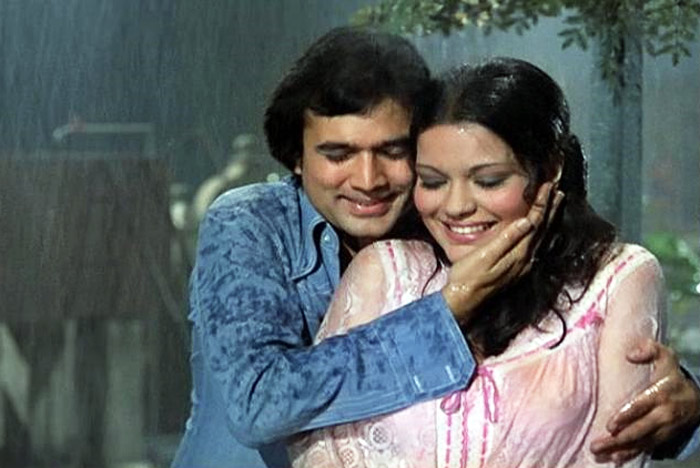
Rajesh Khanna and Rakhee express their sizzling love in the rain in Shehzada (1972).

It’s monsoon season again in India and, naturally, love is sparkling in the air. At last we present our list of the best rain songs from classic Bollywood! We all adore these moments–the iconic cuddling beneath an umbrella, the splashing around in a wet garden, or of course, Zeenat Aman in a drenched saari. It seems now that singing in the rain is the epitome of Bollywood romance, and a marvelous way to introduce a new song. But this phenomena did not occur overnight, and indeed, the meaning of rain itself in a film has shifted over the years with shifting cultural expectations. Let’s take a look at rain songs in Bollywood over the years!

Shree 420 Raj Kapoor Nargis Pyar Hua Iqrar Hua Rain Song Bollywood

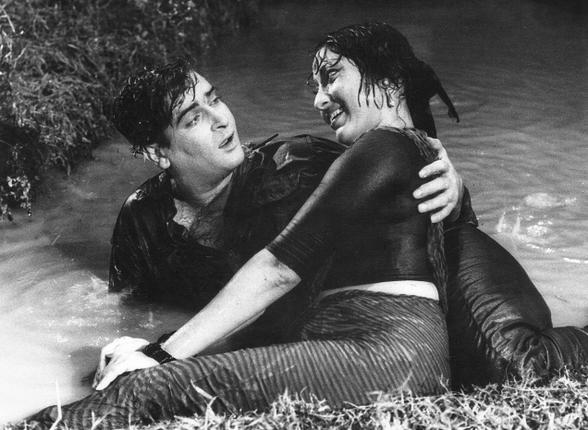
Raj Kapoor and Nargis huddle close together beneath an umbrella in Shree 420 (1955).

We being in the earlier days of cinematic magic. As India awoke to freedom and liberty in the 1950s, so too did the country rapidly begin to shift gears away from pure agriculture and toward industrialization. Many of the best rain songs from that era embody a sense of wonder in urban environments and, matching the film censorship boards, an innocent just-got-struck-by love. In these songs, rain seems to act as that enchantment in the air–that driving force bringing a loved one into contact or sight. Rain too acted as that shimmering veil of restraint that both parties hesitate to cross. “Ek Ladki Bheegi Bhaagi Si” from Chalti Ka Naam Gaadi (1958) is one of the most beloved rain songs of that era!

Raj Kapoor Dum Dum Diga Diga Chhalia

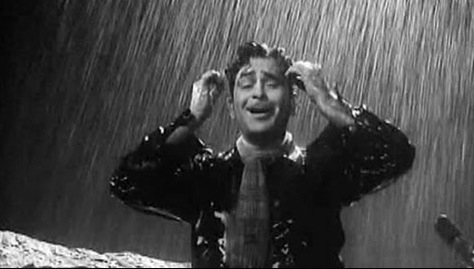
Raj Kapoor prances about the city streets singing “Dum Dum Diga Diga” from Chhalia (1960).

With the advent of the 60s, came a new meaning of being caught in a rainstorm. No longer was rain an innocent effector of love at first sight, but rather a clever and well-understood pretext for full out passion. To clarify, by passion, I mean, symbolic wet dancing that means much more than actual physical contact. The Bollywood rain songs of the 60s exude a sense of joy, independence and confidence. The onset of a rainstorm had an understood implication for overt displays of affection that both parties are eager to demonstrate. Say hello to bouffant hairdos, tight and wet salwar qameezes, and men doing some very special attempts at a courtship dance.

Shammi Kapoor Dil Tera Deewana Hai Sanam Mala Sinha

Shammi Kapoor and Mala Sinha get drenched in Dil Tera Deewana Hai Sanam (1960)

Gone were the days of “Do Bigha Zameen” style agricultural celebration! While the setting of the village recurred, rain ceased to be a blessing for economic survival–instead, it brought the blessing of love between newly liberated men and woman of a new age. Check out our translation of “O Sajna Barkha Bahar” from Parakh (1960) and listen how music directors cleverly incorporated native Indian instruments into creating the sounds and moods of rain. Indeed, the trickling melodies of sitar have graced the introductions of many a great rain sequence–even famously with Ravi Shankar’s solo for Satyajit Rai’s Aparajito!

Asha Parekh Aaya Saawan Jhoom Ke

Dressed as a village belle, Asha Parekh delights in the first rain of the season in “Aaya Sawan Jhoom Ke” (1969).

At last the 70s arrived, and the Bollywood rain song explored new territory. Yes, Zeenat Aman in a wet white saari is crossing some obvious lines and certainly deserves a mention on this list, but the rain song did not merely degenerate into a male fantasy. Instead, as the political atmosphere changed, the rain song adopted a meaning to suit its people. With government dissatisfaction in the air, rain songs were (while maintaining something of a romantic undertone), also a means of escape and hope.

Jeetendra Haye Re Haye Humjoli

Jeetendra and Leena Chandavarkar exhibit some of the strangest and wildest dance moves to date in the famous rain love song of Humjoli (1970)

Did you know in the early days of cinema, rain scenes were not actually filmed in the rain? Because of the nature of unforgiving black-and-white film stock, even heavy pounding natural rain does not appear clearly in the camera–much less the gentle puhaare of many a romantic Bollywood setting. As such, the production staff needed to literally dump buckets of water or spray dozens of hoses above the set for “rain” to actually appear so on screen! So the next time you watch these songs, just imagine the total chaos going on outside the frame among the frantic, water-pouring production assistants!

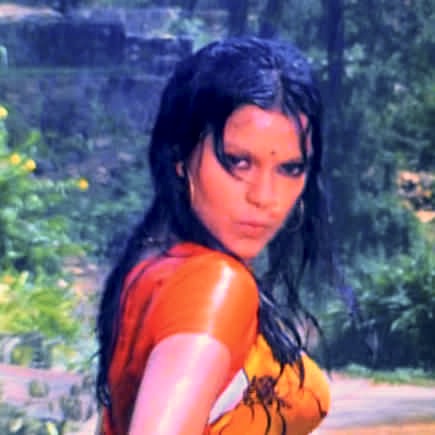
Zeenat Aman sets the rain on fire in “Haye Haye Yeh Majboori” from Shor (1972).

But enough talk. Now that you know the history, here is our list in chronological order of Bollywood’s greatest rain songs! These all-time classic give an entirely new meaning to “Singin’ in the Rain!”

The Best Rain Songs of Classic Bollywood

  1. Pyar Hua Iqrar Hua (Shree 420 – 1955)
  2. Yeh Raat Bheegi Bheegi (Chori Chori – 1956)
  3. Ek Ladki Bheegi Bhagi Si (Chalti Ka Naam Gaadi – 1958)
  4. Dil Tera Deewana Hai Sanam (Dil Tera Deewana – 1960)
  5. Dum Dum Diga Diga (Chhalia -1960)
  6. O Sajna Barkha Bahar Aayi (Parakh -1960)
  7. Rim Jhim Ke Tarane (Kala Bazaar – 1960)
  8. Zindagi Bhar Nahin Bhoolegi (Barsaat Ki Raat – 1960)
  9. Chhup Gaye Saade Nazare (Do Raaste – 1969)
  10. Aaya Saawan Jhoom Ke (Aaya Saawan Jhoom Ke – 1969)
  11. Ang Lag Ja Balma (Mera Naam Joker – 1970)
  12. Haye Re Haye (Humjoli – 1970)
  13. Bheegi Bheegi Raaton Mein (Ajnabi – 1972)
  14. Paani Re Paani (Shor – 1972)
  15. Haye Haye Yeh Majboori (Roti Kapada Aur Makaan – 1974)
Rajesh Khanna Zeenat Aman Bheegi Bheegi Raaton Mein

Rajesh Khanna cuddles Zeenat Aman to keep warm in the spicy rain song “Bheegi Bheegi Raaton Mein” in Ajnabi (1974).

And there you have it, the 15 best classic Bollywood rain songs over the ages! What are YOUR favorite rain songs from classic Bollywood–and tell us how they’ve influenced your own love stories!

– Mrs. 55

Jis Gali Mein Tera Ghar Na Ho Balma Lyrics and Translation: Let’s Learn Urdu-Hindi

Rajesh Khanna serenades Asha Parekh in one of Hindi cinema’s most treasured boat songs from Kati Patang (1970)

If you’ve been following the latest news about Bollywood stars (as you should be), you might be aware of the fact that Rajesh Khanna has been hospitalized recently for exhaustion and a stomach infection. In light of this news, I thought I’d share one of my favorite songs picturized on the Bombay superstar and send along our best wishes for a speedy recovery. Below, I’ve provided the lyrics and a translation for “jis galii me.n teraa ghar na ho baalma,” a beautiful number sung by Mukesh in Kati Patang (1970).

Mukesh singing for Rajesh Khanna? Blasphemy, you might say. As we all know, Kishore Kumar was officially the playback voice for India’s beloved ‘Kaka,’ and you might hear a pairing with Mohammed Rafi on occasion. But a Mukesh song picturized on Rajesh Khanna, let alone a popular one, is quite rare indeed.

In spite of the unconventional pairing, this song from Kati Patang is an all-time classic that has been cherished by fans of Hindi cinema over the years. The beauty in the simplicity of Anand Bakshi’s lyrics here is striking. Expressing the the theme of selflessness in love, these lyrics are unique when placed into context of the film. Rajesh Khanna’s character uses this song to profess his love for Asha Parekh, a woman pretending to be a widow after fleeing the altar. At a time when societal norms prevented such women from marrying again, using such romantic lyrics to describe the love between a man and an ostensible widow is a bold move. In his inimitable style, Mukesh gives one of his career’s best performances as he sings these lyrics with sincerity and a tinge of melancholy.  To top it all off, R.D. Burman composes a simple, yet touching melody that does justice to the beauty of these lyrics. Enjoy this poignantly crafted declaration of love with our glossary and translation below!

-Mr. 55

Playing the role of a supposed widow, Asha Parekh wears a white sari throughout most of this film.

Jis Gali Mein Tera Ghar Na Ho Balma: Lyrics and Translation

jis galii me.n teraa ghar na ho baalma
Any  street on which your house does not reside
us galii se hame.n to guzarnaa nahii.n
is not a street that I shall traverse.
jo Dagar tere dvaare pe jaatii na ho
Any path that does not lead to your door
us Dagar pe hame.n paa.nv rakhnaa nahii.n
is not a path on which I shall set foot.

zindagii me.n kaii rangraliyaa.n sahii
In my life, there have been many colorful celebrations.
har taraf muskuratii ye kaliyaa.n sahii
In every direction, there are smiling flowerbuds
khuubsurat bahaaro.n kii galiyaa.n sahi
and many beautiful views of springtime.
jis chaman mei.n tere pag me.n kaa.nTe chubhe.n
Yet, the garden in which thorns pierce your feet 
us chaman se hame.n phuul chunnaa nahii.n
is not a garden from which I shall pick flowers.

haa.n ye rasme, ye qasame.n sabhii toD ke
Yes, after having broken these rituals and vows,
tu chalii aa chunar pyaar kii oDh ke
please come to me, flying your scarf of love in the air.
yaa chalaa jaauu.nga mai.n yah jag chhoD ke
Or else, I shall go away and leave this world.
jis jagah yaad terii sataane lage
The place where your memories begin to torture me
us jagah ek pal bhii Thaharana nahii.n
is not a place where I shall spend a single moment.

jis galii me.n teraa ghar na ho baalma
Any  street on which your house does not reside…

Glossary

galii: street, alley; baalma: beloved; Dagar: path; dvaaraa: door; rangraliyaa.n: colorful celebrations; kaliyaa.n: flower buds; chaman: garden; pag: foot; chubhnaa: to pierce; rasm: ritual, ceremony; qasam: vow; chunar: scarf; jag: world; sataanaa: to torture.

Rajesh Khanna charms the audience with his characteristic smile.

This song was filmed on site at Lake Nainital in Uttarakhand, India.

The Glorification of Alcohol in Hindi Cinema

A study released in April of this year claimed that Indian adolescents aged 12-16 exposed to alcohol consumption in films were nearly three times more likely to drink than their peers who did not watch Bollywood movies. While this study most likely pertains to the movies released in the industry today, I would venture to say that the origins of this trend can be traced back to films from the Golden Era of Bollywood cinema. Indeed, the consumption of alcohol has been glorified on India’s silver screen for decades, especially through portrayal of sharaab (alcohol) songs in films. Here, I’ve compiled a list of my five favorite male and female sharaab numbers from the Golden Era–let’s take a closer look at these examples to examine how the consumption of alcohol has been portrayed cinematically and its implications on Indian culture.

“Girls Just Want To Have Fun”

In Bollywood’s earliest days, drinking alcohol in films was portrayed as a strictly masculine activity, à la Devdas and other Bollywood heroes who have famously drowned their sorrows in liquor. In contrast, the idealized image of the traditional Indian woman did not permit the depiction of female alcohol consumption in the media.  This trend began to change in the 60s when films depicted heroines and female actresses playing roles in which they partook in the consumption of the Devil’s nectar, just like their male counterparts. As you can see below, the contexts in which female characters drink vary from film to film: alcohol has been used by the women of Bollywood as a coping mechanism, a means of revenge, or just a way to have a good time.

na jaao saiyaa.n (Sahib Bibi aur Ghulam, 1962): In this film based on a Bengali novel by Bimal Mitra, Meena Kumari gives one of her career’s best performances as Chhoti Bahu. Chhoti Bahu is married to young zamii.ndar (played by Rehman), who neglects his wife at home in order to take part in debauchery at local brothels on a nightly basis. In desperate need of her unfaithful husband’s companionship, she decides to take up drinking in order to keep him away from those pesky courtesans at night. In this heartbreaking song sung by Geeta Dutt, Chhoti Bahu drunkenly entreats her husband to stay at home and spend the night with her. In a truly unfortunate example of art mimicing real life, both Geeta and Meena would succumb to alcoholism as a way to cope with their unhappy marriages in the coming years. For those of you who enjoy this song, be sure to check out Hemant Kumar’s Bengali version of the same tune: “olir katha shune.

Meena Kumari, as Chhoti Bahu, tragically turns to alcoholism in Sahib Bibi aur Ghulam (1962).

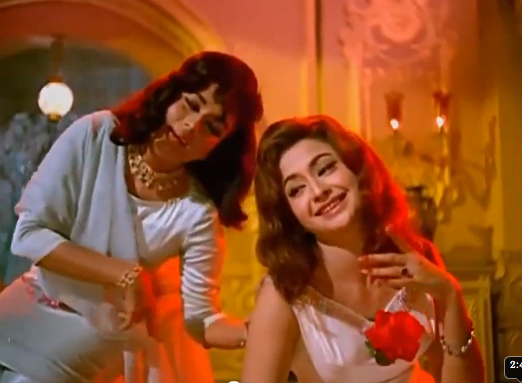
piike hum tum jo chale aaye hai.n (Gumnaam, 1965): This film (reviewed by us here) is a suspense thriller loosely based on the Agatha Christie novel And Then There Were None. The story revolves around seven vacationers who find themselves on a remote island in the middle of nowhere after a plane crash. One by one, they are murdered off and the big question is, of course: whodunnit? In the midst of all this tension, two of the vacationers, Miss Kitty (played by Helen) and Asha (played by Nanda), decide to loosen up and have some fun with a few drinks. In this comical duet sung by Asha Bhonsle and Usha Mangeshkar, the two actresses appear to be having the time of their lives in a drunken stupor on screen. I mean, who wouldn’t be having a good time if they were getting drunk with Helen?

Helen and Nanda get sloppy together in Gumnaam (1965). If you excuse the stumbling, Helen actually looks quite sophisticated in this scene because she’s not wearing one of her characteristically outrageous wigs/outfits.

aao huzuur tum ko (Kismat, 1968): This Asha-OP Nayyar collaboration is an all-time classic from the soundtrack of Kismat (along with “kajraa muhabbatvaalaa“). The film’s narrative is so outrageous that it’s not even worth summarizing here, but this song is picturized on the actress Babita, who is the mother of Karisma and Kareena Kapoor. Babita never managed to gain much success as a heroine, and that’s not surprising given that it’s unclear whether she is drunk or undergoing eplipetic fits in this particular scene. She certainly does make a statement though and manages to embarass the hero Biswajeet with her public intoxication at this party. Regardless of the picturization, Asha Bhonsle adds all the right expressions here to make this an unforgettable sharaab number on the basis of the song alone. Her vocal control in the extended introduction (“ham se raushan hai chaa.nd aur taare...”) before the song’s first stanza is especially commendable. 

Babita has probably had one too many in this scene from Kismat (1968)

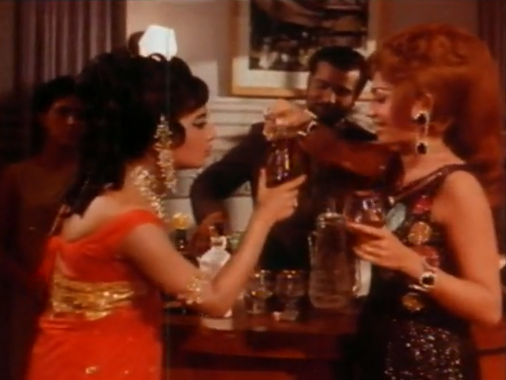
kaise rahuu.n chup (Inteqaam, 1969): Inteqaam is an entertaining (but occaisionally illogical) thriller that stars Sadhana as a woman who seeks revenge against her former boss because he framed her for a theft that she did not commit. As part of her elaborate plan for revenge, she intends to marry her boss’s son (played by Sanjay Khan) and bring shame to his entire family by revealing that the new bahu is, in fact, a convicted criminal! In this song, Sadhana further embarasses her boss’s family by  acting extremely intoxicated under the influence of alcohol at a public gathering. (Technically, this might not be considered a genuine sharaab song because Sadhana is putting on a facade of being drunk without actually consuming, but I liked this song too much to pass up putting it on the list.) This soundtrack composed by Laxmikant-Pyarelal is particularly memorable today because it casts a different light on Lata Mangeshkar, who was considered to be staunchly conservative and traditional in her playback output.  Lata surprises us all by agreeing to sing two sizzling cabaret numbers in addition to this drinking song for the film–listen to her nail those hiccups during the interludes!

Helen serves Sadhana another glass in Inteqaam (1969)

piyaa tuu ab to aajaa (Caravan, 1971): Asha Bhonsle and R.D. Burman come together to produce one of their biggest musical hits together with this classic item number from Caravan. Asha’s performance here solidified her status as the queen of cabaret singing in Hindi cinema. Furthermore, Helen’s portrayal of a nightclub dancer on screen during this song is considered the quintessential Bollywood cabaret performance. Helen’s dance moves are completely outrageous here but she makes it work somehow (see Mrs. 55’s step-by-step breakdown here). Given the ridiculousness of the situation here, you can’t really blame Helen for the heavy drinking…it certainly doesn’t stop her from completely owning the stage during her performance!
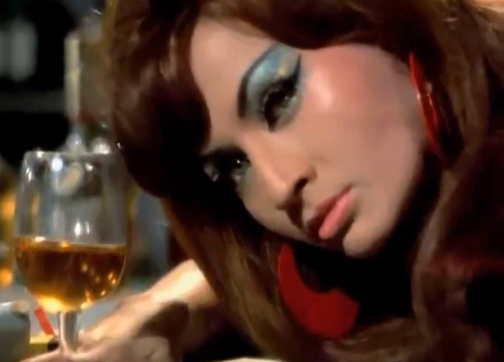
Helen gives one of the best cabaret performances of her career in Caravan (1971)

“Alcohol May Be Man’s Worst Enemy…”

Unlike their female counterparts, the men of Bollywood cinema have been imbibing alcohol since the industry’s earliest days. The most popular context for male drinking in Hindi films occurs when the hero resigns himself to heavy drinking in order to drown his sorrows, usually caused by woman-related heartbreak. While female characters are often stigmatized for their drinking and public intoxication, it is more acceptable for men of the silver screen to use alcohol consumption to deal with their grief.  Other contexts where actors are depicted consuming alcohol include scenes of male-male bonding (bromances, anyone?) and seduction of heroines and courtesans. Though Bollywood has glamorized the consumption of alcohol for both genders, the effect is far more pronounced for males, as evident in the examples I’ve selected below.

mujhe duniyaavaalo sharaabii na samjho (Leader, 1964): Even though its soundtrack is full of gems like “tere husn kii kyaa tariif karuu.n” and “ek shahanshah ne banvaa ke ek hasii.n taaj mahal,” Leader is one mess of a film starring Dilip Kumar and Vijayantimala. Dilip Kumar stars as a law graduate and aspiring political revolutionary who falls in love with a princess (played by Vijyantimala). The script has so many holes that it’s difficult to discern the overall message of this film, but there are some scenes of comic relief between Vijayantimala and Dilip Kumar that are worth remembering. By far, however, the main attraction here is the soundtrack composed by Naushad. In this particular number, an intoxicated Dilip Kumar claims that he has been forced to take up drinking to grapple with society’s evils.
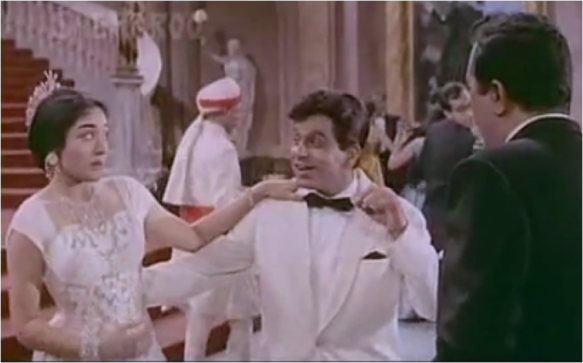
Vijayntimala tries to stop a drunk Dilip Kumar from embarassing himself too much at this party in Leader (1964).

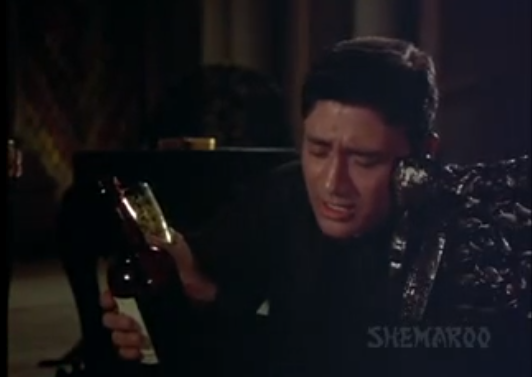
din Dhal jaaye (Guide, 1965): Where do I even begin with the praise for Vijay Anand’s Guide? Mrs. 55 and I both love everything about this film: the unique story written by R.K. Narayan, the stellar performances by Dev Anand and Waheeda Rehman, and of course, the unforgettable soundtrack composed by S.D. Burman. Each and every song from this film is an absolute gem. In this particular Rafi solo picturized on Dev Anand, the hero drowns his sorrows about lost love in alcohol. The melancholic expression that pervades throughout this scene is enhanced by the beautifully crafted lyrics and tune.

Dev Anand turns to the bottle when love goes sour in Guide (1965).

chuu lene do naazuk ho.nTho.n ko (Kaajal, 1965): With this Rafi number penned by Sahir Ludhianvi and composed by Ravi, Raaj Kumar tries to get Meena Kumari, his on-screen shaadi-shudhaa (virtuous) wife, to come to the dark side by having a drink. Alcohol glorification occurs is at its finest in these lyrics: it is referred to as “mubarak cheez,” or a blessed thing.  Meena Kumari excels, as usual, at looking incredibly uncomfortable and disturbed by Raaj Kumar’s advances in this scene.
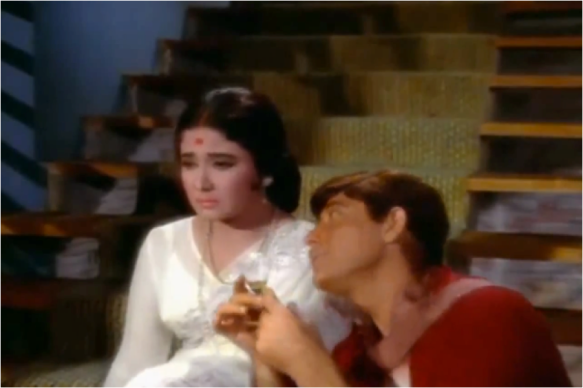
A drunk Raaj Kumar tries to get Meena Kumari on his team in Kaajal (1965).

jo unkii tamanna hai barbad ho jaa (Inteqaam, 1969): This film certainly features a lot of alcohol consumption on screen. In addition to the drunk Lata number discussed above, this Rafi solo from Inteqaam is picturized on Sanjay Khan as he laments being a mere object in Sadhana’s plans for revenge. Rajinder Krishan’s lyrics are exquisite in their ability to capture the essence of being deceived in love.
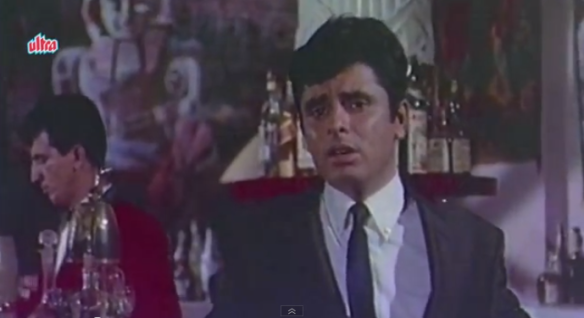
Handsome Sanjay Khan turns to alcohol to get over Sadhana’s deception in Inteqaam (1969)

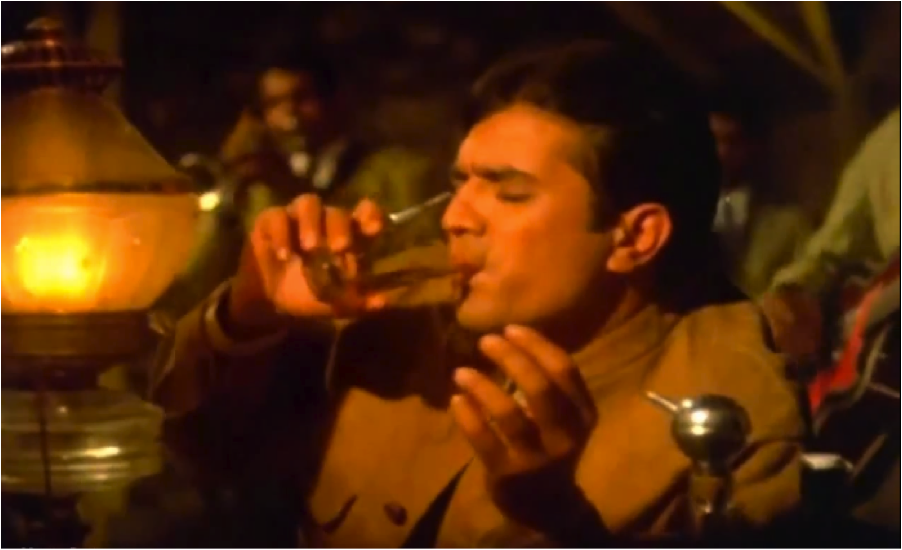
yeh jo muhabbat hai (Kati Patang, 1970): Directed by Shakti Samanta, this film features an evergreen soundtrack composed by R.D. Burman. This particular number sung by Kishore Kumar is one of Bollywood’s most treasured drinking songs, and it features a handsome and bitter Rajesh Khanna drinking the night away because he was stood up at the altar by his wife-to-be.  Asha Parekh watches from a distance, not yet aware of the fact that she is the woman responsible for his heartache.

Rajesh Khanna drinks another glass of liquid courage before singing about the pain of disloyal love in Kati Patang (1970).

What are some of your favorite sharaab/daaru songs from Bollywood films? Let us know in the comments! We’ll understand if your typing is a little bit off…
Mr. 55

Roop Tera Mastana Lyrics and Translation: Let’s Learn Urdu-Hindi

Rajesh Khanna Sharmila Tagore HOT Aradhana

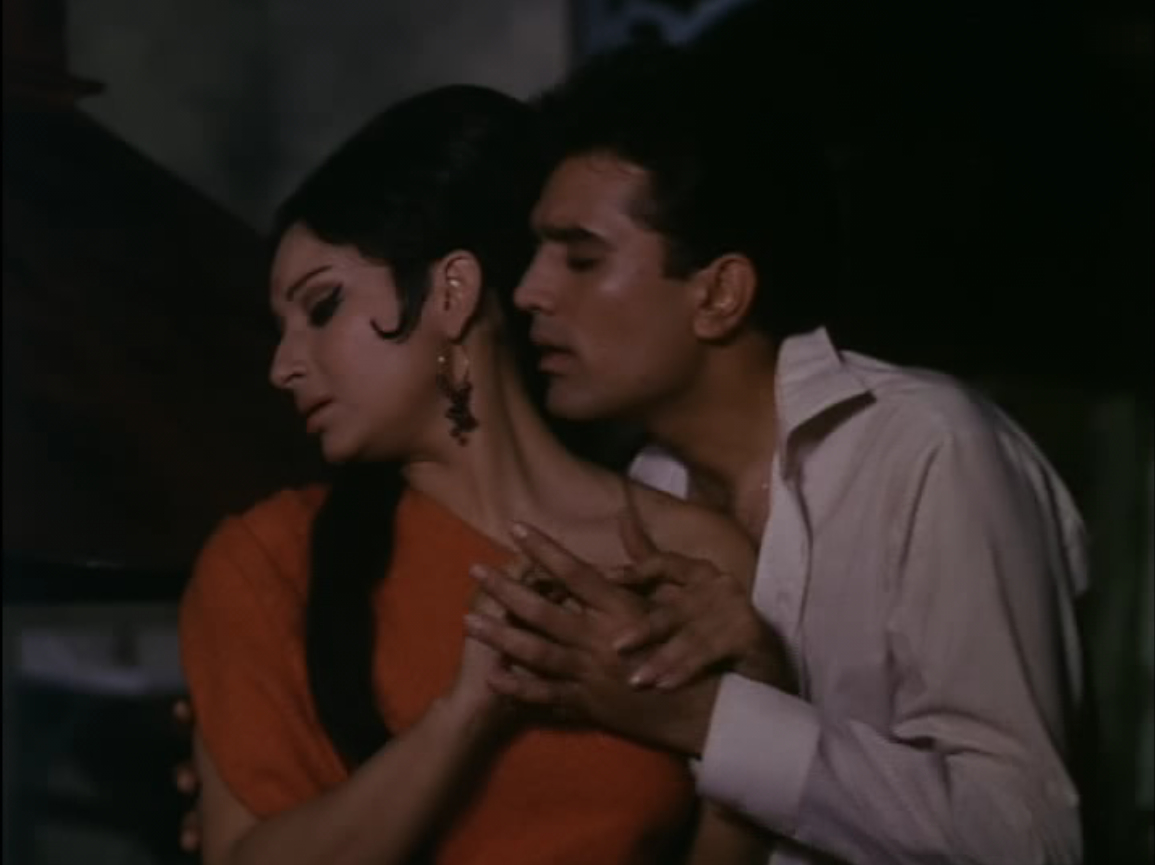
Rajesh Khanna and Sharmila Tagore get too close for comfort in “Roop Tera Mastana” from Aradhana (1969)

Our next post brings you the full lyrics and English translation of the all-time hit “Roop Tera Mastana” from Aradhana (1969). The film stars one of Bollywood’s favorite on-screen couple: the dashing Rajesh Khanna and the elegant Sharmila Tagore. Now this song gets a little racy, so for everyone who isn’t sure they can handle it, please direct yourselves to our G-rated posts (see Rabindranath Tagore’s Influence on S.D. Burman) at this time. Everyone else, grab a seat and a drink of water because it’s about to get a little hot in here.

One of the things I love most about “Roop Tera Mastana” is the cinematography (check out the youtube link here!). The entire song (roughly 4 minutes) is shot in a single long take! The camera swirls around the fire following Rajesh Khanna making his moves on Sharmila, without ONCE cutting for an insert or change in camera angle.

For this to succeed, not only do both the actor and actress need to know exactly where to start and stop with every movement they make during the sequence (any small shift could result in a loss of camera focus), but there is an elaborate dolly track for the camera also laid out all around the floor that they have to be careful not to trip on as they move. And every time the dolly men, the grip guy, the pull-focus team, or heaven-forbid the actors screw up in the 4 minutes you need per take, you start all over again, lose valuable film stock, and probably get a public slap in the face. Check stills from this sequence below!

Rajesh Khanna Sharmila Tagore2

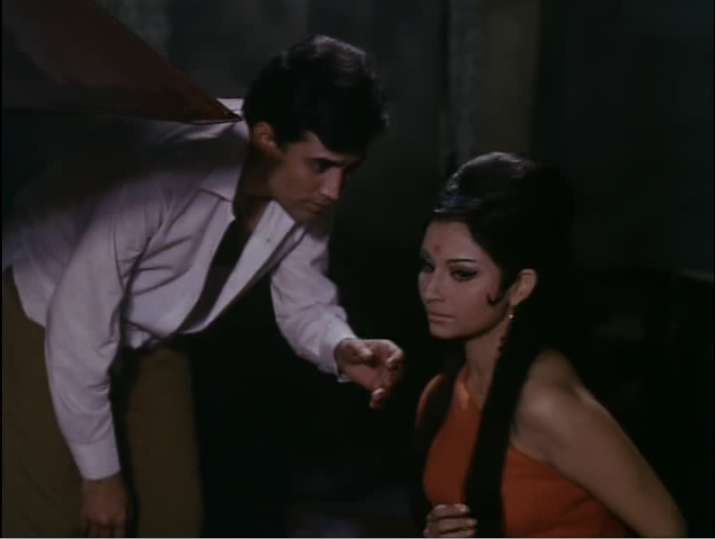
Rajesh Khanna swoops in for the kill.

Rajesh Khanna Sharmila Tagore3

Sharmila Tagore senses danger and edges away.

Oh, awkward–Sharmila and Rajesh bump into each other unexpectedly.

Sharmila: To give in or not to give in??!

Rajesh Khanna rushes in from the other side.

Well…maybe this idea isn’t so bad after all…

Sharmila gets so on board, she starts to be a little aggressive.

Things are just getting out of control now with Rajesh and Sharmila.

Gorgeous Rajesh Khanna is abandoned, bursting with chest hair.

Gotcha! Just when you thought you thought you had given him the slip.

It’s super tense in that room, and I’m not just talking about Sharmila’s sternocleidomastoids.

In the film Aradhana (1969), Sharmila Tagore and Rajesh Khanna have both just come from getting secretly married in a private temple ceremony. They happen upon a shelter lodge, and obviously consummating the marriage is all over Rajesh Khanna’s mind.

Interestingly, the camera itself becomes complicit in the scene. Like the actors themselves, the camera too encircles the fire as if echoing the hallowed rites of Hindu marriage, the saath phere (or seven circles), that give sanctity to their union. It is as if the audience is now the testifying witness of the validity of their marriage, and the camera hesitates–sometimes pausing, sometimes rushing just like the whirlwind of conflicting emotions in the scene. It is extremely symbolic and by eliminating all cutting, the long take seems to slow time down as we grasp the moral and social complexities of this moment, as well as build the tension of what is imminent. Enjoy our English translation of the lyrics of this all-time classic and let us know your opinions in the comments!

Roop Tera Mastana Lyrics and Translation

Roop tera mastana pyaar mera diwaanaa
Your beauty is intoxicating, my love is crazy
Bhool koi humse na ho jaaye
Let me not commit a wrong

Raat nasheelii mast samaa hai
The night is lush, the atmosphere is intoxicating
Aaj nashe mei.N saara jahaa.N hai
Today the whole world seems drunk
Haa.N yeh sharaabii mausam behkaaye
Yes, this intoxicated atmosphere has enticed us
Roop tera mastana pyaar mera diwaanaa
Your beauty is intoxicating, my love is crazy

Aankho.N se aankhe.N miltii hai.N aise
Our eyes met like this
Bechain hoke toofaa.N mei.n jaise
Becoming restless like a storm
Mauj koi saahil se takraaye
Like a wave crashing toward the shore
Roop tera mastana pyaar mera diwaanaa
Your beauty is intoxicating, my love is crazy
Bhool koi humse na ho jaaye
Let me not commit a wrong

Rok rahaa hai hum ko zamaanaa
The world is stopping us
Duur hii rehna paas na aana
We must stay apart and not come closer
Kaise magar koi dil ko samjhaaye?
But how can anyone make our hearts understand this?
Roop tera mastana pyaar mera diwaanaa
Your beauty is intoxicating, my love is crazy
Bhool koi humse na ho jaaye
Let me not commit a wrong

Glossary

roop: beauty; mastaana: intoxicating; diiwaanaa: crazy (in love); bhool: mistake, wrong; nasheelii: lush; samaa: atmosphere; nashe mei.N: drunk; mausam: atmosphere; bechain: restless; toofaa.N: storm; mauj: wave; saahil: shore; zamaanaa: the world

Notice how no one actually gets close to kissing each other in the sequence. I mean, you’d think it happened if you looked at some of these still shots, but in reality the closest thing to physical contact that occurs in this whole sequence is when they hold hands and half-way hug. It would have been awkward, but they pretend like they’re kissing so well, that you hardly notice that no one has touched each other. Oh, the magic of Bollywood!

For more from the magical soundtrack of Aradhana, check out our translation of “Kora Kaagaz Tha” here!

-Mrs. 55