Aye Dil-E-Nadaan Lyrics and Translation: Let’s Learn Urdu-Hindi


As many of our readers may already be aware, today marks the 86th birthday of melody queen Lata Mangeshkar. In commemoration of this special day, we would like to present the lyrics and English translation to one of the most exquisitely beautiful songs sung by the Nightingale of India during her long and illustrious career: ai dil-e-naadaa.n from Razia Sultan (1983).
A

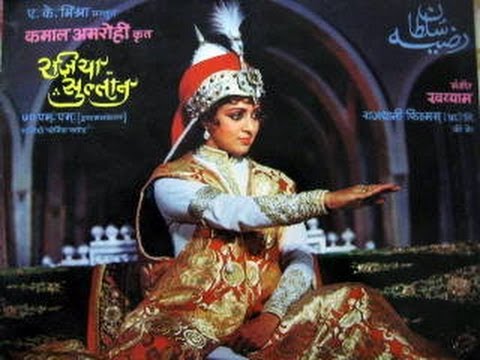
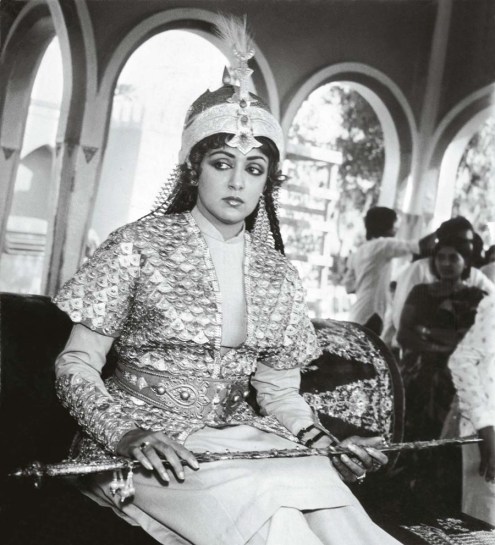
Hema Malini stars as a 13th century empress of Delhi in Razia Sultan (1983)

Directed by Kamal Amrohi (of Mahal and Pakeezah fame), Razia Sultan narrates the story of the only woman to ascend the throne of Delhi and her alleged love affair with Abyssinian slave-turned-warrior Jaml-ud-Din Yaqut. Hema Malini stars in the title role, while her real-life beau Dharmendra plays the role of her love interest Yaqut. When Sultan Altamash decides that his beloved daughter Razia shall be the successor to his throne instead of his trouble-making son Ferozshah, the kingdom erupts in an uproar over the possibility of being ruled by a woman. After her father’s passing, Razia proves herself to be a compassionate and brave ruler who leads with an eye toward justice like her late father. Over time, Razia is accepted as the first female emperor of the kingdom until gossip spreads among the royal court about an affair between Razia and her former slave Yaqut. Although Yaqut is now a free man and army commander, the relationship between him and the empress is highly scandalous due to his roots as a dark-skinned African slave. When this controversy reaches its peak, Razia must make a choice between her kingdom and her love. In the end, in true Bollywood style, Razia makes the ultimate sacrifice for her love.

Although this film had the potential to provide a compelling view on the complexities of race and gender politics, it fails to meet the mark in many respects and was unable to achieve commercial success at the time of its release. It is likely that the heavy-handed use of formal Urdu made it difficult for audiences to understand many parts of the film’s dialogue. The pace drags in many scenes, and the starring duo provide few memorable moments throughout the film. Those familiar with this period of history will also note that many liberties were taken to create a fictionalized narrative suitable for presentation in a Bollywood movie.

The aspect in which director Kamal Amrohi has shined, as he has done in his previous productions, is in the selection of the music for the film’s soundtrack. Khayyam’s sublime and minimalistic compositions come together with Jaan Nisar Akhtar’s reticent yet expressive poetry to create a memorable album that is probably the single most redeeming quality of Razia Sultan. The crowning jewel of this soundtrack is ai dil-e-nadaa.n rendered flawlessly by the inimitable Lata Mangeshkar. Her voice captures the mysticism and tranquility of the poetry with remarkable ease. Jaan Nisar Akhtar’s poetry is beautiful in its simplicity as it probes the nature of human desire and the inevitable suffering that it causes. No discussion of this song would be complete without mention of the santoor interludes interspersed with moments of silence, which provide gentle accompaniment to the serenity evoked by Akhtar’s words and Lata’s ethereal voice.
AA

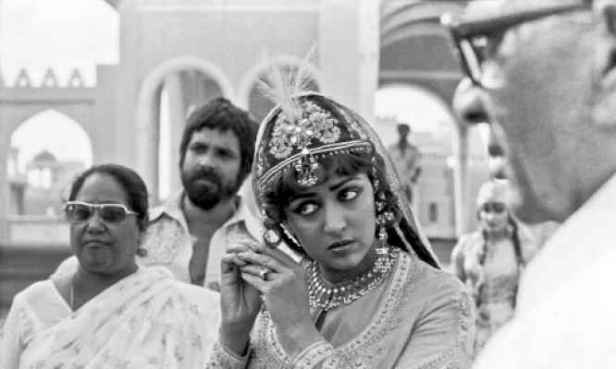
The elaborate costumes and sets used to shoot Razia Sultan (1983) make it one of the most expensive productions of its time. [Source]

A couple of anecdotes from key players involved in the making of this song to round out our discussion today:

Khayyam explains how he was inspired by the story of Razia Sultan during the composition of ai dil-e-naadaa.n: “

The caravan of Razia Sultan came to India from Turkey through a long and tortuous route traversing many countries. If you listen carefully, the tune and orchestration reflects the musical influences of all the regions she traveled across. The song is about the duel in her mind- the woman inside her is deeply in love with a black slave but the princess inside her is all too aware of her duty. The song depicts that dilemma in her mind. [Source]

Lata Mangeshkar has always ranked this song has one of the best of her career and included it in her An Era in An Evening concert that took place in Mumbai in March 1997 (see link above). In her own words, she says:

“Khayyam’s ai dil-e-naadaa.n from Razia Sultan is among the best songs I’ve sung. The way Kamal (Amrohi)-saab explained it to me,  I could actually visualise the situation. I was very satisfied by the way I rendered the number. Kamal-saab found my Urdu pronunciation clear and chaste. The lyrics of ai dil-e-naadaa.n written by Javed Akhtar’s father Jaan Nisar Akhtar, were inspiring. I have sung several songs written by him.” [Source]

Are you wondering why Lata’s voice sounds so heavenly in this song even though it was past its prime at the time of the film’s release in 1983? That’s because Khayyam had this song recorded by Lata nine years earlier in 1974. After just two rehearsals, she had recorded the entire song in one take! Khayyam recollects how the popularity of this song helped him be selected as the music director for other major films in the 1970s like Kabhie Kabhie (1976):

“Actually the reason, I got Kabhie Kabhie was the song ai dil-e-naadaa.n. For Razia Sultan, I had recorded Lata-ji’s ai dil-e-naadaa.n and also Qabban Mirza’s aayii zanjiir kii jhankaar as early as in 1974. ai dil-e-naadaa.n had then created such a stir that practically everyone in the film industry was talking about that song. That fame had reached to Yash Chopra and one evening, when I returned after a Razia Sultan sitting at Kamaalistan, I found Yash-ji and Sahir-saab waiting for me. They told me that they were making a film about a love-story of a poet and they wanted me as a composer. I immediately said, ‘Yes’.” [Source]
A

In spite of a solid portrayal of the lead character by Hema Malini, Razia Sultan (1983) failed to achieve success at the box office. [Source]

Aye Dil-E-Nadaan Lyrics and Translation:

ai dil-e-naadaan
Oh, my naive heart!
aarzuu kyaa hai? justujuu kyaa hai?
What do you desire? What do you seek?

ham bhaTakte hai.n, kyo.n bhaTakate hai.n dasht-o-sehraa me.n?
Why do I wander alone in this deserted wilderness?
aisaa lagtaa hai mauj pyaasii hai apne dariyaa me.n
It seems as if I am a wave thirsty for water in its own river.
kaisii uljhan hai? kyo.n yeh uljhan hai?
What is this turmoil? Why is there this turmoil?
ek saayaa-saa ruuh-ba-ruuh kyaa hai?
What is this shadow that stands face-to-face before me?

kyaa qayaamat hai! kyaa musiibat hai!
What a disaster! What misfortune!
keh nahii.n sakte kiskaa armaa.n hai
I am unable to say whom it is that I desire.
zindagii jaise khoyii-khoyii hai, hairaa.n-hairaa.n hai
It seems as if my life itself is lost and confused.
yeh zamii.n chup hai, aasmaa.n chup hai
The earth lies quietly, while the sky remains in silence.
phir yeh dhaDkan-sii chaar-suu kyaa hai?
Yet, what pulsates around me in every direction?

ai dil-e-nadaan aisii raaho.n me.n kitne kaa.nTe hai.n
Oh, my naive heart! There are many thorns along the path of love.
aarzuuo.n ne har kisii dil ko dard baa.nTe hai.n
The pursuit of desires has given pain to every heart.
kitne ghayal hai.n, kitne bismil hai.n
Many hearts are wounded; many hearts are sacrificed.
is khudaayii me.n ek tuu kyaa hai?
In the face of divinity, who are you alone?

ek tuu kyaa hai, ek tuu kyaa hai?
Who are you alone?
ai dil-e-naadaan, ai dil-e-nadaa.n
Oh, my naive heart!

Glossary:

naadaa.n: naive, foolish; aarzuu: desire; justujuu: search, pursuit; bhaTaknaa: to wander; dasht: desert; sehraa: wilderness; mauj: wave; pyaasii: thirsty; dariyaa: river; uljhan: turmoil, confusion; saayaa: shadow; ruuh-ba-ruuh: face-to-face; qayaamat: disaster, crisis, Day of Judgment: musiibat: misfortune; armaa.n: desire, hope; khoyii: lost; hairaa.n: confused, distressed; zamii.n: earth, land; chup: quiet, silent; aasmaa.n: sky; dhaDkan: pulse, heartbeat; chaar-suu: all around, in all four directions; raah: path; kaa.nTe: thorns; dard: pain; baa.nTnaa: to allocate, to distribute; ghayal: wounded; bismil: wounded, sacrificed; khudaayii: divinity, world.

The use of the word bismil adds a unique spiritual dimension to the lyrics of this song. Bismil means wounded or sacrificed and originates from the Islamic ritual of sacrificing animals as an offering while uttering bismillah (in the name of God).

-Mr. 55

Intimate scenes between Hema Malini and Parveen Babi (particularly during the song khvab ban kar koii aayegaa) sparked some controversy at the time of this film’s release. [Source]
Shokhiyon Mein Ghola Jaaye Lyrics and Translation: Let’s Learn Urdu-Hindi

Shokhiyon Mein Ghola Jaaye Waheeda and Dev Anand sugarcane

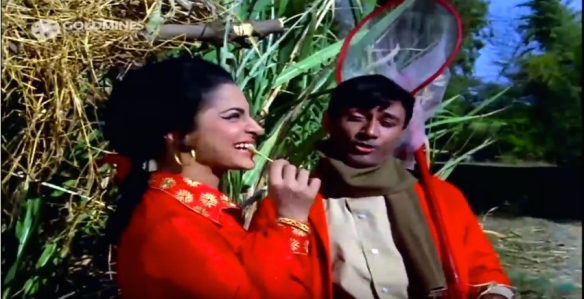
As Dev Anand croons “Shokhiyon Mein Ghola Jaaye” in Prem Pujari (1970), Waheeda Rehman makes even chomping raw sugarcane look attractive.

Today we present the lyrics and English translation of the evergreen duet “Shokhiyon Mein Ghola Jaaye” from Prem Pujari (1970). There could be no better song to welcome the change of seasons than this sweet exploration of the meaning of love…and of a haystack maze. Dev Anand plays a peace-loving son of a veteran who would rather be catching butterflies and whispering words of love to his fiancee, Waheeda Rehman, than holding a gun. However, when war breaks out, he is forced to reconcile his rosy temperament with patriotic duty, ultimately becoming a double spy for India at the expense of his family and loved ones.

But before these complexities of the spirit arise, Waheeda Rehman and Dev Anand spend a few moments blissfully unaware of the perils ahead, playing hide-and-go-seek together like any fully-grown adults in love would do. Their delightful escapades among the haystacks are second only to the passionate Bollywood thrills of running around a tree. I’m a huge sucker for nature-themed flirtation in Hindi films. In “Shokhiyon Mein Ghola Jaaye,” the camera surges between haystacks on a dolly track like a sheep on the loose, anticipating every peekaboo moment of Dev Anand poking his head through the straw or tracing Waheeda’s bright red chunni across the hay to victory. And don’t miss the special moment as they are just about to kiss each other when the camera suddenly cuts to a completely random shot of a raging fire followed by a shot of a gushing water stream. Try to make sense of that adorably antagonistic symbolism, just try. Fortunately, S.D. Burman’s musical genius provides exactly the rip-roaring crescendo we needed to seam all the pieces together.

Gopal Das Neeraj’s poem was originally written as “Chandnii Mei.N Ghola Jaaye,” however Dev Anand wanted to picturize the song during daylight and hence the lyrics were changed. Lata Mangeshkar’s celestial voice is at such a peak in this song, it will make you question her divinity. Kishore Kumar balances her angelic vocals with manly aplomb, helping us gloss past the rough patches caused by Dev Anand’s crimson blazer and matching butterfly net.

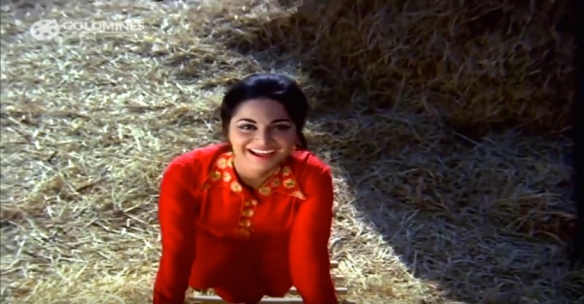
Waheeda climbs up a haystack

Forgetting that sound travels, Waheeda Rehman sings while playfully climbing up a haystack to hide from her lover in Prem Pujari (1970).

Doesn’t this all just make you crave a pumpkin spice latte? We tragically don’t have sugarcane fields in my town, but I hope you enjoy our translation of this charming Autumn ballad and feel inspired to hit your nearest corn maze, apple orchard, or petting zoo with the one you love. Watch the video on youtube here and follow along with our lyrics and English translation below!

Shokhiyon Mein Ghola Jaaye Lyrics and Translation:

KISHORE: Shokhiyo.N mei.N gholaa jaaye, phoolo.N kaa shabaab
Take a swirl of mischievousness, and the youthfulness of flowers
Us mei.N phir milaaii jaaye thoDii sii sharaab
In those mix in a little bit of wine
Hogaa yuu.N nashaa jo taiyyaar
The intoxication you create like this
Haa.N , hogaa yuu.N nashaa jo taiyyaar, woh pyaar hai
Yes, the intoxication you create like this is love
Shokhiyo.N mei.N gholaa jaaye, phoolo.N kaa shabaab…

KISHORE: Hey hey, hey hey, hey hey, hey hey!

LATA: Ha.Nstaa huaa bachpan woh, bahakaa huaa mausam hai
It is a childhood of laughter, it is a deceptive atmosphere
ChheDo to ek sholaa hai, chhuu lo to bas shabnam hai
It teases you like an ember, but when it touches you, it feels like a dewdrop
Gaao.N mei.N, mele mei.N, raah mei.N, akele mei.N
Whether in a village or in a fair, whether upon a street or by yourself
Aataa jo yaad baar baar, woh pyaar hai
That memory that comes to you all the time is love
Shokhiyo.N mei.N gholaa jaaye, phoolo.N kaa shabaab…

LATA: Oh, la la, la la la, la la la, ah…

KISHORE: Rang mei.N pighale sonaa, ang se yuu.N ras chhalke
It is the color of liquid gold, nectar flows from its body
Jaise baje dhun koi raat mei.N halke halke
It is as if a melody is played softly at night
Dhuup mei.N, chhaao.N mei.N, jhuumtii hawaao.N mei.N
In the sunlight, in the shadows, in the playful winds
Har dam kare jo intezaar, woh pyaar hai
That which waits for you every moment is love
Shokhiyo.N mei.N gholaa jaaye, phoolo.N kaa shabaab…

KISHORE: Yaad agar woh aaye…
If you remember your love…
LATA: Oh, yaad agar woh aaye, aise kaTe tanhaaii
Oh, if you remember your love, then loneliness is eased
Suune sheher mei.N jaise bajne lage shahanaai
As if in an empty city, wedding music begins to play
KISHORE: Yaad agar woh aaye, aise kaTe tanahaai
If you remember your love, then loneliness is eased
Suune shahar mei.N jaise bajane lage shahanaai
As if in an empty city, wedding music begins to play
BOTH: Aanaa ho, jaanaa ho, jaisaa bhii zamaanaa ho
Whether you are coming or leaving, however the world may be
Utare kabhii naa jo khumaar, woh pyaar hai
That feeling of intoxication which never lifts is love

BOTH: Shokhiyo.N mei.N gholaa jaaye, phoolo.N kaa shabaab
Take a swirl of mischeviousness, and the youthfulness of flowers
Us mei.N phir milaaii jaaye thoDii sii sharaab
In those mix in a little bit of wine
KISHORE: Hogaa yuu.N nashaa jo taiyyaar
The intoxication you create like this
LATA: Woh pyaar hai
That is love
BOTH: Shokhiyo.N mei.N gholaa jaaye, phoolo.N kaa shabaab…

Glossary:

Shokh: mischievousness, prank; gholaa: solution, swirl; phool: flower, shabaab: youthfulness; thoDii sii: a little bit; sharaab: alcohol; nashaa: intoxication; taiyyaar: ready; ha.Nsnaa: to laugh; bachpan: childhood; bakahnaa: to deceive; mausam: season, atmosphere; chheDnaa: to tease; sholaa: ember; chhuunaa: to touch; shabnam: dewdrop; gaao.N: village; melaa: fair; raah: path; akelaa: alone; yaad: memory; baar baar: time to time, often; rang: color; phigalnaa: to flow, to liquify; sonaa: gold; ang: body; ras: nectar; dhun: tune, melody; raat: night; halkaa: soft; dhuup: sunlight: chaao.N: shadow, cloud; jhoomnaa: to swing; hawaa: wind; har dam: every moment; intezaar: wait; kaTnaa: to be cut; tanhaaii: loneliness; suunaa: lonely, empty; sheher: city; bajnaa: to play [an instrument]; shahanaaii: traditional wind instrument played at weddings; zamaanaa: world, earth; utarnaa: to lift, to raise; khumaar: state of intoxication

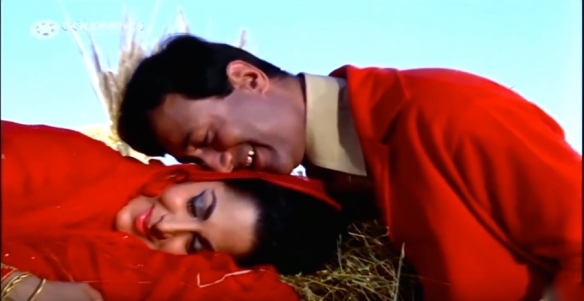
Waheeda and Dev anand cuddle

Perched on an excessively romantic pile of hay, Dev Anand presses his nose affectionately to Waheeda Rehman’s ear in Prem Pujari (1970). Is it getting hot in here, or is it just me?

This lovely duet was requested by fan Roshan Sadanani. Thank you for the excellent suggestion, and keep the requests coming! For more on-screen magic between Dev Anand and Waheeda Rehman, check out our translations of “Na Tum Humen Jano,” “Hai Apna Dil To Awaraa,” and “Khoya Khoya Chand!”

-Mrs. 55

Tere Bina Zindagi Se Koi Shikwa Lyrics and Translation: Let’s Learn Urdu-Hindi

Directed by the renowned lyricist Gulzar, Aandhi stirred up quite the controversy after the film was released in 1975. Shortly after the release of Aandhi, India found itself in the midst of a national state of emergency instituted by Prime Minister Indira Gandhi in response to the deep-seated political unrest and instability that had emerged across the nation. The 21-month Emergency of 1975-1977 is often viewed as one of the darkest eras in the political history of post-independence India: corruption, censorship, and the suspension of civil liberties threatened to compromise the basic principles upon which the nation’s democracy had been built. In this context, it’s not surprising that Aandhi was banned by the government during the Emergency on the grounds that the film’s protagonist bore an inappropriate resemblance to Mrs. Gandhi. As a result, certain scenes depicting the protagonist drinking and smoking were re-shot and an extra scene in which the protagonist tells her father that she idolizes Indira Gandhi (“ye hii to mere ideal hai.n“) was included to separate the film from real life. Although the parallels in appearance, mannerisms, and even the film’s title (Aandhi, meaning storm, rhymes with Gandhi) are undeniable, Gulzar explains in an old Filmfare interview that he never intended to base this film on the life of Indira Gandhi:

“Contrary to popular opinion, my story wasn’t based on Indira Gandhi’s life. It had nothing to do with Indira-ji. She was just the role model for the lady politician. Frankly, who better could there be? She was such a dynamic lady.”

SuchitraSen_Aandhi_IndiraGandhi

Suchitra Sen tells her father that she idolizes Indira Gandhi in a flashback scene that was added to Aandhi (1975) after the film was initially banned by the government.

With inspiration from a novel titled Kali Aandhi by Hindi author Kamaleshwar, Aandhi (1975) depicts the story of Aarti Devi (portrayed by Suchitra Sen) as she struggles to balance her professional ambitions with her quest for personal gratification while navigating through the volatile world of Indian politics. While traveling on the campaign trail, Aarti is caught by surprise when she runs into her estranged husband JK (portrayed by Sanjeev Kumar), who happens to be the owner of the hotel where she is staying currently. Nine years ago, the call to public service compelled Aarti to eschew her domestic duties and leave her husband and daughter in order to pursue her dreams of becoming a politician. After their unexpected reunion, Aarti and JK cultivate a tender but awkward relationship as they reminisce about memories from their past and come to realize that they still have unresolved feelings for each other after all these years. Through an artistic use of flashbacks, we learn about the development of Aarti and JK’s early romance, the disapproval of their marriage by Aarti’s father, and the eventual breakdown of their relationship. Their domestic conflict evolves into an Abhimaan-esque clash of egos and personalities, and they eventually decide to part ways after several failed efforts to maintain a happy marriage.

Su

Suchitra Sen sports Indira Gandhi’s trademark silver streak in Aandhi (1975).

Ultimately, Aandhi illustrates the complexities of an evolving relationship between two individuals who share mutual respect and affection for each other but are unable to reconcile their differences to converge seamlessly on the same path. In addition to providing a mature and realistic view of human relationships, Aandhi sheds light on the unique challenges that confront Indian women in positions of power as they attempt to balance their professional and personal lives. Although Aarti wins her election at the conclusion of the film, this victory is made bittersweet as she grapples with an unfortunate reality: professional success and domestic bliss were often mutually exclusive for Indian women of her time.

SK

The Martand Sun Temple near Anantnag, Kashmir serves as a gorgeous backdrop for this classic song from Aandhi (1975).

In addition to Gulzar’s skillful direction and the captivating performances delivered by Suchitra Sen (her diction is excused!) and Sanjeev Kumar, Aandhi is remembered most often today for its soundtrack of stunning songs composed by R.D. Burman using Gulzar’s poetry. Each Lata-Kishore duet is a gem and serves to illustrate a different facet of Aarti and JK’s relationship in the film. In particular, the classic “tere binaa zindagii se koii” is a tender and wistful expression of regret and lost love. Without the frills of an elevated vocabulary, this song boldly questions: can living life without the one you love be considered a life at all?

Tere Bina Zindagi Se Koi Shikwa: Lyrics and Translation

tere binaa zindagii se koii shikvaa to nahii.n, shikvaa nahii.n
I have no complaints against a life without you.
tere binaa zindagii bhii lekin zindagii to nahii.n, zindagii nahii.n
Yet a life without you is not a life at all.

kaash aisaa ho tere qadamo.n se
I wish that, from your footsteps,
chunke manzil chale.n aur kahii.n, duur kahii.n
we could find a new destination; somewhere else, somewhere far.
tum gar saath ho manzilo.n kii kamii to nahii.n
With you by my side, there is no shortage of destinations for us to reach.

SK: suno Aartii, ye jo phuulo.n kii bele.n nazar aatii hai.n na?
Listen Aarti, do you see those things that look like flower vines?
darasal ye bele.n nahii.n, arabii me.n aayate.n likhii.n hai.n.
In fact, they are not vines. They are verses written in Arabic.
ise din ke vaqt dekhnaa chaahiye, bilkul saaf nazar aatii hai.n.
We should see them during the day. They can be read very clearly.
din ke vaqt yah saaraa paanii se bharaa rahtaa hai.
During the day, this whole place is filled with water. 
din ke vaqt jab ye phuvaaare

During the day, when these fountains…

SS:  din kii baat kyo.n kar rahe ho? kahaa.n aa paauu.ngii mai.n din me.n?
Why do you keep talking about the day? How will I come here during the day?

SK: yah jo chaand hai na? ise raat main dekhnaa.
Do you see this Moon? Watch it at night.
yah din me.n nahii.n nikaltaa.

It does not come out during the day. 

SS: yah to roz nikaltaa hogaa.
But the Moon comes out every night.

SK: haa.n, lekin biich me.n amaavas aa jaatii hai.
Yes, but the dark fortnight comes in between.
vaise to amaavas pandrah din kii hotii hai.
The dark fortnight usually lasts 15 days.
lekin is baar bahut lambii thii.
But this time, it felt much longer.

SS: nau baras lambii thii na?
It felt as if it were nine years long, no?

jii me.n aataa hai tere daaman me.n
I yearn to seek refuge in your bosom
sar chhupake ham rote rahe.n, rote rahe.n
to hide my face as I continue to weep.
terii bhii aa.nkho.n me.n aa.nsuuo.n kii namii to nahii.n
Are your eyes not clouded by the mist of fresh tears, too?

tum jo kah do to aaj kii raat
If you say so tonight,
chaa.nd Duubegaa nahii.n, raat ko rok lo
even the Moon will not wane. Please stop the night from passing!
raat kii baat hai, aur zindagii baaqii to nahii.n
We only have tonight, for the rest of our lives will not be shared together.

tere binaa zindagii se koii shikvaa to nahii.n, shikvaa nahii.n
I have no complaints against a life without you.
tere binaa zindagii bhii lekin zindagii to nahii.n, zindagii nahii.n
Yet a life without you is not a life at all.

*Female lines in red are sung by Lata Mangeshkar. Male lines in green are sung by Kishore Kumar.  The dialogue takes place between Sanjeev Kumar (SK) and Suchitra Sen (SS). 

Glossary

shikvaa: complaint; qadam: footstep; chunnaa: to select; manzil: destination; kamii: shortage, dearth; bele.n: vines; darasal: in fact; aayate.n: verses; phuvaare: fountains; amaavas: dark fortnight; pandrah: fifteen; baras: year; daaman: lap, bosom; aa.nsuu: tear; namii: moistness; chaa.nd: Moon. 

SK

After rumors circulate regarding her nightly meetings with Sanjeev Kumar, Suchitra Sen reveals to the public that she has been meeting her estranged husband in Aandhi (1975).

Did you know that this song was based on a Bengali melody originally composed by R.D. Burman for a Durga Puja album in the 1970s? Listen to “jete jete pathe holo deri” to hear this melody sung by the composer himself! When Gulzar heard R.D. Burman working on this song with Bengali lyricist Gauriprasanna Mazumdar, he enjoyed the song so much that he wrote Hindi lyrics for the tune so it could be included in Aandhi. When Gulzar inserted the iconic “nau baras lambii thii, na?” dialogue in between antaras of this song, he reports in the same interview that R.D. Burman was not pleased:

“So we kept the original tune for the mukhda, and he composed something else for the antara. But when I inserted some dialogue into the lyrics, Pancham scolded me, “’Do you have any idea of sur and taal? You cut in with your dialogue anywhere you want. It’s not done!”’ But we did it!”

They certainly did something right, as this song has become immortalized as one of Hindi film music’s most treasured creations. Thanks to our reader Raju for requesting this post! Until next time…

-Mr. 55

Ramaiya Vastavaiya Lyrics and Translation: Let’s Learn Urdu-Hindi

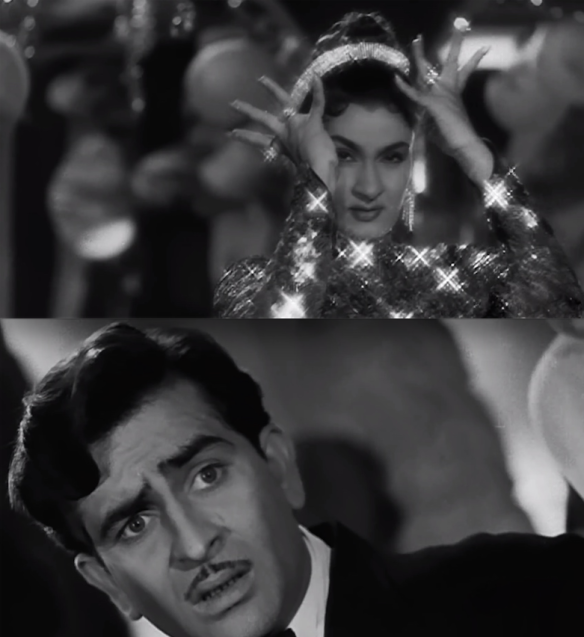
Raj Kapoor Nadira Shree 420

In a classic example of a dutch angle, Raj Kapoor recoils from the snake-like Nadira in Shree 420 (1955).

Today we present the lyrics and English translation of the famous “Ramaiya Vastavaiya” from Raj Kapoor’s 1955 blockbuster Shree 420. One of the most priceless gems of India’s Golden Age of Cinema, Shree 420 is a showman’s dream. In an era when the aesthetic of film was still an experimental playground, Raj Kapoor’s Shree 420 is as original and evocative as it was 60 years ago.

Raju, played by Raj Kapoor himself, arrives in Bombay as a patriotic simpleton crooning “Mera Joota Hai Japani.” In a pawnshop, Raju encounters Vidya (played by Nargis, in her final romantic appearance opposite Raj Kapoor under his banner production company), a pretty teacher who is selling her bangles to help pay for her struggling school (and whose name redundantly means “knowledge.”) For the next few weeks, Raju works hard to both earn a decent living at a laundry service and to woo the principled Vidya, dreaming of a simple and happy future family.

However, this utopian simplicity does not last long. When Raju delivers some pressed shirts to a wealthy flat, he meets Maya (whose name significantly means “illusion”), a high society woman who thrives on parties and gambling with the rich. She recognizes Raju’s untapped potential as a cunning cardshark, and lures him to a fancy soiree where she introduces him as Rajkumar, the Prince of Pipalinagar, of all things ridiculous. This brief taste of luxury and easy money leads Raju to agree to form a partnership with the corrupt industrialist Seth Dharamanand, bringing him instant wealth.

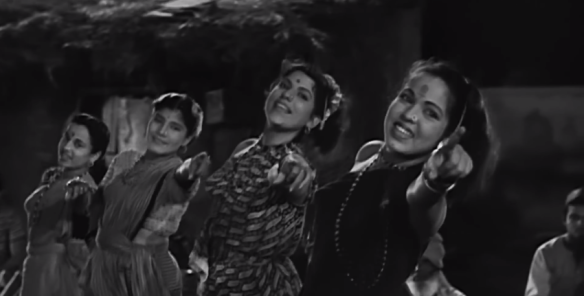
But Raju’s whirlwind romance with high Bombay society is stained by the shame Vidhya instills in him for his actions, and one night at the nightclub, he sees Maya and her world of illusion for what they truly are. He runs away in horror back to the slums that once gave him a home. Enter the song “Ramaiya Vastavaiya,” a cute villager number complete with chorus girls in native dress and a heavy-handed reminder that yes, poor people can be happy too.

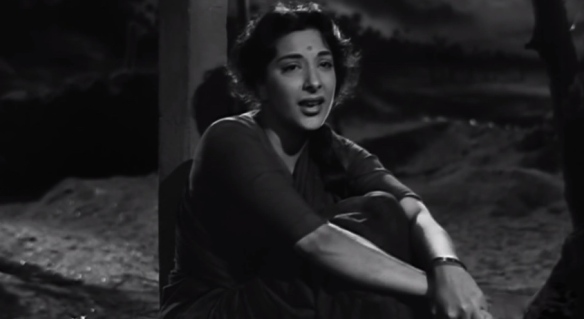
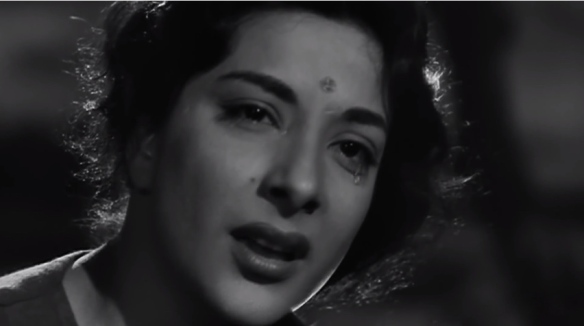
Nargis Shree 420 ramaiya vastavaiya

Nargis plays a virtuous, impoverished schoolteacher who struggles to give her students a better life in Shree 420 (1955).

Of course, the question you really want answered is, what the heck does “Ramaiya vastavaiya” mean?

It turns out Ramaiya vastavaiya is Telegu for respectfully asking, “Ram, won’t you come?” Legend has it that music composer Shankar Singh Raghuvanshi, who grew up in Hyderabad where Telugu is a dominant language, had been demonstrating his composition to director Raj Kapoor using placeholder Telugu lyrics. When Raj Kapoor heard the tune, he loved it so much, he wanted the Telugu title lyrics to be included in the final version! And perhaps the convenient symbolism did not escape Raj Kapoor–like Lord Ram returning at last to his kingdom, Raju finally comes back to the people who love him and his true home.

But all that aside, the real reason everyone has adored “Ramaiya Vastavaiya” for generations is simply that it’s so darn catchy. If you hear it once, you’ll be humming it all day! We hope you enjoy our English translation to the lyrics of this all-time favorite below. Follow along with the video and let us know in the comments how much your mind was blown like ours by the discovery of Ramaiya vastavaiya‘s Telugu roots.

Ramaiya Vastavaiya Lyrics and English Translation:

Mohammed Rafi:
Ramayyaa vastaavayyaa, ramayyaa vastaavayyaa
Ram, will you return?
Lata Mangeshkar:
Mai.N ne dil tujhko diyaa
I have given you my heart
Chorus:
Haa.N ramayyaa vastaavayyaa, ramayyaa vastaavayyaa
Yes, Ram, will you return?
Mai.N ne dil tujhko diyaa
I have given you my heart

village girl

Dancer Sheela Vaz plays a stock village girl with all the right morals in Shree 420 (1955). While shooting the song, Sheila Vaz, who did not speak Hindi, studied a translation of “Ramaiya Vastavaiya” and faked it till she made it!

Mohammed Rafi:
Naino.N mei.N thii pyaar kii roshnii
In your eyes was the light of love
Teri aankho.N me yeh duniyaadaari na thii
This worldliness was not in your eyes then
Lata Mangeshkar:
Tu aur thaa teraa dil aur thaa
You were different, your heart was different
Tere man mei.N yeh miThi kaTaari na thii
This sweet dagger was not in your heart then
Mohammed Rafi:
Mai.n jo dukh paauu.N, to kyaa? Aaj pachhataauu.N, to kyaa?
If I become sad, so what? If I regret today, so what?
Chorus:
Maine dil tujhko diyaa
I have given you my heart
Oh ramayyaa vastaavayyaa, ramayyaa vastaavayyaa
Oh, Ram, will you return?

Mohammed Rafi:
Us desh mei.N tere pardes mei.N
In that country, in your foreign land
Sone chaa.Ndi ke badle mei.N bhikate hai.N dil
Instead of gold and silver, they sell hearts
Lata Mangeshkar:
Is gaao.N mei.N, dard ki chhaao.N mei.N
In this village, in the shadow of pain
Pyaar ke naam par hii dhaDakte hai.N dil
Hearts beat only in the name of love
Chaand taaro.N ke tale, raat yeh gaatii chale
In the tent of the moon and stars, the night sings this songs
Maine dil tujhko diyaa
I have given you my heart
Chorus:
Oh ramayyaa vastaavayyaa, ramayyaa vastaavayyaa
Oh, Ram, will you return?

Nargis Shree 420 ramaiya vastavaiya

Joining in on the song playing on everyone’s lips in town, Nargis mourns for her lost love in Shree 420 (1955).

Lata Mangeshkar:
Yaad aati rahii dil dukhaati rahii
I still remember you, my hearts still grieves
Apne man ko manaanaa na aayaa hame.N
But I do not know how to conciliate my own mind
Tu na aaye to kyaa? Bhuul jaaye, to kyaa?
If you do not come, so what? If you forget, so what?
Pyaar karke bhulaanaa na aayaa hame.N
But having fallen in love, I do not know how to make myself forget
Wohii se duur se hii, tu bhi yeh keh de kabhii
Even from far away, say this sometime
Maine dil tujhko diyaa
I have given you my heart
Chorus:
Oh ramayyaa vastaavayyaa, ramayyaa vastaavayyaa
Oh, Ram, will you return?
Mukesh:
Maine dil tujhko diyaa
I have given you my heart
Chorus:
Oh ramayyaa vastaavayyaa, ramayyaa vastaavayyaa
Oh, Ram, will you return?

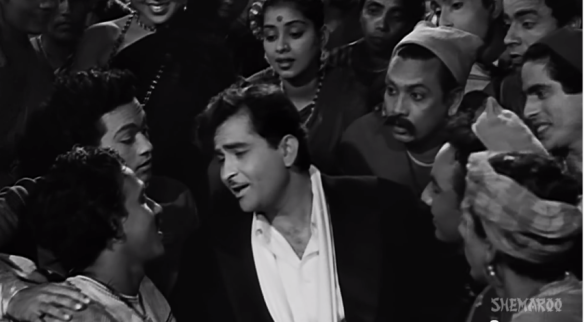
Raj Kapoor Ramaiya Vastavaiya Shree 420

Embodying the return of Lord Ram, Raj Kapoor leaves the glitzy world of Bombay nightlife to engage a captive audience of villagers in Shree 420 (1955).

Mukesh:
Rastaa wohii aur musaafir wohii
The path is the same and the traveler is the same
Ek taaraa na jaane kahaa.N chhup gayaa
But I do not know where that star has hidden itself
Duniyaa wohii duniyaawaale wohii
The society is the same, the citizens are the same
Koi kyaa jaane kiskaa jahaa.N luT gayaa
No one knows whose world has been destroyed
Merii aankho mei.N rahe, kaun jo mujh se kahe?
Who once told me to remain forever in their eyes?
Maine dil tujhko diyaa
I have given you my heart
Chorus:
Oh ramayyaa vastaavayyaa, ramayyaa vastaavayyaa
Oh, Ram, will you return?

Glossary:

Ramya vastavaiyaa: Ram, will you come (Telugu); dil: heart; nain: eyes; pyaar: love; roshnii: light; aankhe.N: eyes; duniyaadaari: wordliness; man: mind; heart; miiThaa: sweet; kaTaarii: small dagger; dukh: sadness; pacchtaanaa: to regret; desh: country (India); pardes: foreign country; sonaa: gold; chaa.Ndii: silver; [kisi ke] badle mei.N: in place of [something]; bhiktaanaa: to sell; gaao.N: village; dard: pain; chaao.N: shadow; naam: name: dhaDaknaa: [the heart] to beat; chaa.Nd: moon; taaraa: star; raat: night; gaanaa: to sing; yaad aanaa: to remember; dukhaanaa: to grieve; manaanaa: to conciliate, to cajole; bhuul jaanaa: to forget; bhuulaanaa: to make [someone] forget; duur: far away; kabhii: sometime; rastaa: path; musaafir: traveler; chhup jaanaa: to hide; duniyaa: society, the world; duniyaawaale: citizens; jahaa.N: world; luT gayaa: destroyed

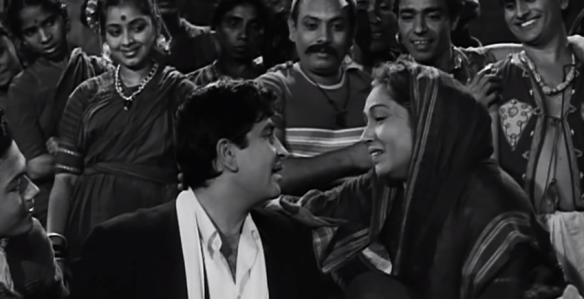
Lalita Pawar Raj Kapoor Shree420

With motherly affection, Lalita Pawar welcomes Raj Kapoor back to the fold with open arms in Shree 420 (1955).

The moral dilemma that plagues Raju’s existence eventually comes to a climax when Seth Dharamanand, Maya, and Raju are incriminated for swindling money from the poor to build communal houses. Seeking to atone for the past, Raju address the scores of poor people awaiting a home. Perhaps it is impossible to build houses for each person individually, he says, but they are a group of a million people, now united, and if they go to the government and demand land, they have the power to build their own homes with their combined money. The cure to poverty for the nation, he preaches, is not dishonesty, but hard-work and determination. Raju is released from his charges, and returns to the lifestyle of an honest workingman as he began, joined by Vidya who has forgiven him. The film finishes, humbled and hopeful, with the two heading down the road of life together.

Thank you to our fans Mustafa and Onima Thakur for this inspiring request!

-Mrs. 55

P.S. Be sure to watch the music video of this song and appreciate Raj Kapoor’s novel song transitions! Halfway through the song, the camera tracks “Ramaiya Vastavaiya” as it is picked up from the dancing villager’s circle by a passing horse carriage, overheard by a bicyclist, who carries the melody to Nargis sitting alone miles away, thereby fluidly retaining the realism of the sequence. Song transitions were still uncharted territory in this infant age of cinema–and Raj Kapoor, like the the great Guru Dutt, was a genius and pioneer. OK, OK I promise that’s the last thing I’m going to say about this song–but seriously, every scene in this movie is a film-lover’s gold mine!

Spooky Songs of Classic Bollywood: The 15 Most Haunting Melodies of Yesteryear

Biswajeet Bees Saal Baad film noir kahin deep jale

Biswajeet is haunted by a mysterious voice singing of love and murder in Bees Saal Baad (1962).

Happy Halloween! What better way to give yourself the creeps than with a vintage Hindi film song! Mr. 55 and I once hosted a Spooky Song-themed study break on-campus during which we projected old Hindi film noirs on a large screen, drank rooh afza and jammed nerdily to Lata’s high notes. Was it any surprise the two of us were the only ones really having an awesome time? Join us in our countdown to the spookiest song of classic Bollywood! When I say scary, I’m not referring to Vinod Khanna’s lime green tuxedo in Aan Milo Sajna (although it might give you nightmares). I’m talking about the real deal here. These are songs that will keep you up at night, that will haunt your waking moments as you grapple with the symbolism. And if you see a mysterious woman in a white-sari floating around your house this evening…well, don’t say we didn’t warn you!

The Fifteen Scariest Songs from Old Hindi Films!

15. Tujhko Pukare Mera Pyar (Neel Kamal 1968)

Few things are scarier than being buried alive. Rajkumar haunts his Mughal-era lover through the ages even when she is reborn as a 1960s desperate housewife.

14. Gagan Jhanjhana Rah (Nastik 1954)

This song is a hidden gem. Hemant Kumar actually impersonates God in this song with a voice that booms from the heavens amidst a stormy apocalpyse. The chorus is so darn creepy in this song, you might feel real chills from the wind sound effects mixed into the song!

13. Waqt Ne Kiya (Kaaghaz Ke Phool 1957)

What makes this song so spooky and yet so beautiful? It’s all in the lighting and the spectres lingering in the room–read our translation for more!

12. Jayen To Jayen Kahan (Taxi Driver 1954)

In our translation of this all-time creeper, we discuss the emptiness of the song’s mis-en-scene to heighten a feeling of abandonment, leaving you nothing but Dev Anand’s perfect pompadour to ease the pain.

11. Akele Hain Chale Aao (Raaz 1967)

While the movie Raaz may be a clunk, “Akele Hain” (that is reprised in a male and female version!) will certainly leave you clawing after your security blanket. Insider hint: Rajesh Khanna takes his shirt off later on in the movie if you can sit through the rest of the film.

10. Raat Andheri (Aah 1953)

In this heartbreaking social drama, Raj Kapoor plays a handsome tuberculosis patient unable to marry the girl of his dreams because of his illness. In the throes of self-pity, the minor key music haunts him as his own life slips away. Tragic, yes, but mostly just creepy.

9. Sau Baar Janam Lenge (Ustadon Ke Ustad 1963)

Mohammed Rafi’s unearthly beautiful voice echoes through the mist in this song like a phantom from the other world. The woman in mourning seems ready to commit suicide at any moment during the song, keeping the audience on their toes!

8. Dekhi Zamane Ki Yaari (Kaaghaz Ke Phool 1957)

This gentle song of disillusioned love beckons you in like a tantalizing dream, and then drags you to perdition as you scream over the ethereal chorus. Our earlier translation of Dekhi Zamane discusses the transitions of the song from fantasy to absolute nightmare!

7. Koi Duur Se Aawaz De Chale Aao (Sahib Biwi Aur Ghulam 1962)

One of my favorite songs in this genre, Guru Dutt is awakened in the middle of the night by a tender lament floating through the halls of the large empty mansion in which he works. Who is this mysterious and sad woman with the enchanting song? You HAVE to watch this genius star-studded film and find out!

6. Jane Kahan Gaye Woh Din (Mera Naam Joker 1970)

Good thing I don’t have a fear of clowns or this song would have permanently wrecked my childhood. Raj Kapoor plays a circus performer who has lost all those he has ever loved. He enters a private Hell in which he is bound to perform in his clown garb to an unfeeling audience, always smiling on the outside and crying on the inside. Brace yourself for several attempts at artsy camera tricks to make him float that could not be more creepy.

5. Gumnaam Hai Koi (Gumnaam 1965)

Based on the Agatha Christie novel “And Then There Were None,” Gumnaam is a kitsch-lovers delight. Drop-dead gorgeous (literally) Lata Mangeshkar’s voice haunts a group of travelers as they meander through a nameless forest. Newsflash! The “ghost” of this song actually chimes in with a high-pitch thrill when the music goes quiet, so listen carefully!

4. Naina Barse (Woh Kaun Thi? 1964)

One of the best examples of a femme fatale in Hindi films, “Naina Barse” is sung by a ghostly woman haunting her lover from a former lifetime. Her flowing white sari against the endless, crisp white snow of a Simla winter set the perfect stage for a nightmare. The woman in a white sari is a classic cliche–read more about its meaning here!

3. Kahin Deep Jale Kahin Dil (Bees Saal Baad 1964)

This song hardly needs an introduction, so famous is its eerie tune. One of the most brilliant shots is the slow crane down from above the chandelier to Biswajeet’s horrified stare at the piano. But has anyone else ever noticed the film version has the interlude violins playing an entire octave lower than in the recorded version?? It totally blew my mind when watching the film–and both ways are equally horrifying!

2. Jhoom Jhoom Dhalti Raat (Kohra 1964)

Stylistic symbolism sets this creepster apart from its competitors. My favorite moment in this song is when the shadow figures do an interpretive dance in the sand, acting out the “choDo piyaa mera, choDo haath” line. I get chills every time I watch this–the cinematography is genuinely brilliant and haunting!

1. Aayega Aanewala (Mahal 1949)

Welcome to the spookiest song of Bollywood! Nothing will ever top the song that officially taught Bollywood everything it needed to know about horror. Don’t expect any corpses to pop out of the closet–this song is way to classy for that. See our translation of this unbeatable classic for more!

So…I know I’m not going to be able to sleep tonight. What are your favorite spooky songs from Bollywood films? Tell us the scenes that have haunted your waking hours for years (think Sadhana declaring “Mujhe khoon achha lagtaa hai” on a rainy night)! Mr. 55 and I both hope you have a very Happy Halloween!

– Mrs. 55

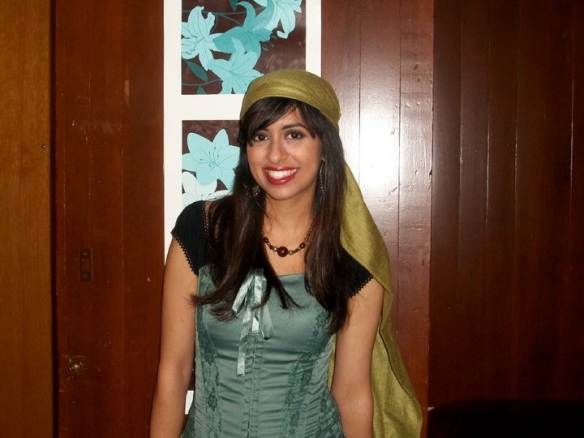
Mrs. 55 in her go-to gypsy girl costume. When all else fails...

Mrs. 55 in her go-to gypsy girl costume. When all else fails…tie a chunni on your head.