The Glorification of Alcohol in Hindi Cinema

A study released in April of this year claimed that Indian adolescents aged 12-16 exposed to alcohol consumption in films were nearly three times more likely to drink than their peers who did not watch Bollywood movies. While this study most likely pertains to the movies released in the industry today, I would venture to say that the origins of this trend can be traced back to films from the Golden Era of Bollywood cinema. Indeed, the consumption of alcohol has been glorified on India’s silver screen for decades, especially through portrayal of sharaab (alcohol) songs in films. Here, I’ve compiled a list of my five favorite male and female sharaab numbers from the Golden Era–let’s take a closer look at these examples to examine how the consumption of alcohol has been portrayed cinematically and its implications on Indian culture.

“Girls Just Want To Have Fun”

In Bollywood’s earliest days, drinking alcohol in films was portrayed as a strictly masculine activity, à la Devdas and other Bollywood heroes who have famously drowned their sorrows in liquor. In contrast, the idealized image of the traditional Indian woman did not permit the depiction of female alcohol consumption in the media.  This trend began to change in the 60s when films depicted heroines and female actresses playing roles in which they partook in the consumption of the Devil’s nectar, just like their male counterparts. As you can see below, the contexts in which female characters drink vary from film to film: alcohol has been used by the women of Bollywood as a coping mechanism, a means of revenge, or just a way to have a good time.

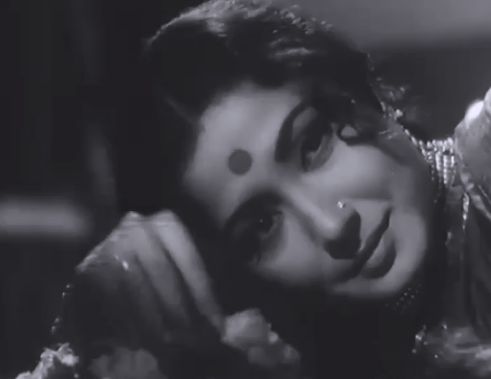
na jaao saiyaa.n (Sahib Bibi aur Ghulam, 1962): In this film based on a Bengali novel by Bimal Mitra, Meena Kumari gives one of her career’s best performances as Chhoti Bahu. Chhoti Bahu is married to young zamii.ndar (played by Rehman), who neglects his wife at home in order to take part in debauchery at local brothels on a nightly basis. In desperate need of her unfaithful husband’s companionship, she decides to take up drinking in order to keep him away from those pesky courtesans at night. In this heartbreaking song sung by Geeta Dutt, Chhoti Bahu drunkenly entreats her husband to stay at home and spend the night with her. In a truly unfortunate example of art mimicing real life, both Geeta and Meena would succumb to alcoholism as a way to cope with their unhappy marriages in the coming years. For those of you who enjoy this song, be sure to check out Hemant Kumar’s Bengali version of the same tune: “olir katha shune.

Meena Kumari, as Chhoti Bahu, tragically turns to alcoholism in Sahib Bibi aur Ghulam (1962).

piike hum tum jo chale aaye hai.n (Gumnaam, 1965): This film (reviewed by us here) is a suspense thriller loosely based on the Agatha Christie novel And Then There Were None. The story revolves around seven vacationers who find themselves on a remote island in the middle of nowhere after a plane crash. One by one, they are murdered off and the big question is, of course: whodunnit? In the midst of all this tension, two of the vacationers, Miss Kitty (played by Helen) and Asha (played by Nanda), decide to loosen up and have some fun with a few drinks. In this comical duet sung by Asha Bhonsle and Usha Mangeshkar, the two actresses appear to be having the time of their lives in a drunken stupor on screen. I mean, who wouldn’t be having a good time if they were getting drunk with Helen?
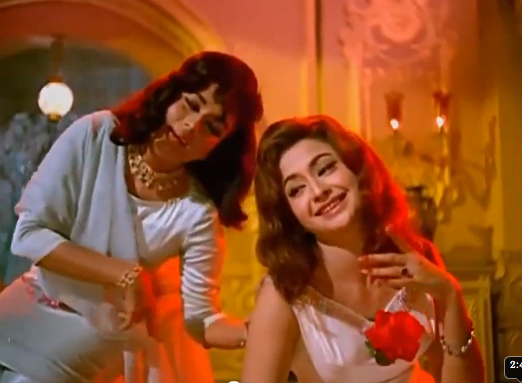
Helen and Nanda get sloppy together in Gumnaam (1965). If you excuse the stumbling, Helen actually looks quite sophisticated in this scene because she’s not wearing one of her characteristically outrageous wigs/outfits.

aao huzuur tum ko (Kismat, 1968): This Asha-OP Nayyar collaboration is an all-time classic from the soundtrack of Kismat (along with “kajraa muhabbatvaalaa“). The film’s narrative is so outrageous that it’s not even worth summarizing here, but this song is picturized on the actress Babita, who is the mother of Karisma and Kareena Kapoor. Babita never managed to gain much success as a heroine, and that’s not surprising given that it’s unclear whether she is drunk or undergoing eplipetic fits in this particular scene. She certainly does make a statement though and manages to embarass the hero Biswajeet with her public intoxication at this party. Regardless of the picturization, Asha Bhonsle adds all the right expressions here to make this an unforgettable sharaab number on the basis of the song alone. Her vocal control in the extended introduction (“ham se raushan hai chaa.nd aur taare...”) before the song’s first stanza is especially commendable. 

Babita has probably had one too many in this scene from Kismat (1968)

kaise rahuu.n chup (Inteqaam, 1969): Inteqaam is an entertaining (but occaisionally illogical) thriller that stars Sadhana as a woman who seeks revenge against her former boss because he framed her for a theft that she did not commit. As part of her elaborate plan for revenge, she intends to marry her boss’s son (played by Sanjay Khan) and bring shame to his entire family by revealing that the new bahu is, in fact, a convicted criminal! In this song, Sadhana further embarasses her boss’s family by  acting extremely intoxicated under the influence of alcohol at a public gathering. (Technically, this might not be considered a genuine sharaab song because Sadhana is putting on a facade of being drunk without actually consuming, but I liked this song too much to pass up putting it on the list.) This soundtrack composed by Laxmikant-Pyarelal is particularly memorable today because it casts a different light on Lata Mangeshkar, who was considered to be staunchly conservative and traditional in her playback output.  Lata surprises us all by agreeing to sing two sizzling cabaret numbers in addition to this drinking song for the film–listen to her nail those hiccups during the interludes!
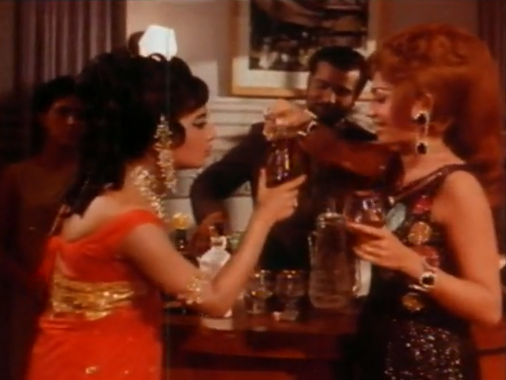
Helen serves Sadhana another glass in Inteqaam (1969)

piyaa tuu ab to aajaa (Caravan, 1971): Asha Bhonsle and R.D. Burman come together to produce one of their biggest musical hits together with this classic item number from Caravan. Asha’s performance here solidified her status as the queen of cabaret singing in Hindi cinema. Furthermore, Helen’s portrayal of a nightclub dancer on screen during this song is considered the quintessential Bollywood cabaret performance. Helen’s dance moves are completely outrageous here but she makes it work somehow (see Mrs. 55’s step-by-step breakdown here). Given the ridiculousness of the situation here, you can’t really blame Helen for the heavy drinking…it certainly doesn’t stop her from completely owning the stage during her performance!

Helen gives one of the best cabaret performances of her career in Caravan (1971)

“Alcohol May Be Man’s Worst Enemy…”

Unlike their female counterparts, the men of Bollywood cinema have been imbibing alcohol since the industry’s earliest days. The most popular context for male drinking in Hindi films occurs when the hero resigns himself to heavy drinking in order to drown his sorrows, usually caused by woman-related heartbreak. While female characters are often stigmatized for their drinking and public intoxication, it is more acceptable for men of the silver screen to use alcohol consumption to deal with their grief.  Other contexts where actors are depicted consuming alcohol include scenes of male-male bonding (bromances, anyone?) and seduction of heroines and courtesans. Though Bollywood has glamorized the consumption of alcohol for both genders, the effect is far more pronounced for males, as evident in the examples I’ve selected below.

mujhe duniyaavaalo sharaabii na samjho (Leader, 1964): Even though its soundtrack is full of gems like “tere husn kii kyaa tariif karuu.n” and “ek shahanshah ne banvaa ke ek hasii.n taaj mahal,” Leader is one mess of a film starring Dilip Kumar and Vijayantimala. Dilip Kumar stars as a law graduate and aspiring political revolutionary who falls in love with a princess (played by Vijyantimala). The script has so many holes that it’s difficult to discern the overall message of this film, but there are some scenes of comic relief between Vijayantimala and Dilip Kumar that are worth remembering. By far, however, the main attraction here is the soundtrack composed by Naushad. In this particular number, an intoxicated Dilip Kumar claims that he has been forced to take up drinking to grapple with society’s evils.

Vijayntimala tries to stop a drunk Dilip Kumar from embarassing himself too much at this party in Leader (1964).

din Dhal jaaye (Guide, 1965): Where do I even begin with the praise for Vijay Anand’s Guide? Mrs. 55 and I both love everything about this film: the unique story written by R.K. Narayan, the stellar performances by Dev Anand and Waheeda Rehman, and of course, the unforgettable soundtrack composed by S.D. Burman. Each and every song from this film is an absolute gem. In this particular Rafi solo picturized on Dev Anand, the hero drowns his sorrows about lost love in alcohol. The melancholic expression that pervades throughout this scene is enhanced by the beautifully crafted lyrics and tune.
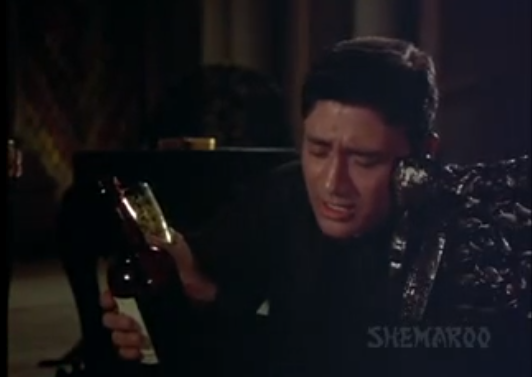
Dev Anand turns to the bottle when love goes sour in Guide (1965).

chuu lene do naazuk ho.nTho.n ko (Kaajal, 1965): With this Rafi number penned by Sahir Ludhianvi and composed by Ravi, Raaj Kumar tries to get Meena Kumari, his on-screen shaadi-shudhaa (virtuous) wife, to come to the dark side by having a drink. Alcohol glorification occurs is at its finest in these lyrics: it is referred to as “mubarak cheez,” or a blessed thing.  Meena Kumari excels, as usual, at looking incredibly uncomfortable and disturbed by Raaj Kumar’s advances in this scene.

A drunk Raaj Kumar tries to get Meena Kumari on his team in Kaajal (1965).

jo unkii tamanna hai barbad ho jaa (Inteqaam, 1969): This film certainly features a lot of alcohol consumption on screen. In addition to the drunk Lata number discussed above, this Rafi solo from Inteqaam is picturized on Sanjay Khan as he laments being a mere object in Sadhana’s plans for revenge. Rajinder Krishan’s lyrics are exquisite in their ability to capture the essence of being deceived in love.
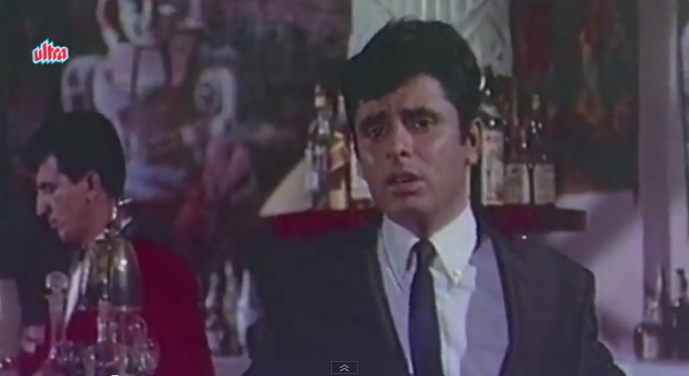
Handsome Sanjay Khan turns to alcohol to get over Sadhana’s deception in Inteqaam (1969)

yeh jo muhabbat hai (Kati Patang, 1970): Directed by Shakti Samanta, this film features an evergreen soundtrack composed by R.D. Burman. This particular number sung by Kishore Kumar is one of Bollywood’s most treasured drinking songs, and it features a handsome and bitter Rajesh Khanna drinking the night away because he was stood up at the altar by his wife-to-be.  Asha Parekh watches from a distance, not yet aware of the fact that she is the woman responsible for his heartache.
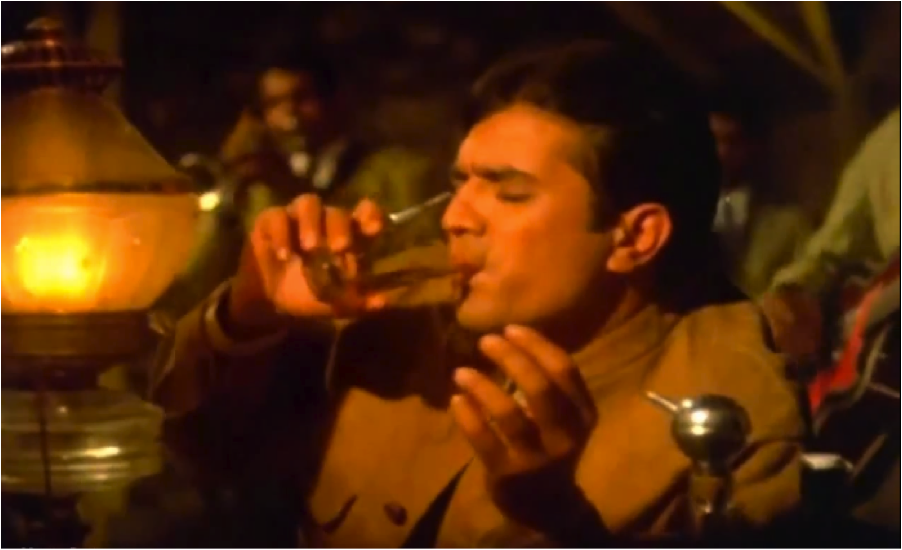
Rajesh Khanna drinks another glass of liquid courage before singing about the pain of disloyal love in Kati Patang (1970).
What are some of your favorite sharaab/daaru songs from Bollywood films? Let us know in the comments! We’ll understand if your typing is a little bit off…
Mr. 55

The Tragedy and Triumphs of Do Bigha Zameen

Do Bigha Zameen 2

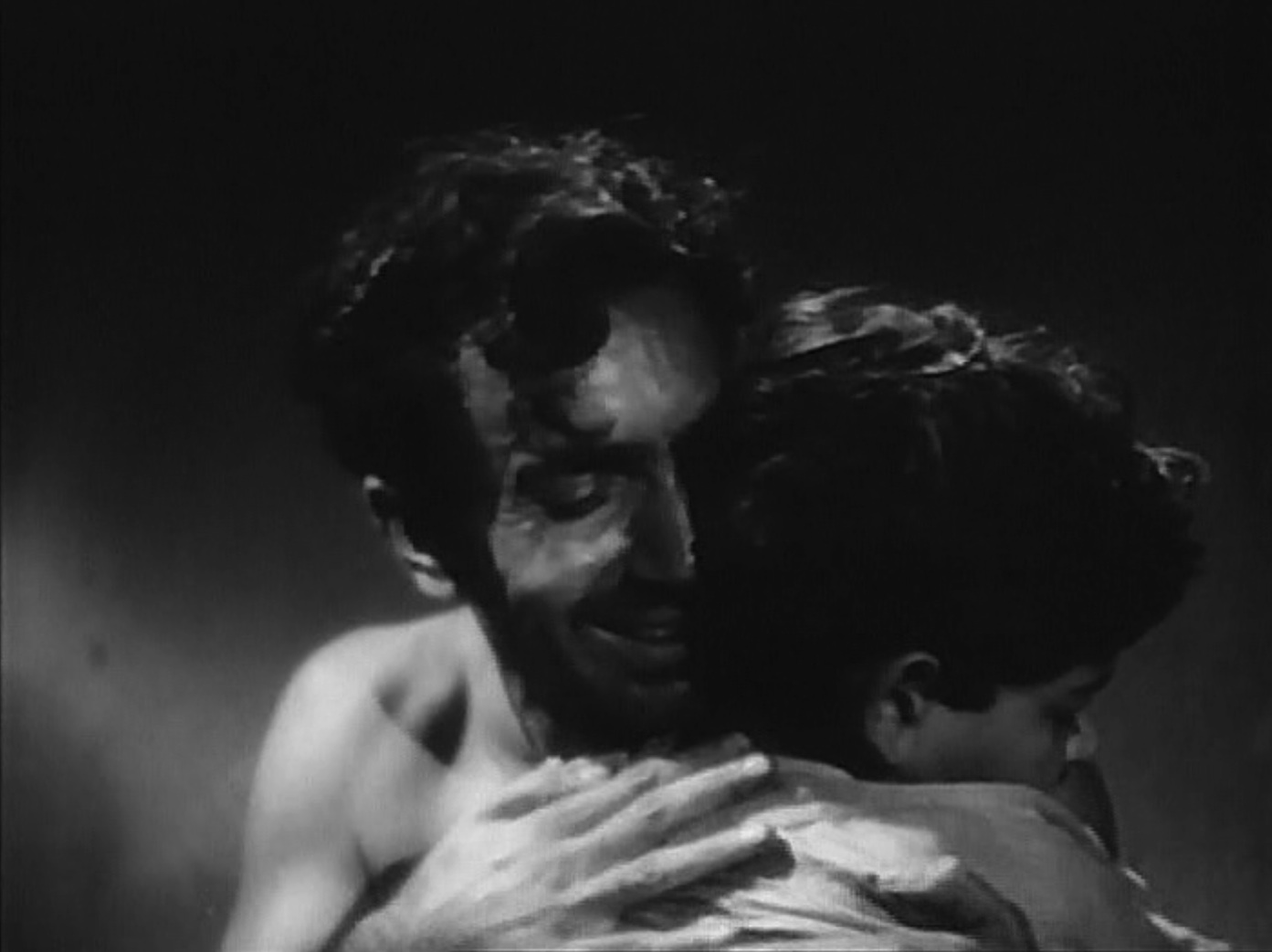
Balraj Sahni embraces his son in despair after a violent misunderstanding in the urban nightmare of Do Bigha Zameen (1954).

In the 1954, the year of the first Indian Filmfare awards, the film that took home the glory of both best picture and best director was about to become more than just a national treasure. Do Bigha Zameen, the latest directorial offering of a relatively minor Bengali newcomer, told a story that was not familiar in the tinsel-lined halls of Bombay filmdom. Without a glamorous period backdrop, without elaborate dream sequences, and without clearly enunciated moral take-home points, Do Bigha Zameen cannot be readily categorized with contemporary village epics such Mother India (1957) nor socially-conscience critiques like Shree 420 (1955) and Pyaasa (1957). With such a new vision of Indian cinema, stylistically and socially, Do Bigha Zameen hit a broader audience, becoming the first Indian film to win the Prix Internationale at the 1954 Cannes Film Festival.

But what is all this hype about? What makes Do Bigha Zameen so radical and why does everyone always bring it up in discussions of must-see Bollywood films? The film is directed by Bimal Roy, a prominent member of the post-colonialist Bengali intelligentsia, who was directly influenced by another radical film movement sweeping Europe: Italian Neorealism. Like other great Bengali directors of his day, ie. Rhitwik Ghatak and Satyajit Ray, Bimal Roy was fascinated by the work of Italian pioneer Vittorio de Sica and his masterpiece Ladri Di Biciclette (1948). The film is the defining work of Italian neorealism, marked by a deliberate attention to the “everyday,” the feeling of an invisible, unhurried camera whose shots and mis-en-scene are carefully constructed, but have the naturalness of a documentary. The Italian neorealist movement glorified without ornamentation the lives and suffering of “ordinary” citizens. It gave importance to the unimportant and evoked sympathy without the crutches of melodrama.

Do Bigha Zameen 1Balraj Sahnia Nirupa Roy

Nirupa Roy and Balraj Sahni flirt with each other beneath a shady tree in Do Bigha Zameen (1954).

Now I’ll argue that among the Indian film influenced by the neorealist movement, Satyajit Ray’s Apu Trilogy is perhaps the truest to the legacy set by Ladri di Biciclette. To fully appreciate that unique style of film-making, you must see Ray’s Aparajito. Do Bigha Zameen blends the line between neorealism and commercial–similar perhaps to the films of Guru Dutt, but without the poetic grandeur. Starring the classiest of men, Balraj Sahni and Nirupa Roy (yes! she did play the heroine before becoming a stock mother-figure actress in the 70s!), Do Bigha Zameen, tells of the hard work, misfortune, and desperate measures taken by a family who is cheated of their land by a greedy mill owner. The film follows the father and son’s trip to Calcutta from their idyllic village to earn enough money to pay their debts–only to discover the harsh realities of urban poverty instead.

Like Ladri di Biciclette, the film also explores the evolving relationship between a father and son, of how the dynamic changes when a child grows up quickly and a mutual level of forgiveness that comes with a more mature relationship. With scenarios by Hrishikesh Mukherjee (who also did the screenplay for gems like Anand!), it’s clear that “realism” is given a healthy splash of Bollywood exaggeration. When the going gets rough for this family, it just spirals into greater and greater tragedy–the loss of property, becoming victims of robbery, illness, and a car crash. A heavy-handed background score encourages the audience to evoke sympathy and fear, as well as a handful of painful histrionics rendered by the cutesy child actor. But all in all, the real triumph of this film is in the conclusion.

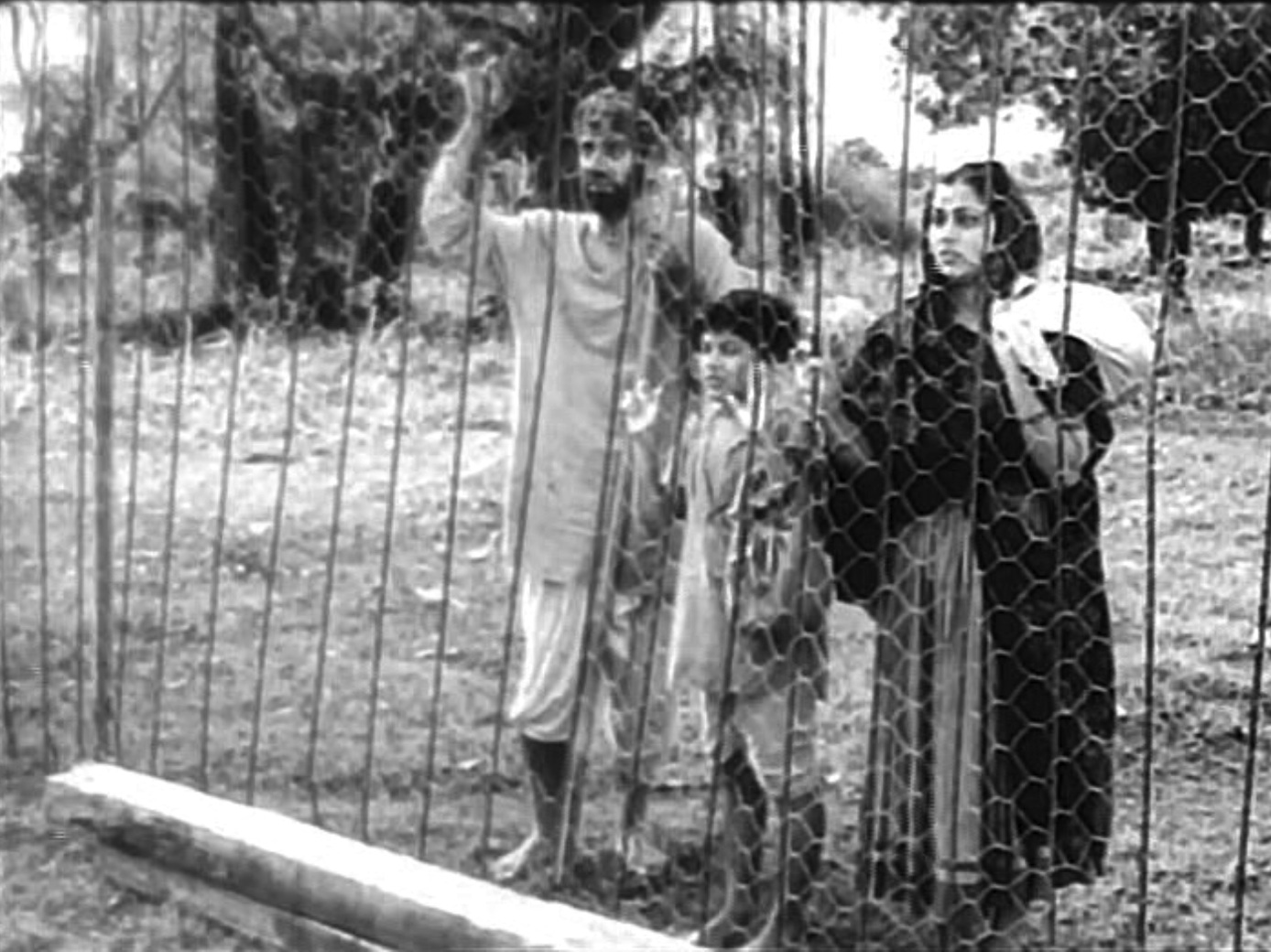
The impoverished family watches the destruction of their ancestral land behind a closed gate in Do Bigha Zameen (1954).

At the end of Do Bigha Zameen, there is no real outcome. Like with Satyajit Ray’s Aparajito, it ends with a single shot of the family, moving on into the distance. The journey we as an audience have witnessed is but a chapter in their lives that we know will be marked in the future with similarly unresolved troubles. But it also carries a kind of hope with it, not that all will be right in the world, but a hope that men and women like these are survivors and will find a way to persevere, even if that does not mean coming out on top. It is what sets this film apart from the Raj Kapoors of the world. And that is, I think, the message that hit home with millions of Indian viewers in the dissatisfied liberated world.

The film takes its name from a Rabindranath Tagore poem “Dui Bigha Jomi.” In the original poem, a poor farmer begs his landlord to not make him sell his ancestral plot of land. But the cruel landlord insists, while the farmer famously begs (as in the film adaptation) that the land is like his mother–and how could anyone sell their own mother? Do Bigha Zameen, however small, carries the price of a man’s honor, and for the poor farmer, this cannot be bought by mere money.

Meena Kumari plays a doting mother in a special appearance for the Lata Mangeshkar song, “Aaja Re Nindiya Tu Aa” in Do Bigha Zameen (1954).

Also of note, a young Meena Kumari plays a minor role as a benevolent landlady who agrees to to help the family with their debts (before further disaster strikes, rendering her offer useless). She had been on set of Roy’s earlier film, Parineeta (1953), when she heard of the production and loved it so much, she begged to participate. Of particular and slightly disturbing note is the facial hair on her upper lip that the costume and make up department didn’t do something more about. You think it blends in because you can’t really see it in person, but it shows up on black-and-white film stock like a dark shadowy menace. Gets ‘em every time.

– Mrs. 55

Nigahein Milane Ko Jee Chahta Hai Lyrics and Translation: Let’s Learn Urdu-Hindi

Who wouldn’t want to exchange glances with those eyes?

For today’s post, we showcase the lyrics and English translation of “Nigahen Milane To” from the film Dil Hi To Hai (1963). If I had to name my favorite actress from the Golden Era of Bollywood cinema, I think that I would pick Nutan.

As one of the beloved goddesses of India’s silver screen, Nutan starred in many evergreen films from the 1950s and 1960s, including Paying Guest (1957), Anari (1959), Bandini (1963), and Milan (1967), just to name a few. In my opinion, there’s something special about Nutan’s performances that sets her apart from her peers. She played her roles with a dignified beauty, a restrained grace, and an acute intelligence that was difficult to find in other actresses of the time. Here, I’ve chosen to translate a song from Dil Hi To Hai (1963), a charming Bollywood romance that is enjoyable to watch even though it is one of Nutan’s lesser-known films.

Nutan stars in Dil Hi To Hai as Jamila, the beautiful daughter of a wealthy London-based banker. Here, Raj Kapoor departs from the image established in his previous films by playing a comic double role as Jamila’s love interest Chand and Jamila’s aged music teacher Khan Sahab. While the film features some memorable performances by Nutan and Raj Kapoor, this film is probably even more memorable today for its soundtrack composed by music director Roshan. Two gems from this soundtrack have survived the test of time. The first is the Bhairavi-based classical number “laagaa chunarii me.n daag,” which is regarded as one of the best songs of Manna De’s career. The other gem is Asha Bhonsle’s exquisitely rendered Yaman qawwalinigaahe.n milaane ko jii chahtaa hai,” which I have translated here.

Penned by Sahir Ludhianvi, this qawwali centers around a woman’s desire to exchange glances with her beloved. The romanticization of eyes and sight is a common theme found in Bollywood films, and the poetry in this song is one of this era’s most cherished portrayals of this theme. The song’s charm is enhanced by the use of Urdu vocabulary (e.g. tahumat and tamhiid) and Asha Bhonsle’s immaculate rendition. Don’t you just love the way she owns those octave glides during the sargam passage?

Mrs. 55 and I actually performed this qawwali at Harvard during the annual South Asian cultural show Ghungroo two years ago. One thing that we noticed after listening carefully to these lyrics during rehearsal is that there is some ambiguity in gender. While most of the song appears to be from a female perspective, we thought that lyrics take on a masculine role for the line starting with “jab kabhii mai.ne teraa chaand-saa chahraa dekhaa…” (Whenever my eyes have fallen upon your moon-like face…). In addition to the fact that the moon is traditionally used by males to describe feminine beauty (e.g. Mohammed Rafi’s “yeh chaa.nd-saa roshan chahraa“), Nutan’s gestures and body language become more masculine in nature in this segment of the song. In fact, as she sings these two lines, Nutan begins to walk with a manly gait and and then flirts with a female friend as if she is her male lover. We may have totally made this up in our heads, but it was not uncommon for such gender-bending to occur in Bollywood songs–a full post on this trend will be coming up soon! In any case, please enjoy this timeless qawwali while following along with our translation/glossary provided below, and remember to send us your requests for any other songs that you would like translated.

-Mr. 55

Nutan takes on the masculine role for a few lines in this qawwali

Nigahein Milane Ko Jee Chahta Hai Lyrics and Translation

raaz kii baat hai, mahfil me.n kahe yaa na kahe?
It is a secret matter; shall I share it in this gathering?
bas gayaa hai koii is dil me.n, kahe yaa na kahe?
Someone has begun to reside in my heart; shall I reveal this here?

nigaahe.n milaane ko jii chahtaa hai
I yearn to exchange glances with my beloved. 
dil-o-jaa.n luTaane ko jii chahtaa hai
I yearn to give away my heart and soul to him.  

woh tahumat jise “ishq” kahtii hai duniyaa
The allegation that the world calls “love,”
woh tahumat uThaane ko jii chahtaa hai
I yearn to accept that allegation.  

kisii ke manaane me.n lazzat woh paayi
Although I have experienced the pleasure of being appeased,   
ki phir ruuTh jaane ko jii chahtaa hai
I yearn to once again engage in a lovers’ tiff. 
 
woh jalvaa jo ojhal bhii hai saamne bhii
The splendor that vanishes and reappears in love, 
woh jalvaa churaane ko jii chahta hai
I yearn to steal that splendor.  
 
jis ghaDii merii nigaaho.n ko terii diid huii
The moment when our eyes first met,  
woh ghaDii mere liye aish kii tamhiid huii
That moment served as a prelude to happiness for me.  
jab kabhii mai.ne teraa chaa.nd-saa chahraa dekhaa.
Whenever my eyes have fallen upon your moon-like face, 
Eid ho ya ki na ho mere liye Eid huii
it is as if I am celebrating the holiday of Eid.  

ni re ga, ga re ga ni re ma, ma ga ma ni re ga
ga re ga ni ga re, re ga, ga ma, ma dha ni
sa sa ni ni dha dha pa pa ga re
sa ni dha pa ma ga re,
ni dha pa ma ga re sa ni, re ga 

mulaaqaat
kaa koii paighaam diije
Please send me a message about our next rendez-vous, 
ki chhup-chhup ke aane ko jii chahtaa hai
Because I yearn to visit you secretly, 
aur aake na jaane ko jii chahtaa hai
And upon visiting you, I hope to never leave.  

nigaahe.n milaane ko jii chahtaa hai
I yearn to exchange glances with my beloved. 


Glossary

raaz: secret; mahfil: gathering; nigaahe.n: eyes; dil-o-jaan: heart and soul; tahumat: allegation; manaanaa: to appease; lazzat: pleasure; jalvaa: splendor,charm; ojhal: vanished; diid: sighting, gaze; aish: joy, happiness; tamhiid: prelude, preamble; Eid: Islamic festival celebrating the end of Ramadan; mulaaqaat: meeting, rendez-vous; chhup-chhup ke: secretly; paighaam: message.

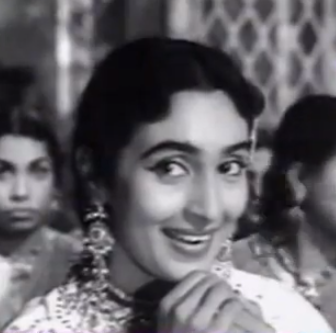
Nutan leads the chorus with an enchanting smile in Dil Hi To Hai (1963)

Bekhudi Mein Sanam Lyrics and Translation: Let’s Learn Urdu-Hindi

Babita Haseena Maan Jaayegi

Whoa there, Babita. Are you sure a Santa hat is appropriate for this occasion?

Our next Hindi lyric translation is the classic Rafi-Lata duet “Bekhudi Mein Sanam” from the film Haseena Maan Jaayegi (1968). The movie soundtrack is probably the only reason you would ever want to watch this film. Sure, the plot description is intriguing: two men (who happen to both be Shashi Kapoor) fall in love with the same woman (the unbearable Babita). One Shashi Kapoor is soft-spoken and romantic, while the other is an aggressive jokester who is spurned by our heroine. But then! War with China! Both men are called to duty, and when only one returns, Babita can’t tell if he is truly the man she loves–or his rival!

So you’re lured in, egged on by a few other vaguely recognizable Rafi numbers (“O Dilbar Janiye,” anyone?), and think you’re getting yourself in for a long Hum Dono-esque genre twin film with a swinger bent.

Oh, but how wrong you’d be.

Babita and Shashi haseena maan jaayegi

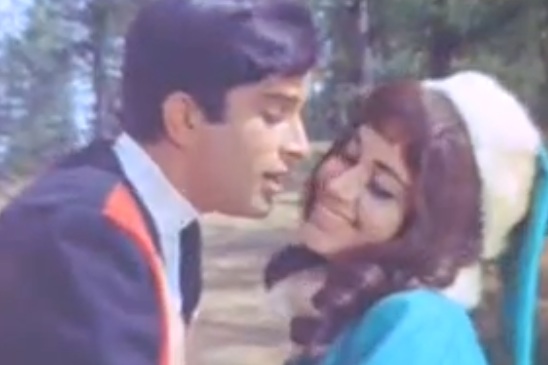
Shashi Kapoor and Babita play two college students in love in Haseena Maan Jaayegi (1968).

Haseena Maan Jaayegi is a painful free-falling bucket of awkward sauce that is weighed down by Babita’s insufferably thick voice, static characters, and an unfocused plot that never quite pulls together it’s obvious loose ends. I mean, seriously Babita? We need to spend two hours watching you try to decide if there is nothing unique about the man you married? Furthermore, what the heck, Shashi? Couldn’t you have convinced the scriptwriter to at least throw in just one line explaining why you guys look so similar? At least turn out to legitimately be twins separated at birth! There’s no way God would just magically make two Shashi Kapoors in this world. A lot of Indian women would be a lot happier if so.

Shashi Kapoor is entranced by Babita’a teal Santa suit from “Bekhudi Mein Sanam.”

Really, nothing gets my goat more than a twin movie that doesn’t acknowledge that they’re supposed to actually be twins. Do yourself a favor by skipping this cheese-flavored package of dry histrionics, and just youtube the songs because they’re awesome. Of particular note in “Bekhudi Mei.N Sanam” is Babita’s puffy white fur Santa hat and teal blue jumpsuit. This is just in case any audience member had lost their mind and started to make the mistake of taking her seriously. Check out the youtube link for the song here and follow along with the lyrics and translation below to this this otherwise beautiful ode of love!

Bekhudi Mein Sanam Lyrics and Translation

Bekhudi mei.N sanam, uTh gaye jo qadam
Unaware of my self, as I started walking
Aa gaye, aa gaye
I arrived
Aa gaye paas hum, aa gaye paas hum
I arrived nearer to you

Aag yeh kaisii man mei.N lagii hai?
What kind of fire is aflame in my mind?
Man se badhii to tan mei.N lagii hai
Yet, even bigger than that in the mind, is the one burning my body
Aag nahii.N yeh dil ki lagii hai
This is not a fire, its the heart’s desire
Jitnii bujhaayii, utnii jalii hai
However much you try to put it out, it will keep burning

Dil ki lagi na ho to, kya zindagii hai?
Without this desire of the heart, what is life?
Saath hum jo chale miT gaye faasle
When we walk together, all that separates us disappears
Aa gaye, aa gaye
I arrived
Aa gaye paas hum, aa gaye paas hum
I arrived nearer to you

Khoyii nazar thii, soye nazaare
The vision was lost, and the sights were asleep
Dekhaa tumhe to jaage yeh saare
On seeing you, all of them were awakened
Dil ne kiye jo dil ko ishaare
As one heart signaled to the other
Milke chale hum saath tumhaare
We met and walked together

Aaj khushii se meraa dil yeh pukaare
Today my heart calls out with joy
Teraa daaman milaa, pyaar meraa khilaa
In finding your embrace, my love has blossomed
Aa gaye, aa gaye
I arrived
Aa gaye paas hum, aa gaye paas hum
I arrived nearer to you

Dil kii kahaanii pahunche zubaa.N tak
The story of my heart is on my tongue
Kisko khabar ab pahunche kahaa.N tak?
Now who knows where it will reach?
Pyaar ke raahii aaye yahaa.N tak
Travelers of love have arrived here
Jaaye.Nge dil ki had hai jahaa.N tak
They will go to the limits set by their hearts

Tum paas jo to chale hum aasmaan tak
With you at my side, we will reach the sky
Dil mein armaan liye laakh toofaan liye
With a heart full of desires and beset by storms

Aa gaye, aa gaye
I arrived
Aa gaye paas hum, aa gaye paas hum
I arrived nearer to you

Bekhudi mei.N sanam, uTh gaye jo qadam
Unaware of my self, as I started walking
Aa gaye, aa gaye
I arrived
Aa gaye paas hum, aa gaye paas hum
I arrived nearer to you

Glossary:

bekhudi: unaware of oneself, in a trance; qadam: footsteps; aag: fire; man: mind; tan: body; faasle: separation, distance; ishaaraa: signal; daaman: embrace; zubaa.N: tongue, language; khabar: news, knowledge; had: limit; aasmaan: sky; armaan: desire; toofaan: storm

I can’t really explain it, but I’ve always really liked with the way Shashi Kapoor starts his first line walking forward toward her with his hands folded behind his back. It’s bashful, the way Indian men in love were meant to be.

Shashi Kapoor Twins Haseena Maan Jaayegi

I know, I know. It’s almost irresistible–TWO Shashi Kapoors on ONE screen! Look at that handsome cricket jacket, those form-fitting white pants. But restrain, my friends. Haseena Maan Jaayegi will suck out your Shashi-gushing capacities and infect you instead with confusion and hatred of Babita.

This song translation was done by request from our reader “Beloved”! We hope you enjoyed, and if you’d like to see your name on our blog, send us an email with your burning Bollywood request or leave us a comment on our “Requests” page!

– Mrs. 55

In Aankhon Ki Masti Ke Lyrics and Translation: Let’s Learn Urdu-Hindi

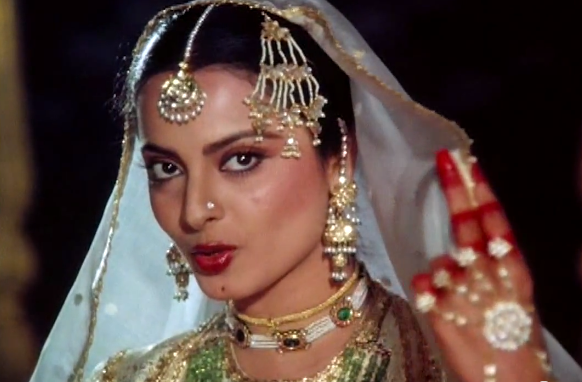
Rekha gives a career-defining performance as a courtesan and poetess in Umrao Jaan (1981)

I recently rewatched Muzaffar Ali’s masterpiece Umrao Jaan (1981), a film that is so brilliantly crafted that it deserves multiple posts on this blog like Pakeezah and Mughal-e-AzamThe film is based on an Urdu novel written by Mirza Muhammad Hadi Ruswa that recounts the life of one of South Asia’s most influential literary figures: Umrao Jaan. Born in Faizabad, a young girl named Amiran is kidnapped and sold to a brothel in Lucknow. As she grows older, Amiran is grooomed by the brothel’s madam until she becomes Umrao Jaan (played by Rekha), one of Lucknow’s most desirable courtesans.  Misfortune after misfortune falls upon Umrao Jaan, but the film ultimately portrays her as a resilient woman whose beautiful mujras and poetry serve as a lasting legacy to her indomitable spirit.

In addition to Rekha’s stunning performance as the tawaif Umrao Jaan, this film is especially memorable for its portrayal of the richness of Lucknow’s cultural heritage. The indulgent life of nawaabs around the turn of 20th century is visually apparent in the film’s costumes, artwork, and set design, but the luxurious atmosphere in the film is taken to a new level by the soundtrack composed by Khayyam and penned by Shahryar. Here, I’ve chosen to translate one of the unforgettable mujra numbers from this film: in aa.nkho.n kii mastii.

She’s not lying when she says her eyes are intoxicating…

In this song, Umrao Jaan engages in some self-indulgent vanity. She mildly chides her lover Nawab Sultan (played by Farooq Shaikh) by saying there are thousands of other madmen in Lucknow that admire her charm and beauty. In the third verse, she continues to brag by saying that all the taverns in the world cannot serve wine as intoxicating as the wine that she serves from her glances. Finally, in the last verse, Umrao makes a warning against those that attempt to suppress her grandeur using a common symbol found in Urdu-Hindi poetry: the moth. Like moths to a flame, she claims that there are thousands of admirers in the city who would sacrifice their lives to protect her. The poetry in this song is not overly complex, but there is a subtle beauty to it that is enhanced by Asha Bhonsle’s beautiful rendition and Rekha’s graceful expressions on screen. I managed to find a very high-quality print of this song on YouTube, so please do watch the link provided above and follow along with the translation/glossary–enjoy!

–Mr. 55

P.S. Whatever you do, please do not waste three hours of your life (like I did) watching J.P. Dutta’s 2006 remake of this movie starring Aishwarya Rai and Abhishek Bacchan. It is a travesty of a film that completely disrespects the beauty of the original. I think one of the worst parts is the atrocious Urdu pronunciations. I mean, even I can get the guttural khe sound right when I say “khudaa haafiz,” and they don’t pay me the big bucks. Why can’t Aishwarya or Abhishek? And let’s not even get started on Anu Malik’s tired and stale soundtrack…

The camera adds to the meaning of the lyrics here by bringing candles into the shot when Rekha sings “is shamm-e-farozaa.n…

In Aankhon Ki Masti Ke Lyrics and Translation

in aa.nkho.n kii mastii ke mastaane hazaaro.n hai.n
The intoxicating beauty of these eyes attracts thousands of admirers. 
in aa.nkho.n se vaabastaa afsaane hazaaro.n hai.n
Indeed, there are thousands of stories associated with these eyes. 

ek tum hii nahii.n tanhaa ulfat me.n merii rusvaa
You are not the only one disgraced by your love for me, 
is shahar me.n tum jaise diivaane hazaaro.n hai.n
There are thousands of madmen like you in this city.

ek sirf ham hii mai ko aa.nkho.n se pilaate hai.n
It is only I who can serve you wine with my eyes, 
kahne ko to duniyaa me.n maikhaane hazaaro.n hai.n
Though it is said that there are thousands of taverns in this world.

is shamm-e-farozaa.n ko aa.ndhii se Daraate ho
Although you attempt to scare this bright candle with a storm,
is shamm-e-farozaa.n ke parvaane hazaaro.n hai.n
The light from this candle attracts thousands of moths. 

in aa.nkho.n kii mastii ke mastaane hazaaro.n hai.n
The intoxicating beauty of these eyes attracts thousands of admirers. 

Glossary

mastii: intoxication; mastaane: admirers; vaabasta: associated with; ulfat: love; rusvaa: disgraced; mai: wine; maikhaane: taverns; shamm-e-farozaa.n: bright candle; aa.ndhii: storm; parvaane: moths.

Farooq Shaikh, as Nawab Sultan, watches the mujra in admiration.