Chalte Chalte Lyrics and Translation: Let’s Learn Urdu-Hindi

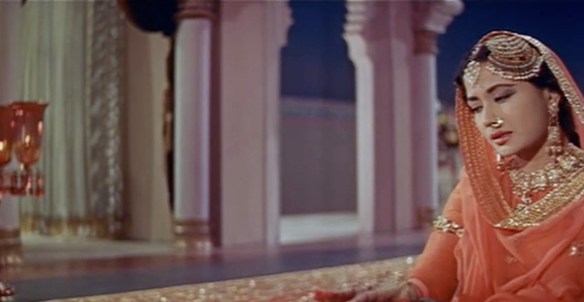
Meena Kumar shines as Pakeezah in the beloved mujra song "Chalte Chalte."

Meena Kumar shines as the golden-hearted Pakeezah in the beloved mujra song “Chalte Chalte.”

For our next song, we provide an English translation of the timeless lyrics of Pakeezah’sChalte Chalte.” The film Pakeezah (1971) instantly reached legendary Bollywood status upon its release, due in part to the ethereal musical score, brilliant Urdu dialogue, lavish sets, but also from its star Meena Kumari’s untimely death within a week of the premiere. This song is known everywhere, and the beauty of Meena and Lata’s performance truly speaks for itself. My parents have old home videos of 4-year-old me draping a chunni on my head and attempting to dance and sing along with her during this song. It’s hard to put that kind of impact into words, but you can tell it’s profound.

Anyway.
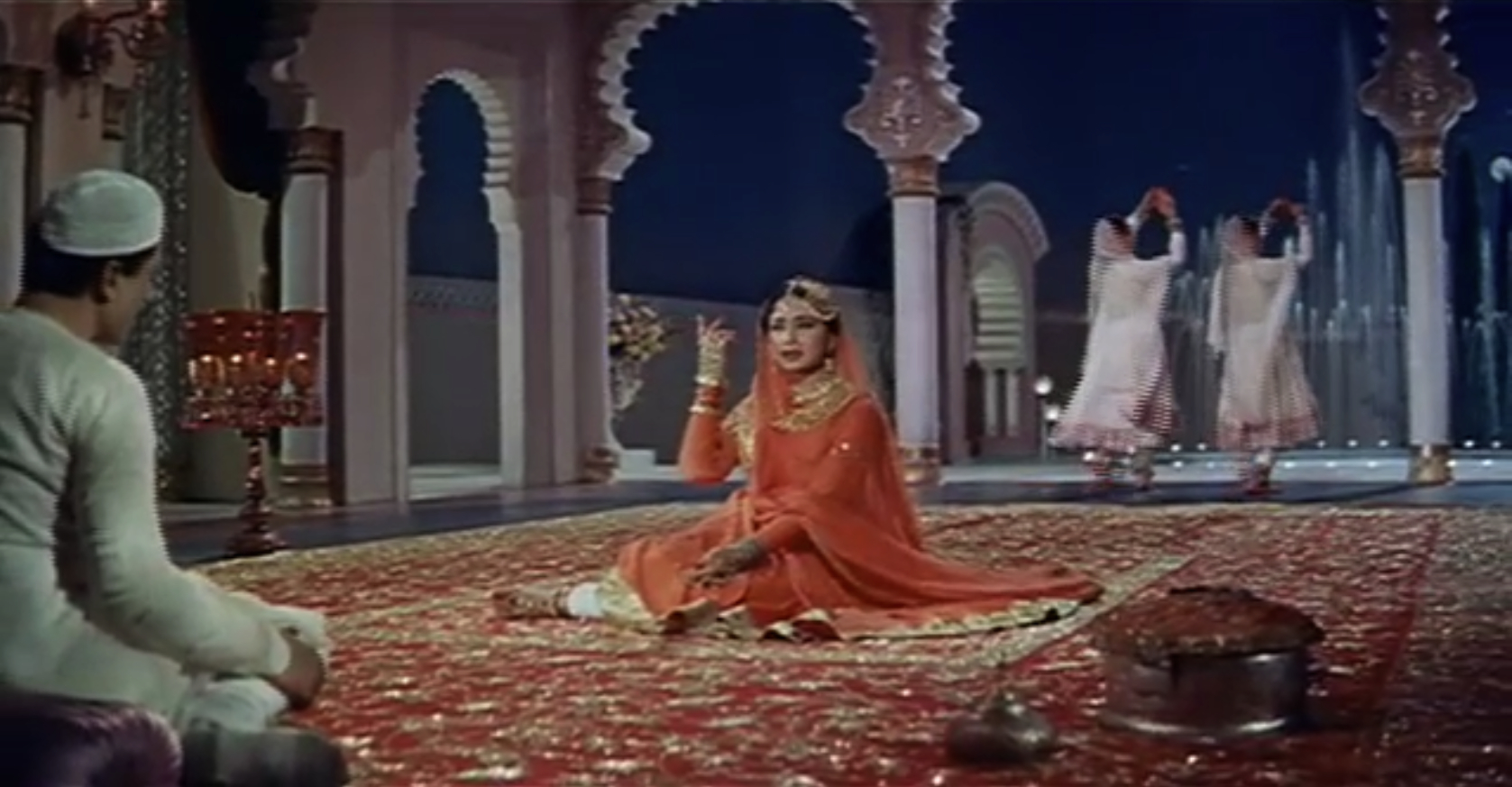
Meena Kumari dazzles her audience with “Chalte Chalte” in Pakeezah (1971)

An interesting facet of this song is the interwoven theme of the train ride. For anyone familiar with film theory, “the train” has a fascinating and critically important role in cinematic history across the globe. Likened to films themselves, the train transports you to a different world and takes you on a brief journey that can leave you different from when you started. It is a theme heavily explored by early French filmmakers first experimenting with the medium (you may remember the loving references to the Lumiere brother’s Arrival of a Train at La Ciotat Station (1895) in Hugo!), and in Indian cinema, trains play no less an important role. Like Satyajit Ray’s famous Pather Panchali (1955) which pivoted on the introduction of a train whistle across the quiet sugarcane fields, so too does the world of Pakeezah hinge on the sound of a distant train whistle incorporated into the score at the end of the song. For trains can represent that journey from tradition to modernity, from reality to fantasy, and for Pakeezah as well as Kamal Amrohi’s viewers entering a hidden, dying world of ornamentation, the train is a vehicle of escape.
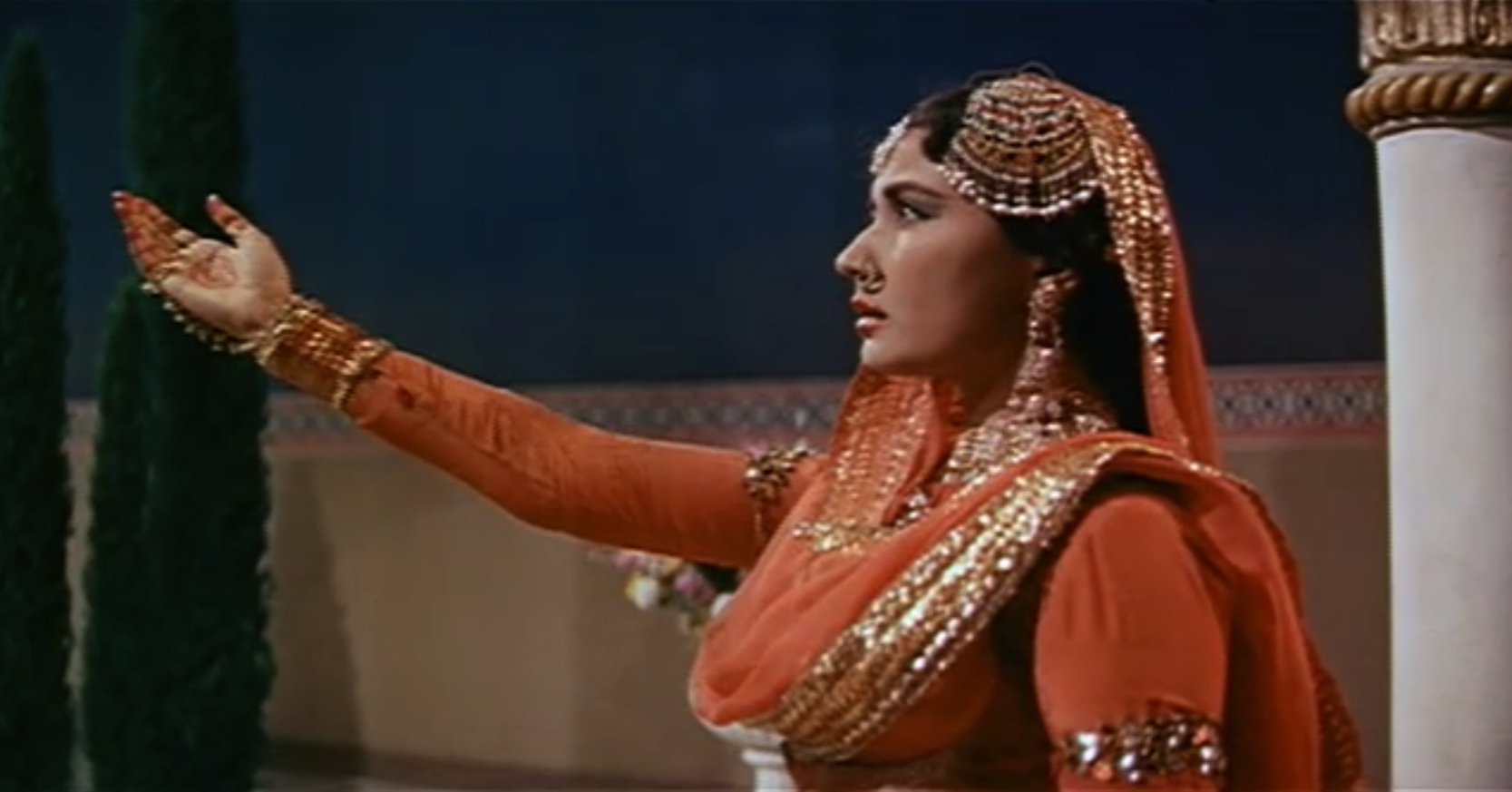
Gesturing to the moon, Meena Kumari waits for her mysterious admirer to find her again in Pakeezah (1971)

“Chalte Chalte” will absolutely leave you wishing for more, so make sure you watch the movie if you ever want to claim cultural competency. To read more about this film, check out our post on behind-the-scenes Pakeezah trivia! Enjoy our full lyrics and English translation to “Chalte Chalte” below!

Chalte Chalte Lyrics and Translation:

Chalte chalte yuu.N hii koi mil gaya tha
I met someone by chance while walking
Sare raah chalte chalte
Walking around the path
Wohii thamke rah gayii hai
The night suddenly came to a standstill
Meri raat dhalte dhalte
Just as it was about to fade away

Jo kahii gayii na mujhse
What I was unable to voice
Woh zamaanaa keh rahaa hai
The world is now saying
Ki fasaanaa ban gayii hai
That a fable has been created
Meri baat talte talte
From those words which evaded me

Shab-e-intezaar aakhir kabhi hogi mukhtasar bhi
That night of waiting will after all shorten soon
Yeh chiraag bhuj rahi hai
These lamps are dying
Mere saath jalte jalte
As they burn alongside me

Glossary:

raah: path; zamaanaa: the world; fasaanaa: fable, legend; baat: words, incident, matter; talna: to evade, to escape; shab-e-intezaar: night of waiting; mukhtasar: short, soon; chiraag: flame
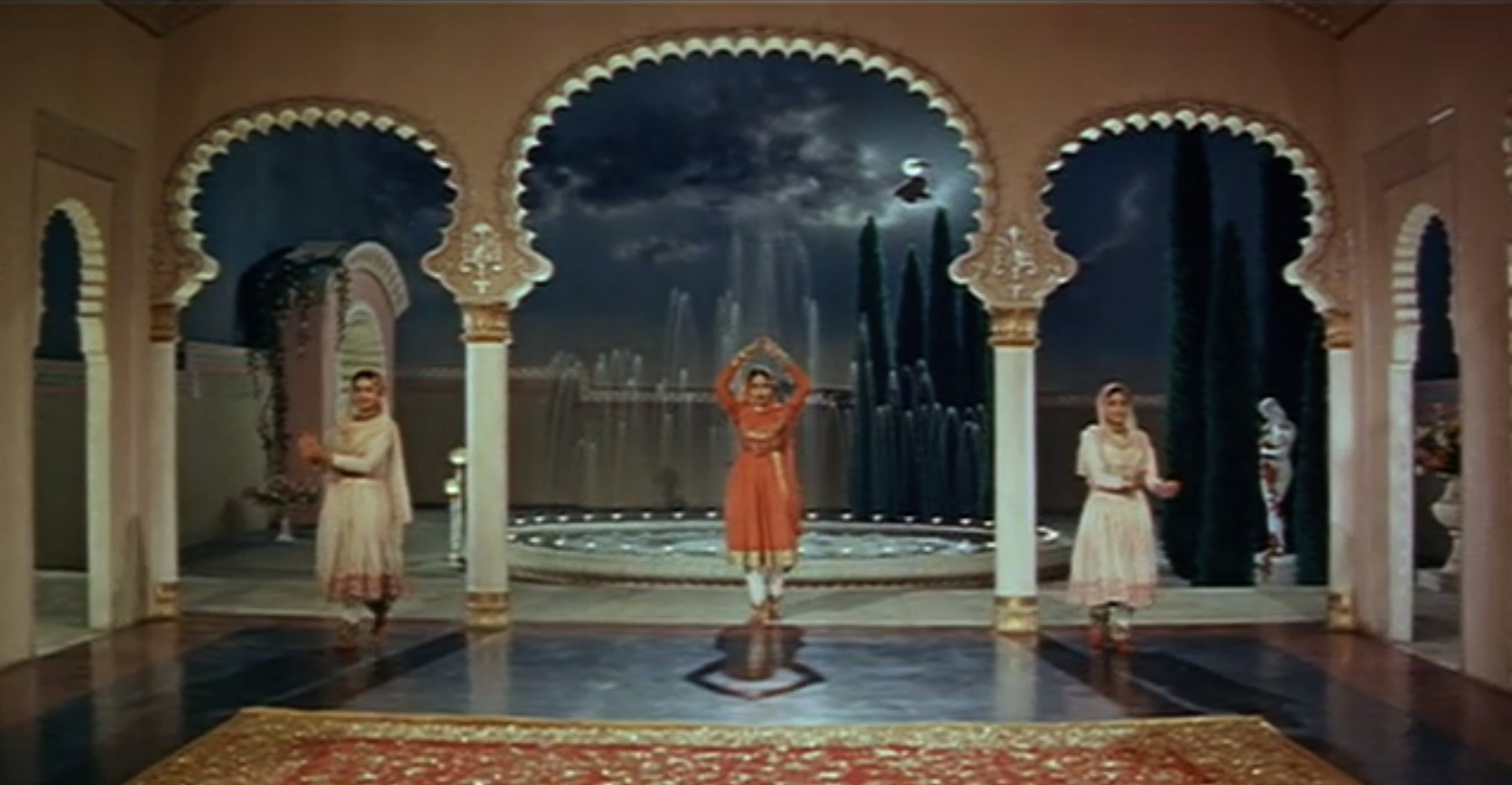
The production value of this film is ridiculous.

It’s always slightly bothered me that after the first antra the two back-up dancers start twirling, and after the second turn, get completely off-sync since the genius on the right goes a little too fast for the music. Kamal Amrohi cuts quickly to the next shot when this starts happening, so you might say it’s not a huge deal per se, but for someone who was such a neurotic perfectionist, how did this slip by him? It just gets to me every time. Or am I over-thinking this?

-Mrs. 55

Rabindranath Tagore’s Influence on S.D. Burman

Rabindranath Tagore (1861-1941) and S.D. Burman (1906-1975)

Due to my upbringing in a Bengali household, I am intimately familiar with Rabindra-sangeet: the genre of songs written and composed by Nobel laureate Rabindranath Tagore. As a composer, artist, novelist, playwright, poet, and philosopher, Tagore has left a lasting legacy on Indian culture through his vast collection of works in a variety of mediums. Although the purism and simplicity of Tagore’s style might suggest that Bollywood is an inappropriate forum to celebrate his art, several music directors from the Golden Age of Hindi cinema have been known to use Tagore songs as inspirations for their musical compositions. The music director who is most well-known for this practice is none other than the illustrious S.D Burman. S.D. Burman is one of the most succesful music directors in the history of the Bollywood industry, and his songs from films such as Bandini (1963), Guide (1965), Jewel Thief (1967), and Aradhana (1969) are still considered all-time classics today. His filmi compositions tend to draw upon inspiration from Bengali folk traditions (e.g. bhatiaalii, saari, etc. ), but here I’d like to draw your attention to a collection of S.D. Burman compositions that are derived from Rabindra-sangeet:

meraa sundar sapnaa biit gayaa (Do Bhai, 1949): From one of S.D. Burman’s first hit scores in the Bollywood industry, this song is considered to be Geeta Dutt’s breakthrough as a playback singer in Hindi films. The mukhDaa of this song is inspired by a Bilaaval-based Tagore composition called “radono bharaa e basonto.” Geeta does an excellent job of expressing the sorrow and pain of this song with her voice, and it is truly unfortunate that the lyrics here would become a reality for her during her tumultuous marriage to Guru Dutt in the next decade.

Playback singer Geeta Dutt (1930-1972) with her husband Guru Dutt (1925-1964)

nain diivaane (Afsar, 1950): This Pilu-based composition is skilfully rendered by Suraiyya, a leading singer/actress who became a huge sensation in Bollywood during the 1940s. Bollywood as we know it today relies on actors and actresses lip-syncing songs sung by playback singers; however, in its very early days, actresses like Suraiyya used to sing their own songs for films. In spite of their dual talents, singer-actresses were not able to survive the onslaught of the Mangeshkar monopoly in the 1950s, and the playback singing paradigm became the standard that is still maintained today in the industry. In any case, this song is based on an extremely popular Tagore composition called “sediin duujane duulechhiinuu bone.” S.D. Burman literally did a copy-paste job here, as the melody of the entire Hindi song is identical to the Bengali original. While loosely basing a mukhDaa on a previous composition is somewhat acceptable, recycling a whole song written by another composer begs the question: should S.D. Burman have given credit to Tagore for this composition?

Singer/actress Suraiyya (1929-2004)


 jaaye.n to jaaye.n kahaa.n? (Taxi Driver, 1954): S.D. Burman won his first Filmfare Award for Best Music Director for this song from Taxi Driver in 1954. As is often the case, the male version of the song (sung by Talat Mehmood) is more popular than the female version (sung by Lata Mangeshkar). Although S.D. Burman modified the raga of his composition to more closely resemble Jaunpuri, the first line of the mukhDaa is instantly recognizable as the main phrase from Tagore’s Bhairavi-based classic  “ he khoniiker otiithhii.” Note that the Tagore original that I have provided here is sung by Hemanta Mukherjee (a.k.a Hemant Kumar), who, in addition to achieving fame as a Hindi playback singer/music director, was known for his beautiful renditions of Rabindra-sangeet in Bengali.

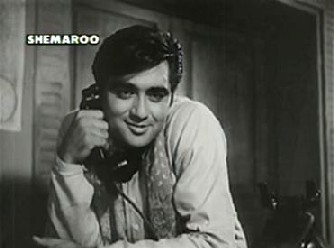
jalte hai.n jiske liye: (Sujata, 1959): This probably qualifies as my favorite “telephone song” from a Hindi film. Here, Sunil Dutt woos Nutan over the phone with this gem as he croons to Talat Mehmood’s silky vocals on playback (notice the characteristic quiver that we know and love!). Although this composition is often considered an all-time classic song of romance, fans of this song may be surprised to know that the mukhDaa is taken directly from a Tagore composition named “ekodaa tumii priye.”

Sunil Dutt serenades Nutan over the telephone with “jalte hai.n jiske liye” in Sujata (1959)

meghaa chhaye aadhii raat (Sharmilee, 1971): Out of all the compositions listed here, the inspiration from Tagore is the most difficult to hear in this song because it does not involve the mukhDaa. Rather, S.D. Burman seems to have inserted a small segment of  laho laho tuule laho (0:26-0:40) into the antara of this raga Patdeep-based classic from Sharmilee. What a trickster, huh?

tere mere milan kii yeh rainaa (Abhimaan, 1973): By far, this is the most famous example where  S.D. Burman has been inspired by Rabindra-sangeet.  In his last hit film score (for which he won his second  Filmfare Award for Best Music Director), S.D. Burman recycles the mukhDaa from Tagore’s Mishra Khamaj-based “jodii taare nai chiinii go sekii?” in this evergreen duet of Lata Mangeshkar and Kishore Kumar. Burman’s antaras are a beautiful addition to the original composition, so we won’t give him too much trouble for his rehashing of Tagore here. Note that the Bengali original that I have linked to here is sung by Kishore Kumar, another Hindi playback singer who was famous for his renditions of Rabindra-sangeet in Bengal.

Amitabh and Jaya Bacchan sing the duet “tere mere milan kii yeh raina” on stage during the climax of Abhimaan (1973).

Although S.D. Burman was often inspired by Tagore in his compositions, he never recorded or sang a single piece of Rabindra-sangeet throughout his career. The reason behind this is, of course, family feuding–an unavoidable staple of all things related to Indian culture. Here’s the story: S.D Burman’s father Nabadwip Chandra Dev Burman was set to be the direct heir to the throne of Tripura when the current king passed away in 1862. However, the crown went to Nabadwip’s paternal uncle Birchandra Dev Burman due to some dirty palace politics. Because Rabindranath Tagore had a very close relationship with Birchandra Dev Burman, S.D. Burman avoided meeting Tagore throughout his lifetime and refused to perform Rabindra-sangeet out of principle. Nevertheless, in spite of this tiff, it is undeniable that S.D. Burman had a great deal of respect for Tagore as a musician given the influence of Rabindra-sangeet on his compositions.

–Mr. 55

​Raat Akeli Hai Lyrics and Translation: Let’s Learn Urdu-Hindi

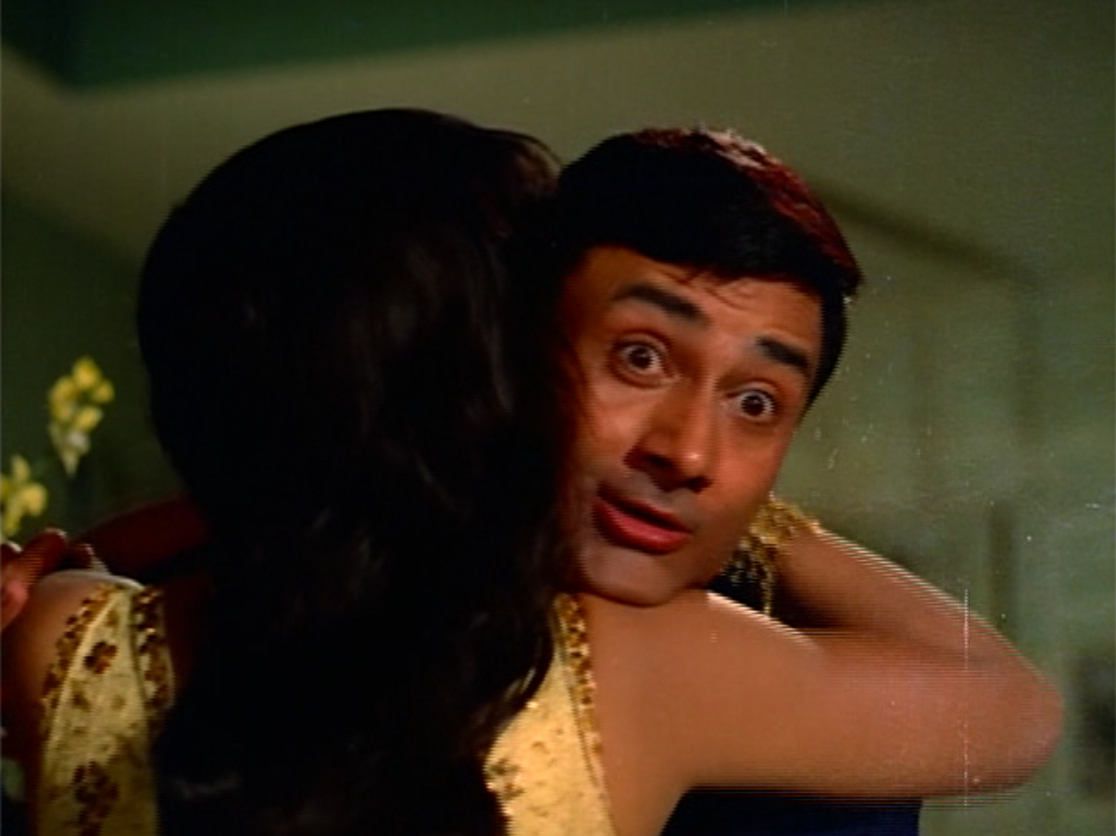
Now we will take a look at the lyrics and English translation of the seductive number “Raat Akeli Hai.” When it came to vamp songs, cabaret numbers, and being the voice any kind of seductress, Asha Bhonsle was the Queen. And yes, while this usually amounted on screen to Helen shaking her stuff in a skin-tight showgirl costume, Asha lent her versatile voice to many other actresses called upon for the vamp sequence, from Sadhana to Parveen Babi. One of her best is the Tanuja hit “Raat Akeli Hai” from Dev Anand’s hit Jewel Thief (1967) and we will now present the song’s full lyrics and translation. Asha Bhonsle gives an amazing performance–magnificently hitting both the highest of highs and hiding a sultry laugh beneath the lows. In the movie, Tanuja plays a fire-cracker “modern girl” (discussed more in our earlier post on Jewel Thief!) whose bold lines she uses to pick up Dev Anand would make anyone blush from awkwardness.

Even dapper Dev Anand is overwhelmed by Tanuja’s advances in Jewel Thief (1967).

In this song, however, her craziness works, and Tanuja is completely adorable. Bursting at the seams from her tight-fitting white dress, she seduces the hero by reaching into the living room’s classy mini-fridge and pulling out two coca-colas. Yes, it’s the 70s living at its finest. Who needs cocktails when you’re this smooth?

Tanuja shakes everything she has in a hip-hugging white dress from the seduction sequence of Jewel Thief (1967).

Enjoy our English translation of the tempting lyrics to “Raat Akeli Hai” below!

Raat Akeli Hai Lyrics and Translation:

Raat akelii hai, bujh gaye diye
The night is lonely, and the lights have gone out
Aake mere paas, kaano.N mei.N mere
Come close to me, and in my ears
Jo bhii chaahe kahiye, jo bhii chaahe kahiye
Tell me whatever you desire

Tum aaj mere liye ruk jaao, rut bhii hai fursat bhii hai
Today, stop a while for me, the atmosphere is right and we are at leisure
Tumhii na ho na sahii, mujhe tumse muhabbat hai
You may not feel the same, but I love you
Muhabbat kii ijaazat hai, to chhup kyuu.N rahiye
I have permitted you to love me, so why remain quiet?
Jo bhii chaahe kahiye, raat
Tell me whatever it is that you desire

Savaal banii huii dabii dabii uljhan siino.N mei.N
The confusion buried in my heart has surfaced as this question
Javaab denaa thaa, to Duube ho phasiino.N mei.N
You were supposed to give an answer, but you became drenched in sweat
Thaanii hai do hasiino.n me.n, to chup kyuu.N rahiye
When there is a resolve between two beautiful people, then why remain quiet?
Jo bhii chaahe kahiye
Tell me whatever it is that you want
Raat akeli hai…

Glossary:

akelii: lonely; kaan: ear; rut: atmosphere, season; fursat: leisure time; ijaazat: permission; chhup: silent; savaal: question; siin: chest; javaab: answer; Duubna: to become drenched, to drown; phasiinaa: sweat; thanii: resolve, commitment

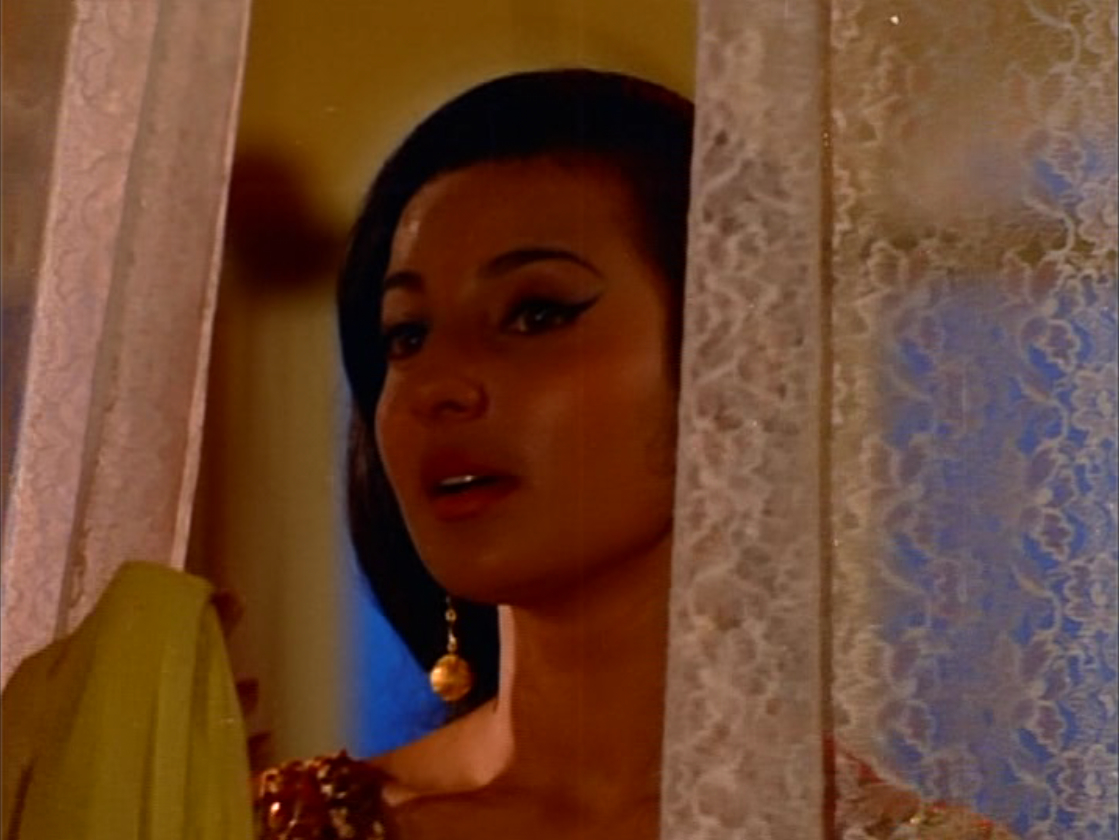
Tanuja coyly wraps herself in a curtain in “Raat Akeli Hai” from Jewel Thief (1967)

Wondering what that glass-shattering note is Asha hits over and over again in this song? It sounds fancy, but it’s really just a high F.  Our girl Asha can go higher–more on this in our post on Lata and Asha’s highest notes!

-Mrs. 55

The Best Qawwalis of Bollywood Films

Rishi Kapoor Amar Akbar Anthony Bollywood Qawwali

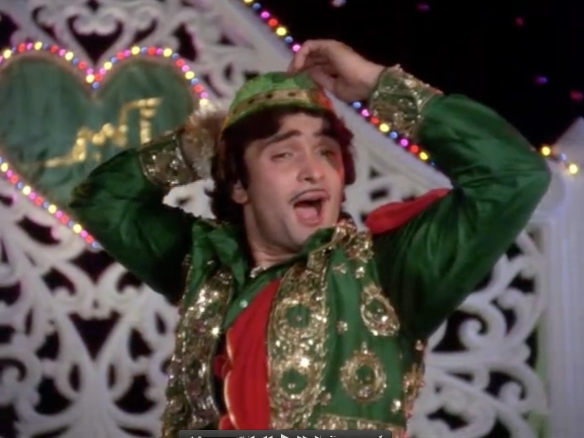
Rishi Kapoor charms his audience singing the famous qawwali “Pardah Hai Pardah” from Amar Akbar Anthony (1979).

The qawwali from films has a hallowed place in the history of the Hindi music industry. A mystic tradition more than 700 hundred years old, the qawwali gained prominence in Bollywood initially through 1950s Muslim social dramas and grew so much in popularity that its influences became mainstream–even continuing to live on today. We present our list below of the best qawwalis of Bollywood films.

But let us first define what precisely is a qawwali? The great Indian poet Amir Khusrau (d. 1326) is considered the founding father of the qawwali genre, having composed songs for the first time in this style to celebrate the death of his spiritual guide Nizamuddin Aulia. The qawwali is the authentic Sufi spiritual song that transports the mystic toward union with God. For centuries, Sufi communities in the Indian subcontinent have sustained this musical tradition in the mahfil-e-sama, or assembly for listening. The qawwali was a religious experience for both listener and performer: as the listener hopes for a spiritual experience of intensity and immediacy to transcend his or her conscious striving, the trained performer seeks to present in song a vast treasure of poetry that articulate and evoke a mystical experience for the audience.

Madhubala impresses the Mughal prince in the classic qawwali “Teri Mehfil Mei.N Qismat” from Mughal-e-Azam (1960)

The qawwali performance usually begins after the evening and may last all night until the morning prayers. The word qawwali means “words” worthy of remembrance, and as such the qawwali traditionally has a devotional aspect in praise of God. Even most “secular” qawwalis found in popular Bollywood movement can be read in this way, although superficially the lyrics have another literal meaning. The harmonium has replaced what was traditionally a sitar as musical accompaniment, but equally important are the tabla and the signature qawwali cyclic hand clapping that increase in speed during the performance. The tarz or tune of the qawwali is normally identified by the first line of the text, which is often a part of the refrain couplet. Although the qawwal was traditionally male, both men and women have enjoyed and excelled at performing the modern qawwali.

Rishi Kapoor dazzles his audience as a popular qawwal in the 1979 blockbuster Amar Akbar Anthony.

Unlike in Hindustani classical music, while taal and raagaa usage is the same, the qawwali places a greater emphasis on the poetic text and the delivery of its message than on musical ornamentation. In many of its vast incarnations within Bollywood, the qawwali became synonymous with a musical debate, a verbal battle (often between the sexes) to outwit the other side on topics that usually boil down to love or the pain of love. That kind of screen chemistry, as you can imagine, is prime Bollywood flirting territory just waiting to be sung.

Let’s take a look at how this genre evolved in mainstream Bollywood into one of the most beloved musical genres of the industry. Here are some highlights:

Humen To Loot LiyaAl Hilal (1958):

One of the first qawwalis to hit the silver screen, no list is complete without this retro low-budget gem. The music is really quite simple, but extremely catchy.

Yeh Ishq Ishq HaiBarsaat Ki Raat (1960):

This qawwali is an Urdu-lover’s paradise. Filled with complex words and allusions you’ll never use in real life, “Yeh Ishq Ishq Hai” set the stage for classy performance duels between men and women that is still considered the greatest Bollywood qawwali for its poetry (see our post for a full English translation!)

Sharma Ke Yeh Kyo.NChaudhvin Ka Chand (1960):

A fun twist on the traditional qawwali, two women sing (Asha Bhonsle and Shamshad Begum) with the latter taking the masculine side and the former taking the feminine.

Teri Mehfil Mei.N QismatMughal-e-Azam (1960):

Oh, does it get any better than this? Every moment of Mughal-e-Azam is a poetic dream and this briliant qawwali is no less. Shamshad Begum battles Lata Mangeshkar for the Prince’s approval of their take on love, each lyric outwitting the last. See our translation with glossary for more!

Nigahe.N Milane KoDil Hi To Hai (1963):

Asha Bhonsle’s greatest contribution to this genre, this qawwali has some beautiful Urdu and probably the most thrilling sargams you’ll find in any of her songs. See our translation with glossary here!

Tumhe Husn Dekhe – Jab Se Tumhe Dekha Hai (1963):

OK, so sure, this qawwali is not particularly memorable for its musical ingenuity (you may or may not cringe the entire way), but how often are you going to behold Shammi and Shashi Kapoor on screen at the same time?! This fascinating qawwali is worth a watch if only for its star value! Kudos to Geeta Bali for holding her own!

Mehengai Maar GayiRoti Kapada Aur Makaan (1974):

This qawwali has a unique flavor–taken from one of Manoj Kumar’s popular Indian propoganda films, the lyrics carry an interesting social message outside the realms of romantic love.

Pardah Hai PardahAmar Akbar Anthony (1979):

A Mohammed Rafi gem, this qawwali ranks among the best of the best. After watching Rishi Kapoor’s enthusiastic performance, you’d believe he was born to be a qawwal. The song is a must-see for anyone interested in the genre.

And just to throw in the contemporary, here’s a picture of me performing the qawwali at last year’s Harvard Ghungroo!

At a Harvard Ghungroo performance of Asha Bhonsle’s “Nigaahe.N Milane Ko.”

-Mrs. 55

Mere Desh Ki Dharti Lyrics and Translation: Let’s Learn Urdu-Hindi

Manoj Kumar Mere Desh Ki Dharti

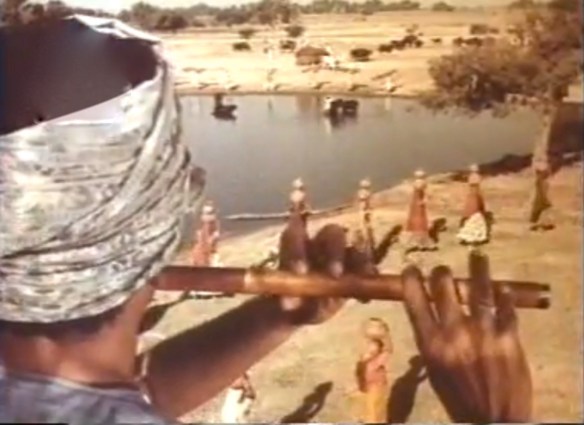
The glory of India’s ancient heritage is celebrated in Manoj Kumar’s “Mere Desh Ki Dharti” from Upkar (1967).

In honor of the great beauty of India we present the patriotic lyrics and English translation of “Mere Desh Ki Dharti” from Upkar (1967). There are few songs that have attained the kind of beloved immortality found in the lyrics of “Mere Desh Ki Dharti.” A rousing declaration of love for the motherland, this song evokes nostalgia, nationalism, and an unwavering pride in traditional values that director Manoj Kumar advocated throughout his career. The film Upkar (1967) from which the song comes is one of many socially responsible movies pioneered by Manoj Kumar in that era–earning him the nickname Mr. Bharat! Like his other works Shaheed (1965), Purab Aur Paschim (1970), and Roti, Kapada, Aur Makaan (1974), Manoj Kumar sought to remind his audience of the beauty of the Indian way of life, of India’s rich history, and of the dangers Westernized modernity could pose to society.

As an interesting contrast to Dev Anand’s somewhat similarly themed-film Prem Pujari (1970), Upkar explores and glorifies the concept of the farmer-soldier, a loyal citizen who selflessly serves the motherland in any way she needs. The hero captures the spirit of self-sacrifice and patriotism in a way that has remained popular even today.

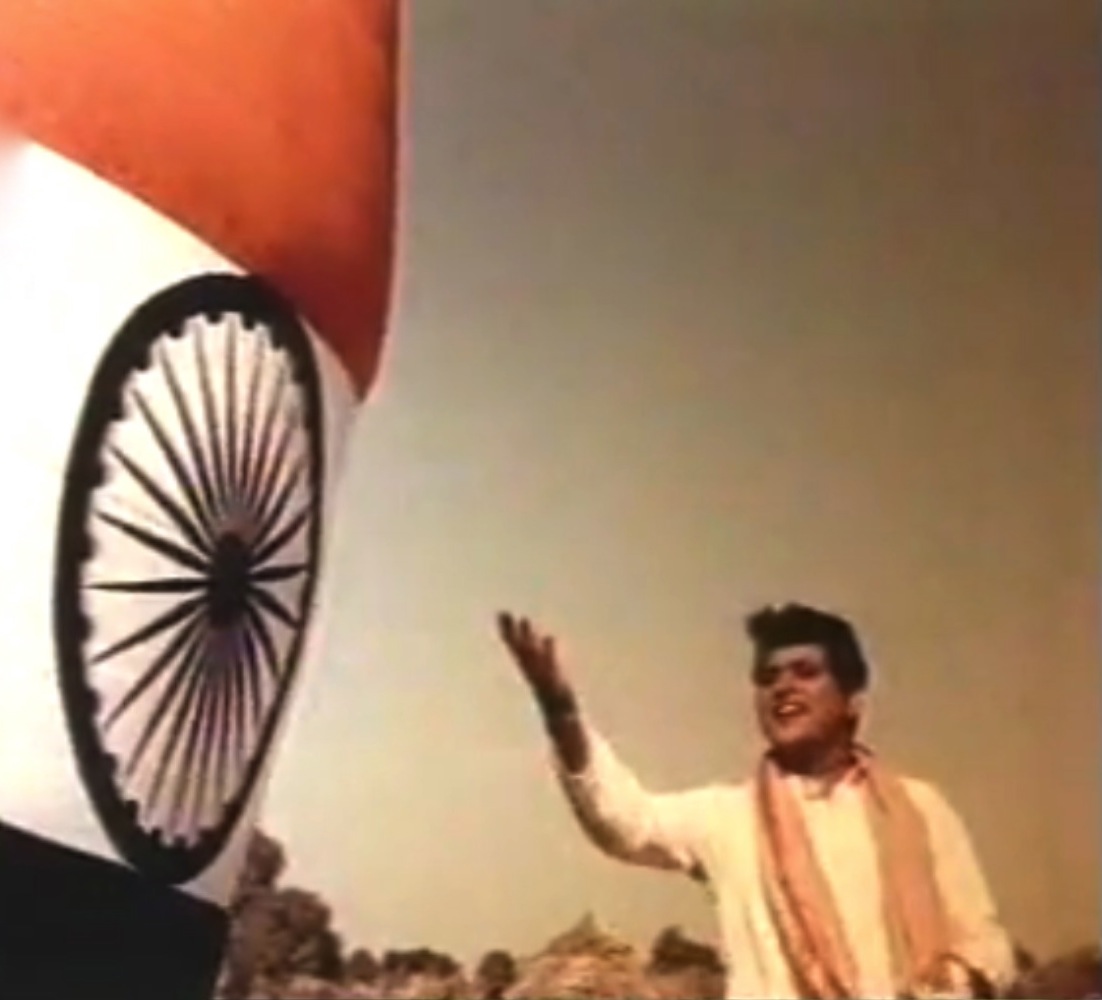
Manoj Kumar pays homage to the tricolor Indian flag in Upkar (1967).

So sure, it’s obviously a propaganda film (the idea of Upkar was after all modeled on Prime Minister Lal Bahadur Shashtri’s slogan, “Jai Jawaan, Jai Kissan!“), but hearing the lyrics to this song rendered stirringly by Mahendra Kapoor, you can feel a true admiration and love for India. Fully understanding a translation of “Mere Desh Ki Dharti” can be quite difficult without some contextual knowledge of Indian history as it is filled with rich allusions and metaphors. I have attempted to explain some of them below each lyric (props to my father for filling in the gaps!) So please enjoy our full English translation to the lyrics of “Mere Desh Ki Dharti” below!

Mere Desh Ki Dharti Lyrics and Translation:

Mere desh ki dharti, sonaa ugale, ugale hiire, moti
The soil of my country is made of gold, diamonds, and pearls
Mere desh ki dharti…


Bailo.N ke gale mei.N jab ghungaruu, jeevan kaa raag sunaate hai
The bells around the necks of the bullocks chime to the melody of life
Gham kos duur ho jaataa hai, khushiio.N ke kamal musakaate hai.N
Sadness and regret go away, and joyous lotuses smile
Sun ke rahaT ki aawaaze, yuu.N lage kahii.N shahanaaii baje
Listening to the sounds of the waterwheels, it seems as if auspicous flutes are playing somewhere
Aate hii mast bahaaro.N ke dulhan ki tarah har khet saje
Every field adorns itself like a bride when the thrill of spring arrives
Mere desh ki dharti…

Jab chalte hai.N is dharti pe hal, mamtaa angadaaiiyaa.N leti hai.N
When ploughs till this land, the love of its mother is activated
Kyu.N na puje is maaTii ko, jo jeevan ka sukh deti hai?
Why would we not worship this soil that gives us the joy of life?
Is dharti pe jis ne janam liyaa, usne hii paayaa pyaar teraa
Whoever was born on this land, obtained your love
Yahaa.N apnaa paraayaa koii nahii.N, hai.N sab pe, Maa.N, upkaar teraa
Here there is no difference between a stranger and one of our own, for Mother, you are benevolent to all
Mere desh ki dharti…

Ye baagh hai.N Gautam Naanak ka, khilte hai.N aman ke phool yahaa.N
This is the garden of Bhudda and Guru Naanak, here bloom the flowers of peace
Gandhi, Subhaash, Tagore, Tilak, aise hai.N chaman ke phool yahaa.N
Gandhi, Subhash, Tagore, Tilak–these are the kinds of flowers of this garden
Rang haraa Hari Singh Nalwe se, rang laal hai Lal Bahadur se
Its green color is from Hari Singh Nalwa , and its red color is from Lal Bahadur
Rang banaa basanti Bhagat Singh, rang aman ka viir Jawaahar se
The color became saffron with Bhagat Singh and the color of peace (white) is from the brave Jawaahar
Mere desh ki dharti…

Glossary:

dharti: soil; hiire: diamonds; moti: pearl [in this case, a metaphor for agricultural treasures]; bail: bullock, ghungruu: bells; kamal: lotus; rahat: waterwheels; dulhan: bride; khet: field; hal: plough; maaTi: soil; paraayaa: stranger; upkaar: benevolence; baagh: garden; guatam: Buddha; Naanak: Guru Nanaak; aman: peace; Gandhi: Mahatma Gandhi; Subhaash: Subhash Chandra Bose; Tagore: Rajindernath Tagore; Tilak: Bal Gangadhar Tilak; rang: color [here is he describing the colors of the Indian Flag]; haraa: green; Hari Singh Nalwa: the commander in chief of the Sikh Emperor, Ranjit Singh; Lal Bahadur: Lal Badur Shastri, one of India’s late Prime Ministers; viir: brave; Jawaahar: Jawaaharlal Nehru, India’s first Prime Minister

As a brief aside to anyone learning Urdu-Hindi, defining the word “angaDaaii” can be complicated when taken out of context (besides also being hard to pronounce if you’re a non-native speaker!). AngaDaaii can be the stretch you take when you wake up in the morning, it can be the way a traditional wrestler slaps his thighs before hopping into a match. In essence, an angaDaaii is any kind of preparatory movement or action you would take before some event. It’s used quite loosely in Hindi songs and must be read in context to understand the full meaning of the line, so watch out for this trickster.

For more patriotic songs from classic Bollywood films, check out our English translation of “Aye Mere Pyare Watan” from Kabuliwala (1961) and “Sarfaroshi Ki Tamanna” from Shaheed (1963)!

– Mrs. 55