Pal Pal Dil Ke Paas Lyrics and Translation: Let’s Learn Urdu-Hindi

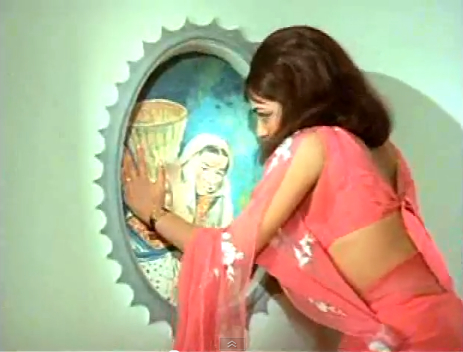
Rakhee daydreams about the ever-handsome Dharmendra in Blackmail (1973)

Blackmail (1973) is considered to be one of Vijay Anand’s most romantic directorial ventures. Starring Dharmendra and Rakhee, this film has all the ingredients to make a great Bollywood film: bogus science,  outrageous costumes, and of course, a memorable soundtrack. This album’s shining jewel is none other than “pal pal dil ke paas,” a beautiful expression of love that is remembered today for Kishore Kumar’s romantic and sensitive rendition.

To understand this song in context of the film, let’s take a look at a brief synopsis of the plot. Kailash (played by Dharmendra) is in charge of operating a power plant that provides electricity to homes across India. His quirky uncle Dr. Khurana (played by Madan Puri) is a scientist that is researching novel approaches to generating electricity via solar sources–how innovative for the 1970s! A local man named Mr. Mehta is unhappy about these advances because solar-powered energy is likely to put an end to his battery business. His business partner Jeevan (played by Shatrugan Sinha) is aware of Dr. Khurana’s research because he is a dear friend of Kailash.

Jeevan is set to marry Asha (played by Rakhee), Mr. Mehta’s daughter, but things change once Kailash unknowingly confesses his love for Asha to him. Taking advantage of this situation, Jeevan plans to get Kailash and Asha married so that he can eventually use Asha to get access to Dr. Khurana’s profitable “formula.” Jeevan arranges to meet Asha in a beautiful garden, but he sends Kailash in his place. They have a conversation about their dreams and hopes, and Asha warms up to the sincerity and purity of Kailash’s heart. In a bold move, Kailash hands over a packet of love letters he has written to Asha over the years to express his deepest desires, and he subsequently flees the scene to avoid embarrassment.

At this point in the film, we hear “pal pal dil ke paas,” song composed by music director duo Kalyanji-Anandji and penned by Rajinder Krishan. Unlike many instances where the on-screen portrayal of a song fails to do it justice, director Vijay Anand has done an excellent job to ensure that this picturization enhances the beauty of the music in the context of the film. In a nutshell, this song describes the progression of love between Kailash and Asha over time. At the beginning, Asha expresses restrained pleasure as she begins to read Kailash’s letters with a coy smile; by the end, she is so smitten by the poetry in his letters that she cannot stop daydreaming about him.

Does the love story between Kailash and Asha reach a happy conclusion? You’ll have to watch the film to find out! Even if the plot doesn’t appeal to you, there’s a particularly steamy  scene between Dharmendra and Rakhee  during “mile mile do badan” that is worth watching for the scandal factor alone.  Enjoy, and remember to send us your requests for song translations — we haven’t received one in a while!

-Mr. 55
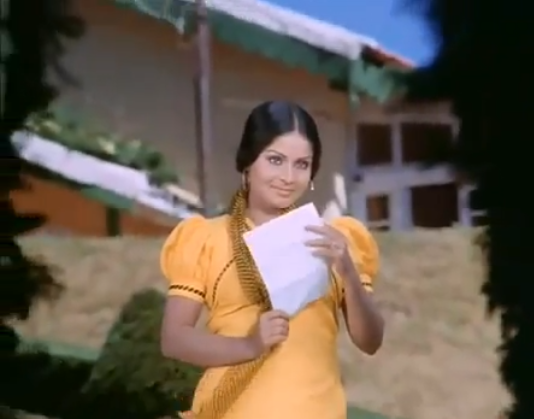
Does anyone even write love letters like this anymore?

Pal Pal Dil Ke Paas: Lyrics and Translation

pal pal dil ke paas tum rahtii ho
You reside forever near my heart,
jiivan miiThii pyaas yah kahtii ho
And you call this life a sweet thirst.

har shaam aa.nkhon par teraa aa.nchal laharaaye
Every evening, the end of your sari flutters over my eyes. 
har raat yaado.n ki baaraat le aaye
And every night, it brings a parade of memories. 
mai.n saa.ns letaa huu.n, terii khushbuu aatii hai
With each breath, I smell your fragrance. 
ek mahkaa-mahkaa saa paighaam laatii hai
It brings along a scented message. 
mere dil kii dhaDkan bhii tere geet gaatii hai
Even my heartbeat sings a song for you. 
pal pal dil ke paas tum rahtii ho
You reside forever near my heart.

kal tujh ko dekhaa thaa, mai.ne apne aangan me.n
Yesterday, I saw you in my own courtyard. 
jaise kah rahii thii tum, mujhe baa.ndh lo bandhan me.n
It was as if you were saying, “Bind me in an eternal bond”
yah kaisaa rishtaa hai? ye kaise sapne hai.n?
What kind of bond is this? What kind of dreams are these?
begaane ho kar bhii kyo.n apne lagte hai.n? 
Despite being so foreign, why do I find them to be intimate? 
mai.n soch me.n rahtaa huu.n, Dar Dar ke kahtaa huu.n 
I remain in contemplation as I hesitatingly declare: 
pal pal dil ke paas tum rahtii ho
You reside forever near my heart. 

tum sochogii kyo.n itnaa mai.n tum se pyaar karuu.n
You might question why I love you so dearly.
tum samjhogii diivaanaa, mai.n bhii iqraar karuu.n
You might think I am crazy, and I would confess to that.
diivaano.n kii ye baate.n, diivaane jaante hai.n
Only a person crazy in love can understand the actions of another,
jalne me.n kyaa mazaa hai, parvaane jaante hai.n
And only moths understand the pleasure found in burning.
tum yuu.n hii jalaate rahnaa, aa aa kar khvaabo.n me.n
Please continue to ignite my passion as you come into my dreams.  
pal pal dil ke paas tum rahtii ho
You reside forever near my heart. 

Glossary

miiThaa: sweet; pyaas: thirst; aa.nchal: decorative end of a sari; laharaanaa: to flutter; baaraat: parade, procession; khushbuu: fragrance; mahka: scented; paighaam: message; aangan: courtyard; bandhan: bond; begaanaa: foreign, alien; Dar Dar ke: hesitaingly, fearfully; iqraar karnaa: to admit, confess; mazaa: pleasure; parvaanaa: moth;  jalaanaa: to ignite; khvaab: dream.

Dharmendra and Rakhee get cozy together in Blackmail (1973).

Pal Bhar Ke Liye Koi Lyrics and Translation: Let’s Learn Urdu-Hindi

Dev Anand gazes longingly at Hema Malini through the kitsch 1970s windows of her living room in Johnny Mera Naam.

Next we present the lyrics and full English translation to “Pal Bhar Ke Liye Koi,” a timelessly catchy Dev Anand jingle from the 1970 blockbuster Johnny Mera Naam. The film became the highest grossing film of Bollywood in the 1970s, and the soundtrack rose with it to glory bringing hits like this playful Kishore solo, the duet “O Mere Raja,” and Lata’s “O Babul Pyaare.” Johnny Mera Naam is an action-thriller-mystery with a splash of glamour by the gorgeous Hema Malini and a touch of class from Pran. Those were the golden days when the name “Johnny” in Bollywood implied the height of suavity, second perhaps only to the villainous sophistication of “Robert!” While the film’s storyline does not quite match up to the genius and spectacle of his earlier films of a similar genre like Jewel Thief (1967), Johnny Mera Naam delivers good clean fun for the whole family.

“Pal Bhar Ke Liye Koi” is one of the all-time cutest songs picturized on screen. Besides the fact that Hema Malini probably wears a saari better than any actress of yesteryear, I love the set design. Hema Malini has to literally shut every single window and blind in the house to keep Dev Anand from singing to her from outside, and the designer was forced to get really creative! I love the painting that’s actually a hidden window and the the strangle holed wall that Dev Anand uses as handcuff props. It’s adorable how he tries to woo her throughout the song, begging her to just pretend to love him–and then the clever zinger of an ending where he throws it back in her face! It’s also one of the last Dev Anand films where I feel like he is still pulling off acting the hero and flirting with younger women. As much as we love him, we wish he had not acted in too many films past this…but that’s another story.

Hema Malini cleverly disguises a window with a traditional oil painting in the wacky fun house of the Johnny Mera Naam (1970) sets.

Below enjoy our English translation of this ever-popular Kishore Kumar song. Did you know that this song was even featured at the end of a Simpsons episode in 2006 entitled, “Kiss Kiss Bangalore”? You’re killing me, people.

Pal Bhar Ke Liye Koi Lyrics and Translation

Pal bhar ke liye koii hume.N pyaar kar le
Let somebody give me momentary love
JhuTa hii sahii
Even if it is false
Do din ke liye koii iqraar kar le
Somebody say yes for a couple of days
JhuTa hii sahii
Even if it is false
Pal bhar ke liye koii hume.N pyaar kar le
Let somebody give me momentary love
JhuTa hii sahii
Even if it is false

Hum ne bahut tujhko chhup chhupke dekhaa
I have often viewed you secretively
Dil pe khiichii hai tere kaajal kii rekhaa
The darkness of your eyeliner is etched on my heart
Kajal kii rekhaa banii Lakshman kii rekhaa
That line has become a line of control now
Ram mei.N kyuu.N tuu ne Raavan ko dekhaa?
Why did you mistake Ram for Raavan?
KhaDe khiDkii pe jogii, swiikar kar le
At your window stands a Yogi, accept him
JhuTa hii sahii
Even if your acceptance is a lie
Pal bhar ke liye koii hume.N pyaar kar le
Let somebody give me momentary love
JhuTa hii sahii
Even if it is false

Hiire se jaDe tere nain baDe
Your big eyes were embedded with diamonds,
Jis din se laDe tere Dar pe paDe
The day our eyes made contact, I was floored,
Sun sun kar terii “nahii.N nahii.N”
Listening to your constant no’s,
Jaa.N apnii nikal jaaye.N na kahii.N
My life may slip away
Zaraa haa.N keh de, merii jaa.N, keh de
Just say yes, my love, say it
Merii jaa.N keh de, zaraa haa.N keh de
Call me “my love,” just say yes
Jab rain paDe ,nahii.N chain paDe
When night falls I have no peace
Nahii.N chain paDe jab rain paDe
I have no peace when night falls

Maanaa tu saare hasiino.N se hasii.N hai
I agree you are the prettiest of the pretty
Apnii bhii surat burii to nahii.N hai
But my face isn’t too bad either
Kabhii tu bhii humaaraa diidaar kar le
Why don’t you sometimes take a look at me?
JhuTaa hii sahii
Even if you are faking
Pal bhar ke liye koii hume.N pyaar kar le
Let somebody give me momentary love
JhuTa hii sahii
Even if it is false

Pal bhar ke pyaar pe nisaar saare jeevan
For a moment of your love, I would sacrifice my entire life
Hum woh nahii.N jo choD de teraa daaman
I am not someone who would leave your embrace
Apne honto.N kii ha.Nsii hum tujhko de.Nge
I will give you the laughter from my lips
Aa.Nsoo tere apni aa.Nkho.N mei.N le.Nge
And I will take the tears from your eyes
Tuu humaari wafaa kaa ek baar kar le
Believe in me just once
JhuTa hii sahii
Even if I’m just lying!

Pal bhar ke liye koii hume.N pyaar kar le
Let somebody give me momentary love
JhuTa hii sahii
Even if it is false

Glossary

jhuuTaa: untrue; iqraar: acceptance; chhup chhupke: secretively; kaajal: eyeliner; Lakshman ki rekha: the circle of protection and control drawn by Lakshman for Sita in the Ramayana; Raavan: the villain of the Ramayana into whose hands Sita temporarily fell (until Raam saved the day once more); khiDkii: window; jogii: yogi; swiikar karna: to accept; hiire: diamonds nain: eyes; Dar: doorstep; jaa.N: life; rain: night; chain: peace of mind; maanaa: agree; hasiino.N se hasii.N: the most beautiful of the beautiful; suurat: face; diidaar: glimpse; nisaar: sacrifice; damaan: embrace; ho.Nto.N: lips; ha.Nsii: laughter; aa.Nsuu: tears; wafaa: faith, belief

Note that I’ve translated “JhuuTaa hii sahii” in many slightly different ways throughout the song’s translation, to match the meaning in each stanzas particular context. But he’s basically always just saying if it’s a lie, that works too.

Hema Malini stops lying to herself and joyfully sings along to Dev Anand’s catchy “Pal Bhar Ke Liye” from Johnny Mera Naam (1970).

My favorite line from the song is from the final antra is: “Pal bhar ke pyaar pe nisaar saaraa jeevan.” Nisaar is such a fabulous Urdu vocabulary word that works so poetically right here before the word saaraa. Unfortunately, this stanza is often missing from most recordings that people have of the song (see our post on songs with hidden stanzas for more!) And without this final stanza in which initially Kishore’s voice becomes the most sweet and sincere of the whole film, you miss the whole surprise ending where Dev Anand shows that he can be just as sassy! Such a shame.

This song request came from one of our absolute favorite readers Bhuvesh! Always, if you have a request for a translation or post, be sure to send us a message!

-Mrs. 55

Plagiarism in Hindi Film Music: Is Imitation the Most Sincere Form of Flattery?

Music directors in the Bollywood industry today are often accused of plagiarizing songs without giving proper credit to the original sources. Pritam Chakraborty, in particular, comes to mind as a composer who has been subjected to such accusations in recent times. Yet, lifting tunes is not a new trend in the industry: its origins can be  traced back to the industry’s earliest days when music directors of the Golden Era composed melodies heavily inspired by unattributed sources. Below, let’s take a listen to some plagiarized works composed by five of the greatest music directors of yesteryear: R.D. Burman, S.D. Burman, Shankar-Jaikishan, Salil Chowdhury, and O.P. Nayyar.

 R.D. Burman

Among the music directors of his time, R.D. Burman was perhaps the most notorious for composing inspired tunes.  Within the list that I’ve provided below, the magnitude of plagiarism varies from song to song. Some numbers below are direct lifts from their originals, such as the cult classic “mahbuubaa mahbuubaa” from Sholay (1975). Others represent more subtle variations of plagiarism: for instance,  the Kishore Kumar classic “dilbar mere kab tak mujhe” only takes it mukhDaa from “Zigeunerjunge” but has original antaras and interludes.  As a musician, I personally feel that the latter form of lifting is somewhat justifiable because it still reflects a level of creativity and originality on the part of the composer. The direct copying of tunes, however, raises ethical concerns and may have even placed music directors like R.D. Burman in legal trouble had such songs been released today.  Regardless of your opinion on this issue, what is universally striking about the list of songs below is the diversity of sources from which R.D. Burman drew his inspiration.  Collectively, the original melodies come from a smorgasbord of musical genres from all over the world: traditional folk, American pop, Greek, German, French, and even Iranian rock!

aao twist kare.n (Bhoot Bangla, 1965)  / “Let’s Twist Again” (Chubby Checker, 1962)
churaa liyaa hai tum ne  (Yaadon Ki Baraat,  1973) / “If It’s Tuesday, This Must Be Belgium” (Bojoura, 1969)
teraa mujhse hai pahle kaa naataa koii  (Aa Gale Lag Ja, 1973)/ “The Yellow Rose of Texas” (Traditional)
mahbuubaa, mahbuubaa (Sholay, 1975) / “Say You Love Me” (Demis Roussos, 1974)
mil gayaa ham ko saathii (Hum Kisi Se Kum Nahin, 1977) / “Mamma Mia” (ABBA, 1975)
jahaa.n terii yah nazar hai (Kaalia, 1981) / “Heleh Maali” (Zia Atabi, 1977)
kaisaa teraa pyaar (Love Story, 1981) / “I Have A Dream” (ABBA, 1979)
dilbar mere kab tak mujhe (Satta Pe Satta, 1982) / “Zigeunerjunge” (Alexandra, 1967)
kahii.n na jaa  (Bade Dilwala, 1983) / “La Vie En Rose” (Edith Piaf, 1955)
tum se milke  (Parinda, 1989) / “When I Need You” (Leo Sayer, 1977)

Zeenat Aman sizzles in “churaa liyaa tum ne” from Yaadon Ki Baraat (1973)

S.D. Burman

Like his son, S.D. Burman has also composed melodies that reflect marked inspiration from foreign sources.  Although we have already investigated the influence of Tagore’s music on S.D. Burman in a previous post, we now observe how his compositions also were inspired by non-Indian genres.  For a composer who was rather traditional in his musical output, who would have imagined that he lifted material from Mexican, Italian, and American country melodies?

chaahe koi khush ho (Taxi Driver, 1954) / “Tarantella” (Traditional)
jiivan ke safar me.n raahii
 
(Munimji, 1955) / “Mexican Hat Dance” (Traditional)
ek laDkii bhiigii bhaagii sii (Chalti Ka Naam Gaadi, 1958) / “Sixteen Tons” (Tennessee Ernie Ford, 1955)
ham the vah thii (Chalti Ka Naam Gaadi, 1958) / “Watermelon Song” (Tennessee Ernie Ford, 1957)
yah dil na hotaa bechaaraa (Jewel Thief, 1967) / “March” (Bridge on the River Kwai, 1957)
saalaa mai.n to sahab ban gayaa (Sagina, 1974) / “Chella Lla” (Renato Carosone, 1959)

The ever-versatile Kishore Kumar stars in a comic role in Chalti Ka Naam Gaadi (1955)

Shankar-Jaikishan

In my opinion, Shankar-Jakishan were the quintessential music directors of Bollywood’s Golden Age. They combined the authenticity of traditional Indian music with the modern sophistication of Western influences to produce songs that appealed to the masses. It’s not surprising that some of their tunes reflect inspiration from foreign influences, but what is remarkable is that several of the songs listed below are remembered today as some of this duo’s most treasured gems.  Two songs from Chori Chori (1956), two songs from Gumnaam (1965), and the title track of Jab Pyar Kisi Se Hota Hai (1961) — among many other hits — were heavily inspired by existing Western numbers. I think you’ll be surprised to see some of your favorites on the list below…

ghar aayaa meraa pardesii (Awaara, 1952) / “Al Balad El Mahboub” (Umm Kulthum)
aajaa sanam madhur chaa.ndnii me.n ham (Chori Chori, 1956) / “Tarantella” (Traditional)
panchii banuu.n uDtii phiruu.n (Chori Chori, 1956) / “Coming Through The Rye” (Traditional)
aigo aigo yah kyaa ho gayaa?
(Boyfriend, 1961) / Stupid Cupid” (Connie Francis, 1958)
jiyaa ho jiyaa kuchh bol do  (Jab Pyar Kisi Se Hota Hai, 1961) / “Broken-Hearted Melody” (Sarah Vaughan, 1959)
sukuu sukuu (Junglee, 1961) / “Sucu Sucu” (Ping Ping, 1961)
dekho ab to kis ko nahii.n hai khabar (Janwar, 1964) / “I Want To Hold Your Hand” (The Beatles, 1963 )
gumnaam hai koii (Gumnaam, 1965) / “Charade” (Henry Mancini and Orchestra, 1963)
jaane chaman sholaa badan (Gumnaam, 1965) / “Autumn Leaves” (Nat King Cole, 1956)
le jaa le jaa meraa dil (An Evening in Paris, 1967) / “Man of Mystery” (The Shadows, 1960)
kaun hai jo sapno.n me.n aayaa? (Jhuk Gaya Aasman, 1968) / “Marguerita” (Elvis Presley, 1963)

Rajendra Kumar definitely breaks conventions of automobile safety during the picturization of “kaun hai jo sapno.n me.n aayaa?” from Jhuk Gaya Aasman (1968).

Salil Chowdhury

Salil Chowdhury’s compositions always reflect an intelligent and sophisticated mastery of music that set him apart from his peers in the industry.  Instead of describing the songs listed here as cases of plagiarism, I would be more likely to categorize them as adaptations. When Salil Chowdhury used another Western melody as an inspiration, he always managed to make it his own by adding something special that would resonate with Indian audiences. Take, for example, the evergreen Talat-Lata duet “itnaa mujhse tu pyaar baDhaa.” Although the mukhDaa is clearly inspired by Mozart’s Jupiter Symphony, Salil composes new antaras that beautifully complement the original melody.  As another example, consider “bachpan o bachpan” from Memdidi (1961).  Inspired by the children’s rhyme “A Tisket, A Tasket,” Salil takes the melody to a new level of complexity by inserting operatic interludes sung by our beloved diva Lata Mangeshkar.  Bravo!

dharti kahe pukaar ke (Do Bigha Zameen, 1953) / “Meadowlands” (Lev Knipper, 1934)
halke halke chalo saa.nvare (Tangewaali, 1955) / “The Wedding Samba” (Edmund Ros and Orchestra,  1950)
dil taDap taDap ke (Madhumati, 1957) / “Szla Dziewczka” (Traditional)
zindagii hai kyaa, sun merii jaan  (Maya, 1961) / “Theme from Limelight [from 3:27] ” (Charlie Chaplin, 1952)
itnaa na mujhse tu pyaar baDhaa (Chhaya, 1961) / “Molto allegro” from Symphony No. 40 (Wolfgang Amadeus Mozart, 1788)
bachpan o bachpan (Memdidi, 1961) / A Tisket, A Tasket” (Traditional)
aa.nkho.n me.n tum ho (Half-Ticket, 1962) / “Buttons and Bows” (Dinah Shore, 1948)

Vijayantimala coyly hides behind a tree in the picturization of “dil taDap taDap ke” from Madhumati (1957)

O.P. Nayyar

O.P. Nayyar is known for his characteristically Western-inspired approach to crafting melodies for Hindi films, but his contribution to our list of directly plagiarized songs is relatively small in comparison to some of his peers in the industry. The most well-known example here is, of course,  the Rafi-Geeta duet “yah hai bambaaii merii jaa.n” which has been lifted from its predecessor “My Darling Clementine.”

baabuujii dhiire chalnaa (Aar Paar, 1954) / “Quizas, Quizas, Quizas(Trio Los Panchos, 1947)
yah hai bambaii merii jaa.n (C.I.D., 1955) / “My Darling Clementine” (Traditional)
lakho.n hai.n yahaa.n dilvaale (Kismat, 1968) / Red River Valley” (Traditional)

Biswajeet hams it up for Babita during the picturization of “lakho.n hai.n yahaa.n dilvaale” in Kismat (1968)

What is your opinion on plagiarism in Hindi film music? Was it acceptable for music directors of this time to lift material from Western sources in order to introduce musical diversity to Indian audiences? Or, is it unethical for such plagiarism to occur without giving credit to the original musicians who created the songs in the first place? Let us know in the comments, and feel free to share any examples that go along the theme of this post!

-Mr. 55

Chingari Koi Bhadke Lyrics and Translation: Let’s Learn Urdu-Hindi

Rajesh Khanna Sharmila Tagore Amar Prem

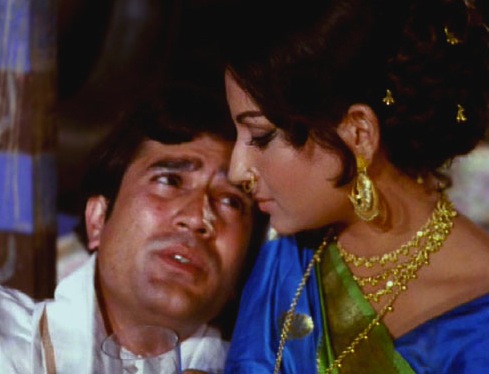
Aided heavily by hard liquor, Rajesh Khanna slips into philosophical discourse gazing at the beautiful Sharmila Tagore in Amar Prem (1972).

Our next English translation, the beautiful lyrics of “Chingari Koi Bhadke,” comes from the eternal love story Amar Prem (1972). Anand Bakshi outdoes himself with these philosophical, thought-provoking lyrics on the nature of life and the inevitability of Fate. Like other masterpieces songs of the sharaab genre in Bollywood, “Chingari Koi Bhadke” glorifies the opportunity to escape societal boundaries through alcohol.

Sung by Rajesh Khanna favorite, Kishore Kumar, “Chingari Koi Bhadke” has some of the greatest lines written in Bollywood music: “Madiira jo pyaas lagaaye, use kaun bhujaaye?” echoes the lines of the great 1935 Hindi poem by Harivanshrai Bachhan, “Madhushala”:

Kya mai.N madhushala ke andhar? Ya mere andhar madhushala?”

Indeed, the theme of an inner thirst can be found in Indian art from time immemorial–whether from spiritual seekers rejecting worldly materialism, or from thwarted lovers searching for a way out.

Amar Prem tells the story of a man trapped in a loveless marriage (Rajesh Khanna) who falls for the golden-hearted brothel songstress, Sharmila Tagore. Although both realize the world will never accept the purity of their love for one another, they remain faithful to their shared ideal of “amar prem” even as they are forced apart. Rajesh Khanna and Sharmila Tagore eventually grow older, not knowing what became of the other, but in separate ways undergo a spiritual transformation sparked by the love they shared. This immortal song, like others in the film by versatile maestro R.D. Burman (eg. “Kuch To Log Kahenge” and “Yeh Kya Hua”) is both a critique on an unforgiving society and a resignation to the laws of Nature. Intoxication itself, the profundity of these lyrics take several passes to completely envelop you, so go slowly and enjoy the full lyrics and our English translation of “Chingari Koi Bhadke” below!

Rajesh Khanna Amar Prem

Rajesh Khanna plays a good-hearted alcoholic trapped by the fetters of societal propriety in Amar Prem (1972).

Chingari Koi Bhadke Lyrics and Translation:

Chingaari koii bhadke
If someone lights a spark
To saawan use bujhaaye
Then the rains will put it out
Saawan jo agan lagaaye, use kaun bhujaaye?
But if the rains start a fire, who will put it out?

PatajhaD jo baagh mei.n ujaaDe
If a garden is destroyed in the Autumn
Woh baagh bahaar khilaaye
It will bloom again in the Spring
Jo baagh bahaar mei.N ujade, use kaun khilaaye?
But who can revive the garden that is destroyed in Spring?

Hum se mat poochho kaise
Do not ask me how
mandir TooTaa sapno.N kaa
The temple of my dreams shattered
Logo.N kii baat nahii.N hai
This is not a matter for everyone to discuss
Yeh qissa hai.N apno.N kaa
This tale is only for my own circle

Koi dushman thhais lagaaye
If an enemy strikes you a blow
To miit jiyaa bahalaaye
Then your beloved will nurse you
Manmiit jo ghaav lagaaye, use kaun mitaaye?
But who can nurse the wounds your beloved strikes?

Na jaane kya ho jaataa
I do not know what happens
Jaane hum kyaa kar jaate
I do not know what would happen
Peete hai.N to zindaa hai.N
If I drink, then I live
Na peete, to mar jaate
If I do not drink, then I die

Duniyaa jo pyaasaa rakhe
If the world is thirsty
To madiiraa pyaas bujhaaye
Then wine can slake that thirst
Madiiraa jo pyaas lagaaye, use kaun bujhaaye?
But who can slake the thirst caused by wine?

Maanaa toofaan ke aage
I agree that before a storm
Nahii.N chaltaa zor kisii kaa
No one can use force
Maujo.N ka dosh naii.N hai
Yet this is not the fault of the waves
Yeh dosh hai aur kisi kaa
It is the fault of someone else

Majhadaar mei.N naiyaa Doobe
If a boat starts to rock midstream
To maajhi par lagaaye
The boatman can lead it to shore
Maajhi jo naaw Dooboye, use kaun bachaaye?
But if the riverman drowns the boat, who can save it?

Chingaari koii bhadke
If someone lights a spark
To saawan use bujhaaye
Then the rains will put it out
Saawan jo agan lagaaye, use kaun bhujaaye?
But if the rains start a fire, who will put it out?

Glossary:

chingari: spark;  agan: fire; patajhaD: Autumn; baagh: garden; bahaar: Spring; mandir: temple; qissa: story, tale; dushman: enemy; thhais: blow; ghaav: wound; zindaa: alive; pyaasaa: thirsty; madhiira: spirits; toofaan: storm; zor: force, dosh: fault; majhdaar: midstream; Doobnaa: to drown; maajhi: boatman; naaw: small boat

Sharmila Tagore Amar Prem

Oh, Sharmila! Is there any commentary anyone can really give you for your divinely majestic presence in this film??!

No, Sir, they sure don’t make songs like they used to. I love the elegance and seeming simplicity of the picturization for this song. No big ruffles or fireworks–just a beautiful traditional instrumentation for background and a metaphorical boat ride filled with meaningful glances and serious faces. Could a song this classy even exist today?

-Mrs. 55

Jis Gali Mein Tera Ghar Na Ho Balma Lyrics and Translation: Let’s Learn Urdu-Hindi

Rajesh Khanna serenades Asha Parekh in one of Hindi cinema’s most treasured boat songs from Kati Patang (1970)

If you’ve been following the latest news about Bollywood stars (as you should be), you might be aware of the fact that Rajesh Khanna has been hospitalized recently for exhaustion and a stomach infection. In light of this news, I thought I’d share one of my favorite songs picturized on the Bombay superstar and send along our best wishes for a speedy recovery. Below, I’ve provided the lyrics and a translation for “jis galii me.n teraa ghar na ho baalma,” a beautiful number sung by Mukesh in Kati Patang (1970).

Mukesh singing for Rajesh Khanna? Blasphemy, you might say. As we all know, Kishore Kumar was officially the playback voice for India’s beloved ‘Kaka,’ and you might hear a pairing with Mohammed Rafi on occasion. But a Mukesh song picturized on Rajesh Khanna, let alone a popular one, is quite rare indeed.

In spite of the unconventional pairing, this song from Kati Patang is an all-time classic that has been cherished by fans of Hindi cinema over the years. The beauty in the simplicity of Anand Bakshi’s lyrics here is striking. Expressing the the theme of selflessness in love, these lyrics are unique when placed into context of the film. Rajesh Khanna’s character uses this song to profess his love for Asha Parekh, a woman pretending to be a widow after fleeing the altar. At a time when societal norms prevented such women from marrying again, using such romantic lyrics to describe the love between a man and an ostensible widow is a bold move. In his inimitable style, Mukesh gives one of his career’s best performances as he sings these lyrics with sincerity and a tinge of melancholy.  To top it all off, R.D. Burman composes a simple, yet touching melody that does justice to the beauty of these lyrics. Enjoy this poignantly crafted declaration of love with our glossary and translation below!

-Mr. 55

Playing the role of a supposed widow, Asha Parekh wears a white sari throughout most of this film.

Jis Gali Mein Tera Ghar Na Ho Balma: Lyrics and Translation

jis galii me.n teraa ghar na ho baalma
Any  street on which your house does not reside
us galii se hame.n to guzarnaa nahii.n
is not a street that I shall traverse.
jo Dagar tere dvaare pe jaatii na ho
Any path that does not lead to your door
us Dagar pe hame.n paa.nv rakhnaa nahii.n
is not a path on which I shall set foot.

zindagii me.n kaii rangraliyaa.n sahii
In my life, there have been many colorful celebrations.
har taraf muskuratii ye kaliyaa.n sahii
In every direction, there are smiling flowerbuds
khuubsurat bahaaro.n kii galiyaa.n sahi
and many beautiful views of springtime.
jis chaman mei.n tere pag me.n kaa.nTe chubhe.n
Yet, the garden in which thorns pierce your feet 
us chaman se hame.n phuul chunnaa nahii.n
is not a garden from which I shall pick flowers.

haa.n ye rasme, ye qasame.n sabhii toD ke
Yes, after having broken these rituals and vows,
tu chalii aa chunar pyaar kii oDh ke
please come to me, flying your scarf of love in the air.
yaa chalaa jaauu.nga mai.n yah jag chhoD ke
Or else, I shall go away and leave this world.
jis jagah yaad terii sataane lage
The place where your memories begin to torture me
us jagah ek pal bhii Thaharana nahii.n
is not a place where I shall spend a single moment.

jis galii me.n teraa ghar na ho baalma
Any  street on which your house does not reside…

Glossary

galii: street, alley; baalma: beloved; Dagar: path; dvaaraa: door; rangraliyaa.n: colorful celebrations; kaliyaa.n: flower buds; chaman: garden; pag: foot; chubhnaa: to pierce; rasm: ritual, ceremony; qasam: vow; chunar: scarf; jag: world; sataanaa: to torture.

Rajesh Khanna charms the audience with his characteristic smile.

This song was filmed on site at Lake Nainital in Uttarakhand, India.