Sansaar Se Bhaage Phirte Ho Lyrics and Translation: Let’s Learn Urdu-Hindi

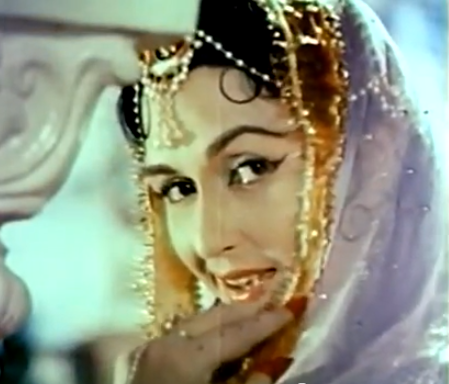
Meena Kumari stars as an enchanting courtesan in Chitralekha (1964)

Sahir Ludhianvi’s lyrical genius as an Urdu poet is widely known, but his poetry in pure Hindi is considerably less prolific. While Sahir churned out gem after gem of Urdu shayari in films such as Taj Mahal and Gumraah, his output in pure Hindi is limited to a handful of films. Sahir’s first foray into the field of Hindi poetry occurred in the soundtrack for Chitralekha (1964), a film directed by Kidar Sharma based on a novel by the same name written by Bhagawati Charan Verma in 1934. The story revolves around the protagonist Chitralekha (played by Meena Kumari), a widowed courtesan who seduces men to their doom with her beauty in the court of King Chandragupta Maurya. Prince Bijgupt (played by Pradeep Kumar) is one of her many admirers, and his lust for Chitralekha prevents him from fulfilling his royal duties. Kumar Giri (played by Ashok Kumar) is a conflicted holy man whose spirituality wavers when faced with the temptation of Chitralekha’s physical charms. Overall, the film questions the philosophical significance of sin and virtue by tracing Chitralekha’s development from being a haughty courtesan to a humble ascetic. Despite this film’s compelling narrative and exploration of uncoventional themes, it failed to achieve success at the box office, especially when compared to its 1941 predecessor (the second highest grossing film of the year!). The mediocre box office performance has been attributed to miscasting of the main characters and a poorly written script.
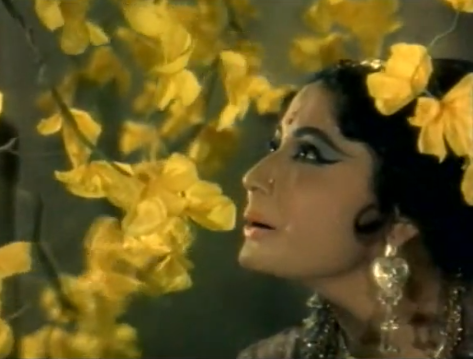
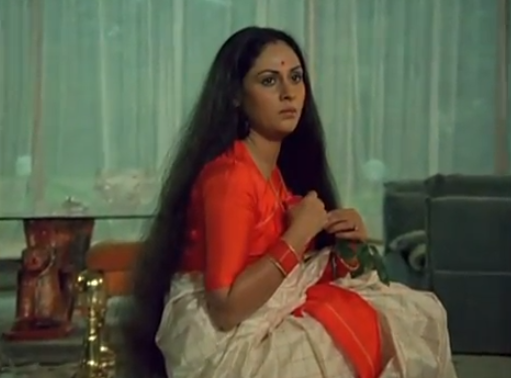
Meena Kumari sings the line “apaman rachetaa kaa hogaa, rachnaa ko agar Thukraaoge” amidst a setting of flowers, which symbolize the natural beauty of creation.

Given the lackluster audience reception at the time of its release, this film is generally remembered today for its soundtrack composed by Roshan and penned by Sahir Ludhianvi. The two songs that are the most well known from this film are the Rafi solo “man re tu kaahe na dhiir dhare” and “sa.nsaar se bhaage phirte ho,” the Lata solo that I’ve chosen to translate today. Based on Raga Yaman Kalyan, this song is a  beautifully crafted statement against spiritual hypocrisy. Through his words, Sahir rejects the conception of sin and virtue established by organized religions in favor of a philosophy of universal hedonism. In context of the film, Chitralekha uses this song to mock Kumar Giri’s ascetism after he patronizes her with a sermon about giving up her sinful lifestyle in order to attain spiritual enlightenment. My favorite part of this song is probably when Chitralekha sings the clever and incisive line: “apaman rachetaa kaa hogaa, rachnaa ko agar Thukraaoge” (It will be an insult to the Creator himself, if you reject the act of creation). This song is full of feisty one-liners like this, so please take a listen to the song and follow along with translation/glossary below if you’d like to hear more. To conclude, I think we can all agree that Sahir does not disappoint here and proves his versatility poet who is equally comfortable writing lyrics in shuddh Hindi as he is in Urdu. Very impressive, indeed–enjoy!

-Mr. 55

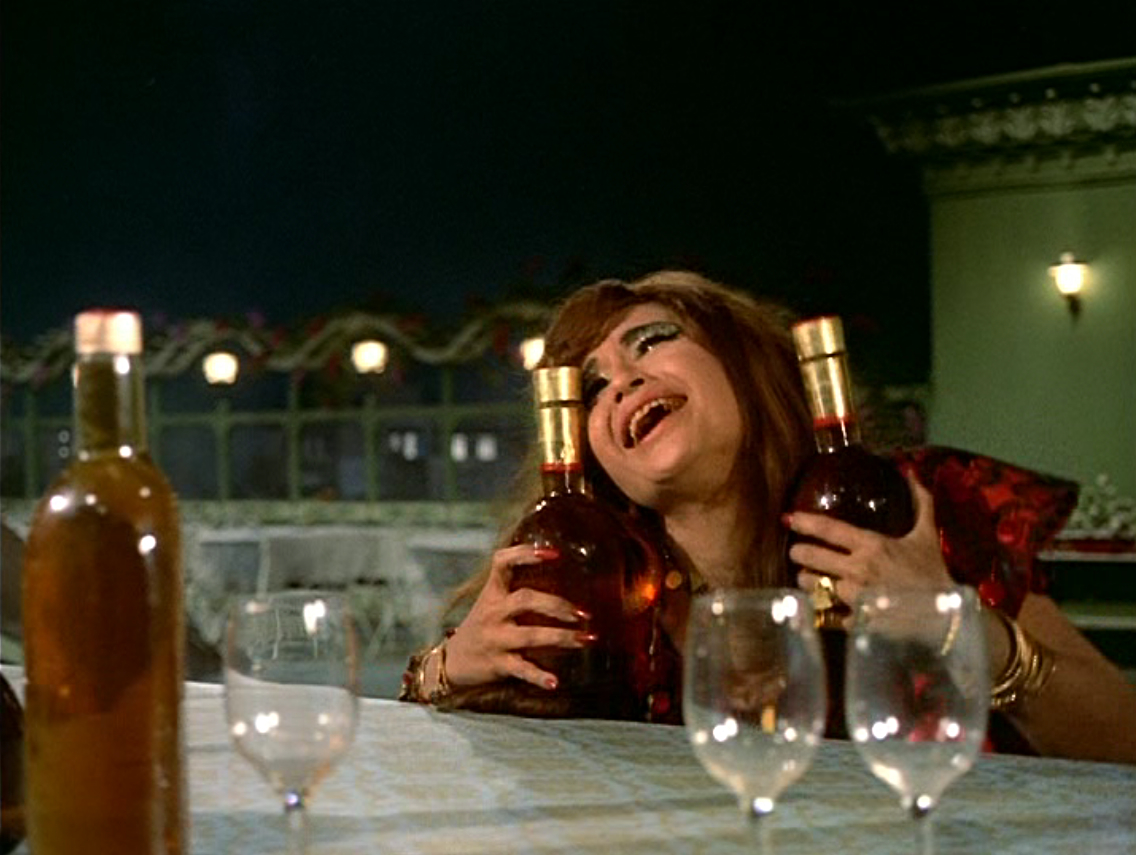
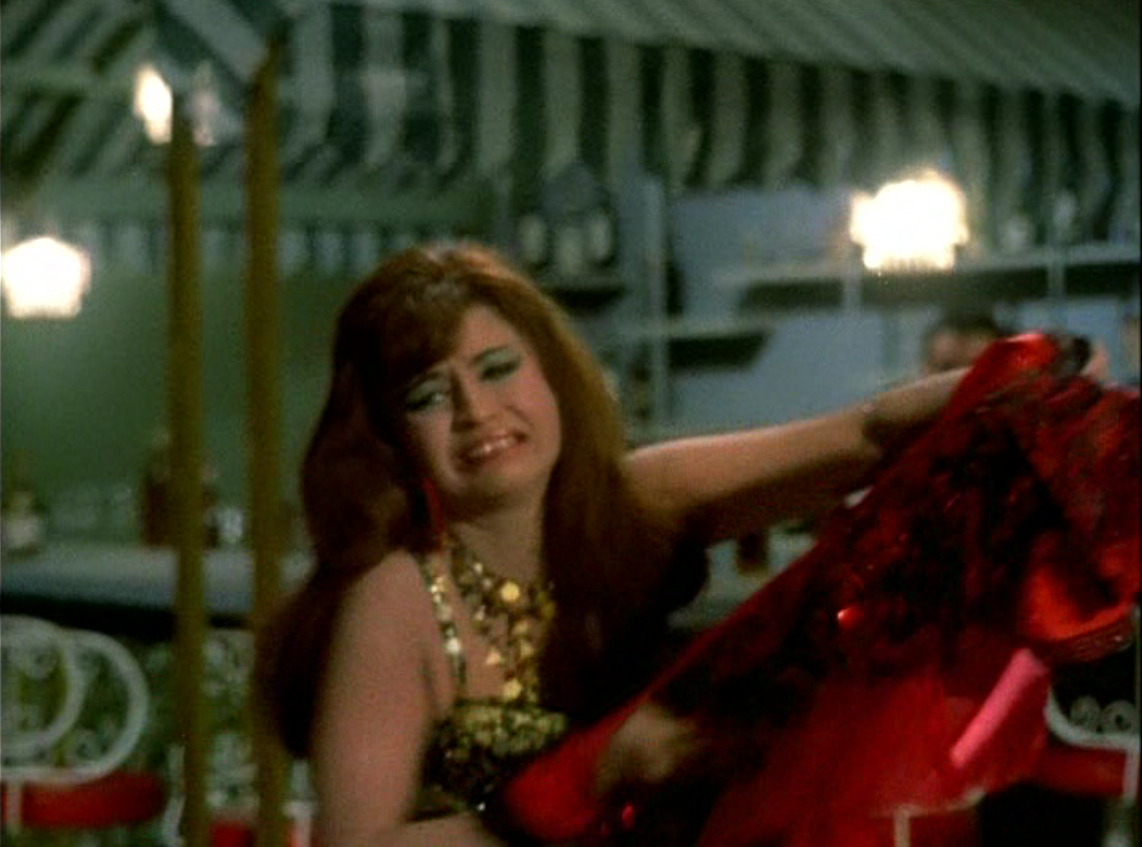
Meena Kumari stumbles under the intoxication of wine in the company of her harem.

Sansar Se Bhage Phirte Ho Lyrics and Translation

sa.nsaar se bhaage phirte ho, bhagvaan ko tum kyaa paaoge?
As you flee from society, how will you find God?
is lok ko apnaa na sake, us lok me.n bhii pachataaoge.
You didn’t consider this world as your own, and you will repent it in that world. 

 ye paap hai.n kyaa, ye punya hai.n kyaa? riito.n par dharm kii mohare hai.n
What is sin and what is virtue? Religion uses such traditions as mere facades. 
har yug me.n badalte dharmo.n ko kaise aadarsh banaaoge?
How will you idealize the changing religions of every age?

yeh bhog bhii ek tapsaya hai, tum tyaag ke maare kyaa jaano?
This suffering is also a form of penance; what would you know, you renunciation-stricken fool?
apaman rachetaa kaa hogaa, rachnaa ko agar Thukraaoge.
It will be an insult to the Creator himself, if you reject the act of creation. 

ham kahte hai.n yah jag apnaa hai, tum kahte ho jhuuTha sapna hai.
I claim that this world is mine; however, you consider it a false dream.
ham janam bitaa kar jaaye.nge, tum janam gavaa kar jaaoge.
I will live life to the fullest, but you will waste yours in vain. 

sa.nsaar se bhaage phirte ho, bhagvaan ko tum kyaa paaoge?
As you flee from society, how will you find God?

Glossary 

sa.nsaar: society; bhagvaan: God; pachataanaa: to repent, regret; lok: world; paap: sin; punya: virtue; riit: tradition; dharm: religion; mohara: front, facade; aadarsh banaanaa: to idealize; bhog: suffering;  tapasya: penance; tyaag ke maare: struck with renunciation; apaman: insult; rachetaa: the Creator; rachnaa: to create; Thukraanaa: to reject, disapprove;  jag: world.

Ashok Kumar plays the role of the conflicted holy man Kumar Giri in Chitralekha (1964)

Roop Tera Mastana Lyrics and Translation: Let’s Learn Urdu-Hindi

Rajesh Khanna Sharmila Tagore HOT Aradhana

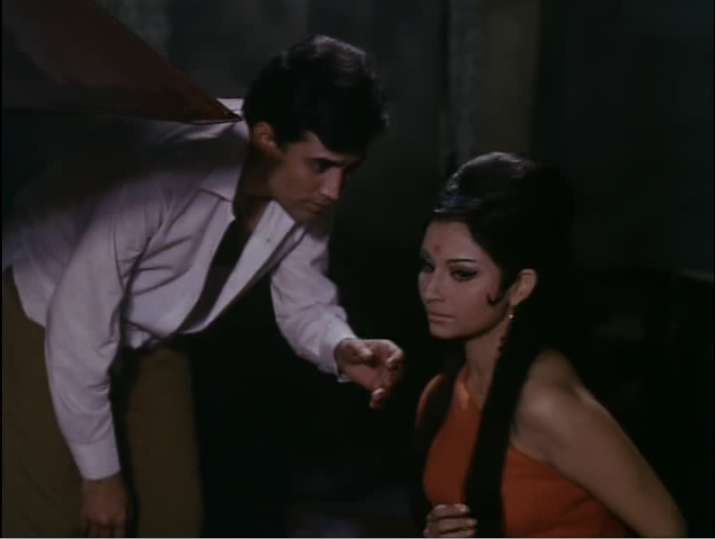
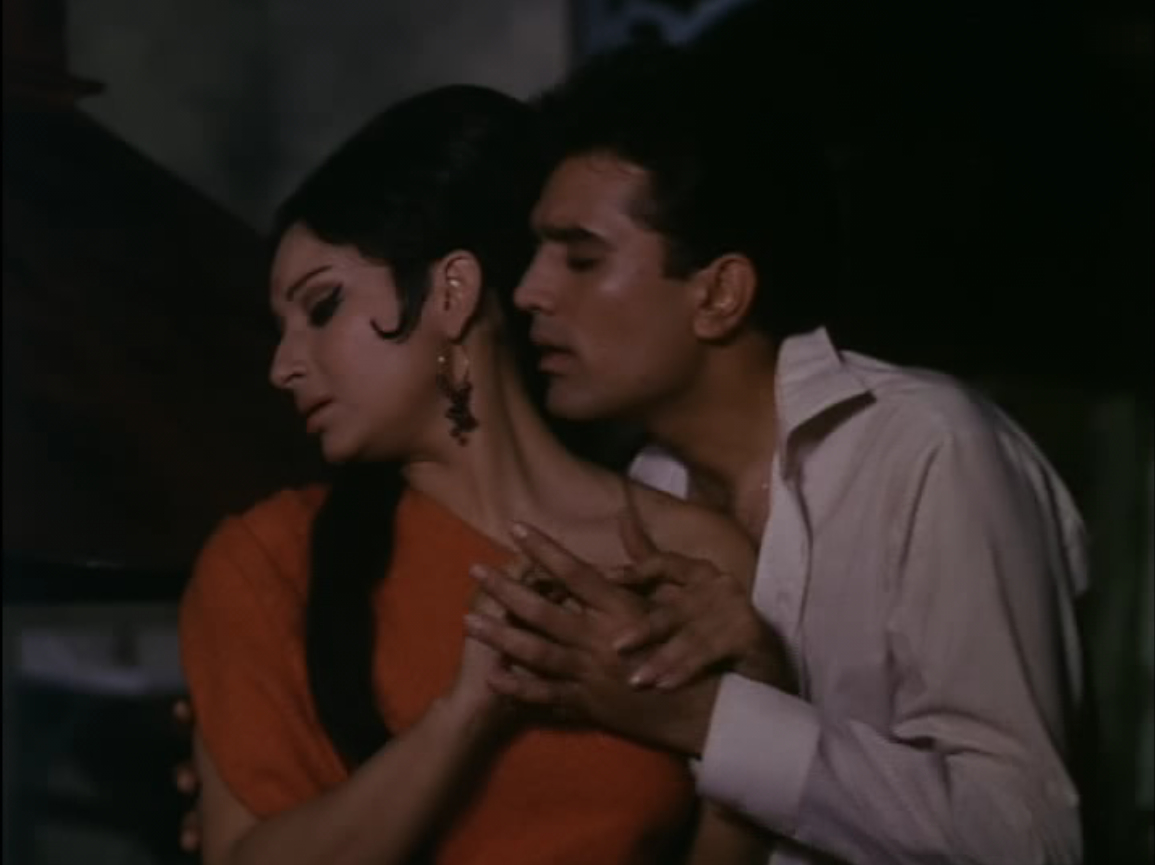
Rajesh Khanna and Sharmila Tagore get too close for comfort in “Roop Tera Mastana” from Aradhana (1969)

Our next post brings you the full lyrics and English translation of the all-time hit “Roop Tera Mastana” from Aradhana (1969). The film stars one of Bollywood’s favorite on-screen couple: the dashing Rajesh Khanna and the elegant Sharmila Tagore. Now this song gets a little racy, so for everyone who isn’t sure they can handle it, please direct yourselves to our G-rated posts (see Rabindranath Tagore’s Influence on S.D. Burman) at this time. Everyone else, grab a seat and a drink of water because it’s about to get a little hot in here.

One of the things I love most about “Roop Tera Mastana” is the cinematography (check out the youtube link here!). The entire song (roughly 4 minutes) is shot in a single long take! The camera swirls around the fire following Rajesh Khanna making his moves on Sharmila, without ONCE cutting for an insert or change in camera angle.

For this to succeed, not only do both the actor and actress need to know exactly where to start and stop with every movement they make during the sequence (any small shift could result in a loss of camera focus), but there is an elaborate dolly track for the camera also laid out all around the floor that they have to be careful not to trip on as they move. And every time the dolly men, the grip guy, the pull-focus team, or heaven-forbid the actors screw up in the 4 minutes you need per take, you start all over again, lose valuable film stock, and probably get a public slap in the face. Check stills from this sequence below!

Rajesh Khanna Sharmila Tagore2

Rajesh Khanna swoops in for the kill.

Rajesh Khanna Sharmila Tagore3

Sharmila Tagore senses danger and edges away.

Oh, awkward–Sharmila and Rajesh bump into each other unexpectedly.

Sharmila: To give in or not to give in??!

Rajesh Khanna rushes in from the other side.

Well…maybe this idea isn’t so bad after all…

Sharmila gets so on board, she starts to be a little aggressive.

Things are just getting out of control now with Rajesh and Sharmila.

Gorgeous Rajesh Khanna is abandoned, bursting with chest hair.

Gotcha! Just when you thought you thought you had given him the slip.

It’s super tense in that room, and I’m not just talking about Sharmila’s sternocleidomastoids.

In the film Aradhana (1969), Sharmila Tagore and Rajesh Khanna have both just come from getting secretly married in a private temple ceremony. They happen upon a shelter lodge, and obviously consummating the marriage is all over Rajesh Khanna’s mind.

Interestingly, the camera itself becomes complicit in the scene. Like the actors themselves, the camera too encircles the fire as if echoing the hallowed rites of Hindu marriage, the saath phere (or seven circles), that give sanctity to their union. It is as if the audience is now the testifying witness of the validity of their marriage, and the camera hesitates–sometimes pausing, sometimes rushing just like the whirlwind of conflicting emotions in the scene. It is extremely symbolic and by eliminating all cutting, the long take seems to slow time down as we grasp the moral and social complexities of this moment, as well as build the tension of what is imminent. Enjoy our English translation of the lyrics of this all-time classic and let us know your opinions in the comments!

Roop Tera Mastana Lyrics and Translation

Roop tera mastana pyaar mera diwaanaa
Your beauty is intoxicating, my love is crazy
Bhool koi humse na ho jaaye
Let me not commit a wrong

Raat nasheelii mast samaa hai
The night is lush, the atmosphere is intoxicating
Aaj nashe mei.N saara jahaa.N hai
Today the whole world seems drunk
Haa.N yeh sharaabii mausam behkaaye
Yes, this intoxicated atmosphere has enticed us
Roop tera mastana pyaar mera diwaanaa
Your beauty is intoxicating, my love is crazy

Aankho.N se aankhe.N miltii hai.N aise
Our eyes met like this
Bechain hoke toofaa.N mei.n jaise
Becoming restless like a storm
Mauj koi saahil se takraaye
Like a wave crashing toward the shore
Roop tera mastana pyaar mera diwaanaa
Your beauty is intoxicating, my love is crazy
Bhool koi humse na ho jaaye
Let me not commit a wrong

Rok rahaa hai hum ko zamaanaa
The world is stopping us
Duur hii rehna paas na aana
We must stay apart and not come closer
Kaise magar koi dil ko samjhaaye?
But how can anyone make our hearts understand this?
Roop tera mastana pyaar mera diwaanaa
Your beauty is intoxicating, my love is crazy
Bhool koi humse na ho jaaye
Let me not commit a wrong

Glossary

roop: beauty; mastaana: intoxicating; diiwaanaa: crazy (in love); bhool: mistake, wrong; nasheelii: lush; samaa: atmosphere; nashe mei.N: drunk; mausam: atmosphere; bechain: restless; toofaa.N: storm; mauj: wave; saahil: shore; zamaanaa: the world

Notice how no one actually gets close to kissing each other in the sequence. I mean, you’d think it happened if you looked at some of these still shots, but in reality the closest thing to physical contact that occurs in this whole sequence is when they hold hands and half-way hug. It would have been awkward, but they pretend like they’re kissing so well, that you hardly notice that no one has touched each other. Oh, the magic of Bollywood!

For more from the magical soundtrack of Aradhana, check out our translation of “Kora Kaagaz Tha” here!

-Mrs. 55

Meera Bhajans as Film Songs: The Saintlier Side of Bollywood

Meera-bai (c. 1498-1547 A.D) was a mystical poet and devotee of Lord Krishna

When most people think of Bollywood cinema, they usually think of extravagant costumes, seductive dance moves, and lots of melodramatic overacting. While all this extravagance is certainly an integral aspect of the industry, you may be surprised to learn about a saintlier side of Bollywood that I will discuss here today: the use of Meera-bai’s texts in Hindi film music.

Meera-bai was a 16th-century mystic whose devotion to Lord Krishna has been immortalized in Indian culture through her poetry and bhajans (religious songs). Meera, a Rajput princess, was married off to a prince at young age, but this marriage did not satisfy her as she already  considered herself the spouse of Lord Krishna. Her husband died in battle soon after their marriage and Meera became a widow at an early age. Meera transformed her grief into spiritual devotion and wrote many poems in praise of Lord Krishna.  In her texts, she worships Krishna from the perspective of a lover longing for union: romantic on one level and spiritual on another. Although her undying devotion to Krishna was initially a private matter, public moments of spiritual ecstasy soon outed her to society. Eventually, her brother-in-law became displeased with her excessive devotion for Krishna and made several attempts on Meera’s life. The most well-known story describes how he poisoned Meera’s prasad and made her drink it, but the Lord transformed the poison into amrit (spiritual nectar) to save her life.

Meera-bai’s texts express themes that are highly pertinent to  heroines in Hindi cinema from the Golden Era. Interpreting and contextualizing Meera’s love for Lord Krishna can be a challenging task, however, because of its apparently paradoxical relationship to acceptable gender norms for women at the time. On one hand, Meera could be considered the ideal Indian woman for the eternal devotion she displays toward her lover–in this case, Lord Krishna–in spite of all the obstacles placed in her way. The type of selfless devotion and sacrifice Meera-bai displays toward Krishna is the same type of devotion that Indian women in the chauvinistic climate of the ’50s and ’60s were expected to provide their husbands.  On the other hand, Meera-bai actually subverts the typical pativrata norms established by Indian society because her devotion is misplaced. Instead of serving her human husband, Meera devotes all of her love to Krishna, which is inconsistent with society’s expectations for the dutiful and virtuous Indian wife. This is further complicated by the fact that Meera, in her mind, actually considered herself to be the wife of Krishna (and supposedly conducted a marriage ceremony with a Krishna idol at a temple).

In any case, it is undeniable that Meera’s texts contain universal themes about love, pain, and devotion that have permeated several mediums of the South Asian cultural sphere. Here, let’s analyze a couple of examples in order to see how Meera’s words have been used in the context of Hindi film songs:

pag ghungruu bandh miiraa nachii re (Meera, 1947): Meera (1947) is a rare treat for lovers of Bollywood films because it is the only Hindi film ever made that features M.S. Subbulakshmi as both an actress and playback singer. M.S. Subbulakshmi, who was the first musician to be awarded the prestigious Bharat Ratna, is one of the most renowned vocalists in the history of the Carnatic musical tradition. Her singing is ethereal and sublime, and many people have praised her by saying she is modern-day personification of Meera-bai herself! Although she retired from films early in her career to pursue classical concert music, her portrayal of Meera in this film is remembered to this day for its natural and pure expression of spiritual divinity.  Words don’t do this woman justice, so just click the link and take a listen for yourself. I’ve selected one of about 20 Meera bhajans that are found in the film; in this particular poem, Meera uses the metaphor of dance to describe her love for the Lord. You may have noticed that the first line of this bhajan was used in another (much less saintly) Bollywood classic rendered by Kishore Kumar and composed by Bappi Lahiri from Namak Halaal (1982) decades later.

M.S. Subbulakshmi embodies the spiritual divinity of Meera-bai in the 1947 Hindi remake of the Tamil film Meera. 

ghunghaT ke paT khol re, tohe piiyaa mile.nge (Jogan, 1950): I have always thought that one of Geeta Dutt’s strengths as a singer was her rendition of bhajans. She shines here in this Raga Jaunpuri-based devotional composed by Bulo C Rani that has some beautiful words penned by Meera-bai. Literally, the first line translates roughly as  “remove your veil so that you can get a glimpse of your beloved.” However, on a deeper level, Meera-bai is using the veil as a metaphor for ignorance–she is asking us to remove our veils of ignorance so that we can be closer to the Lord.

erii mai.n to prem divaanii, meraa dard na jaane koii (Nau Bahar, 1952): Lata Mangeshkar is brilliant in her rendition of this Raga Bhimpalasi-based bhajan composed by Roshan and picturized on Nalini Jaywant  in Nau Bahar. Inspired by a Meera-bai poem, the words here describe how Meera’s devotion to the Lord can is best expressed through love, as she is unfamiliar with the traditional rites and rituals of worship.

 jo tum toDo piiyaa, mai.n naahii.n toDuu.n  (Jhanak Jhanak Payal Baaje, 1955):  V. Shantaram’s Jhanak Jhanak Payal Baje was one of India’s first technicolor films when it was released in 1955.  In this Filmfare award-winning film, when the character played by Sandhya fears that she has destroyed her beloved’s (played by Gopi Krishna) dancing career, she becomes so depressed that she decides to reject all wordly pleasures and become an ascetic like Meera-bai. This Bhairavi-based bhajan composed by Vasant Desai is rendered beautifully once again by Lata, who succeeds in expressing the sentiment of Meera’s words about unconditional devotion to her Lord even if he is not faithful to her.

piyaa ko milan kaise hoye rii, mai.n jaanuu.n naahii.n (Andolan, 1977)Asha Bhonsle tends to employ a lot of over-the-top histrionics in her songs, but music director Jaidev manages to get Asha at her pure, unadulterated best with this soulful composition from Andolan picturized on Neetu Singh.

mere to giriidhhar gopaal, duusro na koii  (Meera, 1979): Directed by lyricist Gulzar, this film is yet another Bollywood biopic about Meera-bai, and Hema Malini takes the starring role here. Despite high hopes, this film achieved only moderate success at the box office. However, the film’s soundtrack of  compositions by sitar virtuoso Pandit Ravi Shankar has certainly left a memorable legacy. In this particular poem, Meera-bai’s words express her singular devotion to the Lord; there is no one else in the world for her except for her Lord Krishna. While Hema falls a little flat in her portrayal of Meera, Vani Jairam actually does a great job expressing the appropriate emotions needed in this rendition and in the rest of the songs on the soundtrack. However, as you may have suspected, Vani was not Ravi Shankar’s first choice of singer for this film–his first choice was none other than Lata Mangeshkar. Lata, however, turned him down, by using the following reasoning:

“How could I? I had already done Meera bhajans for my brother Hridaynath.”

Now, don’t get me wrong, I love the non-filmi album of Meera bhajans released by Lata and Hridaynath. In fact, Lata’s rendition of a similar text  “mhara re giridhhar gopaal, duusra na koii” tuned by Hridaynath for this album is absolutely exquisite. However, her reasoning here doesn’t really make sense to me. Even before her album for Hridaynath, Lata had sung plenty of Meera bhajans for films (see above!) under the baton of other music directors, so I don’t see how this excuse constitutes a legitimate reason to refuse singing in this film. I suspect that her refusal had more to do with some lingering bad blood between her and Ravi Shankar from their prior collaboration on Anuradha (1960): apparently, tensions had flared between the two of them because Lata had failed to show up to a recording session of “saa.nvare saa.nvare” without prior notice. 

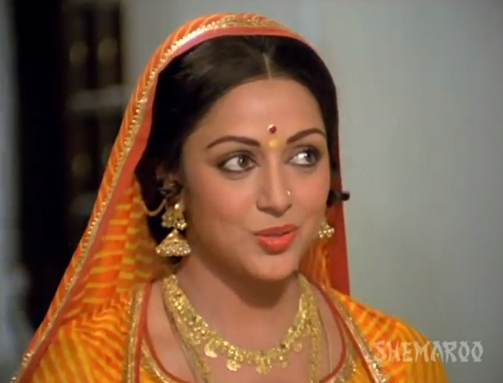
Hema Malini is way too attractive to pull off being an ascetic in Meera (1979)

 jo tum toDo piiyaa, mai.n naahii.n toDuu.n  (Silsila, 1981): Although this text is similar to the Jhanak Jhanak Payal Baje song listed above, the melody is quite different because music directors Shiv-Hari have tuned this song to the Raga Chandrakauns, an underused raga that is quite rare in the filmi musical sphere. Lata, unfortunately, sounds a bit past her prime here, but this song is still memorable for Meera-bai’s words and their relevance to the contemporary situation at hand in the film. Similar to the real-life rumors that were rampant at this time, Jaya Bacchan’s character suspects that her husband (played by Amitabh Bacchan) is having an extramarital affair with another woman (played by Rekha). Meera-bai’s lyrics express the anguish and torment that Jaya feels in response to her husband’s infidelity, but she resolves to remain faithful to him even though he is not faithful to her. Interestingly, things also turned out this way in real life–Jaya stayed with Amitabh even though it was widely known within the film community that he had cheated on her with Rekha.

Jaya Bacchan laments her husband’s infidelity in Silsila (1981). Look at those eyes!

What are some of your favorite bhajans featured in Bollywood films? Let us know in the comments!
–Mr. 55

How To Dance Like Bollywood’s Helen

Helen Piya Tu Ab To Aaja

Helen, Queen of the Nautch Girls, makes Bollywood history with her wild dance moves in “Piya Tu Ab To Aaja” from Caravan (1971).

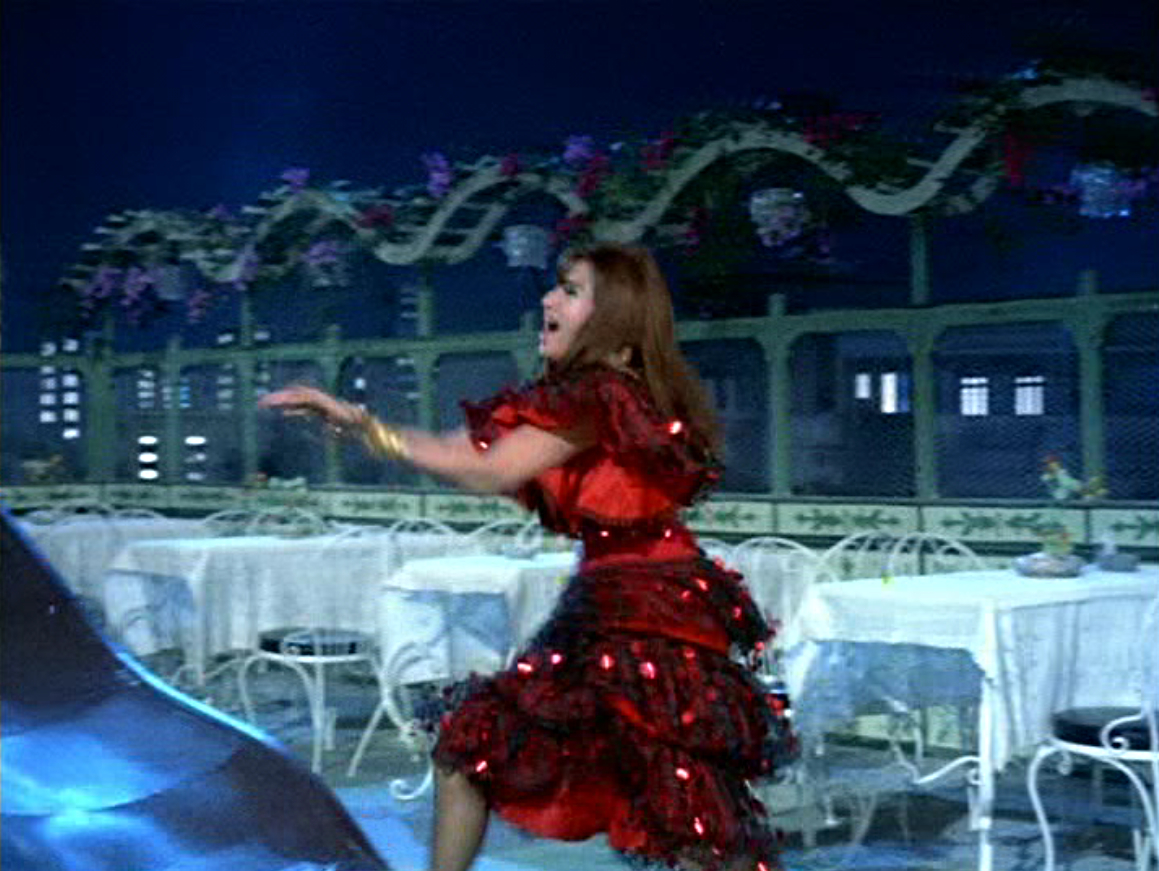
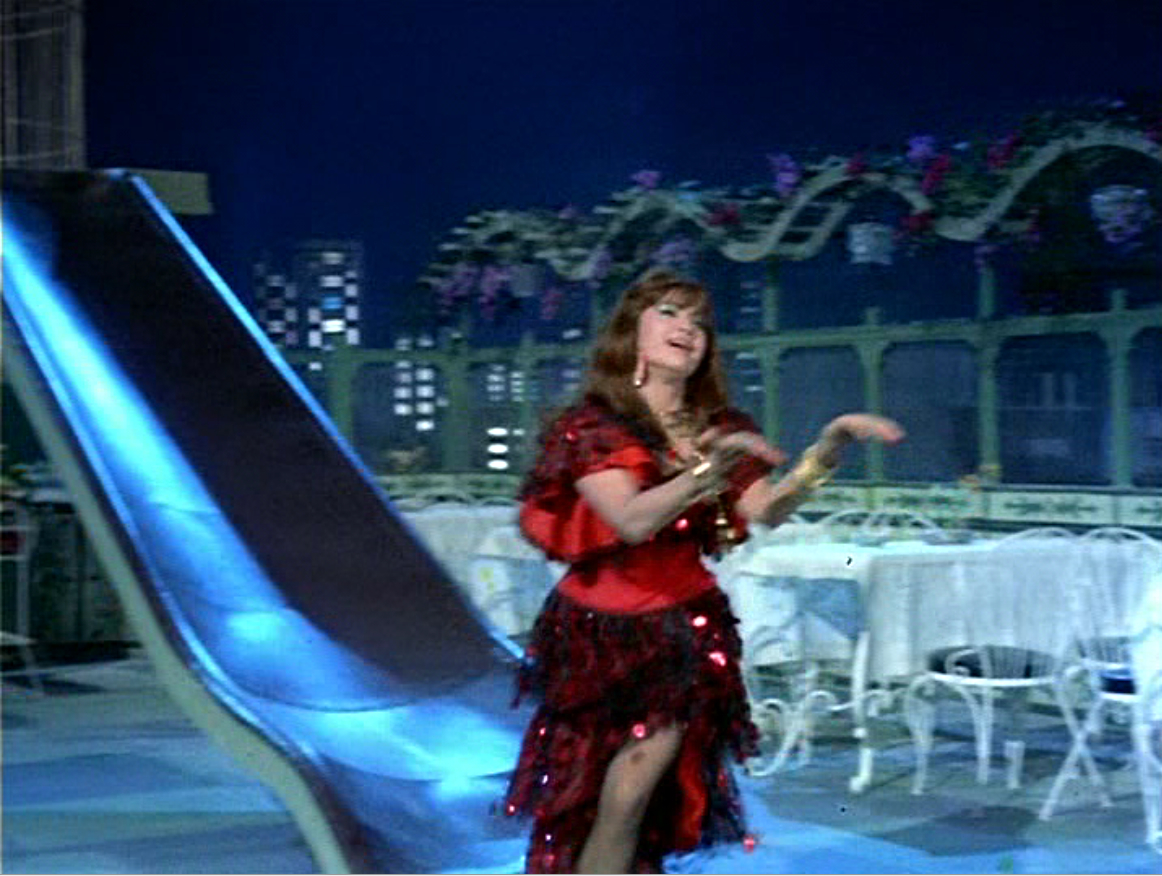
Ever wanted to learn to dance like a Bollywood actress? Helen’s moves are infamous. When Helen dances, it’s as if the screen lights on fire, as if someone exploded a splattering bottle of crazy juice all over the set. The most scandalous of vamps in classic Bollywood cinema, Helen was such a dance icon that Merchant Ivory Productions even made a documentary in 1973 on her monumental impact on Bollywood entitled, “Helen, Queen of the Nautch Girls.”

A mixture of sexy, hilarious, beautiful, and absolutely deranged, Helen’s moves are not intended for the faint-hearted. Below we discuss how to master some of her spiciest tricks from “Piya Tu Ab To Aaja” from Caravan (1971). Perhaps the greatest tip we can give you is simply to perform with blind, unabashed enthusiasm. Whatever Helen was, her moves were absolutely electric with raw passion and joie de vivre! So follow along and learn how to dance like Bollywood legend Helen!

Dance Move: The Money Grab

Let those wild 60s Bombay nightclub goers know exactly what you’re here for.  Make stocking up the bank an integral part of the item number and don’t be subtle about it!

Bollywood Helen8

Appeal to audience members on the left, both hands open and ready.

Bollywood Helen9

Rake it in with a violent, Helen-style hip thrust.

Bollywood Helen10

The other side needs some love too. Twist it around and keep those palms up and open!

Bollywood Helen11

SCORE! Reel it in to home position, and don’t forget that mischievously delightful smile.

Dance Move: The Jekyl-Hyde

Not sure which direction you want to groove? Do both at the same time! This move involves pushing the power forward then spastically pulling yourself in for a personal moment. Lather, rinse, repeat.

Bollywood Helen4

Stay away! Don’t come near!

Bollywood Helen6

Oh, wait, do come closer! Jerk the opposing arm in violently with come-hither modesty. Your audience has gotta stay on its toes to keep up with your routine.

Bollywood Helen7

Just kidding! Go away! Snap back to your original aggressive stance to keep that audience guessing!

Dance Move: Heavy Breathing

Nothing says sexy quite like hypoxemia. This is Helen’s most deadly dance move. Demonstrate your desperate love with a little heavy breathing, and let the close-ups do the rest.

Bollywood Helen14

Start by facing the camera directly with an open mouth, heave in and gasp like a drowning child.

Bollywood Helen17

Now lurch forward, and keep that blood-oxygen low. Come closer and closer with a crazed look on your face, making sure everyone in the audience is really uncomfortable.

Bollywood Helen18

It’s too overwhelming! Drop down with a final violent heave of your chest to let them all know just how much you’re willing to compromise your health for love.

Dance Move: The Switch-a-roo

Just when everyone’s slowly growing accustomed to the crack-cocaine of your dance routine, time to shift things around. Dress gets caught on a chair? No problem. You’ve got a glittery gold slip underneath. Yes, ladies and gentlemen, the switch-a-roo is the risky dance move of a public wardrobe change.

Bollywood Helen 28

Oh yes, the first step of this move is undoubtedly alcohol. Lots and lots of alcohol.

Bollywood Helen 29

Dress is caught on a chair! Quick, act like this wasn’t planned, pretend to tug with all your might.

Bollywood Helen 30

No time to waste, rip that useless outer covering out of the way! The show must go on!

Bollywood Helen 32

What are the ODDS you’d have on a glittery gold slip underneath that crazy red dress? All bets are off now! Go big or go home!

Bollywood Helen 33

Show off your slip’s versatility with a partner! Arch your back, keep smiling, and congratulate yourself on a successful switch-a-roo.

And there have you 4 of Helen’s best dance moves in 1 easy-to-follow guide. Be a star at your next dance party, why wait for a sold-out cabaret? These moves are fabulous at family weddings, bar mitzvahs, high school graduations, and baby birthdays. I dare you to try them out at your next corporate Christmas party. For more in this series, check out our earlier post on how to wink like Rajesh Khanna!

-Mrs. 55

Paaon Choo Lene Do Lyrics and Translation: Let’s Learn Urdu-Hindi

Bina Roy, as Mumtaz Mahal, shys away from Pradeep Kumar in Taj Mahal (1963)

Today we discuss the lyrics and English translation of “paaon choo lene do” from the film Taj Mahal (1963). Lyricist Sahir Ludhianvi and music director Roshan both won Filmfare Awards for their work in Taj Mahal (1963), so it’s not surprising that we’ve decided to discuss a third song from this soundtrack here today (see our previous translations of “jurm-e-ulfat pe” and “khudaa-e-bartar“). “paa.nv chuu lene do” is a duet rendered by Lata Mangeshkar and Mohammed Rafi that was picturized on Bina Roy as Mumtaz Mahal and Pradeep Kumar as Shah Jahan in the film. While “jurm-e-ulfat pe” had some political undertones and “khudaa-e-bartar” was a pacifist statement against war, Sahir’s lyrics in this song from Taj Mahal are purely romantic. The male and female leads flirt back and forth using a savaal-javaab (question-response) structure that focuses on idealizing the heroine’s feet. The female foot has been fetishized in Indian culture and Bollywood cinema over the years, and perhaps the most notable example of this phenomenon occurs in Kamal Amrohi’s magnum opus, Pakeezah: Raaj Kumar is completely smitten after one glance at Meena Kumari’s delicate feet during a train ride.

Krishna decorates Radha’s feet with alta.

What are the origins of the Indian obsession with the foot? Part of this obsession can perhaps be attributed to the importance placed on foot worship in Hindu traditions. For instance, religious imagery in temples and paintings has depicted numerous examples of Krishna painting Radha’s feet or Lakshmi massaging Vishnu’s feet.  Moreover, it is a tradition for women in North India to adorn their feet with a bright red dye called alta during marriages, dances, and religious festivals, like Durga Puja. In fact, during some weddings, brides step into a plate of alta before entering their in-law’s house and leave colored footsteps behind them as they walk. Finally, any child growing up in a Hindu household can attest to the fact that greeting one’s elders by touching their feet is an expected gesture of respect.

Regardless of how you feel about feet, you should definitely take a listen to this duet from Taj Mahal and follow along with our translation/glossary provided below. Indeed, Ludhianvi’s use of language here to highlight the contrast between the hero’s unabashed romantic desires and the heroine’s hesistant modesty is exquisite. As a final note, I just wanted to say that this song was requested by one of our readers Vasuki! We love receiving requests, so please let us know if there is a song you’d like translated, a movie you’d like reviewed, or any other topic you’d like discussed by leaving us a comment here or sending an e-mail to themrandmrs55@gmail.com. Enjoy!

–Mr. 55

The camera fetishizes Bina Roy’s feet in Taj Majal (1963)

Paaon Choo Lene Do Lyrics and Translation

Rafi: paa.nv chhuu lene do, phuulo.n ko inaayat hogii
Please let the flowers touch your feet, it will be favor of kindess to them. 
varnaa ham ko nahii.n, inko bhii shikaayat hogii
Or else, not only I, but they too will protest. 

Lata: aap jo phuul bichhaaye.n unhe.n ham Thukaraaye.n
As I reject the flowers that you have picked for me,
ham ko Dar hai ki yah tauhiin-e-muhabbat hogii
I fear that this will be an insult to love.  

Rafi: dil kii bechain umango.n pe karam faramaao
Please have mercy on the restless yearnings of my heart. 

itnaa ruk ruk ke chalogii to qayaamat hogii
If you walk toward me so hesitatingly, it will be a disaster. 

Lata: sharm roke hai idhar, shauq udhar khii.nche hai
Modesty has held me back here, while desire has drawn me over there.  
kyaa khabar thii kabhii is dil kii yah haalat hogii?
Who knew that my heart would ever be in such a state? 

Rafi: sharm ghairo.n se huaa kartii hai apano.n se nahii.n
One should be modest in the presence of strangers, not with loved ones. 
sharm ham se bhii karogii to musiibat hogii
If you shy away from me, there will be trouble.  

paa.nv chhuu lene do, phuulo.n ko inaayat hogii
Please let the flowers touch your feet, it will be favor of kindess to them.  

Glossary

inaayat: favor; varnaa: or else; shikaayat: complaint; Thukaranaa: to reject; tauhiin-e-muhabbat: insult to love; bechain: restless; umang: hope, yearning; karam faramanaa: to have mercy; ruk ruk ke: hesitatingly; qayaamat: disaster; sharm: modesty; shauq: eagerness, desire; haalat: state, condition; ghair: stranger; musiibat: trouble

Pradeep Kumar as Emperor Shah Jahan in Taj Mahal (1963)