Buried Treasure: Bollywood Songs with Hidden Stanzas

Bollywood record LP

My sweet Bollywood LP record collection.

You know how it is when you grow up listening to a song. Your mom played it on cassettes in the car, your Dad sang it while he worked, and eventually that gem from the 60s sneaks into your personal playlists when you buy an ipod. It’s all fine and dandy until years later, you’re browsing along youtube and BAM! A miracle occurs.

Turns out that song you knew and loved is only AN ABBREVIATED VERSION! The song as it’s played in the film is a whole stanza, a whole musical interlude and a half longer than you ever realized! There are few things on Earth that have the same feeling of win. It give you a rare, blissful tingle all over that can otherwise only be found by watching the wink sequence of a Rajesh Khanna film.

But why, you ask? It’s simple. Unlike now when the film soundtrack hits the iTunes store and you can download your songs one at a time, back in the good old days, marketing had to squeeze an entire soundtrack onto a single LP record (typically about 15-25 minutes per side). And if you planned on selling two hit film soundtracks on the same LP to increase sales, you could forget about musical fidelity. Something had to give.

Rajesh Khanna Farida Jalal Aradhana 3

Rajesh Khanna and Farida Jalal get sassy in the uncut version of “Baaghon Mei.N Bahaar Hai” from Aradhana (1969)

The result? Dozens of priceless compositions were slashed completely, and others had pieces ripped out from their insides to fit the needs of a hungry consumer market. Maybe I’m being melodramatic but I feel really strongly about this. Several hidden classical compositions from even the musical legend Pakeezah got shafted completely. Later as technology improved, recordings were taken from the LP versions and sold as cassettes, CDs, and mP3s. The originals can now often be found only in the films themselves or in the archives.

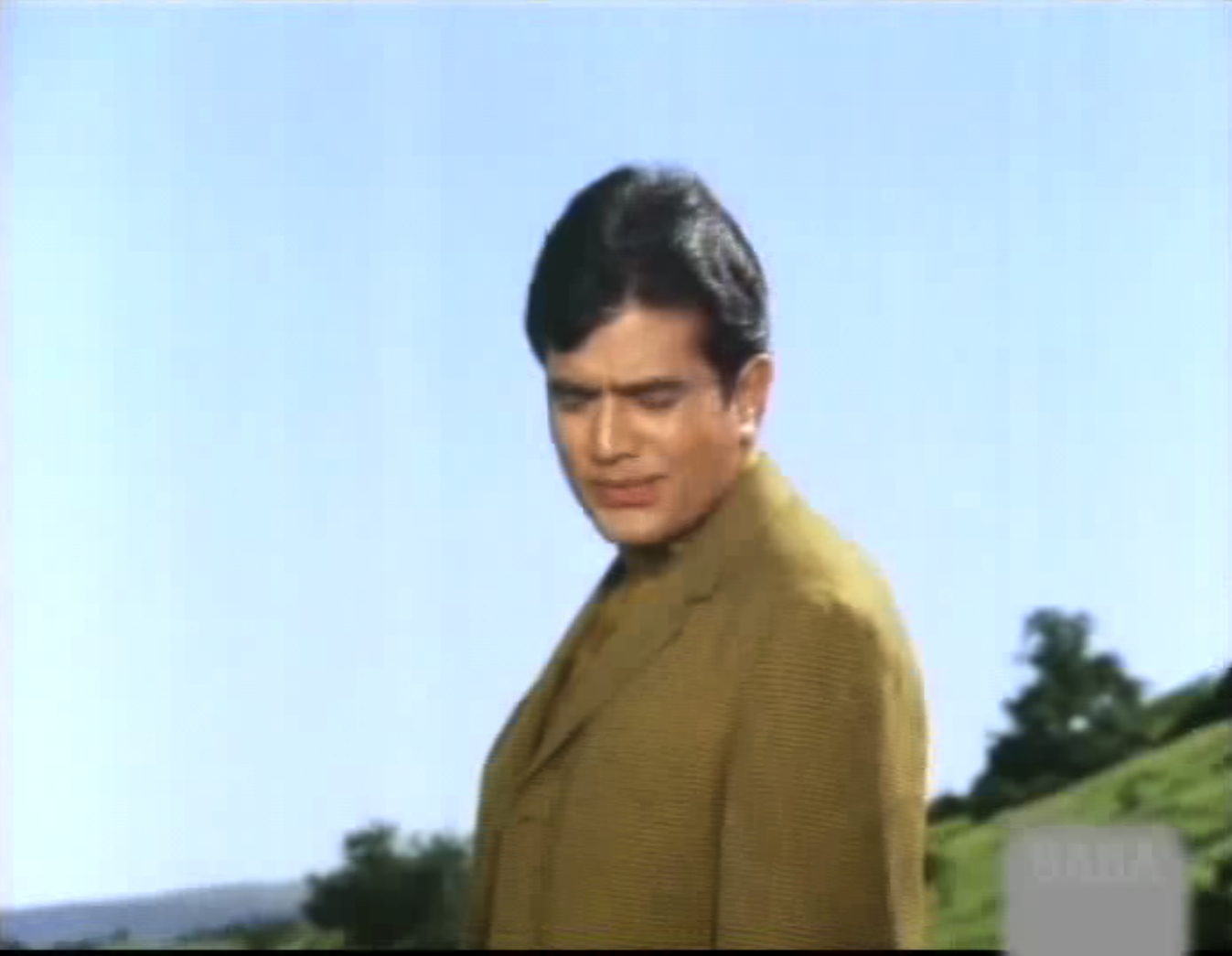
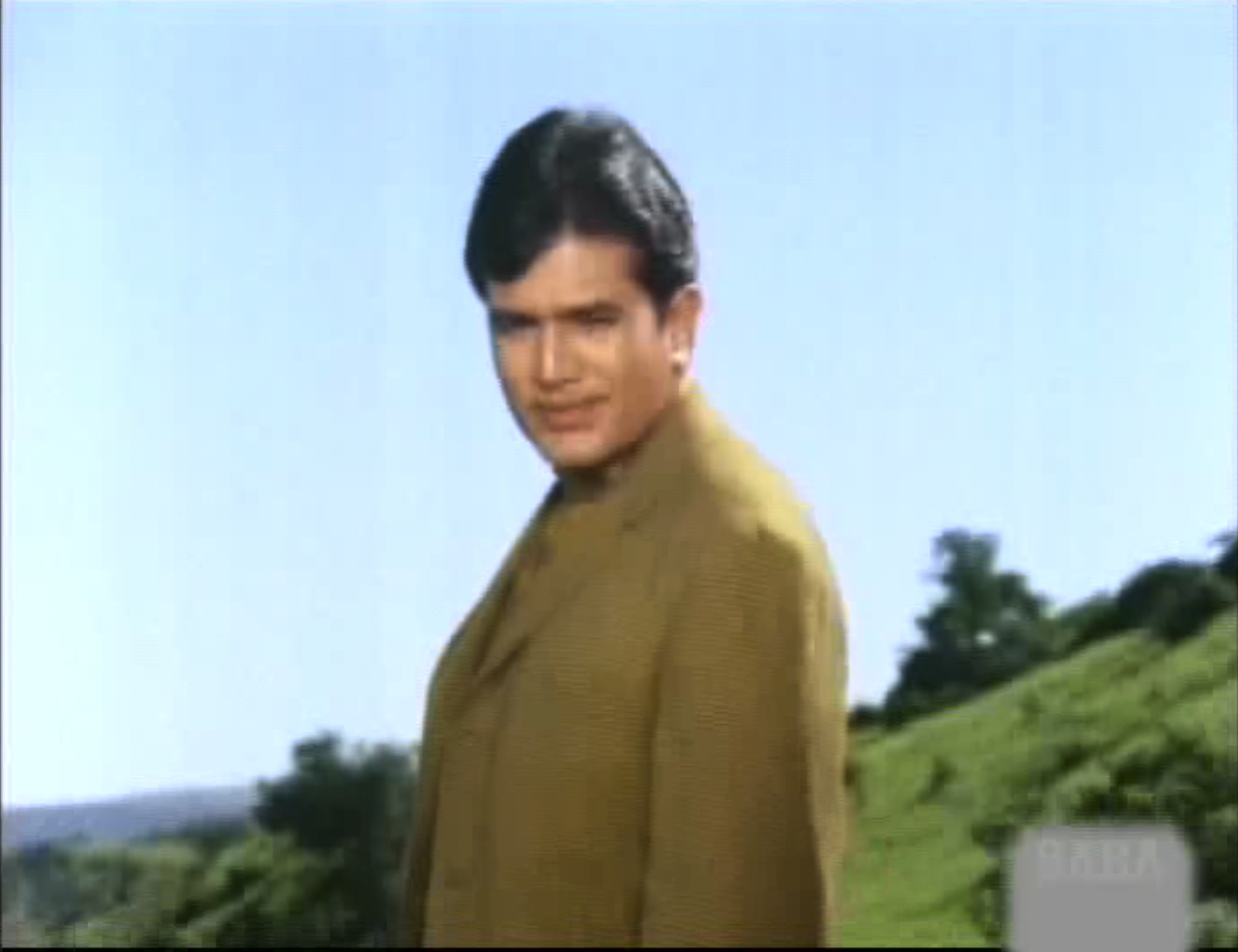
This is the face that got cut from “Baagho.N Mei.N Bahaar Hai.” Rajesh Khanna stars as an Indian Air Force pilot in Aradhana (1969). Are you sure it wasn’t the Navy though? Because I think I see a DREAM BOAT.

Here is a growing list of songs that over the years I’ve found are secretly much longer than I once thought:

  1. Kahin Dur Jab Din Dhal Jaaye (a whole beautiful poetic stanza is cut from the end)
  2. Piya Tose Naina (the ENTIRE magical 1965 Lata Mangeshkar opening is not in the soundtrack version–BIG travesty)
  3. In Bahaaro.N Mei.N Akelii (a whole stanza)
  4. Baaghon Mei.N Bahaar Hai (Rafi’s great comeback stanza)
  5. Aaj Kal Mei.N Dhal Gayaa (in the film, the male and female version are combined in a fabulous way)
  6. Jhumka Gira Re (a whole extra stanza and some sweet prelude music)
  7. Honton Pe Aisi (one minute of introductory dance music that is a huge game-changer)
  8. Aye Gulbadan (lost a final stanza)
  9. Thare Rahiyo (there’s a great musical a moment in the middle that gets totally cut)
  10. Dekhi Zamaane Ki Yaari (random parts are missing–granted the full thing is like 10 minutes, but it’s so worth it)
  11. Dil Ka Bhanwar Kare Pukar (an entire stanza!)
  12. Dum Maro Dum (maybe this doesn’t get cut per se, but there’s a whole reprise version that gets a huge shaft in the soundtrack!)
  13. Ghar Aayaa Mera Pardesi (all the epic dream sequence music at the end)
  14. Kahin Deep Jale Kahin Dil (missing a bunch of creepy-cool interlude music. Also anyone notice the violins play an octave lower in the film? Weird.)
  15. Khwab Ho Tum Ya (the final stanza)
  16. Koi Nazaraaane Lekar (another whole stanza)
  17. Sau Saal Pehle (a great stanza at the end!)
  18. Tujhe Jeevan Ki Dor Se (missing a culmination stanza)
  19. Tu Jahaa.N Jahaa.N Chalega (how could you cut out Lata in her prime?!)
  20. Tera Phoolo.N Jaise Rang (at least a minute worth of dance music from the end that really sets the mood!)
  21. Pal Bhar Ke Liye Koi (the sassy final stanza that puts everything into perspective!)
  22. Jhoom Jhoom Dhalti Raat (the clutch stanza that has the meaning of “Kohra” explained therefore making it the title song–but you’d never have known!)

Mess with my songs? You just watch yourself.

So you can see, it’s a mix of all-time classics and the more obscure gems. No one is safe. I beg of you to add any more you know of that are missing. Perhaps this compilation can help a fellow sufferer in need see the light!

-Mrs. 55

The Bollywood Bromance: Songs of Manly Love

There are few things cuter than a wholesome die-hard Indian bromance. In the past decade, the term “bromance” has become popularized by the American media and by high-grossing summer flicks that explore its comedic aspects—but its roots can be traced back to Hollywood first academy award for best picture Wings (1927). This silent heart-wrenching World War I love-fest between two men inspired dozens of commercial hits down the road from Butch Cassidy and the Sundance Kid (1969) to Top Gun (1986). Say what you want about those films, however, Bollywood was unarguably where this concept blossomed to its colorful fullest.

Perhaps it’s cultural—I can remember visiting Simla when I was younger and seeing teenage boys holding hands as they walked down the street. It was just considered a normal expression of friendship. Things have changed plenty since my childhood, but regardless, the marketability of the bromance genre may also likely stem from what had (and has) been for a long time a male-dominated industry–from directors to screenwriters all the way down to the lowly production assistants. In fact, in the early pre-talkie years of Indian cinema, women were not even allowed to act in films, much less attend viewings. Y-chromosome melodrama sells, and sells big. The bonds of manly love have been a glorified subject of Bollywood expression since time immemorial and has inspired some of the best movies you’ll ever watch.

In this post, we’ll explore our top 5 “bromantic” songs of yesteryear films long before the days of Dostana (2008) and even Qurbani (1980). From declaring eternal devotion to sobbing over betrayal, each one has a special place in our hearts and cinematic history.

Amitabh Bachhan and Dharmendra sing out their love in Sholay (1975)

Yeh Dosti (Sholay 1975):

This song is the crowning jewel of Bollywood bromance. Set at the beginning of an all-time megahit, this song showcases two men (Amitabh Bachhan and Dharmendra) riding a single motorcycle and singing their love for each other. Chest-hair is just blowing in the wind as their friendship is put to the test at the film’s climax. Overdone slightly, but a timeless tear-jerker!

Raj Kapoor pours his heart into his sad song of betrayed trust in Sangam (1964)

Dost Dost Na Raha (Sangam 1964):

Talk about tragedy. Raj Kapoor flies to war and saves his country, only to return and discover that his wife Vijayantimala is really in love with his own best friend Rajendra Kumar. This song of betrayal and lost friendship played morosely on the living room piano makes everyone in the room awkward. Please note that low-cut v-neck top. No, I’m not referring to Vijayantimala.

Rajesh Khanna and Amitabh Bachhan being adorable in Namak Haraam (1978)

Diye Jalte Hai.N (Namak Haraam 1973):

A Rajesh Khanna classic. Although best friends, Rajesh Khanna and Amitabh Bachhan come from two very different socio-economic statuses, ultimately leading to a huge public morally-charged battle of principles. Rajesh Khanna plays the good guy as usual, and his on-screen chemistry with Bachhan evokes the joy audiences loved in Anand! Did I mention the obligatory and visible fluffy chest hair?

Facing starvation and homelessness, two boys find friendship in Dosti (1964)

Chahoonga Mai.N Tujhe (Dosti 1964):

This film was unique in that it is entirely about two teenage boys (neither of whom were big stars then) and the sacrifices they make for each other. Did I mention the hero is blind and homeless? It makes it more endearing. This beautiful Mohammed Rafi song of tragedy is when the hero realizes his best friend is better off without him, and decides to get out of his way forever. These are kids, guys. It’s really, really cute.

Pran works to get a smile out of Amitabh Bachhan in Zanjeer (1973). This is a must-see–Pran is just such a beast in this movie.

Yaari Hai Imaan Mera (Zanjeer 1973):

Oh, Pran, you are a legend. This famous song celebrates the friendship between an Indian (Amitabh Bacchan) and an Afghani patthan (the inimitable Pran). He embodies this character so skillfully—look at how he twirls and gives that sly shake of the head, you’d think he had grown up in a mountainous outskirt of Kabul. See, Bollywood knows how to cross political boundaries too!

An extremely honorable mention goes to “Anhoni Ko Honi” from Amar Akbar Anthony (1979). Does it really count as a bromance if they’re actually supposed to be brothers?

Amitabh Bacchan, Vinod Khanna, and Rishi Kapoor are three brothers on a mission in Amar Akbar Anthony (1979)

Share with us your thoughts and additions to our list!

-Mrs. 55

Woh Shaam Kuch Ajeeb Thi Lyrics and Translation: Let’s Learn Urdu Hindi

Waheeda Rehman Rajesh Khanna khamoshi

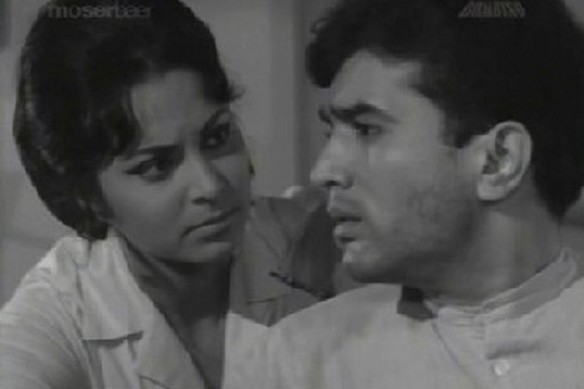
Waheeda Rehman soothes Rajesh Khanna’s aching soul in Khamoshi (1967).

Our next post will explore the stirring lyrics and translation of “Woh Shaam Kuch Ajeeb Thi” from Khamoshi (1967.) A one-of-a-kind film from its generation, Khamoshi is the moving story of patients in an insane asylum and the woman who treats them played by the graceful Waheeda Rehman. In American and European films, the theme of mental illness, the dangers of institutionalism, and the murky line between doctor and patient had been explored quite frequently–such as with famous German Expressionism’s The Cabinet of Dr. Calighari (1931), Hitchcock’s Spellbound (1958), and of course, One Flew Over the Cuckoo’s Nest (1976). However, in Bollywood, the Asit Sen hit Khamoshi vividly remains the only film from that era to have fully explored this theme.

Based on the short story “Nurse Mitra” by Ashutosh Mukhopadhyay, Khamoshi shines with wonderful performances, exquisite musical compositions, and disturbing black-and-white cinematography. Interestingly, Suchitra Sen starred in the original Bengali version Deep Jwele Jaai (1959) also directed by Asit Sen!

In this song, Rajesh Khanna, a patient at the mental institution where Waheeda works, takes her on a boat and declares his love for her. Still recovering from an episode in which he was jilted by a former girlfriend, Rajesh blurs his memories of the two women in these lyrics. Little does he know, his blind, albeit misguided love is the final provocation for Waheeda Rehman to lose her own sanity as she struggles to recover from having also lost one she once loved.

Waheeda Rehman works as a nurse in an insane asylum for the love-sick in Khamoshi (1967)

Woh Shaam Kuch Ajeeb Thi Lyrics and Translation:

Woh shaam kuch ajeeb thi
There was something strange about that evening,
Yeh shaam bhi ajeeb hai
Just as this evening feels strange
Woh kal bhi paas paas thi, woh aaj bhi qareeb hai
She was close to me yesterday, she is near me today as well
Woh shaam kuch ajeeb thi
There was something strange about that evening

Jhukii hui nigaaho.N mei.N, kahii.N meraa khayaal thaa
In her lowered gaze, perhaps there was a thought of me
Dabi dabi ha.Nsii mei.N ek haseen saa gulaal tha
As she suppressed a smile, there was a burst of beautiful color
Main sochtaa thaa meraa naam gungunaa rahi hai woh
I used to think that she was singing my name
Na jaane kyo.N laga mujhe ki muskuraa rahi hai woh
I do not know why it seemed to me that somewhere she is smiling
Woh shaam kuch ajeeb thi
There was something strange about that evening

Meraa khayaal hai abhii jhuki hui nigaaho.N mei.N
Now thoughts of me are in her shy, lowered gaze
Khulii hui hansi bhi hai, Dabii huii sii chaah mei.N
Even though she is laughing openly, there a hidden desire
Mai.N jaanta hoo.N, meraa naam gungunaa rahi hai woh
I know that she is singing my name
Yehii khayaal hai mujhe ki saath aa rahi hai woh
It appears to me that she is coming closer
Woh shaam kuch ajeeb thi
There was something strange about that evening

Glossary:

shaam: evening; ajeeb: strange; qareeb: close, near; jhuka: lowered; khayaal: thought; ha.Nsii: laughter; gulaal: color [like those thrown during the festival of holi]; muskuraanaa: to smile; khula: open; chaah: want, desire

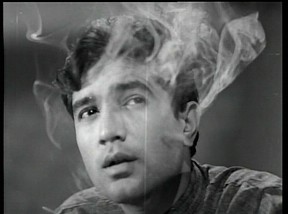
Rajesh Khanna checks in to the kind of hospital where smoking is permitted, and professionalism in doctor-patient relationships remains conveniently undefined…Khamoshi (1967)

For whoever can’t handle the suspense, the film ends with Waheeda being committed to her own institution and Rajesh Khanna declared sane–with the implication that one day perhaps another doctor will fall in love with her and the roles will reverse yet again. It is a cold and disturbing message filmed with some of the purest cinematographic beauty in Bollywood. I’ll spare you from a discussion of subversive political symbolism, but I will point out one last bit of trivia:

In the Bengali version, the Hemant Kumar song “Ai Raat Tomar Amar” is filmed with the same mis-en-scene as “Tum Pukar Lo” in Khamoshi, however, the melodies are not the same! “Ai Raat Tomar Amar” is in fact the musical predecessor of “Yeh Nayan Dare Dare” from Hemant Kumar’s later soundtrack in Kohraa (see our post on Bollywood film noir for more). Music directors back then were notorious for reusing compositions–and we’re sure glad they did!

-Mrs. 55

How To Wink Like Bombay Superstar Rajesh Khanna

You know you’ve tried it. In the 1970s, few Indian men hitting the discotheques hadn’t. The moves of Rajesh Khanna were so powerful, so devastating that the BBC actually made a documentary on his lifestyle entitled “Bombay Superstar” to introduce him to the West. Rajesh Khanna’s signature wink was and remains the final word in Bollywood seduction. If executed correctly, the wink has a 100% success rate. You can see the wink in almost any of Rajesh Khanna songs, including the evergreen Yeh Shaam Mastani from Kati Patang (1970). For everyone who’s still having trouble, I’ve broken down how to pull off this infallible move in 5 easy-to-master steps.

Step 1: Eyes on the prize. Make full, deliberate eye-contact with the chosen target. Make sure she sees you and can sense something’s approaching. Notice the arched brow and the pursed lips–Rajesh Khanna knows how to concentrate when it counts.

Rajesh Khanna locks gazes with Asha Parekh, and both parties mentally prepare themselves for the upcoming wink.

Step 2: Shut your eyelids. The key here is simultaneously tilting your head posterolaterally with the chin leading the way. This takes some very dedicated practice and coordination, so please don’t attempt this in public before you’ve put in the time. Subtle, right? Rajesh Khanna was as talented as he was beautiful.

In the devastating second step of his all-purpose wink, Rajesh Khanna coyly tilts his head and bats his eyelids. A palpable shudder is felt across the mountainside.

Step 3: Act natural. Return immediately to starting position, maintaining eye contact with a sly smile as if what just occurred was normal. You’ll have plenty of time to gauge audience response after.

Rajesh Khanna smiles slyly. He knows the wink just happened. He also knows you know the wink just happened. But the song isn’t done yet, and neither is he.

Step 4: Finish the song. Above all, keep singing. You gotta finish what you started. The violins are still playing and Kishore Kumar’s only on the first antra so hold that gameface until the last note.

Rajesh Khanna resists the urge to assess his wink’s immediate success and instead brings the song to a steady finish, thus heightening the wink’s effect.

Step 5: Watch and weep. This should not really qualify as a step. Observe the target’s resulting awe and proceed to take the win by a. proposing to her, b. holding her hand or c. reprising the film’s theme song.

Asha Parekh is moved literally to tears by the awesome power of Rajesh Khanna’s wink. Another one bites the dust.

That’s it folks–5 simple steps to becoming a Bombay Superstar. No Rajesh Khanna song is really complete with out it! For your viewing pleasure and further studies, check out Rajesh Khanna’s “Yeh Jo Chilman Hai” from Mehboob Ki Mehndi (1971). Then find some hair gel, a colorful ascot, and get winking.

-Mrs. 55

Who Is Mani Rabadi?

Gallery

This gallery contains 32 photos.

You’ve probably never heard of Mani Rabadi, but I’ll bet you’ve seen her work before. A behind-the-scenes legend, Mani Rabadi was a fashion designer to the stars. This woman was the final word in costume design for Bollywood films of … Continue reading