Yeh Raat Yeh Chandni Phir Kahan Lyrics and Translation: Let’s Learn Urdu Hindi

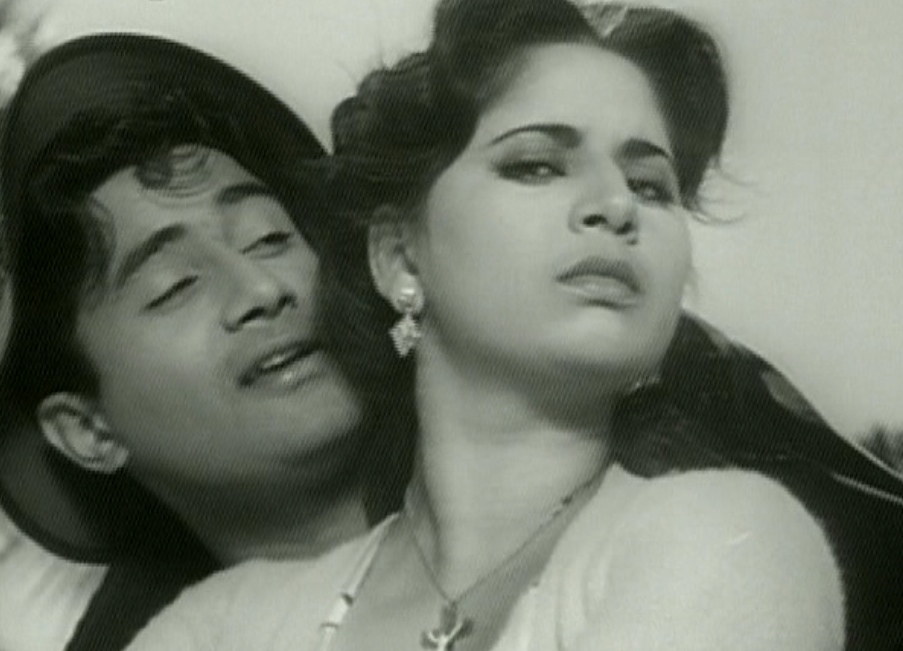
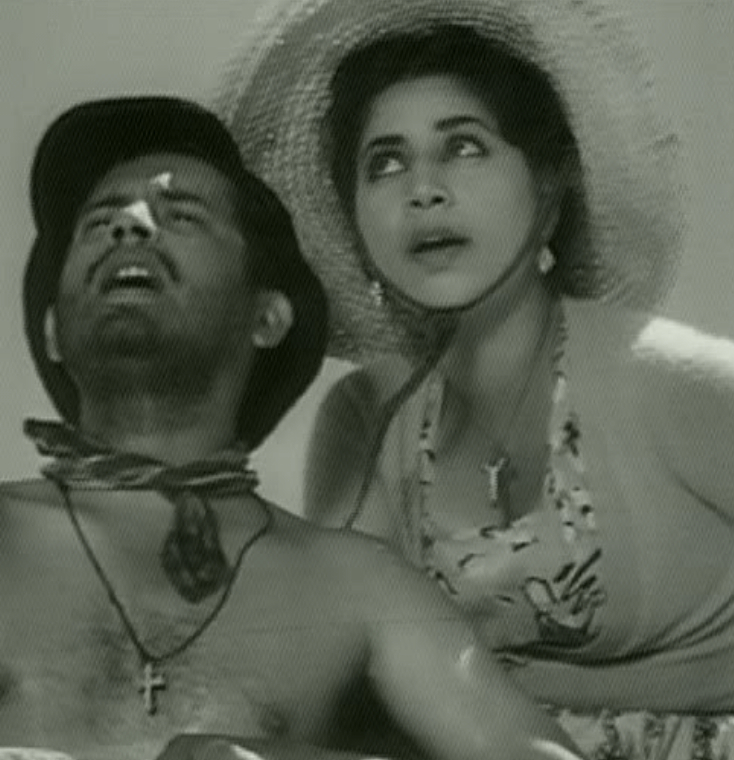
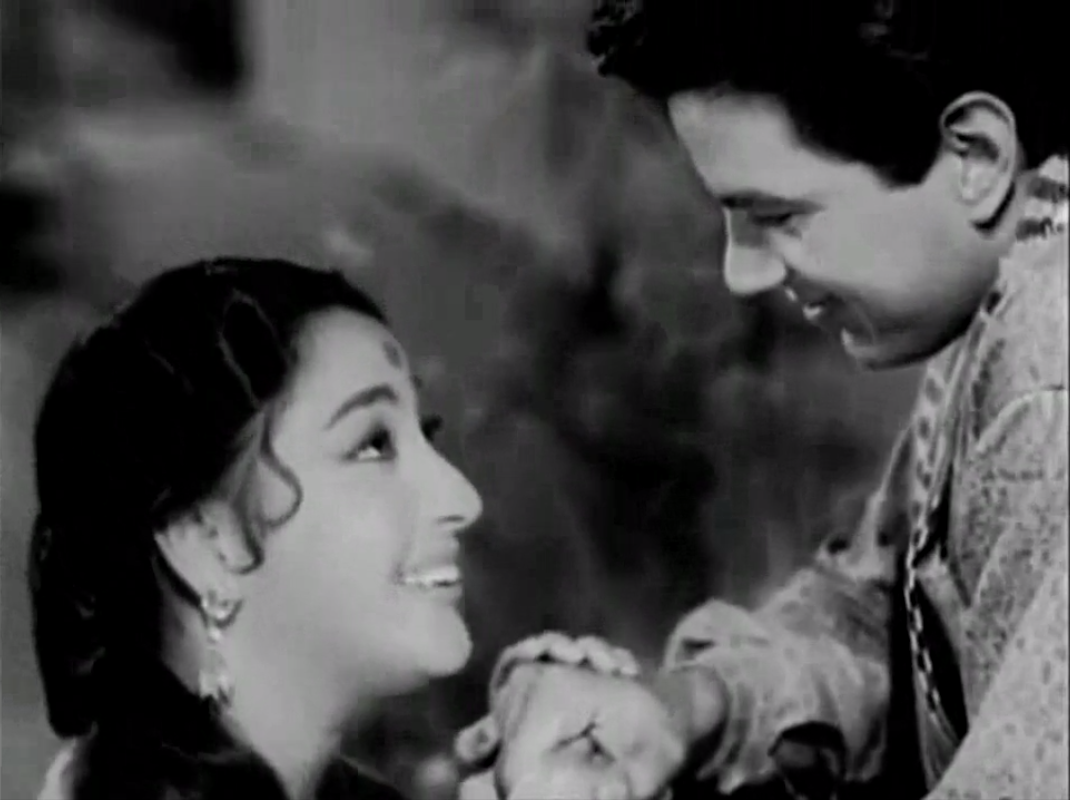
Dev Anand attempts to win over Geeta Bali under the guise of love in Jaal (1952).

We now will present the full lyrics and English translation to the haunting beauty “Yeh Raat Yeh Chandni” from the film Jaal (1952). Starring hit duo Dev Anand and Geeta Bali (who had wowed audiences together in Baazi the year before), Jaal was auteur Guru Dutt’s second film. Unlike Baazi, which mimicked film noirs of the West, Jaal looked outside the crowded cities to the gentle coast of Goa for inspiration. This film is truly one-of-a-kind, exploring life in the Portuguese fishing colony and the interwoven religious themes of forgiveness and love in the unfolding affair between two Christians, Tony (Dev Anand) and Maria (Geeta Bali). Note: Jaal was released before West Side Story hit Broadway, so the names of the lead characters are just a coincidence!

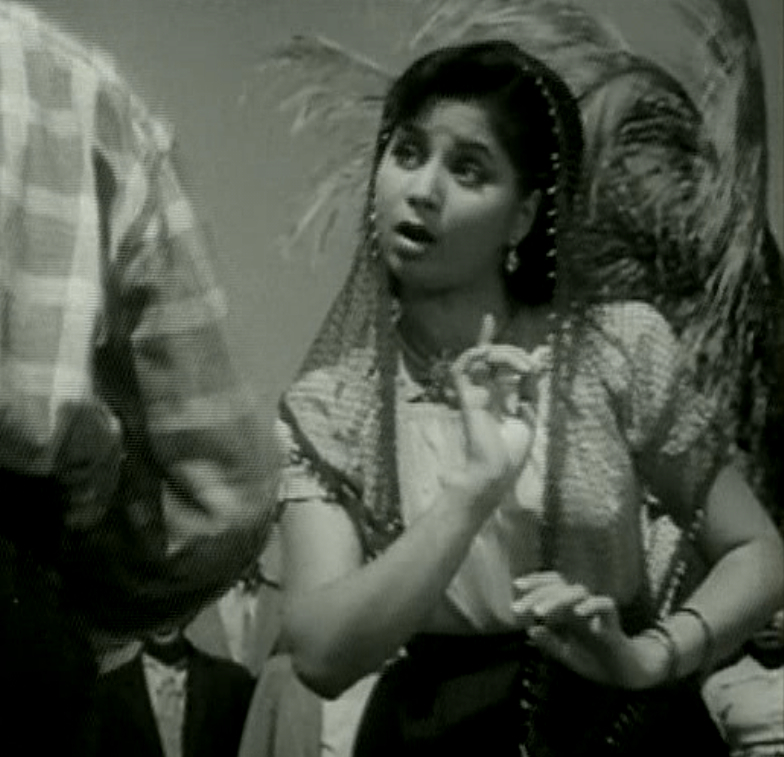
Dev Anand plays a Bombay gold thief who has escaped to Goa and who falls in love with the spunky village belle, Geeta Bali. Their love is tested by society, the law, and ultimately a vow before God that leads Tony to atone for his past and Maria to remain faithful until his sentence is fulfilled. Like most Guru Dutt films, the plot brings something new to the table. Watch out for some wild swing dancing, Johnny Walker making repeated attempts at Arabic, and a generous handful of “amens” throughout the film!

Spunky and fabulous, Geeta Bali leads a Goan dance in Jaal (1952)

The song “Yeh Raat Yeh Chandni” comes in two versions–the tragic Lata Mangeshkar duet, and the initial lilting Hemant Kumar solo. We will translate both to get a fuller understand of the role this song plays in the film, starting with the duet. This version occurs late in the film after Geeta’s friends and family discover Dev Anand’s true past and forcibly remove her from him. However, she is now in love despite his background and sings this tearful song of pining.

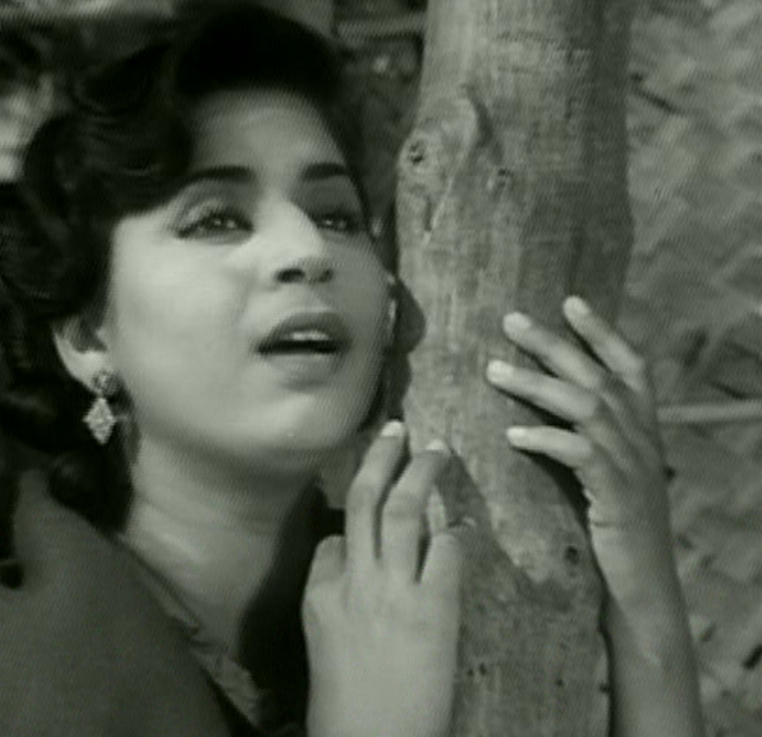
Geeta Bali declares her unwavering love for a wanted criminal in Jaal (1952).

Enjoy our English translation and full lyrics of “Yeh Raat Yeh Chandni” and it’s counterpart “Sun Ja Dil Ki Dastan” below!

Yeh Raat Yeh Chandni Phir Kahan Lyrics and Translation

Duet (Lata Mangeshkar & Hemant Kumar):

Yeh raat yeh chaandni phir kahaa.N
Where will we find this night and this moonlight again?
Sunjaa dil ki daastan
Listen now to the story of my heart

Chaandni raaten pyar ki baaten kho gayi jaane kahaa.N
Where have the moonlit nights and words of love become lost?
Yeh raat yeh chandni phir kahaa.N
Where will we find this night and this moonlight again?
Sunjaa dil ki daastan
Listen now to the story of my heart

Aati hain sada teri TuuTe hue taaro.N se
I sense your presence from the falling stars
AahaT terii suntii hoo.N khaamosh nazaaron se
I hear your footsteps with hushed glances
Bheegii hawa uudi ghaTa kheti hai.N teri kahanii
The moist winds, the soaring clouds speak of your story
Tere liye bechain hain sholo.N mei.N lipti jawaanii
My youth is ablaze in restlessness for you
Seene mei.N balkha raha hai.N dhuaa
The smoke engulfs my chest
Sunjaa dil ki daastan
Listen to the story of my heart

Chandni raaten pyar ki baaten kho gayi jaane kahaa.N
Where have the moonlit nights and words of love become lost?

Leheron ki labon par hai.N khoye hue afsaane
On the lips of the waves lie forgotten fables
Gulzaar umiidon ke sab ho gaye viraane
All the rose gardens of hope have become barren.
Tera pataa paaoo.N kahaa.N? Soone hai.N saare Thikaane
Where can I find where you are? All abodes are deserted
Jaane kahaa.N gum ho gaye jaake ho agle zamaane
I do not know where you have disappeared to in the other world
Barbaad hai.N aarzoo ka jahaa.N
The world of desire has been destroyed
Sunjaa dil ki daastan
Listen now to the story of my heart

Glossary:

raat: night; chaandni: moonlight; TuuTa taaraa: shooting star; aahaT: footsteps; khaamosh: silence, hushed; bheegi: wet; kahaanii: story; bechain: without peace, restless; sholaa: spark, fire: jawaanii: youth; seenaa: heart; chest; dhuaa: smoke; leher: wave; lab: lip; afsaanaa: fable, story; gulzaar: rose garden; umiid: hope; viiraane: wasted, desolate; pataa: whereabouts, address; soonaa: empty, lonely; Thikaanaa: shelter, abode; gumnaa: to become lost; aglaa: next; zamaanaa: world; barbaad: destroyed; aarzoo: desire; jahaa.N: world, place

But before this sad reprise, Dev Anand can be found singing the romantic solo version from his beach side abode. Hemant Kumar’s voice is absolutely magical in this song–he has the perfect blend of richness and allure. At this time in the film, Dev Anand is trying to cinch the deal with his romance and claims he knows that Geeat Bali will come to his hut when she hears this song. His version of “Yeh Raat Yeh Chaandni” has a uniquely tropical Goa flair, but it maintains an exciting sense of urgency in both the lyrics and style. As you can guess, Geeta comes running.

Dev Anand Jaal

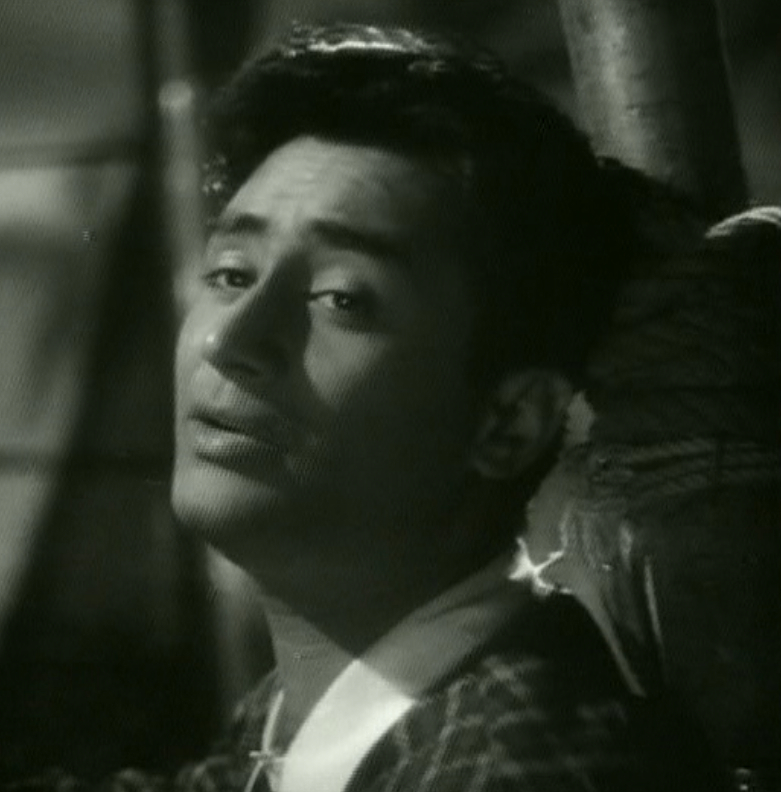
Dev Anand calls to Geeta Bali in the moonlight in Jaal (1952).

Yeh Raat Yeh Chandni Phir Kahan Lyrics and Translation

Male Solo (Hemant Kumar):

Yeh raat yeh chaandnii phir kahaa.N
Where will we find this night and this moonlight again?
Sun ja dil ki daastan
Listen now to the story of my heart

Hey peDo.N ki shaakho.N pe
On the branches of the trees
PeDo.N ki shaakho.N pe soyii soyii chaandnii, peDo.N ki shaakho.N pe…
On the branches of the trees the moonlight slumbers
Tere khayaalo.N mei.N khoyii khoyii chaandnii
In thoughts of you, the moonlight wanders
Aur thoDi der mei.N thak ke laut jaayegii
And soon it will become tired of waiting and return
Raat yeh bahaar ki phir kabhii na aayegii
This night of spring will never come back
Do ek pal aur hai yeh samaa
We have but a few moments left of this atmosphere
Sun ja dil ki daastan
Listen now to the story of my heart

Hey lehero.N ke honTho.N pe
Oh, on the lips of the waves
Lehro.N ke hontho.N pe dhiima dhiima raag hai, lehro.N ke hontho.N pe
On the lips of the waves is a soft melody
Bhiigii hawaao.N mei.N thanDii thanDii aag hai
In the moist wind is a cool fire
Is hasee.N aag mei.N tuu bhii jalke dekhle
In this beautiful fire, you should see what it feels like to burn
Zindagii ke geet ki dhun badal ke dekhle
See what it feels like to change the tune of life’s song
Khulne de ab dhaDkano.N ki zubaan
Free the voice of our heartbeats
Sun ja dil ki daastan
Listen now to the story of my heart

Hey jaatii bahaare hai.N
Oh, the Spring is receding
Jaatii bahaare hai.N uThti jawaaniiyaa, jaatii bahaare hai.N
The Spring is receding, our youth is rising
Taaron ke chaao.N mei.N pehle kahaaniiyaa
In the shadows of the stars lie our stories
Ek baar chal diye gar tujhe pukaarke
If it leaves after calling to you,
Lautkar na aaye.Nge kaafile bahaar ke
The caravans of Spring will not return
Aaja abhi zindagii hai jawaan
Come, life is still young
Sun ja dil ki daastan
Listen to the story of my heart

Glossary:

raat: night; chaandnii: moonlight; peD: tree; shaakh: branch; khayaal: thought; thoDii der mei.N: in a short while, soon; thak hona: to become tired; laut jaanaa: to go back; bahaar: spring; samaa: atmosphere; leher: waves; honT: lip; dhiima: softly; bheega: moist, rainy: ThanDaa: cool; aag: fire; hasee.N: beautiful; dhun: tune; dhaDkan: heartbeat; zubaan: words, language; jawaanii: youth; chhaaye: shadow; kaafile: caravans

Did you know that it was in this movie that Guru Dutt first hired cinematographer V. K. Murthy? V.K. Murthy would continue to work as Guru Dutt’s D.P. (Director of Photography) for all of his following films. In fact, between Guru Dutt and V.K. Murthy grew such trust and friendship, that Murthy eventually encouraged Dutt to start acting in his owns films, including the haunting classics Kaaghaz Ke Phool and Pyaasa. In this film, Guru Dutt actually makes his first cameo–as a shirtless fisherman no less! Ladies, please calm down.

– Mrs. 55

Shirtless Guru Dutt

Guru Dutt makes a brief film debut in Jaal (1952) as a rugged and shirtless fisherman.

Bollywood’s Beloved Sopranos: Lata and Asha’s Highest Notes

I feel like we’ve all been in this situation at some point: one of your favorite aunties steps up to the microphone at the annual Diwali function, and you have a sinking fear in your heart that she’s going to embarass herself by butchering another Lata classsic on stage. As she struggles through the sky-high notes of the antara, you cringe and ask yourself why you’re here again, subjecting yourself to this torture…

Well, it turns out it’s not entirely her fault. The reality of the situation is that Bollywood songs from the Golden Era tend to be pitched at extremely high scales for the average female singer. Unless a woman is a veritable soprano like Lata Mangeshkar or Asha Bhonsle, it is going to be quite a challenge for them to sing many of the classic songs from this period in their original keys. The high-pitched soprano female voice has become a hallmark of Hindi film music, and I’d like to explore this phenomenon in greater detail with this post.

Two sisters who changed playback singing forever: Lata Mangeshkar and Asha Bhonsle.

Why are Bollywood songs for females from the Golden Era pitched at astronomically high scales? I don’t know for sure, but I definitely have a few ideas that could explain this trend. First, the high-pitched female voice is consistent with the image of the ideal Indian woman that was prevalent during the 1950s and 60s. The soprano register suggests innocence and purity, which enhanced the traditionally feminine perceptions of heroines advanced by film directors of the time. Lata Mangeshkar  is the ultimate example of this phenomenon; her voice, with its ethereal purity, has been considered the traditional female voice of India for decades. However, this explanation is less pertinent to Lata’s younger sister Asha Bhonsle. The voice of Asha, who was widely known for her experimentation with non-traditional genres such as the cabaret, is not a national emblem of purity in the same way as her elder sister’s. For this reason, an alternative explanation is needed to describe the popularity of the soprano female voice in Bollywood, and I would venture to say that this alternative explanation is rooted in musical origins. Before the arrival of the Mangeshkars onto the filmi musical scene, female singing in Hindi films was dominated by artists with heavy, nasal voices, such as Suraiyya and Shamshad Begum. Once music directors had the opportunity to work with the Mangeshkars, things changed forever: the nasalized heavy female voices were out and the delicate soprano voices were here to stay. After Lata and Asha became established as playback singers, I would argue that  music directors of the time pushed the boundaries of their compositions in terms of range to test and showcase the virtuosity of these two exceptional talents.

Before we take a listen to some of Lata and Asha’s highest highs throughout Bollywood’s musical history, explaining a little bit of musical nitty-gritty is necessary to fully appreciate the gist of what’s going on here. From my experiences with transcribing and performing many songs from this era, I would estimate that the vast majority (perhaps 90%?) of songs composed for Lata and Asha max out at F5 or F#5 (two F/F#’s above middle C on the piano) as their highest note. Therefore, in the brief list  of high notes that I’ve compiled below, I’ve only chosen to include those rare songs that surpass the typical upper limit of  F#5. Songs for both singers are listed in order of ascending pitch of the composition’s highest note.
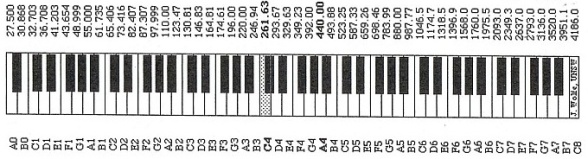
Keyboard labeled with note names and frequencies. C4 is taken as middle C. The high notes listed here range from G5 to C6.

Lata Mangeshkar: Selected High Notes

 jhuumta mausam mast mahiinaa (Ujala, 1959):  In this Lata-Manna duet composed by Shankar-Jakishan, Lata nails a G5 (taar komal ga in the key of E) when she repeats the “yalla yalla” line in the taar saptak (high octave) at the end.

ajii ruuThkar ab kahaa.n jaayiega?  (Aarzoo, 1965): Shankar-Jaikishan is once again the culprit here: listen as Lata reaches an Ab5 (taar shuddh ma in the key of Eb) in the antara of this gem picturized on Sadhana from Aarzoo. Regarding the high pitch of this song, Lata has said:

“I remember “ajii ruuThkar ab kahaa.n jaayiegaa” in Aarzoo (1965). What a high pitch that was! My ears reddened when I sang it. But I stubbornly sang at that impossible scale, refusing to admit defeat to any range. I would get very angry and sing at any range without complaining. Composers would take full advantage of my silence and keep raising the scale. In fact, I used to have arguments with Jaikishan. I would ask him, “kyaa baat hai, aap merii pariksha le rahe hai.n? mai.ne aap kaa kyaa bigaDaa hai jo aap meraa kaan laal kar rahe hai.n? (What’s the matter? Why are you testing me? What have I done that you should trouble me so much to redden my ears?)’

jiyaa o jiyaa kuch bol do (Jab Pyar Kisi Se Hota Hai, 1961): The tandem effect described below with “ahsaan teraa hogaa mujh par” is also observed here. Lata gives it her all as she reaches a Ab5 (taar komal ni in the key of Bb) in the antara of the female tandem version of the fun Rafi classic from Jab Pyar Kisi Se Hota Hai.

rasik balmaa (Chori Chori, 1957):  This Raga Shuddh Kalyan-based Shankar-Jakishan composition is one of my all-time favorites! Lata hits a G#5 (taar shuddh ga in the key of E) when she sings the antara.

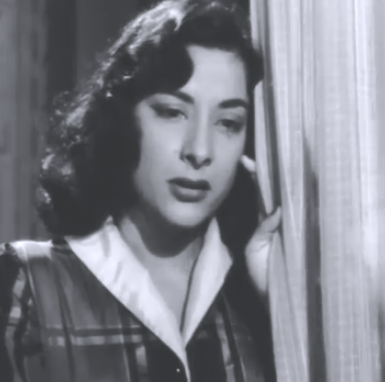
Nargis in a melancholic mood as she sings “rasik balma” from Chori Chori (1957)

ahsaan teraa hogaa mujh par (Junglee, 1961):  The Rafi version of this number is an all-time classic. Although the Lata version is less popular, it is still beautiful in its own right and brings up an interesting point about scales in tandem songs from this era. In almost all cases that I can think of, music directors made the female singer of a tandem song sing her versions in the same key as the male verion. Because men tend to be more comfortable in the higher register of their voices than women, this practice often put the female playback singer at a disadvantage when it came to hitting the highest notes of the composition. But who else would be up for the challenge of adjusting to the “male scale,”  if not Lata Mangeshkar? She hits a G#5 (taar shuddh ga in the key of Ein the antara of this evergreen Shankar-Jakishan composition based in raga Yaman. Regarding the difficulties of singing tandem songs, Lata has remarked:

Actually, “ahsaan teraa hogaa mujh par” was only meant to be sung by Rafi. But the film’s hero, Shammi Kapoor, suddenly decided that the heroine should sing it as well. It was picturised with Rafi’s voice on Saira Banu and later dubbed by me. So I had to sing it in the same sur as Rafi. The same was done with “jiyaa o jiyaa kuch bol do.

tere baadalo.n kii khair (Champakali, 1957): This Bhairavi-based composition composed by Hemant Kumar and picturized on Suchitra Sen is not as well-known as the rest of the songs on this list, but it’s worth mentioning for the A5 (taar ma in the key of E) that Lata hits  at its conclusion.

ahaa rimjhim ke yeh pyaare pyaare geet  (Usne Kaha Tha, 1960):  Salil Chowdhury was known for his incorporation of ideas of Western classical music into his Indian compositions. As an example, he has Lata sing an operatic-style counterpoint passage here in which she reaches an Bb5 (atitaar sa in the key of Bb) against Talat’s rendering of the mukhda at the end of this composition. Subtle, but exquisite!

aa ab laut chale.n (Jis Des Mein Ganga Behti Hai, 1960): Shankar-Jaikishan score another point here with this patriotic composition from Jis Des Mein Ganga Behti Hai. Mukesh and Lata both sing this song, but it is not structured as a prototypical romantic duet. Mukesh takes the main lines while Lata provides a few supporting lines and interesting background vocals, including the virtuosic glide in which she nails an Bb5 (taar pa in the key of Eb) with finesse.

aaja bha.nvar/jhananana jhan baaje paayalia (Rani Roopmati, 1957): Both of these drut bandishes based in Raga Brindavani Sarang and composed by S.N. Tripathi from Rani Roopmati are truly virtuosic by Bollywood standards. Lata sounds so impressive when she nails the Bb5 (taar pa in the key of Bb) at the end of both “aaja bha.nvar” and “jhananana jhan.” In addition to showing off her range, Lata also showcases her classical training and vocal dexterity as she navigates through a host of intricate taans in both songs. I have to say Lata’s virtuosity leaves Rafi in the dust in the duet here (sorry, Mrs. 55!).
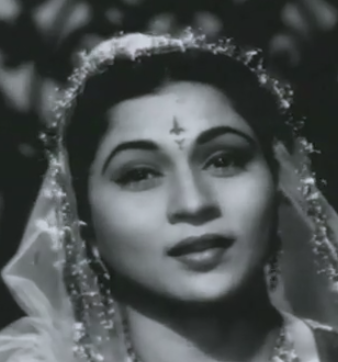
Nimmi sings “aaja bhan.var” in Rani Roopmati (1957)


ham ramchandra kii chandrakala me.n bhii
 
(Sampoorna Ramayana,
1961): The Mangeshkar sisters team up here to sing a duet from Sampoorna Ramayana composed by Vasant Desai. It’s somewhat interesting to note that the song here is actually picturized on two pre-pubescent boys, who are receiving playback from female singers. At the end of the song, there is a dramatic ascent in the melody until both sisters climax at a powerful  Bb5 (taar pa in the key of Eb).

ai dil kahaa.n terii manzil
 (Maya, 1961): Salil Chowdhury makes another contribution to our list with this composition rendered by Dwijen Mukherjee (a noted Bengali singer with a voice similar to Hemant Kumar’s) and Lata. Like “aa ab laut chale.n,” this duet is not structured traditionally; rather, Dwijen sings the main lines and Lata provides background support. Lata sounds heavenly as she hits a Bb5 (taar shuddh dha in the key of Db) in one of Salil’s signature opera-inspired vocal passages.

woh ek nigaah kyaa milii 
(Half-Ticket, 1962): To the best of my knowledge, Salil Chowdhury wins the contest for having recorded Lata’s voice at its highest pitch in the history of Bollywood cinema with this composition.  In this duet with Kishore Kumar picturized on Helen, Lata manages to hit  the elusive soprano C6 (taar shuddh dha in the key of Eb) in the second staccato sequence of the interlude played between stanzas. Her voice is so high here that it blends in naturally with the instrumental piccolo parts.  Nailing a staccato passage in the soprano register like this is incredibly impressive for a vocalist trained in the Indian tradition (in which the emphasis is not placed on vocalizing at the extremes of one’s range)–brava, Lata, brava!

Asha Bhonsle: Selected High Notes

sakhii rii sun bole papiihaa us paar (Miss Mary, 1957): You get the opportunity to hear some some sibling rivalry in this Hemant Kumar composition loosely based on Raga Tilang from Miss Mary! Lata (on Meena Kumari) and Asha (on some rando actress I can’t recognize) duke it out at the end with some intricate taans, but Asha actually takes the more complex passages and touches an Ab5 (taar shuddh ma in the key of Eb)in her last taan here. For those keeping score, Lata also hits the same note in her taan right before.

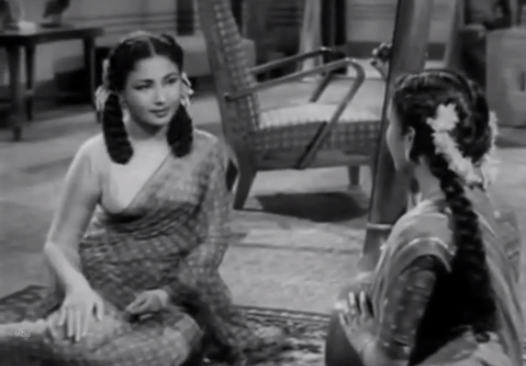
Meena Kumari in a rare non-tragic role in Miss Mary (1957)

dil na kahii.n lagaanaa (Ghunghat, 1960): I hadn’t heard this Ravi composition picturized on Helen before doing research for this post, but it’s quite special. The song is divided into several differents segments with lyrics in four different languages: Hindi, Tamil, Bengali (a cover of Geeta Dutt’s classic “tumi je amar“), and Punjabi. During in an alaap in the final Punjabi segment, Asha manages to hit an A5 (taar shuudh re in the key of G).

tarun aahe ratra ajunii (Non-Film):  This composition by Hridaynath Mangeshkar is a Marathi bhavgeet, so I guess it technically doesn’t belong on the list. Even though I don’t understand the Marathi lyrics, this is one of my favorite Asha songs because the tune and rendition are simply sublime. Here, the line “bagh tula pusatos aahe” begins on Bb3 and climbs up to A5 (taar shuddh ni in the key of Bb) with the ornament Asha sings on the words “gaar vaaraa.” In the span of one musical line, Asha covers nearly two octaves of vocal range–wow!

suunii suunii saa.ns kii sitaar par (Lal Patthar, 1971): This Shankar-Jakishan composition picturized on Rakhee from Lal Patthar is a beautiful example of the use of Raga Jayjayvanti in filmi music. In a passage towards the end of the song (beginning at 3:13), Asha touches a Bb5 (taar komal ga in the key of G). She also finishes the song off with some powerful taans. For comparison, see Shankar-Jakishan’s Jayjayvanti beauty from Seema sung by Lata (note the exquisite taankari at the end!): manmohana baDe jhuuThe

daiyaa mai.n kahaa.n aa pha.nsii (Caravan, 1971): This song from Caravan is probably remembered more for Asha Parekh’s crazy dance moves than its musical underpinnings, but this song is composed in a manner that is rather unique for Bollywood music. Most songs in Bollywood are sung at a fixed tonic (sa), but R.D. Burman experiments with a musical technique all too familiar to those who listen to 90s Western pop: the key change. He goes wild here by changing the tonic of the song by half-steps multiple times, and Asha hits a Bb5 during a transition at the very end.
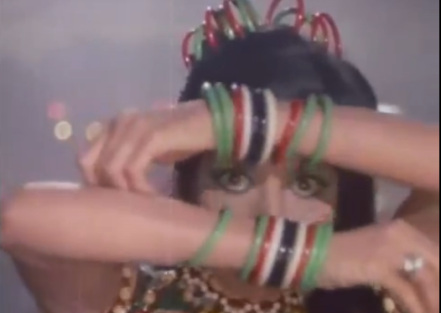
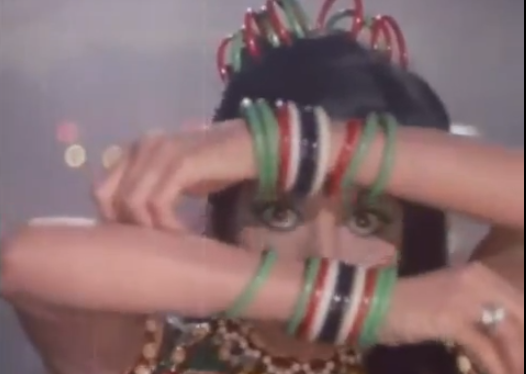
Asha Parekh hides herself on stage during the performance of “daiyaa mai.n kahaa.na aa pha.nsii” in Caravan (1971)

aa dekhe.n zaraa (Rocky, 1981): Despite my aversion to Bollywood music from the 80s, I still decided to include this song on the list for the Bb5 (taar pa in the key of Eb) that Asha manages to yell out at around 2:20.

nadii naa re na jaao shyaam (Mujhe Jeene Do, 1963): In the alaap of this Jaidev composition picturized on Waheeda Rahman, Asha nails a G#5 and briefly touches a B5 (taar pa in the key of E) before descending to pitches that are more comfortable for the average mortal.

tu mi piaci cara (Bewaqoof, 1960):  This cute S.D. Burman composition sung by Asha and Kishore features an opening line in Italian. Maybe it was the Italian lyrics that inspired S.D. Burman to have Asha sing some background operatic passages in addition to her normal lines. During one of these passages before the second-last antara, Asha hits a B5 (taar ma in the key of F#).

jo mai.n hotaa ek TuuTaa taaraa (Chhupa Rustam, 1973): This composition by S.D. Burman rendered by Asha and Kishore features some more opera-like passages at its conclusion. Asha is impressively comfortable as she nails a B5 (ati-taar sa in the key of B)  several times in a row as counterpoint against Kishore’s rendering of the mukhda!

o merii jaa.n maine kahaa (The Train, 1970): You wouldn’t expect this fun item number composed by R.D. Burman and picturized on Helen from The Train to be particularly virtuosic in terms of vocals, but Asha actually hits the a B5 (ati-taar sa in the key of B) in the song’s opening line with her leap on the word “kahaa.” For those of you listening very carefully, it’s important to keep in mind that the film version appears to be transposed a half-step higher than the album version of this song.

If you’ve managed to pay attention so far and take a listen to some of these songs, you may have noticed some interesting trends when comparing the high notes rendered by our two beloved Bollywood divas. After taking a look at the years I’ve listed next to each song, you’ll notice that all of Lata’s highest notes on this list span a range of nine years from 1956 to 1965, while Asha’s highest notes range over 24 years (!) from 1957 to 1981. The broad range of years in which Asha hit her high notes might provide evidence to those who support the notion that Asha’s voice aged better than Lata’s over the decades. But there is one caveat: the manner in which these two divas produce their high notes is distinct and may play a role in mediating this trend. If you listen carefully, you can hear that Lata always employs her “chest voice” to belt out the notes of a composition, even at the highest registers. On the other hand, Asha often employs her “head voice,” the more commonly used technique by female singers to access high notes. Head voice has a softer, gentler sound because it resonates around the nasal cavity instead of the chest during vocal production. This technique of singing is traditionally forbidden in the Indian classical tradition, so purists might consider some of Asha’s highest highs as “cheating”–head voice is sometimes even referred to as naqlii avaaz (fake voice). I’m not so much of a purist that I would discredit Asha for using her head voice in these compositions, but I will venture to say that, if asked to do so, she would not be able to hit the notes of the high soprano register in her later years using her chest voice as gracefully as Lata did during her peak.

Another interesting trend to note is how different music directors composed differently to suit the individual styles of  Lata or Asha. Although all the music directors on this list have worked extensively with both sisters, the music directors who asked Lata to sing at her highest range are not the same as the music directors who asked the same of Asha. Shankar-Jaikishan and Salil Chowdhury, by far, contribute to Lata’s highest record pitches whereas R.D. Burman and S.D. Burman seem to have saved their highest notes for Asha. Just some food for thought.

R.D. Burman teaches Asha Bhonle during a rehearsal session.

Please let us know if you find any more examples of Lata and Asha’s highest highs that are not on this list! I have attempted to find the best examples, but given the vast repertoire of Bollywood film music, I may have naturally missed out on some that are worth mentioning. Also, if you enjoyed this post, let us know in the comments and I’ll try to do some similar-themed posts in the future–perhaps next, we can take a listen to Lata and Asha’s lowest recorded notes or a an analysis of the Bollywood tenor’s highest highs? The possibilities are endless!

-Mr. 55
Perpetuating Gender Norms in Abhiman

Abhiman Amitabh Bacchan Jaya

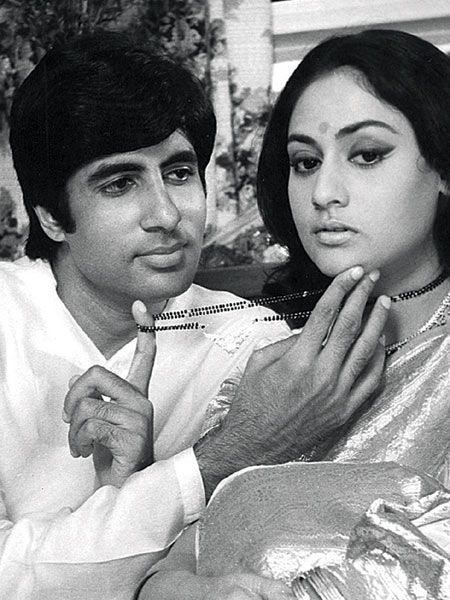
Art mimics life in Abhiman (1973) starring Amitabh Bachchan and Jaya Bhaduri

Everyone loves a bit of filmi gossip. I have been meaning to watch the film Abhiman (1973) ever since I discovered sometime in elementary school that Amitabh Bachchan was actually married (and now an old man) and to none other than Jaya Bhaduri. Like other Bollywood classics that are spicily known to mimic life itself, such as Kaagaz Ke Phool (1959) or Silsila (1981), Abhiman too has a wealth of behind-the-scenes parallels.

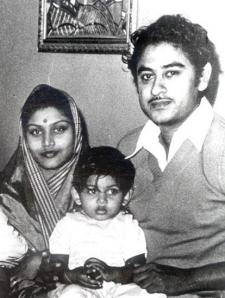
The film tells the story of a husband and wife singing duo—and the rift that forms between them as her career far overshadows his. Before I discuss the gender stereotypes that run rampant in this film, did you know that Abhiman is rumored to be based upon real-life singer Kishore Kumar’s relationship with his first wife Ruma Guha Thakurta? Given that Kishore sings half the songs of this film, it gets pretty juicy. Ruma was a hugely successful Bengali singer and actress (not to mention the niece of legendary filmmaker Satyajit Ray!) whose career was soaring during the time of their marriage. Ruma’s songs were super hits in the Bengali industry and she acted in more than 100 films, starting as a child actress. Kishore and Ruma married in 1951, had a son together Amit Kumar (who was a reasonably successful playback singer himself in the 80s), but the two divorced in 1958. In fact, Kishore proposed to his next wife Madhubala while still married to Ruma. Don’t you just love it?

Kishore Kumar with his first wife Ruma Guha Thakurta and their son Amit Kumar (circa 1953).

The gossip gets even better. After filming Abhiman, Jaya Bhaduri edged out of the acting industry to play housewife while Amitabh continued to make some of his greatest hits—the reason? At the time, people strongly suspected it was in order to prevent art mimicking real life! She was afraid of her own marriage suffering the fate of the marriage they had portrayed together on screen. Whether that’s completely true or not, we certainly don’t know—but their rocky relationship (and Amitabh’s later affair with Rekha) was certainly a hot subject of tabloids for years.

Furthermore, Jaya actually went to Lata Mangeshkar studio recordings for research for her character. In the film she mimics how Lata used to hold her saarii and stand on stage. You might even go so far as to say that this film represents what might have happened to Lata Mangeshkar herself had she married! Ah, the drama.

As far as the movie goes, beyond pure gossip value and an amazing soundtrack, Abhiman doesn’t do much but make your blood boil in one long heteronormative manifesto.

Jaya Bhaduri plays a rising singer in Abhiman (1973)

Amitabh can only be happy when he is the bread-winner and when praise of his wife reflects a praise of his decision to marry her. But when Jaya is recognized as an individual talent, he is unable to bear the competition—she’s a better singer, brings in better money, and let’s face it, better looking. So naturally, being a modern man, he turns to alcohol and the company of other women. Meanwhile, the pure-hearted wife stays a social recluse in her husband’s house, yearning for his return.

amitabh bachchan abhiman

Amitabh Bachchan plays a jealous husband in Abhiman (1973)

The film takes an interesting twist—Jaya miscarriages and Bollywood simplifies this emotional tragedy by turning Jaya into a living statue whose only hope for recovery will be to hear her husband sing again. After all, that was her only wish in life, right? Amitabh even goes so far as to suggest electric shock therapy for her. I almost died.

The film’s overt “male gaze” turns Jaya into unintelligent object of curiosity and manipulation–a far cry from that vibrant and talented woman who once threatened her husband’s social sphere. There’s something disturbing about this message, but hey, what do I know. If you’re looking for a far more realistic portrayal of a similar situation, check out Judy Garland’s performance in A Star Is Born (1954), but otherwise enjoy S.D. Burman’s sublime soundtrack without tainting it with what Abhiman will attempt to pass off as completely normal gender expectations of the period.

– Mrs. 55

abhiman jaya and amitabh bachchan

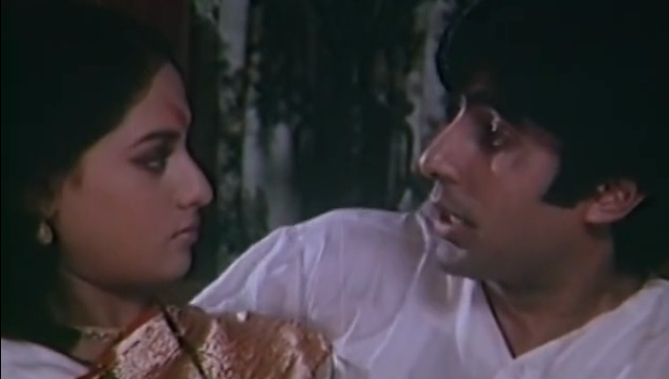
Jaya Bhaduri and Amitabh Bachchan struggle to save their marriage in Abhiman (1973)

Teri Mehfil Mein Qismat Aazmaakar Lyrics and Translation: Let’s Learn Urdu-Hindi

The mehfil for the qawwali looks particularly vibrant in the recolored version of Mughal-e-Azam (1960)

Directed by K. Asif, Mughal-e-Azam (1962) is one of the most cherished films in the history of Bollywood cinema. Although several films have been made around the same premise, Mughal-e-Azam is by far the most well-known depiction of the forbidden love story between Prince Salim and courtesan Anarkali.  We could write (and probably will) at least ten different posts to describe all the things we love about this movie: the intricate Urdu dialogue, the beautiful soundtrack composed by Naushad, the elaborate costumes and set design, the heartwrenching plot, and so on. Here, I’d like to  share the lyrics and translation for one of many gems found in this film’s soundtrack: terii mahfil me.n qismat aazmaakar.

This qawwali is set between Anarkali (played by Madhubala) and her chief rival Bahar (played by Nigar Sultana) as a musical debate on the nature of love. As both women fight for his affections, Prince Salim (played by Dilip Kumar) watches the performance and is supposed to give a rose to the winner of the debate at its conclusion.The back-and-forth debate style of these lyrics is quite a rare find in Bollywood cinema, and it is even rarer to encounter such lyrics (penned by Shakeel Badayuni!) as a female-female duet. Despite being a female-female duet, there is still a subtle division of gender roles if you pay close attention to the song. From her costume, mannerisms, and lines, it could be argued that Bahar is taking on the more masculine role in this qawwali. In fact, her singing part is rendered by the more masculine of the two voices:  Shamshad Begum.

Although the lyrics of this qawwali can be interpreted as universal statements about love, there are a couple of interesting things to point out here with the context of the film’s plot in mind. For example, Bahar introduces a pun on her name when she sings “bahaare.n aaj paigham-e-muhabbat leke aayii. hai.n” (the spring has brought a message of love). Moreover, Bahar snarkily calls attention to the secret love affair between Salim and Anarkali when she claims, “kisii din yeh tamasahaa muskuraakar ham bhii dekhe.nge” (we shall smile one day and watch this spectacle). Aware that her affair with Salim is unacceptable by society’s standards, Anarkali admits that love can be hard when she sings, “muhabbat hamne maanaa zindagi barbaad kartii hai” (we admit that love can destroy one’s life”). She then posits, however, that suffering for the sake of love is worth it because lovers can leave a lasting legacy on the world after they die: “yeh kyaa kam hai ki mar jaane pe duniyaa yaad kartii hai?” Even though she’s being a little dramatic with her lines here, it’s hard not to be rooting for Anarkali over Bahar.

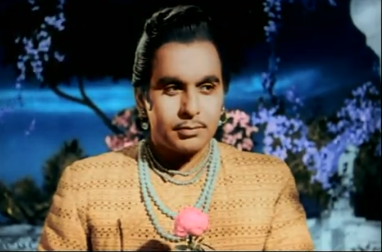
Salim, played by Dilip Kumar, judges the musical debate between Anarkali and Bahar.

At the end of the qawwali, Salim actually declares Bahar the winner of the debate by giving her the rose. This isn’t really a genuine victory because we know that even though Bahar wins the rose, Anarkali has already won Salim’s heart. Also, who could really lose when you have Madhubala and Lata Mangeshkar on your team at their peak of their careers? Come on, Salim, keep it real.

-Mr. 55

Teri Mehfil Mein Qismat Aazmaakar Lyrics and Translation:

Shamshad: terii mahfil me.n qismat aazamaakar ham bhii dekhe.nge
In the gathering of your court, we will test our fate. 
ghaDii bhar ko tere nazdiik aakar ham bhii dekhe.nge
We shall come close to you fleetingly and watch this spectacle. 
ajii haa.n ham bhii dekhe.nge
Yes, we shall watch this spectacle.  

Bahar, played by Nigar Sultana, being sassy as she sings a classic qawwali in Mughal-e-Azam (1960)

Lata: terii mahfil me.n qismat aazamaakar ham bhii dekhe.nge
In the gathering of your court, we will test our fate. 
tere qadamo.n pe sar apanaa jhukaa kar ham bhii dekhe.nge
We shall bow our heads at your feet and watch this spectacle 

ajii haa.n ham bhi dekhe.nge
Yes, we shall watch this spectacle.  

Madhubala charms all of us with her beautiful smile in Mughal-e-Azam (1960).

Shamshad: bahaare.n aaj paighaam-e-muhabbat leke aayii hai.n
The spring has brought a message of love.
baDii muddat me.n ummiido.n kii kaliyaa.n muskuraayii hai.n
The flowerbuds of hope have smiled  after  a long time. 

gham-e-dil se zaraa daaman bachaakar ham bhii dekhe.nge
We shall protect ourselves from heartache and watch this spectacle.
ajii haa.n ham bhii dekhe.nge
Yes, we shall watch this spectacle.   

 Lata: agar dil gham se khaalii ho to jiine kaa mazaa kyaa hai?
If the heart is empty of pain, then what pleasure can one find in living?
na ho khuun-e-jigar to ashq piine kaa mazaa kyaa hai?
If the heart does not bleed, then what pleasure can one find  in swallowing tears? 

muhabbat me.n zaraa aa.nsuu bahaakar ham bhii dekhe.nge
We shall shed a few tears in love and watch this spectacle. 
ajii haa.n ham bhii dekhe.nge
Yes, we shall watch this spectacle.  

Shamshad: muhabbat karnevaalo.n kaa hai bas itnaa hii afasaanaa
Such is the story of lovers: 
taDapnaa chupke chupke aahe.n bharnaa ghuT ke mar jaanaa
They quietly suffer; their eyes fill with tears; they  suffocate and die. 
kisii din yeh tamaashaa muskuraakar ham bhii dekhe.nge
We shall smile one day and watch this spectacle.  

ajii haa.n ham bhii dekhe.nge
Yes, we shall watch this spectacle.   

Lata: muhabbat hamne maanaa zindagii barbaad kartii hai
We admit that love can destroy one’s life.  
yeh kyaa kam hai ki mar jaane pe duniyaa yaad kartii hai?
But, is it unworthy if the the world remembers lovers after they die? 
kisii ke ishq me.n duniyaa luTaakar ham bhii dekhe.nge
We shall sacrifice the world for someone’s love and watch this spectacle. 
ajii haa.n ham bhii dekhe.nge
Yes, we shall watch this spectacle.  

terii mahfil me.n qismat aazamaakar ham bhi dekhe.nge
In the gathering of your court, we will test our fate. 

Glossary

qismat: fate;  aazamaanaa: to test; ghaDii bhar ko: fleetingly; nazdiik: close; qadam: feet; paighaam-e-muhabbat: message of love; baDii muddat me.n: after a long time; ummiid: hope; daaman bachaanaa: to protect; khuun-e-jigar: blood of the heart; ashq piinaa: to swallow tears; aa.nsuu bahaanaa: to shed tears; afasanaa: story; aahe.n: eyes; ghuTnaa: to suffocate; tamaaashaa: spectacle; barbaad: destroyed; luTaanaa: to sacrifice.

Aap Ki Nazaron Ne Samjha Lyrics and Translation: Let’s Learn Urdu-Hindi

A musical match for the ages: Lata Mangeshkar and Madan Mohan

The collaboration between Lata Mangeshkar and Madan Mohan has produced some of the most cherished songs in the musical history of Hindi cinema. Think of gems such as  “lag jaa gale,” “nainaa barse rimjhim rimjhim,” or “tu jahaa.n jahaa.n chalegaa,” to name a few. Today, I’m going to share the lyrics and translation for a ghazal from Anpadh (1962) that is widely considered to be one of this duo’s finest: “aap kii nazaro.n ne samjhaa.” Penned by Raja Mehndi Ali Khan, the lyrics of this song are an equal match for the beauty of the musical composition and rendering. The beauty of the lyrics, however, is perhaps best appreciated once you can get over the whole slave-master dynamic that is going on as Mala Sinha sings to Dharmendra in the film. Although I admit that it is bizarre to refer to your lover as “banda-parvar” (master, lord), it is important to remember that these lyrics were written for the society of 1960s India: gender norms from that era differ dramtically from those established in modern times. At this time, the ideal Indian woman was expected to be submissive to her husband, and this sentiment is reflected in many songs like this one from the period.

An interesting piece of trivia: after the ghazals from Anpadh were released, it is said that composer Naushad supposedly told Madan Mohan that he would trade all of his own compositions for this one song! Although Madan Mohan rarely got his due from audiences back then, it’s nice to hear that his fellow music directors recognized his talent.

-Mr. 55

P.S. Please, for my sake, go to YouTube and give a thumbs-down to Bally Sagoo’s atrocious remix of this song. I don’t understand how these people sleep at night after they ruin the classics (seriously, how did they just change the taal here from 7-beat rupak to 8-beat kaharvaa?)

Mala Sinha expresses her devotion to the handsome Dharmendra in Anpadh (1962)

Aap Ki Nazaron Ne Samjha Lyrics and Translation

aap kii nazaro.n ne samjhaa pyaar ke qaabil mujhe
Your glances deemed me worthy of love.
dil kii ai dhaDkan Thahar jaa, mil gayii manzil mujhe
Oh stop, my heartbeats, for I have found my destination.

jii hame.n manzuur hai, aap kaa yeh faislaa
Yes, this decision of yours is acceptable to me.
kah rahii hai har nazar, bandaa parvar shukriyaa
My every glance is saying, “Thank you, oh lord!”
ha.nske apnii zindagii me.n, kar liyaa shaamil mujhe
As you brought me into your life with a smile. 

aap kii manzil huu.n mai.n, aur merii manzil aap hai.n
I am your destination, and you are mine.

kyo.n mai.n tuufaa.n se Daruu.n? meraa saahil aap hai.n
Why shall I fear the storm? You are my shore.
koii tuufaa.no.n se kah de, mil gayaa saahil mujhe
Someone tell the storms that I have found my shore.

paD gayii.n dil par mere aap ki parchhaaiiyaa.n
Your shadows have cast upon my heart.
har taraf bajne lagii.n saikDo.n shahnaaiiyaa.n
In every direction, hundreds of shahnaiis are playing in celebration
do jahaa.n kii aaj khushiyaa.n, ho gayii.n haasil mujhe
Today, I have enjoyed the happiness of both worlds.

aap kii nazaro.n ne samjhaa pyaar ke qaabil mujhe
Your glances deemed me worthy of love.

Glossary

nazar: glance; qaabil: worthy; manzil: destination; manzuur: acceptable; faislaa: decision; bandaa parvar: master, lord; haasil: achieved, obtained; saahil: shore; parchhaaiiyaa.n: shadows; saikDo.n: hundreds; shahnaaiiyaa.n: traditional Indian instrument resembling a clarinet (associated with weddings); shaamil: present.