What is Eastmancolor?

Amar Akbar Anthony in blinding Eastmancolor!

No, really, what the heck is Eastmancolor? When you look closely at title screen of each of your favorite classic Bollywood films, you find the simple, but bold little phrase, “EASTMANCOLOR” conspicuously splashed across the screen. It’s gnawed quietly at the back of your mind for years. Is “Eastmancolor” part of the name of the film? Is someone making a not-so-clever reference to Indians themselves (“Who is this MAN from the EAST, anyway?”)!? But the words quickly dissolve, the film begins, and in the excitement and messiness of the resulting masala, why “Eastmancolor” deserves a holy spot right in the title screen remains forever an unsolved mystery. Luckily for you, that’s about to change.

Aradhana in mind-blowing Eastmancolor!

Let’s back ourselves up and unravel this riddle from the start. When the first monopack colour film stocks hit Hollywood in the 1930s, India was eager to catch up and bring colour to Bollywood. But the process was not easy. Apart from being significantly more expensive than traditional black-and-white (silver halide photographic emulsion), coloured film stock brought with it a new set of artistic problems: development of the negative taking both luminosity and color into account.

Mere Huzoor in death-defying Eastmancolor!

The first colour film made entirely in India was Kisan Kanya (1937), produced by Ardeshir Irani who had also pioneered the first talkie of Hindi cinema 6 years earlier. However, poor box-office returns and difficulties and expenses in garnering rights to the American Cinecolor stock development process kept coloured film largely out of range for many years following. Guru Dutt, not surprisingly, was among the later auteurs who help revive its popularity. He experimented with the new colour cinematography in his timeless beauty “Chaudhvin Ka Chand”(1961)  that highlights the effect of (fake) moonlight and colour ranges at night. The opportunity to use colour arrived mid-production, and although Dutt had wanted to reshoot the entire film with the new technology, budget and time-constraints forced him to film only this and one other song in colour before the release. Around the same time, K. Asif too experimented with the range of this new technology, incorporating the dazzling colour song “Pyar Kiya To Darna Kya” into his magnum opus Mughal-e-Azam (1961) as a stunning and vivid tribute to the full glamour of the Mughal Empire.

Junglee in dazzling Eastmancolor!

India’s full-length color feature, Mother India (1957), was a landmark film for many reasons, but notably for demonstrating that coloured film stock was the wave of the future—garnering a nomination for Best Foreign Film at the Academy Awards the year of its release. After the overwhelming success of Mother India, Bollywood began shifting its norm to predominantly coloured film, eventually using black-and-white sparingly for stylistic reasons (as in the film noirs or Teen Devian).

Caravan in jaw-dropping Eastmancolor!

Prior to this era, colourizing film had been a technical and artistic nightmare—as far back as the 1910s and 1920s, filmmakers had been painting each frame of a film by hand, bleaching the film stock and adding color dye, or most popularly, using the expensive Technicolor multi-strip subtractive method. These options had little ground in the competitive, movie-a-minute atmosphere of India, and the hassle of processing such film stock (which often needed to be shipped abroad for the purpose), left India for many years colourless.

Teesri Manzil in heart-stopping Eastmancolor!

Eastmancolor, introduced in 1950 by Kodak was a novel and economic technology that used a single-strip 33mm negative-positive process incorporated into one strip of film. While a popular rival to expensive Technicolor, it unfortunately is also the stock most prone to fading over the years. The Eastmancolor emulsions are made of cyan, yellow, and magenta layers. The cyan is the first to fade—in films you see what were originally blue skies now turned white—then eventually all you have left are the sun-washed reddish hues. This gives us a classic image of badly preserved Bollywood films with faded colours and a warm tint.  Contrast this with most beautifully vivid Technicolor processed films you can watch today (think MGM Judy Garland musicals), and you can see a big difference in how the colours have survived.

Safar in gut-wrenching Eastmancolor!

By the time DVDs rolled around, many of the films we know and love in Bollywood had suffered destruction in their original film stocks that no one bothered to repair before a DVD transfer. However, just to give you a hint of what we’ve lost, I’ve personally adjusted the color (albeit imperfectly), to a few stills below from some classic Bollywood films as they would have looked had they been printed on extremely saturated Technicolor. See how subtle thing like this can actually make a HUGE overall difference?! That faded look is merely a tragic artifact of time and neglect.
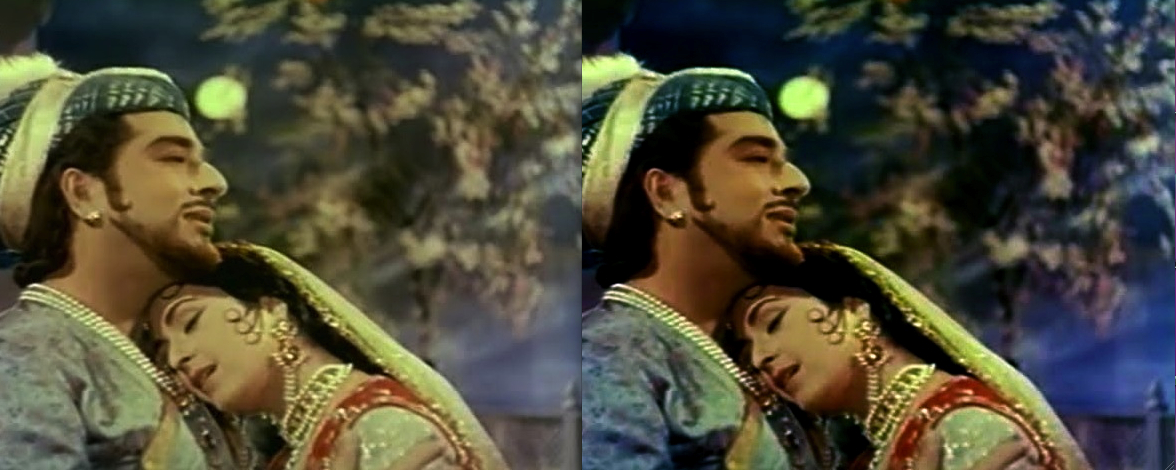
Pradeep Kumar and Bina Rai in Taj Mahal (1963).
Left: Eastmancolor. Right: Technicolor.
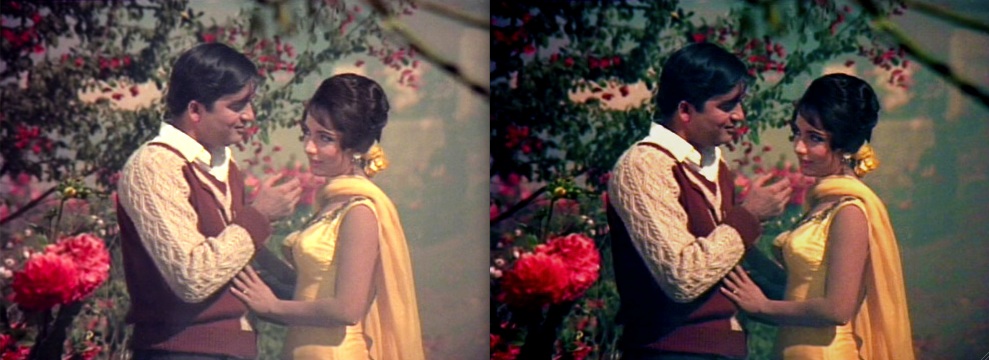
Sunil Dutt and Sadhana in Waqt (1965).
Left: Eastmancolor. Right: Technicolor.

Waheeda Rehman in Guide (1965).
Left: Eastmancolor. Right: Technicolor.

Shammi Kapoor and Asha Parekh in Teesri Manzil (1966).
Left: Eastmancolor. Right: Technicolor.

Aruna Irani in Caravan (1971).
Left: Eastmancolor. Right: Technicolor.

Rajesh Khanna and Sharmila Tagore in Aradhana (1969).
Left: Eastmancolor. Right: Technicolor.

Zeenat Aman and Dev Anand in Hare Rama Hare Krishna (1971).
Left: Eastmancolor. Right: Technicolor.

We often think that Eastmancolor was used only in Bollywood, but it truly started in America as a cheaper rival to Technicolor. In fact, with the advent of Cinemascope (a new widescreen format that once again changed the dynamic of filmmaking), Eastmancolor became THE industry standard—however, in America and unlike in India, the Eastmancolor stock was actually processed still by Technicolor using their sturdier dye-transfer printing. Therefore many films in America billed as “Technicolor” actually have an Eastmancolor base, but would retain their colour fidelity over the years. This is also true of the climax of Mughal-e-Azam which was also shot in and processed by Technicolor and has therefore remained brilliant over the years (helped, of course, also by the recent restoration project). The colours of that film look far different than the colours of classic Eastmancolor Bollywood films like Caravan (1978), Amar Akbar Anthony (1977), or Jewel Thief (1967). Sigh. A little investment would have gone a long way.

Madhubala glitters in K. Asif’s true Technicolor masterpiece Mughal-e-Azam (1961). Now THAT’s colour, people.

Satisfied? More information than you really wanted? I hope everyone’s burning curiosity has been slaked at last. The next time you and your hip friends watch an Eastmancolor film, you’ll be the cool cat who knows the full story. Impress the crowd with your knowledge, and poo-poo those provincial fools who think Eastmancolor simply meant Indian men making films! Fun fact: Eastman is actually the name of George Eastman who founded Kodak Photography in 1889!

This Bollywood Mystery request was submitted by faithful fan Pankaj. As always, shoot us an email and keep those requests coming!

-Mrs. 55
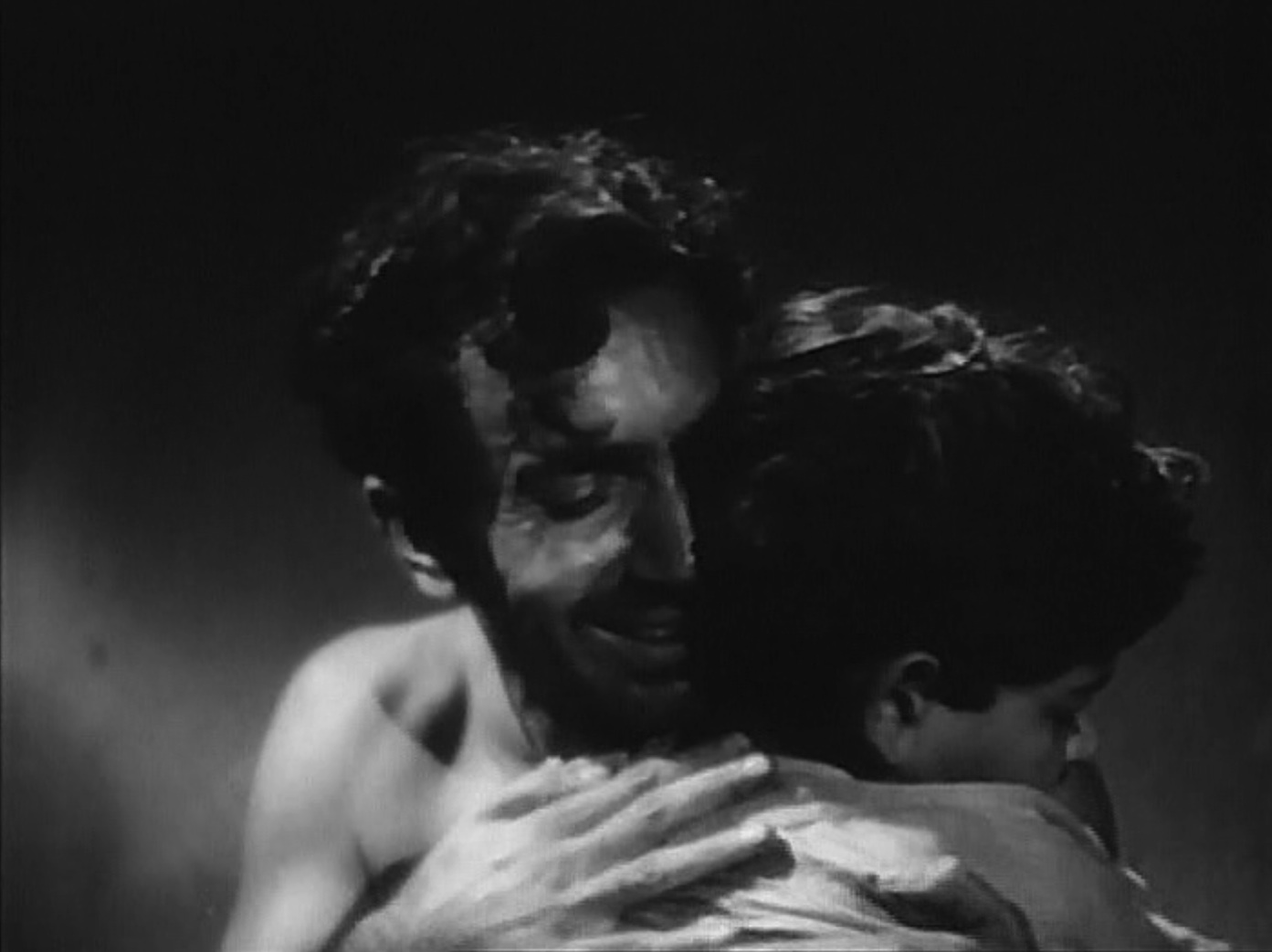
The Tragedy and Triumphs of Do Bigha Zameen

Do Bigha Zameen 2

Balraj Sahni embraces his son in despair after a violent misunderstanding in the urban nightmare of Do Bigha Zameen (1954).

In the 1954, the year of the first Indian Filmfare awards, the film that took home the glory of both best picture and best director was about to become more than just a national treasure. Do Bigha Zameen, the latest directorial offering of a relatively minor Bengali newcomer, told a story that was not familiar in the tinsel-lined halls of Bombay filmdom. Without a glamorous period backdrop, without elaborate dream sequences, and without clearly enunciated moral take-home points, Do Bigha Zameen cannot be readily categorized with contemporary village epics such Mother India (1957) nor socially-conscience critiques like Shree 420 (1955) and Pyaasa (1957). With such a new vision of Indian cinema, stylistically and socially, Do Bigha Zameen hit a broader audience, becoming the first Indian film to win the Prix Internationale at the 1954 Cannes Film Festival.

But what is all this hype about? What makes Do Bigha Zameen so radical and why does everyone always bring it up in discussions of must-see Bollywood films? The film is directed by Bimal Roy, a prominent member of the post-colonialist Bengali intelligentsia, who was directly influenced by another radical film movement sweeping Europe: Italian Neorealism. Like other great Bengali directors of his day, ie. Rhitwik Ghatak and Satyajit Ray, Bimal Roy was fascinated by the work of Italian pioneer Vittorio de Sica and his masterpiece Ladri Di Biciclette (1948). The film is the defining work of Italian neorealism, marked by a deliberate attention to the “everyday,” the feeling of an invisible, unhurried camera whose shots and mis-en-scene are carefully constructed, but have the naturalness of a documentary. The Italian neorealist movement glorified without ornamentation the lives and suffering of “ordinary” citizens. It gave importance to the unimportant and evoked sympathy without the crutches of melodrama.

Do Bigha Zameen 1Balraj Sahnia Nirupa Roy

Nirupa Roy and Balraj Sahni flirt with each other beneath a shady tree in Do Bigha Zameen (1954).

Now I’ll argue that among the Indian film influenced by the neorealist movement, Satyajit Ray’s Apu Trilogy is perhaps the truest to the legacy set by Ladri di Biciclette. To fully appreciate that unique style of film-making, you must see Ray’s Aparajito. Do Bigha Zameen blends the line between neorealism and commercial–similar perhaps to the films of Guru Dutt, but without the poetic grandeur. Starring the classiest of men, Balraj Sahni and Nirupa Roy (yes! she did play the heroine before becoming a stock mother-figure actress in the 70s!), Do Bigha Zameen, tells of the hard work, misfortune, and desperate measures taken by a family who is cheated of their land by a greedy mill owner. The film follows the father and son’s trip to Calcutta from their idyllic village to earn enough money to pay their debts–only to discover the harsh realities of urban poverty instead.

Like Ladri di Biciclette, the film also explores the evolving relationship between a father and son, of how the dynamic changes when a child grows up quickly and a mutual level of forgiveness that comes with a more mature relationship. With scenarios by Hrishikesh Mukherjee (who also did the screenplay for gems like Anand!), it’s clear that “realism” is given a healthy splash of Bollywood exaggeration. When the going gets rough for this family, it just spirals into greater and greater tragedy–the loss of property, becoming victims of robbery, illness, and a car crash. A heavy-handed background score encourages the audience to evoke sympathy and fear, as well as a handful of painful histrionics rendered by the cutesy child actor. But all in all, the real triumph of this film is in the conclusion.

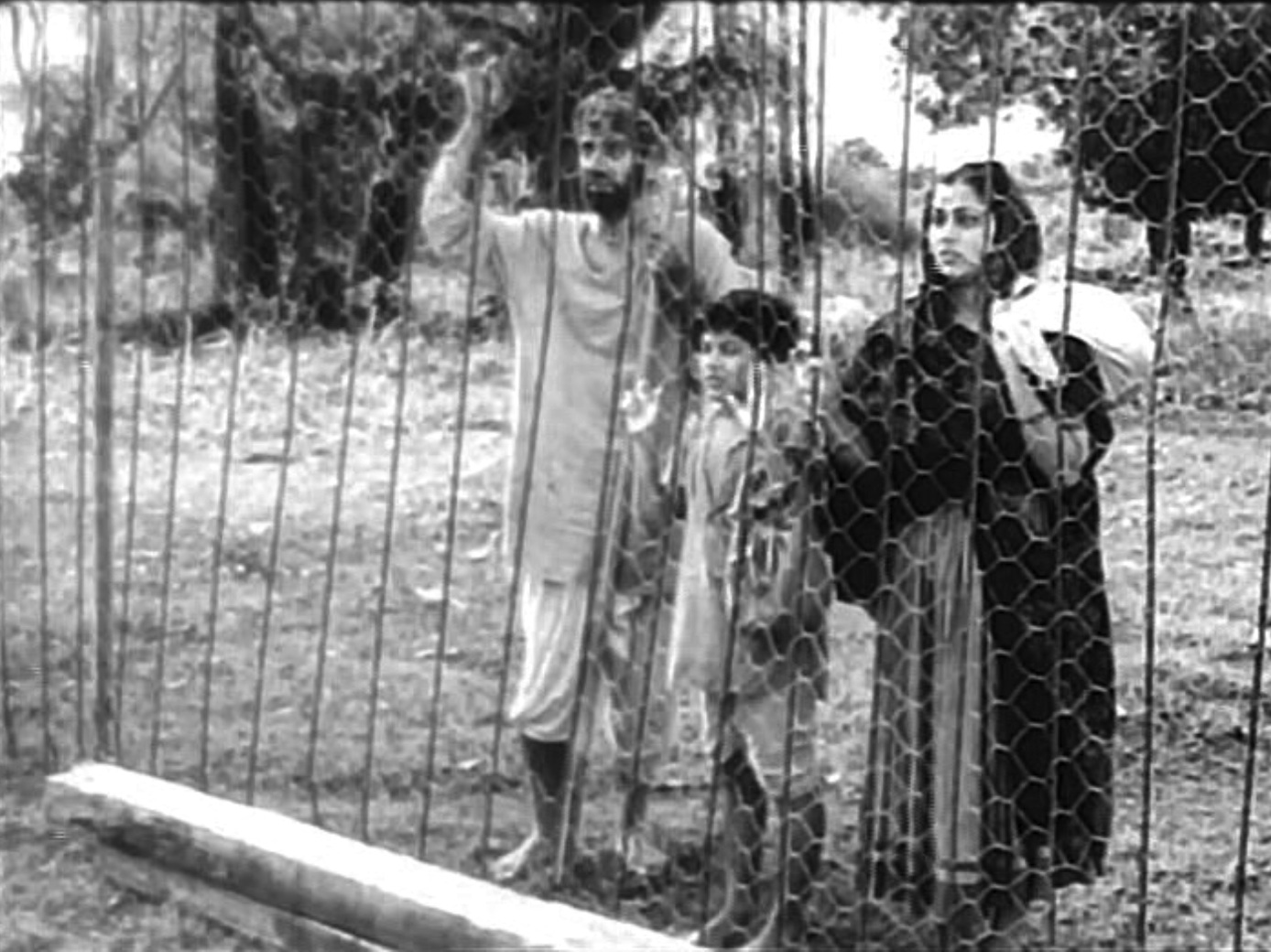
The impoverished family watches the destruction of their ancestral land behind a closed gate in Do Bigha Zameen (1954).

At the end of Do Bigha Zameen, there is no real outcome. Like with Satyajit Ray’s Aparajito, it ends with a single shot of the family, moving on into the distance. The journey we as an audience have witnessed is but a chapter in their lives that we know will be marked in the future with similarly unresolved troubles. But it also carries a kind of hope with it, not that all will be right in the world, but a hope that men and women like these are survivors and will find a way to persevere, even if that does not mean coming out on top. It is what sets this film apart from the Raj Kapoors of the world. And that is, I think, the message that hit home with millions of Indian viewers in the dissatisfied liberated world.

The film takes its name from a Rabindranath Tagore poem “Dui Bigha Jomi.” In the original poem, a poor farmer begs his landlord to not make him sell his ancestral plot of land. But the cruel landlord insists, while the farmer famously begs (as in the film adaptation) that the land is like his mother–and how could anyone sell their own mother? Do Bigha Zameen, however small, carries the price of a man’s honor, and for the poor farmer, this cannot be bought by mere money.

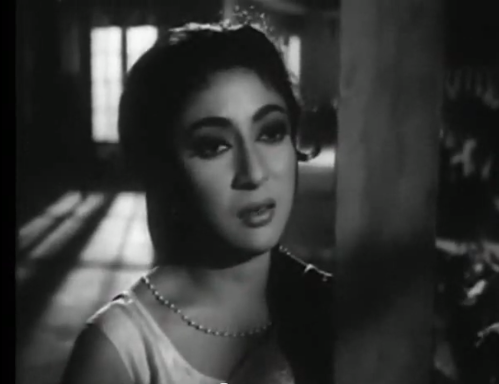
Meena Kumari plays a doting mother in a special appearance for the Lata Mangeshkar song, “Aaja Re Nindiya Tu Aa” in Do Bigha Zameen (1954).

Also of note, a young Meena Kumari plays a minor role as a benevolent landlady who agrees to to help the family with their debts (before further disaster strikes, rendering her offer useless). She had been on set of Roy’s earlier film, Parineeta (1953), when she heard of the production and loved it so much, she begged to participate. Of particular and slightly disturbing note is the facial hair on her upper lip that the costume and make up department didn’t do something more about. You think it blends in because you can’t really see it in person, but it shows up on black-and-white film stock like a dark shadowy menace. Gets ‘em every time.

– Mrs. 55

Which Actor Did Hemant Kumar Sing For Best?

Hemant Kumar (1920-1989) was a legendary Hindi and Bengali film music composer and singer.

Hemant Kumar (1920-1989) was a legendary Hindi and Bengali film music composer and singer.

In classic Bollywood cinema, playback singers could make or break the career actor. Famous actor-singer pairings are legendary. The voice of the singer became the soul of the actor and once a perfect match was made, it was hard to separate them without upheaval. Who could imagine anything but the manly voice of Kishore Kumar with the face Rajesh Khanna? Or the playful sweetness of Mohammed Rafi with fun-loving Shammi Kapoor? When Mukesh passed away, Raj Kapoor (for whose career Mukesh lent his illustrious talent) famously burst into tears and announced, “I have lost my voice.”

But occasionally we find a rogue player in Hindi film music. Hemant Kumar stands out as a unique character, a difficult man to place in the rankings. For he was not merely a singer, but a legendary music director as well in both Hindi and Bengali cinema. Hemant Kumar was heavily influenced by Rabindrasangeet (like his contemporary S.D. Burman!), and first broke into the Bengali industry as a music director in 1947, the year of Indian independence. Hemant Kumar’s unmatched virtuosity led him to not only sing many of the hit songs of the 50s and 60s in Bombay himself, but he actually formed his own production company that made classics such as Bees Saal Baad (1962), Kohra (1964), and Khamoshi (1969). In the 70s he even dabbled as a film director with moderate success.

Hemant Kumar recording a song with Lata Mangeshkar

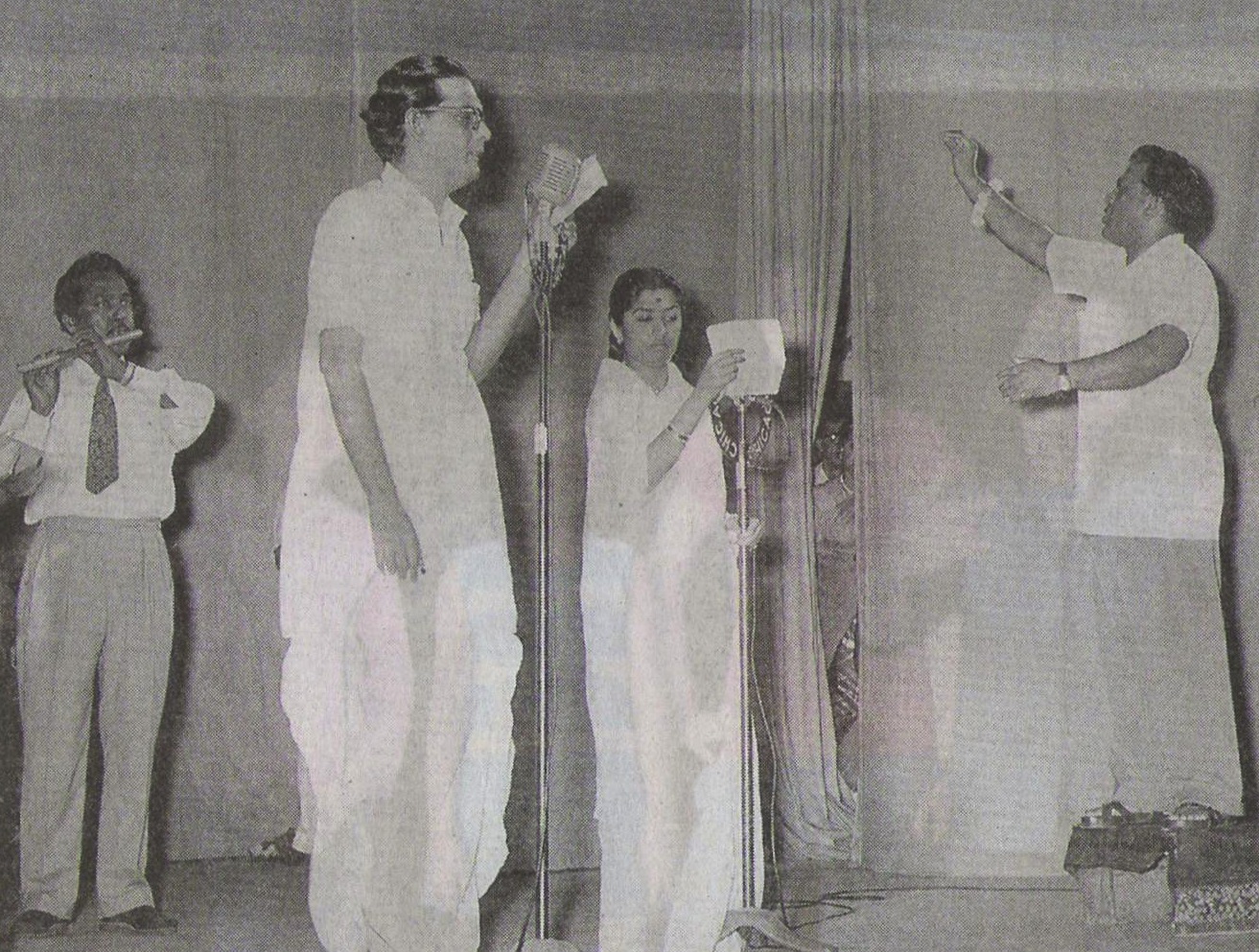
Hemant Kumar and Lata Mangeshkar during the studio recording of “Nain So Nain” from Janak Janak Paayal Baaje (1955).

But for me, it was as a singer that Hemant Kumar always shines and also the category in which history has given him the shaft. His voice was absolutely unlike any other in the industry–a deep and soulful richness that no one could touch. Interestingly, for a man whose talents were so diverse, Hemant Kumar never took to acting and singing his own songs on screen (à la Kishore Kumar). Instead, he sang for a myriad of rising and great actors across the decades–never branding himself with a single artist. Hemant Kumar remained a maverick, and for it, is often brushed aside.

So I now pose to you the question–which actor do YOU think Hemant Kumar sang for best? His voice graced the images of many men, but did it work for all of them? Your contestants are Guru Dutt, Dharmendra, Biswajeet, Dev Anand, and Shammi Kapoor. We present five songs below that illustrate some of Hemant Kumar’s finest collaborations with these actors and the cinematic chemistry that ensued.

1. Guru Dutt: Jaane Woh Kaise

The voice of tragedy, Hemant Kumar sings for Guru Dutt in this timeless lament from Pyaasa (1957). Guru Dutt, who often played the tragic poet, seems a natural choice for the resonant tones of Hemant Kumar in this song that has become iconic for all awkward dinner party songs.

2. Dharmendra: Tum Pukar Lo

Discussed in a previous post, Khamoshi (1968) is a heart-wrenching film about love, loss, and insanity. Although you don’t see much of Dharmendra’s face in this sequence, his subtle performance matches the song’s patient yearning with a hint of a Western flair. But to me, as an actor Dharmendra is somehow too shallow to be worthy of a Hemant Kumar solo. Maybe that’s just me?

3. Biswajeet: Yeh Nayan Dare Dare

A tender sequence from the film Kohra (1964), this song embodies the sweet side to Hemant’s voice that comes in the middle of a spooky film noir. I’m not going to pretend that Biswajeet is anything but a joke, but for me this pairing works–Hemant’s sweet vocals and Biswajeet’s confident, but appeasing motions to Waheeda are a pleasing combination.

4. Dev Anand: Yeh Raat Yeh Chaandni Phir Kahaan

God, I love it. I’ll be the first to tell you that no one sang better for Dev Anand than Mohammed Rafi, but this song is something else. I’ve discussed this sequence already in our earlier translation of the song, but let me just repeat that Hemant Kumar in a seductive mood blends beautifully with that longing gaze of Dev Anand’s. It’s just so exciting and rare, not to mention compliments Dev Anand’s semi-gravely voice in this film.

5. Shammi Kapoor: Aye Dil Ab Kahin Lejaa

This is another beautiful Hemant Kumar tragedy with a touch of mystery. Shammi is clearly giving it his all in this song, but somehow, I think it just doesn’t come together. Shammi Kapoor is too much of a hot mess for me to believe anything but Mohammed Rafi coming out of his mouth–the resonant voice of Hemant seems incongruous with those histrionics, despite its unarguable beauty.

And the winner is…?

I’m gonna have to say Guru Dutt–that song is just sublime on every level, but I’m open to discussion. Who do you think matched Hemant Kumar’s voice best? Let us know YOUR opinion in the comments!

-Mrs. 55

P.S. Wondering why we didn’t mention female playback singers here? It’s because the female side of things worked very differently, ie., it was Lata and Asha or bust. Every actress had them, and with the occasional Geeta Dutt or Shamshad interlude, there was no room for a “signature” playback artist per actress (although Lata will argue she “changed” her voice depending on the actress–more on this to come!)

Woh Hanske Mile Humse Lyrics and Translation: Let’s Learn Urdu-Hindi

Although Asha Bhonsle is perhaps most well-known for her seductive and playful songs (see our translation of “raat akelii hai” here), she was a truly versatile artist who had an excellent command over a range of styles and emotions. When she is in a serious mood, Asha can really tug at your heartstrings with her sad singing. Think “ab ke baras bhej bhaiyya ko babul” from Bandini (1963), “yeh kyaa jagah hai dosto” from Umrao Jaan (1981), or “meraa kuch saamaan” from Ijaazat (1987).  Here, I’ve translated a short yet painfully beautiful Asha solo from Baharein Phir Bhi Aayengi (1966) called woh hanske mile humse.”

Baharein Phir Bhi Aayengi was released posthumuously under Guru Dutt’s film banner after Guru Dutt’s demise in 1964. The film was not even complete half-way before Guru Dutt’s death, so the film was shot again with a new director Shahid Lateef and new hero Dharmendra. Although the movie itself lacks the magic found in older Guru Dutt films, O.P. Nayyar’s soundtrack for the movie is still remembered today, most notably the Rafi number “aap ke hasiin rukh pe aaj nayaa nur hai.”

Mala Sinha in a melancholic mood in Baharen Phir Bhi Aayengi (1966)

The movie’s plot focuses on a love triangle: handsome young news reporter Jitendra (played by Dharmendra) falls in love with the bubbly Sunita (played by Tanuja) while Sunita’s older sister and head of the newspaper Amita (played by Mala Sinha) eventually becomes smitten by Jitendra. Before Amita decides to reveal her feelings to him, she finds out that Jitendra is actually in love with  Sunita. Although she is devastated by this news, she decides to back away for the sake of her sister’s happiness.  Here’s where the song I’ve translated comes in. Backed by Asha’s painstricken vocals and S.H Bihari’s simply crafted lyrics, Amita laments how she misinterpreted Jitendra’s actions to think that he was in love with her when that was not the case (“bekaar hii ulfat kaa izhaar samajh baiThe”). Sigh…

I think this song will strike a chord with those of you who have suffered through a romantic misunderstanding–it certainly did with me.

-Mr. 55

Woh Hanske Mile Humse Lyrics and Translation

woh ha.nske mile ham se, ham pyaar samajh baiThe
He smiled at me when we met, so I thought that he loved me.
bekaar hii ulfat kaa izhaar samajh baiThe
I interpreted it, in vain, as a declaration of love.

aisii to na thii qismat apnaa bhii koii hotaa
It was not in my fate to call someone my own.
kyo.n khud ko muhabbat kaa haqdaar samajh baiThe?
Why did I consider myself entitled to his love? 

roye.n to bhalaa kaise, khole.n to zabaa.n kyo.n kar?
How shall I cry, why should I speak?

Darte hai.n ki jaane kyaa sansaar samajh baiThe.
I fear what society has perceived of this. 

woh ha.nske mile ham se, ham pyaar samajh baiThe
He smiled at me when we met, so I thought that he loved me. 

Glossary

bekaar: useless, in vain; ulfat: love; izhaar: declaration; qismat: fate, destiny; haqdaar: entitled; zabaa.n kholna: to speak; sansaar: society 

Rabindranath Tagore’s Influence on S.D. Burman

Rabindranath Tagore (1861-1941) and S.D. Burman (1906-1975)

Due to my upbringing in a Bengali household, I am intimately familiar with Rabindra-sangeet: the genre of songs written and composed by Nobel laureate Rabindranath Tagore. As a composer, artist, novelist, playwright, poet, and philosopher, Tagore has left a lasting legacy on Indian culture through his vast collection of works in a variety of mediums. Although the purism and simplicity of Tagore’s style might suggest that Bollywood is an inappropriate forum to celebrate his art, several music directors from the Golden Age of Hindi cinema have been known to use Tagore songs as inspirations for their musical compositions. The music director who is most well-known for this practice is none other than the illustrious S.D Burman. S.D. Burman is one of the most succesful music directors in the history of the Bollywood industry, and his songs from films such as Bandini (1963), Guide (1965), Jewel Thief (1967), and Aradhana (1969) are still considered all-time classics today. His filmi compositions tend to draw upon inspiration from Bengali folk traditions (e.g. bhatiaalii, saari, etc. ), but here I’d like to draw your attention to a collection of S.D. Burman compositions that are derived from Rabindra-sangeet:

meraa sundar sapnaa biit gayaa (Do Bhai, 1949): From one of S.D. Burman’s first hit scores in the Bollywood industry, this song is considered to be Geeta Dutt’s breakthrough as a playback singer in Hindi films. The mukhDaa of this song is inspired by a Bilaaval-based Tagore composition called “radono bharaa e basonto.” Geeta does an excellent job of expressing the sorrow and pain of this song with her voice, and it is truly unfortunate that the lyrics here would become a reality for her during her tumultuous marriage to Guru Dutt in the next decade.

Playback singer Geeta Dutt (1930-1972) with her husband Guru Dutt (1925-1964)

nain diivaane (Afsar, 1950): This Pilu-based composition is skilfully rendered by Suraiyya, a leading singer/actress who became a huge sensation in Bollywood during the 1940s. Bollywood as we know it today relies on actors and actresses lip-syncing songs sung by playback singers; however, in its very early days, actresses like Suraiyya used to sing their own songs for films. In spite of their dual talents, singer-actresses were not able to survive the onslaught of the Mangeshkar monopoly in the 1950s, and the playback singing paradigm became the standard that is still maintained today in the industry. In any case, this song is based on an extremely popular Tagore composition called “sediin duujane duulechhiinuu bone.” S.D. Burman literally did a copy-paste job here, as the melody of the entire Hindi song is identical to the Bengali original. While loosely basing a mukhDaa on a previous composition is somewhat acceptable, recycling a whole song written by another composer begs the question: should S.D. Burman have given credit to Tagore for this composition?

Singer/actress Suraiyya (1929-2004)


 jaaye.n to jaaye.n kahaa.n? (Taxi Driver, 1954): S.D. Burman won his first Filmfare Award for Best Music Director for this song from Taxi Driver in 1954. As is often the case, the male version of the song (sung by Talat Mehmood) is more popular than the female version (sung by Lata Mangeshkar). Although S.D. Burman modified the raga of his composition to more closely resemble Jaunpuri, the first line of the mukhDaa is instantly recognizable as the main phrase from Tagore’s Bhairavi-based classic  “ he khoniiker otiithhii.” Note that the Tagore original that I have provided here is sung by Hemanta Mukherjee (a.k.a Hemant Kumar), who, in addition to achieving fame as a Hindi playback singer/music director, was known for his beautiful renditions of Rabindra-sangeet in Bengali.

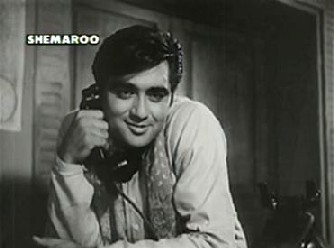
jalte hai.n jiske liye: (Sujata, 1959): This probably qualifies as my favorite “telephone song” from a Hindi film. Here, Sunil Dutt woos Nutan over the phone with this gem as he croons to Talat Mehmood’s silky vocals on playback (notice the characteristic quiver that we know and love!). Although this composition is often considered an all-time classic song of romance, fans of this song may be surprised to know that the mukhDaa is taken directly from a Tagore composition named “ekodaa tumii priye.”

Sunil Dutt serenades Nutan over the telephone with “jalte hai.n jiske liye” in Sujata (1959)

meghaa chhaye aadhii raat (Sharmilee, 1971): Out of all the compositions listed here, the inspiration from Tagore is the most difficult to hear in this song because it does not involve the mukhDaa. Rather, S.D. Burman seems to have inserted a small segment of  laho laho tuule laho (0:26-0:40) into the antara of this raga Patdeep-based classic from Sharmilee. What a trickster, huh?

tere mere milan kii yeh rainaa (Abhimaan, 1973): By far, this is the most famous example where  S.D. Burman has been inspired by Rabindra-sangeet.  In his last hit film score (for which he won his second  Filmfare Award for Best Music Director), S.D. Burman recycles the mukhDaa from Tagore’s Mishra Khamaj-based “jodii taare nai chiinii go sekii?” in this evergreen duet of Lata Mangeshkar and Kishore Kumar. Burman’s antaras are a beautiful addition to the original composition, so we won’t give him too much trouble for his rehashing of Tagore here. Note that the Bengali original that I have linked to here is sung by Kishore Kumar, another Hindi playback singer who was famous for his renditions of Rabindra-sangeet in Bengal.

Amitabh and Jaya Bacchan sing the duet “tere mere milan kii yeh raina” on stage during the climax of Abhimaan (1973).

Although S.D. Burman was often inspired by Tagore in his compositions, he never recorded or sang a single piece of Rabindra-sangeet throughout his career. The reason behind this is, of course, family feuding–an unavoidable staple of all things related to Indian culture. Here’s the story: S.D Burman’s father Nabadwip Chandra Dev Burman was set to be the direct heir to the throne of Tripura when the current king passed away in 1862. However, the crown went to Nabadwip’s paternal uncle Birchandra Dev Burman due to some dirty palace politics. Because Rabindranath Tagore had a very close relationship with Birchandra Dev Burman, S.D. Burman avoided meeting Tagore throughout his lifetime and refused to perform Rabindra-sangeet out of principle. Nevertheless, in spite of this tiff, it is undeniable that S.D. Burman had a great deal of respect for Tagore as a musician given the influence of Rabindra-sangeet on his compositions.

–Mr. 55