Bahut Shukriya Badi Meherbani Lyrics and Translation: Let’s Learn Urdu-Hindi

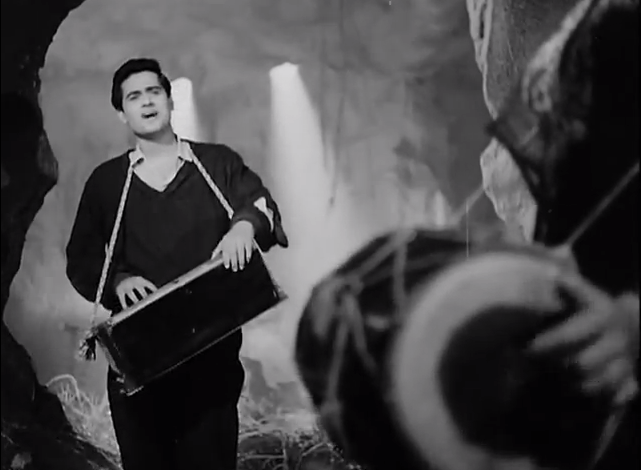
Tall and handsome Joy Mukherjee serenades Sadhana with a harmonium in hand in Ek Musafir Ek Hasina (1962)

HAPPY THANKSGIVING! In the spirit of giving thanks today, we are presenting one of Hindi cinema’s most cherished expressions of gratitude: “bahut shukriyaa baDii maharbaanii” from Ek Musafir Ek Hasina (1962). Directed by Raj Khosla, this film presents Joy Mukherjee and Sadhana in their second film together after debuting in Love in Simla (1960).  Despite some plot loopholes  and scattered character development, this film is worth a watch for Sadhana’s sublime beauty, O.P Nayyar’s evergreen soundtrack, and the cinematic portrayal of Kashmir.  This movie must have done something right because it became the second-biggest hit at the box office in 1962!

Mohammed Rafi is at his playful best as he sings for Joy Mukherjee’s character, a wounded soldier who has fallen in love with Sadhana after being hit with classic Bollywood’s most popular disease: amnesia! Asha Bhonsle also makes her presence felt despite being given a single stanza to sing here.  Although the Lata-Rafi pairing was the golden standard at the time, the unique chemistry shared between Asha and Rafi in such duets as this one is undeniable. The true star here, however, is music director O.P. Nayyar. Despite his lack of formal musical training, O.P. Nayyar was gifted with a natural talent for composing memorable melodies that appealed to the masses. Here, he draws upon Kashmiri folk influences to craft a tune that has truly survived the test of time. Of special note in this song is the interplay of the harmonium and dholak, two instruments that were often passed over by many music directors for more robust alternatives (e.g. strings, tabla, etc). This orchestration  is  an integral part of the song and it has even been reflected in the picturization: Joy Mukherjee serenades with a harmonium strapped around his neck as Sadhana accompanies on the dholak.

Given the special occasion of Thanksgiving, we hope that the portrayal of thankful sincerity in this song will inspire you to go say dhanyavaad, shukriya, or thank you to the loved ones in your life. Before the food coma from dinner sets in, take a listen to this gem and follow along with the lyrics and our English translation below. Enjoy!

–Mr.55
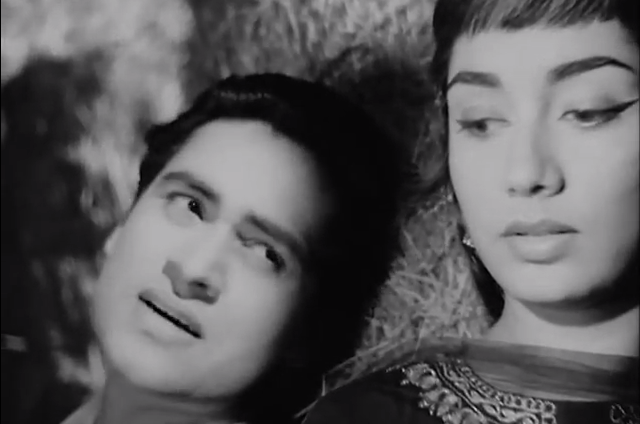
Who is wearing more make-up here? Joy or Sadhana? 🙂

Bahut Shukriya Badi Meherbani: Lyrics and Translation

bahut shukriyaa baDii maharbaanii
Many thanks for the great kindness you have shown
merii zindagii me.n, huzuur, aap aaye
by coming into my life, oh beloved. 
qadam chuum luu.n, yaa ki aa.nkhe.n bichha duu.n?
Shall I kiss your feet or wait in desperation?
karuu.n kyaa yah merii samaj me.n na aaye
I cannot understand what I should do.

karuu.n pesh tum ko nazaraana dil kaa
I shall offer you my heart as a gift
ki ban jaaye koii afsaanaa dil kaa
so that a tale of the heart is created.
khudaa jaane aisii suhaanii ghaDii phir
God knows that such a lovely moment
merii zindagi me.n palaT ke na aaye
may never return again in my life. 
bahut shukriya…
Many thanks... 

khushii to bahut hai, magar yah bhii gham hai
I am experiencing much happiness, but also some sorrow
ki yah saath apnaa qadam do qadam hai
because our companionship is limited to taking only a few steps together.
magar yah musaafir duaa maangtaa hai
Yet this traveler prays that
khudaa aap se phir kisii din milaaye
God may arrange for us to meet again one day 
bahut shukriya…
Many thanks…

mujhe Dar hai mujh me.n ghuruur aa na jaaye
I am afraid that I may become filled with pride.
laguu.n jhuumne me.n, suruur aa na jaaye
As I begin to dance, I fear that I may be overcome with exhilaration.
kahii.n dil na meraa yah taariif sun kar
I hope that, upon hearing your praises, my heart
tumhaaraa bane aur mujhe bhuul jaaye
does not become yours while forgetting me. 

bahut shukriyaa baDii maharbaanii
Many thanks for the kindness you have shown
merii zindagii me.n, huzuur, aap aaye
by coming into my life, oh beloved.

*Male lines in black are sung by Mohammed Rafi. Female lines in red are sung by Asha Bhonsle. 

Glossary

shukriyaa: thanks; maharbaanii: kindness; huzuur: beloved; qadam: foot, step; chuum lenaa: to kiss; aankhe.n bichhaa denaa: to wait desperately; samaj: understanding; pesh karnaa: to offer; nazaraanaa: gift; afsaanaa: tale; suhaanii: lovely; palaT ke aanaa: to return;  musaafir: traveler; duaa maangnaa: to pray; ghuruur: pride; suruur: exhilaration; taariif: praise.

Joy and Sadhana share great (and perhaps unexpected) on-screen chemistry in Ek Musafir Ek Hasina (1962)

Diwali Songs from Classic Bollywood

Happy Diwali! For all our readers and fans observing the occasion, what could be better than a list of 10 classic Bollywood Diwali songs to enjoy over the celebrations today? For a country of over 1 billion Hindus and an industry that absolutely loves to celebrate any kind of occasion with song and dance, Bollywood has a surprisingly low number of Diwali songs in its films. I mean, think about it–Diwali is the country’s largest national holiday, lends itself brilliantly to poetry (festival of lights imagery, the story of the Ramayan, etc.), and is practically bound to succeed by virtue of having very little with which to compete. People are aching for these songs, yet they hardly exist–much less ones worth hearing over and over.

Dharmendra Jugnu Diwali

Dharmendra celebrates Diwali with fireworks and song in Jugnu (1973).

To be sure, plenty of great Diwali bhajans exist outside the realm of Bollywood (look no further than Tulsidas classic “Shri Ram Chandra”), many of which have excellent covers by our favorite playback singers. But within the films? The pickings are slim. I’ve got a theory as to why this might be the case. Let us consider the example of Christmas as we know it in America. When we think of great Christmas jingles, the songs we name predominantly come from hit singers or church traditions–with only a few actually having made it to popular culture from films, despite Hollywood having had a long and successful musical film movement (Judy Garland’s gorgeous “Have Yourself a Merry Little Christmas” comes to mind).

So perhaps Bollywood is no different. Because singing a song about Diwali actually requires Diwali to be a major part of the plot, the happy coincidence rarely occurred–much less with the good fortune of also having been a brilliant composition. Furthermore, celebrations like Holi, for which we can name at least a handful of terrific Bollywood songs, actually lend themselves much better to an upbeat and colorful party on-screen–so musical composition could be a bit more relaxed. With Diwali, you’re treading on sacred ground–and why mess with something that non-filmi bhajans do way better anyway?

Still, a few intrepid pioneers prevailed, and while some are more memorable than others, you’ll find plenty of hidden gems! Below find our list of 10 classic Bollywood Diwali songs that will get the festivities started old-school style! Click the song names to get to the link to youtube.

10 Classic Bollywood Diwali Songs:

1. Kaise Diwali Manaye Lala (Mohammed Rafi, Paigham 1959)

Be prepared from some ridiculous Johnny Walker antics, but a fun dance beat to get your spirits up!

2. Aayi Ab Ke Saal Diwali (Lata Mangeshkar, Haqeeqat 1965)

On a somber note, this haunting Lata Mangeshkar melody from war epic Haqeeqat is a stark reminder of families in grieving this time of year.

3. Is Raat Diwali Kaise (Mohammed Rafi, Shamshad Begum, & Asha Bhonsle, Sabse Bada Rupaiya 1955)

Oh, what?! A Diwali qawwali?! SIGN ME UP! A peppy song describing Diwali festivities sung in traditional qawwali style that gets you clapping along.

4. Laakhon Taare Aasman Mein (Mukesh and Lata, Hariyali Aur Raasta 1962)

Another tragic lovers-separated-on-Diwali-night song starring Manoj Kumar and Mala Sinha, but the melody is sweet and watching Manoj Kumar mope is never such a bad thing. The Lata-Mukesh chemistry works well as always!

5. Jagmati Diwali Ki Raat Aa Gayi (Asha Bhonsle, Stage 1951)

We’re really getting old-school with this one. It’s a rare early song that sounds more like Geeta Dutt than Asha Bhonsle to me. It builds to a frenzy at the end that’s kind of exciting!

6. Deep Diwale Ke (Kishore Kumar, Jugnu 1973)

This may be one of the more popular Diwali songs on our list–sung by lively Kishore Kumar and picturized on Dharmendra with a bunch of happy school kids, you can’t go wrong!

7. Ek Woh Bhi Diwali Thi (Mukesh, Nazrana 1961)

For some balance, here’s another sad song by the inimitable Mukesh-Raj Kapoor duo. Everyone is having a grand time outside partying with sparklers, while moody Raj Kapoor broods upon the days that once were.

8. Deep Jalenge Deep Diwali Aayi Ho (Geeta Dutt, Paisa 1957)

As a connoisseur of Geeta Dutt obscurities, I love this song. With a joyous melody and that gentle lulling voice, it’s one of the better gems on this list!

9. Mele Hain Chiragon Ke Rangeen Ki Diwali Hai (Lata, Nazrana, 1961)

This would be the “happy version” counterpoint to the Raj Kapoor tragedy from earlier. You can see why Raj Kapoor is sad these days are over–everyone’s having a grand old time and it doesn’t hurt to have the voice of a goddess Lata to back you up!

10. Aayi Hai Diwali (Geeta Dutt and Shamshad Begum, Sheesh Mahal 1950)

Another early period Diwali song–and a duet no less! The whole household is bustling with activity and women all over join the chorus for the celebrations!

Even sexy song siren Helen puts on her serious face for a Diwali moment in Lahu Ke Do Rang (1979).

Here are two bonus tracks for extra thrills:

11. Aayi Diwali (Zohrabai Ambalewali, Rattan 1944)

The oldest song on our list! And of course, it’s a Greek tragedy–but rare and exciting for any fans of early early Bollywood. Before the days of Lata Mangeshkar, 1940s playback singer Zohrabai Ambalewali turned music director Naushad into an overnight sensation with this hit!

12. Jyot Se Jyot Jagate Chalo (the exciting Lata version! Sant Gyaneshwar, 1964)

OK, so this song might not be *technically* a Diwali song per se, but it’s thematically spot-on! And I just discovered the Lata Mangeshkar version to compliment the Mukesh version, which I had thought existed in isolation. I can’t believe I did not know about this sooner, I’m so happy right now!

This Diwali special was brought in by request from one of our favorite readers muskaan. We wish everyone a joyous Diwali and a prosperous year ahead!

– Mrs. 55

Aye Mere Watan Ke Logo Lyrics and Translation: Let’s Learn Urdu-Hindi

A rare photograph depicting Lata Mangeshkar’s performance of “ai mere vatan ke logo” at the Ramlila Maidan in New Delhi on Republic Day,1963

On behalf of Mrs. 55 and me, I’d like to wish all of our readers a happy Indian Independence Day! In celebration of this holiday, we have provided the lyrics and translation for an all-time patriotic classic: ai mere vatan ke logo. Although this song is not technically a Bollywood song, all of the artists involved in its production are legends of the Hindi film industry: composer C. Ramachandra, poet Kavi Pradeep, and of course, singer Lata Mangeshkar. Kavi Pradeep was inspired to write the lyrics of this poem after being moved by the losses India suffered during the Sino-Indian War of 1962. His tribute to the Indian soldiers who fought in the war has become immortalized in this touching anthem, which is remembered today as one of the finest Hindi songs in the patriotic genre.

Even a song like this, however, was not immune to the drama of the Bollywood industry. It has been reported by journalist Raju Bharatan that C.Ramachandra originally composed this song as a duet between Lata and her younger sister Asha Bhonsle. Allegedly, Lata managed to coax her sister out of the situation using questionable tactics and went on to record the song as a solo because she wanted it for herself. If this story is not merely Bollywood gossip, I certainly don’t condone the lack of sisterly love–but I can say that you’d be hard-pressed to find anyone who thinks Lata didn’t do complete justice to this gem.

Kavi Pradeep (left), Lata Mangeshkar (center), C. Ramachandra (right)

In fact, a popular story has been recounted over the years about how Prime Minister Pandit Jawaharlal Nehru was moved to tears when Lata debuted this number at the Ramlila Maidan in New Delhi just two months after the war ended.  Lata narrates this incident in her own words:

Following the Chinese attack on India in 1962, Pradeep ji wrote this song and I sang it for the first time in Delhi on Republic Day on 26th January, 1963. C. Ramchandra conducted the few musicians who were performing on stage with me. That year, many stars and music directors from Bombay were in Delhi, including Dilip Kumar, Raj Kapoor, Naushad Ali, Shankar-Jaikishan and Madan Mohan. Once I finished singing, I sat down behind the stage and asked for a coffee.

Mehboob Sahib came rushing to me and said: ‘Lata! Where is Lata? Panditji is calling you.’ I followed him outside and when Pandit ji saw me, he stood up. Indira ji and many leading politicians were there too.

Mehboob Sahib introduced me saying: ‘This is Lata Mangeshkar.’ He said: ‘beTii, tum ne aaj mujhe rulaa diyaa’ [Child, you have brought tears to my eyes today].

Given the occasion, we hope that you’ll take a moment to listen to this evergreen patriotic anthem and commemorate the brave heroes who have fought to protect the freedom of our beloved motherland over the years. Jai Hind!

–Mr. 55

Aye Mere Watan Ke Logo: Lyrics and Translation

ai mere vatan ke logo, tum khuub lagaa lo naaraa
Oh, my fellow citizens! Chant slogans in praise of our country.
yah shubhdin hai ham sab kaa, laharaa lo tiiranga pyaaraa
This is an auspicious day for us all,  so fly our beloved tri-color flag.
par mat bhuulo siimaa par viiro.n ne hai praan ga.nvaaye
Yet, do not forget that brave soldiers have lost their lives on our borders.
kuchh yaad unhe.n bhii kar lo, jo laut ke ghar na aaye
Remember those who have not returned home.

ai mere vatan ke logo, zaraa aa.nkh me.n bhar lo paani
Oh, my fellow citizens! Shed a few tears.
jo shahiid hue hai.n unkii, zaraa yaad karo qurbaanii
Remember the sacrifice of those martyrs.
tum bhuul na jaao unko, is liye suno yah kahaanii
Listen to this story so that you do not forget them.
jo shahiid hue hai.n unkii, zaraa yaad karo qurbaani
Remember the sacrifice of those martyrs.

jab ghaayal huaa himaalay, khatre me.n paDii aazaadii
When the great Himalayas were wounded and our freedom was in danger,
jab tak thii saa.ns laDe ve, phir apnii laash bichha dii
They fought until their last breath and then laid their corpses to the ground.
sangiin pe dhar kar maatha, so gaye amar baliidaanii
Resting their heads on bayonets, these immortal martyrs fell into an eternal sleep.
jo shahiid hue hai.n unkii, zaraa yaad karo qurbaanii
Remember the sacrifice of those martyrs. 

jab desh me.n thii diivaalii, ve khel rahe the holii
When our country celebrated Diwali, they were playing Holi on the battlefield.
jab ham baiThe the gharo.n me.n, ve jhel rahe the golii
As we sat comfortably in our homes, they were firing bullets.
the dhanya javaan ve apane, thii dhanya vah unkii javaanii
Blessed were those soldiers, and blessed was their youth.
jo shahiid hue hai.n unkii, zaraa yaad karo qurbaanii
Remember the sacrifice of those martyrs.

koii sikh koii jaaT maraaThaa, koii gurkhaa koii madaraasii
Some were Sikh, Jaat, or Marathi; some were Gurkha or Madrasi.
sarhad par marnevaala har viir thaa bhaaratvaasii
But each man who died on the border was an Indian,
jo khuun giraa parvat par, wah khuun thaa hindustaanii
And the blood that stained the mountainside was Indian blood.
jo shahiid hue hai.n unkii, zaraa yaad karo qurbaanii
Remember the sacrifice of those martyrs. 

thii khuun se lathpath kaayaa, phir bhii banduuk uThaa ke
Although their bodies were soaked in blood, they still raised their guns.
das das ko ek ne maaraa, phir gir gaye hosh ga.nvaa ke
Each man shot tens of enemy soldiers and then fell unconscious to the ground.

jab ant samay aayaa to kah gaye ki ab marte hai.n
When the final moment came, they said: “Now we shall die.
khush rahnaa desh ke pyaaro, ab ham to safar karte hai.n
My beloved countrymen, stay happy. We now begin our final journey to the afterlife.”
kyaa log the ve diivaane, kyaa log the ve abhiimaanii
They displayed such passion and dignity.
jo shahiid hue hai.n unkii, zaraa yaad karo qurbaani
Remember the sacrifice of those martyrs.

tum bhuul na jaao unko, is liye kahii yah kahaanii
This story has been recounted so that you do not forget them.
jo shahiid hue hai.n unkii, zaraa yaad karo qurbaani
Remember the sacrifice of those martyrs.

jai hind, jai hind kii senaa
jai hind, jai hind, jai hind!
Victory to India and its armed forces!

Glossary

vatan: motherland; naaraa: slogan; shubhdin: auspicious day; tiirangaa: tri-color; siimaa: boundary; viir: brave; praan: life; shahiid: martyr; qurbanii: sacrifice; ghaayal: wounded; khatre me.n: in danger; aazaadii: freedom; laash: corpse; bichhanaa: to lay; sangiin: bayonet; amar: immortal; balidaanii: martyr; golii jhelnaa: to fire a bullet; dhanya: blessed; sarhad: border; khuun: blood; lathpath: soaked; kaayaa: body; hosh: senses, conscious; abhimaanii: dignified; senaa: army.

Deewana Hua Badal Lyrics and Translation: Let’s Learn Urdu-Hindi

Sharmila Tagore Kashmir ki Kali

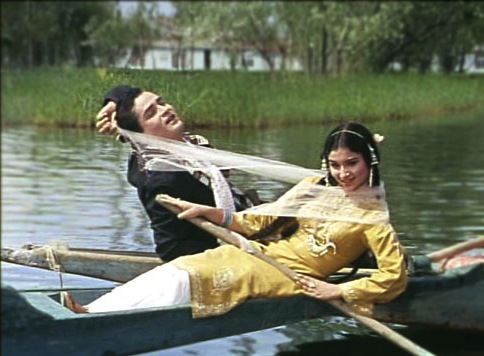
Sharmila Tagore plays a shy Kashmiri village girl in Kashmir ki Kali (1964)

Next we present the full lyrics and English translation to the jewel “Deewana Hua Badal” from Kashmir Ki Kali (1964). A beauty of beauties, “Deewaana Hua Badal” embodies the timeless dream of Kashmiri paradise. This charming duet by Mohammed Rafi and Asha Bhonsle is the highlight of the film Kashmir Ki Kali (1964), starring Shammi Kapoor and Sharmila Tagore. With a gently uplifting melody and traditional orchestration, “Deewana Hua Badal” captures a sense of pure bliss in the surroundings of the beautiful Kashmiri mountainside. Shammi Kapoor follows his lover Sharmila Tagore to the base of the famous Dal Lake where lotus flowers bloom and intricate wooden houseboats line the banks.

For centuries, Indians have been entranced by that heavenly treasure, Kashmir. Mughal emperor Jahangir famously wrote of Kashmir in the 17th century,

Gar firdaus ruhe zameen ast,
Hameen asto, hameen asto, hameen ast.”

“If there is Paradise on this Earth,
Then it is here, it is here, it is here…”

And classic Bollywood was no different. For years, all love dream sequences and the most beautiful of songs were set in Kashmir’s Shalimar gardens. Kashmir Ki Kali is but one of many films set in this paradise from that time period–before internal war and strife drove filmmakers away from Srinagar to the Swiss mountains. Being partly Kashmiri myself, I can attest to the sublimity of the countryside and what the natural beauty means to its people and history. The politics and tragedies that have plagued this gem are completely beyond the scope of this blog, but regarding its impact on Bollywood, Kashmir will remain forever the lover’s ideal.

Sharmila Tagore and Shammi Kapoor Kashmir Ki Kali Dal Lake

The famous Dal Lake of Srinagar, Kashmir is the gorgeous backdrop for “Deewana Hua Badal” from Kashmir Ki Kali (1964).

If I’m ever making a list of my favorite Bollywood songs, “Deewana Hua Badal” IS my number one choice. Since I was a little girl, this enchanting song found a special place in my heart. In fact, my own grandparents honeymooned in Srinagar by the famous Dal Lake in the early 1950s! When you listen to the sweetness of this song’s lyrics and melody, then imagine the paradise of vintage Kashmir, it’s easy to fall to in love! Please enjoy our full lyrics and English translation to “Deewana Hua Badal” below!

Deewana Hua Badal Lyrics and Translation: Let’s Learn Urdu-Hindi

Male:
Yeh dekh ke dil jhuumaa
Upon seeing her, my heart swayed
Lii pyaar ne a.NgaDaaii
And love sprang forth
Diiwaanaa huaa baadal
The clouds became mad with love
Saavan kii ghataa chhaaii
The rain clouds of Spring abounded

Aisii to merii taqdiir na thii
My fate was once not as such
Tumsaa jo koii mehboob mile
To have met a lover like you before
Dil aaj khushii se paagal hai
Today my heart is crazy with happiness
Aye jaan-e-wafaa tum khuub mile
Oh my faithful one, we met at the right time
Dil kyuu.N na bane paagal?
Why should my heart not go crazy?
Kyaa tumne adaa paaii!
What style you have!
Yeh dekh ke dil jhuumaa
Upon seeing her, my heart swayed
Lii pyaar ne a.NgaDaaii
And love sprang forth
Diiwaanaa huaa baadal
The clouds became mad with love

Female:
Jab tumse nazar takaraaii sanam
Ever since my gaze struck you
Jazabaat kaa ek tuufaan uThaa
A storm of emotions lifted within me
Tinake kii tarah mai.N Bah nikalii
Like a twig, I was swept away
Sailaab mere roke na rukaa
Despite my effort, I could not stop the flood
Jeevan mei.N machii halchal
There was a stirring in my soul
Aur bajane lagii shahanaaii
And music of the shahanaii began to play
Yeh dekh ke dil jhuumaa
Upon seeing him, my heart swayed
Lii pyaar ne a.NgaDaaii
And love sprang forth

Male
Diiwaanaa huaa baadal
The clouds became mad with love

Hai aaj naye armaano.N se
Today with new desires
Aabaad merii dil kii nagarii
The city of my heart is filled
Baraso.N se khizaa.N kaa mausam thaa
For ages it was the season of Autumn
Viiraan baDi duniyaa thi merii
My world was a barren waste
Haathon mei.N teraa aanchal
Then in my hands came the drape of your saari
Aayaa ki bahaar aayii!
And when it came, the Spring followed!
Yeh dekh ke dil jhuumaa
Upon seeing her, my heart swayed
Lii pyaar ne a.NgaDaaii
And love sprang forth

Female:
Diiwaanaa huaa baadal
The clouds became mad with love
Saavan kii ghataa chhaaii
The rain clouds of Spring abounded
Yeh dekh ke dil jhuumaa
Upon seeing him, my heart swayed
Lii pyaar ne a.NgaDaaii
And love sprang forth

Male:
Diiwaanaa huaa baadal…

Glossary

angaDaaii: a turn, a leap; diiwaanaa: crazy (in love); baadal: cloud, saawan: rain; ghataa: cloud; taqdiir: Fate; mehboob: lover; khushii: happiness; paagal: crazy; jaan-e-wafa: faithful one; nazar takraanaa: to strike a gaze; jazabaat: emotion; tuufaan: storm; tinake: twig; straw; sailaab: flood, deluge; halchal: stirring; shahanaaii: a woodwind instrument traditionally played at Indian weddings; armaan: desire; aabad: filled; nagarii: city; khizaa: Autumn; mausam: atmosphere; viraan: wasted; duniya: world; aanchal: drape of a saari or dupatta; bahar: Spring

A few notes on this translation: The word angaDaaii does not have a simple English translationPlease see our translation of Likhe Jo Khat Tujhe for further discussion of this complex word. Basically, all of those awkward stretching movements Shammi is doing in the beginning are examples of angaDaaii. Furthermore the line “deewana hua baadal…” can be interpreted in two ways! Although we have written “the clouds became mad with love,” this line could easily mean the inverse: that he who is mad with love became a cloud. This alternative meaning could make some sense–he felt so light and happy with love that he lifted up and joined the clouds. I’m not going to get carried overboard though. We will leave it up to you to decide to how interpret these famous opening lines!

Shammi Kapoor Kashmir ki Kali

Shammi Kapoor blushes and shimmies during the opening of “Deewana Hua Badal” from Kashmir Ki Kali (1964).

Some of you may question the opening performance by Shammi Kapoor in this song. Yes, he’s absurd as he comes tumbling down the stairs, bulging out of his tight clothes. Yes, his lipstick is a tad too red. And yes, you can see the line below his chin where Costumes forgot to blend his pasty white pancake foundation into his neck. But I’ve come to terms with everything Shammi is: a spastic, messy heartthrob. And since in this film, Sharmila Tagore isn’t wearing half of the sweeping cat-eyeliner that would later become her signature, someone had to wear enough make-up for the team!

– Mrs. 55

Justiju Jiski Thi Lyrics and Translation: Let’s Learn Urdu-Hindi

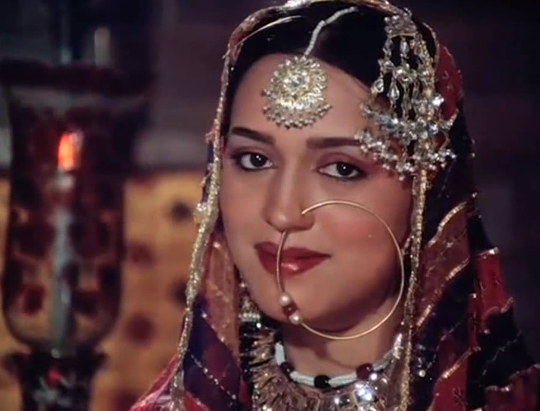
Rekha plays the role of Umrao Jaan with elegance and sophisticated grace.


Muzaffar Ali’s Umrao Jaan (1981) is one of Bollywood’s most  treasured films in the courtesan genre. With Rekha in the starring role, this film narrates the tragic story of Umrao Jaan Ada, a poetess and tawaif from the Urdu novel of the same name written by Mirza Hadi Ruswa. In addition to Rekha’s touching performance of this role, this movie has been immortalized in the history of Hindi cinema for its music. The soundtrack composed by Khayaam and penned by Shahryar is almost exclusively filled with ghazals sung by the evergreen Asha Bhonsle. In a previous post, we discussed and translatedin aa.nkhon kii mastii,” on of this film’s unforgettable ghazals.  Today, on the request of one of our readers (shoutout to Vasuki!),  we will be taking a closer look at another gem from the same soundtrack: “justajuu jiski thii.”

While “in aa.nkhon kii mastii” showcases the playful and proud side of Umrao Jaan, this song takes a different route and depicts the tragedy that Umrao has endured as a fallen woman. The song “justajuu jiskii thii” is found in the film when Umrao is called upon to perform a mujra at a birthday celebration for the son of the begum of Kanpur. In an ironic twist of fate, the begum turns out to be Ram Dei, the girl who was kidnapped and sold at the same time as Umrao when they were both young. Deemed the less attractive of the two, Amiran (who would later become known as Umrao Jaan)  was sold to Khanum’s brothel while Ram Dei was sold as a slave to a wealthy family. As the two women share a moment together recalling the tragedies of their past, Umrao is greeted by a painful surprise: Ram Dei is actually married to Nawab Sultan, the man that Umrao fell in love with during her younger years. In the presence of the couple, Umrao sings “justajuu jiskii thii,” a ghazal whose lyrics beautifully express the tragedy of unfulfilled love.

Rita Rani Kaul, as Ram Dei, listens to Umrao’s heart-wrenching poetry in admiration.

Musically, the tune for this song is probably my favorite among all of the ghazals found in Umrao Jaan. I think it must have been the favorite of music director Khayyam as well–if you listen carefully, you’ll hear snippets of this melody used as background music at various points in the film. In fact, before the proper song starts, Umrao recites a shair for Ram Dei in the same tune: gardish-e-vaqt kaa kitanaa baDaa ahsaan hai aaj/ yah zamii.n chaa.nd se bahtar nazar aatii hame.n.”   The lyrics and tune of this song are remarkably beautiful, but the real star of the show here is Asha Bhonsle.  Asha excels throughout this soundtrack, but I feel that her rendition of this song is particularly outstanding for its emotional depth and maturity.  Asha was 48 years old when she recorded these songs in 1981, but her voice sounds impressive and fresh as ever.  An interesting tidbit about the songs from this film is that Khayyam had Asha sing them at a half-step lower than expected (in the key of C) to create a deeper, fuller sound. Regarding her renditions on this soundtrack, Asha has said:

‘I was skeptical about the results when Khayyam lowered my pitch by half a note. But I have always believed that the composer calls the tune, so I sang just as Khayyam wanted me to do.’

There was nothing to be skeptical about here! The Asha-Khayyam collaboration for the music of Umrao Jaan has been cherished ever since this film was released, and the songs are remembered today  as some of the finest examples of ghazals in Bollywood cinema. Enjoy our translation of “justajuu jiskii thi” with the glossary below, and remember to send in any requests for future posts!

-Mr. 55

Rekha excels at expressing the pain of a fallen woman through her role in Umrao Jaan (1981)

Justiju Jiski Thi: Lyrics and Translation

justajuu jiskii thii usko to na paayaa ham ne 
I did not get whom I desired,
is bahaane se magar dekh lii duniyaa ham ne 
Yet, on this quest, I have seen the entire world. 

tujhko rusvaa na kiyaa khud bhii pashemaan na hue
I did not disgrace you, nor did I bring shame to myself.  
ishq kii rasm ko is tarah nibhaayaa ham ne
In this manner, I fulfilled the vows of our love.  

kab milii thii kahaa.n bichhaDii thii hame.n yaad nahii.n 
I do not remember when we met or where we departed. 
zindagii, tujhko to bas khvaab me.n dekhaa ham ne 
Life, I have only beheld you in my dreams. 

ai adaa, aur sunaaye.n bhii to kyaa haal apanaa? 
What more shall I tell you of my state? 
umr kaa lambaa safar tai kiyaa tanhaa ham ne
I have resigned myself to traveling the long journey of life alone.  

justajuu jiskii thii usko to na paayaa ham ne 
I did not get whom I desired. 

Glossary

justajuu: search, quest; bahaana: excuse, pretext; rusvaa: disgraced; pashemaan: ashamed; rasm: ritual, vow; bichhaDnaa: to separate, depart; adaa: pen name for Umrao Jaan; safar: journey; tai karnaa: to settle; tanhaa: alone.

Farooq Shaikh, as Nawab Sultan, reminisces about his unfulfilled love in Umrao Jaan (1981)