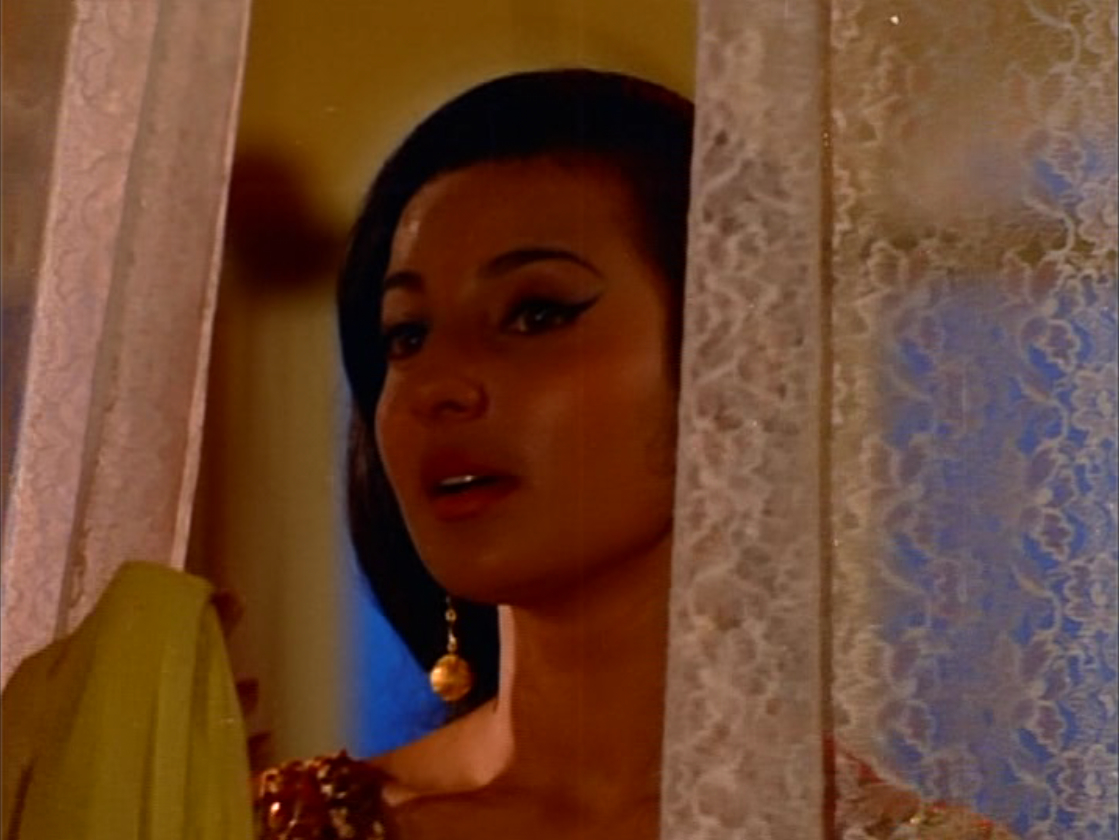
Woh Hanske Mile Humse Lyrics and Translation: Let’s Learn Urdu-Hindi

Although Asha Bhonsle is perhaps most well-known for her seductive and playful songs (see our translation of “raat akelii hai” here), she was a truly versatile artist who had an excellent command over a range of styles and emotions. When she is in a serious mood, Asha can really tug at your heartstrings with her sad singing. Think “ab ke baras bhej bhaiyya ko babul” from Bandini (1963), “yeh kyaa jagah hai dosto” from Umrao Jaan (1981), or “meraa kuch saamaan” from Ijaazat (1987).  Here, I’ve translated a short yet painfully beautiful Asha solo from Baharein Phir Bhi Aayengi (1966) called woh hanske mile humse.”

Baharein Phir Bhi Aayengi was released posthumuously under Guru Dutt’s film banner after Guru Dutt’s demise in 1964. The film was not even complete half-way before Guru Dutt’s death, so the film was shot again with a new director Shahid Lateef and new hero Dharmendra. Although the movie itself lacks the magic found in older Guru Dutt films, O.P. Nayyar’s soundtrack for the movie is still remembered today, most notably the Rafi number “aap ke hasiin rukh pe aaj nayaa nur hai.”

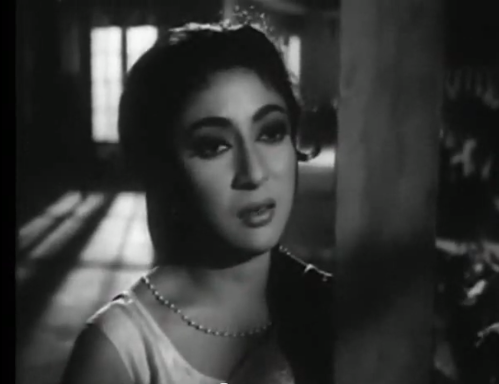
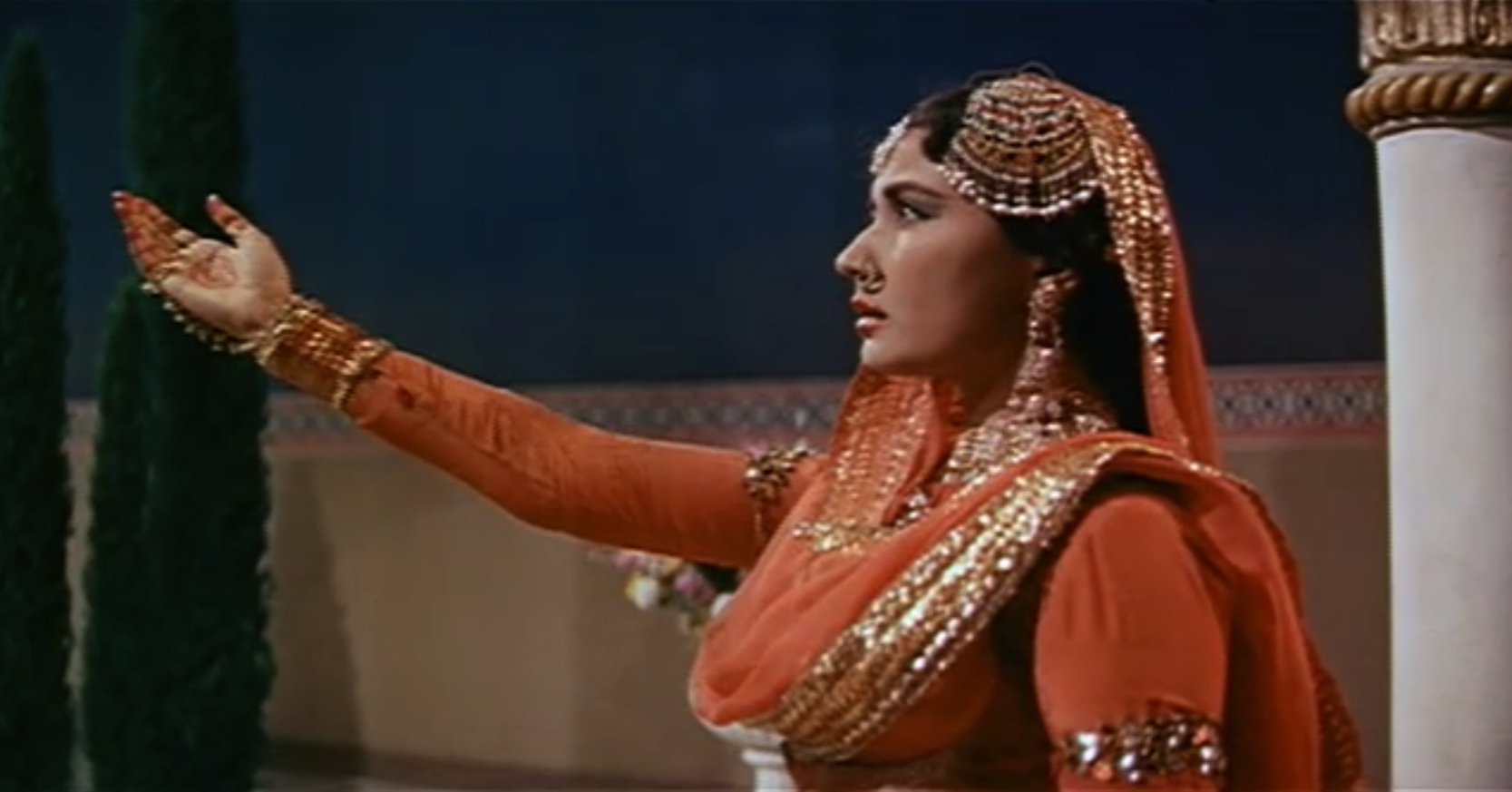
Mala Sinha in a melancholic mood in Baharen Phir Bhi Aayengi (1966)

The movie’s plot focuses on a love triangle: handsome young news reporter Jitendra (played by Dharmendra) falls in love with the bubbly Sunita (played by Tanuja) while Sunita’s older sister and head of the newspaper Amita (played by Mala Sinha) eventually becomes smitten by Jitendra. Before Amita decides to reveal her feelings to him, she finds out that Jitendra is actually in love with  Sunita. Although she is devastated by this news, she decides to back away for the sake of her sister’s happiness.  Here’s where the song I’ve translated comes in. Backed by Asha’s painstricken vocals and S.H Bihari’s simply crafted lyrics, Amita laments how she misinterpreted Jitendra’s actions to think that he was in love with her when that was not the case (“bekaar hii ulfat kaa izhaar samajh baiThe”). Sigh…

I think this song will strike a chord with those of you who have suffered through a romantic misunderstanding–it certainly did with me.

-Mr. 55

Woh Hanske Mile Humse Lyrics and Translation

woh ha.nske mile ham se, ham pyaar samajh baiThe
He smiled at me when we met, so I thought that he loved me.
bekaar hii ulfat kaa izhaar samajh baiThe
I interpreted it, in vain, as a declaration of love.

aisii to na thii qismat apnaa bhii koii hotaa
It was not in my fate to call someone my own.
kyo.n khud ko muhabbat kaa haqdaar samajh baiThe?
Why did I consider myself entitled to his love? 

roye.n to bhalaa kaise, khole.n to zabaa.n kyo.n kar?
How shall I cry, why should I speak?

Darte hai.n ki jaane kyaa sansaar samajh baiThe.
I fear what society has perceived of this. 

woh ha.nske mile ham se, ham pyaar samajh baiThe
He smiled at me when we met, so I thought that he loved me. 

Glossary

bekaar: useless, in vain; ulfat: love; izhaar: declaration; qismat: fate, destiny; haqdaar: entitled; zabaa.n kholna: to speak; sansaar: society 

Woh Shaam Kuch Ajeeb Thi Lyrics and Translation: Let’s Learn Urdu Hindi

Waheeda Rehman Rajesh Khanna khamoshi

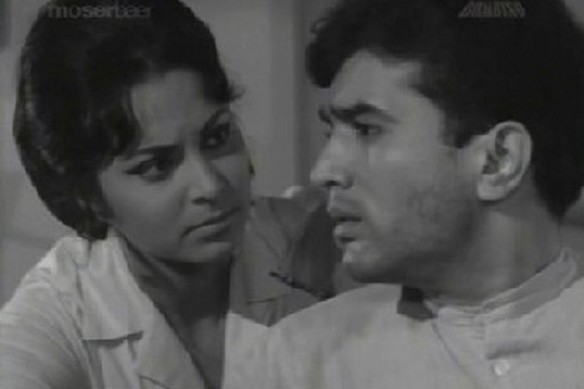
Waheeda Rehman soothes Rajesh Khanna’s aching soul in Khamoshi (1967).

Our next post will explore the stirring lyrics and translation of “Woh Shaam Kuch Ajeeb Thi” from Khamoshi (1967.) A one-of-a-kind film from its generation, Khamoshi is the moving story of patients in an insane asylum and the woman who treats them played by the graceful Waheeda Rehman. In American and European films, the theme of mental illness, the dangers of institutionalism, and the murky line between doctor and patient had been explored quite frequently–such as with famous German Expressionism’s The Cabinet of Dr. Calighari (1931), Hitchcock’s Spellbound (1958), and of course, One Flew Over the Cuckoo’s Nest (1976). However, in Bollywood, the Asit Sen hit Khamoshi vividly remains the only film from that era to have fully explored this theme.

Based on the short story “Nurse Mitra” by Ashutosh Mukhopadhyay, Khamoshi shines with wonderful performances, exquisite musical compositions, and disturbing black-and-white cinematography. Interestingly, Suchitra Sen starred in the original Bengali version Deep Jwele Jaai (1959) also directed by Asit Sen!

In this song, Rajesh Khanna, a patient at the mental institution where Waheeda works, takes her on a boat and declares his love for her. Still recovering from an episode in which he was jilted by a former girlfriend, Rajesh blurs his memories of the two women in these lyrics. Little does he know, his blind, albeit misguided love is the final provocation for Waheeda Rehman to lose her own sanity as she struggles to recover from having also lost one she once loved.

Waheeda Rehman works as a nurse in an insane asylum for the love-sick in Khamoshi (1967)

Woh Shaam Kuch Ajeeb Thi Lyrics and Translation:

Woh shaam kuch ajeeb thi
There was something strange about that evening,
Yeh shaam bhi ajeeb hai
Just as this evening feels strange
Woh kal bhi paas paas thi, woh aaj bhi qareeb hai
She was close to me yesterday, she is near me today as well
Woh shaam kuch ajeeb thi
There was something strange about that evening

Jhukii hui nigaaho.N mei.N, kahii.N meraa khayaal thaa
In her lowered gaze, perhaps there was a thought of me
Dabi dabi ha.Nsii mei.N ek haseen saa gulaal tha
As she suppressed a smile, there was a burst of beautiful color
Main sochtaa thaa meraa naam gungunaa rahi hai woh
I used to think that she was singing my name
Na jaane kyo.N laga mujhe ki muskuraa rahi hai woh
I do not know why it seemed to me that somewhere she is smiling
Woh shaam kuch ajeeb thi
There was something strange about that evening

Meraa khayaal hai abhii jhuki hui nigaaho.N mei.N
Now thoughts of me are in her shy, lowered gaze
Khulii hui hansi bhi hai, Dabii huii sii chaah mei.N
Even though she is laughing openly, there a hidden desire
Mai.N jaanta hoo.N, meraa naam gungunaa rahi hai woh
I know that she is singing my name
Yehii khayaal hai mujhe ki saath aa rahi hai woh
It appears to me that she is coming closer
Woh shaam kuch ajeeb thi
There was something strange about that evening

Glossary:

shaam: evening; ajeeb: strange; qareeb: close, near; jhuka: lowered; khayaal: thought; ha.Nsii: laughter; gulaal: color [like those thrown during the festival of holi]; muskuraanaa: to smile; khula: open; chaah: want, desire

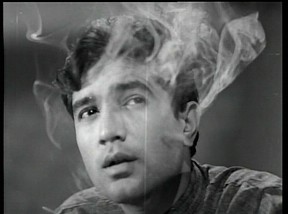
Rajesh Khanna checks in to the kind of hospital where smoking is permitted, and professionalism in doctor-patient relationships remains conveniently undefined…Khamoshi (1967)

For whoever can’t handle the suspense, the film ends with Waheeda being committed to her own institution and Rajesh Khanna declared sane–with the implication that one day perhaps another doctor will fall in love with her and the roles will reverse yet again. It is a cold and disturbing message filmed with some of the purest cinematographic beauty in Bollywood. I’ll spare you from a discussion of subversive political symbolism, but I will point out one last bit of trivia:

In the Bengali version, the Hemant Kumar song “Ai Raat Tomar Amar” is filmed with the same mis-en-scene as “Tum Pukar Lo” in Khamoshi, however, the melodies are not the same! “Ai Raat Tomar Amar” is in fact the musical predecessor of “Yeh Nayan Dare Dare” from Hemant Kumar’s later soundtrack in Kohraa (see our post on Bollywood film noir for more). Music directors back then were notorious for reusing compositions–and we’re sure glad they did!

-Mrs. 55

Chalte Chalte Lyrics and Translation: Let’s Learn Urdu-Hindi

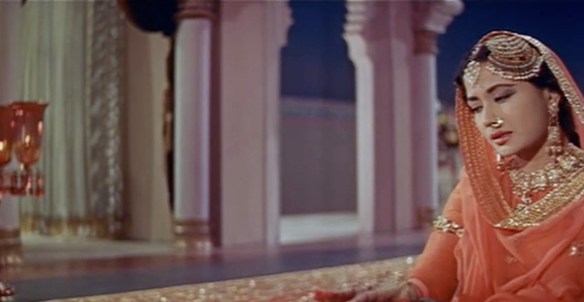
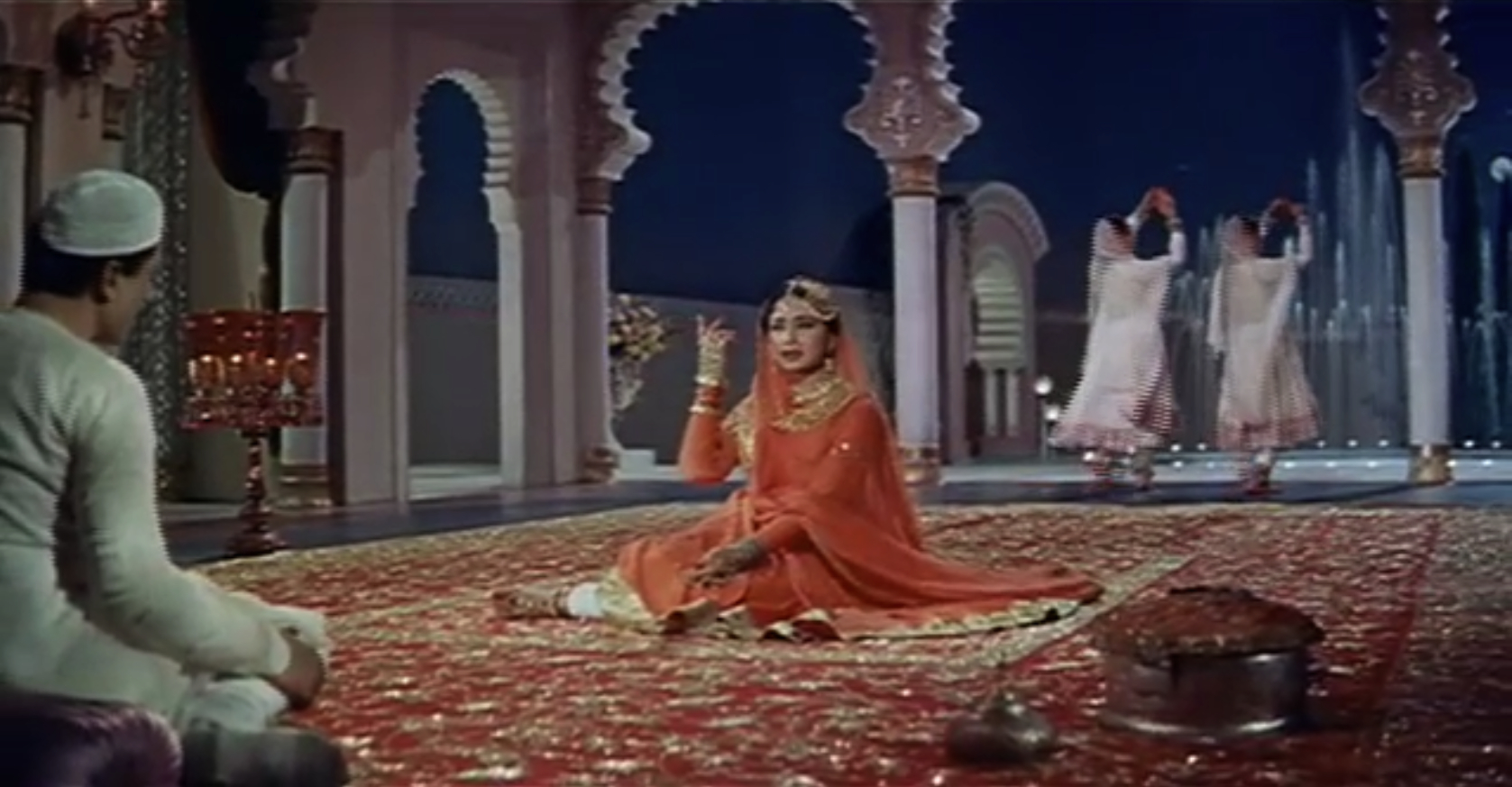
Meena Kumar shines as Pakeezah in the beloved mujra song "Chalte Chalte."

Meena Kumar shines as the golden-hearted Pakeezah in the beloved mujra song “Chalte Chalte.”

For our next song, we provide an English translation of the timeless lyrics of Pakeezah’sChalte Chalte.” The film Pakeezah (1971) instantly reached legendary Bollywood status upon its release, due in part to the ethereal musical score, brilliant Urdu dialogue, lavish sets, but also from its star Meena Kumari’s untimely death within a week of the premiere. This song is known everywhere, and the beauty of Meena and Lata’s performance truly speaks for itself. My parents have old home videos of 4-year-old me draping a chunni on my head and attempting to dance and sing along with her during this song. It’s hard to put that kind of impact into words, but you can tell it’s profound.

Anyway.

Meena Kumari dazzles her audience with “Chalte Chalte” in Pakeezah (1971)

An interesting facet of this song is the interwoven theme of the train ride. For anyone familiar with film theory, “the train” has a fascinating and critically important role in cinematic history across the globe. Likened to films themselves, the train transports you to a different world and takes you on a brief journey that can leave you different from when you started. It is a theme heavily explored by early French filmmakers first experimenting with the medium (you may remember the loving references to the Lumiere brother’s Arrival of a Train at La Ciotat Station (1895) in Hugo!), and in Indian cinema, trains play no less an important role. Like Satyajit Ray’s famous Pather Panchali (1955) which pivoted on the introduction of a train whistle across the quiet sugarcane fields, so too does the world of Pakeezah hinge on the sound of a distant train whistle incorporated into the score at the end of the song. For trains can represent that journey from tradition to modernity, from reality to fantasy, and for Pakeezah as well as Kamal Amrohi’s viewers entering a hidden, dying world of ornamentation, the train is a vehicle of escape.

Gesturing to the moon, Meena Kumari waits for her mysterious admirer to find her again in Pakeezah (1971)

“Chalte Chalte” will absolutely leave you wishing for more, so make sure you watch the movie if you ever want to claim cultural competency. To read more about this film, check out our post on behind-the-scenes Pakeezah trivia! Enjoy our full lyrics and English translation to “Chalte Chalte” below!

Chalte Chalte Lyrics and Translation:

Chalte chalte yuu.N hii koi mil gaya tha
I met someone by chance while walking
Sare raah chalte chalte
Walking around the path
Wohii thamke rah gayii hai
The night suddenly came to a standstill
Meri raat dhalte dhalte
Just as it was about to fade away

Jo kahii gayii na mujhse
What I was unable to voice
Woh zamaanaa keh rahaa hai
The world is now saying
Ki fasaanaa ban gayii hai
That a fable has been created
Meri baat talte talte
From those words which evaded me

Shab-e-intezaar aakhir kabhi hogi mukhtasar bhi
That night of waiting will after all shorten soon
Yeh chiraag bhuj rahi hai
These lamps are dying
Mere saath jalte jalte
As they burn alongside me

Glossary:

raah: path; zamaanaa: the world; fasaanaa: fable, legend; baat: words, incident, matter; talna: to evade, to escape; shab-e-intezaar: night of waiting; mukhtasar: short, soon; chiraag: flame

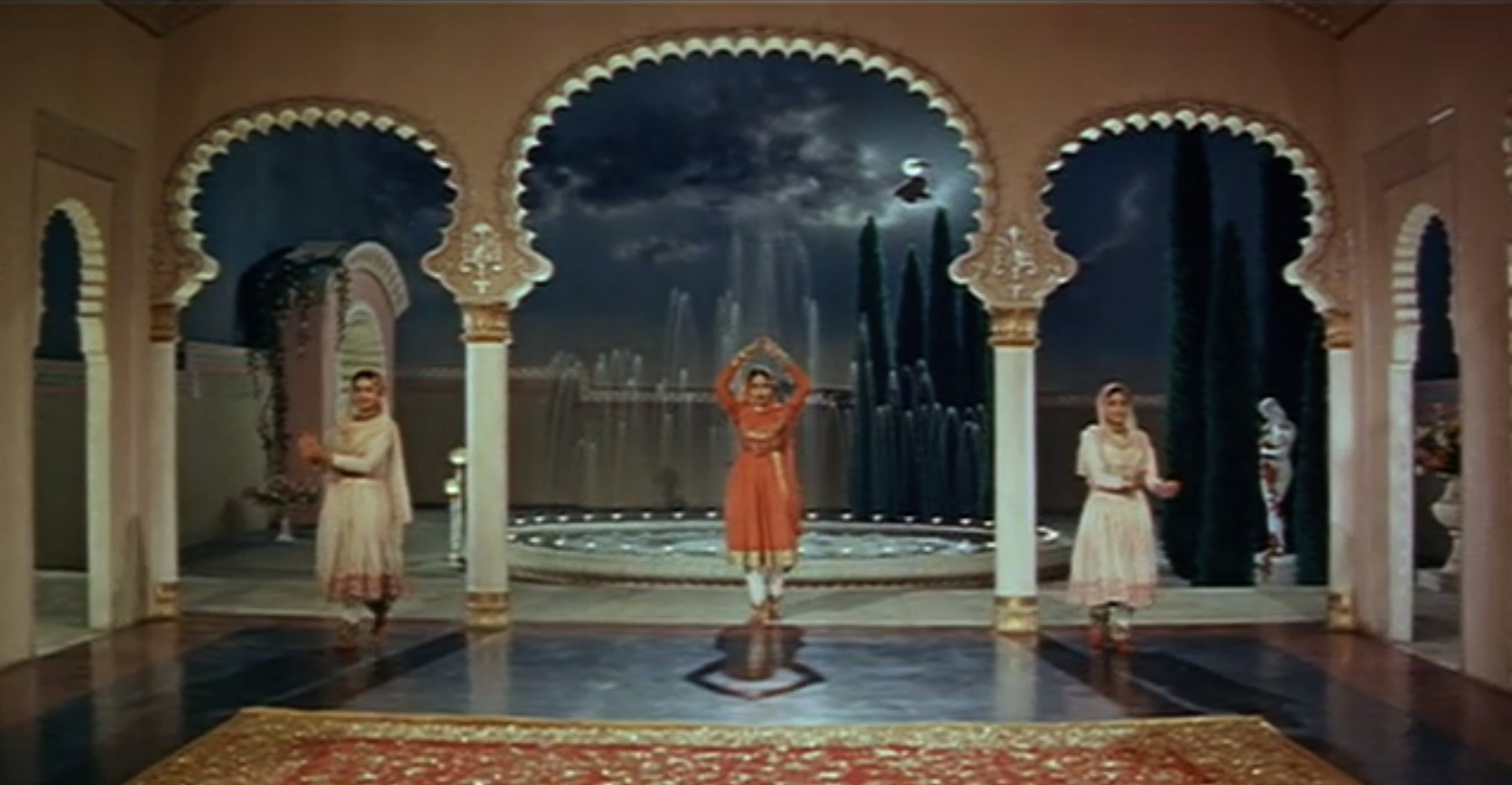
The production value of this film is ridiculous.

It’s always slightly bothered me that after the first antra the two back-up dancers start twirling, and after the second turn, get completely off-sync since the genius on the right goes a little too fast for the music. Kamal Amrohi cuts quickly to the next shot when this starts happening, so you might say it’s not a huge deal per se, but for someone who was such a neurotic perfectionist, how did this slip by him? It just gets to me every time. Or am I over-thinking this?

-Mrs. 55

Rabindranath Tagore’s Influence on S.D. Burman

Rabindranath Tagore (1861-1941) and S.D. Burman (1906-1975)

Due to my upbringing in a Bengali household, I am intimately familiar with Rabindra-sangeet: the genre of songs written and composed by Nobel laureate Rabindranath Tagore. As a composer, artist, novelist, playwright, poet, and philosopher, Tagore has left a lasting legacy on Indian culture through his vast collection of works in a variety of mediums. Although the purism and simplicity of Tagore’s style might suggest that Bollywood is an inappropriate forum to celebrate his art, several music directors from the Golden Age of Hindi cinema have been known to use Tagore songs as inspirations for their musical compositions. The music director who is most well-known for this practice is none other than the illustrious S.D Burman. S.D. Burman is one of the most succesful music directors in the history of the Bollywood industry, and his songs from films such as Bandini (1963), Guide (1965), Jewel Thief (1967), and Aradhana (1969) are still considered all-time classics today. His filmi compositions tend to draw upon inspiration from Bengali folk traditions (e.g. bhatiaalii, saari, etc. ), but here I’d like to draw your attention to a collection of S.D. Burman compositions that are derived from Rabindra-sangeet:

meraa sundar sapnaa biit gayaa (Do Bhai, 1949): From one of S.D. Burman’s first hit scores in the Bollywood industry, this song is considered to be Geeta Dutt’s breakthrough as a playback singer in Hindi films. The mukhDaa of this song is inspired by a Bilaaval-based Tagore composition called “radono bharaa e basonto.” Geeta does an excellent job of expressing the sorrow and pain of this song with her voice, and it is truly unfortunate that the lyrics here would become a reality for her during her tumultuous marriage to Guru Dutt in the next decade.

Playback singer Geeta Dutt (1930-1972) with her husband Guru Dutt (1925-1964)

nain diivaane (Afsar, 1950): This Pilu-based composition is skilfully rendered by Suraiyya, a leading singer/actress who became a huge sensation in Bollywood during the 1940s. Bollywood as we know it today relies on actors and actresses lip-syncing songs sung by playback singers; however, in its very early days, actresses like Suraiyya used to sing their own songs for films. In spite of their dual talents, singer-actresses were not able to survive the onslaught of the Mangeshkar monopoly in the 1950s, and the playback singing paradigm became the standard that is still maintained today in the industry. In any case, this song is based on an extremely popular Tagore composition called “sediin duujane duulechhiinuu bone.” S.D. Burman literally did a copy-paste job here, as the melody of the entire Hindi song is identical to the Bengali original. While loosely basing a mukhDaa on a previous composition is somewhat acceptable, recycling a whole song written by another composer begs the question: should S.D. Burman have given credit to Tagore for this composition?

Singer/actress Suraiyya (1929-2004)


 jaaye.n to jaaye.n kahaa.n? (Taxi Driver, 1954): S.D. Burman won his first Filmfare Award for Best Music Director for this song from Taxi Driver in 1954. As is often the case, the male version of the song (sung by Talat Mehmood) is more popular than the female version (sung by Lata Mangeshkar). Although S.D. Burman modified the raga of his composition to more closely resemble Jaunpuri, the first line of the mukhDaa is instantly recognizable as the main phrase from Tagore’s Bhairavi-based classic  “ he khoniiker otiithhii.” Note that the Tagore original that I have provided here is sung by Hemanta Mukherjee (a.k.a Hemant Kumar), who, in addition to achieving fame as a Hindi playback singer/music director, was known for his beautiful renditions of Rabindra-sangeet in Bengali.

jalte hai.n jiske liye: (Sujata, 1959): This probably qualifies as my favorite “telephone song” from a Hindi film. Here, Sunil Dutt woos Nutan over the phone with this gem as he croons to Talat Mehmood’s silky vocals on playback (notice the characteristic quiver that we know and love!). Although this composition is often considered an all-time classic song of romance, fans of this song may be surprised to know that the mukhDaa is taken directly from a Tagore composition named “ekodaa tumii priye.”
Sunil Dutt serenades Nutan over the telephone with “jalte hai.n jiske liye” in Sujata (1959)

meghaa chhaye aadhii raat (Sharmilee, 1971): Out of all the compositions listed here, the inspiration from Tagore is the most difficult to hear in this song because it does not involve the mukhDaa. Rather, S.D. Burman seems to have inserted a small segment of  laho laho tuule laho (0:26-0:40) into the antara of this raga Patdeep-based classic from Sharmilee. What a trickster, huh?

tere mere milan kii yeh rainaa (Abhimaan, 1973): By far, this is the most famous example where  S.D. Burman has been inspired by Rabindra-sangeet.  In his last hit film score (for which he won his second  Filmfare Award for Best Music Director), S.D. Burman recycles the mukhDaa from Tagore’s Mishra Khamaj-based “jodii taare nai chiinii go sekii?” in this evergreen duet of Lata Mangeshkar and Kishore Kumar. Burman’s antaras are a beautiful addition to the original composition, so we won’t give him too much trouble for his rehashing of Tagore here. Note that the Bengali original that I have linked to here is sung by Kishore Kumar, another Hindi playback singer who was famous for his renditions of Rabindra-sangeet in Bengal.

Amitabh and Jaya Bacchan sing the duet “tere mere milan kii yeh raina” on stage during the climax of Abhimaan (1973).

Although S.D. Burman was often inspired by Tagore in his compositions, he never recorded or sang a single piece of Rabindra-sangeet throughout his career. The reason behind this is, of course, family feuding–an unavoidable staple of all things related to Indian culture. Here’s the story: S.D Burman’s father Nabadwip Chandra Dev Burman was set to be the direct heir to the throne of Tripura when the current king passed away in 1862. However, the crown went to Nabadwip’s paternal uncle Birchandra Dev Burman due to some dirty palace politics. Because Rabindranath Tagore had a very close relationship with Birchandra Dev Burman, S.D. Burman avoided meeting Tagore throughout his lifetime and refused to perform Rabindra-sangeet out of principle. Nevertheless, in spite of this tiff, it is undeniable that S.D. Burman had a great deal of respect for Tagore as a musician given the influence of Rabindra-sangeet on his compositions.

–Mr. 55

​Raat Akeli Hai Lyrics and Translation: Let’s Learn Urdu-Hindi

Now we will take a look at the lyrics and English translation of the seductive number “Raat Akeli Hai.” When it came to vamp songs, cabaret numbers, and being the voice any kind of seductress, Asha Bhonsle was the Queen. And yes, while this usually amounted on screen to Helen shaking her stuff in a skin-tight showgirl costume, Asha lent her versatile voice to many other actresses called upon for the vamp sequence, from Sadhana to Parveen Babi. One of her best is the Tanuja hit “Raat Akeli Hai” from Dev Anand’s hit Jewel Thief (1967) and we will now present the song’s full lyrics and translation. Asha Bhonsle gives an amazing performance–magnificently hitting both the highest of highs and hiding a sultry laugh beneath the lows. In the movie, Tanuja plays a fire-cracker “modern girl” (discussed more in our earlier post on Jewel Thief!) whose bold lines she uses to pick up Dev Anand would make anyone blush from awkwardness.

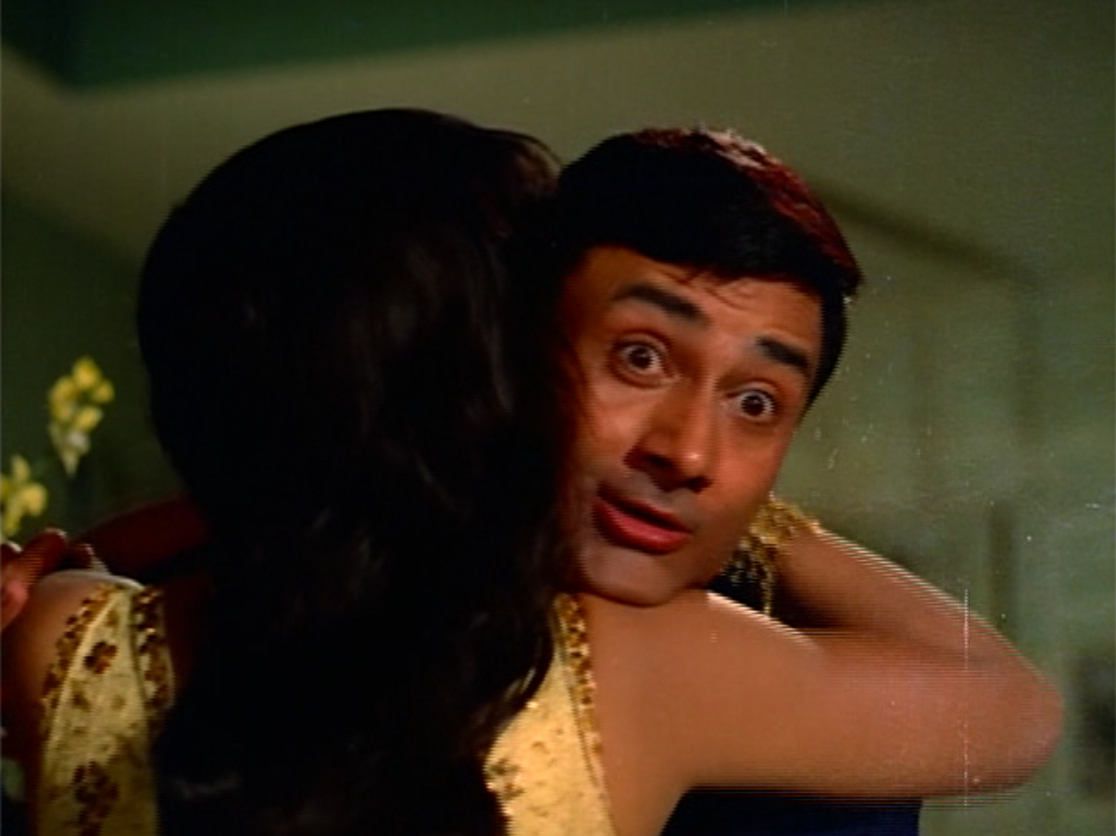
Even dapper Dev Anand is overwhelmed by Tanuja’s advances in Jewel Thief (1967).

In this song, however, her craziness works, and Tanuja is completely adorable. Bursting at the seams from her tight-fitting white dress, she seduces the hero by reaching into the living room’s classy mini-fridge and pulling out two coca-colas. Yes, it’s the 70s living at its finest. Who needs cocktails when you’re this smooth?

Tanuja shakes everything she has in a hip-hugging white dress from the seduction sequence of Jewel Thief (1967).

Enjoy our English translation of the tempting lyrics to “Raat Akeli Hai” below!

Raat Akeli Hai Lyrics and Translation:

Raat akelii hai, bujh gaye diye
The night is lonely, and the lights have gone out
Aake mere paas, kaano.N mei.N mere
Come close to me, and in my ears
Jo bhii chaahe kahiye, jo bhii chaahe kahiye
Tell me whatever you desire

Tum aaj mere liye ruk jaao, rut bhii hai fursat bhii hai
Today, stop a while for me, the atmosphere is right and we are at leisure
Tumhii na ho na sahii, mujhe tumse muhabbat hai
You may not feel the same, but I love you
Muhabbat kii ijaazat hai, to chhup kyuu.N rahiye
I have permitted you to love me, so why remain quiet?
Jo bhii chaahe kahiye, raat
Tell me whatever it is that you desire

Savaal banii huii dabii dabii uljhan siino.N mei.N
The confusion buried in my heart has surfaced as this question
Javaab denaa thaa, to Duube ho phasiino.N mei.N
You were supposed to give an answer, but you became drenched in sweat
Thaanii hai do hasiino.n me.n, to chup kyuu.N rahiye
When there is a resolve between two beautiful people, then why remain quiet?
Jo bhii chaahe kahiye
Tell me whatever it is that you want
Raat akeli hai…

Glossary:

akelii: lonely; kaan: ear; rut: atmosphere, season; fursat: leisure time; ijaazat: permission; chhup: silent; savaal: question; siin: chest; javaab: answer; Duubna: to become drenched, to drown; phasiinaa: sweat; thanii: resolve, commitment

Tanuja coyly wraps herself in a curtain in “Raat Akeli Hai” from Jewel Thief (1967)

Wondering what that glass-shattering note is Asha hits over and over again in this song? It sounds fancy, but it’s really just a high F.  Our girl Asha can go higher–more on this in our post on Lata and Asha’s highest notes!

-Mrs. 55