The Best Qawwalis of Bollywood Films

Rishi Kapoor Amar Akbar Anthony Bollywood Qawwali

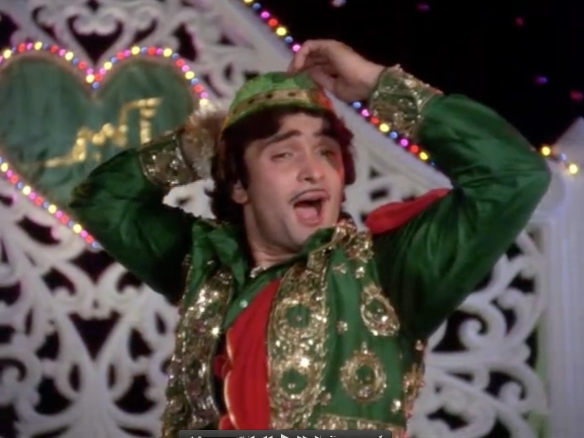
Rishi Kapoor charms his audience singing the famous qawwali “Pardah Hai Pardah” from Amar Akbar Anthony (1979).

The qawwali from films has a hallowed place in the history of the Hindi music industry. A mystic tradition more than 700 hundred years old, the qawwali gained prominence in Bollywood initially through 1950s Muslim social dramas and grew so much in popularity that its influences became mainstream–even continuing to live on today. We present our list below of the best qawwalis of Bollywood films.

But let us first define what precisely is a qawwali? The great Indian poet Amir Khusrau (d. 1326) is considered the founding father of the qawwali genre, having composed songs for the first time in this style to celebrate the death of his spiritual guide Nizamuddin Aulia. The qawwali is the authentic Sufi spiritual song that transports the mystic toward union with God. For centuries, Sufi communities in the Indian subcontinent have sustained this musical tradition in the mahfil-e-sama, or assembly for listening. The qawwali was a religious experience for both listener and performer: as the listener hopes for a spiritual experience of intensity and immediacy to transcend his or her conscious striving, the trained performer seeks to present in song a vast treasure of poetry that articulate and evoke a mystical experience for the audience.

Madhubala impresses the Mughal prince in the classic qawwali “Teri Mehfil Mei.N Qismat” from Mughal-e-Azam (1960)

The qawwali performance usually begins after the evening and may last all night until the morning prayers. The word qawwali means “words” worthy of remembrance, and as such the qawwali traditionally has a devotional aspect in praise of God. Even most “secular” qawwalis found in popular Bollywood movement can be read in this way, although superficially the lyrics have another literal meaning. The harmonium has replaced what was traditionally a sitar as musical accompaniment, but equally important are the tabla and the signature qawwali cyclic hand clapping that increase in speed during the performance. The tarz or tune of the qawwali is normally identified by the first line of the text, which is often a part of the refrain couplet. Although the qawwal was traditionally male, both men and women have enjoyed and excelled at performing the modern qawwali.

Rishi Kapoor dazzles his audience as a popular qawwal in the 1979 blockbuster Amar Akbar Anthony.

Unlike in Hindustani classical music, while taal and raagaa usage is the same, the qawwali places a greater emphasis on the poetic text and the delivery of its message than on musical ornamentation. In many of its vast incarnations within Bollywood, the qawwali became synonymous with a musical debate, a verbal battle (often between the sexes) to outwit the other side on topics that usually boil down to love or the pain of love. That kind of screen chemistry, as you can imagine, is prime Bollywood flirting territory just waiting to be sung.

Let’s take a look at how this genre evolved in mainstream Bollywood into one of the most beloved musical genres of the industry. Here are some highlights:

Humen To Loot LiyaAl Hilal (1958):

One of the first qawwalis to hit the silver screen, no list is complete without this retro low-budget gem. The music is really quite simple, but extremely catchy.

Yeh Ishq Ishq HaiBarsaat Ki Raat (1960):

This qawwali is an Urdu-lover’s paradise. Filled with complex words and allusions you’ll never use in real life, “Yeh Ishq Ishq Hai” set the stage for classy performance duels between men and women that is still considered the greatest Bollywood qawwali for its poetry (see our post for a full English translation!)

Sharma Ke Yeh Kyo.NChaudhvin Ka Chand (1960):

A fun twist on the traditional qawwali, two women sing (Asha Bhonsle and Shamshad Begum) with the latter taking the masculine side and the former taking the feminine.

Teri Mehfil Mei.N QismatMughal-e-Azam (1960):

Oh, does it get any better than this? Every moment of Mughal-e-Azam is a poetic dream and this briliant qawwali is no less. Shamshad Begum battles Lata Mangeshkar for the Prince’s approval of their take on love, each lyric outwitting the last. See our translation with glossary for more!

Nigahe.N Milane KoDil Hi To Hai (1963):

Asha Bhonsle’s greatest contribution to this genre, this qawwali has some beautiful Urdu and probably the most thrilling sargams you’ll find in any of her songs. See our translation with glossary here!

Tumhe Husn Dekhe – Jab Se Tumhe Dekha Hai (1963):

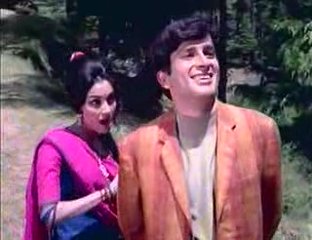
OK, so sure, this qawwali is not particularly memorable for its musical ingenuity (you may or may not cringe the entire way), but how often are you going to behold Shammi and Shashi Kapoor on screen at the same time?! This fascinating qawwali is worth a watch if only for its star value! Kudos to Geeta Bali for holding her own!

Mehengai Maar GayiRoti Kapada Aur Makaan (1974):

This qawwali has a unique flavor–taken from one of Manoj Kumar’s popular Indian propoganda films, the lyrics carry an interesting social message outside the realms of romantic love.

Pardah Hai PardahAmar Akbar Anthony (1979):

A Mohammed Rafi gem, this qawwali ranks among the best of the best. After watching Rishi Kapoor’s enthusiastic performance, you’d believe he was born to be a qawwal. The song is a must-see for anyone interested in the genre.

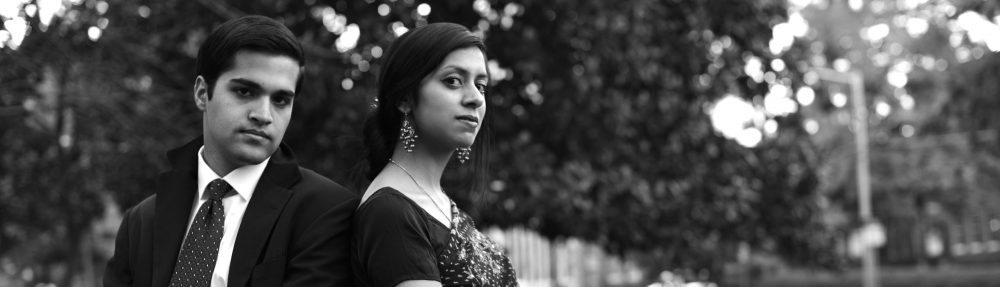
And just to throw in the contemporary, here’s a picture of me performing the qawwali at last year’s Harvard Ghungroo!

At a Harvard Ghungroo performance of Asha Bhonsle’s “Nigaahe.N Milane Ko.”

-Mrs. 55
Mere Desh Ki Dharti Lyrics and Translation: Let’s Learn Urdu-Hindi

Manoj Kumar Mere Desh Ki Dharti

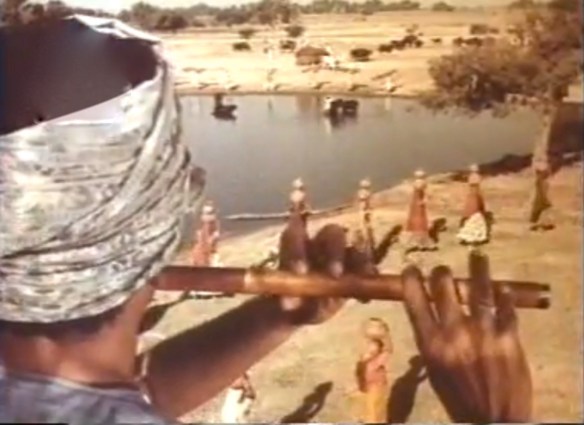
The glory of India’s ancient heritage is celebrated in Manoj Kumar’s “Mere Desh Ki Dharti” from Upkar (1967).

In honor of the great beauty of India we present the patriotic lyrics and English translation of “Mere Desh Ki Dharti” from Upkar (1967). There are few songs that have attained the kind of beloved immortality found in the lyrics of “Mere Desh Ki Dharti.” A rousing declaration of love for the motherland, this song evokes nostalgia, nationalism, and an unwavering pride in traditional values that director Manoj Kumar advocated throughout his career. The film Upkar (1967) from which the song comes is one of many socially responsible movies pioneered by Manoj Kumar in that era–earning him the nickname Mr. Bharat! Like his other works Shaheed (1965), Purab Aur Paschim (1970), and Roti, Kapada, Aur Makaan (1974), Manoj Kumar sought to remind his audience of the beauty of the Indian way of life, of India’s rich history, and of the dangers Westernized modernity could pose to society.

As an interesting contrast to Dev Anand’s somewhat similarly themed-film Prem Pujari (1970), Upkar explores and glorifies the concept of the farmer-soldier, a loyal citizen who selflessly serves the motherland in any way she needs. The hero captures the spirit of self-sacrifice and patriotism in a way that has remained popular even today.

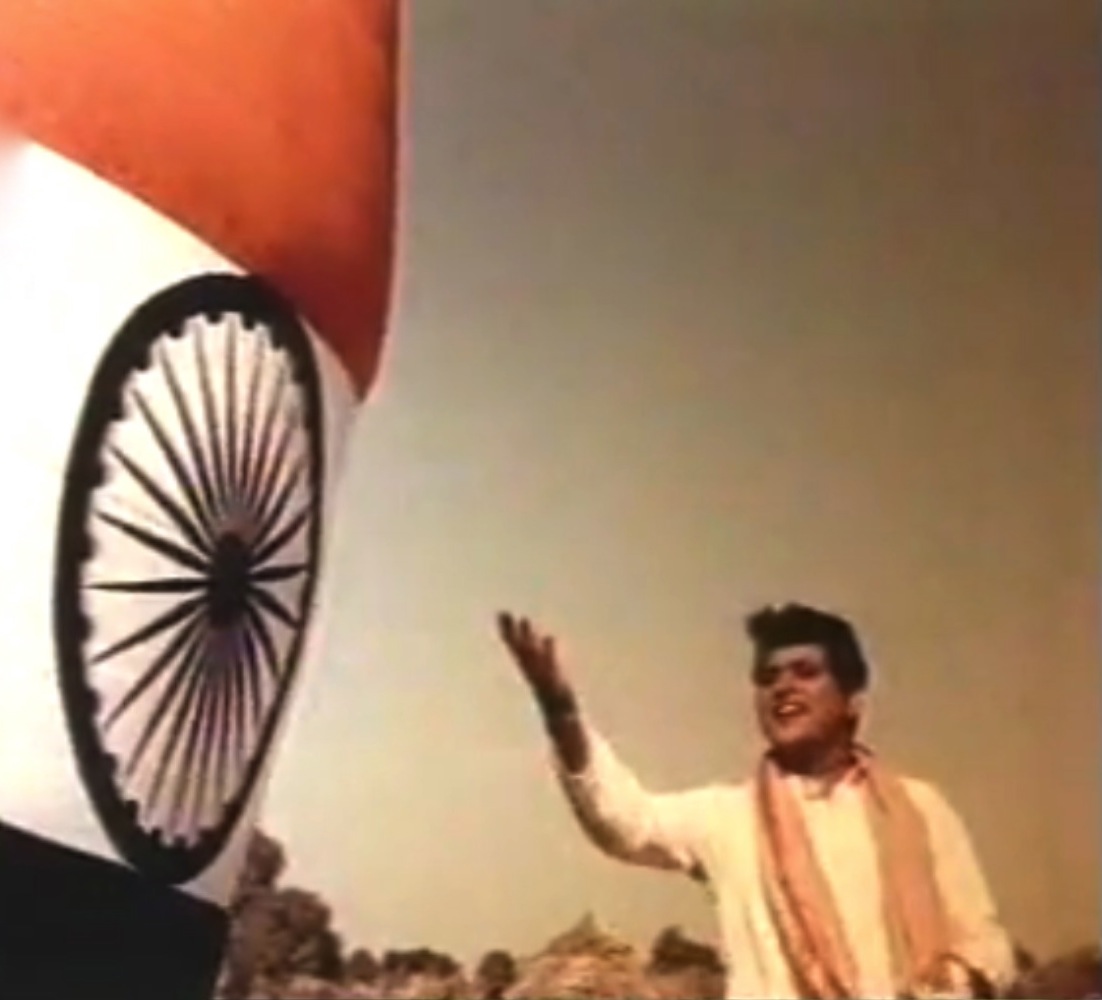
Manoj Kumar pays homage to the tricolor Indian flag in Upkar (1967).

So sure, it’s obviously a propaganda film (the idea of Upkar was after all modeled on Prime Minister Lal Bahadur Shashtri’s slogan, “Jai Jawaan, Jai Kissan!“), but hearing the lyrics to this song rendered stirringly by Mahendra Kapoor, you can feel a true admiration and love for India. Fully understanding a translation of “Mere Desh Ki Dharti” can be quite difficult without some contextual knowledge of Indian history as it is filled with rich allusions and metaphors. I have attempted to explain some of them below each lyric (props to my father for filling in the gaps!) So please enjoy our full English translation to the lyrics of “Mere Desh Ki Dharti” below!

Mere Desh Ki Dharti Lyrics and Translation:

Mere desh ki dharti, sonaa ugale, ugale hiire, moti
The soil of my country is made of gold, diamonds, and pearls
Mere desh ki dharti…


Bailo.N ke gale mei.N jab ghungaruu, jeevan kaa raag sunaate hai
The bells around the necks of the bullocks chime to the melody of life
Gham kos duur ho jaataa hai, khushiio.N ke kamal musakaate hai.N
Sadness and regret go away, and joyous lotuses smile
Sun ke rahaT ki aawaaze, yuu.N lage kahii.N shahanaaii baje
Listening to the sounds of the waterwheels, it seems as if auspicous flutes are playing somewhere
Aate hii mast bahaaro.N ke dulhan ki tarah har khet saje
Every field adorns itself like a bride when the thrill of spring arrives
Mere desh ki dharti…

Jab chalte hai.N is dharti pe hal, mamtaa angadaaiiyaa.N leti hai.N
When ploughs till this land, the love of its mother is activated
Kyu.N na puje is maaTii ko, jo jeevan ka sukh deti hai?
Why would we not worship this soil that gives us the joy of life?
Is dharti pe jis ne janam liyaa, usne hii paayaa pyaar teraa
Whoever was born on this land, obtained your love
Yahaa.N apnaa paraayaa koii nahii.N, hai.N sab pe, Maa.N, upkaar teraa
Here there is no difference between a stranger and one of our own, for Mother, you are benevolent to all
Mere desh ki dharti…

Ye baagh hai.N Gautam Naanak ka, khilte hai.N aman ke phool yahaa.N
This is the garden of Bhudda and Guru Naanak, here bloom the flowers of peace
Gandhi, Subhaash, Tagore, Tilak, aise hai.N chaman ke phool yahaa.N
Gandhi, Subhash, Tagore, Tilak–these are the kinds of flowers of this garden
Rang haraa Hari Singh Nalwe se, rang laal hai Lal Bahadur se
Its green color is from Hari Singh Nalwa , and its red color is from Lal Bahadur
Rang banaa basanti Bhagat Singh, rang aman ka viir Jawaahar se
The color became saffron with Bhagat Singh and the color of peace (white) is from the brave Jawaahar
Mere desh ki dharti…

Glossary:

dharti: soil; hiire: diamonds; moti: pearl [in this case, a metaphor for agricultural treasures]; bail: bullock, ghungruu: bells; kamal: lotus; rahat: waterwheels; dulhan: bride; khet: field; hal: plough; maaTi: soil; paraayaa: stranger; upkaar: benevolence; baagh: garden; guatam: Buddha; Naanak: Guru Nanaak; aman: peace; Gandhi: Mahatma Gandhi; Subhaash: Subhash Chandra Bose; Tagore: Rajindernath Tagore; Tilak: Bal Gangadhar Tilak; rang: color [here is he describing the colors of the Indian Flag]; haraa: green; Hari Singh Nalwa: the commander in chief of the Sikh Emperor, Ranjit Singh; Lal Bahadur: Lal Badur Shastri, one of India’s late Prime Ministers; viir: brave; Jawaahar: Jawaaharlal Nehru, India’s first Prime Minister

As a brief aside to anyone learning Urdu-Hindi, defining the word “angaDaaii” can be complicated when taken out of context (besides also being hard to pronounce if you’re a non-native speaker!). AngaDaaii can be the stretch you take when you wake up in the morning, it can be the way a traditional wrestler slaps his thighs before hopping into a match. In essence, an angaDaaii is any kind of preparatory movement or action you would take before some event. It’s used quite loosely in Hindi songs and must be read in context to understand the full meaning of the line, so watch out for this trickster.

For more patriotic songs from classic Bollywood films, check out our English translation of “Aye Mere Pyare Watan” from Kabuliwala (1961) and “Sarfaroshi Ki Tamanna” from Shaheed (1963)!

– Mrs. 55

How To Wink Like Bombay Superstar Rajesh Khanna

You know you’ve tried it. In the 1970s, few Indian men hitting the discotheques hadn’t. The moves of Rajesh Khanna were so powerful, so devastating that the BBC actually made a documentary on his lifestyle entitled “Bombay Superstar” to introduce him to the West. Rajesh Khanna’s signature wink was and remains the final word in Bollywood seduction. If executed correctly, the wink has a 100% success rate. You can see the wink in almost any of Rajesh Khanna songs, including the evergreen Yeh Shaam Mastani from Kati Patang (1970). For everyone who’s still having trouble, I’ve broken down how to pull off this infallible move in 5 easy-to-master steps.

Step 1: Eyes on the prize. Make full, deliberate eye-contact with the chosen target. Make sure she sees you and can sense something’s approaching. Notice the arched brow and the pursed lips–Rajesh Khanna knows how to concentrate when it counts.

Rajesh Khanna locks gazes with Asha Parekh, and both parties mentally prepare themselves for the upcoming wink.

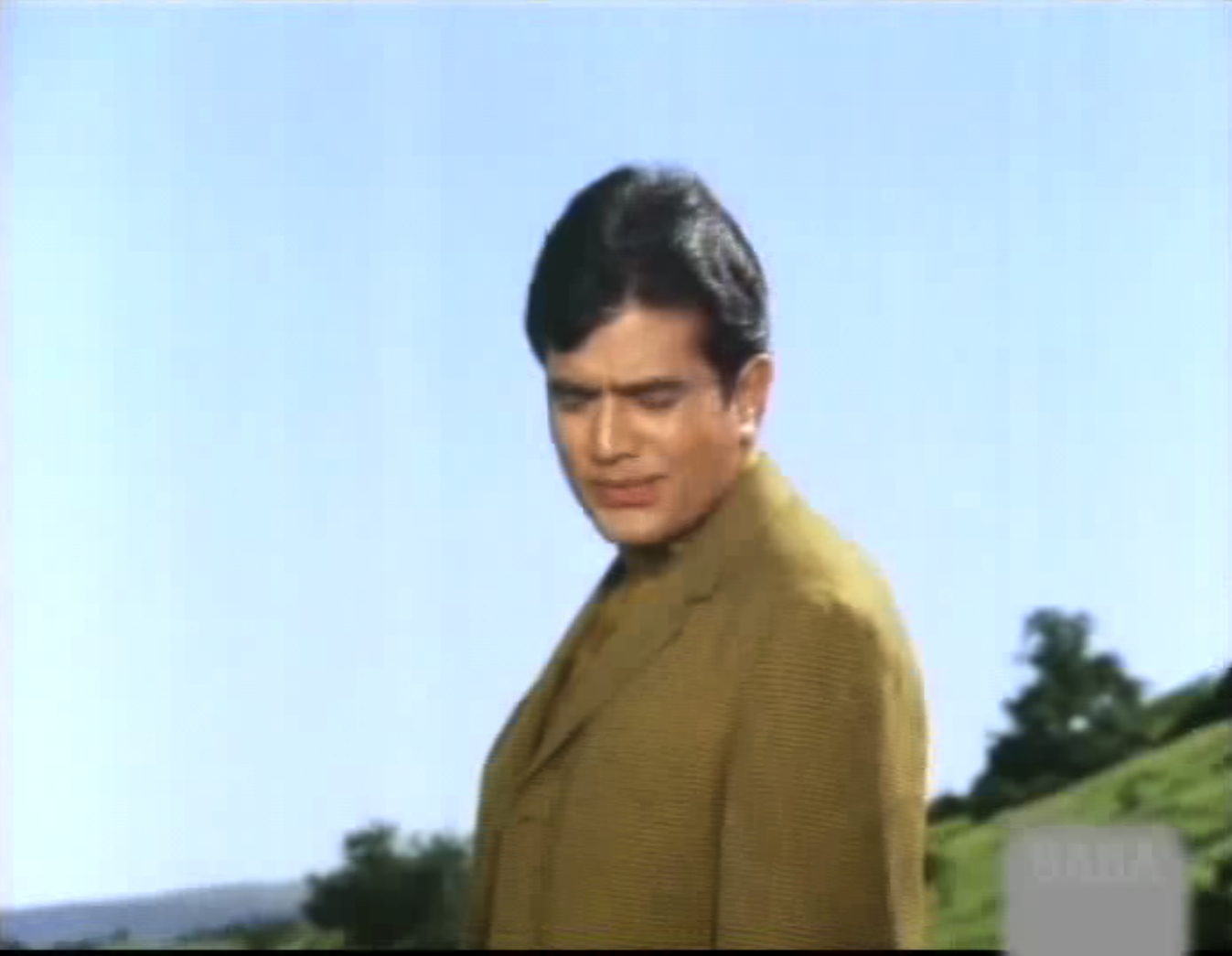
Step 2: Shut your eyelids. The key here is simultaneously tilting your head posterolaterally with the chin leading the way. This takes some very dedicated practice and coordination, so please don’t attempt this in public before you’ve put in the time. Subtle, right? Rajesh Khanna was as talented as he was beautiful.

In the devastating second step of his all-purpose wink, Rajesh Khanna coyly tilts his head and bats his eyelids. A palpable shudder is felt across the mountainside.

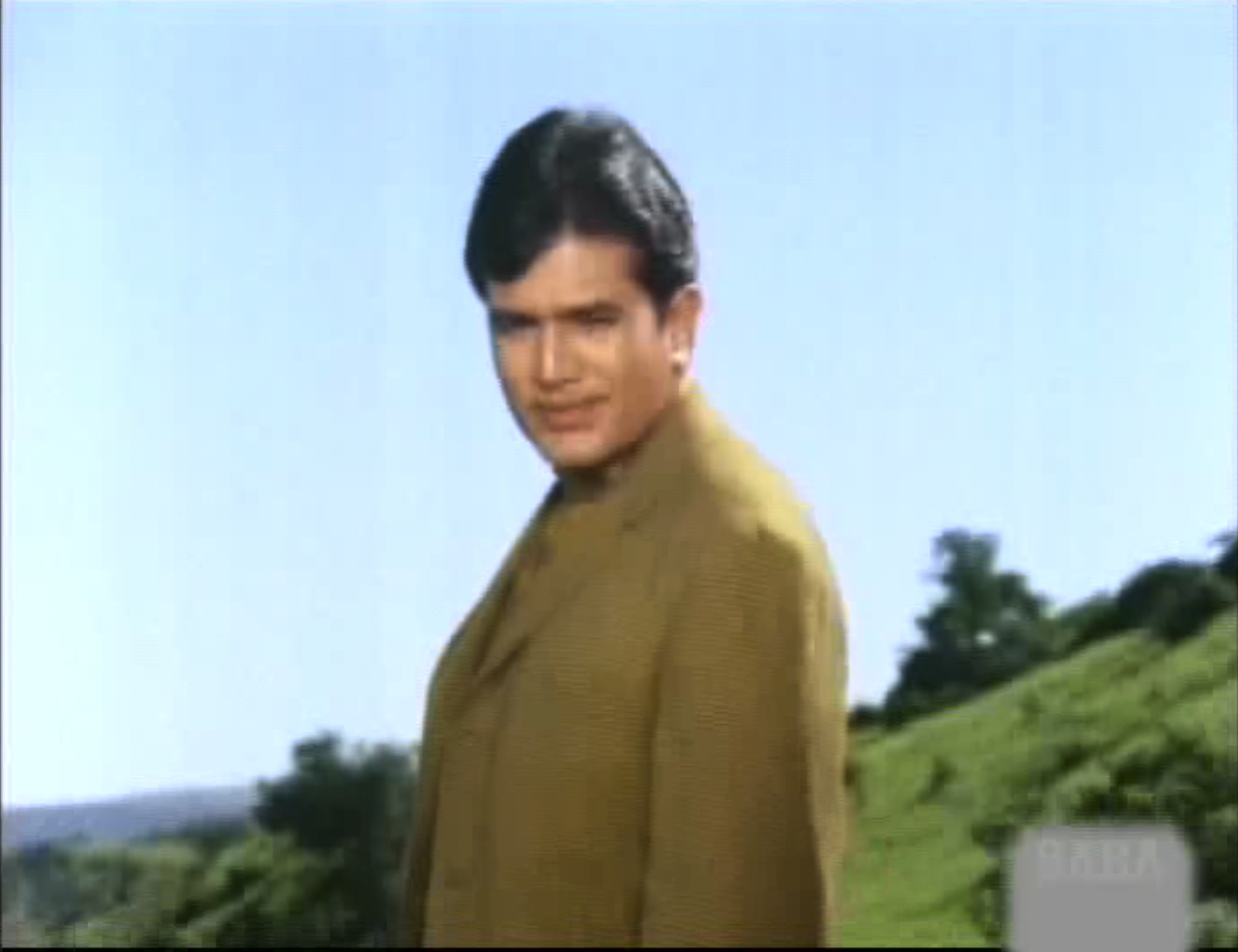
Step 3: Act natural. Return immediately to starting position, maintaining eye contact with a sly smile as if what just occurred was normal. You’ll have plenty of time to gauge audience response after.

Rajesh Khanna smiles slyly. He knows the wink just happened. He also knows you know the wink just happened. But the song isn’t done yet, and neither is he.

Step 4: Finish the song. Above all, keep singing. You gotta finish what you started. The violins are still playing and Kishore Kumar’s only on the first antra so hold that gameface until the last note.

Rajesh Khanna resists the urge to assess his wink’s immediate success and instead brings the song to a steady finish, thus heightening the wink’s effect.

Step 5: Watch and weep. This should not really qualify as a step. Observe the target’s resulting awe and proceed to take the win by a. proposing to her, b. holding her hand or c. reprising the film’s theme song.

Asha Parekh is moved literally to tears by the awesome power of Rajesh Khanna’s wink. Another one bites the dust.

That’s it folks–5 simple steps to becoming a Bombay Superstar. No Rajesh Khanna song is really complete with out it! For your viewing pleasure and further studies, check out Rajesh Khanna’s “Yeh Jo Chilman Hai” from Mehboob Ki Mehndi (1971). Then find some hair gel, a colorful ascot, and get winking.

-Mrs. 55

Likhe Jo Khat Tujhe Lyrics and Translation: Let’s Learn Urdu-Hindi

Likhe jo Khat Tujhe Shashi Kapoor

Shashi Kapoor and Asha Parekh star in Kanyadaan (1968)

For our next song, we translate the lyrics of my all-time favorite Mohammed Rafi song, Likhe Jo Khat Tujhe. The lyrics and translation of Likhe Jo Khat Tujhe have no frills, no super complicated Urdu, just verse straight from the heart. The metaphors of the lyrics have a simple beauty to them and the handsome voice of Mohammed Rafi brings them to sublimity. Although the film Kanyadan (1968) glorifies the social oppression of women and child marriages (highly objectionable and not worth the three hours I lost watching it), this song epitomizes what classic Bollywood love is all about. Boy falls for girl. Girl has an extremely cute colorful native outfit on and hides coyly behind local trees. Boy attempts to win over girl by serenading her. Girl and boy do not kiss, but you know by the way the camera pans around the flora that it’s on their minds. Likhe Jo Khat Tujhe is a blissfully adorable reminder of all things magical that Bollywood romance once meant: the charming poetry of innocent love. Can that ever get old?

Handsome shashi kapoor smile .png

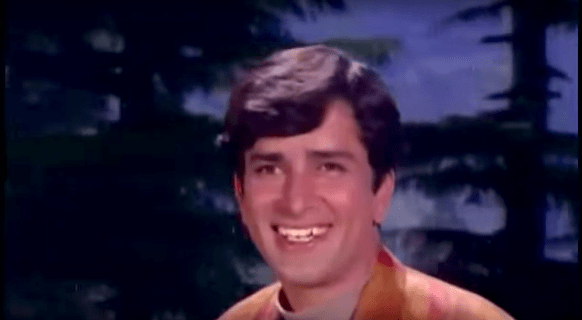
Shashi Kapoor flashes his famous smile, somehow made even more handsome by the crooked teeth.

Also note the clever use of Shashi Kapoor’s sleek convertible as the object around which the actors flirt and evade each other. As if we weren’t already convinced of how cool it was to be modern in the 60s…

Likhe Jo Khat Tujhe Lyrics and Translation:

Likhe jo khat tujhe woh teri yaad mei.N
Those letters that I wrote to you
Hazaaro.N rang ke nazaare ban gaye
Became a wondrous sight of a thousand colors
Sa.Nveraa jab huaa to phool ban gaye,
When morning came, they became flowers
Jo raat aayi to sitaare ban gaye
When night fell, they became stars
Likhe jo khat tujhe…

Koyi naghma kahii.N goonjaa kahaa dil ne yeh tu aayii
A melody resonated somewhere as my heart sensed your presence
Kahin chatki kali koyi main yeh samjha, tu sharmaayi
Somewhere a flower blossomed and it appeared as if you had blushed
Koi khushboo kahii.N bikhrii lagaa yeh zulf lehraayi
A fragrance filled the air and it seemed to me your hair had billowed

Fiza rangeen, adaa rangeen, yeh ithlaana, yeh sharmaana
The ambiance is colourful, your style is colourful, you sometimes swagger, you are sometimes demure
Yeh angaDaaii, yeh tanhaayii yeh tarsa kar, chale jaana
This preparedness, this isolation, this way you torture me, then walk away
Bana de ga nahii.N kisko jawaa.N jadoo yeh deewaanaa?
Who would not go crazy with your youthful magic?
Likhe jo khat tujhe…

Jahaa.N tu hai, vahaa.N main hoo.N, mere dil ki tu dhaDhkan hai
Wherever you are, I am there. You are my heartbeat
Musaafir mai.N tu manzil hai, main pyaasaa hoo.N tu saawan hai
I am a traveler, you are my destination. I am thirsty, you are the monsoon
Meri duniya yeh nazare.N hai.N, meri jannat yeh daaman hai
My world is held by the way you look at me, my paradise lies in your embrace
Likhe jo khat tujhe…

Glossary:

khat: letter; yaad: memory; sa.Nveraa: morning; khushboo: fragrance; zulf: hair; rangeen: colorful; tanhaayii: loneliness; jadoo: magic; musaafir: traveler; pyaasaa: thirsty; jannat: paradise

For all the Urdu-Hindi grammar junkies, you’ll notice that we’ve written the word “naghma” with an “h” although it’s often seen written without. This because the word naghma in Urdu is actually spelled with a ghain, not a regular “g” (in Hindi, the “ga” would have a dot below to indicate this). Ghain makes the “g” a more gutteral, difficult sound to pronounce, but if you’re trying to impress your friends at your next Bollywood Night, be sure to enunciate this clearly. Other words like kaaghaz (paper), baagh (garden), maghruur (proud) and ghalat (mistake) also contained frequently overlooked ghains.

-Mrs. 55