Dil Cheez Kya Hai Lyrics and Translation: Let’s Learn Urdu-Hindi

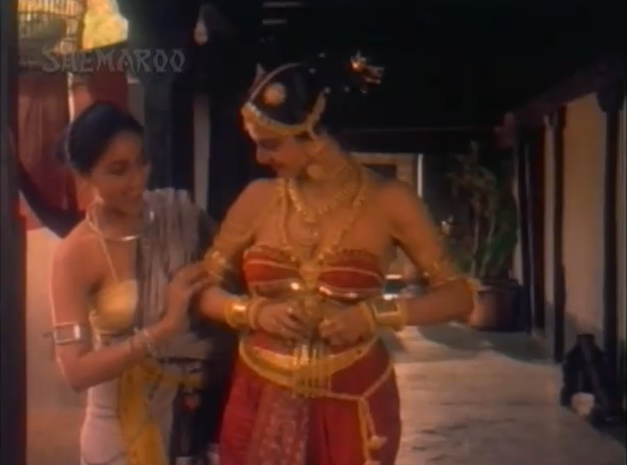
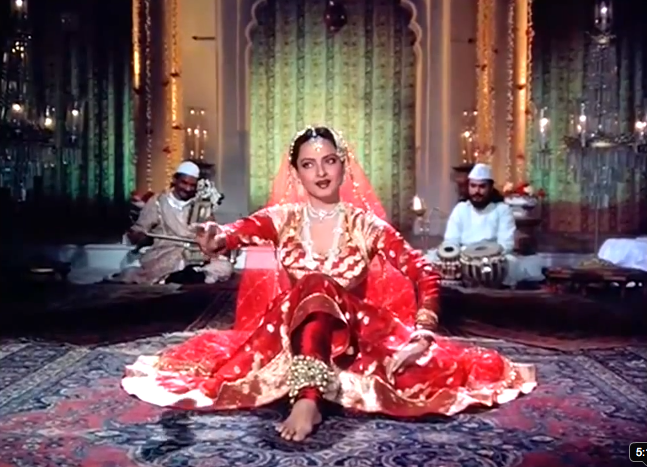
Rekha stars as a courtesan and poetess in Umrao Jaan (1981), based on an Urdu novel by Mirza Muhammad Hadi Ruswa

Today, we continue our series on Umrao Jaan (1981) by providing the lyrics and English translation to what is arguably the film’s most popular song: dil chiiz kyaa hai?  Based on Mirza Muhammad Hadi Ruswa’s novel Umrao Jaan Ada, this film narrates the tragic tale of a young girl who is kidnapped and forced to become a tawaif (courtesan).

Through the course of this film, we witness the transformation of an innocent young girl Amiran as she becomes Umrao Jaan Ada, one of Lucknow’s most sought after courtesans. At the brothel, young Amiran receives training in classical voice, Kathak dance, and Urdu poetry–a forbidden world of art and education that the average Indian girl of this time period would never get the chance to explore. When the brothel’s madam Khanum feels that she has been sufficiently groomed, Umrao Jaan begins performing and attracting the attention of wealthy patrons all over Lucknow. Umrao’s first public performance as a courtesan is marked by the song dil chiiz kyaa hai?

This gem is considered to be one of Asha Bhonsle’s career-defining songs, and she was awarded a National Film Award for her performance of this ghazal along with the rest of her contributions to this soundtrack. Khayyam bagged a well-deserved National Film Award for his compositions in this film, and Rekha took home the National Film Award for Best Actress. From her performance in this mujra in particular, it is clear that Rekha is worthy of all the critical acclaim she received for her work in Umrao Jaan.  Although she may lack the technical precision of a trained Kathak dancer, she compensates with her compelling on-screen presence and natural elegance. With eyes like hers, would any man in Lucknow be able to resist the charms of Umrao Jaan Ada?

What is your favorite song from the Umrao Jaan soundtrack? Share with us in the comments! Until next time…

-Mr. 55
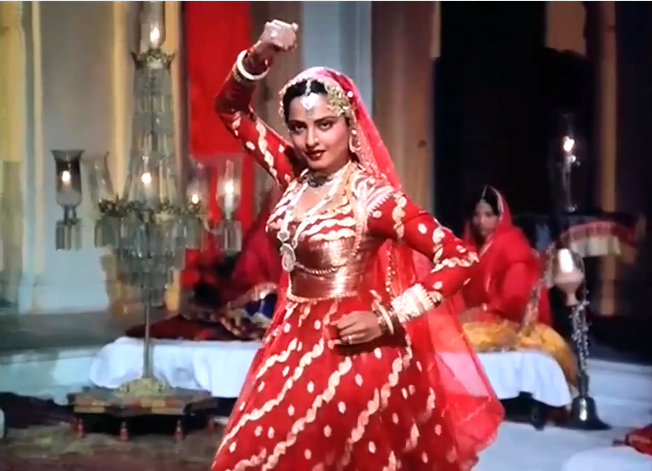
Rekha’s mujras in this film, especially dil chiiz kyaa hai?, are fan-favorites to this day.

Dil Cheez Kya Hai: Lyrics and Translation

dil chiiz kyaa hai? aap merii jaan liijiye
What is the heart worth? Take my life instead!
bas ek baar meraa kahaa maan lijiye
But just once, please accept what I say.

is a.njuman me.n aap ko aanaa hai baar baar
You must return to this gathering time and time again.
diivaar-o-dar ko ghaur se pahchaan liijiye
So, learn to recognize these surroundings carefully.

maanaa ki dosto.n ko nahii.n dostii kaa paas
I admit that friends may not always hold friendship in high regard.
lekin yah kyaa ki ghair kaa ahsaan liijiye?
Yet, does this mean you should accept kindness from strangers?

kahiye to aasmaa.n ko zamii.n par utaar laaye.n
If you ask for it, I shall bring down the sky to the ground. 
mushkil nahii.n hai kuchh bhii agar Thaan liijiye
No task is difficult if you pursue it firmly.

dil chiiz kyaa hai? aap merii jaan liijiye
What is the heart worth? Take my life instead!
bas ek baar meraa kahaa maan liijiye
But just once, please accept what I say.

Glossary

maan lenaa: to accept; anjuuman: gathering; diivaar-o-dar: walls and doors, surroundings; ghaur se: carefully; pahchaan lenaa: to recognize; dostii: friendship; paas: regard, consideration; ghair: stranger; ahsaan: favor, kindness; utaar laanaa: to bring down; Thaan lenaa: to pursue firmly.

A quick note regarding the word paas. Those of you familiar with its common use in the phrase kisii ke paas (next to someone/something) may be confused by the line “maana ki dosto.n ko nahii.n dostii kaa paas.” Here, a less common use of the word paas is used to mean regard or consideration. So, there is no relation to proximity here; the whole line would be translated as: “I admit that that friends may not always hold friendship in high regard.” Tricky, tricky.
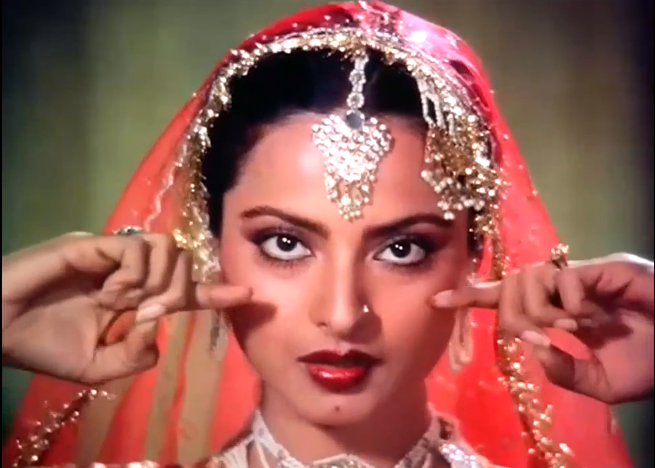
As Umrao Jaan, Rekha seduces wealthy men in Lucknow with her most tempting asset: her eyes!
Dam Bhar Jo Udhar Lyrics and Translation: Let’s Learn Urdu-Hindi

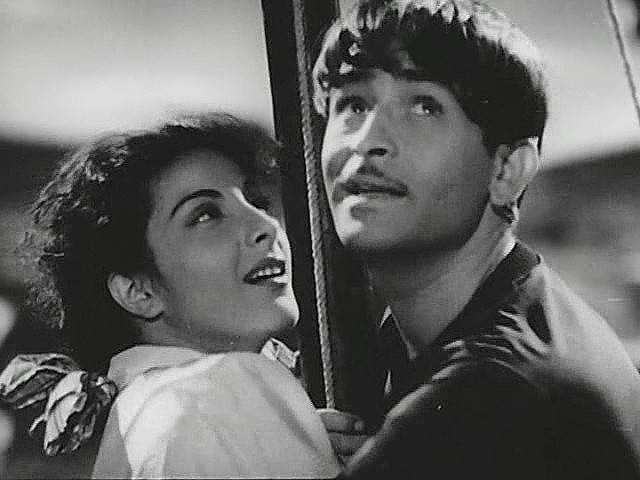
Raj Kapoor and Nargis Awara Dum Bhar Jo Udhar

Raj Kapoor and Nargis huddle together on a love-boat in Awaara (1951).

Our next lyrics and English translation is of the great love duet “Dum Bhar Jo Udhar” from the film Awaara (1951). It’s practically impossible to not love this song. Raj Kapoor plays an underworld criminal who falls for the wealthy ward of a rich judge played by his favorite leading lady Nargis. The film launched both of their careers to mega-stardom and for good reason. Packed with musical gems like the evergreen “Awaara Hoon” or “Ghar Aaya Mera Pardesi,” the film is a scathing social drama that weaves Raj Kapoor’s own respectable father, Prithviraj Kapoor, into the heart of its scandalous and surprising twist. The film was so well-received and brilliantly made that it was nominated for a Grand Prize at the Cannes Film Festival in 1953! Propelled by a tempting bad-boy with a tragic past storyline, the film arguably contains the greatest performance of Raj Kapoor’s career. Awaara is a historical and artistic must-see!

Dum Bhar Jo Udhar” is a Mukesh-Lata duet sung on a small boat in the middle of the night. Shailendra’s lyrics embody a theme common in Hindi films, which emphasizes the shyness of the woman and the boldness of the man. Both man and woman address the only other witness to their tryst–the beautiful moon above. However, the woman begs the moon to look away and not make her feel shy, while the man eagerly urges the moon to shine upon him and witness their love blossom. The importance of moon imagery in Urdu-Hindi poetry is legendary–most often taking the form of a feminine metaphor that epitomizes beauty. In this case, however, the playful moon evokes the male gaze as a trusty ally to the hero and a source of embarrassment to the heroine. It’s so adorable I could squirm.

Nargis Awaara Dum Bhar Jo Udhar

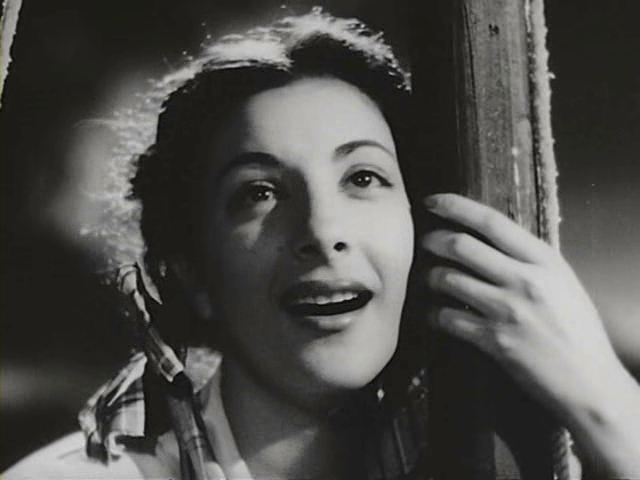
The eternally lovely Nargis glows in the moonlight in Awaara (1951).

Here are the full lyrics and English translation to “Dum Bhar jo Udhar” from Awaara (1951). Enjoy our interpretation of the song’s meaning and follow along on youtube with this link!

Dam Bhar Jo Udhar Lyrics and Translation

Lata:

Dam bhar jo udhar muu.N phere, O Chandaa
O Moon, if you would turn your face away for one moment
Mai.N unse pyaar kar luu.Ngii
I will make love to him
Baate.N hazaar kar luu.Ngii
I will say a thousand things to him

Dil kartaa hai pyaar ke sajade
My heart has prayed for such love
Aur mai.N bhii unke saath
And now I am with him
Chaand ko chandaa roz hii dekhe
The moon sees moonlight every day
Merii pehlii raat, ho, merii pehlii raat
But this is my first night, oh, this is my first night!
Baadal mei.N ab chhup jaa re! O Chandaa
Now go hide in the clouds, O Moon!
Mai.N unse pyaar kar luu.Ngii
For I will make love to him
Baate.N hazaar kar luu.Ngii
I will say a thousand things to him

Mukesh:

Dam bhar jo idhar muu.N phere, O Chandaa
O Moon, if you would turn your face here for one moment
Mai.N unse pyaar kar luu.Ngaa
I will make love to her
Nazare.N do-chaar kar luu.Ngaa
I will steal a few glances from her

Mai.N chor hoo.N kaam hai chorii
I am a thief, and my job is to steal
Duniyaa mei.N hoo.N badnaam
I am dishonored in society
Dil ko churaataa aayaa hoo.N mai.N
I have come to steal your heart
Yehii meraa kaam, ho, yehii meraa kaam
This alone is my job
Aanaa tuu gavaahi dene, O Chandaa
You must come and be a witness, O Moon
Mai.N unse pyaar kar luu.Ngaa
For I will make love to her
Nazare.N do chaar kar luu.Ngaa
I will steal a few glances from her

Lata:

Dil ko churaake kho mat jaanaa
Do not steal my heart and then become lost
Raah na jaanaa bhool
Do not forget your way back to me
In qadmo.n se kuchal na denaa
Do not crush with your footsteps
Mere dil kaa phool, ho, mere dil kaa phool
The flower of my heart, oh, the flower of my heart!
Yeh baat unhe.N samjhaa de, O Chanda
You make him understand this, O Moon
Mai.N unse pyaar kar luu.Ngii
I will make love to him
Baate.N hazaar kar luu.Ngii
I will say a thousand things to him

Glossary:

dam bhar: one full moment; udhar: in that direction; muu.N: face; pherna: to turn; hazaar: a thousand; pehlii; first; baadal: clouds; idhar: in this direction, here; do-chaar: a few; badnaam: a person of ill-repute; gavaahi denaa: to serve as witness; raah: path, way; qadam: footsteps; kuchal dena: to crush; phool: flower; samjhaa denaa: to make [someone] understand

Now before anyone gets their knickers in a twist, let’s just talk briefly about the phrase “Mai.N unse pyaar kar luu.Ngii” and what that really means. I have translated it somewhat literally for simplicity’s sake as “I will make love to him,” but that phrase in English carries with it more physical connotations than what it means in this context. Although the verb “pyaar karna” means simply “to love” as in the general English sense, the way it is used in this song carries a more immediate sense of both action and personal gain–by adding the coloring verb “lena” (“to take”), the phrase now implies that the girl is about to do something for her own benefit. We can safely say that these lyrics are not a prelude to actual Victorian “love-making” on that rocky boat of theirs, but rather an expression of desire and courtship. When she says, “Mai.N unse pyaar kar luu.Ngii,” I argue that this means no more than whispering sweet nothings, holding hands, stealing glances, and other forms of expressing tenderness and passion short of actually “making love.” See my point? And don’t let Nargis’ pole dancing throw you off.

Nargis pole dancing awaara

Yeah, no seriously I wasn’t kidding. Nargis takes the phrase “pole-dance” to a whole new level in Awaara (1951).

You know what’s really great about this movie? The fact that ages before women were given anything close to social equality, Nargis plays a powerful lawyer who ends up bringing justice to her lover Raj Kapoor. She stands strong in a court filled with men, and really makes us all proud. Granted, she’s really rich and let’s Raj Kapoor SLAP her in a different scene (kill me now), but we can appreciate what she stood for at least in that regard. It’s one of the best courtroom scenes of the industry! This song was requested by die-hard fan lalten–hope you enjoyed!

– Mrs. 55

What is Solah Singaar?

Fans of vintage Hindi films are intimately familiar with the theme of female ornamentation, which is expressed beautifully through song lyrics from this period of cinema. Countless songs from the Golden Era describe the charms of a woman’s kajraa (kohl), gajraa (flower garland), jhumkaa (earring), bi.ndii (beauty spot), ka.nganaa (bangle), and so on. In addition to these words, another common term that you might encounter in this genre of songs is solaah si.ngaar, which literally means “sixteen embellishments.” 

MK

Meena Kumari is beautifully adorned as a sensitive courtesan in the classic film Pakeezah (1972).

The most famous example of this phrase occurs in a song from the eternally beautiful film PakeezahIn “ThaaDe rahiiyo, o baa.nke yaar,” Lata Mangeshkar, on Meena Kumari, sings:

mai.n to kar aauu.n solaah si.ngaar / (I will come, adorned with the sixteen embellishments)
ThaaDe rahiiyo, o baa.nke yaar / (Keep waiting, oh beautiful lover) 

The term solaah si.ngaar refers to sixteen ways in which brides of ancient India adorned themselves before meeting their groom. Although sources conflict over the inclusion of certain ornaments, I am presenting a list of the most commonly accepted beautification aids associated with solaah si.ngaar below. 

1. bi.ndii, a beauty spot adorning the forehead. 

2. si.nduur, a sacred mark of vermillion lining the parting of a bride’s hair. si.nduur is still applied as a sign of marriage by modern Indian women. 

3. maa.ng tiikaaa gold pendant that hangs over the bride’s forehead. 

4. a.njanaa or kaajalthe decoration of  the bride’s eyes using kohl. 

5. naath, a hoop-shaped nose ring.

6. haar, intricate necklaces made of gold and precious stones. The most auspicious necklace offered to the bride during a Hindu wedding is the mangalsutra, which symbolizes the inseparable bond between husband and wife. 

Mangalsutras often contain a gold pendant on a chain of black beads as shown here.

7. karan phuullarge earrings that cover the bride’s entire ear. 

8. maha.ndiihenna designs drawn on the bride’s hands and feet. 

9. chuuDiisets of bangles adorning the bride’s wrists. 

10. baajuba.ndarmlets adorning the bride’s upper arms. 

11. aarsii, a flat jeweled mirror worn as a ring. Supposedly, it was used by brides to check their appearance and possibly sneak a look at their grooms before the official unveiling! 

12. keshaa-pashaa-rachnaa, the styling of the bride’s hair in traditional patterns and adornment of the hair with jewelry and gajraa (flower garlands). 

13. kamarba.nda waist band made of gold and precious gems. The etymologists among our readers might notice the uncanny similarity of this word to cummerbund, the broad waist sash worn by men with tuxedos.  

14. paayala chain adorned with small bells, often made of silver, worn around the ankle. 

15. itarfragrant oils and perfumes to keep the bride smelling fresh throughout the ceremony. 

16. saarii/laha.ngaa, the bridal dress. Popular colors include red, green, and gold. 

Rekha

In Utsav (1984), Rekha is bedecked with many of the common ornaments that constitute solaah si.ngaar: maa.ng tiikaa, kaajal, maa.ng tiikaa, naath, haar, karan phuul, chuuDii, baajuba.nd, and kamarba.nd.  

As you can see, solaah si.ngaar takes make-up to a whole new level of complexity and depth! Thankfully, modern Indian brides aren’t expected to keep up most of these practices past their wedding day in order to please their husbands. We can only imagine how much time and effort brides in ancient India must have spent on perfecting their appearances through this elaborate regimen of beautification.

This post was inspired by a question about solaah si.ngaar by one of our readers paasha. If you have any more burning questions about vintage Hindi cinema, feel free to shoot us a line–we’ll do our best to solve your Bollywood mystery! Until next time…

-Mr. 55

Dum Maro Dum Lyrics and Translation: Let’s Learn Urdu-Hindi

Zeenat Aman Dev Anand Dum Maro Dum

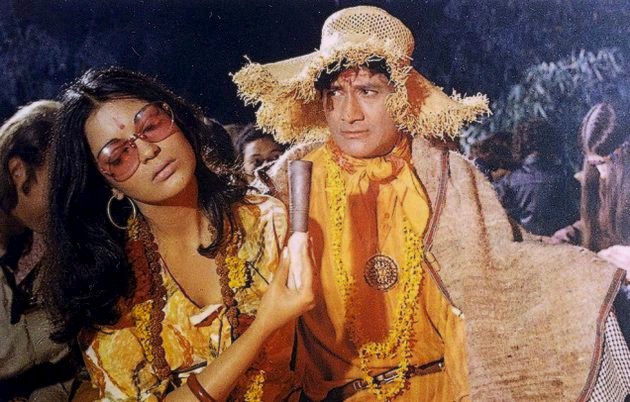
Zeenat Aman becomes shamelessly intoxicated in front of her brother Dev Anand in Hare Rama Hare Krishna (1971). More importantly, can someone please burn that hideous floppy straw hat?

Our next lyrics and English translation is the epitome of youthful rebellion and psychadelic glamour: “Dum Maro Dum” from Dev Anand’s 1971 Hare Rama Hare Krishna. The translation could not have come at a more appropriate time–as many of you know, as of 2 weeks ago, medical marijuana is now legalized in Massachusetts. So to all the Harvard seniors getting ready to graduate in a few months, this song is for you! When people think of Asha Bhonsle at her craziest, “Dum Maro Dum” is often the song that comes immediately to mind. It’s seductive, eccentric, and exhibits her full range from those bizarre, unexpected high notes to the fabulous embodiment of character as only Asha knew how. It’s one of incomparable music director R.D. Burman’s greatest works for the ground he broke–putting illicit drugs and societal defiance to the forefront in a youth-targeted song that was so instantly catchy no one could brush it off. Let’s face it, with this song, Zeenat may represent everything we don’t want in our loved ones, but God, does she make it look appealing.

Zeenat Aman Hare Rama Hare Krishna

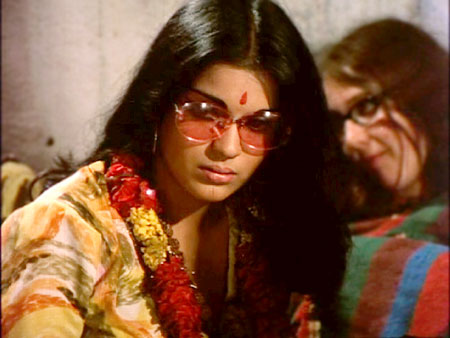
Gorgeous Zeenat Aman sports a pair of show-stopping 70s shades as a drug addict in Hare Rama Hare Krishna (1971).

Shot in one of Dev Anand’s favorite locations, Kathmandu (remember Jewel Thief, anyone?), Hare Rama Hare Krishna is a politically-driven film against the subversive hippie culture that our hero believes to be distorting the true message of the Hindu ideals it pretends to preach. Dev Anand hunts down his long-lost sister in such a hippie camp and tries to extricate her with tragic results. The film delivers a powerful message without feeling like Manoj Kumar-eqsue patriotic propaganda. I really applaud Dev Anand for making such a bold film that critiques a subject so ignored by his contemporaries and so popular among the masses who bought into it–with a delightfully satirical name like Hare Rama Hare Krishna, the film was a risk and it paid off.

So enjoy our English translation and lyrics to “Dum Maro Dum” below! Follow along with the video and let us know your thoughts on this controversial smash hit in the comments! You know how Zeenat starts the song with a little “Hush!” just before the music starts? I can’t exactly explain why, but I always feel really awkward when I hear it.

Dum Maro Dum Lyrics and Translation

Dam maaro dam miT jaaye gham
Take another hit, all your worries will disappear
Bolo subah shaam hare krishna hare raam
From morning until night sing, “Hare Krishna Hare Ram!”

Duniyaa ne hum ko diyaa kyaa?
What has the world given us?
Duniyaa se hum ne liyaa kyaa?
What have we taken from the world?
Hum sab kii parwaa kare.N kyo.N?
Why should we worry about anyone?
Sab ne humaaraa kiyaa kyaa?
What has anyone does for us?
Dam maaro dam miT jaaye gham…

Chaahe jiye.Nge, mare.Nge
Whether we want to live or to die
Hum na kisii se Dare.Nge
We won’t be afraid of anyone
hum ko na roke zamaanaa
The world won’t be able to stop us
Jo chaahe.Nge hum kare.Nge
For we will do what we want

Dam maaro dam miT jaaye gham
Take another hit, all your worries will disappear
Bolo subah shaam hare krishna hare raam
From morning until night sing, “Hare Krishna Hare Ram!”

Glossary:

dam maarnaa: to take a hit [of marijuana]; miT jaanaa: to disappear; gham: sadness, worries; subah shaam: from morning to night; Hare Krishna Hare Raam: a chant of the Hare Krishna sect popularized by the hippie culture in the 60s and 70s; duniyaa: society, the world; parwaa: worry; zamaanaa: the world

Zeenat Aman Dum Maro Dum

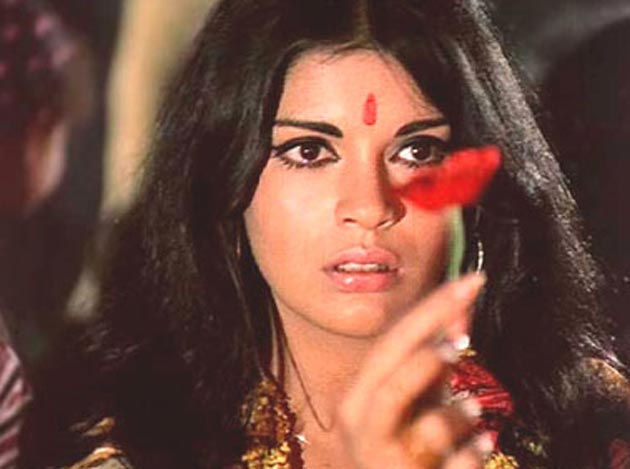
Zeenat Aman suddenly remembers her idyllic drug-free childhood with an emotional outburst of regret in Hare Rama Hare Krishna (1971).

For the sake of completeness, I feel compelled to include a translation of Dev Anand’s great comeback to the moral disorder he witnesses among the Hare Krishnas: “Dekho O Diwaano.” “Dekh O Diwano” and indeed the film Hare Rama Hare Krishna, is not a direct attack on the actual Hare Krishna movement, but rather the hippie culture that traveled with it in the 60 and 70s–and by blending the two, confused and disheartened many a contemporary conservative Hindu. Dev Anand makes some brilliant comparisons through example in this song–by drawing upon classic Hindu literature such as the Ramayan story of Lord Ram’s banishment to the forest (“Ram ne ha.Ns kar sab sukh tyaage“) and Krishna’s explanation to Arjun of the meaning of karma in the timeless battlefield of the Mahabharat (“Krishna ne karm ki riit sikhaayi“), Dev Anand makes a clear distinction between lip service and actual belief.

Dekho O Deewano Lyrics and Translation:

Dekho O deewano, tum yeh kaam na karo
Look, Oh crazy people, do not behave like this
Raam kaa naam badnaam na karo
Do not bring dishonor to the name of Ram

Raam ko samjho, Krishna ko jaano
Understand Ram, know Krishna well
Nee.Nd se jaago, O mastaano
Wake up from this sleep, Oh intoxicated ones
Jeet lo man ko paDh kar Geeta
Win back your mind by studying the Geeta
Man hii haaraa, to kyaa jeetaa?
For once you’ve lost your mind, what is there to win?

Hare Krishna, Hare Ram
Jeevan ko nashe ka tum ghulaam na karo
Do not make your life a servant to intoxications
Raam kaa naam badnaam na karo
Do not bring dishonor to the name of Ram

Raam ne ha.Ns kar sab sukh tyaage
With a smile, Ram renounced all his joys
Tum sab dukh se Dar ke bhaage
But you are scared and run away from every grief
Krishna ne karm kii riit sikhaaii
Krishna taught us the tradition of righteous action
Tum ne farz se aa.Nkh churaayii
But you avoid your duties

Hare Krishna, Hare Ram
Jeevan naam hai kaam kaa aaraam na karo
The meaning of life is work, do not rest
Raam kaa naam badnaam na karo
Do not bring dishonor to the name of Ram

Glossary:

badnaam: dishonored; tyaagnaa: to renounce; nee.Nd: sleep; Geeta: the Bhagavad Gita, a religious text within the epic poem the Mahabharat; jeevan: life; nashe: intoxications; ghulaam: servant; riit: culture, tradition; farz: duty; aa.Nkh churaanaa: to avoid; aaraam karna: to rest

While Zeenat Aman and her fellow groupies waste their minds and lives to drugs in the name of Lords Ram and Krishna, Dev Anand reminds the audience of the wrong of even inaction as discussed in the Gita. Classical Hindu dharmic responsibility is not passive, but active and tempered–with no stake in the outcome whether happiness or sadness. It is an ancient theme that you may recall Dev Anand explored years earlier in his 1965 legend Guide. Sadly, Zeenat Aman eventually succumbs to her addiction, and in the end the story returns briefly to the heart of many a great film: a tale of a broken family reunited.

These themes can certainly be pretty volatile subjects, and it’s not our intention to spark a political or religious debate on this forum. So we shall end with a grammar lesson instead: do you know why the “deewaano” and “mastaano” are used instead of simply “deewaane” or “mastaane”? The vocative as used here is a special case! The nasalization “o.N” used in the oblique (eg. “dosto.N ke saath”) is not to be confused with the vocative “o” (eg. “suniye, dosto”) used to address a group directly! People commonly make this sloppy Urdu mistake–so rise above the masses!

But don’t go that high, if you know what I mean. Have fun, Massachusetts.

-Mrs. 55

Karvaten Badalte Rahe Lyrics and Translation: Let’s Learn Urdu-Hindi


RK

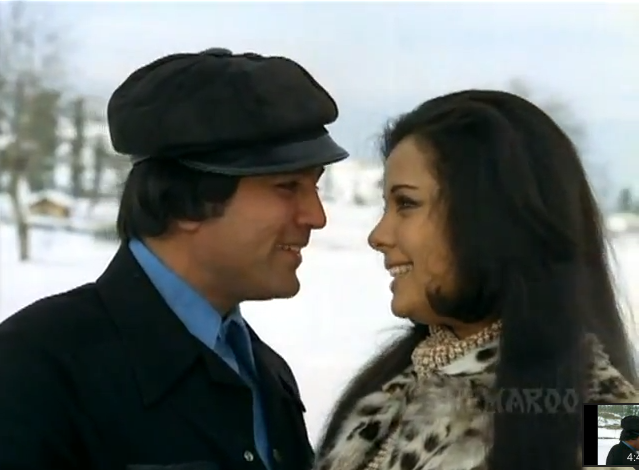
Rajesh Khanna and Mumtaz frolic in pre-marital bliss in the title track from Aap Ki Qasam (1974)

Today, we present the lyrics and English translation to the title track from Aap Ki Qasam (1974): karvate.n badalte rahe.n.  Directed by J. Om Prakash, this film stars Rajesh Khanna, Mumtaz, and Sanjeev Kumar in a story that illustrates how suspicion can be the ultimate enemy to marital bliss. 

As Mumtaz’s jealous husband, Rajesh Khanna begins to doubt his wife’s fidelity when his best friend Sanjeev Kumar comes into the picture. Although Mumtaz and Sanjeev Kumar share a platonic brother-sister friendship, Rajesh Khanna’s suspicion blinds him from reality until he destroys his own marriage.  Refusing to dignify the false accusations of infidelity placed on her with a response, Mumtaz leaves him and returns to her father’s home.  When she realizes that she is pregnant with Rajesh Khanna’s daughter, she enters a second marriage (with her father’s blessings!) so that her child can be raised in a loving home.  In the mean time, Rajesh Khanna comes to his senses and realizes that his suspicion towards his wife was misguided. Unable to apologize properly to Mumtaz for his unacceptable behavior, guilt drives Rajesh Khanna to become a homeless wanderer. Several years later, Mumtaz invites him to his daughter’s wedding where all parties receive closure of sorts. However, a tragedy strikes to create an ending that seeps with melodrama in true Bollywood fashion. 

Aap Ki Qasam is remarkable in its portrayal of marital suspicion for avoiding the chauvinistic bias present in similar films of this era. Typically, female characters accused of infidelity were vilified and forced to appease their husbands regardless of whether the accusations placed upon them were were valid or not. This film breaks the patii-parameshvar (husband is God) mold by supporting a woman’s right to leave an unhappy marriage in which she is treated disrespectfully by her husband. In particular, the support that Mumtaz receives from her father (played by Rehman) in divorcing her husband and entering a second marriage is unusually refreshing for this period of cinematic history. Although it can be argued that Mumtaz’s father makes much of the decisions for her, the fact that she is not compelled to beg for forgiveness at her husband’s feet is sufficiently progressive to merit attention. Indeed, valuing a woman’s dignity and self-worth over her duty to preserve a dysfunctional marriage is the ground-breaking message that makes Aap Ki Qasam stand out among other movies from this time.

In addition to being a cherished Rajesh Khanna-Mumtaz hit, this film is remembered today for its fantastic soundtrack composed by R.D. Burman. Aside from the  Pahadi-based duet sung by Lata Mangeshkar and Kishore Kumar presented here, this album contains the popular duets “suno, haa.n kaho,” “jai jai shiv sha.nkar,” “paas nahii.n aanaa,” the beautiful Lata solo “chorii chorii chup ke chup ke,” and the philosophical Kishore solo “zindagii ke safar me.n.”  Anand Bakshi’s lyrics in “karvate.n badalte rahe.n” are marked by simplicity in their expression of the romance and trust shared between two lovers as they yearn in separation. Moreover, the beautiful snow-filled Himalayan landscape and the on-screen chemistry exhibited by Rajesh Khanna and Mumtaz add to the appeal of this duet. 

Finally, as an aside, the 1973 BBC documentary Bombay Superstar profiling Rajesh Khanna and his influence on Hindi cinema actually features a behind-the-scenes look at the making of Aap Ki Qasam through interviews with the superstar himself,  director J. Om Prakash, and co-star Mumtaz. My favorite part of this documentary is the scene that depicts the amount of work that went into picturizing a playback song for a Bollywood film (the filming of “suno, haa.n kaho” is shown in the documentary).  Check out the full documentary here on YouTube if you haven’t seen it yet! Until next time…

-Mr. 55
RK

The on-screen chemistry between Rajesh Khanna and Mumtaz allowed this pair to dominate the box office during the early 1970s.

Karvaten Badalte Rahe: Lyrics and Translation

karvate.n badalte rahe.n saarii raat ham
Tossing and turning in bed, I have been restless the entire night.
aap kii qasam, aap kii qasam
I swear by you.
gham na karo, din judaayii ke bahut hai.n kam
Do not be sad; the days of our separation are very limited.
aap kii qasam, aap kii qasam
I swear by you.

yaad tum aate rahe ek huuk sii uThtii rahii
As I remembered you, a sharp pain kept arising in my heart.
nii.nd mujhse, nii.nd se mai.n, bhaagtii chhuptii rahii
Sleep and I kept fleeing and hiding from each other.
raat bhar bairan nigoDii chaa.ndnii chubhtii rahii
The hostile, wretched moonlight continued to pierce through the entire night.
aag sii jaltii rahii, girtii rahii shabnam
A fire kept burning, as the dew continued to fall.
aap kii qasam, aap kii qasam
I swear by you.

jhiil sii aa.nkho.n me.n aashiq Duub ke kho jaayegaa
Your beloved will get lost by drowning in the loch of your eyes.
zulf ke saaye me.n dil armaan bharaa so jayegaa
Under the shadows of your tresses, his hope-filled heart will fall into slumber.
tum chale jaao, nahii.n to kuchh na kuchh ho jaayegaa
Please go away, or else something will happen between us.
Dagmagaa jaaye.nge aise haal me.n qadam
Our steps will falter out of control under these circumstances.
aap kii qasam, aap kii qasam
I swear by you.

ruuTh jaaye.n ham to tum ham ko manaa lenaa sanam
Should I sulk, please console me, oh beloved.
duur ho.n to paas ham ko tum bulaa lenaa sanam
Should you be far away, please call me to your side, oh beloved.
kuchh gilaa ho to gale ham ko lagaa lenaa sanam
Should I make a mistake, please embrace me in forgiveness, oh beloved.
TuuT na jaaye kabhii yah pyaar kii qasam
May this vow of love never be broken by us.
aap kii qasam, aap kii qasam
I swear by you.

Female lines in red are sung by Lata Mangeshkar. Male lines in green are sung by Kishore Kumar. Lines in black are sung together by Lata Mangeshkar and Kishore Kumar. 

Glossary

karvate.n badalnaa: to toss and turn in bed  (i.e. to be restless at night); qasam: a sworn oath or vow; gham karnaa: to be sad; judaayii: separation; huuk: a sharp pain; nii.nd: sleep; bhaagna: to flee; chhupnaa: to hide; bairan: hositle, cruel; nigoDii: wretched; chubhnaa: to pierce; aag: fire; shabnam: dew; jhiil: loch, lake; aashiq: beloved; zulf: tresses; saaye: shadows; armaan: hope; Dagmagaaanaa: to falter, stagger; haal: circumstances, state; qadam: steps, feet; ruuTh jaanaa: to sulk; manaa lenaa: to console; sanam: beloved; paas bulaa lenaa: to call to one’s side; gilaa: mistake; gale lagaa lenaa: to embrace; TuuT jaanaa: to be broken.

r

The snowy Himalayan foothills provide the ideal backdrop for this romantic duet from Aap Ki Qasam (1974).