Jadugar Saiyan Lyrics and Translation: Let’s Learn Urdu-Hindi

Vijayantimala in Nagin (1954)

Vijayantimala gazes at her snake-charmer lover in Nagin (1954)

Today we highlight the lyrics and English translation of the sweet Lata Mangeshkar solo “Jadugar Saiyan” from the hit film Nagin (1954). A lively mandolin solo fades in as a handsome young couple daydream in a jungle grove . There are many reasons why this song is one of Bollywood’s favorites. For me, I think it is because “Jadugar Saiyan” captures that beautiful age of innocence we like believe once existed in Indian romance. This song hearkens us back to a fabricated time when just holding hands could give a man heart palpitations, and all the women sung amazingly just like Lata Mangeshkar.

Mala, played by Vijayantimala, and Sanatan, played by Pradeep Kumar, come from rival spear-throwing adivasi clans whose eclectic livelihood involves capturing live snakes. The feisty, blood-thirsty daughter of the clan chief, Mala, is the definition of bada$$, complete with an intimidating ‘do and a bow-and-arrow ensemble. After hearing the enchanting been melody Sanatan is playing to lure a family of cobras, she falls for him harder than any snake ever had. The feeling is mutual, for even when she later attempts to kill him (he is from a rival family, after all), he’s too hooked to let a minor thing like disregard for human life get between them.

While the lyrics of the song are from the point of view a girl who claims to desperately wish to go home because it’s past her curfew, the tone is completely flirtatious. Throughout the entire song, he does literally nothing to stop her from leaving (unless you count the occasional flex of his bare pectoralis majors), while Mala dances circles around him, initiates impromptu games of tag, and bats her eyelids ferociously. This endearing, almost comical, tension between the girl’s actions and words underscore the wholesome nature of their love affair. I mean, there are probably more scintillating things you could say to entice the man you love other than how your all your besties are going to tease you for being embarrassed later. Mala embodies that purity of intention with just a dash of spice that makes her the quintessential Bollywood heroine.
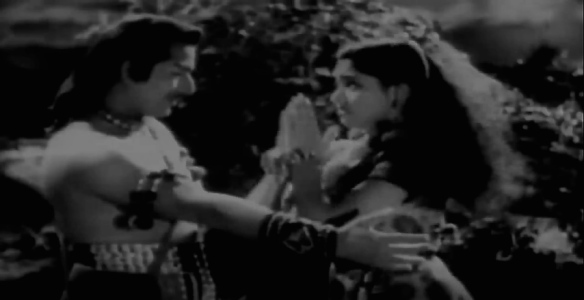
Vijayantimala pleads with Pradeep Kumar in Jadugar Saiyan from Nagin

Vijayantimala pretends to plead with a shirtless Pradeep Kumar in “Jadugar Saiyan” from Nagin (1954).

At the end of the song, Mala’s father arrives to break up the party, spelling utter disaster for our star-crossed couple. Welcome to 1950s Bollywood, people. Sanatan might be able to kill a poisonous cobra with his bare hands, but there can be no worse fate for our hero than to suffer disapproval from his would-be father-in-law.

With lyrics by Rajinder Krishan and music by Hemant Kumar, the soundtrack from Nagin is one of Bollywood’s all-time best. Be sure to check out Vijantimala’s extra special dance moves in the music video, and we hope you love the lyrics and English translation of this delightful song from Nagin as much as we do!

Jadugar Saiyan Lyrics and English Translation:

jaaduugar, saiyaa.N, chhoDo more bai.Nyaa
Magician, beloved, let go of my wrists
ho gayii aadhii raat, ab ghar jaane do
It is midnight, let me go home

jaane de, O rasiiyaa, mere man basiiyaa
Let me leave, O sweet one, for you reside in my mind
gaao.N meraa baDii duur hai
My village is very far away
terii nagariiyaa.N ruk na sakuu.N mai.N
I cannot stop in your town
pyaar meraa majbuur hai
My love is helpless
zanjiir paDii mere haath, ab ghar jaane do
My hands are shackled, now let me go home

jaaduugar, saiyaa.N, chhoDo more bai.Nyaa
Magician, beloved, let go of my wrist
ho gayii aadhii raat, ab ghar jaane do
It is midnight, let me go home

jhukii jhukii a.Nkhiiyaa.N dekhe.Nge saaDii sakhiiyaa.N
All my friends will see my lowered eyes
de.Nge taanaa tere naam kaa
They will tease me with your name
aise mei.N, mat rok, bedardii
Do not stop me like this, unfeeling one
le vachan kal shaam ka
Accept a promise of tomorrow evening
kal ho.Nge phir ham saath, ab ghar jaane do
Tomorrow we will be together again, now let me go home

jaaduugar, saiyaa.N, chhoDo more bai.Nyaa
Magician, beloved, let go of my wrist
ho gayii aadhii raat, ab ghar jaane do
It is midnight, let me go home

Glossary:

jaaduugar: magician; saiyaa.N: beloved; chhoDnaa: to let go; moraa: Braj bhasha term for meraa, my; baiyaa.N: wrists; aadhii raat: midnight; ghar: home; jaane denaa: to allow to go; rasiiyaa: sweet one; man basiyaa: one who resides in the mind; gaao.N: village; baDii: very; duur: far; nagariiyaa.N: town; ruknaa: to stop; pyaar: love; majbuur: helpless, weak; zanjiir: chains, shackles; haath: hands; jhuknaa: to lower, to bow; a.Nkhiiyaa.N: eyes; saaDii: all; sakhiiyaa.N: a girl’s other female friends; taanaa: taunt; naam: name; aise: like this; mat; do not [do something] roknaa: to stop [someone/something]; bedardii: unfeeling one, cruel one; vachan: promise; kal: yesterday/tomorrow; shaam: evening; phir: again, then; saath: together
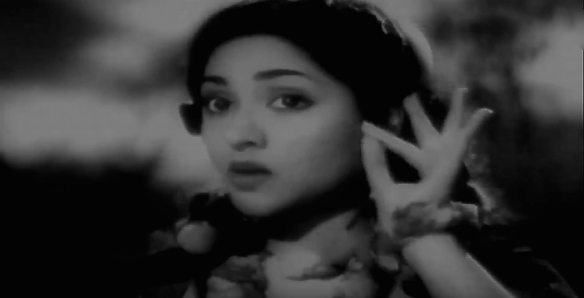
Vijyantimala in Jadugar Saiyan from Nagin 1954

Vijyantimala plays the fearless daughter of an adivasi chief in Nagin (1954).

Will Mala and Sanatan ultimately have a happy snake-charmed life together? Even without the plot, the film is well-worth watching for the songs and an introduction to the fascinating way classic Bollywood portrays India’s tribal communities (which is a whole other discussion). For a glimpse of another famous shirtless actor from the 1950s, check out our translation of “Yeh Raat Yeh Chandni” from Jaal (1952)! You can thank me later.

This song translation was requested by fan Pankaj. Keep these great requests coming!

-Mrs. 55
Awaaz Deke Humen Tum Bulaao Lyrics and Translation: Let’s Learn Urdu-Hindi

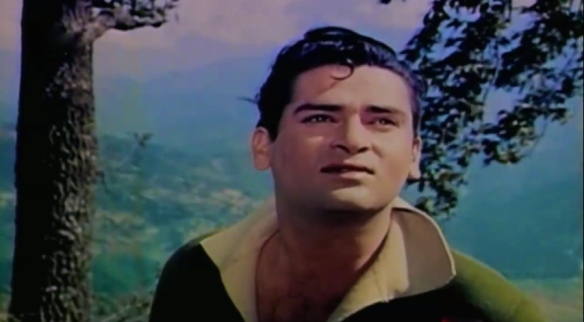
Shammi Kapoor awaaz deke professor

Collar fully popped with emotion, Shammi Kapoor hears his lover’s voice echo to him through the mountains in “Awaz Deke” from Professor (1962).

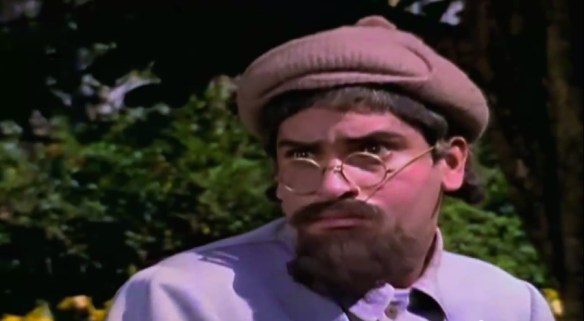
Today we present the haunting duet “Awaaz Deke” from the crowd-pleasing dramedy Professor (1962), starring Shammi Kapoor, Kalpana Mohan, and Lalita Pawar. There is a charm to this film, enhanced by the scenic woods of Darjeeling, that surmounts its kitsch basis and the sprinklings of Tuntun as comic relief. Shammi Kapoor plays a young educated man in desperate search of a job as a teacher when his mother is diagnosed with the dreaded…wait for it…tuberculosis! [cue: sad violin solo and unnecessarily exuberant coughing spell]. You were expecting lymphosarcoma of the intestine, no? In order to pay for her treatment at a sanitorium, Shammi accepts a post as a professor to four orphaned children living with their domineering aunt. However, because the aunt (played in her usual court martial fashion by Lalita Pawar) mistrusts men and specifically requested a professor older than 50, Shammi cleverly dons a goatee and spectacles and attempts to pass as an elderly scholar. The comedy of errors that ensues forms the basis of a delightful, albeit sometimes face-palm-inducing, two and a half hours of singing and prancing around the picturesque Darjeeling countryside.

“Awaaz Deke” is among my favorite Lata-Rafi pairings, boasting a soul-stirring melody that rises above the rest of the film. I remember when I was younger hearing this song before ever seeing the movie, and being struck by the song’s unusual saxophone theme. I love the juxtaposition of the traditional Indian percussion that gives the song its sense of urgency with the beauty of the jazz staple, played in a way I had never experienced a saxophone before: haunting and pure. Composed by Shankar-Jaikishen in one of their favorites ragas, Shivaranjani, “Awaaz Deke” is a diamond of the Professor album that won the 1963 Filmfare Award for best music direction. That stunning high F5 that Lata nails in the antra, while not her highest note on record, will make you wonder how there can exist people in the world who have never known the majesty of Hindi film music.

Kalpana Mohan awaaz deke professor

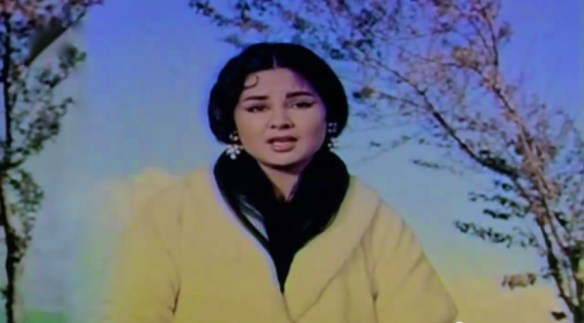
Kalpana Mohan searches for her estranged lover in a cute fur coat “Awaz Deke” from Professor (1962).

As pleasant a face as our leading lady possesses, director Lekh Tandon had harsh words for Kalpana Mohan when filming his directorial debut Professor. Because of her inexperience before a camera, he was forced to shoot multiple takes before achieving the performance he wanted–a costly endeavor in the days before digital film! A Kashmiri native, Kalpana was trained in Kathak dancing before she received her first break in Bollywood as the playful heroine of Professor. She virtually disappeared from the film industry following her marriage shortly after her successful role in Teen Devian (1965), and died tragically of cancer almost 3 years ago. She is remembered today by fans for the mesmerizing twinkle in her eyes you can see in all her films.

We hope you enjoy the English translation and lyrics to “Awaz Deke” below. This would be a perfect song to burst into the next time you and your significant other are having a lover’s tiff, right? I can think of no better way to break the tension. You can follow along with the video on youtube here!

Awaaz Deke Hamen Tum Bulaao Lyrics and Translation:

LATA: aawaaz deke hame.N tum bulaao
Lend me your voice and call out to me
Mohabbat mei.N itnaa na hamko sataao
Do not torture me so much in our love

LATA: Abhii to merii zindagii hai pareshaa.N
Now my life is filled with worry
Kahii.N mar ke ho khaak bhii na pareshaa.N
If I die somewhere, may my ashes be not so distraught
Diye kii tarah se na hamko jalaao
Do not light me on fire like a candle
Mohabbat mei.N itnaa na hamko sataao
Do not torture me so much in our love

RAFI: aawaaz deke hame.N tum bulaao
Lend me your voice and call out to me
Mohabbat mei.N itnaa na hamko sataao
Do not torture me so much in our love

RAFI: Mai.n saa.Nso.N ke har taar mei.N chhup rahaa huu.N
I am hidden in every chord of your breath
Mai.N dhaDkan ke har raag mei.N bas rahaa huu.N
I inhabit every melody of your heartbeat
Zaraa dil kii jaanib nigaahe.N jhukaao
Just lower your gaze toward your heart
Mohabbat mei.N itnaa na hamko sataao
Do not torture me so much in our love

LATA: na ho.nge agar ham to rote rahoge
If I was not here, then you would cry forever
Sadaa dil kaa daaman bhigote rahoge
You would forever drench the fabric of your heart
Jo tum par miTaa ho use na miTaao
Do not destroy the person who is already destroyed for you
Mohabbat mei.N itnaa na hamko sataao
Do not torture me so much in our love

RAFI: aawaaz deke hame.N tum bulaao
Lend me your voice and call out to me
Mohabbat mei.N itnaa na hamko sataao
Do not torture me this much in our love

Glossary:

awaaz: voice; [kisi ko] bulaanaa: to call out [to someone]; mohabbat: love; sataanaa: to torture; abhii: now; zindagii: life; pareshaa.N: worried, distraught; kahii.N: somewhere; marnaa: to die; khaak: ashes; diyaa: candle; [kisi] ki tarah se: in the manner [of something], like [something]; jalaanaa: to light on fire; saa.Ns: breath; taar: chord, string (of an instrument); chhup: silent, hidden; dhaDkan: heartbeat; raag: melody (in Hindustani classical music, a strict set of notes upon which a melody is based); basnaa: to settle, to inhabit; zaraa: a little; dil: heart; [kisii kii] jaanib: toward [something]; nigaahe.N: gaze; jhuknaa: to bow, to lower; ronaa: to cry; sadaa: always, forever; damaan: the end of a saari or skirt; bhigonaa: to drench; miTnaa: to disappear: miTaanaa: to erase, to make disappear

As a side note, this song is another great and tragic example of how the legacy of Hindi film music has been distorted by the constraints of the LP–you probably have been listening to an abbreviated version that removes the first line repetition of each stanza! It’s a small detail, but critical if you’re as obsessed with soaking in every drop of this masterpiece as I am. Two other great songs from this film, “Aye Gulbadan” and “Khuli Palak Mein,” suffered the loss of an entire stanza each when facing the LP cutting board! I can’t even handle this travesty.

Shammi Kapoor Professor outfit glasses hat

Shammi Kapoor pretends to be an elderly professor complete with round spectacles and a dubious goatee in Professor (1962).

This translation was requested by fan Jayawanth Bharadwaj! Thanks for reading and giving us a chance to translate such a beautiful duet!

– Mrs. 55

Naina Barse Rimjhim Rimjhim Lyrics and Translation: Let’s Learn Urdu-Hindi

Sadhana

Sadhana excels in her role as the mysterious femme fatale of Woh Kaun Thi? (1964)

Happy Halloween to our readers! What better way to celebrate with a classic ghost song featuring Lata Mangeshkar’s spooky vocals, Sadhana’s haunting beauty, and Madan Mohan’s soul-stirring composition? In the spirit of Halloween, we are sharing the lyrics and English translation to nainaa barse rimjhim rimjhim from Raj Khosla’s suspense thriller Woh Kaun Thi? (1964).

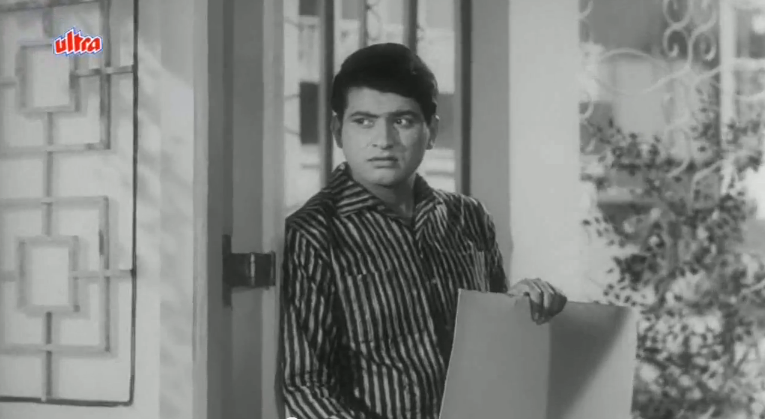
In a previous post, we have discussed how Woh Kaun Thi? is the quintessential example of film noir being adapted for vintage Hindi cinema.  In this film, Dr. Anand (Manoj Kumar) encounters a mysterious woman (Sadhana) on a stormy night and offers to give her a ride in his car. After she makes a strange request to be dropped off at a local cemetery, he hears this woman sing the first part of nainaa barse – a song that continues to haunt him at various points throughout the film. Later in the movie, Dr. Anand is called to see a patient in an old mansion that is rumored to be haunted. When he arrives at this mansion, the patient has already died and she appears to be the same woman that he encountered on the stormy night. In an even more strange turn of events, Dr. Anand’s fiancee is murdered suddenly by a cyanide injection. To alleviate his grief and loneliness, Dr. Anand is set up by his mother to his marry a new woman named Sandhya. Much to his surprise, Dr. Anand finds on his wedding night that his new wife looks exactly like the supposedly dead woman he gave a ride to in the film’s opening scene! Like Dr. Anand, the audience is left confused as they grapple with the film’s eponymous question: Woh kaun thi? Who was she?

Throughout her career, Lata Mangeshkar earned a reputation for her haunting renditions of ghost songs in films. Some of her most influential and beautiful hits are used as ghost songs in their respective movies: aayegaa aanevaalaa from Mahal (1949), tuu jahaa.n jahaa.n chalegaa from Mera Saaya (1966), kahii.n diip jale kahii.n dil from Bees Saal Baad (1962), and gumnaam hai koii from Gumnaam (1965). In an interview for her 80th birthday, the melody queen humorously remarks about her career: mai.n ne sab se zyaadaa gaanaa gaaye hai.n bhuuto.n ke (I have sung the most songs for ghosts!).

An interesting and apt anecdote: when this song was being filmed in Kufri (near Shimla), Lata had not yet had the opportunity to record the song in the studio. Much to the surprise of the crowd that had gathered to watch the filming, actress Sadhana shot her scenes by lip-syncing to a version of this song rendered by music director Madan Mohan himself – perhaps a bit creepy but also a rare treat!

Did you know that Woh Kaun Thi? was inspired by a British play called The Woman In White (1859) written by Wilkie Collins? Raj Khosla’s mentor Guru Dutt had attempted to create a film based on the same story a few years earlier in 1959. He abandoned this project entitled Raaz in which he was supposed to play the male lead while Waheeda Rehman played the female lead. Interestingly, this film was supposed to have been R.D. Burman’s debut as a solo music director.

-Mr. 55
MK

Manoj Kumar plays a confused doctor who is recurrently haunted by a mysterious woman and her song in Woh Kaun Thi? (1964)

Naina Barse Rimjhim Rimjhim (Version 1): Lyrics and Translation

nainaa barse rimjhim rimjhim
My eyes shed tears, drop by drop,
piyaa tore aavan kii aas
in hopes of your return, my beloved.
nainaa barse, barse, barse
My eyes shed tears.

yeh laakho.n gham, yeh tanhaayii
Thousands of sorrows and this solitiude
muhabbat kii yeh rusvaayii
are all part of love’s disgrace. 
kaTii aisii kaii raate.n
I have spent several such nights
na tum aaye na maut aayii
where neither you came to me, nor my death. 
yeh bi.ndiyaa kaa taaraa
The star of my beauty spot
jaise ho a.ngaaraa
burns brightly like an ember.
mahandii mere haatho.n kii udaas
Even the henna on my hands is sullen.

nainaa barse rimjhim rimjhim
My eyes shed tears, drop by drop,
piyaa tore aavan kii aas
in hopes of your return, my beloved.
nainaa barse, barse, barse
My eyes shed tears.

MK

Manoj Kumar’s restrained and understated performance falls short in comparison to Sadhana’s dynamic portrayal of the leading character in Woh Kaun Thi? (1964).  

Naina Barse Rimjhim Rimjhim (Version 2): Lyrics and Translation

nainaa barse rimjhim rimjhim
My eyes shed tears, drop by drop,
piyaa tore aavan kii aas
in hopes of your return, my beloved. 
nainaa barse, barse, barse
My eyes shed tears.

adhuuraa huu.n mai.n afsaanaa
I am an incomplete story. 
jo yaad aauu.n chale aanaa
When you remember me, come back to me. 
meraa jo haal hai tujh bin
The state that I am in without you, 
voh aa kar dekhte jaanaa
come to me and see it for yourself. 
bhiigii bhiigii palke.n
My eyelashes are moist, 
chham-chham aa.nsuu chhalke.n
as my tears drip, sounding like the jingle of an anklet.  
khoyii khoyii aa.nkhe.n hai.n udaas
My eyes are lost and sullen.

nainaa barse rimjhim rimjhim
My eyes shed tears, drop by drop,
piyaa tore aavan kii aas
in hopes of your return, my beloved. 
nainaa barse, barse, barse
My eyes shed tears.

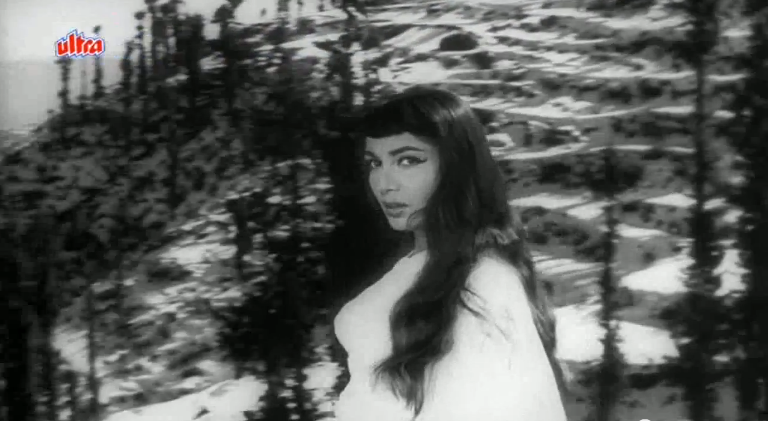
Sadhana

Sadhana’s dashing beauty shines against the backdrop of Shimla in the Himalayas in Woh Kaun Thi? (1964)

Naina Barse Rimjhim Rimjhim (Version 3): Lyrics and Translation

nainaa barse rimjhim rimjhim
My eyes shed tears, drop by drop,
piyaa tore aavan kii aas
in hopes of your return, my beloved.
nainaa barse, barse, barse
My eyes shed tears.

voh din merii nigaaho.n me.n
Those days remain in my eyes. 
voh yaade.n merii aaho.n me.n
Those memories remain in my sighs. 
yeh dil ab tak bhaTaktaa hai
This heart still wanders
terii ulfat kii raaho.n me.n
along the paths of your love. 
suunii suunii raahe.n, sahmii sahmii baahe.n
Along those empty paths, with my nervous arms, 
aan.kho.n me.n hai barso.n kii pyaas
my eyes carry a thirst unslaked for years.

nazar tujh bin machaltii hai
My sight wavers without you. 
muhabbat haath maltii hai
My love repents in desperation. 
chalaa aa mere parvaane
Please come to me, my moth. 
vafaa kii shamaa jaltii hai
The candle of faithfulness still burns brightly. 
o mere hamraahii, phirtii huu.n ghabraayii
Oh, my soulmate! I wander about afraid. 
jahaa.n bhii hai, aa jaa mere paas
Wherever you are, please come to me.

nainaa barse rimjhim rimjhim
My eyes shed tears, drop by drop,
piyaa tore aavan kii aas
in hopes of your return, my beloved. 
nainaa barse, barse, barse
My eyes shed tears.

Glossary

nainaa: eyes; barasnaa: to rain; rimjhim: onomatopoeia for the dripping noise of rain; aavan: return, arrival; aas: hope; adhuuraa: incomplete; afsaanaa: story; haal: state, condition; palak: eyelid, eyelash; chham-chham: onomatopoeia for the jingling noise of an anklet; chhalaknaa: to drip; udaas: sullen, gloomy; tanhaayii: solitude; rusvaayii: disgrace; maut: death; bi.ndiyaa: beauty spot; angaaraa: cinder, ember; mahandii: henna, nigaah: eyes; aah: sigh; sahmaa: nervous; baras: year; pyaas: thirst; nazar: glance, sight; machalnaa: to waver; haath malnaa: to repent; parvaanaa: moth; vafaa: faithfulness; shamaa: candle; hamraahii: soulmate, companion; phirnaa: to wander about; ghabraayaa: afraid.

Sadhana

     Those eyes! 

Aye Dil-E-Nadaan Lyrics and Translation: Let’s Learn Urdu-Hindi


As many of our readers may already be aware, today marks the 86th birthday of melody queen Lata Mangeshkar. In commemoration of this special day, we would like to present the lyrics and English translation to one of the most exquisitely beautiful songs sung by the Nightingale of India during her long and illustrious career: ai dil-e-naadaa.n from Razia Sultan (1983).

A

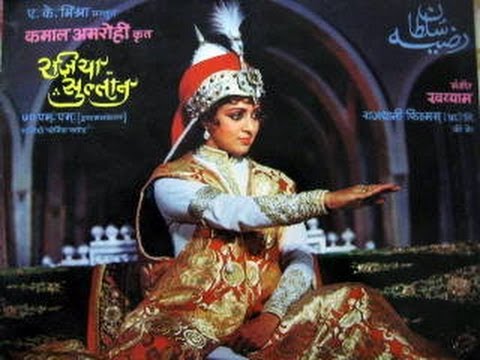
Hema Malini stars as a 13th century empress of Delhi in Razia Sultan (1983)

Directed by Kamal Amrohi (of Mahal and Pakeezah fame), Razia Sultan narrates the story of the only woman to ascend the throne of Delhi and her alleged love affair with Abyssinian slave-turned-warrior Jaml-ud-Din Yaqut. Hema Malini stars in the title role, while her real-life beau Dharmendra plays the role of her love interest Yaqut. When Sultan Altamash decides that his beloved daughter Razia shall be the successor to his throne instead of his trouble-making son Ferozshah, the kingdom erupts in an uproar over the possibility of being ruled by a woman. After her father’s passing, Razia proves herself to be a compassionate and brave ruler who leads with an eye toward justice like her late father. Over time, Razia is accepted as the first female emperor of the kingdom until gossip spreads among the royal court about an affair between Razia and her former slave Yaqut. Although Yaqut is now a free man and army commander, the relationship between him and the empress is highly scandalous due to his roots as a dark-skinned African slave. When this controversy reaches its peak, Razia must make a choice between her kingdom and her love. In the end, in true Bollywood style, Razia makes the ultimate sacrifice for her love.

Although this film had the potential to provide a compelling view on the complexities of race and gender politics, it fails to meet the mark in many respects and was unable to achieve commercial success at the time of its release. It is likely that the heavy-handed use of formal Urdu made it difficult for audiences to understand many parts of the film’s dialogue. The pace drags in many scenes, and the starring duo provide few memorable moments throughout the film. Those familiar with this period of history will also note that many liberties were taken to create a fictionalized narrative suitable for presentation in a Bollywood movie.

The aspect in which director Kamal Amrohi has shined, as he has done in his previous productions, is in the selection of the music for the film’s soundtrack. Khayyam’s sublime and minimalistic compositions come together with Jaan Nisar Akhtar’s reticent yet expressive poetry to create a memorable album that is probably the single most redeeming quality of Razia Sultan. The crowning jewel of this soundtrack is ai dil-e-nadaa.n rendered flawlessly by the inimitable Lata Mangeshkar. Her voice captures the mysticism and tranquility of the poetry with remarkable ease. Jaan Nisar Akhtar’s poetry is beautiful in its simplicity as it probes the nature of human desire and the inevitable suffering that it causes. No discussion of this song would be complete without mention of the santoor interludes interspersed with moments of silence, which provide gentle accompaniment to the serenity evoked by Akhtar’s words and Lata’s ethereal voice.

AA

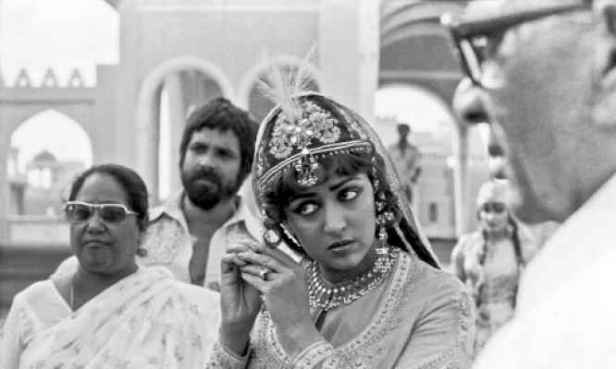
The elaborate costumes and sets used to shoot Razia Sultan (1983) make it one of the most expensive productions of its time. [Source]

A couple of anecdotes from key players involved in the making of this song to round out our discussion today:

Khayyam explains how he was inspired by the story of Razia Sultan during the composition of ai dil-e-naadaa.n: “

The caravan of Razia Sultan came to India from Turkey through a long and tortuous route traversing many countries. If you listen carefully, the tune and orchestration reflects the musical influences of all the regions she traveled across. The song is about the duel in her mind- the woman inside her is deeply in love with a black slave but the princess inside her is all too aware of her duty. The song depicts that dilemma in her mind. [Source]

Lata Mangeshkar has always ranked this song has one of the best of her career and included it in her An Era in An Evening concert that took place in Mumbai in March 1997 (see link above). In her own words, she says:

“Khayyam’s ai dil-e-naadaa.n from Razia Sultan is among the best songs I’ve sung. The way Kamal (Amrohi)-saab explained it to me,  I could actually visualise the situation. I was very satisfied by the way I rendered the number. Kamal-saab found my Urdu pronunciation clear and chaste. The lyrics of ai dil-e-naadaa.n written by Javed Akhtar’s father Jaan Nisar Akhtar, were inspiring. I have sung several songs written by him.” [Source]

Are you wondering why Lata’s voice sounds so heavenly in this song even though it was past its prime at the time of the film’s release in 1983? That’s because Khayyam had this song recorded by Lata nine years earlier in 1974. After just two rehearsals, she had recorded the entire song in one take! Khayyam recollects how the popularity of this song helped him be selected as the music director for other major films in the 1970s like Kabhie Kabhie (1976):

“Actually the reason, I got Kabhie Kabhie was the song ai dil-e-naadaa.n. For Razia Sultan, I had recorded Lata-ji’s ai dil-e-naadaa.n and also Qabban Mirza’s aayii zanjiir kii jhankaar as early as in 1974. ai dil-e-naadaa.n had then created such a stir that practically everyone in the film industry was talking about that song. That fame had reached to Yash Chopra and one evening, when I returned after a Razia Sultan sitting at Kamaalistan, I found Yash-ji and Sahir-saab waiting for me. They told me that they were making a film about a love-story of a poet and they wanted me as a composer. I immediately said, ‘Yes’.” [Source]

A

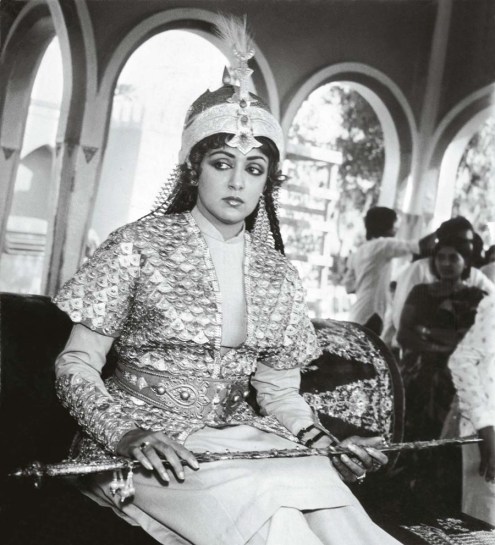
In spite of a solid portrayal of the lead character by Hema Malini, Razia Sultan (1983) failed to achieve success at the box office. [Source]

Aye Dil-E-Nadaan Lyrics and Translation:

ai dil-e-naadaan
Oh, my naive heart!
aarzuu kyaa hai? justujuu kyaa hai?
What do you desire? What do you seek?

ham bhaTakte hai.n, kyo.n bhaTakate hai.n dasht-o-sehraa me.n?
Why do I wander alone in this deserted wilderness?
aisaa lagtaa hai mauj pyaasii hai apne dariyaa me.n
It seems as if I am a wave thirsty for water in its own river.
kaisii uljhan hai? kyo.n yeh uljhan hai?
What is this turmoil? Why is there this turmoil?
ek saayaa-saa ruuh-ba-ruuh kyaa hai?
What is this shadow that stands face-to-face before me?

kyaa qayaamat hai! kyaa musiibat hai!
What a disaster! What misfortune!
keh nahii.n sakte kiskaa armaa.n hai
I am unable to say whom it is that I desire.
zindagii jaise khoyii-khoyii hai, hairaa.n-hairaa.n hai
It seems as if my life itself is lost and confused.
yeh zamii.n chup hai, aasmaa.n chup hai
The earth lies quietly, while the sky remains in silence.
phir yeh dhaDkan-sii chaar-suu kyaa hai?
Yet, what pulsates around me in every direction?

ai dil-e-nadaan aisii raaho.n me.n kitne kaa.nTe hai.n
Oh, my naive heart! There are many thorns along the path of love.
aarzuuo.n ne har kisii dil ko dard baa.nTe hai.n
The pursuit of desires has given pain to every heart.
kitne ghayal hai.n, kitne bismil hai.n
Many hearts are wounded; many hearts are sacrificed.
is khudaayii me.n ek tuu kyaa hai?
In the face of divinity, who are you alone?

ek tuu kyaa hai, ek tuu kyaa hai?
Who are you alone?
ai dil-e-naadaan, ai dil-e-nadaa.n
Oh, my naive heart!

Glossary:

naadaa.n: naive, foolish; aarzuu: desire; justujuu: search, pursuit; bhaTaknaa: to wander; dasht: desert; sehraa: wilderness; mauj: wave; pyaasii: thirsty; dariyaa: river; uljhan: turmoil, confusion; saayaa: shadow; ruuh-ba-ruuh: face-to-face; qayaamat: disaster, crisis, Day of Judgment: musiibat: misfortune; armaa.n: desire, hope; khoyii: lost; hairaa.n: confused, distressed; zamii.n: earth, land; chup: quiet, silent; aasmaa.n: sky; dhaDkan: pulse, heartbeat; chaar-suu: all around, in all four directions; raah: path; kaa.nTe: thorns; dard: pain; baa.nTnaa: to allocate, to distribute; ghayal: wounded; bismil: wounded, sacrificed; khudaayii: divinity, world.

The use of the word bismil adds a unique spiritual dimension to the lyrics of this song. Bismil means wounded or sacrificed and originates from the Islamic ritual of sacrificing animals as an offering while uttering bismillah (in the name of God).

-Mr. 55

Intimate scenes between Hema Malini and Parveen Babi (particularly during the song khvab ban kar koii aayegaa) sparked some controversy at the time of this film’s release. [Source]

Shokhiyon Mein Ghola Jaaye Lyrics and Translation: Let’s Learn Urdu-Hindi

Shokhiyon Mein Ghola Jaaye Waheeda and Dev Anand sugarcane

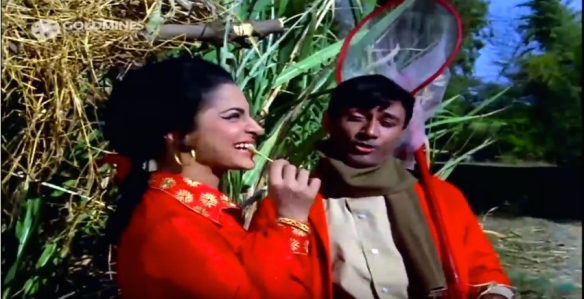
As Dev Anand croons “Shokhiyon Mein Ghola Jaaye” in Prem Pujari (1970), Waheeda Rehman makes even chomping raw sugarcane look attractive.

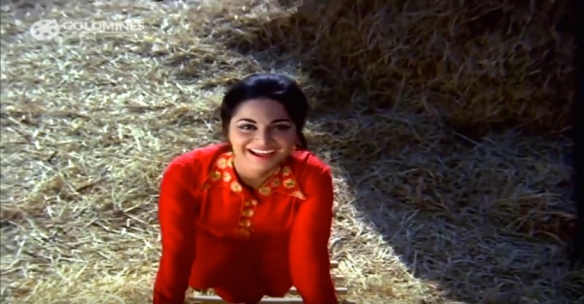
Today we present the lyrics and English translation of the evergreen duet “Shokhiyon Mein Ghola Jaaye” from Prem Pujari (1970). There could be no better song to welcome the change of seasons than this sweet exploration of the meaning of love…and of a haystack maze. Dev Anand plays a peace-loving son of a veteran who would rather be catching butterflies and whispering words of love to his fiancee, Waheeda Rehman, than holding a gun. However, when war breaks out, he is forced to reconcile his rosy temperament with patriotic duty, ultimately becoming a double spy for India at the expense of his family and loved ones.

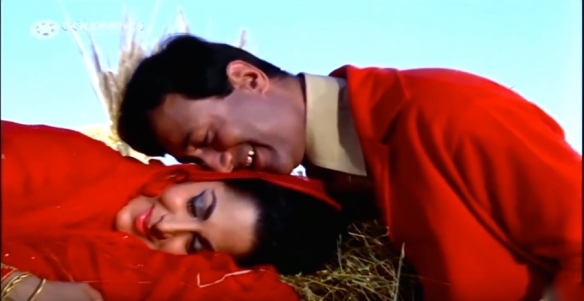
But before these complexities of the spirit arise, Waheeda Rehman and Dev Anand spend a few moments blissfully unaware of the perils ahead, playing hide-and-go-seek together like any fully-grown adults in love would do. Their delightful escapades among the haystacks are second only to the passionate Bollywood thrills of running around a tree. I’m a huge sucker for nature-themed flirtation in Hindi films. In “Shokhiyon Mein Ghola Jaaye,” the camera surges between haystacks on a dolly track like a sheep on the loose, anticipating every peekaboo moment of Dev Anand poking his head through the straw or tracing Waheeda’s bright red chunni across the hay to victory. And don’t miss the special moment as they are just about to kiss each other when the camera suddenly cuts to a completely random shot of a raging fire followed by a shot of a gushing water stream. Try to make sense of that adorably antagonistic symbolism, just try. Fortunately, S.D. Burman’s musical genius provides exactly the rip-roaring crescendo we needed to seam all the pieces together.

Gopal Das Neeraj’s poem was originally written as “Chandnii Mei.N Ghola Jaaye,” however Dev Anand wanted to picturize the song during daylight and hence the lyrics were changed. Lata Mangeshkar’s celestial voice is at such a peak in this song, it will make you question her divinity. Kishore Kumar balances her angelic vocals with manly aplomb, helping us gloss past the rough patches caused by Dev Anand’s crimson blazer and matching butterfly net.

Waheeda climbs up a haystack

Forgetting that sound travels, Waheeda Rehman sings while playfully climbing up a haystack to hide from her lover in Prem Pujari (1970).

Doesn’t this all just make you crave a pumpkin spice latte? We tragically don’t have sugarcane fields in my town, but I hope you enjoy our translation of this charming Autumn ballad and feel inspired to hit your nearest corn maze, apple orchard, or petting zoo with the one you love. Watch the video on youtube here and follow along with our lyrics and English translation below!

Shokhiyon Mein Ghola Jaaye Lyrics and Translation:

KISHORE: Shokhiyo.N mei.N gholaa jaaye, phoolo.N kaa shabaab
Take a swirl of mischievousness, and the youthfulness of flowers
Us mei.N phir milaaii jaaye thoDii sii sharaab
In those mix in a little bit of wine
Hogaa yuu.N nashaa jo taiyyaar
The intoxication you create like this
Haa.N , hogaa yuu.N nashaa jo taiyyaar, woh pyaar hai
Yes, the intoxication you create like this is love
Shokhiyo.N mei.N gholaa jaaye, phoolo.N kaa shabaab…

KISHORE: Hey hey, hey hey, hey hey, hey hey!

LATA: Ha.Nstaa huaa bachpan woh, bahakaa huaa mausam hai
It is a childhood of laughter, it is a deceptive atmosphere
ChheDo to ek sholaa hai, chhuu lo to bas shabnam hai
It teases you like an ember, but when it touches you, it feels like a dewdrop
Gaao.N mei.N, mele mei.N, raah mei.N, akele mei.N
Whether in a village or in a fair, whether upon a street or by yourself
Aataa jo yaad baar baar, woh pyaar hai
That memory that comes to you all the time is love
Shokhiyo.N mei.N gholaa jaaye, phoolo.N kaa shabaab…

LATA: Oh, la la, la la la, la la la, ah…

KISHORE: Rang mei.N pighale sonaa, ang se yuu.N ras chhalke
It is the color of liquid gold, nectar flows from its body
Jaise baje dhun koi raat mei.N halke halke
It is as if a melody is played softly at night
Dhuup mei.N, chhaao.N mei.N, jhuumtii hawaao.N mei.N
In the sunlight, in the shadows, in the playful winds
Har dam kare jo intezaar, woh pyaar hai
That which waits for you every moment is love
Shokhiyo.N mei.N gholaa jaaye, phoolo.N kaa shabaab…

KISHORE: Yaad agar woh aaye…
If you remember your love…
LATA: Oh, yaad agar woh aaye, aise kaTe tanhaaii
Oh, if you remember your love, then loneliness is eased
Suune sheher mei.N jaise bajne lage shahanaai
As if in an empty city, wedding music begins to play
KISHORE: Yaad agar woh aaye, aise kaTe tanahaai
If you remember your love, then loneliness is eased
Suune shahar mei.N jaise bajane lage shahanaai
As if in an empty city, wedding music begins to play
BOTH: Aanaa ho, jaanaa ho, jaisaa bhii zamaanaa ho
Whether you are coming or leaving, however the world may be
Utare kabhii naa jo khumaar, woh pyaar hai
That feeling of intoxication which never lifts is love

BOTH: Shokhiyo.N mei.N gholaa jaaye, phoolo.N kaa shabaab
Take a swirl of mischeviousness, and the youthfulness of flowers
Us mei.N phir milaaii jaaye thoDii sii sharaab
In those mix in a little bit of wine
KISHORE: Hogaa yuu.N nashaa jo taiyyaar
The intoxication you create like this
LATA: Woh pyaar hai
That is love
BOTH: Shokhiyo.N mei.N gholaa jaaye, phoolo.N kaa shabaab…

Glossary:

Shokh: mischievousness, prank; gholaa: solution, swirl; phool: flower, shabaab: youthfulness; thoDii sii: a little bit; sharaab: alcohol; nashaa: intoxication; taiyyaar: ready; ha.Nsnaa: to laugh; bachpan: childhood; bakahnaa: to deceive; mausam: season, atmosphere; chheDnaa: to tease; sholaa: ember; chhuunaa: to touch; shabnam: dewdrop; gaao.N: village; melaa: fair; raah: path; akelaa: alone; yaad: memory; baar baar: time to time, often; rang: color; phigalnaa: to flow, to liquify; sonaa: gold; ang: body; ras: nectar; dhun: tune, melody; raat: night; halkaa: soft; dhuup: sunlight: chaao.N: shadow, cloud; jhoomnaa: to swing; hawaa: wind; har dam: every moment; intezaar: wait; kaTnaa: to be cut; tanhaaii: loneliness; suunaa: lonely, empty; sheher: city; bajnaa: to play [an instrument]; shahanaaii: traditional wind instrument played at weddings; zamaanaa: world, earth; utarnaa: to lift, to raise; khumaar: state of intoxication

Waheeda and Dev anand cuddle

Perched on an excessively romantic pile of hay, Dev Anand presses his nose affectionately to Waheeda Rehman’s ear in Prem Pujari (1970). Is it getting hot in here, or is it just me?

This lovely duet was requested by fan Roshan Sadanani. Thank you for the excellent suggestion, and keep the requests coming! For more on-screen magic between Dev Anand and Waheeda Rehman, check out our translations of “Na Tum Humen Jano,” “Hai Apna Dil To Awaraa,” and “Khoya Khoya Chand!”

-Mrs. 55