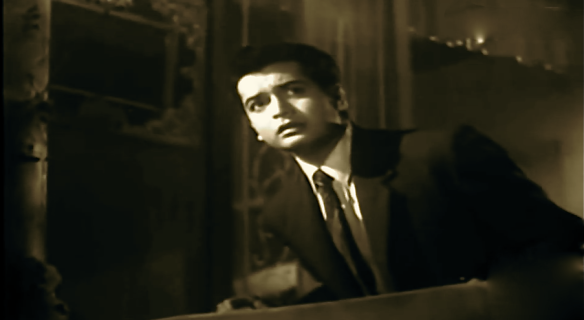
Biswajeet is haunted by a mysterious voice singing of love and murder in Bees Saal Baad (1962).
Happy Halloween!What better way to give yourself the creeps than with a vintage Hindi film song! Mr. 55 and I once hosted a Spooky Song-themed study break on-campus during which we projectedold Hindi film noirson a large screen, drank rooh afza and jammed nerdily to Lata’s high notes. Was it any surprise the two of us were the only ones really having an awesome time? Join us in our countdown to the spookiest song of classic Bollywood! When I say scary, I’m not referring toVinod Khanna’s lime green tuxedo in Aan Milo Sajna(although it might give you nightmares). I’m talking about the real deal here. These are songs that will keep you up at night, that will haunt your waking moments as you grapple with the symbolism. And if you see a mysterious woman in a white-sari floating around your house this evening…well, don’t say we didn’t warn you!
The Fifteen Scariest Songs from Old Hindi Films!
15. Tujhko Pukare Mera Pyar (Neel Kamal 1968)
Few things are scarier than being buried alive. Rajkumar haunts his Mughal-era lover through the ages even when she is reborn as a 1960s desperate housewife.
14. Gagan Jhanjhana Rah (Nastik 1954)
This song is a hidden gem. Hemant Kumar actually impersonates God in this song with a voice that booms from the heavens amidst a stormy apocalpyse. The chorus is so darn creepy in this song, you might feel real chills from the wind sound effects mixed into the song!
13. Waqt Ne Kiya (Kaaghaz Ke Phool 1957)
What makes this song so spooky and yet so beautiful? It’s all in the lighting and the spectres lingering in the room–read our translation for more!
12. Jayen To Jayen Kahan (Taxi Driver 1954)
In our translation of this all-time creeper, we discuss the emptiness of the song’s mis-en-scene to heighten a feeling of abandonment, leaving you nothing but Dev Anand’s perfect pompadour to ease the pain.
11. Akele Hain Chale Aao (Raaz 1967)
While the movie Raaz may be a clunk, “Akele Hain” (that is reprised in a male and female version!) will certainly leave you clawing after your security blanket. Insider hint: Rajesh Khanna takes his shirt off later on in the movie if you can sit through the rest of the film.
10. Raat Andheri (Aah 1953)
In this heartbreaking social drama, Raj Kapoor plays a handsome tuberculosis patient unable to marry the girl of his dreams because of his illness. In the throes of self-pity, the minor key music haunts him as his own life slips away. Tragic, yes, but mostly just creepy.
9. Sau Baar Janam Lenge (Ustadon Ke Ustad 1963)
Mohammed Rafi’s unearthly beautiful voice echoes through the mist in this song like a phantom from the other world. The woman in mourning seems ready to commit suicide at any moment during the song, keeping the audience on their toes!
8. Dekhi Zamane Ki Yaari (Kaaghaz Ke Phool 1957)
This gentle song of disillusioned love beckons you in like a tantalizing dream, and then drags you to perdition as you scream over the ethereal chorus. Our earlier translation of Dekhi Zamane discusses the transitions of the song from fantasy to absolute nightmare!
7. Koi Duur Se Aawaz De Chale Aao (Sahib Biwi Aur Ghulam 1962)
One of my favorite songs in this genre, Guru Dutt is awakened in the middle of the night by a tender lament floating through the halls of the large empty mansion in which he works. Who is this mysterious and sad woman with the enchanting song? You HAVE to watch this genius star-studded film and find out!
6. Jane Kahan Gaye Woh Din (Mera Naam Joker 1970)
Good thing I don’t have a fear of clowns or this song would have permanently wrecked my childhood. Raj Kapoor plays a circus performer who has lost all those he has ever loved. He enters a private Hell in which he is bound to perform in his clown garb to an unfeeling audience, always smiling on the outside and crying on the inside. Brace yourself for several attempts at artsy camera tricks to make him float that could not be more creepy.
5. Gumnaam Hai Koi (Gumnaam 1965)
Based on the Agatha Christie novel “And Then There Were None,” Gumnaam is a kitsch-lovers delight. Drop-dead gorgeous (literally) Lata Mangeshkar’s voice haunts a group of travelers as they meander through a nameless forest. Newsflash! The “ghost” of this song actually chimes in with a high-pitch thrill when the music goes quiet, so listen carefully!
4. Naina Barse (Woh Kaun Thi? 1964)
One of the best examples of a femme fatale in Hindi films, “Naina Barse” is sung by a ghostly woman haunting her lover from a former lifetime. Her flowing white sari against the endless, crisp white snow of a Simla winter set the perfect stage for a nightmare. The woman in a white sari is a classic cliche–read more about its meaning here!
3. Kahin Deep Jale Kahin Dil (Bees Saal Baad 1964)
This song hardly needs an introduction, so famous is its eerie tune. One of the most brilliant shots is the slow crane down from above the chandelier to Biswajeet’s horrified stare at the piano. But has anyone else ever noticed the film version has the interlude violins playing an entire octave lower than in the recorded version?? It totally blew my mind when watching the film–and both ways are equally horrifying!
2. Jhoom Jhoom Dhalti Raat (Kohra 1964)
Stylistic symbolism sets this creepster apart from its competitors. My favorite moment in this song is when the shadow figures do an interpretive dance in the sand, acting out the “choDo piyaa mera, choDo haath” line. I get chills every time I watch this–the cinematography is genuinely brilliant and haunting!
1. Aayega Aanewala (Mahal 1949)
Welcome to the spookiest song of Bollywood! Nothing will ever top the song that officially taught Bollywood everything it needed to know about horror. Don’t expect any corpses to pop out of the closet–this song is way to classy for that. See our translation of this unbeatable classic for more!
So…I know I’m not going to be able to sleep tonight. What are your favorite spooky songs from Bollywood films? Tell us the scenes that have haunted your waking hours for years (think Sadhana declaring “Mujhe khoon achha lagtaa hai” on a rainy night)! Mr. 55 and I both hope you have a very Happy Halloween!
– Mrs. 55
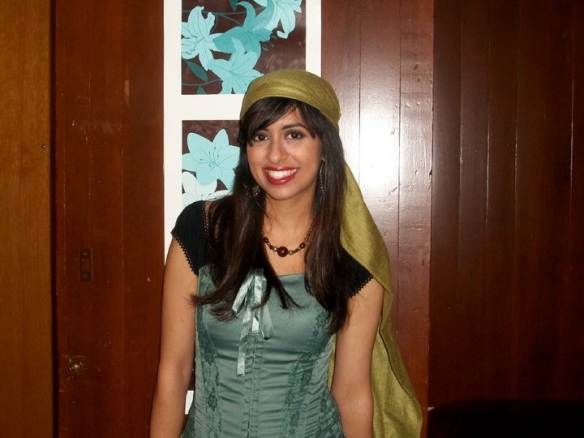
Mrs. 55 in her go-to gypsy girl costume. When all else fails…tie a chunni on your head.
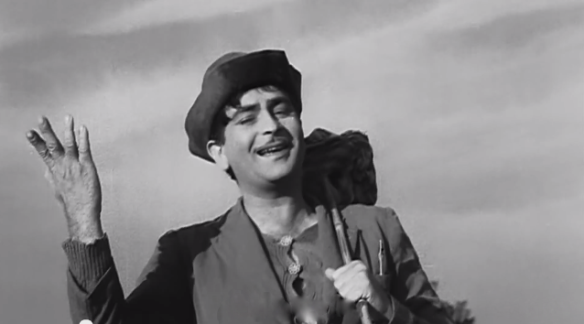
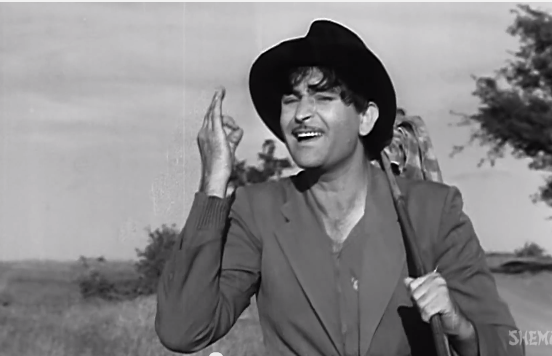
Raj Kapoor in his famous Charlie Chaplin incarnation from hit film Shree 420 (1955)
Today we showcase the lyrics and English translation of “Mera Joota Hai Japani” from Raj Kapoor’s Shree 420(1955) to mark the occasion of India’s Independence Day! Shree 420 is truly a landmark film in Hindi cinema starring a legendary showman who became known from Bombay to Bulgaria. To understand the film and the ramifications of the enormously popular song of patriotism, “Mera Joota Hai Japani,” we turn to the context of the nation’s not-so-distant past.
When India awakened to independence from British rule in the summer of 1947, the country faced many barriers to united prosperity under Prime Minister Jawaharlal Nehru’s integrated social programs. While the freedom for which it had fought for generations was now realized, the Partition divided the Northern boundary of the nation between Muslims and Hindus, bolstering a mutual fear and hatred that seeped into the many ethnically diverse major cities. There, in turn, a rapid industrialization ideologically distanced the surrounding villagers from the urbanites, and a booming economy further isolated and redefined the gentry and the working class. While the geographic and cultural bars of much of Southern India allowed for a lesser degree of revolution, the Northern states, especially in the metropolises like Bombay where Bollywood blossomed, underwent a dramatic change that was felt at some level by the majority of inhabitants. Some strove to achieve a balance between the traditions of old and the advantages of Westernization, others the romanticism of rural life versus modern city life, and as always, the penniless lower classes wished to close the widening economic gap between themselves and the teeming wealth of the industrialists. In this maze of contradictions and extremes, Nehru tried nobly to guide the nation into forming a unique identity of its own as it moved into the future.
Raj Kapoor famously reminds his audience that “Phir bhi dil hai Hindustani” in Shree 420 (1955).
The elaborate family dramas and mythologicals of pre-independence Bollywood, therefore, no longer completely satisfied the country’s cinematic needs. Raj Kapoor was among the major influential directors and actors that emerged in the early years of independence whose work changed the face of Indian film. With the surfacing of a new middle and lower class audience, he sought to restructure the accessibility and impact of Indian cinema. Raj Kapoor (whose self-proclaimed audience was the underdog and downtrodden) responded to the socio-economic tensions of Nehru’s India through highly stylistic proletariat films that glorified the virtuous poor. His Chaplin-esque comedic appeal and playful optimism made him an iconic figure domestically and across the Middle East and Soviet Union. As a director of many of the era’s greatest hits such as the classic comedy, Shree 420, he established in the 1950s what now seems to be the “formulaic” Bollywood film. His plots mingled wholesome entertainment with social tension, dramatic one-liners, catchy show tunes, and the invariable triumph of Indian purity in the poor over the decadent Westernized ways of the rich.
Shree 420 is the story of a young man, Raju, who wanders from the countryside to find opportunity in city society. With an innocent smile and optimism, he strolls down the street famously singing love for his homeland in “Mera Joota Hai Japani.” His humble cheerfulness and patriotic pride captures the spirit of Nehru’s hopes and ideals for the blooming nation of a newly independent India threatened by corruption. 420, the well-known number from which the film derives its title, is the Indian penal code for fraud and dishonesty, and foreshadows Raju’s discovery of the means to survive in “modern” society.
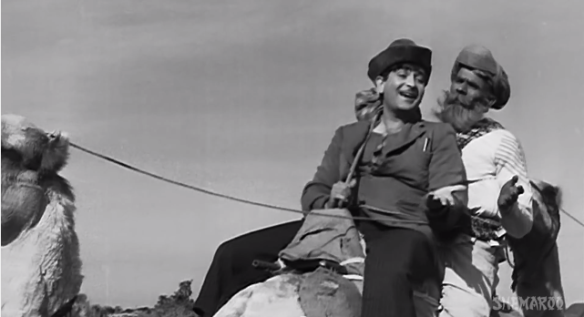
Raj Kapoor hops on a camel with an old guy who doesn’t seem to mind in Shree 420 (1955)
Shree 420 was a milestone production under the R.K. Studios banner that was among the first to be produced, directed, and acted in by Raj Kapoor himself. The son of a widely respected and extremely wealthy actor of the previous era, Prithviraj Kapoor, Raj Kapoor was nurtured in the film industry and had little difficulty in starting his own company with a very liberal amount of freedom. Formed in 1946, R.K. Studios went on to create some of the most successful films of Indian cinema. With lyrics by Shailendra and the soulful voice of Mukesh, we hope you enjoy our English translation of the lyrics to one of the thespian’s most beloved solos, “Mera Joota Hai Japani!”
Mera Joota Hai Japani Lyrics and Translation:
Meraa juuta hai Japaanii, yeh patluunEnglishtaanii My shoes are Japanese, these pants are British Sar pe laaltopiiRuusi, phir bhidil hai Hindustanii On my head is a red Russian hat, nonetheless my heart is Indian
Nikal paDe hai khuliisaDak par, apnaa seenaa taane I set out upon the wide open road confidently Manzil kahaa.N, kahaa.N ruknaa hai, uparwaalaa jaane Where is my destination, where must I stop, only God knows BaDhte jaaye.N hum sailaanii, jaise ek Dariyaatoofanii We advance forward relentlessly, as if a hurricane in a river Sar pe laal topi Ruusi phir bhi dil hai Hindustani On my head is a red Russian hat, nonetheless my heart is Indian Mera juuta hai Japaanii…
Uupar-niiche niiche-uupar, leher chale jeevan kii High to low, low to high, the waves of life flow Nadaa.N hai jo baiThekinaare, puuchhe raah watan kii Those who wait by the shore are naive, ask for the path toward the motherland Chalna jeevan kii kahaanii, rukna maut kii nishaanii Going is the story of life while stopping is a sign of death Sar pe laal topi Ruusi phir bhi dil hai Hindustani On my head is a red Russian hat, nonetheless my heart is Indian Mera juuta hai Japaanii…
Ho.Nge raaje rajkanwar ham bigaDe dil shehzaade I will become the prince of fallen hearts Ham singhaasan par jaa baithe.N jab jab kare.N iraade.N I will sit upon a throne whenever I desire Surat hai jaani-pehchaanii, duniyaa walo.N ko hairanii My face will become familiar, it will be a surprise to the world Sar pe laal topi Ruusi phir bhi dil hai Hindustani On my head is a red Russian hat, nonetheless my heart is Indian
Mera juuta hai Japaanii…
Glossary:
juuta: shoe; Japaanii: Japanese; patluun: pants; Englishtani: British; sar: head; laal: red; topii: hat; Ruusii: Russian; phir bhi: nonetheless; however; dil: heart; Hindustani: Indian; nikal paDnaa: to set out; khulii: open; saDak: road; seenaa taannaa: (literally) to puff out the chest with pride, confidently; manzil: destination; ruknaa: to stop; uparwaalaa: God, he who is above; sailaanii: relentlessly; Dariyaa: river; toofaan: hurricane; uupar: high; niiche: low; leher: wave; jeevan: life; nadaa.N: naive; foolish; baiThnaa: to sit; kinaaraa: shore; raah: path; watan: motherland; country; maut: death; nishaanii: sign, symbol; raajaa: king; rajkanwar: prince; bigaDnaa: to fall; shehzaadaa: prince; singhaasan: throne; iraadaa: desire; surat: face; jaan-pehchaan: familiar; hairaani: surprise
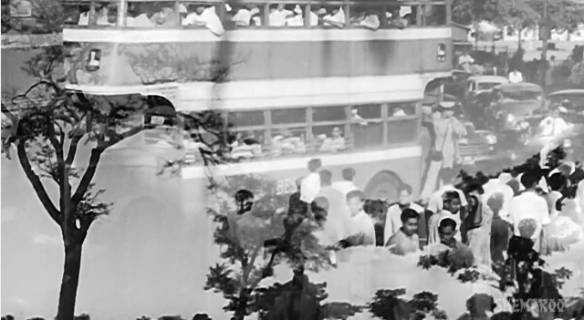
Raj Kapoor elegantly transitions with a cross-fade from rural India to a bustling city at the end of “Mera Joota Hai Japani.”
In the 1960s Raj Kapoor would drop his former image of the lovable proletariat and direct movies that resonated as family dramas of the wealthy, an increasing surrender to commercialism. The socio-political atmosphere of India had changed, and with it, the wants of the people. Movies that emphasized the difficulties of the developing period of the nation, or the unforgiving nature of that society were not the sell-outs they once were. The transition to a new era was over.
– Mrs. 55
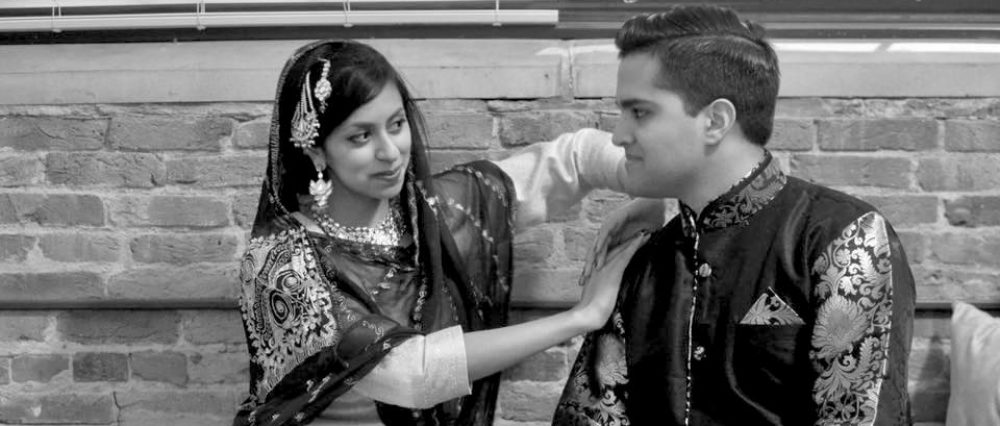
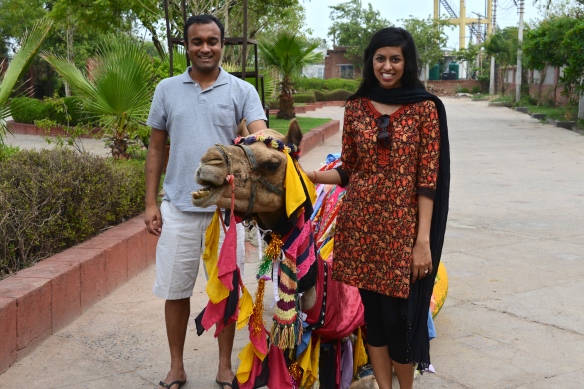
My fiance and I camel-spotting à la Raj Kapoor on our journey from New Delhi to Agra in a recent trip! Phir bhi dil hai Hindustani, as they say…
The top 30 greatest classic Bollywood films have been selected. Which films made the list of Bollywood’s best?
Introduction
Mr. and Mrs. 55 – Classic Bollywood Revisited! at last present our definitive list of the Bollywood classics you absolutely must see before you die. Hundreds of films were scored and ranked across multiple dimensions of Bollywood cinema including: story, direction, performances, musical composition, as well as cultural impact and legacy. We included Hindi-language films made between the period of 1949-1979 on our list of the best classic Bollywood filmsever made. Some on the list are beloved favorites of the industry, while others may surprise you.
Among the winners are directors Guru Dutt, Bimal Roy and Raj Kapoor–names synonymous with masterpiece Indian cinema–each with multiple films among Bollywood’s all-time greatest. Always wondered why a couple of young Harvard students like us love old Indian films so passionately? No matter what you think you know about Bollywood, the movies on this list will change your understanding of Indian films like never before. From village epics that grapple with our national identity to the nostalgic poetry of sudden disillusionment, classic Bollywood films transport us from the enchanting glamour of Bombay nightlife to the majestic gardens of Kashmir. They carry our souls through hardship and loss and revive our spirits with redemption.
This is cinema the way it was meant to be. This is classic Bollywood.
The top 30 Films from 30 years of classic Hindi cinema (1949-1979):
1. Pyaasa
Guru Dutt, 1957
Pyaasa, or “thirst,”is the story of one man’s search for compassion in the cold cynicism of post-independence Indian society. Vijay is an unpublished poet, dismissed by his own family and scorned by socialites and his colleagues. After befriending a prostitute who shelters him, Vijay is believed dead and his poetry “posthumously” lionized. He becomes an overnight sensation, mourned by fans across the country, and the true Vijay is labeled an imposter. India entered its golden age of filmmaking in the 1950s when its long-awaited freedom from England and the hopes of a new government created a social tinderbox of great expectations and disillusionment. Pioneering the technique of utilizing song lyrics as direct extensions of the film’s dialogue, Guru Dutt as the writer-producer-director-star paints a stirring portrait of the commodification of humanity.
2. Mughal-e-Azam
Karimuddin Asif, 1961
At the turn of the 17th century, Prince Salim falls in love with the court dancer Anarkali and wages war against his own father, Emperor Akbar, in order to marry her. Director K. Asif’s enormous cast, opulent sets, intricately designed costumes and extravagantly staged battle scenes made the film the most expensive ever produced in India at the time. But despite of all the grandeur, the film has a warm heart, and the dangers of the romance between Salim and Anarkali are infused into each glance they share. Although the love story is the backbone of the film, it is Emperor Akbar, from whom the film derives its name (“the Great Mughal”), who takes center stage as he is torn between love for his only son and the unforgiving demands of the Mughal Empire. Every line of dialogue is written with the ornamentation of poetry, casting an elegance to Mughal-e Azam‘s thunderous power.
3. Pakeezah
Kamal Amrohi, 1971
In the grandeur of Muslim Lucknow at the turn of the century, Pakeezah is a courtesan and dancer who dreams of leaving her life behind when a stranger falls in love with her in a train compartment, not knowing her true profession. With swirling romanticism and languid, dream-like cinematography, Pakeezah instantly became one of the most extraordinary musicals ever made. Perfectionist director Kamal Amrohi, who also wrote the script and some of the lyrics, effectively transports the viewer into a wistful age of bygone formality and luxury. Each of Pakeezah‘s popular semi-classical songs illustrates the duality of a courtesan’s poetry, at once glamorizing the elaborate rituals of love and destroying the institutions that upheld them.
4. Mother India
Mehboob Khan, 1957
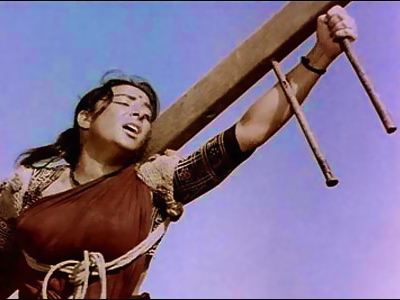
With tragedy strikes her family, newlywed village belle Radha is determined to weather a crucible of social and personal adversities without compromising her honor. In doing so, she reinvents herself as a heavy-handed symbol of India’s own pride as an ancient culture and a new democracy. A defining film in the history of Bollywood, director Mehboob Khan’s iconic Mother India set the pattern for the more than 60 years of Bollywood film that followed it. A mythologization of traditional values and an homage to the beauty of Indian heritage, Mother India‘s unabashedly epic glorification of self-sacrifice and female empowerment was nominated for the Academy Award for Best Foreign Film in 1958.
5. Guide
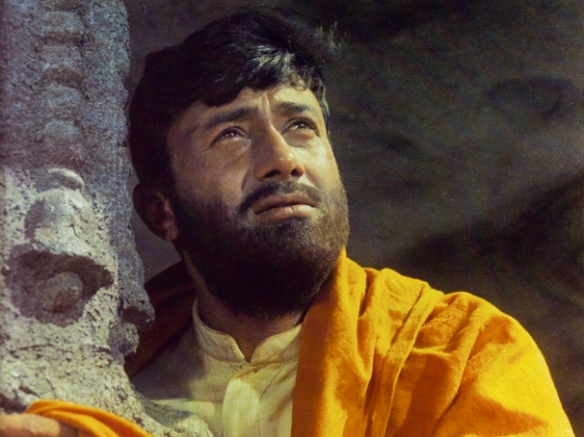
Vijay Anand, 1965
A corrupt businessman is transformed into a spiritual guide after a misunderstanding that leads to his idolization by a village besieged by drought. Based on the R.K. Narayan novel of the same name and bolstered by a stunning soundtrack, Guide explores a fundamental Vedic transformation from materialism to a release from worldly attachments in an extremely unlikely hero. A scandalous love story settles into the background as director Vijay Anand boldly deconstructs social taboos, from adultery and non-traditional gender roles to religious fraud, in a film that stirringly evolves into a philosophical awakening greater than the circumstances it portrays–a brilliant reflection of the double entendre intended by its title.
6. Kaaghaz Ke Phool
Guru Dutt, 1959
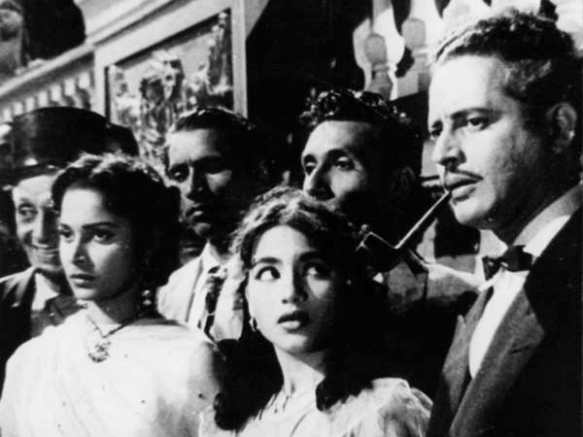
In the 1950s at the height of India’s golden age of film-making, a celebrated movie director feels uninspired by the tinsel-lined glitz of studio era Bollywood. When he discovers a new actress, innocent to the corruption of the industry, he believes he has found a muse to ease his restlessness. A elegiac behind-the-scenes film about film-making, Kaaghaz Ke Phool became a cult classic following the eerie semi-autobiographical death of its director Guru Dutt. Trapped in a world of pretense, Guru Dutt illustrates a kind of yearning that softly and slowly erodes the soul–a desperate hunt for a human connection. The real triumph is in the film’s stunning camerawork, gracefully gliding through the empty studio sets like a beautiful spectre of Dutt’s own shattered desires.
7. Awaara
Raj Kapoor, 1951
A female lawyer is determined to prove her lover’s innocence in a murder attempt on the life of a respected judge. Structured in medias res, the film’s flashback reveals the injustice of her lover’s past when the very judge who condemns him proves to be his own father: a man who threw his wife onto the streets when he believed a criminal had raped her. Echoing the dark lessons of the ancient Ramayana, Awaara shatters the nature versus nurture debate with a showman’s flair and surrealist fantasy, including the film’s legendary dream sequence evoking a descent into Hell. Awaara launched Raj Kapoor’s famous Chaplin-esque hero for the first time, who resonated immensely across the Soviet Union and Communist China as the voice of a new generation.
8. Sahib, Bibi, Aur Ghulam
Guru Dutt/Abrar Alvi, 1962
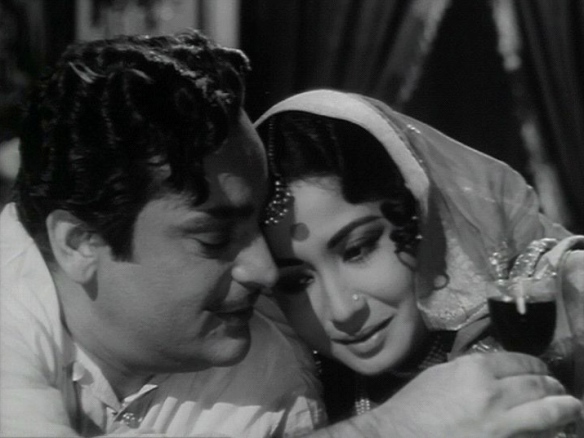
Desperate to save her marriage, the younger daughter-in-law of a wealthy family sacrifices her moral boundaries to win over her alcoholic husband. A nostalgic glimpse into the decaying Bengali feudal system, Sahib, Bibi, Aur Ghulam unravels a dazzling murder mystery at the heart of its progressive view of societal redemption. Seen from the perspective of a young factory worker lured into a stately mansion as an ally of its young mistress, Sahib, Bibi, Aur Ghulam hauntingly opens the doors to the hollowness of exterior splendor. Spiraling against her will with the collapse of Calcutta’s landed aristocracy, Meena Kumari’s portrayal of the tormented wife is forever considered among the most magnificent on-screen performances of Bollywood history.
9. Aradhana
Shakti Samanta, 1971
When her lover dies at war, an unwed mother gives up her son up for adoption, vowing to watch over him in secrecy as he grows up in the house of another. Her poignant worship, or aradhana, of her dead fiancé and their son became immortalized in the Indian cinematic psyche as an audacious struggle of traditional society confronted by changing modern values. Boasting one of the all-time greatest soundtracks of Indian cinema, Aradhana epitomizes the versatility and creativity of the era’s leading music directors. From the youthful romance of “Kora Kaagaz Tha” to the grim Bardic undertones of “Safal Hogi Teri Aradhana” to the notoriously seductive “Roop Tera Mastana,” the film is as much remembered for its luminous performances as for exemplifying the golden age of Bollywood music.
10. Do Bigha Zameen
Bimal Roy, 1953
A farming family fights to save their ancestral land from a cunning mill owner. Do Bigha Zameen follows the father and son’s trip to Calcutta from their idyllic village to earn enough money to pay their debts–only to discover the miseries of urban poverty instead. Inspired by the work of Italian neorealism, Do Bigha Zameen pioneered early parallel cinema with a deliberate attention to the “everyday,” and the feeling of an invisible, unhurried camera whose shots and mis-en-scene are both carefully constructed and effortlessly fluid. Directed by Bengali auteur Bimal Roy, the film’s nationalistic electricity hit a broader audience, becoming the first Indian film to win the Prix Internationale at the 1954 Cannes Film Festival.
11. Bandini
During the British Raj of the 1930s, a prison doctor falls in love with a convict who reveals the story of her tumultuous connection to a freedom fighter.
12. Madhumati
Bimal Roy, 1958
On a rainy night, a man enters an abandoned mansion where he is confronted by unfulfilled visions of his past life.
13. Shree 420
Raj Kapoor, 1955
A country boy travels to Bombay to make his fortune where he is lured from the path of virtue into a thrilling life of deceit.
14. Sholay
Ramesh Sippy, 1975
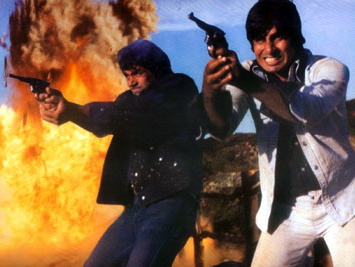
After his family is murdered by a notorious bandit, a former police officer enlists the help of two outlaws to capture him.
15. Ankur
Shyam Benegal, 1974
The social hierarchies of rural India are disrupted when a landowner begins an affair with a poor farmer’s wife.
16. Hum Dono
Amarjeet, Vijay Anand (1961)
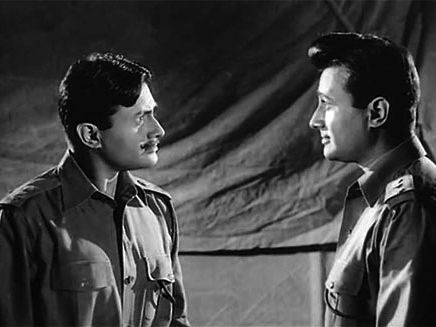
After returning from war, a soldier begins to lead a double-life when his doppelgänger’s family welcomes him home.
17. Barsaat (1949)
Raj Kapoor, 1949
Two men with different ideals of love search for answers with the coming of the monsoons.
18. Amar Akbar Anthony
Manmohan Desai, 1977
Three brothers are separated in childhood and eventually unite after one is brought up a Christian, one a Hindu, and one a Muslim.
19. Anand
Hrishikesh Mukherjee, 1971
A doctor recounts the story of a terminally ill man who wishes to his live life to the fullest and spread happiness to those around him.
20. Haqeeqat
Chetan Anand, 1964
A platoon of Indian soldiers leave their homes and loved ones to encounter the harsh realities of battle in the Indo-China War of 1962.
21. Don
Chandra Barot, 1978
A simpleton is trained to infiltrate the underworld by impersonating a criminal leader who has been killed in a police chase.
22. Mahal
Kamal Amrohi, 1949
A young lawyer is haunted by a ghostly woman in his new house, where the builder and his fiancée died shortly after it was built.
23. Sangam
Raj Kapoor, 1964
An Indian Air Force Officer leaves for the Kashmiri front, entrusting his wife to the care of his best friend who has secretly always loved her.
24. Dosti
Satyen Bose, 1964
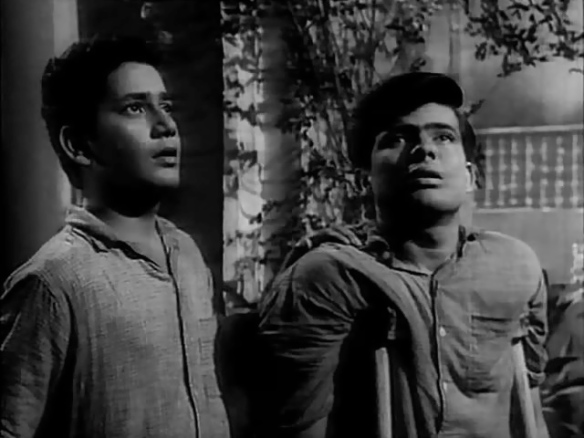
A penniless orphan makes the unexpected friendship of a blind boy who teaches him survival on the streets of Bombay.
25. Waqt
Yash Chopra, 1965
Natural disaster separates the members of a close-knit family who re-connect in a series of dramatic entanglements years later.
26. Deewar
Yash Chopra, 1975
A mother attempts to reunite her two estranged sons: one, a leading criminal of the underworld, and the other, an uprighteous policeman.
27. Kati Patang
Shakti Samanta, 1970
As a promise to raise the child of her dying friend, a young woman risks starting a new life under a false identity.
28. Aandhi
Gulzar, 1975
A powerful politician struggles to reconcile her position with secrets from her past.
29. Purab Aur Paschim
Manoj Kumar, 1970
East clashes with West when a traditional Indian student encounters swinging London society for the first time.
30. Bombai Ka Babu
Raj Khosla, 1960
A small-time thief is forced into a deadly web of deception when he gains the trust of his victim’s family.
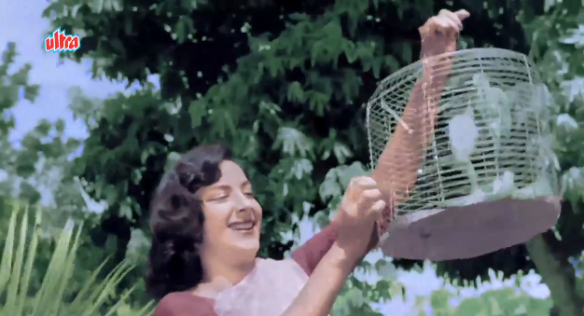
Nargis frees a bird from its cage in a symbolic representation of her unfettered joy in Chori Chori (1956)
I have some good news to share with our readers: I was recently accepted to my top-choice medical school and I will be matriculating there this fall! To celebrate this momentous occasion in my life, I am providing the lyrics and English translation to one of Bollywood’s most memorable feel-good numbers from Chori Chori (1956):panchhii banuu.n uDtii phiruu.n.
Adapted from Frank Capra’s It Happened One Night (1932), Chori Chori (1956) narrates the story of a wealthy socialite (played by Nargis) who flees her home when her father objects to her decision to marry a pilot with a reputation for womanizing and greed. En route to Bangalore, Nargis encounters Raj Kapoor, a journalist hoping to scoop this exciting story about an heiress on the run. Throughout the course of their journey, the initial bickering and animosity between Raj Kapoor and Nargis gradually transforms into love. This film’s most memorable asset is the on-screen chemistry shared by Raj Kapoor and Nargis, who were involved in a real-life affair that became the talk of the town in the Bollywood industry during this era.
Claudette Colbert and Clark Gable star in It Happened One Night (1932).
Placed into the context of the film, panchhii banuu.n uDtii phiruu.n sung by Lata Mangeshkar is picturized on Nargis as she basks in her newfound freedom after running away from home. Composed by Shankar-Jaikishan and penned by Hasrat Jaipuri, this song is inspired by a traditional Scottish standard called “Comin’ Thro’ the Rye.” In addition to its Western influences, Hindustani classical music buffs may also argue that this melody is based on the pentatonic Raga Bhupali. Indeed, the diversity of musical influences found in the Chori Chori soundtrack make this one of Shankar-Jaikishan’s most treasured scores. From classical (“rasik balma“) to folk (“man bhaavan ke ghar“) to Western (“aajaa sanam madhur chaa.ndnii“), the compositions in Chori Chori are remarkable for their technical quality and popular appeal. It is no surprise that Shankar-Jaikishan received a well-deserved Filmfare Award for this soundtrack in 1957.
The exuberant essence of panchii banuu.n uDtii phiruu.n is undeniable: its exaltation of life brings a smile to my face with every listen. As I celebrate my acceptance to medical school, I hope to continue pursuing my dreams in the future with this spirit of joie de vivre alwaysin mind. Until next time…
-Mr. 55
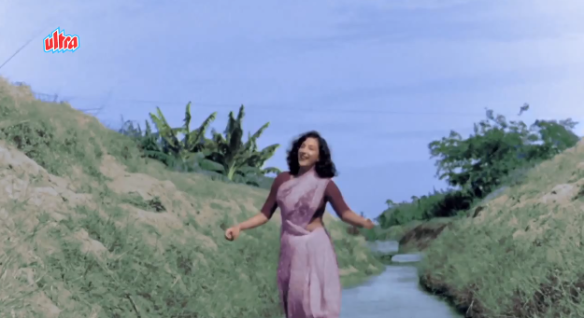
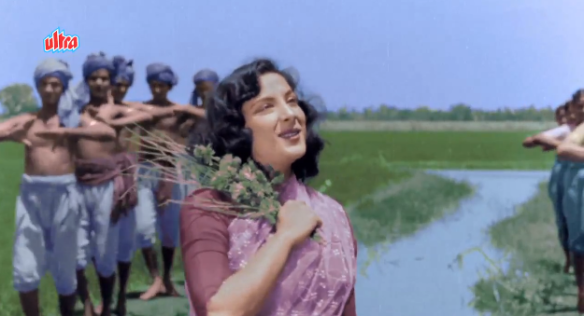
The rural landscape accentuates Nargis’s liberated state of mind in Chori Chori (1956).
Panchhi Banoon Udti Phiroon: Lyrics and Translation
panchhii banuu.n uDtii phiruu.n mastgagan me.n As a bird, I want to fly in the beautiful sky. aaj mai.n aazaad huu.n duniyaa ke chaman me.n Today, I have been liberated in the garden of the world.
(hillorii, hillorii)
mere jiivan me.n chamkaa saveraa The morning light has shined brightly in my life. miTaa dil se vah gham kaa andheraa It has removed the darkness of sorrow from my heart. harekheton me.n gaaye koii lahraa Someone sings, billowing in the green fields. yahaa.n dil par kisi kaa na pahraa Here, no one keeps guard over the heart. rang bahaaro.n ne bharaa mere jiivan me.n The Spring has filled my life with color. aaj mai.n aazaad huu.n duniyaa ke chaman me.n Today, I have been liberated in the garden of the world.
dil yah chaahe bahaaro.n se kheluu.n My heart desires that I play with the Spring. gorii nadiyaa ke dhaaro.n se kheluu.n I shall frolic in the currents of the fair river. chaand suuraj sitaaro.n se kheluu.n I shall play with the Moon, the Sun, and the stars. apnii baaho.n me.n aakaash le luu.n I shall embrace the sky in my arms. baDhtii chaluu.n gaatii chaluu.n apnii lagan me.n I shall forge ahead as I sing to my own tune. aaj mai.n aazaad huu.n duniyaa ke chaman me.n Today, I feel liberated in the garden of the world.
(hillorii, hillorii)
mai.n to oDhuu.ngii baadal kaa aa.nchal I shall wear a shawl of clouds. mai.n to pahnuu.ngi bijlii kii paayal I shall wear an anklet of lightning rods. chhiin luu.ngiighaTaao.n se kaajal I shall steal some kohl from the dark clouds. meraa jiivan hai nadiyaa kii halchal My life is like the movement of a river: dil se mere lahre.n uThe.n ThanDii pavan me.n waves arise from my heart in the cool breeze. aaj mai.n aazaad huu.n duniyaa ke chaman me.n Today, I have been liberated in the garden of the world.
panchhii banuu.n uDtii phiruu.n mast gagan me.n As a bird, I want to fly in the beautiful sky.
*Female lines in red are sung by Lata Mangeshkar. Male lines in green are sung by Manna De.
Glossary
panchhii: bird; mast: beautiful, incredible; gagan: sky; aazaad: liberated, free; chaman: garden; saveraa: morning; andheraa: darkness; haraa: green; khet: field; lahraanaa: to billow; pahraa: guard; rang bharnaa: to fill with color; goraa: fair; dhaar: current of a river; sitaaraa: star; aakaash: sky; baDhnaa: to advance, move forward; aa.nchal oDhnaa: to wear a shawl; pahnaa: to wear; bijlii: lightning; paayal: anklet; chiin lenaa: to steal; ghaTaa: dark cloud; kaajal: kohl; halchal: bustle, movement; lahar: wave; pavan: breeze, wind.
The color version of thissong released by UltraHindi offers modern vibrance to a timeless beauty.
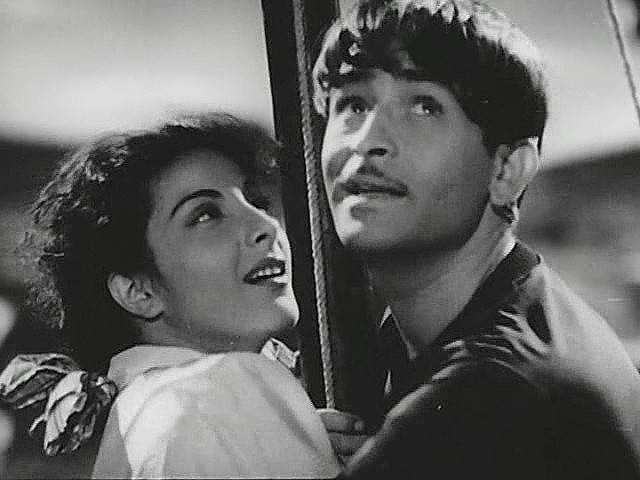
Raj Kapoor and Nargis huddle together on a love-boat in Awaara (1951).
Our next lyrics and English translation is of the great love duet “Dum Bhar Jo Udhar” from the film Awaara (1951). It’s practically impossible to not love this song. Raj Kapoor plays an underworld criminal who falls for the wealthy ward of a rich judge played by his favorite leading lady Nargis. The film launched both of their careers to mega-stardom and for good reason. Packed with musical gems like the evergreen “AwaaraHoon” or “Ghar Aaya Mera Pardesi,” the film is a scathing social drama that weaves Raj Kapoor’s own respectable father, Prithviraj Kapoor, into the heart of its scandalous and surprising twist. The film was so well-received and brilliantly made that it was nominated for a Grand Prize at the Cannes Film Festival in 1953! Propelled by a tempting bad-boy with a tragic past storyline, the film arguably contains the greatest performance of Raj Kapoor’s career. Awaara is a historical and artistic must-see!
“Dum Bhar Jo Udhar” is a Mukesh-Lata duet sung on a small boat in the middle of the night. Shailendra’s lyrics embody a theme common in Hindi films, which emphasizes the shyness of the woman and the boldness of the man. Both man and woman address the only other witness to their tryst–the beautiful moon above. However, the woman begs the moon to look away and not make her feel shy, while the man eagerly urges the moon to shine upon him and witness their love blossom. The importance of moon imagery in Urdu-Hindi poetry is legendary–most often taking the form of a feminine metaphor that epitomizes beauty. In this case, however, the playful moon evokes the male gaze as a trusty ally to the hero and a source of embarrassment to the heroine. It’s so adorable I could squirm.
The eternally lovely Nargis glows in the moonlight in Awaara (1951).
Here are the full lyrics and English translation to “Dum Bhar jo Udhar” from Awaara (1951). Enjoy our interpretation of the song’s meaning and follow along on youtube with this link!
Dam Bhar Jo Udhar Lyrics and Translation
Lata:
Dam bhar jo udharmuu.Nphere, O Chandaa
O Moon, if you would turn your face away for one moment Mai.N unse pyaar kar luu.Ngii
I will make love to him Baate.N hazaar kar luu.Ngii
I will say a thousand things to him
Dil kartaa hai pyaar ke sajade
My heart has prayed for such love Aur mai.N bhii unke saath
And now I am with him Chaand ko chandaa roz hii dekhe
The moon sees moonlight every day Merii pehlii raat, ho, merii pehlii raat
But this is my first night, oh, this is my first night! Baadal mei.N ab chhup jaa re! O Chandaa
Now go hide in the clouds, O Moon! Mai.N unse pyaar kar luu.Ngii
For I will make love to him Baate.N hazaar kar luu.Ngii
I will say a thousand things to him
Mukesh:
Dam bhar jo idhar muu.N phere, O Chandaa
O Moon, if you would turn your face here for one moment Mai.N unse pyaar kar luu.Ngaa
I will make love to her Nazare.N do-chaar kar luu.Ngaa
I will steal a few glances from her
Mai.N chor hoo.N kaam hai chorii
I am a thief, and my job is to steal Duniyaa mei.N hoo.N badnaam
I am dishonored in society Dil ko churaataa aayaa hoo.N mai.N
I have come to steal your heart Yehii meraa kaam, ho, yehii meraa kaam
This alone is my job Aanaa tuu gavaahi dene, O Chandaa
You must come and be a witness, O Moon Mai.N unse pyaar kar luu.Ngaa
For I will make love to her Nazare.N do chaar kar luu.Ngaa
I will steal a few glances from her
Lata:
Dil ko churaake kho mat jaanaa
Do not steal my heart and then become lost Raah na jaanaa bhool
Do not forget your way back to me In qadmo.n se kuchal na denaa
Do not crush with your footsteps Mere dil kaa phool, ho, mere dil kaa phool
The flower of my heart, oh, the flower of my heart! Yeh baat unhe.N samjhaa de, O Chanda
You make him understand this, O Moon Mai.N unse pyaar kar luu.Ngii
I will make love to him Baate.N hazaar kar luu.Ngii
I will say a thousand things to him
Glossary:
dam bhar: one full moment; udhar: in that direction; muu.N: face; pherna: to turn; hazaar: a thousand; pehlii; first; baadal: clouds; idhar: in this direction, here; do-chaar: a few; badnaam: a person of ill-repute; gavaahi denaa: to serve as witness; raah: path, way; qadam: footsteps; kuchal dena: to crush; phool: flower; samjhaa denaa: to make [someone] understand
Now before anyone gets their knickers in a twist, let’s just talk briefly about the phrase “Mai.N unse pyaar kar luu.Ngii” and what that really means. I have translated it somewhat literally for simplicity’s sake as “I will make love to him,” but that phrase in English carries with it more physical connotations than what it means in this context. Although the verb “pyaar karna” means simply “to love” as in the general English sense, the way it is used in this song carries a more immediate sense of both action and personal gain–by adding the coloring verb “lena” (“to take”), the phrase now implies that the girl is about to do something for her own benefit. We can safely say that these lyrics are not a prelude to actual Victorian “love-making” on that rocky boat of theirs, but rather an expression of desire and courtship. When she says, “Mai.N unse pyaar kar luu.Ngii,” I argue that this means no more than whispering sweet nothings, holding hands, stealing glances, and other forms of expressing tenderness and passion short of actually “making love.” See my point? And don’t let Nargis’ pole dancing throw you off.
Yeah, no seriously I wasn’t kidding. Nargis takes the phrase “pole-dance” to a whole new level in Awaara (1951).
You know what’s really great about this movie? The fact that ages before women were given anything close to social equality, Nargis plays a powerful lawyer who ends up bringing justice to her lover Raj Kapoor. She stands strong in a court filled with men, and really makes us all proud. Granted, she’s really rich and let’s Raj Kapoor SLAP her in a different scene (kill me now), but we can appreciate what she stood for at least in that regard. It’s one of the best courtroom scenes of the industry! This song was requested by die-hard fan lalten–hope you enjoyed!





 Mr. & Mrs. 55 - Classic Bollywood Revisited!