The Glorification of Alcohol in Hindi Cinema

A study released in April of this year claimed that Indian adolescents aged 12-16 exposed to alcohol consumption in films were nearly three times more likely to drink than their peers who did not watch Bollywood movies. While this study most likely pertains to the movies released in the industry today, I would venture to say that the origins of this trend can be traced back to films from the Golden Era of Bollywood cinema. Indeed, the consumption of alcohol has been glorified on India’s silver screen for decades, especially through portrayal of sharaab (alcohol) songs in films. Here, I’ve compiled a list of my five favorite male and female sharaab numbers from the Golden Era–let’s take a closer look at these examples to examine how the consumption of alcohol has been portrayed cinematically and its implications on Indian culture.

“Girls Just Want To Have Fun”

In Bollywood’s earliest days, drinking alcohol in films was portrayed as a strictly masculine activity, à la Devdas and other Bollywood heroes who have famously drowned their sorrows in liquor. In contrast, the idealized image of the traditional Indian woman did not permit the depiction of female alcohol consumption in the media.  This trend began to change in the 60s when films depicted heroines and female actresses playing roles in which they partook in the consumption of the Devil’s nectar, just like their male counterparts. As you can see below, the contexts in which female characters drink vary from film to film: alcohol has been used by the women of Bollywood as a coping mechanism, a means of revenge, or just a way to have a good time.

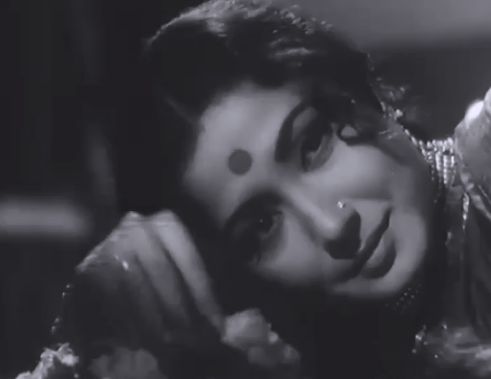
na jaao saiyaa.n (Sahib Bibi aur Ghulam, 1962): In this film based on a Bengali novel by Bimal Mitra, Meena Kumari gives one of her career’s best performances as Chhoti Bahu. Chhoti Bahu is married to young zamii.ndar (played by Rehman), who neglects his wife at home in order to take part in debauchery at local brothels on a nightly basis. In desperate need of her unfaithful husband’s companionship, she decides to take up drinking in order to keep him away from those pesky courtesans at night. In this heartbreaking song sung by Geeta Dutt, Chhoti Bahu drunkenly entreats her husband to stay at home and spend the night with her. In a truly unfortunate example of art mimicing real life, both Geeta and Meena would succumb to alcoholism as a way to cope with their unhappy marriages in the coming years. For those of you who enjoy this song, be sure to check out Hemant Kumar’s Bengali version of the same tune: “olir katha shune.

Meena Kumari, as Chhoti Bahu, tragically turns to alcoholism in Sahib Bibi aur Ghulam (1962).

piike hum tum jo chale aaye hai.n (Gumnaam, 1965): This film (reviewed by us here) is a suspense thriller loosely based on the Agatha Christie novel And Then There Were None. The story revolves around seven vacationers who find themselves on a remote island in the middle of nowhere after a plane crash. One by one, they are murdered off and the big question is, of course: whodunnit? In the midst of all this tension, two of the vacationers, Miss Kitty (played by Helen) and Asha (played by Nanda), decide to loosen up and have some fun with a few drinks. In this comical duet sung by Asha Bhonsle and Usha Mangeshkar, the two actresses appear to be having the time of their lives in a drunken stupor on screen. I mean, who wouldn’t be having a good time if they were getting drunk with Helen?
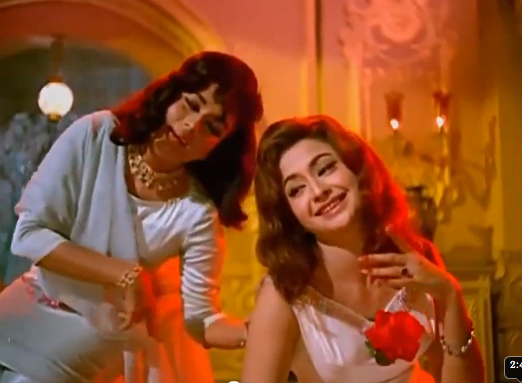
Helen and Nanda get sloppy together in Gumnaam (1965). If you excuse the stumbling, Helen actually looks quite sophisticated in this scene because she’s not wearing one of her characteristically outrageous wigs/outfits.

aao huzuur tum ko (Kismat, 1968): This Asha-OP Nayyar collaboration is an all-time classic from the soundtrack of Kismat (along with “kajraa muhabbatvaalaa“). The film’s narrative is so outrageous that it’s not even worth summarizing here, but this song is picturized on the actress Babita, who is the mother of Karisma and Kareena Kapoor. Babita never managed to gain much success as a heroine, and that’s not surprising given that it’s unclear whether she is drunk or undergoing eplipetic fits in this particular scene. She certainly does make a statement though and manages to embarass the hero Biswajeet with her public intoxication at this party. Regardless of the picturization, Asha Bhonsle adds all the right expressions here to make this an unforgettable sharaab number on the basis of the song alone. Her vocal control in the extended introduction (“ham se raushan hai chaa.nd aur taare...”) before the song’s first stanza is especially commendable. 

Babita has probably had one too many in this scene from Kismat (1968)

kaise rahuu.n chup (Inteqaam, 1969): Inteqaam is an entertaining (but occaisionally illogical) thriller that stars Sadhana as a woman who seeks revenge against her former boss because he framed her for a theft that she did not commit. As part of her elaborate plan for revenge, she intends to marry her boss’s son (played by Sanjay Khan) and bring shame to his entire family by revealing that the new bahu is, in fact, a convicted criminal! In this song, Sadhana further embarasses her boss’s family by  acting extremely intoxicated under the influence of alcohol at a public gathering. (Technically, this might not be considered a genuine sharaab song because Sadhana is putting on a facade of being drunk without actually consuming, but I liked this song too much to pass up putting it on the list.) This soundtrack composed by Laxmikant-Pyarelal is particularly memorable today because it casts a different light on Lata Mangeshkar, who was considered to be staunchly conservative and traditional in her playback output.  Lata surprises us all by agreeing to sing two sizzling cabaret numbers in addition to this drinking song for the film–listen to her nail those hiccups during the interludes!
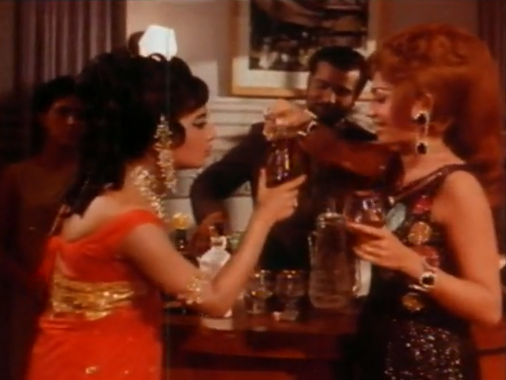
Helen serves Sadhana another glass in Inteqaam (1969)

piyaa tuu ab to aajaa (Caravan, 1971): Asha Bhonsle and R.D. Burman come together to produce one of their biggest musical hits together with this classic item number from Caravan. Asha’s performance here solidified her status as the queen of cabaret singing in Hindi cinema. Furthermore, Helen’s portrayal of a nightclub dancer on screen during this song is considered the quintessential Bollywood cabaret performance. Helen’s dance moves are completely outrageous here but she makes it work somehow (see Mrs. 55’s step-by-step breakdown here). Given the ridiculousness of the situation here, you can’t really blame Helen for the heavy drinking…it certainly doesn’t stop her from completely owning the stage during her performance!

Helen gives one of the best cabaret performances of her career in Caravan (1971)

“Alcohol May Be Man’s Worst Enemy…”

Unlike their female counterparts, the men of Bollywood cinema have been imbibing alcohol since the industry’s earliest days. The most popular context for male drinking in Hindi films occurs when the hero resigns himself to heavy drinking in order to drown his sorrows, usually caused by woman-related heartbreak. While female characters are often stigmatized for their drinking and public intoxication, it is more acceptable for men of the silver screen to use alcohol consumption to deal with their grief.  Other contexts where actors are depicted consuming alcohol include scenes of male-male bonding (bromances, anyone?) and seduction of heroines and courtesans. Though Bollywood has glamorized the consumption of alcohol for both genders, the effect is far more pronounced for males, as evident in the examples I’ve selected below.

mujhe duniyaavaalo sharaabii na samjho (Leader, 1964): Even though its soundtrack is full of gems like “tere husn kii kyaa tariif karuu.n” and “ek shahanshah ne banvaa ke ek hasii.n taaj mahal,” Leader is one mess of a film starring Dilip Kumar and Vijayantimala. Dilip Kumar stars as a law graduate and aspiring political revolutionary who falls in love with a princess (played by Vijyantimala). The script has so many holes that it’s difficult to discern the overall message of this film, but there are some scenes of comic relief between Vijayantimala and Dilip Kumar that are worth remembering. By far, however, the main attraction here is the soundtrack composed by Naushad. In this particular number, an intoxicated Dilip Kumar claims that he has been forced to take up drinking to grapple with society’s evils.

Vijayntimala tries to stop a drunk Dilip Kumar from embarassing himself too much at this party in Leader (1964).

din Dhal jaaye (Guide, 1965): Where do I even begin with the praise for Vijay Anand’s Guide? Mrs. 55 and I both love everything about this film: the unique story written by R.K. Narayan, the stellar performances by Dev Anand and Waheeda Rehman, and of course, the unforgettable soundtrack composed by S.D. Burman. Each and every song from this film is an absolute gem. In this particular Rafi solo picturized on Dev Anand, the hero drowns his sorrows about lost love in alcohol. The melancholic expression that pervades throughout this scene is enhanced by the beautifully crafted lyrics and tune.
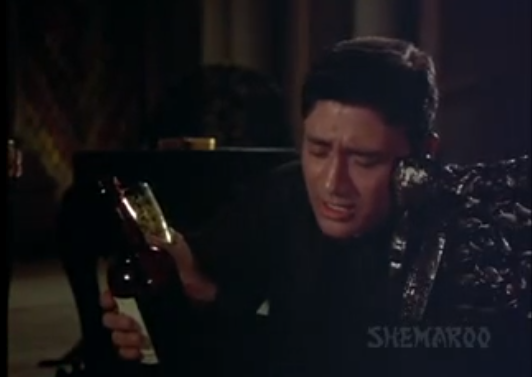
Dev Anand turns to the bottle when love goes sour in Guide (1965).

chuu lene do naazuk ho.nTho.n ko (Kaajal, 1965): With this Rafi number penned by Sahir Ludhianvi and composed by Ravi, Raaj Kumar tries to get Meena Kumari, his on-screen shaadi-shudhaa (virtuous) wife, to come to the dark side by having a drink. Alcohol glorification occurs is at its finest in these lyrics: it is referred to as “mubarak cheez,” or a blessed thing.  Meena Kumari excels, as usual, at looking incredibly uncomfortable and disturbed by Raaj Kumar’s advances in this scene.

A drunk Raaj Kumar tries to get Meena Kumari on his team in Kaajal (1965).

jo unkii tamanna hai barbad ho jaa (Inteqaam, 1969): This film certainly features a lot of alcohol consumption on screen. In addition to the drunk Lata number discussed above, this Rafi solo from Inteqaam is picturized on Sanjay Khan as he laments being a mere object in Sadhana’s plans for revenge. Rajinder Krishan’s lyrics are exquisite in their ability to capture the essence of being deceived in love.
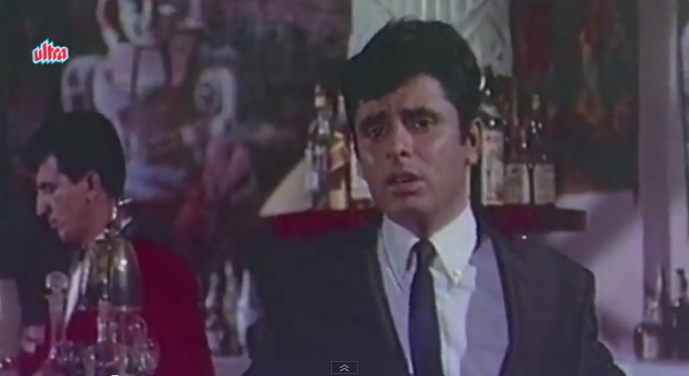
Handsome Sanjay Khan turns to alcohol to get over Sadhana’s deception in Inteqaam (1969)

yeh jo muhabbat hai (Kati Patang, 1970): Directed by Shakti Samanta, this film features an evergreen soundtrack composed by R.D. Burman. This particular number sung by Kishore Kumar is one of Bollywood’s most treasured drinking songs, and it features a handsome and bitter Rajesh Khanna drinking the night away because he was stood up at the altar by his wife-to-be.  Asha Parekh watches from a distance, not yet aware of the fact that she is the woman responsible for his heartache.
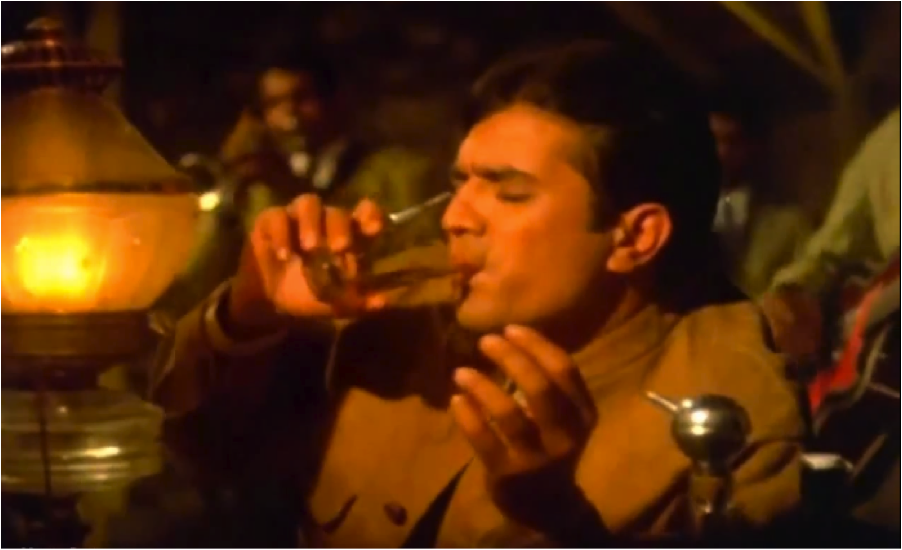
Rajesh Khanna drinks another glass of liquid courage before singing about the pain of disloyal love in Kati Patang (1970).

What are some of your favorite sharaab/daaru songs from Bollywood films? Let us know in the comments! We’ll understand if your typing is a little bit off…
Mr. 55

Roop Tera Mastana Lyrics and Translation: Let’s Learn Urdu-Hindi

Rajesh Khanna Sharmila Tagore HOT Aradhana

Rajesh Khanna and Sharmila Tagore get too close for comfort in “Roop Tera Mastana” from Aradhana (1969)

Our next post brings you the full lyrics and English translation of the all-time hit “Roop Tera Mastana” from Aradhana (1969). The film stars one of Bollywood’s favorite on-screen couple: the dashing Rajesh Khanna and the elegant Sharmila Tagore. Now this song gets a little racy, so for everyone who isn’t sure they can handle it, please direct yourselves to our G-rated posts (see Rabindranath Tagore’s Influence on S.D. Burman) at this time. Everyone else, grab a seat and a drink of water because it’s about to get a little hot in here.

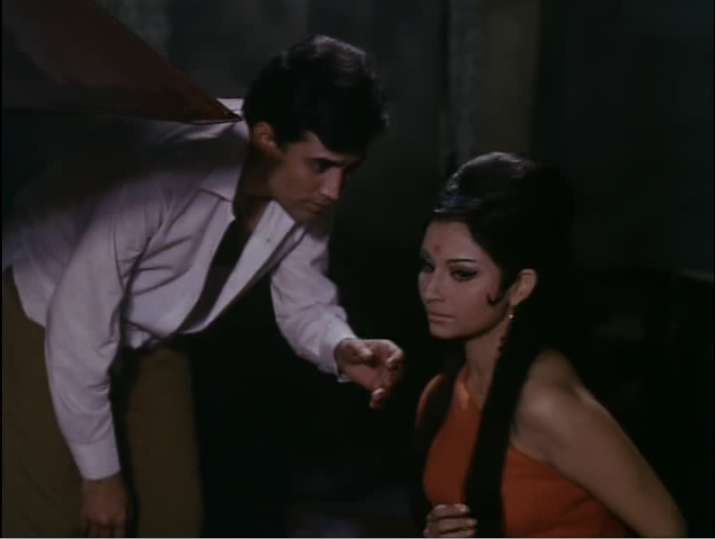
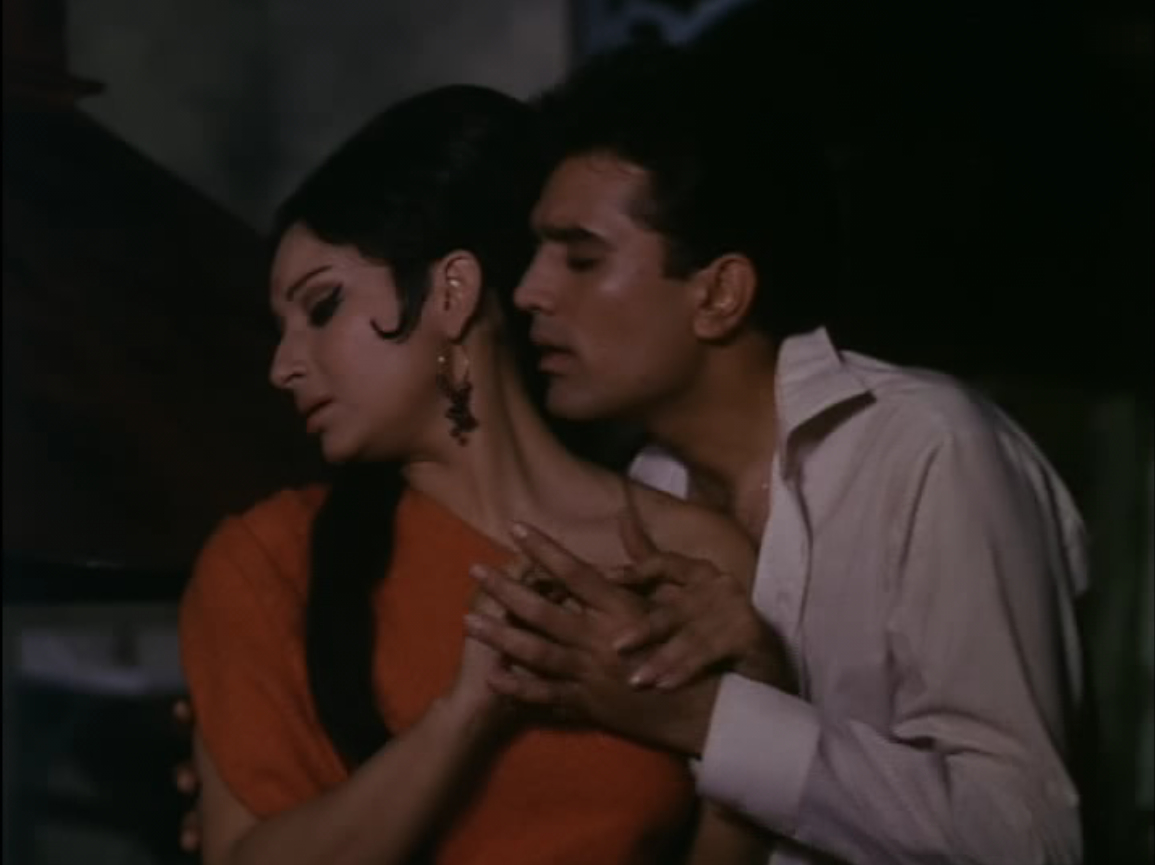
One of the things I love most about “Roop Tera Mastana” is the cinematography (check out the youtube link here!). The entire song (roughly 4 minutes) is shot in a single long take! The camera swirls around the fire following Rajesh Khanna making his moves on Sharmila, without ONCE cutting for an insert or change in camera angle.

For this to succeed, not only do both the actor and actress need to know exactly where to start and stop with every movement they make during the sequence (any small shift could result in a loss of camera focus), but there is an elaborate dolly track for the camera also laid out all around the floor that they have to be careful not to trip on as they move. And every time the dolly men, the grip guy, the pull-focus team, or heaven-forbid the actors screw up in the 4 minutes you need per take, you start all over again, lose valuable film stock, and probably get a public slap in the face. Check stills from this sequence below!

Rajesh Khanna Sharmila Tagore2

Rajesh Khanna swoops in for the kill.

Rajesh Khanna Sharmila Tagore3

Sharmila Tagore senses danger and edges away.

Oh, awkward–Sharmila and Rajesh bump into each other unexpectedly.

Sharmila: To give in or not to give in??!

Rajesh Khanna rushes in from the other side.

Well…maybe this idea isn’t so bad after all…

Sharmila gets so on board, she starts to be a little aggressive.

Things are just getting out of control now with Rajesh and Sharmila.

Gorgeous Rajesh Khanna is abandoned, bursting with chest hair.

Gotcha! Just when you thought you thought you had given him the slip.

It’s super tense in that room, and I’m not just talking about Sharmila’s sternocleidomastoids.

In the film Aradhana (1969), Sharmila Tagore and Rajesh Khanna have both just come from getting secretly married in a private temple ceremony. They happen upon a shelter lodge, and obviously consummating the marriage is all over Rajesh Khanna’s mind.

Interestingly, the camera itself becomes complicit in the scene. Like the actors themselves, the camera too encircles the fire as if echoing the hallowed rites of Hindu marriage, the saath phere (or seven circles), that give sanctity to their union. It is as if the audience is now the testifying witness of the validity of their marriage, and the camera hesitates–sometimes pausing, sometimes rushing just like the whirlwind of conflicting emotions in the scene. It is extremely symbolic and by eliminating all cutting, the long take seems to slow time down as we grasp the moral and social complexities of this moment, as well as build the tension of what is imminent. Enjoy our English translation of the lyrics of this all-time classic and let us know your opinions in the comments!

Roop Tera Mastana Lyrics and Translation

Roop tera mastana pyaar mera diwaanaa
Your beauty is intoxicating, my love is crazy
Bhool koi humse na ho jaaye
Let me not commit a wrong

Raat nasheelii mast samaa hai
The night is lush, the atmosphere is intoxicating
Aaj nashe mei.N saara jahaa.N hai
Today the whole world seems drunk
Haa.N yeh sharaabii mausam behkaaye
Yes, this intoxicated atmosphere has enticed us
Roop tera mastana pyaar mera diwaanaa
Your beauty is intoxicating, my love is crazy

Aankho.N se aankhe.N miltii hai.N aise
Our eyes met like this
Bechain hoke toofaa.N mei.n jaise
Becoming restless like a storm
Mauj koi saahil se takraaye
Like a wave crashing toward the shore
Roop tera mastana pyaar mera diwaanaa
Your beauty is intoxicating, my love is crazy
Bhool koi humse na ho jaaye
Let me not commit a wrong

Rok rahaa hai hum ko zamaanaa
The world is stopping us
Duur hii rehna paas na aana
We must stay apart and not come closer
Kaise magar koi dil ko samjhaaye?
But how can anyone make our hearts understand this?
Roop tera mastana pyaar mera diwaanaa
Your beauty is intoxicating, my love is crazy
Bhool koi humse na ho jaaye
Let me not commit a wrong

Glossary

roop: beauty; mastaana: intoxicating; diiwaanaa: crazy (in love); bhool: mistake, wrong; nasheelii: lush; samaa: atmosphere; nashe mei.N: drunk; mausam: atmosphere; bechain: restless; toofaa.N: storm; mauj: wave; saahil: shore; zamaanaa: the world

Notice how no one actually gets close to kissing each other in the sequence. I mean, you’d think it happened if you looked at some of these still shots, but in reality the closest thing to physical contact that occurs in this whole sequence is when they hold hands and half-way hug. It would have been awkward, but they pretend like they’re kissing so well, that you hardly notice that no one has touched each other. Oh, the magic of Bollywood!

For more from the magical soundtrack of Aradhana, check out our translation of “Kora Kaagaz Tha” here!

-Mrs. 55

Bollywood’s Beloved Sopranos: Lata and Asha’s Highest Notes

I feel like we’ve all been in this situation at some point: one of your favorite aunties steps up to the microphone at the annual Diwali function, and you have a sinking fear in your heart that she’s going to embarass herself by butchering another Lata classsic on stage. As she struggles through the sky-high notes of the antara, you cringe and ask yourself why you’re here again, subjecting yourself to this torture…

Well, it turns out it’s not entirely her fault. The reality of the situation is that Bollywood songs from the Golden Era tend to be pitched at extremely high scales for the average female singer. Unless a woman is a veritable soprano like Lata Mangeshkar or Asha Bhonsle, it is going to be quite a challenge for them to sing many of the classic songs from this period in their original keys. The high-pitched soprano female voice has become a hallmark of Hindi film music, and I’d like to explore this phenomenon in greater detail with this post.

Two sisters who changed playback singing forever: Lata Mangeshkar and Asha Bhonsle.

Why are Bollywood songs for females from the Golden Era pitched at astronomically high scales? I don’t know for sure, but I definitely have a few ideas that could explain this trend. First, the high-pitched female voice is consistent with the image of the ideal Indian woman that was prevalent during the 1950s and 60s. The soprano register suggests innocence and purity, which enhanced the traditionally feminine perceptions of heroines advanced by film directors of the time. Lata Mangeshkar  is the ultimate example of this phenomenon; her voice, with its ethereal purity, has been considered the traditional female voice of India for decades. However, this explanation is less pertinent to Lata’s younger sister Asha Bhonsle. The voice of Asha, who was widely known for her experimentation with non-traditional genres such as the cabaret, is not a national emblem of purity in the same way as her elder sister’s. For this reason, an alternative explanation is needed to describe the popularity of the soprano female voice in Bollywood, and I would venture to say that this alternative explanation is rooted in musical origins. Before the arrival of the Mangeshkars onto the filmi musical scene, female singing in Hindi films was dominated by artists with heavy, nasal voices, such as Suraiyya and Shamshad Begum. Once music directors had the opportunity to work with the Mangeshkars, things changed forever: the nasalized heavy female voices were out and the delicate soprano voices were here to stay. After Lata and Asha became established as playback singers, I would argue that  music directors of the time pushed the boundaries of their compositions in terms of range to test and showcase the virtuosity of these two exceptional talents.

Before we take a listen to some of Lata and Asha’s highest highs throughout Bollywood’s musical history, explaining a little bit of musical nitty-gritty is necessary to fully appreciate the gist of what’s going on here. From my experiences with transcribing and performing many songs from this era, I would estimate that the vast majority (perhaps 90%?) of songs composed for Lata and Asha max out at F5 or F#5 (two F/F#’s above middle C on the piano) as their highest note. Therefore, in the brief list  of high notes that I’ve compiled below, I’ve only chosen to include those rare songs that surpass the typical upper limit of  F#5. Songs for both singers are listed in order of ascending pitch of the composition’s highest note.

Keyboard labeled with note names and frequencies. C4 is taken as middle C. The high notes listed here range from G5 to C6.

Lata Mangeshkar: Selected High Notes

 jhuumta mausam mast mahiinaa (Ujala, 1959):  In this Lata-Manna duet composed by Shankar-Jakishan, Lata nails a G5 (taar komal ga in the key of E) when she repeats the “yalla yalla” line in the taar saptak (high octave) at the end.

ajii ruuThkar ab kahaa.n jaayiega?  (Aarzoo, 1965): Shankar-Jaikishan is once again the culprit here: listen as Lata reaches an Ab5 (taar shuddh ma in the key of Eb) in the antara of this gem picturized on Sadhana from Aarzoo. Regarding the high pitch of this song, Lata has said:

“I remember “ajii ruuThkar ab kahaa.n jaayiegaa” in Aarzoo (1965). What a high pitch that was! My ears reddened when I sang it. But I stubbornly sang at that impossible scale, refusing to admit defeat to any range. I would get very angry and sing at any range without complaining. Composers would take full advantage of my silence and keep raising the scale. In fact, I used to have arguments with Jaikishan. I would ask him, “kyaa baat hai, aap merii pariksha le rahe hai.n? mai.ne aap kaa kyaa bigaDaa hai jo aap meraa kaan laal kar rahe hai.n? (What’s the matter? Why are you testing me? What have I done that you should trouble me so much to redden my ears?)’

jiyaa o jiyaa kuch bol do (Jab Pyar Kisi Se Hota Hai, 1961): The tandem effect described below with “ahsaan teraa hogaa mujh par” is also observed here. Lata gives it her all as she reaches a Ab5 (taar komal ni in the key of Bb) in the antara of the female tandem version of the fun Rafi classic from Jab Pyar Kisi Se Hota Hai.

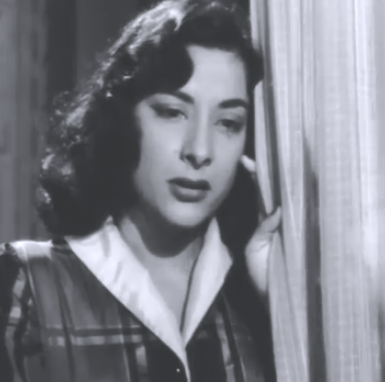
rasik balmaa (Chori Chori, 1957):  This Raga Shuddh Kalyan-based Shankar-Jakishan composition is one of my all-time favorites! Lata hits a G#5 (taar shuddh ga in the key of E) when she sings the antara.

Nargis in a melancholic mood as she sings “rasik balma” from Chori Chori (1957)

ahsaan teraa hogaa mujh par (Junglee, 1961):  The Rafi version of this number is an all-time classic. Although the Lata version is less popular, it is still beautiful in its own right and brings up an interesting point about scales in tandem songs from this era. In almost all cases that I can think of, music directors made the female singer of a tandem song sing her versions in the same key as the male verion. Because men tend to be more comfortable in the higher register of their voices than women, this practice often put the female playback singer at a disadvantage when it came to hitting the highest notes of the composition. But who else would be up for the challenge of adjusting to the “male scale,”  if not Lata Mangeshkar? She hits a G#5 (taar shuddh ga in the key of Ein the antara of this evergreen Shankar-Jakishan composition based in raga Yaman. Regarding the difficulties of singing tandem songs, Lata has remarked:

Actually, “ahsaan teraa hogaa mujh par” was only meant to be sung by Rafi. But the film’s hero, Shammi Kapoor, suddenly decided that the heroine should sing it as well. It was picturised with Rafi’s voice on Saira Banu and later dubbed by me. So I had to sing it in the same sur as Rafi. The same was done with “jiyaa o jiyaa kuch bol do.

tere baadalo.n kii khair (Champakali, 1957): This Bhairavi-based composition composed by Hemant Kumar and picturized on Suchitra Sen is not as well-known as the rest of the songs on this list, but it’s worth mentioning for the A5 (taar ma in the key of E) that Lata hits  at its conclusion.

ahaa rimjhim ke yeh pyaare pyaare geet  (Usne Kaha Tha, 1960):  Salil Chowdhury was known for his incorporation of ideas of Western classical music into his Indian compositions. As an example, he has Lata sing an operatic-style counterpoint passage here in which she reaches an Bb5 (atitaar sa in the key of Bb) against Talat’s rendering of the mukhda at the end of this composition. Subtle, but exquisite!

aa ab laut chale.n (Jis Des Mein Ganga Behti Hai, 1960): Shankar-Jaikishan score another point here with this patriotic composition from Jis Des Mein Ganga Behti Hai. Mukesh and Lata both sing this song, but it is not structured as a prototypical romantic duet. Mukesh takes the main lines while Lata provides a few supporting lines and interesting background vocals, including the virtuosic glide in which she nails an Bb5 (taar pa in the key of Eb) with finesse.

aaja bha.nvar/jhananana jhan baaje paayalia (Rani Roopmati, 1957): Both of these drut bandishes based in Raga Brindavani Sarang and composed by S.N. Tripathi from Rani Roopmati are truly virtuosic by Bollywood standards. Lata sounds so impressive when she nails the Bb5 (taar pa in the key of Bb) at the end of both “aaja bha.nvar” and “jhananana jhan.” In addition to showing off her range, Lata also showcases her classical training and vocal dexterity as she navigates through a host of intricate taans in both songs. I have to say Lata’s virtuosity leaves Rafi in the dust in the duet here (sorry, Mrs. 55!).

Nimmi sings “aaja bhan.var” in Rani Roopmati (1957)


ham ramchandra kii chandrakala me.n bhii
 
(Sampoorna Ramayana,
1961): The Mangeshkar sisters team up here to sing a duet from Sampoorna Ramayana composed by Vasant Desai. It’s somewhat interesting to note that the song here is actually picturized on two pre-pubescent boys, who are receiving playback from female singers. At the end of the song, there is a dramatic ascent in the melody until both sisters climax at a powerful  Bb5 (taar pa in the key of Eb).

ai dil kahaa.n terii manzil
 (Maya, 1961): Salil Chowdhury makes another contribution to our list with this composition rendered by Dwijen Mukherjee (a noted Bengali singer with a voice similar to Hemant Kumar’s) and Lata. Like “aa ab laut chale.n,” this duet is not structured traditionally; rather, Dwijen sings the main lines and Lata provides background support. Lata sounds heavenly as she hits a Bb5 (taar shuddh dha in the key of Db) in one of Salil’s signature opera-inspired vocal passages.

woh ek nigaah kyaa milii 
(Half-Ticket, 1962): To the best of my knowledge, Salil Chowdhury wins the contest for having recorded Lata’s voice at its highest pitch in the history of Bollywood cinema with this composition.  In this duet with Kishore Kumar picturized on Helen, Lata manages to hit  the elusive soprano C6 (taar shuddh dha in the key of Eb) in the second staccato sequence of the interlude played between stanzas. Her voice is so high here that it blends in naturally with the instrumental piccolo parts.  Nailing a staccato passage in the soprano register like this is incredibly impressive for a vocalist trained in the Indian tradition (in which the emphasis is not placed on vocalizing at the extremes of one’s range)–brava, Lata, brava!

Asha Bhonsle: Selected High Notes

sakhii rii sun bole papiihaa us paar (Miss Mary, 1957): You get the opportunity to hear some some sibling rivalry in this Hemant Kumar composition loosely based on Raga Tilang from Miss Mary! Lata (on Meena Kumari) and Asha (on some rando actress I can’t recognize) duke it out at the end with some intricate taans, but Asha actually takes the more complex passages and touches an Ab5 (taar shuddh ma in the key of Eb)in her last taan here. For those keeping score, Lata also hits the same note in her taan right before.

Meena Kumari in a rare non-tragic role in Miss Mary (1957)

dil na kahii.n lagaanaa (Ghunghat, 1960): I hadn’t heard this Ravi composition picturized on Helen before doing research for this post, but it’s quite special. The song is divided into several differents segments with lyrics in four different languages: Hindi, Tamil, Bengali (a cover of Geeta Dutt’s classic “tumi je amar“), and Punjabi. During in an alaap in the final Punjabi segment, Asha manages to hit an A5 (taar shuudh re in the key of G).

tarun aahe ratra ajunii (Non-Film):  This composition by Hridaynath Mangeshkar is a Marathi bhavgeet, so I guess it technically doesn’t belong on the list. Even though I don’t understand the Marathi lyrics, this is one of my favorite Asha songs because the tune and rendition are simply sublime. Here, the line “bagh tula pusatos aahe” begins on Bb3 and climbs up to A5 (taar shuddh ni in the key of Bb) with the ornament Asha sings on the words “gaar vaaraa.” In the span of one musical line, Asha covers nearly two octaves of vocal range–wow!

suunii suunii saa.ns kii sitaar par (Lal Patthar, 1971): This Shankar-Jakishan composition picturized on Rakhee from Lal Patthar is a beautiful example of the use of Raga Jayjayvanti in filmi music. In a passage towards the end of the song (beginning at 3:13), Asha touches a Bb5 (taar komal ga in the key of G). She also finishes the song off with some powerful taans. For comparison, see Shankar-Jakishan’s Jayjayvanti beauty from Seema sung by Lata (note the exquisite taankari at the end!): manmohana baDe jhuuThe

daiyaa mai.n kahaa.n aa pha.nsii (Caravan, 1971): This song from Caravan is probably remembered more for Asha Parekh’s crazy dance moves than its musical underpinnings, but this song is composed in a manner that is rather unique for Bollywood music. Most songs in Bollywood are sung at a fixed tonic (sa), but R.D. Burman experiments with a musical technique all too familiar to those who listen to 90s Western pop: the key change. He goes wild here by changing the tonic of the song by half-steps multiple times, and Asha hits a Bb5 during a transition at the very end.

Asha Parekh hides herself on stage during the performance of “daiyaa mai.n kahaa.na aa pha.nsii” in Caravan (1971)

aa dekhe.n zaraa (Rocky, 1981): Despite my aversion to Bollywood music from the 80s, I still decided to include this song on the list for the Bb5 (taar pa in the key of Eb) that Asha manages to yell out at around 2:20.

nadii naa re na jaao shyaam (Mujhe Jeene Do, 1963): In the alaap of this Jaidev composition picturized on Waheeda Rahman, Asha nails a G#5 and briefly touches a B5 (taar pa in the key of E) before descending to pitches that are more comfortable for the average mortal.

tu mi piaci cara (Bewaqoof, 1960):  This cute S.D. Burman composition sung by Asha and Kishore features an opening line in Italian. Maybe it was the Italian lyrics that inspired S.D. Burman to have Asha sing some background operatic passages in addition to her normal lines. During one of these passages before the second-last antara, Asha hits a B5 (taar ma in the key of F#).

jo mai.n hotaa ek TuuTaa taaraa (Chhupa Rustam, 1973): This composition by S.D. Burman rendered by Asha and Kishore features some more opera-like passages at its conclusion. Asha is impressively comfortable as she nails a B5 (ati-taar sa in the key of B)  several times in a row as counterpoint against Kishore’s rendering of the mukhda!

o merii jaa.n maine kahaa (The Train, 1970): You wouldn’t expect this fun item number composed by R.D. Burman and picturized on Helen from The Train to be particularly virtuosic in terms of vocals, but Asha actually hits the a B5 (ati-taar sa in the key of B) in the song’s opening line with her leap on the word “kahaa.” For those of you listening very carefully, it’s important to keep in mind that the film version appears to be transposed a half-step higher than the album version of this song.

If you’ve managed to pay attention so far and take a listen to some of these songs, you may have noticed some interesting trends when comparing the high notes rendered by our two beloved Bollywood divas. After taking a look at the years I’ve listed next to each song, you’ll notice that all of Lata’s highest notes on this list span a range of nine years from 1956 to 1965, while Asha’s highest notes range over 24 years (!) from 1957 to 1981. The broad range of years in which Asha hit her high notes might provide evidence to those who support the notion that Asha’s voice aged better than Lata’s over the decades. But there is one caveat: the manner in which these two divas produce their high notes is distinct and may play a role in mediating this trend. If you listen carefully, you can hear that Lata always employs her “chest voice” to belt out the notes of a composition, even at the highest registers. On the other hand, Asha often employs her “head voice,” the more commonly used technique by female singers to access high notes. Head voice has a softer, gentler sound because it resonates around the nasal cavity instead of the chest during vocal production. This technique of singing is traditionally forbidden in the Indian classical tradition, so purists might consider some of Asha’s highest highs as “cheating”–head voice is sometimes even referred to as naqlii avaaz (fake voice). I’m not so much of a purist that I would discredit Asha for using her head voice in these compositions, but I will venture to say that, if asked to do so, she would not be able to hit the notes of the high soprano register in her later years using her chest voice as gracefully as Lata did during her peak.

Another interesting trend to note is how different music directors composed differently to suit the individual styles of  Lata or Asha. Although all the music directors on this list have worked extensively with both sisters, the music directors who asked Lata to sing at her highest range are not the same as the music directors who asked the same of Asha. Shankar-Jaikishan and Salil Chowdhury, by far, contribute to Lata’s highest record pitches whereas R.D. Burman and S.D. Burman seem to have saved their highest notes for Asha. Just some food for thought.

R.D. Burman teaches Asha Bhonle during a rehearsal session.

Please let us know if you find any more examples of Lata and Asha’s highest highs that are not on this list! I have attempted to find the best examples, but given the vast repertoire of Bollywood film music, I may have naturally missed out on some that are worth mentioning. Also, if you enjoyed this post, let us know in the comments and I’ll try to do some similar-themed posts in the future–perhaps next, we can take a listen to Lata and Asha’s lowest recorded notes or a an analysis of the Bollywood tenor’s highest highs? The possibilities are endless!

-Mr. 55