Nigahein Milane Ko Jee Chahta Hai Lyrics and Translation: Let’s Learn Urdu-Hindi

Who wouldn’t want to exchange glances with those eyes?

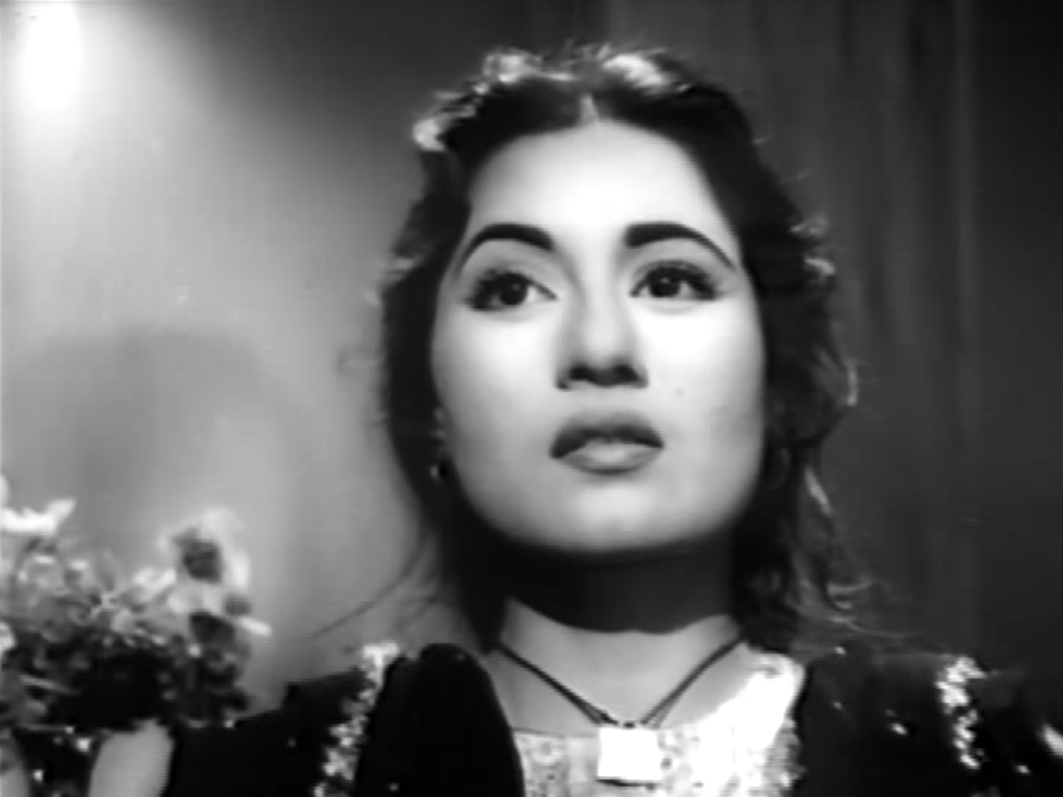
For today’s post, we showcase the lyrics and English translation of “Nigahen Milane To” from the film Dil Hi To Hai (1963). If I had to name my favorite actress from the Golden Era of Bollywood cinema, I think that I would pick Nutan.

As one of the beloved goddesses of India’s silver screen, Nutan starred in many evergreen films from the 1950s and 1960s, including Paying Guest (1957), Anari (1959), Bandini (1963), and Milan (1967), just to name a few. In my opinion, there’s something special about Nutan’s performances that sets her apart from her peers. She played her roles with a dignified beauty, a restrained grace, and an acute intelligence that was difficult to find in other actresses of the time. Here, I’ve chosen to translate a song from Dil Hi To Hai (1963), a charming Bollywood romance that is enjoyable to watch even though it is one of Nutan’s lesser-known films.

Nutan stars in Dil Hi To Hai as Jamila, the beautiful daughter of a wealthy London-based banker. Here, Raj Kapoor departs from the image established in his previous films by playing a comic double role as Jamila’s love interest Chand and Jamila’s aged music teacher Khan Sahab. While the film features some memorable performances by Nutan and Raj Kapoor, this film is probably even more memorable today for its soundtrack composed by music director Roshan. Two gems from this soundtrack have survived the test of time. The first is the Bhairavi-based classical number “laagaa chunarii me.n daag,” which is regarded as one of the best songs of Manna De’s career. The other gem is Asha Bhonsle’s exquisitely rendered Yaman qawwalinigaahe.n milaane ko jii chahtaa hai,” which I have translated here.

Penned by Sahir Ludhianvi, this qawwali centers around a woman’s desire to exchange glances with her beloved. The romanticization of eyes and sight is a common theme found in Bollywood films, and the poetry in this song is one of this era’s most cherished portrayals of this theme. The song’s charm is enhanced by the use of Urdu vocabulary (e.g. tahumat and tamhiid) and Asha Bhonsle’s immaculate rendition. Don’t you just love the way she owns those octave glides during the sargam passage?

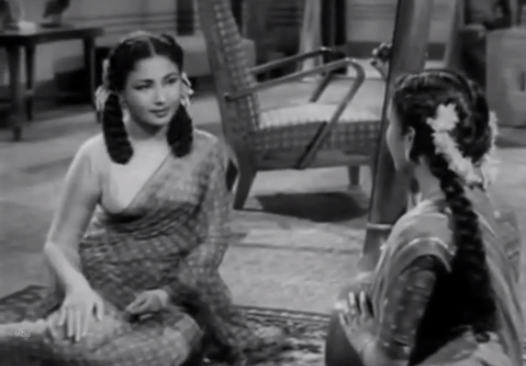
Mrs. 55 and I actually performed this qawwali at Harvard during the annual South Asian cultural show Ghungroo two years ago. One thing that we noticed after listening carefully to these lyrics during rehearsal is that there is some ambiguity in gender. While most of the song appears to be from a female perspective, we thought that lyrics take on a masculine role for the line starting with “jab kabhii mai.ne teraa chaand-saa chahraa dekhaa…” (Whenever my eyes have fallen upon your moon-like face…). In addition to the fact that the moon is traditionally used by males to describe feminine beauty (e.g. Mohammed Rafi’s “yeh chaa.nd-saa roshan chahraa“), Nutan’s gestures and body language become more masculine in nature in this segment of the song. In fact, as she sings these two lines, Nutan begins to walk with a manly gait and and then flirts with a female friend as if she is her male lover. We may have totally made this up in our heads, but it was not uncommon for such gender-bending to occur in Bollywood songs–a full post on this trend will be coming up soon! In any case, please enjoy this timeless qawwali while following along with our translation/glossary provided below, and remember to send us your requests for any other songs that you would like translated.

-Mr. 55

Nutan takes on the masculine role for a few lines in this qawwali

Nigahein Milane Ko Jee Chahta Hai Lyrics and Translation

raaz kii baat hai, mahfil me.n kahe yaa na kahe?
It is a secret matter; shall I share it in this gathering?
bas gayaa hai koii is dil me.n, kahe yaa na kahe?
Someone has begun to reside in my heart; shall I reveal this here?

nigaahe.n milaane ko jii chahtaa hai
I yearn to exchange glances with my beloved. 
dil-o-jaa.n luTaane ko jii chahtaa hai
I yearn to give away my heart and soul to him.  

woh tahumat jise “ishq” kahtii hai duniyaa
The allegation that the world calls “love,”
woh tahumat uThaane ko jii chahtaa hai
I yearn to accept that allegation.  

kisii ke manaane me.n lazzat woh paayi
Although I have experienced the pleasure of being appeased,   
ki phir ruuTh jaane ko jii chahtaa hai
I yearn to once again engage in a lovers’ tiff. 
 
woh jalvaa jo ojhal bhii hai saamne bhii
The splendor that vanishes and reappears in love, 
woh jalvaa churaane ko jii chahta hai
I yearn to steal that splendor.  
 
jis ghaDii merii nigaaho.n ko terii diid huii
The moment when our eyes first met,  
woh ghaDii mere liye aish kii tamhiid huii
That moment served as a prelude to happiness for me.  
jab kabhii mai.ne teraa chaa.nd-saa chahraa dekhaa.
Whenever my eyes have fallen upon your moon-like face, 
Eid ho ya ki na ho mere liye Eid huii
it is as if I am celebrating the holiday of Eid.  

ni re ga, ga re ga ni re ma, ma ga ma ni re ga
ga re ga ni ga re, re ga, ga ma, ma dha ni
sa sa ni ni dha dha pa pa ga re
sa ni dha pa ma ga re,
ni dha pa ma ga re sa ni, re ga 

mulaaqaat
kaa koii paighaam diije
Please send me a message about our next rendez-vous, 
ki chhup-chhup ke aane ko jii chahtaa hai
Because I yearn to visit you secretly, 
aur aake na jaane ko jii chahtaa hai
And upon visiting you, I hope to never leave.  

nigaahe.n milaane ko jii chahtaa hai
I yearn to exchange glances with my beloved. 


Glossary

raaz: secret; mahfil: gathering; nigaahe.n: eyes; dil-o-jaan: heart and soul; tahumat: allegation; manaanaa: to appease; lazzat: pleasure; jalvaa: splendor,charm; ojhal: vanished; diid: sighting, gaze; aish: joy, happiness; tamhiid: prelude, preamble; Eid: Islamic festival celebrating the end of Ramadan; mulaaqaat: meeting, rendez-vous; chhup-chhup ke: secretly; paighaam: message.

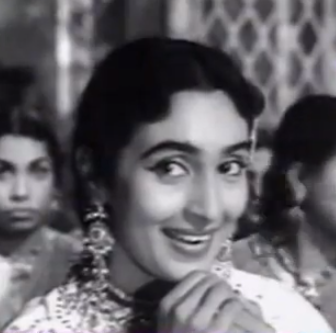
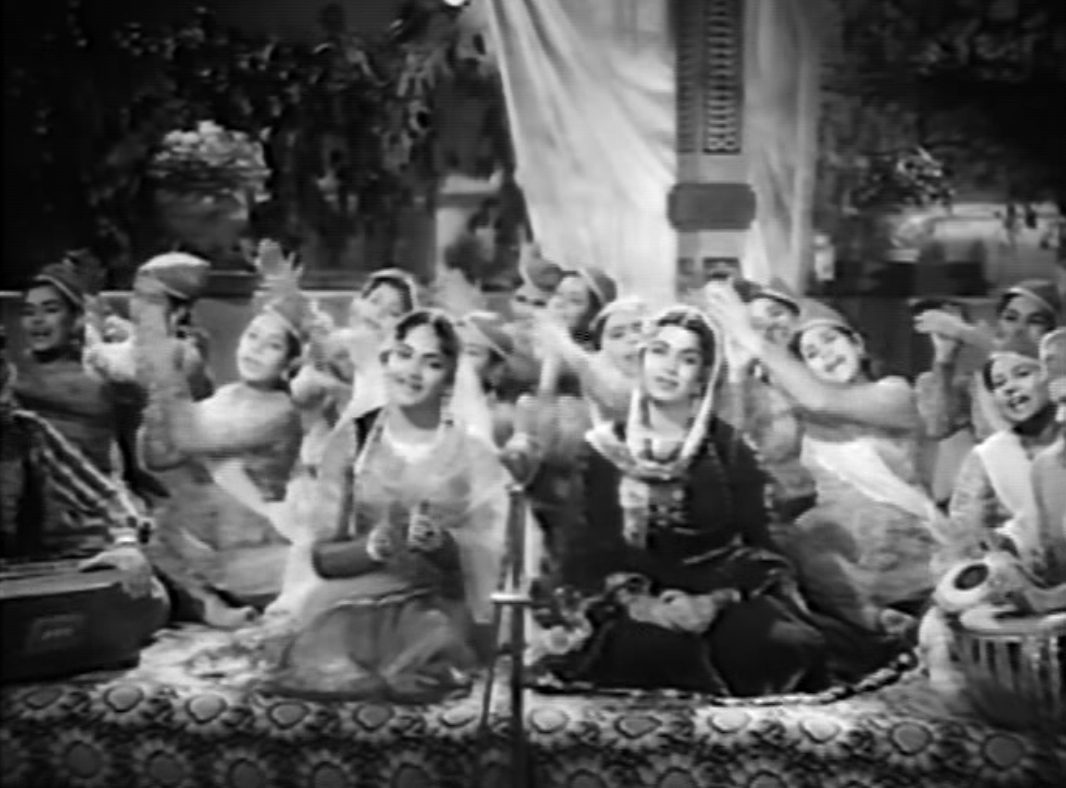
Nutan leads the chorus with an enchanting smile in Dil Hi To Hai (1963)

Bekhudi Mein Sanam Lyrics and Translation: Let’s Learn Urdu-Hindi

Babita Haseena Maan Jaayegi

Whoa there, Babita. Are you sure a Santa hat is appropriate for this occasion?

Our next Hindi lyric translation is the classic Rafi-Lata duet “Bekhudi Mein Sanam” from the film Haseena Maan Jaayegi (1968). The movie soundtrack is probably the only reason you would ever want to watch this film. Sure, the plot description is intriguing: two men (who happen to both be Shashi Kapoor) fall in love with the same woman (the unbearable Babita). One Shashi Kapoor is soft-spoken and romantic, while the other is an aggressive jokester who is spurned by our heroine. But then! War with China! Both men are called to duty, and when only one returns, Babita can’t tell if he is truly the man she loves–or his rival!

So you’re lured in, egged on by a few other vaguely recognizable Rafi numbers (“O Dilbar Janiye,” anyone?), and think you’re getting yourself in for a long Hum Dono-esque genre twin film with a swinger bent.

Oh, but how wrong you’d be.

Babita and Shashi haseena maan jaayegi

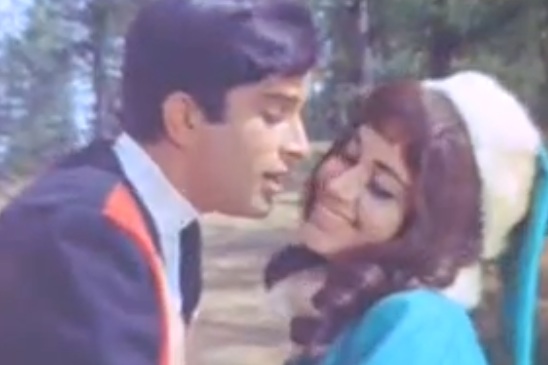
Shashi Kapoor and Babita play two college students in love in Haseena Maan Jaayegi (1968).

Haseena Maan Jaayegi is a painful free-falling bucket of awkward sauce that is weighed down by Babita’s insufferably thick voice, static characters, and an unfocused plot that never quite pulls together it’s obvious loose ends. I mean, seriously Babita? We need to spend two hours watching you try to decide if there is nothing unique about the man you married? Furthermore, what the heck, Shashi? Couldn’t you have convinced the scriptwriter to at least throw in just one line explaining why you guys look so similar? At least turn out to legitimately be twins separated at birth! There’s no way God would just magically make two Shashi Kapoors in this world. A lot of Indian women would be a lot happier if so.

Shashi Kapoor is entranced by Babita’a teal Santa suit from “Bekhudi Mein Sanam.”

Really, nothing gets my goat more than a twin movie that doesn’t acknowledge that they’re supposed to actually be twins. Do yourself a favor by skipping this cheese-flavored package of dry histrionics, and just youtube the songs because they’re awesome. Of particular note in “Bekhudi Mei.N Sanam” is Babita’s puffy white fur Santa hat and teal blue jumpsuit. This is just in case any audience member had lost their mind and started to make the mistake of taking her seriously. Check out the youtube link for the song here and follow along with the lyrics and translation below to this this otherwise beautiful ode of love!

Bekhudi Mein Sanam Lyrics and Translation

Bekhudi mei.N sanam, uTh gaye jo qadam
Unaware of my self, as I started walking
Aa gaye, aa gaye
I arrived
Aa gaye paas hum, aa gaye paas hum
I arrived nearer to you

Aag yeh kaisii man mei.N lagii hai?
What kind of fire is aflame in my mind?
Man se badhii to tan mei.N lagii hai
Yet, even bigger than that in the mind, is the one burning my body
Aag nahii.N yeh dil ki lagii hai
This is not a fire, its the heart’s desire
Jitnii bujhaayii, utnii jalii hai
However much you try to put it out, it will keep burning

Dil ki lagi na ho to, kya zindagii hai?
Without this desire of the heart, what is life?
Saath hum jo chale miT gaye faasle
When we walk together, all that separates us disappears
Aa gaye, aa gaye
I arrived
Aa gaye paas hum, aa gaye paas hum
I arrived nearer to you

Khoyii nazar thii, soye nazaare
The vision was lost, and the sights were asleep
Dekhaa tumhe to jaage yeh saare
On seeing you, all of them were awakened
Dil ne kiye jo dil ko ishaare
As one heart signaled to the other
Milke chale hum saath tumhaare
We met and walked together

Aaj khushii se meraa dil yeh pukaare
Today my heart calls out with joy
Teraa daaman milaa, pyaar meraa khilaa
In finding your embrace, my love has blossomed
Aa gaye, aa gaye
I arrived
Aa gaye paas hum, aa gaye paas hum
I arrived nearer to you

Dil kii kahaanii pahunche zubaa.N tak
The story of my heart is on my tongue
Kisko khabar ab pahunche kahaa.N tak?
Now who knows where it will reach?
Pyaar ke raahii aaye yahaa.N tak
Travelers of love have arrived here
Jaaye.Nge dil ki had hai jahaa.N tak
They will go to the limits set by their hearts

Tum paas jo to chale hum aasmaan tak
With you at my side, we will reach the sky
Dil mein armaan liye laakh toofaan liye
With a heart full of desires and beset by storms

Aa gaye, aa gaye
I arrived
Aa gaye paas hum, aa gaye paas hum
I arrived nearer to you

Bekhudi mei.N sanam, uTh gaye jo qadam
Unaware of my self, as I started walking
Aa gaye, aa gaye
I arrived
Aa gaye paas hum, aa gaye paas hum
I arrived nearer to you

Glossary:

bekhudi: unaware of oneself, in a trance; qadam: footsteps; aag: fire; man: mind; tan: body; faasle: separation, distance; ishaaraa: signal; daaman: embrace; zubaa.N: tongue, language; khabar: news, knowledge; had: limit; aasmaan: sky; armaan: desire; toofaan: storm

I can’t really explain it, but I’ve always really liked with the way Shashi Kapoor starts his first line walking forward toward her with his hands folded behind his back. It’s bashful, the way Indian men in love were meant to be.

Shashi Kapoor Twins Haseena Maan Jaayegi

I know, I know. It’s almost irresistible–TWO Shashi Kapoors on ONE screen! Look at that handsome cricket jacket, those form-fitting white pants. But restrain, my friends. Haseena Maan Jaayegi will suck out your Shashi-gushing capacities and infect you instead with confusion and hatred of Babita.

This song translation was done by request from our reader “Beloved”! We hope you enjoyed, and if you’d like to see your name on our blog, send us an email with your burning Bollywood request or leave us a comment on our “Requests” page!

– Mrs. 55

Bollywood’s Beloved Sopranos: Lata and Asha’s Highest Notes

I feel like we’ve all been in this situation at some point: one of your favorite aunties steps up to the microphone at the annual Diwali function, and you have a sinking fear in your heart that she’s going to embarass herself by butchering another Lata classsic on stage. As she struggles through the sky-high notes of the antara, you cringe and ask yourself why you’re here again, subjecting yourself to this torture…

Well, it turns out it’s not entirely her fault. The reality of the situation is that Bollywood songs from the Golden Era tend to be pitched at extremely high scales for the average female singer. Unless a woman is a veritable soprano like Lata Mangeshkar or Asha Bhonsle, it is going to be quite a challenge for them to sing many of the classic songs from this period in their original keys. The high-pitched soprano female voice has become a hallmark of Hindi film music, and I’d like to explore this phenomenon in greater detail with this post.

Two sisters who changed playback singing forever: Lata Mangeshkar and Asha Bhonsle.

Why are Bollywood songs for females from the Golden Era pitched at astronomically high scales? I don’t know for sure, but I definitely have a few ideas that could explain this trend. First, the high-pitched female voice is consistent with the image of the ideal Indian woman that was prevalent during the 1950s and 60s. The soprano register suggests innocence and purity, which enhanced the traditionally feminine perceptions of heroines advanced by film directors of the time. Lata Mangeshkar  is the ultimate example of this phenomenon; her voice, with its ethereal purity, has been considered the traditional female voice of India for decades. However, this explanation is less pertinent to Lata’s younger sister Asha Bhonsle. The voice of Asha, who was widely known for her experimentation with non-traditional genres such as the cabaret, is not a national emblem of purity in the same way as her elder sister’s. For this reason, an alternative explanation is needed to describe the popularity of the soprano female voice in Bollywood, and I would venture to say that this alternative explanation is rooted in musical origins. Before the arrival of the Mangeshkars onto the filmi musical scene, female singing in Hindi films was dominated by artists with heavy, nasal voices, such as Suraiyya and Shamshad Begum. Once music directors had the opportunity to work with the Mangeshkars, things changed forever: the nasalized heavy female voices were out and the delicate soprano voices were here to stay. After Lata and Asha became established as playback singers, I would argue that  music directors of the time pushed the boundaries of their compositions in terms of range to test and showcase the virtuosity of these two exceptional talents.

Before we take a listen to some of Lata and Asha’s highest highs throughout Bollywood’s musical history, explaining a little bit of musical nitty-gritty is necessary to fully appreciate the gist of what’s going on here. From my experiences with transcribing and performing many songs from this era, I would estimate that the vast majority (perhaps 90%?) of songs composed for Lata and Asha max out at F5 or F#5 (two F/F#’s above middle C on the piano) as their highest note. Therefore, in the brief list  of high notes that I’ve compiled below, I’ve only chosen to include those rare songs that surpass the typical upper limit of  F#5. Songs for both singers are listed in order of ascending pitch of the composition’s highest note.

Keyboard labeled with note names and frequencies. C4 is taken as middle C. The high notes listed here range from G5 to C6.

Lata Mangeshkar: Selected High Notes

 jhuumta mausam mast mahiinaa (Ujala, 1959):  In this Lata-Manna duet composed by Shankar-Jakishan, Lata nails a G5 (taar komal ga in the key of E) when she repeats the “yalla yalla” line in the taar saptak (high octave) at the end.

ajii ruuThkar ab kahaa.n jaayiega?  (Aarzoo, 1965): Shankar-Jaikishan is once again the culprit here: listen as Lata reaches an Ab5 (taar shuddh ma in the key of Eb) in the antara of this gem picturized on Sadhana from Aarzoo. Regarding the high pitch of this song, Lata has said:

“I remember “ajii ruuThkar ab kahaa.n jaayiegaa” in Aarzoo (1965). What a high pitch that was! My ears reddened when I sang it. But I stubbornly sang at that impossible scale, refusing to admit defeat to any range. I would get very angry and sing at any range without complaining. Composers would take full advantage of my silence and keep raising the scale. In fact, I used to have arguments with Jaikishan. I would ask him, “kyaa baat hai, aap merii pariksha le rahe hai.n? mai.ne aap kaa kyaa bigaDaa hai jo aap meraa kaan laal kar rahe hai.n? (What’s the matter? Why are you testing me? What have I done that you should trouble me so much to redden my ears?)’

jiyaa o jiyaa kuch bol do (Jab Pyar Kisi Se Hota Hai, 1961): The tandem effect described below with “ahsaan teraa hogaa mujh par” is also observed here. Lata gives it her all as she reaches a Ab5 (taar komal ni in the key of Bb) in the antara of the female tandem version of the fun Rafi classic from Jab Pyar Kisi Se Hota Hai.

rasik balmaa (Chori Chori, 1957):  This Raga Shuddh Kalyan-based Shankar-Jakishan composition is one of my all-time favorites! Lata hits a G#5 (taar shuddh ga in the key of E) when she sings the antara.

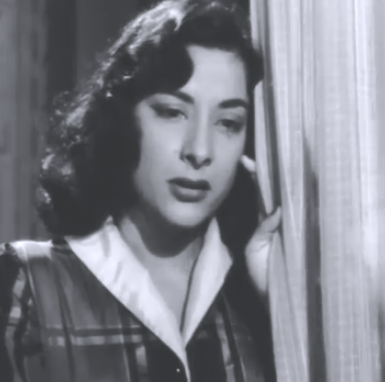
Nargis in a melancholic mood as she sings “rasik balma” from Chori Chori (1957)

ahsaan teraa hogaa mujh par (Junglee, 1961):  The Rafi version of this number is an all-time classic. Although the Lata version is less popular, it is still beautiful in its own right and brings up an interesting point about scales in tandem songs from this era. In almost all cases that I can think of, music directors made the female singer of a tandem song sing her versions in the same key as the male verion. Because men tend to be more comfortable in the higher register of their voices than women, this practice often put the female playback singer at a disadvantage when it came to hitting the highest notes of the composition. But who else would be up for the challenge of adjusting to the “male scale,”  if not Lata Mangeshkar? She hits a G#5 (taar shuddh ga in the key of Ein the antara of this evergreen Shankar-Jakishan composition based in raga Yaman. Regarding the difficulties of singing tandem songs, Lata has remarked:

Actually, “ahsaan teraa hogaa mujh par” was only meant to be sung by Rafi. But the film’s hero, Shammi Kapoor, suddenly decided that the heroine should sing it as well. It was picturised with Rafi’s voice on Saira Banu and later dubbed by me. So I had to sing it in the same sur as Rafi. The same was done with “jiyaa o jiyaa kuch bol do.

tere baadalo.n kii khair (Champakali, 1957): This Bhairavi-based composition composed by Hemant Kumar and picturized on Suchitra Sen is not as well-known as the rest of the songs on this list, but it’s worth mentioning for the A5 (taar ma in the key of E) that Lata hits  at its conclusion.

ahaa rimjhim ke yeh pyaare pyaare geet  (Usne Kaha Tha, 1960):  Salil Chowdhury was known for his incorporation of ideas of Western classical music into his Indian compositions. As an example, he has Lata sing an operatic-style counterpoint passage here in which she reaches an Bb5 (atitaar sa in the key of Bb) against Talat’s rendering of the mukhda at the end of this composition. Subtle, but exquisite!

aa ab laut chale.n (Jis Des Mein Ganga Behti Hai, 1960): Shankar-Jaikishan score another point here with this patriotic composition from Jis Des Mein Ganga Behti Hai. Mukesh and Lata both sing this song, but it is not structured as a prototypical romantic duet. Mukesh takes the main lines while Lata provides a few supporting lines and interesting background vocals, including the virtuosic glide in which she nails an Bb5 (taar pa in the key of Eb) with finesse.

aaja bha.nvar/jhananana jhan baaje paayalia (Rani Roopmati, 1957): Both of these drut bandishes based in Raga Brindavani Sarang and composed by S.N. Tripathi from Rani Roopmati are truly virtuosic by Bollywood standards. Lata sounds so impressive when she nails the Bb5 (taar pa in the key of Bb) at the end of both “aaja bha.nvar” and “jhananana jhan.” In addition to showing off her range, Lata also showcases her classical training and vocal dexterity as she navigates through a host of intricate taans in both songs. I have to say Lata’s virtuosity leaves Rafi in the dust in the duet here (sorry, Mrs. 55!).

Nimmi sings “aaja bhan.var” in Rani Roopmati (1957)


ham ramchandra kii chandrakala me.n bhii
 
(Sampoorna Ramayana,
1961): The Mangeshkar sisters team up here to sing a duet from Sampoorna Ramayana composed by Vasant Desai. It’s somewhat interesting to note that the song here is actually picturized on two pre-pubescent boys, who are receiving playback from female singers. At the end of the song, there is a dramatic ascent in the melody until both sisters climax at a powerful  Bb5 (taar pa in the key of Eb).

ai dil kahaa.n terii manzil
 (Maya, 1961): Salil Chowdhury makes another contribution to our list with this composition rendered by Dwijen Mukherjee (a noted Bengali singer with a voice similar to Hemant Kumar’s) and Lata. Like “aa ab laut chale.n,” this duet is not structured traditionally; rather, Dwijen sings the main lines and Lata provides background support. Lata sounds heavenly as she hits a Bb5 (taar shuddh dha in the key of Db) in one of Salil’s signature opera-inspired vocal passages.

woh ek nigaah kyaa milii 
(Half-Ticket, 1962): To the best of my knowledge, Salil Chowdhury wins the contest for having recorded Lata’s voice at its highest pitch in the history of Bollywood cinema with this composition.  In this duet with Kishore Kumar picturized on Helen, Lata manages to hit  the elusive soprano C6 (taar shuddh dha in the key of Eb) in the second staccato sequence of the interlude played between stanzas. Her voice is so high here that it blends in naturally with the instrumental piccolo parts.  Nailing a staccato passage in the soprano register like this is incredibly impressive for a vocalist trained in the Indian tradition (in which the emphasis is not placed on vocalizing at the extremes of one’s range)–brava, Lata, brava!

Asha Bhonsle: Selected High Notes

sakhii rii sun bole papiihaa us paar (Miss Mary, 1957): You get the opportunity to hear some some sibling rivalry in this Hemant Kumar composition loosely based on Raga Tilang from Miss Mary! Lata (on Meena Kumari) and Asha (on some rando actress I can’t recognize) duke it out at the end with some intricate taans, but Asha actually takes the more complex passages and touches an Ab5 (taar shuddh ma in the key of Eb)in her last taan here. For those keeping score, Lata also hits the same note in her taan right before.

Meena Kumari in a rare non-tragic role in Miss Mary (1957)

dil na kahii.n lagaanaa (Ghunghat, 1960): I hadn’t heard this Ravi composition picturized on Helen before doing research for this post, but it’s quite special. The song is divided into several differents segments with lyrics in four different languages: Hindi, Tamil, Bengali (a cover of Geeta Dutt’s classic “tumi je amar“), and Punjabi. During in an alaap in the final Punjabi segment, Asha manages to hit an A5 (taar shuudh re in the key of G).

tarun aahe ratra ajunii (Non-Film):  This composition by Hridaynath Mangeshkar is a Marathi bhavgeet, so I guess it technically doesn’t belong on the list. Even though I don’t understand the Marathi lyrics, this is one of my favorite Asha songs because the tune and rendition are simply sublime. Here, the line “bagh tula pusatos aahe” begins on Bb3 and climbs up to A5 (taar shuddh ni in the key of Bb) with the ornament Asha sings on the words “gaar vaaraa.” In the span of one musical line, Asha covers nearly two octaves of vocal range–wow!

suunii suunii saa.ns kii sitaar par (Lal Patthar, 1971): This Shankar-Jakishan composition picturized on Rakhee from Lal Patthar is a beautiful example of the use of Raga Jayjayvanti in filmi music. In a passage towards the end of the song (beginning at 3:13), Asha touches a Bb5 (taar komal ga in the key of G). She also finishes the song off with some powerful taans. For comparison, see Shankar-Jakishan’s Jayjayvanti beauty from Seema sung by Lata (note the exquisite taankari at the end!): manmohana baDe jhuuThe

daiyaa mai.n kahaa.n aa pha.nsii (Caravan, 1971): This song from Caravan is probably remembered more for Asha Parekh’s crazy dance moves than its musical underpinnings, but this song is composed in a manner that is rather unique for Bollywood music. Most songs in Bollywood are sung at a fixed tonic (sa), but R.D. Burman experiments with a musical technique all too familiar to those who listen to 90s Western pop: the key change. He goes wild here by changing the tonic of the song by half-steps multiple times, and Asha hits a Bb5 during a transition at the very end.

Asha Parekh hides herself on stage during the performance of “daiyaa mai.n kahaa.na aa pha.nsii” in Caravan (1971)

aa dekhe.n zaraa (Rocky, 1981): Despite my aversion to Bollywood music from the 80s, I still decided to include this song on the list for the Bb5 (taar pa in the key of Eb) that Asha manages to yell out at around 2:20.

nadii naa re na jaao shyaam (Mujhe Jeene Do, 1963): In the alaap of this Jaidev composition picturized on Waheeda Rahman, Asha nails a G#5 and briefly touches a B5 (taar pa in the key of E) before descending to pitches that are more comfortable for the average mortal.

tu mi piaci cara (Bewaqoof, 1960):  This cute S.D. Burman composition sung by Asha and Kishore features an opening line in Italian. Maybe it was the Italian lyrics that inspired S.D. Burman to have Asha sing some background operatic passages in addition to her normal lines. During one of these passages before the second-last antara, Asha hits a B5 (taar ma in the key of F#).

jo mai.n hotaa ek TuuTaa taaraa (Chhupa Rustam, 1973): This composition by S.D. Burman rendered by Asha and Kishore features some more opera-like passages at its conclusion. Asha is impressively comfortable as she nails a B5 (ati-taar sa in the key of B)  several times in a row as counterpoint against Kishore’s rendering of the mukhda!

o merii jaa.n maine kahaa (The Train, 1970): You wouldn’t expect this fun item number composed by R.D. Burman and picturized on Helen from The Train to be particularly virtuosic in terms of vocals, but Asha actually hits the a B5 (ati-taar sa in the key of B) in the song’s opening line with her leap on the word “kahaa.” For those of you listening very carefully, it’s important to keep in mind that the film version appears to be transposed a half-step higher than the album version of this song.

If you’ve managed to pay attention so far and take a listen to some of these songs, you may have noticed some interesting trends when comparing the high notes rendered by our two beloved Bollywood divas. After taking a look at the years I’ve listed next to each song, you’ll notice that all of Lata’s highest notes on this list span a range of nine years from 1956 to 1965, while Asha’s highest notes range over 24 years (!) from 1957 to 1981. The broad range of years in which Asha hit her high notes might provide evidence to those who support the notion that Asha’s voice aged better than Lata’s over the decades. But there is one caveat: the manner in which these two divas produce their high notes is distinct and may play a role in mediating this trend. If you listen carefully, you can hear that Lata always employs her “chest voice” to belt out the notes of a composition, even at the highest registers. On the other hand, Asha often employs her “head voice,” the more commonly used technique by female singers to access high notes. Head voice has a softer, gentler sound because it resonates around the nasal cavity instead of the chest during vocal production. This technique of singing is traditionally forbidden in the Indian classical tradition, so purists might consider some of Asha’s highest highs as “cheating”–head voice is sometimes even referred to as naqlii avaaz (fake voice). I’m not so much of a purist that I would discredit Asha for using her head voice in these compositions, but I will venture to say that, if asked to do so, she would not be able to hit the notes of the high soprano register in her later years using her chest voice as gracefully as Lata did during her peak.

Another interesting trend to note is how different music directors composed differently to suit the individual styles of  Lata or Asha. Although all the music directors on this list have worked extensively with both sisters, the music directors who asked Lata to sing at her highest range are not the same as the music directors who asked the same of Asha. Shankar-Jaikishan and Salil Chowdhury, by far, contribute to Lata’s highest record pitches whereas R.D. Burman and S.D. Burman seem to have saved their highest notes for Asha. Just some food for thought.

R.D. Burman teaches Asha Bhonle during a rehearsal session.

Please let us know if you find any more examples of Lata and Asha’s highest highs that are not on this list! I have attempted to find the best examples, but given the vast repertoire of Bollywood film music, I may have naturally missed out on some that are worth mentioning. Also, if you enjoyed this post, let us know in the comments and I’ll try to do some similar-themed posts in the future–perhaps next, we can take a listen to Lata and Asha’s lowest recorded notes or a an analysis of the Bollywood tenor’s highest highs? The possibilities are endless!

-Mr. 55

Yeh Ishq Ishq Hai Lyrics and Translation: Let’s Learn Urdu-Hindi

Bollywood Qawwali Barsaat Ki Raat Shyama Ratna

Ratna (left) and Shyama (right) lead the qawwali “Yeh Ishq Ishq Hai” from the hit Bollywood film Barsaat Ki Raat (196)

For our next post, we provide an English translation of “Yeh Ishq Ishq Hai” qawwali (and its prelude “Na to Caravan ki Talaash Hai“) from the all-time classic film Barsaat ki Raat (1960). For anyone familiar with the beautiful lyrics of this Sahir Ludhviani masterpiece, you know that “Yeh Ishq Ishq Hai” is the crowning jewel of the qawwali genre. The ultimate in lyrical poetry, allusions, wit, and transcendent symbolism, “Yeh Ishq Ishq Hai” was no easy task to translate and dissect. Sahir Ludhviani, who also later penned the gems from films like Taj Mahal (1963), wrote an album of love poetry for Barsaat Ki Raat--from “Zindagi Bhar Nahii.N Bhoolegi” to “Mai.N Ne Shaayad Tumhe” to la pièce de résistance, “Yeh Ishq Ishq Hai.”
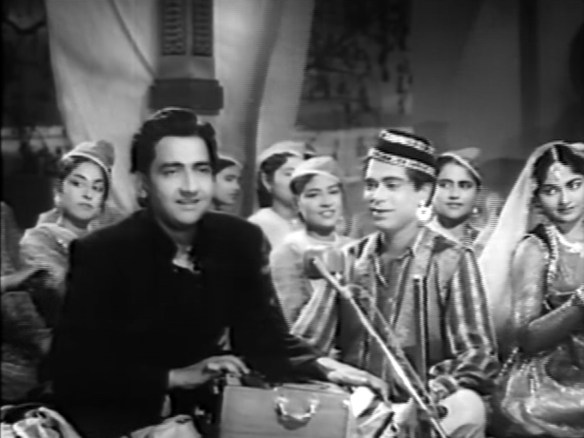
Bharat Bhushan Barsaat Ki Raat qawwali

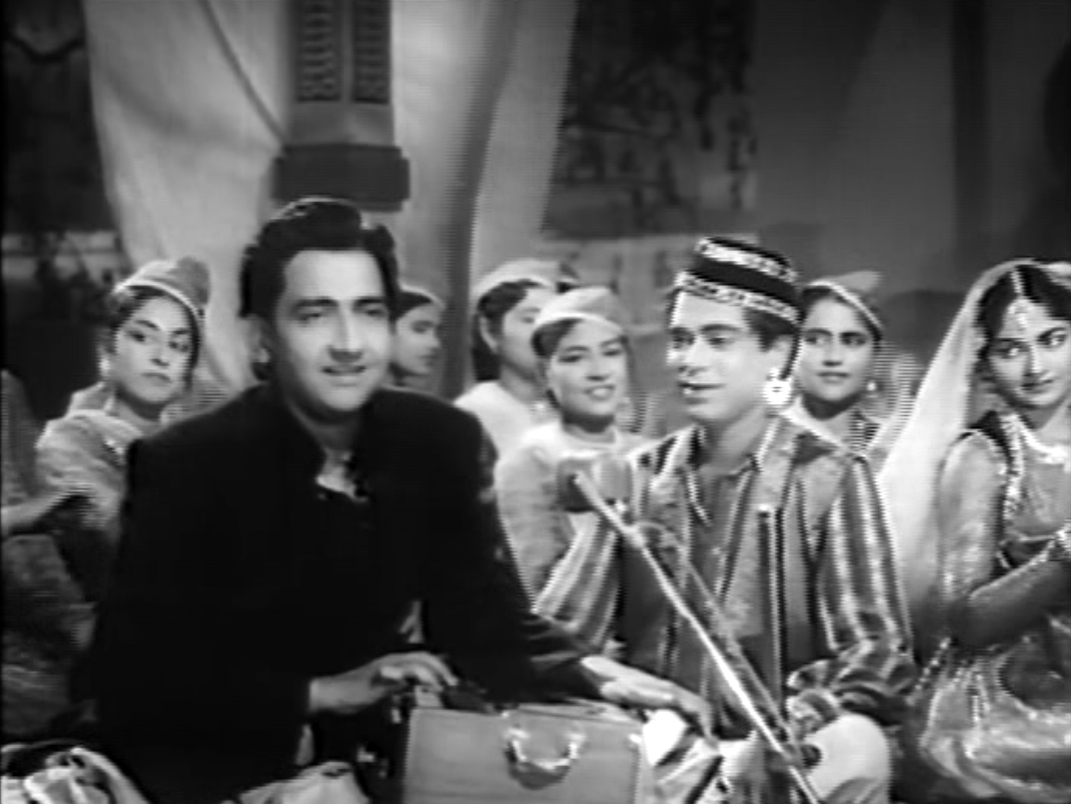
Bharat Bhushan jumps in to save the girls’ qawwali team in “Yeh Ishq Ishq Hai” from Barsaat Ki Raat (1960)

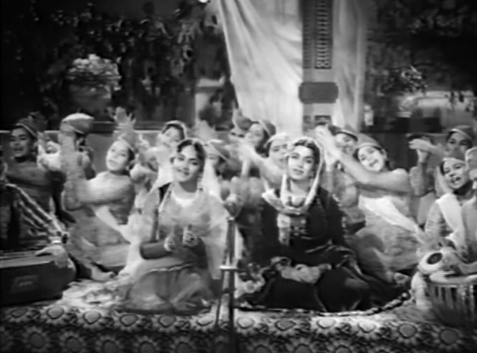
Through this culmination piece of the film’s ongoing qawwali competition, both hero (Bharat Bhushan) and the heroine (Madhubala) are reunited after a long and painful separation. Mohammed Rafi, Asha Bhonsle, and Manna Dey vie to out-do each other in this clever, powerful discussion of the meaning of love, but at the song’s climax Rafi brings the qawwali to a heart-stopping triumphant finish that wins his team the competition. It is a real pleasure to appreciate the many levels on which the qawwali can be understood–from religious, to romantic, to quite literal–after singing “ilaaj koi to maut hai,” Shyama literally falls sick to her deathbed, or as Bharat Bhushan croons, “nikalii Radha saj ke,” Madhubala appears miraculously at the doorway from the prison of her house. Come follow along with our translation of this epic qawwali and it will be clear why “Yeh Ishq Ishq Hai” made Bollywood film history!
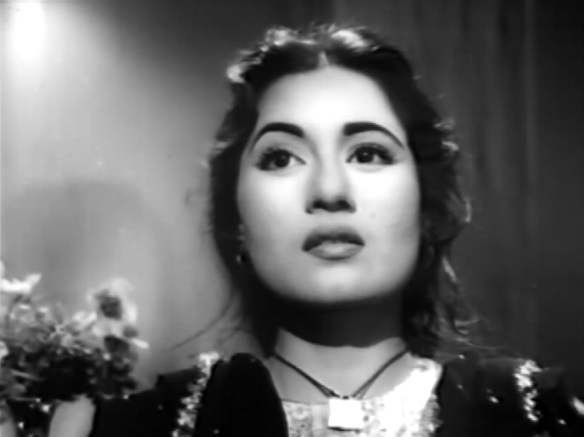
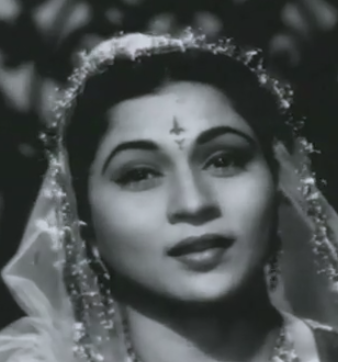
Madhubala Barsaat Ki Raat

Madhubala hears Bharat Bhushan on the radio and decides to find him in Barsaat Ki Raat (1960)

Yeh Ishq Ishq Hai Lyrics and Translation

MALE:

Na to caaravaan ki talaash hai
I am not in search of a caravan
Na to humsafar ki talaash hai
I am not in search of a fellow traveler
Mere shauq-e-khaana kharaab ko teri rehguzar ki talaash hai
That ruined place of my desire searches for the path that leads to you

FEMALE:

Mere naamuraad junoon ka hai ilaaj koi to maut hai
If there is any cure for my unfortunate obsession, then it is death
Jo davaa ke naam pe zehar de
Give me that medicine whose name is poison
Usi chaaraagar ki talaash hai
I am in search of such a healer

Tera ishq hai meri aarzoo,
Your love is my desire
Tera ishq hai meri aabroo,
Your love is my honor
Dil ishq, jism ishq hai, aur jaan ishq hai
My heart is love, my body is love, and my life is love
Imaan ki jo poochho to imaan ishq hai
If you ask for faith, then that is love too
Tera ishq mai.N kaise ChhoD doo.N?
How could I ever leave your love?
Meri umr bhar ki talaash hai
That love is what I have been searching for all my life

MALE:

Yeh ishq ishq hai, ishq ishq, yeh ishq ishq hai, ishq ishq
This is love, this is love, this is love
Jaan-soz ki haalat ko jaan-soz hi samjhegaa
Only one in torment can understand the condition of a fellow sufferer
Mai.N shamaa se kehta hoo.N mehfil se nahii.N kehta
I am speaking to the flame, not to the company gathered here
Kyonki yeh ishq ishq hai, ishq ishq, yeh ishq ishq hai, ishq ishq
For this is love, this is love, this is love

FEMALE:
Sahar tak sab ka hai anjaam jal kar khaak ho jaana
By dawn, everything will burn and be reduced to ashes
Bhari mehfil mei.N koi shamaa yaa parvaana ho jaaye
Everyone in this gathering shall became either flame or moth
Kyo.N ki yeh ishq ishq hai, ishq ishq, yeh ishq ishq hai, ishq ishq
For this is love, this is love, this is love

MALE:

Vehshat-e-dil rasn-o-daar se roki na gayi
Love is not stopped by the madness of the heart or ropes and the gallows
Kisi khanjar, kisi talvaar se roki na gayi
It is not stopped by any dagger, by any sword
Ishq Majnu ki woh aavaz hai jiske aage koi Laila kisi deewaar se roki na gayi,
Love is that voice of Majnu’s which Laila followed and which no barrier could stop
Kyo.N ki yeh ishq ishq hai, ishq ishq, yeh ishq ishq hai, ishq ishq
For this is love, this is love, this is love

Woh hanske agar maa.Nge.N to hum jaan bhi dede.N,
If she laughs and asks, then I would even give my life
Haa.N yeh jaan to kya cheez hai? Imaan bhi dede.N!
Yes, after all what is this life? I would even give up my faith!
Kyo.N ki yeh ishq ishq hai, ishq ishq, yeh ishq ishq hai, ishq ishq
For this is love, this is love, this is love

Naaz-o-andaaz se kehte hai.N ki jeena hoga,
I am told that I must live with my fate gracefully
Zehar bhi dete hai.N to kehte hai.N Ki peena hoga
They give me poison, and say I must drink
Jab mai.N peetaa hoo.N to kehte hai.N ki marta bhi nahii.N,
But when I drink it, then they say I won’t die
Jab mai.N martaa hoo.N to kehte hai.N ki jeenaa hogaa
When I am dying, they say I must live
Yeh ishq ishq hai, ishq ishq, yeh ishq ishq hai, ishq ishq
For this is love, this is love, this is love

Mazhab-e-ishq ki har rasm kaDi hoti hai,
The laws and customs of love are very strict
Har qadam par koi deewaar khaDi hoti hai
At every step, there is a barrier standing
Ishq aazad hai, Hindu Na Musalmaan hai ishq,
Love is free, love is neither Hindu nor Muslim
Aap hii dharm hai aur aap hii imaan hai ishq
Your own duty and your own faith alone is love
Jis se aage nahii.N shekh-o-Brahaman dono.N,
Both Hindu and Muslim religious men cannot surpass this
Us haqeeqat ka garajtaa hua ailaan hai ishq
The reality of that thundering proclamation is love

(FEMALE in Panjabi):

Ishq na puchhe deen dharm nu, ishq na puchhe jaataan
Love does not ask your religion or creed, love does not ask your social class or caste,
Ishq de haatho.N garam lahu vich doobiyaan laakh baraataan ke
Love has drowned thousands of wedding revelers in its fiery blood
Yeh ishq ishq hai, ishq ishq, yeh ishq ishq hai, ishq ishq
This is love, this is love, this is love

MALE:
Raah ulfat ki kaThin hai ise aasaan na samajh
The path of love is dangerous, do not think it easy
Yeh ishq ishq hai, ishq ishq, yeh ishq ishq hai, ishq ishq
This is love, this is love, this is love

FEMALE:
Bahut kaThin hai Dagar panghat ki
The path to the riverside is very dangerous
Ab kya bhar luau.N mai.N Jamuna se matki?
Now how can I fill my jug with water from the banks of the Jamuna River?
Mai.N jo chali jal jamuna bharan ko dekho sakhi ji mai.N jo chali jal jamuna bharan ko
As I was on my way to fill my jug with water from the Jamuna,
Nand kishor mohe roke jhaadon
The young boy of Nanda [Krishna] stopped me
To kya bhar luau.N mai.N Jamuna se matki?
So how can I fill my jug with water from the banks of the Jamuna River?

MALE:
Ab laaj raakho more ghoonghat pat ki
Now protect my honor, this veil of mine
Jab jab Krishn ki bansi baaji,
When Krishna played his flute
Nikali Raadhaa saj ke
Radha emerged, dressed up
Jaan ajaan ka dhyaan bhulaa ke,
Forgetting all she was taught
Lok laaj ko taj ke
She left the honor of society
Haaye ban ban Doli Janak dulaari,
The darling child of King Janak [Sita] swayed into the forest
Pehenke prem ki maalaa
And wore a garland of love
Darshan jal ki pyaasi Meera
Meera thirsty for her a glimpse of her Lord
Pii gayii vishh ka pyaalaa aur phir araj kari
Drank a glass of poison and then pleaded
Ke laaj raakho raakho raakho, laaj raakho dekho dekho,
Protect my honor, protect my honor, protect my honor
Yeh ishq ishq hai, ishq ishq, yeh ishq ishq hai, ishq ishq
This is love, this is love, this is love

Allah rasool ka farmaan ishq hai
The commands of God and Mohammed are love
Yaanii Hadith ishq hai, Quraan ishq hai
The teachings of Mohammed are love, the Quraan is love
Gautam kaa aur Maseehaa kaa armaan ishq hai
The wishes of Bhudda and Christ are love
Yeh kaayanaat jism hai aur jaan ishq hai
This material existence and this life are love
Ishq sarmad, ishq hii mansoor hai
Love is everlasting, love alone is victorious
Ishq Moosa, ishq Koh-e-Toor hai
Love is Moses, love is Mt. Sinai
Khaaq ko but, aur but ko devtaa karta hai ishq
Love turns clay into idols, and idols into Gods
Intahaa yeh hai ke bande ko khuda karta hai ishq
The pinnacle is that love has the power to turn a man into a revered God
Haan.N yeh ishq ishq hai, ishq ishq, yeh ishq ishq hai, ishq ishq
Yes, this is love, this is love, this is love

Glossary:

caravaan: caravan; talaash: search; humsafar: fellow traveler; shauq-e-khaana; desires, hobbies; barbaad: ruined; rehuguzar: pathway; naamuraad: unfortunate; junoon: obsession; ilaaj: cure; maut: death; davaa: medicine; zeher: poison; chaaragar: one who treats you, doctor, healer; aarzuu: desire; aabruu: honor; jism: body; imaan: faith; jaansoz: torment, soul-burning; sahar: the time before dawn; anjaam: conclusion; khaak: ashes; parvaanaa: moth (used allegorically as one blinded by love); vehshat: madness; rasn: rope; daar: gallows; khanjar: dagger; talwar: sword; LailaMajnu: legendary ill-fated lovers; awaaz: voice; deewaar: barrier, wall; cheez: thing; naazoandaaz: pride and style, grace; mazhab: law; kaDi: strict, harsh; qadam: step; azaad: free; dharm: Hindu religious duty; haqeeqat: reality; garajnaa: to thunder; ailaan: proclaimation; deen: Islamic obedience; jaataan: caste; lahu: blood; ulfat: love; kaThin: dangerous; aasaan: easy; Dagar: pathway; maTki: jug, pot; Nand kishor: young Krishna laaj: honor; ghuunghat: veil; bansi: type of flute; dhyaan: meditation; lok: people, society; ban: forest; Dolna: to sway; Janak Dulari: The darling daughter of the mythological King Janak [Sita]; prem: love; maalaa: garland; darshan: glimpse of a deity; pyaasi: thirsty; vish ka pyaalaa: glass of poison; araj: plea; rasool: messenger [of God, Mohammed]; farmaan: commands; hadith: a report of the deeds and the teachings of Muhammed, Gautam: Buddha; Maseehaa: Jesus Christ; kaayanaat: material creation; sarmad: everlasting; mansoor: victorious, Moosaa: Moses; Koh-e-Toor: Mt. Sinai; khaaq: clay; but: idol; devtaa: God; intahaa: pinnacle, culmination

Yes, that glossary was a mouthful. Even as it is, I must warn that many of these words have a far deeper religious meaning to them that cannot be summed up in the one or two words as I have defined them. But no one said the Hindustani language was easy, and this song is just loaded with Arabic-based and Sanskrit-based vocabulary as well as references from both Hindu and Islamic traditions. It’s part of why Urdu-Hindi is such a complex, beautiful and absolutely fascinating language. Let’s take a more in-depth look at some of these lines:

  • “Ishq Majnu ki woh awaaz hai…” according to the Arab legend, similar to Romeo and Juliet, Laila and Majnu (whose nickname means “madly in love”) were two star-crossed lovers from rival families. However, Laila fled from her house to be with the one she loved and it is said that as Majnu was caught and whipped, their love was so strong that Laila screamed and blood appeared to flow from Laila’s skin instead.
  • “Bahut kaThin hai Dagar panghat ki…” is actually a line from the great Amir Khusrau qawwali written during the 13th century. The qawwali refers in one sense to the risks of dishonor faced by Radha as she attempted to fetch water, another sense explores the risks of standing up for religious beliefs (in Khusrau’s case, an allegiance to Sufi saint Nizamuddin Auliya.) The line has now become a sort of idiomatic warning to not underestimate the burden of any difficult task.
  • “Jab jab Krishna ki bansi baaji…” refers to the tales of Hindu folklore of childhood lovers Krishna and Radha, the latter of whom risked familial honor and suffered teasing and torment from her girlfriends in her love for the young Lord.
  • “Janak dulari ban ban Doli…” is a reference to the Ramayan in which Sita, upon learning of her husband Ram’s banishment to the forest, renounced her title as well. Sita, it should be recalled, had a very lavish upbringing as she was the daughter of King Janak, so this was no simple sacrifice to live in the dangerous jungle. But Sita’s love was unparalleled, and although she was not otherwise compelled to accompany Ram to the jungle, did indeed join him out of pure devotion.
  • “Darshan jal ki pyaasi Meera…” refers to the legend of Krishna devotee and Rajput Princess, Meera Bai of the 16th century. Her zealous worship and love of Krishna inspired not only many famous bhajans we know and sing today, but the resentment of her brother-in-law who frowned upon her actions (eg. mingling with the poor, ignoring her husband, etc.) He made several notorious attempts to kill her, including forcing her to drink a glass of poison that Lord Krishna is said to have transformed into nectar and saved her when she pleaded for the Lord to protect her honor.

As you can probably tell, I LOVE this qawwali. I discover new things every time I enjoy it (for example, anyone else notice how the background clappers only start shrugging their shoulders cliched bhangra-style ONLY when Ratna starts singing in Panjabi? Coincidence? I think not!) The song indeed transcends all religious and material loyalties, bringing the audience a dazzling, other-wordly experience. For anyone who’s tired of all the allegories and vocabulary quizzes, here’s the long-awaited behind-the-scenes gossip:

Did you know Bharat Bhushan actually got married in real life to Ratna (who ironically played the only character in the film NOT in love with him!) Surprise, right!? She was his second wife, and some even say that later mild-mannered Bharat Bhushan had had an affair with none other than Meena Kumari. Did the scandals never end in this town?

For more Urdu bliss, check out our post on the beauty of Urdu poetry in Hindi films!

-Mrs. 55
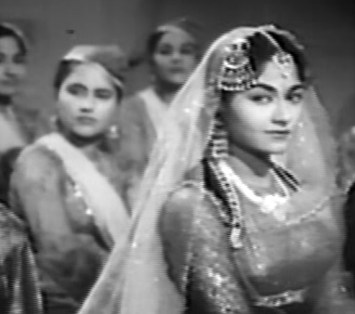
Ratna Barsaat Ki Raat

Ratna, wife of Bharat Bhushan, plays a sassy side-kick in the film Barsaat Ki Raat (1960)
Dil Jo Na Keh Saka Lyrics and Translation: Let’s Learn Urdu-Hindi

A vengeful Pradeep Kumar taunts Meena Kumari at her engagement party in Bheegi Raat (1965)

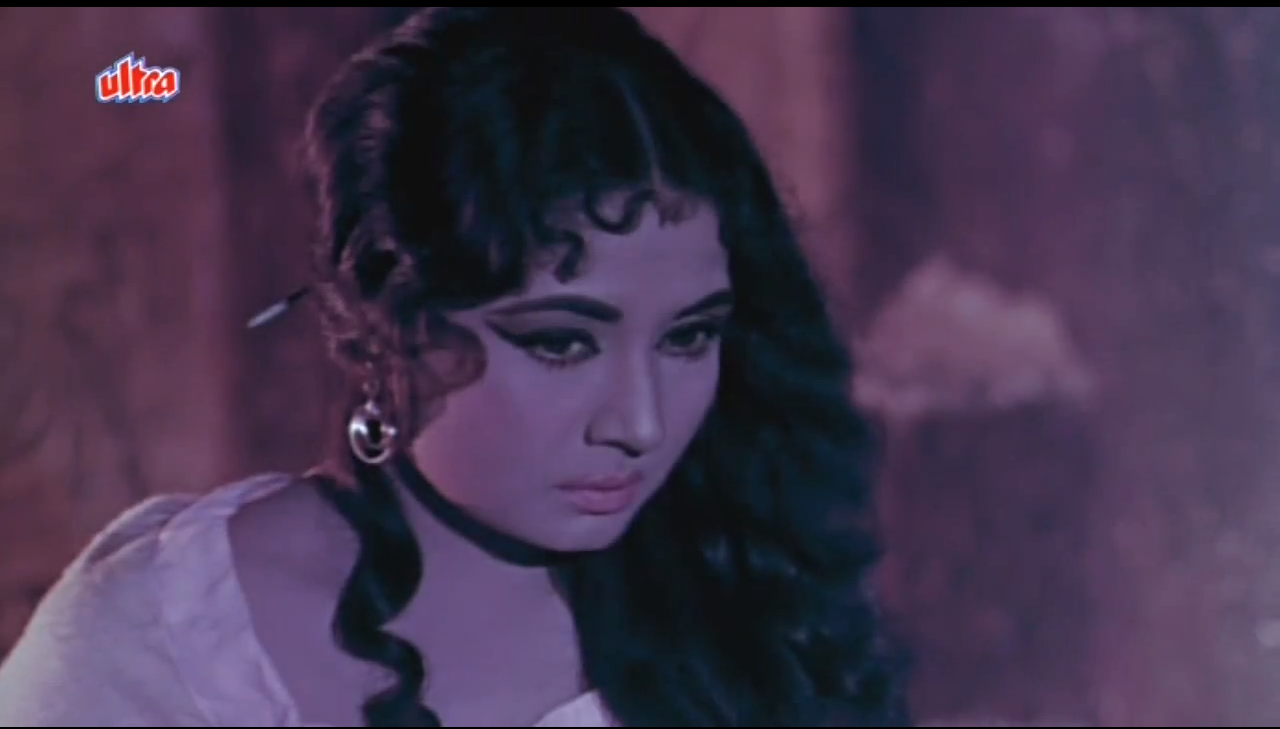
Bheegi Raat (1965) stars Ashok Kumar, Meena Kumari, and Pradeep Kumar in a classic Bollywood love triangle story full of messy drama and heartache. The film is not particularly memorable for its plot, but the soundtrack composed by Roshan and penned by Majrooh Sultanpuri contains a beautiful Raga Yaman-based gem that is still remembered today: “dil jo na keh saka.” Here, I’ve provided the lyrics and translation for both the female version (sung by Lata Mangeshkar) and the male version (sung by Mohammed Rafi) found in the film. The lyrics for the female version are standard Bollywood fare, but the male version is surprisingly vengeful and caustic. Hearing these lyrics in context of the film makes more sense: a jealous Pradeep Kumar taunts Meena Kumari using this song at a party celebrating her engagement to Ashok Kumar during the film’s conclusion. Even still, some of these lyrics are pretty wild. For example, he implores Meena’s character to drink blood from the heart (!) (piyo chaahe khuun-e-dil ho, ki piite pilaate hi…). The bitter sentiments found in these lyrics really drive home a theme expressed in Hindi films from this era that we’re all forced to grapple with at some point — love really hurts sometimes, doesn’t it?

–Mr. 55

P.S. Obviously, the Rafi version of this song is more popular than the Lata version, but I really think Lata holds her ground in this case with the tandem rendition. Her version has a segment of humming during the introduction that isn’t found in the Rafi version, which has always sounded absolutely heavenly to me.

Dil Jo Na Keh Saka Lyrics and Translation:


[Male]

dil jo na kah sakaa, vohii raaz-e-dil kahne kii raat aayii
The  night has come to uncover that secret which my heart could not reveal. 

naghmaa saa koii jaag uThaa badan me.n
A melody has awakened in my soul,
jhankaar kii sii thharthharii hai tan me.n
and a tinkling sensation quivered throughout my body.
mubaarak tumhe.n kisii kii laraztii sii baaho.n me.n rahne kii raat aayii
Congratulations to you, for the night has come to spend in someone else’s quivering arms. 

taubaa! yeh kis ne anjuman sajaa ke
Oh! Who has organized this gathering
tukDe kiye hai.n gunchaa-e-vafaa ke?
and destroyed the flowerbud of love?
uchhaalo gulo.n ke tukDe ki rangii.n fizaao.n me.n rehne kii raat aayii
Toss up the pieces of those flowers, for the night has come to spend in this colorful atmosphere.

chaliye mubaarak jashn dosti kaa,
Felications on this celebration of friendship;

daaman to thaamaa aap ne kisii kaa
you have accepted someone else’s embrace. 

hame.n to khushii yahii.n hai, tumhe.n bhi kisii ko apnaa kahne kii raat aayii
I am pleased, as the night has come for you to call someone else your own.

saaghar uThaao, dil kaa kis ko gham hai?
Raise your wine glass; who sulks for the heart?
aaj dil kii qiimat jaam se bhi kam hai
Today, the value of a heart is worth less than that of wine.  

piiyo chaahe khuun-e-dil ho ki piite pilaate hii rahne kii raat aayii
Drink the blood of the heart if you so desire, for the night of endless drinking has come. 

dil jo na kah sakaa, vohii raaz-e-dil kehne kii raat aayii
The night has come to uncover that secret which my heart could not reveal.


[Female]

dil jo na kah sakaa, vohii raaz-e-dil kahne kii raat aayi
The night has come to uncover that secret which my heart could not reveal. 

naghmaa saa koii jaag uThaa badan me.n
A melody has awakened in my soul,
jhankaar kii sii thharthharii hai tan me.n
and a tinkling sensation quivered throughout my body. 

pyaar kii inhii.n dhaDaktii fizaao.n me.n rahne kii raat aayii
The night has come to spend in this pulsating ambience of love.  

ab tak dabii thii ek mauj-e-armaa.n
Until now, a wave of desire was suppressed within me.
lab tak jo aayii ban gayii hai tuufaa.n
When it reached my lips, it became a storm.
baat pyaar ki bahakti nigaaho.n se kahne kii raat aayii
The night has come to speak about love to those wandering eyes. 

guzare na yah shab, khol duu.n ye zulfe.n
As the night passses slowly, I shall let down my hair.
tum ko chhupaa luu.n muund ke ye palake.n
And I will hide you by shutting these eyelids. 
beqaraar sii laraztii sii chhaa.nvo.n me.n rahne ki raat aayii
The night has come to spend in these restless and quivering shadows. 

dil jo na kah sakaa, vohii raaz-e-dil kahne kii raat aayi
The  night has come to uncover that secret which my heart could not reveal.

Meena Kumari looking beautiful (and sad) as usual in Bheegi Raat (1965).

Glossary:

raaz-e-dil: secret of the heart; naghmaa: melody, song; thharthharaanaa: to quiver;  jhankaar: tinkle; laraztii: trembling; baaho.n: arms; tauba: oh!; anjuman: gathering; tukDe karna: to crush, destroy; gunchaa-e-vafaa: flowerbud of love; uchhaalna: to throw, toss up; gul: flowerfizaa: atmosphere, ambience; jashn: celebration; daaman thhaamnaa: to accept an embrace; saaghar: wine glass; qiimat: price, value; jaam: wine; khuun-e-dil: blood of heart; dabnaa: to suppress; mauj-e-armaa.n: wave of desire; bahakna: to wander; shab: night; muundna: to shut; palake.n: eyelids; beqaraar: restless