Zindagi Kaisi Hai Paheli Lyrics and Translation: Let’s Learn Urdu-Hindi

Rajesh Khanna Anand Zindagi Kaisi Hai Paheli

Dangerously attractive Rajesh Khanna proves that real men wear lavender in Anand (1971).

Next we showcase the lyrics and English translation of “Zindagi Kaisi Hai Paheli” from the sentimental mega-hit Anand (1971). Diagnosed with terminal lymphosarcoma of the intestine, Rajesh Khanna is determined to raise the spirits of those around him. With a smile, he explains his philosophy to his bewildered physician, Amitabh Bachhan:

“Babumushai, zindagii badii honii chahiye, lambii nahii.N.” [“Babumushai, life should be big, not long.”]

Brimming with rich symbolism from floating balloons to boatmen in the ocean, “Zindagi Kaisi Hai Paheli” explores the outlook of a man whose journey is approaching its destination. Rajesh Khanna give a tour de force performance as a character at peace with the mysteries of the world.
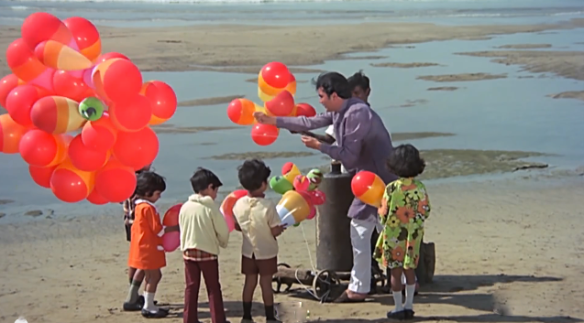
Rajesh Khanna gives out balloons at Juhu Beach

Rajesh Khanna buys out a lucky balloon-wala in “Zindagi Kaisi Hai Paheli” from Anand (1971).

The song begins with a distinctive, uplifting trumpet solo, establishing the tone. While other gorgeous songs of Anand such as “Kahin Door Jab Din” are sung by the gentle Mukesh, Manna Dey was chosen for “Zindagi Kaisi Hai Paheli.” Known better for his masterful Hindustani classical numbers of the 1960s, Manna Dey’s film career began to falter with the rise of Kishore Kumar’s heroic romantic vocals. But his popularity revived in the 70s with Anand when Rajesh Khanna himself asked music director Salil Chaudhary for a chance to lip-sync a Manna Dey song. As Manna Dey recalled in a 2012 interview,

“I loved the way he [Rajesh Khanna] picturised music. The success of a song depends upon how an actor picturises it. He was the number one in picturising songs. I will ever be indebted to him.”

We hope you enjoy the lyrics and English translation of “Zindagi Kaisi Hai Paheli” from Anand (1971). Follow along with the video here while reflecting on film lyricist Yogesh’s philosophical poetry!

Zindagi Kaisi Paheli Lyrics and Translation:

Zindagii kaisii hai pahelii, haaye!
Oh, what a riddle life is!
Kabhii to ha.Nsaaye kabhi yeh rulaaye
Sometimes it makes us laugh, sometimes it makes us cry

Kabhii dekho man nahii.N jaage, peechhe peechhe sapno.N ke bhaage
Sometimes the mind does not awaken, it chases dreams
Ek din sapno.N ka raahii chalaa jaaye sapno.N ke aage, kahaa.N?
One day that traveler of dreams will go beyond the dreams, but where?

Jin hone sajaaye yahaa.N mele sukh dukh sang-sang jhele
Those who bring people together, they experience joy and sorrow together
Wohii chunkar khaamoshii yuu.N chalii jaaye akele, kahaa.N?
Those same people choose silence and depart alone, but where?

Glossary:

zindagii: life; pahelii: riddle, puzzle; haaye: oh, sigh; ha.Nsaanaa: to make [someone] laugh; rulaanaa: to make [someone] cry; man: mind; jaagnaa: to awaken; peechhe: behind; bhaagnaa: to run; ek din: one day; sapnaa: dream; raahii: traveler; aage: ahead, future; melaa sajaanaa: to arrange a fair (literal), to bring people together; sukh: happiness; dukh: sadness; sang-sang: together; jhelnaa: to experience; chunnaa: to choose; khamoshii: silence; akelaa: alone
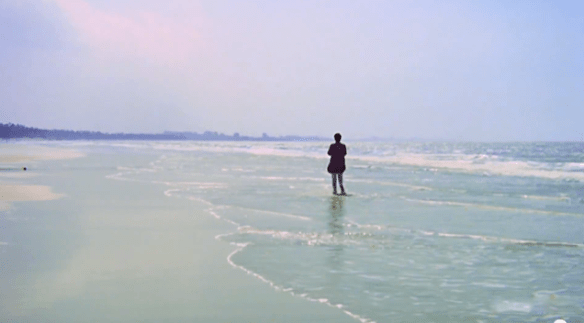
Juhu Beach Rajesh Khanna Zindagi Kaisi Hai Paheli Anand

“Zindagi Kaisi Hai Paheli” was famously filmed at suburban Bombay’s Juhu Beach, made even more gorgeous by the delicate silhouette of Rajesh Khanna against the shoreline.

It’s hard to believe we lost a legend like Manna Dey 6 months ago, a little more than a year after losing Rajesh Khanna. The singer was 95 years old. This beautiful tribute to those dream chasers we wish were with us, “Zindagi Kaisi Hai Paheli,” was requested by fan Ajay.

-Mrs. 55
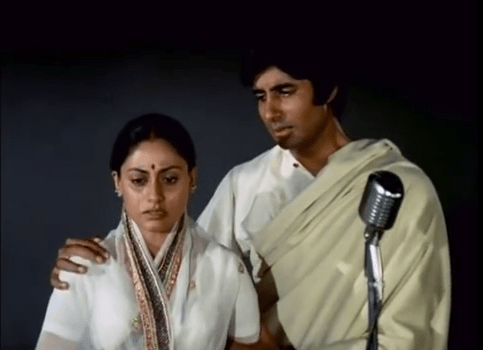
Tere Mere Milan Ki Lyrics and Translation: Let’s Learn Urdu-Hindi

tere mere milan jaya amitabh abhiman

In the famous climax of Abhimaan (1973), Jaya Bhaduri and Amitabh Bachhan reunite on-stage for an emotional rendition of “Tere Mere Milan Ki.”

Today we showcase the lyrics and full English translation of “Tere Mere Milan Ki” from the 1973 hit film Abhimaan. Based loosely on the life of famous playback singer Kishore Kumar and his first wife, Ruma Ghosh, the film centers around a talented newlywed couple whose marriage is threatened by professional jealousy. When high-rolling pop singer Amitabh Bacchan marries innocent country girl Jaya Bhaduri, her newly-discovered musical prowess steals his limelight with alarming disharmony.

The show-stopping number “Tere Mere Milan Ki” is a song of reconciliation in the film’s finale. Flowing with tenderness and hope, the enchanting duet gives Amitabh Bacchan and Jaya Bhaduri another chance to love each other. Is their marriage worth saving? Read more about the film’s story and behind-the-scenes gossip in our earlier review of Abhimaan!

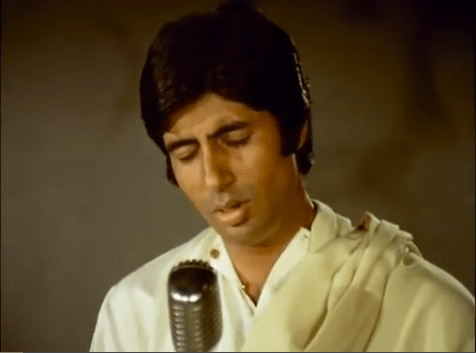
Amitabh Bachan abhiman tere mere milan

Amitabh Bachhan humbly begins his performance alone and ashamed in Abhimaan (1973).

Rightfully earning S.D. Burman the 1973 Filmfare Award for Best Music Director, “Tere Mere Milan Ki” is a classic example of Rabindra-sangeet in Bollywood. The song dazzles with Majrooh Sultanpuri’s poetic nuances, a metaphorical glimpse into the creation of a family. He describes the lover’s eyes as “chanchal,” which can mean playful, but also implies something that does not remain in one spot, a certain liveliness in spirit. With every “dekho na,” he directs that gaze back toward the night of their union, while she looks toward what lies ahead and the family they will begin together.

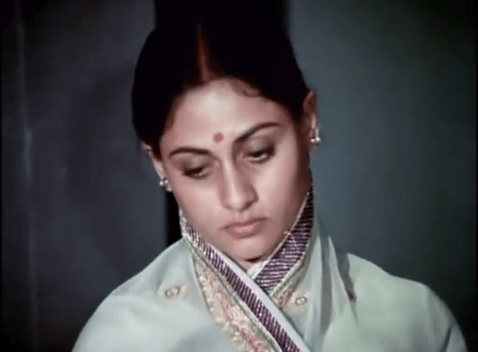
Jaya Bahaduri tere mere milan abhiman

Jaya Bhaduri mourns her miscarried child backstage of her husband’s performance in Abhimaan (1973).

For me, this song has always glowed. Lata Mangeshkar’s voice resonates after the opening stanza like an angel descending from heaven. But it was only after seeing the film that I realized the heroine of the story had recently suffered a miscarriage. Thus the lines “nanhaa sa gul khilegaa a.Nganaa” are more than a hope for the future, but a true reflection of their family’s dream deferred. The entire song changed its meaning for me, and became if possible, even more poignant.

We hope you enjoy our English translation and lyrics to “Tere Mere Milan Ki” from Abhimaan (1973) below! Follow along with the video here.

Tere Mere Milan Ki Yeh Raina Lyrics and Translation:

Male:
Tere mere milan kii yeh rainaa
On the night of your and my union
Nayaa koi gul khilaayegi
A new rose will bloom
Tabhi to chanchal hai tere naina
That is why your eyes are playful
Dekho na! Dekho na, tere mere milan kii yeh rainaa
Look! Look at the night of your and my union

Female:
Nanha sa gul khilegaa a.Nganaa
A small rose will bloom upon our balcony
Suunii baiyaa sajegii, sajnaa
She will decorate my lonely arms, beloved
Male:
Jaise khele chandaa baadal mei.N
Just as the moon plays with the clouds
Khelegaa woh tere aa.Nchal mei.N
She will play in the folds of your saari
Female:
Chandaniyaa gungunaayegi
The rays of the moon will sing
Tabhi to chanchal hai tere naina
That is why your eyes are playful
Dekho na! Dekho na, tere mere milan kii yeh rainaa
Look! Look at the night of your and my union

Male:
Tujhe thaame kaii hatho.N se
I will hold your hand many times
Miluu.Nga madbharii raato.N mei.N
I will meet you many intoxicating nights
Female:
Jagaake aansuunii si dhaDkan
By awakening this unfamiliar heartbeat
Balamwaa, bhar duu.Ngii teraa man
My beloved, I will fill your soul
Male:
Nayii adaa se sataayegii
With a new style you will torment me
Tabhi to chanchal hai tere naina
That is why your eyes are playful
Dekho na! Dekho na, tere mere milan kii yeh rainaa
Look! Look at the night of your and my union

Both:
Nayaa koi gul khilaayegi
A new rose will bloom
Tabhi to chanchal hai tere naina
That is why your eyes are playful
Dekho na! Dekho na, tere mere milan kii yeh rainaa
Look! Look at the night of your and my union

Glossary:

milan: meeting, union; rainaa: night; gul: rose; tabhi: this is why, hence; chanchal: restless, playful; nainaa: eyes; nanhaa: little, tiny; a.Nganaa: balcony; suunii: lonely; baiyaa: arms; sajnaa [verb]: to decorate; sajnaa [noun]: darling, beloved; chandaa: moon; baadal: clouds; aa.Nchal: the end of a saari (pallu) or dupatta; chandan: silver, rays of the moon; gungunaanaa: to hum, to sing; haath thaamnaa: to hold hands; madbharii: filled with intoxication; jagaanaa: to wake up; aansuunii: unfamiliar, unheard; dhaDkan: heartbeat; balamwaa: lover; man: soul, heart; adaa: style; sataanaa: to torment

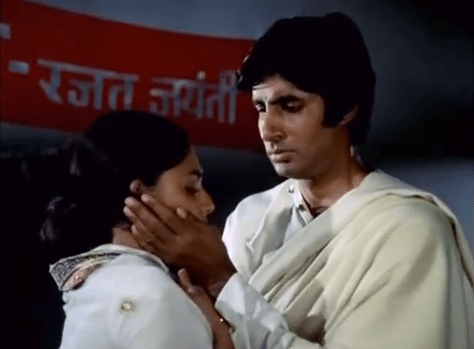
Amitabh comforts Jaya tere mere milan abhiman

Art mimics life as Amitabh Bachhan comforts Jaya Bhaduri in “Tere Mere Milan Ki” from Abhimaan (1973).

This lovely Lata-Kishore duet was requested by fan Dilip! Thank you for the beautiful request! For more songs from Abhimaan, check out our earlier post on the lovely Rafi-Lata duet “Teri Bindiya Re.”

– Mrs. 55

Shokh Nazar Ki Bijliyan Lyrics and Translation: Let’s Learn Urdu-Hindi

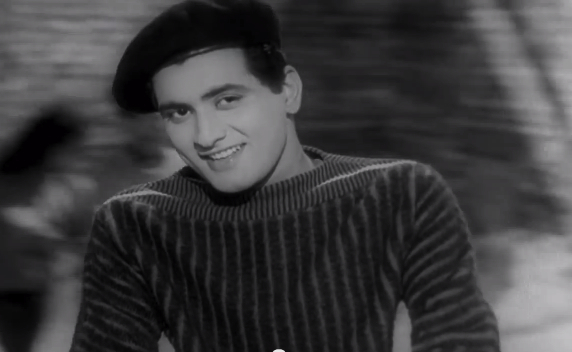
Manoj Kumar Shokh Nazar Ki Woh Kaun Thi ice skating

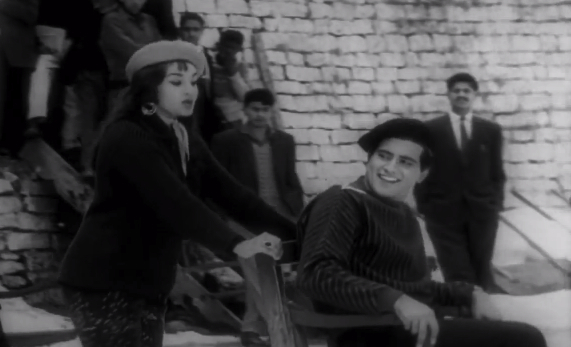
Looking extra-special in a French beret, Manoj Kumar goes for a spin on the ice in “Woh Kaun Thi” (1964).

Today we present the lyrics and English translation to the playful wintertime number “Shokh Nazar Ki Bijliyaan” in honor of the Winter Olympics 2014 figure skating competition! My life goes on temporary hold when the Winter Olympics rolls around. I always root vehemently for Team USA, especially in my favorite of all Olympic competitions: Women’s Figure Skating! Have you ever asked why India never participates in figure skating? Today’s showcased song “Shokh Nazar Ki Bijliyan” will prove that it’s not because India lacks talent!

After suffering a series of severe shocks as the hero of Woh Kaun Thi? (1964), Manoj Kumar takes a trip to Simla with his co-worker Praveen Chaudhary to forget his woes. Praveen Chaudhary, who is not-so-secretly in love with him, takes the opportunity to seduce her man with a pair of skates in a way no woman had dared before. Enter Bollywood On Ice!

Praveen Chaudhary Manoj Kumar Woh Kaun Thi ice skating

Praveen Chaudhary playfully pushes Manoj Kumar around the Simla Ice Skating Club in Woh Kaun Thi (1964).

After watching her B-grade flirtatious efforts in this song and comparing them to heroine Sadhana’s subtle performance in “Lag Ja Gale” from the same film, it’s easy to discern which lucky lady Manoj Kumar ultimately chooses. To drive the point home, did you further notice how Praveen is wearing a garish “Western” outfit while Sadhana consistently dresses in saaris? Manoj Kumar may be no Evgeni Plushenko, but his moves always seemed to get all the girls!

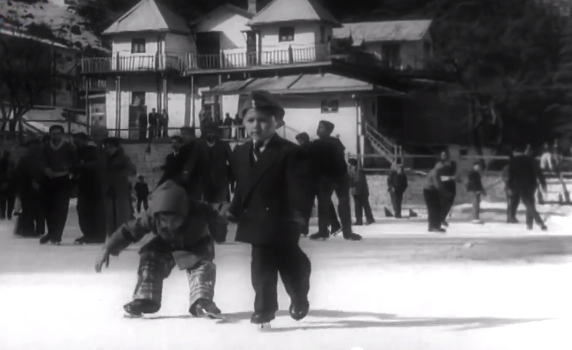
“Shokh Nazar Ki Bijliyan” was actually picturised on a famous ice-skating rink, the Simla Ice Skating Club, that is still popular in downtown Simla today! In fact, my own father fondly recalls his childhood in Simla, skating at this very rink where evidently they used to blast the gramophone record of Woh Kaun Thi through their speakers so the songs could be heard for miles around! My father also claims that the kid who adorably falls down in the middle of the song is none other than my own uncle, but this has been vehemently rebuked at many a family reunion.

random kids shokh nazar ki bijliyan woh kaun thi ice skating

Kid, if you ever stumble across this blog, write to us! Did you grow up to become a famous cardiothoracic surgeon? Are you a spoken word poet? Do you sell aloo-puri along the roads of Himachal Pradesh? I NEED TO KNOW what happened to you.

But enough chat. Join us in the spirit of the Winter Olympics with a little romantic ice-skating brought to you by Asha Bhonsle and music composer extraordinaire Madan Mohan. Watch the gold medal-worthy performance here, and follow along with our full English translation and lyrics to “Shokh Nazar Ki Bijliyaan” below!

Shokh Nazar Ki Bijliyaan Lyrics and English Translation:

Shokh nazar ki bijliyaa.N dil pe mere giraaye jaa
Let the lightening bolts of your mischievous glances fall upon my heart
Meraa na kuch khayaal kar, tu yuu.N hii muskuraaye jaa
Do not worry about me, you keep on smiling

Jaag uThii hai aarzuu jaise chiraagh jal paDe
My desire has arisen as if a lamp has been lit
Ab to wafaa ki raah pe hum tere saath chal paDe
Now I have stumbled upon the path of loyalty with you
Chaahe ha.Nsaaye jaa hame.N, chaahe hume.N rulaaye jaa
If you want, you can keep making me laugh or you can keep making me cry

Chain kahii.N kisii ghaDii aaye na tere bin mujhe
Without you, I find no peace anywhere at any moment
Kaash mai.N is jahaa.N se chhiin luu.N ek din tujhe
If only I could steal you away from this world one day
Main tere saath saath hoon, chahe nazar bachaaye jaa
I am by your side, even if you keep avoiding eye contact

Manzil-e ishq duur hai, duur hi bahut duur hai
The destination of our love is far away, very far away
Aa meraa haath thaam le, ruuh thakan se chuur hai
Come, take my hand, my spirit is broken by fatigue
Apne jahaa.N ko chhoD kar, mere jahaa.N pe chaaye jaa
Leave your world, and keep staying in mine

Glossary:

shokh: mischievous, playful; nazar: glance, eyes; bijli: lightening; dil: heart; giraanaa: to let fall; khayaal: thought: yuu.N hii: in this manner, like this; muskuraanaa: to smile; jaag uThnaa: to wake up, to arise; aarzuu: desire; chiraagh: lamp, flame; wafaa: loyalty, faith; raah: path; [kisii ke] saath: by [someone’s] side, together; ha.Nsaanaa: to make laught; rulaanaa: to make cry; chain: peace of mind; ghaDii: moment; kaash: if only; jahaa.N: world; ek din: one day; manzil: destination; ishq: love; duur: far away; haath thaamnaa: to take [someone’s] hand; ruuh: spirit, soul; thakan: exhaustion; chuur: broken

mrs 55 ice skating rockefeller center nyc

Practicing my triple Lutz at the Rockefeller Center ice skating rink in New York City!

ice skatin grockefeller center

Me and some of my roommates (soon to be bridesmaids!), holding up ice skating rink traffic.

You may notice that there’s a discrepancy between the lyrics of the version you see in the video and the ones you may hear on your audio version. Each one has a different second stanza! This comes back to an old sore point I’ve made before about how record companies short-changed Hindi film songs when making the final LP!

-Mrs. 55

Na Tum Humen Jano Lyrics and Translation: Let’s Learn Urdu-Hindi

Na Tum Humen Jano Dev Anand

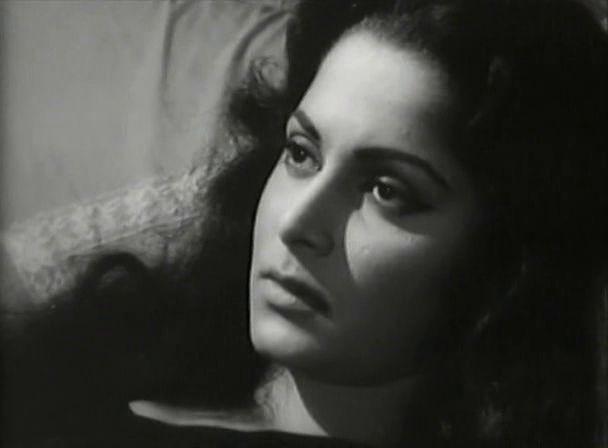
With glistening suavity dripping from his pomade, Dev Anand croons the love ballad “Na Tum Humen Jano” to a sleeping Waheeda Rehman in Baat Ek Raat Ki (1962).

Today we showcase the lyrics and English translation of the haunting melody “Na Tum Humen Jano” from Baat Ek Raat Ki (1962). Dapper Dev Anand plays a young lawyer whose enigmatic client, Waheeda Rehman, has been convicted of murdering her ex-lover in a fit of rage. Deemed clinically depressed and mentally unhinged, Waheeda’s only chance at redemption, in classic Bollywood tradition, is the stable love of a good man. Dev Anand rises quickly to the occasion, “pretending” to woo her for..ahem…medical reasons–and more importantly to extract the true events leading up to the murder for which she is convicted. I think it comes as no surprise that she ultimately proves innocent and Dev Anand actually falls in love with her while faking it. But that’s not what makes this film’s twist ending so fantastic–and trust me, it’s not what you’d expect!

Waheeda Rehman Na Tum Humen Jano

Waheeda Rehman is awakened by the sound of a haunting melody in Baat Ek Raat Ki (1962). Did anyone mention that black is totally your color, Waheeda?

So how does this gem of a Hemant Kumar solo fit into the bizarre whoddunit? I’ve always found Hemant Kumar an intriguing rogue in the strict actor-singer pairings of classic films–the mysterious dark chocolate mousse of Bollywood playback. His tender yet overwhelmingly manly voice stood out among the Rafi wannabes of the age–the celestial way his voice resonates in the opening lines is a rich treat for the soul. Famed music director Salil Chowdhury said of the singer’s voice,

“If God could sing, he would have a voice like Hemanta.”

Have truer words ever been spoken? No better testament exists than the love song “Na Tum Humen Jano.” In Baat Ek Raat Ki, “Na Tum Humen Jano” plays on a gramophone record in the moments leading up to the murder. Waheeda Rehman is so traumatized afterwards, she cannot recall details of the event or her exact involvement. Naturally, Dev Anand believes that singing the song while she sleeps will subconsciously trigger her memory, thereby providing him the missing evidence of what  transpired that fatal night. He croons to her hidden in the background, observing her reaction as the melody wafts through the air. What follows is one of the most nostalgic songs of yesteryear.

We hope you love the lyrics and English translation to “Na Tum Humen Jano” as much as us! Follow along with the video and try to keep your beating heart in check as you get swept away in the romance!

Na Tum Humen Jano Lyrics and Translation:

Na tum hame.N jaano, na hum tumhe.N jaane
You do not know me, I do not know you
Magar lagtaa hai kuch aisaa meraa humdum mil gayaaa
Yet somehow I feel as if I have found my soul mate

Yeh mausam yeh raat chhup hai
These surroundings and this night are quiet
Woh honTo.N kii baat chhup hai
Those words on our lips are quiet
Khamoshii sunaanii lagii hai dastaa.N
The silence has begun to tell a story
Nazar ban gayii hai dil kii zubaa.N
Our glances have become the language of our hearts

Mohabbat ke moD pe hum
At the crossing of love
Mile sab ko chhoDke hum
We met and left everything behind
DhaDakhte dilo.N ka leke yeh caravaa.N
We took our beating hearts with us on this caravan
Chale aaj dono.N jaane kahaa.N
Let us go together today, I know not where

Na tum hame.N jaano, na hum tumhe.N jaane.N
You do not know me, I do not know you
Magar lagtaa hai kuch aisaa meraa humdum mil gayaaa
Yet somehow I feel as if I have found my soul mate

Glossary:

humdum: soulmate; mausam: atmosphere, surroundings; raat: night: chhup: quiet; honT: lips; baat: words; khamoshii: silence; sunaanaa: to tell; daastaa.N: tale, story; nazar: glance; zubaa.N: language; mohabbat: love; moD: crossing, turn; sab: everything; dhaDakhnaa: to beat [heart]; aaj: today

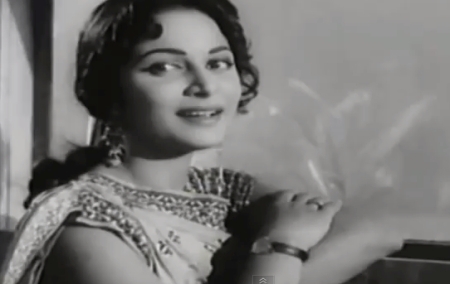
Waheeda Rehman Baat ek raat ki na tum humen jano

Prior to murder charges, the lovely Waheeda Rehman sings merrily along to a record of “Na Tum Humen Jano” in Baat Ek Raat Ki (1962).

Now before anyone comments on how angelic Lata’s solo moment is halfway through the song, don’t be fooled! That voice of a goddess is none other than rival soprano Suman Kalyanpur! Her highest high note in the cameo moment is an E5, which doesn’t even come close to Asha and Lata’s famous trills. Composed by S.D. Burman, the song is fully picturized as a happy female solo earlier in the film here! Was Suman Kalyanpur’s solo able to compete with the magic of the famous Hemant counterpart? I think it was certainly a valiant effort, but…let’s not lie to ourselves.

Our English translation of “Na Tum Humen Jano” was requested by diehard fangirl Reena! Stay classy, Reena.

– Mrs. 55

Teer-e Nazar Dekhenge Lyrics and Translation: Let’s Learn Urdu-Hindi

Teer-e-nazar 1

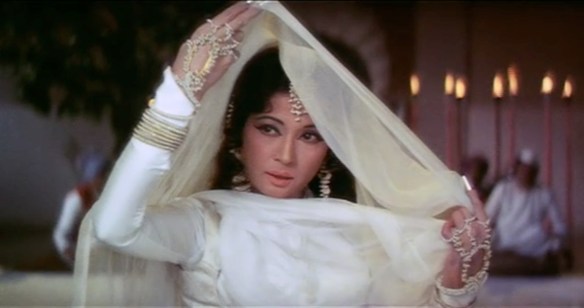
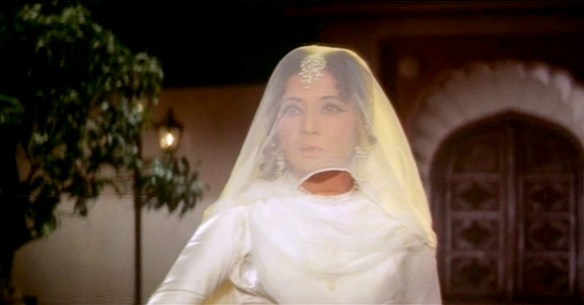
Bedecked in a white gown symbolic of her own death, Pakeezah dances at the celebration of her lover’s marriage to another woman in Pakeezah (1971).

We now showcase the lyrics and English translation to Lata Mangeshkar’s “Teer-e Nazar” from the cinematic jewel Pakeezah (1971). One of classic Bollywood’s most iconic and daring song sequences, “Teer-e Nazar” dazzles the audience by the audacity of its stunning visual fabric–the magnum opus of the industry’s greatest artists with a story worthy of their union. In an ironic twist, the film’s heroine Pakeezah is asked to perform a mujraa at the wedding of her lover to another woman. Throughout the striking song that follows, director Kamal Amrohi deliberately transforms our understanding of beauty and love into omens of murder and death.

Lyricist Kaif Bhopali’s title phrase “teer-e nazar,” while otherwise a romantic reference to a lover’s piercing gaze, assumes a sinister implication, a literal means of wounding its target. Pakeezah once more dances a graceful kathak dance, but this time she is dressed for a funeral in all-white. The death she celebrates is her own. Her beautiful dance suddenly re-invents itself when she purposefully smashes a glass chandelier across the pristine white floor. The moment is one of the most shocking in Bollywood history, with a dramatic shift in the room’s dynamics to accompany the jarring musical screech. Before this moment, Pakeezah was a mere witness to the injustice of her society’s prejudices. Now, Pakeezah wields a commanding power, entrancing a captive audience to which she willingly presents herself as a ritual sacrifice in the name of her own unfulfilled love.

Teer-e-nazar 4

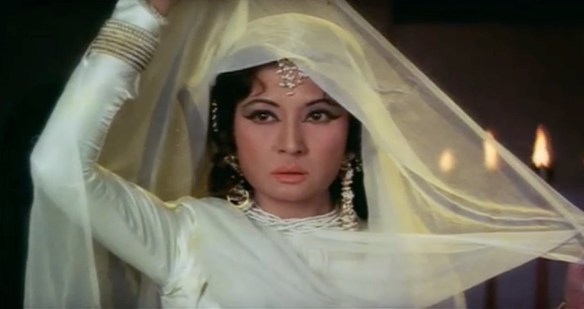
Like a veiled Lady of Shallot, the effervescent Meena Kumari as Pakeezah realizes the show is coming to an end tonight.

Unleashing a passion she had been trained for so long to suppress, Pakeezah dances upon the jagged broken glass with a frenzied energy. Her blood, the bright red of wedding bliss she has been denied, stains the floor with every footstep. As evidenced by the film’s famous dialogue, feet play an important sensual role in Pakeezah. The blood-smeared feet ironically mirror the once dainty red foot paint of a dancer–the vehicle by which Rajkumar first fell in love with Pakeezah in a train compartment, begging her romantically to never allow them to touch the ground. With each step, Pakeezah regains her identity by destroying the constraints of her past.

Director Kamal Amrohi brilliantly shapes the scene through a chaotic editing pattern as fragmented and disturbing as the glass upon which she dances. Below is a short gallery of some of the many gorgeous shots that compose this scene, each more violent than the next.

This iconic song is among Bollywood’s greatest cinematic moments–made even more fascinating by the behind-the-scenes gossip between Meena Kumari and stunt double Padma Khanna who actually dances in this sequence! Follow along with the video, and we hope you enjoy our lyrics and English translation to the awe-inducing “Teer-e Nazar” from Pakeezah (1971) below!

Teer-e Nazar Dekhenge Lyrics and Translation:

Aaj hum apnii du’aao.n kaa asar dekhe.Nge
Today I shall behold the image of my prayers
Teer-e nazar dekhe.Nge, zakhm-e jigar dekhe.Nge
I shall see arrows from your glances, I shall see the wounds of my heart

Aap to aa.Nkh milaate hue sharmaate hai.N
Upon meeting my eyes, you feel embarrassed
Aap to dil ke dhaDakne se bhi Dar jaate hai.N
You are even afraid of your own heartbeat
Phir bhi yeh zidd hai ki ham zakhm-e jigar dekhe.Nge
Nonetheless I remain stubborn to witness the wounds of my heart
Teer-e nazar dekhe.Nge, zakhm-e jigar dekhe.Nge
I shall see arrows from your glances, I shall see the wounds of my heart

Pyaar karna dil-e betaab buraa hotaa hai
It is unfortunate for a weak heart to fall in love
Sunte aaye hai ki yeh khwaab buraa hota hai
I have heard that this dream of mine is also cursed
Aaj is khwaab ke taabiir magar dekhe.Nge
But today I will interpret the meaning of that dream
Teer-e nazar dekhe.Nge, zakhm-e jigar dekhe.Nge
I shall see arrows from your glances, I shall see the wounds of my heart

Jaan levaa hai mohabbat ka samaa aaj ki raat
Tonight this atmosphere of love feels fatal
Shamaa ho jaayegii jal jal ke dhuaa.N aaj ki raat
Tonight the lamps shall burn into smoke
Aaj ki raat bache.Nge to sahar dekhe.Nge
If I escape tonight, then I shall see the dawn
Teer-e nazar dekhe.Nge, zakhm-e jigar dekhe.Nge
I shall see arrows from your glances, I shall see the wounds of my heart

Aaj hum apnii du’aao.n kaa asar dekhe.Nge
Today I shall behold the image of my prayers
Teer-e nazar dekhe.Nge, zakhm-e jigar dekhe.Nge
I shall see arrows from your glances, I shall see the wounds of my heart

Glossary:

du’aa: prayer; asar: sign, image; teer: arrow; nazar: glance; zakhm: wound; jigar: heart; aankh milaanaa: to make eye contact; sharmaanaa: to become embarrassed, to be shy; dhaDaknaa: to beat [heart]; Dar jaanaa: to become afraid; zidd: stubborness, firm; betaab: weak; buraa: bad, unfortunate; khwaab ke taabir: interpretation of a dream; jaan levaa: fatal; mohabbat: love; samaa: atmosphere; shamaa: lamp; dhuaa.N: smoke; sahar: dawn

teer-e-nazar 2

Oh, Meena Kumari, will there ever live a woman so breathtakingly classy again?

This fantastic Pakeezah hit was requested by fans VintageBollywood and Moosa Desai! Thank you for the epic request!

Arguably, Pakeezah’s wild dance following the chandelier shattering contains the most thrilling music (composed by the great Ghulam Mohammed) in the entire film. But there’s a big unsolved mystery here. Does the ambiguity of the diegetic soundscape in this sequence bother anyone else but me? Think about it: If Pakeezah had just smashed a chandelier to the ground, ruffling the entire audience, and then starts bleeding all over the party floor, is it likely that the band would carry on as usual? But on the other hand, if the music is, in fact, non-diegetic, what are the odds her dance movements are still so perfectly coordinated to the beat? Is she in theory really dancing like a maniac to a silent room while the furious strings Kamal Amrohi added are for the film viewers’ ears alone? This is going to keep me awake at night.

For lighter moments from the iconic film, check out our translations of Pakeezah‘s immortal Chalte Chalte, Mausam Hai Aashiqaana, and Inhi Logo.N Ne!

-Mrs. 55