Ab Kya Misal Doon Lyrics and Translation: Let’s Learn Urdu-Hindi

Pradeep Kumar Aarti 1962

Pradeep Kumar sings an Urdu love poem to Meena Kumari in Aarti (1962)

The next English translation in our series is of the poetic lyrics to “Ab Kya Misal Doon” from Aarti (1962). This timeless song is one of Bollywood’s most beloved romantic odes by Mohammed Rafi. Pradeep Kumar, Meena Kumari, and Ashok Kumar star in Aarti, a family drama of love, debts, and vengeance. Ashok Kumar plays a wealthy surgeon and the villain of the film, vowing revenge when his betrothed, Meena Kumari, marries another man, Pradeep Kumar. An exacting dilemma of the film comes when ironically Ashok Kumar must decide whether or not to push aside his emotional battles and perform surgery on his own rival Pradeep Kumar to save his life. Of course, Meena Kumari throws in some more drama into the bargain–and her quiet beauty steals the show yet again. Aarti has a number of great songs written by Majrooh Sultanpuri, but unarguably the greatest is the sweet Mohammed Rafi ballad “Ab Kya Misal Doon.”

Pradeep Kumar plays “the other man” in the film–a good-hearted, but unemployed poetic dreamer who croons softly to Meena Kumari in this number. It would put any girl in a tough position: the poetry of the song is exquisite, without overwhelming anyone with an Urdu vocabulary exam. It has just the right blend of tenderness, lyricism, and adoration made magical by the unequivocal talent of Mohammed Rafi. Follow along on youtube here and enjoy our English translation of this poetic masterpiece!

Meena Kumari in Aarti 1962

Meena Kumari blushes as she hears Pradeep Kumar singing her praises in Aarti (1962)

Ab Kya Misal Doon: Lyrics and Translation

Ab kyaa misaal doon mei.N tumhaare shabaab ki
What can I now compare to your lustre?
Insaan ban gayee hai kiran mahtaab kii
You are a ray of the moon in human form

Chehre mei.N ghul gayaa hai haseen chaandni ka noor
The beautiful light of the moon has melted upon your face
Aankho.N mei.N hai chaman ki jawaan raat ka suroor
In your eyes is the garden of the early night’s joy
Gardan hai ek jhuki hui daali gulab kii
Your neck is like a lowered branch of a rose flower
Ab kyaa misaal doon…
What can I compare now…

Gesu khule to shaam ke dil se dhuan uThe
When your hair was let open, then the smokiness of night emerged from my heart
Chhule qadam to jhuk ke na phir aasmaan uThe
When your feet hit the ground, the sky bowed down would not raise itself again
Sau baar jhilmilaaye shamaa aftaab kii
The light of this sun sparkled a hundred times
Ab kyaa misaal doon…
What can I compare now…

Deewar-o-dar kaa rang, yeh aanchal, yeh pairhan
The end of your saarii and your robes are the colours of my refuge
Ghar kaa mere chiraagh hai boota sa yeh badan
The lamp of my house is this slender plant-like body
Tasveer ho tumhii mere jannat ke khwaab kii
You are the image of the paradise of my dreams
Ab kyaa misaal doon…
What can I compare now…

Glossary:

misaal: example, comparison; shabaab: glory, lustre; insaan: human; kiran: ray, mahtaab: moon; chehra: face; noor: light; chaman: garden; suruur: joy, exhilaration; gardan: neck; daalii: branch; gulaab: rose flower; gesuu: hair; dhuaan: smoke; qadam: footsteps; aasmaan: sky; sau baar: a hundred times; jhilmilaanaa: to sparkle, to shine; aftaab: sun; deewar-o-dar: walls and doors, refuge; rang: colour; aanchal: the end draping of a saarii; pairhan: robe; ghar: house; chiraagh: light; boota: small plant; badan: body; tasveer: image, picture; jannat: paradise; khwaab: dream

Meena Kumari filmfare awards 1962

Meena Kumari poses with Ashok Kumar and actress Shashikala at the 1962 Filmfare Awards.

Did you know in 1962, Meena Kumari was the only nominee at the Filmfare Awards for Best Actress? She was nominated for Aarti, Sahib Bibi Aur Ghulam, Main Chhup Rahuungi. Talk about a walk-over. She took it home for Sahib Bibi Aur Ghulam (1962).

-Mrs. 55

Nigahein Milane Ko Jee Chahta Hai Lyrics and Translation: Let’s Learn Urdu-Hindi

Who wouldn’t want to exchange glances with those eyes?

For today’s post, we showcase the lyrics and English translation of “Nigahen Milane To” from the film Dil Hi To Hai (1963). If I had to name my favorite actress from the Golden Era of Bollywood cinema, I think that I would pick Nutan.

As one of the beloved goddesses of India’s silver screen, Nutan starred in many evergreen films from the 1950s and 1960s, including Paying Guest (1957), Anari (1959), Bandini (1963), and Milan (1967), just to name a few. In my opinion, there’s something special about Nutan’s performances that sets her apart from her peers. She played her roles with a dignified beauty, a restrained grace, and an acute intelligence that was difficult to find in other actresses of the time. Here, I’ve chosen to translate a song from Dil Hi To Hai (1963), a charming Bollywood romance that is enjoyable to watch even though it is one of Nutan’s lesser-known films.

Nutan stars in Dil Hi To Hai as Jamila, the beautiful daughter of a wealthy London-based banker. Here, Raj Kapoor departs from the image established in his previous films by playing a comic double role as Jamila’s love interest Chand and Jamila’s aged music teacher Khan Sahab. While the film features some memorable performances by Nutan and Raj Kapoor, this film is probably even more memorable today for its soundtrack composed by music director Roshan. Two gems from this soundtrack have survived the test of time. The first is the Bhairavi-based classical number “laagaa chunarii me.n daag,” which is regarded as one of the best songs of Manna De’s career. The other gem is Asha Bhonsle’s exquisitely rendered Yaman qawwalinigaahe.n milaane ko jii chahtaa hai,” which I have translated here.

Penned by Sahir Ludhianvi, this qawwali centers around a woman’s desire to exchange glances with her beloved. The romanticization of eyes and sight is a common theme found in Bollywood films, and the poetry in this song is one of this era’s most cherished portrayals of this theme. The song’s charm is enhanced by the use of Urdu vocabulary (e.g. tahumat and tamhiid) and Asha Bhonsle’s immaculate rendition. Don’t you just love the way she owns those octave glides during the sargam passage?

Mrs. 55 and I actually performed this qawwali at Harvard during the annual South Asian cultural show Ghungroo two years ago. One thing that we noticed after listening carefully to these lyrics during rehearsal is that there is some ambiguity in gender. While most of the song appears to be from a female perspective, we thought that lyrics take on a masculine role for the line starting with “jab kabhii mai.ne teraa chaand-saa chahraa dekhaa…” (Whenever my eyes have fallen upon your moon-like face…). In addition to the fact that the moon is traditionally used by males to describe feminine beauty (e.g. Mohammed Rafi’s “yeh chaa.nd-saa roshan chahraa“), Nutan’s gestures and body language become more masculine in nature in this segment of the song. In fact, as she sings these two lines, Nutan begins to walk with a manly gait and and then flirts with a female friend as if she is her male lover. We may have totally made this up in our heads, but it was not uncommon for such gender-bending to occur in Bollywood songs–a full post on this trend will be coming up soon! In any case, please enjoy this timeless qawwali while following along with our translation/glossary provided below, and remember to send us your requests for any other songs that you would like translated.

-Mr. 55

Nutan takes on the masculine role for a few lines in this qawwali

Nigahein Milane Ko Jee Chahta Hai Lyrics and Translation

raaz kii baat hai, mahfil me.n kahe yaa na kahe?
It is a secret matter; shall I share it in this gathering?
bas gayaa hai koii is dil me.n, kahe yaa na kahe?
Someone has begun to reside in my heart; shall I reveal this here?

nigaahe.n milaane ko jii chahtaa hai
I yearn to exchange glances with my beloved. 
dil-o-jaa.n luTaane ko jii chahtaa hai
I yearn to give away my heart and soul to him.  

woh tahumat jise “ishq” kahtii hai duniyaa
The allegation that the world calls “love,”
woh tahumat uThaane ko jii chahtaa hai
I yearn to accept that allegation.  

kisii ke manaane me.n lazzat woh paayi
Although I have experienced the pleasure of being appeased,   
ki phir ruuTh jaane ko jii chahtaa hai
I yearn to once again engage in a lovers’ tiff. 
 
woh jalvaa jo ojhal bhii hai saamne bhii
The splendor that vanishes and reappears in love, 
woh jalvaa churaane ko jii chahta hai
I yearn to steal that splendor.  
 
jis ghaDii merii nigaaho.n ko terii diid huii
The moment when our eyes first met,  
woh ghaDii mere liye aish kii tamhiid huii
That moment served as a prelude to happiness for me.  
jab kabhii mai.ne teraa chaa.nd-saa chahraa dekhaa.
Whenever my eyes have fallen upon your moon-like face, 
Eid ho ya ki na ho mere liye Eid huii
it is as if I am celebrating the holiday of Eid.  

ni re ga, ga re ga ni re ma, ma ga ma ni re ga
ga re ga ni ga re, re ga, ga ma, ma dha ni
sa sa ni ni dha dha pa pa ga re
sa ni dha pa ma ga re,
ni dha pa ma ga re sa ni, re ga 

mulaaqaat
kaa koii paighaam diije
Please send me a message about our next rendez-vous, 
ki chhup-chhup ke aane ko jii chahtaa hai
Because I yearn to visit you secretly, 
aur aake na jaane ko jii chahtaa hai
And upon visiting you, I hope to never leave.  

nigaahe.n milaane ko jii chahtaa hai
I yearn to exchange glances with my beloved. 


Glossary

raaz: secret; mahfil: gathering; nigaahe.n: eyes; dil-o-jaan: heart and soul; tahumat: allegation; manaanaa: to appease; lazzat: pleasure; jalvaa: splendor,charm; ojhal: vanished; diid: sighting, gaze; aish: joy, happiness; tamhiid: prelude, preamble; Eid: Islamic festival celebrating the end of Ramadan; mulaaqaat: meeting, rendez-vous; chhup-chhup ke: secretly; paighaam: message.

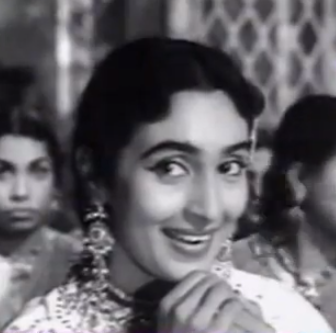
Nutan leads the chorus with an enchanting smile in Dil Hi To Hai (1963)

Bekhudi Mein Sanam Lyrics and Translation: Let’s Learn Urdu-Hindi

Babita Haseena Maan Jaayegi

Whoa there, Babita. Are you sure a Santa hat is appropriate for this occasion?

Our next Hindi lyric translation is the classic Rafi-Lata duet “Bekhudi Mein Sanam” from the film Haseena Maan Jaayegi (1968). The movie soundtrack is probably the only reason you would ever want to watch this film. Sure, the plot description is intriguing: two men (who happen to both be Shashi Kapoor) fall in love with the same woman (the unbearable Babita). One Shashi Kapoor is soft-spoken and romantic, while the other is an aggressive jokester who is spurned by our heroine. But then! War with China! Both men are called to duty, and when only one returns, Babita can’t tell if he is truly the man she loves–or his rival!

So you’re lured in, egged on by a few other vaguely recognizable Rafi numbers (“O Dilbar Janiye,” anyone?), and think you’re getting yourself in for a long Hum Dono-esque genre twin film with a swinger bent.

Oh, but how wrong you’d be.

Babita and Shashi haseena maan jaayegi

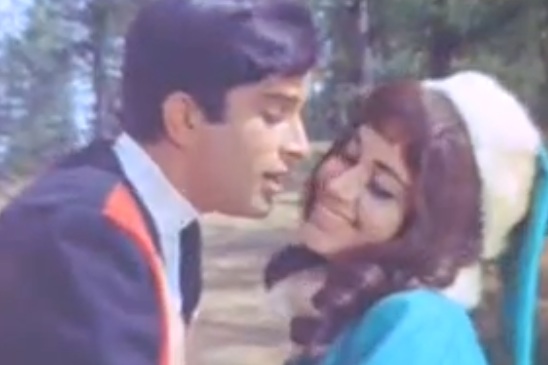
Shashi Kapoor and Babita play two college students in love in Haseena Maan Jaayegi (1968).

Haseena Maan Jaayegi is a painful free-falling bucket of awkward sauce that is weighed down by Babita’s insufferably thick voice, static characters, and an unfocused plot that never quite pulls together it’s obvious loose ends. I mean, seriously Babita? We need to spend two hours watching you try to decide if there is nothing unique about the man you married? Furthermore, what the heck, Shashi? Couldn’t you have convinced the scriptwriter to at least throw in just one line explaining why you guys look so similar? At least turn out to legitimately be twins separated at birth! There’s no way God would just magically make two Shashi Kapoors in this world. A lot of Indian women would be a lot happier if so.

Shashi Kapoor is entranced by Babita’a teal Santa suit from “Bekhudi Mein Sanam.”

Really, nothing gets my goat more than a twin movie that doesn’t acknowledge that they’re supposed to actually be twins. Do yourself a favor by skipping this cheese-flavored package of dry histrionics, and just youtube the songs because they’re awesome. Of particular note in “Bekhudi Mei.N Sanam” is Babita’s puffy white fur Santa hat and teal blue jumpsuit. This is just in case any audience member had lost their mind and started to make the mistake of taking her seriously. Check out the youtube link for the song here and follow along with the lyrics and translation below to this this otherwise beautiful ode of love!

Bekhudi Mein Sanam Lyrics and Translation

Bekhudi mei.N sanam, uTh gaye jo qadam
Unaware of my self, as I started walking
Aa gaye, aa gaye
I arrived
Aa gaye paas hum, aa gaye paas hum
I arrived nearer to you

Aag yeh kaisii man mei.N lagii hai?
What kind of fire is aflame in my mind?
Man se badhii to tan mei.N lagii hai
Yet, even bigger than that in the mind, is the one burning my body
Aag nahii.N yeh dil ki lagii hai
This is not a fire, its the heart’s desire
Jitnii bujhaayii, utnii jalii hai
However much you try to put it out, it will keep burning

Dil ki lagi na ho to, kya zindagii hai?
Without this desire of the heart, what is life?
Saath hum jo chale miT gaye faasle
When we walk together, all that separates us disappears
Aa gaye, aa gaye
I arrived
Aa gaye paas hum, aa gaye paas hum
I arrived nearer to you

Khoyii nazar thii, soye nazaare
The vision was lost, and the sights were asleep
Dekhaa tumhe to jaage yeh saare
On seeing you, all of them were awakened
Dil ne kiye jo dil ko ishaare
As one heart signaled to the other
Milke chale hum saath tumhaare
We met and walked together

Aaj khushii se meraa dil yeh pukaare
Today my heart calls out with joy
Teraa daaman milaa, pyaar meraa khilaa
In finding your embrace, my love has blossomed
Aa gaye, aa gaye
I arrived
Aa gaye paas hum, aa gaye paas hum
I arrived nearer to you

Dil kii kahaanii pahunche zubaa.N tak
The story of my heart is on my tongue
Kisko khabar ab pahunche kahaa.N tak?
Now who knows where it will reach?
Pyaar ke raahii aaye yahaa.N tak
Travelers of love have arrived here
Jaaye.Nge dil ki had hai jahaa.N tak
They will go to the limits set by their hearts

Tum paas jo to chale hum aasmaan tak
With you at my side, we will reach the sky
Dil mein armaan liye laakh toofaan liye
With a heart full of desires and beset by storms

Aa gaye, aa gaye
I arrived
Aa gaye paas hum, aa gaye paas hum
I arrived nearer to you

Bekhudi mei.N sanam, uTh gaye jo qadam
Unaware of my self, as I started walking
Aa gaye, aa gaye
I arrived
Aa gaye paas hum, aa gaye paas hum
I arrived nearer to you

Glossary:

bekhudi: unaware of oneself, in a trance; qadam: footsteps; aag: fire; man: mind; tan: body; faasle: separation, distance; ishaaraa: signal; daaman: embrace; zubaa.N: tongue, language; khabar: news, knowledge; had: limit; aasmaan: sky; armaan: desire; toofaan: storm

I can’t really explain it, but I’ve always really liked with the way Shashi Kapoor starts his first line walking forward toward her with his hands folded behind his back. It’s bashful, the way Indian men in love were meant to be.

Shashi Kapoor Twins Haseena Maan Jaayegi

I know, I know. It’s almost irresistible–TWO Shashi Kapoors on ONE screen! Look at that handsome cricket jacket, those form-fitting white pants. But restrain, my friends. Haseena Maan Jaayegi will suck out your Shashi-gushing capacities and infect you instead with confusion and hatred of Babita.

This song translation was done by request from our reader “Beloved”! We hope you enjoyed, and if you’d like to see your name on our blog, send us an email with your burning Bollywood request or leave us a comment on our “Requests” page!

– Mrs. 55

Roop Tera Mastana Lyrics and Translation: Let’s Learn Urdu-Hindi

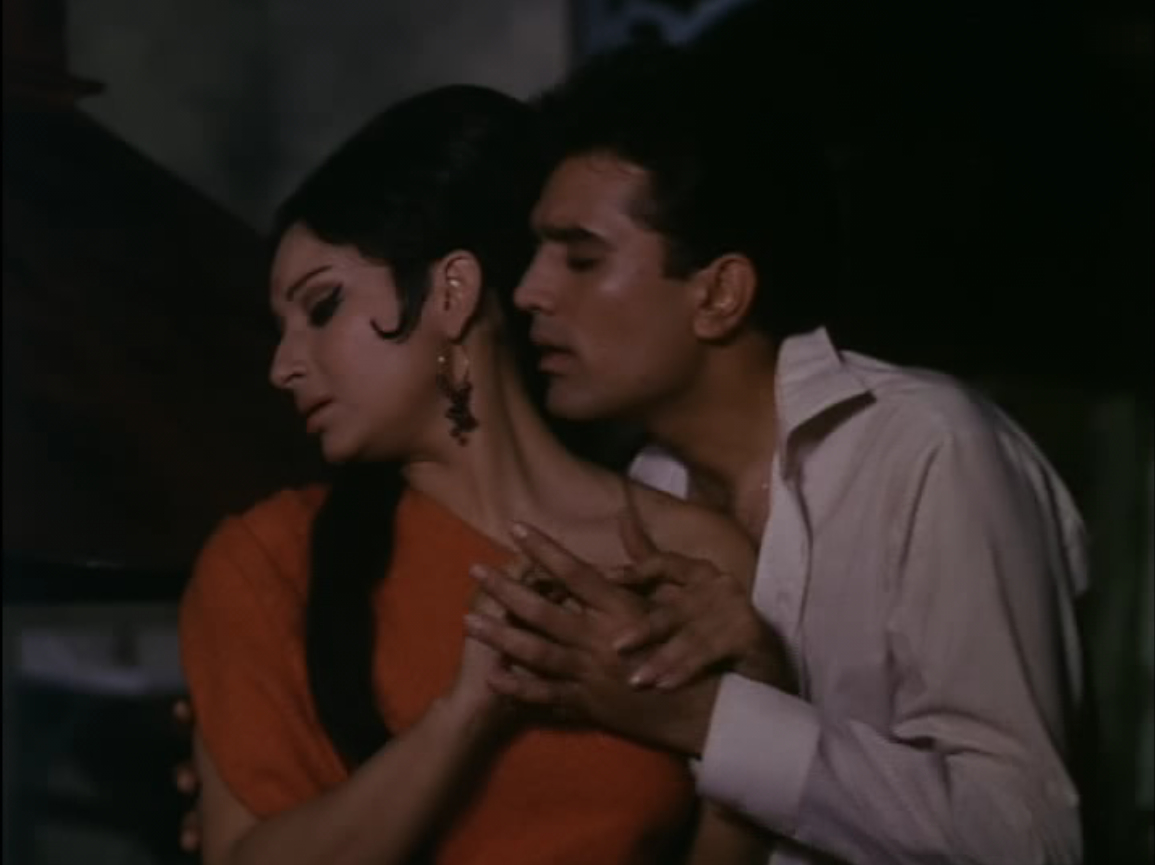
Rajesh Khanna Sharmila Tagore HOT Aradhana

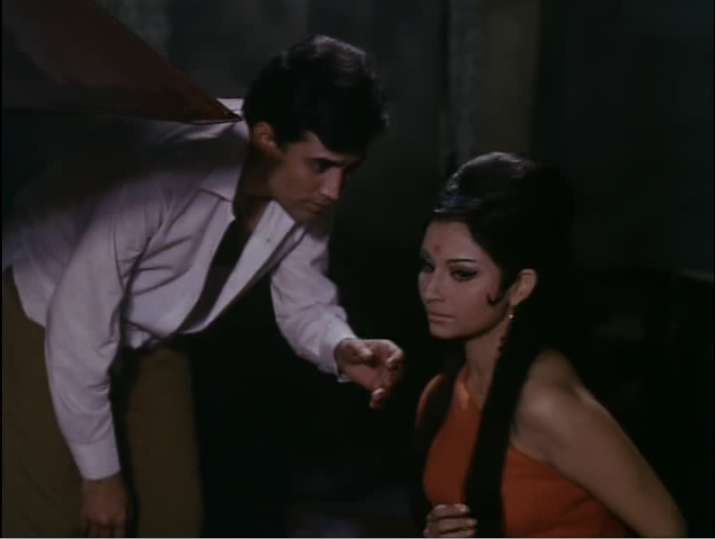
Rajesh Khanna and Sharmila Tagore get too close for comfort in “Roop Tera Mastana” from Aradhana (1969)

Our next post brings you the full lyrics and English translation of the all-time hit “Roop Tera Mastana” from Aradhana (1969). The film stars one of Bollywood’s favorite on-screen couple: the dashing Rajesh Khanna and the elegant Sharmila Tagore. Now this song gets a little racy, so for everyone who isn’t sure they can handle it, please direct yourselves to our G-rated posts (see Rabindranath Tagore’s Influence on S.D. Burman) at this time. Everyone else, grab a seat and a drink of water because it’s about to get a little hot in here.

One of the things I love most about “Roop Tera Mastana” is the cinematography (check out the youtube link here!). The entire song (roughly 4 minutes) is shot in a single long take! The camera swirls around the fire following Rajesh Khanna making his moves on Sharmila, without ONCE cutting for an insert or change in camera angle.

For this to succeed, not only do both the actor and actress need to know exactly where to start and stop with every movement they make during the sequence (any small shift could result in a loss of camera focus), but there is an elaborate dolly track for the camera also laid out all around the floor that they have to be careful not to trip on as they move. And every time the dolly men, the grip guy, the pull-focus team, or heaven-forbid the actors screw up in the 4 minutes you need per take, you start all over again, lose valuable film stock, and probably get a public slap in the face. Check stills from this sequence below!

Rajesh Khanna Sharmila Tagore2

Rajesh Khanna swoops in for the kill.

Rajesh Khanna Sharmila Tagore3

Sharmila Tagore senses danger and edges away.

Oh, awkward–Sharmila and Rajesh bump into each other unexpectedly.

Sharmila: To give in or not to give in??!

Rajesh Khanna rushes in from the other side.

Well…maybe this idea isn’t so bad after all…

Sharmila gets so on board, she starts to be a little aggressive.

Things are just getting out of control now with Rajesh and Sharmila.

Gorgeous Rajesh Khanna is abandoned, bursting with chest hair.

Gotcha! Just when you thought you thought you had given him the slip.

It’s super tense in that room, and I’m not just talking about Sharmila’s sternocleidomastoids.

In the film Aradhana (1969), Sharmila Tagore and Rajesh Khanna have both just come from getting secretly married in a private temple ceremony. They happen upon a shelter lodge, and obviously consummating the marriage is all over Rajesh Khanna’s mind.

Interestingly, the camera itself becomes complicit in the scene. Like the actors themselves, the camera too encircles the fire as if echoing the hallowed rites of Hindu marriage, the saath phere (or seven circles), that give sanctity to their union. It is as if the audience is now the testifying witness of the validity of their marriage, and the camera hesitates–sometimes pausing, sometimes rushing just like the whirlwind of conflicting emotions in the scene. It is extremely symbolic and by eliminating all cutting, the long take seems to slow time down as we grasp the moral and social complexities of this moment, as well as build the tension of what is imminent. Enjoy our English translation of the lyrics of this all-time classic and let us know your opinions in the comments!

Roop Tera Mastana Lyrics and Translation

Roop tera mastana pyaar mera diwaanaa
Your beauty is intoxicating, my love is crazy
Bhool koi humse na ho jaaye
Let me not commit a wrong

Raat nasheelii mast samaa hai
The night is lush, the atmosphere is intoxicating
Aaj nashe mei.N saara jahaa.N hai
Today the whole world seems drunk
Haa.N yeh sharaabii mausam behkaaye
Yes, this intoxicated atmosphere has enticed us
Roop tera mastana pyaar mera diwaanaa
Your beauty is intoxicating, my love is crazy

Aankho.N se aankhe.N miltii hai.N aise
Our eyes met like this
Bechain hoke toofaa.N mei.n jaise
Becoming restless like a storm
Mauj koi saahil se takraaye
Like a wave crashing toward the shore
Roop tera mastana pyaar mera diwaanaa
Your beauty is intoxicating, my love is crazy
Bhool koi humse na ho jaaye
Let me not commit a wrong

Rok rahaa hai hum ko zamaanaa
The world is stopping us
Duur hii rehna paas na aana
We must stay apart and not come closer
Kaise magar koi dil ko samjhaaye?
But how can anyone make our hearts understand this?
Roop tera mastana pyaar mera diwaanaa
Your beauty is intoxicating, my love is crazy
Bhool koi humse na ho jaaye
Let me not commit a wrong

Glossary

roop: beauty; mastaana: intoxicating; diiwaanaa: crazy (in love); bhool: mistake, wrong; nasheelii: lush; samaa: atmosphere; nashe mei.N: drunk; mausam: atmosphere; bechain: restless; toofaa.N: storm; mauj: wave; saahil: shore; zamaanaa: the world

Notice how no one actually gets close to kissing each other in the sequence. I mean, you’d think it happened if you looked at some of these still shots, but in reality the closest thing to physical contact that occurs in this whole sequence is when they hold hands and half-way hug. It would have been awkward, but they pretend like they’re kissing so well, that you hardly notice that no one has touched each other. Oh, the magic of Bollywood!

For more from the magical soundtrack of Aradhana, check out our translation of “Kora Kaagaz Tha” here!

-Mrs. 55

Yeh Raat Yeh Chandni Phir Kahan Lyrics and Translation: Let’s Learn Urdu Hindi

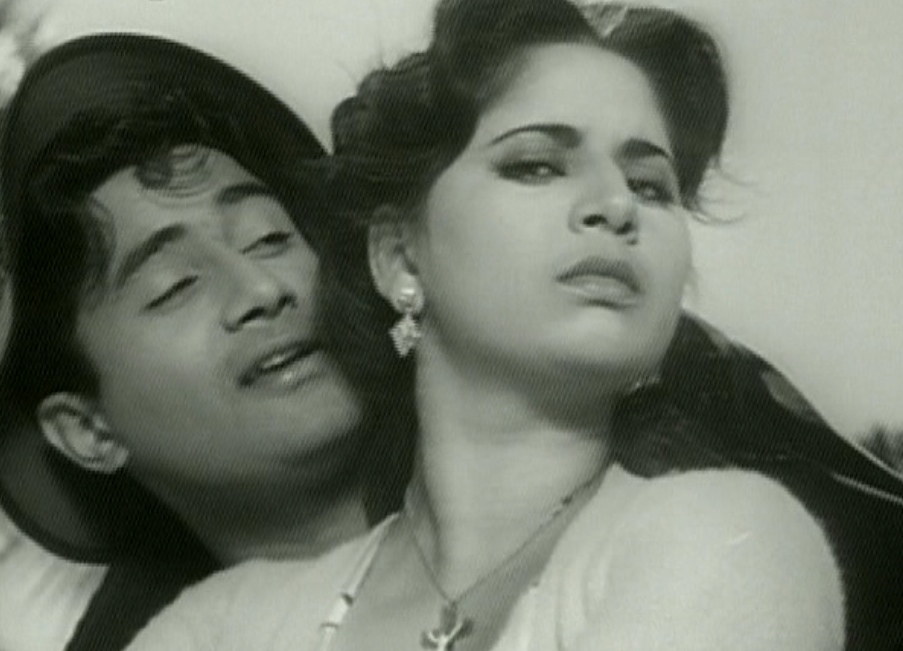
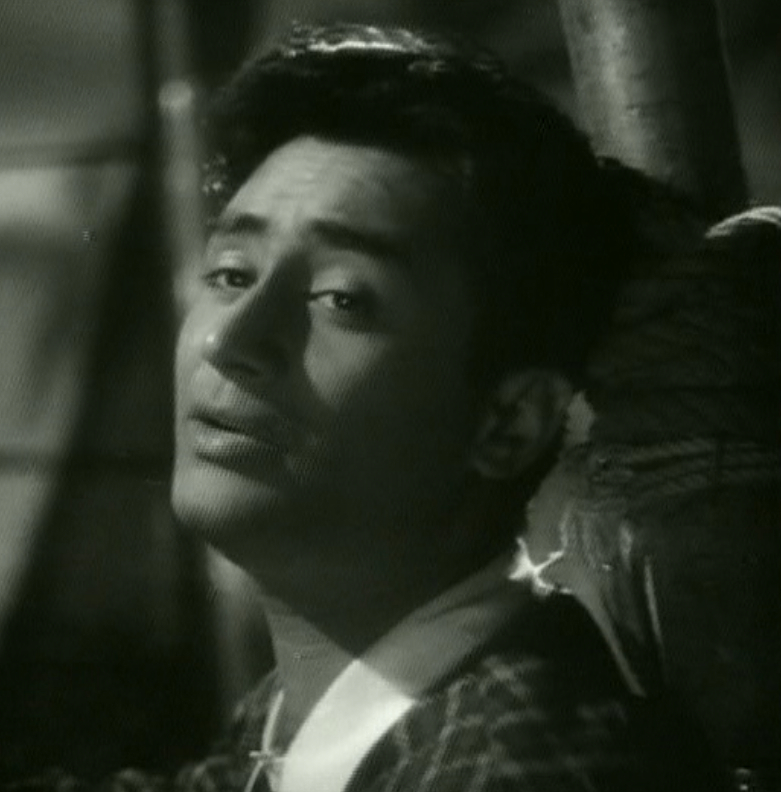
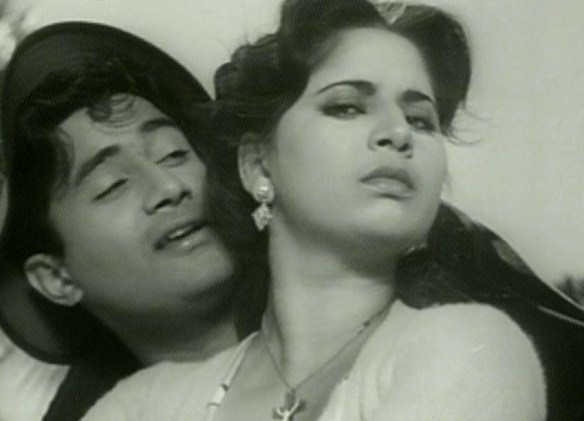
Dev Anand attempts to win over Geeta Bali under the guise of love in Jaal (1952).

We now will present the full lyrics and English translation to the haunting beauty “Yeh Raat Yeh Chandni” from the film Jaal (1952). Starring hit duo Dev Anand and Geeta Bali (who had wowed audiences together in Baazi the year before), Jaal was auteur Guru Dutt’s second film. Unlike Baazi, which mimicked film noirs of the West, Jaal looked outside the crowded cities to the gentle coast of Goa for inspiration. This film is truly one-of-a-kind, exploring life in the Portuguese fishing colony and the interwoven religious themes of forgiveness and love in the unfolding affair between two Christians, Tony (Dev Anand) and Maria (Geeta Bali). Note: Jaal was released before West Side Story hit Broadway, so the names of the lead characters are just a coincidence!

Dev Anand plays a Bombay gold thief who has escaped to Goa and who falls in love with the spunky village belle, Geeta Bali. Their love is tested by society, the law, and ultimately a vow before God that leads Tony to atone for his past and Maria to remain faithful until his sentence is fulfilled. Like most Guru Dutt films, the plot brings something new to the table. Watch out for some wild swing dancing, Johnny Walker making repeated attempts at Arabic, and a generous handful of “amens” throughout the film!
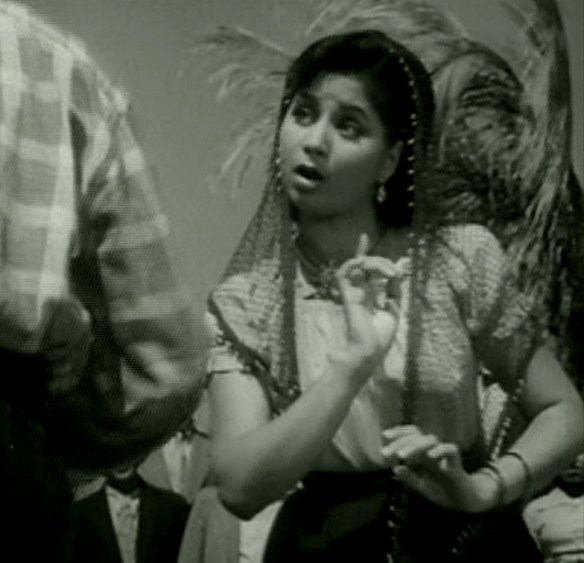
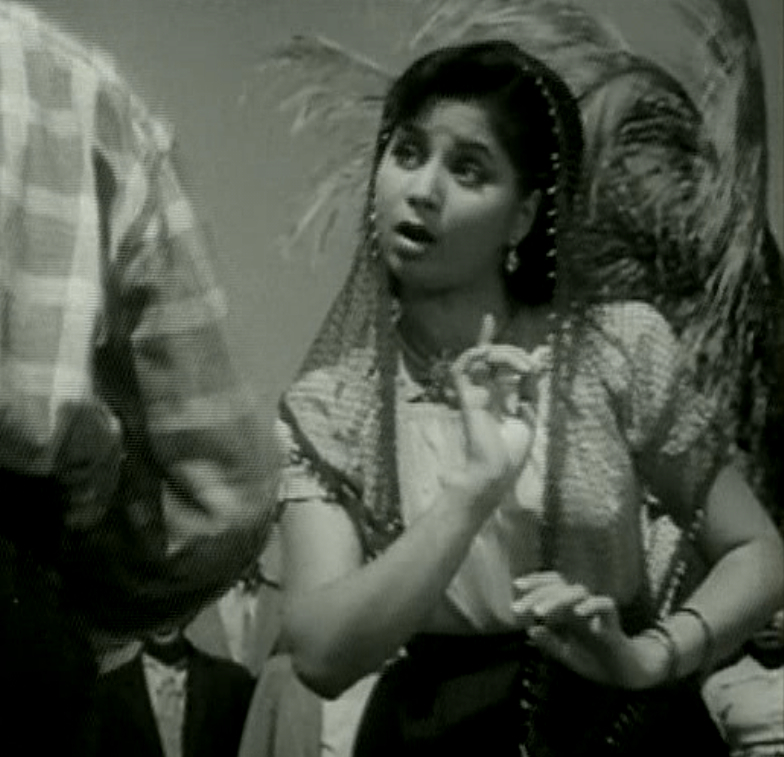
Spunky and fabulous, Geeta Bali leads a Goan dance in Jaal (1952)

The song “Yeh Raat Yeh Chandni” comes in two versions–the tragic Lata Mangeshkar duet, and the initial lilting Hemant Kumar solo. We will translate both to get a fuller understand of the role this song plays in the film, starting with the duet. This version occurs late in the film after Geeta’s friends and family discover Dev Anand’s true past and forcibly remove her from him. However, she is now in love despite his background and sings this tearful song of pining.
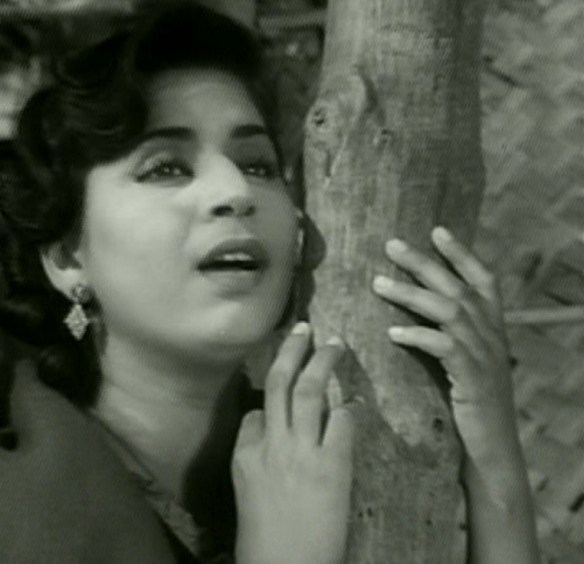
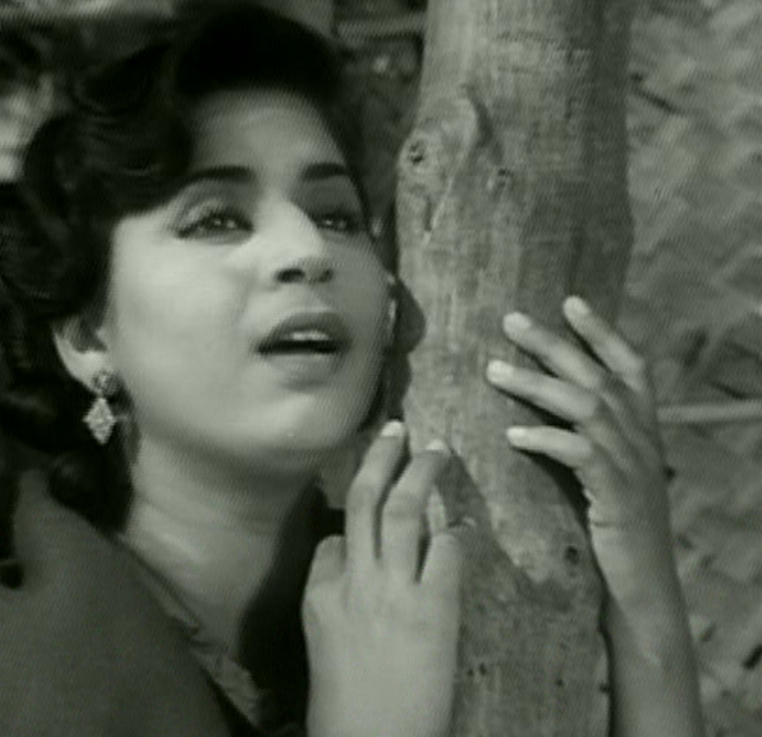
Geeta Bali declares her unwavering love for a wanted criminal in Jaal (1952).

Enjoy our English translation and full lyrics of “Yeh Raat Yeh Chandni” and it’s counterpart “Sun Ja Dil Ki Dastan” below!

Yeh Raat Yeh Chandni Phir Kahan Lyrics and Translation

Duet (Lata Mangeshkar & Hemant Kumar):

Yeh raat yeh chaandni phir kahaa.N
Where will we find this night and this moonlight again?
Sunjaa dil ki daastan
Listen now to the story of my heart

Chaandni raaten pyar ki baaten kho gayi jaane kahaa.N
Where have the moonlit nights and words of love become lost?
Yeh raat yeh chandni phir kahaa.N
Where will we find this night and this moonlight again?
Sunjaa dil ki daastan
Listen now to the story of my heart

Aati hain sada teri TuuTe hue taaro.N se
I sense your presence from the falling stars
AahaT terii suntii hoo.N khaamosh nazaaron se
I hear your footsteps with hushed glances
Bheegii hawa uudi ghaTa kheti hai.N teri kahanii
The moist winds, the soaring clouds speak of your story
Tere liye bechain hain sholo.N mei.N lipti jawaanii
My youth is ablaze in restlessness for you
Seene mei.N balkha raha hai.N dhuaa
The smoke engulfs my chest
Sunjaa dil ki daastan
Listen to the story of my heart

Chandni raaten pyar ki baaten kho gayi jaane kahaa.N
Where have the moonlit nights and words of love become lost?

Leheron ki labon par hai.N khoye hue afsaane
On the lips of the waves lie forgotten fables
Gulzaar umiidon ke sab ho gaye viraane
All the rose gardens of hope have become barren.
Tera pataa paaoo.N kahaa.N? Soone hai.N saare Thikaane
Where can I find where you are? All abodes are deserted
Jaane kahaa.N gum ho gaye jaake ho agle zamaane
I do not know where you have disappeared to in the other world
Barbaad hai.N aarzoo ka jahaa.N
The world of desire has been destroyed
Sunjaa dil ki daastan
Listen now to the story of my heart

Glossary:

raat: night; chaandni: moonlight; TuuTa taaraa: shooting star; aahaT: footsteps; khaamosh: silence, hushed; bheegi: wet; kahaanii: story; bechain: without peace, restless; sholaa: spark, fire: jawaanii: youth; seenaa: heart; chest; dhuaa: smoke; leher: wave; lab: lip; afsaanaa: fable, story; gulzaar: rose garden; umiid: hope; viiraane: wasted, desolate; pataa: whereabouts, address; soonaa: empty, lonely; Thikaanaa: shelter, abode; gumnaa: to become lost; aglaa: next; zamaanaa: world; barbaad: destroyed; aarzoo: desire; jahaa.N: world, place

But before this sad reprise, Dev Anand can be found singing the romantic solo version from his beach side abode. Hemant Kumar’s voice is absolutely magical in this song–he has the perfect blend of richness and allure. At this time in the film, Dev Anand is trying to cinch the deal with his romance and claims he knows that Geeat Bali will come to his hut when she hears this song. His version of “Yeh Raat Yeh Chaandni” has a uniquely tropical Goa flair, but it maintains an exciting sense of urgency in both the lyrics and style. As you can guess, Geeta comes running.
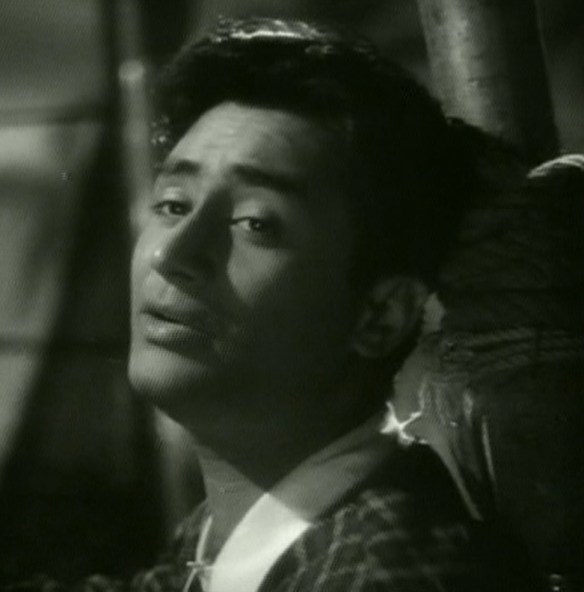
Dev Anand Jaal

Dev Anand calls to Geeta Bali in the moonlight in Jaal (1952).

Yeh Raat Yeh Chandni Phir Kahan Lyrics and Translation

Male Solo (Hemant Kumar):

Yeh raat yeh chaandnii phir kahaa.N
Where will we find this night and this moonlight again?
Sun ja dil ki daastan
Listen now to the story of my heart

Hey peDo.N ki shaakho.N pe
On the branches of the trees
PeDo.N ki shaakho.N pe soyii soyii chaandnii, peDo.N ki shaakho.N pe…
On the branches of the trees the moonlight slumbers
Tere khayaalo.N mei.N khoyii khoyii chaandnii
In thoughts of you, the moonlight wanders
Aur thoDi der mei.N thak ke laut jaayegii
And soon it will become tired of waiting and return
Raat yeh bahaar ki phir kabhii na aayegii
This night of spring will never come back
Do ek pal aur hai yeh samaa
We have but a few moments left of this atmosphere
Sun ja dil ki daastan
Listen now to the story of my heart

Hey lehero.N ke honTho.N pe
Oh, on the lips of the waves
Lehro.N ke hontho.N pe dhiima dhiima raag hai, lehro.N ke hontho.N pe
On the lips of the waves is a soft melody
Bhiigii hawaao.N mei.N thanDii thanDii aag hai
In the moist wind is a cool fire
Is hasee.N aag mei.N tuu bhii jalke dekhle
In this beautiful fire, you should see what it feels like to burn
Zindagii ke geet ki dhun badal ke dekhle
See what it feels like to change the tune of life’s song
Khulne de ab dhaDkano.N ki zubaan
Free the voice of our heartbeats
Sun ja dil ki daastan
Listen now to the story of my heart

Hey jaatii bahaare hai.N
Oh, the Spring is receding
Jaatii bahaare hai.N uThti jawaaniiyaa, jaatii bahaare hai.N
The Spring is receding, our youth is rising
Taaron ke chaao.N mei.N pehle kahaaniiyaa
In the shadows of the stars lie our stories
Ek baar chal diye gar tujhe pukaarke
If it leaves after calling to you,
Lautkar na aaye.Nge kaafile bahaar ke
The caravans of Spring will not return
Aaja abhi zindagii hai jawaan
Come, life is still young
Sun ja dil ki daastan
Listen to the story of my heart

Glossary:

raat: night; chaandnii: moonlight; peD: tree; shaakh: branch; khayaal: thought; thoDii der mei.N: in a short while, soon; thak hona: to become tired; laut jaanaa: to go back; bahaar: spring; samaa: atmosphere; leher: waves; honT: lip; dhiima: softly; bheega: moist, rainy: ThanDaa: cool; aag: fire; hasee.N: beautiful; dhun: tune; dhaDkan: heartbeat; zubaan: words, language; jawaanii: youth; chhaaye: shadow; kaafile: caravans

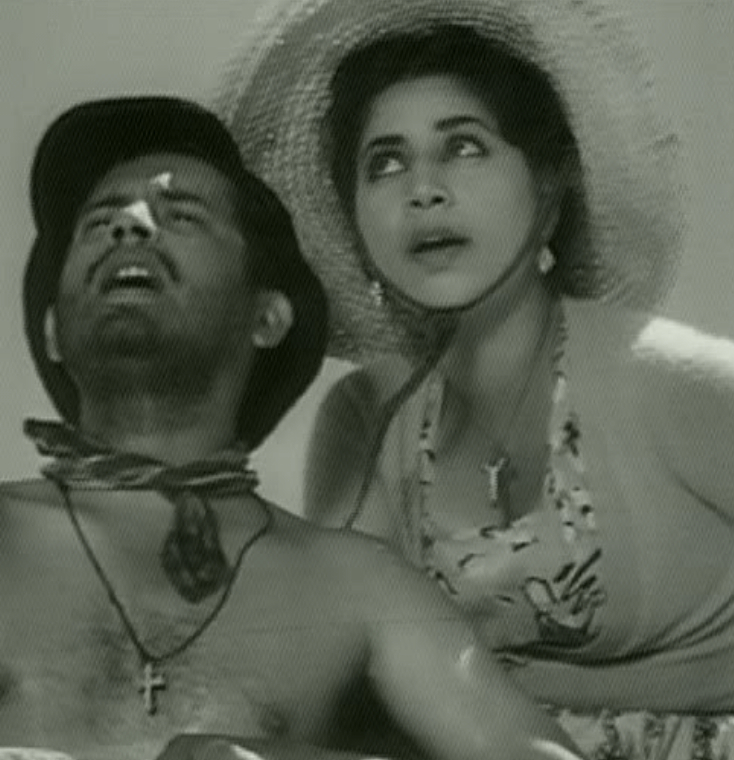
Did you know that it was in this movie that Guru Dutt first hired cinematographer V. K. Murthy? V.K. Murthy would continue to work as Guru Dutt’s D.P. (Director of Photography) for all of his following films. In fact, between Guru Dutt and V.K. Murthy grew such trust and friendship, that Murthy eventually encouraged Dutt to start acting in his owns films, including the haunting classics Kaaghaz Ke Phool and Pyaasa. In this film, Guru Dutt actually makes his first cameo–as a shirtless fisherman no less! Ladies, please calm down.

– Mrs. 55
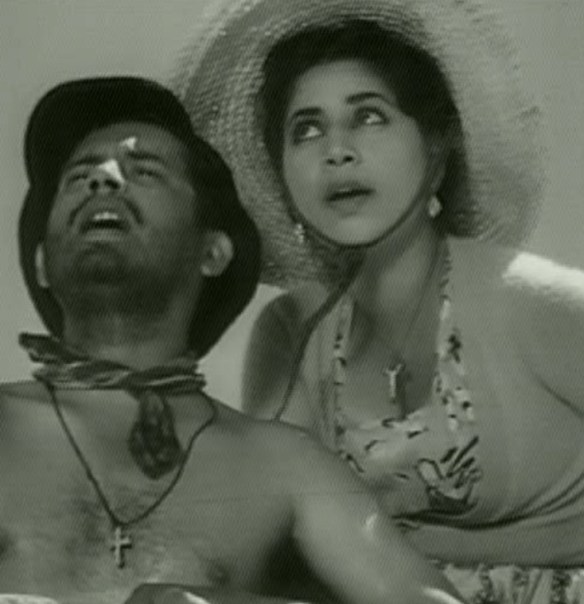
Shirtless Guru Dutt

Guru Dutt makes a brief film debut in Jaal (1952) as a rugged and shirtless fisherman.