Tum Pukar Lo Lyrics and Translation: Let’s Learn Urdu-Hindi

Waheeda Rehman Tum Pukar Lo

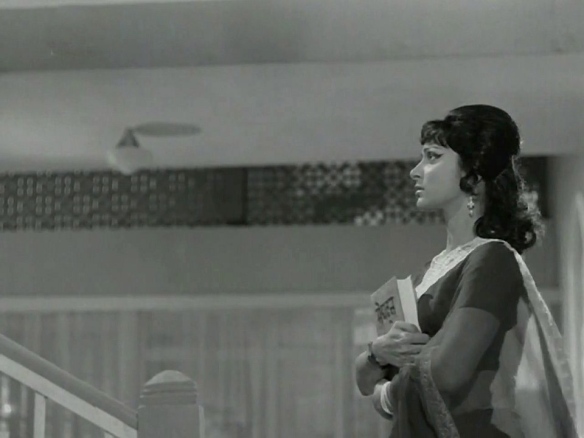
Waheeda Rehman hesitates at the bottom of a staircase leading to the man she loves in Khamoshi (1968).

For our next post we present the full lyrics and translation to the hauntingly beautiful “Tum Pukar Lo” from Khamoshi (1968). This song easily makes my list of most powerful and stirring picturizations from Bollywood. The stark black-and-white imagery highlights the emptiness of space, of shadows, and symbolic barriers. Most of all, the graceful shots that linger longer than action alone permits serve to create a new environment–a world of waiting where time slows down and the confines of the hospital become both escapist and imprisoning. I loved and still love the opening dolly shot so much that I attempted to recreate it in my final film project junior year of Harvard. The shot is transformative–literally taking the audience from behind bars to the free world, and Waheeda from the restraint of her conscience to the new life that beckons her above the staircase. A gentle wind miraculously flows down from Dharmendra’s balcony, through the barren corridor, down the grand stairs, and ultimately through Waheeda’s saari palluu giving rise to a simple, evocative image of a woman drawn by a force greater than any danger: love.

Waheeda Rehman Tum Pukar Lo Khamoshi

I LOVE the classic “frame-within-a-frame” of the mis-en-scene. Not how the lighting in this sequence informs the trajectory of the characters–recall that prior to Waheeda’s discouragement, the welcoming light source came from the balcony (now shrouded in obscurity), indicating a change in both destination and mindset.

I’ve broken down the dolly shot into 3 parts with my storyboard sketches to give you a full picture of how a shot like this is pulled off. The timing and fluidity of the dolly movement (and the pull focus) must be perfectly coordinated with the pace of the actresses walk as the camera additionally swivels on its own axis tracking her ascent up the stairs. I can only say after having attempting to do this shot myself, that it’s a headache but the effect is absolutely wonderful. Ultimately, Khamoshi is a film about identity and the silence caused by its loss through love. The misappropriated gazes in the film that lead characters in and out of a world of insanity is moving and tragic–and the audience too becomes implicit in that beautiful slippage of reality through Kamal Bose’s stunning cinematography, which won him the Filmfare award in 1968! Like Khamoshi’s characters, the camera lingers in each constructedly bereft space, longing for something more.

TumPukarLo1

The shot begins to the side of the staircase, a literal behind-bars view of Waheeda’s ascent.

tumpukarlo2

The camera swivels midway through the dolly pull at a low-angle as the rails of the staircase form a figurative cage around the actress.

The dolly track at last ends at the base of the staircase, holding the shot after Waheeda leaves the stairs, underscoring the incredible emptiness of the space she inhabits.

The dolly track at last ends at the base of the staircase, holding the shot after Waheeda leaves the stairs, underscoring the incredible emptiness of the rigid space she inhabits–and her escape from it.

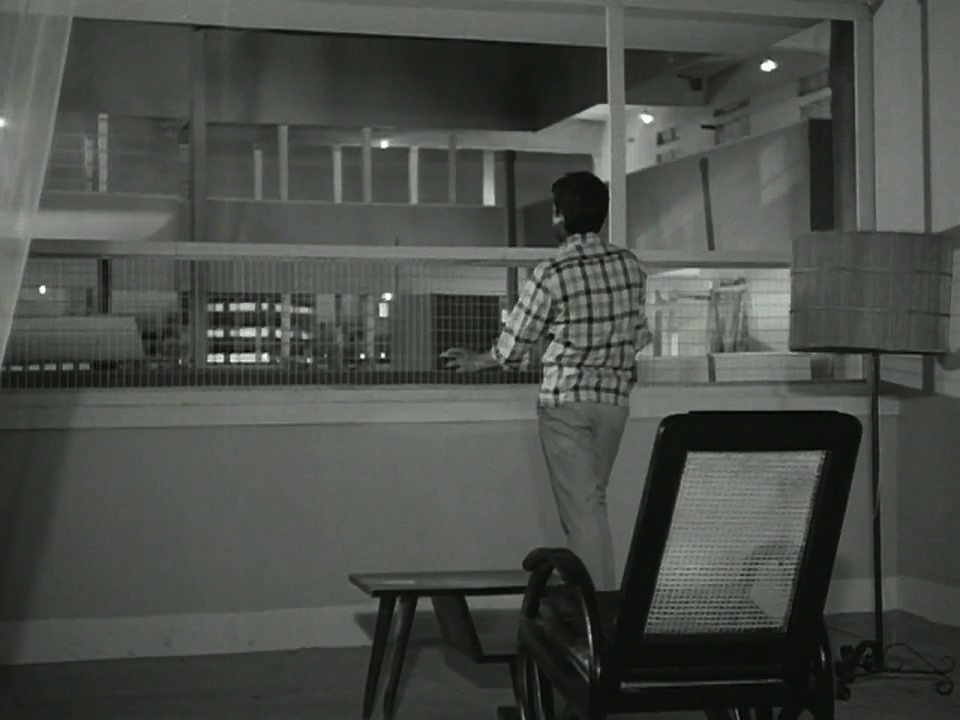
You won’t see much of Dharmendra, the mystery man and asylum inpatient, who sings this song. Instead you see only his outline against the balcony of their confinement. And of course, anything else would be imperfect–while this, this unfulfilled gaze of love, is precisely the poetic complement to the yearning expressed in Gulzar’s heartfelt lyrics. This song may be my favorite Hemant Kumar solo with a melody that hangs in the air long after the song is finished. Whether or not it beats Rajesh Khanna lip-syncing “Woh Shaam Kuch Ajeeb Thi” from the same film is up to you to decide!
tum-pukar-lo-03 Dharmendra

Dharmendra passes sleepless nights thinking of the beautiful woman he lost in Khamoshi (1968).

Without further ado, see for yourself why this song has become immortal. Follow along with the video here, and we hope you enjoy the lyrics and full English translation to “Tum Pukar Lo” below!

Tum Pukar Lo Lyrics and Translation:

Tum pukaar lo
Call out to me
Tumhaaraa intezaar hai
I am waiting for you
Tum pukar lo
Call out to me
Khwaab chun rahe hai.N raat beqaraar hai
I am sifting through dreams while the night remains restless
Tumhaaraa intezaar hai
I am waiting for you
Tum pukaar lo
Call out to me

HonTh se liye hue dil ki baat hum
The words in my heart have escaped from my lips
Jaagte rahe.nge aur kitne raat hum?
How many more nights will I remain awake like this?
Mukhtasar si baat hai: tumse pyaar hai
The matter is simple: I love you

Tumhaaraa intezaar hai
I am waiting for you
Tum pukaar lo
Call out to me

Dil bahal to jaayegaa is khayaal se
My heart will be content with this thought
Haal mil gaya tumhaaraa apne haal se
That my well-being becomes yours
Raat yeh qaraar ki beqaraar hai
This restful night remains restless

Tumhaaraa intezaar hai
I am waiting for you
Tum pukaar lo
Call out to me

Glossary:

pukaarnaa: to call; intezaar karna: to wait; khvaab: dream; beqaraar: restless; honTh: lips; mukhtasar: brief, short; bahal: content; khayaal: thought; haal: well-being, state; qaraar: restful, quiet

My favorite line of this song is by far “Mukhtasar si baat hai, tum se pyaar hai!” So romantic and God, how I love an understatedly accurate pronunciation of the Urdu khe! However, I’m afraid this is one of those cases in which no matter how you translate it, the beauty of the line is just lost in the bluntness of English.

Mrs. 55

Na Tu Zameen Ke Liye Lyrics and Translation: Let’s Learn Urdu-Hindi

Dilip Kumar Na Tu Zameen Ke Liye 5

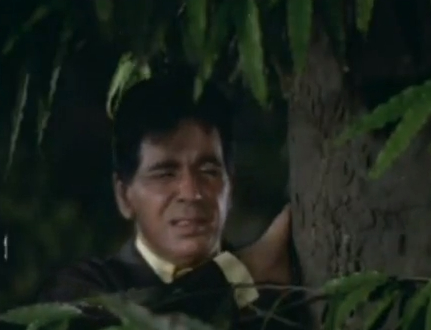
Dilip Kumar is horrified to learn of his wife Bindu’s betrayal in Dastan (1972).

We now present the lyrics and English translation to the emotional Sahir Ludhianvi ghazalNa Tu Zameen Ke Liye” from Dastan (1972). Sung by Mohammed Rafi as the hero Dilip Kumar reels from the shock of discovering an affair between his wife Bindu and best friend Prem Chopra, “Na Tu Zameen Ke Liye” is a sympathetic voice in a world of disloyalty.

The true magic of the song comes from the lyrics from the pen of Sahir Ludhianvi–but you may be surprised to learn that this song is not entirely original! With the ghazal “Na Tu Zameen Ke Liye” Ludhianvi draws from the beautiful Sir Muhammed Iqbal (1877-1938) poem of the same name and contains the portending line:

Maqaam-e parvarish-e aah wa naalaa hai yeh chaman. Na sair-e gul ke liye hai, na aashiyaan ke liye.” [This garden is a place for you to sigh and see visions. It is neither for taking a leisurely stroll nor building a home.”]

Similarly, Ludhianvi’s lyrics warns the hero of the dangers lurking beneath the surface of circumstances too good to be true. “Na Tu Zameen Ke Liye” is a gleaming lotus of poetry that is well-worth the wait of an otherwise rather lackluster film. Thematically, the song is reminiscent of Ludhianvi’s earlier tragic poem, “Chalo Ek Baar Phir Se,” which carries the heavy burden of deception. Thrown from that garden of love into a world of disorder, “Na Tu Zameen Ke Liye” seeks clarity in an hazy, unforgiving world.

Dilip Kumar Na Tu Zameen Ke Liye 3

With tears and heartbreak, Dilip Kumar realizes his marriage is a sham in Dastan (1972). But I mean, your wife was played by Bindu…anyone could’ve seen that coming a mile away…

Check out the video of Dilip Kumar’s despair and follow along with our English translation of Sahir Ludhianvi’s gem “Na Tu Zameen Ke Liye” below!

Na Tu Zameen Ke Liye Lyrics and Translation:

Na tuu zameen ke liye hai na aasmaan ke liye
You belong to neither the earth nor the sky
Teraa wajuud hai ab sirf dastaan ke liye
Your existence belongs to legend alone

PalaTke suu-e chaman dekhne se kya hogaa?
What can be gained by looking back toward the garden of love?
Woh shaakh hii na rahii jo thii aashiyaa.N ke liye
For that branch no longer exists, which once belonged to your nest
Na tuu zameen ke liye hai na aasmaan ke liye
You belong to neither the earth nor the sky

Garaz-parast jahaa.N mei.N, wafaa talaash na kar
In this self-centered world, do not search for faithfulness
Yeh shaii banii thii kisii duusre jahaa.N ke liye
For such a thing was designed for a world other than our own
Teraa wajuud hai ab sirf dastaan ke liye
Your existence belongs to legend alone

Na tuu zameen ke liye hai na aasmaan ke liye
You belong to neither the earth nor the sky

Glossary:

zameen: earth; aasmaan: sky; waajuud: existence; sirf: only dastaan: story, legend; palaTnaa: to turn around; soo-e chaman: direction of the garden–a reference to Amir Khusrau ghazal 248 describing an idyllic garden of young lovers; shaakh: branch; aashiaa.N: dream house, nest; garaz-parast: self-centered, selfish; jahaa.N: world; wafaa: faithfulness, loyalty; talaash: search; shaaii: thing, object

Getting teary-eyed? Calm down, there’s a happy ending to this dastaan. Sharmila Tagore adroitly steps in as the patient lover who soothes a haggard Dilip Kumar’s broken heart. Frankly, could any man ask for more?!

Sharmila Tagore Dastaan

Sharmila Tagore selflessly hides her undying love for hero Dilip Kumar in Dastaan (1972).

This Sahir Ludhianvi ghazal was requested by loyal fan muskaan! Hope you enjoyed and keep those requests coming!

Mrs. 55

Kabhi Kabhi Mere Dil Mein Lyrics and Translation: Let’s Learn Urdu-Hindi

kabhi kabhi shashi kapoor rakhee 3

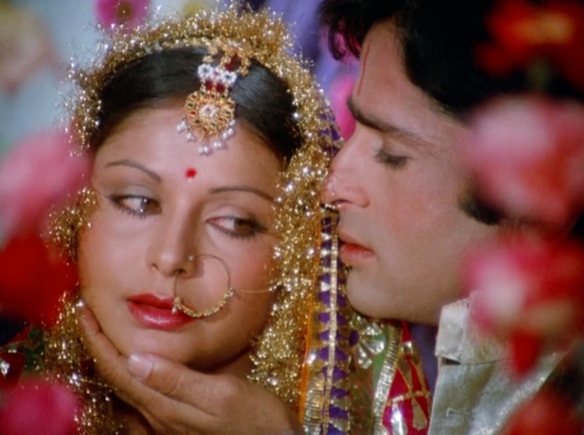
Shashi Kapoor and Rakhee celebrate their wedding night with song in Kabhi Kabhi (1976).

Happy Valentine’s Day! In honor of the occasion, we present the lyrics and full English translation to one of the great love poems of Hindi films: “Kabhi Kabhi Mere Dil Mein” from the 1976 star-studded mega-hit Kabhi Kabhi.

Penned by that evergreen poet Sahir Ludhianvi, “Kabhi Kabhi” remains on top of any list of Bollywood love songs. The lyrics are written from the heart in adoration of a woman on a couple’s wedding night. The song is reflective and gentle, but bursting with a beautiful excitement of what lies ahead. Kabhi Kabhi revolves around the love affairs of the protagonists and their effects on the next generation. The ageless devotion expressed in this song continues to evolve and evoke new meanings as the film progresses from one revelation to the next.

An interesting aspect of this song is that it is sung from a male perspective by a female heroine (after all, the song was dedicated to her in the first place by Amitabh Bachchan!) Lines like “Suhaag raat hai, ghunghaT uTaa rahaa hoo.N mai.N” evoke tragic irony as Rakhee feels her veil lifted by a man she does not love. Similarly, the final line “Mai.N jaantaa huu.N ki tuu gher hai, magar yuu.N hii” can be interpreted as both as an understanding that husband and wife still must get to know one another, but also as Amitabh Bachhan accepting that Rakhee now belongs to someone else. And just further to wring your heart, blind-to-reality Shashi Kapoor insists to her that if they ever meet the great poet who wrote these words, they must thank him for being with them on their wedding night. (Naturally, they all do meet up somehow–and it’s every bit a circus you can imagine!)

kabhi kabhi shashi kapoor rakhee 2

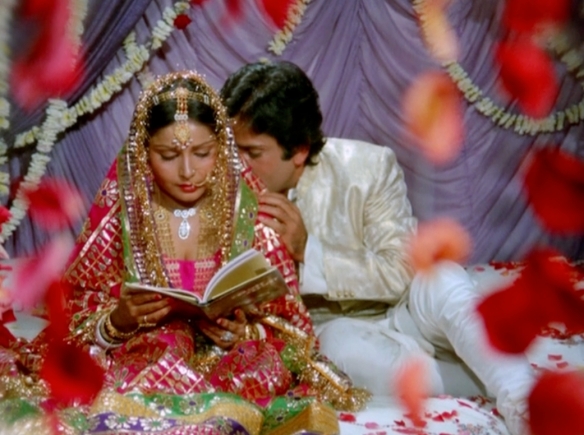
Rakhee sings from the anthology of poems written by a former lover in Kabhi Kabhi (1976).

You don’t need to know or appreciate the background of this song to fall head over heels for its melody and blissful lyrics. So celebrate the love in your life and enjoy our English translation of “Kabhi Kabhi Mere Dil Mein” below!

Kabhi Kabhi Mere Dil Mein Lyrics and Translation:

Mukesh:

Kabhi kabhi mere dil mei.N khayaal aataa hai
Sometimes this thought enters my heart

Lata:

Kabhi kabhi mere dil mei.N khayaal aataa hai
Sometimes this thought enters my heart
Ki jaise tujhko banaayaa gaya hai mere liye
That you were created only for me
Tu ab se pehle sitaaro.n mei.N bas rahii thii kahii.N
Before now you lived somewhere among the stars
Tujhe zameen pe bulaayaa gayaa hai mere liye
You were called to earth only for me

Kabhi kabhi mere dil mei.N khayaal aataa hai
Sometimes this thought enters my heart
Ki yeh badan, yeh nigaahe.N merii amaanat hai.N
That this body and these eyes belong to me
Yeh gesuuo.N kii ghanii chaao.N hai.N merii khaatir
These dark shadows of your hair are for me alone
Yeh honTh aur yeh baahe.N meri amaanat hai.N
These lips and these arms belong to me

Kabhi kabhi mere dil mei.N khayaal aataa hai
Sometimes this thought enters my heart
Ki jaise bajatii hai shahanaaiiaa.N sii raaho.N mei.N
As if wedding music is being played in the streets

Mukesh:

Suhaag raat hai, ghunghaT uTaa rahaa huu.N mai.N
It is our wedding night, I am lifting your veil

Lata:

Suhaag raat hai, ghunghaT uTaa rahaa huu.N mai.N
It is our wedding night, I am lifting your veil
SimaT rahii hai tuu sharmaake apne baaho.N mei.N
You shyly blush as I wrap you in my arms

Kabhi kabhi mere dil mei.N khayaal aataa hai
Sometimes this thought enters my heart
Ki jaise tuu mujhe chaahegii umr bhar yuu.N hii
That you will love me forever like this
UThegii merii taraf pyaar kii nazar yuu.N hii
That you will always lift this loving gaze to me

Mukesh:

Mai.N jaantaa huu.N ki tuu gher hai magar yuu.N hii
I know you are still a stranger, however
Kabhi kabhi mere dil mei.N khayaal aataa hai
Sometimes this thought enters my heart

Glossary:

kabhi kabhi: sometimes, from time to time; khayaal: thought; sitaaraa: star; zameen: earth; badan: body; nigaahe.N: glances, eyes; amaanat: property; gesuu: hair; ghanii: dark; chaao.N: shadow; [kisii kii] khatir: [for someone’s] sake; honTh; lips; baahe.N: arms; amaanat: belonging; shahanaaii: a wind instrument usually played at weddings; raah: path, streets; suhaag raat: wedding night; ghunghaT: veil; sharmaanaa: to become shy; umr bhar: whole life; [kisii kii] taraf: [in someone’s] direction; gher: stranger

kabhi kabhi shashi kapoor rakhee 4

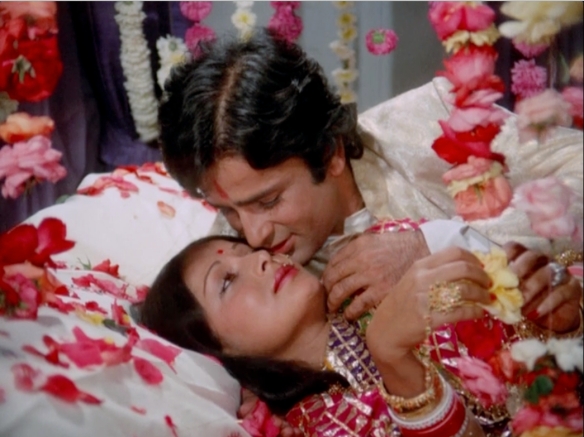
By the end of “Kabhi Kabhi”, the already awkward suhaag raat scene inevitably becomes more awkward.

This special Valentine’s day post is dedicated to my fiancé! It’s been two years since we’ve been together and I’ve loved every moment. Thank you for putting up with my singing old Lata songs outside my range while you’re trying to study, and for finally appreciating the epicness that is Mughal-e-Azam!

DSC_2492

My adorable fiancé and I met at as undergrads at Harvard where he was in the class ahead of me. He proposed two years later, and now we’re busy planning the wedding!

– Mrs. 55

Dam Bhar Jo Udhar Lyrics and Translation: Let’s Learn Urdu-Hindi

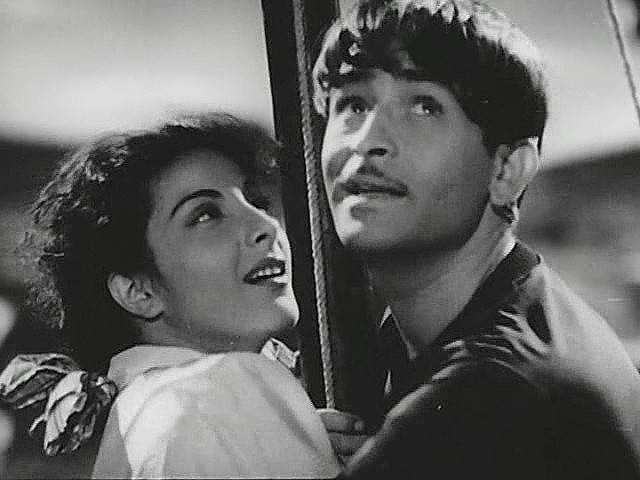
Raj Kapoor and Nargis Awara Dum Bhar Jo Udhar

Raj Kapoor and Nargis huddle together on a love-boat in Awaara (1951).

Our next lyrics and English translation is of the great love duet “Dum Bhar Jo Udhar” from the film Awaara (1951). It’s practically impossible to not love this song. Raj Kapoor plays an underworld criminal who falls for the wealthy ward of a rich judge played by his favorite leading lady Nargis. The film launched both of their careers to mega-stardom and for good reason. Packed with musical gems like the evergreen “Awaara Hoon” or “Ghar Aaya Mera Pardesi,” the film is a scathing social drama that weaves Raj Kapoor’s own respectable father, Prithviraj Kapoor, into the heart of its scandalous and surprising twist. The film was so well-received and brilliantly made that it was nominated for a Grand Prize at the Cannes Film Festival in 1953! Propelled by a tempting bad-boy with a tragic past storyline, the film arguably contains the greatest performance of Raj Kapoor’s career. Awaara is a historical and artistic must-see!

Dum Bhar Jo Udhar” is a Mukesh-Lata duet sung on a small boat in the middle of the night. Shailendra’s lyrics embody a theme common in Hindi films, which emphasizes the shyness of the woman and the boldness of the man. Both man and woman address the only other witness to their tryst–the beautiful moon above. However, the woman begs the moon to look away and not make her feel shy, while the man eagerly urges the moon to shine upon him and witness their love blossom. The importance of moon imagery in Urdu-Hindi poetry is legendary–most often taking the form of a feminine metaphor that epitomizes beauty. In this case, however, the playful moon evokes the male gaze as a trusty ally to the hero and a source of embarrassment to the heroine. It’s so adorable I could squirm.

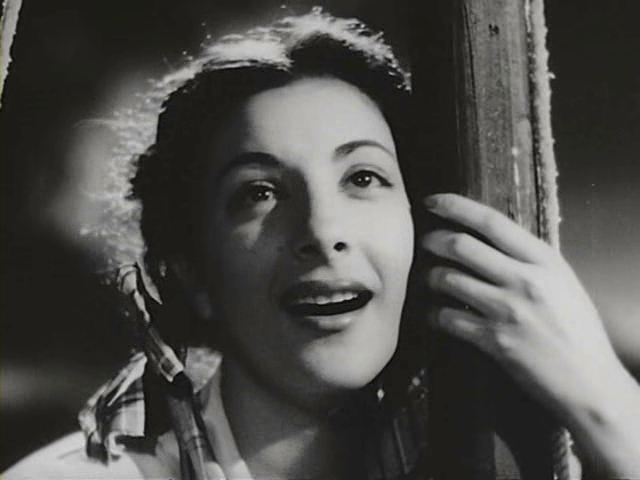
Nargis Awaara Dum Bhar Jo Udhar

The eternally lovely Nargis glows in the moonlight in Awaara (1951).

Here are the full lyrics and English translation to “Dum Bhar jo Udhar” from Awaara (1951). Enjoy our interpretation of the song’s meaning and follow along on youtube with this link!

Dam Bhar Jo Udhar Lyrics and Translation

Lata:

Dam bhar jo udhar muu.N phere, O Chandaa
O Moon, if you would turn your face away for one moment
Mai.N unse pyaar kar luu.Ngii
I will make love to him
Baate.N hazaar kar luu.Ngii
I will say a thousand things to him

Dil kartaa hai pyaar ke sajade
My heart has prayed for such love
Aur mai.N bhii unke saath
And now I am with him
Chaand ko chandaa roz hii dekhe
The moon sees moonlight every day
Merii pehlii raat, ho, merii pehlii raat
But this is my first night, oh, this is my first night!
Baadal mei.N ab chhup jaa re! O Chandaa
Now go hide in the clouds, O Moon!
Mai.N unse pyaar kar luu.Ngii
For I will make love to him
Baate.N hazaar kar luu.Ngii
I will say a thousand things to him

Mukesh:

Dam bhar jo idhar muu.N phere, O Chandaa
O Moon, if you would turn your face here for one moment
Mai.N unse pyaar kar luu.Ngaa
I will make love to her
Nazare.N do-chaar kar luu.Ngaa
I will steal a few glances from her

Mai.N chor hoo.N kaam hai chorii
I am a thief, and my job is to steal
Duniyaa mei.N hoo.N badnaam
I am dishonored in society
Dil ko churaataa aayaa hoo.N mai.N
I have come to steal your heart
Yehii meraa kaam, ho, yehii meraa kaam
This alone is my job
Aanaa tuu gavaahi dene, O Chandaa
You must come and be a witness, O Moon
Mai.N unse pyaar kar luu.Ngaa
For I will make love to her
Nazare.N do chaar kar luu.Ngaa
I will steal a few glances from her

Lata:

Dil ko churaake kho mat jaanaa
Do not steal my heart and then become lost
Raah na jaanaa bhool
Do not forget your way back to me
In qadmo.n se kuchal na denaa
Do not crush with your footsteps
Mere dil kaa phool, ho, mere dil kaa phool
The flower of my heart, oh, the flower of my heart!
Yeh baat unhe.N samjhaa de, O Chanda
You make him understand this, O Moon
Mai.N unse pyaar kar luu.Ngii
I will make love to him
Baate.N hazaar kar luu.Ngii
I will say a thousand things to him

Glossary:

dam bhar: one full moment; udhar: in that direction; muu.N: face; pherna: to turn; hazaar: a thousand; pehlii; first; baadal: clouds; idhar: in this direction, here; do-chaar: a few; badnaam: a person of ill-repute; gavaahi denaa: to serve as witness; raah: path, way; qadam: footsteps; kuchal dena: to crush; phool: flower; samjhaa denaa: to make [someone] understand

Now before anyone gets their knickers in a twist, let’s just talk briefly about the phrase “Mai.N unse pyaar kar luu.Ngii” and what that really means. I have translated it somewhat literally for simplicity’s sake as “I will make love to him,” but that phrase in English carries with it more physical connotations than what it means in this context. Although the verb “pyaar karna” means simply “to love” as in the general English sense, the way it is used in this song carries a more immediate sense of both action and personal gain–by adding the coloring verb “lena” (“to take”), the phrase now implies that the girl is about to do something for her own benefit. We can safely say that these lyrics are not a prelude to actual Victorian “love-making” on that rocky boat of theirs, but rather an expression of desire and courtship. When she says, “Mai.N unse pyaar kar luu.Ngii,” I argue that this means no more than whispering sweet nothings, holding hands, stealing glances, and other forms of expressing tenderness and passion short of actually “making love.” See my point? And don’t let Nargis’ pole dancing throw you off.

Nargis pole dancing awaara

Yeah, no seriously I wasn’t kidding. Nargis takes the phrase “pole-dance” to a whole new level in Awaara (1951).

You know what’s really great about this movie? The fact that ages before women were given anything close to social equality, Nargis plays a powerful lawyer who ends up bringing justice to her lover Raj Kapoor. She stands strong in a court filled with men, and really makes us all proud. Granted, she’s really rich and let’s Raj Kapoor SLAP her in a different scene (kill me now), but we can appreciate what she stood for at least in that regard. It’s one of the best courtroom scenes of the industry! This song was requested by die-hard fan lalten–hope you enjoyed!

– Mrs. 55

Dum Maro Dum Lyrics and Translation: Let’s Learn Urdu-Hindi

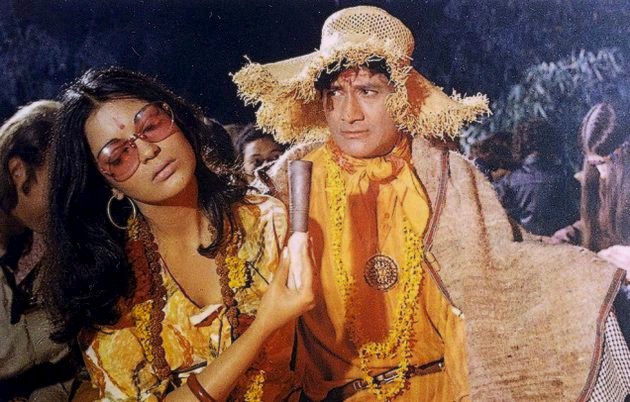
Zeenat Aman Dev Anand Dum Maro Dum

Zeenat Aman becomes shamelessly intoxicated in front of her brother Dev Anand in Hare Rama Hare Krishna (1971). More importantly, can someone please burn that hideous floppy straw hat?

Our next lyrics and English translation is the epitome of youthful rebellion and psychadelic glamour: “Dum Maro Dum” from Dev Anand’s 1971 Hare Rama Hare Krishna. The translation could not have come at a more appropriate time–as many of you know, as of 2 weeks ago, medical marijuana is now legalized in Massachusetts. So to all the Harvard seniors getting ready to graduate in a few months, this song is for you! When people think of Asha Bhonsle at her craziest, “Dum Maro Dum” is often the song that comes immediately to mind. It’s seductive, eccentric, and exhibits her full range from those bizarre, unexpected high notes to the fabulous embodiment of character as only Asha knew how. It’s one of incomparable music director R.D. Burman’s greatest works for the ground he broke–putting illicit drugs and societal defiance to the forefront in a youth-targeted song that was so instantly catchy no one could brush it off. Let’s face it, with this song, Zeenat may represent everything we don’t want in our loved ones, but God, does she make it look appealing.

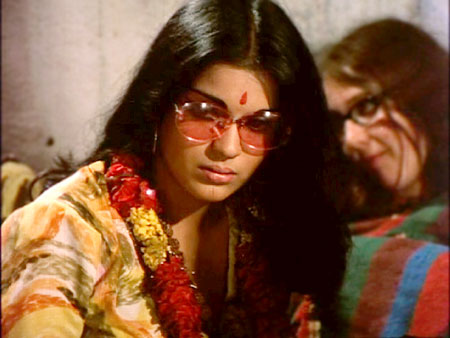
Zeenat Aman Hare Rama Hare Krishna

Gorgeous Zeenat Aman sports a pair of show-stopping 70s shades as a drug addict in Hare Rama Hare Krishna (1971).

Shot in one of Dev Anand’s favorite locations, Kathmandu (remember Jewel Thief, anyone?), Hare Rama Hare Krishna is a politically-driven film against the subversive hippie culture that our hero believes to be distorting the true message of the Hindu ideals it pretends to preach. Dev Anand hunts down his long-lost sister in such a hippie camp and tries to extricate her with tragic results. The film delivers a powerful message without feeling like Manoj Kumar-eqsue patriotic propaganda. I really applaud Dev Anand for making such a bold film that critiques a subject so ignored by his contemporaries and so popular among the masses who bought into it–with a delightfully satirical name like Hare Rama Hare Krishna, the film was a risk and it paid off.

So enjoy our English translation and lyrics to “Dum Maro Dum” below! Follow along with the video and let us know your thoughts on this controversial smash hit in the comments! You know how Zeenat starts the song with a little “Hush!” just before the music starts? I can’t exactly explain why, but I always feel really awkward when I hear it.

Dum Maro Dum Lyrics and Translation

Dam maaro dam miT jaaye gham
Take another hit, all your worries will disappear
Bolo subah shaam hare krishna hare raam
From morning until night sing, “Hare Krishna Hare Ram!”

Duniyaa ne hum ko diyaa kyaa?
What has the world given us?
Duniyaa se hum ne liyaa kyaa?
What have we taken from the world?
Hum sab kii parwaa kare.N kyo.N?
Why should we worry about anyone?
Sab ne humaaraa kiyaa kyaa?
What has anyone does for us?
Dam maaro dam miT jaaye gham…

Chaahe jiye.Nge, mare.Nge
Whether we want to live or to die
Hum na kisii se Dare.Nge
We won’t be afraid of anyone
hum ko na roke zamaanaa
The world won’t be able to stop us
Jo chaahe.Nge hum kare.Nge
For we will do what we want

Dam maaro dam miT jaaye gham
Take another hit, all your worries will disappear
Bolo subah shaam hare krishna hare raam
From morning until night sing, “Hare Krishna Hare Ram!”

Glossary:

dam maarnaa: to take a hit [of marijuana]; miT jaanaa: to disappear; gham: sadness, worries; subah shaam: from morning to night; Hare Krishna Hare Raam: a chant of the Hare Krishna sect popularized by the hippie culture in the 60s and 70s; duniyaa: society, the world; parwaa: worry; zamaanaa: the world

Zeenat Aman Dum Maro Dum

Zeenat Aman suddenly remembers her idyllic drug-free childhood with an emotional outburst of regret in Hare Rama Hare Krishna (1971).

For the sake of completeness, I feel compelled to include a translation of Dev Anand’s great comeback to the moral disorder he witnesses among the Hare Krishnas: “Dekho O Diwaano.” “Dekh O Diwano” and indeed the film Hare Rama Hare Krishna, is not a direct attack on the actual Hare Krishna movement, but rather the hippie culture that traveled with it in the 60 and 70s–and by blending the two, confused and disheartened many a contemporary conservative Hindu. Dev Anand makes some brilliant comparisons through example in this song–by drawing upon classic Hindu literature such as the Ramayan story of Lord Ram’s banishment to the forest (“Ram ne ha.Ns kar sab sukh tyaage“) and Krishna’s explanation to Arjun of the meaning of karma in the timeless battlefield of the Mahabharat (“Krishna ne karm ki riit sikhaayi“), Dev Anand makes a clear distinction between lip service and actual belief.

Dekho O Deewano Lyrics and Translation:

Dekho O deewano, tum yeh kaam na karo
Look, Oh crazy people, do not behave like this
Raam kaa naam badnaam na karo
Do not bring dishonor to the name of Ram

Raam ko samjho, Krishna ko jaano
Understand Ram, know Krishna well
Nee.Nd se jaago, O mastaano
Wake up from this sleep, Oh intoxicated ones
Jeet lo man ko paDh kar Geeta
Win back your mind by studying the Geeta
Man hii haaraa, to kyaa jeetaa?
For once you’ve lost your mind, what is there to win?

Hare Krishna, Hare Ram
Jeevan ko nashe ka tum ghulaam na karo
Do not make your life a servant to intoxications
Raam kaa naam badnaam na karo
Do not bring dishonor to the name of Ram

Raam ne ha.Ns kar sab sukh tyaage
With a smile, Ram renounced all his joys
Tum sab dukh se Dar ke bhaage
But you are scared and run away from every grief
Krishna ne karm kii riit sikhaaii
Krishna taught us the tradition of righteous action
Tum ne farz se aa.Nkh churaayii
But you avoid your duties

Hare Krishna, Hare Ram
Jeevan naam hai kaam kaa aaraam na karo
The meaning of life is work, do not rest
Raam kaa naam badnaam na karo
Do not bring dishonor to the name of Ram

Glossary:

badnaam: dishonored; tyaagnaa: to renounce; nee.Nd: sleep; Geeta: the Bhagavad Gita, a religious text within the epic poem the Mahabharat; jeevan: life; nashe: intoxications; ghulaam: servant; riit: culture, tradition; farz: duty; aa.Nkh churaanaa: to avoid; aaraam karna: to rest

While Zeenat Aman and her fellow groupies waste their minds and lives to drugs in the name of Lords Ram and Krishna, Dev Anand reminds the audience of the wrong of even inaction as discussed in the Gita. Classical Hindu dharmic responsibility is not passive, but active and tempered–with no stake in the outcome whether happiness or sadness. It is an ancient theme that you may recall Dev Anand explored years earlier in his 1965 legend Guide. Sadly, Zeenat Aman eventually succumbs to her addiction, and in the end the story returns briefly to the heart of many a great film: a tale of a broken family reunited.

These themes can certainly be pretty volatile subjects, and it’s not our intention to spark a political or religious debate on this forum. So we shall end with a grammar lesson instead: do you know why the “deewaano” and “mastaano” are used instead of simply “deewaane” or “mastaane”? The vocative as used here is a special case! The nasalization “o.N” used in the oblique (eg. “dosto.N ke saath”) is not to be confused with the vocative “o” (eg. “suniye, dosto”) used to address a group directly! People commonly make this sloppy Urdu mistake–so rise above the masses!

But don’t go that high, if you know what I mean. Have fun, Massachusetts.

-Mrs. 55