Defining Bollywood Film Noir

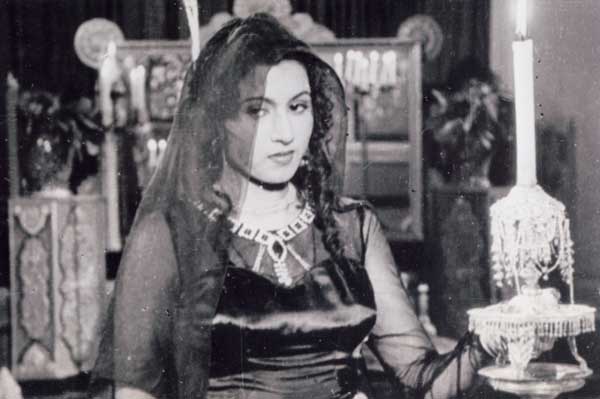
Sadhana enters a graveyard as the femme fatale of Woh Kaun Thi? (1964)

In the U.S. historians and film theorists have debated for decades about the meaning of the elusive term: “film noir.” Although many of us conjure an image of a hard-boiled detective and a mystery made more mysterious by the femme fatale, few “film noirs” actually contain these elements. This so-called genre had its roots in German Expressionism with films like Fritz Lang’s M (1931) and in depression-era crime novels. But what does the term “film noir” mean as it applies to Hindi cinema? What are the hallmarks of this genre as it played out in Bollywood and how did it begin?

I will present five films that I propose to be in the genre of Indian film noir. This is no easy task. Just as the term is vague in the American lexicon, so too does it only hazily engulf a variety of Hindi films with low-key lighting. And so I shall begin with an illustrative example. We can debate the precise definition of the genre until the end of time, but I think I can safely say that whatever Indian film noir is, Woh Kaun Thi? (1964) is Indian film noir.

Woh Kaun Thi? has 4 main basic elements. The first is in its distinct cinematographic style and setting—low-key lighting throughout a mysterious mansion and slow unhurried shots with a somber film score to match. The film gives a sense of the world being trapped in a fatalistic dream, whether alone by a graveyard or in a crowd of dancing people.

The second is the film’s overall tone and pacing—there is an uncomfortable sense of being pursued, of an impending doom unless a mystery is solved in time by the hero. Unlike in American film noir, the hero is no cynic and there is no quick sardonic dialogue to off-set the dreary mood. The hero is instead a righteous and innocent man of affairs, an heir to a fortune who becomes a victim. Though mingled with occasional musical highs, the film spirals from a slow and deliberate set-up to a climax closer and closer to complete ruin.

An interesting element of many American film noirs is the flash-back structure, which takes on an interesting form in their Indian counterparts. Woh Kaun Thi? centers around a mysterious background that occurred in the protagonist’s past life. Because the audience of Hindi films was largely composed of practicing Hindus, the world of reincarnation narrative is able to begin on a new and creatively extremely fertile ground. The hero must revisit through song, hearsay, and secrets events that took place in a past life, but whose consequences (whether karma or otherwise) now haunt him. This is the third element.

Fourthly, the film does indeed revolve around the appearance and (mis)guidance of the femme fatale, who is heard singing alluring, tragic songs. The hero is never able to wholly communicate with her, but her intentions are clearly marked with a deadly undertone. The femme fatale remains an elusive character–sometimes he chases after her, sometimes she chases after him—when her story is fully told, only then can the mystery be solved.

The films below can be placed into the category of Indian film noir along with Who Kaun Thi?:

Mahal (1949): Perhaps the grandfather of this genre, Mahal tells of a man tortured and madly in love with an apparition who haunts his mansion and claims a connection from an earlier life. The film also features the haunting vocals of Lata Mangeshkar’s all-time hit Aayegaa Aanewaalaa.

Madhubala mesmerizes Ashok Kumar in Mahal (1949)

Madhumati (1958): This classic Vijayantimala-Dilip Kumar blockbuster is told in flashback to a previous lifetime of the murder of the woman the hero still loves. The gently alluring Aajaa Re Pardesi encompasses the film’s themes of love and debts spanning several lifetimes.

Vijayantimala is reincarnated to find her lover once more in Madhumati (1958)

Bees Saal Baad (1961): A rich man comes to live in his new mansion and must solve a tragedy and murder that occurred 20 years earlier. The film contains a brilliant surprise ending, and Lata Mangeshkar scores once again with the beautiful Kahin Deep Jale, Kahin Dil.

Biswajeet follows a mysterious voice in Bees Saal Baad (1961)

Kohra (1964): This twist on Hitchcock’s Rebecca is told through the eyes of a female protagonist, living in a large, unexplored mansion that is haunted by the apparition of her husband’s first wife. Waheeda Rehman must discover the true circumstances surrounding the first wife’s death before she is driven insane. The song of the femme fatale (Jhoom Jhoom Dhalti Raat) is an absolutely genius and rare example of symbolic imagery in montage to create a feeling of horror from the song.

Waheeda Rehman sees a ghostly vision atop her mansion roof in Kohra (1964)

There are some films that contain one or more of the above elements that I have not classified as Indian film noir. These include Mera Saaya, Gumnaam, and Karz, for different reasons–often overall tone or cinematographic style. Additionally, others might argue that these films should not be categorized at all as Indian film noir, but rather as Indian gothic horror films or other such genres. Watch some of these classics and let us know your take on this chapter in cinematic history!

– Mrs. 55

Khudaa-E-Bartar Lyrics and Translation: Let’s Learn Urdu-Hindi


Our blog probably seems like one huge Sahir Ludhianvi love-fest by now, but I couldn’t help myself from posting and translating this beauty from Taj Mahal (1963). This song is from the same movie as “jurm-e-ulfat pe,” which I translated here a little while ago. While “jurm-e-ulfat pe” tackles the theme of forbidden love, the lesser-known “khudaa-e-bartar” discusses something that doesn’t get much coverage in the world of Bollywood: war. By posing a series of questions, Ludhianvi uses universal and timeless words here to express the futility of war. While the song directly pertains to the Mughal battles depicted in the film, I’ll go out on a limb and say that the pacifism expressed in these lyrics is also Ludhianvi’s response to India’s losses in the Sino-Indian War, which had ended only a year before this film was released.

In addition to its unique thematic content, this song stands out for its nuanced use of language. Such elevated Urdu is truly a rare treat in Hindi cinema. Seriously, when was the last time you heard a song with the words like hidaayat, kibr-o-ghuruur, or fatah-o-zafar? Perhaps my favorite thing about this song is its use of izaafat, a grammatical construct borrowed from Persian where two nouns or a noun and adjective are linked together with the vowel -e- or -o-. When the -e- vowel is used between two nouns, it can generally be translated as “of.” When the -o- vowel is used, it is translated as “and.” This song makes extensive use of izaafat, as evident in compound phrases like rasm-e-jang-o-jadaal (rules of war and disputes) and jashn-e-tiir-o-tafang (celebration of arrows and rifles). Super fancy, no?

Since almost every other word here is a vocab word, you’ll have to take a close look at the glossary below while you follow along with the song. But I guarantee that you’ll learn some new Urdu if you do–enjoy and let us know your thoughts about this song in the comments!

–Mr. 55

P.S. For the classical music enthusiasts out there, this composition is also remarkable for being one of the finest examples of Raga Miyan ki Todi used in a film song.

Lyrics:
khudaa-e-bartar terii zamii.n par zamii.n kii khaatir, yeh jang kyo.n hai?
har ek fatah-o-zafar ke daaman pe khuun-e-insaa.n kaa rang kyo.n hai?

zamii.n bhii terii, hai.n ham bhii tere. yeh milkiiyat kaa savaal kyaa hai?
yeh qatl-o-khuu.n ka rivaaj kyo.n hai? yeh rasm-e-jang-o-jadaal kyaa hai?
jinhe.n talab hai jahaan bhar kii, unhii.n kaa dil itnaa tang kyo.n hai?

ghariib maao.n shariif bahno.n ko aman-o-izzat kii zindagii de
jinhe.n ataa kii hai tuu ne taaqat, unhe.n hidaayat kii roshnii de
saro.n me.n kibr-o-ghuruur kyo.n hai? dilo.n ke shiishe pe zang kyo.n hai?

qazaa ke raste pe jaanevaalo.n ko bach ke aane ki raah denaa
dilo.n ke gulshan ujaD na jaaye.n, muhabbato.n ko panaah denaa
jahaa.n me.n jashn-e-vafaa ke badle, yeh jashn-e-tiir-o-tafang kyo.n hai?

khudaa-e-bartar terii zamii.n par zamii.n kii khaatir, yeh jang kyo.n hai?

Glossary:
khudaa-e-bartar
: superior Lord; zamii.n: land, world; jang: war; fatah-o-zafar: victories and triumphs; daaman: foothills; khuun-e-insaa.n: human blood; milkiiyat: ownership; qatl-e-khuu.n: murders and blood; rivaaj: tradition; rasm-e-jang-o-jadaal: rules of war and disuptes; talab: need, desire; jahaan: world; tang: troubled; ghariib: poor; shariif: noble; aman-o-izzat: peace and respect; ataa karna: to bless; taaqat: strength, courage; hidaayat: guidance; roshnii: light; kibr-o-ghuruur: pride and arrogance; shiishaa: mirror; qazaa: death; bach ke aanaa: to escape; gulshan: garden; ujaD jaana: to be uprooted; panaah: shelter; jashn-e-vafaa: celebration of love; jashn-e-tiir-o-tafang: celebration of arrows and rifles

Rough Translation:
O superior Lord, why is there this war over land in your world? Why does human blood stain the foothills of every victory and triumph?

This land is yours, and we are yours. Then, what is this question of ownership and possession? What are these traditions of bloody murder? What are these rules of wars and disputes? Those who have a desire to rule the world, why are their hearts so troubled?

Give poor mothers and noble sisters a life of peace and respect. Give those whom you have blessed with strength and courage a light of guidance. Why are minds filled with pride and arrogance? Why are the mirrors of people’s hearts blemished by rust?

Give those who are headed on the road to death a way to escape. May the garden of hearts not be uprooted as you provide shelter to love. In this world, instead of a celebration of love, why is there a celebration of arrows and rifles?

O superior Lord, why is there war over land in your world?


O Mere Shah-e Khuban Lyrics and Translation: Let’s Learn Urdu-Hindi

Clad in a tight kimono, Asha Parekh prances about Japan in Love in Tokyo (1966)

Next we will explore the lyrics and translation of the hit song “O Mere Shah-e Khuban” from Love in Tokyo. Shot on location in Japan shortly after the 1964 Olympics, Love in Tokyo (1966) is nothing short of an “exotic” tourist fantasy. The film is one of a trilogy of films I put in this category from the same era with Night in London (1967) and An Evening in Paris (1967). These are movies that dazzled Indian audiences with a glimpse into a lifestyle and culture outside the familiar homeland, and on occasion were almost laughably politically incorrect. Love in Tokyo stars Asha Parekh (playing an Indian woman raised Japanese) and Joy Mukherji who finds himself in Tokyo for reasons almost too complicated to discuss here (or probably anywhere outside a psychiatric ward).

But say what you want about the worth of the film’s plot, Love in Tokyo’s soundtrack is wonderful (the cheesy title song grows on you in spite of its lyrics). The real gem of the album is the love ballad “O Mere Shah-e Khuban”, with music by Shankar-Jaikishen. Lata Mangeshkar and Mohammed Rafi each sing a version at different points in the film. I naturally prefer Rafi’s because of that deep sublime silky voice, but it’s open for argument. The lyrics have some rare Urdu vocabulary and is an example of probably the only time you will ever hear the “h” in “shaah” actually pronounced because of the “-e-” conjunct that follows! This Hasrat Jaipuri ghazal harkens to a famous couplet of Mughal era poet Momin Khan Momin: “Tum mere paas hote ho goyaa/Jab koi doosraa nahii.N hotaa.” The lines can be interpreted on several levels, literal and spiritual, and are a beautiful example of classical Urdu poetry’s rich legacy in contemporary music.

I loved the intro music to this song so much, I actually featured it in my Harvard thesis film. Enjoy our English translation of “O Mere Shah-e Khuban” below!

O Mere Shah-e Khuban Lyrics and Translation:

O mere shaah-e khubaa.N, o meri jaan-e janaana
Oh my beautiful ruler, the love of my life
Tum mere paas hote ho
You are beside me
Koi doosra nahi.N hota
Let no one else take your place

O mere shaah-e khubaa.N…

Kab khayaalo.N ki dhoop dhalti hai
When the sunlight fades from my thoughts
Har qadam par shamaa si jalti hai
Then with every step there is a light as if from a candle
Mera saayaa jidhar bhi jaataa hai
For wherever my shadow goes
Teri tasveer saath chalti hai
It goes with your image

O mere shaah-e khubaa.N…

Tum ho saharaa mei.N, tum gulistaan mei.N
You are in the desert, you are in the rose gardens
Tum ho zarron mei.N tum biyaabaan mei.N
You are in every particle, you are in the wilderness
Mai.N ne tumko kahaa.N kahaa.N dekha
I have seen you everywhere
Chhupke rehte ho tum rag-e-jaan mei.N
You are hidden within my very veins

O mere shaah-e khubaa.N…

Meri aankho.N ki justaju tum ho
You are that for which my eyes are searching
Iltijaa tum ho, aarzoo tum ho
You are my prayer, and you are my desire
Main kisi aur ko to kya jaanuu.N?
What could I know about anyone else
Meri ulfat ki aabroo tum ho
The honor of my love lies with you

O mere shaah-e khubaa.N…

Glossary:

Shaah: ruler; khubaa.N: radiant, beautiful; janaanaa: beloved; doosra: second, other; dhoop: sunlight; shamaa: light, candle; saayaa: shadow; tasveer: photograph, image; saharaa: desert; gulistaan: rose garden; zar: particle; biyaabaan: wilderness, desert; rag: vein, vessel; justaju: quest, search; iltijaa: request, prayer; aarzoo: desire; ulfat: love; aabroo: honor

As a bizarre bit of trivia, in the film Asha Parekh often does her hair in cutsy ponytails with a beaded elastic. The hairdo became known as “The Love in Tokyo” and was enjoyed a brief period of popularity among the masses. But men, don’t think you’re above this sort of fad–that classy plaid fedora from Jewel Thief? Sold-out in Indian stores across the nation after the film’s release. So let’s just try be grateful for what dignity we have.

Sweet ‘do, Asha. You totally blend in now!

-Mrs. 55

Lata Goes Cabaret!

A true fan of old Bollywood movies is all too familiar with the wonderfully awkward genre of songs known as cabaret numbers. Don’t even pretend like you don’t know what I’m talking about. Here at Mr. and Mrs. 55, we don’t judge our readers based on their taste – even if this includes a love for uncomfortably suggestive lyrics, flamboyant dance moves, and scantily clad B-grade actresses. Despite my initial aversion to these types of songs, I have learned to appreciate cabaret numbers for their showiness and sheer entertainment value.

Helen sizzles in her portrayal of "aa-jaan-e-jaa.n" on screen in Inteqaam (1969)

In terms of vocals, the queen of cabaret numbers in those days was the ever-versatile Asha Bhonsle. Asha’s voice was perfect for this type of song; she had the right combination of seduction, silkiness, and charm to execute cabaret songs with finesse.  In fact, Asha’s skill in performing cabaret numbers (think piiyaa tuu ab to aajaa from Caravaan and yeh meraa dil from Don) is one way in which she carved a niche for herself in the industry to emerge from the shadows of elder sister Lata Mangeshkar. However, although Asha was the dominating force when it came to the cabaret genre, you may be surprised to know that Lata also sung her fair share of vamp songs in films. Generally known for her conservative and purist reputation, Lata’s take on this genre is markedly different from her sister’s style: she avoids Asha’s over-the-top histrionics in favor of a more quiet (yet effective) seductive appeal. Let’s take a look at the following examples to see how Lata fares when she goes cabaret:

  1. aa jaan-e-jaa.n, aa meraa yeh husn jawaa.n.  This song from Inteqaam (1969) is perhaps the most well-known example of Lata singing cabaret, and she really nails the execution here by slowly and subtly seducing the listener with her enchanting vocals. Although Lata had an understanding with most music directors that she would not agree to sing cabarets, Laxmikant-Pyarelaal assured her that this song would not be problematic because it was composed with her style and artistic vision in mind. We’re grateful that Lata compromised here because, in my book, this song is one of the finest examples of cabaret singing in Hindi cinema.
  2. mehfil soyii, aisaa koii hogaa kahaa.n. Although this is the second lesser-known cabaret number by Lata in Inteqaam, it’s almost as good as the first. Like aa jaan-e-jaa.n, Lata’s silky vocals and understated seduction make this a cabaret to remember. The little stacatto “oh” that Lata adds to each antara is absolutely precious.
  3. is duniyaa me.n jiinaa ho, to sun lo merii baat. This song from Gumnaam (discussed earlier by Mrs. 55 here) might not qualify as a cabaret using a strict definition, but it’s certainly worth mentioning because it is one of Lata’s best songs picturized on Helen. In an otherwise grim and suspenseful thriller, this song composed by Shankar-Jaikishan provides some interesting contrast with its light-hearted, frothy spirit. The second line of this song’s mukhda has always confused me: “gham chhoD ke manaao rang-relii, man lo jo kahe kitty kelly.” Helen’s character is probably referring to herself in the third-person, but where the heck did this “Kitty Kelly” nickname come from?
  4.  jiinevaale jhuum ke mastaanaa ho ke jii. Penned by Sahir Ludhianvi and composed by Chitragupta, this rare number sung by Lata in Vaasna (1968) has a different feel to it from the typical cabarets we know and love. While its lyrics and music aren’t quite as sultry as the other cabarets here, this song is worth a listen as a strong example of music directors from this time period experimenting with Western fusion. I especially enjoyed the lilting interludes composed by Chitragupta, who was a music director from the Golden Age known for his stylish orchestration.
  5. mera naam rita christina. Though Helen was the undisputed diva of the vamp genre, there are the occasional instances where cabarets were picturized on other actresses. Saira Banu, looking stunning as ever in a red dress, seduces Biswajeet (watch him pretend like he doesn’t love it) with this fun number from April Fool (1964). I won’t say that this is one of Lata’s best renditions, but this song composed by Shankar-Jaikishan was immensely popular when it was released — so much so that it was banned by the Vividh Bharati radio station for being “culturally inappropriate.”

    Saira Banu in "mera naam rita christina" from April Fool (1964)

  6. aur mera naam hai jamiilaa. Before Laxmikant-Pyarelaal had composed the songs in Inteqaam that shot Lata to cabaret super-stardom, they wrote this song for her a couple years earlier in Night in London (1967). Supposedly, Laxmikant-Pyarelaal had traveled to London to become inspired by the locale while writing the music for this film. I’d say they did an excellent job of capturing the right spirit: Lata shines here with a cabaret that is tailored to suit her style. Even if you hate the song, be sure to watch the video for this one because I know you don’t want to miss out on Helen dancing scandalously while she’s surrounded by a gaggle of shirtless men.

After taking a listen to these examples, do you think Lata had what it took to pull off the cabaret genre? We want to hear your thoughts in the comments! Also, don’t forget to follow us on Twitter @themrandmrs55.

–Mr. 55