Main Zindagi Ka Saath Nibhata Lyrics and Translation: Let’s Learn Urdu Hindi

Dev Anand Hum Dono Main Zindagi Ka Saath

Dev Anand plays a philosophical military officer in Navketan Films’ all-time hit Hum Dono (1961)

We now present the full lyrics and English translation to the evergreen Mohammed Rafi solo, “Main Zindagi Ka Saath Nibhata” from the film Hum Dono (1961). As we know, Hum Dono was released in colour last year by the late film legend Dev Anand, and newly entitled Hum Dono Rangeen. The film joins a string of recently re-colourized classics such as Mughal-e-Azam (1961) and Naya Daur (1957), riding the wave of India’s general excitement to enter previously unexplored technologies in film-making–from animation to digital special effects. The amount of work that goes into a recolourization of a film is amazing–particularly a 3 hour Hindi epic. Imagine hand-painting a single frame from the film: First, you must decide which colours would best match the director’s intention and the styles of the time. Then painstakingly painting the colours onto the frame that follow to exactly match the hue of the one before, making allowances for natural shifts of shadows and lighting as the actors move. When you remember that it takes 24 frames to make 1 second of a film, you can realize the enormity of the job ahead.

Dev Anand Sadhana Hum Dono

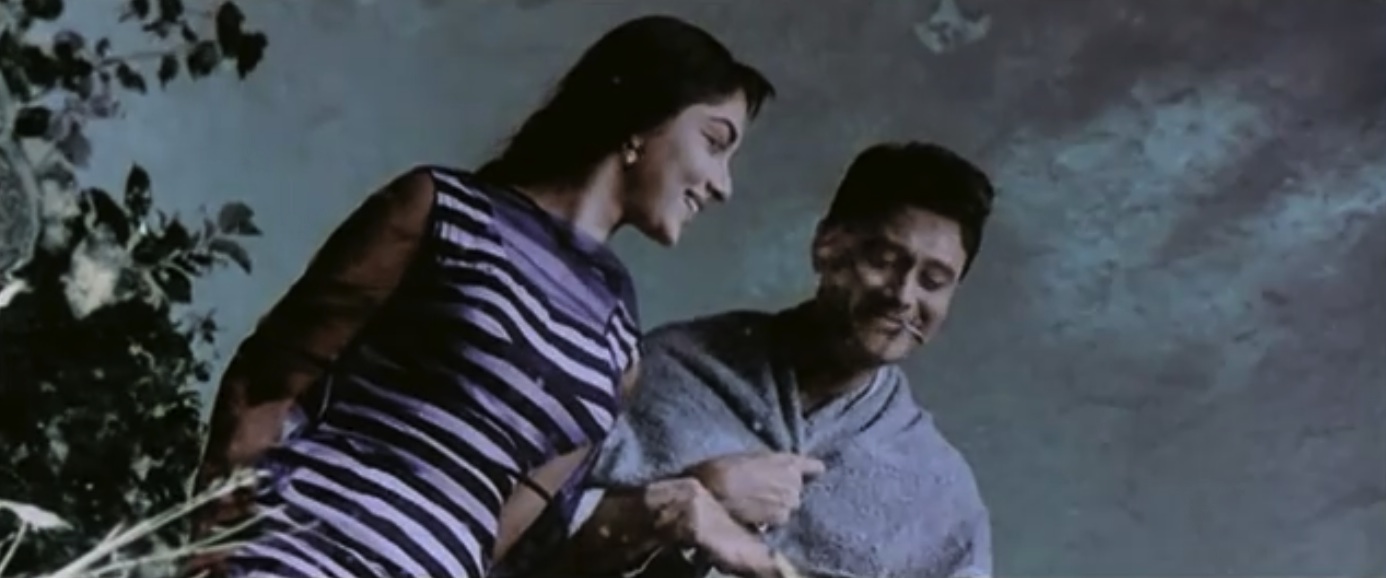
Dev Anand imagines Sadhana appearing next to his reflection in a pool of water.

Additionally, apart from adding a splash of colour, it would seem the new editors also altered the aspect ratio of the film into a widescreen presentation. Throughout some of the songs, you’ll also see Dev Anand had added fancy fades to and from black, which are definitely classy. However, I mourn the loss of the original aspect ratio–because the film is now made for the widescreen, a portion of the frame’s top and bottom have been cut off. A bit of the magic was cut too.

But even without these external alterations, the original beauty of the film has shone for decades. Hum Dono is a war film, but the story is not strictly about war. Dev Anand plays a dual role in the film and faces a moral dilemma when he impersonates the identity of his look-alike after the latter’s presumed death. Every action he makes has spiraling and exciting ethical repercussions. The film is one of the finest Bollywood has ever produced, and like most Dev Anand films, boldly explores difficult social themes and relationships. My only regret is that it’s obviously a twin story that no one bothered to explicitly state in the script. It’s a big gripe of mine about Bollywood twin movies, and for one of the worst examples of it, Haseena Maan Jaayegi, see our previous post on Bekhudi Mein Sanam!

Dev Anand hum Dono Main Zindagi Ka Saath 2

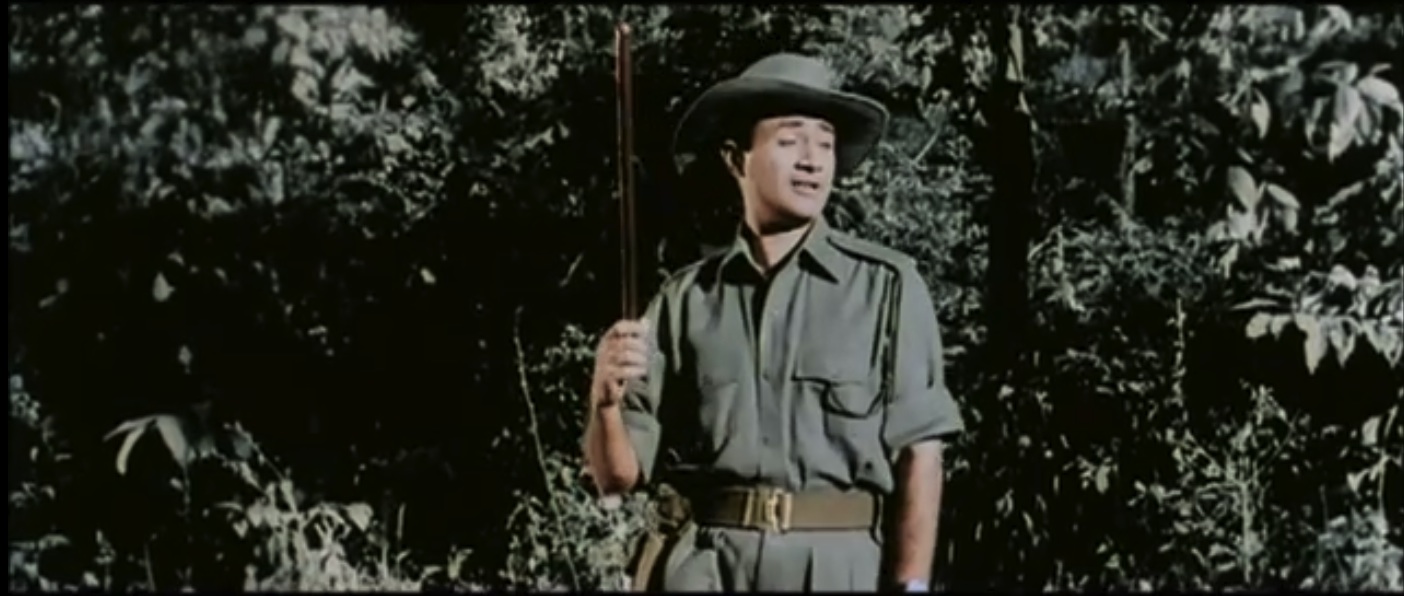
Dev Anand in full military dress from Hum Dono (1961)

But the greatest achievement of Hum Dono is in its music by Jaidev. Every single song in its soundtrack is pure gold, from the Rafi-Asha love duet “Abhi Na Jaao ChoD Kar” to the majestic Lata devotional “Allah Tero Naam.” The sweet melodies of Hum Dono have remained popular today, and amongst them is the sentimental mood-lifter “Main Zindagi Ka Saath Nibhata Chala Gaya.” In it, Dev Anand expresses many of the philosophies that would present in his later films such as Guide (1965). The Vedic-inspired line “gham aur khushi ke farq na mehsuus ho jahaan” allows the hero a carefree outlook that is unusual and refreshing for a jaded military officer. Because of it, this song has retained its popularity over the years. Of interesting note, Hindi movies were not allowed to use authentic Indian Army officer outfits for their costumes. So for anyone familiar with period military wear in India, you’ll notice the epaulette on the shoulder has been adjusted so it is not an exact replicate of what was actually worn!

Check out the youtube link here, and follow along with us below for full lyrics and English translation of “Main Zindagi Ka Saath“!

Main Zindagi Ka Saath Nibhata Lyrics and Translation

Mai.N zindagii ka saath nibhaataa chalaa gayaa
I faithfully followed wherever life took me
Har fikr ko dhuei.N mei.N uDaataa chalaa gayaa
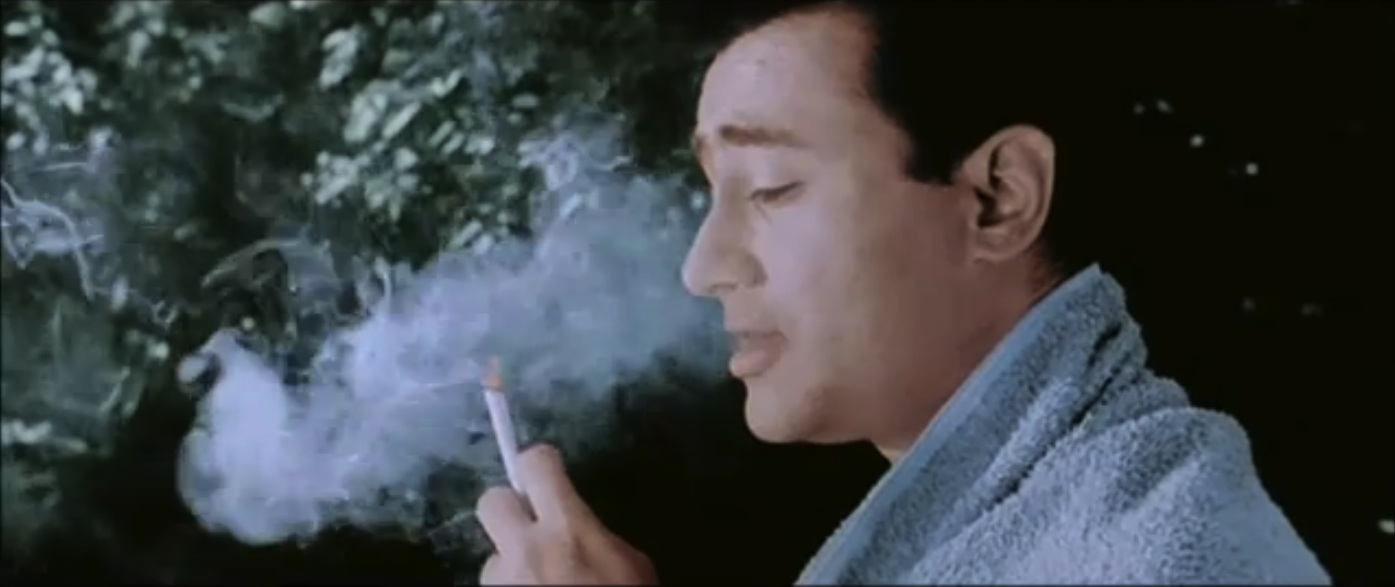
I blew every worry into a mist of smoke

Barbaadiyo.N ka shok manaanaa fizuul tha
It was pointless to grieve about my destruction,
Barbaadiyo.N ka jashn manaataa chalaa gayaa
So I kept making a celebration of my destruction!
Har fikr ko dhuei.N mei.N uDaataa chalaa gayaa
I blew every worry into a mist of smoke

Jo mil gayaa usii ko muqaddar samajh liyaa
Whatever came my way I considered to be my destiny
Jo kho gayaa mei.N usko bhulaataa chalaa gayaa
Whatever was lost to me, I kept putting out of my mind.
Har fikr ko dhuei.N mei.N uDaataa chalaa gayaa
I blew every worry into a mist of smoke

Gham aur khushi mei.N farq na mehsuus ho jahaa.N
That state where happiness and sorrow are indistinguishable
Mai.N dil ko us muqaam pe laataa chalaa gayaa
That realm is where I kept pushing my heart
Har fikr ko dhuei.N mei.N uDaataa chalaa gayaa
I blew every worry into a mist of smoke

Glossary:

zindagii: life; fikr: worry; dhuuei.N; smoke; barbaad: destruction; shok manaanaa: grieve; fizul: pointless; jashn: celebration; muqaddar: destiny, fate; bhulaanaa: to forget gham: sadness; khushi: happiness; farq: difference mehsuus: feeling; muqaam: realm

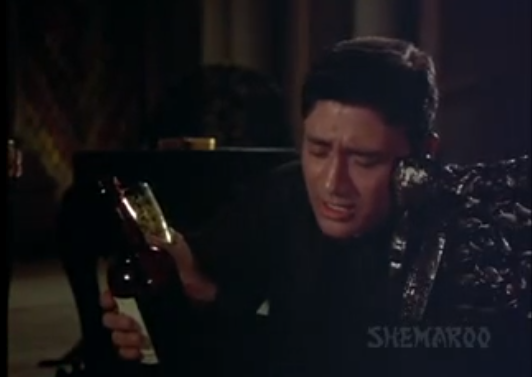
Dev Anand Hum Dono Main Zindagi Ka Saath

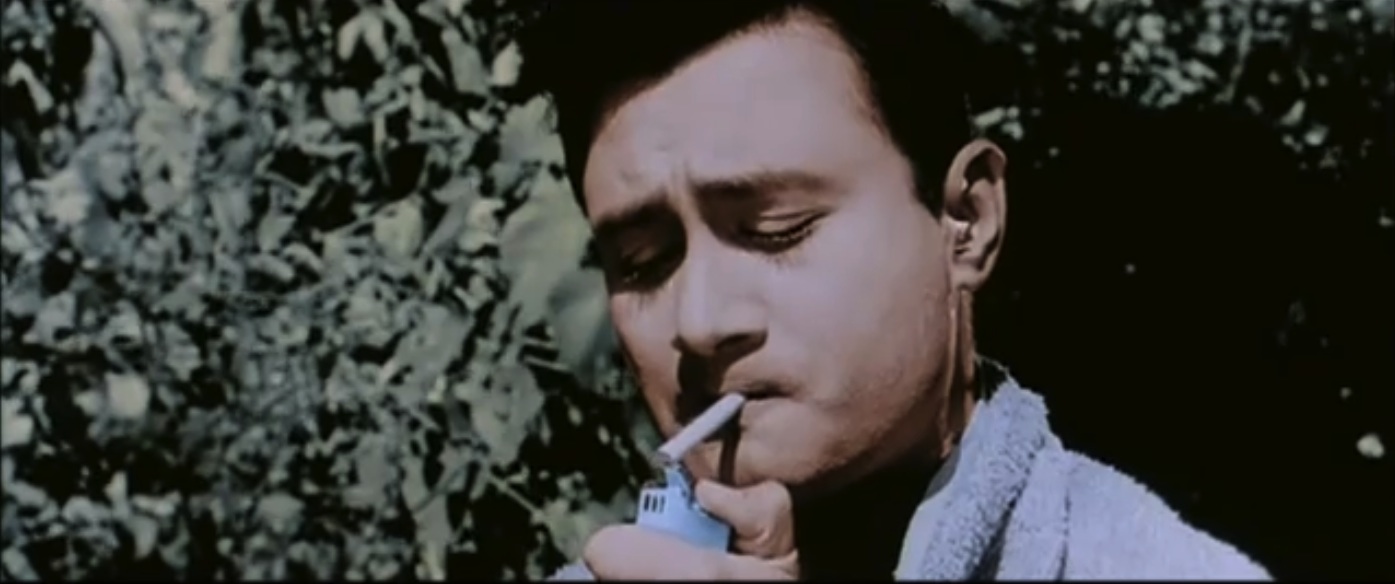
Dev Anand blows all his worries away in a puff of smoke in Hum Dono (1961)

The gentle chiming at the beginning of the song can also be found at the very end of “Abhi Na Jaao ChoD Kar” from the same film. Nice, Jaidev. Nice. This song translation was made by special request from our fan Bhuvesh! We always welcome requests from our readers, so don’t forget to drop us a line!

– Mrs. 55

The Glorification of Alcohol in Hindi Cinema

A study released in April of this year claimed that Indian adolescents aged 12-16 exposed to alcohol consumption in films were nearly three times more likely to drink than their peers who did not watch Bollywood movies. While this study most likely pertains to the movies released in the industry today, I would venture to say that the origins of this trend can be traced back to films from the Golden Era of Bollywood cinema. Indeed, the consumption of alcohol has been glorified on India’s silver screen for decades, especially through portrayal of sharaab (alcohol) songs in films. Here, I’ve compiled a list of my five favorite male and female sharaab numbers from the Golden Era–let’s take a closer look at these examples to examine how the consumption of alcohol has been portrayed cinematically and its implications on Indian culture.

“Girls Just Want To Have Fun”

In Bollywood’s earliest days, drinking alcohol in films was portrayed as a strictly masculine activity, à la Devdas and other Bollywood heroes who have famously drowned their sorrows in liquor. In contrast, the idealized image of the traditional Indian woman did not permit the depiction of female alcohol consumption in the media.  This trend began to change in the 60s when films depicted heroines and female actresses playing roles in which they partook in the consumption of the Devil’s nectar, just like their male counterparts. As you can see below, the contexts in which female characters drink vary from film to film: alcohol has been used by the women of Bollywood as a coping mechanism, a means of revenge, or just a way to have a good time.

na jaao saiyaa.n (Sahib Bibi aur Ghulam, 1962): In this film based on a Bengali novel by Bimal Mitra, Meena Kumari gives one of her career’s best performances as Chhoti Bahu. Chhoti Bahu is married to young zamii.ndar (played by Rehman), who neglects his wife at home in order to take part in debauchery at local brothels on a nightly basis. In desperate need of her unfaithful husband’s companionship, she decides to take up drinking in order to keep him away from those pesky courtesans at night. In this heartbreaking song sung by Geeta Dutt, Chhoti Bahu drunkenly entreats her husband to stay at home and spend the night with her. In a truly unfortunate example of art mimicing real life, both Geeta and Meena would succumb to alcoholism as a way to cope with their unhappy marriages in the coming years. For those of you who enjoy this song, be sure to check out Hemant Kumar’s Bengali version of the same tune: “olir katha shune.

Meena Kumari, as Chhoti Bahu, tragically turns to alcoholism in Sahib Bibi aur Ghulam (1962).

piike hum tum jo chale aaye hai.n (Gumnaam, 1965): This film (reviewed by us here) is a suspense thriller loosely based on the Agatha Christie novel And Then There Were None. The story revolves around seven vacationers who find themselves on a remote island in the middle of nowhere after a plane crash. One by one, they are murdered off and the big question is, of course: whodunnit? In the midst of all this tension, two of the vacationers, Miss Kitty (played by Helen) and Asha (played by Nanda), decide to loosen up and have some fun with a few drinks. In this comical duet sung by Asha Bhonsle and Usha Mangeshkar, the two actresses appear to be having the time of their lives in a drunken stupor on screen. I mean, who wouldn’t be having a good time if they were getting drunk with Helen?

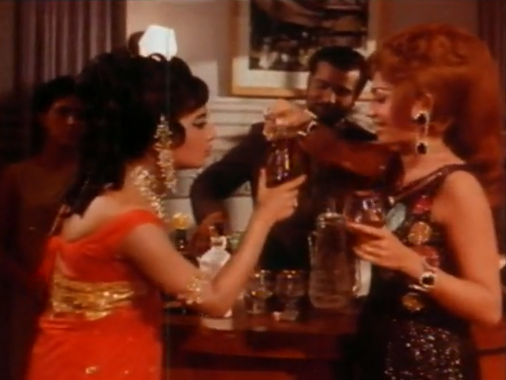
Helen and Nanda get sloppy together in Gumnaam (1965). If you excuse the stumbling, Helen actually looks quite sophisticated in this scene because she’s not wearing one of her characteristically outrageous wigs/outfits.

aao huzuur tum ko (Kismat, 1968): This Asha-OP Nayyar collaboration is an all-time classic from the soundtrack of Kismat (along with “kajraa muhabbatvaalaa“). The film’s narrative is so outrageous that it’s not even worth summarizing here, but this song is picturized on the actress Babita, who is the mother of Karisma and Kareena Kapoor. Babita never managed to gain much success as a heroine, and that’s not surprising given that it’s unclear whether she is drunk or undergoing eplipetic fits in this particular scene. She certainly does make a statement though and manages to embarass the hero Biswajeet with her public intoxication at this party. Regardless of the picturization, Asha Bhonsle adds all the right expressions here to make this an unforgettable sharaab number on the basis of the song alone. Her vocal control in the extended introduction (“ham se raushan hai chaa.nd aur taare...”) before the song’s first stanza is especially commendable. 

Babita has probably had one too many in this scene from Kismat (1968)

kaise rahuu.n chup (Inteqaam, 1969): Inteqaam is an entertaining (but occaisionally illogical) thriller that stars Sadhana as a woman who seeks revenge against her former boss because he framed her for a theft that she did not commit. As part of her elaborate plan for revenge, she intends to marry her boss’s son (played by Sanjay Khan) and bring shame to his entire family by revealing that the new bahu is, in fact, a convicted criminal! In this song, Sadhana further embarasses her boss’s family by  acting extremely intoxicated under the influence of alcohol at a public gathering. (Technically, this might not be considered a genuine sharaab song because Sadhana is putting on a facade of being drunk without actually consuming, but I liked this song too much to pass up putting it on the list.) This soundtrack composed by Laxmikant-Pyarelal is particularly memorable today because it casts a different light on Lata Mangeshkar, who was considered to be staunchly conservative and traditional in her playback output.  Lata surprises us all by agreeing to sing two sizzling cabaret numbers in addition to this drinking song for the film–listen to her nail those hiccups during the interludes!

Helen serves Sadhana another glass in Inteqaam (1969)

piyaa tuu ab to aajaa (Caravan, 1971): Asha Bhonsle and R.D. Burman come together to produce one of their biggest musical hits together with this classic item number from Caravan. Asha’s performance here solidified her status as the queen of cabaret singing in Hindi cinema. Furthermore, Helen’s portrayal of a nightclub dancer on screen during this song is considered the quintessential Bollywood cabaret performance. Helen’s dance moves are completely outrageous here but she makes it work somehow (see Mrs. 55’s step-by-step breakdown here). Given the ridiculousness of the situation here, you can’t really blame Helen for the heavy drinking…it certainly doesn’t stop her from completely owning the stage during her performance!
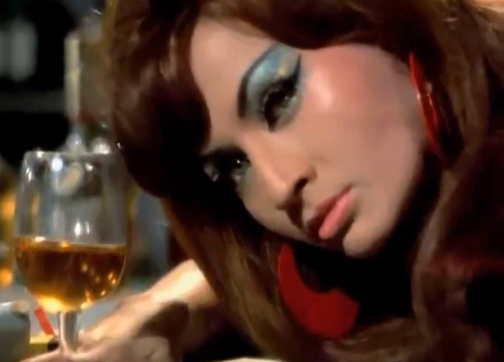
Helen gives one of the best cabaret performances of her career in Caravan (1971)

“Alcohol May Be Man’s Worst Enemy…”

Unlike their female counterparts, the men of Bollywood cinema have been imbibing alcohol since the industry’s earliest days. The most popular context for male drinking in Hindi films occurs when the hero resigns himself to heavy drinking in order to drown his sorrows, usually caused by woman-related heartbreak. While female characters are often stigmatized for their drinking and public intoxication, it is more acceptable for men of the silver screen to use alcohol consumption to deal with their grief.  Other contexts where actors are depicted consuming alcohol include scenes of male-male bonding (bromances, anyone?) and seduction of heroines and courtesans. Though Bollywood has glamorized the consumption of alcohol for both genders, the effect is far more pronounced for males, as evident in the examples I’ve selected below.

mujhe duniyaavaalo sharaabii na samjho (Leader, 1964): Even though its soundtrack is full of gems like “tere husn kii kyaa tariif karuu.n” and “ek shahanshah ne banvaa ke ek hasii.n taaj mahal,” Leader is one mess of a film starring Dilip Kumar and Vijayantimala. Dilip Kumar stars as a law graduate and aspiring political revolutionary who falls in love with a princess (played by Vijyantimala). The script has so many holes that it’s difficult to discern the overall message of this film, but there are some scenes of comic relief between Vijayantimala and Dilip Kumar that are worth remembering. By far, however, the main attraction here is the soundtrack composed by Naushad. In this particular number, an intoxicated Dilip Kumar claims that he has been forced to take up drinking to grapple with society’s evils.
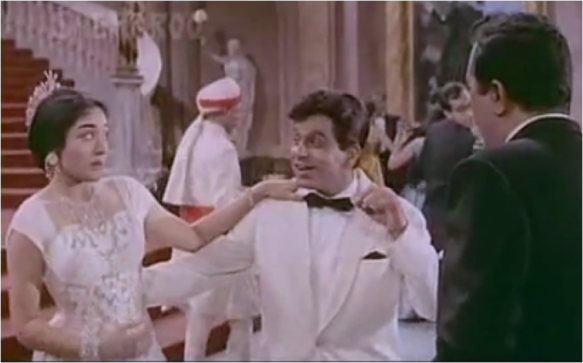
Vijayntimala tries to stop a drunk Dilip Kumar from embarassing himself too much at this party in Leader (1964).

din Dhal jaaye (Guide, 1965): Where do I even begin with the praise for Vijay Anand’s Guide? Mrs. 55 and I both love everything about this film: the unique story written by R.K. Narayan, the stellar performances by Dev Anand and Waheeda Rehman, and of course, the unforgettable soundtrack composed by S.D. Burman. Each and every song from this film is an absolute gem. In this particular Rafi solo picturized on Dev Anand, the hero drowns his sorrows about lost love in alcohol. The melancholic expression that pervades throughout this scene is enhanced by the beautifully crafted lyrics and tune.

Dev Anand turns to the bottle when love goes sour in Guide (1965).

chuu lene do naazuk ho.nTho.n ko (Kaajal, 1965): With this Rafi number penned by Sahir Ludhianvi and composed by Ravi, Raaj Kumar tries to get Meena Kumari, his on-screen shaadi-shudhaa (virtuous) wife, to come to the dark side by having a drink. Alcohol glorification occurs is at its finest in these lyrics: it is referred to as “mubarak cheez,” or a blessed thing.  Meena Kumari excels, as usual, at looking incredibly uncomfortable and disturbed by Raaj Kumar’s advances in this scene.
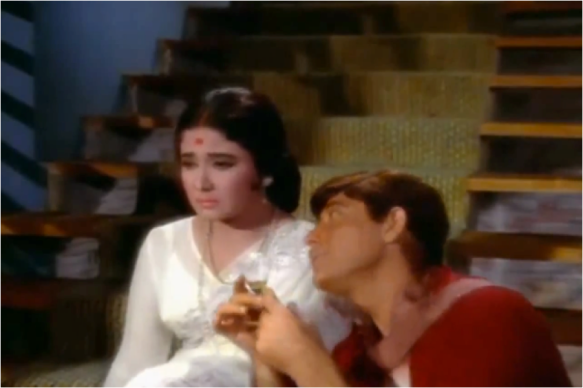
A drunk Raaj Kumar tries to get Meena Kumari on his team in Kaajal (1965).

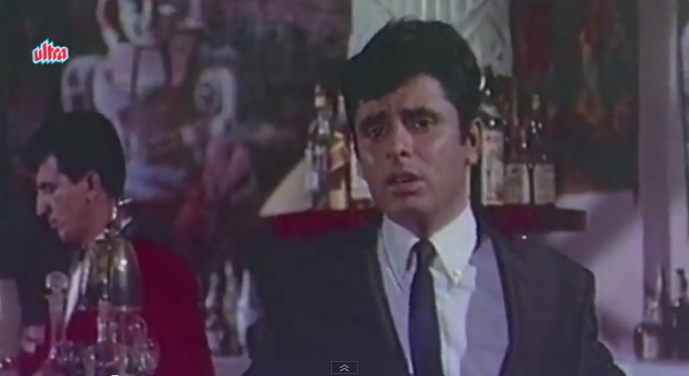
jo unkii tamanna hai barbad ho jaa (Inteqaam, 1969): This film certainly features a lot of alcohol consumption on screen. In addition to the drunk Lata number discussed above, this Rafi solo from Inteqaam is picturized on Sanjay Khan as he laments being a mere object in Sadhana’s plans for revenge. Rajinder Krishan’s lyrics are exquisite in their ability to capture the essence of being deceived in love.
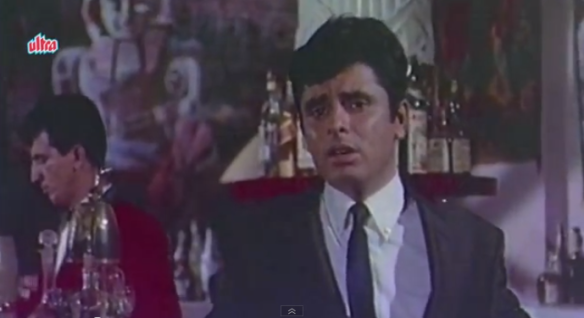
Handsome Sanjay Khan turns to alcohol to get over Sadhana’s deception in Inteqaam (1969)

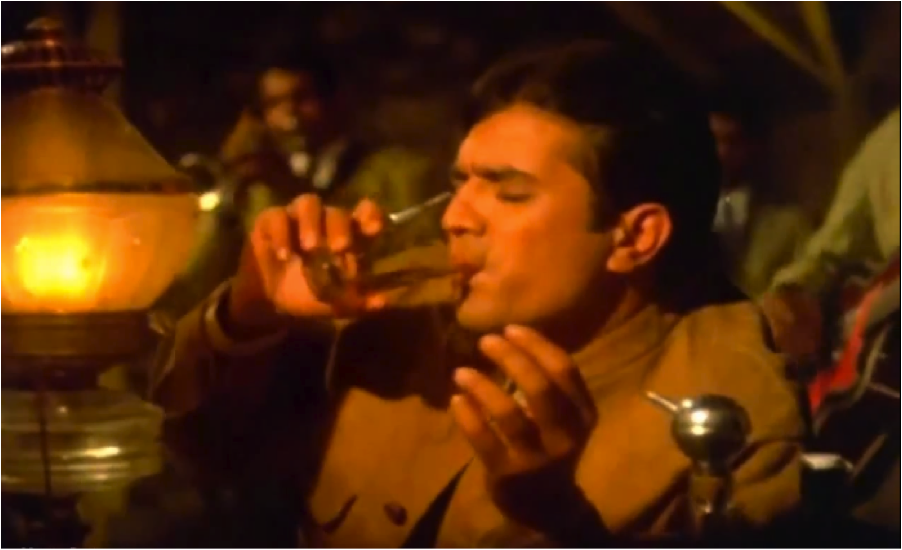
yeh jo muhabbat hai (Kati Patang, 1970): Directed by Shakti Samanta, this film features an evergreen soundtrack composed by R.D. Burman. This particular number sung by Kishore Kumar is one of Bollywood’s most treasured drinking songs, and it features a handsome and bitter Rajesh Khanna drinking the night away because he was stood up at the altar by his wife-to-be.  Asha Parekh watches from a distance, not yet aware of the fact that she is the woman responsible for his heartache.

Rajesh Khanna drinks another glass of liquid courage before singing about the pain of disloyal love in Kati Patang (1970).

What are some of your favorite sharaab/daaru songs from Bollywood films? Let us know in the comments! We’ll understand if your typing is a little bit off…
Mr. 55

Which Actor Did Hemant Kumar Sing For Best?

Hemant Kumar (1920-1989) was a legendary Hindi and Bengali film music composer and singer.

Hemant Kumar (1920-1989) was a legendary Hindi and Bengali film music composer and singer.

In classic Bollywood cinema, playback singers could make or break the career actor. Famous actor-singer pairings are legendary. The voice of the singer became the soul of the actor and once a perfect match was made, it was hard to separate them without upheaval. Who could imagine anything but the manly voice of Kishore Kumar with the face Rajesh Khanna? Or the playful sweetness of Mohammed Rafi with fun-loving Shammi Kapoor? When Mukesh passed away, Raj Kapoor (for whose career Mukesh lent his illustrious talent) famously burst into tears and announced, “I have lost my voice.”

But occasionally we find a rogue player in Hindi film music. Hemant Kumar stands out as a unique character, a difficult man to place in the rankings. For he was not merely a singer, but a legendary music director as well in both Hindi and Bengali cinema. Hemant Kumar was heavily influenced by Rabindrasangeet (like his contemporary S.D. Burman!), and first broke into the Bengali industry as a music director in 1947, the year of Indian independence. Hemant Kumar’s unmatched virtuosity led him to not only sing many of the hit songs of the 50s and 60s in Bombay himself, but he actually formed his own production company that made classics such as Bees Saal Baad (1962), Kohra (1964), and Khamoshi (1969). In the 70s he even dabbled as a film director with moderate success.

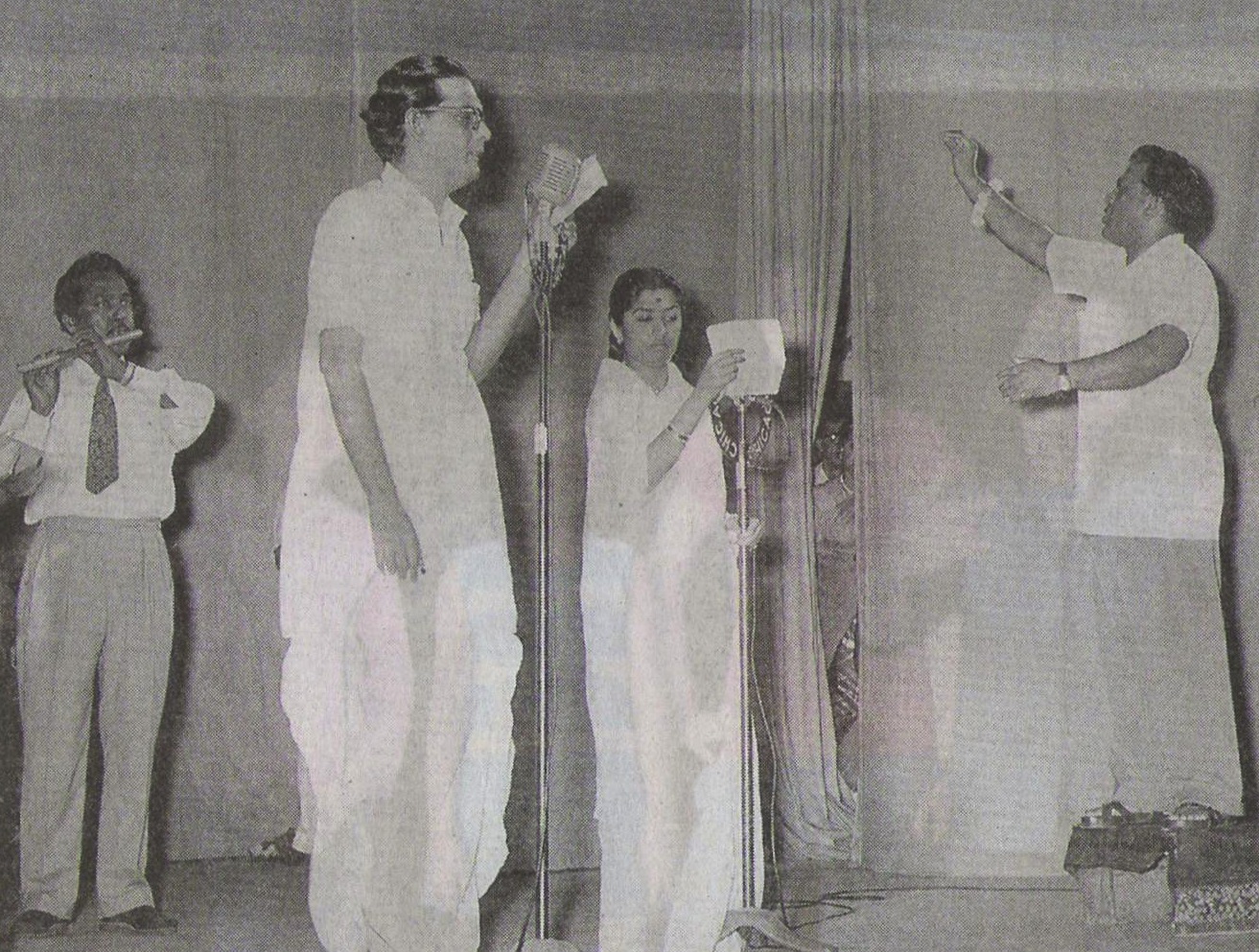
Hemant Kumar recording a song with Lata Mangeshkar

Hemant Kumar and Lata Mangeshkar during the studio recording of “Nain So Nain” from Janak Janak Paayal Baaje (1955).

But for me, it was as a singer that Hemant Kumar always shines and also the category in which history has given him the shaft. His voice was absolutely unlike any other in the industry–a deep and soulful richness that no one could touch. Interestingly, for a man whose talents were so diverse, Hemant Kumar never took to acting and singing his own songs on screen (à la Kishore Kumar). Instead, he sang for a myriad of rising and great actors across the decades–never branding himself with a single artist. Hemant Kumar remained a maverick, and for it, is often brushed aside.

So I now pose to you the question–which actor do YOU think Hemant Kumar sang for best? His voice graced the images of many men, but did it work for all of them? Your contestants are Guru Dutt, Dharmendra, Biswajeet, Dev Anand, and Shammi Kapoor. We present five songs below that illustrate some of Hemant Kumar’s finest collaborations with these actors and the cinematic chemistry that ensued.

1. Guru Dutt: Jaane Woh Kaise

The voice of tragedy, Hemant Kumar sings for Guru Dutt in this timeless lament from Pyaasa (1957). Guru Dutt, who often played the tragic poet, seems a natural choice for the resonant tones of Hemant Kumar in this song that has become iconic for all awkward dinner party songs.

2. Dharmendra: Tum Pukar Lo

Discussed in a previous post, Khamoshi (1968) is a heart-wrenching film about love, loss, and insanity. Although you don’t see much of Dharmendra’s face in this sequence, his subtle performance matches the song’s patient yearning with a hint of a Western flair. But to me, as an actor Dharmendra is somehow too shallow to be worthy of a Hemant Kumar solo. Maybe that’s just me?

3. Biswajeet: Yeh Nayan Dare Dare

A tender sequence from the film Kohra (1964), this song embodies the sweet side to Hemant’s voice that comes in the middle of a spooky film noir. I’m not going to pretend that Biswajeet is anything but a joke, but for me this pairing works–Hemant’s sweet vocals and Biswajeet’s confident, but appeasing motions to Waheeda are a pleasing combination.

4. Dev Anand: Yeh Raat Yeh Chaandni Phir Kahaan

God, I love it. I’ll be the first to tell you that no one sang better for Dev Anand than Mohammed Rafi, but this song is something else. I’ve discussed this sequence already in our earlier translation of the song, but let me just repeat that Hemant Kumar in a seductive mood blends beautifully with that longing gaze of Dev Anand’s. It’s just so exciting and rare, not to mention compliments Dev Anand’s semi-gravely voice in this film.

5. Shammi Kapoor: Aye Dil Ab Kahin Lejaa

This is another beautiful Hemant Kumar tragedy with a touch of mystery. Shammi is clearly giving it his all in this song, but somehow, I think it just doesn’t come together. Shammi Kapoor is too much of a hot mess for me to believe anything but Mohammed Rafi coming out of his mouth–the resonant voice of Hemant seems incongruous with those histrionics, despite its unarguable beauty.

And the winner is…?

I’m gonna have to say Guru Dutt–that song is just sublime on every level, but I’m open to discussion. Who do you think matched Hemant Kumar’s voice best? Let us know YOUR opinion in the comments!

-Mrs. 55

P.S. Wondering why we didn’t mention female playback singers here? It’s because the female side of things worked very differently, ie., it was Lata and Asha or bust. Every actress had them, and with the occasional Geeta Dutt or Shamshad interlude, there was no room for a “signature” playback artist per actress (although Lata will argue she “changed” her voice depending on the actress–more on this to come!)

Yeh Raat Yeh Chandni Phir Kahan Lyrics and Translation: Let’s Learn Urdu Hindi

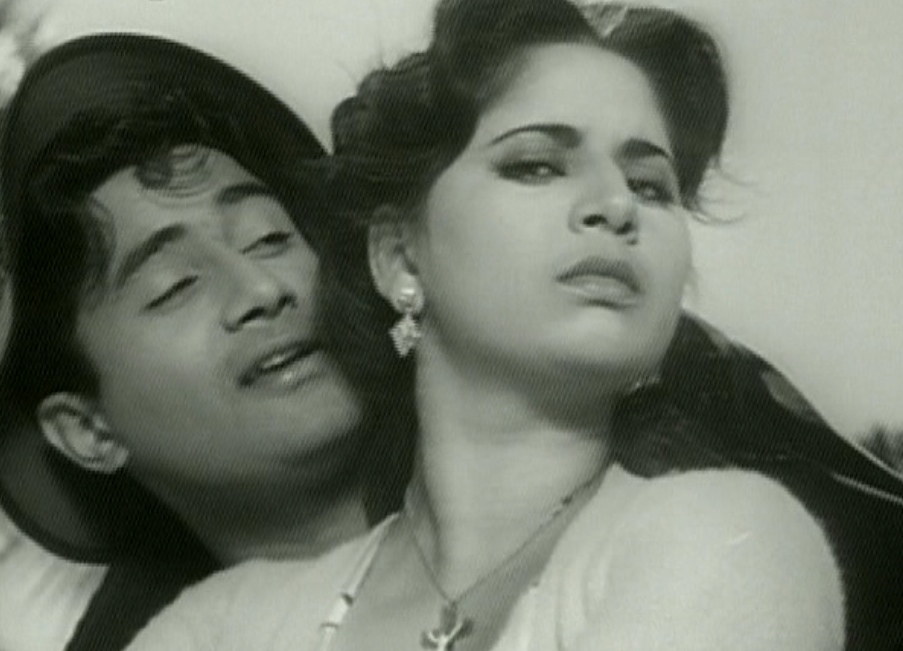
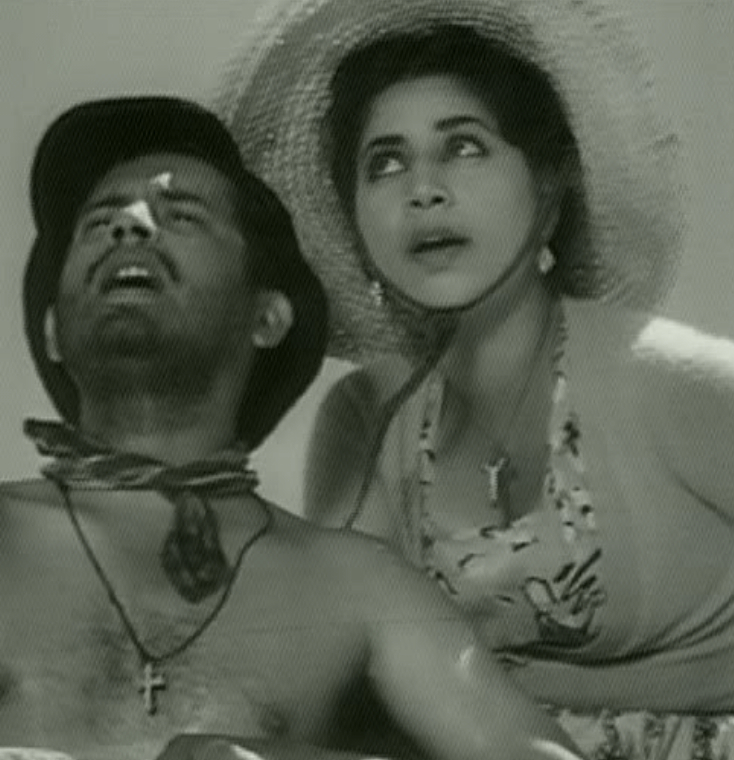
Dev Anand attempts to win over Geeta Bali under the guise of love in Jaal (1952).

We now will present the full lyrics and English translation to the haunting beauty “Yeh Raat Yeh Chandni” from the film Jaal (1952). Starring hit duo Dev Anand and Geeta Bali (who had wowed audiences together in Baazi the year before), Jaal was auteur Guru Dutt’s second film. Unlike Baazi, which mimicked film noirs of the West, Jaal looked outside the crowded cities to the gentle coast of Goa for inspiration. This film is truly one-of-a-kind, exploring life in the Portuguese fishing colony and the interwoven religious themes of forgiveness and love in the unfolding affair between two Christians, Tony (Dev Anand) and Maria (Geeta Bali). Note: Jaal was released before West Side Story hit Broadway, so the names of the lead characters are just a coincidence!

Dev Anand plays a Bombay gold thief who has escaped to Goa and who falls in love with the spunky village belle, Geeta Bali. Their love is tested by society, the law, and ultimately a vow before God that leads Tony to atone for his past and Maria to remain faithful until his sentence is fulfilled. Like most Guru Dutt films, the plot brings something new to the table. Watch out for some wild swing dancing, Johnny Walker making repeated attempts at Arabic, and a generous handful of “amens” throughout the film!

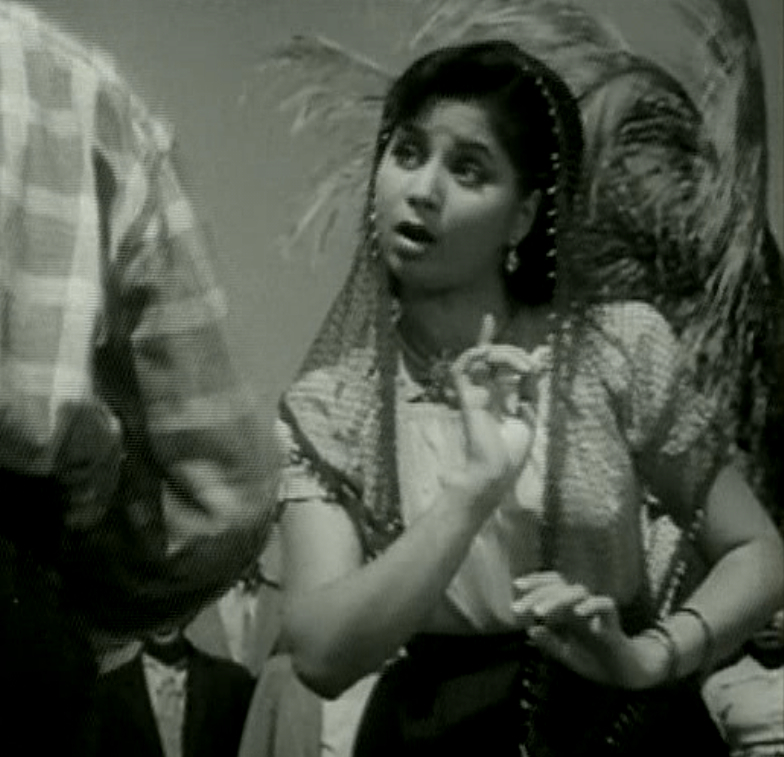
Spunky and fabulous, Geeta Bali leads a Goan dance in Jaal (1952)

The song “Yeh Raat Yeh Chandni” comes in two versions–the tragic Lata Mangeshkar duet, and the initial lilting Hemant Kumar solo. We will translate both to get a fuller understand of the role this song plays in the film, starting with the duet. This version occurs late in the film after Geeta’s friends and family discover Dev Anand’s true past and forcibly remove her from him. However, she is now in love despite his background and sings this tearful song of pining.

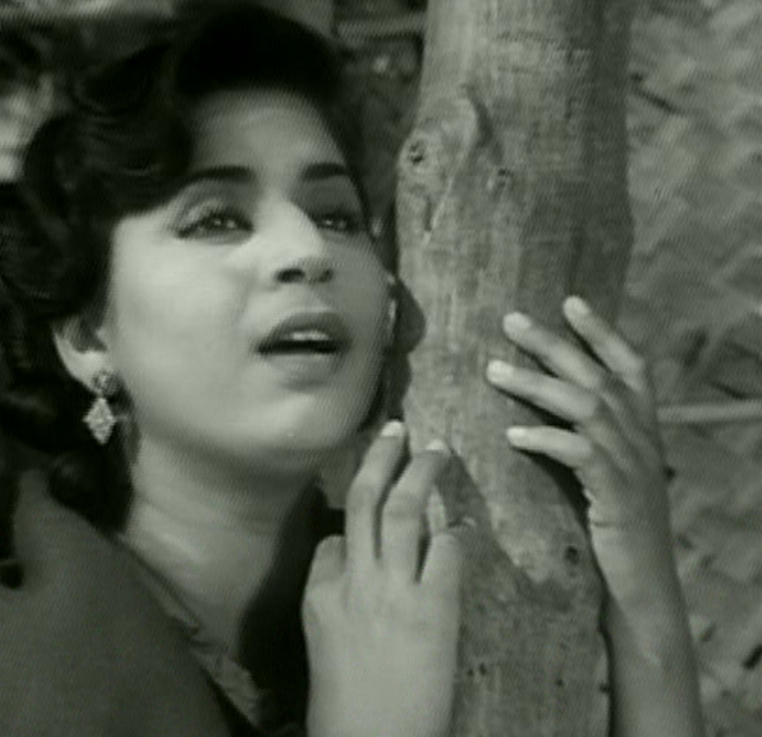
Geeta Bali declares her unwavering love for a wanted criminal in Jaal (1952).

Enjoy our English translation and full lyrics of “Yeh Raat Yeh Chandni” and it’s counterpart “Sun Ja Dil Ki Dastan” below!

Yeh Raat Yeh Chandni Phir Kahan Lyrics and Translation

Duet (Lata Mangeshkar & Hemant Kumar):

Yeh raat yeh chaandni phir kahaa.N
Where will we find this night and this moonlight again?
Sunjaa dil ki daastan
Listen now to the story of my heart

Chaandni raaten pyar ki baaten kho gayi jaane kahaa.N
Where have the moonlit nights and words of love become lost?
Yeh raat yeh chandni phir kahaa.N
Where will we find this night and this moonlight again?
Sunjaa dil ki daastan
Listen now to the story of my heart

Aati hain sada teri TuuTe hue taaro.N se
I sense your presence from the falling stars
AahaT terii suntii hoo.N khaamosh nazaaron se
I hear your footsteps with hushed glances
Bheegii hawa uudi ghaTa kheti hai.N teri kahanii
The moist winds, the soaring clouds speak of your story
Tere liye bechain hain sholo.N mei.N lipti jawaanii
My youth is ablaze in restlessness for you
Seene mei.N balkha raha hai.N dhuaa
The smoke engulfs my chest
Sunjaa dil ki daastan
Listen to the story of my heart

Chandni raaten pyar ki baaten kho gayi jaane kahaa.N
Where have the moonlit nights and words of love become lost?

Leheron ki labon par hai.N khoye hue afsaane
On the lips of the waves lie forgotten fables
Gulzaar umiidon ke sab ho gaye viraane
All the rose gardens of hope have become barren.
Tera pataa paaoo.N kahaa.N? Soone hai.N saare Thikaane
Where can I find where you are? All abodes are deserted
Jaane kahaa.N gum ho gaye jaake ho agle zamaane
I do not know where you have disappeared to in the other world
Barbaad hai.N aarzoo ka jahaa.N
The world of desire has been destroyed
Sunjaa dil ki daastan
Listen now to the story of my heart

Glossary:

raat: night; chaandni: moonlight; TuuTa taaraa: shooting star; aahaT: footsteps; khaamosh: silence, hushed; bheegi: wet; kahaanii: story; bechain: without peace, restless; sholaa: spark, fire: jawaanii: youth; seenaa: heart; chest; dhuaa: smoke; leher: wave; lab: lip; afsaanaa: fable, story; gulzaar: rose garden; umiid: hope; viiraane: wasted, desolate; pataa: whereabouts, address; soonaa: empty, lonely; Thikaanaa: shelter, abode; gumnaa: to become lost; aglaa: next; zamaanaa: world; barbaad: destroyed; aarzoo: desire; jahaa.N: world, place

But before this sad reprise, Dev Anand can be found singing the romantic solo version from his beach side abode. Hemant Kumar’s voice is absolutely magical in this song–he has the perfect blend of richness and allure. At this time in the film, Dev Anand is trying to cinch the deal with his romance and claims he knows that Geeat Bali will come to his hut when she hears this song. His version of “Yeh Raat Yeh Chaandni” has a uniquely tropical Goa flair, but it maintains an exciting sense of urgency in both the lyrics and style. As you can guess, Geeta comes running.

Dev Anand Jaal

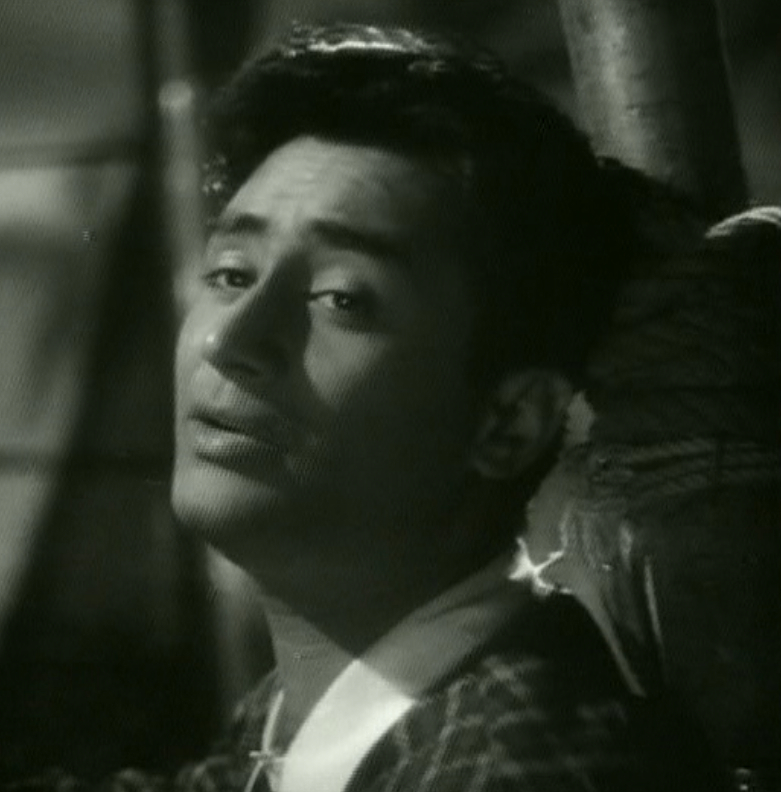
Dev Anand calls to Geeta Bali in the moonlight in Jaal (1952).

Yeh Raat Yeh Chandni Phir Kahan Lyrics and Translation

Male Solo (Hemant Kumar):

Yeh raat yeh chaandnii phir kahaa.N
Where will we find this night and this moonlight again?
Sun ja dil ki daastan
Listen now to the story of my heart

Hey peDo.N ki shaakho.N pe
On the branches of the trees
PeDo.N ki shaakho.N pe soyii soyii chaandnii, peDo.N ki shaakho.N pe…
On the branches of the trees the moonlight slumbers
Tere khayaalo.N mei.N khoyii khoyii chaandnii
In thoughts of you, the moonlight wanders
Aur thoDi der mei.N thak ke laut jaayegii
And soon it will become tired of waiting and return
Raat yeh bahaar ki phir kabhii na aayegii
This night of spring will never come back
Do ek pal aur hai yeh samaa
We have but a few moments left of this atmosphere
Sun ja dil ki daastan
Listen now to the story of my heart

Hey lehero.N ke honTho.N pe
Oh, on the lips of the waves
Lehro.N ke hontho.N pe dhiima dhiima raag hai, lehro.N ke hontho.N pe
On the lips of the waves is a soft melody
Bhiigii hawaao.N mei.N thanDii thanDii aag hai
In the moist wind is a cool fire
Is hasee.N aag mei.N tuu bhii jalke dekhle
In this beautiful fire, you should see what it feels like to burn
Zindagii ke geet ki dhun badal ke dekhle
See what it feels like to change the tune of life’s song
Khulne de ab dhaDkano.N ki zubaan
Free the voice of our heartbeats
Sun ja dil ki daastan
Listen now to the story of my heart

Hey jaatii bahaare hai.N
Oh, the Spring is receding
Jaatii bahaare hai.N uThti jawaaniiyaa, jaatii bahaare hai.N
The Spring is receding, our youth is rising
Taaron ke chaao.N mei.N pehle kahaaniiyaa
In the shadows of the stars lie our stories
Ek baar chal diye gar tujhe pukaarke
If it leaves after calling to you,
Lautkar na aaye.Nge kaafile bahaar ke
The caravans of Spring will not return
Aaja abhi zindagii hai jawaan
Come, life is still young
Sun ja dil ki daastan
Listen to the story of my heart

Glossary:

raat: night; chaandnii: moonlight; peD: tree; shaakh: branch; khayaal: thought; thoDii der mei.N: in a short while, soon; thak hona: to become tired; laut jaanaa: to go back; bahaar: spring; samaa: atmosphere; leher: waves; honT: lip; dhiima: softly; bheega: moist, rainy: ThanDaa: cool; aag: fire; hasee.N: beautiful; dhun: tune; dhaDkan: heartbeat; zubaan: words, language; jawaanii: youth; chhaaye: shadow; kaafile: caravans

Did you know that it was in this movie that Guru Dutt first hired cinematographer V. K. Murthy? V.K. Murthy would continue to work as Guru Dutt’s D.P. (Director of Photography) for all of his following films. In fact, between Guru Dutt and V.K. Murthy grew such trust and friendship, that Murthy eventually encouraged Dutt to start acting in his owns films, including the haunting classics Kaaghaz Ke Phool and Pyaasa. In this film, Guru Dutt actually makes his first cameo–as a shirtless fisherman no less! Ladies, please calm down.

– Mrs. 55

Shirtless Guru Dutt

Guru Dutt makes a brief film debut in Jaal (1952) as a rugged and shirtless fisherman.

​Raat Akeli Hai Lyrics and Translation: Let’s Learn Urdu-Hindi

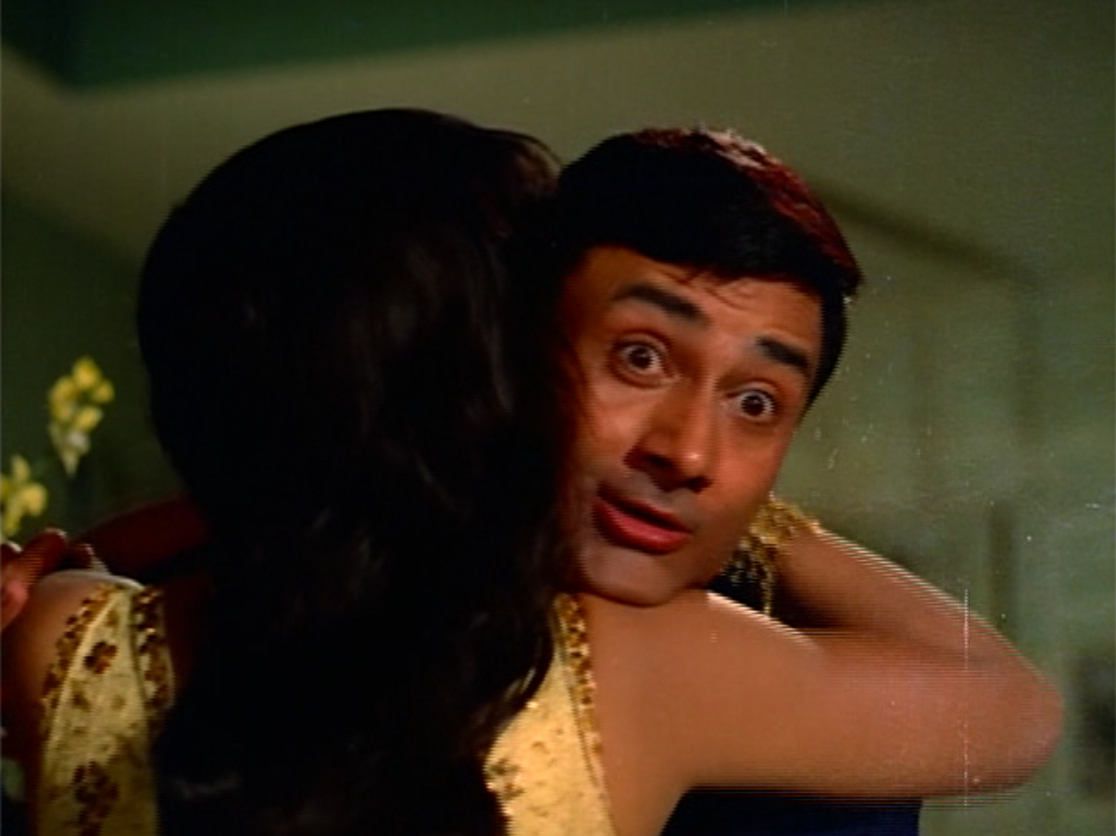
Now we will take a look at the lyrics and English translation of the seductive number “Raat Akeli Hai.” When it came to vamp songs, cabaret numbers, and being the voice any kind of seductress, Asha Bhonsle was the Queen. And yes, while this usually amounted on screen to Helen shaking her stuff in a skin-tight showgirl costume, Asha lent her versatile voice to many other actresses called upon for the vamp sequence, from Sadhana to Parveen Babi. One of her best is the Tanuja hit “Raat Akeli Hai” from Dev Anand’s hit Jewel Thief (1967) and we will now present the song’s full lyrics and translation. Asha Bhonsle gives an amazing performance–magnificently hitting both the highest of highs and hiding a sultry laugh beneath the lows. In the movie, Tanuja plays a fire-cracker “modern girl” (discussed more in our earlier post on Jewel Thief!) whose bold lines she uses to pick up Dev Anand would make anyone blush from awkwardness.

Even dapper Dev Anand is overwhelmed by Tanuja’s advances in Jewel Thief (1967).

In this song, however, her craziness works, and Tanuja is completely adorable. Bursting at the seams from her tight-fitting white dress, she seduces the hero by reaching into the living room’s classy mini-fridge and pulling out two coca-colas. Yes, it’s the 70s living at its finest. Who needs cocktails when you’re this smooth?

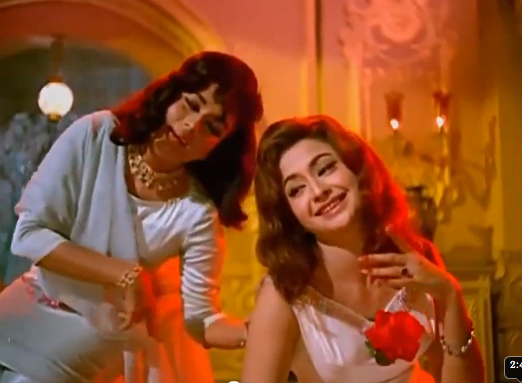
Tanuja shakes everything she has in a hip-hugging white dress from the seduction sequence of Jewel Thief (1967).

Enjoy our English translation of the tempting lyrics to “Raat Akeli Hai” below!

Raat Akeli Hai Lyrics and Translation:

Raat akelii hai, bujh gaye diye
The night is lonely, and the lights have gone out
Aake mere paas, kaano.N mei.N mere
Come close to me, and in my ears
Jo bhii chaahe kahiye, jo bhii chaahe kahiye
Tell me whatever you desire

Tum aaj mere liye ruk jaao, rut bhii hai fursat bhii hai
Today, stop a while for me, the atmosphere is right and we are at leisure
Tumhii na ho na sahii, mujhe tumse muhabbat hai
You may not feel the same, but I love you
Muhabbat kii ijaazat hai, to chhup kyuu.N rahiye
I have permitted you to love me, so why remain quiet?
Jo bhii chaahe kahiye, raat
Tell me whatever it is that you desire

Savaal banii huii dabii dabii uljhan siino.N mei.N
The confusion buried in my heart has surfaced as this question
Javaab denaa thaa, to Duube ho phasiino.N mei.N
You were supposed to give an answer, but you became drenched in sweat
Thaanii hai do hasiino.n me.n, to chup kyuu.N rahiye
When there is a resolve between two beautiful people, then why remain quiet?
Jo bhii chaahe kahiye
Tell me whatever it is that you want
Raat akeli hai…

Glossary:

akelii: lonely; kaan: ear; rut: atmosphere, season; fursat: leisure time; ijaazat: permission; chhup: silent; savaal: question; siin: chest; javaab: answer; Duubna: to become drenched, to drown; phasiinaa: sweat; thanii: resolve, commitment

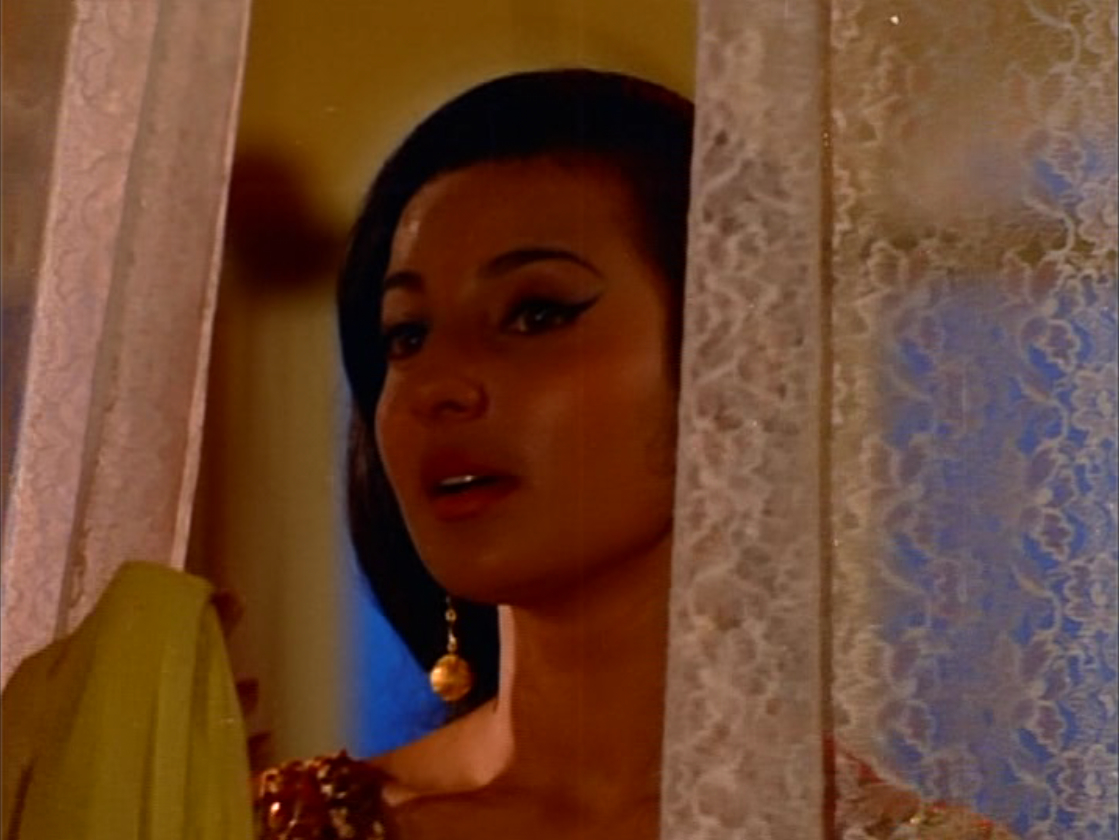
Tanuja coyly wraps herself in a curtain in “Raat Akeli Hai” from Jewel Thief (1967)

Wondering what that glass-shattering note is Asha hits over and over again in this song? It sounds fancy, but it’s really just a high F.  Our girl Asha can go higher–more on this in our post on Lata and Asha’s highest notes!

-Mrs. 55