Hum Bekhudi Mein Tumko Pukare Lyrics and Translation: Let’s Learn Urdu-Hindi

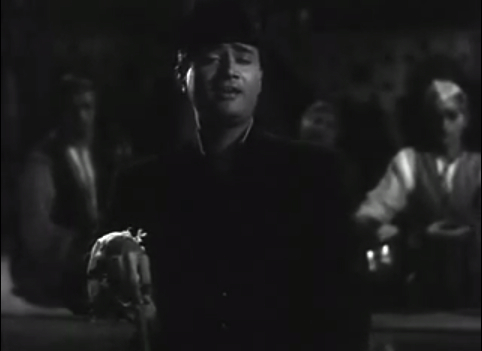
Dev Anand hum bekhudi kala pani

Dev Anand entrances the audience with “Hum Bekhudi Mein” in Kala Pani (1958).

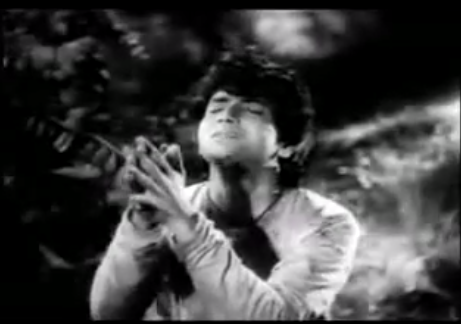
We now present our complete translation to “Hum Bekhudi Mein Tumko Pukare,” one of Mohammed Rafi’s finest solos. The song, and in fact the film Kala Pani (1958), is a considerable break from Dev Anand’s previous work, transforming him from the debonair urbanite to a meditative, black kurta pajama-clad member of the traditional intelligentsia. “Hum Bekhudi Mein” bears the unmistakable hallmark of S.D. Burman’s finest compositions—a hauntingly powerful melody that is so captivating, instrumental ornamentation is close to entirely abandoned. There is something reminiscent of his earlier composition, “Dekhi Zamaane Ki Yaari“–with an emphasis on reflection, the purity of Mohammed Rafi’s voice engulfs the listener in the qawwal-like trance of his yearning, the feeling of entering a dream where time loses its meaning. Indeed, the “bekhudi” or loss of self as described by the singer is precisely what lyricist Majrooh Sultanpuri aims to induce in the listener.
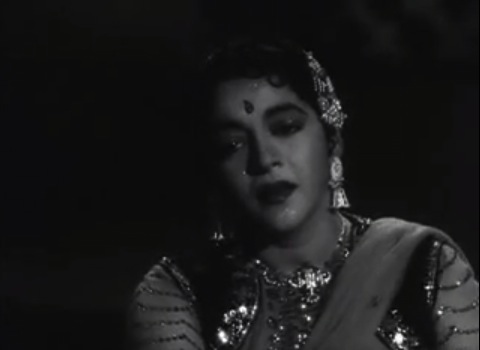
Nalini Jaywant Kala Pani hum bekhudi

Nalini Jaywant believes she has found love at last in the mysterious stranger with a haunting voice in Kala Pani (1958).

The nuance of the lyrics is an exceptional example of the multi-faceted levels of interpretation of Urdu poetry. Each line returns to the refrain’s lingering “chale gaye”—a verb tense indicating continuity of the hero’s past actions, and his current obsession with reliving them. However, Mohammed Rafi’s very deliberate pause before singing “chale gaye” with each line allows for an additional dimension to the song’s interpretation, as if a forlorn reference to the woman herself who has left him (“woh jo chale gaye”). I love this song for every person that hears it will understand it in a slightly different way. If you can’t get enough of this melody, lovers of trivia will be delighted to discover that S.D. Burman actually recorded the original Bengali version of this song in his own voice, “Ghum Bhulechi Nijhum”!

In the Hindi version, hero Dev Anand elaborates on two forms of intoxication—first, the spell cast by his former lover, and second, alcohol to which he has resigned himself.  In the evocative final line of the song, “Sheeshe mei.N aap ko bhi utaare chale gaye,” the hero reconciles their duality and his escape from reality. With the oblivion granted by alcohol, he regains the very woman who has left him in a state of bekhudi—a philosophical wanderer in fugue-like search of a connection.
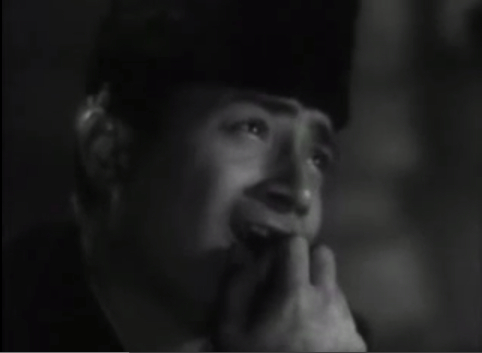
Dev Anand kala pani black hat

Despite biting his fingernails throughout the song, Dev Anand is simply too attractive to handle in a black kurta and matching traditional hat.

We hope you enjoy our English translation to the lyrics of this beautiful poem “Hum Bekhudi Mein” from Kala Pani (1958). Check out the video in which Dev Anand woos the lovely courtesan Nalini Jaywant with his artistic depth! Did you know that after this song was released, Dev Anand was actually told not to wear black anymore in public because Indian women  would swoon and jump from buildings upon seeing him dressed in that devastatingly attractive shade? I mean…I can see where they’re coming from!

Hum Bekhudi Mein Tumko Pukare Lyrics and Translation:

Hum bekhudii mei.N tum ko pukaare chale gaye
Unaware of my own self, I kept calling to you
Saaghar mei.N zindagii ko utaare chale gaye
And so I kept drowning my life in a glass of wine
Hum…

Dekhaa kiye tumhe hum banke deewaanaa
When I used to see you, I was madly love
Utaraa jo nashaa to hum ne yeh jaana
Once that intoxication wore off, I knew this
Saare woh zindagii ke sahaare chale gaye
That all the support I had in life had gone

Hum bekhudii mei.N tum ko pukaare chale gaye
Unaware of my own self, I kept calling to you

Tum to na kaho hum khud hi se khele
At least do not say that I played this game by myself.
Doobe nahii.N humii yuu.N nashe mei.N akele
For I did not drown in this intoxication alone
Sheeshe mei.N aap ko bhi utaare chale gaye
You were what I kept pouring into my glass

Hum bekhudii mei.N tum ko pukaare chale gaye
Unaware of my own self, I kept calling to you
Saaghar mei.N zindagii ko utaare chale gaye
And so I kept drowning my life in a glass of wine
Hum…

Glossary:

bekhudi: loss of self-awareness; pukaarnaa: to call out; saaghar: wine goblet; zindagii: life; deewaanaa: madly in love; nashaa: intoxication; sahaaraa: support; khud: self; khelnaa: to play; Doobnaa: to drown; akelaa: alone; sheeshaa: glass, mirror

Interestingly, this gently hypnotic song is used to trap Nalini Jaywant into falling in love with Dev Anand and confess her past crimes. Yes, it’s all a pretense–Dev Anand is actually in love with Madhubala, the cheeky journalist who is helping him absolve his wrongfully imprisoned father. Nalini Jaywant played a role in the original crime and must now the price of unrequited love for his son. The film was actually based on A.J. Cronin’s Scottish novel “Beyond This Place” published in 1953. Dev Anand loved Cronin’s work so much, he also later turned one of Cronin’s most famous novels, “The Citadel” into the 1971 Bollywood film Tere Mere Sapne.

– Mrs. 55
The Art of Urdu in Hindi Films: Losing A Poetic Legacy

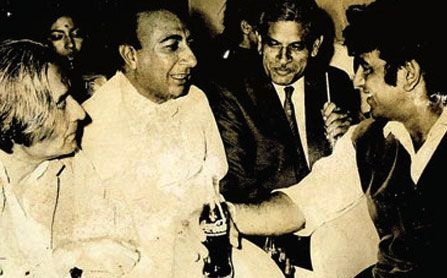
Jan Nisar Akhtar and Sahir Ludhianvi

Legendary Bollywood lyricists Jan Nisar Akhtar (far left) and Sahir Ludhianvi (left center) enjoy a birthday celebration.

The language of Hindi films has evolved since the first talkie Alam Ara in 1931, based on a Parsi play.  The Golden Age of Hindi cinema that blossomed with the studio era of the 1950s and ebbed by the late 1970s is one of India’s greatest artistic achievements. During that time, Hindi films could hardly be called Hindi films. Rather, Hindustani, a mixture of Urdu and Hindi, was the lingua franca of the silver-screen—a reflection of a country unified by a fascinatingly diverse heritage with linguistic influences from Sanskrit, Farsi, Bengali, Arabic, Panjabi, and a myriad of others.

To anyone unfamiliar with the distinction between Urdu and Hindi—there are no hard and fast rules. What many call Hindi, others would call Urdu, but most everyone can appreciate their structural and grammatical similarity. Any attempt to divide them is based on the root origins of the vocabulary intermingled with what is generally a highly homologous syntax. “Urdu” vocabulary tends to draw upon words of Farsi or occasionally Arabic and Turkish origin and “Hindi” vocabulary is generally derived from Sanskrit or regional dialects. But don’t be fooled into thinking any word “belongs” to another language (or those of a particular religion)—Hindustani may vary speaker to speaker, community to community, but the language is all-encompassing.

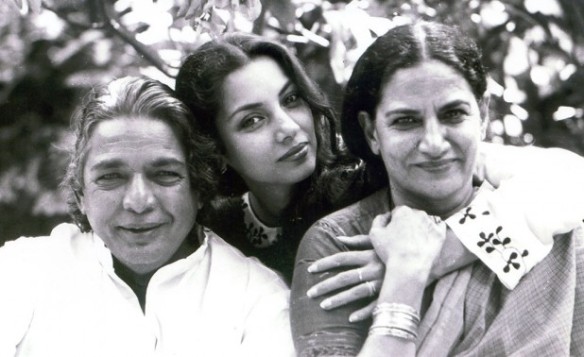
Veteran Urdu poet Kaifi Azmi (left) with his daughter actress Shabhana Azmi (center), who married contemporary lyricist Javed Akhtar, and wife Shaukat Azmi (right).

Veteran Urdu poet Kaifi Azmi (left) with his daughter actress Shabhana Azmi (center), who married contemporary lyricist Javed Akhtar, and wife Shaukat Azmi (right).

The impact of Urdu in the Indian mainstream can be no better summed up by the famous words of our freedom struggle: “Inquilaab zindabaad!” or “Sarfaroshii kii tamanna ab hamaare dil mei.N hai.” Controversial arguments have been made relating the decline in popularity to links with Pakistan, which adopted Urdu as its official language. Yet in Hindi films for decades, the legacy of Urdu poetry continued to flourish in India as the pinnacle of culture and expression.

Indeed, despite enormous gaps in literacy across the country, some of the most popular songs of that era amazingly contain the most complex Urdu-based vocabulary. Perhaps one reason is that the Hindi film song-writers themselves were trained in the art of Urdu poetry. Many of the finest and most successful poets of Hindi film: Sahir Ludhianvi, Raja Mehdi Ali Khan, Gulzar, Hasrat Jaipuri, Shakeel Badayuni, Kaifi Azmi, Jan Nisar Akhtar, and Majrooh Sultanpuri to name but a few, began their careers in Urdu mushairaas, or poetic symposiums.

Gulzar lyricist

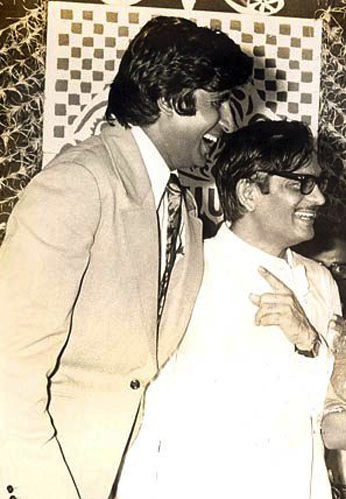
Record-breaking winner of 11 Filmfare awards for best lyrics, poet Gulzar (right) stands with actor Amitabh Bacchan (left) for whom he wrote hits from the dialogue of Anand (1971) to the modern dance number “Kajra Re” from Bunty Aur Babli (2006)

It would seem more than mere coincidence that these artists came to dominate film lyrics. Like many arenas, the Bombay film industry was an old boy network: Sahir Ludhianvi for example was close friends with Jan Nisar Akhtar, who became in-laws with Kaifi Azmi, who was a prominent member of the pre-partition Progressive Writer’s Movement with Majrooh Sultanpuri. And the music directors who often hand-picked their lyricists and made recommendations to film producers were also steeped in similar artistic traditions. Veteran composer Naushad grew up in the heart of Lucknowi culture, and Madan Mohan spent his childhood in the Middle East, eventually getting his break by joining the All India Radio in Lucknow. Yet connections in the film industry account for only part of its success—audiences had to maintain demand as well.

From the epic qawwali “Yeh Ishq Ishq Hai” from Barsaat Ki Raat (1961), the lilting ode, “Aap Ki Nazron Mein Samjha” from Anpadh 1962), to the playful duet “Deewana Hua Badal” from Kashmir Ki Kali (1964), Urdu in films was remarkably accessible—holding a place for any viewer in every genre. True, it is unlikely the entire audience understood each word in those songs. However, in this manner, film and music could be educational for those who did not–a unique way of preserving the culture they reflected back on. As parallel cinema diva Shabana Azmi aptly quipped,

“If you compare today’s songs with the songs of the 1960s and 1970s, then definitely today’s songs are according to the demand. But if you see, Hindi films used to protect the Urdu language as they used it, but it is slowly dying and I feel bad for it.”

The same extended to the dialogues of films themselves–and I don’t refer only to genre films like Pakeezah (1971) or Mughal-e-Azam (1961). Pure Urdu was ubiquitous in classic Hindi cinema, wafting equally through the sets of an urban crime drama and meandering through a village epic. The importance and sheer beauty of Urdu poetry in dialogues is highlighted in one of the most famous film speech’s of yesteryear. The stirring climax of Daag (1973) culminates in a speech given by Rajesh Khanna’s character for an award bestowed to him by his community. Notice how in this and so many other scripts, Urdu is an inextricable poetic catalyst for the Hindi speech:

Rajesh Khanna’s Speech from Daag (1973):

Aap.
Aap kya jaane mujhko samajhte hai.N kyaa?
Mai.N to kuch bhi nahii.N

“You.
I do not know what you make of me
For I am nothing

Is qadar pyaar itnii baDe bheed ka mai.N rakhuu.Ngaa kya?
Is qadar pyaar rakhne ke qaabil nahii.N
Mera dil, merii jaan…
Mujhko itni mohabbat na do, dosto.
Soch lo dosto…
Is qadar pyaar kaise sambhaaluu.Ngaa mai.N?
Mai.N to kuch bhi nahii.N

How can I carry such love from so great a crowd?
I am not worthy of such great love
My heart, my life…
Do not give me so much love, my friends
Think instead.
How will I bear such great love?
For I am nothing.

Pyaar.
Pyaar ek shakhs ko agar mil sake to badii cheez hai zindagi ke liye
Aadmi ko magar yeh bhi milta nahii.n
Yeh bhi milta nahii.n
Mujhko itni mohabbat milii aap se,
Mujhko itni mohabbat milii aap se…
Yeh mera haq nahii.N, merii taqdiir hai.
Mai.N zamaane ki nazro.N mei.N kuch bhi na thaa.
Merii ankho.N mei.N ab tak woh tasveer hai

Love.
If a man can receive love, it is a great thing in life
Yet many men do not even receive this
They do not even receive this
I have received so much love from you,
I have received so much love from you
This is not my right, it is my fate
I was once nothing in the eyes of the world
And in my eyes, that image remains

Izzate.N, shauharate.N, chaahate.N, ulfate.N, koi cheez duniya mei.N rehtii nahii.N
Aaj mai.N huu.N jahaa.N, kal koi aur thaa.
Yeh bhi ek daur hai, woh bhi ek daur thaa…

Respect, fame, desire, love, nothing remains in the world permanently
Today where I am, yesterday there was someone else
This is one generation, that was another generation…

Aaj itni mohabbat na do dosto.
Ki mere kal kii khatir ka kuch bhi rahe
Aaj ka pyaar thoDa bacha kar rakho
Aaj ka pyaar thoDa bacha kar rakho, mere kal ke liye

Today do not give me so much love, my friends
So that there may be some left for me tomorrow
Today, save some of that love
Today save some of that love for my days ahead

Kal.
Kal jo gumnaam hai
Kal jo sunsaan hai
Kal jo anjaan hai
Kal jo viiraan hai

Tomorrow.
Tomorrow which is anonymous
Tomorrow which is silent
Tomorrow which is unknown
Tomorrow which may be barren

Main to kuch bhi nahii.N huu.N
Mai.N to kuch bhi nahii.n”

I am nothing at all
I am nothing at all.”

With every thoughtfully chosen word, the pervasive Urdu “qaaf” is pronounced as delicately as the gentle “khe,” and the lines are delivered with the poetic overtures of a song lyric. These dialogues were written with poetry in mind, and indeed many song lyricists eventually took to writing entire film scripts (the script of Daag was written by immortal Urdu poet Akhtar ul Iman of Waqt and Gumraah fame).

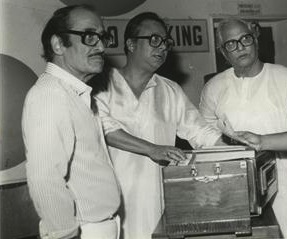
Immortal lyricist Majrooh Sultanpuri (right) with music director R.D. Burman and film director Nasir Hussain at a 1983 recording session.

Famed lyricist Majrooh Sultanpuri (right) with music director R.D. Burman (center) and film director Nasir Hussain (left) at a 1983 recording session.

It would be impossible to summarize the incredible work of these poets in one post (hence why we’ve devoted much of our blog to it!). A small sampling of Filmfare award-winning lyrics are below:

“Chaudhvin ka chaand ho, ya aftaab ho? Jo bhi ho tum khudaa ki qasam laa-jawaab ho…” –Shakeel Badayuni (Chaudhvin Ka Chand 1961)

“Chaahuu.Ngaa mai.N tujhe saa.Nj saveN.re. Phir bhi kabhi ab naam ko tere awaaz mai.N na doo.Ngaa…”--Majrooh Sultanpuri (Dosti 1965)

“Bahaaro.N phool barsaao, meraa mehboob aayaa hai. Hawaao.N raagini gaao, meraa mehboob aaya hai…”--Hasrat Jaipuri (Suraj 1967)

“Kabhi kabhi mere dil mei.N khayaal aataa hai ki jaise tujhko baanaayaa gaya hai mere liye…” –Sahir Ludhianvi (Kabhi Kabhi 1977)

“Aanewaalaa pal jaanewaalaa hai. Ho sake to is mei.N zindagii biTaado pal jo yeh jaanewalaa hai…” — Gulzar (Gol Maal 1980)

I was fortunate to have the chance to learn to read and write in Urdu from my grandparents who moved to New Delhi after the partition of Punjab. But this opportunity is so rare that I found after my grandfather passed away, I know few people to whom I can still write in Nasta’liq. Urdu is a language of romance—more beautiful than French and Italian, and more intricate than superficial political divides. The legacy of Urdu will continue to add to the allure and nostalgia of old films for generations to come. For the loss of Urdu is more than the mere loss of vocabulary. Without Urdu in Hindi films, we have lost our own andaaz–the manner with which we once communicated our thoughts and feelings, our decorum, and a rich, meaningful ornamentation in expressing ourselves that can never be replaced.

-Mrs. 55

Panchhi Banoon Udti Phiroon Lyrics and Translation: Let’s Learn Urdu-Hindi

Nargis

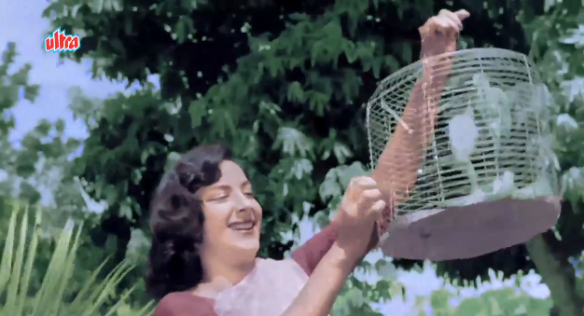
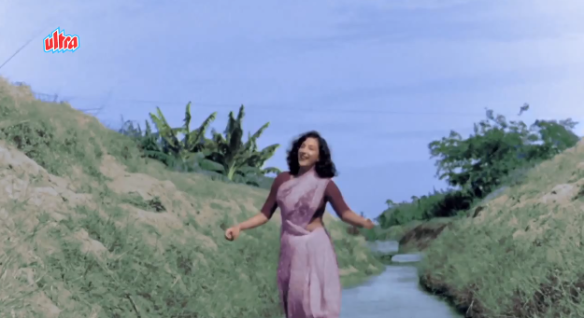
Nargis frees a bird from its cage in a symbolic representation of her unfettered joy in Chori Chori (1956)

I have some good news to share with our readers: I was recently accepted to my top-choice medical school and I will be matriculating there this fall! To celebrate this momentous occasion in my life, I am providing the lyrics and English translation to one of Bollywood’s most memorable feel-good numbers from Chori Chori (1956): panchhii banuu.n uDtii phiruu.n. 

Adapted from Frank Capra’s It Happened One Night (1932), Chori Chori (1956) narrates the story of a wealthy socialite (played by Nargis) who flees her home when her father objects to her decision to marry a pilot with a reputation for womanizing and greed. En route to Bangalore, Nargis encounters Raj Kapoor, a journalist hoping to scoop this exciting story about an heiress on the run. Throughout the course of their journey, the initial bickering and animosity between Raj Kapoor and Nargis gradually transforms into love.  This film’s most memorable asset is the on-screen chemistry shared by Raj Kapoor and Nargis, who were involved in a real-life affair that became the talk of the town in the Bollywood industry during this era. 

Claudette Colbert and Clark Gable star in It Happened One Night (1932).

Placed into the context of the film, panchhii banuu.n uDtii phiruu.n sung by Lata Mangeshkar is picturized on Nargis as she basks in her newfound freedom after running away from home. Composed by Shankar-Jaikishan and penned by Hasrat Jaipuri, this song is inspired by a traditional Scottish standard calledComin’ Thro’ the Rye.” In addition to its Western influences, Hindustani classical music buffs may also argue that this melody is based on the pentatonic Raga Bhupali. Indeed, the diversity of musical influences found in the Chori Chori soundtrack make this one of Shankar-Jaikishan’s most treasured scores. From classical (“rasik balma“) to folk (“man bhaavan ke ghar“) to Western (“aajaa sanam madhur chaa.ndnii“), the compositions in Chori Chori are remarkable for their technical quality and popular appeal. It is no surprise that Shankar-Jaikishan received a well-deserved Filmfare Award for this soundtrack in 1957.

The exuberant essence of panchii banuu.n uDtii phiruu.n is undeniable: its exaltation of life brings a smile to my face with every listen. As I celebrate my acceptance to medical school, I hope to continue pursuing my dreams in the future with this spirit of joie de vivre always in mind. Until next time…

-Mr. 55
Nargis

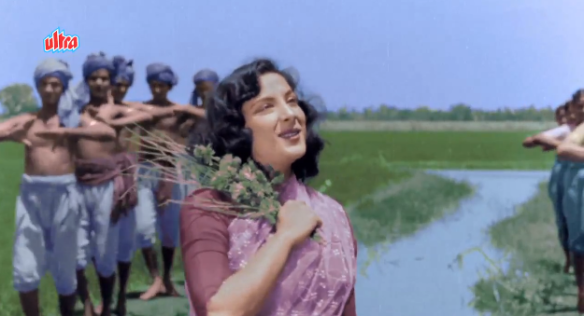
The rural landscape accentuates Nargis’s liberated state of mind in Chori Chori (1956).

Panchhi Banoon Udti Phiroon: Lyrics and Translation

panchhii banuu.n uDtii phiruu.n mast gagan me.n
As a bird, I want to fly in the beautiful sky.
aaj mai.n aazaad huu.n duniyaa ke chaman me.n
Today, I have been liberated in the garden of the world.

(hillorii, hillorii)

mere jiivan me.n chamkaa saveraa
The morning light has shined brightly in my life.
miTaa dil se vah gham kaa andheraa
It has removed the darkness of sorrow from my heart. 
hare kheton me.n gaaye koii lahraa
Someone sings, billowing in the green fields. 
yahaa.n dil par kisi kaa na pahraa
Here, no one keeps guard over the heart. 
rang bahaaro.n ne bharaa mere jiivan me.n
The Spring has filled my life with color.
aaj mai.n aazaad huu.n duniyaa ke chaman me.n
Today, I have been liberated in the garden of the world.

dil yah chaahe bahaaro.n se kheluu.n
My heart desires that I play with the Spring. 
gorii nadiyaa ke dhaaro.n se kheluu.n
I shall frolic in the currents of the fair river. 
chaand suuraj sitaaro.n se kheluu.n
I shall play with the Moon, the Sun, and the stars. 
apnii baaho.n me.n aakaash le luu.n
I shall embrace the sky in my arms. 
baDhtii chaluu.n gaatii chaluu.n apnii lagan me.n
I shall forge ahead as I sing to my own tune. 
aaj mai.n aazaad huu.n duniyaa ke chaman me.n
Today, I feel liberated in the garden of the world. 

(hillorii, hillorii)

mai.n to oDhuu.ngii baadal kaa aa.nchal
I shall wear a shawl of clouds.
mai.n to pahnuu.ngi bijlii kii paayal
I shall wear an anklet of lightning rods.
chhiin luu.ngii ghaTaao.n se kaajal
I shall steal some kohl from the dark clouds.
meraa jiivan hai nadiyaa kii halchal
My life is like the movement of a river:
dil se mere lahre.n uThe.n ThanDii pavan me.n
waves arise from my heart in the cool breeze.
aaj mai.n aazaad huu.n duniyaa ke chaman me.n
Today, I have been liberated in the garden of the world.

panchhii banuu.n uDtii phiruu.n mast gagan me.n
As a bird, I want to fly in the beautiful sky.

*Female lines in red are sung by Lata Mangeshkar. Male lines in green are sung by Manna De

Glossary

panchhii: bird; mast: beautiful, incredible; gagan: sky; aazaad: liberated, free; chaman: garden; saveraa: morning; andheraa: darkness; haraa: green; khet: field; lahraanaa: to billow; pahraa: guard; rang bharnaa: to fill with color; goraa: fair; dhaar: current of a river; sitaaraa: star; aakaash: sky; baDhnaa: to advance, move forward; aa.nchal oDhnaa: to wear a shawl; pahnaa: to wear; bijlii: lightning; paayal: anklet; chiin lenaa: to steal; ghaTaa: dark cloud; kaajal: kohl; halchal: bustle, movement; lahar: wave; pavan: breeze, wind.

Nargis

The color version of this song released by UltraHindi offers modern vibrance to a timeless beauty.


Saiyan Dil Mein Aana Re Lyrics and Translation: Let’s Learn Urdu-Hindi

Shamshad Begum Bollywood playback singer

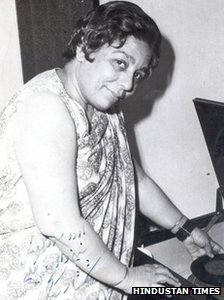
Bollywood playback legend Shamshad Begum (1919-2013)

Last Wednesday, Bollywood lost another of its finest treasures: legendary playback singer Shamshad Begum. The veteran singer was 94 years old. She was well-known for breaking the norms–a maverick with a Brenda Lee-esque penchant for the Western and an irresistible je ne sais quoi that drew hoards of admirers from across the sub-continent. While Lata Mangeshkar and her clones sought to define femininity by delicate, high-pitch vocals Shamshad Begum proved over and over again that a sexy, strong timber could still carry innocence and that women in India could not all be categorized by a single stereotyped voice. Yes, the world needed Shamshad Begum, a woman who never succumbed to expectations and whose daring voice lent itself to some of the greatest works of Bollywood’s Golden Age. We salute you, Shamshad, and the invaluable service you did to the nascent Hindi film industry.

Who can forget her performance with Nigar Sultana as the sultry Bahar in Mughal-e-Azam‘s “Teri Mehfil Mein Qismat“? Few women dared sing a duet with Lata Mangeshkar for fear of inferiority–but that was precisely where the great talents of Shamshad shined their brightest. With a voice unlike anything in Bollywood history, Shamshad dazzled audiences with a deep, edgy flair for which she was famous. There was simply no competition because the voices were incomparable. Shamshad’s other famous duets such as “Leke Pehla Pehla Pyar” with Mohammed Rafi from CID (1956), “Mere Piya Gaye Rangoon” with Chitalkar Ramchandra in Patanga (1949) or “Kajra Mohabbatwala” with Asha Bhonsle in Qismat (1968) to name a few, showcase her unique robust twist on the norm and continue to be remade and popularized today.

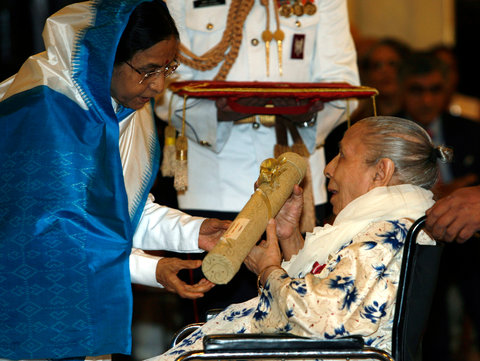
Shamshad Begum receiving the Padma Bhushan for a lifetime of achievements in 200.9

Shamshad Begum receiving the Padma Bhushan for a lifetime of achievements in 2009.

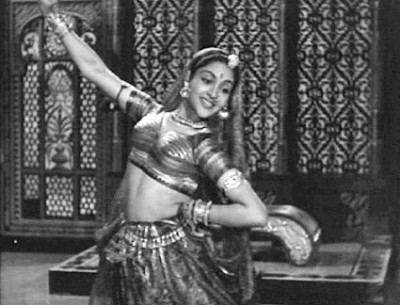
Music director O.P. Nayyar confessed in an interview that when he entered the music industry, he begged Shamshad Begum to sing for his compositions. Her first collaboration with him became absolutely legendary: “Kabhi Aar, Kabhi Paar” from the film Aar Paar (1954). Here at Mr. and Mrs. 55, our favorite of her solo hits is the extraordinarily catchy S.D. Burman composition, “Saiyan Dil Mein Aana Re” from Bahar (1951) in which classical dancer Vijayantimala made her Bollywood debut.

You can tell from themyriad of hand gestures reminiscent of a classical mudra to accompany the emotion of each line (coupled with her impeccable posture), that teenager Vijayantimala was well-trained in Bharatnatyam arts. This theatrical dance form meshes interestingly with the medium of film, at times carrying the over-expression of a silent movie and the spectacle of a living room classical dance performance. Perhaps the best part of this adorably innocent love song (besides, of course, Shamshad’s vocals!) is the clever and hilariously unnecessary drama accompanying the actresses 4 costumes changes in the song!

Vijayantimala in Bahar 1951 Saiyan Dil Mein Ana Re

Young Vijantimala makes her Bollywood film debut singing Shamshad Begum’s “Saiyan Dil Mein Aana Re” in Bahar (1951).

Please enjoy the full lyrics and English translation to this Shamshad Begum hit “Saiyan Dil Mein Aana Re” below and let us know YOUR favorite Shamshad Begum song in the comments!

Saiyan Dil Mein Aana Re Lyrics and Translation:

Saiyaa.N dil mei.N aanaa re
Beloved, come into my heart
Aake phir na jaanaa re
And once you come, never leave
Chham chhamaa chham chham

Raja ban ke aanaa re
Like a king, come to me
Mohe leke jaanaa re
And take me with you when you go
Chham chhamaa chham chham

Chaandnii raat hogii, taaro.N kii baaraat hogii
It will be a moonlit night, the stars will form a wedding procession
Pehle pehle pyaar kii pehlii pehlii baat hogii
The first words of my first love will be spoken
Khushii khushii gaaye.Nge ham geet suhaanaa re
We will joyfully sing a beautiful song

ThoDii thoDii sahal hogii, thoDaa thoDaa pyaar hogaa
Little by little, our love will become easy
Kabhii iqraar hoga, kabhii inkaar hogaa
Sometimes you will agree with me, sometimes you will refuse me
Teraa manaanaa meraa rooTh jaanaa re
But you appease me, my anger will disappear

Tum mere paas hoge, gham baDii duur hogaa
You will be beside me, and all sadness will be far away
Kehtaa hai jiyaa meraa hogaa zuroor hogaa
My heart tells me this will certainly be so
Laanaa re laanaa tashriif laana re
Come, believe in me

Saiyaa.N dil mei.N aanaa re
Beloved, come into my heart
Aake phir na jaanaa re
And once you come, never leave
Chham chhamaa chham chham

Raja ban ke aanaa re
Like a king, come to me
Mohe leke jaanaa re
And take me with you when you go
Chham chhamaa chham chham

Glossary:

saiyaaN: beloved; raajaa: king; chaandnii: moonlight; baaraat: wedding procession; khushii: happiness, joy; geet: song; suhaanaa: beautiful; thoDaa: a little; sahal: easy; iqraar: agreement, acceptance; inkaar: refusal; manaanaa: to appease someone; rooTh: sulk, anger; gham: sadness; duur: far; jiyaa: soul, heart; zuroor: certainly; tashriif laanaa: a respectful way of asking someone to come or to enter (and in doing so, trust their honor with you)

So now you’re asking yourself, why is there no translation given for arguably the best line of the song: “Chham chhamaa chham chham“? There are a few ways to analyze this line–whether she’s referencing the glittering of stars, doing some free-styling by adding an extemporaneous beat to the melody, or getting carried away by the excitement of her own life–I think any real attempt to translate that exceedingly interpretive line formally would be an injustice to the song’s joie de vivre. Let us know your favorite Shamshad Begum moment in the comments!

– Mrs. 55

O Duniya Ke Rakhwale Lyrics and Translation: Let’s Learn Urdu-Hindi

BB

Agonized by his fate, Bharat Bhushan entreats the Lord to heed his grievances in Baiju Bawra (1952)

On April 15, 2013, an unspeakable tragedy hit my current hometown of Boston when two bombs were set off at the finish line of the Boston Marathon. This annual event held on Patriot’s Day attracts nearly 500,000 spectators who come to watch amateur and professional runners from all over the world. Considered one of the largest acts of terrorism ever to strike Boston, the marathon bombings killed 3 individuals and wounded nearly 300 victims. Tragedy is always unsettling, but these attacks have been particularly difficult to grapple with because of their proximity to home. As the local community finds the strength to overcome, our thoughts and prayers at Mr. and Mrs. 55 are with all those who were affected by this senseless act of violence in Boston.

Five days after the attack, a harrowing manhunt for one of the suspects at large put the entire city of Boston on lockdown with a “shelter in place” order for all residents.  Within the safe confines of my dorm at Harvard, I found comfort during this time in old Hindi film songs–something familiar and close to my heart.  In the aftermath of this tragedy, there was one song in particular that resonated deeply with my state of mind: o duniyaa ke rakhvaale from Baiju Bawra (1952). In commemoration of the victims of the Boston Marathon bombings, we offer the lyrics and English translation to this timeless devotional classic. 

521732_10152739462480304_1562200480_n

Composed by Naushad in the somber and grave raga Darbari Kanada, this evergreen number from Baiju Bawra (1952) is one of Mohammed Rafi’s best renditions. His pathos-laden voice navigates through a difficult melody spanning nearly two octaves that culminates in a high Bb4 (taar shuddh ma in the key of F) during the final climax. In light of the recent tragedy, however, we will focus on the message presented by Shakeel Badayuni’s lyrics. Without using elevated vocabulary, Badayuni masterfully captures the essence of an important philosophical maxim that may help us cope with the recent events: the reconciliation of opposites. Expressed as frustration and anger, the song’s protagonist struggles to accept the contradictory nature of the world he inhabits. Why were storms created along with ships? Why must we be separated from our loved ones after being united? Why does hope exist along with despair? And ultimately, why was evil created along with good? 

Failing to find adequate responses to these difficult questions, the protagonist lashes out in grievance against his Lord. Indeed, Badayuni makes a bold move in the context of a bhajan by having the protagonist refer to his Lord as harjaayii (unfaithful, betrayer). The protagonist’s frustration is understandable given that everything familiar to him in this world has turned against him. Using metaphorical imagery, Badayuni describes this feeling through the transformation of conventional entities: rain into fire, flowers into embers, night into snake, and stars into stones. The lyrics continue to take a few unconventional turns when the protagonist asks the Lord to take his life (“jiivan apnaa vaapas le le, jiivan denevaale“) and when the devotee subversively offers his blessings to the Lord (“bhagvaan bhalaa ho teraa!”) in sardonic resignation. 

At their core, these lyrics encourage the listener to appreciate the value of prajna, a Sanskrit term used to describe the wisdom of non-duality. Based on the fundamental reconciliation of dual phenomena, this worldview posits that the demarcation of polar opposites leads to further conflict and suffering.  Instead of placing last week’s tragic events within a framework of good versus evil, valuing prajna instructs us to focus our energy on reflection and the discovery of underlying causes.  Additionally, in Shakeel Badayuni’s words, we must not lose hope in the face of misfortune (“qismat TuuTii aas na TuuTii) as we rise above our differences and provide support to one another in this trying time of need.  

Here at Mr. and Mrs. 55, we would like to reiterate our deepest condolences and sympathies to all those in our community and beyond who were affected by the recent Boston Marathon attacks. For those who are interested, we encourage donations to One Fund Boston, a charitable organization established by Mayor Thomas Menino and Gov. Patrick Deval to support the victims of this tragedy. Stay strong, Boston!

-Mr. 55
s

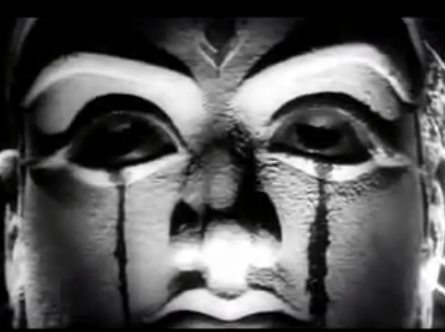
Lord Shiva sheds tears upon his devotee’s plight in Baiju Bawra (1952)

O Duniya Ke Rakhwale: Lyrics and Translation

bhagvaan, bhagvaan, bhagvaan!
Oh Lord!

o duniyaa ke rakhvaale! sun dardbhare mere naale
Oh protector of this world! Please heed my woeful lamentations.

aash niraash ke do rango.n se duniyaa tuu ne sajaayii
You have adorned this world with the two colors of hope and despair.
naiyaa sang tuufaan banaayaa, milan ke saath judaayii
You created the storm along with the boat, separation along with union.
jaa dekh liyaa harjaayii
Lord, I have witnessed your betrayal.
 o luuT gayii mere pyaar ki nagarii, ab to niir bahaa le
Oh! My city of love has been plundered; now shed a few tears upon my plight.

aag banii saavaan kii barkhaa, phuul bane angaare
The monsoon rains have turned into fire, while the flowers have become embers.
naagin ban gayii raat suhaanii, patthar ban gaye taare
The beautiful night has become a snake, while the stars have turned into stones.
sab TuuT chuke hai.n sahaare
All of my support has been lost.
o jiivan apnaa vaapas le le, jiivan denevaale
Oh provider of life! Please take back this life from me.

chaa.nd ko Dhuu.nDe paagal suuraj, shaam ko Dhuu.nDe saveraa
The mad Sun seeks the Moon, while the morning searches for the night.
mai.n bhii Dhuu.nDuu.n us priitam ko ho na sakaa jo meraa
I too search for the beloved who could not be mine.
bhagvaan bhalaa ho teraa!
Lord, may you be blessed!
o qismat phuuTii aas na TuuTii, paa.nv me.n paD gaye chhaale
Oh! I have suffered misfortune without losing hope, though my feet have become sore with blisters.

mahal udaas aur galiyaa.n suunii, chup-chup hai.n diivaare.n
The palace is forlorn with its deserted alleys and silent walls.
dil kyaa ujaDaa, duniyaa ujaDii, ruuTh gayii hai.n bahaare.n
My heart has been ravaged, my entire world has been destroyed, and even the new spring sulks in displeasure.
ham jiivan kaise guzaare.n?
How can I spend my life like this?
o mandir girtaa phir ban jaataa, dil ko kaun sambhaale?
Oh! Fallen temples can be rebuilt, but who can mend my broken heart?

o duniyaa ke rakhvaale! sun dardbhare mere naale
Oh protector of this world! Please heed my woeful lamentations.

Glossary

bhagvaan: Lord; duniyaa: word; rakhvaalaa: protector; dardbharaa: woeful; naale: lamentation; aash: hope; niraash: despair; sajaanaa: to adorn; naiyaa: boat; tuufaan: storm; milan: union; judaayii: separation; harjaayii: betrayer, unfaithful one; luuT jaanaa: to be plundered; nagrii: city, town; niir bahaanaa: to shed tears; aag: fire; saavan: monsoon; barkhaa: rain; naagin: snake (female); suhaanii: lovely, beautiful; sahaaraa: support; jiivan: life; vaapas lenaa: to take back; denevaalaa: provider; chaa.nd; Moon; paagal: mad, crazy; suuraj: Sun; shaam: evening, night; saveraa: morning; priitam: beloved; “(kisii kaa) bhalaa ho!“: an expression used to indicate the offering of blessings to someone; chhaalaa: blister; mahal: palace; udaas: sullen, forlorn; galii: alley; suunaa: empty, deserted; chup-chaap: silent; diivaar: wall; ujaDnaa: to be uprooted, ravaged or destroyed; ruuTh jaanaa: to sulk; bahaar: spring; jiivan guzaarnaa: to spend life; mandir: temple; sambhaalnaa: to manage, mend.

shadows

A dejected Bharat Bhushan asks for his life to be taken back in Baiju Bawra (1952)