Retro Bollywood Hairstyles from Caravan (1971): Wigs, Teasing, and More Wigs

Asha Parekh sports long side-parted bangs with a girlish ribbon and a bouffant wig in the exciting opening chase scene of Caravan (1971). And please don’t ignore the matching orange lipstick!

In India in the 60s and early 70s, Hindi film heroines were notorious for sporting heavy wig pieces day-to-day that added volume, glamour, and pizazz. Hairdos in India from that time period sought to create works of art atop a woman’s head, from simple teased crown, to elaborate braiding with ornaments, jewelry, and soaring heights. The key was to wear enormous wigs and lots of them (and yes, those wigs are made of REAL hair!)

Big hair was by no means a strictly Indian phenomena. Starting as early back in history as the famous wigs of Marie Antoinette, puffy bouffant styles were sported not just in films, but by First Lady Jackie Kennedy in the 60s and took the musical South by storm when Dolly Parton learned how to tease (a word for the back-combing technique used to bulk up layers of hair). But I’d say, Audrey Hepburn in Breakfast at Tiffany’s  (1961) aside, Indian women like Sharmila Tagore and Asha Parekh were the ones to bring it to new levels.

The overall effect when done correctly can be extremely elegant and beautiful–at some point or another, we’ve all tried to emulate big hair in the hopes of looking fabulous. But, of course as you’ll see, there are always those special moments when wigs go wild and the ‘do takes on an alternate life of its own.

Check out our gallery of fabulous retro Bollywood hairdos sported by Asha Parekh in the 1971 film Caravan (yes, it’s 1971, but the styles are super 60s!). This film is notable for many reasons, from a delightfully ridiculous plot to a magical soundtrack enhanced by Helen’s insane dance moves. But every time I watch it, I am way too distracted by Asha Parekh’s latest ‘do to care for anything else. Haute couture meets gypsy allure, good intentions meet near-lethal doses of hairspray. After all, the higher the hair, the closer to God.

Who is it?? Why, it’s little bo peep. She wants her ribbon back.

Asha’s fabulous ‘do in the opening scene of Caravan has tight long curls, a side-tied white ribbon, and of course, a 4-inch high wig.

Asha goes gypsy! Note the most important touch of all: the little ringlet of hair by her cheek that probably was once a delicate sideburn.

Hair parted in the center is getting slightly more 70s than 60s, but thank goodness you threw in that 3-inch poof, Asha. Otherwise, I don’t think the look had enough crazy going on.
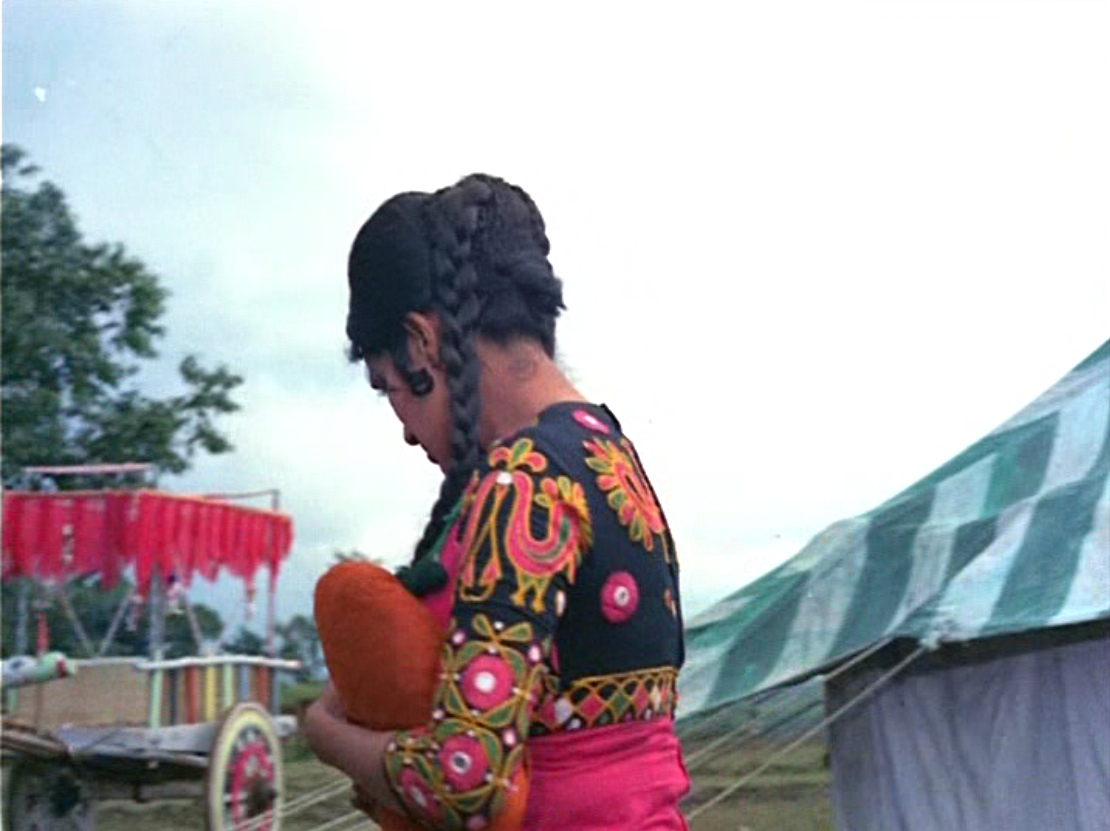
What a pleasant little surprise! The back of the ‘do is as wild as the front! What was the stylist really going for with this ruffled little back-bun? Historians may never know.
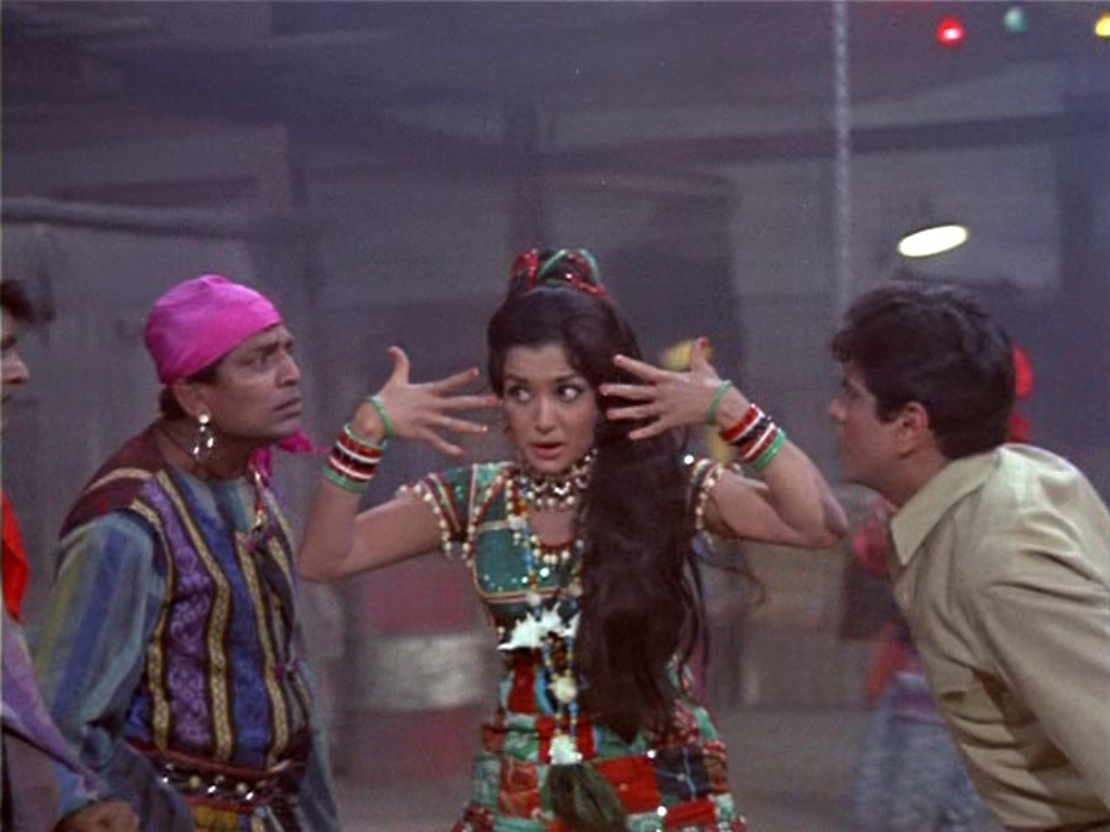
Bring on the ribbons! And the back-up dancers.
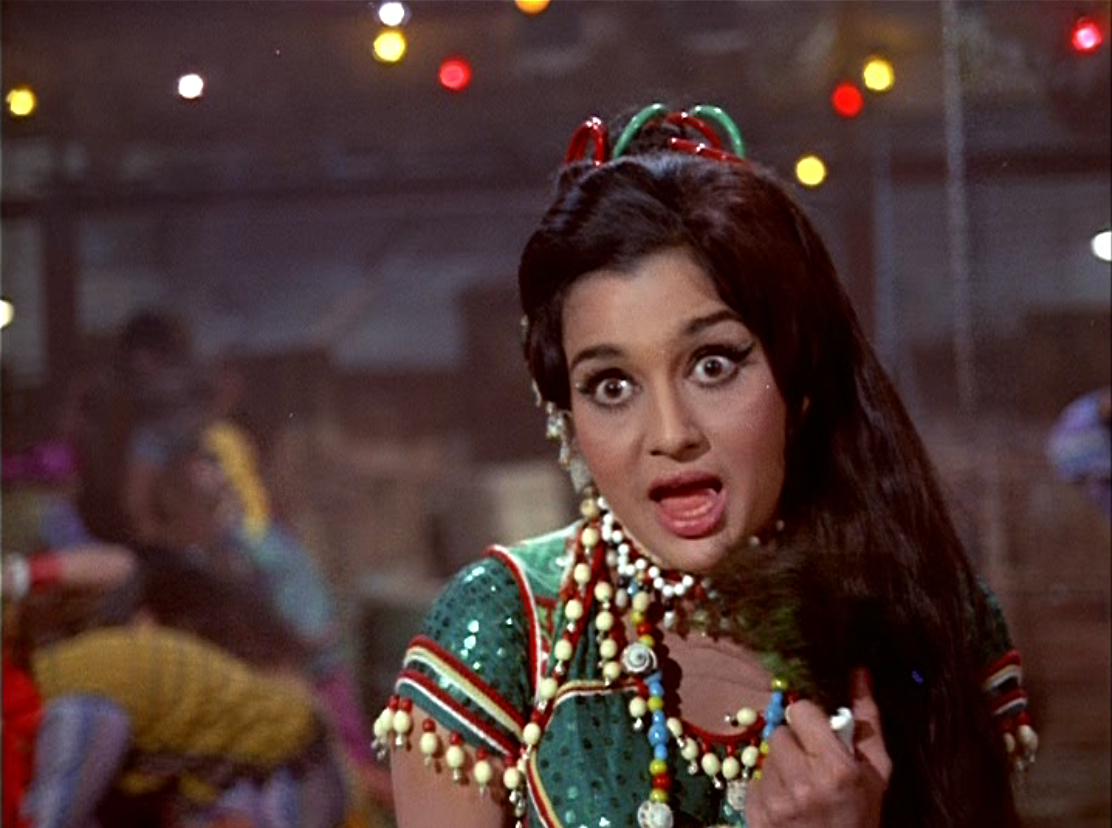
Oh, just kidding–those aren’t ribbons after all! They are bangles arranged like a pillbox hat at the crown of the coiffe! You can never be too creative with accessories, can you?
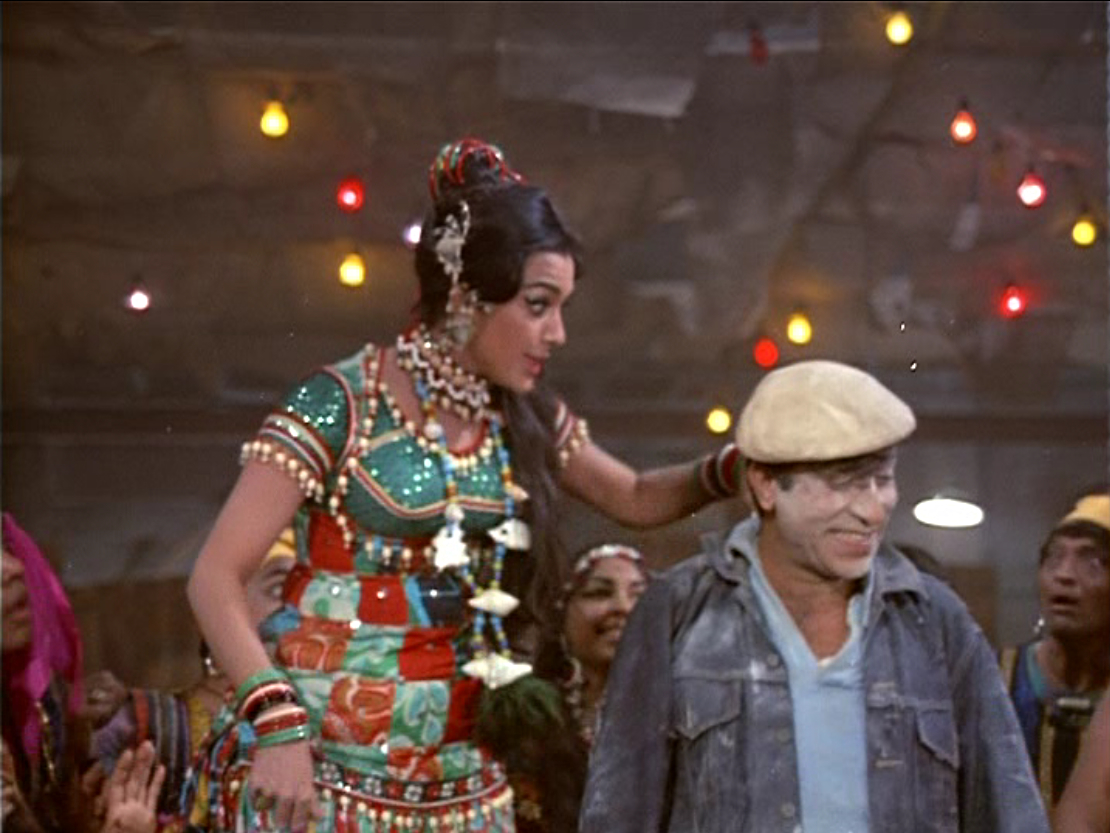
I like the “au natural” look of the long sweeps of locks hanging to one side. And look how Asha made the “jhumar” a day-to-day fashion accessory long before it became vogue!
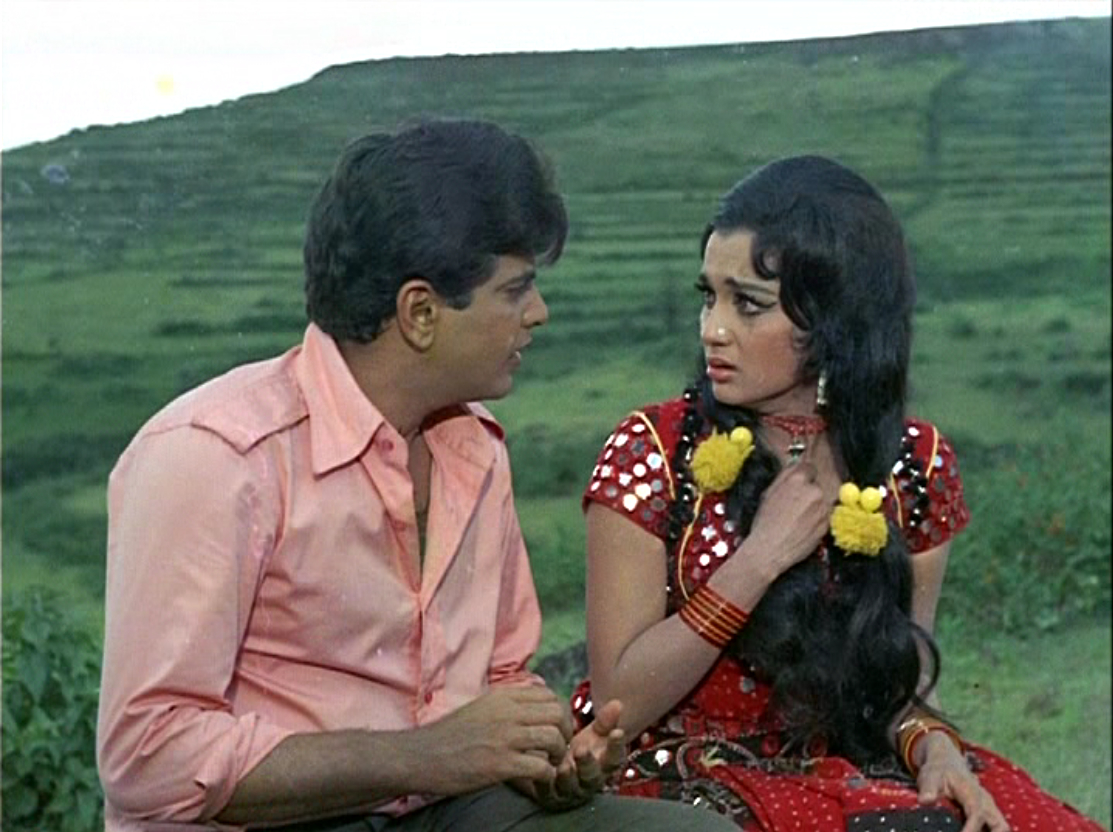
Drooping pigtails with bright yellow flower ties for a much-needed pop of colour.
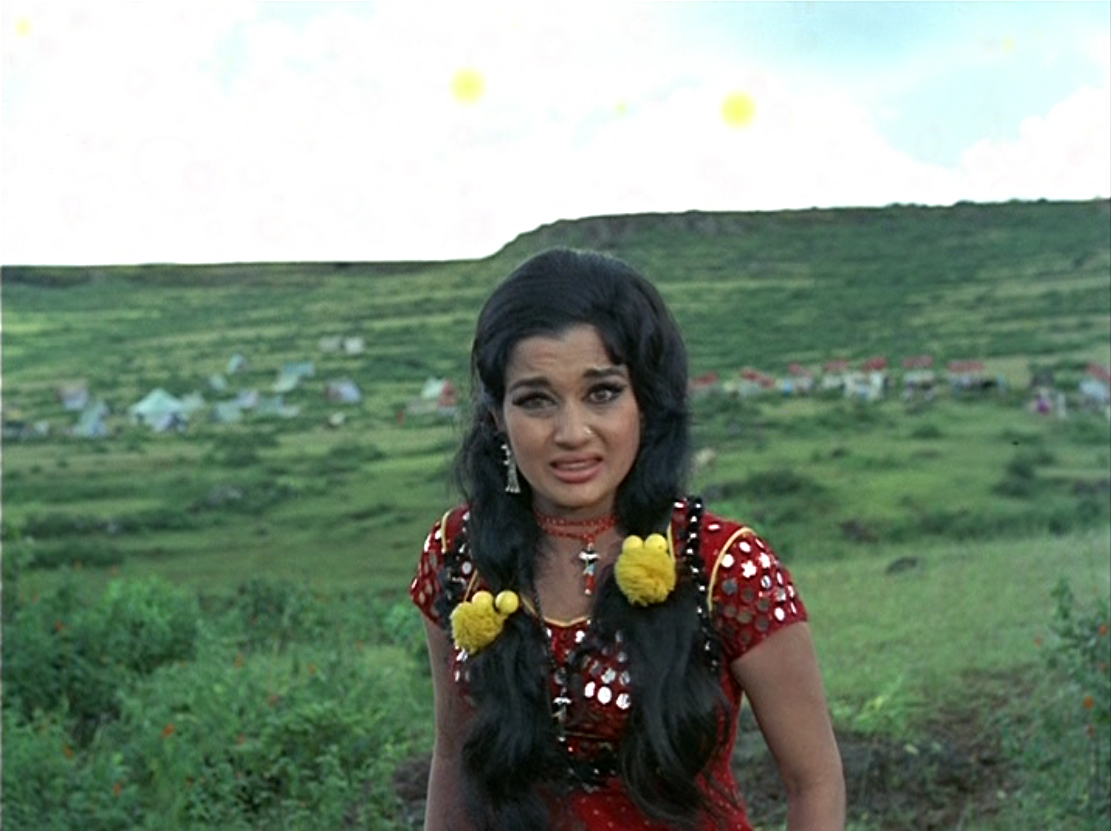
Great hair aside…I think the most striking aspect of this photo is that Asha is about to have a conniption on-screen.
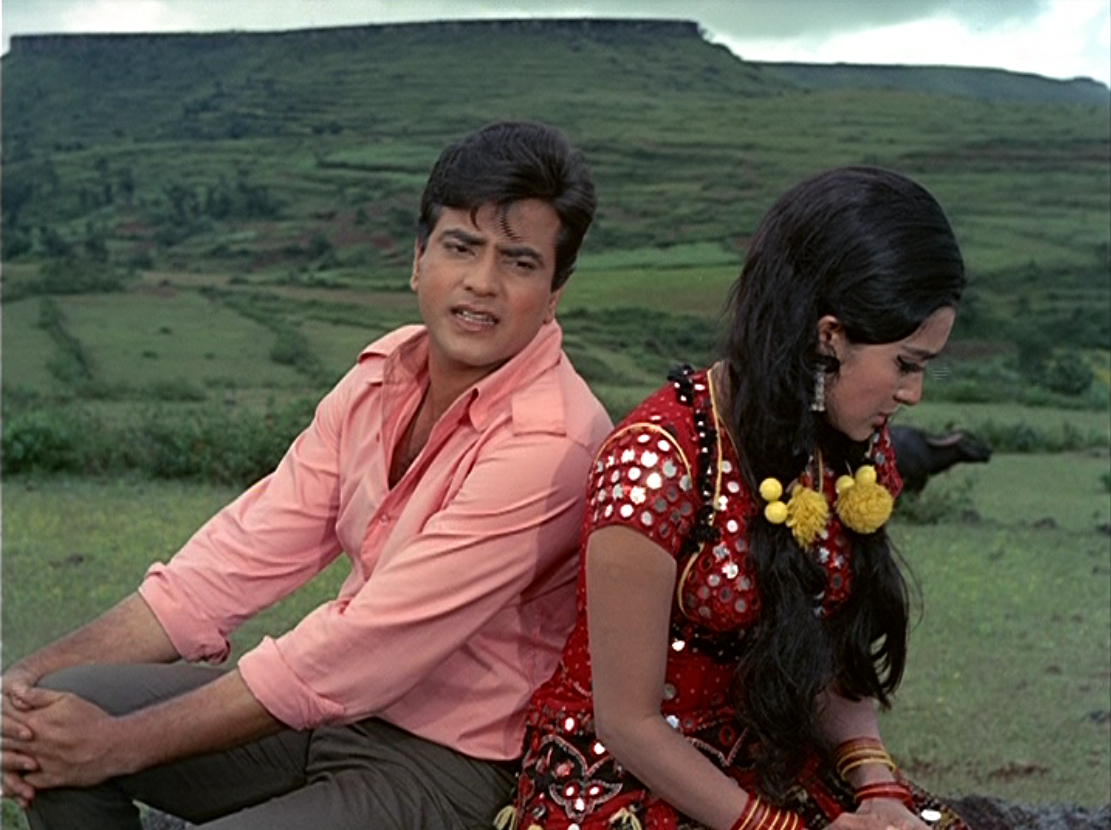
I love the side-parted pigtail village look. Who cares if you’re pushing 40 years old?!
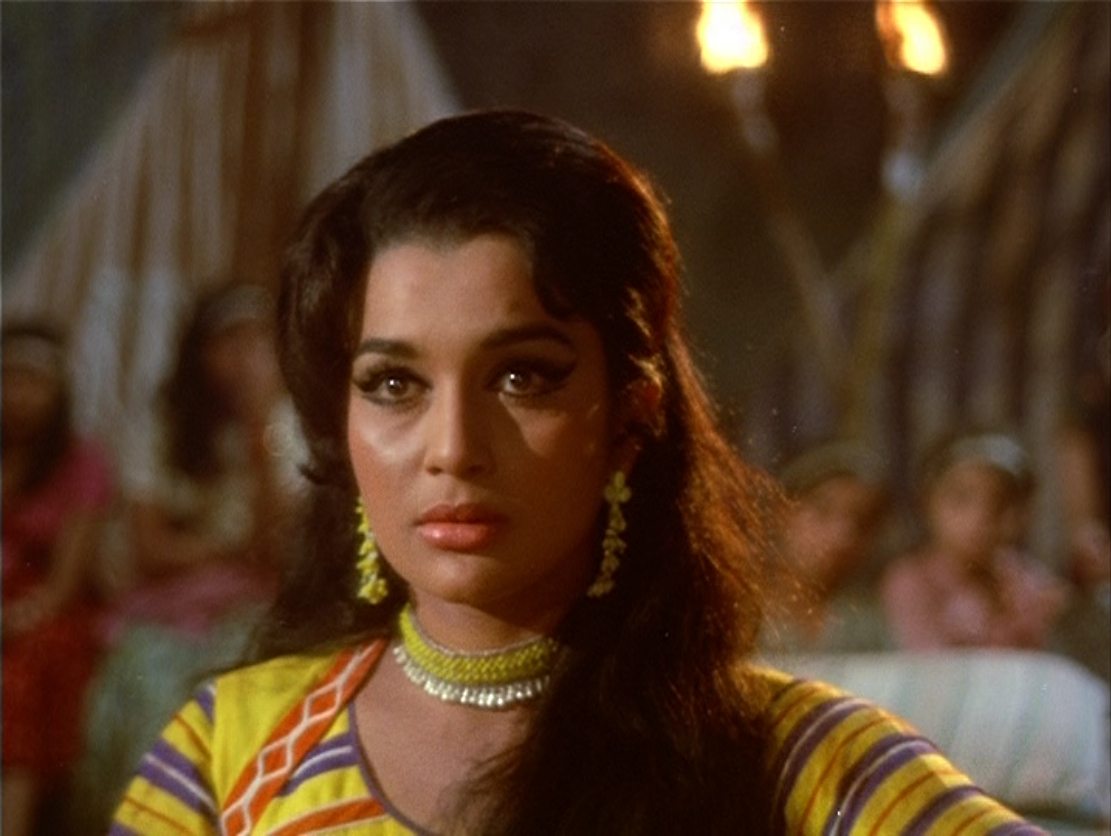
I could do without the brushed back bangs in the center, while leaving an awkward patch of bangs to the side. But perhaps it’s all part of how distressed she’s supposed to be?
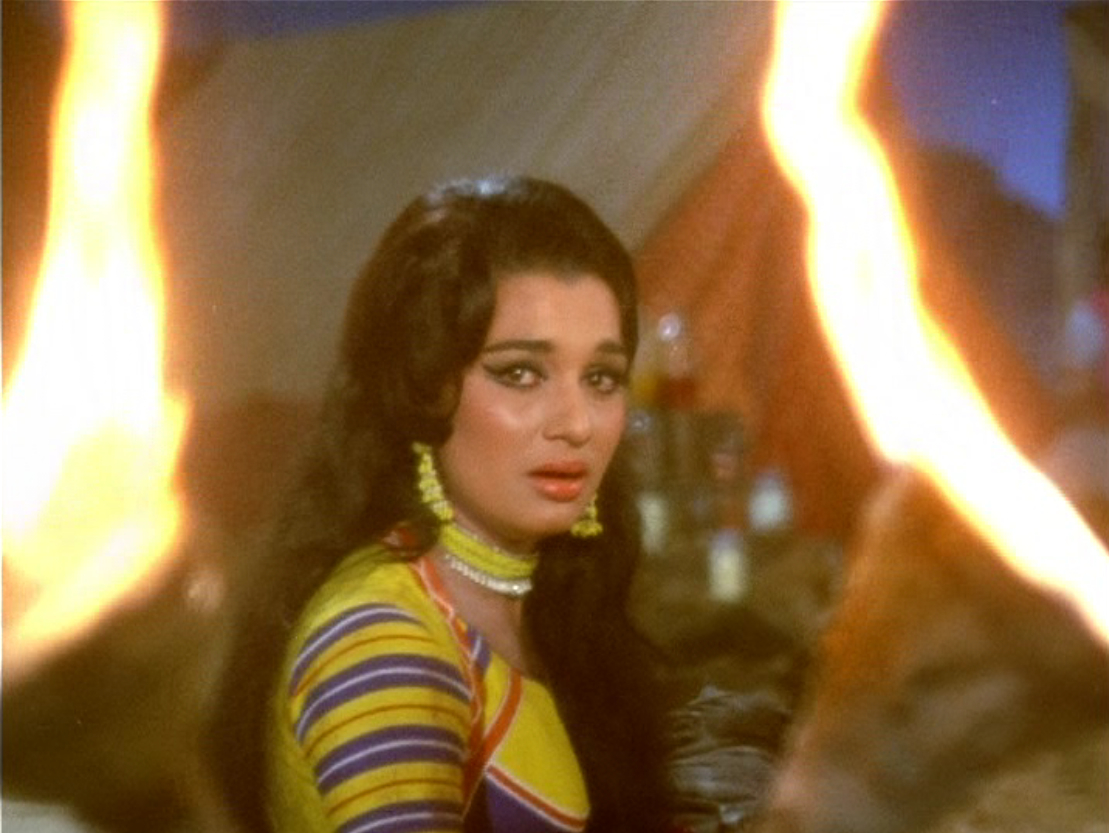
Again with the awkward patch of bangs! I far prefer some Sadhana-fringe.
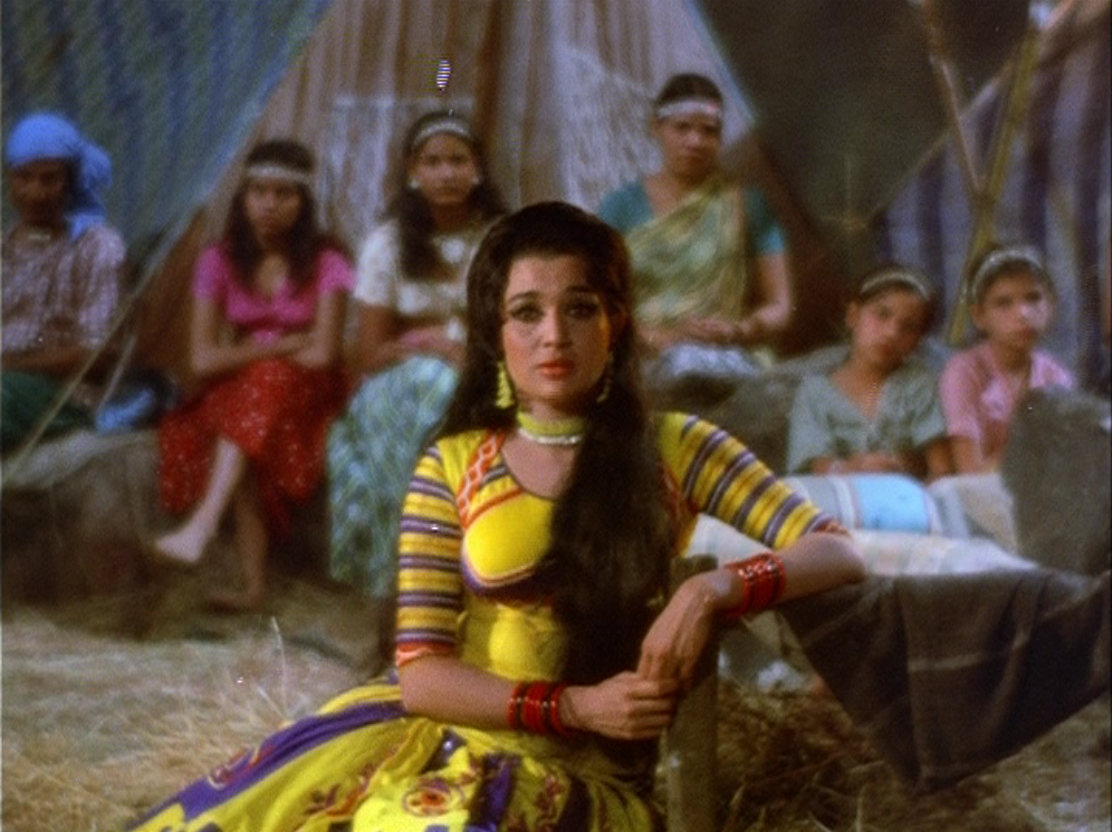
You get a good sense of the volume of hair involved in the making of this ‘do in this shot.

The forehead to wig-height ratio is borderline criminal.
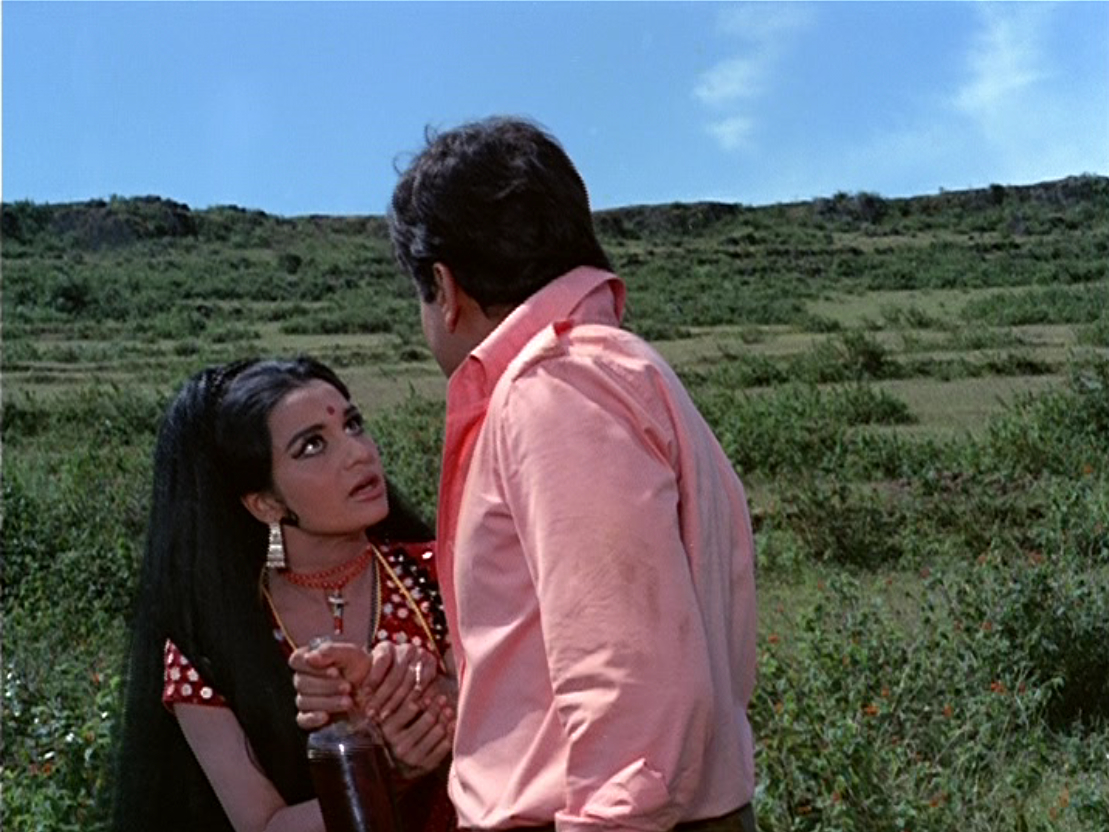
Asha Parekh in Caravan 48

Classic example of a ‘do taking on it’s own life. It’s like she’s attacking Jeetendra, and her hair is attacking her. The hair wins, of course.

Asha Parekh in Caravan 49

The glamour shot is nice–especially since you can’t see all the little people jumping off the top of her ‘do to commit suicide.
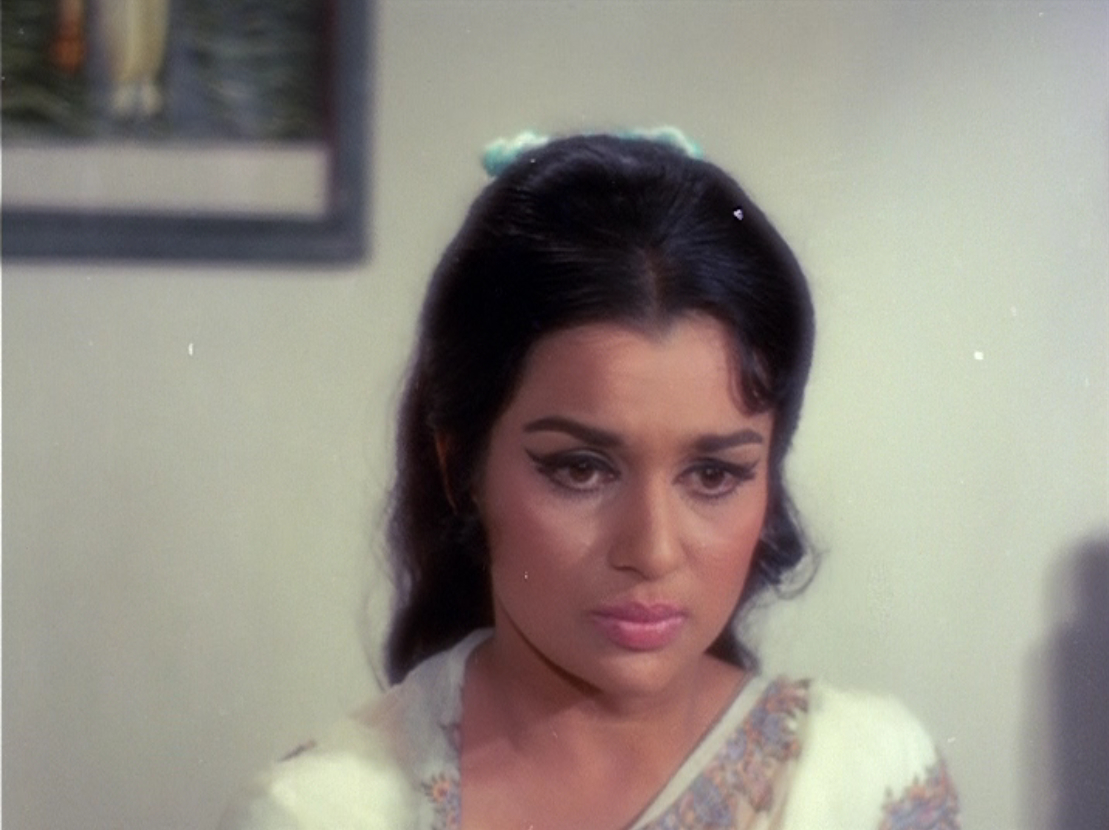
Asha Parekh in Caravan 50

Back to a simple, conservative ribbon with moderate heights. That’s more like it!
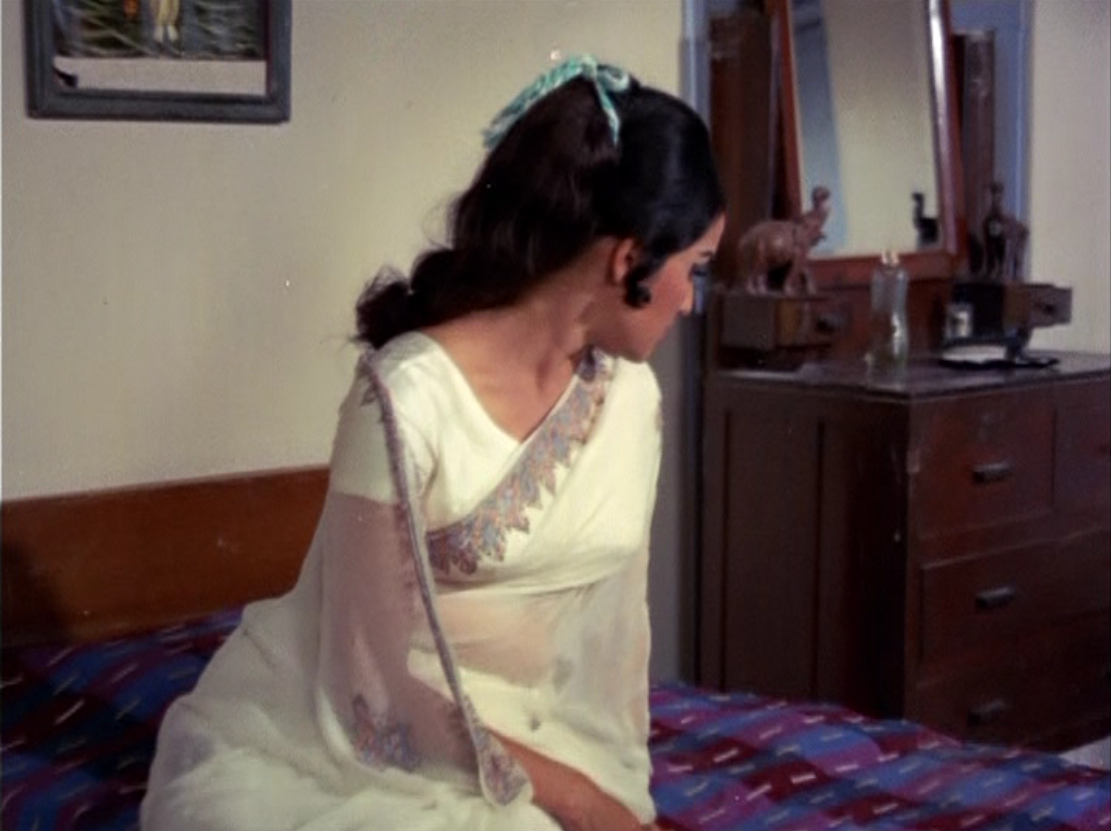
Oh, and a little curl too? Sign me up!!
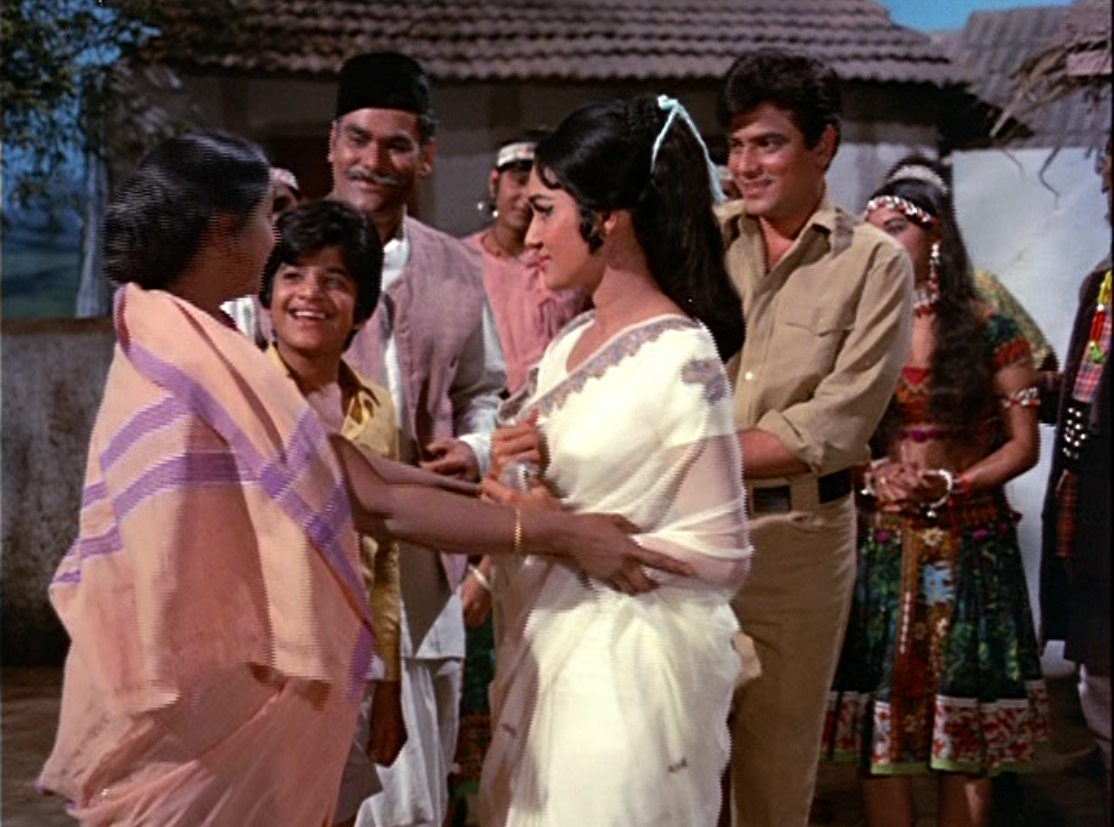
Asha Parekh in Caravan 51a

Love how far back the ribbon is pushed–less of a headband, more an accessory to make room for the beehive.
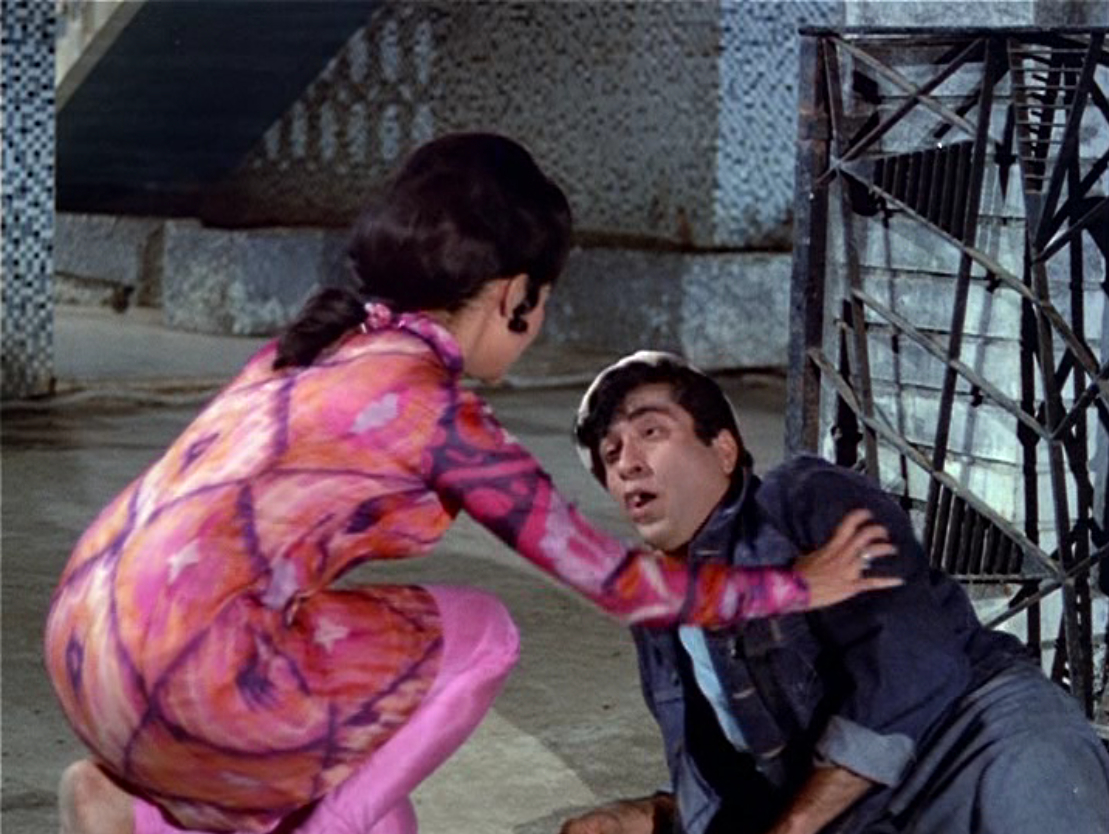
Asha Parekh in Caravan 52

I don’t know how I feel about pony-tails this short and this puffy.
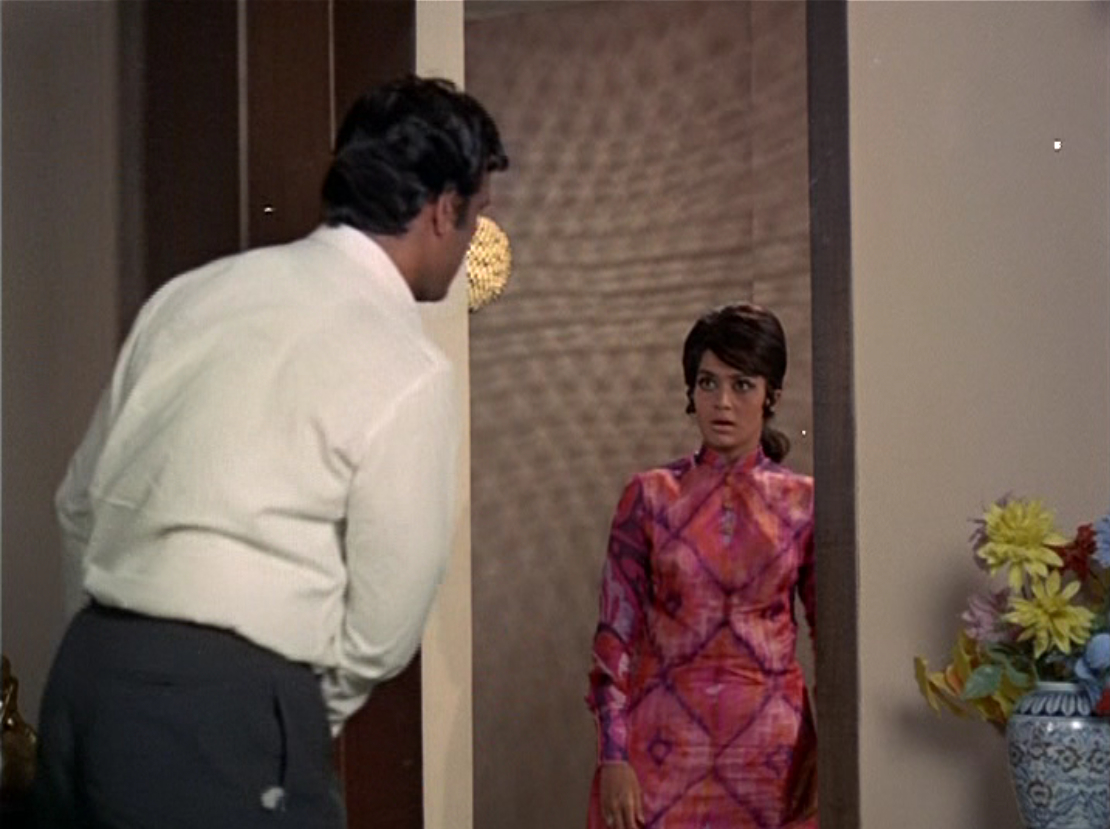
Asha Parekh in Caravan 54

Very Audrey Hepburn from the front. We’ll take it.
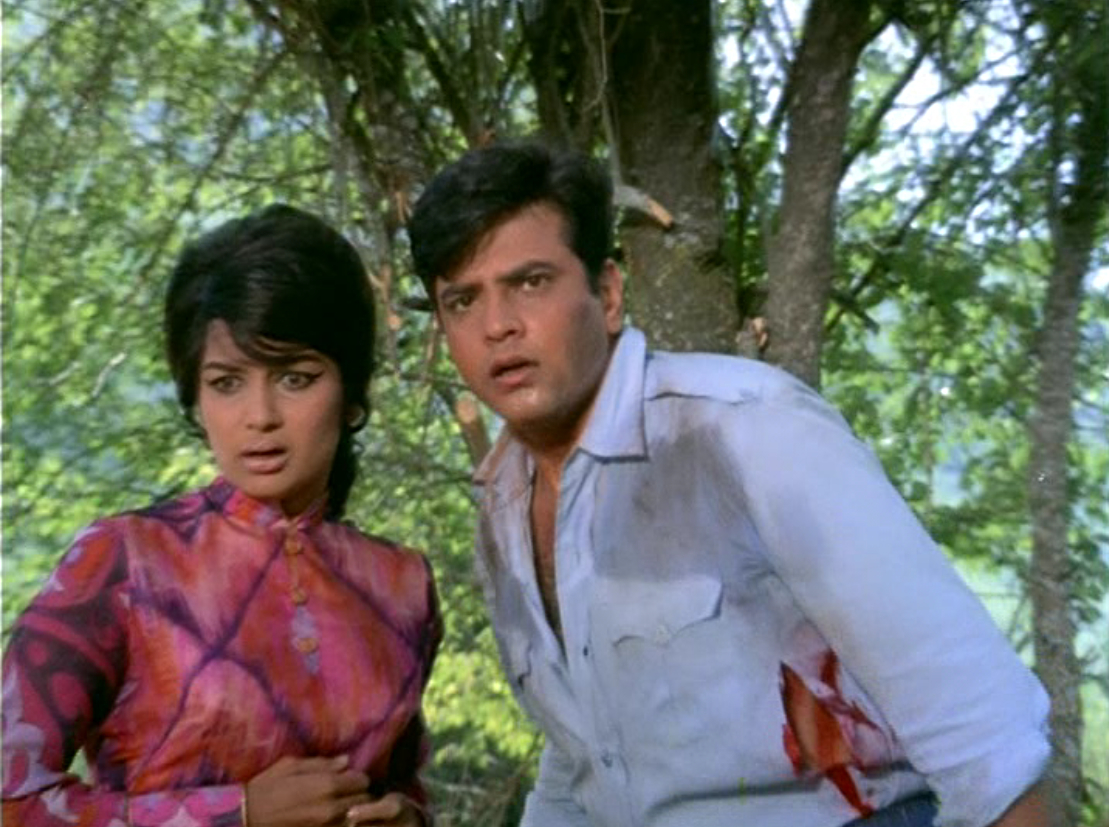
Asha Parekh in Caravan 56

These bangs are classic from this era–the angled part, the bouffant! If only it had been a French twist in the back instead of an incomplete pony.

Now after seeing this gallery, you must be under the mistaken impression that Asha Parekh does nothing but make painfully melodramatic faces in throughout the film. You wouldn’t be entirely wrong, but just know that in addition to that, she dances occasionally too. Asha Parekh’s hairstyles are so mesmerizing in this film, that you shouldn’t really be looking for much artistic depth.

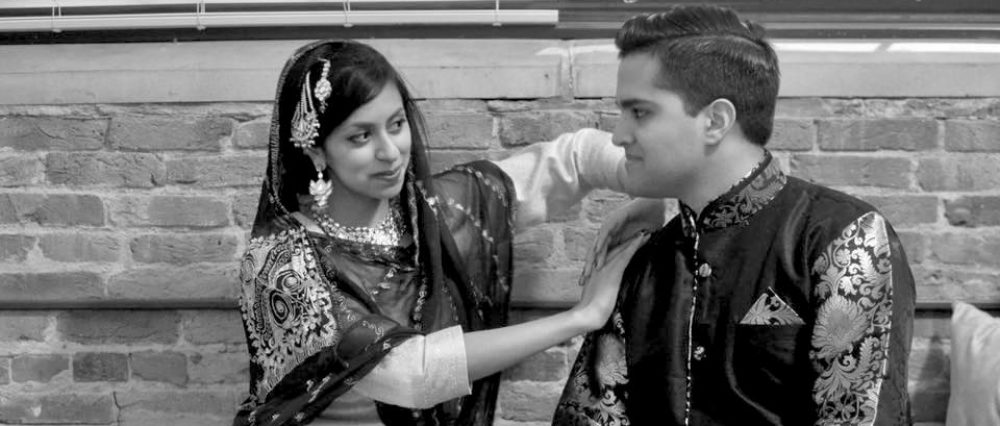
Now why, you may be asking, am I so invested in retro Bollywood hairdos? I’ve been planning my look for my fiance and my official engagement party and needed some 70s inspiration! I’m probably one of the few brides-to-be these days that are still all about the vintage Bollywood look–from sweeping cat-eyeliner to hair that reaches the ceiling. I went through dozens of old school films to perfect the ‘do I wanted. Here’s the final product!

My attempt at Asha Parekh fabulousness with a retro Bollywood hair do!

It’s a classy mixture of Asha’s best looks in Caravan, complete with flowers! Now although I did not use wigs, my tricks were to use LOTS and LOTS of hairspray, back-combing like my life depended on it, and a puffy headband underneath the bump to give some structural support to the ‘do.

For more galleries of costumes from the great films of the 60s and 70s, check out our earlier post on famed Bollywood costume designer Mani Rabadi!

-Mrs. 55
Yash Chopra: King of Bollywood Romance

Yash Chopra (1932-2012)

Today marks a very sad occasion in the tinsel-lined world of Mumbai filmdom. Legendary filmmaker Yash Chopra has passed away at the famous Lilavati Hospital in Bombay at the age of 80. A timeless pillar of Bollywood romance, Yash Chopra defined generation after generation of Indian love. From his earliest directorial super-hit Waqt (1965) to his later epic romances Veer-Zara (2004), Yash Chopra made the careers of dozens of stars that we know and cherish today. One of his most famous muses, struggling Amitabh Bachchan who starred in Yash Chopra blockbusters like Deewar (1975) and Kabhi Kabhi (1976), was given a new chance at a comeback with Mohabbatein (2001)–a film that led to the evergreen actor’s eventual rebirth as a grand figure in Bollywood once more. For that opportunity, Big B like many great actors remains ever grateful to the man and legend who supported him.

With Yash Chopra’s passing, the neo-golden age of Bollywood film comes as well to a sad close. Films like Dilwale Dulhania Le Jaayenge (1995), Dil To Pagal Hai (1997), and Kuch Kuch Hota (1998) that defined my childhood and that of a generation of hopeless romantics were produced by the Yash Raj banner and carry the hallmark of an era of innocent beauty and carefree romance that brought joy to millions world round. Thank you, Yash Chopra, for the memories and the love. You taught us how to give unconditionally and the precious, crazy things a person can do in the name of love. In the words of your own film Kuch Kuch Hota Hai: tumne na jaane kya sapne dikhaaye

Here is a glimpse at some of Yash Chopra’s most famous films over the years as both director and producer:

Daag (1973)

Daag (1973) starring Rajesh Khanna and Sharmila Tagore.

Waqt (1965)

Waqt (1965) starring Sadhana, Sharmila Tagore, Sunil Dutt, Shashi Kapoor, Balraj Sahni and Rajkumar.

Deewar (1975)

Deewar (1975) starring Shashi Kapoor and Amitabh Bachchan.

Kabhi Kabhi (1977)

Kabhi Kabhi (1977) starring Amitabh Bachchan, Rakhi, Rishi Kapoor, and Nitu Singh.

Silsila (1981)

Silsila (1981) starring Rekha, Jaya Bachchan and Amitabh Bachchan.

Chandni (1989)

Chandni (1989) starring Sridevi and Rishi Kapoor.

Dilwale Dulhania Le Jaayenge (1995)

Dilwale Dulhania Le Jayenge (1995) starring Kajol and Shah Rukh Khan.

Dil To Pagal Hai (1997)

Dil To Pagal Hai (1997) starring Madhuri Dixit, Shah Rukh Khan and Karishma Kapoor.

Kuch Kuch Hota Hai (1998)

Kuch Kuch Hota Hai (1998) starring Shah Rukh Khan, Kajol and Salman Khan.

Mohabbatein (2001)

Mohabbatein (2001) starring Shah Rukh Khan, Amitabh Bachchan and Aishwarya Rai.

Veer-Zara (2004)

Veer-Zara (2004) starring Shah Rukh Khan and Preity Zinta.

What was YOUR favorite Yash Chopra film moment and how have his films affected you? Let us know in the comments!

– Mrs. 55

Dost Dost Na Raha Lyrics and Translation: Let’s Learn Urdu-Hindi

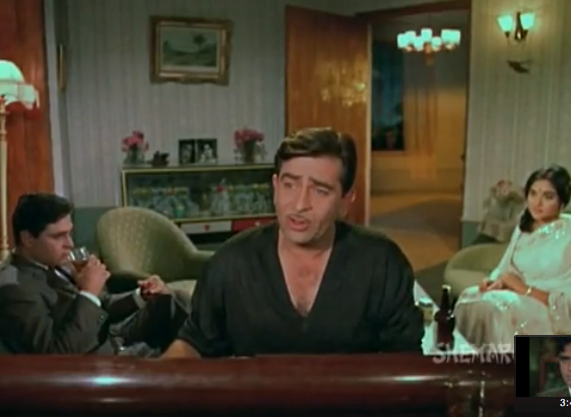
Raj Kapoor sings about betrayal in love and friendship at the piano in Sangam (1965)

Our next translation comes from Sangam (1965), a film starring Raj Kapoor as Sundar, Vijayntimala as Radha, and Rajendra Kumar as Gopal in a classic love triangle story gone wrong. The plot of Sangam is somewhat complex, but it can be boiled down to a few key points:

  • From a young age, Sundar has been attracted to his childhood friend Radha. However, Radha only has eyes for another friend Gopal and persistently rejects Sundar’s advances.  In secret, Gopal reciprocates Radha’s feelings for him.
  • To prove his worthiness as a man and impress Radha, Sundar enlists in the Indian Air Force. Before his departure, Sundar asks Gopal to make sure no man comes in between him and Radha while he is gone.
  • One day, Gopal and Radha receive the terrible news that Sundar is presumed dead after a plane crash. Although they are deeply saddened, this news means that Gopal and Radha can pursue their feelings for each other with a clear conscience. During their courtship, Gopal writes an unsigned love letter to Radha that will become important later in the story.
  • Much to Gopal and Radha’s surprise, Sundar returns happy and healthy from the Air Force–the rumors of his death were inaccurate. The self-sacrificing Gopal keeps his word and steps out of the picture so that Sundar can woo Radha.
  • Eventually, Radha and Sundar get married. It is difficult for Radha to reject Sundar now because his heroic accomplishments in the Air Force have elevated his status to that of a worthy suitor. The newly wedded couple have an extravagant European honeymoon.
  • After their return, the couple enjoy marital bliss. Yet, their happiness is short-lived: Sundar finds the unsigned love letter and assumes that Radha has been an unfaithful wife (although she has stopped all relations with Gopal post-marriage).
  • In the days that follow, Sundar becomes insane with jealousy and makes Radha’s life miserable with constant threats and aggression. Radha flees to Gopal’s house for refuge without knowing that Sundar will end up doing the same thing.
  • The three characters now have a dramatic confrontation where Gopal admits that he is the author of  the unsigned love letter. Tensions flare, and to avoid giving too much away, I’ll just say that the movie ends with a tragic death….

Placed into the context of this film,  Sundar pours his heart out by singing “dost dost na rahaa” after discovering the unsigned love letter that Radha has hidden from him.  With heart-wrenching lyrics penned by Shailendra and a touching melody based on Raga Bhairavi composed by Shankar-Jaikishan, this song is Bollywood’s quintessential anthem for those who have been betrayed in love or friendship. Mukesh’s pathos-laden voice is perfectly suited to express the pain that Sundar must feel after he comes to believe that his two closest companions in life have been unfaithful to him. The intensity of emotion is heightened by this song’s picturization: the camera captures close-up shots of facial expressions when Sundar sings the antara addressed to Gopal followed by the one addressed to Radha.  From watching this scene, it seems like you can cut the tension in the air with a knife! Although no one should ever have to endure being spurned like this in real life, we hope that the lyrics and English translation provided below will allow you to acquire a greater appreciation for one of Hindi cinema’s finest expressions of angst and betrayal that is still a fan-favorite today.

-Mr. 55

Vijayantimala quietly endures Raj Kapoor’s misguided accusations of infidelity in Sangam (1965)

Dost Dost Na Raha: Lyrics and Translation

dost dost na rahaa, pyaar na pyaar rahaa
My friend no longer remains a friend; my love no longer remains love.
zindagii, hame.n teraa aitbaar na rahaa 
Life, I have lost my faith in you.

amaanate.n mai.n pyaar kii gayaa thaa jisko sau.np kar
The one to whom I entrusted my belongings of love,
vah, mere dost, tum hii the, tum hii to the 
My friend, you were him. Only you.
jo zindagii kii raah me.n bane the mere hamsafar 
The one who had become my fellow traveler in the journey of life,
vah mere dost tum hii the, tum hii to the 
My friend, you were him. Only you.
saare bhed khul gaye, raazdaar na rahaa 
All my secrets are now exposed, the secret-bearer no longer remains.
zindagii, hame.n teraa aitbaar na rahaa
Life, I have lost my faith in you.

gale lagii saham saham, bhare gale se boltii
The one who embraced me fearfully while speaking in a somber voice,
vah tum na thii.n to kaun thaa? tum hii to thii.n
If she wasn’t you, then who was she? It was only you. 
safar ke vaqt me.n palak pe motiyo.n ko toltii 
The one who shed tears of pearls at the parting hour,
vah tum na thii.n to kaun thaa? tum hii to thii.n 
If she wasn’t you, then who was she? It was only you. 
nashe kii raat Dhal gayii, ab khumaar na rahaa
The night of intoxication is over, the inebriation no longer remains.
zindagii, hame.n teraa aitbaar na rahaa
Life, I have lost my faith in you.

vafaa kaa leke naam jo dhaDak rahe the har ghaDii
The one who beat each moment in the name of faithfulness
vah, mere nek nek dil, tum hii to ho
My good heart, you are it.
jo muskuraake rah gaye zahar kii jab suii gaDii
The one who continued to smile when pierced with a needle of poison
vah, mere nek nek dil, tum hii to ho
My good heart, you are it.
ab kisii kaa, mere dil, intazaar na rahaa
Now, my heart, I am not waiting for anyone.
zindagii, hame.n teraa aitbaar na rahaa
Life, I have lost my faith in you.

dost dost na rahaa, pyaar na pyaar rahaa
My friend no longer remains a friend; my love no longer remains love.

Glossary

aitbaar: trust, faith; amaanat: property, belongings; sau.npnaa: to entrust, hand over; hamsafar: traveler, companion; bhed: secret; raazdaar: secret-bearer; gale lagnaa: to embrace; saham: fearfully; bharaa galaa: somber voice; palak: eyelid; motiyaa.n: pearls; tolnaa: to weigh; nashaa: intoxication; khumaar: inebriation; vafaa: faithfulness; dhaDaknaa: to beat; nek: good, worthy; zahar: poison, suii: needle; gaDnaa: to pierce, thrust in; intazaar: wait.

Rajendra Kumar, with a distressed and guilty expression, listens to Raj Kapoor’s allegations of disloyalty during this song from Sangam (1965).

Plagiarism in Hindi Film Music: Is Imitation the Most Sincere Form of Flattery?

Music directors in the Bollywood industry today are often accused of plagiarizing songs without giving proper credit to the original sources. Pritam Chakraborty, in particular, comes to mind as a composer who has been subjected to such accusations in recent times. Yet, lifting tunes is not a new trend in the industry: its origins can be  traced back to the industry’s earliest days when music directors of the Golden Era composed melodies heavily inspired by unattributed sources. Below, let’s take a listen to some plagiarized works composed by five of the greatest music directors of yesteryear: R.D. Burman, S.D. Burman, Shankar-Jaikishan, Salil Chowdhury, and O.P. Nayyar.

 R.D. Burman

Among the music directors of his time, R.D. Burman was perhaps the most notorious for composing inspired tunes.  Within the list that I’ve provided below, the magnitude of plagiarism varies from song to song. Some numbers below are direct lifts from their originals, such as the cult classic “mahbuubaa mahbuubaa” from Sholay (1975). Others represent more subtle variations of plagiarism: for instance,  the Kishore Kumar classic “dilbar mere kab tak mujhe” only takes it mukhDaa from “Zigeunerjunge” but has original antaras and interludes.  As a musician, I personally feel that the latter form of lifting is somewhat justifiable because it still reflects a level of creativity and originality on the part of the composer. The direct copying of tunes, however, raises ethical concerns and may have even placed music directors like R.D. Burman in legal trouble had such songs been released today.  Regardless of your opinion on this issue, what is universally striking about the list of songs below is the diversity of sources from which R.D. Burman drew his inspiration.  Collectively, the original melodies come from a smorgasbord of musical genres from all over the world: traditional folk, American pop, Greek, German, French, and even Iranian rock!

aao twist kare.n (Bhoot Bangla, 1965)  / “Let’s Twist Again” (Chubby Checker, 1962)
churaa liyaa hai tum ne  (Yaadon Ki Baraat,  1973) / “If It’s Tuesday, This Must Be Belgium” (Bojoura, 1969)
teraa mujhse hai pahle kaa naataa koii  (Aa Gale Lag Ja, 1973)/ “The Yellow Rose of Texas” (Traditional)
mahbuubaa, mahbuubaa (Sholay, 1975) / “Say You Love Me” (Demis Roussos, 1974)
mil gayaa ham ko saathii (Hum Kisi Se Kum Nahin, 1977) / “Mamma Mia” (ABBA, 1975)
jahaa.n terii yah nazar hai (Kaalia, 1981) / “Heleh Maali” (Zia Atabi, 1977)
kaisaa teraa pyaar (Love Story, 1981) / “I Have A Dream” (ABBA, 1979)
dilbar mere kab tak mujhe (Satta Pe Satta, 1982) / “Zigeunerjunge” (Alexandra, 1967)
kahii.n na jaa  (Bade Dilwala, 1983) / “La Vie En Rose” (Edith Piaf, 1955)
tum se milke  (Parinda, 1989) / “When I Need You” (Leo Sayer, 1977)

Zeenat Aman sizzles in “churaa liyaa tum ne” from Yaadon Ki Baraat (1973)

S.D. Burman

Like his son, S.D. Burman has also composed melodies that reflect marked inspiration from foreign sources.  Although we have already investigated the influence of Tagore’s music on S.D. Burman in a previous post, we now observe how his compositions also were inspired by non-Indian genres.  For a composer who was rather traditional in his musical output, who would have imagined that he lifted material from Mexican, Italian, and American country melodies?

chaahe koi khush ho (Taxi Driver, 1954) / “Tarantella” (Traditional)
jiivan ke safar me.n raahii
 
(Munimji, 1955) / “Mexican Hat Dance” (Traditional)
ek laDkii bhiigii bhaagii sii (Chalti Ka Naam Gaadi, 1958) / “Sixteen Tons” (Tennessee Ernie Ford, 1955)
ham the vah thii (Chalti Ka Naam Gaadi, 1958) / “Watermelon Song” (Tennessee Ernie Ford, 1957)
yah dil na hotaa bechaaraa (Jewel Thief, 1967) / “March” (Bridge on the River Kwai, 1957)
saalaa mai.n to sahab ban gayaa (Sagina, 1974) / “Chella Lla” (Renato Carosone, 1959)

The ever-versatile Kishore Kumar stars in a comic role in Chalti Ka Naam Gaadi (1955)

Shankar-Jaikishan

In my opinion, Shankar-Jakishan were the quintessential music directors of Bollywood’s Golden Age. They combined the authenticity of traditional Indian music with the modern sophistication of Western influences to produce songs that appealed to the masses. It’s not surprising that some of their tunes reflect inspiration from foreign influences, but what is remarkable is that several of the songs listed below are remembered today as some of this duo’s most treasured gems.  Two songs from Chori Chori (1956), two songs from Gumnaam (1965), and the title track of Jab Pyar Kisi Se Hota Hai (1961) — among many other hits — were heavily inspired by existing Western numbers. I think you’ll be surprised to see some of your favorites on the list below…

ghar aayaa meraa pardesii (Awaara, 1952) / “Al Balad El Mahboub” (Umm Kulthum)
aajaa sanam madhur chaa.ndnii me.n ham (Chori Chori, 1956) / “Tarantella” (Traditional)
panchii banuu.n uDtii phiruu.n (Chori Chori, 1956) / “Coming Through The Rye” (Traditional)
aigo aigo yah kyaa ho gayaa?
(Boyfriend, 1961) / Stupid Cupid” (Connie Francis, 1958)
jiyaa ho jiyaa kuchh bol do  (Jab Pyar Kisi Se Hota Hai, 1961) / “Broken-Hearted Melody” (Sarah Vaughan, 1959)
sukuu sukuu (Junglee, 1961) / “Sucu Sucu” (Ping Ping, 1961)
dekho ab to kis ko nahii.n hai khabar (Janwar, 1964) / “I Want To Hold Your Hand” (The Beatles, 1963 )
gumnaam hai koii (Gumnaam, 1965) / “Charade” (Henry Mancini and Orchestra, 1963)
jaane chaman sholaa badan (Gumnaam, 1965) / “Autumn Leaves” (Nat King Cole, 1956)
le jaa le jaa meraa dil (An Evening in Paris, 1967) / “Man of Mystery” (The Shadows, 1960)
kaun hai jo sapno.n me.n aayaa? (Jhuk Gaya Aasman, 1968) / “Marguerita” (Elvis Presley, 1963)

Rajendra Kumar definitely breaks conventions of automobile safety during the picturization of “kaun hai jo sapno.n me.n aayaa?” from Jhuk Gaya Aasman (1968).

Salil Chowdhury

Salil Chowdhury’s compositions always reflect an intelligent and sophisticated mastery of music that set him apart from his peers in the industry.  Instead of describing the songs listed here as cases of plagiarism, I would be more likely to categorize them as adaptations. When Salil Chowdhury used another Western melody as an inspiration, he always managed to make it his own by adding something special that would resonate with Indian audiences. Take, for example, the evergreen Talat-Lata duet “itnaa mujhse tu pyaar baDhaa.” Although the mukhDaa is clearly inspired by Mozart’s Jupiter Symphony, Salil composes new antaras that beautifully complement the original melody.  As another example, consider “bachpan o bachpan” from Memdidi (1961).  Inspired by the children’s rhyme “A Tisket, A Tasket,” Salil takes the melody to a new level of complexity by inserting operatic interludes sung by our beloved diva Lata Mangeshkar.  Bravo!

dharti kahe pukaar ke (Do Bigha Zameen, 1953) / “Meadowlands” (Lev Knipper, 1934)
halke halke chalo saa.nvare (Tangewaali, 1955) / “The Wedding Samba” (Edmund Ros and Orchestra,  1950)
dil taDap taDap ke (Madhumati, 1957) / “Szla Dziewczka” (Traditional)
zindagii hai kyaa, sun merii jaan  (Maya, 1961) / “Theme from Limelight [from 3:27] ” (Charlie Chaplin, 1952)
itnaa na mujhse tu pyaar baDhaa (Chhaya, 1961) / “Molto allegro” from Symphony No. 40 (Wolfgang Amadeus Mozart, 1788)
bachpan o bachpan (Memdidi, 1961) / A Tisket, A Tasket” (Traditional)
aa.nkho.n me.n tum ho (Half-Ticket, 1962) / “Buttons and Bows” (Dinah Shore, 1948)

Vijayantimala coyly hides behind a tree in the picturization of “dil taDap taDap ke” from Madhumati (1957)

O.P. Nayyar

O.P. Nayyar is known for his characteristically Western-inspired approach to crafting melodies for Hindi films, but his contribution to our list of directly plagiarized songs is relatively small in comparison to some of his peers in the industry. The most well-known example here is, of course,  the Rafi-Geeta duet “yah hai bambaaii merii jaa.n” which has been lifted from its predecessor “My Darling Clementine.”

baabuujii dhiire chalnaa (Aar Paar, 1954) / “Quizas, Quizas, Quizas(Trio Los Panchos, 1947)
yah hai bambaii merii jaa.n (C.I.D., 1955) / “My Darling Clementine” (Traditional)
lakho.n hai.n yahaa.n dilvaale (Kismat, 1968) / Red River Valley” (Traditional)

Biswajeet hams it up for Babita during the picturization of “lakho.n hai.n yahaa.n dilvaale” in Kismat (1968)

What is your opinion on plagiarism in Hindi film music? Was it acceptable for music directors of this time to lift material from Western sources in order to introduce musical diversity to Indian audiences? Or, is it unethical for such plagiarism to occur without giving credit to the original musicians who created the songs in the first place? Let us know in the comments, and feel free to share any examples that go along the theme of this post!

-Mr. 55

How to Play the Awkward Miffed Lover

It happens to everyone at some point. We all hate this situation. You land the girl of your dreams, you take her to a fancy dinner party, and just when everything is going your way, her ex-lover crashes the scene. With the heavenly voice of a playback singer, the new contender bursts into dramatic song, calling out his passion with your girl in front of EVERYONE.

Plus, the more the song goes on, the more you realize you’re trapped–any interruption would only backfire. And on top of it, your girl is getting embarrassingly emotional.

So what to do? It’s clear everyone in the audience is just cheering for those two to reunite, leaving YOU with the ugly villain label. The rules of the game prevent you from simply cutting the song off short—you have no option but to helplessly be made a fool. It’s such an unfair tactic, and heroes of Bollywood films LOVE to use it.

In times like these, we reflect on the inspiring behavior of greater men. They too were placed in these compromising and uncomfortable situations. Each one had their own style, their own method of handling the filmi fire life dealt them.

As I see it, you have five main options to choose from. Let us examine their protocols below.

The Vinod Khanna: Get Angry

During the beautiful love ode “Koi Nazarana Lekar” from Aan Milo Sajna (1970), Vinod Khanna shoots daggers from his eyes at the shameless flirt Rajesh Khanna.

Option 1. Get angry. It’s bad enough that you showed up to this event in a lime green tuxedo. Complete the look and let your face turn pea green with envy. Who cares who judges you? Be a party-pooper and scowl your way through the song, sucking the joy out of everyone else’s fun.

The Rehman: Blush

Ugh. Nothing worse than having your own crimes turned into public poetry. Although it’s a black-and-white film, you can see Rehman turn a hot pink during Guru Dutt’s classic lament “Jaane Woh Kaise” from Pyaasa (1957).

Option 2. Blush. You’re guilty and there’s no hiding it. Don’t make eye contact with anyone! Instead, mentally review the cquestionable ethical decisions you took along the path that led you to this debacle. You will realize what a jerk you’ve been, and although you have to stay the course, colour will rise to your cheeks.

The Raj Kapoor: Play it off as a joke

Always a goofball, Raj Kapoor attempts valiantly to make light of the humiliating situation wrought by Dilip Kumar singing “Jhoom Jhoom Ke” from Andaz (1949).

Option 3. Play it off as a joke. You’re at a dinner party, after all and this is no time to aggravate the situation. Keep that bow-tie straight and act casual. With enough non-chalance, maybe the party-goers will think it’s only a bit of fun among friends?

The Rishi Kapoor: Give up

Horror and resignation overwhelm Rishi Kapoor’s face during Tariq’s performance of “Kya Hua Tera Wada” from Hum Kisise Kam Nahin (1979)

Option 4. Give up. Just give up. How could you have not known of this beautiful subverted love story earlier? This is entirely your fault. You’re overwhelmed with moral guilt and regret–do the righteous thing and withdraw your nomination from the ballet entirely. In this way, you can quickly drop the villain label and return to your proper place as hero!

The Pran: Enjoy the show

Pran doesn’t ruffle a feather during Shammi Kapoor’s heartfelt and passionate “Dil Ke Jharoke” from Brahmachari (1968). But hey, when you’re as devastatingly sophisticated as Pran, you wouldn’t have time for these amateurs either.

Option 5. Enjoy the show. After all, who’s worried? This other guy has nothing on you, you suave gift to womankind.  Keep the entertainment coming! Oh, I’m sorry, honey, are you crying? Here, take my silk handkerchief. You might need it.

So the next time you hear the tinkerings of a tragic song start on the piano behind you, don’t panic. There is a way out! Just pick an approach from the textbook of Hindi films. If classic Bollywood has taught us anything about these moments, it’s that they can and will happen all the time. Tell us whose approach YOU prefer!

-Mrs. 55