Shammi Kapoor, the Elvis of India: Realities of a Rockstar

Shammi Kapoor Teesri Manzil

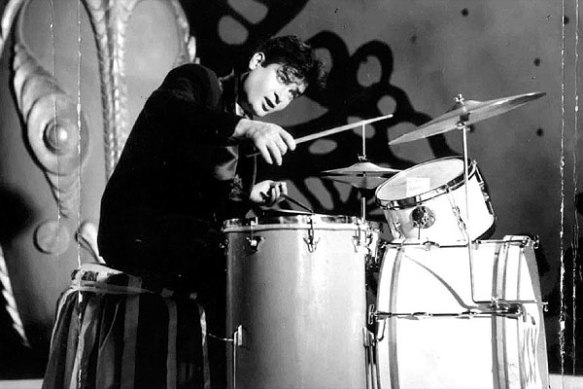
Shammi Kapoor plays a lovable rockstar in Teesri Manzil (1966).

Bollywood actor Shammi Kapoor (1930-2011) was popularly known as the Elvis of India. I just got back from a road trip with my fiancé down to Graceland, home of the original King. Despite jamming out to “That’s All Right Mama” as we toured around, I couldn’t help but think of Bombay film legend Shammi Kapoor and the famous media comparison. I’m a diehard Elvis Presley fan, and my love for his Indian counterpart is no less. But is it even fair to correlate the two?

When I first heard of the comparison of yesteryear Bollywood actor Shammi to American rock-and-roll legend Elvis, I needed a little convincing. All right, I needed a lot of convincing. Nothing short of blasphemy is on the line when you start comparing yourself to the King. I grew up listening to Elvis and had seen Shammi Kapoor films like an Evening in Paris (1967), Brahmachari (1968), Prince (1969) and Andaz (1971). The slightly overweight Bollywood thespian with heavy pancake makeup and tight pants was a far cry from the jailhouse rocking Elvis Presley I knew so well. After all, anyone can wear a pair of tight pants in public, but not everyone should.

So why then do we call Shammi Kapoor the Elvis of India? To begin to answer this, we must go back in time. We return to Shammi Kapoor’s earliest hits films in the days before even the rip-roaring success of Junglee (1961): movies like Tumsa Nahin Dekha (1957) and Dil Deke Dekho (1958). Suddenly, the similarities in appearance are clear. Sure in later colour films Shammi Kapoor didn’t look much like Elvis, but let’s face it, by the time the 70s rolled around, Elvis didn’t look much like Elvis either.
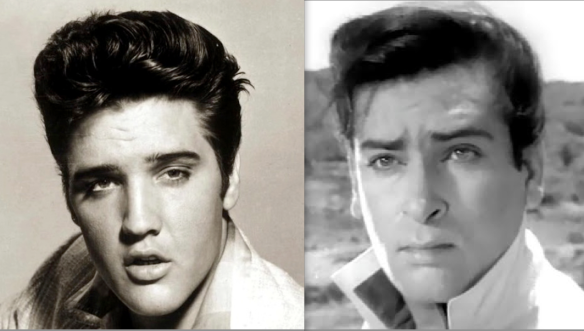
Elvis Presley Shammi Kapoor

Unintentional twins, Elvis Presley (left) and Shammi Kapoor (right) revolutionized the entertainment industry complete with popped collars and pompadours.

But the comparison of the two entertainment icons goes beyond mere appearance. Elvis brought with him a cultural revolution in the midst of a tumultuous political atmosphere in the U.S. Shammi Kapoor, I would argue, brought that same youthful rebellion to India. Before Shammi Kapoor, no actor had ever so deliberately and daringly sought to appeal to the “modern youth” audience on-screen. Before the Shammi revolution, popular actors like Ashok Kumar, Guru Dutt and even Raj Kapoor appealed to a more traditional, elder protagonist who often encountered a modern society—but did not speak for it. Shammi was different.
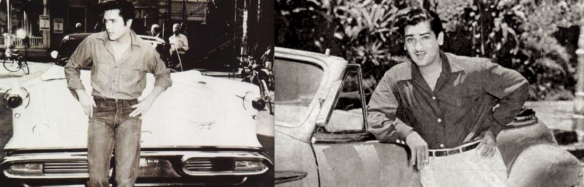
elvis shammi kapoor car

Both Elvis (left) and Shammi (right) pose with their convertibles, hands on hips and one button too many unbuttoned.

With edgy attire, a boyish charm to mask his sharp tongue and a irreverent eye for the ladies, Shammi burst onto the Bombay scene with never-before-seen sex-appeal. He voiced the thoughts and emotions of a new generation who didn’t play by the rules of their fathers—Shammi flirted shamelessly in his movies, played the drums like a rockstar in his songs, and never failed to bring a sleek pompadour ‘do to the set to balance the party happening in his hips. Before Shammi, such actions would have been downright villainous, reserved only for the drunk antagonist of the film who would never win the pure-hearted girl. But Shammi changed the game.

He oozed that James Dean sense of self-confidence so despised by the older generations and so adored by young women everywhere. Watch his peacock strut in “Baar Baar Dekho” from Chinatown (1962), and the way Mohammed Rafi throws in a suave “Tally ho!” into the mix as Shammi coolly slams his guitar. Those signature hip gyrations would have done the King proud!
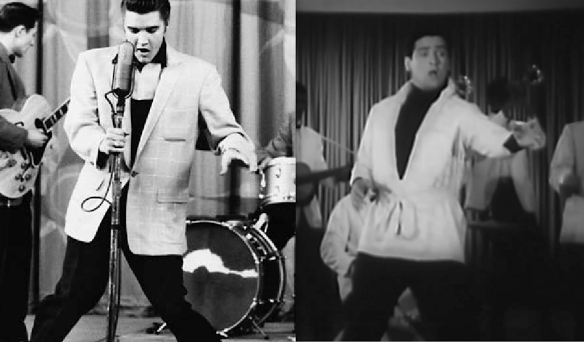
Elvis Presley Shammi Kapoor

Elvis Presley and Shammi Kapoor strike similar poses in even more similar outfits. Left: Elvis performing “Jailhouse Rock” in 1957. Right: Shammi Kapoor swinging to “Dilruba Meri Neeta” in Dil Deke Dekho (1959).

The heart of the revolution, of course, lay with the music. Elvis combined his Southern gospel routes with African-American rhythm and blues to create a whole new catchy sound that caught the country by storm. It was a wave that Shammi Kapoor brought to Bombay. Through radical compositions that drew upon rock-and-roll themes, sassy lyrics, and Mohammed Rafi’s energetic and versatile vocals, Shammi Kapoor too changed the face Bollywood music, ushering an era of fusion-inspired hits from “Bolo Bolo Kuch To Bolo” to “Aaja Aaja Main Hoon Pyaar Tera.”

As Shammi Kapoor said in a Times of India interview before his death:

“My style was unique, but it would have come to nothing had it not been for such brilliant music directors like O. P. Nayyar and Shankar-Jaikishan. I was this supremely macho guy and within me lay dormant an incredible energy that was screaming for expression. Luckily for me, my directors sensed the potential in me and allowed me to unleash my creativity. I guess I also had this very innocent way of looking at girls that heightened the romance element in my films.”

Graceland Elvis Presley

My visit to Graceland, home of the King of Rock and Roll. Left: Boarding one of Elvis’ private jets named for his daughter Lisa Marie. Right: Giving the King a little help holding up a gold record!

The truth of the matter is, Shammi Kapoor never said he modeled himself off of Elvis and never mentioned him in any interviews. Although their legacies share some similarities, the two men never met nor made any attempt to do so. The parallels that link their names together are those that we their fans imagined as observers. The late Shammi Kapoor did not achieve fame in an era where concert videos of Elvis could be watched or copies of the King’s films reviewed over and over again. Shammi insisted that all his choreography was extempore, straight from his heart. In fact, the only direct Bollywood copy of an Elvis hit was “Marguerita” (1963) picturised as “Kaun Hai Jo Sapnon Mein Aaya” by Rajendra Kumar in 1968.

So ultimately, perhaps it is an injustice to say that Shammi Kapoor imitated Elvis Presley’s style. After all, many men around the world knew how to shake their hips and puff their hair, but how many could bellow “YAHOO!” to the object of their affection and get away with it?

Perhaps it would be better to call Elvis the Shammi Kapoor of America.

– Mrs. 55
Rahe Na Rahe Hum Lyrics and Translation: Let’s Learn Urdu-Hindi

Suchitra Sen Ashok Kumar Mamta

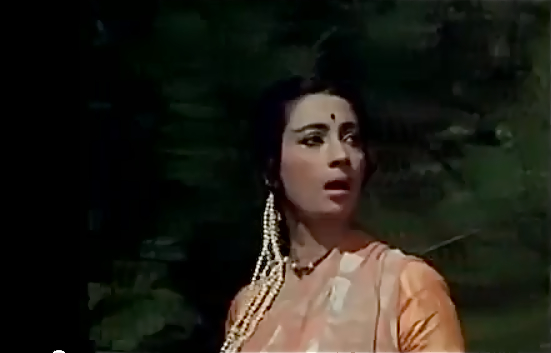
Ashok Kumar and Suchitra Sen star in the beautiful Asit Sen film Mamta (1966).

Today we showcase the lyrics and English translation of the melodious “Rahe Na Rahe Hum” from the film Mamta (1966). This gentle beauty sung by Lata Mangeshkar captures an inspiring philosophy on losing a loved one. An optimistic melody balances the tragic sentiments of its lyrics. While Ashok Kumar must leave Suchitra Sen to study law abroad, he pledges his loyalty to her upon the forthcoming separation and asks her to sing for him before he leaves.

The film Mamta explores the sacrifices Suchitra makes upon becoming a mother and like the thematically-similar blockbuster Aradhana (1969) demonstrates the resilience of a woman wronged by society. Majrooh Sultanpuri wrote the lyrics to Roshan’s superb compositions for Mamta that have kept the film’s legacy alive today. “Rahe Na Rahe Hum” continues to be a favorite with its playful chime opening and nectar-sweet vocals that betray the heartache of the scene.

Suchitra Sen in Mamta

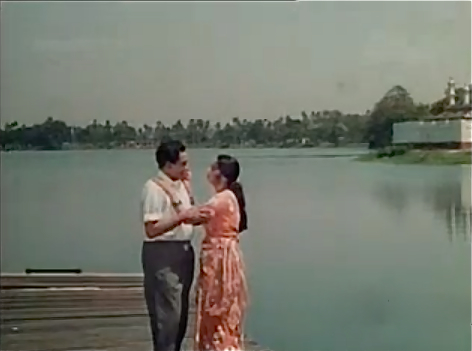
Suchitra Sen tears the petals from a flower on the eve of her separation from Ashok Kumar (right) and tosses the torn petals into the pond (left). The imagery of Suchitra’s identification with a flower recurs throughout the song and film–note how even her saari is decorated with a floral pattern!

“Rahe Na Rahe Hum” captures an appreciation of transience, framed as a neglected yet wonderous consequence of continuity, and highlights the transcendence of attachment to worldly phenomena such as seasons, physical proximity, and even time itself.

The tender line “ashqo.N se bhiigii chandnii mei.N ek sadaa si sunoge chalte chalte” allows simultaneously for mourning and recovery. While Suchitra acknowledges he will miss her, those tears of sadness will not last through the end of his journey that both know he must continue without her. Like the flowers petals that fall away drifting into the pond, Suchitra’s presence is not fettered by a set manifestation. Ultimately “Rahe Na Rahe Hum” is far more than mere words of consolation—it is an ode to love that celebrates the permanence of memory.

Suchitra Sen in Mamta

Suchitra Sen sings “Rahe Na Rahe Hum” as a parting gesture to the man she loves in Mamta (1966).

We hope you enjoy the full lyrics and English translation to the beautiful “Rahe Na Rahe Hum” below. Note that the plural pronoun “hum” can be translated as either “we” or “I.” I’ve chosen the singular for poetic purposes, but you can see how this no-doubt deliberate subtlety on the part of Sultanpuri sahib may color the translation slightly differently with each read. Watch the original song here!

Rahe Na Rahe Hum Lyrics and Translation: Let’s Learn Urdu-Hindi

Rahe na rahe hum mahakaa kareN.ge
Whether or not I am here, this fragrance will remain
Banke kali banke sabaa baagh-e-wafaa mei.N
As if a flower, as if a breeze in our devoted garden

Mausum koi ho, is chaman mei.N rang barse rahe.Nge hum khiraamaa
Whatever the weather may be in our garden, I will fill it gracefully with color
Chaahat ki khushbuu yuu.N hii zulfo.N se uDegii khizaa ho ya bahaare.N
The sweet fragrance of our love will still fly from my hair, whether Autumn or Spring
Yuu.N hii jhuumte aur khilte rahe.Nge
I will continue to sway and blossom
Banke kali banke sabaa baagh-e-wafaa mei.N
As if a flower, as if a breeze in our devoted garden
Rahe na rahe hum…
Whether or not I am here…

Khoye hum aise kyaa hai milnaa kyaa bichhaDnaa nahii.N hai yaad humko
I am so deeply lost in love that I no longer know separation from unity
Kooche mei.N dil ke jab se aaye sirf dil ki zameen hai yaad humko
Ever since you entered the lanes of my heart, I can only remember its world of love
Ise sarzameen pe hum to rahe.Nge
In that realm I will remain
Banke kali banke sabaa baagh-e-wafaa mei.N
As if a flower, as if a breeze in our devoted garden
Rahe na rahe hum…
Whether or not I am here…

Jab hum na ho.Nge, jab hamaare khaak pe tum rukoge chalte chalte
When I am gone, when you pause by my ashes as you walk
Ashqo.N se bhiigi chaandnii mei.N ek sadaa si sunoge chalte chalte
In the rainy moonlight that is wet from my tears, you will hear my call as you walk
Wohii pe kahii.N hum tum se mile.Nge
There somewhere, we both will meet again
Banke kali banke sabaa baagh-e-wafaa mei.N
As if a flower, as if a breeze in our devoted garden

Rahe na rahe hum mahakaa kareN.ge
Whether or not I am here, this fragrance will remain
Banke kali banke sabaa baagh-e-wafaa mei.N
As if a flower, as if a breeze in our devoted garden

Glossary:

mahaknaa: [a fragrance] to spread, kali: flower; sabaa: breeze; baagh: garden; wafaa: loyalty, devotedness; mausam: weather, atmosphere; chaman: garden; rang: color; khiraamaa: gracefully; chaahat: love, desire; khushbuu: sweet fragrance; zulf: hair; khizaa: Autumn; bahaar: Spring; jhuumnaa: to sway; khilnaa: to blossom; milnaa: to meet; bichhaDnaa: to separate; kooche: lane; zameen: world; yaad: memory; sarzameen: realm, society; khaak: ashes; ashq: tears; bhiigii: wet, rainy; chaandnii: moonlight, sadaa: call, voice

You may be interested to note that there is a duet version of this gem that is reprised at the end of the film by Mohammed Rafi and Suman Kalyanpur. Yes, it was the days of the famous Rafi-Mangeshkar feud–hence why the duets of the film necessitated recruiting additional singers (also from the same film, the flirtatious hit “In Baharo.N Mei.N Akeli” by Rafi and Asha as well as “Chhupa Lo Yuu.N Dil” featuring Lata and Hemant Kumar).

This song was requested by the one and only “lalten“! Let us know in the comments, does this song make you feel happy or bring tears to your eyes?

– Mrs. 55

Chaudavin Ka Chand Ho Lyrics and Translation: Let’s Learn Urdu-Hindi

GD

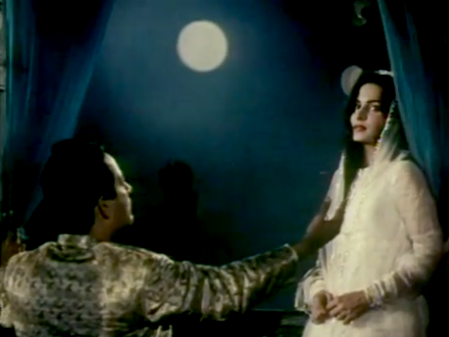
Guru Dutt compares the beauty of his beloved Waheeda Rehman to the full moon of the night sky in Chaudavin Ka Chand (1960).

Today, we present the lyrics and English translation to the title track from Mohammed Sadiq’s Chaudavin Ka Chand (1960).  After Kaaghaz Ke Phool (1959) proved to be a box office disaster, Chaudavin Ka Chand salvaged Guru Dutt’s production studio by garnering  widespread commercial success at the time of its release. Reflecting on the failure of Kaaghaz Ke Phool and the success of Chaudavin Ka Chand, Guru Dutt said,

 “Life me.n, yaar, kyaa hai? Do hii to chiize.n hai.n: –kamiyaabii aur failure. There is nothing in between.”

Although the success of Chaudavin Ka Chand as a comeback film for Guru Dutt Productions can be attributed to number of factors, one of the most important is the film’s outstanding musical score. Composed by Ravi and penned by Shakeel Badayuni, this soundtrack is full of memorable gems like the sassy Asha-Shamshad qawwali sharmaa ke ye kyo.n sab pardaanashii.n and the pain-filled badle badle mere sarkaar (Lata Mangeshkar’s only foray into singing for Guru Dutt Films!).

Among these gems, the film’s title track chaudavii.n ka chaa.nd ho steals the show as one of the most beautiful expressions of love in Hindi film music. Tuned to Raga Pahadi, Shakeel Badayuni’s Filmfare Award winning Urdu poetry abounds with metaphors to describe the film’s heroine Waheeda Rehman. Reminiscent of Shakespeare’s Sonnet No. 18 (“Shall I compare thee to a summer’s day?”), the the poet employs natural imagery to characterize his beloved’s beauty through references to the full moon (chaudavii.n kaa chaa.nd), the sun (aftaab), a lotus (ka.nval), wine (sharaab), and more. Ultimately, the poet concludes that his beloved is so beautiful that her beauty is beyond comparison to any object (jo bhii ho tum khudaa kii qasam laajavaab ho).

No discussion about chaudavii.n ka chaa.nd ho can be complete without giving credit to Mohammed Rafi for his magical rendition. Here, Rafi offers a technically brilliant performance but it is the warmth, passion, and soul in his voice that renders this song a timeless masterpiece. About fifteen years following his Bollywood debut, Rafi received his first well-deserved Filmfare Award for this song in 1961.

Did you know that the Censor Board objected to chaudavii.n kaa chaa.nd ho when Guru Dutt re-released a version of the song shot in color? As the color version was being filmed, Waheeda Rehman’s eyes became irritated from the heat of the high-powered lights used during the shoot. Upon seeing the red color of the heroine’s eyes, the Censor Board claimed that the colored picturization of the song contained suggestive and lustful implications inappropriate for audiences. What a bizarre and unfair objection placed on such an innocently romantic song! Don’t let it stop your from enjoying this classic gem along with our lyrics and translation below. Until next time…

-Mr. 55
WR

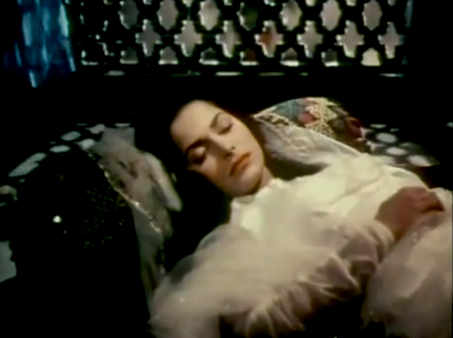
Sleeping in a white dress, Waheeda Rehman’s angelic beauty shines in Chaudavin Ka Chand (1960).

Chaudavin Ka Chand Ho: Lyrics and Translation

chaudavii.n kaa chaa.nd ho yaa aftaab ho?
Are you the full moon of the night or the sun of the day? 
jo bhii ho tum khudaa kii qasam laajavaab ho

Whatever you are, I swear by the Lord that you are incomparable.

zulfe.n hai.n jaise kaandho.n pe baadal jhuke hue
Your tresses are like dark clouds sloping down your shoulders.
aa.nkhe.n hai.n jaise mai ke pyaale bhare hue
Your beautiful eyes are like wine-filled goblets.
mastii hai jis me.n pyaar kii tum vah sharaab ho
You are the wine that abounds with the intoxication of love.

chaharaa hai jaise jhiil me.n ha.nstaa huaa ka.nval
Is your face like a smiling lotus in the brook,
yaa zindagii ke saaz pe chheDii huii ghazal?
or like an ode tuned to the music of life?
jaan-e-bahaar tum kisii shaayar kaa khvaab ho
My beloved, you are a poet’s dream.

ho.nTho.n pe kheltii hai.n tabassum kii bijliyaa.n
The current of your bright smile runs through your beautiful lips.
sajde tumhaarii raah me.n kartii hai kahkashaa.n
Even galaxies lay prostrate with reverence in your path.
duniyaa-e-husn-o-ishq kaa tum hii shabaab ho
 Only your youthful splendor shines in this world of love and beauty.

chaudavii.n kaa chaa.nd ho yaa aftaab ho?
Are you the full moon of the night or the sun of the day?

Glossary

chaudavii.n kaa chaa.nd: moon of the fourteenth night, full moon; aftaab: sun; laajavaab: incomparable; kaandhaa: shoulder; mai: wine; pyaalaa: goblet; mastii: intoxication; sharaab: wine, alcohol; jhiil: brook; ka.nval: lotus; saaz: musical instrument; ghazal: song, ode; jaan-e-bahaar: beloved; shaayar: poet; khvaab: dream; tabassum: smile; bijlii: current; sajde karnaa: to lay prostrate; kahkashaa.n: galaxy; duniyaa-e-husn-o-ishq: world of love and beauty; shabaab: youth.

GD

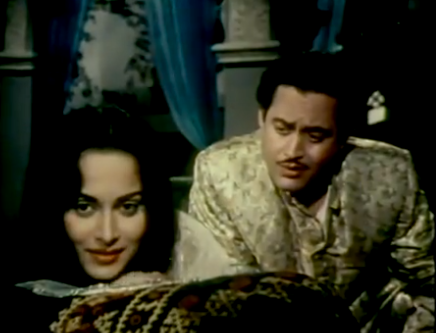
Guru Dutt and Waheeda Rehman’s on-screen chemistry in Chaudavin Ka Chand (1960) reflected their passionate off-screen affair.

Hum Bekhudi Mein Tumko Pukare Lyrics and Translation: Let’s Learn Urdu-Hindi

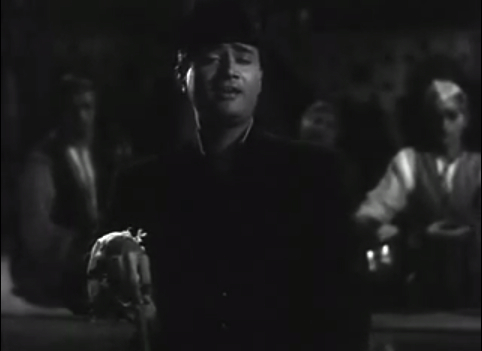
Dev Anand hum bekhudi kala pani

Dev Anand entrances the audience with “Hum Bekhudi Mein” in Kala Pani (1958).

We now present our complete translation to “Hum Bekhudi Mein Tumko Pukare,” one of Mohammed Rafi’s finest solos. The song, and in fact the film Kala Pani (1958), is a considerable break from Dev Anand’s previous work, transforming him from the debonair urbanite to a meditative, black kurta pajama-clad member of the traditional intelligentsia. “Hum Bekhudi Mein” bears the unmistakable hallmark of S.D. Burman’s finest compositions—a hauntingly powerful melody that is so captivating, instrumental ornamentation is close to entirely abandoned. There is something reminiscent of his earlier composition, “Dekhi Zamaane Ki Yaari“–with an emphasis on reflection, the purity of Mohammed Rafi’s voice engulfs the listener in the qawwal-like trance of his yearning, the feeling of entering a dream where time loses its meaning. Indeed, the “bekhudi” or loss of self as described by the singer is precisely what lyricist Majrooh Sultanpuri aims to induce in the listener.

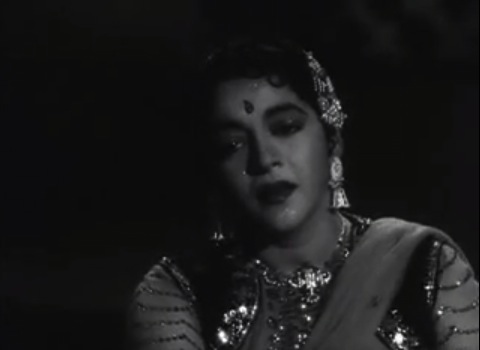
Nalini Jaywant Kala Pani hum bekhudi

Nalini Jaywant believes she has found love at last in the mysterious stranger with a haunting voice in Kala Pani (1958).

The nuance of the lyrics is an exceptional example of the multi-faceted levels of interpretation of Urdu poetry. Each line returns to the refrain’s lingering “chale gaye”—a verb tense indicating continuity of the hero’s past actions, and his current obsession with reliving them. However, Mohammed Rafi’s very deliberate pause before singing “chale gaye” with each line allows for an additional dimension to the song’s interpretation, as if a forlorn reference to the woman herself who has left him (“woh jo chale gaye”). I love this song for every person that hears it will understand it in a slightly different way. If you can’t get enough of this melody, lovers of trivia will be delighted to discover that S.D. Burman actually recorded the original Bengali version of this song in his own voice, “Ghum Bhulechi Nijhum”!

In the Hindi version, hero Dev Anand elaborates on two forms of intoxication—first, the spell cast by his former lover, and second, alcohol to which he has resigned himself.  In the evocative final line of the song, “Sheeshe mei.N aap ko bhi utaare chale gaye,” the hero reconciles their duality and his escape from reality. With the oblivion granted by alcohol, he regains the very woman who has left him in a state of bekhudi—a philosophical wanderer in fugue-like search of a connection.

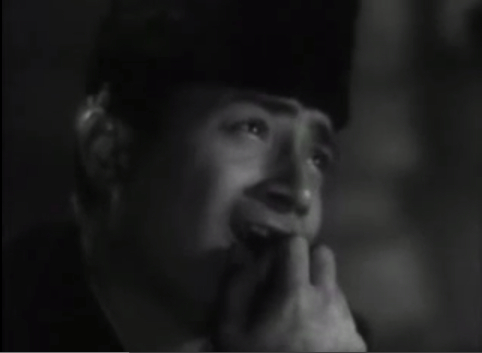
Dev Anand kala pani black hat

Despite biting his fingernails throughout the song, Dev Anand is simply too attractive to handle in a black kurta and matching traditional hat.

We hope you enjoy our English translation to the lyrics of this beautiful poem “Hum Bekhudi Mein” from Kala Pani (1958). Check out the video in which Dev Anand woos the lovely courtesan Nalini Jaywant with his artistic depth! Did you know that after this song was released, Dev Anand was actually told not to wear black anymore in public because Indian women  would swoon and jump from buildings upon seeing him dressed in that devastatingly attractive shade? I mean…I can see where they’re coming from!

Hum Bekhudi Mein Tumko Pukare Lyrics and Translation:

Hum bekhudii mei.N tum ko pukaare chale gaye
Unaware of my own self, I kept calling to you
Saaghar mei.N zindagii ko utaare chale gaye
And so I kept drowning my life in a glass of wine
Hum…

Dekhaa kiye tumhe hum banke deewaanaa
When I used to see you, I was madly love
Utaraa jo nashaa to hum ne yeh jaana
Once that intoxication wore off, I knew this
Saare woh zindagii ke sahaare chale gaye
That all the support I had in life had gone

Hum bekhudii mei.N tum ko pukaare chale gaye
Unaware of my own self, I kept calling to you

Tum to na kaho hum khud hi se khele
At least do not say that I played this game by myself.
Doobe nahii.N humii yuu.N nashe mei.N akele
For I did not drown in this intoxication alone
Sheeshe mei.N aap ko bhi utaare chale gaye
You were what I kept pouring into my glass

Hum bekhudii mei.N tum ko pukaare chale gaye
Unaware of my own self, I kept calling to you
Saaghar mei.N zindagii ko utaare chale gaye
And so I kept drowning my life in a glass of wine
Hum…

Glossary:

bekhudi: loss of self-awareness; pukaarnaa: to call out; saaghar: wine goblet; zindagii: life; deewaanaa: madly in love; nashaa: intoxication; sahaaraa: support; khud: self; khelnaa: to play; Doobnaa: to drown; akelaa: alone; sheeshaa: glass, mirror

Interestingly, this gently hypnotic song is used to trap Nalini Jaywant into falling in love with Dev Anand and confess her past crimes. Yes, it’s all a pretense–Dev Anand is actually in love with Madhubala, the cheeky journalist who is helping him absolve his wrongfully imprisoned father. Nalini Jaywant played a role in the original crime and must now the price of unrequited love for his son. The film was actually based on A.J. Cronin’s Scottish novel “Beyond This Place” published in 1953. Dev Anand loved Cronin’s work so much, he also later turned one of Cronin’s most famous novels, “The Citadel” into the 1971 Bollywood film Tere Mere Sapne.

– Mrs. 55

O Duniya Ke Rakhwale Lyrics and Translation: Let’s Learn Urdu-Hindi

BB

Agonized by his fate, Bharat Bhushan entreats the Lord to heed his grievances in Baiju Bawra (1952)

On April 15, 2013, an unspeakable tragedy hit my current hometown of Boston when two bombs were set off at the finish line of the Boston Marathon. This annual event held on Patriot’s Day attracts nearly 500,000 spectators who come to watch amateur and professional runners from all over the world. Considered one of the largest acts of terrorism ever to strike Boston, the marathon bombings killed 3 individuals and wounded nearly 300 victims. Tragedy is always unsettling, but these attacks have been particularly difficult to grapple with because of their proximity to home. As the local community finds the strength to overcome, our thoughts and prayers at Mr. and Mrs. 55 are with all those who were affected by this senseless act of violence in Boston.

Five days after the attack, a harrowing manhunt for one of the suspects at large put the entire city of Boston on lockdown with a “shelter in place” order for all residents.  Within the safe confines of my dorm at Harvard, I found comfort during this time in old Hindi film songs–something familiar and close to my heart.  In the aftermath of this tragedy, there was one song in particular that resonated deeply with my state of mind: o duniyaa ke rakhvaale from Baiju Bawra (1952). In commemoration of the victims of the Boston Marathon bombings, we offer the lyrics and English translation to this timeless devotional classic. 

521732_10152739462480304_1562200480_n

Composed by Naushad in the somber and grave raga Darbari Kanada, this evergreen number from Baiju Bawra (1952) is one of Mohammed Rafi’s best renditions. His pathos-laden voice navigates through a difficult melody spanning nearly two octaves that culminates in a high Bb4 (taar shuddh ma in the key of F) during the final climax. In light of the recent tragedy, however, we will focus on the message presented by Shakeel Badayuni’s lyrics. Without using elevated vocabulary, Badayuni masterfully captures the essence of an important philosophical maxim that may help us cope with the recent events: the reconciliation of opposites. Expressed as frustration and anger, the song’s protagonist struggles to accept the contradictory nature of the world he inhabits. Why were storms created along with ships? Why must we be separated from our loved ones after being united? Why does hope exist along with despair? And ultimately, why was evil created along with good? 

Failing to find adequate responses to these difficult questions, the protagonist lashes out in grievance against his Lord. Indeed, Badayuni makes a bold move in the context of a bhajan by having the protagonist refer to his Lord as harjaayii (unfaithful, betrayer). The protagonist’s frustration is understandable given that everything familiar to him in this world has turned against him. Using metaphorical imagery, Badayuni describes this feeling through the transformation of conventional entities: rain into fire, flowers into embers, night into snake, and stars into stones. The lyrics continue to take a few unconventional turns when the protagonist asks the Lord to take his life (“jiivan apnaa vaapas le le, jiivan denevaale“) and when the devotee subversively offers his blessings to the Lord (“bhagvaan bhalaa ho teraa!”) in sardonic resignation. 

At their core, these lyrics encourage the listener to appreciate the value of prajna, a Sanskrit term used to describe the wisdom of non-duality. Based on the fundamental reconciliation of dual phenomena, this worldview posits that the demarcation of polar opposites leads to further conflict and suffering.  Instead of placing last week’s tragic events within a framework of good versus evil, valuing prajna instructs us to focus our energy on reflection and the discovery of underlying causes.  Additionally, in Shakeel Badayuni’s words, we must not lose hope in the face of misfortune (“qismat TuuTii aas na TuuTii) as we rise above our differences and provide support to one another in this trying time of need.  

Here at Mr. and Mrs. 55, we would like to reiterate our deepest condolences and sympathies to all those in our community and beyond who were affected by the recent Boston Marathon attacks. For those who are interested, we encourage donations to One Fund Boston, a charitable organization established by Mayor Thomas Menino and Gov. Patrick Deval to support the victims of this tragedy. Stay strong, Boston!

-Mr. 55
s

Lord Shiva sheds tears upon his devotee’s plight in Baiju Bawra (1952)

O Duniya Ke Rakhwale: Lyrics and Translation

bhagvaan, bhagvaan, bhagvaan!
Oh Lord!

o duniyaa ke rakhvaale! sun dardbhare mere naale
Oh protector of this world! Please heed my woeful lamentations.

aash niraash ke do rango.n se duniyaa tuu ne sajaayii
You have adorned this world with the two colors of hope and despair.
naiyaa sang tuufaan banaayaa, milan ke saath judaayii
You created the storm along with the boat, separation along with union.
jaa dekh liyaa harjaayii
Lord, I have witnessed your betrayal.
 o luuT gayii mere pyaar ki nagarii, ab to niir bahaa le
Oh! My city of love has been plundered; now shed a few tears upon my plight.

aag banii saavaan kii barkhaa, phuul bane angaare
The monsoon rains have turned into fire, while the flowers have become embers.
naagin ban gayii raat suhaanii, patthar ban gaye taare
The beautiful night has become a snake, while the stars have turned into stones.
sab TuuT chuke hai.n sahaare
All of my support has been lost.
o jiivan apnaa vaapas le le, jiivan denevaale
Oh provider of life! Please take back this life from me.

chaa.nd ko Dhuu.nDe paagal suuraj, shaam ko Dhuu.nDe saveraa
The mad Sun seeks the Moon, while the morning searches for the night.
mai.n bhii Dhuu.nDuu.n us priitam ko ho na sakaa jo meraa
I too search for the beloved who could not be mine.
bhagvaan bhalaa ho teraa!
Lord, may you be blessed!
o qismat phuuTii aas na TuuTii, paa.nv me.n paD gaye chhaale
Oh! I have suffered misfortune without losing hope, though my feet have become sore with blisters.

mahal udaas aur galiyaa.n suunii, chup-chup hai.n diivaare.n
The palace is forlorn with its deserted alleys and silent walls.
dil kyaa ujaDaa, duniyaa ujaDii, ruuTh gayii hai.n bahaare.n
My heart has been ravaged, my entire world has been destroyed, and even the new spring sulks in displeasure.
ham jiivan kaise guzaare.n?
How can I spend my life like this?
o mandir girtaa phir ban jaataa, dil ko kaun sambhaale?
Oh! Fallen temples can be rebuilt, but who can mend my broken heart?

o duniyaa ke rakhvaale! sun dardbhare mere naale
Oh protector of this world! Please heed my woeful lamentations.

Glossary

bhagvaan: Lord; duniyaa: word; rakhvaalaa: protector; dardbharaa: woeful; naale: lamentation; aash: hope; niraash: despair; sajaanaa: to adorn; naiyaa: boat; tuufaan: storm; milan: union; judaayii: separation; harjaayii: betrayer, unfaithful one; luuT jaanaa: to be plundered; nagrii: city, town; niir bahaanaa: to shed tears; aag: fire; saavan: monsoon; barkhaa: rain; naagin: snake (female); suhaanii: lovely, beautiful; sahaaraa: support; jiivan: life; vaapas lenaa: to take back; denevaalaa: provider; chaa.nd; Moon; paagal: mad, crazy; suuraj: Sun; shaam: evening, night; saveraa: morning; priitam: beloved; “(kisii kaa) bhalaa ho!“: an expression used to indicate the offering of blessings to someone; chhaalaa: blister; mahal: palace; udaas: sullen, forlorn; galii: alley; suunaa: empty, deserted; chup-chaap: silent; diivaar: wall; ujaDnaa: to be uprooted, ravaged or destroyed; ruuTh jaanaa: to sulk; bahaar: spring; jiivan guzaarnaa: to spend life; mandir: temple; sambhaalnaa: to manage, mend.

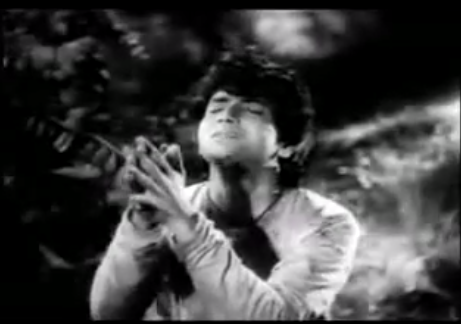
shadows

A dejected Bharat Bhushan asks for his life to be taken back in Baiju Bawra (1952)