Rahe Na Rahe Hum Lyrics and Translation: Let’s Learn Urdu-Hindi

Suchitra Sen Ashok Kumar Mamta

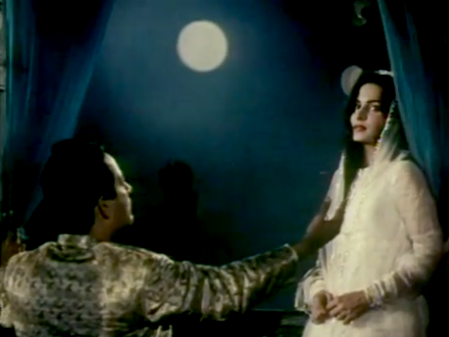
Ashok Kumar and Suchitra Sen star in the beautiful Asit Sen film Mamta (1966).

Today we showcase the lyrics and English translation of the melodious “Rahe Na Rahe Hum” from the film Mamta (1966). This gentle beauty sung by Lata Mangeshkar captures an inspiring philosophy on losing a loved one. An optimistic melody balances the tragic sentiments of its lyrics. While Ashok Kumar must leave Suchitra Sen to study law abroad, he pledges his loyalty to her upon the forthcoming separation and asks her to sing for him before he leaves.

The film Mamta explores the sacrifices Suchitra makes upon becoming a mother and like the thematically-similar blockbuster Aradhana (1969) demonstrates the resilience of a woman wronged by society. Majrooh Sultanpuri wrote the lyrics to Roshan’s superb compositions for Mamta that have kept the film’s legacy alive today. “Rahe Na Rahe Hum” continues to be a favorite with its playful chime opening and nectar-sweet vocals that betray the heartache of the scene.

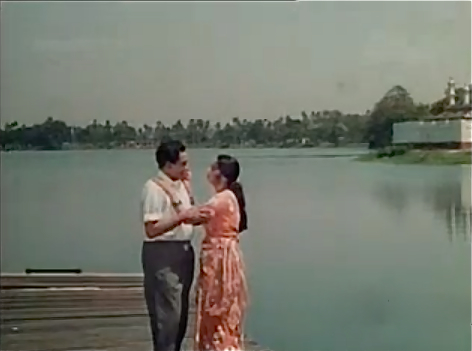
Suchitra Sen in Mamta

Suchitra Sen tears the petals from a flower on the eve of her separation from Ashok Kumar (right) and tosses the torn petals into the pond (left). The imagery of Suchitra’s identification with a flower recurs throughout the song and film–note how even her saari is decorated with a floral pattern!

“Rahe Na Rahe Hum” captures an appreciation of transience, framed as a neglected yet wonderous consequence of continuity, and highlights the transcendence of attachment to worldly phenomena such as seasons, physical proximity, and even time itself.

The tender line “ashqo.N se bhiigii chandnii mei.N ek sadaa si sunoge chalte chalte” allows simultaneously for mourning and recovery. While Suchitra acknowledges he will miss her, those tears of sadness will not last through the end of his journey that both know he must continue without her. Like the flowers petals that fall away drifting into the pond, Suchitra’s presence is not fettered by a set manifestation. Ultimately “Rahe Na Rahe Hum” is far more than mere words of consolation—it is an ode to love that celebrates the permanence of memory.
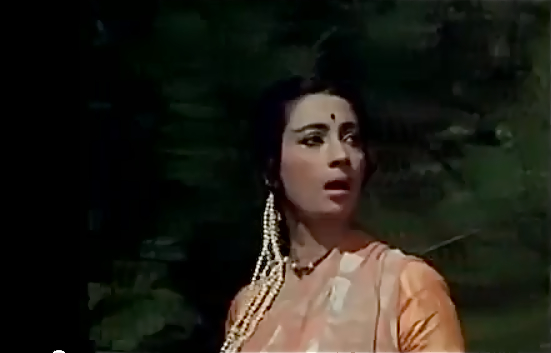
Suchitra Sen in Mamta

Suchitra Sen sings “Rahe Na Rahe Hum” as a parting gesture to the man she loves in Mamta (1966).

We hope you enjoy the full lyrics and English translation to the beautiful “Rahe Na Rahe Hum” below. Note that the plural pronoun “hum” can be translated as either “we” or “I.” I’ve chosen the singular for poetic purposes, but you can see how this no-doubt deliberate subtlety on the part of Sultanpuri sahib may color the translation slightly differently with each read. Watch the original song here!

Rahe Na Rahe Hum Lyrics and Translation: Let’s Learn Urdu-Hindi

Rahe na rahe hum mahakaa kareN.ge
Whether or not I am here, this fragrance will remain
Banke kali banke sabaa baagh-e-wafaa mei.N
As if a flower, as if a breeze in our devoted garden

Mausum koi ho, is chaman mei.N rang barse rahe.Nge hum khiraamaa
Whatever the weather may be in our garden, I will fill it gracefully with color
Chaahat ki khushbuu yuu.N hii zulfo.N se uDegii khizaa ho ya bahaare.N
The sweet fragrance of our love will still fly from my hair, whether Autumn or Spring
Yuu.N hii jhuumte aur khilte rahe.Nge
I will continue to sway and blossom
Banke kali banke sabaa baagh-e-wafaa mei.N
As if a flower, as if a breeze in our devoted garden
Rahe na rahe hum…
Whether or not I am here…

Khoye hum aise kyaa hai milnaa kyaa bichhaDnaa nahii.N hai yaad humko
I am so deeply lost in love that I no longer know separation from unity
Kooche mei.N dil ke jab se aaye sirf dil ki zameen hai yaad humko
Ever since you entered the lanes of my heart, I can only remember its world of love
Ise sarzameen pe hum to rahe.Nge
In that realm I will remain
Banke kali banke sabaa baagh-e-wafaa mei.N
As if a flower, as if a breeze in our devoted garden
Rahe na rahe hum…
Whether or not I am here…

Jab hum na ho.Nge, jab hamaare khaak pe tum rukoge chalte chalte
When I am gone, when you pause by my ashes as you walk
Ashqo.N se bhiigi chaandnii mei.N ek sadaa si sunoge chalte chalte
In the rainy moonlight that is wet from my tears, you will hear my call as you walk
Wohii pe kahii.N hum tum se mile.Nge
There somewhere, we both will meet again
Banke kali banke sabaa baagh-e-wafaa mei.N
As if a flower, as if a breeze in our devoted garden

Rahe na rahe hum mahakaa kareN.ge
Whether or not I am here, this fragrance will remain
Banke kali banke sabaa baagh-e-wafaa mei.N
As if a flower, as if a breeze in our devoted garden

Glossary:

mahaknaa: [a fragrance] to spread, kali: flower; sabaa: breeze; baagh: garden; wafaa: loyalty, devotedness; mausam: weather, atmosphere; chaman: garden; rang: color; khiraamaa: gracefully; chaahat: love, desire; khushbuu: sweet fragrance; zulf: hair; khizaa: Autumn; bahaar: Spring; jhuumnaa: to sway; khilnaa: to blossom; milnaa: to meet; bichhaDnaa: to separate; kooche: lane; zameen: world; yaad: memory; sarzameen: realm, society; khaak: ashes; ashq: tears; bhiigii: wet, rainy; chaandnii: moonlight, sadaa: call, voice

You may be interested to note that there is a duet version of this gem that is reprised at the end of the film by Mohammed Rafi and Suman Kalyanpur. Yes, it was the days of the famous Rafi-Mangeshkar feud–hence why the duets of the film necessitated recruiting additional singers (also from the same film, the flirtatious hit “In Baharo.N Mei.N Akeli” by Rafi and Asha as well as “Chhupa Lo Yuu.N Dil” featuring Lata and Hemant Kumar).

This song was requested by the one and only “lalten“! Let us know in the comments, does this song make you feel happy or bring tears to your eyes?

– Mrs. 55
Chaudavin Ka Chand Ho Lyrics and Translation: Let’s Learn Urdu-Hindi

GD

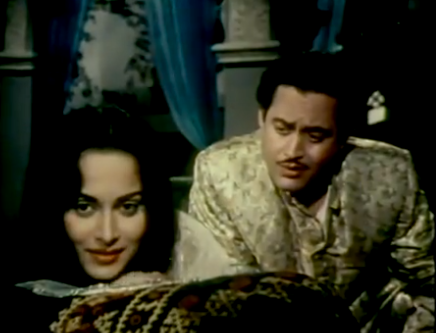
Guru Dutt compares the beauty of his beloved Waheeda Rehman to the full moon of the night sky in Chaudavin Ka Chand (1960).

Today, we present the lyrics and English translation to the title track from Mohammed Sadiq’s Chaudavin Ka Chand (1960).  After Kaaghaz Ke Phool (1959) proved to be a box office disaster, Chaudavin Ka Chand salvaged Guru Dutt’s production studio by garnering  widespread commercial success at the time of its release. Reflecting on the failure of Kaaghaz Ke Phool and the success of Chaudavin Ka Chand, Guru Dutt said,

 “Life me.n, yaar, kyaa hai? Do hii to chiize.n hai.n: –kamiyaabii aur failure. There is nothing in between.”

Although the success of Chaudavin Ka Chand as a comeback film for Guru Dutt Productions can be attributed to number of factors, one of the most important is the film’s outstanding musical score. Composed by Ravi and penned by Shakeel Badayuni, this soundtrack is full of memorable gems like the sassy Asha-Shamshad qawwali sharmaa ke ye kyo.n sab pardaanashii.n and the pain-filled badle badle mere sarkaar (Lata Mangeshkar’s only foray into singing for Guru Dutt Films!).

Among these gems, the film’s title track chaudavii.n ka chaa.nd ho steals the show as one of the most beautiful expressions of love in Hindi film music. Tuned to Raga Pahadi, Shakeel Badayuni’s Filmfare Award winning Urdu poetry abounds with metaphors to describe the film’s heroine Waheeda Rehman. Reminiscent of Shakespeare’s Sonnet No. 18 (“Shall I compare thee to a summer’s day?”), the the poet employs natural imagery to characterize his beloved’s beauty through references to the full moon (chaudavii.n kaa chaa.nd), the sun (aftaab), a lotus (ka.nval), wine (sharaab), and more. Ultimately, the poet concludes that his beloved is so beautiful that her beauty is beyond comparison to any object (jo bhii ho tum khudaa kii qasam laajavaab ho).

No discussion about chaudavii.n ka chaa.nd ho can be complete without giving credit to Mohammed Rafi for his magical rendition. Here, Rafi offers a technically brilliant performance but it is the warmth, passion, and soul in his voice that renders this song a timeless masterpiece. About fifteen years following his Bollywood debut, Rafi received his first well-deserved Filmfare Award for this song in 1961.

Did you know that the Censor Board objected to chaudavii.n kaa chaa.nd ho when Guru Dutt re-released a version of the song shot in color? As the color version was being filmed, Waheeda Rehman’s eyes became irritated from the heat of the high-powered lights used during the shoot. Upon seeing the red color of the heroine’s eyes, the Censor Board claimed that the colored picturization of the song contained suggestive and lustful implications inappropriate for audiences. What a bizarre and unfair objection placed on such an innocently romantic song! Don’t let it stop your from enjoying this classic gem along with our lyrics and translation below. Until next time…

-Mr. 55
WR

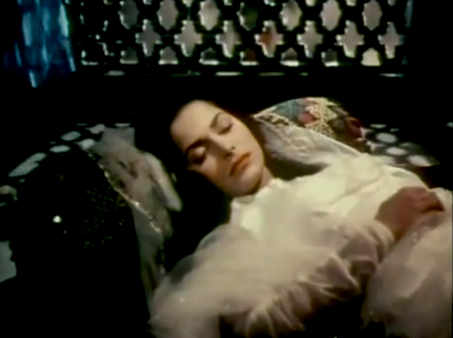
Sleeping in a white dress, Waheeda Rehman’s angelic beauty shines in Chaudavin Ka Chand (1960).

Chaudavin Ka Chand Ho: Lyrics and Translation

chaudavii.n kaa chaa.nd ho yaa aftaab ho?
Are you the full moon of the night or the sun of the day? 
jo bhii ho tum khudaa kii qasam laajavaab ho

Whatever you are, I swear by the Lord that you are incomparable.

zulfe.n hai.n jaise kaandho.n pe baadal jhuke hue
Your tresses are like dark clouds sloping down your shoulders.
aa.nkhe.n hai.n jaise mai ke pyaale bhare hue
Your beautiful eyes are like wine-filled goblets.
mastii hai jis me.n pyaar kii tum vah sharaab ho
You are the wine that abounds with the intoxication of love.

chaharaa hai jaise jhiil me.n ha.nstaa huaa ka.nval
Is your face like a smiling lotus in the brook,
yaa zindagii ke saaz pe chheDii huii ghazal?
or like an ode tuned to the music of life?
jaan-e-bahaar tum kisii shaayar kaa khvaab ho
My beloved, you are a poet’s dream.

ho.nTho.n pe kheltii hai.n tabassum kii bijliyaa.n
The current of your bright smile runs through your beautiful lips.
sajde tumhaarii raah me.n kartii hai kahkashaa.n
Even galaxies lay prostrate with reverence in your path.
duniyaa-e-husn-o-ishq kaa tum hii shabaab ho
 Only your youthful splendor shines in this world of love and beauty.

chaudavii.n kaa chaa.nd ho yaa aftaab ho?
Are you the full moon of the night or the sun of the day?

Glossary

chaudavii.n kaa chaa.nd: moon of the fourteenth night, full moon; aftaab: sun; laajavaab: incomparable; kaandhaa: shoulder; mai: wine; pyaalaa: goblet; mastii: intoxication; sharaab: wine, alcohol; jhiil: brook; ka.nval: lotus; saaz: musical instrument; ghazal: song, ode; jaan-e-bahaar: beloved; shaayar: poet; khvaab: dream; tabassum: smile; bijlii: current; sajde karnaa: to lay prostrate; kahkashaa.n: galaxy; duniyaa-e-husn-o-ishq: world of love and beauty; shabaab: youth.

GD

Guru Dutt and Waheeda Rehman’s on-screen chemistry in Chaudavin Ka Chand (1960) reflected their passionate off-screen affair.

The Best Holi Songs of Classic Bollywood Movies

Hema Malini Sholay holi

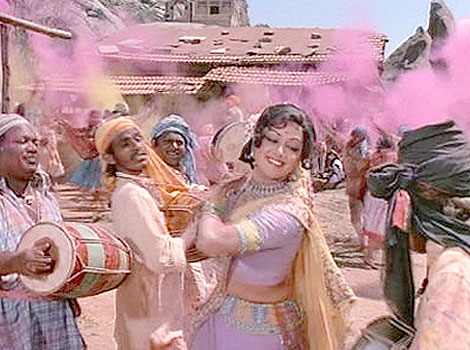
Hema Malini dances with joyful abandon in Sholay’s famous holi number “Holi Ke Din.”

The festival of Holi is among Bollywood’s favorite celebrations–an occasion at last as colorful as the country of its origin. Indeed Holi, a Hindu spring festival, is commonly known as the Festival of Colors. It is both a religious celebration signifying the triumph of Good over Evil, as well as a cultural one commemorating the onset of a new Spring season. It is marked by the throwing of colorful powders, the lighting of bonfires, and the strengthening of bonds between all individuals in colorful merriment. Its spirited catchphrase “Buraa na maano, Holi hai!” (Don’t bear any ill-feelings, it’s Holi!”) speaks to the underlying theme of the day – the burning of negative forces or ill-will, a sort of spiritual purging. The smearing of colors represents the deconstructing of identities and the breaking of social barriers, as all rejoice and participate together, regardless of social class. At the very least, it is a day to settle old scores and move on. Indeed, everyone is welcome and everyone is pardoned for his or her revelry. Thus, we mortals celebrate Holi today with fun and games, colors and powder, and Bollywood takes this grand opportunity to ignite romance.

Rajesh Khanna asha parekh holi

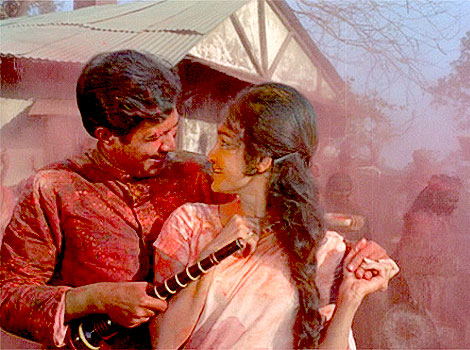
Rajesh Khanna woos Asha Parekh with color at the Holi celebration of Kati Patang (1970).

There’s something inherent to the playful tag-style nature of Holi that lends itself so conveniently to flirtation and a male-female dichotomy. We discussed the appalling lack of Diwali-associated songs in classic Bollywood previously, and hazarded the guess that the festival is far less conducive to overt flirtation and bumping dance grooves like Holi invariably is. Whether wooing the mourning lover into a literal rainbow of joy or painting your sweetheart with a visible mark of your flirtatious overtures, Holi delivers the goods for Bollywood every time.

Mother India holi

Even the old school epic Mother India takes a drama break for the holi festivities!

Below is our list of the 10 greatest Holi songs of classic Bollywood cinema. Happy Holi to all our readers–and if you’re stuck in a huge snowstorm like we are, here’s hoping Holi will usher in the Spring at last!

1. Rang barse (Silsila 1981)

The ultimate old school Holi hit, this song will force anyone to get in the mood and join the festivities! Say what you want about Amitabh and Rekha’s clandestine affair, this dance number will get you on board in no time!

2. Aaj na chodenge (Kati Patang 1970)

This song is easily my favorite Bollywood holi song! Besides the fact that I grew up on the Kati Patang soundtrack, does it get much better than Rajesh Khanna-Asha Parekh shy seduction? Lata and Kishore are delightful, but don’t get me started on the bizarre chorus act that chops up the number like barbarians on holiday.

3. Holi Aayi Re Kanhaayi (Mother India 1957)

Oh, there’s no school like the old school! Bring it back Nargis-style with this classic song from Mother India that just overflows with romance and sass! The only thing better than a Holi song is a Holi village dance-off.

4. Tan rang lo ji (Kohinoor 1960)

While this royal gem may be shot in black-and-white, you can practically see the colors flying in this fantastic Mohammed Rafi-Dilip Kumar celebration that invites the entire kingdom for a Holi song-and-dance sequence!

5. Holi Ke Din (Sholay 1975)

Retro flirting Queen Hema Malini proves to Dharmendra that she’s more than just a loud mouth in Sholay–her moves and dancing steal the show in this colorful song!

6. Are Ja Re Hat Natkhat (Navrang 1959)

Classical dancer Sandhya wows the audience with this traditional stage performance, alternating as both the male and female character complete with ghungroo! Asha Bhonsle’s Hindustani vocals balance out Mahendra Kapoor’s mainstream sway in a Holi number that is well-known even today for its stunning classical choreography.

7. Piya Tose Naina (Guide 1965)

Looking for something a little classier? Go no further than this Waheeda Rehman semi-classical piece from the great philosophical Guide. Watch her prance around with so much joie de vivre, you’ll ignore how gaudy the stage is decorated and your feelings for high-pitched female choruses of the 1960s.

8. Nadiya Se Dariya (Namak Haram 1973)

This song is just plain cute. While not a roaring shoulder-shaking dance off like some of these others, the song is playful and full of shy passion for Rajesh Khanna, which we always approve of.

9. Baghi Re Bhagi Brij Bala (Rajput 1982)

I think this hidden jewel is under-appreciated by historians. While something of a repeat of previous Hema Malini-Dharmendra magic, Vinod Khanna holds his own in this fast-paced duet that once again brings an entire kingdom to the palace to party Holi-style!

10. Kaikhe Paan Banaraswala (Don 1978)

OK, so this isn’t technically a Holi song per se, but it’s arguably the unofficial anthem! There’s something about a traditional, rich beat coupled with Kishore’s absolutely unabashed vocals that set the tone of a celebration and throwing inhibitions to the wind!

While Holi was born in India, it’s popularity was carried across the diaspora and is celebrated around the world each year with full force! The picture below is from my freshman year at Harvard where Holi was played on the Mac quad! Can you spot me in the pigtails with the orange-yellow face?

n31939_34049799_4730

– Mrs. 55

Neela Aasman So Gaya Lyrics and Translation: Let’s Learn Urdu-Hindi

AR

Amitabh Bacchan plays a writer who falls for Rekha’s timeless beauty in Silsila (1981)

Directed and produced by Yash Chopra, Silsila (1981) sparked controversy even before it was released. Rumors regarding the film’s casting spread throughout the industry, as its portrayal of a love triangle between Amitabh Bacchan, his wife Jaya Bacchan, and his alleged mistress Rekha was said to mimic reality. Today, we present the lyrics and English translation of a classic romantic ballad from Silsilaniilaa aasmaa.n so gayaa.

This film depicts a passionate romance between Amit (played by Amitabh Bacchan) and Chandni (played by Rekha) that cannot culminate in marriage due to unfortunate circumstances. After his brother (played by Shashi Kapoor) is killed in the Indo-Pakistani War of 1971, Amit marries his brother’s pregnant fiancee in order to save her honor. Unable to pursue her love with Amit, Chandni marries Dr. Anand (played by Sanjeev Kumar). When Amit and Shobha are involved in a car accident (that causes Shobha to lose her baby), they are hospitalized and treated by Dr. Anand. Chandni sees Amit in the hospital, and this encounter triggers memories of their past love. Amit and Chandni give into their temptations and begin to rekindle their romance through clandestine meetings. The plot thickens when an evening rendezvous goes sour: Amit and Chandni must go to the police station after hitting a pedestrian while driving, and officer assigned to their case turns out to be Shobha’s cousin. How long can Amit and Chandni keep their adultery a secret? Will Amit and Chandni leave their spouses to be together? Silsila is worth a viewing to find out!

Although Silsila is not the first Bollywood film to depict extra-marital love, it is ground-breaking in its concrete portrayal of the consummation of adultery.  Indeed, this film compelled Indian audiences to think about extra-marital affairs and whether they can be cinematically romanticized in a way that appeals to the masses. Silsila offers some justification for the relationship between Amit and Chandni because they were a couple before Amit sacrificed his love to uphold his duty to his brother. However, the film portrays the tumultous decline of their extra-marital romance, eventually depicting Amit and Chandni as disloyal adulterers instead of righteous lovers. The uncomfortable subject matter is presumably the reason why this film failed to be a box office success. Regarding the audience’s reaction to Silsila, Yash Chopra has said:

 “The film had inherent tensions because of the casting coup. If I was confident of the project, it was because all the three artistes had individually assured me that there would be no problems at their end. And they kept their word. It was a film on extra-marital relationships and call it moral and societal pressures, but at the last minute, I developed cold-feet and thought that maybe the hero should come home to his wife. The original ended differently. When and why I changed the ending I don’t know, but I did so because I felt that the audience wasn’t ready. But the audience didn’t accept what we gave them either.”

Although audiences may not have reacted positively to its thematic content, the film has left a legacy of controversy that is still remembered today. The release of Silsila marked the end of the alleged affair between Rekha and Amitabh, but those associated with the Bollywood industry still discuss their love story more than 25 years later. At public events such as award functions, the media is unforgiving in keeping a close eye on how Amitabh, Jaya, and Rekha interact with each other!

Aside from its controversy, this film is also remembered for a number of special debuts. In Silsila, Yash Chopra introduced Shiv (santoor maestro Pt. Shivkumar Sharma) and Hari (flute maestro Pt. Hariprasad Chaurasia) for the first time as composers of Hindi film music. Moreover, Javed Akhtar penned his first lyrics for a Hindi film in Silsila. The soundtrack for Silsila has a number of popular hits such as dekhaa ek khvaab and rang barse, but “niilaa aasmaa.n so gayaa is especially noteworthy for its use of Amitabh Bacchan as a playback singer. Amitabh showcases his versatility as a performer by doing his own singing, which defied the conventions that had been established in the industry for years. Although he lacks the refinement of musical training, Mr. Bacchan can certainly hold a tune in his version of this ballad. A little bit past her prime, Lata Mangeshkar also offers a melancholic interpretation of the same song picturized on Rekha. Listen to both as you follow along with our translations, and let us know which version you prefer in the comments! Until next time…

-Mr. 55
AR

The first version of niilaa aasmaa.n showcases the passionate on-screen chemistry shared by Rekha and Amitabh Bacchan in Silsila (1981)

Neela Aasman So Gaya: Lyrics and Translation (Male)

niilaa aasmaa.n so gayaa
The blue sky has fallen into slumber.

os barse.n, raat bhiige, ho.nTh thharraaye.n
Dew falls, the night becomes drenched, and my lips quiver.
dhaDkane.n kuchh kahnaa chaahe.n, kah nahii.n paaye.n
Although my heartbeats desire to say something, they are unable to.
havaa kaa geet maddham hai
The breeze sings softly,
samay kii chaal bhii kam hai
while the time passes slowly.

merii baaho.n me.n sharmaate lajaate aise tum aaye
You came into my arms, shying away in embarassment, 
ki jaise baadalo.n me.n chaa.nd dhiire dhiire aa jaaye
like the Moon cautiously slipping into the clouds.
yah tanhaayii, yah mai.n aur tum
This solitude, you, and me. 
zamii.n bhii ho gayii gumsum
Even the Earth has fallen silent.

niilaa aasmaa.n so gayaa
The blue sky has fallen into slumber.

R

Rekha wallows in sorrow during the second version of niilaa aasmaa.n after Amitabh tells her that they cannot marry each other in Silsila (1981).

Neela Aasman So Gaya: Lyrics and Translation (Female)

niilaa aasmaa.n so gayaa
The blue sky has fallen into slumber. 

aa.nsuuo.n me.n chaa.nd Duubaa, raat murjhaayii
In my tears, the Moon has set and the night has withered. 
zindagii me.n duur tak phailii hai tanhaayii
Solitude has spread far into my life. 
jo guzre ham pe vah kam hai
What has happened to me thus far is a small beginning,
tumhaare gham kaa mausam hai
for I have just entered the season of sorrow for you.

yaad kii vaadii me.n guu.nje biite afsaane
Tales of the past resonate in the valley of memories. 
hamsafar jo kal the ab Thahare ve begaane
Yesterday’s companion is now a stranger. 
muhabbat aaj pyaasii hai
My love remains unquenched today.
baDii gahrii udaasii hai
I am overcome by a very deep sorrow.

niilaa aasmaa.n so gayaa
The blue sky has fallen into slumber.

Glossary

niilaa: blue; aasmaa.n: sky; os: dew; bhiignaa: to become drenched; tharraanaa: to quiver; dhaDkan: heartbeat; havaa: wind, breeze; maddham: dim, soft; samay: time; chaal: movement, passing; sharmaanaa: to shy away; lajaanaa: to be embarrassed; baadal: cloud; dhiire dhiire: cautiously; tanhaayii: solitude; gumsum: silent; murjhaanaa: to wither; phailnaa: to spread; yaad: memories; vaadii: valley; guu.njnaa: to resonate; afsaanaa: tale, story; hamsafar: companion: begaanaa: stranger; pyaasii: unquenched; gahraa: deep; udaasii: sorrow.

AJ

Amitabh Bacchan sacrifices his love for Rekha to marry his late brother’s pregnant fiance Jaya Bacchan in Silsila (1981).


Tum Gagan Ke Chandrama Ho Lyrics and Translation: Let’s Learn Urdu-Hindi

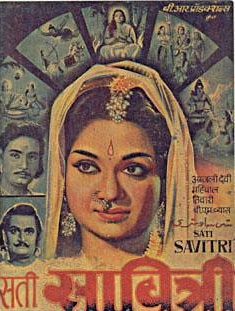
Sati Savitri

Sati Savitri (1964) portrays a Hindu myth about a wife’s unconditional devotion to her husband.

Today, we present the lyrics and English translation to a beautiful duet from Sati Savitri (1964): tum gagan ke cha.ndramaa ho. Directed by Shantilal Soni, Sati Savitri is a forgotten film in the Hindu devotional genre that narrates the love story of Savitri (played by Anjali Devi) and Satyavan (Mahipal). Savitri is celebrated in Hindu mythology as the ideal pativrata wife whose dedication to her husband allowed her to bring her husband back from Yama, the God of Death.

While the film itself has been forgotten, Laxmikant-Pyarelaal’s soundtrack for this movie is full of exquisite compositions that are still remembered today. Laxmikant and Pyarelaal had worked as assistants to the South Indian composer P. Adinarayana Rao on the music for Suvarna Sundari (1957). As the producer of Sati Savitri, P. Adinarayana Rao hired Laxmikant-Pyarelaal to compose the music for this film. In reverence of their former mentor, Laxmikant-Pyarelaal composed a classical soundtrack with several raga-based melodies. Aside from the lovely duet presented here, two stellar Lata solos from this film come to mind: jiivan Dor tumhii sang bandhii based in Yaman Kalyan and kabhii to miloge jiivan saathii based in Kalavati. 

The duet tum gagan ke cha.ndramaa ho is also rendered by Lata Mangeshkar and Manna De in raga Yaman Kalyan. In my opinion, no other playback singer renders Yaman Kalyan as gracefully as Lata does. Her prowess with this raga is matched here by Manna De, whose classical training set him apart from many of his male peers in the industry.

Apart from the beautiful melody and rendition, the lyrics of this duet are memorable for their use of chaste Hindi. Given the devotional Hindu story presented in this film, the use of Urdu poetry here would have seemed incongruous. Instead, lyricist Bharat Vyas has written a series of metaphors in pure Hindi where both Savitri and Satyavan use self-deprecating comparisons to describe themselves while using elevating comparisons to describe the other. In the mukhDaa, Savitri claims that she is the dust of the Earth whereas Satyavan is the Moon in the sky (tum gagan ke cha.ndramaa ho, mai.n dharaa kii dhuul huu.n). In response, Satyavan claims that he is merely the priest when Savitri is the prayer; he is thirst when Savitri is the nectar (tum ho puujaa mai.n pujaarii, tum sudhaa mai.n pyaas huu.n). This song certainly contains beautiful metaphors all around, but it is interesting to note that the poet decided to give the most self-deprecating line to the heroine: tum ho kaayaa mai.n huu.n chhayaa, tum kshamaa mai.n bhuul huu.n (You are the body, I am the shadow; you are forgiveness, I am the sin). Why are we not surprised?

You might have noticed that images from the film are missing from this post. Normally, when Mrs. 55 or I translate a song, we try to include images from the movie’s picturization of the song to go along with our entries. I tried searching for a long time, but I was unable to find any images or video clips of Sati Savitri on the internet (except for the film poster displayed above). If any of our readers have more information to share about this rare and forgotten film, we would love to hear about it! Until next time…

-Mr. 55

Tum Gagan Ke Chandrama Ho: Lyrics and Translation

tum gagan ke cha.ndramaa ho, mai.n dharaa kii dhuul huu.n
You are the Moon of the sky, while I am the dust of the Earth.
tum praNay ke devtaa ho, mai.n samarpit phuul huu.n
You are the God of love, while I am a devoted flower.
tum ho puujaa mai.n pujaarii, tum sudhaa mai.n pyaas huu.n
You are the prayer, I am the priest; you are nectar, I am thirst.

tum mahaasaagar kii siimaa, mai.n kinaare kii lahar
You are the boundary of the ocean, while I am a wave by the shore.
tum mahaasangiit ke svar, mai.n adhuurii saa.ns bhar
You are the notes of a profound melody, while I am an incomplete breath.
tum ho kaayaa mai.n huu.n chhayaa, tum kshamaa mai.n bhuul huu.n
You are the body, I am the shadow; you are forgiveness, I am the sin.

tum ushaa kii laalimaa ho, bhor kaa sinduur ho
You are the redness of daybreak, the vermillion of dawn.
mere praaNo.n kii ho gunjan, mere man kii mayuur ho
You are the humming of my spirit, the peacock of my mind. 
tum ho puujaa mai.n pujaarii, tum sudhaa mai.n pyaas huu.n
You are the prayer, I am the priest; you are nectar, I am thirst.

tum gagan ke chandramaa ho, mai.n dharaa kii dhuul huu.n
You are the Moon of the sky, while I am the dust of the Earth.

*Female lines in red are sung by Lata Mangeshkar. Male lines in green are sung by Manna De. 

Glossary

gagan: sky; cha.ndramaa: Moon; dharaa: Earth; praNay: love; devta: god; samarpit: devoted; pujaarii: priest; sudhaa: nectar; mahaasaagar: ocean; siimaa: boundary, border; kinaaraa: shore; lahar: wave; svar: musical note; adhuurii: incomplete; kaayaa: body; kshamaa: forgiveness; bhuul: sin, mistake; ushaa: daybreak, dawn; sinduur: vermillion; praaN: spirit; gunjan: humming; mayuur: peacock.

Goan composer Anthony Gonsalves conducts Lata Mangeshkar and Manna De on stage in Bombay (1958). Laxmikant and Pyarelaal are seated toward the right.