Teri Bindiya Re Lyrics and Translation: Let’s Learn Urdu-Hindi

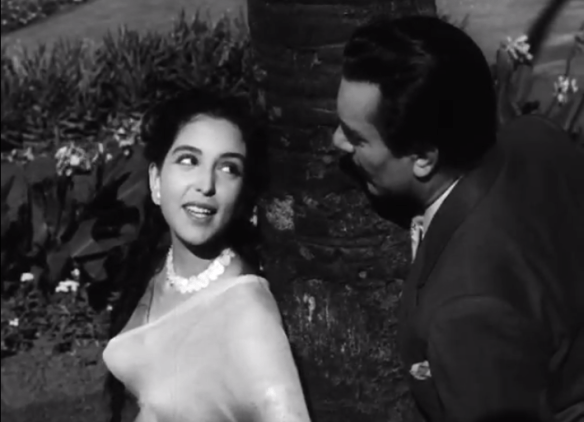
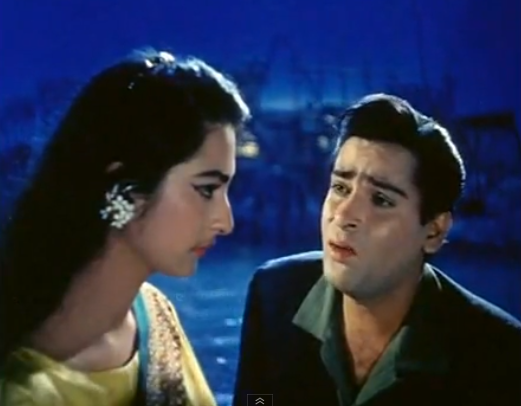
Amitabh Bacchan marries a village girl with a golden voice in Abhimaan (1973)

Today, we present the lyrics and English translation of an evergreen duet from Hrishikesh Mukherjee’s Abhimaan (1975): terii bi.ndiyaa re . Starring Amitabh Bacchan and Jaya Bhaduri, Abhimaan narrates the story of an ill-fated love between two singers that eventually approaches it breaking point when a husband’s masculine ego suffers a wound from his wife’s overwhelming professional success.

Given that this film revolves around a playback singing couple, the composition of its soundtrack naturally demanded a music director par excellence. In this case, director Hrishikesh Mukherjee chose veteran composer S.D. Burman to do the job–and what a job he did! Aside from the duet presented here, the Lata solos “nadiyaa kinaare,” “ab to hai tum se,” and “piyaa binaa,” the Kishore solo “miit na milaa re man kaa,” and the Lata-Kishore duet “tere mere milan kii yah rainaa” are still cherished by fans today. S.D. Burman’s compositions in this film won him his last Filmfare Award for Best Music Director before his death in 1975.

The duet terii bindiyaa re is sung by Lata Mangeshkar and Mohammed Rafi at a point in the film where Amitabh Bacchan introduces his newly wedded wife Jaya Bhaduri at their wedding reception. In response to a request, they sing this duet for the guests at their party. Here, Majrooh Sultanpuri’s lyrics describe the allure of a woman’s ornaments, specifically her bi.ndiyaa (beauty spot), jhumkaa (earring), and ka.nganaa (bangle).  Voiced by Lata Mangeshkar on playback, Jaya Bhaduri offers an on-screen performance that illustrates a wife’s admiration and respect for her husband. Since this song takes place before Amitabh Bacchan’s tragic descent into insecurity, he is able to reciprocate with affection and warmth.  However, after this performance, a classical musician (played by David) in the audience recognizes that Jaya is the technically superior singer and expresses concern about the couple’s future…watch the film to see how the drama unfolds!

Those of you who are more musically inclined may have noticed that this song is based in rupak taal, a 7-beat rhythmic cycle that was used far less frequently by Bollywood composers than kaharva taal (8 beats) or dadra taal  (6 beats). Interestingly, S.D. Burman has also used this unconventional rhythmic pattern skillfully in the film’s other popular duet tere mere milan kii yah rainaa

What are some of your other favorite Hindi songs that describe female ornaments? Feel free to share with us in the comments! Until next time…

– Mr. 55

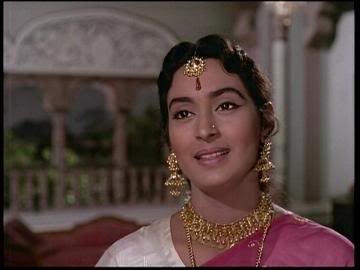
Jaya Bacchan gives a Filmfare Award-winning performance as a humble and talented singer whose success in the music industry ultimately hurts her husband’s ego.

Teri Bindiya Re: Lyrics and Translation

terii bi.ndiyaa re, re aay haay!
Your beauty spot, oh!
sajan, bi.ndiyaa le legii terii ni.ndiyaa
Oh beloved, my beauty spot will steal away your sleep.
re aay haay! terii bindiyaa re
Oh, your beauty spot!

tere maathe lage hai.n yuu.n jaise chandaa taaraa
It clings to your forehead like a star to the moon.
jiyaa me.n chamke kabhii kabhii to, jaise koii a.ngaaraa
It shines in my heart from time to time, as if it were a glowing ember.
tere maathe lage hai.n yuu.n
It clings to your forehead.
sajan, nindiyaa le legii, le legii, le legii merii bi.ndiyaa
Beloved, my beauty spot will steal away your sleep.
re aay haay! teraa jhumkaa re
Oh, your earring!
chain lene na degaa sajan tum kaa
It will not let you be at peace, beloved.
re aay haay! meraa jhumkaa re
Oh, my earring!

meraa gahnaa balam tuu, tose saj ke Doluu.n
You are my jewelry, beloved.  Adorning myself with you, I will dance.
bhaTakte hai.n tere hii nainaa, mai.n to kuchh na boluu.n
Your eyes wander, yet I say nothing at all.
meraa gahnaa balam tuu
You are my jewelry, beloved.
to phir yah kyaa bole hai, bole hai, bole hai teraa ka.nganaa?
Then, what is it that your bangle says?
re aay haay! meraa kanganaa re
Oh, my bangle!
bole re ab to chhuuTe na teraa a.nganaa
It says that it will not leave your courtyard.
re aay haay! teraa ka.nganaa re
Oh, your bangle!

tuu aayii hai sajaniyaa, jab se merii ban ke
Beloved, since you came to me and became mine,
Thuumak-Thuumak chale hai tu, merii nas-nas khanke
your strutting has made me feel a jitter in my veins.
tuu aayii hai sajaniyaa
Beloved, since you came to me.
sajan, ab to chhuuTe na, chhuuTe na, chhuuTe na, teraa anganaa
Beloved, it will not leave your courtyard.
re aay haay! teraa ka.nganaa re
Oh, your bangle!
sajan, ab to chuuTe na teraa a.nganaa
Beloved, it will not leave your courtyard.
re aay haay! teraa a.nganaa re
Oh, your courtyard!

*Female lines in red are sung by Lata Mangeshkar. Male lines in green are sung by Mohammed Rafi. 

Glossary

bindiyaa: beauty spot; nindiyaa: sleep; jiyaa: heart; chamkaanaa: to shine, glow; angaaraa: ember; jhumkaa: earring; sajan: beloved; gahnaa: jewelry; balam: beloved; tose: from you, an archaic form of ‘tujhse‘; sajnaa: to adorn; Dolnaa: to swing, dance; bhaTaknaa: to wander; nainaa: eye; kanganaa: bangle; chhuTnaa: to leave, forsake; a.nganaa: courtyard; sajaniyaa: beloved; Thumak-Thumak chalnaa: to strutter; nas-nas: veins; khanaknaa: to jitter.

In her first major non-vamp role, Bindu plays the ‘other woman’  as  a rich socialite who fawns over Amitabh Bacchan in Abhimaan (1973).
Jaane Kaise Sapnon Mein Lyrics and Translation: Let’s Learn Urdu-Hindi

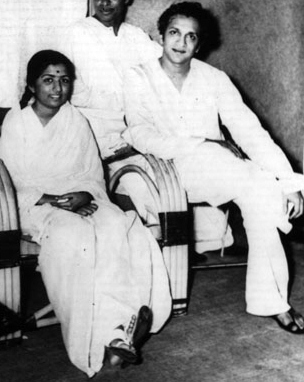
Two Bharat Ratnas come together: Pt. Ravi Shankar and Lata Mangeshkar

Today, we present a guest blog entry by one of our favorite readers Pothik Chatterjee:

“The classical sun of India has set and a darkness has come over. There is no artist who spread Indian music this rapidly across the world.”

–Lata Mangeshkar, on the passing of Ravi Shankar

Legendary Indian classical musician and composer Pandit Ravi Shankar, passed away recently on December 11, 2012 at the age of 92 near his home in Encinitas, California. Shankar, a winner of the prestigious Bharat Ratna award, was a proponent of  “world music” before the term became fashionable in the field. He is most famous in the West for his collaborations with violin virtuouso Yehudi Menuhin, minimalist composer Phillip Glass, and Beatles singer George Harrison. Shankar’s legacy is a testament to the fact that truly great music can overcome cultural barriers and achieve appreciation on a universal scale.

In 2006, I received the opportunity to hear Pandit-ji and his daughter Anoushka Shankar perform live in Washington D.C.  It was a sublime musical experience that I cherish fondly to this day. Even as a child, I have memories of watching Satyajit Ray’s film, Pather Panchali (1955)  and being moved to tears by the touching story of a Bengali family in rural India. The soundtrack that Shankar composed for Ray’s film and the entire Apu Trilogy was so powerful and emotionally stirring that it could be regarded as one of the film’s major characters in itself. Shankar also composed the soundtrack for Richard Attenborough’s Gandhi, earning him a coveted Oscar nomination.

Pt. Ravi Shankar teaches George Harrison on the sitar.

It is less well-known that that Pandit-ji also composed a handful of soundtracks in the arena of Bollywood cinema, including Anuradha (1960), Godaan (1963) and Meera (1979). As a tribute to Ravi Shankar’s contributions to Hindi film music, we provide the lyrics and English translation for jaane kaise sapno.n me.n from Anuradha (1960). Directed by Hrishikesh Mukherjee, this film is based on a short story by Sachin Bhowmick that was originally inspired by Gustave Flaubert’s novel Madame Bovary. The film tells the story of  Anuradha (played by Leela Naidu), who goes against her father’s wishes by marrying an idealistic doctor (Balraj Sahni). Anuradha sacrifices her singing career to move to the village with her husband, and the film depicts her ensuing feelings of marginalization and entrapment.

The soundtrack to this film is especially memorable for Ravi Shankar’s collaboration with Lata Mangeshkar. Lata navigates effortlessly through the difficult classical compositions of this soundtrack, matching Shankar’s musical genius every step of the way. In this particular song, Shankar crafts a pleasant melody based on raga Tilak Shyam, a hybrid creation of Pandit-ji himself that fuses the evening ragas Tilak Kamod and Shyam Kalyan. Appropriately enough, the picturization here depicts the beautiful and expressive Leela Naidu walking with Balraj Sahni through a grove of coconut trees in the evening with the sun setting behind them.  As a joyous and exuberant raga, Tilak Shyam is often performed at a fast tempo, evoking a sense of romantic delirium that is also reflected in this song’s lyrics penned by Shailendra.

Leela Naidu makes her debut as a Bollywood heroine in Anuradha (1960)

Even diehard fans of vintage Hindi cinema may not recognize the name Leela Naidu. Born to an Indian father and Irish-French mother, Naidu received an elite education in Switzerland and began her training as an actress under the renowned French director Jean Renoir. In 1954, she was named Miss India and made Vogue magazine’s top ten list of most beautiful women in the world. In 1960, Naidu made her Bollywood debut in Anuradha. However, despite her beauty and competence as an actress, she failed to achieve success in the Bollywood industry. There are some interesting parallels between Shankar and Naidu’s experiences in Hindi cinema: the Western exposure and upbringing of both artists alienated them as outsiders in some ways, and this may have prevented them from reaching their full potential in the industry. Perhaps they could only be fully appreciated by the classes, and not the masses of Bollywood fans.

On the other hand, Ravi Shankar did command immense respect from the music directors and singers in the Hindi film world. Such was his aura that when music director Ravi (of Chaudhvin ka Chand fame) entered the film industry, he happily gave up the last part of his name out of reverence. Initially, he was called Ravi Shankar but he did not want to be confused with Pandit-ji.

To conclude, I’ll leave you with an interesting tidbit of controversy about Ravi Shankar and Lata Mangeshkar that originated from their work together during the recordings for Anuradha. Because Lata had failed to show up to one of her recording sessions for the this film without prior notice, tensions flared between these two legendary artists. Years later, Ravi Shankar returned to mainstream Hindi cinema in 1979 to compose the music of Gulzar’s directorial venture Meera. In place of Bollywood’s reigning playback queen, Vani Jairam sang all the compositions on this soundtrack, and she even received a Filmfare Award for her work! Clearly, it doesn’t always pay to be a diva…

-Pothik Chatterjee (@pothik on Twitter)

Jaane Kaise Sapnon Mein: Lyrics and Translation

jaane kaise sapno.n me.n kho gayii.n a.nkhiiyaa.n?
Who knows in which dreams my eyes have become lost?
mai.n to huu.n jaagii, morii so gayii.n a.nkhiyaa.n
I am awake, yet my eyes have fallen asleep.

ajab diivaanii bhayii, mose a.njaanii bhayii
My eyes have become wondrously mad and unfamiliar to me.
pal me.n parayii dekho ho gayii.n a.nkhiiyaa.n
in a moment, my own eyes have turned into strangers.
mai.n to huu.n jaagii, morii so gayii.n a.nkhiyaa.n
I am awake, yet my eyes have gone to sleep.

barsii yah kaisii dhaaraa, kaa.npe tan-man saaraa
Such a torrent has rained upon me that my entire body and soul is quivering.
ra.ng se a.ng bhigo gayii.n a.nkhiyaa.n
Along with my body, my eyes have become soaked in color.
mai.n to huu.n jaagii, morii so gayii.n a.nkhiyaa.n
I am awake, yet my eyes have gone to sleep.

man ujiyaaraa chhaayaa, jag ujiyaaraa chhayaa
When my mind was illuminated, the world lit up.
jag-mag diip sanjo gayii.n a.nkhiyaa.n
The glimmering candles in my eyes have become enshrined.
mai.n to huu.n jaagii, morii so gayii.n a.nkhiyaa.n
I am awake, yet my eyes have gone to sleep.

koii man bhaa gayaa, jaaduu vah chalaa gayaa
Someone has pleased my mind; he has cast his magic upon me.
man ke do motiyaa.n piro gayii.n a.nkhiyaa.n
The two pearls of my mind have been joined together as my eyes.
mai.n to huu.n jaagii, morii so gayii.n a.nkhiyaa.n
I am awake, yet my eyes have gone to sleep.

jaane kaise sapno.n me.n kho gayii.n a.nkhiyaa.n?
Who knows in which dreams my eyes have become lost?

Glossary:

sapnaa: dream; kho jaanaa: to become lost; a.nkhiiyaa.n: eyes; morii: my, an archaic form of merii; jaagii: awake; so jaanaa: to go to sleep; ajab: strange, wondrous; diivaanaa: mad, crazy; mose: from/to me, an archaic form of mujhse; anjaanii: unknown, unfamiliar; paraayaa: stranger, foreign; barasnaa: to rain; dhaaraa: torrent, tide; kaa.npnaa: to quiver; tan-man: body and soul; a.ng: body; bhigo jaanaa: to become soaked; ujiyaaraa chhanaa: to be illuminated, to light up; jag-mag: glimmering; diip: candle; sanjo jaanaa: to become enshrined; man bhaanaa: to please the mind; jaaduu chalaanaa: to cast magic; motii: pearl; piro jaanaa: to be joined together.

Leela Naidu experiences her first love with Balraj Sahni in Anuradha (1960)

Leela Naidu experiences her first love with Balraj Sahni in Anuradha (1960)

Aao Tumhein Chand Pe Le Jaaye Lyrics and Translation: Let’s Learn Urdu-Hindi

Asha

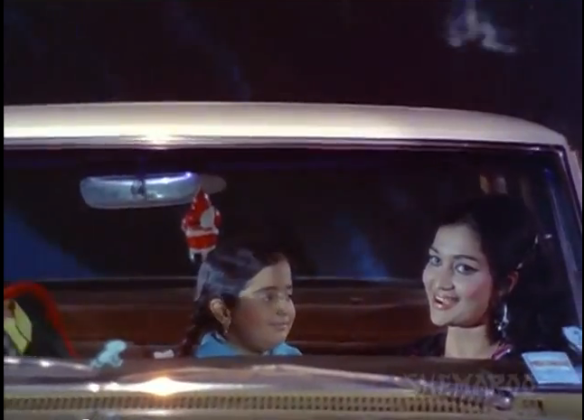
Asha Parekh sings a song for Baby Pinky on the ride back from Simla in Zakhmee (1975).  Take note of the Santa Claus figurine hanging off the rearview mirror.

Merry Christmas! Mrs. 55 and I hope that your holiday season is filled with lots of joy, laughter, and great music with your loved ones. In the spirit of the holidays, we are providing the lyrics and English translation to one of the few Christmas-themed songs that has ever graced the Bollywood silver screen: aao tumhe.n chaa.nd pe le jaaye.n from Zakhmee (1975).

Lata Mangeshkar sings for Asha Parekh and Sushma Shreshta sings for Baby Pinky in this song composed by Bappi Lahiri and penned by Gauhar Kanpuri. As is expected for a children’s anthem, the lyrics and melody in this song are nothing fancy. Here, in his debut film, Bappi Lahiri composes a catchy, pleasant tune that builds off of the classic Christmas carol “Jingle Bells.” In the introduction, we even get the rare opportunity to hear Lata Mangeshkar singing a snippet in English from the chorus of “Jingle Bells.” Her accent isn’t too distracting, so we won’t dwell on that point. Interestingly though, you might have noticed that the traditional lyrics to “Jingle Bells” have been modified to include a reference to Santa Claus.

When Baby Pinky asks where Santa Claus lives, Asha Parekh responds that he lives on the Moon and offers to take her there through this song. While I certainly can appreciate a fantasy lunar world now and again, I have to point out that the entire premise here is flawed! Santa Claus lives at the North Pole, which has nothing to do the with the Moon.  It is of slight concern to me that films back then were exposing Indian children to blatant geographical inaccuracies (outer space is not the same thing as the North Pole!) while butchering cherished holiday folklore!

Technicalities aside, we hope that watching this song will spread holiday cheer in true Bollywood style with its outrageous dream sequences, melodramatic facial close-ups, and heart-warming spirit. Enjoy, and have a very merry Christmas! Even if you wanted to go to the Moon, we hope that you received all the presents that you asked for this year. Until next time…

-Mr. 55
Asha

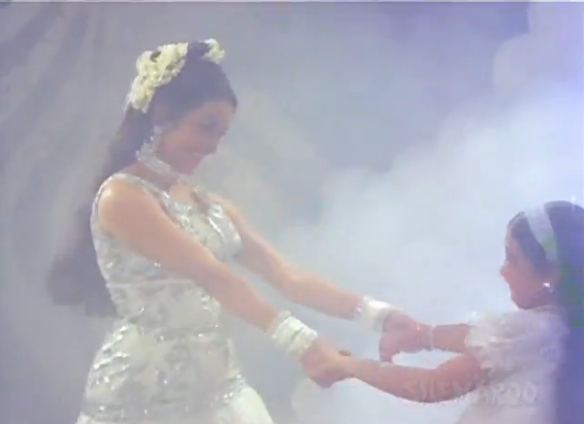
Asha Parekh and Baby Pinky dance together in a dream sequence depicting a fantasy lunar landscape.

Aao Tumhein Chand Pe Le Jaaye: Lyrics and Translation

Jingle bells, jingle bells,
jingle all the way!
Santa Claus is coming to town,
Riding on a sleigh!

Baby Pinky: Miss, Santa Claus kaa ghar kahaa.n hai?
Asha Parekh: chaan.d pe
Baby Pinky: hame.n bhii vahaa.n pe le chaliye na!
Asha Parekhacchaa?

aao tumhe.n chaa.nd pe le jaaye.n
Come, let’s take you to the Moon, 
pyaar bhare sapne sajaaye.n
and create dreams filled with love.
chhoTaa-saa ba.nglaa banaaye.n
Let’s build a small home,
ek nayii duniyaa basaaye.n
and settle a new world.

pyaar kii hai duniyaa duur aasmaa.n pe
A world of love exists in the far skies.
mil ke na bichhDe koii vahaa.n pe
No is separated after being united there.
aisii bhii ek Dagar hai, aisaa bhii ek nagar hai
There is a path to such a place.

gham jahaa.n soye aur khushi jaage
Sorrow sleeps there, while joy awakens.
aas kii hai manzil taaro.n se aage
It is a destination of hope beyond the stars.
vahaa.n dil rote nahii.n hai.n, aan.nsuu to hote nahii.n hai.n
Hearts do not cry there, for tears do not even exist.

aao tumhe.n chaa.nd pe le jaaye.n
Come, let’s take you to the Moon.

Glossary

chaa.nd: the Moon; sapne sajaanaa: to create dreams; ba.nglaa: a house in the Bengali style, a bungalow; duniyaa basaanaa to settle a world; bichhaDnaa: to be separated; Dagar: path; nagar: place, town; aas: hope; manzil: destination; aa.nsuu: tears.

Kirkland House Holiday Dinner and Dance

My blockmates and me at my last winter holiday formal at Harvard! (12.08.2012)

Five Anti-Feminist Bollywood Songs That Will Make You Cringe

Nutan Khandan 1965

Nutan literally worships the ground beneath her husband’s feet in Khandan (1965).

There is a careful line to be drawn in classic Bollywood cinema between love for a man and all-out worship. The songs below represent that unfortunate relic of Bollywood songs that transformed the excitement and bliss of romantic love into something plain unhealthy. We all know the genre I refer to. The trouble is, the songs are so good on a purely artistic level that we can’t help but keep playing them over and over again. Most of them were smash hits at the time of their release and continue to keep a significant slice of Indian audiences captivated, despite shifting social norms.

It’s easy to oversimplify this phenomena by saying, “it’s cultural” or “that was the way of thinking back then.” Yes, in India as in many countries, many women were raised to believe their ultimate role was in service to their husband and the framework for sexuality revolutionized worldwide in the 60s and 70s. But you can’t let it go at that for any similar explanation undermines the contradictory evidence within Indian history and the inherent wrong of this mindset. I don’t care if you lived in the 17th century or were born yesterday, we can’t raise our daughters like this. India is a country famous for electing the first female Prime Minister, for revering the strength and wisdom of its many awe-inspiring female gods, and where women become IT specialists and make salaries equivalent to their male counterparts. But there’s an uglier side too, and hopefully today we all feel a collective awkwardness when reminded of it in that great reflection of culture: film.

You’ll notice that all the songs on our cringe-tastic list are Lata Mangeshkar (half of them Nutan) hits, and it’s no surprise. Of course, it would be the heroine, not the bad modern girl left with an Asha side number, that would sing the song of self-flagellistic devotion. It’s a bad sign that some of these lines were thought to be representative of the “ideal” woman or wife–have we really improved anything by turning women into half-naked screens sirens instead? You decide.

Nutan just loves doing household chores and singing about her god-like husband in Saudagar (1973).

Personally, I have a violent reaction hearing some of these words come out of these actresses. Have a gander yourself and listen carefully to so-called Indian love of the 1950s and 1960s. Can you make it to the bottom of this list without squirming?

1. Tumhi Mere Mandir (Khandan 1965)

Cringe-worthy line: “Tumhi mere mandir, tumhi mere pujaa, tumhi devta ho.” (“You alone are my temple, you alone are my prayer, you alone are my God.”)

Gurrl, please stop it. This is seriously not healthy. Husbands should not take the place of God in your day-t0-day logic. How are you even functioning right now?

2. Aap Ki Nazaro.n Ne Samjha (Anpadh 1962)

Cringe-worthy lines: “Aap ki nazaro.n ne samjha pyaar ke qaabil mujhe…Keh rahi hai har nazar, banda parwar shukriya.” (“Your glances deemed me worthy of your love…every glance of mine says ‘Thank you, Lord.'”)

AAAAAAAAAAH. I’m in so much pain right now. So you’re telling me, you’re grateful that your husband “deemed you worthy” of his love? Help me. Check out our full translation if you’re in the mood for punishment!

3. Tera Mera Saath Rahe (Saudagar 1973)

Cringe-worthy line:”Tu kabhi mere khuda, mujhse bezaar na ho.” (May you never become angry with me, my revered God!)

Although this film is actually really good and takes some unexpected twists that make you love Nutan, I can’t deal with her in this song. She frolics around doing the chores with a pep in her step, just wishing and hoping that her GOD, oh wait, sorry, that man you married, will never be angry at her.

4. Hum Tere Pyaar Mei.N (Dil Ek Mandir 1963)

Cringe-worthy line: “Is tere charan kii dhuul se ham ne apnii jiivan maa.ng bharii…Ab in charano.n me.n dam nikle bas itnii aur tamannaa hai.” (“I put sindoor on my forehead from the dust at your feet…now I have but one more wish, which is to die at your feet.”)

OMG, calm down, girlfriend. You are legit scaring me. I don’t care if you’re being figurative, go take a cold shower and re-evaluate yourself!!! Our English translation of this monster is here.

5. Dheere Dheere Machal (Anupama 1966)

Cringe-worthy line: “Mujhko karne de! Karne de! Solah sringar! Koi aataa hai!” (Oh let me, let me, let me adorn myself and put on full-make up! He is coming!”)

OK I get it, we all try to look good for our man, but it’s the sheer frenzied desperation here that bothers me. Do you think your man gets that crazy to straighten his tie and brush his hair when he hears your painted toenails pattering on the ground in approach??

So how’d you do? Survived? Well done! Sorry about my rant, I just prefer a little equality in a relationship. For a rebuttal (and there are plenty to choose from), be sure to read our post on Mukesh’s “Koi Jab Tumhara Hriday” just in case you were afraid it was only women who knew how to grovel. Did we miss any cringe-worthy gems that always rankle your bones? Let us know in the comments!
-Mrs. 55

Ehsaan Tera Hoga Mujhpar Lyrics and Translation: Let’s Learn Urdu-Hindi

Shammi Kapoor’s wistful gaze wins over hearts as he pines about unconditional love in Junglee (1961)

Our next translation is a truly special song from Subodh Mukherjee’s Junglee (1961): ahsaan teraa hogaa mujh par. Junglee stars Saira Banu in her debut role as a stunning Kashmiri beauty who wins over a stoic, arrogant businessman played by Shammi Kapoor. This film was instrumental in launching Saira Banu’s career as a heroine and solidifying Shammi Kapoor’s image as a charming loverboy. As an aside, this film is also noteworthy because it ushered in an era of producing mainstream Bollywood films in Eastman color!

Composed by Shankar-Jaikishan and penned by Hasrat Jaipuri, this song ranks among my all-time favorites rendered by the inimitable Mohammed Rafi. This touching melody rooted in raga Yaman Kalyan with heartfelt words expressing the beautiful struggles of unconditional love is perfectly suited for Mohammed Rafi’s delicate, velvety vocals.  Shammi Kapoor’s on-screen portrayal–especially that sensual look in his eyes–adds to Rafi’s romantic rendition.

Lata Mangeshkar has done an apt job performing a second shorter “sad” version of this song in film. Yet it somehow lacks the magic and sensual ease of Rafi’s rendition, and this might be attributed to Shankar-Jakishan’s decision to have Lata sing this song in the same “male scale” as Rafi. For more on this phenomenon, please see our previous post on the role of the soprano voice in Hindi film music here.

Please enjoy this veritable gem of Hindi film music by reading the lyrics and our English translation provided below! Until next time…

-Mr. 55

16-year-old Saira Banu makes a stunning debut alongside Shammi Kapoor in Junglee (1961)

Ehsaan Tera Hoga Mujhpar: Lyrics and Translation

ahsaan teraa hogaa mujh par
You would be granting me a favor 
dil chahtaa hai vah kahne do
if you permit me to reveal my heart’s desires. 
mujhe tum se muhabbat ho gayii hai
I have fallen in love with you. 
mujhe palko.n kii chaa.nv me.n rahne do
Please let me dwell in the shadows of your eyelashes.

tum ne mujhko ha.nsnaa sikhayaa
You taught me how to smile,
rone kahoge ro le.nge ab
yet I would cry now upon your request.
aa.nsuu kaa hamaare gham na karo
Please do not mourn for my tears.
ve bahte hai.n to bahne do
They have started to flow, so let them fall.
mujhe tum se muhabbat ho gayii hai
I have fallen in love with you.
mujhe palko.n ki chaa.nv me.n rahne do
Please let me dwell in the shadows of your eyelashes.

chaahe banaa do chaahe miTaa do
Whether you build me up or destroy me, 
mar bhii gaye to de.nge duaaye.n
I will give you my blessings even if I die. 
uD uD ke kahegii khaak sanam
Oh beloved, as they fly in the air, my ashes will say:
yah dard-e-muhabbat sahne do
“Let us bear the burden of this pain in love.”
mujhe tum se muhabbat ho gayii haii
I have fallen in love with you.
mujhe palko.n kii chaa.nv me.n rahne do
Please let me dwell in the shadows of your eyelashes.

ahsaan teraa hogaa mujh par
You would be granting me a favor. 

Glossary

ahsaan: favor; muhabbat: love; palke.n: eyelids, eyelashes; aa.nsuu: tears; gham karnaa: to mourn; bahnaa: to flow; miTaa denaa: to destroy; duaaye.n: blessings; uDnaa: to fly; khaak: ashes; sanam: beloved; dard-e-muhabbat: pain in love; sahnaa: to endure, tolerate.

Junglee (1961) showcases the beauty of the Kashmiri countryside.