Na Tum Humen Jano Lyrics and Translation: Let’s Learn Urdu-Hindi

Na Tum Humen Jano Dev Anand

With glistening suavity dripping from his pomade, Dev Anand croons the love ballad “Na Tum Humen Jano” to a sleeping Waheeda Rehman in Baat Ek Raat Ki (1962).

Today we showcase the lyrics and English translation of the haunting melody “Na Tum Humen Jano” from Baat Ek Raat Ki (1962). Dapper Dev Anand plays a young lawyer whose enigmatic client, Waheeda Rehman, has been convicted of murdering her ex-lover in a fit of rage. Deemed clinically depressed and mentally unhinged, Waheeda’s only chance at redemption, in classic Bollywood tradition, is the stable love of a good man. Dev Anand rises quickly to the occasion, “pretending” to woo her for..ahem…medical reasons–and more importantly to extract the true events leading up to the murder for which she is convicted. I think it comes as no surprise that she ultimately proves innocent and Dev Anand actually falls in love with her while faking it. But that’s not what makes this film’s twist ending so fantastic–and trust me, it’s not what you’d expect!
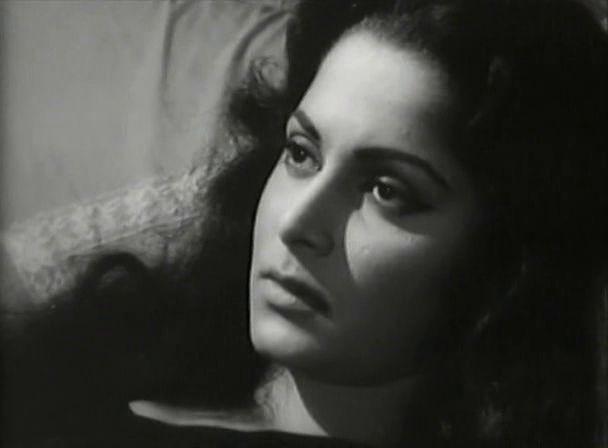
Waheeda Rehman Na Tum Humen Jano

Waheeda Rehman is awakened by the sound of a haunting melody in Baat Ek Raat Ki (1962). Did anyone mention that black is totally your color, Waheeda?

So how does this gem of a Hemant Kumar solo fit into the bizarre whoddunit? I’ve always found Hemant Kumar an intriguing rogue in the strict actor-singer pairings of classic films–the mysterious dark chocolate mousse of Bollywood playback. His tender yet overwhelmingly manly voice stood out among the Rafi wannabes of the age–the celestial way his voice resonates in the opening lines is a rich treat for the soul. Famed music director Salil Chowdhury said of the singer’s voice,

“If God could sing, he would have a voice like Hemanta.”

Have truer words ever been spoken? No better testament exists than the love song “Na Tum Humen Jano.” In Baat Ek Raat Ki, “Na Tum Humen Jano” plays on a gramophone record in the moments leading up to the murder. Waheeda Rehman is so traumatized afterwards, she cannot recall details of the event or her exact involvement. Naturally, Dev Anand believes that singing the song while she sleeps will subconsciously trigger her memory, thereby providing him the missing evidence of what  transpired that fatal night. He croons to her hidden in the background, observing her reaction as the melody wafts through the air. What follows is one of the most nostalgic songs of yesteryear.

We hope you love the lyrics and English translation to “Na Tum Humen Jano” as much as us! Follow along with the video and try to keep your beating heart in check as you get swept away in the romance!

Na Tum Humen Jano Lyrics and Translation:

Na tum hame.N jaano, na hum tumhe.N jaane
You do not know me, I do not know you
Magar lagtaa hai kuch aisaa meraa humdum mil gayaaa
Yet somehow I feel as if I have found my soul mate

Yeh mausam yeh raat chhup hai
These surroundings and this night are quiet
Woh honTo.N kii baat chhup hai
Those words on our lips are quiet
Khamoshii sunaanii lagii hai dastaa.N
The silence has begun to tell a story
Nazar ban gayii hai dil kii zubaa.N
Our glances have become the language of our hearts

Mohabbat ke moD pe hum
At the crossing of love
Mile sab ko chhoDke hum
We met and left everything behind
DhaDakhte dilo.N ka leke yeh caravaa.N
We took our beating hearts with us on this caravan
Chale aaj dono.N jaane kahaa.N
Let us go together today, I know not where

Na tum hame.N jaano, na hum tumhe.N jaane.N
You do not know me, I do not know you
Magar lagtaa hai kuch aisaa meraa humdum mil gayaaa
Yet somehow I feel as if I have found my soul mate

Glossary:

humdum: soulmate; mausam: atmosphere, surroundings; raat: night: chhup: quiet; honT: lips; baat: words; khamoshii: silence; sunaanaa: to tell; daastaa.N: tale, story; nazar: glance; zubaa.N: language; mohabbat: love; moD: crossing, turn; sab: everything; dhaDakhnaa: to beat [heart]; aaj: today
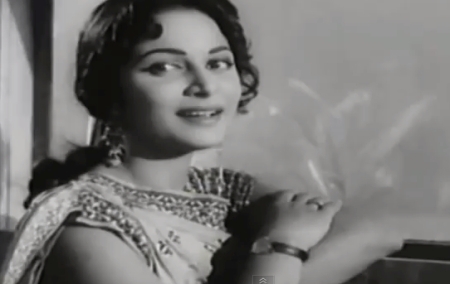
Waheeda Rehman Baat ek raat ki na tum humen jano

Prior to murder charges, the lovely Waheeda Rehman sings merrily along to a record of “Na Tum Humen Jano” in Baat Ek Raat Ki (1962).

Now before anyone comments on how angelic Lata’s solo moment is halfway through the song, don’t be fooled! That voice of a goddess is none other than rival soprano Suman Kalyanpur! Her highest high note in the cameo moment is an E5, which doesn’t even come close to Asha and Lata’s famous trills. Composed by S.D. Burman, the song is fully picturized as a happy female solo earlier in the film here! Was Suman Kalyanpur’s solo able to compete with the magic of the famous Hemant counterpart? I think it was certainly a valiant effort, but…let’s not lie to ourselves.

Our English translation of “Na Tum Humen Jano” was requested by diehard fangirl Reena! Stay classy, Reena.

– Mrs. 55
Teer-e Nazar Dekhenge Lyrics and Translation: Let’s Learn Urdu-Hindi

Teer-e-nazar 1

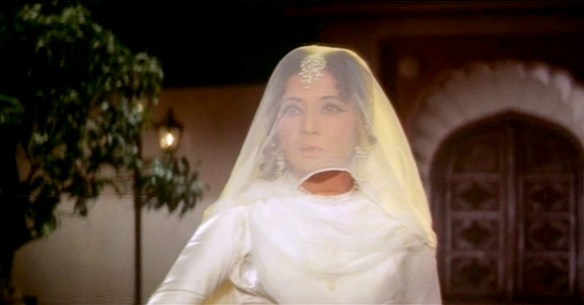
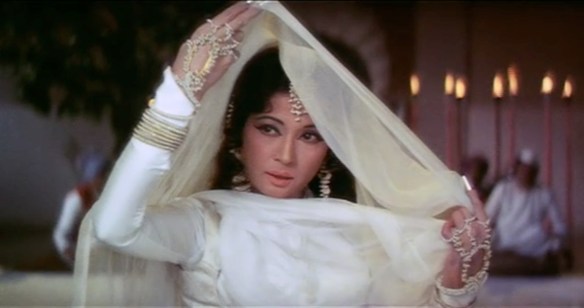
Bedecked in a white gown symbolic of her own death, Pakeezah dances at the celebration of her lover’s marriage to another woman in Pakeezah (1971).

We now showcase the lyrics and English translation to Lata Mangeshkar’s “Teer-e Nazar” from the cinematic jewel Pakeezah (1971). One of classic Bollywood’s most iconic and daring song sequences, “Teer-e Nazar” dazzles the audience by the audacity of its stunning visual fabric–the magnum opus of the industry’s greatest artists with a story worthy of their union. In an ironic twist, the film’s heroine Pakeezah is asked to perform a mujraa at the wedding of her lover to another woman. Throughout the striking song that follows, director Kamal Amrohi deliberately transforms our understanding of beauty and love into omens of murder and death.

Lyricist Kaif Bhopali’s title phrase “teer-e nazar,” while otherwise a romantic reference to a lover’s piercing gaze, assumes a sinister implication, a literal means of wounding its target. Pakeezah once more dances a graceful kathak dance, but this time she is dressed for a funeral in all-white. The death she celebrates is her own. Her beautiful dance suddenly re-invents itself when she purposefully smashes a glass chandelier across the pristine white floor. The moment is one of the most shocking in Bollywood history, with a dramatic shift in the room’s dynamics to accompany the jarring musical screech. Before this moment, Pakeezah was a mere witness to the injustice of her society’s prejudices. Now, Pakeezah wields a commanding power, entrancing a captive audience to which she willingly presents herself as a ritual sacrifice in the name of her own unfulfilled love.

Teer-e-nazar 4

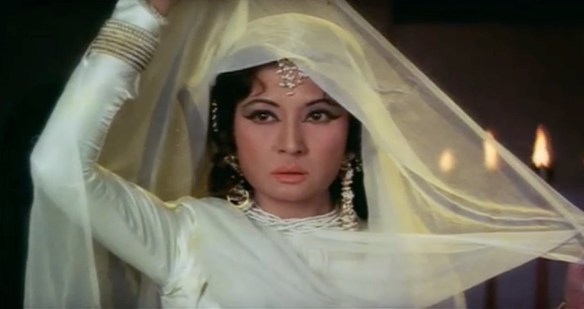
Like a veiled Lady of Shallot, the effervescent Meena Kumari as Pakeezah realizes the show is coming to an end tonight.

Unleashing a passion she had been trained for so long to suppress, Pakeezah dances upon the jagged broken glass with a frenzied energy. Her blood, the bright red of wedding bliss she has been denied, stains the floor with every footstep. As evidenced by the film’s famous dialogue, feet play an important sensual role in Pakeezah. The blood-smeared feet ironically mirror the once dainty red foot paint of a dancer–the vehicle by which Rajkumar first fell in love with Pakeezah in a train compartment, begging her romantically to never allow them to touch the ground. With each step, Pakeezah regains her identity by destroying the constraints of her past.

Director Kamal Amrohi brilliantly shapes the scene through a chaotic editing pattern as fragmented and disturbing as the glass upon which she dances. Below is a short gallery of some of the many gorgeous shots that compose this scene, each more violent than the next.

This iconic song is among Bollywood’s greatest cinematic moments–made even more fascinating by the behind-the-scenes gossip between Meena Kumari and stunt double Padma Khanna who actually dances in this sequence! Follow along with the video, and we hope you enjoy our lyrics and English translation to the awe-inducing “Teer-e Nazar” from Pakeezah (1971) below!

Teer-e Nazar Dekhenge Lyrics and Translation:

Aaj hum apnii du’aao.n kaa asar dekhe.Nge
Today I shall behold the image of my prayers
Teer-e nazar dekhe.Nge, zakhm-e jigar dekhe.Nge
I shall see arrows from your glances, I shall see the wounds of my heart

Aap to aa.Nkh milaate hue sharmaate hai.N
Upon meeting my eyes, you feel embarrassed
Aap to dil ke dhaDakne se bhi Dar jaate hai.N
You are even afraid of your own heartbeat
Phir bhi yeh zidd hai ki ham zakhm-e jigar dekhe.Nge
Nonetheless I remain stubborn to witness the wounds of my heart
Teer-e nazar dekhe.Nge, zakhm-e jigar dekhe.Nge
I shall see arrows from your glances, I shall see the wounds of my heart

Pyaar karna dil-e betaab buraa hotaa hai
It is unfortunate for a weak heart to fall in love
Sunte aaye hai ki yeh khwaab buraa hota hai
I have heard that this dream of mine is also cursed
Aaj is khwaab ke taabiir magar dekhe.Nge
But today I will interpret the meaning of that dream
Teer-e nazar dekhe.Nge, zakhm-e jigar dekhe.Nge
I shall see arrows from your glances, I shall see the wounds of my heart

Jaan levaa hai mohabbat ka samaa aaj ki raat
Tonight this atmosphere of love feels fatal
Shamaa ho jaayegii jal jal ke dhuaa.N aaj ki raat
Tonight the lamps shall burn into smoke
Aaj ki raat bache.Nge to sahar dekhe.Nge
If I escape tonight, then I shall see the dawn
Teer-e nazar dekhe.Nge, zakhm-e jigar dekhe.Nge
I shall see arrows from your glances, I shall see the wounds of my heart

Aaj hum apnii du’aao.n kaa asar dekhe.Nge
Today I shall behold the image of my prayers
Teer-e nazar dekhe.Nge, zakhm-e jigar dekhe.Nge
I shall see arrows from your glances, I shall see the wounds of my heart

Glossary:

du’aa: prayer; asar: sign, image; teer: arrow; nazar: glance; zakhm: wound; jigar: heart; aankh milaanaa: to make eye contact; sharmaanaa: to become embarrassed, to be shy; dhaDaknaa: to beat [heart]; Dar jaanaa: to become afraid; zidd: stubborness, firm; betaab: weak; buraa: bad, unfortunate; khwaab ke taabir: interpretation of a dream; jaan levaa: fatal; mohabbat: love; samaa: atmosphere; shamaa: lamp; dhuaa.N: smoke; sahar: dawn

teer-e-nazar 2

Oh, Meena Kumari, will there ever live a woman so breathtakingly classy again?

This fantastic Pakeezah hit was requested by fans VintageBollywood and Moosa Desai! Thank you for the epic request!

Arguably, Pakeezah’s wild dance following the chandelier shattering contains the most thrilling music (composed by the great Ghulam Mohammed) in the entire film. But there’s a big unsolved mystery here. Does the ambiguity of the diegetic soundscape in this sequence bother anyone else but me? Think about it: If Pakeezah had just smashed a chandelier to the ground, ruffling the entire audience, and then starts bleeding all over the party floor, is it likely that the band would carry on as usual? But on the other hand, if the music is, in fact, non-diegetic, what are the odds her dance movements are still so perfectly coordinated to the beat? Is she in theory really dancing like a maniac to a silent room while the furious strings Kamal Amrohi added are for the film viewers’ ears alone? This is going to keep me awake at night.

For lighter moments from the iconic film, check out our translations of Pakeezah‘s immortal Chalte Chalte, Mausam Hai Aashiqaana, and Inhi Logo.N Ne!

-Mrs. 55

Ab Kya Misal Doon Lyrics and Translation: Let’s Learn Urdu-Hindi

Pradeep Kumar Aarti 1962

Pradeep Kumar sings an Urdu love poem to Meena Kumari in Aarti (1962)

The next English translation in our series is of the poetic lyrics to “Ab Kya Misal Doon” from Aarti (1962). This timeless song is one of Bollywood’s most beloved romantic odes by Mohammed Rafi. Pradeep Kumar, Meena Kumari, and Ashok Kumar star in Aarti, a family drama of love, debts, and vengeance. Ashok Kumar plays a wealthy surgeon and the villain of the film, vowing revenge when his betrothed, Meena Kumari, marries another man, Pradeep Kumar. An exacting dilemma of the film comes when ironically Ashok Kumar must decide whether or not to push aside his emotional battles and perform surgery on his own rival Pradeep Kumar to save his life. Of course, Meena Kumari throws in some more drama into the bargain–and her quiet beauty steals the show yet again. Aarti has a number of great songs written by Majrooh Sultanpuri, but unarguably the greatest is the sweet Mohammed Rafi ballad “Ab Kya Misal Doon.”

Pradeep Kumar plays “the other man” in the film–a good-hearted, but unemployed poetic dreamer who croons softly to Meena Kumari in this number. It would put any girl in a tough position: the poetry of the song is exquisite, without overwhelming anyone with an Urdu vocabulary exam. It has just the right blend of tenderness, lyricism, and adoration made magical by the unequivocal talent of Mohammed Rafi. Follow along on youtube here and enjoy our English translation of this poetic masterpiece!

Meena Kumari in Aarti 1962

Meena Kumari blushes as she hears Pradeep Kumar singing her praises in Aarti (1962)

Ab Kya Misal Doon: Lyrics and Translation

Ab kyaa misaal doon mei.N tumhaare shabaab ki
What can I now compare to your lustre?
Insaan ban gayee hai kiran mahtaab kii
You are a ray of the moon in human form

Chehre mei.N ghul gayaa hai haseen chaandni ka noor
The beautiful light of the moon has melted upon your face
Aankho.N mei.N hai chaman ki jawaan raat ka suroor
In your eyes is the garden of the early night’s joy
Gardan hai ek jhuki hui daali gulab kii
Your neck is like a lowered branch of a rose flower
Ab kyaa misaal doon…
What can I compare now…

Gesu khule to shaam ke dil se dhuan uThe
When your hair was let open, then the smokiness of night emerged from my heart
Chhule qadam to jhuk ke na phir aasmaan uThe
When your feet hit the ground, the sky bowed down would not raise itself again
Sau baar jhilmilaaye shamaa aftaab kii
The light of this sun sparkled a hundred times
Ab kyaa misaal doon…
What can I compare now…

Deewar-o-dar kaa rang, yeh aanchal, yeh pairhan
The end of your saarii and your robes are the colours of my refuge
Ghar kaa mere chiraagh hai boota sa yeh badan
The lamp of my house is this slender plant-like body
Tasveer ho tumhii mere jannat ke khwaab kii
You are the image of the paradise of my dreams
Ab kyaa misaal doon…
What can I compare now…

Glossary:

misaal: example, comparison; shabaab: glory, lustre; insaan: human; kiran: ray, mahtaab: moon; chehra: face; noor: light; chaman: garden; suruur: joy, exhilaration; gardan: neck; daalii: branch; gulaab: rose flower; gesuu: hair; dhuaan: smoke; qadam: footsteps; aasmaan: sky; sau baar: a hundred times; jhilmilaanaa: to sparkle, to shine; aftaab: sun; deewar-o-dar: walls and doors, refuge; rang: colour; aanchal: the end draping of a saarii; pairhan: robe; ghar: house; chiraagh: light; boota: small plant; badan: body; tasveer: image, picture; jannat: paradise; khwaab: dream

Meena Kumari filmfare awards 1962

Meena Kumari poses with Ashok Kumar and actress Shashikala at the 1962 Filmfare Awards.

Did you know in 1962, Meena Kumari was the only nominee at the Filmfare Awards for Best Actress? She was nominated for Aarti, Sahib Bibi Aur Ghulam, Main Chhup Rahuungi. Talk about a walk-over. She took it home for Sahib Bibi Aur Ghulam (1962).

-Mrs. 55

Nigahein Milane Ko Jee Chahta Hai Lyrics and Translation: Let’s Learn Urdu-Hindi

Who wouldn’t want to exchange glances with those eyes?

For today’s post, we showcase the lyrics and English translation of “Nigahen Milane To” from the film Dil Hi To Hai (1963). If I had to name my favorite actress from the Golden Era of Bollywood cinema, I think that I would pick Nutan.

As one of the beloved goddesses of India’s silver screen, Nutan starred in many evergreen films from the 1950s and 1960s, including Paying Guest (1957), Anari (1959), Bandini (1963), and Milan (1967), just to name a few. In my opinion, there’s something special about Nutan’s performances that sets her apart from her peers. She played her roles with a dignified beauty, a restrained grace, and an acute intelligence that was difficult to find in other actresses of the time. Here, I’ve chosen to translate a song from Dil Hi To Hai (1963), a charming Bollywood romance that is enjoyable to watch even though it is one of Nutan’s lesser-known films.

Nutan stars in Dil Hi To Hai as Jamila, the beautiful daughter of a wealthy London-based banker. Here, Raj Kapoor departs from the image established in his previous films by playing a comic double role as Jamila’s love interest Chand and Jamila’s aged music teacher Khan Sahab. While the film features some memorable performances by Nutan and Raj Kapoor, this film is probably even more memorable today for its soundtrack composed by music director Roshan. Two gems from this soundtrack have survived the test of time. The first is the Bhairavi-based classical number “laagaa chunarii me.n daag,” which is regarded as one of the best songs of Manna De’s career. The other gem is Asha Bhonsle’s exquisitely rendered Yaman qawwalinigaahe.n milaane ko jii chahtaa hai,” which I have translated here.

Penned by Sahir Ludhianvi, this qawwali centers around a woman’s desire to exchange glances with her beloved. The romanticization of eyes and sight is a common theme found in Bollywood films, and the poetry in this song is one of this era’s most cherished portrayals of this theme. The song’s charm is enhanced by the use of Urdu vocabulary (e.g. tahumat and tamhiid) and Asha Bhonsle’s immaculate rendition. Don’t you just love the way she owns those octave glides during the sargam passage?

Mrs. 55 and I actually performed this qawwali at Harvard during the annual South Asian cultural show Ghungroo two years ago. One thing that we noticed after listening carefully to these lyrics during rehearsal is that there is some ambiguity in gender. While most of the song appears to be from a female perspective, we thought that lyrics take on a masculine role for the line starting with “jab kabhii mai.ne teraa chaand-saa chahraa dekhaa…” (Whenever my eyes have fallen upon your moon-like face…). In addition to the fact that the moon is traditionally used by males to describe feminine beauty (e.g. Mohammed Rafi’s “yeh chaa.nd-saa roshan chahraa“), Nutan’s gestures and body language become more masculine in nature in this segment of the song. In fact, as she sings these two lines, Nutan begins to walk with a manly gait and and then flirts with a female friend as if she is her male lover. We may have totally made this up in our heads, but it was not uncommon for such gender-bending to occur in Bollywood songs–a full post on this trend will be coming up soon! In any case, please enjoy this timeless qawwali while following along with our translation/glossary provided below, and remember to send us your requests for any other songs that you would like translated.

-Mr. 55

Nutan takes on the masculine role for a few lines in this qawwali

Nigahein Milane Ko Jee Chahta Hai Lyrics and Translation

raaz kii baat hai, mahfil me.n kahe yaa na kahe?
It is a secret matter; shall I share it in this gathering?
bas gayaa hai koii is dil me.n, kahe yaa na kahe?
Someone has begun to reside in my heart; shall I reveal this here?

nigaahe.n milaane ko jii chahtaa hai
I yearn to exchange glances with my beloved. 
dil-o-jaa.n luTaane ko jii chahtaa hai
I yearn to give away my heart and soul to him.  

woh tahumat jise “ishq” kahtii hai duniyaa
The allegation that the world calls “love,”
woh tahumat uThaane ko jii chahtaa hai
I yearn to accept that allegation.  

kisii ke manaane me.n lazzat woh paayi
Although I have experienced the pleasure of being appeased,   
ki phir ruuTh jaane ko jii chahtaa hai
I yearn to once again engage in a lovers’ tiff. 
 
woh jalvaa jo ojhal bhii hai saamne bhii
The splendor that vanishes and reappears in love, 
woh jalvaa churaane ko jii chahta hai
I yearn to steal that splendor.  
 
jis ghaDii merii nigaaho.n ko terii diid huii
The moment when our eyes first met,  
woh ghaDii mere liye aish kii tamhiid huii
That moment served as a prelude to happiness for me.  
jab kabhii mai.ne teraa chaa.nd-saa chahraa dekhaa.
Whenever my eyes have fallen upon your moon-like face, 
Eid ho ya ki na ho mere liye Eid huii
it is as if I am celebrating the holiday of Eid.  

ni re ga, ga re ga ni re ma, ma ga ma ni re ga
ga re ga ni ga re, re ga, ga ma, ma dha ni
sa sa ni ni dha dha pa pa ga re
sa ni dha pa ma ga re,
ni dha pa ma ga re sa ni, re ga 

mulaaqaat
kaa koii paighaam diije
Please send me a message about our next rendez-vous, 
ki chhup-chhup ke aane ko jii chahtaa hai
Because I yearn to visit you secretly, 
aur aake na jaane ko jii chahtaa hai
And upon visiting you, I hope to never leave.  

nigaahe.n milaane ko jii chahtaa hai
I yearn to exchange glances with my beloved. 


Glossary

raaz: secret; mahfil: gathering; nigaahe.n: eyes; dil-o-jaan: heart and soul; tahumat: allegation; manaanaa: to appease; lazzat: pleasure; jalvaa: splendor,charm; ojhal: vanished; diid: sighting, gaze; aish: joy, happiness; tamhiid: prelude, preamble; Eid: Islamic festival celebrating the end of Ramadan; mulaaqaat: meeting, rendez-vous; chhup-chhup ke: secretly; paighaam: message.

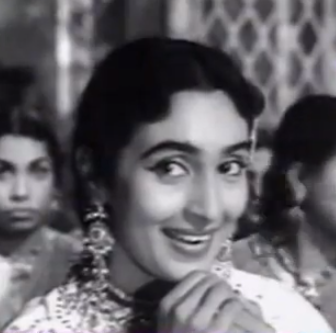
Nutan leads the chorus with an enchanting smile in Dil Hi To Hai (1963)

Bekhudi Mein Sanam Lyrics and Translation: Let’s Learn Urdu-Hindi

Babita Haseena Maan Jaayegi

Whoa there, Babita. Are you sure a Santa hat is appropriate for this occasion?

Our next Hindi lyric translation is the classic Rafi-Lata duet “Bekhudi Mein Sanam” from the film Haseena Maan Jaayegi (1968). The movie soundtrack is probably the only reason you would ever want to watch this film. Sure, the plot description is intriguing: two men (who happen to both be Shashi Kapoor) fall in love with the same woman (the unbearable Babita). One Shashi Kapoor is soft-spoken and romantic, while the other is an aggressive jokester who is spurned by our heroine. But then! War with China! Both men are called to duty, and when only one returns, Babita can’t tell if he is truly the man she loves–or his rival!

So you’re lured in, egged on by a few other vaguely recognizable Rafi numbers (“O Dilbar Janiye,” anyone?), and think you’re getting yourself in for a long Hum Dono-esque genre twin film with a swinger bent.

Oh, but how wrong you’d be.

Babita and Shashi haseena maan jaayegi

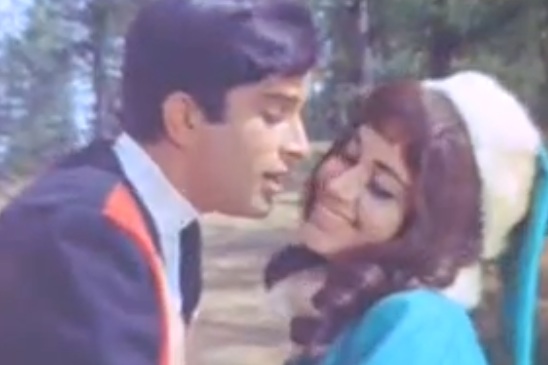
Shashi Kapoor and Babita play two college students in love in Haseena Maan Jaayegi (1968).

Haseena Maan Jaayegi is a painful free-falling bucket of awkward sauce that is weighed down by Babita’s insufferably thick voice, static characters, and an unfocused plot that never quite pulls together it’s obvious loose ends. I mean, seriously Babita? We need to spend two hours watching you try to decide if there is nothing unique about the man you married? Furthermore, what the heck, Shashi? Couldn’t you have convinced the scriptwriter to at least throw in just one line explaining why you guys look so similar? At least turn out to legitimately be twins separated at birth! There’s no way God would just magically make two Shashi Kapoors in this world. A lot of Indian women would be a lot happier if so.

Shashi Kapoor is entranced by Babita’a teal Santa suit from “Bekhudi Mein Sanam.”

Really, nothing gets my goat more than a twin movie that doesn’t acknowledge that they’re supposed to actually be twins. Do yourself a favor by skipping this cheese-flavored package of dry histrionics, and just youtube the songs because they’re awesome. Of particular note in “Bekhudi Mei.N Sanam” is Babita’s puffy white fur Santa hat and teal blue jumpsuit. This is just in case any audience member had lost their mind and started to make the mistake of taking her seriously. Check out the youtube link for the song here and follow along with the lyrics and translation below to this this otherwise beautiful ode of love!

Bekhudi Mein Sanam Lyrics and Translation

Bekhudi mei.N sanam, uTh gaye jo qadam
Unaware of my self, as I started walking
Aa gaye, aa gaye
I arrived
Aa gaye paas hum, aa gaye paas hum
I arrived nearer to you

Aag yeh kaisii man mei.N lagii hai?
What kind of fire is aflame in my mind?
Man se badhii to tan mei.N lagii hai
Yet, even bigger than that in the mind, is the one burning my body
Aag nahii.N yeh dil ki lagii hai
This is not a fire, its the heart’s desire
Jitnii bujhaayii, utnii jalii hai
However much you try to put it out, it will keep burning

Dil ki lagi na ho to, kya zindagii hai?
Without this desire of the heart, what is life?
Saath hum jo chale miT gaye faasle
When we walk together, all that separates us disappears
Aa gaye, aa gaye
I arrived
Aa gaye paas hum, aa gaye paas hum
I arrived nearer to you

Khoyii nazar thii, soye nazaare
The vision was lost, and the sights were asleep
Dekhaa tumhe to jaage yeh saare
On seeing you, all of them were awakened
Dil ne kiye jo dil ko ishaare
As one heart signaled to the other
Milke chale hum saath tumhaare
We met and walked together

Aaj khushii se meraa dil yeh pukaare
Today my heart calls out with joy
Teraa daaman milaa, pyaar meraa khilaa
In finding your embrace, my love has blossomed
Aa gaye, aa gaye
I arrived
Aa gaye paas hum, aa gaye paas hum
I arrived nearer to you

Dil kii kahaanii pahunche zubaa.N tak
The story of my heart is on my tongue
Kisko khabar ab pahunche kahaa.N tak?
Now who knows where it will reach?
Pyaar ke raahii aaye yahaa.N tak
Travelers of love have arrived here
Jaaye.Nge dil ki had hai jahaa.N tak
They will go to the limits set by their hearts

Tum paas jo to chale hum aasmaan tak
With you at my side, we will reach the sky
Dil mein armaan liye laakh toofaan liye
With a heart full of desires and beset by storms

Aa gaye, aa gaye
I arrived
Aa gaye paas hum, aa gaye paas hum
I arrived nearer to you

Bekhudi mei.N sanam, uTh gaye jo qadam
Unaware of my self, as I started walking
Aa gaye, aa gaye
I arrived
Aa gaye paas hum, aa gaye paas hum
I arrived nearer to you

Glossary:

bekhudi: unaware of oneself, in a trance; qadam: footsteps; aag: fire; man: mind; tan: body; faasle: separation, distance; ishaaraa: signal; daaman: embrace; zubaa.N: tongue, language; khabar: news, knowledge; had: limit; aasmaan: sky; armaan: desire; toofaan: storm

I can’t really explain it, but I’ve always really liked with the way Shashi Kapoor starts his first line walking forward toward her with his hands folded behind his back. It’s bashful, the way Indian men in love were meant to be.

Shashi Kapoor Twins Haseena Maan Jaayegi

I know, I know. It’s almost irresistible–TWO Shashi Kapoors on ONE screen! Look at that handsome cricket jacket, those form-fitting white pants. But restrain, my friends. Haseena Maan Jaayegi will suck out your Shashi-gushing capacities and infect you instead with confusion and hatred of Babita.

This song translation was done by request from our reader “Beloved”! We hope you enjoyed, and if you’d like to see your name on our blog, send us an email with your burning Bollywood request or leave us a comment on our “Requests” page!

– Mrs. 55