Tum Pukar Lo Lyrics and Translation: Let’s Learn Urdu-Hindi

Waheeda Rehman Tum Pukar Lo

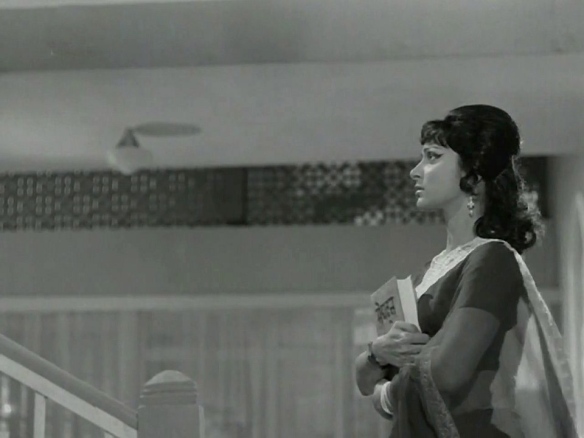
Waheeda Rehman hesitates at the bottom of a staircase leading to the man she loves in Khamoshi (1968).

For our next post we present the full lyrics and translation to the hauntingly beautiful “Tum Pukar Lo” from Khamoshi (1968). This song easily makes my list of most powerful and stirring picturizations from Bollywood. The stark black-and-white imagery highlights the emptiness of space, of shadows, and symbolic barriers. Most of all, the graceful shots that linger longer than action alone permits serve to create a new environment–a world of waiting where time slows down and the confines of the hospital become both escapist and imprisoning. I loved and still love the opening dolly shot so much that I attempted to recreate it in my final film project junior year of Harvard. The shot is transformative–literally taking the audience from behind bars to the free world, and Waheeda from the restraint of her conscience to the new life that beckons her above the staircase. A gentle wind miraculously flows down from Dharmendra’s balcony, through the barren corridor, down the grand stairs, and ultimately through Waheeda’s saari palluu giving rise to a simple, evocative image of a woman drawn by a force greater than any danger: love.

Waheeda Rehman Tum Pukar Lo Khamoshi

I LOVE the classic “frame-within-a-frame” of the mis-en-scene. Not how the lighting in this sequence informs the trajectory of the characters–recall that prior to Waheeda’s discouragement, the welcoming light source came from the balcony (now shrouded in obscurity), indicating a change in both destination and mindset.

I’ve broken down the dolly shot into 3 parts with my storyboard sketches to give you a full picture of how a shot like this is pulled off. The timing and fluidity of the dolly movement (and the pull focus) must be perfectly coordinated with the pace of the actresses walk as the camera additionally swivels on its own axis tracking her ascent up the stairs. I can only say after having attempting to do this shot myself, that it’s a headache but the effect is absolutely wonderful. Ultimately, Khamoshi is a film about identity and the silence caused by its loss through love. The misappropriated gazes in the film that lead characters in and out of a world of insanity is moving and tragic–and the audience too becomes implicit in that beautiful slippage of reality through Kamal Bose’s stunning cinematography, which won him the Filmfare award in 1968! Like Khamoshi’s characters, the camera lingers in each constructedly bereft space, longing for something more.

TumPukarLo1

The shot begins to the side of the staircase, a literal behind-bars view of Waheeda’s ascent.

tumpukarlo2

The camera swivels midway through the dolly pull at a low-angle as the rails of the staircase form a figurative cage around the actress.

The dolly track at last ends at the base of the staircase, holding the shot after Waheeda leaves the stairs, underscoring the incredible emptiness of the space she inhabits.

The dolly track at last ends at the base of the staircase, holding the shot after Waheeda leaves the stairs, underscoring the incredible emptiness of the rigid space she inhabits–and her escape from it.

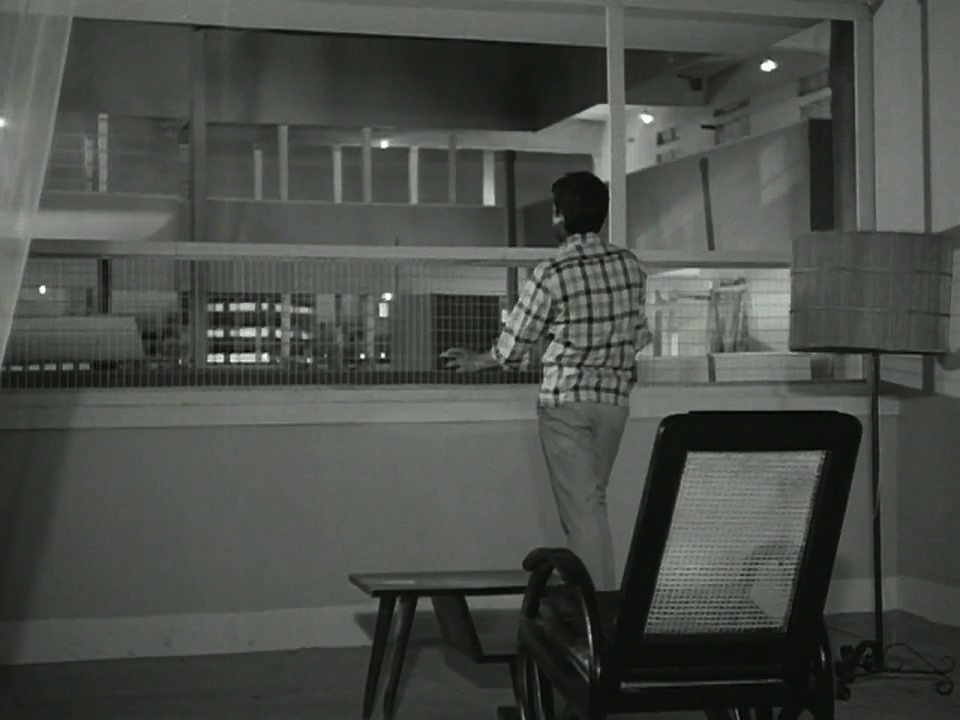
You won’t see much of Dharmendra, the mystery man and asylum inpatient, who sings this song. Instead you see only his outline against the balcony of their confinement. And of course, anything else would be imperfect–while this, this unfulfilled gaze of love, is precisely the poetic complement to the yearning expressed in Gulzar’s heartfelt lyrics. This song may be my favorite Hemant Kumar solo with a melody that hangs in the air long after the song is finished. Whether or not it beats Rajesh Khanna lip-syncing “Woh Shaam Kuch Ajeeb Thi” from the same film is up to you to decide!
tum-pukar-lo-03 Dharmendra

Dharmendra passes sleepless nights thinking of the beautiful woman he lost in Khamoshi (1968).

Without further ado, see for yourself why this song has become immortal. Follow along with the video here, and we hope you enjoy the lyrics and full English translation to “Tum Pukar Lo” below!

Tum Pukar Lo Lyrics and Translation:

Tum pukaar lo
Call out to me
Tumhaaraa intezaar hai
I am waiting for you
Tum pukar lo
Call out to me
Khwaab chun rahe hai.N raat beqaraar hai
I am sifting through dreams while the night remains restless
Tumhaaraa intezaar hai
I am waiting for you
Tum pukaar lo
Call out to me

HonTh se liye hue dil ki baat hum
The words in my heart have escaped from my lips
Jaagte rahe.nge aur kitne raat hum?
How many more nights will I remain awake like this?
Mukhtasar si baat hai: tumse pyaar hai
The matter is simple: I love you

Tumhaaraa intezaar hai
I am waiting for you
Tum pukaar lo
Call out to me

Dil bahal to jaayegaa is khayaal se
My heart will be content with this thought
Haal mil gaya tumhaaraa apne haal se
That my well-being becomes yours
Raat yeh qaraar ki beqaraar hai
This restful night remains restless

Tumhaaraa intezaar hai
I am waiting for you
Tum pukaar lo
Call out to me

Glossary:

pukaarnaa: to call; intezaar karna: to wait; khvaab: dream; beqaraar: restless; honTh: lips; mukhtasar: brief, short; bahal: content; khayaal: thought; haal: well-being, state; qaraar: restful, quiet

My favorite line of this song is by far “Mukhtasar si baat hai, tum se pyaar hai!” So romantic and God, how I love an understatedly accurate pronunciation of the Urdu khe! However, I’m afraid this is one of those cases in which no matter how you translate it, the beauty of the line is just lost in the bluntness of English.

Mrs. 55

Pal Pal Dil Ke Paas Lyrics and Translation: Let’s Learn Urdu-Hindi

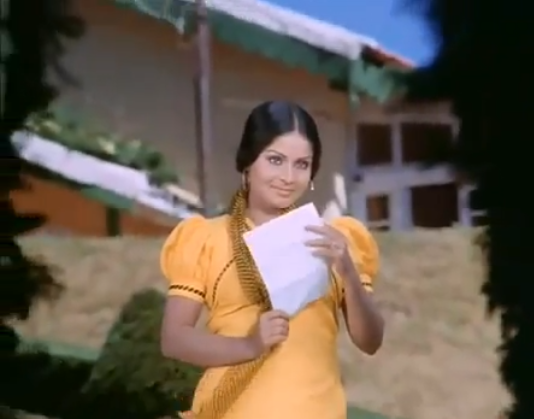
Rakhee daydreams about the ever-handsome Dharmendra in Blackmail (1973)

Blackmail (1973) is considered to be one of Vijay Anand’s most romantic directorial ventures. Starring Dharmendra and Rakhee, this film has all the ingredients to make a great Bollywood film: bogus science,  outrageous costumes, and of course, a memorable soundtrack. This album’s shining jewel is none other than “pal pal dil ke paas,” a beautiful expression of love that is remembered today for Kishore Kumar’s romantic and sensitive rendition.

To understand this song in context of the film, let’s take a look at a brief synopsis of the plot. Kailash (played by Dharmendra) is in charge of operating a power plant that provides electricity to homes across India. His quirky uncle Dr. Khurana (played by Madan Puri) is a scientist that is researching novel approaches to generating electricity via solar sources–how innovative for the 1970s! A local man named Mr. Mehta is unhappy about these advances because solar-powered energy is likely to put an end to his battery business. His business partner Jeevan (played by Shatrugan Sinha) is aware of Dr. Khurana’s research because he is a dear friend of Kailash.

Jeevan is set to marry Asha (played by Rakhee), Mr. Mehta’s daughter, but things change once Kailash unknowingly confesses his love for Asha to him. Taking advantage of this situation, Jeevan plans to get Kailash and Asha married so that he can eventually use Asha to get access to Dr. Khurana’s profitable “formula.” Jeevan arranges to meet Asha in a beautiful garden, but he sends Kailash in his place. They have a conversation about their dreams and hopes, and Asha warms up to the sincerity and purity of Kailash’s heart. In a bold move, Kailash hands over a packet of love letters he has written to Asha over the years to express his deepest desires, and he subsequently flees the scene to avoid embarrassment.

At this point in the film, we hear “pal pal dil ke paas,” song composed by music director duo Kalyanji-Anandji and penned by Rajinder Krishan. Unlike many instances where the on-screen portrayal of a song fails to do it justice, director Vijay Anand has done an excellent job to ensure that this picturization enhances the beauty of the music in the context of the film. In a nutshell, this song describes the progression of love between Kailash and Asha over time. At the beginning, Asha expresses restrained pleasure as she begins to read Kailash’s letters with a coy smile; by the end, she is so smitten by the poetry in his letters that she cannot stop daydreaming about him.

Does the love story between Kailash and Asha reach a happy conclusion? You’ll have to watch the film to find out! Even if the plot doesn’t appeal to you, there’s a particularly steamy  scene between Dharmendra and Rakhee  during “mile mile do badan” that is worth watching for the scandal factor alone.  Enjoy, and remember to send us your requests for song translations — we haven’t received one in a while!

-Mr. 55

Does anyone even write love letters like this anymore?

Pal Pal Dil Ke Paas: Lyrics and Translation

pal pal dil ke paas tum rahtii ho
You reside forever near my heart,
jiivan miiThii pyaas yah kahtii ho
And you call this life a sweet thirst.

har shaam aa.nkhon par teraa aa.nchal laharaaye
Every evening, the end of your sari flutters over my eyes. 
har raat yaado.n ki baaraat le aaye
And every night, it brings a parade of memories. 
mai.n saa.ns letaa huu.n, terii khushbuu aatii hai
With each breath, I smell your fragrance. 
ek mahkaa-mahkaa saa paighaam laatii hai
It brings along a scented message. 
mere dil kii dhaDkan bhii tere geet gaatii hai
Even my heartbeat sings a song for you. 
pal pal dil ke paas tum rahtii ho
You reside forever near my heart.

kal tujh ko dekhaa thaa, mai.ne apne aangan me.n
Yesterday, I saw you in my own courtyard. 
jaise kah rahii thii tum, mujhe baa.ndh lo bandhan me.n
It was as if you were saying, “Bind me in an eternal bond”
yah kaisaa rishtaa hai? ye kaise sapne hai.n?
What kind of bond is this? What kind of dreams are these?
begaane ho kar bhii kyo.n apne lagte hai.n? 
Despite being so foreign, why do I find them to be intimate? 
mai.n soch me.n rahtaa huu.n, Dar Dar ke kahtaa huu.n 
I remain in contemplation as I hesitatingly declare: 
pal pal dil ke paas tum rahtii ho
You reside forever near my heart. 

tum sochogii kyo.n itnaa mai.n tum se pyaar karuu.n
You might question why I love you so dearly.
tum samjhogii diivaanaa, mai.n bhii iqraar karuu.n
You might think I am crazy, and I would confess to that.
diivaano.n kii ye baate.n, diivaane jaante hai.n
Only a person crazy in love can understand the actions of another,
jalne me.n kyaa mazaa hai, parvaane jaante hai.n
And only moths understand the pleasure found in burning.
tum yuu.n hii jalaate rahnaa, aa aa kar khvaabo.n me.n
Please continue to ignite my passion as you come into my dreams.  
pal pal dil ke paas tum rahtii ho
You reside forever near my heart. 

Glossary

miiThaa: sweet; pyaas: thirst; aa.nchal: decorative end of a sari; laharaanaa: to flutter; baaraat: parade, procession; khushbuu: fragrance; mahka: scented; paighaam: message; aangan: courtyard; bandhan: bond; begaanaa: foreign, alien; Dar Dar ke: hesitaingly, fearfully; iqraar karnaa: to admit, confess; mazaa: pleasure; parvaanaa: moth;  jalaanaa: to ignite; khvaab: dream.

Dharmendra and Rakhee get cozy together in Blackmail (1973).

Hai Isi Mein Pyar Ki Abhroo Lyrics and Translation: Let’s Learn Urdu-Hindi

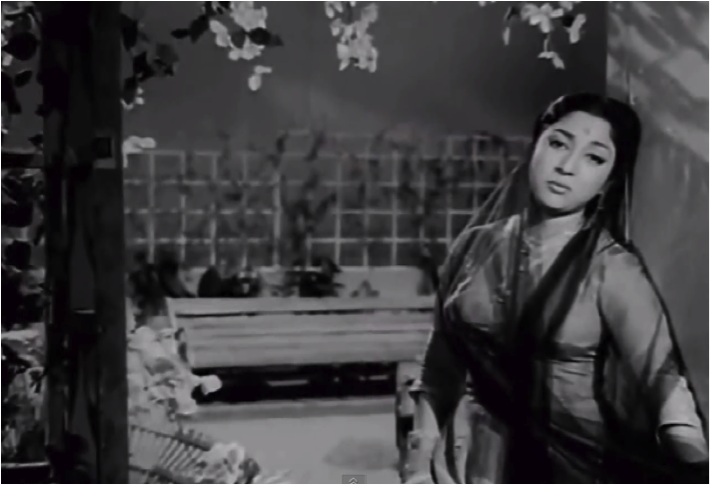
Mala Sinha experiences the pain of rejection in Anpadh (1962) from her husband Dharmendra due to her illiteracy.

As a sequel to our previous post on “aap ki nazaro.n samjhaa,” I have provided an English translation and glossary for another memorable ghazal from Anpadh (1962): “hai isii me.n pyaar kii aabhruu.” As a quick refresher, Anpadh narrates the story of a wealthy but illiterate woman (played by Mala Sinha) who is married off to an educated gentleman (played by Dharmendra).  When Dharmendra asks Mala to recite a poem for him for her on their wedding night, she is compelled to reveal her darkest secret: her parents never taught her how to read or write.  After hearing this, Dharmendra is furious that his parents lured into arranging his marriage to an uneducated woman because of the large dowry. As he spurns Mala for her lack of education, she expresses her sadness through this song, which was composed by Madan Mohan and penned by Raja Mehndi Ali Khan.

I’ll be the first to admit that these lyrics are a tad excessive in the drama department, but this is exactly the kind of song that you need when you’re in the mood to wallow. The essence of heartache is and the pain of rejection are illustrated beautifully in these words,  so listening to a song like this can really hit the spot when you’re love-sick and need to get that sulking out of your system.  Although one can find beauty in the lyrics, it is difficult to overlook that this ghazal also carries an underlying subtext of misogyny that reflects societal attitudes of the time. Take, for instance, the mukhDaa where Mala proclaims that she finds pride in her beloved’s cruelty: “hai isii me.n pyaar kii aabhruuwah jafaa kare, mai.n vafaa karuu.n” (In this, I find the pride of love: he is cruel to me, yet I remain faithful to him).  You won’t (and shouldn’t!) find such a line sung by the heroines in the Bollywood industry today.

Even if the lyrics for this song are too much for you to handle, I am certain that you can appreciate this song for its musical value. Madan Mohan has composed an evergreen melody that tugs at your heartstrings, and Lata Mangeshkar pulls through with a winning rendition. As an aside, I thought that I would share an alternate version of this song rendered by Madan Mohan himself using a different tune.  This alternate melody was not used in the film, and I am guessing that was because it sounds too happy to suit the melancholic nature of these lyrics. Take a listen to both versions for yourself, and enjoy the translation and glossary that we have provided below! Requests for future posts, as always, should be e-mailed to themrandmrs55@gmail.com.

The intensity of Mala’s pain depicted in this song highlights the urgency of Anpadh‘s message about the need educate Indian girls.

Hai Isi Mein Pyar Ki Abhroo: Lyrics and Translation

hai isii me.n pyaar kii aabhruu
In this, I find the pride of love:
wah jafaa kare mai.n vafaa karuu.n
He is cruel to me, yet I remain faithful to him.
jo vafaa bhii kaam na aa sake
Although this love is in vain,
to wahii kahe ki mai.n kyaa karuu.n
It now dictates my actions.

mujhe gham bhii unkaa aziiz hai
Even the sadness I feel is dear to me,
ki unhii kii dii huii chiiz hai
Because it is something given to me by him.
yahii gham hai ab merii zindagii
This sadness has become my life,
ise kaise dil se judaa karuu.n?
how shall I separate it from my heart?

jo na ban sake mai.n wah baat huu.n
I am the matter that cannot be,
jo na khatm ho mai.n wah raat huu.n
And I am the night that cannot end. 
yah likhaa hai mere nasiib mein
It is written in my destiny
yuu.n hii shamma ban ke jalaa karuu.n
That I shall burn here like a candle.

na kisii ke dil kii huu.n aarzuu
I am not the desire of anyone’s heart
na kisii nazar ki huu.n justajuu
Nor am I the object of anyone’s glances.
mai.n wah phuul huu.n jo udaas ho
I am that flower which is wilted.
na bahaar aaye to kyaa karuu.n?
If the spring does not arrive, what shall I do?

hai isii me.n pyaar kii aabhruu
In this, I find the pride of love.

Glossary

aabhruu: pride; jafaa: cruelty; vafaa: loyalty, love; aziiz: dear; judaa: separate; khatm: end; nasiib: destiny, fate; shamma: candle; aarzuu: desire; justajuu: quest, search; udaas: sullen, wilted.

Kuch Dil Ne Kaha Lyrics and Translation: Let’s Learn Urdu-Hindi

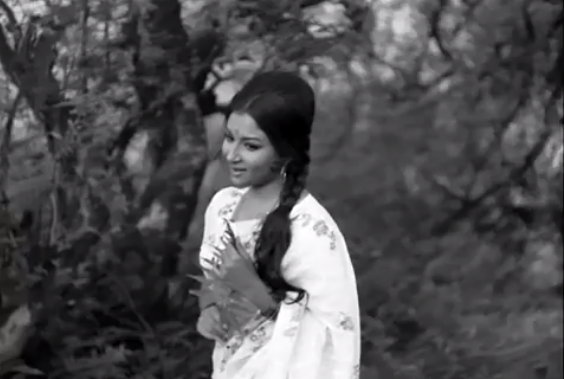
Sharmila Tagore shines in her restrained portrayal of Uma in Anupama (1966)

Our next translation comes from Hrishikesh Mukherji’s Anupama (1966), a poignantly crafted film that narrates the story of a father who blames his daughter for his wife’s death during childbirth.  On the request of one of our readers Himadree, we have provided the lyrics and English translation for the song “kuchh dil ne kahaa” from this film below.

Sharmila Tagore plays the role of Uma, a reticient young woman who has maintained a painful and difficult relationship with her wealthy father (played by Tarun Bose) from a young age. Because Uma’s mother died in childbirth, Uma’s father harbors feelings of resentment that prevent him from fully loving his daughter as she grows up. Uma also assumes culpability for her mother’s death, and her self-repression becomes a coping mechanism to deal with her own guilt and her father’s anger toward her.

When Uma meets the handsome and sensitive writer Ashok (played by Dharmendra), her life seems to to take a turn for the better. Yet, as the two fall in love, it becomes apparent that Uma’s  troubles have not vanished completely: her father has already arranged her marriage with another man and will never not approve of a relationship with a man of Ashok’s social status. Hrishikesh Mukherji uses this situation to provide realistic and eloquent commentary on the complex interplay between love and class in Indian society. In this context, Kaifi Azmi’s lyrics in “kuchh dil ne kahaa” truly come alive. The lyrics express the conflict that characterizes Uma’s state of mind as she faces the most challenging decision of her life: should she pursue her romance with Ashok or should she push him away to appease her father? The essence of this dilemma is captured beautifully in many lines of this song. Although her heart has become restless with love for Ashok, Uma contemplates that it may be best  to suppress these desires: “letaa hai dil angaDaaiiyaa.n, is dil ko samjhaaye koii.”  Moreover, in spite of her outer appearances, Uma’s inner turmoil is a real and painful obstacle in her life (“dil kii tasallii ke liye jhuuThii chamak jhuuThaa nikhaarjiivan to suunaa hii rahaa, sab samjhe aayii hai bahaar”).

In addition to its unique lyrics, this song is a musical masterpiece that has been cherished by Hindi film lovers over the years (though it didn’t receive its due at the time of the film’s release!). Hemant Kumar crafts a serene melody in Raga Bhimpalasi that accentuates the melancholic beauty found in both the lyrics and the natural landscape where this song is picturized. Lata Mangeshkar, as usual, is par excellence here as she emotes softly with some beautifully restrained vocals. As an interesting tidbit, you may have noticed that Lata sings this melody at a lower pitch than is expected for a Bollywood soprano. When Lata repeats the line “aisii bhii baate.n hotii hai.n” in the mukhda, she hits an A3 (komal ni in the key of B), one of the lower notes of her range recorded during this period. Enjoy our translation of this under-appreciated gem below and continue to send us your requests and other messages–we love to hear from you all!

-Mr. 55

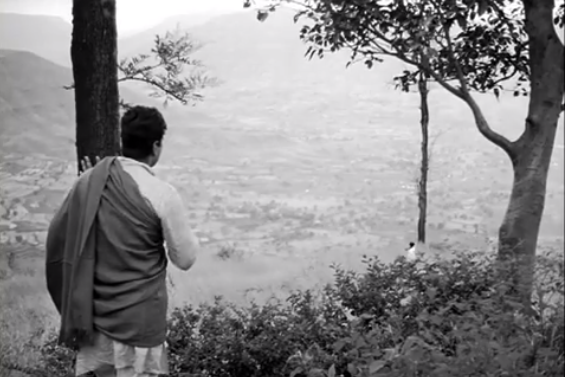
This song was filmed in Mahabaleshwar, a scenic hill station found in the state of Maharashtra. What a stunning landscape!

Kuch Dil Ne Kaha: Lyrics and Translation

kuchh dil ne kahaa, kuchh bhii nahii.n
My heart said something; yet, it was nothing at all.
kuchh dil ne sunaa, kuchh bhii nahii.n
My heart heard something; yet, it was nothing at all.
aisii bhii baate.n hotii hai.n
Such things happen in life.

letaa hai dil angaDaaiiyaa.n, is dil ko samajhaaye koii
My heart has become restless in anticipation of him; may someone please make it stop.
armaan na aa.nkhe.n khol de.n, rusvaa na ho jaaye koii
I hope that my desires do not cause my eyes to open and bring about disgrace,
palko.n kii ThanDii sej par sapno.n ki pariyaa.n sotii hai.n
For the dream-fairies remain asleep on the cool bed of my eyelids.
aisii bhii baate.n hotii hai.n
Such things happen in life.

dil kii tasallii ke liye jhuuThii chamak jhuuThaa nikhaar
For my heart’s satisification, I have adorned myself in this false glitter and shine.
jiivan to suunaa hii rahaa, sab samajhe aayii hai bahaar
Though it remains empty, everyone assumes that spring has arrived in my life.
kaliiyo.n se koii puuchtaa, hastii hai.n yaa ve rotii hai.n
Yet, no one has bothered to ask the flowerbuds whether they are smiling or crying.
aisii bhii baate.n hotii hai.n
Such things happen in life.

kuchh dil ne kahaa, kuchh bhii nahii.n
My heart said something; yet, it was nothing at all.

Glossary

angaDaaiiyaa.n: preparation, anticipation; armaan: hope, desire; rusvaa: disgrace; palko.n: eyelids; sej: bed; pariyaa.n: faires; tasallii: satisfaction, relief; chamak: glitter; nikhaar: glow, shine; bahaar: spring.

Sharmila Tagore rocks the classic beehive hairstyle that would later become her trademark.

The ever-handsome Dharmendra plays the role of a sensitive writer in Anupama (1966)

The 15 Best Bollywood Rain Songs: Evolution of a Classic Genre

Rajesh Khanna and Rakhee Rain Song Bollywood

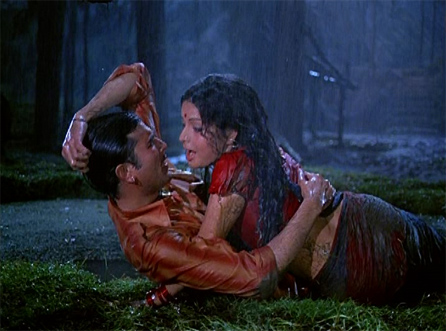
Rajesh Khanna and Rakhee express their sizzling love in the rain in Shehzada (1972).

It’s monsoon season again in India and, naturally, love is sparkling in the air. At last we present our list of the best rain songs from classic Bollywood! We all adore these moments–the iconic cuddling beneath an umbrella, the splashing around in a wet garden, or of course, Zeenat Aman in a drenched saari. It seems now that singing in the rain is the epitome of Bollywood romance, and a marvelous way to introduce a new song. But this phenomena did not occur overnight, and indeed, the meaning of rain itself in a film has shifted over the years with shifting cultural expectations. Let’s take a look at rain songs in Bollywood over the years!

Shree 420 Raj Kapoor Nargis Pyar Hua Iqrar Hua Rain Song Bollywood

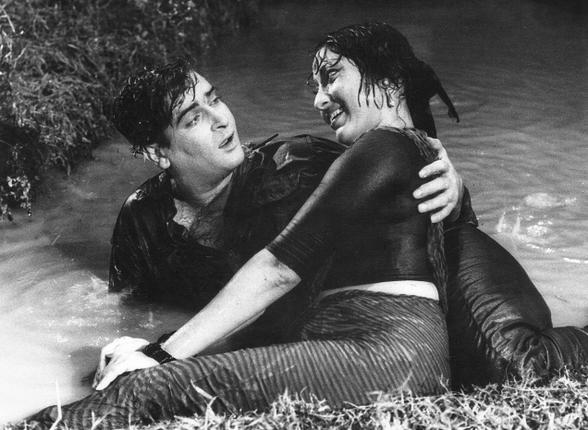
Raj Kapoor and Nargis huddle close together beneath an umbrella in Shree 420 (1955).

We being in the earlier days of cinematic magic. As India awoke to freedom and liberty in the 1950s, so too did the country rapidly begin to shift gears away from pure agriculture and toward industrialization. Many of the best rain songs from that era embody a sense of wonder in urban environments and, matching the film censorship boards, an innocent just-got-struck-by love. In these songs, rain seems to act as that enchantment in the air–that driving force bringing a loved one into contact or sight. Rain too acted as that shimmering veil of restraint that both parties hesitate to cross. “Ek Ladki Bheegi Bhaagi Si” from Chalti Ka Naam Gaadi (1958) is one of the most beloved rain songs of that era!

Raj Kapoor Dum Dum Diga Diga Chhalia

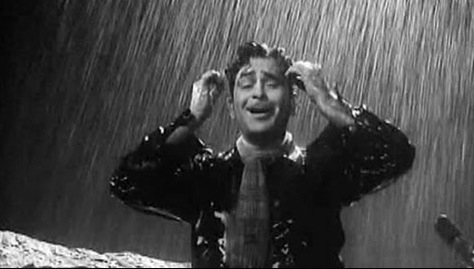
Raj Kapoor prances about the city streets singing “Dum Dum Diga Diga” from Chhalia (1960).

With the advent of the 60s, came a new meaning of being caught in a rainstorm. No longer was rain an innocent effector of love at first sight, but rather a clever and well-understood pretext for full out passion. To clarify, by passion, I mean, symbolic wet dancing that means much more than actual physical contact. The Bollywood rain songs of the 60s exude a sense of joy, independence and confidence. The onset of a rainstorm had an understood implication for overt displays of affection that both parties are eager to demonstrate. Say hello to bouffant hairdos, tight and wet salwar qameezes, and men doing some very special attempts at a courtship dance.

Shammi Kapoor Dil Tera Deewana Hai Sanam Mala Sinha

Shammi Kapoor and Mala Sinha get drenched in Dil Tera Deewana Hai Sanam (1960)

Gone were the days of “Do Bigha Zameen” style agricultural celebration! While the setting of the village recurred, rain ceased to be a blessing for economic survival–instead, it brought the blessing of love between newly liberated men and woman of a new age. Check out our translation of “O Sajna Barkha Bahar” from Parakh (1960) and listen how music directors cleverly incorporated native Indian instruments into creating the sounds and moods of rain. Indeed, the trickling melodies of sitar have graced the introductions of many a great rain sequence–even famously with Ravi Shankar’s solo for Satyajit Rai’s Aparajito!

Asha Parekh Aaya Saawan Jhoom Ke

Dressed as a village belle, Asha Parekh delights in the first rain of the season in “Aaya Sawan Jhoom Ke” (1969).

At last the 70s arrived, and the Bollywood rain song explored new territory. Yes, Zeenat Aman in a wet white saari is crossing some obvious lines and certainly deserves a mention on this list, but the rain song did not merely degenerate into a male fantasy. Instead, as the political atmosphere changed, the rain song adopted a meaning to suit its people. With government dissatisfaction in the air, rain songs were (while maintaining something of a romantic undertone), also a means of escape and hope.

Jeetendra Haye Re Haye Humjoli

Jeetendra and Leena Chandavarkar exhibit some of the strangest and wildest dance moves to date in the famous rain love song of Humjoli (1970)

Did you know in the early days of cinema, rain scenes were not actually filmed in the rain? Because of the nature of unforgiving black-and-white film stock, even heavy pounding natural rain does not appear clearly in the camera–much less the gentle puhaare of many a romantic Bollywood setting. As such, the production staff needed to literally dump buckets of water or spray dozens of hoses above the set for “rain” to actually appear so on screen! So the next time you watch these songs, just imagine the total chaos going on outside the frame among the frantic, water-pouring production assistants!

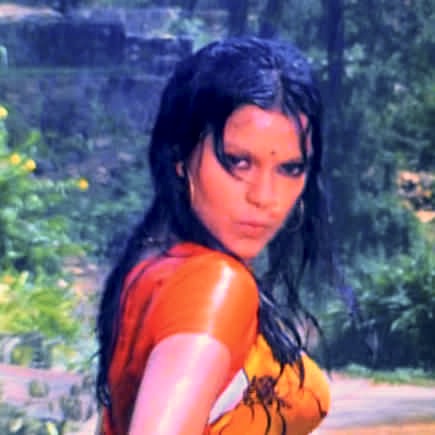
Zeenat Aman sets the rain on fire in “Haye Haye Yeh Majboori” from Shor (1972).

But enough talk. Now that you know the history, here is our list in chronological order of Bollywood’s greatest rain songs! These all-time classic give an entirely new meaning to “Singin’ in the Rain!”

The Best Rain Songs of Classic Bollywood

  1. Pyar Hua Iqrar Hua (Shree 420 – 1955)
  2. Yeh Raat Bheegi Bheegi (Chori Chori – 1956)
  3. Ek Ladki Bheegi Bhagi Si (Chalti Ka Naam Gaadi – 1958)
  4. Dil Tera Deewana Hai Sanam (Dil Tera Deewana – 1960)
  5. Dum Dum Diga Diga (Chhalia -1960)
  6. O Sajna Barkha Bahar Aayi (Parakh -1960)
  7. Rim Jhim Ke Tarane (Kala Bazaar – 1960)
  8. Zindagi Bhar Nahin Bhoolegi (Barsaat Ki Raat – 1960)
  9. Chhup Gaye Saade Nazare (Do Raaste – 1969)
  10. Aaya Saawan Jhoom Ke (Aaya Saawan Jhoom Ke – 1969)
  11. Ang Lag Ja Balma (Mera Naam Joker – 1970)
  12. Haye Re Haye (Humjoli – 1970)
  13. Bheegi Bheegi Raaton Mein (Ajnabi – 1972)
  14. Paani Re Paani (Shor – 1972)
  15. Haye Haye Yeh Majboori (Roti Kapada Aur Makaan – 1974)
Rajesh Khanna Zeenat Aman Bheegi Bheegi Raaton Mein

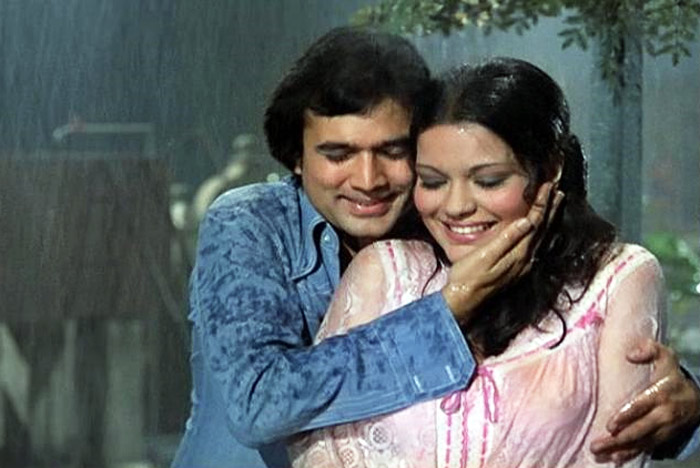
Rajesh Khanna cuddles Zeenat Aman to keep warm in the spicy rain song “Bheegi Bheegi Raaton Mein” in Ajnabi (1974).

And there you have it, the 15 best classic Bollywood rain songs over the ages! What are YOUR favorite rain songs from classic Bollywood–and tell us how they’ve influenced your own love stories!

– Mrs. 55