Bekhudi Mein Sanam Lyrics and Translation: Let’s Learn Urdu-Hindi

Babita Haseena Maan Jaayegi

Whoa there, Babita. Are you sure a Santa hat is appropriate for this occasion?

Our next Hindi lyric translation is the classic Rafi-Lata duet “Bekhudi Mein Sanam” from the film Haseena Maan Jaayegi (1968). The movie soundtrack is probably the only reason you would ever want to watch this film. Sure, the plot description is intriguing: two men (who happen to both be Shashi Kapoor) fall in love with the same woman (the unbearable Babita). One Shashi Kapoor is soft-spoken and romantic, while the other is an aggressive jokester who is spurned by our heroine. But then! War with China! Both men are called to duty, and when only one returns, Babita can’t tell if he is truly the man she loves–or his rival!

So you’re lured in, egged on by a few other vaguely recognizable Rafi numbers (“O Dilbar Janiye,” anyone?), and think you’re getting yourself in for a long Hum Dono-esque genre twin film with a swinger bent.

Oh, but how wrong you’d be.
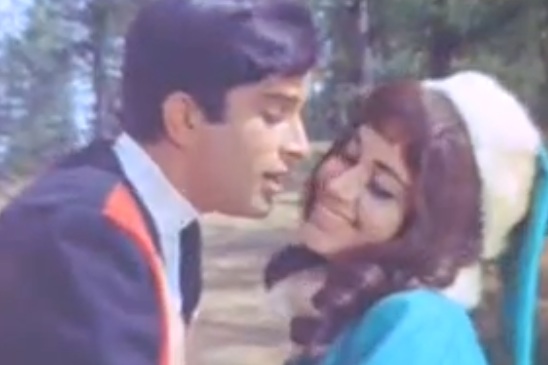
Babita and Shashi haseena maan jaayegi

Shashi Kapoor and Babita play two college students in love in Haseena Maan Jaayegi (1968).

Haseena Maan Jaayegi is a painful free-falling bucket of awkward sauce that is weighed down by Babita’s insufferably thick voice, static characters, and an unfocused plot that never quite pulls together it’s obvious loose ends. I mean, seriously Babita? We need to spend two hours watching you try to decide if there is nothing unique about the man you married? Furthermore, what the heck, Shashi? Couldn’t you have convinced the scriptwriter to at least throw in just one line explaining why you guys look so similar? At least turn out to legitimately be twins separated at birth! There’s no way God would just magically make two Shashi Kapoors in this world. A lot of Indian women would be a lot happier if so.

Shashi Kapoor is entranced by Babita’a teal Santa suit from “Bekhudi Mein Sanam.”

Really, nothing gets my goat more than a twin movie that doesn’t acknowledge that they’re supposed to actually be twins. Do yourself a favor by skipping this cheese-flavored package of dry histrionics, and just youtube the songs because they’re awesome. Of particular note in “Bekhudi Mei.N Sanam” is Babita’s puffy white fur Santa hat and teal blue jumpsuit. This is just in case any audience member had lost their mind and started to make the mistake of taking her seriously. Check out the youtube link for the song here and follow along with the lyrics and translation below to this this otherwise beautiful ode of love!

Bekhudi Mein Sanam Lyrics and Translation

Bekhudi mei.N sanam, uTh gaye jo qadam
Unaware of my self, as I started walking
Aa gaye, aa gaye
I arrived
Aa gaye paas hum, aa gaye paas hum
I arrived nearer to you

Aag yeh kaisii man mei.N lagii hai?
What kind of fire is aflame in my mind?
Man se badhii to tan mei.N lagii hai
Yet, even bigger than that in the mind, is the one burning my body
Aag nahii.N yeh dil ki lagii hai
This is not a fire, its the heart’s desire
Jitnii bujhaayii, utnii jalii hai
However much you try to put it out, it will keep burning

Dil ki lagi na ho to, kya zindagii hai?
Without this desire of the heart, what is life?
Saath hum jo chale miT gaye faasle
When we walk together, all that separates us disappears
Aa gaye, aa gaye
I arrived
Aa gaye paas hum, aa gaye paas hum
I arrived nearer to you

Khoyii nazar thii, soye nazaare
The vision was lost, and the sights were asleep
Dekhaa tumhe to jaage yeh saare
On seeing you, all of them were awakened
Dil ne kiye jo dil ko ishaare
As one heart signaled to the other
Milke chale hum saath tumhaare
We met and walked together

Aaj khushii se meraa dil yeh pukaare
Today my heart calls out with joy
Teraa daaman milaa, pyaar meraa khilaa
In finding your embrace, my love has blossomed
Aa gaye, aa gaye
I arrived
Aa gaye paas hum, aa gaye paas hum
I arrived nearer to you

Dil kii kahaanii pahunche zubaa.N tak
The story of my heart is on my tongue
Kisko khabar ab pahunche kahaa.N tak?
Now who knows where it will reach?
Pyaar ke raahii aaye yahaa.N tak
Travelers of love have arrived here
Jaaye.Nge dil ki had hai jahaa.N tak
They will go to the limits set by their hearts

Tum paas jo to chale hum aasmaan tak
With you at my side, we will reach the sky
Dil mein armaan liye laakh toofaan liye
With a heart full of desires and beset by storms

Aa gaye, aa gaye
I arrived
Aa gaye paas hum, aa gaye paas hum
I arrived nearer to you

Bekhudi mei.N sanam, uTh gaye jo qadam
Unaware of my self, as I started walking
Aa gaye, aa gaye
I arrived
Aa gaye paas hum, aa gaye paas hum
I arrived nearer to you

Glossary:

bekhudi: unaware of oneself, in a trance; qadam: footsteps; aag: fire; man: mind; tan: body; faasle: separation, distance; ishaaraa: signal; daaman: embrace; zubaa.N: tongue, language; khabar: news, knowledge; had: limit; aasmaan: sky; armaan: desire; toofaan: storm

I can’t really explain it, but I’ve always really liked with the way Shashi Kapoor starts his first line walking forward toward her with his hands folded behind his back. It’s bashful, the way Indian men in love were meant to be.

Shashi Kapoor Twins Haseena Maan Jaayegi

I know, I know. It’s almost irresistible–TWO Shashi Kapoors on ONE screen! Look at that handsome cricket jacket, those form-fitting white pants. But restrain, my friends. Haseena Maan Jaayegi will suck out your Shashi-gushing capacities and infect you instead with confusion and hatred of Babita.

This song translation was done by request from our reader “Beloved”! We hope you enjoyed, and if you’d like to see your name on our blog, send us an email with your burning Bollywood request or leave us a comment on our “Requests” page!

– Mrs. 55

In Aankhon Ki Masti Ke Lyrics and Translation: Let’s Learn Urdu-Hindi

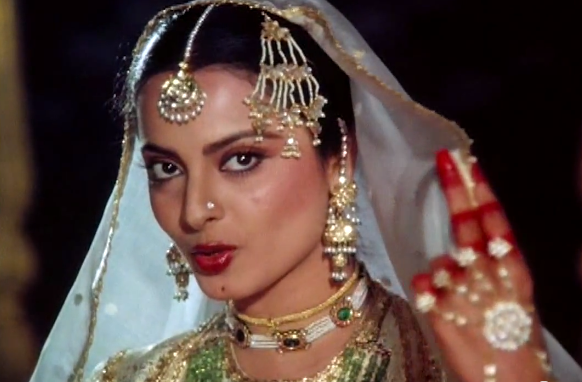
Rekha gives a career-defining performance as a courtesan and poetess in Umrao Jaan (1981)

I recently rewatched Muzaffar Ali’s masterpiece Umrao Jaan (1981), a film that is so brilliantly crafted that it deserves multiple posts on this blog like Pakeezah and Mughal-e-AzamThe film is based on an Urdu novel written by Mirza Muhammad Hadi Ruswa that recounts the life of one of South Asia’s most influential literary figures: Umrao Jaan. Born in Faizabad, a young girl named Amiran is kidnapped and sold to a brothel in Lucknow. As she grows older, Amiran is grooomed by the brothel’s madam until she becomes Umrao Jaan (played by Rekha), one of Lucknow’s most desirable courtesans.  Misfortune after misfortune falls upon Umrao Jaan, but the film ultimately portrays her as a resilient woman whose beautiful mujras and poetry serve as a lasting legacy to her indomitable spirit.

In addition to Rekha’s stunning performance as the tawaif Umrao Jaan, this film is especially memorable for its portrayal of the richness of Lucknow’s cultural heritage. The indulgent life of nawaabs around the turn of 20th century is visually apparent in the film’s costumes, artwork, and set design, but the luxurious atmosphere in the film is taken to a new level by the soundtrack composed by Khayyam and penned by Shahryar. Here, I’ve chosen to translate one of the unforgettable mujra numbers from this film: in aa.nkho.n kii mastii.

She’s not lying when she says her eyes are intoxicating…

In this song, Umrao Jaan engages in some self-indulgent vanity. She mildly chides her lover Nawab Sultan (played by Farooq Shaikh) by saying there are thousands of other madmen in Lucknow that admire her charm and beauty. In the third verse, she continues to brag by saying that all the taverns in the world cannot serve wine as intoxicating as the wine that she serves from her glances. Finally, in the last verse, Umrao makes a warning against those that attempt to suppress her grandeur using a common symbol found in Urdu-Hindi poetry: the moth. Like moths to a flame, she claims that there are thousands of admirers in the city who would sacrifice their lives to protect her. The poetry in this song is not overly complex, but there is a subtle beauty to it that is enhanced by Asha Bhonsle’s beautiful rendition and Rekha’s graceful expressions on screen. I managed to find a very high-quality print of this song on YouTube, so please do watch the link provided above and follow along with the translation/glossary–enjoy!

–Mr. 55

P.S. Whatever you do, please do not waste three hours of your life (like I did) watching J.P. Dutta’s 2006 remake of this movie starring Aishwarya Rai and Abhishek Bacchan. It is a travesty of a film that completely disrespects the beauty of the original. I think one of the worst parts is the atrocious Urdu pronunciations. I mean, even I can get the guttural khe sound right when I say “khudaa haafiz,” and they don’t pay me the big bucks. Why can’t Aishwarya or Abhishek? And let’s not even get started on Anu Malik’s tired and stale soundtrack…

The camera adds to the meaning of the lyrics here by bringing candles into the shot when Rekha sings “is shamm-e-farozaa.n…

In Aankhon Ki Masti Ke Lyrics and Translation

in aa.nkho.n kii mastii ke mastaane hazaaro.n hai.n
The intoxicating beauty of these eyes attracts thousands of admirers. 
in aa.nkho.n se vaabastaa afsaane hazaaro.n hai.n
Indeed, there are thousands of stories associated with these eyes. 

ek tum hii nahii.n tanhaa ulfat me.n merii rusvaa
You are not the only one disgraced by your love for me, 
is shahar me.n tum jaise diivaane hazaaro.n hai.n
There are thousands of madmen like you in this city.

ek sirf ham hii mai ko aa.nkho.n se pilaate hai.n
It is only I who can serve you wine with my eyes, 
kahne ko to duniyaa me.n maikhaane hazaaro.n hai.n
Though it is said that there are thousands of taverns in this world.

is shamm-e-farozaa.n ko aa.ndhii se Daraate ho
Although you attempt to scare this bright candle with a storm,
is shamm-e-farozaa.n ke parvaane hazaaro.n hai.n
The light from this candle attracts thousands of moths. 

in aa.nkho.n kii mastii ke mastaane hazaaro.n hai.n
The intoxicating beauty of these eyes attracts thousands of admirers. 

Glossary

mastii: intoxication; mastaane: admirers; vaabasta: associated with; ulfat: love; rusvaa: disgraced; mai: wine; maikhaane: taverns; shamm-e-farozaa.n: bright candle; aa.ndhii: storm; parvaane: moths.

Farooq Shaikh, as Nawab Sultan, watches the mujra in admiration.

Roop Tera Mastana Lyrics and Translation: Let’s Learn Urdu-Hindi

Rajesh Khanna Sharmila Tagore HOT Aradhana

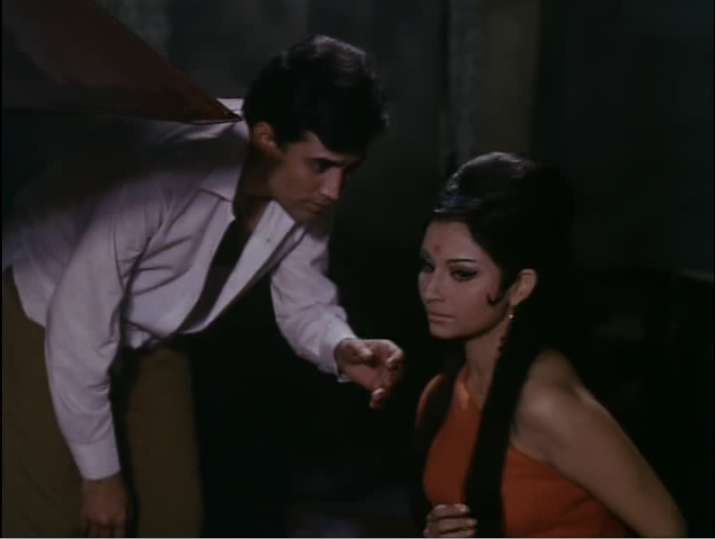
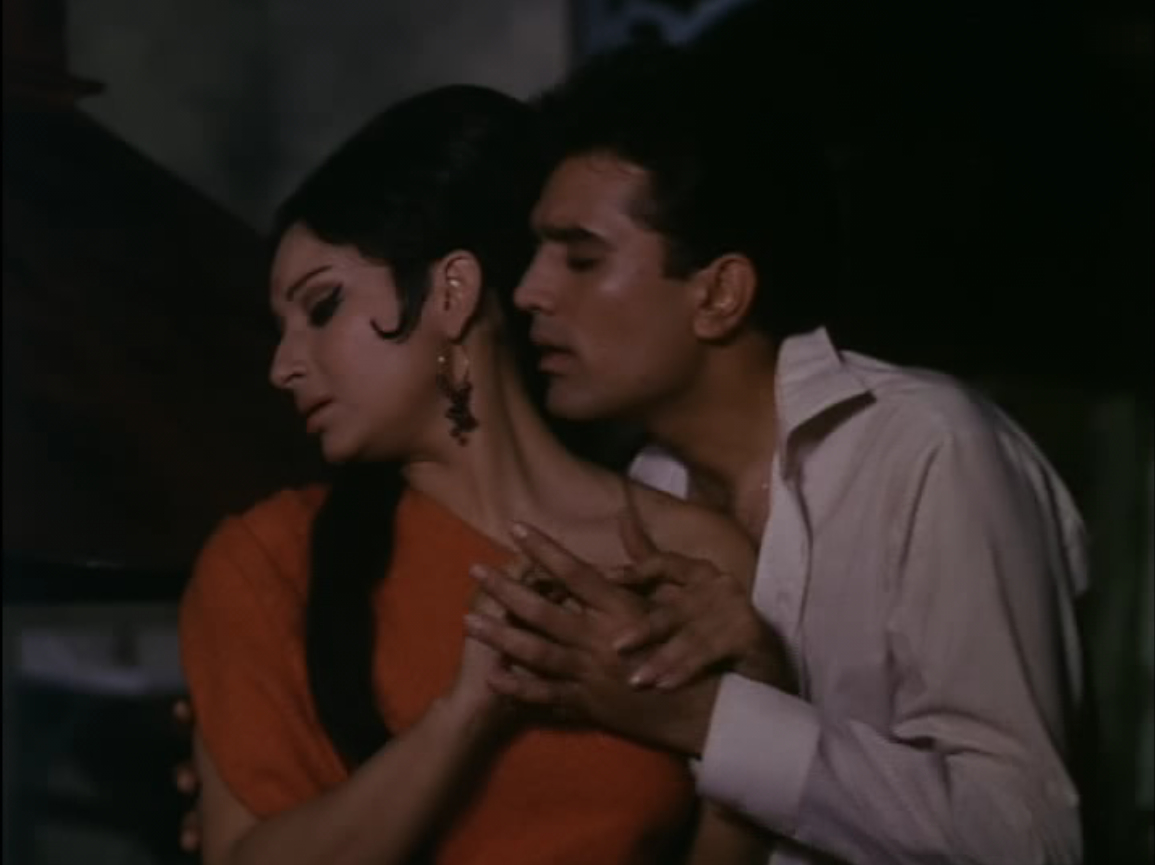
Rajesh Khanna and Sharmila Tagore get too close for comfort in “Roop Tera Mastana” from Aradhana (1969)

Our next post brings you the full lyrics and English translation of the all-time hit “Roop Tera Mastana” from Aradhana (1969). The film stars one of Bollywood’s favorite on-screen couple: the dashing Rajesh Khanna and the elegant Sharmila Tagore. Now this song gets a little racy, so for everyone who isn’t sure they can handle it, please direct yourselves to our G-rated posts (see Rabindranath Tagore’s Influence on S.D. Burman) at this time. Everyone else, grab a seat and a drink of water because it’s about to get a little hot in here.

One of the things I love most about “Roop Tera Mastana” is the cinematography (check out the youtube link here!). The entire song (roughly 4 minutes) is shot in a single long take! The camera swirls around the fire following Rajesh Khanna making his moves on Sharmila, without ONCE cutting for an insert or change in camera angle.

For this to succeed, not only do both the actor and actress need to know exactly where to start and stop with every movement they make during the sequence (any small shift could result in a loss of camera focus), but there is an elaborate dolly track for the camera also laid out all around the floor that they have to be careful not to trip on as they move. And every time the dolly men, the grip guy, the pull-focus team, or heaven-forbid the actors screw up in the 4 minutes you need per take, you start all over again, lose valuable film stock, and probably get a public slap in the face. Check stills from this sequence below!

Rajesh Khanna Sharmila Tagore2

Rajesh Khanna swoops in for the kill.

Rajesh Khanna Sharmila Tagore3

Sharmila Tagore senses danger and edges away.

Oh, awkward–Sharmila and Rajesh bump into each other unexpectedly.

Sharmila: To give in or not to give in??!

Rajesh Khanna rushes in from the other side.

Well…maybe this idea isn’t so bad after all…

Sharmila gets so on board, she starts to be a little aggressive.

Things are just getting out of control now with Rajesh and Sharmila.

Gorgeous Rajesh Khanna is abandoned, bursting with chest hair.

Gotcha! Just when you thought you thought you had given him the slip.

It’s super tense in that room, and I’m not just talking about Sharmila’s sternocleidomastoids.

In the film Aradhana (1969), Sharmila Tagore and Rajesh Khanna have both just come from getting secretly married in a private temple ceremony. They happen upon a shelter lodge, and obviously consummating the marriage is all over Rajesh Khanna’s mind.

Interestingly, the camera itself becomes complicit in the scene. Like the actors themselves, the camera too encircles the fire as if echoing the hallowed rites of Hindu marriage, the saath phere (or seven circles), that give sanctity to their union. It is as if the audience is now the testifying witness of the validity of their marriage, and the camera hesitates–sometimes pausing, sometimes rushing just like the whirlwind of conflicting emotions in the scene. It is extremely symbolic and by eliminating all cutting, the long take seems to slow time down as we grasp the moral and social complexities of this moment, as well as build the tension of what is imminent. Enjoy our English translation of the lyrics of this all-time classic and let us know your opinions in the comments!

Roop Tera Mastana Lyrics and Translation

Roop tera mastana pyaar mera diwaanaa
Your beauty is intoxicating, my love is crazy
Bhool koi humse na ho jaaye
Let me not commit a wrong

Raat nasheelii mast samaa hai
The night is lush, the atmosphere is intoxicating
Aaj nashe mei.N saara jahaa.N hai
Today the whole world seems drunk
Haa.N yeh sharaabii mausam behkaaye
Yes, this intoxicated atmosphere has enticed us
Roop tera mastana pyaar mera diwaanaa
Your beauty is intoxicating, my love is crazy

Aankho.N se aankhe.N miltii hai.N aise
Our eyes met like this
Bechain hoke toofaa.N mei.n jaise
Becoming restless like a storm
Mauj koi saahil se takraaye
Like a wave crashing toward the shore
Roop tera mastana pyaar mera diwaanaa
Your beauty is intoxicating, my love is crazy
Bhool koi humse na ho jaaye
Let me not commit a wrong

Rok rahaa hai hum ko zamaanaa
The world is stopping us
Duur hii rehna paas na aana
We must stay apart and not come closer
Kaise magar koi dil ko samjhaaye?
But how can anyone make our hearts understand this?
Roop tera mastana pyaar mera diwaanaa
Your beauty is intoxicating, my love is crazy
Bhool koi humse na ho jaaye
Let me not commit a wrong

Glossary

roop: beauty; mastaana: intoxicating; diiwaanaa: crazy (in love); bhool: mistake, wrong; nasheelii: lush; samaa: atmosphere; nashe mei.N: drunk; mausam: atmosphere; bechain: restless; toofaa.N: storm; mauj: wave; saahil: shore; zamaanaa: the world

Notice how no one actually gets close to kissing each other in the sequence. I mean, you’d think it happened if you looked at some of these still shots, but in reality the closest thing to physical contact that occurs in this whole sequence is when they hold hands and half-way hug. It would have been awkward, but they pretend like they’re kissing so well, that you hardly notice that no one has touched each other. Oh, the magic of Bollywood!

For more from the magical soundtrack of Aradhana, check out our translation of “Kora Kaagaz Tha” here!

-Mrs. 55

Paaon Choo Lene Do Lyrics and Translation: Let’s Learn Urdu-Hindi

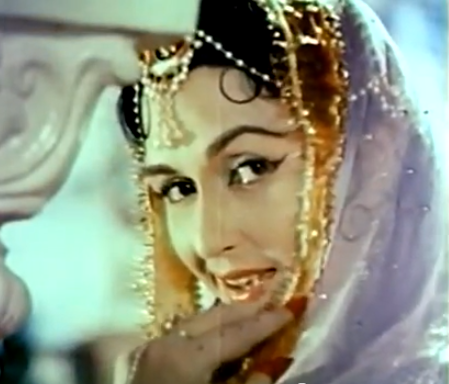
Bina Roy, as Mumtaz Mahal, shys away from Pradeep Kumar in Taj Mahal (1963)

Today we discuss the lyrics and English translation of “paaon choo lene do” from the film Taj Mahal (1963). Lyricist Sahir Ludhianvi and music director Roshan both won Filmfare Awards for their work in Taj Mahal (1963), so it’s not surprising that we’ve decided to discuss a third song from this soundtrack here today (see our previous translations of “jurm-e-ulfat pe” and “khudaa-e-bartar“). “paa.nv chuu lene do” is a duet rendered by Lata Mangeshkar and Mohammed Rafi that was picturized on Bina Roy as Mumtaz Mahal and Pradeep Kumar as Shah Jahan in the film. While “jurm-e-ulfat pe” had some political undertones and “khudaa-e-bartar” was a pacifist statement against war, Sahir’s lyrics in this song from Taj Mahal are purely romantic. The male and female leads flirt back and forth using a savaal-javaab (question-response) structure that focuses on idealizing the heroine’s feet. The female foot has been fetishized in Indian culture and Bollywood cinema over the years, and perhaps the most notable example of this phenomenon occurs in Kamal Amrohi’s magnum opus, Pakeezah: Raaj Kumar is completely smitten after one glance at Meena Kumari’s delicate feet during a train ride.

Krishna decorates Radha’s feet with alta.

What are the origins of the Indian obsession with the foot? Part of this obsession can perhaps be attributed to the importance placed on foot worship in Hindu traditions. For instance, religious imagery in temples and paintings has depicted numerous examples of Krishna painting Radha’s feet or Lakshmi massaging Vishnu’s feet.  Moreover, it is a tradition for women in North India to adorn their feet with a bright red dye called alta during marriages, dances, and religious festivals, like Durga Puja. In fact, during some weddings, brides step into a plate of alta before entering their in-law’s house and leave colored footsteps behind them as they walk. Finally, any child growing up in a Hindu household can attest to the fact that greeting one’s elders by touching their feet is an expected gesture of respect.

Regardless of how you feel about feet, you should definitely take a listen to this duet from Taj Mahal and follow along with our translation/glossary provided below. Indeed, Ludhianvi’s use of language here to highlight the contrast between the hero’s unabashed romantic desires and the heroine’s hesistant modesty is exquisite. As a final note, I just wanted to say that this song was requested by one of our readers Vasuki! We love receiving requests, so please let us know if there is a song you’d like translated, a movie you’d like reviewed, or any other topic you’d like discussed by leaving us a comment here or sending an e-mail to themrandmrs55@gmail.com. Enjoy!

–Mr. 55

The camera fetishizes Bina Roy’s feet in Taj Majal (1963)

Paaon Choo Lene Do Lyrics and Translation

Rafi: paa.nv chhuu lene do, phuulo.n ko inaayat hogii
Please let the flowers touch your feet, it will be favor of kindess to them. 
varnaa ham ko nahii.n, inko bhii shikaayat hogii
Or else, not only I, but they too will protest. 

Lata: aap jo phuul bichhaaye.n unhe.n ham Thukaraaye.n
As I reject the flowers that you have picked for me,
ham ko Dar hai ki yah tauhiin-e-muhabbat hogii
I fear that this will be an insult to love.  

Rafi: dil kii bechain umango.n pe karam faramaao
Please have mercy on the restless yearnings of my heart. 

itnaa ruk ruk ke chalogii to qayaamat hogii
If you walk toward me so hesitatingly, it will be a disaster. 

Lata: sharm roke hai idhar, shauq udhar khii.nche hai
Modesty has held me back here, while desire has drawn me over there.  
kyaa khabar thii kabhii is dil kii yah haalat hogii?
Who knew that my heart would ever be in such a state? 

Rafi: sharm ghairo.n se huaa kartii hai apano.n se nahii.n
One should be modest in the presence of strangers, not with loved ones. 
sharm ham se bhii karogii to musiibat hogii
If you shy away from me, there will be trouble.  

paa.nv chhuu lene do, phuulo.n ko inaayat hogii
Please let the flowers touch your feet, it will be favor of kindess to them.  

Glossary

inaayat: favor; varnaa: or else; shikaayat: complaint; Thukaranaa: to reject; tauhiin-e-muhabbat: insult to love; bechain: restless; umang: hope, yearning; karam faramanaa: to have mercy; ruk ruk ke: hesitatingly; qayaamat: disaster; sharm: modesty; shauq: eagerness, desire; haalat: state, condition; ghair: stranger; musiibat: trouble

Pradeep Kumar as Emperor Shah Jahan in Taj Mahal (1963)

Aage Bhi Jaane Na Tu Lyrics and Translation: Let’s Learn Urdu-Hindi

What a classy soiree!

I just spent three hours of my life watching Waqt (1965) instead of studying for the MCAT.  Therefore today we present the lyrics and English translation of “Aage Bhi Jane Na Tu.” Was it worth it? Totally.

This 1965 film directed by Yash Chopra features an all-star cast (Balraj Sahni, Achla Sachdev, Sadhana, Raaj Kumar, Sunil Dutt, Sharmila Tagore, Shashi Kapoor, Motilal, Rehman, Madan Puri, Leela Chitnis, and Shashikala, among others) along with a compelling storyline that defined the masala genre of Hindi cinema for years to come. The plot tells the story of a family of five who are tragically separated by a natural disaster. Years later, their lives become bizarrely connected through a series of complex entanglements involving romance, misunderstandings, illness, and of course–a murder. I don’t want to ruin the movie by giving away too many details, but its theme can be summarized by the powerful concluding statement made by Balraj Sahni’s character: “waqt hi banata hai aur waqt hi bigaDta hai” (Time creates all, and time destroys all).

Sadhana and Sunil Dutt have a moment in Waqt (1965)

The icing on the cake for this movie is its soundtrack composed by Ravi and penned by Sahir Ludhianvi. One popular song you may know from this film is Manna De’s “ai merii zohraa jabii.n,” but today, I have chosen to translate the soundtrack’s crown jewel: “aage bhii jaane na tu.” Unlike many songs in Bollywood movies that serve as fillers, this song is actually instrumental in advancing the plot. The song is played in the background at a soiree that is attended by many of the film’s major characters. During the course of the song, a lot of important things happen: Sadhana and Sunil Dutt get all romantic together, Rehman orders Raaj Kumar to steal Shashikala’s diamond necklace, Sharmila Tagore seeks Shashi Kapoor’s attention, and Shashi Kapoor is forced to leave the party early to take care of his sick mother. Most importantly, however, Raaj Kumar gets into a fight with a drunk Madan Puri because he makes a pass at Sadhana, and this fight is related to the murder that I eluded to above. I’ll leave it at that for now to keep things suspenseful…

Dashing Raaj Kumar attempts to steal Shashikala’s diamond necklace. Sneaky!

Sahir Ludhianvi is brilliant as always in his poetry, as he transforms a potentially mediocre party song into a beautifully expressed philosophical statement about life. Through his words, he urges listeners to adopt a carpe diem intellectual framework in which decisions should be based on the present instead of relying on the uncertainties of the future and the past. He illustrates that seizing the day is important by saying, “jo bhii hai, bas yahii ek pal hai” (What is here now is only this one moment), and these words are particularly apt for a movie whose title and theme revolve around time. Ravi’s exquisite tune and Asha Bhonsle’s passionate rendition do justice to the depth of Ludhianvi’s words, which all  have contributed to making this gem one of Bollywood’s most treasured songs from the Golden Era.

Shashi Kapoor leaves the party to take care of his ailing mother 😦

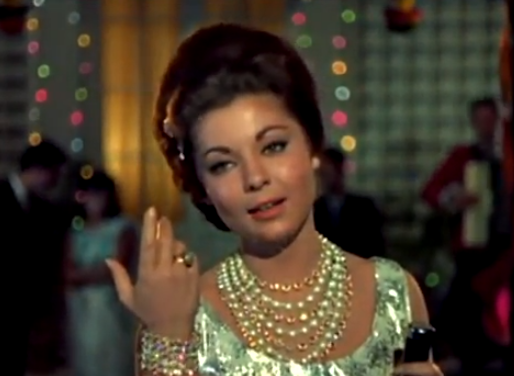
Do you recognize the woman on whom this song is picturized in the film? Her name is Erica Lal, but I couldn’t find much biographical information about her except that she was an American woman who married an Indian living in Mumbai at this time. In any case, she looks stunning on screen during this song and captures the spirit and style of the sophisticated ’60s crooner.

–Mr. 55

Erica Lal is the epitome of the stylish ’60s crooner in Waqt (1965)

Aage Bhi Jaane Na Tu Lyrics and Translation

aage bhii jaane na tu, piichhe bhii jaane na tu
You may not know what lies ahead of you, nor do you know what lies behind you.

jo bhii hai, bas yahii ek pal hai
What is here now is only this one moment.

anjaane saayo.n kaa raaho.n mein Deraa hai
Unknown shadows camp along the paths ahead,

andekhii baaho.n ne ham sab ko ghera hai
While unseen arms have embraced us all.

yeh pal ujaalaa hai, baaqii andhheraa hai
This moment is shining with light; everything else is darkness.

yeh pal gavaana na, yeh pal hii teraa hai
Do not waste this moment, as only this moment is yours.

jiinevaale, soch le yahii vaqt hai kar le purii aarzuu
Think fast, oh living soul: this is the time to fulfill all your desires.

is pal ke jalvo.n ne mahfil sa.nvaarii hai
The passion of this moment has graced this gathering,

is pal kii garmii ne dhaDkan ubhaarii hai
And the warmth of this moment has accelerated our heartbeats.

is pal ke hone se duniyaa hamaarii hai
The world is ours because of this moment’s existence.

yeh pal jo dekho to sadiyo.n pe bhaarii hai
Take a look at this moment, for its grandeur is to be remembered for centuries.

jiinevaale, soch le yahii vaqt hai kar le purii aarzuu
Think fast, oh living soul: this is the time to fulfill all your desires.

is pal ke saaye me.n apnaa Thikaanaa hai
One’s destination can be found in the shadows of this moment.

is pal ke aage hii har shay fasaanaa hai
Ahead of this moment, all objects become stories of fantasy.

kal kis ne dekhaa hai? kal kis ne jaanaa hai?
Who has seen tomorrow? Who has known tomorrow?
is pal se paayegaa jo tujh ko paanaa hai
From this moment, you shall receive all that you are due.

jiinevaale, soch le yahii vaqt hai kar le purii aarzuu
Think fast, oh living soul: this is the time to fulfill all your desires.

aage bhii jaane na tu, piichhe bhii jaane na tu
You may not know what lies ahead of you, nor do you know what lies behind you.

jo bhii hai, bas yahii ek pal hai
What is here now is only this one moment.

Glossary

pal: moment; anjaane: unknown; Deraa: stop, camp; andekhii: unseen; baahe.n: arms; ghernaa: to encircle, embrace; ujaalaa: light; andhheraa: darkness; jiinevaale: living soul;  aarzuu: desire; jalvaa: passion; mahfil: gathering; sa.nvaaranaa: to grace, adorn; ubhaarnaa: to intensify, accelerate; sadii: century; Thikaanaa: destination, address; shay: object;  fasaanaa: tale, story

Raaj Kumar beats up a salacious drunkard to protect Sadhana’s honor. With the right combination of handsome looks, sophisticated personality, and masculine brawn, he is a model example of the classic Bollywood stud.