Kabhi Kabhi Mere Dil Mein Lyrics and Translation: Let’s Learn Urdu-Hindi

kabhi kabhi shashi kapoor rakhee 3

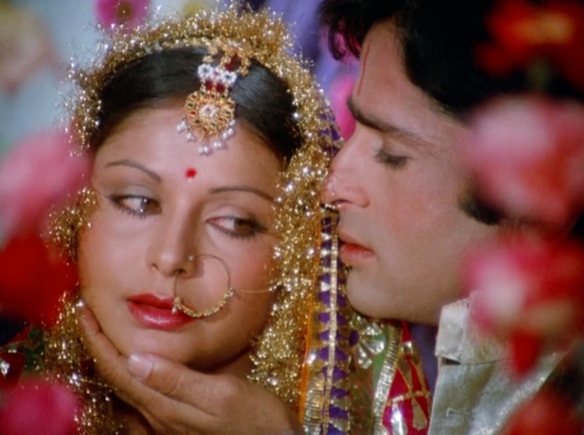
Shashi Kapoor and Rakhee celebrate their wedding night with song in Kabhi Kabhi (1976).

Happy Valentine’s Day! In honor of the occasion, we present the lyrics and full English translation to one of the great love poems of Hindi films: “Kabhi Kabhi Mere Dil Mein” from the 1976 star-studded mega-hit Kabhi Kabhi.

Penned by that evergreen poet Sahir Ludhianvi, “Kabhi Kabhi” remains on top of any list of Bollywood love songs. The lyrics are written from the heart in adoration of a woman on a couple’s wedding night. The song is reflective and gentle, but bursting with a beautiful excitement of what lies ahead. Kabhi Kabhi revolves around the love affairs of the protagonists and their effects on the next generation. The ageless devotion expressed in this song continues to evolve and evoke new meanings as the film progresses from one revelation to the next.

An interesting aspect of this song is that it is sung from a male perspective by a female heroine (after all, the song was dedicated to her in the first place by Amitabh Bachchan!) Lines like “Suhaag raat hai, ghunghaT uTaa rahaa hoo.N mai.N” evoke tragic irony as Rakhee feels her veil lifted by a man she does not love. Similarly, the final line “Mai.N jaantaa huu.N ki tuu gher hai, magar yuu.N hii” can be interpreted as both as an understanding that husband and wife still must get to know one another, but also as Amitabh Bachhan accepting that Rakhee now belongs to someone else. And just further to wring your heart, blind-to-reality Shashi Kapoor insists to her that if they ever meet the great poet who wrote these words, they must thank him for being with them on their wedding night. (Naturally, they all do meet up somehow–and it’s every bit a circus you can imagine!)
kabhi kabhi shashi kapoor rakhee 2

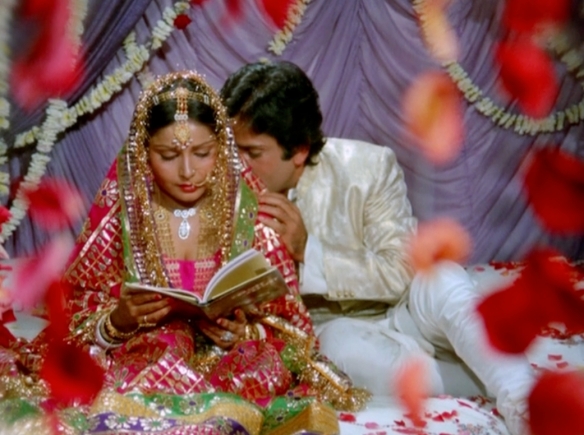
Rakhee sings from the anthology of poems written by a former lover in Kabhi Kabhi (1976).

You don’t need to know or appreciate the background of this song to fall head over heels for its melody and blissful lyrics. So celebrate the love in your life and enjoy our English translation of “Kabhi Kabhi Mere Dil Mein” below!

Kabhi Kabhi Mere Dil Mein Lyrics and Translation:

Mukesh:

Kabhi kabhi mere dil mei.N khayaal aataa hai
Sometimes this thought enters my heart

Lata:

Kabhi kabhi mere dil mei.N khayaal aataa hai
Sometimes this thought enters my heart
Ki jaise tujhko banaayaa gaya hai mere liye
That you were created only for me
Tu ab se pehle sitaaro.n mei.N bas rahii thii kahii.N
Before now you lived somewhere among the stars
Tujhe zameen pe bulaayaa gayaa hai mere liye
You were called to earth only for me

Kabhi kabhi mere dil mei.N khayaal aataa hai
Sometimes this thought enters my heart
Ki yeh badan, yeh nigaahe.N merii amaanat hai.N
That this body and these eyes belong to me
Yeh gesuuo.N kii ghanii chaao.N hai.N merii khaatir
These dark shadows of your hair are for me alone
Yeh honTh aur yeh baahe.N meri amaanat hai.N
These lips and these arms belong to me

Kabhi kabhi mere dil mei.N khayaal aataa hai
Sometimes this thought enters my heart
Ki jaise bajatii hai shahanaaiiaa.N sii raaho.N mei.N
As if wedding music is being played in the streets

Mukesh:

Suhaag raat hai, ghunghaT uTaa rahaa huu.N mai.N
It is our wedding night, I am lifting your veil

Lata:

Suhaag raat hai, ghunghaT uTaa rahaa huu.N mai.N
It is our wedding night, I am lifting your veil
SimaT rahii hai tuu sharmaake apne baaho.N mei.N
You shyly blush as I wrap you in my arms

Kabhi kabhi mere dil mei.N khayaal aataa hai
Sometimes this thought enters my heart
Ki jaise tuu mujhe chaahegii umr bhar yuu.N hii
That you will love me forever like this
UThegii merii taraf pyaar kii nazar yuu.N hii
That you will always lift this loving gaze to me

Mukesh:

Mai.N jaantaa huu.N ki tuu gher hai magar yuu.N hii
I know you are still a stranger, however
Kabhi kabhi mere dil mei.N khayaal aataa hai
Sometimes this thought enters my heart

Glossary:

kabhi kabhi: sometimes, from time to time; khayaal: thought; sitaaraa: star; zameen: earth; badan: body; nigaahe.N: glances, eyes; amaanat: property; gesuu: hair; ghanii: dark; chaao.N: shadow; [kisii kii] khatir: [for someone’s] sake; honTh; lips; baahe.N: arms; amaanat: belonging; shahanaaii: a wind instrument usually played at weddings; raah: path, streets; suhaag raat: wedding night; ghunghaT: veil; sharmaanaa: to become shy; umr bhar: whole life; [kisii kii] taraf: [in someone’s] direction; gher: stranger
kabhi kabhi shashi kapoor rakhee 4

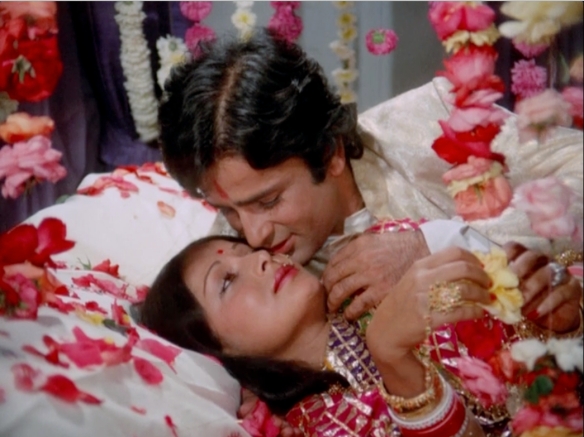
By the end of “Kabhi Kabhi”, the already awkward suhaag raat scene inevitably becomes more awkward.

This special Valentine’s day post is dedicated to my fiancé! It’s been two years since we’ve been together and I’ve loved every moment. Thank you for putting up with my singing old Lata songs outside my range while you’re trying to study, and for finally appreciating the epicness that is Mughal-e-Azam!

DSC_2492

My adorable fiancé and I met at as undergrads at Harvard where he was in the class ahead of me. He proposed two years later, and now we’re busy planning the wedding!

– Mrs. 55

Mata Saraswati Sharda Lyrics and Translation: Let’s Learn Urdu-Hindi

Saraswati

Saraswati, the Hindu goddess of knowledge and music, is worshipped each year on Basant Panchami.

Basant Panchami is a Hindu festival that celebrates the arrival of Spring through the worship of Saraswati, the goddess of knowledge and music. On this day, Ma Saraswati is worshipped with great fervor and devotion, especially by students in educational institutions across India.  In addition, many young children are given their first lesson in writing on this holiday through a ritual called haathe-korii. Since this auspicious holiday is coming up in just a few days on Friday, we are presenting the lyrics and English translation to one of Bollywood’s  only homages to goddess Saraswati: maataa sarasvatii shardaa from Alaap (1977).

As many of you probably know, bhajans dedicated to Saraswati are a rare commodity in the arena of Bollywood cinema. The majority of the film industry’s references to Hinduism focus on Vishnu in the form of Krishna and his consort Radha. What is the reason behind Bollywood’s obsession with Radha and Krishna? The most obvious answer is that the love stories presented in Hindi films lend themselves easily to comparisons to the romance shared between these two figures of Hinduism. Bollywood heroes can identify with flirtatious Krishna who uses his charm to seduce Radha whose delicate coyness resembles that of Bollywood heroines.  An austere deity like Saraswati, symbolizing wisdom and education, finds little glamor in an industry that is driven primarily by themes based on love and romance. 

In what context does Saraswati receive prominence in Hrishikesh Mukherjee’s Alaap (1977)? Tuned by Jaidev in Raga Bhairavi, a version of this bhajan sung by Yesudas, Madhurani, and Dilraj Kaur opens the film as Amitabh Bachhan prays to Saraswati for her blessings at the music school where he studies classical vocal. This bhajan also concludes the film when a version sung by Lata Mangeshkar and Dilraj Kaur is reprised on Rekha singing along with her son for her husband Amitabh who has contracted a severe case of tuberculosis.  The homage to Saraswati is fitting in Alaap because the film’s plot is driven in part by music. In Alaap, Amitabh Bachhan desires to become a classically trained vocalist against the wishes of his conservative father Om Prakash who refuses to accept music as a legitimate profession. He pressures Amitabh to become a lawyer like himself and the ensuing resentment leads to a bitter conflict between father and son that culminates in a tragic conclusion.

As the holiday of Basant Panchami approaches with its celebration of learning and new beginnings, we hope that you enjoy this beautiful bhajan and our English translation provided below. May Ma Saraswati bless all of us in our academic and musical pursuits during the upcoming year. Until next time…

-Mr. 55

P.S. This non-filmi Saraswati Vandana recorded by Lata is also divinely enchanting: yaa kundendu tushaar haar dhavalaa

AB

Amitabh Bacchan looks pious in white during prayers to Ma Saraswati in a music school in Alaap (1977)

Mata Saraswati Sharda: Lyrics and Translation

maataa sarasvatii sharadaa,
Mother Saraswati,
he maataa sarasvatii sharadaa!
Oh mother Saraswati!
vidyaadaanii dayaanii dukh-harinii
You are the giver of knowledge, the goddess of compassion, and the remover of sorrow.
jagatajananii jvaalaamukhii
You are the fire-mouthed mother of this world.
maataa sarasvatii sharadaa!
Mother Saraswati!

kiije sudrishTi
Please cast an auspicous glance upon us,
sevak jaan apnaa
and know us as your humble servants.
itnaa vardaan diije
Please grant us these boons:
taan, taal, aur aalaap
musical mastery of passagework, rhythm, and preludes.
buddhii ala.nkaar, sharadaa
Knowledge is your jewel, Saraswati.

he maataa sarasvatii shardaa!
Oh mother Saraswati!

Glossary

maataa: mother; sarasvatii: Hindu goddess of learning and music; sharadaa: another name for Saraswati; vidyaadaanii: giver of knowledge; dayaanii: goddess of compassion; dukh-harinii: remover of sorrow; jagatjananii: mother of the world; jvaalaamukhii: fire-mouthed; sudrishTii: auspicious glance; sevak: servant; vardaan: boon; taan: musical passagework; taal: rhythm; aalaap: prelude to a raagbuddhii: knowledge; ala.nkaar: jewel, ornamentation.

Rekha

Rekha sings a reprise of this bhajan with her son for her ailing husband Amitabh in the conclusion of Alaap (1977)

Dil Cheez Kya Hai Lyrics and Translation: Let’s Learn Urdu-Hindi

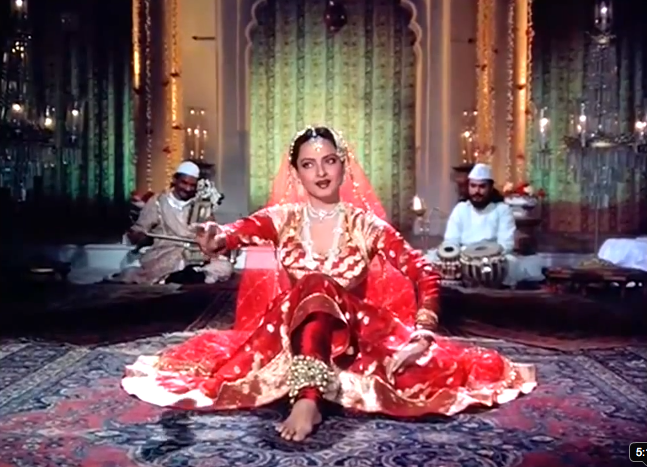
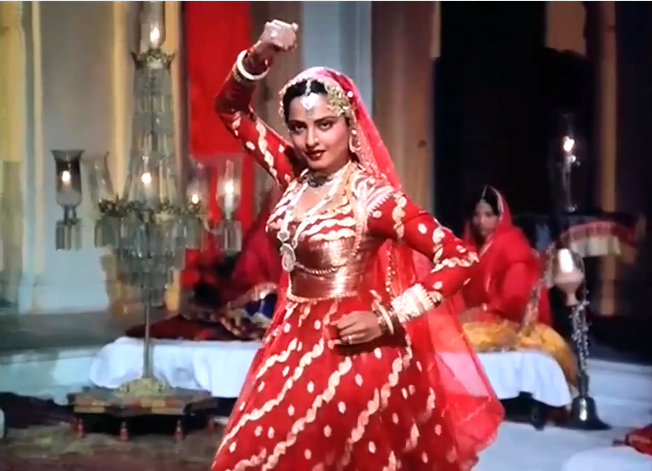
Rekha stars as a courtesan and poetess in Umrao Jaan (1981), based on an Urdu novel by Mirza Muhammad Hadi Ruswa

Today, we continue our series on Umrao Jaan (1981) by providing the lyrics and English translation to what is arguably the film’s most popular song: dil chiiz kyaa hai?  Based on Mirza Muhammad Hadi Ruswa’s novel Umrao Jaan Ada, this film narrates the tragic tale of a young girl who is kidnapped and forced to become a tawaif (courtesan).

Through the course of this film, we witness the transformation of an innocent young girl Amiran as she becomes Umrao Jaan Ada, one of Lucknow’s most sought after courtesans. At the brothel, young Amiran receives training in classical voice, Kathak dance, and Urdu poetry–a forbidden world of art and education that the average Indian girl of this time period would never get the chance to explore. When the brothel’s madam Khanum feels that she has been sufficiently groomed, Umrao Jaan begins performing and attracting the attention of wealthy patrons all over Lucknow. Umrao’s first public performance as a courtesan is marked by the song dil chiiz kyaa hai?

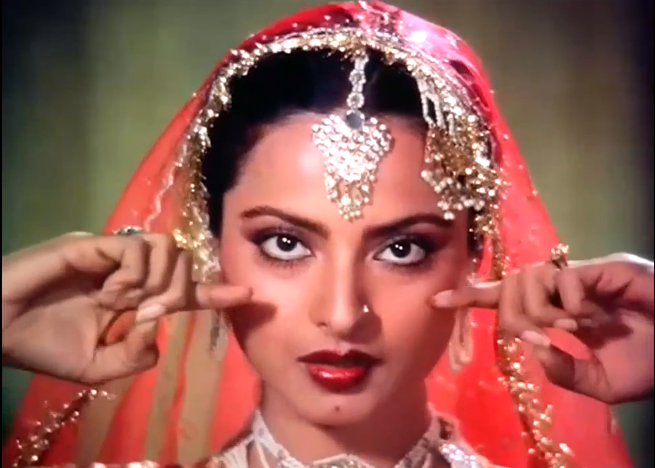
This gem is considered to be one of Asha Bhonsle’s career-defining songs, and she was awarded a National Film Award for her performance of this ghazal along with the rest of her contributions to this soundtrack. Khayyam bagged a well-deserved National Film Award for his compositions in this film, and Rekha took home the National Film Award for Best Actress. From her performance in this mujra in particular, it is clear that Rekha is worthy of all the critical acclaim she received for her work in Umrao Jaan.  Although she may lack the technical precision of a trained Kathak dancer, she compensates with her compelling on-screen presence and natural elegance. With eyes like hers, would any man in Lucknow be able to resist the charms of Umrao Jaan Ada?

What is your favorite song from the Umrao Jaan soundtrack? Share with us in the comments! Until next time…

-Mr. 55

Rekha’s mujras in this film, especially dil chiiz kyaa hai?, are fan-favorites to this day.

Dil Cheez Kya Hai: Lyrics and Translation

dil chiiz kyaa hai? aap merii jaan liijiye
What is the heart worth? Take my life instead!
bas ek baar meraa kahaa maan lijiye
But just once, please accept what I say.

is a.njuman me.n aap ko aanaa hai baar baar
You must return to this gathering time and time again.
diivaar-o-dar ko ghaur se pahchaan liijiye
So, learn to recognize these surroundings carefully.

maanaa ki dosto.n ko nahii.n dostii kaa paas
I admit that friends may not always hold friendship in high regard.
lekin yah kyaa ki ghair kaa ahsaan liijiye?
Yet, does this mean you should accept kindness from strangers?

kahiye to aasmaa.n ko zamii.n par utaar laaye.n
If you ask for it, I shall bring down the sky to the ground. 
mushkil nahii.n hai kuchh bhii agar Thaan liijiye
No task is difficult if you pursue it firmly.

dil chiiz kyaa hai? aap merii jaan liijiye
What is the heart worth? Take my life instead!
bas ek baar meraa kahaa maan liijiye
But just once, please accept what I say.

Glossary

maan lenaa: to accept; anjuuman: gathering; diivaar-o-dar: walls and doors, surroundings; ghaur se: carefully; pahchaan lenaa: to recognize; dostii: friendship; paas: regard, consideration; ghair: stranger; ahsaan: favor, kindness; utaar laanaa: to bring down; Thaan lenaa: to pursue firmly.

A quick note regarding the word paas. Those of you familiar with its common use in the phrase kisii ke paas (next to someone/something) may be confused by the line “maana ki dosto.n ko nahii.n dostii kaa paas.” Here, a less common use of the word paas is used to mean regard or consideration. So, there is no relation to proximity here; the whole line would be translated as: “I admit that that friends may not always hold friendship in high regard.” Tricky, tricky.

As Umrao Jaan, Rekha seduces wealthy men in Lucknow with her most tempting asset: her eyes!

Dam Bhar Jo Udhar Lyrics and Translation: Let’s Learn Urdu-Hindi

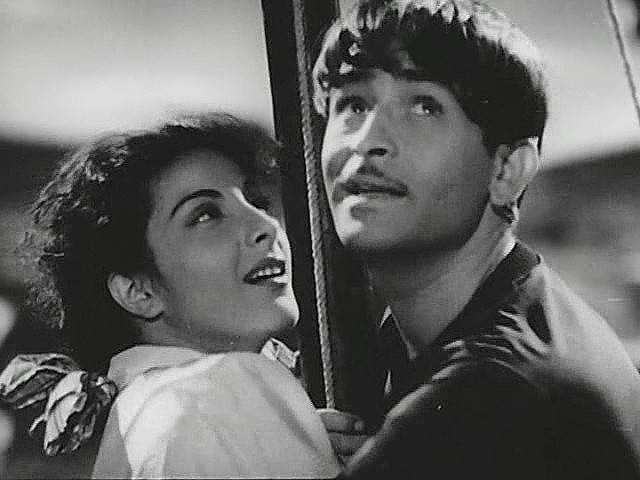
Raj Kapoor and Nargis Awara Dum Bhar Jo Udhar

Raj Kapoor and Nargis huddle together on a love-boat in Awaara (1951).

Our next lyrics and English translation is of the great love duet “Dum Bhar Jo Udhar” from the film Awaara (1951). It’s practically impossible to not love this song. Raj Kapoor plays an underworld criminal who falls for the wealthy ward of a rich judge played by his favorite leading lady Nargis. The film launched both of their careers to mega-stardom and for good reason. Packed with musical gems like the evergreen “Awaara Hoon” or “Ghar Aaya Mera Pardesi,” the film is a scathing social drama that weaves Raj Kapoor’s own respectable father, Prithviraj Kapoor, into the heart of its scandalous and surprising twist. The film was so well-received and brilliantly made that it was nominated for a Grand Prize at the Cannes Film Festival in 1953! Propelled by a tempting bad-boy with a tragic past storyline, the film arguably contains the greatest performance of Raj Kapoor’s career. Awaara is a historical and artistic must-see!

Dum Bhar Jo Udhar” is a Mukesh-Lata duet sung on a small boat in the middle of the night. Shailendra’s lyrics embody a theme common in Hindi films, which emphasizes the shyness of the woman and the boldness of the man. Both man and woman address the only other witness to their tryst–the beautiful moon above. However, the woman begs the moon to look away and not make her feel shy, while the man eagerly urges the moon to shine upon him and witness their love blossom. The importance of moon imagery in Urdu-Hindi poetry is legendary–most often taking the form of a feminine metaphor that epitomizes beauty. In this case, however, the playful moon evokes the male gaze as a trusty ally to the hero and a source of embarrassment to the heroine. It’s so adorable I could squirm.

Nargis Awaara Dum Bhar Jo Udhar

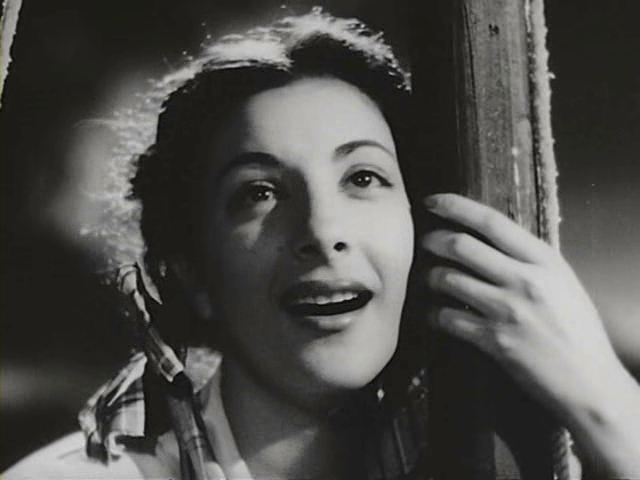
The eternally lovely Nargis glows in the moonlight in Awaara (1951).

Here are the full lyrics and English translation to “Dum Bhar jo Udhar” from Awaara (1951). Enjoy our interpretation of the song’s meaning and follow along on youtube with this link!

Dam Bhar Jo Udhar Lyrics and Translation

Lata:

Dam bhar jo udhar muu.N phere, O Chandaa
O Moon, if you would turn your face away for one moment
Mai.N unse pyaar kar luu.Ngii
I will make love to him
Baate.N hazaar kar luu.Ngii
I will say a thousand things to him

Dil kartaa hai pyaar ke sajade
My heart has prayed for such love
Aur mai.N bhii unke saath
And now I am with him
Chaand ko chandaa roz hii dekhe
The moon sees moonlight every day
Merii pehlii raat, ho, merii pehlii raat
But this is my first night, oh, this is my first night!
Baadal mei.N ab chhup jaa re! O Chandaa
Now go hide in the clouds, O Moon!
Mai.N unse pyaar kar luu.Ngii
For I will make love to him
Baate.N hazaar kar luu.Ngii
I will say a thousand things to him

Mukesh:

Dam bhar jo idhar muu.N phere, O Chandaa
O Moon, if you would turn your face here for one moment
Mai.N unse pyaar kar luu.Ngaa
I will make love to her
Nazare.N do-chaar kar luu.Ngaa
I will steal a few glances from her

Mai.N chor hoo.N kaam hai chorii
I am a thief, and my job is to steal
Duniyaa mei.N hoo.N badnaam
I am dishonored in society
Dil ko churaataa aayaa hoo.N mai.N
I have come to steal your heart
Yehii meraa kaam, ho, yehii meraa kaam
This alone is my job
Aanaa tuu gavaahi dene, O Chandaa
You must come and be a witness, O Moon
Mai.N unse pyaar kar luu.Ngaa
For I will make love to her
Nazare.N do chaar kar luu.Ngaa
I will steal a few glances from her

Lata:

Dil ko churaake kho mat jaanaa
Do not steal my heart and then become lost
Raah na jaanaa bhool
Do not forget your way back to me
In qadmo.n se kuchal na denaa
Do not crush with your footsteps
Mere dil kaa phool, ho, mere dil kaa phool
The flower of my heart, oh, the flower of my heart!
Yeh baat unhe.N samjhaa de, O Chanda
You make him understand this, O Moon
Mai.N unse pyaar kar luu.Ngii
I will make love to him
Baate.N hazaar kar luu.Ngii
I will say a thousand things to him

Glossary:

dam bhar: one full moment; udhar: in that direction; muu.N: face; pherna: to turn; hazaar: a thousand; pehlii; first; baadal: clouds; idhar: in this direction, here; do-chaar: a few; badnaam: a person of ill-repute; gavaahi denaa: to serve as witness; raah: path, way; qadam: footsteps; kuchal dena: to crush; phool: flower; samjhaa denaa: to make [someone] understand

Now before anyone gets their knickers in a twist, let’s just talk briefly about the phrase “Mai.N unse pyaar kar luu.Ngii” and what that really means. I have translated it somewhat literally for simplicity’s sake as “I will make love to him,” but that phrase in English carries with it more physical connotations than what it means in this context. Although the verb “pyaar karna” means simply “to love” as in the general English sense, the way it is used in this song carries a more immediate sense of both action and personal gain–by adding the coloring verb “lena” (“to take”), the phrase now implies that the girl is about to do something for her own benefit. We can safely say that these lyrics are not a prelude to actual Victorian “love-making” on that rocky boat of theirs, but rather an expression of desire and courtship. When she says, “Mai.N unse pyaar kar luu.Ngii,” I argue that this means no more than whispering sweet nothings, holding hands, stealing glances, and other forms of expressing tenderness and passion short of actually “making love.” See my point? And don’t let Nargis’ pole dancing throw you off.

Nargis pole dancing awaara

Yeah, no seriously I wasn’t kidding. Nargis takes the phrase “pole-dance” to a whole new level in Awaara (1951).

You know what’s really great about this movie? The fact that ages before women were given anything close to social equality, Nargis plays a powerful lawyer who ends up bringing justice to her lover Raj Kapoor. She stands strong in a court filled with men, and really makes us all proud. Granted, she’s really rich and let’s Raj Kapoor SLAP her in a different scene (kill me now), but we can appreciate what she stood for at least in that regard. It’s one of the best courtroom scenes of the industry! This song was requested by die-hard fan lalten–hope you enjoyed!

– Mrs. 55

Dum Maro Dum Lyrics and Translation: Let’s Learn Urdu-Hindi

Zeenat Aman Dev Anand Dum Maro Dum

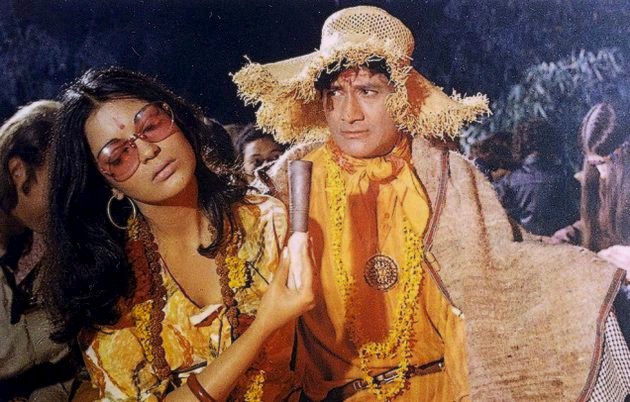
Zeenat Aman becomes shamelessly intoxicated in front of her brother Dev Anand in Hare Rama Hare Krishna (1971). More importantly, can someone please burn that hideous floppy straw hat?

Our next lyrics and English translation is the epitome of youthful rebellion and psychadelic glamour: “Dum Maro Dum” from Dev Anand’s 1971 Hare Rama Hare Krishna. The translation could not have come at a more appropriate time–as many of you know, as of 2 weeks ago, medical marijuana is now legalized in Massachusetts. So to all the Harvard seniors getting ready to graduate in a few months, this song is for you! When people think of Asha Bhonsle at her craziest, “Dum Maro Dum” is often the song that comes immediately to mind. It’s seductive, eccentric, and exhibits her full range from those bizarre, unexpected high notes to the fabulous embodiment of character as only Asha knew how. It’s one of incomparable music director R.D. Burman’s greatest works for the ground he broke–putting illicit drugs and societal defiance to the forefront in a youth-targeted song that was so instantly catchy no one could brush it off. Let’s face it, with this song, Zeenat may represent everything we don’t want in our loved ones, but God, does she make it look appealing.

Zeenat Aman Hare Rama Hare Krishna

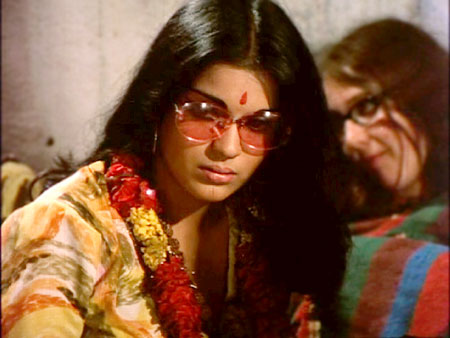
Gorgeous Zeenat Aman sports a pair of show-stopping 70s shades as a drug addict in Hare Rama Hare Krishna (1971).

Shot in one of Dev Anand’s favorite locations, Kathmandu (remember Jewel Thief, anyone?), Hare Rama Hare Krishna is a politically-driven film against the subversive hippie culture that our hero believes to be distorting the true message of the Hindu ideals it pretends to preach. Dev Anand hunts down his long-lost sister in such a hippie camp and tries to extricate her with tragic results. The film delivers a powerful message without feeling like Manoj Kumar-eqsue patriotic propaganda. I really applaud Dev Anand for making such a bold film that critiques a subject so ignored by his contemporaries and so popular among the masses who bought into it–with a delightfully satirical name like Hare Rama Hare Krishna, the film was a risk and it paid off.

So enjoy our English translation and lyrics to “Dum Maro Dum” below! Follow along with the video and let us know your thoughts on this controversial smash hit in the comments! You know how Zeenat starts the song with a little “Hush!” just before the music starts? I can’t exactly explain why, but I always feel really awkward when I hear it.

Dum Maro Dum Lyrics and Translation

Dam maaro dam miT jaaye gham
Take another hit, all your worries will disappear
Bolo subah shaam hare krishna hare raam
From morning until night sing, “Hare Krishna Hare Ram!”

Duniyaa ne hum ko diyaa kyaa?
What has the world given us?
Duniyaa se hum ne liyaa kyaa?
What have we taken from the world?
Hum sab kii parwaa kare.N kyo.N?
Why should we worry about anyone?
Sab ne humaaraa kiyaa kyaa?
What has anyone does for us?
Dam maaro dam miT jaaye gham…

Chaahe jiye.Nge, mare.Nge
Whether we want to live or to die
Hum na kisii se Dare.Nge
We won’t be afraid of anyone
hum ko na roke zamaanaa
The world won’t be able to stop us
Jo chaahe.Nge hum kare.Nge
For we will do what we want

Dam maaro dam miT jaaye gham
Take another hit, all your worries will disappear
Bolo subah shaam hare krishna hare raam
From morning until night sing, “Hare Krishna Hare Ram!”

Glossary:

dam maarnaa: to take a hit [of marijuana]; miT jaanaa: to disappear; gham: sadness, worries; subah shaam: from morning to night; Hare Krishna Hare Raam: a chant of the Hare Krishna sect popularized by the hippie culture in the 60s and 70s; duniyaa: society, the world; parwaa: worry; zamaanaa: the world

Zeenat Aman Dum Maro Dum

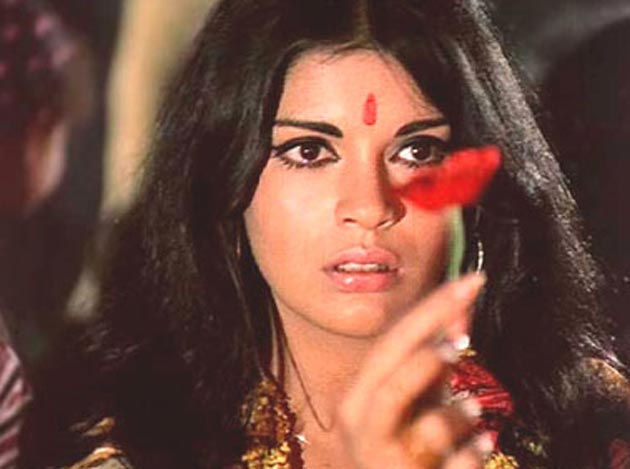
Zeenat Aman suddenly remembers her idyllic drug-free childhood with an emotional outburst of regret in Hare Rama Hare Krishna (1971).

For the sake of completeness, I feel compelled to include a translation of Dev Anand’s great comeback to the moral disorder he witnesses among the Hare Krishnas: “Dekho O Diwaano.” “Dekh O Diwano” and indeed the film Hare Rama Hare Krishna, is not a direct attack on the actual Hare Krishna movement, but rather the hippie culture that traveled with it in the 60 and 70s–and by blending the two, confused and disheartened many a contemporary conservative Hindu. Dev Anand makes some brilliant comparisons through example in this song–by drawing upon classic Hindu literature such as the Ramayan story of Lord Ram’s banishment to the forest (“Ram ne ha.Ns kar sab sukh tyaage“) and Krishna’s explanation to Arjun of the meaning of karma in the timeless battlefield of the Mahabharat (“Krishna ne karm ki riit sikhaayi“), Dev Anand makes a clear distinction between lip service and actual belief.

Dekho O Deewano Lyrics and Translation:

Dekho O deewano, tum yeh kaam na karo
Look, Oh crazy people, do not behave like this
Raam kaa naam badnaam na karo
Do not bring dishonor to the name of Ram

Raam ko samjho, Krishna ko jaano
Understand Ram, know Krishna well
Nee.Nd se jaago, O mastaano
Wake up from this sleep, Oh intoxicated ones
Jeet lo man ko paDh kar Geeta
Win back your mind by studying the Geeta
Man hii haaraa, to kyaa jeetaa?
For once you’ve lost your mind, what is there to win?

Hare Krishna, Hare Ram
Jeevan ko nashe ka tum ghulaam na karo
Do not make your life a servant to intoxications
Raam kaa naam badnaam na karo
Do not bring dishonor to the name of Ram

Raam ne ha.Ns kar sab sukh tyaage
With a smile, Ram renounced all his joys
Tum sab dukh se Dar ke bhaage
But you are scared and run away from every grief
Krishna ne karm kii riit sikhaaii
Krishna taught us the tradition of righteous action
Tum ne farz se aa.Nkh churaayii
But you avoid your duties

Hare Krishna, Hare Ram
Jeevan naam hai kaam kaa aaraam na karo
The meaning of life is work, do not rest
Raam kaa naam badnaam na karo
Do not bring dishonor to the name of Ram

Glossary:

badnaam: dishonored; tyaagnaa: to renounce; nee.Nd: sleep; Geeta: the Bhagavad Gita, a religious text within the epic poem the Mahabharat; jeevan: life; nashe: intoxications; ghulaam: servant; riit: culture, tradition; farz: duty; aa.Nkh churaanaa: to avoid; aaraam karna: to rest

While Zeenat Aman and her fellow groupies waste their minds and lives to drugs in the name of Lords Ram and Krishna, Dev Anand reminds the audience of the wrong of even inaction as discussed in the Gita. Classical Hindu dharmic responsibility is not passive, but active and tempered–with no stake in the outcome whether happiness or sadness. It is an ancient theme that you may recall Dev Anand explored years earlier in his 1965 legend Guide. Sadly, Zeenat Aman eventually succumbs to her addiction, and in the end the story returns briefly to the heart of many a great film: a tale of a broken family reunited.

These themes can certainly be pretty volatile subjects, and it’s not our intention to spark a political or religious debate on this forum. So we shall end with a grammar lesson instead: do you know why the “deewaano” and “mastaano” are used instead of simply “deewaane” or “mastaane”? The vocative as used here is a special case! The nasalization “o.N” used in the oblique (eg. “dosto.N ke saath”) is not to be confused with the vocative “o” (eg. “suniye, dosto”) used to address a group directly! People commonly make this sloppy Urdu mistake–so rise above the masses!

But don’t go that high, if you know what I mean. Have fun, Massachusetts.

-Mrs. 55