Inhi Logon Ne Lyrics and Translation: Let’s Learn Urdu-Hindi

MK

The tragically beautiful film Pakeezah (1972) stars Meena Kumari in its leading role.

Today, we continue our series on the eternally beautiful Pakeezah (1972) by providing the lyrics and English translation to inhii.n logo.n ne, a classic gem that has defined the genre of Bollywood mujras since its release.  

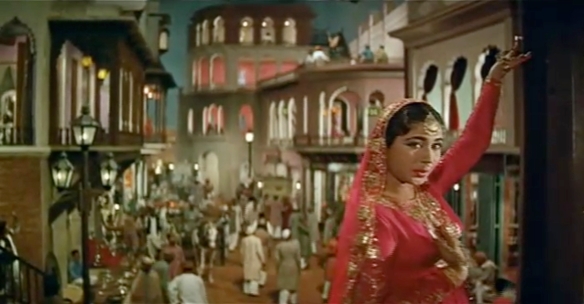
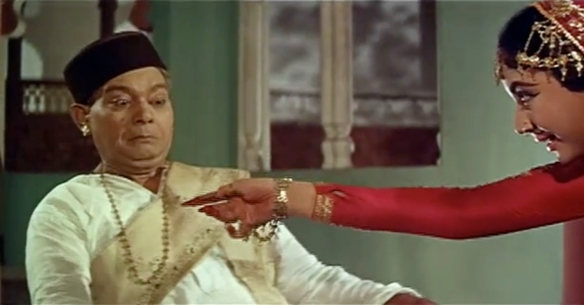
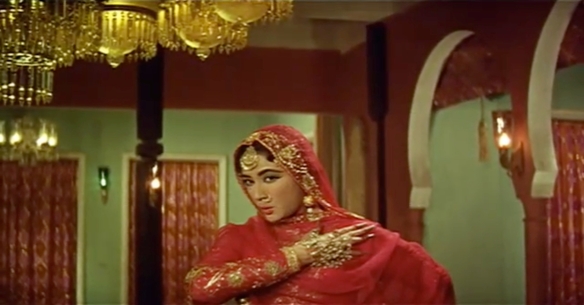
Tuned by Ghulam Mohammed and penned by Majrooh Sultanpuri, this song was perhaps the most widely appreciated number (it reached #2 on the 1972 Binaca Geet Mala list!) from a soundtrack full of memorable compositions like chalte chalte and mausam hai aashiqaanaa. Although its light, Yaman-based melody evokes a playful sprit, the underlying tragedy expressed in the lyrics of this song is unexpectedly ironic. In spite of the pain she suffers from being stigmatized as a tavaaif, Meena Kumari is forced to render this mujraa with verve and a smile for her patrons at the brothel. While addressing her beloved saiyaa.n, she laments how the men around her have stolen her innocence and modesty, which is symbolically represented by the loss of her DupaTTaa. To persuade her lover, she implores him to ask three characters in the song to confirm that her virtue was soiled against her will: the cloth merchant, the cloth dyer, and the constable. Representing different facets of society, these characters serve as witnesses to her loss of innocence and sometimes take part in the process (e.g. when the constable snatches her scarf away at the market.) To add to the irony, the red color of the lost scarf and Meena Kumari’s on-screen outfit are reminiscent of the colors adorning a South Asian bride on her wedding day. Yet, the audience is acutely aware that a courtesan in such a position will provoke condemnation and disgust for attempting to engage in the conventional structures of love and marriage established by the society around her. 

In addition to carrying a powerful message about social stigma in Indian society, these lyrics are memorable for their apabhransa (corrupt, non-grammatical) use of Urdu-Hindi. Reminiscent of the Awadhi dialect, a number of modifications to modern standard Hindi have been used here for poetic effect:

le liinaa = le liyaa (have taken)
bajajvaa = bajaj (cloth merchant)
hamrii = hamaarii (my, our)
sipaiyaa = sipaahii (constable)
bajariyaa = bazaar (market)

These substitutions really stick in the listener’s mind and give the lyrics of inhii.n logo.n ne a unique linguistic flavor that stands out from other compositions from the same period. Non-standard dialects such as Braj find prominence in classical Hindustani bandishes, but the lyricists for Bollywood cinema of the Golden Age tended to rely on standard Urdu-Hindi for most of their work. 

Songs like inhii.n logo.n ne have historically cast a sympathetic light on the tragic lives led by courtesans of yesteryear, and it is a well-known fact that fans have been fascinated with this genre of music and movies since the earliest days of the Hindi film industry. To conclude, I’ll leave you with a thought-provoking question: given the conservative social climate of 1960s and 1970s India, why did courtesan-based films (e.g. Pakeezah, Mughal-e-Azam, Amar Prem) resonate intimately with Indian audiences? Although deep-seated stigmas surround tavaaifs and their profession, what is the driving force behind India’s obsession with the story of a courtesan with a heart of gold? Let us know your thoughts in the comments!

-Mr. 55

P.S. Check out a rare black and white version of this song filmed on a younger Meena Kumari in 1956 (16 years before the film’s eventual release)!
MK

Meena Kumari’s playful spirit in ‘inhii.n logo.n ne belies the tragic reality of her profession as a courtesan in Pakeezah (1972).

Inhi Logon Ne: Lyrics and Translation

inhii.n logo.n ne, inhii.n logo.n ne
These people, these people
inhii.n logo.n ne le liina DupaTTaa meraa

These people have taken away my scarf of modesty.

hamrii na maano, saiyaa.nbajajvaa se puuchho
If you don’t accept my word, oh beloved, ask the cloth merchant
jis ne asharfii gaj diinaa DupaTTaa meraa
who sold me a yard of its fabric for a gold coin.

hamrii na maano, saiyaa.n, ra.ng rajvaa se puuchho
If you don’t accept my word, oh beloved, ask the cloth dyer
jis ne gulaabii ra.ng diinaa DupaTTaa meraa
who gave my scarf its pink color.

hamrii na maano, saiyaa.n, sipaiyaa se puuchho
If you don’t accept my word, oh beloved, ask the constable
jis ne bajariyaa me.n chhiinaa DupaTTaa meraa
who stripped away my scarf at the market.

inhii.n logo.n ne le liinaa DupaTTaa meraa
These people have taken away my scarf of modesty.

Glossary

le lenaa: to take away; DupaTTaa: a long scarf covering a woman’s chest, a traditional symbol of modesty and honor for Indian women; hamrii (baat): my word; maannaa: to accept, believe; bajajvaa: cloth merchant; asharfii: a gold coin issued by Muslim dynasties; gaj: a unit of measurement equivalent to a yard; saiyaa.n: beloved; rang rajvaa: cloth dyer; gulaabii: pink; sipaiyaa: constable; bajariyaa: market; chiinnaa: to strip away.
MK

Adorned in red and gold ornaments, Meena Kumari’s appearance resembles that of an Indian bride in Pakeezah (1972).

Jab Dil Hi Toot Gaya Lyrics and Translation: Let’s Learn Urdu-Hindi

KL Saigal in Shahjehan 1946

Pre-independance Indian actor and singer, K.L. Saigal plays a Mughal-era lover in in Shahjehan (1946).

Our next lyrics and English translation is of the ageless song “Jab Dil Hi Toot Gaya” from Shahjehan (1946). Known widely as early playback singer K.L. Saigal’s swansong, “Jab Dil Hi Toot Gaya” is a song close to my heart and family. K.L. Saigal was my great-great uncle through my Kashmiri Nani who grew up in Jammu near Saigal sahib‘s birthplace. It’s a song that defined a generation, and one that sadly, many of my generation have never known. The great K.L. Saigal’s voice was the voice of my grandparents–the voice of men and women who can remember a time before India gained independence, before the partition destroyed Punjab, and before Bollywood was redefined as a spectacle of the mass ornament. He was a superstar before there was Mohammed Rafi and before the rise of Lata Mangeshkar. For he lived and died in an era that did not know the glitter of Eastmancolor or the dazzle of expensive special effects. K.L. Saigal was an artist when poetry reigned supreme.

KL Saigal Devdas 1935

K.L. Saigal and co-star Jamuna by the riverbanks in the 1935 Hindi epic Devdas.

Like Al Jolson in America, K.L. Saigal revolutionized music in the 1930s and 1940s in the early days of “talkies” when the concept of a “playback singer” had not been born. He acted in his own films–including the famous 1935 Devdas that has been since remade by countless Bollywood thespians. You may not know his work, but you know his legacy. He left a profound stylistic impact on the great singers of the Golden era that would follow (think Mukesh’s “Dil Jalta Hai” from Pehli Nazar to understand how hard these artists sought to emulate Saigal sahib)! Perhaps you recall the song playing in background of Dilwale Dulhania Le Jayenge (1995) as Simran’s father returned home–it was none other than K.L. Saigal’s “Gham Diye Mushtaqil,” meant to represent the traditions of an backward generation–but in my opinion that sells it unfairly short. K.L. Saigal’s masterpieces may seem old-fashioned now, but they were the hallmark of those who fought for civil rights and equality, who dreamed of romance and greater things than the dull lives they were trapped in, and who believed in a future better than their own. Perhaps his audience is not so different from today’s. Me, when I hear “Jab Dil Hi Toot Gaya“, I am always reminded of my grandparents who used to sing this song at the most unexpected moments–for in its words are not just the roots of Bollywood as we know it, but of our own traditions.

KL Saigal

K.L. Saigal (1904-1947) passed away at the age of 43 after years of struggling with alcoholism. Someone tell me he doesn’t look straight from a German Expressionist film here–look at those piercing eyes!

I hope I can convince you to open your mind to the world of Hindi cinema before the Golden Age–at least this once! I think Saigal sahib‘s depth will surprise you–and perhaps you’ll recognize in the soulful lyrics of Majrooh Sultanpuri the many reincarnations of a similar theme that followed. In Shahjehan (1946), K.L Saigal plays a rejected lover involved in a complicated royal coup that ultimately ends in both a happy marriage for him and the construction of the Taj Mahal for eternity. Intriguing, no? Our lyrics and English translation to “Jab Dil Hi Toot Gaya” are below. Follow along with the video, and do let us know your thoughts on this old school number in the comments!

Jab Dil Hi Toot Gaya Lyrics and Translation:

Jab dil hii TuuT gayaa
When my heart is broken
Ham jii ke kyaa kare.Nge?
What can I do by living?

Ulfat ka diyaa hamne is dil mei.N jalaayaa thaa
I lit the flame of love in my heart
Umiid ke phoolo.N se is ghar ko sajaayaa thaa
I decorated this house with the flowers of hope
Ek bhedii looT gaayaa
And one of my own stole everything
Ham jii ke kyaa kare.Nge?
What can I do by living?
Jab dil hii TuuT gayaa
When my heart is broken

Maaluum na thaa intii mushkil hai.N merii raahe.N
I was not aware that my paths would prove so difficult
Armaan ke bahe aa.Nsuu, hasrat ne bhari aahe.N
I shed tears of desire, unfulfilled wishes filled my sighs
Har saathii chhuuT gayaa
Every companion abandoned me
Ham jii ke kyaa kare.Nge?
What can I do by living?
Jab dil hii TuuT gayaa
When my heart is broken

Glossary:

ulfat: love; diyaa: flame, candle; umiid: hope; phool: flower; bhedi: an insider, one of your own; maalum: awareness; mushkil: difficult; armaan: desire; aa.Nsuu: tears; hasrat: unfulfilled wish; aah: sigh; saathii: companion

Did you know that at the age of 13, a young Mohammed Rafi actually met K.L. Saigal? According to a new biography, Rafi sahib got the chance to meet his idol at a K.L. Saigal concert in Lahore in which young Rafi spontaneously performed a Punjabi solo to the accolades of the crowd. K.L. Saigal was so impressed with the boy’s talent, he patted him on the head and declared he would be a great singer one day!

-Mrs. 55

The Best Holi Songs of Classic Bollywood Movies

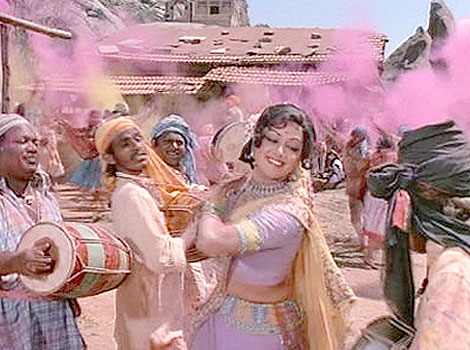
Hema Malini Sholay holi

Hema Malini dances with joyful abandon in Sholay’s famous holi number “Holi Ke Din.”

The festival of Holi is among Bollywood’s favorite celebrations–an occasion at last as colorful as the country of its origin. Indeed Holi, a Hindu spring festival, is commonly known as the Festival of Colors. It is both a religious celebration signifying the triumph of Good over Evil, as well as a cultural one commemorating the onset of a new Spring season. It is marked by the throwing of colorful powders, the lighting of bonfires, and the strengthening of bonds between all individuals in colorful merriment. Its spirited catchphrase “Buraa na maano, Holi hai!” (Don’t bear any ill-feelings, it’s Holi!”) speaks to the underlying theme of the day – the burning of negative forces or ill-will, a sort of spiritual purging. The smearing of colors represents the deconstructing of identities and the breaking of social barriers, as all rejoice and participate together, regardless of social class. At the very least, it is a day to settle old scores and move on. Indeed, everyone is welcome and everyone is pardoned for his or her revelry. Thus, we mortals celebrate Holi today with fun and games, colors and powder, and Bollywood takes this grand opportunity to ignite romance.

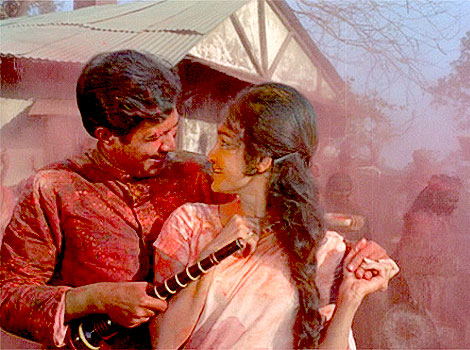
Rajesh Khanna asha parekh holi

Rajesh Khanna woos Asha Parekh with color at the Holi celebration of Kati Patang (1970).

There’s something inherent to the playful tag-style nature of Holi that lends itself so conveniently to flirtation and a male-female dichotomy. We discussed the appalling lack of Diwali-associated songs in classic Bollywood previously, and hazarded the guess that the festival is far less conducive to overt flirtation and bumping dance grooves like Holi invariably is. Whether wooing the mourning lover into a literal rainbow of joy or painting your sweetheart with a visible mark of your flirtatious overtures, Holi delivers the goods for Bollywood every time.

Mother India holi

Even the old school epic Mother India takes a drama break for the holi festivities!

Below is our list of the 10 greatest Holi songs of classic Bollywood cinema. Happy Holi to all our readers–and if you’re stuck in a huge snowstorm like we are, here’s hoping Holi will usher in the Spring at last!

1. Rang barse (Silsila 1981)

The ultimate old school Holi hit, this song will force anyone to get in the mood and join the festivities! Say what you want about Amitabh and Rekha’s clandestine affair, this dance number will get you on board in no time!

2. Aaj na chodenge (Kati Patang 1970)

This song is easily my favorite Bollywood holi song! Besides the fact that I grew up on the Kati Patang soundtrack, does it get much better than Rajesh Khanna-Asha Parekh shy seduction? Lata and Kishore are delightful, but don’t get me started on the bizarre chorus act that chops up the number like barbarians on holiday.

3. Holi Aayi Re Kanhaayi (Mother India 1957)

Oh, there’s no school like the old school! Bring it back Nargis-style with this classic song from Mother India that just overflows with romance and sass! The only thing better than a Holi song is a Holi village dance-off.

4. Tan rang lo ji (Kohinoor 1960)

While this royal gem may be shot in black-and-white, you can practically see the colors flying in this fantastic Mohammed Rafi-Dilip Kumar celebration that invites the entire kingdom for a Holi song-and-dance sequence!

5. Holi Ke Din (Sholay 1975)

Retro flirting Queen Hema Malini proves to Dharmendra that she’s more than just a loud mouth in Sholay–her moves and dancing steal the show in this colorful song!

6. Are Ja Re Hat Natkhat (Navrang 1959)

Classical dancer Sandhya wows the audience with this traditional stage performance, alternating as both the male and female character complete with ghungroo! Asha Bhonsle’s Hindustani vocals balance out Mahendra Kapoor’s mainstream sway in a Holi number that is well-known even today for its stunning classical choreography.

7. Piya Tose Naina (Guide 1965)

Looking for something a little classier? Go no further than this Waheeda Rehman semi-classical piece from the great philosophical Guide. Watch her prance around with so much joie de vivre, you’ll ignore how gaudy the stage is decorated and your feelings for high-pitched female choruses of the 1960s.

8. Nadiya Se Dariya (Namak Haram 1973)

This song is just plain cute. While not a roaring shoulder-shaking dance off like some of these others, the song is playful and full of shy passion for Rajesh Khanna, which we always approve of.

9. Baghi Re Bhagi Brij Bala (Rajput 1982)

I think this hidden jewel is under-appreciated by historians. While something of a repeat of previous Hema Malini-Dharmendra magic, Vinod Khanna holds his own in this fast-paced duet that once again brings an entire kingdom to the palace to party Holi-style!

10. Kaikhe Paan Banaraswala (Don 1978)

OK, so this isn’t technically a Holi song per se, but it’s arguably the unofficial anthem! There’s something about a traditional, rich beat coupled with Kishore’s absolutely unabashed vocals that set the tone of a celebration and throwing inhibitions to the wind!

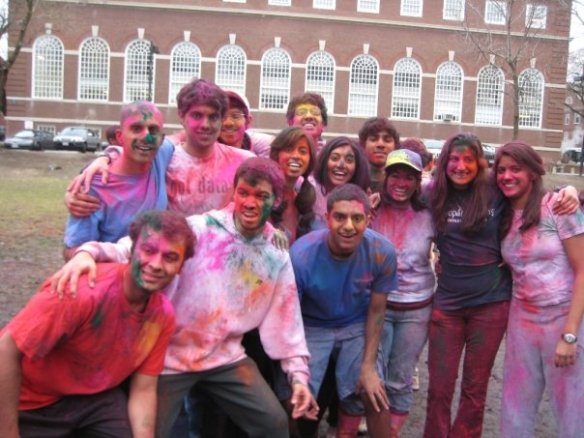
While Holi was born in India, it’s popularity was carried across the diaspora and is celebrated around the world each year with full force! The picture below is from my freshman year at Harvard where Holi was played on the Mac quad! Can you spot me in the pigtails with the orange-yellow face?

n31939_34049799_4730

– Mrs. 55

Tum Pukar Lo Lyrics and Translation: Let’s Learn Urdu-Hindi

Waheeda Rehman Tum Pukar Lo

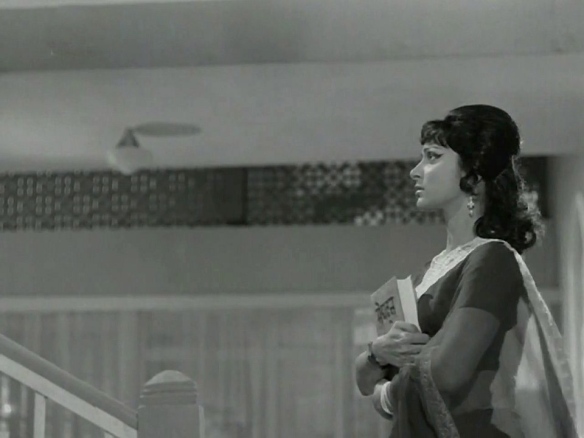
Waheeda Rehman hesitates at the bottom of a staircase leading to the man she loves in Khamoshi (1968).

For our next post we present the full lyrics and translation to the hauntingly beautiful “Tum Pukar Lo” from Khamoshi (1968). This song easily makes my list of most powerful and stirring picturizations from Bollywood. The stark black-and-white imagery highlights the emptiness of space, of shadows, and symbolic barriers. Most of all, the graceful shots that linger longer than action alone permits serve to create a new environment–a world of waiting where time slows down and the confines of the hospital become both escapist and imprisoning. I loved and still love the opening dolly shot so much that I attempted to recreate it in my final film project junior year of Harvard. The shot is transformative–literally taking the audience from behind bars to the free world, and Waheeda from the restraint of her conscience to the new life that beckons her above the staircase. A gentle wind miraculously flows down from Dharmendra’s balcony, through the barren corridor, down the grand stairs, and ultimately through Waheeda’s saari palluu giving rise to a simple, evocative image of a woman drawn by a force greater than any danger: love.

Waheeda Rehman Tum Pukar Lo Khamoshi

I LOVE the classic “frame-within-a-frame” of the mis-en-scene. Not how the lighting in this sequence informs the trajectory of the characters–recall that prior to Waheeda’s discouragement, the welcoming light source came from the balcony (now shrouded in obscurity), indicating a change in both destination and mindset.

I’ve broken down the dolly shot into 3 parts with my storyboard sketches to give you a full picture of how a shot like this is pulled off. The timing and fluidity of the dolly movement (and the pull focus) must be perfectly coordinated with the pace of the actresses walk as the camera additionally swivels on its own axis tracking her ascent up the stairs. I can only say after having attempting to do this shot myself, that it’s a headache but the effect is absolutely wonderful. Ultimately, Khamoshi is a film about identity and the silence caused by its loss through love. The misappropriated gazes in the film that lead characters in and out of a world of insanity is moving and tragic–and the audience too becomes implicit in that beautiful slippage of reality through Kamal Bose’s stunning cinematography, which won him the Filmfare award in 1968! Like Khamoshi’s characters, the camera lingers in each constructedly bereft space, longing for something more.

TumPukarLo1

The shot begins to the side of the staircase, a literal behind-bars view of Waheeda’s ascent.

tumpukarlo2

The camera swivels midway through the dolly pull at a low-angle as the rails of the staircase form a figurative cage around the actress.

The dolly track at last ends at the base of the staircase, holding the shot after Waheeda leaves the stairs, underscoring the incredible emptiness of the space she inhabits.

The dolly track at last ends at the base of the staircase, holding the shot after Waheeda leaves the stairs, underscoring the incredible emptiness of the rigid space she inhabits–and her escape from it.

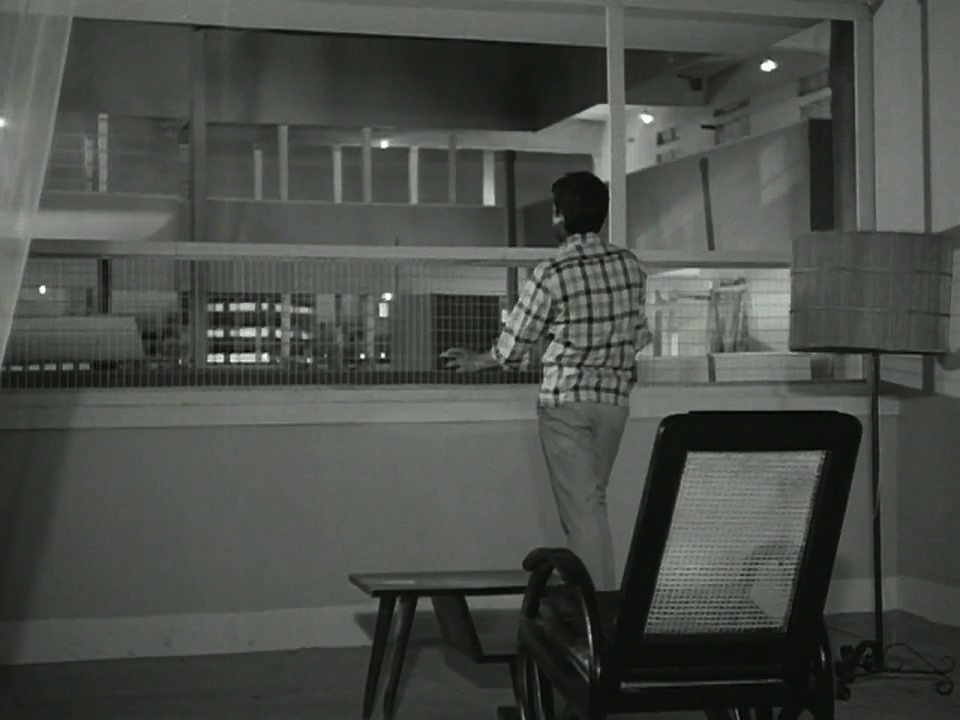
You won’t see much of Dharmendra, the mystery man and asylum inpatient, who sings this song. Instead you see only his outline against the balcony of their confinement. And of course, anything else would be imperfect–while this, this unfulfilled gaze of love, is precisely the poetic complement to the yearning expressed in Gulzar’s heartfelt lyrics. This song may be my favorite Hemant Kumar solo with a melody that hangs in the air long after the song is finished. Whether or not it beats Rajesh Khanna lip-syncing “Woh Shaam Kuch Ajeeb Thi” from the same film is up to you to decide!

tum-pukar-lo-03 Dharmendra

Dharmendra passes sleepless nights thinking of the beautiful woman he lost in Khamoshi (1968).

Without further ado, see for yourself why this song has become immortal. Follow along with the video here, and we hope you enjoy the lyrics and full English translation to “Tum Pukar Lo” below!

Tum Pukar Lo Lyrics and Translation:

Tum pukaar lo
Call out to me
Tumhaaraa intezaar hai
I am waiting for you
Tum pukar lo
Call out to me
Khwaab chun rahe hai.N raat beqaraar hai
I am sifting through dreams while the night remains restless
Tumhaaraa intezaar hai
I am waiting for you
Tum pukaar lo
Call out to me

HonTh se liye hue dil ki baat hum
The words in my heart have escaped from my lips
Jaagte rahe.nge aur kitne raat hum?
How many more nights will I remain awake like this?
Mukhtasar si baat hai: tumse pyaar hai
The matter is simple: I love you

Tumhaaraa intezaar hai
I am waiting for you
Tum pukaar lo
Call out to me

Dil bahal to jaayegaa is khayaal se
My heart will be content with this thought
Haal mil gaya tumhaaraa apne haal se
That my well-being becomes yours
Raat yeh qaraar ki beqaraar hai
This restful night remains restless

Tumhaaraa intezaar hai
I am waiting for you
Tum pukaar lo
Call out to me

Glossary:

pukaarnaa: to call; intezaar karna: to wait; khvaab: dream; beqaraar: restless; honTh: lips; mukhtasar: brief, short; bahal: content; khayaal: thought; haal: well-being, state; qaraar: restful, quiet

My favorite line of this song is by far “Mukhtasar si baat hai, tum se pyaar hai!” So romantic and God, how I love an understatedly accurate pronunciation of the Urdu khe! However, I’m afraid this is one of those cases in which no matter how you translate it, the beauty of the line is just lost in the bluntness of English.

Mrs. 55

Neela Aasman So Gaya Lyrics and Translation: Let’s Learn Urdu-Hindi

AR

Amitabh Bacchan plays a writer who falls for Rekha’s timeless beauty in Silsila (1981)

Directed and produced by Yash Chopra, Silsila (1981) sparked controversy even before it was released. Rumors regarding the film’s casting spread throughout the industry, as its portrayal of a love triangle between Amitabh Bacchan, his wife Jaya Bacchan, and his alleged mistress Rekha was said to mimic reality. Today, we present the lyrics and English translation of a classic romantic ballad from Silsilaniilaa aasmaa.n so gayaa.

This film depicts a passionate romance between Amit (played by Amitabh Bacchan) and Chandni (played by Rekha) that cannot culminate in marriage due to unfortunate circumstances. After his brother (played by Shashi Kapoor) is killed in the Indo-Pakistani War of 1971, Amit marries his brother’s pregnant fiancee in order to save her honor. Unable to pursue her love with Amit, Chandni marries Dr. Anand (played by Sanjeev Kumar). When Amit and Shobha are involved in a car accident (that causes Shobha to lose her baby), they are hospitalized and treated by Dr. Anand. Chandni sees Amit in the hospital, and this encounter triggers memories of their past love. Amit and Chandni give into their temptations and begin to rekindle their romance through clandestine meetings. The plot thickens when an evening rendezvous goes sour: Amit and Chandni must go to the police station after hitting a pedestrian while driving, and officer assigned to their case turns out to be Shobha’s cousin. How long can Amit and Chandni keep their adultery a secret? Will Amit and Chandni leave their spouses to be together? Silsila is worth a viewing to find out!

Although Silsila is not the first Bollywood film to depict extra-marital love, it is ground-breaking in its concrete portrayal of the consummation of adultery.  Indeed, this film compelled Indian audiences to think about extra-marital affairs and whether they can be cinematically romanticized in a way that appeals to the masses. Silsila offers some justification for the relationship between Amit and Chandni because they were a couple before Amit sacrificed his love to uphold his duty to his brother. However, the film portrays the tumultous decline of their extra-marital romance, eventually depicting Amit and Chandni as disloyal adulterers instead of righteous lovers. The uncomfortable subject matter is presumably the reason why this film failed to be a box office success. Regarding the audience’s reaction to Silsila, Yash Chopra has said:

 “The film had inherent tensions because of the casting coup. If I was confident of the project, it was because all the three artistes had individually assured me that there would be no problems at their end. And they kept their word. It was a film on extra-marital relationships and call it moral and societal pressures, but at the last minute, I developed cold-feet and thought that maybe the hero should come home to his wife. The original ended differently. When and why I changed the ending I don’t know, but I did so because I felt that the audience wasn’t ready. But the audience didn’t accept what we gave them either.”

Although audiences may not have reacted positively to its thematic content, the film has left a legacy of controversy that is still remembered today. The release of Silsila marked the end of the alleged affair between Rekha and Amitabh, but those associated with the Bollywood industry still discuss their love story more than 25 years later. At public events such as award functions, the media is unforgiving in keeping a close eye on how Amitabh, Jaya, and Rekha interact with each other!

Aside from its controversy, this film is also remembered for a number of special debuts. In Silsila, Yash Chopra introduced Shiv (santoor maestro Pt. Shivkumar Sharma) and Hari (flute maestro Pt. Hariprasad Chaurasia) for the first time as composers of Hindi film music. Moreover, Javed Akhtar penned his first lyrics for a Hindi film in Silsila. The soundtrack for Silsila has a number of popular hits such as dekhaa ek khvaab and rang barse, but “niilaa aasmaa.n so gayaa is especially noteworthy for its use of Amitabh Bacchan as a playback singer. Amitabh showcases his versatility as a performer by doing his own singing, which defied the conventions that had been established in the industry for years. Although he lacks the refinement of musical training, Mr. Bacchan can certainly hold a tune in his version of this ballad. A little bit past her prime, Lata Mangeshkar also offers a melancholic interpretation of the same song picturized on Rekha. Listen to both as you follow along with our translations, and let us know which version you prefer in the comments! Until next time…

-Mr. 55
AR

The first version of niilaa aasmaa.n showcases the passionate on-screen chemistry shared by Rekha and Amitabh Bacchan in Silsila (1981)

Neela Aasman So Gaya: Lyrics and Translation (Male)

niilaa aasmaa.n so gayaa
The blue sky has fallen into slumber.

os barse.n, raat bhiige, ho.nTh thharraaye.n
Dew falls, the night becomes drenched, and my lips quiver.
dhaDkane.n kuchh kahnaa chaahe.n, kah nahii.n paaye.n
Although my heartbeats desire to say something, they are unable to.
havaa kaa geet maddham hai
The breeze sings softly,
samay kii chaal bhii kam hai
while the time passes slowly.

merii baaho.n me.n sharmaate lajaate aise tum aaye
You came into my arms, shying away in embarassment, 
ki jaise baadalo.n me.n chaa.nd dhiire dhiire aa jaaye
like the Moon cautiously slipping into the clouds.
yah tanhaayii, yah mai.n aur tum
This solitude, you, and me. 
zamii.n bhii ho gayii gumsum
Even the Earth has fallen silent.

niilaa aasmaa.n so gayaa
The blue sky has fallen into slumber.

R

Rekha wallows in sorrow during the second version of niilaa aasmaa.n after Amitabh tells her that they cannot marry each other in Silsila (1981).

Neela Aasman So Gaya: Lyrics and Translation (Female)

niilaa aasmaa.n so gayaa
The blue sky has fallen into slumber. 

aa.nsuuo.n me.n chaa.nd Duubaa, raat murjhaayii
In my tears, the Moon has set and the night has withered. 
zindagii me.n duur tak phailii hai tanhaayii
Solitude has spread far into my life. 
jo guzre ham pe vah kam hai
What has happened to me thus far is a small beginning,
tumhaare gham kaa mausam hai
for I have just entered the season of sorrow for you.

yaad kii vaadii me.n guu.nje biite afsaane
Tales of the past resonate in the valley of memories. 
hamsafar jo kal the ab Thahare ve begaane
Yesterday’s companion is now a stranger. 
muhabbat aaj pyaasii hai
My love remains unquenched today.
baDii gahrii udaasii hai
I am overcome by a very deep sorrow.

niilaa aasmaa.n so gayaa
The blue sky has fallen into slumber.

Glossary

niilaa: blue; aasmaa.n: sky; os: dew; bhiignaa: to become drenched; tharraanaa: to quiver; dhaDkan: heartbeat; havaa: wind, breeze; maddham: dim, soft; samay: time; chaal: movement, passing; sharmaanaa: to shy away; lajaanaa: to be embarrassed; baadal: cloud; dhiire dhiire: cautiously; tanhaayii: solitude; gumsum: silent; murjhaanaa: to wither; phailnaa: to spread; yaad: memories; vaadii: valley; guu.njnaa: to resonate; afsaanaa: tale, story; hamsafar: companion: begaanaa: stranger; pyaasii: unquenched; gahraa: deep; udaasii: sorrow.

AJ

Amitabh Bacchan sacrifices his love for Rekha to marry his late brother’s pregnant fiance Jaya Bacchan in Silsila (1981).