Nigahein Milane Ko Jee Chahta Hai Lyrics and Translation: Let’s Learn Urdu-Hindi

Who wouldn’t want to exchange glances with those eyes?

For today’s post, we showcase the lyrics and English translation of “Nigahen Milane To” from the film Dil Hi To Hai (1963). If I had to name my favorite actress from the Golden Era of Bollywood cinema, I think that I would pick Nutan.

As one of the beloved goddesses of India’s silver screen, Nutan starred in many evergreen films from the 1950s and 1960s, including Paying Guest (1957), Anari (1959), Bandini (1963), and Milan (1967), just to name a few. In my opinion, there’s something special about Nutan’s performances that sets her apart from her peers. She played her roles with a dignified beauty, a restrained grace, and an acute intelligence that was difficult to find in other actresses of the time. Here, I’ve chosen to translate a song from Dil Hi To Hai (1963), a charming Bollywood romance that is enjoyable to watch even though it is one of Nutan’s lesser-known films.

Nutan stars in Dil Hi To Hai as Jamila, the beautiful daughter of a wealthy London-based banker. Here, Raj Kapoor departs from the image established in his previous films by playing a comic double role as Jamila’s love interest Chand and Jamila’s aged music teacher Khan Sahab. While the film features some memorable performances by Nutan and Raj Kapoor, this film is probably even more memorable today for its soundtrack composed by music director Roshan. Two gems from this soundtrack have survived the test of time. The first is the Bhairavi-based classical number “laagaa chunarii me.n daag,” which is regarded as one of the best songs of Manna De’s career. The other gem is Asha Bhonsle’s exquisitely rendered Yaman qawwalinigaahe.n milaane ko jii chahtaa hai,” which I have translated here.

Penned by Sahir Ludhianvi, this qawwali centers around a woman’s desire to exchange glances with her beloved. The romanticization of eyes and sight is a common theme found in Bollywood films, and the poetry in this song is one of this era’s most cherished portrayals of this theme. The song’s charm is enhanced by the use of Urdu vocabulary (e.g. tahumat and tamhiid) and Asha Bhonsle’s immaculate rendition. Don’t you just love the way she owns those octave glides during the sargam passage?

Mrs. 55 and I actually performed this qawwali at Harvard during the annual South Asian cultural show Ghungroo two years ago. One thing that we noticed after listening carefully to these lyrics during rehearsal is that there is some ambiguity in gender. While most of the song appears to be from a female perspective, we thought that lyrics take on a masculine role for the line starting with “jab kabhii mai.ne teraa chaand-saa chahraa dekhaa…” (Whenever my eyes have fallen upon your moon-like face…). In addition to the fact that the moon is traditionally used by males to describe feminine beauty (e.g. Mohammed Rafi’s “yeh chaa.nd-saa roshan chahraa“), Nutan’s gestures and body language become more masculine in nature in this segment of the song. In fact, as she sings these two lines, Nutan begins to walk with a manly gait and and then flirts with a female friend as if she is her male lover. We may have totally made this up in our heads, but it was not uncommon for such gender-bending to occur in Bollywood songs–a full post on this trend will be coming up soon! In any case, please enjoy this timeless qawwali while following along with our translation/glossary provided below, and remember to send us your requests for any other songs that you would like translated.

-Mr. 55

Nutan takes on the masculine role for a few lines in this qawwali

Nigahein Milane Ko Jee Chahta Hai Lyrics and Translation

raaz kii baat hai, mahfil me.n kahe yaa na kahe?
It is a secret matter; shall I share it in this gathering?
bas gayaa hai koii is dil me.n, kahe yaa na kahe?
Someone has begun to reside in my heart; shall I reveal this here?

nigaahe.n milaane ko jii chahtaa hai
I yearn to exchange glances with my beloved. 
dil-o-jaa.n luTaane ko jii chahtaa hai
I yearn to give away my heart and soul to him.  

woh tahumat jise “ishq” kahtii hai duniyaa
The allegation that the world calls “love,”
woh tahumat uThaane ko jii chahtaa hai
I yearn to accept that allegation.  

kisii ke manaane me.n lazzat woh paayi
Although I have experienced the pleasure of being appeased,   
ki phir ruuTh jaane ko jii chahtaa hai
I yearn to once again engage in a lovers’ tiff. 
 
woh jalvaa jo ojhal bhii hai saamne bhii
The splendor that vanishes and reappears in love, 
woh jalvaa churaane ko jii chahta hai
I yearn to steal that splendor.  
 
jis ghaDii merii nigaaho.n ko terii diid huii
The moment when our eyes first met,  
woh ghaDii mere liye aish kii tamhiid huii
That moment served as a prelude to happiness for me.  
jab kabhii mai.ne teraa chaa.nd-saa chahraa dekhaa.
Whenever my eyes have fallen upon your moon-like face, 
Eid ho ya ki na ho mere liye Eid huii
it is as if I am celebrating the holiday of Eid.  

ni re ga, ga re ga ni re ma, ma ga ma ni re ga
ga re ga ni ga re, re ga, ga ma, ma dha ni
sa sa ni ni dha dha pa pa ga re
sa ni dha pa ma ga re,
ni dha pa ma ga re sa ni, re ga 

mulaaqaat
kaa koii paighaam diije
Please send me a message about our next rendez-vous, 
ki chhup-chhup ke aane ko jii chahtaa hai
Because I yearn to visit you secretly, 
aur aake na jaane ko jii chahtaa hai
And upon visiting you, I hope to never leave.  

nigaahe.n milaane ko jii chahtaa hai
I yearn to exchange glances with my beloved. 


Glossary

raaz: secret; mahfil: gathering; nigaahe.n: eyes; dil-o-jaan: heart and soul; tahumat: allegation; manaanaa: to appease; lazzat: pleasure; jalvaa: splendor,charm; ojhal: vanished; diid: sighting, gaze; aish: joy, happiness; tamhiid: prelude, preamble; Eid: Islamic festival celebrating the end of Ramadan; mulaaqaat: meeting, rendez-vous; chhup-chhup ke: secretly; paighaam: message.
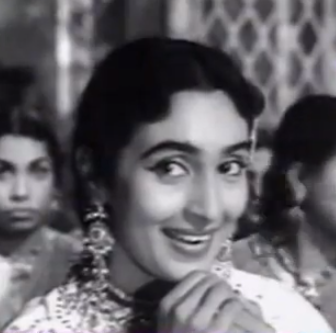
Nutan leads the chorus with an enchanting smile in Dil Hi To Hai (1963)

Bekhudi Mein Sanam Lyrics and Translation: Let’s Learn Urdu-Hindi

Babita Haseena Maan Jaayegi

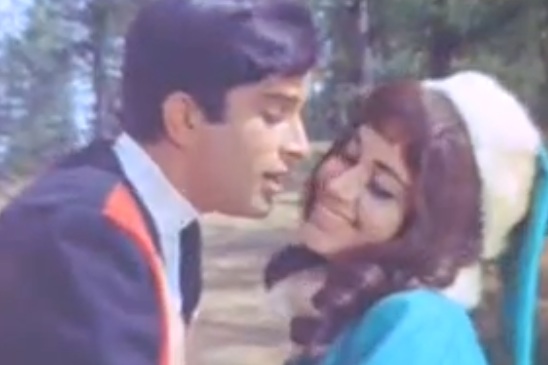
Whoa there, Babita. Are you sure a Santa hat is appropriate for this occasion?

Our next Hindi lyric translation is the classic Rafi-Lata duet “Bekhudi Mein Sanam” from the film Haseena Maan Jaayegi (1968). The movie soundtrack is probably the only reason you would ever want to watch this film. Sure, the plot description is intriguing: two men (who happen to both be Shashi Kapoor) fall in love with the same woman (the unbearable Babita). One Shashi Kapoor is soft-spoken and romantic, while the other is an aggressive jokester who is spurned by our heroine. But then! War with China! Both men are called to duty, and when only one returns, Babita can’t tell if he is truly the man she loves–or his rival!

So you’re lured in, egged on by a few other vaguely recognizable Rafi numbers (“O Dilbar Janiye,” anyone?), and think you’re getting yourself in for a long Hum Dono-esque genre twin film with a swinger bent.

Oh, but how wrong you’d be.

Babita and Shashi haseena maan jaayegi

Shashi Kapoor and Babita play two college students in love in Haseena Maan Jaayegi (1968).

Haseena Maan Jaayegi is a painful free-falling bucket of awkward sauce that is weighed down by Babita’s insufferably thick voice, static characters, and an unfocused plot that never quite pulls together it’s obvious loose ends. I mean, seriously Babita? We need to spend two hours watching you try to decide if there is nothing unique about the man you married? Furthermore, what the heck, Shashi? Couldn’t you have convinced the scriptwriter to at least throw in just one line explaining why you guys look so similar? At least turn out to legitimately be twins separated at birth! There’s no way God would just magically make two Shashi Kapoors in this world. A lot of Indian women would be a lot happier if so.

Shashi Kapoor is entranced by Babita’a teal Santa suit from “Bekhudi Mein Sanam.”

Really, nothing gets my goat more than a twin movie that doesn’t acknowledge that they’re supposed to actually be twins. Do yourself a favor by skipping this cheese-flavored package of dry histrionics, and just youtube the songs because they’re awesome. Of particular note in “Bekhudi Mei.N Sanam” is Babita’s puffy white fur Santa hat and teal blue jumpsuit. This is just in case any audience member had lost their mind and started to make the mistake of taking her seriously. Check out the youtube link for the song here and follow along with the lyrics and translation below to this this otherwise beautiful ode of love!

Bekhudi Mein Sanam Lyrics and Translation

Bekhudi mei.N sanam, uTh gaye jo qadam
Unaware of my self, as I started walking
Aa gaye, aa gaye
I arrived
Aa gaye paas hum, aa gaye paas hum
I arrived nearer to you

Aag yeh kaisii man mei.N lagii hai?
What kind of fire is aflame in my mind?
Man se badhii to tan mei.N lagii hai
Yet, even bigger than that in the mind, is the one burning my body
Aag nahii.N yeh dil ki lagii hai
This is not a fire, its the heart’s desire
Jitnii bujhaayii, utnii jalii hai
However much you try to put it out, it will keep burning

Dil ki lagi na ho to, kya zindagii hai?
Without this desire of the heart, what is life?
Saath hum jo chale miT gaye faasle
When we walk together, all that separates us disappears
Aa gaye, aa gaye
I arrived
Aa gaye paas hum, aa gaye paas hum
I arrived nearer to you

Khoyii nazar thii, soye nazaare
The vision was lost, and the sights were asleep
Dekhaa tumhe to jaage yeh saare
On seeing you, all of them were awakened
Dil ne kiye jo dil ko ishaare
As one heart signaled to the other
Milke chale hum saath tumhaare
We met and walked together

Aaj khushii se meraa dil yeh pukaare
Today my heart calls out with joy
Teraa daaman milaa, pyaar meraa khilaa
In finding your embrace, my love has blossomed
Aa gaye, aa gaye
I arrived
Aa gaye paas hum, aa gaye paas hum
I arrived nearer to you

Dil kii kahaanii pahunche zubaa.N tak
The story of my heart is on my tongue
Kisko khabar ab pahunche kahaa.N tak?
Now who knows where it will reach?
Pyaar ke raahii aaye yahaa.N tak
Travelers of love have arrived here
Jaaye.Nge dil ki had hai jahaa.N tak
They will go to the limits set by their hearts

Tum paas jo to chale hum aasmaan tak
With you at my side, we will reach the sky
Dil mein armaan liye laakh toofaan liye
With a heart full of desires and beset by storms

Aa gaye, aa gaye
I arrived
Aa gaye paas hum, aa gaye paas hum
I arrived nearer to you

Bekhudi mei.N sanam, uTh gaye jo qadam
Unaware of my self, as I started walking
Aa gaye, aa gaye
I arrived
Aa gaye paas hum, aa gaye paas hum
I arrived nearer to you

Glossary:

bekhudi: unaware of oneself, in a trance; qadam: footsteps; aag: fire; man: mind; tan: body; faasle: separation, distance; ishaaraa: signal; daaman: embrace; zubaa.N: tongue, language; khabar: news, knowledge; had: limit; aasmaan: sky; armaan: desire; toofaan: storm

I can’t really explain it, but I’ve always really liked with the way Shashi Kapoor starts his first line walking forward toward her with his hands folded behind his back. It’s bashful, the way Indian men in love were meant to be.

Shashi Kapoor Twins Haseena Maan Jaayegi

I know, I know. It’s almost irresistible–TWO Shashi Kapoors on ONE screen! Look at that handsome cricket jacket, those form-fitting white pants. But restrain, my friends. Haseena Maan Jaayegi will suck out your Shashi-gushing capacities and infect you instead with confusion and hatred of Babita.

This song translation was done by request from our reader “Beloved”! We hope you enjoyed, and if you’d like to see your name on our blog, send us an email with your burning Bollywood request or leave us a comment on our “Requests” page!

– Mrs. 55

In Aankhon Ki Masti Ke Lyrics and Translation: Let’s Learn Urdu-Hindi

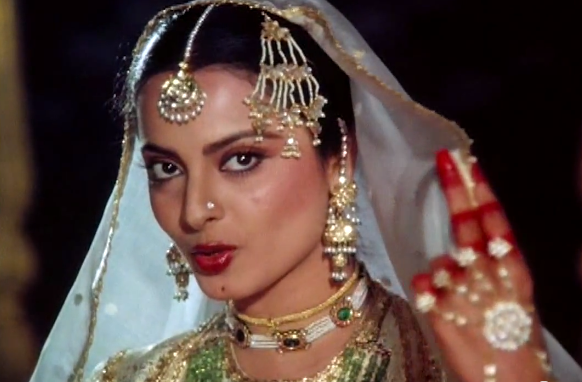
Rekha gives a career-defining performance as a courtesan and poetess in Umrao Jaan (1981)

I recently rewatched Muzaffar Ali’s masterpiece Umrao Jaan (1981), a film that is so brilliantly crafted that it deserves multiple posts on this blog like Pakeezah and Mughal-e-AzamThe film is based on an Urdu novel written by Mirza Muhammad Hadi Ruswa that recounts the life of one of South Asia’s most influential literary figures: Umrao Jaan. Born in Faizabad, a young girl named Amiran is kidnapped and sold to a brothel in Lucknow. As she grows older, Amiran is grooomed by the brothel’s madam until she becomes Umrao Jaan (played by Rekha), one of Lucknow’s most desirable courtesans.  Misfortune after misfortune falls upon Umrao Jaan, but the film ultimately portrays her as a resilient woman whose beautiful mujras and poetry serve as a lasting legacy to her indomitable spirit.

In addition to Rekha’s stunning performance as the tawaif Umrao Jaan, this film is especially memorable for its portrayal of the richness of Lucknow’s cultural heritage. The indulgent life of nawaabs around the turn of 20th century is visually apparent in the film’s costumes, artwork, and set design, but the luxurious atmosphere in the film is taken to a new level by the soundtrack composed by Khayyam and penned by Shahryar. Here, I’ve chosen to translate one of the unforgettable mujra numbers from this film: in aa.nkho.n kii mastii.

She’s not lying when she says her eyes are intoxicating…

In this song, Umrao Jaan engages in some self-indulgent vanity. She mildly chides her lover Nawab Sultan (played by Farooq Shaikh) by saying there are thousands of other madmen in Lucknow that admire her charm and beauty. In the third verse, she continues to brag by saying that all the taverns in the world cannot serve wine as intoxicating as the wine that she serves from her glances. Finally, in the last verse, Umrao makes a warning against those that attempt to suppress her grandeur using a common symbol found in Urdu-Hindi poetry: the moth. Like moths to a flame, she claims that there are thousands of admirers in the city who would sacrifice their lives to protect her. The poetry in this song is not overly complex, but there is a subtle beauty to it that is enhanced by Asha Bhonsle’s beautiful rendition and Rekha’s graceful expressions on screen. I managed to find a very high-quality print of this song on YouTube, so please do watch the link provided above and follow along with the translation/glossary–enjoy!

–Mr. 55

P.S. Whatever you do, please do not waste three hours of your life (like I did) watching J.P. Dutta’s 2006 remake of this movie starring Aishwarya Rai and Abhishek Bacchan. It is a travesty of a film that completely disrespects the beauty of the original. I think one of the worst parts is the atrocious Urdu pronunciations. I mean, even I can get the guttural khe sound right when I say “khudaa haafiz,” and they don’t pay me the big bucks. Why can’t Aishwarya or Abhishek? And let’s not even get started on Anu Malik’s tired and stale soundtrack…

The camera adds to the meaning of the lyrics here by bringing candles into the shot when Rekha sings “is shamm-e-farozaa.n…

In Aankhon Ki Masti Ke Lyrics and Translation

in aa.nkho.n kii mastii ke mastaane hazaaro.n hai.n
The intoxicating beauty of these eyes attracts thousands of admirers. 
in aa.nkho.n se vaabastaa afsaane hazaaro.n hai.n
Indeed, there are thousands of stories associated with these eyes. 

ek tum hii nahii.n tanhaa ulfat me.n merii rusvaa
You are not the only one disgraced by your love for me, 
is shahar me.n tum jaise diivaane hazaaro.n hai.n
There are thousands of madmen like you in this city.

ek sirf ham hii mai ko aa.nkho.n se pilaate hai.n
It is only I who can serve you wine with my eyes, 
kahne ko to duniyaa me.n maikhaane hazaaro.n hai.n
Though it is said that there are thousands of taverns in this world.

is shamm-e-farozaa.n ko aa.ndhii se Daraate ho
Although you attempt to scare this bright candle with a storm,
is shamm-e-farozaa.n ke parvaane hazaaro.n hai.n
The light from this candle attracts thousands of moths. 

in aa.nkho.n kii mastii ke mastaane hazaaro.n hai.n
The intoxicating beauty of these eyes attracts thousands of admirers. 

Glossary

mastii: intoxication; mastaane: admirers; vaabasta: associated with; ulfat: love; rusvaa: disgraced; mai: wine; maikhaane: taverns; shamm-e-farozaa.n: bright candle; aa.ndhii: storm; parvaane: moths.

Farooq Shaikh, as Nawab Sultan, watches the mujra in admiration.

Which Actor Did Hemant Kumar Sing For Best?

Hemant Kumar (1920-1989) was a legendary Hindi and Bengali film music composer and singer.

Hemant Kumar (1920-1989) was a legendary Hindi and Bengali film music composer and singer.

In classic Bollywood cinema, playback singers could make or break the career actor. Famous actor-singer pairings are legendary. The voice of the singer became the soul of the actor and once a perfect match was made, it was hard to separate them without upheaval. Who could imagine anything but the manly voice of Kishore Kumar with the face Rajesh Khanna? Or the playful sweetness of Mohammed Rafi with fun-loving Shammi Kapoor? When Mukesh passed away, Raj Kapoor (for whose career Mukesh lent his illustrious talent) famously burst into tears and announced, “I have lost my voice.”

But occasionally we find a rogue player in Hindi film music. Hemant Kumar stands out as a unique character, a difficult man to place in the rankings. For he was not merely a singer, but a legendary music director as well in both Hindi and Bengali cinema. Hemant Kumar was heavily influenced by Rabindrasangeet (like his contemporary S.D. Burman!), and first broke into the Bengali industry as a music director in 1947, the year of Indian independence. Hemant Kumar’s unmatched virtuosity led him to not only sing many of the hit songs of the 50s and 60s in Bombay himself, but he actually formed his own production company that made classics such as Bees Saal Baad (1962), Kohra (1964), and Khamoshi (1969). In the 70s he even dabbled as a film director with moderate success.

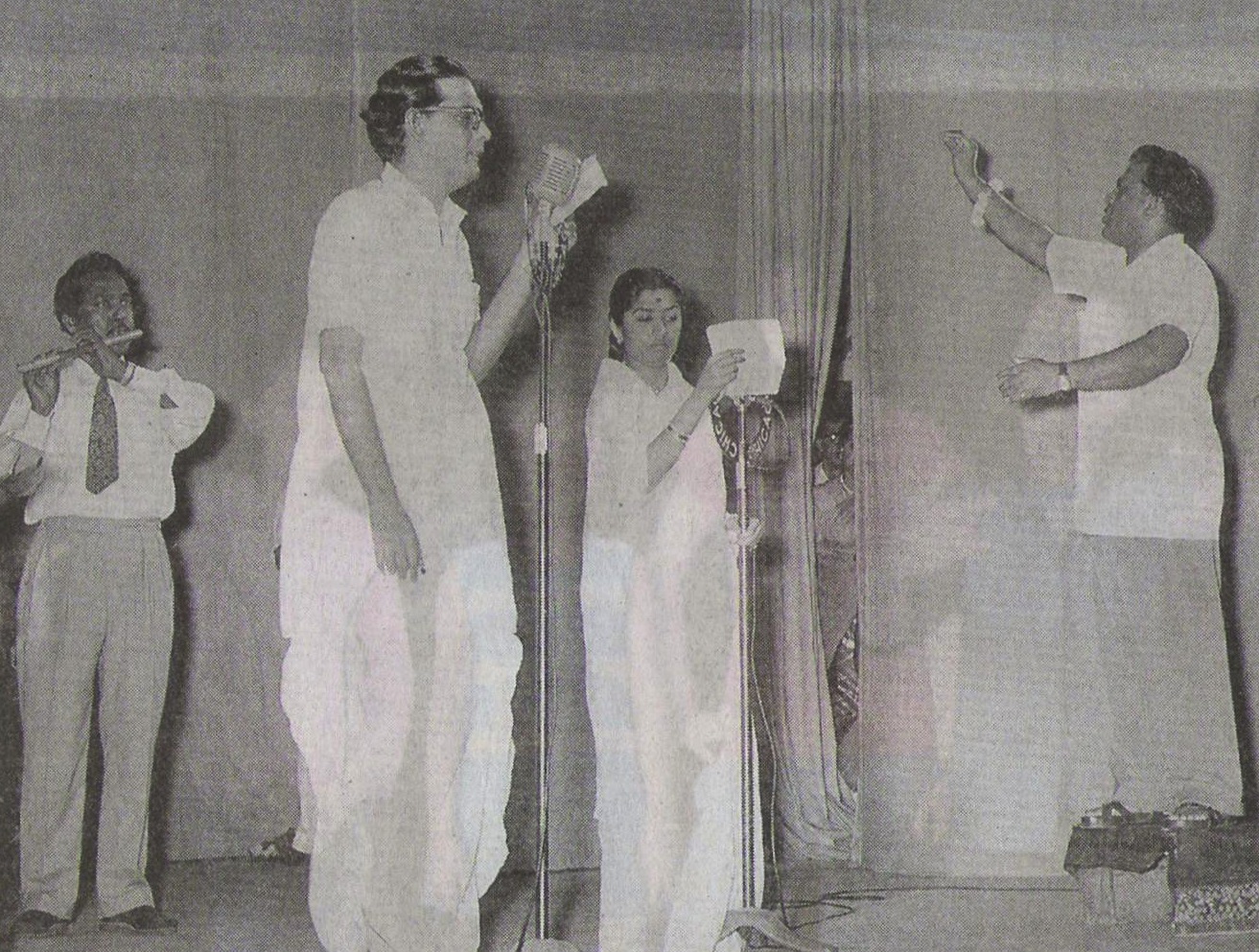
Hemant Kumar recording a song with Lata Mangeshkar

Hemant Kumar and Lata Mangeshkar during the studio recording of “Nain So Nain” from Janak Janak Paayal Baaje (1955).

But for me, it was as a singer that Hemant Kumar always shines and also the category in which history has given him the shaft. His voice was absolutely unlike any other in the industry–a deep and soulful richness that no one could touch. Interestingly, for a man whose talents were so diverse, Hemant Kumar never took to acting and singing his own songs on screen (à la Kishore Kumar). Instead, he sang for a myriad of rising and great actors across the decades–never branding himself with a single artist. Hemant Kumar remained a maverick, and for it, is often brushed aside.

So I now pose to you the question–which actor do YOU think Hemant Kumar sang for best? His voice graced the images of many men, but did it work for all of them? Your contestants are Guru Dutt, Dharmendra, Biswajeet, Dev Anand, and Shammi Kapoor. We present five songs below that illustrate some of Hemant Kumar’s finest collaborations with these actors and the cinematic chemistry that ensued.

1. Guru Dutt: Jaane Woh Kaise

The voice of tragedy, Hemant Kumar sings for Guru Dutt in this timeless lament from Pyaasa (1957). Guru Dutt, who often played the tragic poet, seems a natural choice for the resonant tones of Hemant Kumar in this song that has become iconic for all awkward dinner party songs.

2. Dharmendra: Tum Pukar Lo

Discussed in a previous post, Khamoshi (1968) is a heart-wrenching film about love, loss, and insanity. Although you don’t see much of Dharmendra’s face in this sequence, his subtle performance matches the song’s patient yearning with a hint of a Western flair. But to me, as an actor Dharmendra is somehow too shallow to be worthy of a Hemant Kumar solo. Maybe that’s just me?

3. Biswajeet: Yeh Nayan Dare Dare

A tender sequence from the film Kohra (1964), this song embodies the sweet side to Hemant’s voice that comes in the middle of a spooky film noir. I’m not going to pretend that Biswajeet is anything but a joke, but for me this pairing works–Hemant’s sweet vocals and Biswajeet’s confident, but appeasing motions to Waheeda are a pleasing combination.

4. Dev Anand: Yeh Raat Yeh Chaandni Phir Kahaan

God, I love it. I’ll be the first to tell you that no one sang better for Dev Anand than Mohammed Rafi, but this song is something else. I’ve discussed this sequence already in our earlier translation of the song, but let me just repeat that Hemant Kumar in a seductive mood blends beautifully with that longing gaze of Dev Anand’s. It’s just so exciting and rare, not to mention compliments Dev Anand’s semi-gravely voice in this film.

5. Shammi Kapoor: Aye Dil Ab Kahin Lejaa

This is another beautiful Hemant Kumar tragedy with a touch of mystery. Shammi is clearly giving it his all in this song, but somehow, I think it just doesn’t come together. Shammi Kapoor is too much of a hot mess for me to believe anything but Mohammed Rafi coming out of his mouth–the resonant voice of Hemant seems incongruous with those histrionics, despite its unarguable beauty.

And the winner is…?

I’m gonna have to say Guru Dutt–that song is just sublime on every level, but I’m open to discussion. Who do you think matched Hemant Kumar’s voice best? Let us know YOUR opinion in the comments!

-Mrs. 55

P.S. Wondering why we didn’t mention female playback singers here? It’s because the female side of things worked very differently, ie., it was Lata and Asha or bust. Every actress had them, and with the occasional Geeta Dutt or Shamshad interlude, there was no room for a “signature” playback artist per actress (although Lata will argue she “changed” her voice depending on the actress–more on this to come!)

Sansaar Se Bhaage Phirte Ho Lyrics and Translation: Let’s Learn Urdu-Hindi

Meena Kumari stars as an enchanting courtesan in Chitralekha (1964)

Sahir Ludhianvi’s lyrical genius as an Urdu poet is widely known, but his poetry in pure Hindi is considerably less prolific. While Sahir churned out gem after gem of Urdu shayari in films such as Taj Mahal and Gumraah, his output in pure Hindi is limited to a handful of films. Sahir’s first foray into the field of Hindi poetry occurred in the soundtrack for Chitralekha (1964), a film directed by Kidar Sharma based on a novel by the same name written by Bhagawati Charan Verma in 1934. The story revolves around the protagonist Chitralekha (played by Meena Kumari), a widowed courtesan who seduces men to their doom with her beauty in the court of King Chandragupta Maurya. Prince Bijgupt (played by Pradeep Kumar) is one of her many admirers, and his lust for Chitralekha prevents him from fulfilling his royal duties. Kumar Giri (played by Ashok Kumar) is a conflicted holy man whose spirituality wavers when faced with the temptation of Chitralekha’s physical charms. Overall, the film questions the philosophical significance of sin and virtue by tracing Chitralekha’s development from being a haughty courtesan to a humble ascetic. Despite this film’s compelling narrative and exploration of uncoventional themes, it failed to achieve success at the box office, especially when compared to its 1941 predecessor (the second highest grossing film of the year!). The mediocre box office performance has been attributed to miscasting of the main characters and a poorly written script.

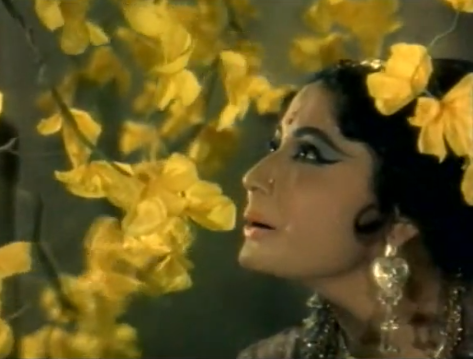
Meena Kumari sings the line “apaman rachetaa kaa hogaa, rachnaa ko agar Thukraaoge” amidst a setting of flowers, which symbolize the natural beauty of creation.

Given the lackluster audience reception at the time of its release, this film is generally remembered today for its soundtrack composed by Roshan and penned by Sahir Ludhianvi. The two songs that are the most well known from this film are the Rafi solo “man re tu kaahe na dhiir dhare” and “sa.nsaar se bhaage phirte ho,” the Lata solo that I’ve chosen to translate today. Based on Raga Yaman Kalyan, this song is a  beautifully crafted statement against spiritual hypocrisy. Through his words, Sahir rejects the conception of sin and virtue established by organized religions in favor of a philosophy of universal hedonism. In context of the film, Chitralekha uses this song to mock Kumar Giri’s ascetism after he patronizes her with a sermon about giving up her sinful lifestyle in order to attain spiritual enlightenment. My favorite part of this song is probably when Chitralekha sings the clever and incisive line: “apaman rachetaa kaa hogaa, rachnaa ko agar Thukraaoge” (It will be an insult to the Creator himself, if you reject the act of creation). This song is full of feisty one-liners like this, so please take a listen to the song and follow along with translation/glossary below if you’d like to hear more. To conclude, I think we can all agree that Sahir does not disappoint here and proves his versatility poet who is equally comfortable writing lyrics in shuddh Hindi as he is in Urdu. Very impressive, indeed–enjoy!

-Mr. 55

Meena Kumari stumbles under the intoxication of wine in the company of her harem.

Sansar Se Bhage Phirte Ho Lyrics and Translation

sa.nsaar se bhaage phirte ho, bhagvaan ko tum kyaa paaoge?
As you flee from society, how will you find God?
is lok ko apnaa na sake, us lok me.n bhii pachataaoge.
You didn’t consider this world as your own, and you will repent it in that world. 

 ye paap hai.n kyaa, ye punya hai.n kyaa? riito.n par dharm kii mohare hai.n
What is sin and what is virtue? Religion uses such traditions as mere facades. 
har yug me.n badalte dharmo.n ko kaise aadarsh banaaoge?
How will you idealize the changing religions of every age?

yeh bhog bhii ek tapsaya hai, tum tyaag ke maare kyaa jaano?
This suffering is also a form of penance; what would you know, you renunciation-stricken fool?
apaman rachetaa kaa hogaa, rachnaa ko agar Thukraaoge.
It will be an insult to the Creator himself, if you reject the act of creation. 

ham kahte hai.n yah jag apnaa hai, tum kahte ho jhuuTha sapna hai.
I claim that this world is mine; however, you consider it a false dream.
ham janam bitaa kar jaaye.nge, tum janam gavaa kar jaaoge.
I will live life to the fullest, but you will waste yours in vain. 

sa.nsaar se bhaage phirte ho, bhagvaan ko tum kyaa paaoge?
As you flee from society, how will you find God?

Glossary 

sa.nsaar: society; bhagvaan: God; pachataanaa: to repent, regret; lok: world; paap: sin; punya: virtue; riit: tradition; dharm: religion; mohara: front, facade; aadarsh banaanaa: to idealize; bhog: suffering;  tapasya: penance; tyaag ke maare: struck with renunciation; apaman: insult; rachetaa: the Creator; rachnaa: to create; Thukraanaa: to reject, disapprove;  jag: world.

Ashok Kumar plays the role of the conflicted holy man Kumar Giri in Chitralekha (1964)