Abhi Na Jao Chod Kar Lyrics and Translation: Let’s Learn Urdu-Hindi

Dev Anand croons to Sadhana in a moonlit forest in Hum Dono (1961).

Dev Anand croons to Sadhana in a moonlit forest in Hum Dono (1961).

Next we present the enchanting lyrics and English translation to “Abhi Na Jao” from Hum Dono (1961). When I think of a Bollywood tree song, I think of this. This is where the magical tradition of hopping around a hidden forest and coyly shimmying behind the nearest tree to dodge your lover’s advances all began. Delightful Dev Anand and young Sadhana prance about gently in a quiet grove with slick back-and-forth lyrics that keep us grounded. The essence of the song comes down to this: Boy loves girl. Girl shyly expresses a desire to go home. Boy insists girl stays. Girl fears losing face. Boy takes opportunity to corner girl against a tree. You certainly don’t need anyone else to tell you how to think, but consider what it means that modern day Romeo Shah Rukh Khan voted this picturization as the most romantic song of Hindi cinema! “Abhi Na Jao” is eternal and the embodiment of sweetly innocent Bollywood courtship.

I’ve talked before about my feelings for the Hum Dono recolourization. Frankly, it’s cute, but not worth eliminating the original black-and-white stock. By converting the film from academy ratio to widescreen, you lose a great deal of the movie in exchange for some glitzy editing tricks (watch the colorized version here to see what I mean!). The film, its characters, the music, and the plot are so strong, it does not require any remodeling for wider accessibility. This song comes early in the movie, setting a high key tone for the upcoming embroilment.
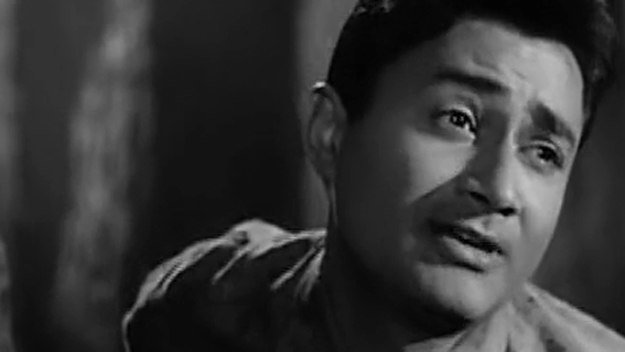
Dev Anand Abhi Na Jao

Dev Anand looks like a lost sheep as Sadhana coyly sneaks away in “Abhi Na Jao” from Hum Dono (1961).

The signature Dev Anand coiffure is at its puffiest in this song, a welcome reflection of his bursting emotions. So take a seat, grab a snuggle pillow, and enjoy the lyrics and our full English translation to the evergreen duet “Abhi Na Jao Chod Kar” from Hum Dono (1961)!

Abhi Na Jao Chhod Kar Lyrics and Translation

MALE:
Abhi na jaao chhoD kar ki dil abhi bhara nahii.N
Do not go and leave me now, for my heart is not yet filled
Abhi abhi to aayii ho abhi abhi to
You have only just come
Abhi abhi to aayi ho bahaar banke chhaaii ho
You have only just come, you became the Spring as you arrived
Hawaa zaraa mahak to le nazar zara bahak to le
Let the wind spread your fragrance, let your gaze wander
Yeh shaam dhal to le zaraa
Let the night fall a little more
Yeh dil sambhal to le zaraa
Let my heart steady itself
Main thoDi der jii to luu.N nashe ke ghuunT pii to luu.N
Let me live a little longer, let me taste a sip of your intoxication
Nashe ke ghunT pii to luu.N, abhi to kuch kahaa nahii.N
Let me taste a sip of your intoxication, for I have said nothing yet
Abhii to kuch sunaa nahii.N
You have heard nothing yet
Abhii na jaao chod kar ke dil abhi bhara nahii.N
Do not go and leave me now, for my heart is not yet filled

FEMALE:
Sitaare.N jhil milaa uThe
The stars have begun to sparkle
Sitaare.N jhil milaa uThe, chiraag jagmagaa uThe
The stars have begun to sparkle, the lamps have been lit
Bas ab na mujhko Toknaa
Enough, do not scold me now
Bas ab na mujhko Toknaaa, na baDhke raah rokna
Enough, do not scold me now, do not come forward to block my path
Agar mai.N ruk gayii abhii to jaa na paauu.Ngii kabhii
If I stop now, I will never be able to leave
Yehii kahoge tum sadaa ke dil abhii nahii.N bharaa
For you will keep on saying that your heart is not yet filled
Jo khatm ho kisii jagah yeh aisaa silsila nahii.N
This is not the kind of affair that ends easily

MALE:
Abhii nahii.N abhii nahii.N!
Not yet, not yet!

FEMALE:
Nahii.N, nahii.N, nahii.N, nahii.N!
No, no, no, no!

MALE:
Abhi na jaao chod kar ke dil abhi bhara nahii.N
Do not go and leave me now, for my heart is not yet filled

MALE:
Adhuurii aas
Unfulfilled desire
Adhuurii aas chhoDke, adhuurii pyaas chhoD ke
Leaving me with unfulfilled desire, leaving me with unfulfilled thirst
Jo roz yuu.N hii jaaogii to kis tarhaa nibhaaogii
If you go every day like this, then how will you keep your promise?
Ki zindagii kii raah mei.N jawaa.N dilo.N kii chaah mei.N
For in the path of life, in the desire of two young hearts
Kaii maqaam aaye.Nge jo humko aazmaae.Nge
Many challenges will come to test us
Buraa na maano baat kaa, yeh pyaar hai, gilaa nahii.N
Do not be hurt by my words, for they are words of love, not a complaint

FEMALE:
Haa.N, yehii kahoge tum sadaa ki dil abhii bharaa nahii.N!
Yes, but you will keep on saying that your heart is not yet filled!

MALE:
Haa.N, dil abhi bharaa nahii.N
Yes, my heart is not yet filled!

FEMALE:
Nahii.N, nahii.N, nahii.N, nahii.N!
No, no, no, no!

Glossary:

bhara: filled; bahaar: Spring; hawaa: wind; mahak: fragrance; nazar: gaze, bahak: wander; shaam: evening; sambhalnaa: to steady oneself; thoDi der: a little while longer; nashe: intoxication; ghuunT: sip; jhilmilnaa: to sparkle; chiraag: lamp; Toknaa: to scold; raah: path; khatm: finish; jagaah: place; silsilaa: affair; adhuurii: unfulfilled; aas: desire; pyaas: thirst; roz: every day; nibhaanaa: to fulfill [a promise], zindagii: life; jawaa.N: young; chaah: desire, love; maqaam: challenge; aazmaanaa: to test, to try; buraa: hurt; gilaa: complaint
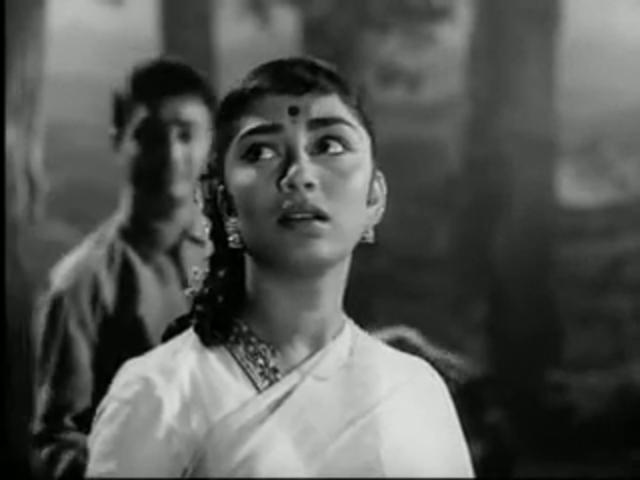
Sadhana Abhi Na Jao Hum Dono

Sadhana worries on a late evening out with her lover in Hum Dono (1961).

Yes, like many a great Hindi song, this one comes with a tragic reprise. A tender Asha Bhonsle solo, “Jahan Mein Aisa Kaun Hai” is a song of steadfast devotion in the face of impending wartime separation. Sadhana beautifully demonstrates her love to be more than a worthy match for the original duet’s playful warning of a perilous future. We have included the full lyrics and translation of Jahan Mein Aisa Kaun Hai as well below for your edification!

Jahan Mein Aisa Kaun Hai Lyrics and Translation:

Dukh aur sukh ke raaste bane hai sab ke vaaste
The paths of sadness and happiness are made for everyone
Jo gham se haar jaaoge to kis tarah nibhaaoge?
If you lose to sadness and leave, then how will you keep your promise?
Khushii mile hame.N ki gham jo hoga baat le.Nge hum
Whether we are met with happiness or sorrow, let us accept it
Mujhe tum aazmaao to zara nazar milaao to
Test me and meet my eyes
Ye jism do sahii magar dilo.N mei.N faaslaa nahii.N
We may have two bodies, but there is no distance between our hearts

Jahaan mei.N aisaa kaun hai ki jisko gham milaa nahii.N?
Is there anyone in the world who has not had sadness?

Tumhaare pyaar kii qasam tumharaa gham hai meraa gham
I swear by your love that your sorrow is my sorrow
Na yuu.N bhujhe bhujhe raho jo dil ki baat hai kaho
Do not fade away like this, tell me what is in your heart
Jo mujhse bhi chhupaaoge to phir kisse bataaoge?
If you hide those words from me, then whom will you tell?
Mai.N koi ghair to nahii.N dilaaoo.N kis tarah yakeen?
I am no stranger, how can I make you believe me?

Ki tum se mai.N judaa nahii.N, mujhse tum judaa nahii.N
For you are not separated from me, and I am not separated from you

Glossary:

dukh: sorrow; sukh: happiness; raastaa: path; [kisii ke] vaaste: for the sake of; haarnaa: to lose; tarah: type, manner; khushii: joy, happiness; aazmaanaa: to test, to try; nazar milaanaa: to make eye contact; jism: body, faaslaa: distance; qasam: swear; chhupaanaa: to hide; ghair: stranger; yakeen: belief

Can’t get enough? Check out our other translations from the same film like “Main Zindagi Ka Saath” and “Allah Tero Naam” for more!

-Mrs. 55
Chaudavin Ka Chand Ho Lyrics and Translation: Let’s Learn Urdu-Hindi

GD

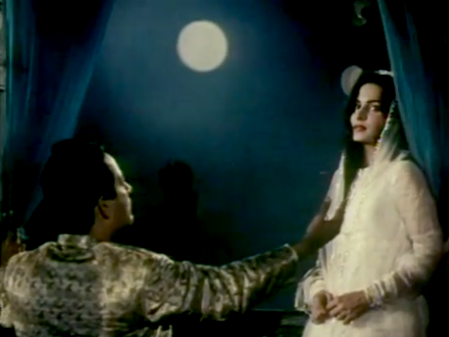
Guru Dutt compares the beauty of his beloved Waheeda Rehman to the full moon of the night sky in Chaudavin Ka Chand (1960).

Today, we present the lyrics and English translation to the title track from Mohammed Sadiq’s Chaudavin Ka Chand (1960).  After Kaaghaz Ke Phool (1959) proved to be a box office disaster, Chaudavin Ka Chand salvaged Guru Dutt’s production studio by garnering  widespread commercial success at the time of its release. Reflecting on the failure of Kaaghaz Ke Phool and the success of Chaudavin Ka Chand, Guru Dutt said,

 “Life me.n, yaar, kyaa hai? Do hii to chiize.n hai.n: –kamiyaabii aur failure. There is nothing in between.”

Although the success of Chaudavin Ka Chand as a comeback film for Guru Dutt Productions can be attributed to number of factors, one of the most important is the film’s outstanding musical score. Composed by Ravi and penned by Shakeel Badayuni, this soundtrack is full of memorable gems like the sassy Asha-Shamshad qawwali sharmaa ke ye kyo.n sab pardaanashii.n and the pain-filled badle badle mere sarkaar (Lata Mangeshkar’s only foray into singing for Guru Dutt Films!).

Among these gems, the film’s title track chaudavii.n ka chaa.nd ho steals the show as one of the most beautiful expressions of love in Hindi film music. Tuned to Raga Pahadi, Shakeel Badayuni’s Filmfare Award winning Urdu poetry abounds with metaphors to describe the film’s heroine Waheeda Rehman. Reminiscent of Shakespeare’s Sonnet No. 18 (“Shall I compare thee to a summer’s day?”), the the poet employs natural imagery to characterize his beloved’s beauty through references to the full moon (chaudavii.n kaa chaa.nd), the sun (aftaab), a lotus (ka.nval), wine (sharaab), and more. Ultimately, the poet concludes that his beloved is so beautiful that her beauty is beyond comparison to any object (jo bhii ho tum khudaa kii qasam laajavaab ho).

No discussion about chaudavii.n ka chaa.nd ho can be complete without giving credit to Mohammed Rafi for his magical rendition. Here, Rafi offers a technically brilliant performance but it is the warmth, passion, and soul in his voice that renders this song a timeless masterpiece. About fifteen years following his Bollywood debut, Rafi received his first well-deserved Filmfare Award for this song in 1961.

Did you know that the Censor Board objected to chaudavii.n kaa chaa.nd ho when Guru Dutt re-released a version of the song shot in color? As the color version was being filmed, Waheeda Rehman’s eyes became irritated from the heat of the high-powered lights used during the shoot. Upon seeing the red color of the heroine’s eyes, the Censor Board claimed that the colored picturization of the song contained suggestive and lustful implications inappropriate for audiences. What a bizarre and unfair objection placed on such an innocently romantic song! Don’t let it stop your from enjoying this classic gem along with our lyrics and translation below. Until next time…

-Mr. 55
WR

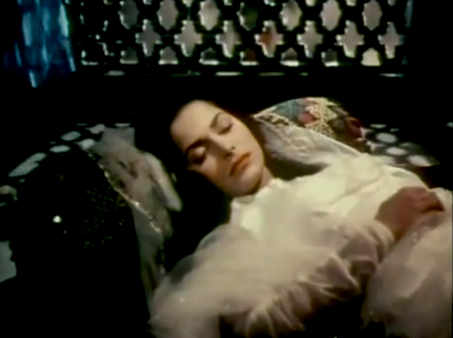
Sleeping in a white dress, Waheeda Rehman’s angelic beauty shines in Chaudavin Ka Chand (1960).

Chaudavin Ka Chand Ho: Lyrics and Translation

chaudavii.n kaa chaa.nd ho yaa aftaab ho?
Are you the full moon of the night or the sun of the day? 
jo bhii ho tum khudaa kii qasam laajavaab ho

Whatever you are, I swear by the Lord that you are incomparable.

zulfe.n hai.n jaise kaandho.n pe baadal jhuke hue
Your tresses are like dark clouds sloping down your shoulders.
aa.nkhe.n hai.n jaise mai ke pyaale bhare hue
Your beautiful eyes are like wine-filled goblets.
mastii hai jis me.n pyaar kii tum vah sharaab ho
You are the wine that abounds with the intoxication of love.

chaharaa hai jaise jhiil me.n ha.nstaa huaa ka.nval
Is your face like a smiling lotus in the brook,
yaa zindagii ke saaz pe chheDii huii ghazal?
or like an ode tuned to the music of life?
jaan-e-bahaar tum kisii shaayar kaa khvaab ho
My beloved, you are a poet’s dream.

ho.nTho.n pe kheltii hai.n tabassum kii bijliyaa.n
The current of your bright smile runs through your beautiful lips.
sajde tumhaarii raah me.n kartii hai kahkashaa.n
Even galaxies lay prostrate with reverence in your path.
duniyaa-e-husn-o-ishq kaa tum hii shabaab ho
 Only your youthful splendor shines in this world of love and beauty.

chaudavii.n kaa chaa.nd ho yaa aftaab ho?
Are you the full moon of the night or the sun of the day?

Glossary

chaudavii.n kaa chaa.nd: moon of the fourteenth night, full moon; aftaab: sun; laajavaab: incomparable; kaandhaa: shoulder; mai: wine; pyaalaa: goblet; mastii: intoxication; sharaab: wine, alcohol; jhiil: brook; ka.nval: lotus; saaz: musical instrument; ghazal: song, ode; jaan-e-bahaar: beloved; shaayar: poet; khvaab: dream; tabassum: smile; bijlii: current; sajde karnaa: to lay prostrate; kahkashaa.n: galaxy; duniyaa-e-husn-o-ishq: world of love and beauty; shabaab: youth.

GD

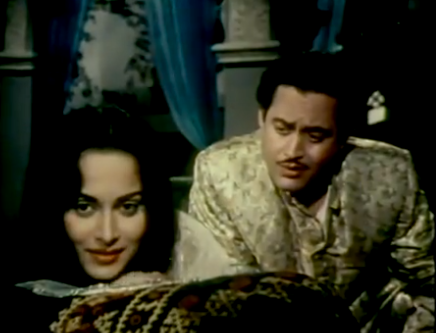
Guru Dutt and Waheeda Rehman’s on-screen chemistry in Chaudavin Ka Chand (1960) reflected their passionate off-screen affair.

Yeh Kya Jagah Hai Doston Lyrics and Translation: Let’s Learn Urdu-Hindi

Rekha Umrao Jaan Yeh Kya Jagah Hai Doston

Rekha stars as a courtesan with a heart of gold in Umrao Jaan (1981).

We next present the beautifully tragic lyrics and English translation of “Yeh Kya Jagah Hai Doston” from Umrao Jaan (1981). Umrao Jaan is a heart-breaking film with depths more profound than the glittery tawaif dances it showcases. Based on the 1899 Urdu novel by Mirza Hadi Ruswa entitled, “Umrao Jaan Ada,” the 1981 film stays largely true to the original text.

Delving into the decadence of 19th century Lucknowi society, Umrao Jaan Ada portrays the rituals of a fascinating culture marked by luxury and oppression. I first read Ruswa’s novel during my junior year of college in Urdu class and fell in in love with the resilience of the story’s heroine.

Rekha in Umrao jaan 1981

Searching for a familiar face in a crowd of strangers, Rekha remains alone in Umrao Jaan (1981).

Interestingly, the framing of the 1981 Muzaffar Ali-directed film differs from the novel, told as a chronological account instead of a reminiscence. For me, this changes the tone of the film entirely: in the novel, the audience knows that although Umrao Jaan has suffered greatly in her lifetime, she eventually finds the peace and independence she deserves.

In the film, however, Umrao Jaan’s fate is unclear. We are left only with the stirring final image of her somber reflection in the mirror of her childhood home—an identity so long defined by others now confronted by its owner. Knowing these alternate endings colours the implications of Asha Bhonsle’s emotional “Yeh Kya Jagah Hai Doston” preceding them.

Rekha Umrao Jaan 2

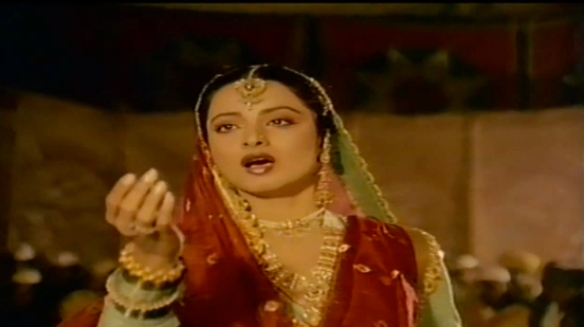
Rekha hides a tear as Umrao Jaan sings to a gathering in her hometown of Faizabad.

Just prior to the film’s finale, Umrao Jaan (portrayed by Rekha) is asked to perform a song in her own town of Faizabad where she is now regarded as a pariah or stranger. The poetry that results in “Yeh Kya Jagah Hai Doston” evokes that sense of loss and confusion—a blameless fall from Eden with no path forward. As her own mother listens quietly outside the tent, Umrao Jaan’s addressing the unfamiliar gathering as “doston” becomes perhaps less ironic and more of an earnest plea.

Written by Shahryar with music by Khayyam, “Yeh Kya Jagah Hai Doston” is a counterpoint to the film’s earlier musical gems “In Ankhon Ki Masti” and “Dil Cheez Kya Hai.” With no ulterior motives, Umrao Jaan at last sings and dances as herself, voicing the real emotions within her heart. Many consider this song to be the film’s greatest composition.

We hope you enjoy our lyrics and translation to the soulful swansong, “Yeh Kya Jagah Hai Doston” below! Let us know your favorite Umrao Jaan moment in the comments!

Yeh Kya Jagah Hai Doston Lyrics and Translation:

Yeh kyaa jagah hai dosto.N?
What place is this, friends?
Yeh kaunsaa dayaar hai?
What kind of world is this?
Had-e-nigaah tak jahaa.N, ghubaar hii ghubaar hai
Where, as far as the eye can see, there are only dust storms

Yeh kis maqaam par hayaat mujhko lekii aa gayii?
To what realm has life brought me?
Na bas khushii pe hai jahaa.N, na gham pe ikhtiyaar hai
In this place I have no control over my happiness, and no choice in my sorrow

Tamaam umr ka hissaa maa.ngtii hai zindagii
Life demands an account of all my years
Yeh meraa dil kahe to kyaa? Yeh khud se sharmasaar hai
What will this heart of mine answer? It is so ashamed of itself

Bulaa rahaa hai kaun mujhko chilmano.N ki us taraf?
Who is calling me from the other side of those blinds?
Mere liye bhi kyaa koi udhaas beqaraar hai?
Is anyone there for me who is restless in sorrow?

Yeh kyaa jagah hai dosto.N?
What place is this, friends?
Yeh kaunsaa dayaar hai?
What kind of world is this?
Had-e-nigaah tak jahaa.N, ghubaar hii ghubaar hai
Where, as far as the eye can see, there are only dust storms

Glossary:

jagah: place; dayaar: world, region; had-e nigaah tak: until the limits seen by the eye; ghubaar: dust storm; maqaam: realm; hayaat: life; bas: power; khushii: happiness; gham: sorrow; ikhtiyaar: choice, tamaam umr: whole life, all the years; hissaa: account; zindagi: life; khud: self; sharmasaar: embarrassed, ashamed; chilman: curtains made of reeds, blinds; udhaas: sorrow; beqaraar: restless

As I read the pages of Ruswa’s novel, I was so struck by his descriptions of the admirable training in classical arts given to students of the kothe. These talents that in today’s society would be so valued as the pinnacle of culture, instead branded these women for a lifetime of ignominy. Today such diligence in the study and practice of classical voice, dance, and poetry is so rare and impressive!

Rekha in Umrao Jaan Yeh Kya Jagah Hai Doston

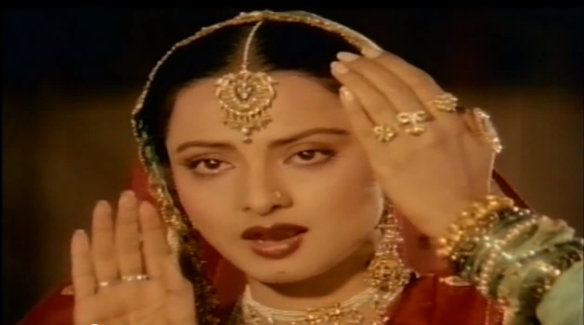
Ethereal beauty Rekha yearns for acceptance from her long-lost family in Umrao Jaan (1981).

For the grammar junkies among us, you may wonder why the “jagah” in this song is pronounced to rhyme with “yeh” instead of “kyaa.” Strictly speaking, the Lucknowi pronunciation of the word is the long “aah,” however, for poetic fluidity, Asha Bhonsle pronounces it here in the alternate form. Regional variants exist in the Hindustani language for similar words such as subah and vajah!

– Mrs. 55

Dil Cheez Kya Hai Lyrics and Translation: Let’s Learn Urdu-Hindi

Rekha stars as a courtesan and poetess in Umrao Jaan (1981), based on an Urdu novel by Mirza Muhammad Hadi Ruswa

Today, we continue our series on Umrao Jaan (1981) by providing the lyrics and English translation to what is arguably the film’s most popular song: dil chiiz kyaa hai?  Based on Mirza Muhammad Hadi Ruswa’s novel Umrao Jaan Ada, this film narrates the tragic tale of a young girl who is kidnapped and forced to become a tawaif (courtesan).

Through the course of this film, we witness the transformation of an innocent young girl Amiran as she becomes Umrao Jaan Ada, one of Lucknow’s most sought after courtesans. At the brothel, young Amiran receives training in classical voice, Kathak dance, and Urdu poetry–a forbidden world of art and education that the average Indian girl of this time period would never get the chance to explore. When the brothel’s madam Khanum feels that she has been sufficiently groomed, Umrao Jaan begins performing and attracting the attention of wealthy patrons all over Lucknow. Umrao’s first public performance as a courtesan is marked by the song dil chiiz kyaa hai?

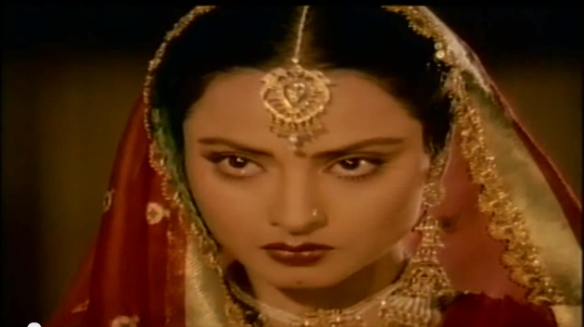
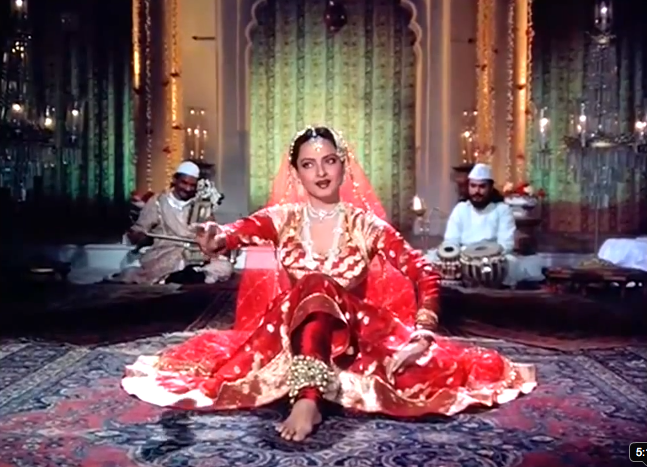
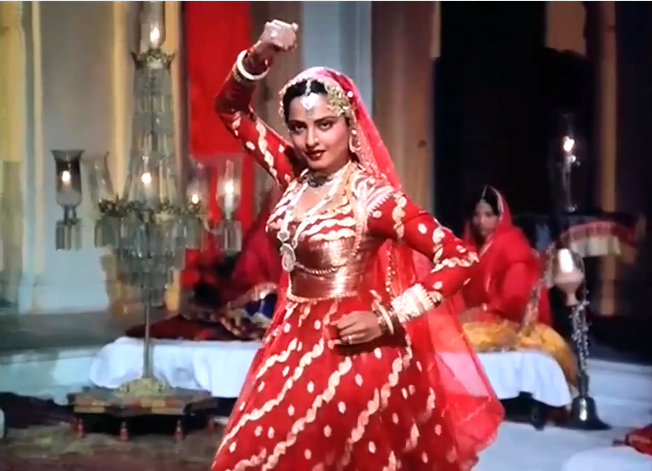
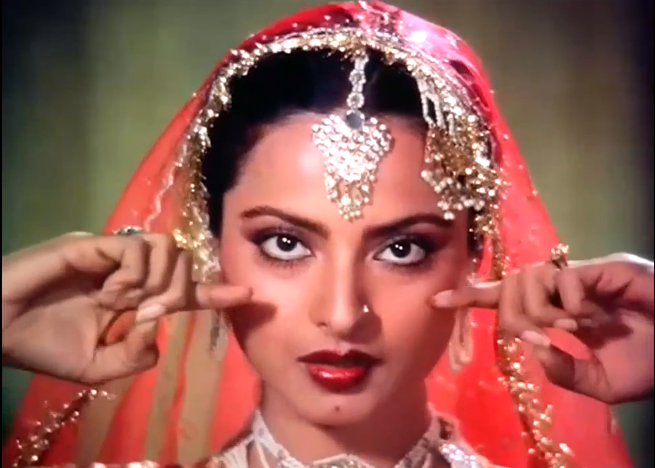
This gem is considered to be one of Asha Bhonsle’s career-defining songs, and she was awarded a National Film Award for her performance of this ghazal along with the rest of her contributions to this soundtrack. Khayyam bagged a well-deserved National Film Award for his compositions in this film, and Rekha took home the National Film Award for Best Actress. From her performance in this mujra in particular, it is clear that Rekha is worthy of all the critical acclaim she received for her work in Umrao Jaan.  Although she may lack the technical precision of a trained Kathak dancer, she compensates with her compelling on-screen presence and natural elegance. With eyes like hers, would any man in Lucknow be able to resist the charms of Umrao Jaan Ada?

What is your favorite song from the Umrao Jaan soundtrack? Share with us in the comments! Until next time…

-Mr. 55

Rekha’s mujras in this film, especially dil chiiz kyaa hai?, are fan-favorites to this day.

Dil Cheez Kya Hai: Lyrics and Translation

dil chiiz kyaa hai? aap merii jaan liijiye
What is the heart worth? Take my life instead!
bas ek baar meraa kahaa maan lijiye
But just once, please accept what I say.

is a.njuman me.n aap ko aanaa hai baar baar
You must return to this gathering time and time again.
diivaar-o-dar ko ghaur se pahchaan liijiye
So, learn to recognize these surroundings carefully.

maanaa ki dosto.n ko nahii.n dostii kaa paas
I admit that friends may not always hold friendship in high regard.
lekin yah kyaa ki ghair kaa ahsaan liijiye?
Yet, does this mean you should accept kindness from strangers?

kahiye to aasmaa.n ko zamii.n par utaar laaye.n
If you ask for it, I shall bring down the sky to the ground. 
mushkil nahii.n hai kuchh bhii agar Thaan liijiye
No task is difficult if you pursue it firmly.

dil chiiz kyaa hai? aap merii jaan liijiye
What is the heart worth? Take my life instead!
bas ek baar meraa kahaa maan liijiye
But just once, please accept what I say.

Glossary

maan lenaa: to accept; anjuuman: gathering; diivaar-o-dar: walls and doors, surroundings; ghaur se: carefully; pahchaan lenaa: to recognize; dostii: friendship; paas: regard, consideration; ghair: stranger; ahsaan: favor, kindness; utaar laanaa: to bring down; Thaan lenaa: to pursue firmly.

A quick note regarding the word paas. Those of you familiar with its common use in the phrase kisii ke paas (next to someone/something) may be confused by the line “maana ki dosto.n ko nahii.n dostii kaa paas.” Here, a less common use of the word paas is used to mean regard or consideration. So, there is no relation to proximity here; the whole line would be translated as: “I admit that that friends may not always hold friendship in high regard.” Tricky, tricky.

As Umrao Jaan, Rekha seduces wealthy men in Lucknow with her most tempting asset: her eyes!

Dum Maro Dum Lyrics and Translation: Let’s Learn Urdu-Hindi

Zeenat Aman Dev Anand Dum Maro Dum

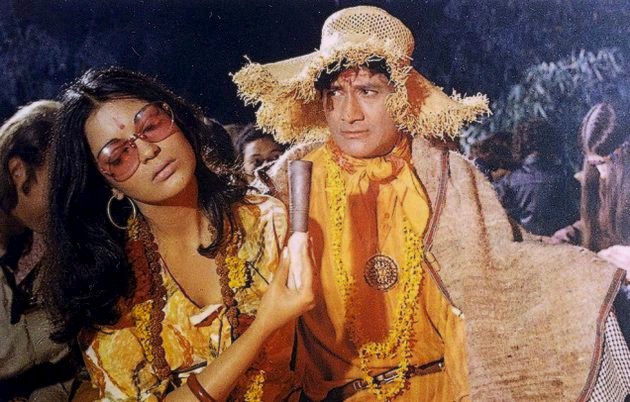
Zeenat Aman becomes shamelessly intoxicated in front of her brother Dev Anand in Hare Rama Hare Krishna (1971). More importantly, can someone please burn that hideous floppy straw hat?

Our next lyrics and English translation is the epitome of youthful rebellion and psychadelic glamour: “Dum Maro Dum” from Dev Anand’s 1971 Hare Rama Hare Krishna. The translation could not have come at a more appropriate time–as many of you know, as of 2 weeks ago, medical marijuana is now legalized in Massachusetts. So to all the Harvard seniors getting ready to graduate in a few months, this song is for you! When people think of Asha Bhonsle at her craziest, “Dum Maro Dum” is often the song that comes immediately to mind. It’s seductive, eccentric, and exhibits her full range from those bizarre, unexpected high notes to the fabulous embodiment of character as only Asha knew how. It’s one of incomparable music director R.D. Burman’s greatest works for the ground he broke–putting illicit drugs and societal defiance to the forefront in a youth-targeted song that was so instantly catchy no one could brush it off. Let’s face it, with this song, Zeenat may represent everything we don’t want in our loved ones, but God, does she make it look appealing.

Zeenat Aman Hare Rama Hare Krishna

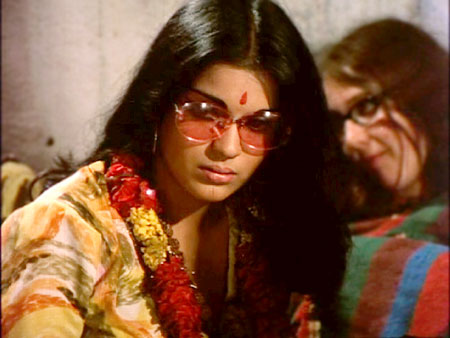
Gorgeous Zeenat Aman sports a pair of show-stopping 70s shades as a drug addict in Hare Rama Hare Krishna (1971).

Shot in one of Dev Anand’s favorite locations, Kathmandu (remember Jewel Thief, anyone?), Hare Rama Hare Krishna is a politically-driven film against the subversive hippie culture that our hero believes to be distorting the true message of the Hindu ideals it pretends to preach. Dev Anand hunts down his long-lost sister in such a hippie camp and tries to extricate her with tragic results. The film delivers a powerful message without feeling like Manoj Kumar-eqsue patriotic propaganda. I really applaud Dev Anand for making such a bold film that critiques a subject so ignored by his contemporaries and so popular among the masses who bought into it–with a delightfully satirical name like Hare Rama Hare Krishna, the film was a risk and it paid off.

So enjoy our English translation and lyrics to “Dum Maro Dum” below! Follow along with the video and let us know your thoughts on this controversial smash hit in the comments! You know how Zeenat starts the song with a little “Hush!” just before the music starts? I can’t exactly explain why, but I always feel really awkward when I hear it.

Dum Maro Dum Lyrics and Translation

Dam maaro dam miT jaaye gham
Take another hit, all your worries will disappear
Bolo subah shaam hare krishna hare raam
From morning until night sing, “Hare Krishna Hare Ram!”

Duniyaa ne hum ko diyaa kyaa?
What has the world given us?
Duniyaa se hum ne liyaa kyaa?
What have we taken from the world?
Hum sab kii parwaa kare.N kyo.N?
Why should we worry about anyone?
Sab ne humaaraa kiyaa kyaa?
What has anyone does for us?
Dam maaro dam miT jaaye gham…

Chaahe jiye.Nge, mare.Nge
Whether we want to live or to die
Hum na kisii se Dare.Nge
We won’t be afraid of anyone
hum ko na roke zamaanaa
The world won’t be able to stop us
Jo chaahe.Nge hum kare.Nge
For we will do what we want

Dam maaro dam miT jaaye gham
Take another hit, all your worries will disappear
Bolo subah shaam hare krishna hare raam
From morning until night sing, “Hare Krishna Hare Ram!”

Glossary:

dam maarnaa: to take a hit [of marijuana]; miT jaanaa: to disappear; gham: sadness, worries; subah shaam: from morning to night; Hare Krishna Hare Raam: a chant of the Hare Krishna sect popularized by the hippie culture in the 60s and 70s; duniyaa: society, the world; parwaa: worry; zamaanaa: the world

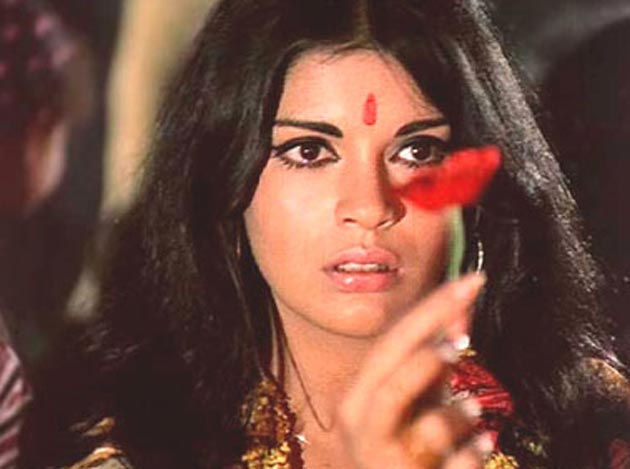
Zeenat Aman Dum Maro Dum

Zeenat Aman suddenly remembers her idyllic drug-free childhood with an emotional outburst of regret in Hare Rama Hare Krishna (1971).

For the sake of completeness, I feel compelled to include a translation of Dev Anand’s great comeback to the moral disorder he witnesses among the Hare Krishnas: “Dekho O Diwaano.” “Dekh O Diwano” and indeed the film Hare Rama Hare Krishna, is not a direct attack on the actual Hare Krishna movement, but rather the hippie culture that traveled with it in the 60 and 70s–and by blending the two, confused and disheartened many a contemporary conservative Hindu. Dev Anand makes some brilliant comparisons through example in this song–by drawing upon classic Hindu literature such as the Ramayan story of Lord Ram’s banishment to the forest (“Ram ne ha.Ns kar sab sukh tyaage“) and Krishna’s explanation to Arjun of the meaning of karma in the timeless battlefield of the Mahabharat (“Krishna ne karm ki riit sikhaayi“), Dev Anand makes a clear distinction between lip service and actual belief.

Dekho O Deewano Lyrics and Translation:

Dekho O deewano, tum yeh kaam na karo
Look, Oh crazy people, do not behave like this
Raam kaa naam badnaam na karo
Do not bring dishonor to the name of Ram

Raam ko samjho, Krishna ko jaano
Understand Ram, know Krishna well
Nee.Nd se jaago, O mastaano
Wake up from this sleep, Oh intoxicated ones
Jeet lo man ko paDh kar Geeta
Win back your mind by studying the Geeta
Man hii haaraa, to kyaa jeetaa?
For once you’ve lost your mind, what is there to win?

Hare Krishna, Hare Ram
Jeevan ko nashe ka tum ghulaam na karo
Do not make your life a servant to intoxications
Raam kaa naam badnaam na karo
Do not bring dishonor to the name of Ram

Raam ne ha.Ns kar sab sukh tyaage
With a smile, Ram renounced all his joys
Tum sab dukh se Dar ke bhaage
But you are scared and run away from every grief
Krishna ne karm kii riit sikhaaii
Krishna taught us the tradition of righteous action
Tum ne farz se aa.Nkh churaayii
But you avoid your duties

Hare Krishna, Hare Ram
Jeevan naam hai kaam kaa aaraam na karo
The meaning of life is work, do not rest
Raam kaa naam badnaam na karo
Do not bring dishonor to the name of Ram

Glossary:

badnaam: dishonored; tyaagnaa: to renounce; nee.Nd: sleep; Geeta: the Bhagavad Gita, a religious text within the epic poem the Mahabharat; jeevan: life; nashe: intoxications; ghulaam: servant; riit: culture, tradition; farz: duty; aa.Nkh churaanaa: to avoid; aaraam karna: to rest

While Zeenat Aman and her fellow groupies waste their minds and lives to drugs in the name of Lords Ram and Krishna, Dev Anand reminds the audience of the wrong of even inaction as discussed in the Gita. Classical Hindu dharmic responsibility is not passive, but active and tempered–with no stake in the outcome whether happiness or sadness. It is an ancient theme that you may recall Dev Anand explored years earlier in his 1965 legend Guide. Sadly, Zeenat Aman eventually succumbs to her addiction, and in the end the story returns briefly to the heart of many a great film: a tale of a broken family reunited.

These themes can certainly be pretty volatile subjects, and it’s not our intention to spark a political or religious debate on this forum. So we shall end with a grammar lesson instead: do you know why the “deewaano” and “mastaano” are used instead of simply “deewaane” or “mastaane”? The vocative as used here is a special case! The nasalization “o.N” used in the oblique (eg. “dosto.N ke saath”) is not to be confused with the vocative “o” (eg. “suniye, dosto”) used to address a group directly! People commonly make this sloppy Urdu mistake–so rise above the masses!

But don’t go that high, if you know what I mean. Have fun, Massachusetts.

-Mrs. 55