Jayen To Jayen Kahan Lyrics and Translation: Let’s Learn Urdu-Hindi

Dev Anand Taxi Driver

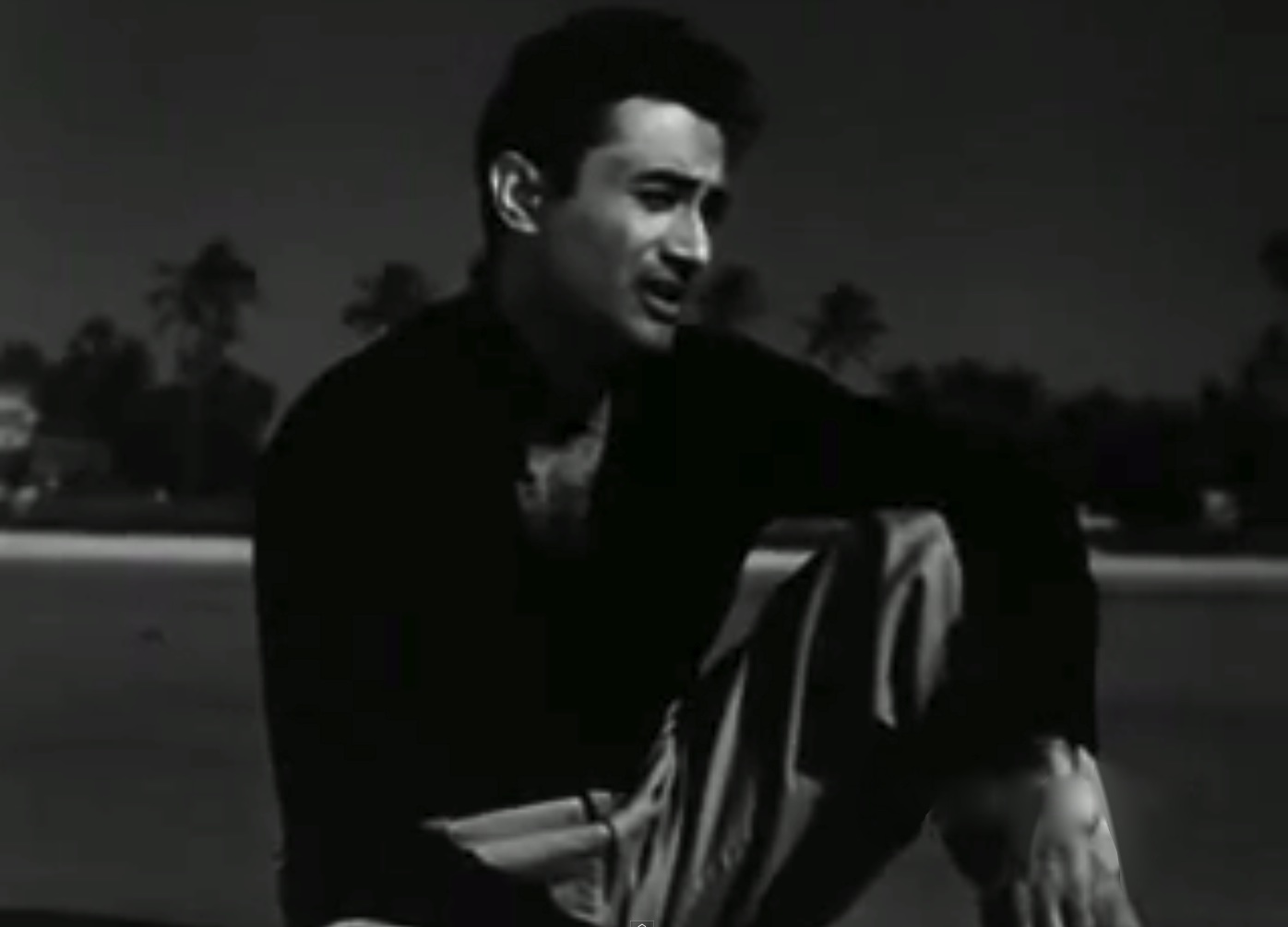
Dev Anand stares at the lonely beach in “Jayen To Jayen Kahan” from Taxi Driver (1954).

Next we present the full lyrics and English translation of “Jayen To Jayen Kahan” from Taxi Driver (1954). It’s one of yesteryear star Talat Mehmood’s most beloved solo hits. For anyone in the crowd who is unfamiliar with Talat, I’m truly saddened for your sake, but actually not entirely surprised. He’s one of the great unsung heroes of Bollywood who’s place in musical history was undermined with the rise and domination of Mohammed Rafi and Mukesh by the 60s. At least Hemant Kumar wrote his own film compositions and could conveniently cast himself as singer! But Talat was classy. While largely remembered for his legendary mark in ghazal-dom, Talat actually gave Shammi Kapoor his first hits in the 50s before Mohammed Rafi entered the scene. Yes, Talat was edged out of the business like a budding flower before Autumn. And did I mention he was so incredibly good-looking for a playback singer that he also acted in several films?
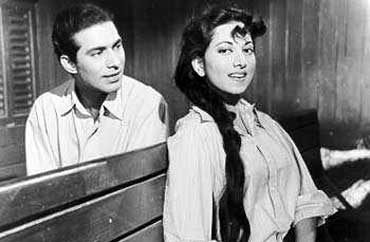
Dapper Talat Mehmood sings and acts with Suraiya in Waris (1954). Hottie, right?!

I could go on and on about my love for Talat and his velvety smooth voice, but let’s stay focused. Like later Dev Anand hit CID (1956), Taxi Driver is a really wonderful glimpse at chaotic and quaint 1950s Bombay city life. Told through the creative eyes of Chetan Anand (director and Dev Anand’s brother), the film is forever locked in its own charmingly antiquated society and street life of a bygone era. Most importantly, behind-the-scenes, Dev Anand was falling in love with his sensuous on-screen partner, Kalpana Kartik who would become his wife! It’s one of the few times you’ll see the two together (check out Baazi (1951) or Nau Do Gyarah (1957) for more!) and the juiciness of it all makes the film fun for the whole family. As Kalpana (AKA Mona Anand) later recalled:

I still remember our midnight marriage on the sets of “Taxi Driver” in 1954. Dev was a shy, youthful person, very co-operative and sensitive. We passed six decades together amid a lot of thick and thin. Whenever I heard rumours that he would desert me, I laughed my heart out. I knew that nomadic Dev would always be mine.

Cute, right? The hit philosophical song of the film “Jayen To Jayen Kahan” is sung first by Talat and later by Lata in the reprise–adding a touch of melodrama to the action. It’s beautifully picturized–the Talat version feels like an early Ozu film and carries a heavy weight with it. The careful cinematography allows time to pass slowly in a way that removes the viewer from the material world of the film and completely engulfs them in the philosophical queries of the song. Lyrics are, of course, by the great Sahir Ludhianvi. It’s a must-see for fans of early cinema!
Kalpana Karthik Taxi Driver

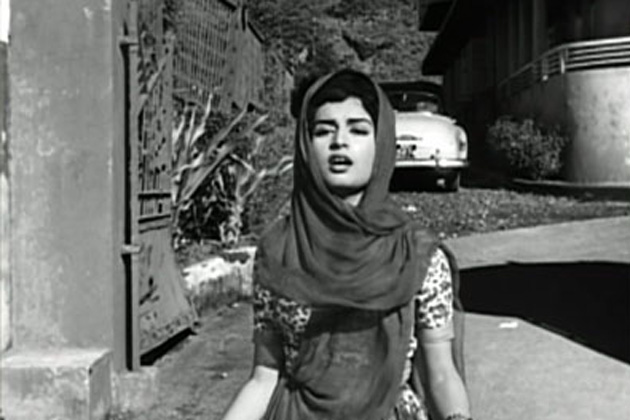
Gorgeous Kalpana Karthik and wife of Dev Anand, sings with Grace Kelly style in Taxi Driver (1954).

So without further ado, enjoy the lyrics and English translation to “Jayen To Jayen Kahan“! We’ve got you the male and female versions below (click here for the Talat version video!).

Jayen To Jayen Kahan Lyrics and Translation:

Male:

Jaaye.N to jaaye.N kahaa.N?
If I must go, where could I go?
Samjhegaa kaun yahaa.N dard bhare dil ki zubaa.N?
Who here will understand the words of a heart full of pain?

Mayuusiio.N kaa majamaa hai.N jee mei.N
A crowd of disappointments resides in my soul
Kya reh gayaa hai is zindagi mei.n
What is left for me in this life?
Ruuh mei.N gham, dil mei.N dhuuaa.N
In my soul is sadness, in my heart is smoke

Unka bhi gham hai, apna bhi gham hai
She has her sorrows, I have my own
Ab dil ke bachne kii ummiid kam hai
Now there is little hope of saving my heart
Ek kashTii, sau tuufaa.N
For it is like a single boat against a hundred storms

Jaaye.N to jaaye.N kahaa.N?
If I must go, where could I go?
Samjhegaa kaun yahaa.N dard bhare dil ki zubaa.N?
Who here will understand the words of a heart full of pain?

Female:

Jaaye.N to jaaye.N kahaa.N?
If I must go, where could I go?
Samjhegaa kaun yahaa.N dard bhare dil ki zubaa.N?
Who here will understand the words of a heart full of pain?

O jaanewaale daaman chhuDaake
Oh traveler who is leaving my embrace
mushkil hai jeenaa tujhko bhuulaake
Forgetting you and continuing to live is difficult
Is se to hai maut aasaan
Even death is easier than this

Seene.N mei.N shole, saa.Nso.N mei.N aahe.N
In my chest are embers, in my breaths are sighs
Is zindagii se kaise nibhaaye
What is there for me to fulfill in this life?
Har jazabaat hai viiraan
My every emotion is empty

Jaaye.N to jaaye.N kahaa.N?
If I must go, where could I go?
Samjhegaa kaun yahaa.N dard bhare dil ki zubaa.N?
Who here will understand the words of a heart full of pain?

Glossary:

dard: pain; zubaa.N: words, language; mayuusii: disappointment; majamaa: crowd; ruuh: soul; gham: sadness; dhhuuaa.N: smoke; ummiid: hope; kashTii: boat; tuufaa.N: storm; mushkil: difficult; maut: death; ahsaan: easy; seenaa: chest; shole: embers; saans: breath; aah: sigh; jazabaat: emotion; viraan: empty, wasted

I think the most important question here is, who sang it better: Lata or Talat? At the risk of being strangled by Mr. 55, I think it’s pretty clear the answer is Talat. It’s one of the few songs that just was not written for Lata–it sounds a little strained coming from her, if I dare say so. Talat, meanwhile, sounds like an effortless dream as always. A Talat Mehmood hit was requested by reader Suman! Send us a message if you’ve got a request too!
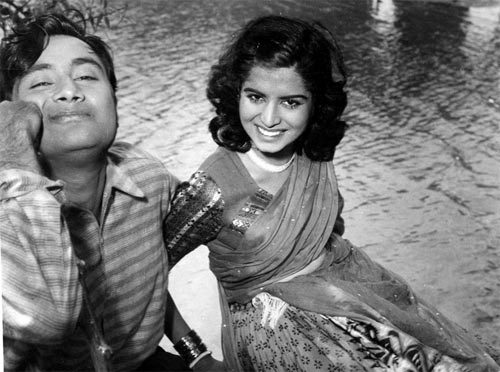
An adorable early rare photograph of Dev Anand with his wife Kalpana Kartik.

An adorable early rare photograph of Dev Anand with his wife Kalpana Kartik.

-Mrs. 55

Diwali Songs from Classic Bollywood

Happy Diwali! For all our readers and fans observing the occasion, what could be better than a list of 10 classic Bollywood Diwali songs to enjoy over the celebrations today? For a country of over 1 billion Hindus and an industry that absolutely loves to celebrate any kind of occasion with song and dance, Bollywood has a surprisingly low number of Diwali songs in its films. I mean, think about it–Diwali is the country’s largest national holiday, lends itself brilliantly to poetry (festival of lights imagery, the story of the Ramayan, etc.), and is practically bound to succeed by virtue of having very little with which to compete. People are aching for these songs, yet they hardly exist–much less ones worth hearing over and over.

Dharmendra Jugnu Diwali

Dharmendra celebrates Diwali with fireworks and song in Jugnu (1973).

To be sure, plenty of great Diwali bhajans exist outside the realm of Bollywood (look no further than Tulsidas classic “Shri Ram Chandra”), many of which have excellent covers by our favorite playback singers. But within the films? The pickings are slim. I’ve got a theory as to why this might be the case. Let us consider the example of Christmas as we know it in America. When we think of great Christmas jingles, the songs we name predominantly come from hit singers or church traditions–with only a few actually having made it to popular culture from films, despite Hollywood having had a long and successful musical film movement (Judy Garland’s gorgeous “Have Yourself a Merry Little Christmas” comes to mind).

So perhaps Bollywood is no different. Because singing a song about Diwali actually requires Diwali to be a major part of the plot, the happy coincidence rarely occurred–much less with the good fortune of also having been a brilliant composition. Furthermore, celebrations like Holi, for which we can name at least a handful of terrific Bollywood songs, actually lend themselves much better to an upbeat and colorful party on-screen–so musical composition could be a bit more relaxed. With Diwali, you’re treading on sacred ground–and why mess with something that non-filmi bhajans do way better anyway?

Still, a few intrepid pioneers prevailed, and while some are more memorable than others, you’ll find plenty of hidden gems! Below find our list of 10 classic Bollywood Diwali songs that will get the festivities started old-school style! Click the song names to get to the link to youtube.

10 Classic Bollywood Diwali Songs:

1. Kaise Diwali Manaye Lala (Mohammed Rafi, Paigham 1959)

Be prepared from some ridiculous Johnny Walker antics, but a fun dance beat to get your spirits up!

2. Aayi Ab Ke Saal Diwali (Lata Mangeshkar, Haqeeqat 1965)

On a somber note, this haunting Lata Mangeshkar melody from war epic Haqeeqat is a stark reminder of families in grieving this time of year.

3. Is Raat Diwali Kaise (Mohammed Rafi, Shamshad Begum, & Asha Bhonsle, Sabse Bada Rupaiya 1955)

Oh, what?! A Diwali qawwali?! SIGN ME UP! A peppy song describing Diwali festivities sung in traditional qawwali style that gets you clapping along.

4. Laakhon Taare Aasman Mein (Mukesh and Lata, Hariyali Aur Raasta 1962)

Another tragic lovers-separated-on-Diwali-night song starring Manoj Kumar and Mala Sinha, but the melody is sweet and watching Manoj Kumar mope is never such a bad thing. The Lata-Mukesh chemistry works well as always!

5. Jagmati Diwali Ki Raat Aa Gayi (Asha Bhonsle, Stage 1951)

We’re really getting old-school with this one. It’s a rare early song that sounds more like Geeta Dutt than Asha Bhonsle to me. It builds to a frenzy at the end that’s kind of exciting!

6. Deep Diwale Ke (Kishore Kumar, Jugnu 1973)

This may be one of the more popular Diwali songs on our list–sung by lively Kishore Kumar and picturized on Dharmendra with a bunch of happy school kids, you can’t go wrong!

7. Ek Woh Bhi Diwali Thi (Mukesh, Nazrana 1961)

For some balance, here’s another sad song by the inimitable Mukesh-Raj Kapoor duo. Everyone is having a grand time outside partying with sparklers, while moody Raj Kapoor broods upon the days that once were.

8. Deep Jalenge Deep Diwali Aayi Ho (Geeta Dutt, Paisa 1957)

As a connoisseur of Geeta Dutt obscurities, I love this song. With a joyous melody and that gentle lulling voice, it’s one of the better gems on this list!

9. Mele Hain Chiragon Ke Rangeen Ki Diwali Hai (Lata, Nazrana, 1961)

This would be the “happy version” counterpoint to the Raj Kapoor tragedy from earlier. You can see why Raj Kapoor is sad these days are over–everyone’s having a grand old time and it doesn’t hurt to have the voice of a goddess Lata to back you up!

10. Aayi Hai Diwali (Geeta Dutt and Shamshad Begum, Sheesh Mahal 1950)

Another early period Diwali song–and a duet no less! The whole household is bustling with activity and women all over join the chorus for the celebrations!

Even sexy song siren Helen puts on her serious face for a Diwali moment in Lahu Ke Do Rang (1979).

Here are two bonus tracks for extra thrills:

11. Aayi Diwali (Zohrabai Ambalewali, Rattan 1944)

The oldest song on our list! And of course, it’s a Greek tragedy–but rare and exciting for any fans of early early Bollywood. Before the days of Lata Mangeshkar, 1940s playback singer Zohrabai Ambalewali turned music director Naushad into an overnight sensation with this hit!

12. Jyot Se Jyot Jagate Chalo (the exciting Lata version! Sant Gyaneshwar, 1964)

OK, so this song might not be *technically* a Diwali song per se, but it’s thematically spot-on! And I just discovered the Lata Mangeshkar version to compliment the Mukesh version, which I had thought existed in isolation. I can’t believe I did not know about this sooner, I’m so happy right now!

This Diwali special was brought in by request from one of our favorite readers muskaan. We wish everyone a joyous Diwali and a prosperous year ahead!

– Mrs. 55

Jhumka Gira Re Lyrics and Translation: Let’s Learn Urdu-Hindi

Sadhana flirts with a percussionist as she dances in the street in Mera Saaya (1966)

Our next translation comes from Raj Khosla’s evergreen thriller Mera Saaya (1967) starring Sadhana and Sunil Dutt. A memorable film with an even more memorable soundtrack composed by Madan Mohan and penned by Raja Mehndi Ali Khan! The two Lata solos “tuu jahaa.n jahaa.n chalegaa” and “naino.n me.n badraa chhaaye” get all the critical acclaim, but can you guess which song has achieved the most popularity among fans over the years?

That’s right! It’s “jhumkaa giraa re” sung by Asha Bhosle, our favorite queen of nakhra. Although she has been known to be prone to excess, Asha sings this folk-inspired number with just the right amount of sassy charm to get everyone excited without overdoing it. The text of this song reads like a story in which the female protagonist describes a common motif found in Hindustani poetry: a woman’s ornaments, and specifically her earrings in this case. For other songs in a similar vein, listen to “milaa hai kisii kaa jhumkaa” from Parakh (1960),  “terii bindiyaa re” from Abhimaan (1973), “dhuu.nDo dhuu.nDo re sajna, more kaan kaa baalaa” from Ganga Jamuna (1961), and another song with the same title as this number sung by Shamshad Begum in Dekhoji (1947).  Moreover, Mera Saaya is a remake of the Marathi film Pathlag (1964), so there is a similar scene with an accompanying song that shares a resemblance with “jhumkaa giraa re.”

Even a folk number can’t stop Sadhana from showing off her characteristic fringe!

The city of Bareilly gets referenced occasionally in various Bollywood songs (especially in relation to jhumkaas!), so I was interested in learning more about its historical and cultural background. Bareilly is a prominent city situated in Uttar Pradesh, and according to Wikipedia:

“Bareilly is famous for its zari work (a type of fabric decoration), dari (a common type of carpet use in most of the Indian houses), jhumkaa (an intricate type of earrings), and surmaa (eyeliner).”

A montage of sights and attractions in Bareilly, India.

Who knew? After taking in our small cultural lesson for the day, make sure you listen to this classic fok dance gem and follow along with our glossary/translation below. You might expect a light-hearted song like this to be very easy to understand, but there is definitely some interesting vocabulary to be learned here! Enjoy!

-Mr. 55

P.S: Don’t you just love it when the random male interrupts with the “phir kyaa huaa?” each time? It’s my favorite part!

Jhumka Gira Re: Lyrics and Translation

jhumkaa giraa re barelii ke bazaar me.n
My earring fell in a market in Bareilly.
jhumkaa giraa, jhumkaa giraa, jhumkaa giraa
My earring fell, my earring fell, my earring fell.
haay, haay, haay!
Oh, oh, oh!

saiyaa.n aaye nai.n jhukaaye ghar me.n chorii-chorii
My beloved came into the house furtively with a lowered gaze.
bole “jhumkaa mai.n pahnaa duu.n, aaja baa.nkii chhorii
He said: “Come, dear, let me help you put on your earrings.”
mai.n bolii “naa naa naa baabaa, naa kar joraajorii
I said “No, no, no, dear. Please don’t be so aggressive.”
laakh chhuDaayaa, saiyaa.n ne kalaiyaa naahi.n chhoDii
I tried to release myself several times, but my beloved did not let go my wrist.
haay! kalaiyaa nahii.n chhoDii
Oh! He did not let go of my wrist.
[Male: phir kyaa huaa? ]
Then, what happened?
phir? phir jhumkaa giraa re ham dono.n kii Takraar me.n
Then? Then, my earring fell during our ensuing quarrel.
jhumkaa giraa re
My earring fell. 

ghar kii chhat pe mai.n khaDii, galii me.n dilbar jaanii
I stood on my house’s rooftop terrace while my beloved stood in the alley below.
ha.nske bole “niiche aa, ab niiche aa diivaanii
He smiled and said: “Come down, oh crazy one,
yaa anguuThii phe.nk apnii yaa chhallaa de nishaanii”
or throw me your ring as a sign of our love.”
ghar ki chhat pe khaDe-khaDe mai.n huii sharam se paanii
Standing on the roof, I became filled with shame.
mai.n huii sharam se paanii
I became filled with shame.
[Male: phir kyaa huaa?]
Then, what happened?
daiyaa! phir jhumkaa giraa re ham dono.n ke is pyaar me.n
Oh lord! Then, my earring fell in the midst of our love. 
jhumkaa gira re
My earring fell.

bagiyaa me.n balmaa ne merii laT uljhii suljhaayii
In the garden, my beloved tied and unraveled my braids.
thaamke aa.nchal bole “gorii, tu mere man bhaayii
Holding the end of my sari, he said: “Fair one, you have pleased my mind.”
aa.nkh jhukaake kuchh naa bolii, dhiire se muskaayii
With a lowered gaze, I said nothing; I smiled quietly.
saiyaa.n ne jab chheDaa mujh ko ho gauii haathaapaayii
When my beloved teased me, a scuffle ensued.
haay! ho gayii haathaapayii
Oh! A scuffle ensued.
[Male: phir kyaa huaa?]
Then, what happened?
phir jhumkaa giraa re, mai.n kyaa boluu.n bekaar me.n?
Then, my earring fell.  What shall I say in vain? 
jhumkaa giraa re
My earring fell.

jhumkaa giraa re barelii ke bazaar me.n
My earring fell in a market in Bareilly.
jhumkaa giraa, jhumkaa giraa, jhumkaa giraa
My earring fell, my earring fell, my earring fell.
haay, haay, haay!
Oh, oh, oh!

Glossary

jhumkaa: earring; Bareilly: a city in Uttar Pradesh, India; saiyaa.n: beloved; nain jhukaanaa: to lower one’s gaze; chorii-chorii: quietly, furtively; pahnaa denaa: to help someone wear; baa.nkii chhorii: dear; joraajorii: aggression; chhuDaanaa: to release, disengage; kalaiyaa: wrist; Takraar: quarrel; chhat: rooftop; galii: alley; dilbar jaanii: beloved; anguuThii: ring; chhalla: ring;  nishaanii: sign; sharam se paanii honaa: to become filled with shame; daiyaa: oh lord, an exclamation; bagiyaa: garden; balmaa: beloved; laT uljhaana: to tie braids of hair; laT suljhaanaa: to unravel braids of hair; thaamnaa: to hold, embrace; gorii: fair girl; man bhaanaa: to please the mind; dhiire se: quietly, slowly; chheDnaa: to tease; haathaapaayii: scuffle; bekaar me.n: in vain.
  

An audience of male creepers can’t help but stare at Sadhana’s moves in Mera Saaya (1966)

Retro Bollywood Hairstyles from Caravan (1971): Wigs, Teasing, and More Wigs

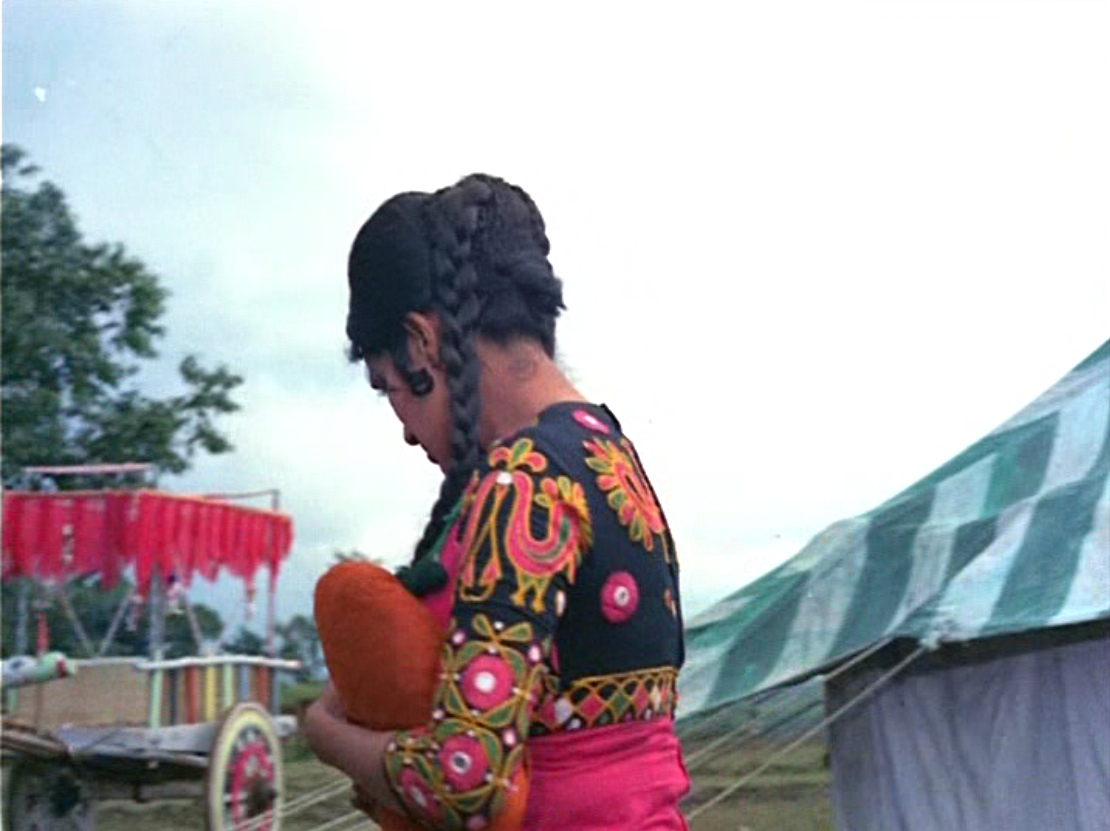
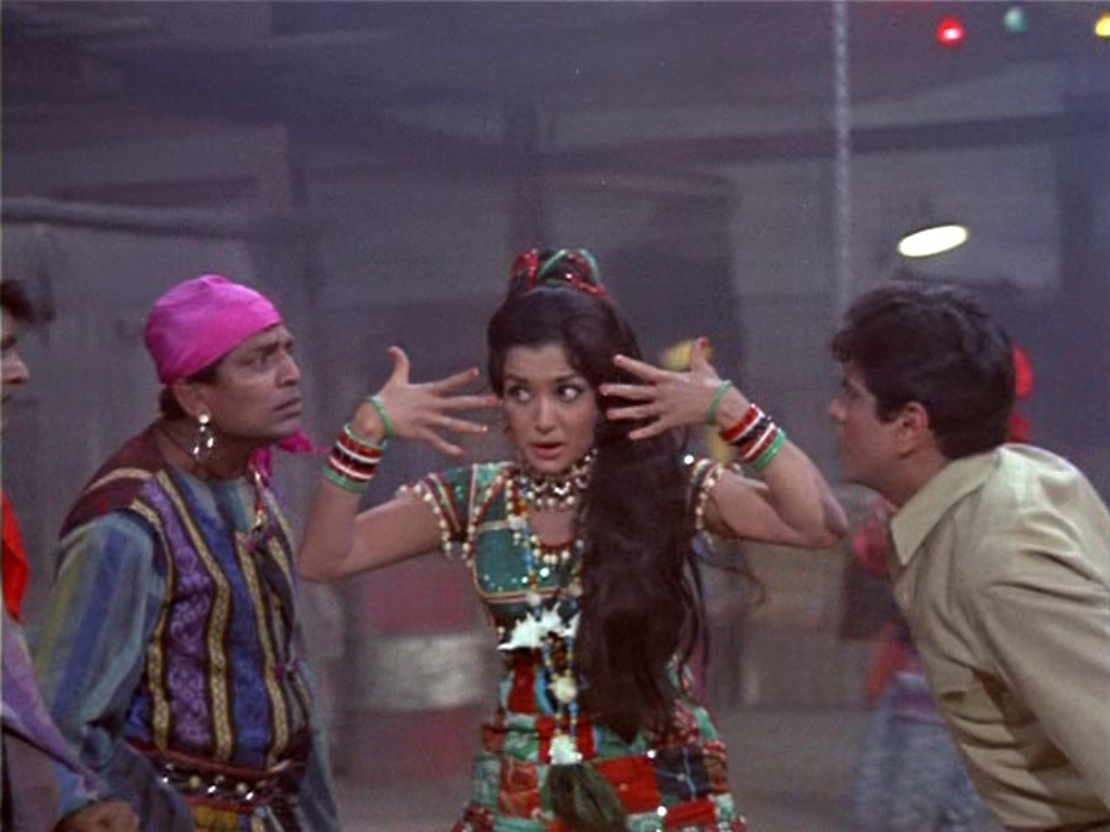
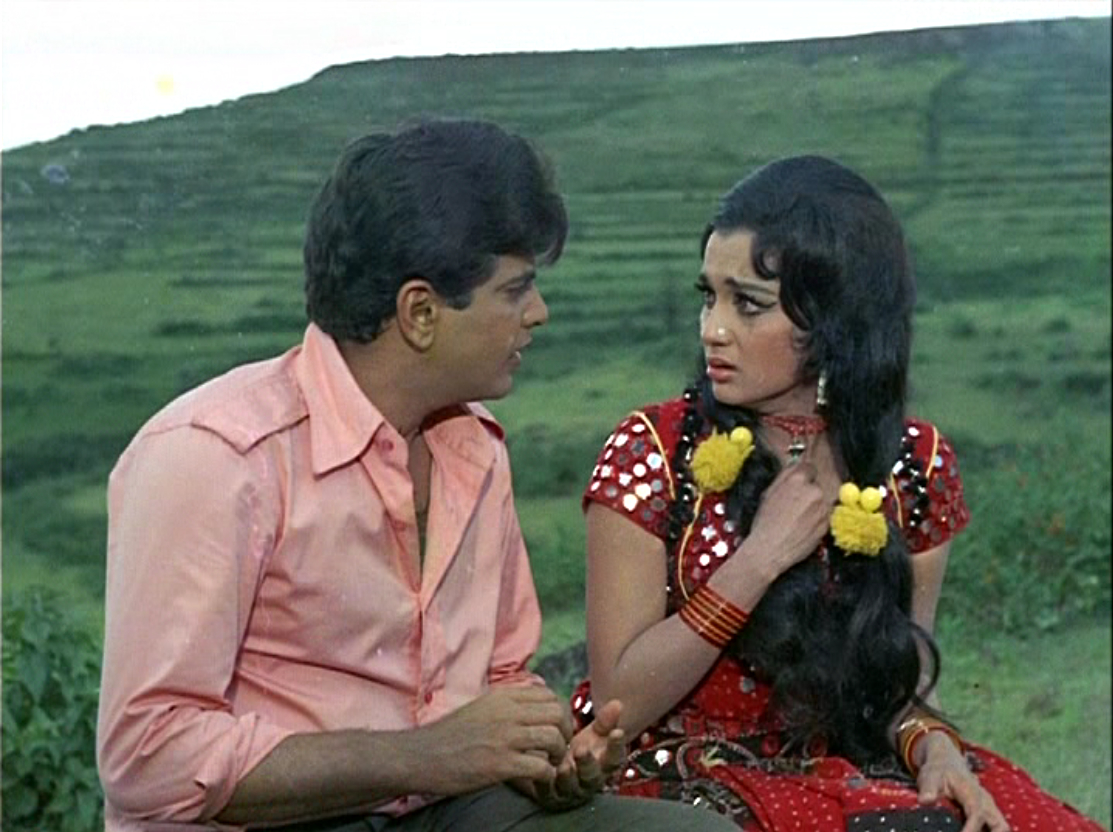
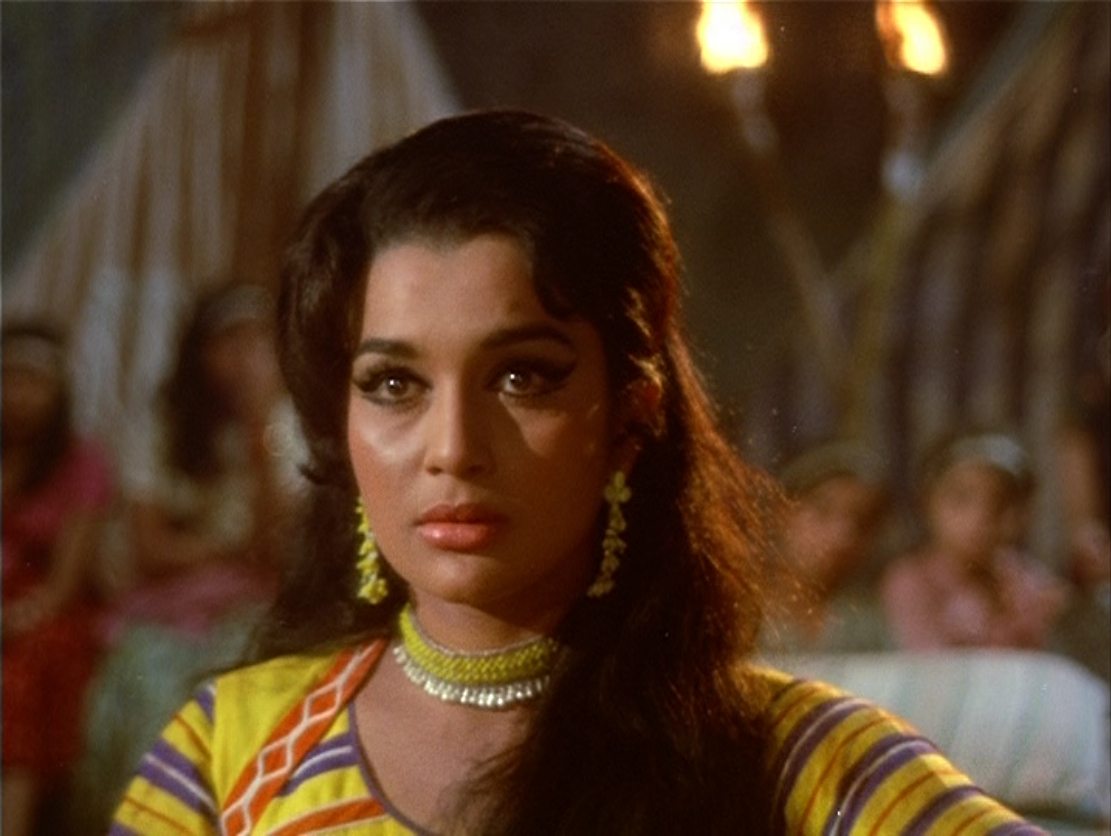
Asha Parekh sports long side-parted bangs with a girlish ribbon and a bouffant wig in the exciting opening chase scene of Caravan (1971). And please don’t ignore the matching orange lipstick!

In India in the 60s and early 70s, Hindi film heroines were notorious for sporting heavy wig pieces day-to-day that added volume, glamour, and pizazz. Hairdos in India from that time period sought to create works of art atop a woman’s head, from simple teased crown, to elaborate braiding with ornaments, jewelry, and soaring heights. The key was to wear enormous wigs and lots of them (and yes, those wigs are made of REAL hair!)

Big hair was by no means a strictly Indian phenomena. Starting as early back in history as the famous wigs of Marie Antoinette, puffy bouffant styles were sported not just in films, but by First Lady Jackie Kennedy in the 60s and took the musical South by storm when Dolly Parton learned how to tease (a word for the back-combing technique used to bulk up layers of hair). But I’d say, Audrey Hepburn in Breakfast at Tiffany’s  (1961) aside, Indian women like Sharmila Tagore and Asha Parekh were the ones to bring it to new levels.

The overall effect when done correctly can be extremely elegant and beautiful–at some point or another, we’ve all tried to emulate big hair in the hopes of looking fabulous. But, of course as you’ll see, there are always those special moments when wigs go wild and the ‘do takes on an alternate life of its own.

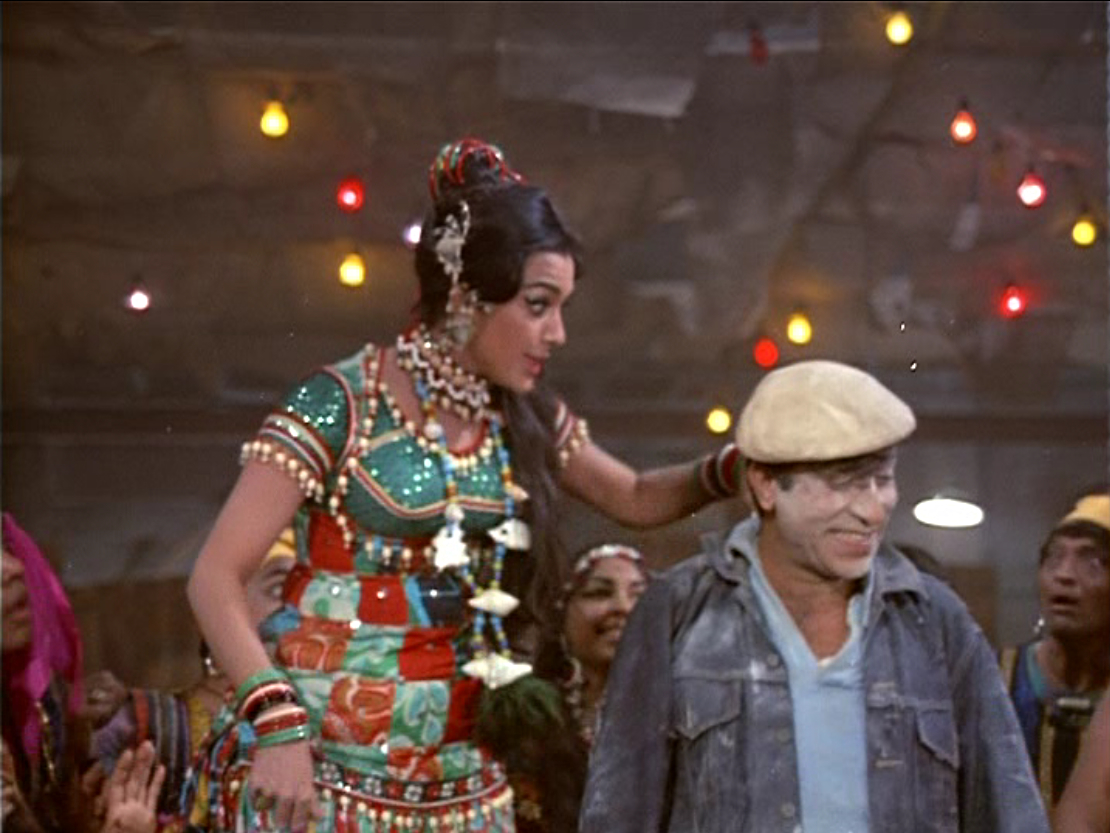
Check out our gallery of fabulous retro Bollywood hairdos sported by Asha Parekh in the 1971 film Caravan (yes, it’s 1971, but the styles are super 60s!). This film is notable for many reasons, from a delightfully ridiculous plot to a magical soundtrack enhanced by Helen’s insane dance moves. But every time I watch it, I am way too distracted by Asha Parekh’s latest ‘do to care for anything else. Haute couture meets gypsy allure, good intentions meet near-lethal doses of hairspray. After all, the higher the hair, the closer to God.

Who is it?? Why, it’s little bo peep. She wants her ribbon back.

Asha’s fabulous ‘do in the opening scene of Caravan has tight long curls, a side-tied white ribbon, and of course, a 4-inch high wig.

Asha goes gypsy! Note the most important touch of all: the little ringlet of hair by her cheek that probably was once a delicate sideburn.

Hair parted in the center is getting slightly more 70s than 60s, but thank goodness you threw in that 3-inch poof, Asha. Otherwise, I don’t think the look had enough crazy going on.

What a pleasant little surprise! The back of the ‘do is as wild as the front! What was the stylist really going for with this ruffled little back-bun? Historians may never know.

Bring on the ribbons! And the back-up dancers.

Oh, just kidding–those aren’t ribbons after all! They are bangles arranged like a pillbox hat at the crown of the coiffe! You can never be too creative with accessories, can you?

I like the “au natural” look of the long sweeps of locks hanging to one side. And look how Asha made the “jhumar” a day-to-day fashion accessory long before it became vogue!

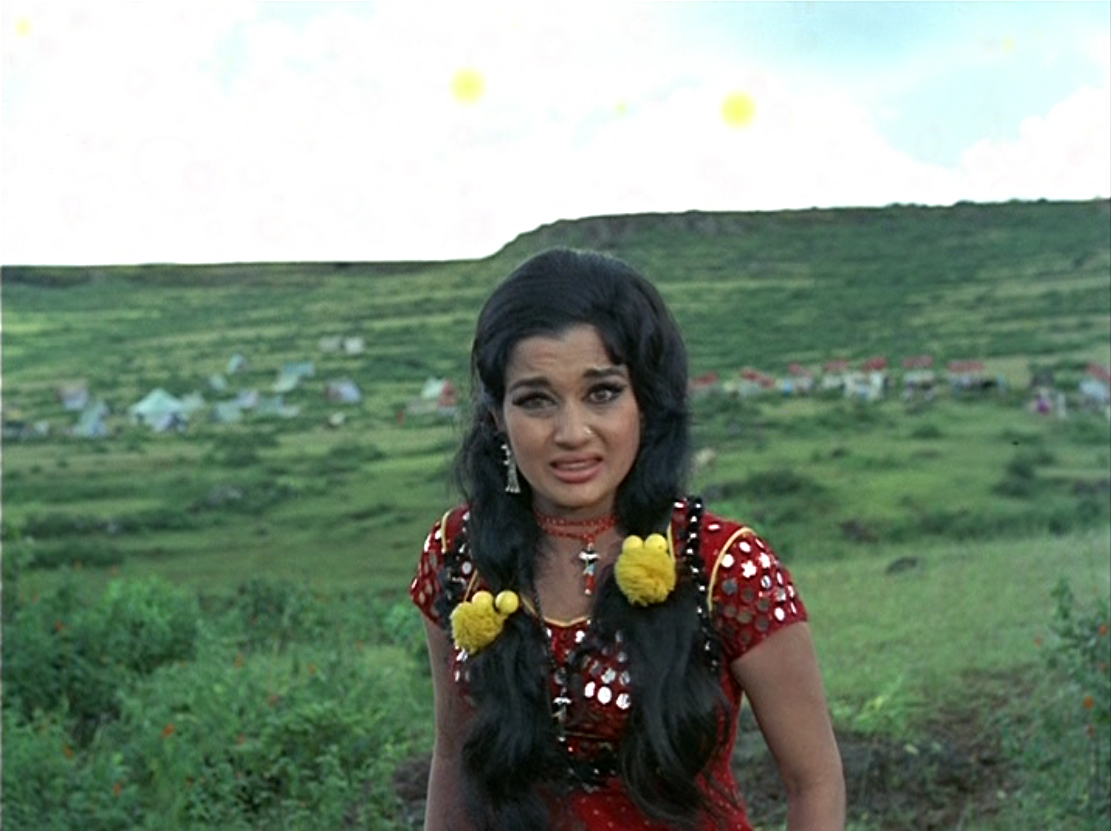
Drooping pigtails with bright yellow flower ties for a much-needed pop of colour.

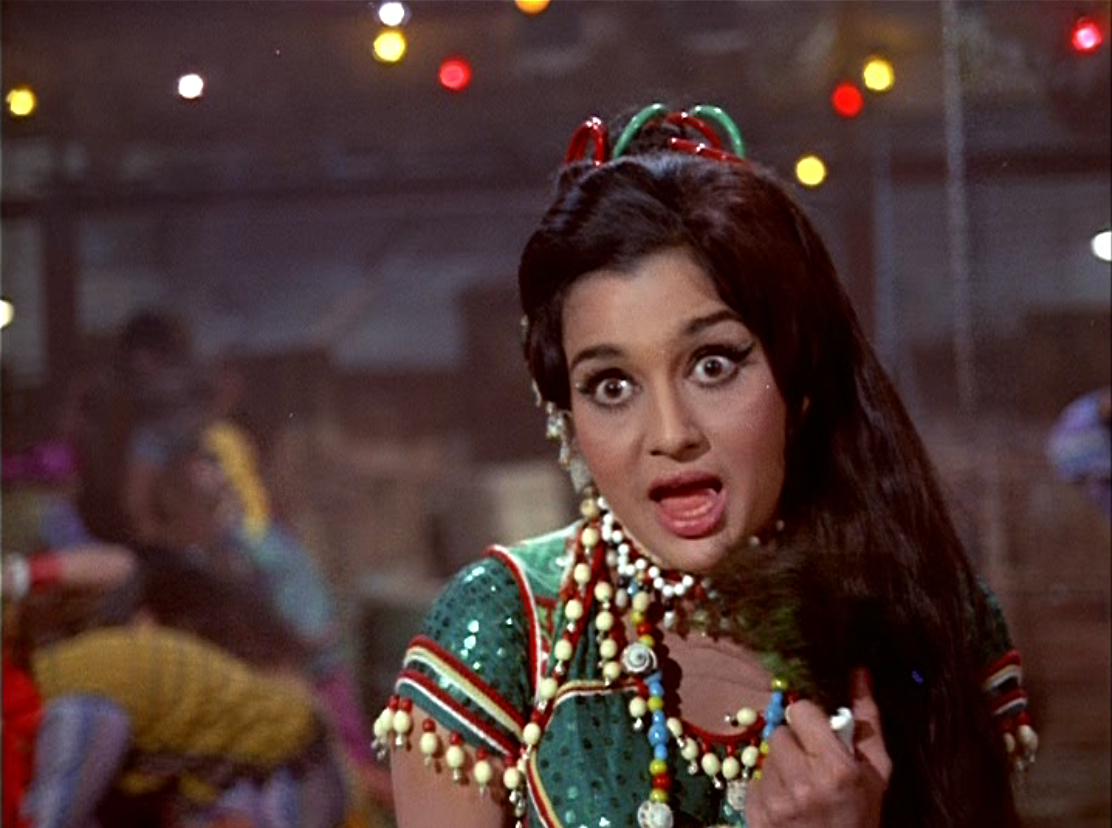
Great hair aside…I think the most striking aspect of this photo is that Asha is about to have a conniption on-screen.

I love the side-parted pigtail village look. Who cares if you’re pushing 40 years old?!

I could do without the brushed back bangs in the center, while leaving an awkward patch of bangs to the side. But perhaps it’s all part of how distressed she’s supposed to be?

Again with the awkward patch of bangs! I far prefer some Sadhana-fringe.

You get a good sense of the volume of hair involved in the making of this ‘do in this shot.

The forehead to wig-height ratio is borderline criminal.

Asha Parekh in Caravan 48

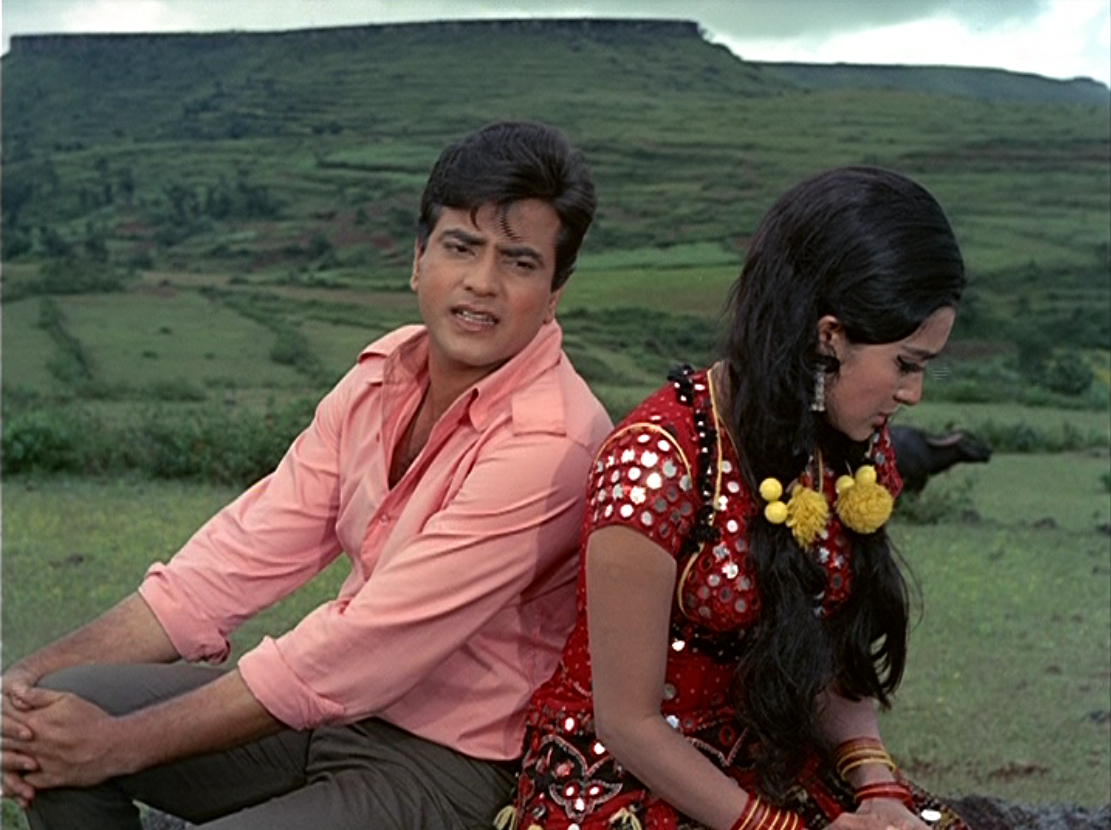
Classic example of a ‘do taking on it’s own life. It’s like she’s attacking Jeetendra, and her hair is attacking her. The hair wins, of course.

Asha Parekh in Caravan 49

The glamour shot is nice–especially since you can’t see all the little people jumping off the top of her ‘do to commit suicide.

Asha Parekh in Caravan 50

Back to a simple, conservative ribbon with moderate heights. That’s more like it!

Oh, and a little curl too? Sign me up!!

Asha Parekh in Caravan 51a

Love how far back the ribbon is pushed–less of a headband, more an accessory to make room for the beehive.

Asha Parekh in Caravan 52

I don’t know how I feel about pony-tails this short and this puffy.

Asha Parekh in Caravan 54

Very Audrey Hepburn from the front. We’ll take it.

Asha Parekh in Caravan 56

These bangs are classic from this era–the angled part, the bouffant! If only it had been a French twist in the back instead of an incomplete pony.

Now after seeing this gallery, you must be under the mistaken impression that Asha Parekh does nothing but make painfully melodramatic faces in throughout the film. You wouldn’t be entirely wrong, but just know that in addition to that, she dances occasionally too. Asha Parekh’s hairstyles are so mesmerizing in this film, that you shouldn’t really be looking for much artistic depth.

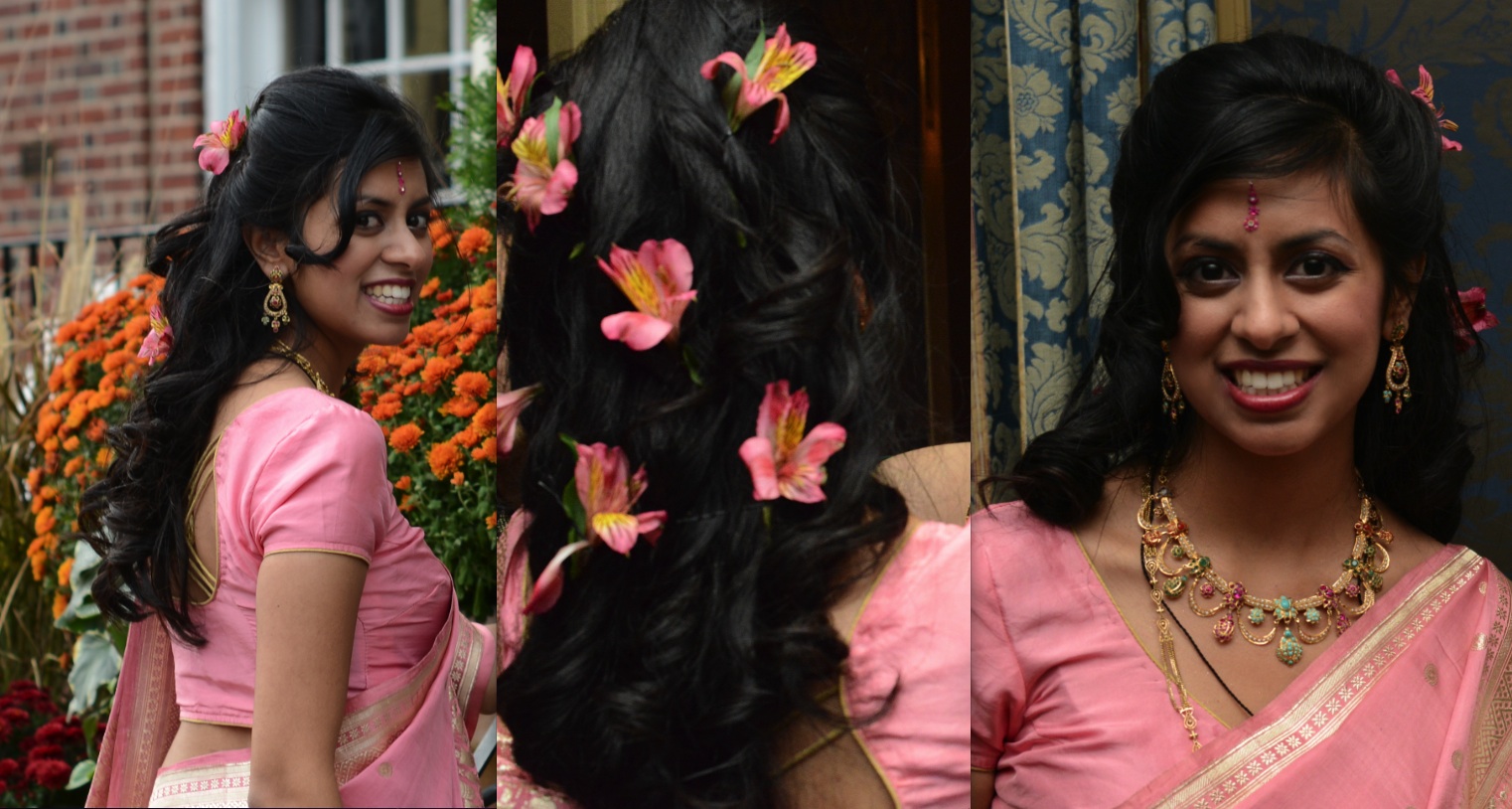
Now why, you may be asking, am I so invested in retro Bollywood hairdos? I’ve been planning my look for my fiance and my official engagement party and needed some 70s inspiration! I’m probably one of the few brides-to-be these days that are still all about the vintage Bollywood look–from sweeping cat-eyeliner to hair that reaches the ceiling. I went through dozens of old school films to perfect the ‘do I wanted. Here’s the final product!

My attempt at Asha Parekh fabulousness with a retro Bollywood hair do!

It’s a classy mixture of Asha’s best looks in Caravan, complete with flowers! Now although I did not use wigs, my tricks were to use LOTS and LOTS of hairspray, back-combing like my life depended on it, and a puffy headband underneath the bump to give some structural support to the ‘do.

For more galleries of costumes from the great films of the 60s and 70s, check out our earlier post on famed Bollywood costume designer Mani Rabadi!

-Mrs. 55
Pal Pal Dil Ke Paas Lyrics and Translation: Let’s Learn Urdu-Hindi

Rakhee daydreams about the ever-handsome Dharmendra in Blackmail (1973)

Blackmail (1973) is considered to be one of Vijay Anand’s most romantic directorial ventures. Starring Dharmendra and Rakhee, this film has all the ingredients to make a great Bollywood film: bogus science,  outrageous costumes, and of course, a memorable soundtrack. This album’s shining jewel is none other than “pal pal dil ke paas,” a beautiful expression of love that is remembered today for Kishore Kumar’s romantic and sensitive rendition.

To understand this song in context of the film, let’s take a look at a brief synopsis of the plot. Kailash (played by Dharmendra) is in charge of operating a power plant that provides electricity to homes across India. His quirky uncle Dr. Khurana (played by Madan Puri) is a scientist that is researching novel approaches to generating electricity via solar sources–how innovative for the 1970s! A local man named Mr. Mehta is unhappy about these advances because solar-powered energy is likely to put an end to his battery business. His business partner Jeevan (played by Shatrugan Sinha) is aware of Dr. Khurana’s research because he is a dear friend of Kailash.

Jeevan is set to marry Asha (played by Rakhee), Mr. Mehta’s daughter, but things change once Kailash unknowingly confesses his love for Asha to him. Taking advantage of this situation, Jeevan plans to get Kailash and Asha married so that he can eventually use Asha to get access to Dr. Khurana’s profitable “formula.” Jeevan arranges to meet Asha in a beautiful garden, but he sends Kailash in his place. They have a conversation about their dreams and hopes, and Asha warms up to the sincerity and purity of Kailash’s heart. In a bold move, Kailash hands over a packet of love letters he has written to Asha over the years to express his deepest desires, and he subsequently flees the scene to avoid embarrassment.

At this point in the film, we hear “pal pal dil ke paas,” song composed by music director duo Kalyanji-Anandji and penned by Rajinder Krishan. Unlike many instances where the on-screen portrayal of a song fails to do it justice, director Vijay Anand has done an excellent job to ensure that this picturization enhances the beauty of the music in the context of the film. In a nutshell, this song describes the progression of love between Kailash and Asha over time. At the beginning, Asha expresses restrained pleasure as she begins to read Kailash’s letters with a coy smile; by the end, she is so smitten by the poetry in his letters that she cannot stop daydreaming about him.

Does the love story between Kailash and Asha reach a happy conclusion? You’ll have to watch the film to find out! Even if the plot doesn’t appeal to you, there’s a particularly steamy  scene between Dharmendra and Rakhee  during “mile mile do badan” that is worth watching for the scandal factor alone.  Enjoy, and remember to send us your requests for song translations — we haven’t received one in a while!

-Mr. 55

Does anyone even write love letters like this anymore?

Pal Pal Dil Ke Paas: Lyrics and Translation

pal pal dil ke paas tum rahtii ho
You reside forever near my heart,
jiivan miiThii pyaas yah kahtii ho
And you call this life a sweet thirst.

har shaam aa.nkhon par teraa aa.nchal laharaaye
Every evening, the end of your sari flutters over my eyes. 
har raat yaado.n ki baaraat le aaye
And every night, it brings a parade of memories. 
mai.n saa.ns letaa huu.n, terii khushbuu aatii hai
With each breath, I smell your fragrance. 
ek mahkaa-mahkaa saa paighaam laatii hai
It brings along a scented message. 
mere dil kii dhaDkan bhii tere geet gaatii hai
Even my heartbeat sings a song for you. 
pal pal dil ke paas tum rahtii ho
You reside forever near my heart.

kal tujh ko dekhaa thaa, mai.ne apne aangan me.n
Yesterday, I saw you in my own courtyard. 
jaise kah rahii thii tum, mujhe baa.ndh lo bandhan me.n
It was as if you were saying, “Bind me in an eternal bond”
yah kaisaa rishtaa hai? ye kaise sapne hai.n?
What kind of bond is this? What kind of dreams are these?
begaane ho kar bhii kyo.n apne lagte hai.n? 
Despite being so foreign, why do I find them to be intimate? 
mai.n soch me.n rahtaa huu.n, Dar Dar ke kahtaa huu.n 
I remain in contemplation as I hesitatingly declare: 
pal pal dil ke paas tum rahtii ho
You reside forever near my heart. 

tum sochogii kyo.n itnaa mai.n tum se pyaar karuu.n
You might question why I love you so dearly.
tum samjhogii diivaanaa, mai.n bhii iqraar karuu.n
You might think I am crazy, and I would confess to that.
diivaano.n kii ye baate.n, diivaane jaante hai.n
Only a person crazy in love can understand the actions of another,
jalne me.n kyaa mazaa hai, parvaane jaante hai.n
And only moths understand the pleasure found in burning.
tum yuu.n hii jalaate rahnaa, aa aa kar khvaabo.n me.n
Please continue to ignite my passion as you come into my dreams.  
pal pal dil ke paas tum rahtii ho
You reside forever near my heart. 

Glossary

miiThaa: sweet; pyaas: thirst; aa.nchal: decorative end of a sari; laharaanaa: to flutter; baaraat: parade, procession; khushbuu: fragrance; mahka: scented; paighaam: message; aangan: courtyard; bandhan: bond; begaanaa: foreign, alien; Dar Dar ke: hesitaingly, fearfully; iqraar karnaa: to admit, confess; mazaa: pleasure; parvaanaa: moth;  jalaanaa: to ignite; khvaab: dream.

Dharmendra and Rakhee get cozy together in Blackmail (1973).