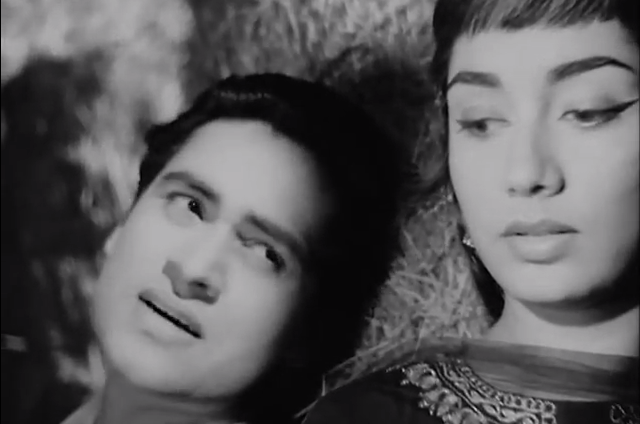
Raat Ke Humsafar Lyrics and Translation: Let’s Learn Urdu-Hindi

S

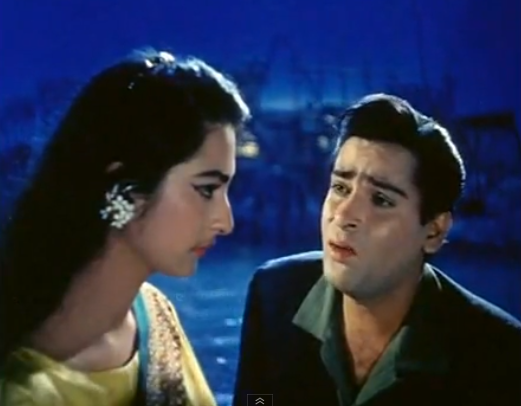
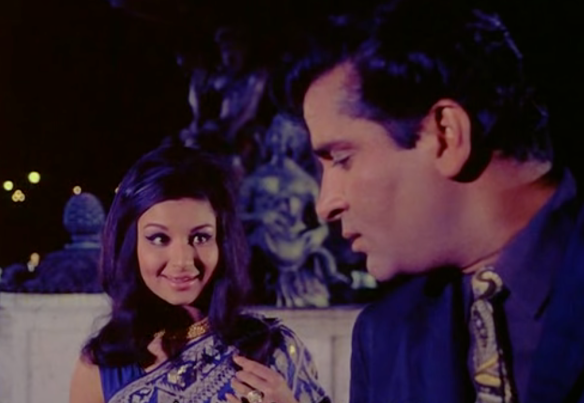
Sharmila Tagore and Shammi Kapoor enjoy the magic of Paris at night in An Evening In Paris (1967).

“If you are lucky enough to have lived in Paris as a young man, then wherever you go for the rest of your life, it stays with you, for Paris is a moveable feast.”

This quote by Ernest Hemingway is perhaps my favorite description of Paris, the quintessential city of lights and love. Being in Paris is truly a feast for all senses, but it is an opportunity that the average citizen in 1960s India would never receive. Not in person, at least.

In the 1960s, the advent of a new escapist genre of films allowed Indian audiences to be transported to exotic cosmopolitan locales through cinema. Films like Love in Tokyo (1966) and Night in London (1967) offered Indian movie-goers the chance to catch a glimpse of foreign culture from the comfort of their seats in a movie theater. In these tourist fantasies, consistency in plot and character development was not important; the real star of the show was the international destination being featured in the film.  The lyrics and English translation that we have provided today come from one of this genre’s most well-known examples: Shakti Samanta’s An Evening in Paris (1967) starring Sharmila Tagore and Shammi Kapoor.

The soundtrack for this film, composed by Shankar-Jaikishan and penned by Shailendra/Hasrat Jaipuri, contains a number of memorable hits. Yet, in my opinion, “raat ke hamsafar stands out from the rest for its beautiful melody, poetic lyrics, and passionate rendition by Mohammed Rafi and Asha Bhonsle. This romantic duet reflects a strong Western musical influence, which is enhanced by the gorgeous strings-centered orchestration and the non-traditional modulations in Rafi and Asha’s voices.

To bring an interesting perspective that may not be known to all fans of this song, there is a story behind its making that has been narrated by Nandu Chawathe, a musician in Shankar-Jakishan’s troupe. In a tragic turn of events, composer Shankar’s mother died the same morning that a musical sitting was planned for “raat ke hamsafar.”  Jaikishan, Shammi Kapoor, and others were waiting for Shankar, but most of the group left after hearing the news under the assumption that Shankar would like to take the day off. When Shankar arrived late, he asked Nandu Chawathe why everyone had left before the sitting occurred. Shankar was angry when he realized everyone had left and canceled the sitting without telling him when it was his mother who had died. An evening sitting was rescheduled the same day. When Shankar arrived, he turned off all the lights and lit a candle, much to everyone’s surprise. He hummed the opening line of “raat ke hamsafar,” and everyone was stunned instantly. The first line of the mukhDaa was even Shankar’s own words! Shammi Kapoor approved the composition, Shailendra finished out the rest of the lyrics, and a treasured gem of Hindi film music was born.
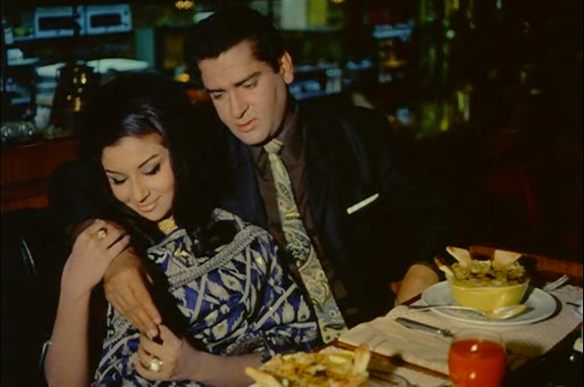
French onion soup!

Sharmila Tagore and Shammi Kapoor snuggle in a Parisian cafe as they enjoy a late-night snack–French onion soup!

Raat Ke Humsafar: Lyrics and Translation

raat ke hamsafar thak ke ghar ko chale.n
Oh companion of the night, let us wander home wearily,
jhuumtii aa rahii hai subaah pyaar kii
as the dawn of love arrives, swaying about.
dekh kar saamne ruup kii raushnii
After encountering the light of your beauty,
phir luTii jaa rahii hai subaah pyaar kii
the dawn of love is being stolen away.

sonevaalo.n ko ha.ns kar jagaanaa bhii hai
Those who are sleeping are to be awakened with a smile.
raat ke jaagato.n ko sulaanaa bhii hai
Those who have stayed awake tonight are to be lulled to sleep.
detii hai jaagne kii sadaa saath hii
Though it also gives the call to awaken,
loriyaa.n gaa rahii hai subaah pyaar kii
this dawn of love evokes calm by singing lullabies.

raat ne pyaar ke jaam bhar kar diiye
The night has filled our wine goblets of love.
aankho.n-aankho.n se jo mai.ne tum ne piiye
You and I drank from them with our eyes.
hosh to ab talak jaa ke lauTe nahii.n
After leaving us, our consciousness has yet to return.
aur kyaa laa rahii hai subaah pyaar kii?
What else does this dawn of love have in store?

kyaa kyaa vaade hue, kis ne khaayii qasam?
What promises were made tonight? Who has sworn to new vows?
is nayii raah par ham ne rakhe qadam
Upon this new path, we have taken our first steps.
chhup sakaa pyaar kab? ham chhupaaye.n to kyaa?
When could our love be hidden? Even if we could, so what?
sab samajh paa rahii hai subaah pyaar kii
This dawn of love is able to understand everything.

raat ke hamsafar thak ke ghar ko chale.n
Oh companion of the night, let us wander home wearily,
jhuumtii aa rahii hai subaah pyaar kii
as the dawn of love arrives, swaying about.

Glossary

hamsafar: companion; thaknaa: to be tired, weary; jhuumnaa: to sway; subaah: dawn; ruup: beauty; raushnii: light; luTaa jaanaa: to be stolen away; jaagat: one who is awake; sulaanaa: to lull to sleep; sadaa: call; saath hii: also; lorii: lullaby; jaam: wine goblet; hosh: consciousness; ab talak: yet; vaadaa: promise; qasam khaanaa: to take a vow; qadam rakhnaa: to take steps; chhupaanaa: to hide; samajh paanaa: to be able to understand.
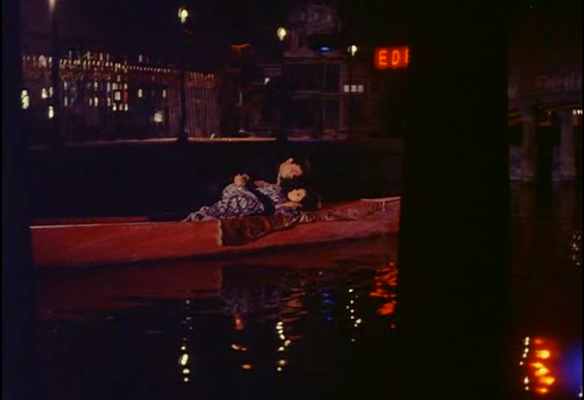
Seine

Sharmila Tagore and Shammi Kapoor float away into the night on the Seine.

As an aside, I thought that I would say a word about the time that I spent in Paris during the summer of 2011! I was fortunate enough to receive a fellowship to conduct a research internship for three months in a cancer immunology laboratory at the Institut Curie. Besides the academic opportunities presented to me in the lab, my summer in Paris was a formative experience in terms of cultural enrichment and personal growth. I always look back fondly upon the time I spent in Paris, and the memories of that summer have stayed with me ever since. In keeping with the theme of this post, a couple of my pictures of Paris by night are presented below. Enjoy! À bientôt!

-Mr. 55

Seine

An early evening view of the Seine river.
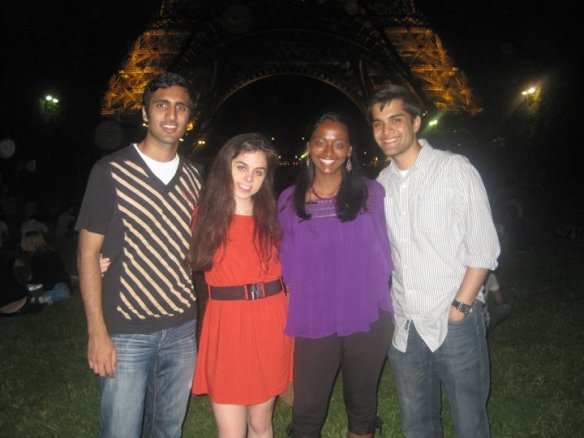
EiffelTower

Enjoying the Eiffel Tower with friends on a Parisian summer night.
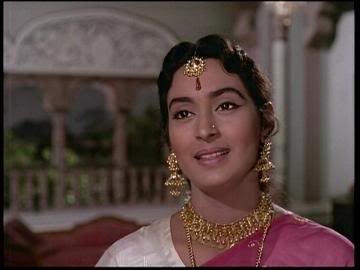
Five Anti-Feminist Bollywood Songs That Will Make You Cringe

Nutan Khandan 1965

Nutan literally worships the ground beneath her husband’s feet in Khandan (1965).

There is a careful line to be drawn in classic Bollywood cinema between love for a man and all-out worship. The songs below represent that unfortunate relic of Bollywood songs that transformed the excitement and bliss of romantic love into something plain unhealthy. We all know the genre I refer to. The trouble is, the songs are so good on a purely artistic level that we can’t help but keep playing them over and over again. Most of them were smash hits at the time of their release and continue to keep a significant slice of Indian audiences captivated, despite shifting social norms.

It’s easy to oversimplify this phenomena by saying, “it’s cultural” or “that was the way of thinking back then.” Yes, in India as in many countries, many women were raised to believe their ultimate role was in service to their husband and the framework for sexuality revolutionized worldwide in the 60s and 70s. But you can’t let it go at that for any similar explanation undermines the contradictory evidence within Indian history and the inherent wrong of this mindset. I don’t care if you lived in the 17th century or were born yesterday, we can’t raise our daughters like this. India is a country famous for electing the first female Prime Minister, for revering the strength and wisdom of its many awe-inspiring female gods, and where women become IT specialists and make salaries equivalent to their male counterparts. But there’s an uglier side too, and hopefully today we all feel a collective awkwardness when reminded of it in that great reflection of culture: film.

You’ll notice that all the songs on our cringe-tastic list are Lata Mangeshkar (half of them Nutan) hits, and it’s no surprise. Of course, it would be the heroine, not the bad modern girl left with an Asha side number, that would sing the song of self-flagellistic devotion. It’s a bad sign that some of these lines were thought to be representative of the “ideal” woman or wife–have we really improved anything by turning women into half-naked screens sirens instead? You decide.

Nutan just loves doing household chores and singing about her god-like husband in Saudagar (1973).

Personally, I have a violent reaction hearing some of these words come out of these actresses. Have a gander yourself and listen carefully to so-called Indian love of the 1950s and 1960s. Can you make it to the bottom of this list without squirming?

1. Tumhi Mere Mandir (Khandan 1965)

Cringe-worthy line: “Tumhi mere mandir, tumhi mere pujaa, tumhi devta ho.” (“You alone are my temple, you alone are my prayer, you alone are my God.”)

Gurrl, please stop it. This is seriously not healthy. Husbands should not take the place of God in your day-t0-day logic. How are you even functioning right now?

2. Aap Ki Nazaro.n Ne Samjha (Anpadh 1962)

Cringe-worthy lines: “Aap ki nazaro.n ne samjha pyaar ke qaabil mujhe…Keh rahi hai har nazar, banda parwar shukriya.” (“Your glances deemed me worthy of your love…every glance of mine says ‘Thank you, Lord.'”)

AAAAAAAAAAH. I’m in so much pain right now. So you’re telling me, you’re grateful that your husband “deemed you worthy” of his love? Help me. Check out our full translation if you’re in the mood for punishment!

3. Tera Mera Saath Rahe (Saudagar 1973)

Cringe-worthy line:”Tu kabhi mere khuda, mujhse bezaar na ho.” (May you never become angry with me, my revered God!)

Although this film is actually really good and takes some unexpected twists that make you love Nutan, I can’t deal with her in this song. She frolics around doing the chores with a pep in her step, just wishing and hoping that her GOD, oh wait, sorry, that man you married, will never be angry at her.

4. Hum Tere Pyaar Mei.N (Dil Ek Mandir 1963)

Cringe-worthy line: “Is tere charan kii dhuul se ham ne apnii jiivan maa.ng bharii…Ab in charano.n me.n dam nikle bas itnii aur tamannaa hai.” (“I put sindoor on my forehead from the dust at your feet…now I have but one more wish, which is to die at your feet.”)

OMG, calm down, girlfriend. You are legit scaring me. I don’t care if you’re being figurative, go take a cold shower and re-evaluate yourself!!! Our English translation of this monster is here.

5. Dheere Dheere Machal (Anupama 1966)

Cringe-worthy line: “Mujhko karne de! Karne de! Solah sringar! Koi aataa hai!” (Oh let me, let me, let me adorn myself and put on full-make up! He is coming!”)

OK I get it, we all try to look good for our man, but it’s the sheer frenzied desperation here that bothers me. Do you think your man gets that crazy to straighten his tie and brush his hair when he hears your painted toenails pattering on the ground in approach??

So how’d you do? Survived? Well done! Sorry about my rant, I just prefer a little equality in a relationship. For a rebuttal (and there are plenty to choose from), be sure to read our post on Mukesh’s “Koi Jab Tumhara Hriday” just in case you were afraid it was only women who knew how to grovel. Did we miss any cringe-worthy gems that always rankle your bones? Let us know in the comments!
-Mrs. 55

Ehsaan Tera Hoga Mujhpar Lyrics and Translation: Let’s Learn Urdu-Hindi

Shammi Kapoor’s wistful gaze wins over hearts as he pines about unconditional love in Junglee (1961)

Our next translation is a truly special song from Subodh Mukherjee’s Junglee (1961): ahsaan teraa hogaa mujh par. Junglee stars Saira Banu in her debut role as a stunning Kashmiri beauty who wins over a stoic, arrogant businessman played by Shammi Kapoor. This film was instrumental in launching Saira Banu’s career as a heroine and solidifying Shammi Kapoor’s image as a charming loverboy. As an aside, this film is also noteworthy because it ushered in an era of producing mainstream Bollywood films in Eastman color!

Composed by Shankar-Jaikishan and penned by Hasrat Jaipuri, this song ranks among my all-time favorites rendered by the inimitable Mohammed Rafi. This touching melody rooted in raga Yaman Kalyan with heartfelt words expressing the beautiful struggles of unconditional love is perfectly suited for Mohammed Rafi’s delicate, velvety vocals.  Shammi Kapoor’s on-screen portrayal–especially that sensual look in his eyes–adds to Rafi’s romantic rendition.

Lata Mangeshkar has done an apt job performing a second shorter “sad” version of this song in film. Yet it somehow lacks the magic and sensual ease of Rafi’s rendition, and this might be attributed to Shankar-Jakishan’s decision to have Lata sing this song in the same “male scale” as Rafi. For more on this phenomenon, please see our previous post on the role of the soprano voice in Hindi film music here.

Please enjoy this veritable gem of Hindi film music by reading the lyrics and our English translation provided below! Until next time…

-Mr. 55

16-year-old Saira Banu makes a stunning debut alongside Shammi Kapoor in Junglee (1961)

Ehsaan Tera Hoga Mujhpar: Lyrics and Translation

ahsaan teraa hogaa mujh par
You would be granting me a favor 
dil chahtaa hai vah kahne do
if you permit me to reveal my heart’s desires. 
mujhe tum se muhabbat ho gayii hai
I have fallen in love with you. 
mujhe palko.n kii chaa.nv me.n rahne do
Please let me dwell in the shadows of your eyelashes.

tum ne mujhko ha.nsnaa sikhayaa
You taught me how to smile,
rone kahoge ro le.nge ab
yet I would cry now upon your request.
aa.nsuu kaa hamaare gham na karo
Please do not mourn for my tears.
ve bahte hai.n to bahne do
They have started to flow, so let them fall.
mujhe tum se muhabbat ho gayii hai
I have fallen in love with you.
mujhe palko.n ki chaa.nv me.n rahne do
Please let me dwell in the shadows of your eyelashes.

chaahe banaa do chaahe miTaa do
Whether you build me up or destroy me, 
mar bhii gaye to de.nge duaaye.n
I will give you my blessings even if I die. 
uD uD ke kahegii khaak sanam
Oh beloved, as they fly in the air, my ashes will say:
yah dard-e-muhabbat sahne do
“Let us bear the burden of this pain in love.”
mujhe tum se muhabbat ho gayii haii
I have fallen in love with you.
mujhe palko.n kii chaa.nv me.n rahne do
Please let me dwell in the shadows of your eyelashes.

ahsaan teraa hogaa mujh par
You would be granting me a favor. 

Glossary

ahsaan: favor; muhabbat: love; palke.n: eyelids, eyelashes; aa.nsuu: tears; gham karnaa: to mourn; bahnaa: to flow; miTaa denaa: to destroy; duaaye.n: blessings; uDnaa: to fly; khaak: ashes; sanam: beloved; dard-e-muhabbat: pain in love; sahnaa: to endure, tolerate.

Junglee (1961) showcases the beauty of the Kashmiri countryside.

Koi Jab Tumhara Hriday Lyrics and Translation: Let’s Learn Urdu-Hindi

Manoj Kumar Purab Paschim

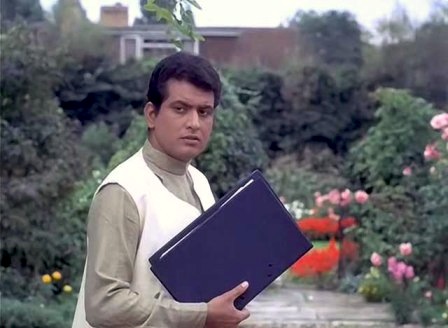
Manoj Kumar plays the righteous Mr. Bharat wooing a wayward Westernized girl in Purab Aur Paschim (1970).

We now present the lyrics and English translation to the haunting love song “Koi Jab Tumhara Hriday” from Manoj Kumar’s cult classic Purab Aur Paschim (1970). The film was one of many patriotic hits by Manoj Kumar that etched his niche as a fighter of Indian values on screen that no other producer or actor could replace. Shot with an entirely overt pro-India agenda that is really more endearing than offensive, Purab Aur Paschim rides on the righteousness of traditional values over the decay and corruption of societies lost to drugs, sex, and disregard for elders. It’s the anti-thesis to Orientalism–a vibrant, exotic lens coloured by everything India wanted to believe existed in the wild, wild West. It’s a film that only Manoj Kumar in his quiet Nehru coats, quivering upper lip, and a sincere belief in the Indian way of life could truly pull off. While the exaggerations of  London decadence may seem heavy-handed at times, there’s a real heart in this film that will win you over. See our translation of “Mere Desh Ki Dharti” for more!

“Koi Jab Tumhara Hriday” is a haunting Mukesh solo that stands wonderfully alone without fancy back-up music or elaborate picturization. From the plucking of strings that mark its opening to the quietly fading finale, his song has a unique power. Plus, keeping in line with the extremist traditionalism, how often will you find hardcore Sanskrit-based Hindi films in lyrics like “hriday” or “kanwal“?!

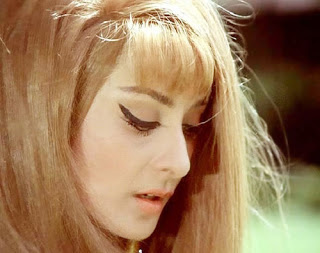
All that said, you can’t ignore that the lyrics are borderline groveling–they are sung by a traditional Mr. Bharat who finds himself in “modern” London and unused to the fast and easy ways of the West. Manoj Kumar falls hard for smoking playgirl Saira Banu–blonde wig, miniskirt, and all–to the point that he proclaims he will wait for her until the end to reciprocate after her other lovers grow tired of her. Is this truly what the perfect Indian man is supposed to be? My former Urdu professor used to have a really negative reaction to Manoj Kumar putting up with a girl like that–and found it pathetic he accepted she had so many other men in her life! Is he really pathetic or just blindly in love? Perhaps Manoj Kumar is simply trying to express that the unconditional love and devotion of the Indian way of life will outlast the fickle West shifting back and forth from empty pleasure to pleasure.

Saira Banu Purab Paschim

Saira Banu feigns nonchalance with her painfully fake blonde bouffant in Purab Aur Paschim (1970).

But say what you want about the lyrics, the melody is beautiful and Mukesh’s rendition is filled with emotion that I adore every time. Enjoy our English translation and lyrics to “Koi Jab Tumhara Hriday” below! Follow along here on youtube and let us know your thoughts in the comments!

Koi Jab Tumhara Hriday Lyrics and Translation

Koi jab tumhaaraa hriday toD de
When someone breaks your heart
Tadaptaa huaa jab koii chhoD de
When someone leaves you in suffering
Tab tum mere paas aanaa priye
Then come to me, beloved
Meraa dar khulaa hai, khulaa hii rahegaa tumhaare liye
My door is open, and will always remain open for you
Koi jab tumhaaraa hriday toD de
When someone breaks your heart

Abhii tumko merii zaruurat nahii.N
At the moment you do not need someone like me
Bahut chaahanewaale mil jaaye.nge
You will meet many people who fall in love with you
Abhii ruup ka ek saagar ho tum
For now you are an ocean of beauty
Kanwal jitne chaahoge khil jaaye.Nge
As many lotuses as you desire will bloom for you
Darpan tumhe jab Daraane lage
When your own image in the mirror starts to scare you
Jawaanii bhi daaman chuDaane lage
When your youth begins to leave you
Tab tum mere paas aanaa priye
Then you will come to me, beloved
Meraa sar jhukaa hai, jhukaa hii rahegaa tumhaare liye
My head is bowed to you, and will always bow to you
Koi jab tumhaaraa hriday toD de
When someone breaks your heart

Koii shart hotii nahii.N pyaar mei.N
There are no conditions in love
Magar pyaar sharto.N pe tum ne kiyaa
But your love is based on conditions
Nazar mei.N sitaare jo chamake zaraa
Those stars in your eyes that glittered for a while
Bujhaane lagii aartii ka diiyaa
They have begun to extinguish the candles of devotion
Jab apnii nazar mei.N hii girne lago
When that image of yourself falls in your own esteem
Andhero.N mei.N apne hii ghirne lago
When your own darkness starts to surround you
Tab tum mere paas aanaa priye
Then you will come to me, beloved
Yeh deepak jalaa hai, jalaa hii rahegaa tumhaare liye
This light is burning, it will always remain burning for you

Koi jab tumhaaraa hriday toD de
When someone breaks your heart
Tadaptaa huaa jab koii chhoD de
When someone leaves you in suffering
Tab tum mere paas aanaa priye
Then come to me, beloved
Meraa dar khulaa hai, khulaa hii rahegaa tumhaare liye
My door is open, and will always remain open for you
Koi jab tumhaaraa hriday toD de
When someone breaks your heart

Glossary

hriday: heart, liver; priya: beloved; dar: door; zaruurat: need; ruup: beauty, saagar: ocean; kanwal: lotus; Darpan: mirror; Daraane: to scare; jawaanii: youth; sar jhuknaa: to bow your head; shart: condition; sitaaraa: star; chamaknaa: to sparkle, to glitter; aartii: a common Hindu devotional prayer; diiyaa: small clay candle; girnaa: to fall; ghirnaa: to cloud, to surround; andheraa: darkness; deepak: light

Note: Take careful note of the use of the verbs ghirnaa and girnaa that are found side-by-side in these lyrics. They sound extremely similar but mean different things!

Saira Banu reformed Purab Paschim

Yes, surprise surprise, Saira Banu reforms her wicked Western ways by the end of the film and bursts into a beautiful Lata rendition of aarti back in the motherland. Oh, looks like you forgot to remove and burn that blonde wig. Woops.

Did you know this song was actually filmed at Oxford University? Watch the video carefully–the trimmed lawns and elegantly gated deer are from none other than Magdalen college! I only wonder what all the hip 60s British college students must have been thinking as they watched the filming take place…

-Mrs. 55

Bahut Shukriya Badi Meherbani Lyrics and Translation: Let’s Learn Urdu-Hindi

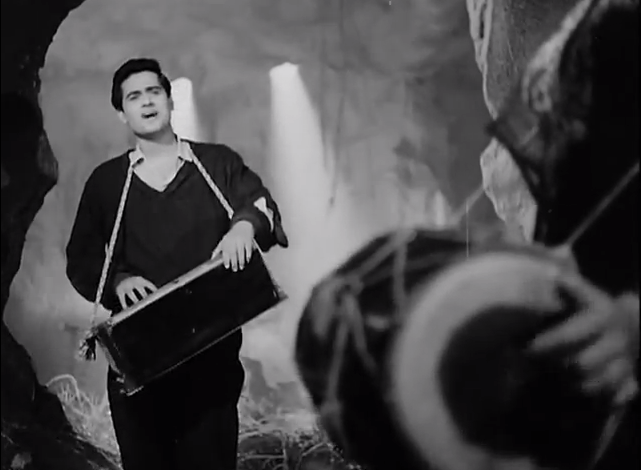
Tall and handsome Joy Mukherjee serenades Sadhana with a harmonium in hand in Ek Musafir Ek Hasina (1962)

HAPPY THANKSGIVING! In the spirit of giving thanks today, we are presenting one of Hindi cinema’s most cherished expressions of gratitude: “bahut shukriyaa baDii maharbaanii” from Ek Musafir Ek Hasina (1962). Directed by Raj Khosla, this film presents Joy Mukherjee and Sadhana in their second film together after debuting in Love in Simla (1960).  Despite some plot loopholes  and scattered character development, this film is worth a watch for Sadhana’s sublime beauty, O.P Nayyar’s evergreen soundtrack, and the cinematic portrayal of Kashmir.  This movie must have done something right because it became the second-biggest hit at the box office in 1962!

Mohammed Rafi is at his playful best as he sings for Joy Mukherjee’s character, a wounded soldier who has fallen in love with Sadhana after being hit with classic Bollywood’s most popular disease: amnesia! Asha Bhonsle also makes her presence felt despite being given a single stanza to sing here.  Although the Lata-Rafi pairing was the golden standard at the time, the unique chemistry shared between Asha and Rafi in such duets as this one is undeniable. The true star here, however, is music director O.P. Nayyar. Despite his lack of formal musical training, O.P. Nayyar was gifted with a natural talent for composing memorable melodies that appealed to the masses. Here, he draws upon Kashmiri folk influences to craft a tune that has truly survived the test of time. Of special note in this song is the interplay of the harmonium and dholak, two instruments that were often passed over by many music directors for more robust alternatives (e.g. strings, tabla, etc). This orchestration  is  an integral part of the song and it has even been reflected in the picturization: Joy Mukherjee serenades with a harmonium strapped around his neck as Sadhana accompanies on the dholak.

Given the special occasion of Thanksgiving, we hope that the portrayal of thankful sincerity in this song will inspire you to go say dhanyavaad, shukriya, or thank you to the loved ones in your life. Before the food coma from dinner sets in, take a listen to this gem and follow along with the lyrics and our English translation below. Enjoy!

–Mr.55

Who is wearing more make-up here? Joy or Sadhana? 🙂

Bahut Shukriya Badi Meherbani: Lyrics and Translation

bahut shukriyaa baDii maharbaanii
Many thanks for the great kindness you have shown
merii zindagii me.n, huzuur, aap aaye
by coming into my life, oh beloved. 
qadam chuum luu.n, yaa ki aa.nkhe.n bichha duu.n?
Shall I kiss your feet or wait in desperation?
karuu.n kyaa yah merii samaj me.n na aaye
I cannot understand what I should do.

karuu.n pesh tum ko nazaraana dil kaa
I shall offer you my heart as a gift
ki ban jaaye koii afsaanaa dil kaa
so that a tale of the heart is created.
khudaa jaane aisii suhaanii ghaDii phir
God knows that such a lovely moment
merii zindagi me.n palaT ke na aaye
may never return again in my life. 
bahut shukriya…
Many thanks... 

khushii to bahut hai, magar yah bhii gham hai
I am experiencing much happiness, but also some sorrow
ki yah saath apnaa qadam do qadam hai
because our companionship is limited to taking only a few steps together.
magar yah musaafir duaa maangtaa hai
Yet this traveler prays that
khudaa aap se phir kisii din milaaye
God may arrange for us to meet again one day 
bahut shukriya…
Many thanks…

mujhe Dar hai mujh me.n ghuruur aa na jaaye
I am afraid that I may become filled with pride.
laguu.n jhuumne me.n, suruur aa na jaaye
As I begin to dance, I fear that I may be overcome with exhilaration.
kahii.n dil na meraa yah taariif sun kar
I hope that, upon hearing your praises, my heart
tumhaaraa bane aur mujhe bhuul jaaye
does not become yours while forgetting me. 

bahut shukriyaa baDii maharbaanii
Many thanks for the kindness you have shown
merii zindagii me.n, huzuur, aap aaye
by coming into my life, oh beloved.

*Male lines in black are sung by Mohammed Rafi. Female lines in red are sung by Asha Bhonsle. 

Glossary

shukriyaa: thanks; maharbaanii: kindness; huzuur: beloved; qadam: foot, step; chuum lenaa: to kiss; aankhe.n bichhaa denaa: to wait desperately; samaj: understanding; pesh karnaa: to offer; nazaraanaa: gift; afsaanaa: tale; suhaanii: lovely; palaT ke aanaa: to return;  musaafir: traveler; duaa maangnaa: to pray; ghuruur: pride; suruur: exhilaration; taariif: praise.

Joy and Sadhana share great (and perhaps unexpected) on-screen chemistry in Ek Musafir Ek Hasina (1962)