Dost Dost Na Raha Lyrics and Translation: Let’s Learn Urdu-Hindi

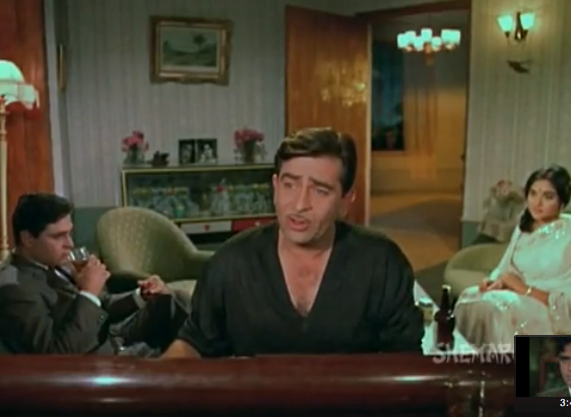
Raj Kapoor sings about betrayal in love and friendship at the piano in Sangam (1965)

Our next translation comes from Sangam (1965), a film starring Raj Kapoor as Sundar, Vijayntimala as Radha, and Rajendra Kumar as Gopal in a classic love triangle story gone wrong. The plot of Sangam is somewhat complex, but it can be boiled down to a few key points:

  • From a young age, Sundar has been attracted to his childhood friend Radha. However, Radha only has eyes for another friend Gopal and persistently rejects Sundar’s advances.  In secret, Gopal reciprocates Radha’s feelings for him.
  • To prove his worthiness as a man and impress Radha, Sundar enlists in the Indian Air Force. Before his departure, Sundar asks Gopal to make sure no man comes in between him and Radha while he is gone.
  • One day, Gopal and Radha receive the terrible news that Sundar is presumed dead after a plane crash. Although they are deeply saddened, this news means that Gopal and Radha can pursue their feelings for each other with a clear conscience. During their courtship, Gopal writes an unsigned love letter to Radha that will become important later in the story.
  • Much to Gopal and Radha’s surprise, Sundar returns happy and healthy from the Air Force–the rumors of his death were inaccurate. The self-sacrificing Gopal keeps his word and steps out of the picture so that Sundar can woo Radha.
  • Eventually, Radha and Sundar get married. It is difficult for Radha to reject Sundar now because his heroic accomplishments in the Air Force have elevated his status to that of a worthy suitor. The newly wedded couple have an extravagant European honeymoon.
  • After their return, the couple enjoy marital bliss. Yet, their happiness is short-lived: Sundar finds the unsigned love letter and assumes that Radha has been an unfaithful wife (although she has stopped all relations with Gopal post-marriage).
  • In the days that follow, Sundar becomes insane with jealousy and makes Radha’s life miserable with constant threats and aggression. Radha flees to Gopal’s house for refuge without knowing that Sundar will end up doing the same thing.
  • The three characters now have a dramatic confrontation where Gopal admits that he is the author of  the unsigned love letter. Tensions flare, and to avoid giving too much away, I’ll just say that the movie ends with a tragic death….

Placed into the context of this film,  Sundar pours his heart out by singing “dost dost na rahaa” after discovering the unsigned love letter that Radha has hidden from him.  With heart-wrenching lyrics penned by Shailendra and a touching melody based on Raga Bhairavi composed by Shankar-Jaikishan, this song is Bollywood’s quintessential anthem for those who have been betrayed in love or friendship. Mukesh’s pathos-laden voice is perfectly suited to express the pain that Sundar must feel after he comes to believe that his two closest companions in life have been unfaithful to him. The intensity of emotion is heightened by this song’s picturization: the camera captures close-up shots of facial expressions when Sundar sings the antara addressed to Gopal followed by the one addressed to Radha.  From watching this scene, it seems like you can cut the tension in the air with a knife! Although no one should ever have to endure being spurned like this in real life, we hope that the lyrics and English translation provided below will allow you to acquire a greater appreciation for one of Hindi cinema’s finest expressions of angst and betrayal that is still a fan-favorite today.

-Mr. 55

Vijayantimala quietly endures Raj Kapoor’s misguided accusations of infidelity in Sangam (1965)

Dost Dost Na Raha: Lyrics and Translation

dost dost na rahaa, pyaar na pyaar rahaa
My friend no longer remains a friend; my love no longer remains love.
zindagii, hame.n teraa aitbaar na rahaa 
Life, I have lost my faith in you.

amaanate.n mai.n pyaar kii gayaa thaa jisko sau.np kar
The one to whom I entrusted my belongings of love,
vah, mere dost, tum hii the, tum hii to the 
My friend, you were him. Only you.
jo zindagii kii raah me.n bane the mere hamsafar 
The one who had become my fellow traveler in the journey of life,
vah mere dost tum hii the, tum hii to the 
My friend, you were him. Only you.
saare bhed khul gaye, raazdaar na rahaa 
All my secrets are now exposed, the secret-bearer no longer remains.
zindagii, hame.n teraa aitbaar na rahaa
Life, I have lost my faith in you.

gale lagii saham saham, bhare gale se boltii
The one who embraced me fearfully while speaking in a somber voice,
vah tum na thii.n to kaun thaa? tum hii to thii.n
If she wasn’t you, then who was she? It was only you. 
safar ke vaqt me.n palak pe motiyo.n ko toltii 
The one who shed tears of pearls at the parting hour,
vah tum na thii.n to kaun thaa? tum hii to thii.n 
If she wasn’t you, then who was she? It was only you. 
nashe kii raat Dhal gayii, ab khumaar na rahaa
The night of intoxication is over, the inebriation no longer remains.
zindagii, hame.n teraa aitbaar na rahaa
Life, I have lost my faith in you.

vafaa kaa leke naam jo dhaDak rahe the har ghaDii
The one who beat each moment in the name of faithfulness
vah, mere nek nek dil, tum hii to ho
My good heart, you are it.
jo muskuraake rah gaye zahar kii jab suii gaDii
The one who continued to smile when pierced with a needle of poison
vah, mere nek nek dil, tum hii to ho
My good heart, you are it.
ab kisii kaa, mere dil, intazaar na rahaa
Now, my heart, I am not waiting for anyone.
zindagii, hame.n teraa aitbaar na rahaa
Life, I have lost my faith in you.

dost dost na rahaa, pyaar na pyaar rahaa
My friend no longer remains a friend; my love no longer remains love.

Glossary

aitbaar: trust, faith; amaanat: property, belongings; sau.npnaa: to entrust, hand over; hamsafar: traveler, companion; bhed: secret; raazdaar: secret-bearer; gale lagnaa: to embrace; saham: fearfully; bharaa galaa: somber voice; palak: eyelid; motiyaa.n: pearls; tolnaa: to weigh; nashaa: intoxication; khumaar: inebriation; vafaa: faithfulness; dhaDaknaa: to beat; nek: good, worthy; zahar: poison, suii: needle; gaDnaa: to pierce, thrust in; intazaar: wait.

Rajendra Kumar, with a distressed and guilty expression, listens to Raj Kapoor’s allegations of disloyalty during this song from Sangam (1965).

Ek Pyar Ka Nagma Hai Lyrics and Translation: Let’s Learn Urdu-Hindi

Nanda runs in two directions at once, coming and leaving, in “Ek Pyaar Ka Naghma Hai” from Shor (1972).

We next present the lyrics and full English translation to the eternal love ode “Ek Pyar Ka Nagma Hai” from Shor (1972). What makes “Ek Pyar Ka Nagma” so timeless? It is on everyone’s list of favorites. Part of it is that the lyrics are some of the best poetry written in accessible language (don’t get me wrong, personally if someone wants to burst into the Urdu-textbook “Mere Mehboob Tujhe,” I’m down for that too!). “Ek Pyar Ka Nagma” is rendered with almost magical emotion by Lata Mangeshkar and Mukesh–simultaneously a song of dream-like ecstasy and of tender nostalgia. It’s incomparable. The song speaks to a deep love between two souls undergoing hardship, to cherishing those brief precious moments spent together in happiness, and most of all, to remaining hopeful. The song is simple and evocative–and one of the most beautiful you’ll ever hear.

Manoj Kumar picturizes the famous violin introduction to “Ek Pyaar Ka Naghma” at a family beach outing.

Arriving about midway through the politcally-charged film, Shor, the song is partly told in golden-hued flashback of a family trip to the beach. Manoj Kumar plays a hard-luck activist and single father who’s wife, Nanda, is killed in a train accident.

Now some of you may at first be confused, if not disturbed, by Manoj Kumar’s radical cinematography in this sequence, typical of his edgy style. He experiments with several epigenetic, if you will, modifications at once that create an entirely signature effect: slow-motion, still photography inserts, split mirror screens. It was the 70s, and it was the time to experiment–and he’s one of the few Indian directors who did indeed drizzle these new techniques into his big screen productions. It’s unexpected, but upon closer analysis, I’ll argue works brilliantly. Manoj Kumar is no fool. To picturize a song about ephermal bliss, of prolonging a brief moment–he actually freeze frames his film to highlight the transience and importance of memory. His split frames, showing Nanda walking in and out of the center of the screen, of two halves of the beach merging, capture the duality of life that the lyrics speak of. In context, these techniques actually bring together the reflective themes of the film itself and of the love shared between its protagonists. For it, Manoj Kumar won the Filmfare Award Best Editing in 1972!

Nanda’s own reflection stares back at her as a symbolic representation of past and future in Manoj Kumar’s radical cinematography of Shor (1972).

So follow along below with our English translation of this lovely ode to carpe diem and unconditional devotion, “Ek Pyar Ka Nagma Hai” and watch the youtube version here!

Ek Pyaar Ka Naghma Hai Lyrics and Translation

Ek pyaar kaa naghmaa hai
Life is a tale of love
Maujo.N kii ravaani hai
Life is the flowing of waves
Zindagii aur kuch bhi nahii.N, terii merii kahaanii hai
Life is nothing more than your and my story

Kuch paakar khonaa hai
In gaining something, we lose something
Kuch khokar paanaa hai
In losing something, we gain something
Jeevan ka matlab to aanaa aur jaanaa hai
The meaning of life is to come and to go
Do pal ke jeevan se, ek umr churaani hai
From a few moments of existence, we must steal a whole lifetime
Zindagii aur kuch bhi nahii.N, terii merii kahaanii hai
Life is nothing more than your and my story
Ek pyaar kaa naghmaa hai…
Life is a tale of love…

Tu dhaar hai nadiyaa kii
You are the waters of a river
Mai.N teraa kinaaraa hoo.N
I am your shore
Tu meraa sahaaraa hai, mai.N teraa sahaaraa hoo.N
You are my support, I am your support
Aankho.N mei.N samandar hai, aashaao.N ka paanii hai
In my eyes is an ocean, it contains the water of hopes
Zindagii aur kuch bhi nahii.N, terii merii kahaanii hai
Life is nothing more than your and my story
Ek pyaar kaa naghmaa hai…
Life is a tale of love…

Toofaan to aanaa hai
Storms will come
Aakar chale jaanaa hai
But in the end, they will pass
Baadal hai yeh kuch pal kaa, chhaakar dhal jaanaa hai
These clouds are only momentary, after rising they will diminish
Parachhaaiiyaa.N reh jaatii, reh jaatii nishaanii hai
But these shadows remain, these symbols of you remain
Zindagii aur kuch bhi nahii.N, terii merii kahaanii hai
Life is nothing more than your and my story
Ek pyaar kaa naghmaa hai…
Life is a tale of love…

Glossary:

naghma: tale, ravaani: flowing, turning; zindagi: life; kahaanii: story; matlab: meaning; umr: age, lifetime, dhaar: water; nadiyaa: river; kinaaraa: shore; sahaaraa: support; samandar: ocean; aashaa: hope, wish; paanii: water; toofaan: storm; baadal: cloud; parchaaii: shadow; nishaanii: symbol, sign

Manoj Kumar remembers his dead wife and the love she left behind in Shor (1972).

The film, as in many Manoj Kumar patriotic hits, ends on a defiantly tragic note. Like Shaheed (1965), in which he is martyred with pride, or Upkar (1967) in which he loses his limbs for the glorious cause, in Shor too, Manoj Kumar becomes deaf–a poetic price for his son to gain back his lost voice. The film is a must-see for many reasons, if only to complete your understanding of the role Manoj Kumar played in Bollywood and defining the political tensions of his era. Although Manoj Kumar can no longer hear his late wife sing “Ek Pyar Ka Nagma Hai” to him, and from now on will no longer be able to hear his son, he remains hopeful and comforted by memories of the moments he once spent in happiness.

– Mrs. 55

Lag Ja Gale Lyrics and Translation: Let’s Learn Urdu-Hindi

Maybe only a hardcore fanatic like me would know this, but today (September 28th) is Lata Mangeshkar’s birthday! Mrs 55 and I would like to wish our favorite melody queen many happy returns of the day as she turns 83 years young.

Lata Mangeshkar (1929- )

Given this special occasion, I have decided to share one of my all-time favorite songs sung by Lata Mangeshkar: lag jaa gale from Raj Khosla’s classic film noir Woh Kaun Thi? (1964). I am often asked to name my favorite Lata song, but I find this request to be challenging because there are simply too many gems to narrow it down to one choice. Instead, I feel compelled to produce a list and I can say that this song consistently makes my top ten compilation of personal favorites rendered by India’s beloved nightingale.

Sadhana displays an ethereal beauty in Woh Kaun Thi? (1964)

Penned by Raja Mehndi Ali Khan and composed by Madan Mohan, this song has been immortalized as a veritable gem of the Hindi film music industry. Through an expression of carpe diem philosophy, these lyrics encourage listeners to live in the moment and cherish their loved ones now before the opportunity escapes in the future. The beautiful simplicity of these lyrics is enhanced by a sublime melody crafted by Madan Mohan–one of his career’s finest. Lata Mangeshkar’s voice is also at its heavenly best here, and her flawless rendition takes this song to the next level. It is certainly no mystery why this song has survived the test of time as one of Bollywood’s most cherished musical numbers. As you follow along with our translation and glossary below, I hope that you enjoy this masterpiece whose beauty has brought joy to countless listeners (myself included!) over the years.

-Mr. 55

Lag Ja Gale: Lyrics and Translation

lag jaa gale ki phir yah hasii.n raat ho na ho
Embrace me, for this beautiful night may come no more. 
shayad phir is janam me.n mulaaqaat ho na ho
Perhaps, in this life, we may never meet again.

ham ko milii hai.n aaj ye ghaDiyaa.n nasiib se
We are fortunate to share these moments today.
jii bhar ke dekh liijiye ham ko qariib se
Wholeheartedly take a look at me from up close,
phir aap ke nasiib me.n yah baat ho na ho
As your fate may never hold this opportunity again.
shayad phir is janam me.n mulaaqaat ho na ho
Perhaps, in this life, we may never meet again. 

paas aaiye ki ham nahii.n aaye.nge baar baar
Come close to me, for I will not return again and again.
baahe.n gale me.n Daal ke ham ro le.n zaar-zaar
Wrapping my arms around your neck, I will continue to weep. 
aa.nkho.n se phir yah pyaar kii barsaat ho na ho
My eyes may never shed such a storm of love again. 
shayad phir is janam me.n mulaaqaat ho na ho
Perhaps, in this life, we may never meet again.

lag jaa gale ki phir yah hasii.n raat ho na ho
Embrace me, for this beautiful night may come no more. 

Glossary

gale lag jaanaa: to embrace; hasii.n: beautiful; janam: birth, life; mulaaqaat: meeting;  ghaDiyaa.n: moments; nasiib se: fortunately; nasiib: fate, destiny; jii bhar ke: wholeheartedly; qariib se: up close; baahe.n: arms; galaa: neck; zaar-zaar ro lenaa: to weep continuously; barsaat: storm.

Sadhana enchants Manoj Kumar with her mysterious allure in Woh Kaun Thi? (1964)

What is Eastmancolor?

Amar Akbar Anthony in blinding Eastmancolor!

No, really, what the heck is Eastmancolor? When you look closely at title screen of each of your favorite classic Bollywood films, you find the simple, but bold little phrase, “EASTMANCOLOR” conspicuously splashed across the screen. It’s gnawed quietly at the back of your mind for years. Is “Eastmancolor” part of the name of the film? Is someone making a not-so-clever reference to Indians themselves (“Who is this MAN from the EAST, anyway?”)!? But the words quickly dissolve, the film begins, and in the excitement and messiness of the resulting masala, why “Eastmancolor” deserves a holy spot right in the title screen remains forever an unsolved mystery. Luckily for you, that’s about to change.

Aradhana in mind-blowing Eastmancolor!

Let’s back ourselves up and unravel this riddle from the start. When the first monopack colour film stocks hit Hollywood in the 1930s, India was eager to catch up and bring colour to Bollywood. But the process was not easy. Apart from being significantly more expensive than traditional black-and-white (silver halide photographic emulsion), coloured film stock brought with it a new set of artistic problems: development of the negative taking both luminosity and color into account.

Mere Huzoor in death-defying Eastmancolor!

The first colour film made entirely in India was Kisan Kanya (1937), produced by Ardeshir Irani who had also pioneered the first talkie of Hindi cinema 6 years earlier. However, poor box-office returns and difficulties and expenses in garnering rights to the American Cinecolor stock development process kept coloured film largely out of range for many years following. Guru Dutt, not surprisingly, was among the later auteurs who help revive its popularity. He experimented with the new colour cinematography in his timeless beauty “Chaudhvin Ka Chand”(1961)  that highlights the effect of (fake) moonlight and colour ranges at night. The opportunity to use colour arrived mid-production, and although Dutt had wanted to reshoot the entire film with the new technology, budget and time-constraints forced him to film only this and one other song in colour before the release. Around the same time, K. Asif too experimented with the range of this new technology, incorporating the dazzling colour song “Pyar Kiya To Darna Kya” into his magnum opus Mughal-e-Azam (1961) as a stunning and vivid tribute to the full glamour of the Mughal Empire.

Junglee in dazzling Eastmancolor!

India’s full-length color feature, Mother India (1957), was a landmark film for many reasons, but notably for demonstrating that coloured film stock was the wave of the future—garnering a nomination for Best Foreign Film at the Academy Awards the year of its release. After the overwhelming success of Mother India, Bollywood began shifting its norm to predominantly coloured film, eventually using black-and-white sparingly for stylistic reasons (as in the film noirs or Teen Devian).

Caravan in jaw-dropping Eastmancolor!

Prior to this era, colourizing film had been a technical and artistic nightmare—as far back as the 1910s and 1920s, filmmakers had been painting each frame of a film by hand, bleaching the film stock and adding color dye, or most popularly, using the expensive Technicolor multi-strip subtractive method. These options had little ground in the competitive, movie-a-minute atmosphere of India, and the hassle of processing such film stock (which often needed to be shipped abroad for the purpose), left India for many years colourless.

Teesri Manzil in heart-stopping Eastmancolor!

Eastmancolor, introduced in 1950 by Kodak was a novel and economic technology that used a single-strip 33mm negative-positive process incorporated into one strip of film. While a popular rival to expensive Technicolor, it unfortunately is also the stock most prone to fading over the years. The Eastmancolor emulsions are made of cyan, yellow, and magenta layers. The cyan is the first to fade—in films you see what were originally blue skies now turned white—then eventually all you have left are the sun-washed reddish hues. This gives us a classic image of badly preserved Bollywood films with faded colours and a warm tint.  Contrast this with most beautifully vivid Technicolor processed films you can watch today (think MGM Judy Garland musicals), and you can see a big difference in how the colours have survived.

Safar in gut-wrenching Eastmancolor!

By the time DVDs rolled around, many of the films we know and love in Bollywood had suffered destruction in their original film stocks that no one bothered to repair before a DVD transfer. However, just to give you a hint of what we’ve lost, I’ve personally adjusted the color (albeit imperfectly), to a few stills below from some classic Bollywood films as they would have looked had they been printed on extremely saturated Technicolor. See how subtle thing like this can actually make a HUGE overall difference?! That faded look is merely a tragic artifact of time and neglect.

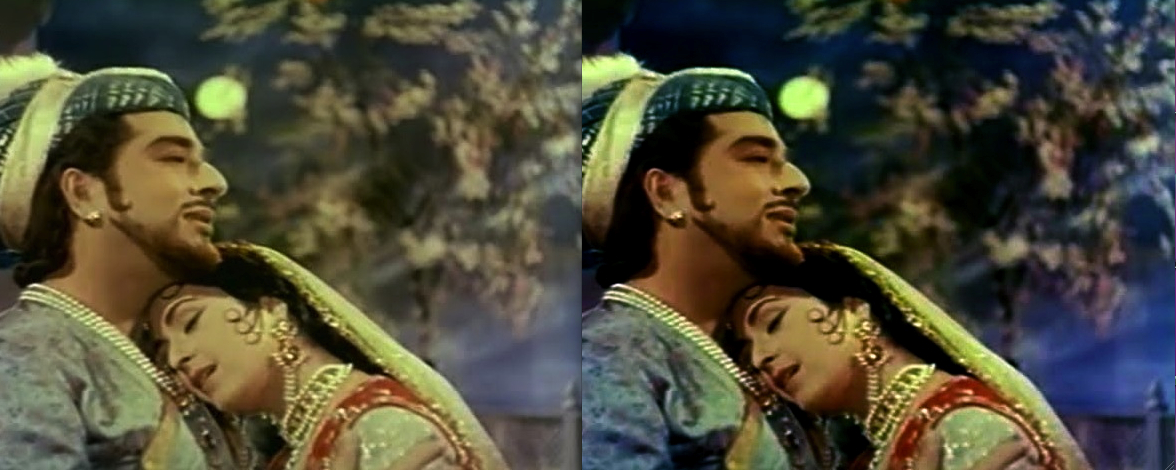
Pradeep Kumar and Bina Rai in Taj Mahal (1963).
Left: Eastmancolor. Right: Technicolor.

Sunil Dutt and Sadhana in Waqt (1965).
Left: Eastmancolor. Right: Technicolor.

Waheeda Rehman in Guide (1965).
Left: Eastmancolor. Right: Technicolor.

Shammi Kapoor and Asha Parekh in Teesri Manzil (1966).
Left: Eastmancolor. Right: Technicolor.

Aruna Irani in Caravan (1971).
Left: Eastmancolor. Right: Technicolor.

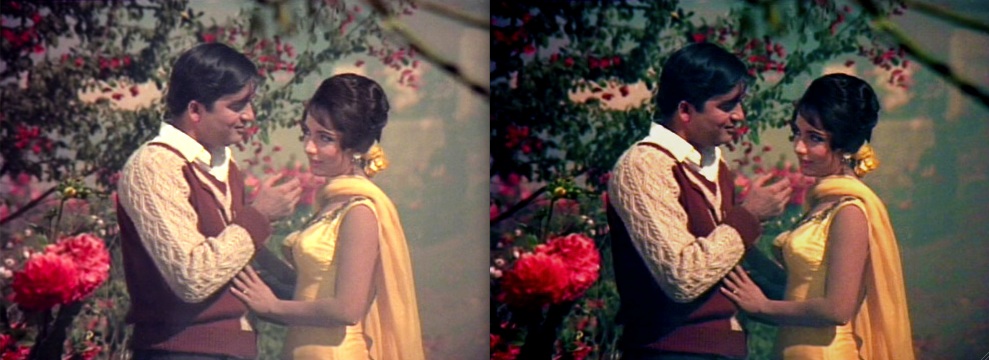
Rajesh Khanna and Sharmila Tagore in Aradhana (1969).
Left: Eastmancolor. Right: Technicolor.

Zeenat Aman and Dev Anand in Hare Rama Hare Krishna (1971).
Left: Eastmancolor. Right: Technicolor.

We often think that Eastmancolor was used only in Bollywood, but it truly started in America as a cheaper rival to Technicolor. In fact, with the advent of Cinemascope (a new widescreen format that once again changed the dynamic of filmmaking), Eastmancolor became THE industry standard—however, in America and unlike in India, the Eastmancolor stock was actually processed still by Technicolor using their sturdier dye-transfer printing. Therefore many films in America billed as “Technicolor” actually have an Eastmancolor base, but would retain their colour fidelity over the years. This is also true of the climax of Mughal-e-Azam which was also shot in and processed by Technicolor and has therefore remained brilliant over the years (helped, of course, also by the recent restoration project). The colours of that film look far different than the colours of classic Eastmancolor Bollywood films like Caravan (1978), Amar Akbar Anthony (1977), or Jewel Thief (1967). Sigh. A little investment would have gone a long way.

Madhubala glitters in K. Asif’s true Technicolor masterpiece Mughal-e-Azam (1961). Now THAT’s colour, people.

Satisfied? More information than you really wanted? I hope everyone’s burning curiosity has been slaked at last. The next time you and your hip friends watch an Eastmancolor film, you’ll be the cool cat who knows the full story. Impress the crowd with your knowledge, and poo-poo those provincial fools who think Eastmancolor simply meant Indian men making films! Fun fact: Eastman is actually the name of George Eastman who founded Kodak Photography in 1889!

This Bollywood Mystery request was submitted by faithful fan Pankaj. As always, shoot us an email and keep those requests coming!

-Mrs. 55

Hai Isi Mein Pyar Ki Abhroo Lyrics and Translation: Let’s Learn Urdu-Hindi

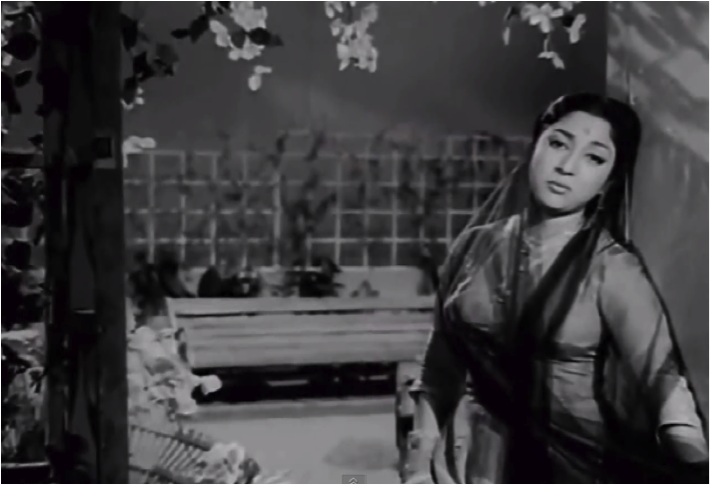
Mala Sinha experiences the pain of rejection in Anpadh (1962) from her husband Dharmendra due to her illiteracy.

As a sequel to our previous post on “aap ki nazaro.n samjhaa,” I have provided an English translation and glossary for another memorable ghazal from Anpadh (1962): “hai isii me.n pyaar kii aabhruu.” As a quick refresher, Anpadh narrates the story of a wealthy but illiterate woman (played by Mala Sinha) who is married off to an educated gentleman (played by Dharmendra).  When Dharmendra asks Mala to recite a poem for him for her on their wedding night, she is compelled to reveal her darkest secret: her parents never taught her how to read or write.  After hearing this, Dharmendra is furious that his parents lured into arranging his marriage to an uneducated woman because of the large dowry. As he spurns Mala for her lack of education, she expresses her sadness through this song, which was composed by Madan Mohan and penned by Raja Mehndi Ali Khan.

I’ll be the first to admit that these lyrics are a tad excessive in the drama department, but this is exactly the kind of song that you need when you’re in the mood to wallow. The essence of heartache is and the pain of rejection are illustrated beautifully in these words,  so listening to a song like this can really hit the spot when you’re love-sick and need to get that sulking out of your system.  Although one can find beauty in the lyrics, it is difficult to overlook that this ghazal also carries an underlying subtext of misogyny that reflects societal attitudes of the time. Take, for instance, the mukhDaa where Mala proclaims that she finds pride in her beloved’s cruelty: “hai isii me.n pyaar kii aabhruuwah jafaa kare, mai.n vafaa karuu.n” (In this, I find the pride of love: he is cruel to me, yet I remain faithful to him).  You won’t (and shouldn’t!) find such a line sung by the heroines in the Bollywood industry today.

Even if the lyrics for this song are too much for you to handle, I am certain that you can appreciate this song for its musical value. Madan Mohan has composed an evergreen melody that tugs at your heartstrings, and Lata Mangeshkar pulls through with a winning rendition. As an aside, I thought that I would share an alternate version of this song rendered by Madan Mohan himself using a different tune.  This alternate melody was not used in the film, and I am guessing that was because it sounds too happy to suit the melancholic nature of these lyrics. Take a listen to both versions for yourself, and enjoy the translation and glossary that we have provided below! Requests for future posts, as always, should be e-mailed to themrandmrs55@gmail.com.

The intensity of Mala’s pain depicted in this song highlights the urgency of Anpadh‘s message about the need educate Indian girls.

Hai Isi Mein Pyar Ki Abhroo: Lyrics and Translation

hai isii me.n pyaar kii aabhruu
In this, I find the pride of love:
wah jafaa kare mai.n vafaa karuu.n
He is cruel to me, yet I remain faithful to him.
jo vafaa bhii kaam na aa sake
Although this love is in vain,
to wahii kahe ki mai.n kyaa karuu.n
It now dictates my actions.

mujhe gham bhii unkaa aziiz hai
Even the sadness I feel is dear to me,
ki unhii kii dii huii chiiz hai
Because it is something given to me by him.
yahii gham hai ab merii zindagii
This sadness has become my life,
ise kaise dil se judaa karuu.n?
how shall I separate it from my heart?

jo na ban sake mai.n wah baat huu.n
I am the matter that cannot be,
jo na khatm ho mai.n wah raat huu.n
And I am the night that cannot end. 
yah likhaa hai mere nasiib mein
It is written in my destiny
yuu.n hii shamma ban ke jalaa karuu.n
That I shall burn here like a candle.

na kisii ke dil kii huu.n aarzuu
I am not the desire of anyone’s heart
na kisii nazar ki huu.n justajuu
Nor am I the object of anyone’s glances.
mai.n wah phuul huu.n jo udaas ho
I am that flower which is wilted.
na bahaar aaye to kyaa karuu.n?
If the spring does not arrive, what shall I do?

hai isii me.n pyaar kii aabhruu
In this, I find the pride of love.

Glossary

aabhruu: pride; jafaa: cruelty; vafaa: loyalty, love; aziiz: dear; judaa: separate; khatm: end; nasiib: destiny, fate; shamma: candle; aarzuu: desire; justajuu: quest, search; udaas: sullen, wilted.