A musical match for the ages: Lata Mangeshkar and Madan Mohan
The collaboration between Lata Mangeshkar and Madan Mohan has produced some of the most cherished songs in the musical history of Hindi cinema. Think of gems such as “lag jaa gale,” “nainaa barse rimjhim rimjhim,” or “tu jahaa.n jahaa.n chalegaa,” to name a few. Today, I’m going to share the lyrics and translation for a ghazal from Anpadh (1962) that is widely considered to be one of this duo’s finest: “aap kii nazaro.n ne samjhaa.” Penned by Raja Mehndi Ali Khan, the lyrics of this song are an equal match for the beauty of the musical composition and rendering. The beauty of the lyrics, however, is perhaps best appreciated once you can get over the whole slave-master dynamic that is going on as Mala Sinha sings to Dharmendra in the film. Although I admit that it is bizarre to refer to your lover as “banda-parvar” (master, lord), it is important to remember that these lyrics were written for the society of 1960s India: gender norms from that era differ dramtically from those established in modern times. At this time, the ideal Indian woman was expected to be submissive to her husband, and this sentiment is reflected in many songs like this one from the period.
An interesting piece of trivia: after the ghazals from Anpadh were released, it is said that composer Naushad supposedly told Madan Mohan that he would trade all of his own compositions for this one song! Although Madan Mohan rarely got his due from audiences back then, it’s nice to hear that his fellow music directors recognized his talent.
-Mr. 55
P.S. Please, for my sake, go to YouTube and give a thumbs-down to Bally Sagoo’s atrocious remix of this song. I don’t understand how these people sleep at night after they ruin the classics (seriously, how did they just change the taal here from 7-beat rupak to 8-beat kaharvaa?)
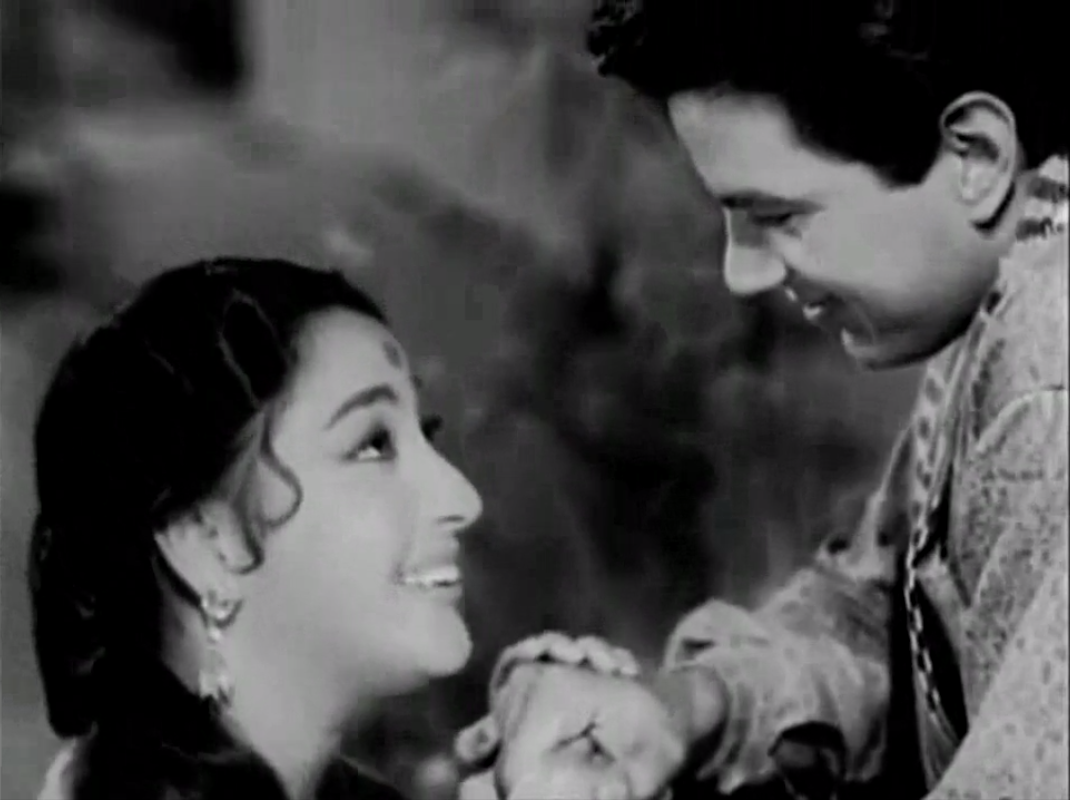
Mala Sinha expresses her devotion to the handsome Dharmendra in Anpadh (1962)
Aap Ki Nazaron Ne Samjha Lyrics and Translation
aap kii nazaro.n ne samjhaa pyaar ke qaabil mujhe Your glances deemed me worthy of love. dil kii ai dhaDkan Thahar jaa, mil gayii manzil mujhe Oh stop, my heartbeats, for I have found my destination.
jii hame.n manzuur hai, aap kaa yeh faislaa Yes, this decision of yours is acceptable to me. kah rahii hai har nazar, bandaa parvar shukriyaa My every glance is saying, “Thank you, oh lord!” ha.nske apnii zindagii me.n, kar liyaa shaamil mujhe As you brought me into your life with a smile.
aap kii manzil huu.n mai.n, aur merii manzil aap hai.n
I am your destination, and you are mine. kyo.n mai.n tuufaa.n se Daruu.n? meraa saahil aap hai.n Why shall I fear the storm? You are my shore. koii tuufaa.no.n se kah de, mil gayaa saahil mujhe Someone tell the storms that I have found my shore.
paD gayii.n dil par mere aap ki parchhaaiiyaa.n Your shadows have cast upon my heart. har taraf bajne lagii.n saikDo.nshahnaaiiyaa.n In every direction, hundreds of shahnaiis are playing in celebration do jahaa.n kii aaj khushiyaa.n, ho gayii.n haasil mujhe Today, I have enjoyed the happiness of both worlds.
aap kii nazaro.n ne samjhaa pyaar ke qaabil mujhe Your glances deemed me worthy of love.
Glossary
nazar: glance; qaabil: worthy; manzil: destination; manzuur: acceptable; faislaa: decision; bandaa parvar: master, lord; haasil: achieved, obtained; saahil: shore; parchhaaiiyaa.n: shadows; saikDo.n: hundreds; shahnaaiiyaa.n: traditional Indian instrument resembling a clarinet (associated with weddings); shaamil: present.
Muslim social dramas have always been one of my favorite genres of old Bollywood films. It is truly difficult to beat the classiness and sophistication that exudes from films such as Mere Huzoor (1968), Chaudhvin ka Chand (1961), or Bahu Begum (1967). The combination of beautiful costumes, intricate use of Urdu, and riveting drama makes watching these movies a truly memorable experience. Here, I’m going to a share with you what is considered to be one of the most romantic songs in the history of Hindi cinema: the title song from Mere Mehboob (1963), a film that embodies the essence of Lucknowi splendor as one of the best-known examples of the Muslim social.
In this film, student poet Anwar (played by Rajendra Kumar) writes this nazm after catching a brief glimpse of the aptly named Husna (played by Sadhana). One look at Husna’s eyes through her burkha is enough to make Anwar’s heart melt, and he is convinced by his friend to sing this piece at the university’s Urdu poetry competition (seriously, why do these not happen anymore?). Smitten by this handsome poet, Husna instantly feels a connection to Anwar but is too shy to make a move. I’ll save a full review of this movie for a later post, but I can tell you that this 3.5-hour film has the right mix of over-the-top melodrama, ironic plot twists, and beautifully constructed songs.
Composed by Naushad, penned by Shakeel Badayuni, and rendered by Mohammed Rafi, this song is a true classic that should be familiar to all the hopeless romantics out there who are obsessed with Hindi cinema like us. One of the most striking things about Mere Mehboob is the formality of the courtship between Husna and Anwar, and the lyrics of this song reflect the conventions (e.g. the practice of purdah) that were followed by lovers when pursuing one another in those days. It might just be the old-fashioned side of me, but anyone who can dedicate a poem like this to me is a total keeper in my book. So, the next time you’re around your favorite crush, why not try quoting a few lines from this gem? You never know what could happen…
-Mr. 55
P.S. The movie also contains a female version of this song rendered by Lata Mangeshkar. I am the self-proclaimed president of the Lata fan club, but even I must concede here that the Rafi version is unbeatable. What do you guys think? Let us know in the comments
Sadhana startles Rajendra Kumar by reciting his poem on the other side of the screen in this classic scene from Mere Mehboob (1963).
Lyrics:
mere mahbuub tujhe, merii muhabbat ki qasam phir mujhe nargisii aa.nkho.n kaa sahaaraa de de meraa khoyaa huaa rangiinnazaaraa de de mere mahbuub tujhe.
ai mere khvaab kii taabiir, merii jaan-e-ghazal zindagii merii tujhe yaad kiye jaatii hai raat din mujhko sataataa hai tasavvur tera dil ki dhaDkan tujhe avaaz diye jaatii hai aa mujhe apnii sadaao.n ka sahaaraa de de [meraa khoyaa huaa rangiin nazaaraa de de mere mahbuub tujhe]
bhuul saktii nahii.n aa.nkhe.n voh suhaanaamanzar jab teraa husn mere ishq se Takraayaa thhaa aur phir raah me.n bikhre thhe hazaro.n naghme mai.n voh naghme terii avaaz ko de aayaa thhaa saaz-e-dil ko unhii.n giito.n kaa sahaaraa de de [meraa khoyaa huaa rangiin nazaaraa de de mere mahbuub tujhe]
yaad hai mujhko merii umr ki pahlii voh ghaDii terii aa.nkho.n se koii jaam piiyaa thhaa mai.ne merii rag-rag me.n koii barq-si leheraayii thhii jab tere marmarii haathho.n ko chhuu.naa thhaa mai.ne aa mujhe phir unhii.n haatho.n kaa sahaaraa de de [meraa khoyaa huaa rangiin nazaaraa de de mere mahbuub tujhe]
mai.ne ek baar terii ek jhalak dekhii hai merii hasrat hai ki mai.n phir tera diidaarkaruu.n tere saaye ko samajh kar mai.n hasii.n taaj mahal chaa.ndni raat me.n nazaro.n se tujhe pyaar karuu.n apnii mahkii huii zulfo.n kaa sahaaraa de de [meraa khoyaa huaa rangiin nazaaraa de de mere mahbuub tujhe]
DhuunDhtaa huu.n tujhe har raah me.n har mahfil me.n thhak gaye hai.n merii majbuurtamanna ke qadam aaj kaa din hai merii ummiid kaa aakhrii din kal na jaane mai.n kahaa.n aur tu kahaa.n ho sanam do ghaDii apnii nigaaho.n kaa sahaaraa de de [meraa khoyaa huaa rangiin nazaaraa de de mere mahbuub tujhe]
saamne aake zaraa pardaa uThaa de rukh se ek yahii.n mera ilaaj-e-gham-e-tanhaayii hai terii furqat ne pareshaan kiyaa hai mujhko ab to mil jaa ki merii jaan pe ban aayii hai dil ko bhuulii huii yaado.n kaa sahaaraa de de [meraa khoyaa huaa rangiin nazaaraa de de mere mahbuub tujhe]
Glossary: mahbuub: beloved; muhabbat: love ; qasam: vow; nargisii: daffodil; sahaaraa: support; rangiin: colorful; nazaaraa: sight, vision; khvaab: dream taabiir: interpretation, meaning; jaan-e-ghazal: soul of poetry; sataanaa: to pester; tasavvur: imagination, thought; sadaa: voice, call; suhaanaa: pleasant; manzar: sight, vision; husn: beauty; Takraanaa: to collide; bikhre: scattered; naghmaa: song; saaz-e-dil: the instruments of the heart; ghaDii: moment; jaam piinaa: to drink wine; rag-rag: veins; barq: electricity; marmarii: soft, delicate; chhuunaa: to touch; jhalak: a glimpse; hasrat: desire; diidaar karna: to catch a glmpse ; mahkii huii: fragrant; mahfil: a gathering/evening of poetry, music, or dance; thhak jaanaa: to become weary; majbuur: helpless; tamanna: desire; qadam: footsteps; ummiid: hope; nigaahe.n: eyes; pardaa: veil; rukh: face; ilaaj-e-gham-e-tanhaayii: cure for the sorrow of solitude; furqat: separation; pareshaan: anxious, concerned
Rough Translation:
My beloved, in the name of my love,
Please, once again, lend me the support of your daffodil-like eyes,
And please return the colorful vision that I have lost.
You are the meaning of my dreams and the soul of my poetry.
My existence continues to remember you,
And thoughts of you pester me day and night
Please come and lend me the support of your voice.
And please return the colorful vision that I have lost.
My eyes are unable to forget that beautiful sight
When your beauty collided with my love,
And scattered on the path remained a thousand melodies
That I had gifted to your voice.
Please lend me the support of those songs to the instruments in my heart
And please return the colorful vision that I have lost.
I remember the first moments of my life
When I had drunk some wine from your eyes.
A flash of lightning surged through my veins,
As I brushed upon your velvet-like hands.
Please come and lend me the support of those hands,
And please return the colorful vision that I have lost.
I have caught a glimpse of you just once,
But my desire is to behold the sight of you once again.
Mistaking your shadow for the beautiful Taj Mahal,
I have been making love to you on moonlit nights with my glances.
Please lend me the support of your fragrant tresses,
And please return the colorful vision that I have lost.
I seek you in every path and in every gathering,
As the feet of my helpless desires have become weary.
Oh beloved, who knows where you and I will be tomorrow?
Please lend me the support of your eyes for a few moments today,
And please return the colorful vision that I have lost.
Please come in front of me and lift the veil hiding your face,
This is the only solution for the sorrow of my solitude.
Being separated from you has made me anxious,
Now come meet me because this separation is threatening my existence.
Please lend the support of forgotten memories to my heart,
And please return the colorful vision that I have lost.
Few films have more behind-the-scenes gossip and excitement than Pakeezah (1971). If you know anything about classic Hindi film songs, you’ve probably heard some part of the Pakeezah soundtrack from director Kamal Amrohi’s 1971 legend. The film stars tragedy queen Meena Kumari as Pakeezah and gorgeous, gravely-voiced Raajkumar in a story of unforgiving traditional values that collide with the forbidden love of a pure-hearted courtesan. In an ironic twist, Pakeezah is revealed at the climax to be the hero’s long lost cousin, thus at last sanctioning their marriage (the ethical complexities of this kicker are a whole different issue.) But the movie itself is pure cinematic magic–Kamal Amrohi was notorious for his artistry and attention to detail. Pakeezah’s breath-taking production design, Ghulam Muhammed’s haunting semi-classical thumris, and the effortless poetry of the film’s dialogue is like entering one long, opium-induced dream.
But what was happening beneath the surface? A whole lot of drama.
Director Kamal Amrohi married Meena Kumari when she was 19 years old in 1952. They began filming Pakeezah within a few years–in fact, the song Inhi Logon Ne (raga Yaman) was filmed and edited before Amrohi switched to coloured film stock. The 1956 black-and-white version of the song was never used, but many of the shots are extremely similar to the final version. Notice how different young Lata’s voice sounds in this song compared to parts of the soundtrack recorded years later. Even more interestingly, Inhi Logon Ne was originally taken from the film Himmat (1941) in a version sung by none other than Shamshad Begum!
My favorite non-Lata song from the film is, Nazariyan Ki Maari, sung by 1930s playback singer Rajkumari Dubey. During production, when Naushad spotted Rajkumari singing in his chorus to make ends meet (and this is a woman who had been first female playback singer of India!), he reportedly caused an uproar and gave his former collaborator her own solo. This is why we love Naushad.
Pakeezah took over 14 years to complete, mainly because of the famously tumultuous relationship between Kamal and Meena (and her eventual alcoholism). Rumor has it that Meena was such a hot mess during the filming of Chalo Dildar Chalo, Amrohi cut her out and reworked the shot list so that her face is actually never seen in the song. Her condition became so bad that during the filming of the grueling emotional mujraa “Teer-e Nazar,” Meena Kumari collapsed. A body double, none other than filmi vamp Padma Khanna, was recruited to replace her! Meena Kumari personally trained her for the scene, and the song was filmed with the majority of the dancing done with an opaque chunni hiding Padma’s face! I would’ve killed to be a yes-man on that set and drink in all the gossip.
A very convenient camera angle…
Speaking of which, did you know the beautiful Mohammed Rafi-Lata Mangeshkar duet, Chalo Dildar Chalo (raga Pahadi), was actually also recorded as a female solo? Intended for use as a dancing number, the fascinating solo version was cut from both the film and record releases, although in my opinion, coupling the theme of romantic freedom in the lyrics with the close-up imagery of a ghungroo-bound Pakeezah could have been beautiful filmic irony. But it just didn’t make the cut.
And you know what else got cut from this film? I mean, literally, cut off. Turns out Meena Kumari was actually missing her left pinky from an accident that occurred around the time of her marriage! For a film that is so heavily focused on music and dancing, you can imagine that structuring every tiny shot and dance move to hide the left hand was tricky–but if you watch the film closely, Amrohi does a meticulous job of making sure her left hand stays hidden. And Meena Kumari’s right hand works such graceful magic, I dare you to find a prettier dancer with all 10 fingers.



 Mr. & Mrs. 55 - Classic Bollywood Revisited!